


Ghana
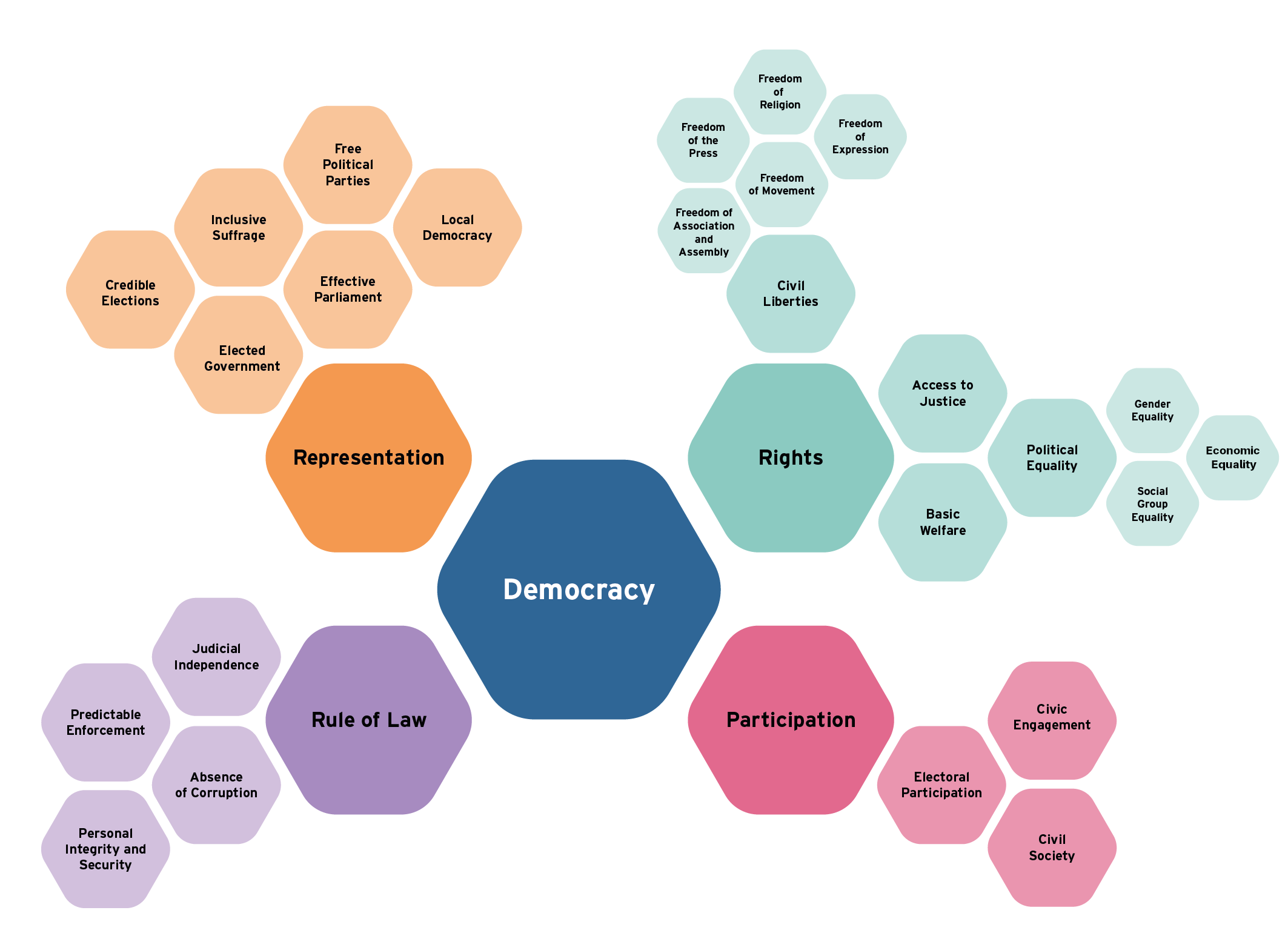
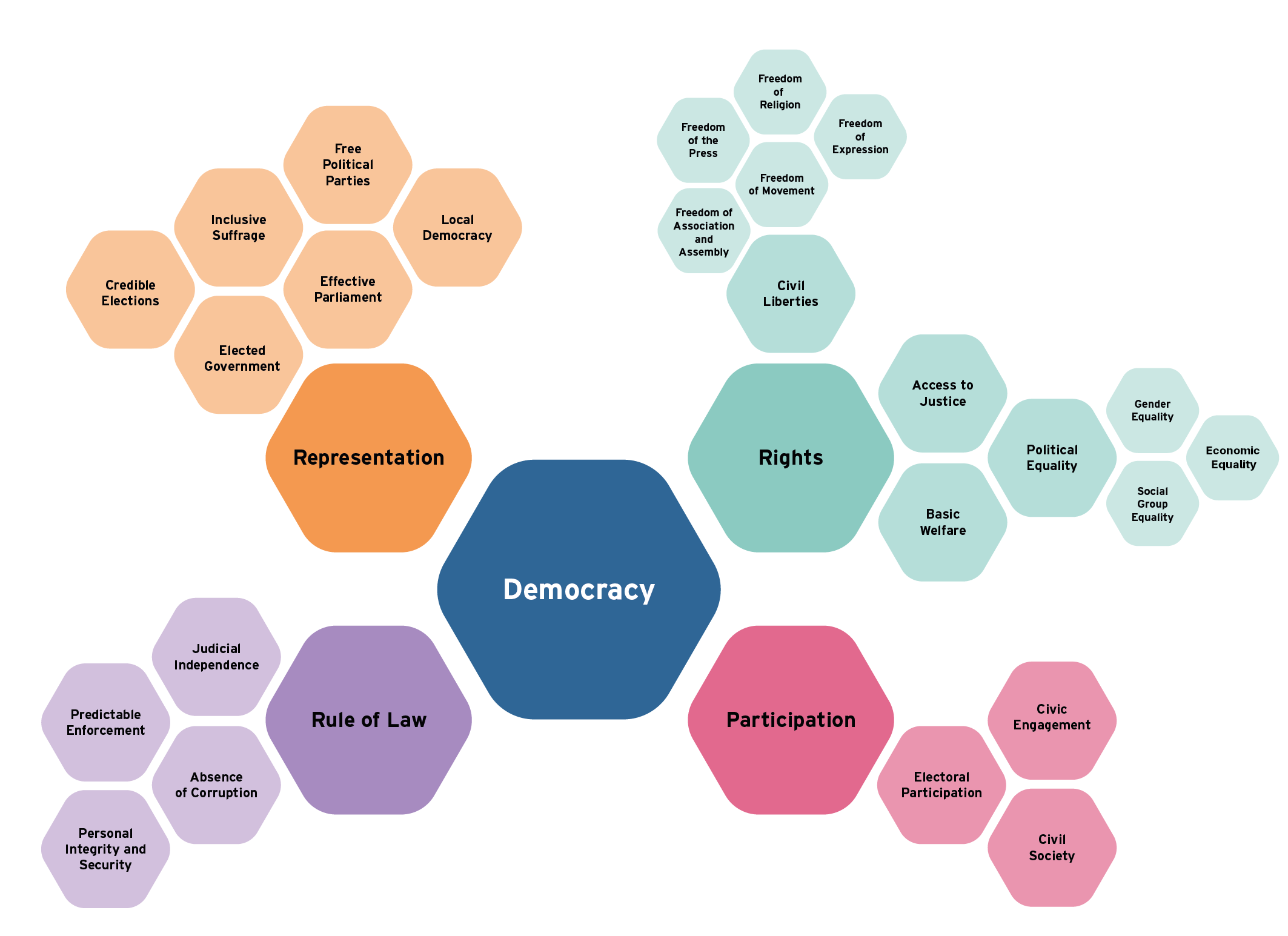
Ghana exhibits mid-range performance across all four categories of the Global State of Democracy Framework. It is among the top 25 per cent of countries with regard to several factors, including Elected Government, Civic Engagement and Freedom of Expression. Compared to five years prior, it has experienced significant declines in Access to Justice. Ghana is rich in natural resources, notably oil and gold. Since 2022, its economy, which relies mainly on services and agriculture, is experiencing its worst crisis in decades, resulting in record-high inflation and soaring cost of living.
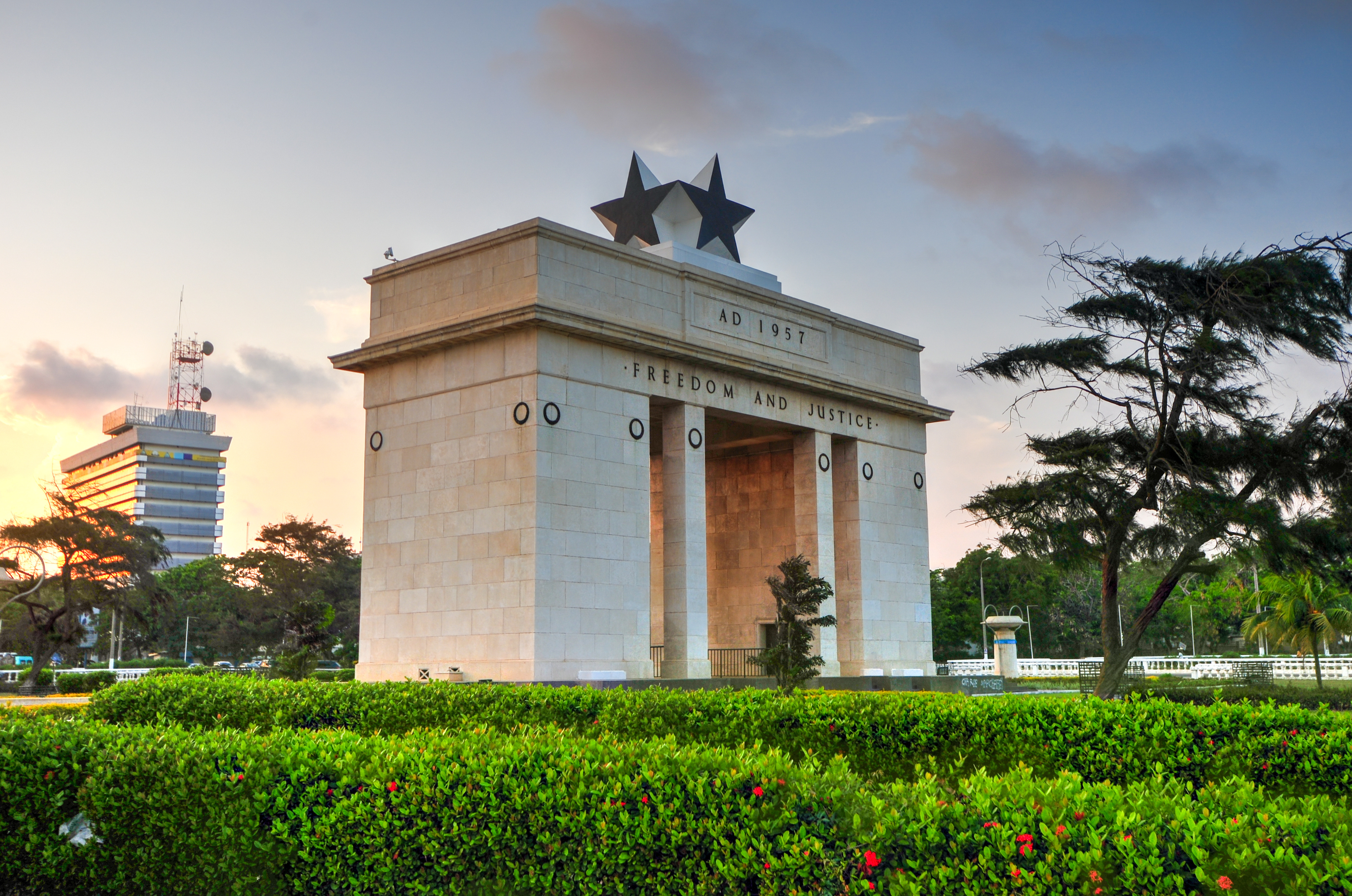
Pre-colonial Ghana was hosted several ancient kingdoms, including the Akan states of Akwamus, Ashanti, and Fante, and the coastal Ga and Ewe states. European trade began with the Portuguese in the 15th century, Britain made the Gold Coast a Crown Colony in 1874. Ghana gained independence in 1957—the first sub-Saharan African country to do so—led by Kwame Nkrumah as its first prime minster and later president. Early socio-economic progress under Nkrumah was disrupted by a 1966 military coup, followed by decades of authoritarianism, coups, and military rule. Multi-party elections resumed in 1992, marking the start of Ghana’s democratic transition.
Since then, Ghana has held nine successful elections, with power alternating between the National Democratic Congress (NDC) and the New Patriotic Party (NPP). While the 2012 and 2020 presidential elections were disputed and ultimately resolved by the Supreme Court, the peaceful transfer of power and use of legal channels to resolve disputes have largely contributed to political stability. However, the April 2025 suspensionof the Chief Justice following misconduct allegations has raised concerns about judicial independence and due process, as legal experts warn that vague legal grounds and procedural flaws could undermine safeguards against executive overreach.
Ghana is a multi-ethnic country, with the Akan as the largest group and significant minorities such as the Mole-Dagbani, Ewe, Ga-Dangme, and Gurma. The NPP draws its core support from Akan strongholds, especially in the Ashanti Region, while the NDC relies on the Ewes in the Volta Region and voters in northern Ghana. Winning presidential elections requires cross-ethnic coalitions, making ethnic and regional balance key in the formation of any government. Party politics is also characterized by ideological polarization between the center-right NPP and the center-left NDC.
Recent opinion data highlights declining satisfaction with Ghanaian democracy. Key public concerns include unemployment, economic management, and increasing living costs—heightened by the ongoing debt crisis and austerity measures. Corruption and governance problems have also prompted public anger and protests, with allegations of heavy-handed police responses.
Ghana has made some progress on gender equality in health and education, yet significant gaps remain in economic and political participation. In 2024, the country passed the long-awaited Affirmative Action bill, targeting at least 30 per cent representation of women in key sectors by 2030. Gender-based violence persists, rooted in poverty, power imbalances and cultural norms. LGBTQIA+ rights also face uncertainty, as a contentious anti-LGBTQIA+ rights bill was passed by parliament in 2024 but remains stalled due to legal challenges.
Looking ahead, key areas to monitor include Rule of Law, amid growing public discontent over corruption and recent developments that have raised concerns about judicial independence. Social Group Equality is also important to watch, especially regarding uncertainty around the anti-LGBTQIA+ rights bill passed by Parliament but not yet enacted.
Last updated: June 2025
https://www.idea.int/democracytracker/
April 2026
Court ruling strips anti-corruption prosecutor of independence

On 15 April, an Accra High Court ruled that the Office of the Special Prosecutor (OSP), Ghana’s anti-corruption body, could not initiate criminal proceedings without prior authorization from the Attorney-General. It ordered all ongoing OSP prosecutions transferred to the Attorney-General’s department and declared them null and void. The ruling arose from a case brought by a customs official the OSP had charged over the irregular sale of imported rice. Established in 2018 to insulate corruption cases from partisan influence, the OSP argued it was created to act independently, while the Attorney-General, a political appointee and cabinet member, maintained that prior authorization was required. Civil society groups, including the Ghana Center for Democratic Development, said they would file an amicus brief in a related Supreme Court case, warning the decision could weaken anti-corruption efforts and public trust. The Supreme Court was expected to rule on the OSP’s powers in mid-May.
Update: On 29 July, the Supreme Court unanimously upheld the OSP Act as constitutional, ruling that the OSP already holds standing prosecutorial authorization from the Attorney-General that remains in force unless formally revoked. It held the Attorney-General retains power to discontinue OSP prosecutions, but that this power is subject to constitutional fairness safeguards and accountable to the courts, Parliament and the public.
Sources: Citi Newsroom, The Africa Report, Africa Confidential, Ghanian News, Modern Ghana



October 2025
Critics sound alarm over Ghana’s draft cybersecurity amendments
On 1 October, Ghana’s Cyber Security Authority (CSA) opened a public consultation on the draft Cybersecurity (Amendment) Bill, 2025, which expands the Authority’s powers to investigate, prosecute and manage cybercrime. The bill would allow the CSA to arrest, search and seize property, prosecute cybercrime with the Attorney General’s approval, freeze assets and access private data under court orders. It also introduces new offences, including cyberbullying, cyberstalking and spreading false information, with penalties of up to 10 years. Critics, including the Ghana Journalists Association, IMANI Africa, and opposition politicians, argue that vague definitions and disproportionate penalties risk criminalising legitimate expression and could be used to target journalists and government critics. The government argues the bill strengthens national cyber defences and says the draft remains open for input from the public until 14 November. Cabinet and Attorney General review will follow before the bill is introduced in Parliament.
Sources: Cyber Security Authority of Ghana, Digital Policy Alert, GhanaFact, MyJoyOnline, The Africa Report, Civil Society Alliances for Digital Empowerment

April 2025
Chief Justice suspended amid political controversy
On 22 April, President John Mahama suspended Chief Justice Gertrude Torkornoo following the submission of undisclosed petitions alleging misconduct. Torkornoo was initially denied access to the petitions — a step later rectified — raising concerns about due process. Acting on advice from the Council of State, Mahama determined that a prima facie case had been established and initiated a formal inquiry. The suspension of a sitting chief justice is the first of its kind under Ghana’s 1992 constitution. The opposition condemned the move as a ‘judicial coup’ and accused Mahama of attempting to reshape the judiciary in his party’s favour. A five-member committee has been formed to investigate the allegations. Torkornoo is Ghana's third female chief justice and was appointed in 2023 by former president Nana Akufo-Addo. The Ghana Bar Association described the move as ‘unconstitutional’ and has called for transparency and adherence to due process, warning that the episode could erode public trust in the judiciary.
Update: On 1 September, President John Mahama dismissed Chief Justice Gertrude Torkornoo following a president-appointed committee’s finding of ‘stated misbehaviour,’ including unlawful expenditure on private travel and interference in appointments. Torkornoo, who denies wrongdoing, is challenging her dismissal in domestic and regional courts, including taking her case to the Economic Community of West African States (ECOWAS) in July 2025.
Sources: Ghana Bar Association, Graphic Online, The Africa Report, Barron’s, British Broadcasting Corporation, Africa Confidential
December 2024
Opposition secures decisive victory in presidential and parliamentary elections

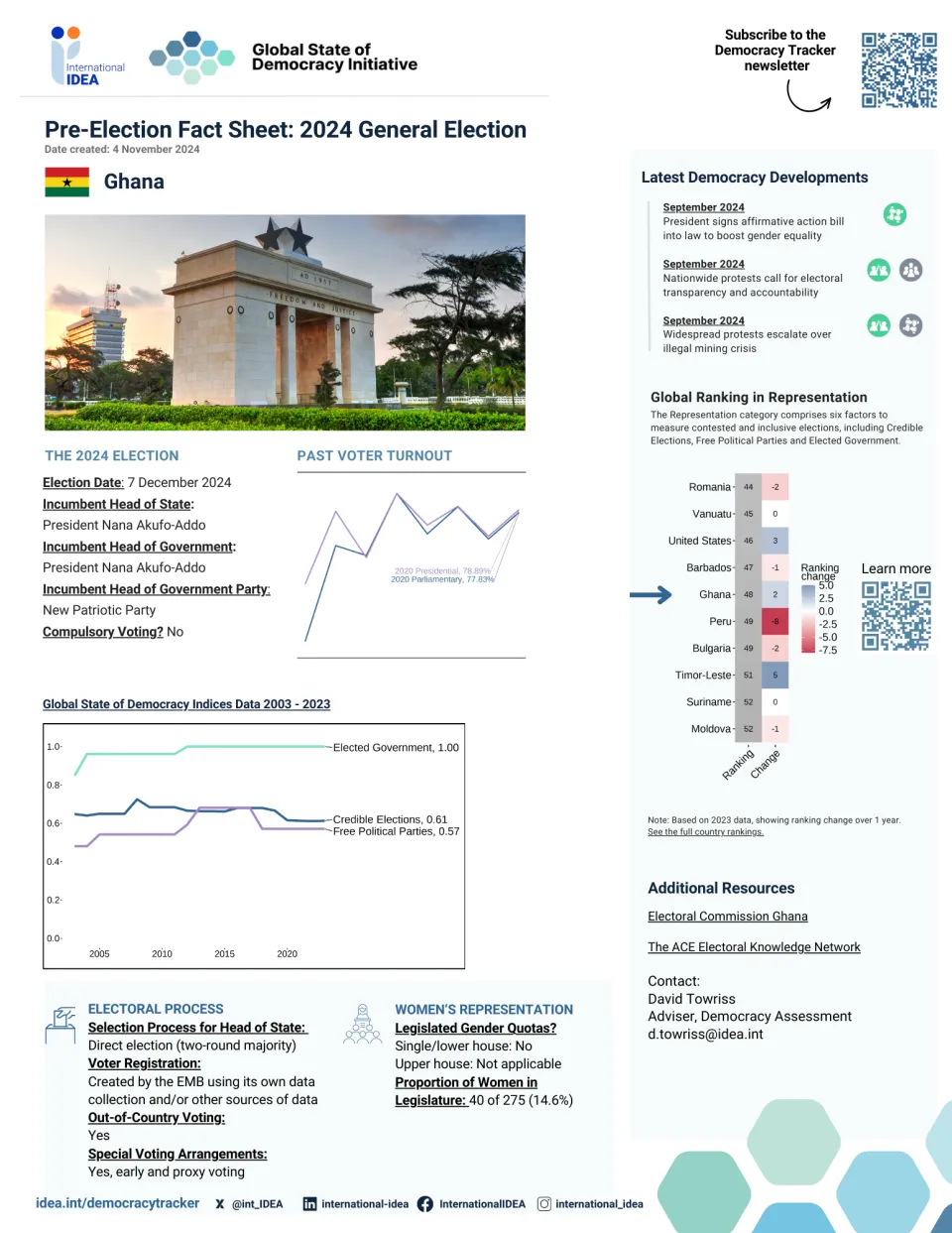
On 7 December, former President John Dramani Mahama won Ghana’s presidential election with 56.4 per cent of the vote, defeating Vice President Mahamudu Bawumia, who secured 41.8 per cent. Voter turnout stood at 64.0 per cent, down from 79.0 per cent in 2020. The election also resulted in a strong parliamentary win for Mahama’s National Democratic Congress (NDC), which secured 186 of the 276 seats (67.4 per cent), giving it a two-thirds majority. The country will now have its first woman Vice-President, Jane Naana Opoku-Agyemang. According to Ghana’s Electoral Commission, 12.8 per cent of parliamentary candidates in 2024 were women. Election results were initially delayed as political parties incited their supporters to gather in large numbers at collation centres. While Bawumia conceded on 8 December, reports of vandalism, looting, and property destruction led security forces to disperse crowds with tear gas and pepper spray. Observers from the African Union and the Commonwealth of Nations lauded the Electoral Commission for conducting a transparent and credible election.
Sources: Electoral Commission Ghana, African Union, Commonwealth Observer Group, The Africa Report, Africa Confidential, British Broadcasting Corporation, Ghana Broadcasting Corporation
See all event reports for this country
Global ranking per category of democratic performance in 2025

Basic Information

Human Rights Treaties
 State party
 Signatory
 No action
Performance by category over the last 6 months
 Representation
Rights
Rule of law
Representation
Rights
Rule of law
 Participation
Election factsheets
Global State of Democracy Indices
Hover over the trend lines to see the exact data points across the years


Factors of Democratic Performance Over Time
Use the slider below to see how democratic performance has changed over time