

Kyrgyzstan
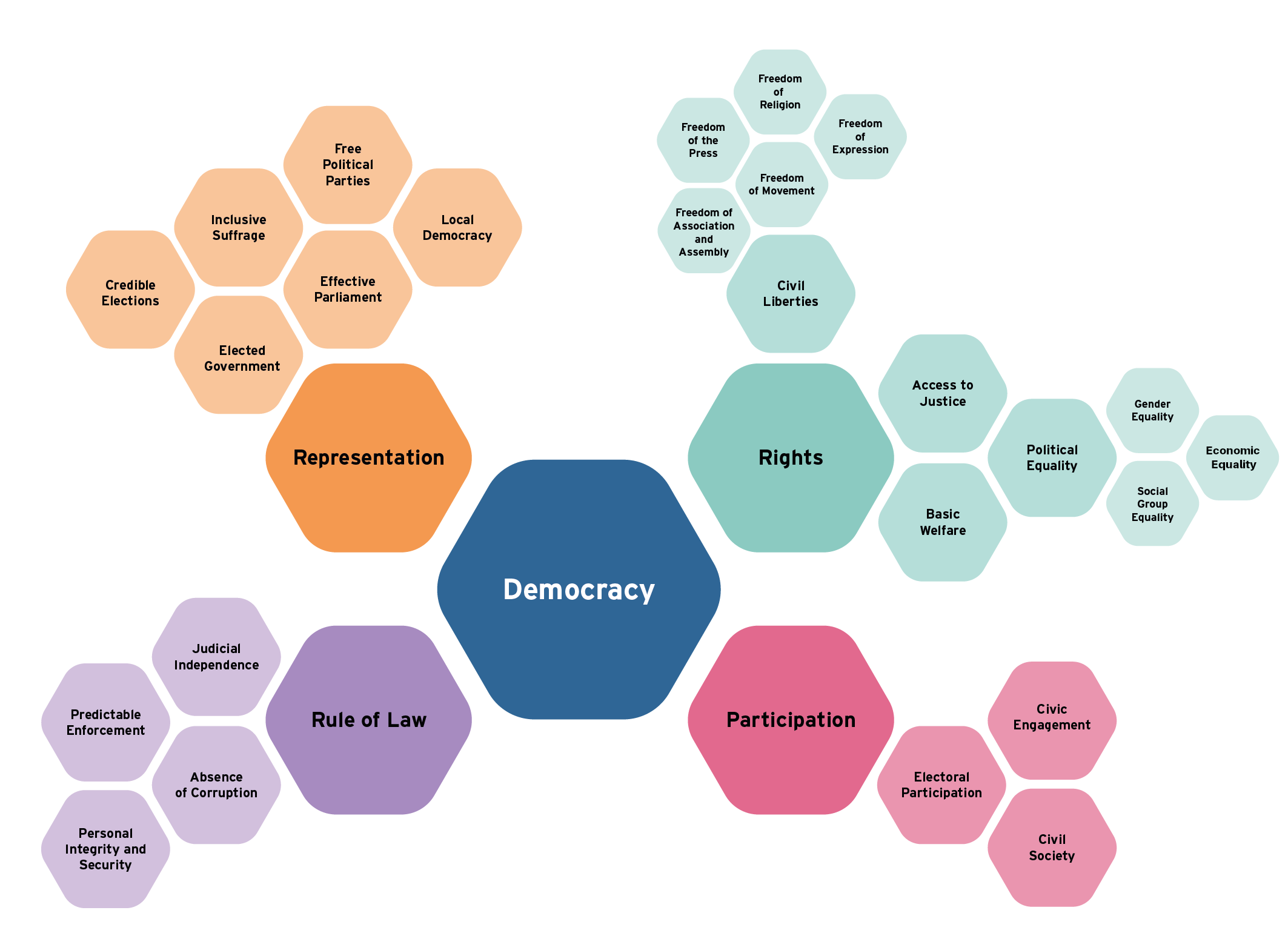
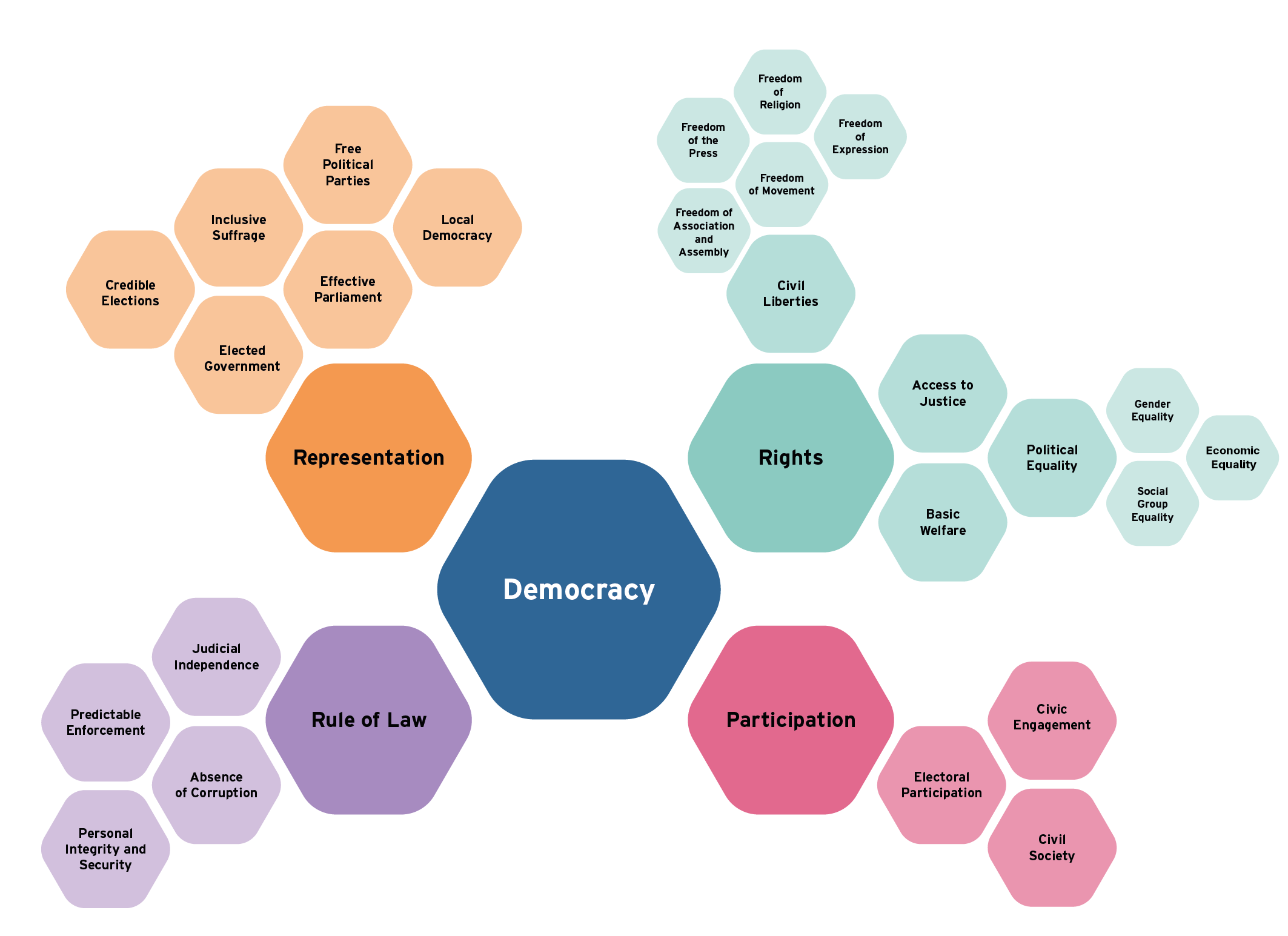
Kyrgyzstan is a low-performing country in every core measure of the Global State of Democracy framework: Participation, Representation, Rights and Rule of Law. It is among the bottom 25 per cent of countries with regards to several factors of Rule of Law and Participation, including Judicial Independence, Absence of Corruption, Civil Society, and Electoral Participation. Over the last five years, it has experienced significant declines in Civil Liberties, Elected Government, Effective Parliament, Free Political Parties and Judicial Independence as President Sadyr Japarov centralized political power and undermined checks and balances. Kyrgyzstan is a lower middle-income country with a domestic economy based on agriculture and gold mining, and a quarter of the population lives under the national poverty line. Kyrgyzstan is one of the most remittance-dependent countries in the world, with money sent home – mostly from Russia – accounts for 20 per cent of GDP.
Kyrgyzstan is a multiethnic country (77 per cent Kyrgyz, 14 per cent Uzbek, and with small Dungan, Uyghur, and Russian minorities) with a young population, whose politics have historically been driven by regionally-based patronage and organized criminal groups. Since gaining independence from the Soviet Union in 1991, it has seen six constitutional amendment processes that repeatedly renegotiated electoral, political, and power-sharing systems. In 2005, the Tulip Revolution, triggered by dissatisfaction with authoritarianism and corruption resulted in the resignation of the country’s president since independence, and in 2010 a revolution that grew out of clashes between minority Uzbek and majority Kyrgyz communities in the south resulted in a shift from a presidential to a parliamentary system.
Recently, economic interests have taken political precedence over regional identity, as was visible in the 2015 elections and violent governmental turnover in 2020. The nationalist-populist Japarov rose to power in late 2020 following widely-criticized elections. Japarov’s rise was fueled in part by dissatisfaction with the government’s COVID-19 response and subsequent economic crisis, general negative public attitudes towards the government, and anti-establishment sentiment among oligarchs. The new administration oversaw a 2021 referendum that transitioned Kyrgyzstan from a parliamentary to a fully presidential system, vesting more power in the president’s office and foreshadowing today’s entrenching authoritarianism.
Kyrgyzstan has long been caught between the geopolitical interests of Russia (which has several military bases and is the major migrant destination country) and China (which is the main investor and creditor). Economic integration with other neighbors was hampered by poor border demarcation, which complicated access to water and enclaves for decades and occasionally deteriorated into armed clashed with Uzbekistan and Tajikistan which displaced tens of thousands. These border issues were finally resolved at the diplomatic level in 2023 and 2024, respectively, but questions of implementation remain.
Recent years have seen further worrying signs for Kyrgyzstan’s democratic trajectory, including restrictions on civil society organizations, encroachments on religious freedom, and the tightening of insult and defamation laws.. Gender-based violence has long been a systemic issue, and reports from human rights activists argue that even assessing its extent is difficult due to underreporting, a lack of support services, and ineffective legal protections. Public charges of corruption against top ministers frequently go unpunished. Historically, civil society in Kyrgyzstan has been able to withstand rising autocratization and decelerate democratic decline through active public protest and engagement. However, President Japarov’s weakening of parliament, pressure on courts, and attacks on freedom of expression might further deteriorate the Rule of Law, Effective Parliament and Civil Liberties in the years to come.
Last updated: June 2025
https://www.idea.int/democracytracker/
July 2026
Former security chief convicted in alleged coup plot
On 2 July 2026, a court in Kyrgyzstan sentenced former State Committee for National Security (GKNB) chairman Kamchybek Tashiev to four years’ imprisonment on charges of attempting to violently seize power. The sentences were suspended in favor of probation the same day. The case stemmed from the publication in February of an open letter signed by political figures and public personalities calling for early presidential elections, which President Japarov’s administration described as part of a coordinated effort to destabilize the government. Tashiev, previously the second most powerful official in the country and a close ally of Japarov, was dismissed from office following the controversy. Court proceedings took place almost entirely behind closed doors, and observers noted the nature and outcome of the trial marked a further shift away from the rule of law towards a political and judicial system dependent on President Japarov’s will.
Sources: Organized Crime and Corruption Reporting Project, The Diplomat



November 2025
Kyrgyzstan holds snap parliamentary elections

Kyrgyzstan held snap elections for the Jogorku Kenesh (parliament) on 30 November, with preliminary results showing allies of President Sadyr Japarov securing nearly all 90 electoral seats. As a result of a new electoral law passed in June which disadvantaged political parties due to an increase in the registration fee, most candidates were self-nominated individuals, making determining the precise balance of the incoming parliament difficult. The law also mandated that one of every three MPs in each of the 30 electoral districts be a woman, resulting in an increase to 30 from 18 women in the previous sitting. Voter turnout was 36.9 per cent, slightly up from 34.94 per cent in the 2021 elections. Turnout in both elections was well below the country’s historical average. Observers from the OSCE found the election to be efficiently run within a restrictive environment that fell short of international standards.
Sources: Reuters, Eurasianet, OSCE, Kaktus, International IDEA
Pre-election arrests target opposition Social Democrats
Kyrgyzstan’s security services launched a crackdown on opposition politicians in the run-up to the 2025 snap parliamentary elections held on 30 November. Ten leading members of the opposition Social Democrats were arrested on 22 November on charges of planning to violently overthrow the government, and other high-profile political figures and their family members were also questioned for hours without legal counsel. The ten individuals, including Kadyrbek Atambayev, the son of former president Almazbek Atambayev, were sentenced to preventive detention and will remain in custody for the foreseeable future. While pre-election harassment of opposition is not unheard of in Kyrgyzstan, the scale of the arrests, the seriousness of the charges, and the dearth of evidence raise concerns of further shrinking of political space.
Sources: Times of Central Asia, Reuters


Kyrgyzstan moves to reintroduce capital punishment

A draft law approving Kyrgyzstan’s revocation of the Second Optional Protocol to the International Covenant on Civil and Political Rights was introduced to the Jogorku Kenesh (parliament) in November, beginning the legal process for the country to reintroduce the death penalty. The return of the death penalty has been broadly debated in Kyrgyzstan as a possible response to a rise in high-profile cases of rape and murder of women and children. UN Human Rights Chief Volker Türk called on Kyrgyzstan in October 2025 to stop all efforts to reintroduce capital punishment, and he and other legal experts say any attempt to do so would breach international law. President Sadyr Japarov has made statements indicating he is in favour of the process. Should Kyrgyzstan withdraw from the Protocol, it would first have to amend its constitution, which also bans capital punishment, in order to reintroduce it.
Sources: 24.kg, Verfassungblog, OHCHR

September 2025
Cameramen convicted for videos they did not produce
Two cameramen for investigative journalism outlet Kloop were sentenced to five years in prison for ‘inciting mass unrest’ for allegedly producing five videos critical of the government. The trial marked a degradation of judicial processes in Kyrgyzstan, as no evidence was presented to show that the cameramen participated in the production of the videos, nor how the videos themselves contributed to ‘inciting mass unrest’. The videos were also not published by Kloop, but by the YouTube-based media outlet, Temirov Live, whose head said he did not know the cameramen. The prosecution’s case rested on the cameramen’s confessions, but both (Alexander Alexandrov and Zhoomart Duulatov) said they confessed under duress and in exchange for a promise to be sentenced to house arrest or conditional release. Both recanted their confessions when the prosecution instead pursued prison sentences. Human rights and press freedom advocates condemned the sentences as aimed at silencing independent journalists and further undermining press freedom in the country.
Update: The sentences of Alexander Alexandrov and Zhoomart Duulatov were commuted to probation, and they were released from custody on 25 November. Both men reportedly changed their pleas once more to guilty in exchange for their release.
Sources: Kloop, The Diplomat, Human Rights Watch, Kloop (Telegram), OCCRP
August 2025
New media law passes without civil society compromises
Kyrgyzstan enacted a new media law on 7 August that requires all traditional and online media outlets to register with the Cabinet of Ministers in order to operate. Journalists and human rights experts say the bill will allow the government to effectively control what media outlets publish, as the law does not allow for oversight or judicial review of the decisions to grant or revoke registration. A version of the media law was first introduced in 2022 but was withdrawn after public backlash. The presidential administration then sought the advice of the Venice Commission, convened a working group with journalists and media lawyers, and revised the law several times with the stated goal of finding a ‘compromise’ in line with international legal standards. However, the final version introduced to parliament in June removed nearly all these changes, suggesting the engagement with civil society was not in earnest.
Sources: Fergana, The Diplomat, European Commission for Democracy through Law (Venice Commission)

See all event reports for this country
Global ranking per category of democratic performance in 2025

Basic Information

Human Rights Treaties
 State party
 Signatory
 No action
Performance by category over the last 6 months


Global State of Democracy Indices
Hover over the trend lines to see the exact data points across the years


Factors of Democratic Performance Over Time
Use the slider below to see how democratic performance has changed over time