

Cameroon
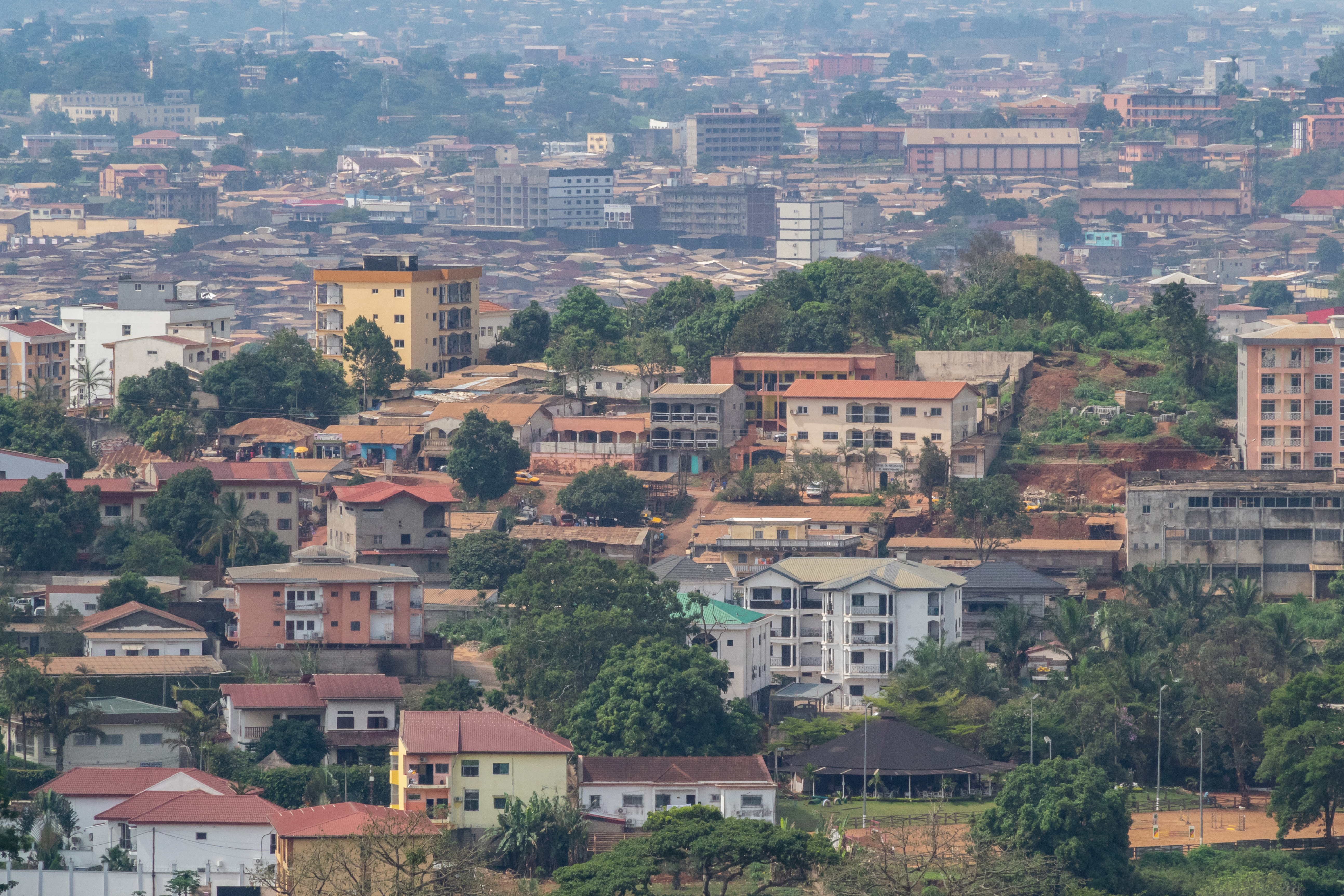
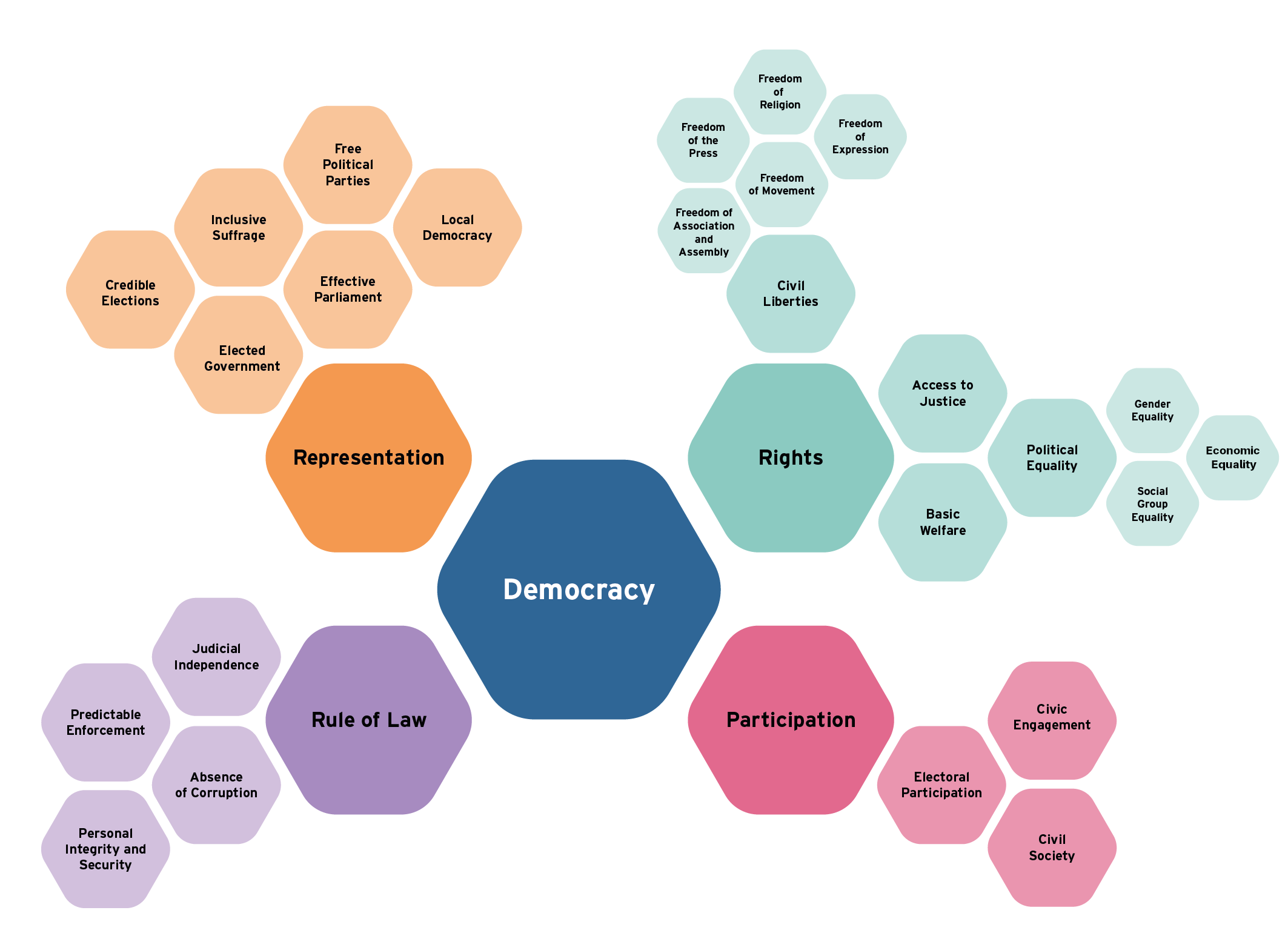
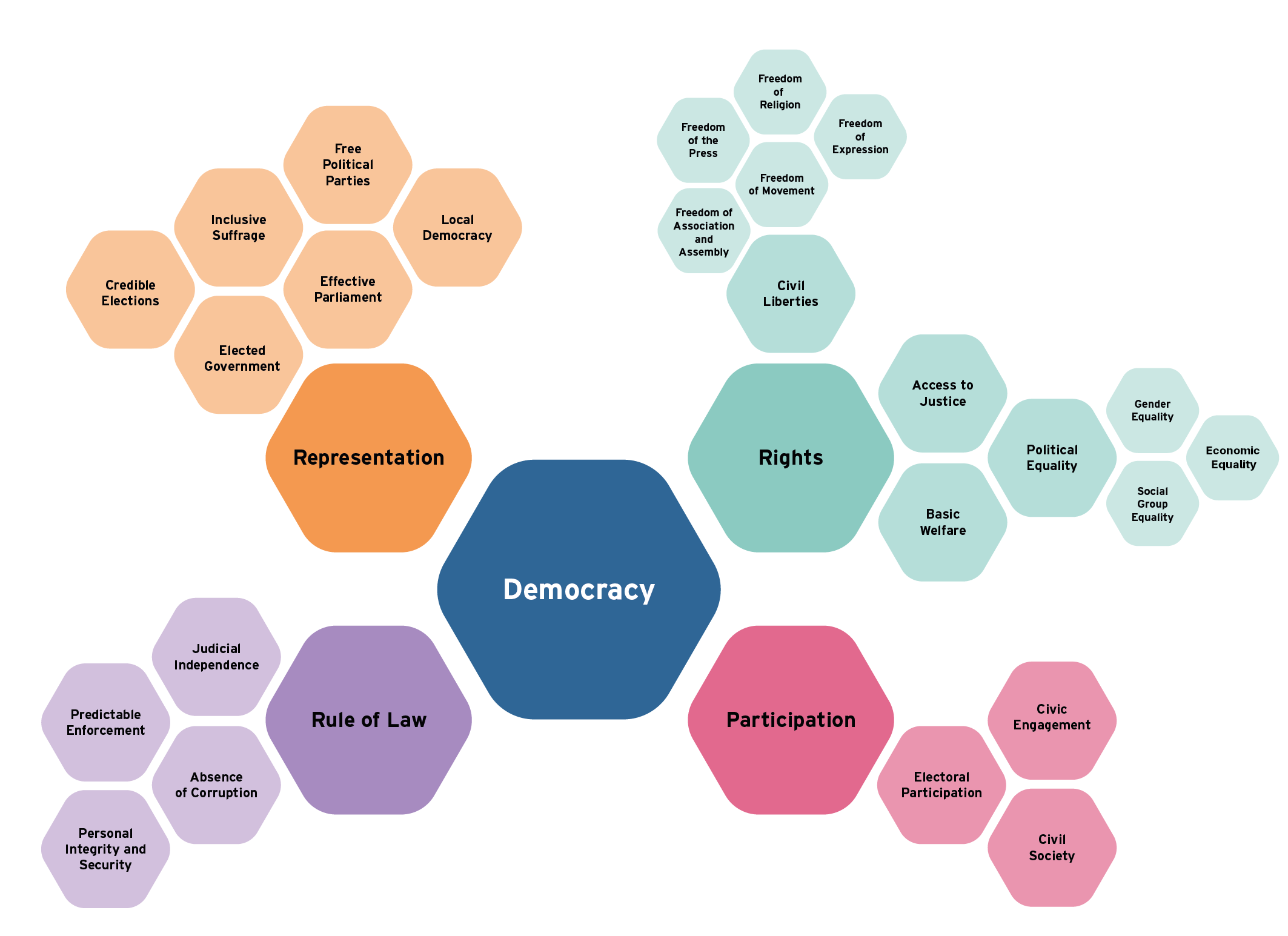
Cameroon exhibits low-range performance across three categories of the Global State of Democracy framework: Representation, Rights and Rule of Law; it performs in the mid-range in Participation. It among the bottom 25 per cent of countries with regard to most factors of democracy. Over the past five years, Cameroon has not experienced any significant advances or declines. It is classified as a lower-middle income country and has a diversified economy, which includes agriculture, mining, services, and production of oil and gas, timber and aluminium. Crude oil is its largest export.
Cameroon’s history traces back at least 50,000 years and in the pre-colonial period its political landscape evolved from kinship-based communities to centralized states like the Bamum. Cameroon was colonized by Germany in 1884, then partitioned between France and Britain after World War I. Gaining independence in 1960 and 1961 respectively, the two regions re-united in 1961.
Post-independence, its history has been dominated by the Cameroon People's Democratic Movement (CPDM) under President Paul Biya, who has been in power since 1982. Over the past four decades, Biya has used constitutional and electoral manipulation, co-optation of opponents, political patronage and the development of a robust and loyal state security and intelligence apparatus to gradually assert virtually total control of the political landscape.
Since 2018, the regime has become increasingly authoritarian, a trend marked by state security agencies’ repression of perceived political opponents, especially sympathisers of Anglophone separatist groups. Activists are routinely arrested, prosecuted and abused within a corrupt justice system that lacks independence and heavily restricts civil liberties. Opposition movements are institutionally weak, and split into more than 150 parties that are divided by ethnic, linguistic and regional identities, ideological differences, personal rivalries and government actions that encourage competition and stymie co-operation.
Cameroon is an ethnically diverse country, home to almost 250 ethnic groups. Despite Biya’s multi-ethnic coalition that incorporates most ethnic groups into the ruling framework, he is accused of using his extensive discretionary powers to appoint members of his native Beti-Bulu ethnic group to key positions. Language is a more significant political cleavage than ethnicity, and Cameroon’s English-speaking regions in the northwest and southwest are opposed to the state’s abolition of the previous federal system. Longstanding perceptions of multifaceted discrimination toward Anglophones led to calls for independence, which sparked the outbreak of an ongoing conflict between Anglophone separatist groups and the army in 2016.
Cameroon performs at the mid-range on Gender Equality and, despite legal protections, women continue to face discrimination, with high levels of gender-based violence and lower literacy and labour force participation rates than their male compatriots. The LGBTQIA+ community faces violence, arbitrary detention, and a continued ban on same-sex activity.
Biya’s succession is the country’s most significant near-term political issue. His current mandate is set to finish in 2025. He has not chosen a successor and open lobbying to replace him is taboo within the CPDM. Amid growing speculation about his absence in public, media coverage of Biya’s health was formally prohibited. In parallel, signs suggest civic space has continued to narrow: civil society organisations have faced bans and suspensions, and the delay of national and municipal elections to 2026 was conceived by some as a strategic effort to limit opposition access to the presidential ballot. These parallel developments stress the need to closely monitor the Rights and Participation factors in the near-term.
Last updated: May 2025
https://www.idea.int/democracytracker/
October 2025
President Paul Biya wins eighth term in disputed presidential election

Incumbent President Paul Biya of the Cameroon People’s Democratic Movement (Rassemblement démocratique du Peuple Camerounais, RDPC) won Cameroon’s presidential election, held on 12 October, extending his rule to an eighth consecutive term. According to official results, Biya won 53.7 per cent of votes, ahead of Issa Tchiroma of the Cameroon National Salvation (Front pour le salut national du Cameroun, FSNC) with 35.2 per cent. Of the 12 candidates that contested the election, only one was a woman. Prominent opposition leader, Maurice Kamto was disqualified after the Constitutional Council rejected his candidacy in favour of a rival from the same party. Turnout was 57.8 per cent of the registered voters (up from 53.9 per cent in 2018). Several candidates disputed various aspects of the election and widespread perceptions of fraud among opposition supporters sparked violence. However, the Constitutional Council rejected all petitions challenging the poll and (in contrast to domestic monitors) observers from the African Union and the Economic Community of Central African States found it to have been ‘conducted largely in accordance with…international standards.’
Sources: The Constitutional Council of Cameroon, Africa Confidential, Jeune Afrique, International IDEA, Pan African Visions

Dozens killed as post-election violence breaks out amid fraud concerns
At least 48 people were killed and hundreds arrested, as security agencies responded forcefully to opposition supporters protesting Cameroon’s disputed presidential election. Demonstrations broke out across several cities shortly after polling on 12 October, as supporters of opposition candidate Issa Tchiroma perceived the election was being rigged against Tchiroma, who had pre-emptively claimed victory. They intensified when incumbent Paul Biya was later officially declared to have won. Most of the civilians killed by the security agencies were shot or beaten. Some protesters were also violent, assaulting the police and gendarmes, looting and vandalising symbols of authority. At least three gendarmes died in the violence. Among those arrested were several opposition politicians. While post-electoral violence is not uncommon in Cameroon, the scale of the protests, fatalities and protester violence appear to set it apart from the unrest after the 2018 presidential election.
Sources: International Crisis Group, Reuters, Human Rights Watch (1), Human Rights Watch (2), Africa Confidential, Associated Press News, Jeune Afrique


March 2025
Violence against lawyers by security forces prompts strike by Bar Association
On 5 March, Cameroon’s Bar Association (CBA) launched a three-day strike over what it described as ‘recurrent violence’ by the country’s security forces against lawyers. In its statement announcing the strike, the Bar Association referred to two recent cases, the first of which was brought to light by videos posted to social media on 1 March, capturing what it described as ‘police officers carrying out violence and other degrading and inhumane acts on a lawyer.’ The previous day, the CBA had been informed that another lawyer had been unlawfully detained by authorities in a bid to force him to retract a statement denouncing violations of his clients’ rights. Similar incidents were reported in September and November 2024 and the CBA claimed at the time that attacks by the police and gendarmerie against lawyers were becoming the norm.
Sources: Conférence Internationale des Barreaux/Cameroon Bar Association, Jeune Afrique, Human Rights Watch


February 2025
Cameroon closes dozens of unauthorised churches
Cameroon’s government has closed dozens of churches in the country’s capital, Yaoundé, as part of a major operation to shut down unauthorised places of worship. The operation was launched in the fourth district of Yaoundé in mid-February, and by the end of the month 188 of the 615 churches in the district were reported to have been closed, with revivalist churches particularly affected. In justifying the action, officials cited public complaints about noise pollution, fraud and abuses against congregants. Under a policy of ‘administrative tolerance’, the government had previously allowed hundreds of unregistered churches to operate. The power to approve the registration of religious associations in Cameroon lies with the president and, according to the Ministry of Territorial Administration, only 48 denominations have been registered since 1952, with the most recent of these occurring in 2020. Hundreds of registration applications are thought to be pending presidential approval.
Sources: Jeune Afrique, Voice of America, US State Department, Ministry of Territorial Administration, Actu Cameroun
December 2024
Cameroon halts the work of four CSOs
On 6 December, Cameroon’s Minister of Territorial Administration, Paul Atanga Nji, signed orders halting the work of four civil society organisations, citing ‘illicit financing’, threats to the ‘integrity of the national financial system’ and a ‘lack of authorisation’. Two organisations were suspended for three months, another was permanently banned and a fourth, the Central Africa Human Rights Defenders Network (Réseau des Défenseurs des Droits Humains en Afrique Centrale, REDHAC), was the subject of both a suspension and a permanent ban. Nji said the moves were part of an effort to strengthen the country’s fight against financial crime. However, several rights organisations alleged that the orders were illegal and further undermined civic space in the country. REDHAC is one of Cameroon’s most active CSOs and, like Reach Out Cameroon (one of the suspended organisations), it has a strong international reputation for defending human rights and publishing reports critical of the government.
Sources: Ministry of Territorial Administration (1), Ministry of Territorial Administration (2), Jeune Afrique, Human Rights Watch, Amnesty International

See all event reports for this country
Global ranking per category of democratic performance in 2025

Basic Information

Human Rights Treaties
 State party
 Signatory
 No action
Performance by category over the last 6 months
Representation
Rights
 Rule of law
Participation
Rule of law
Participation
Global State of Democracy Indices
Hover over the trend lines to see the exact data points across the years


Factors of Democratic Performance Over Time
Use the slider below to see how democratic performance has changed over time