

Libya
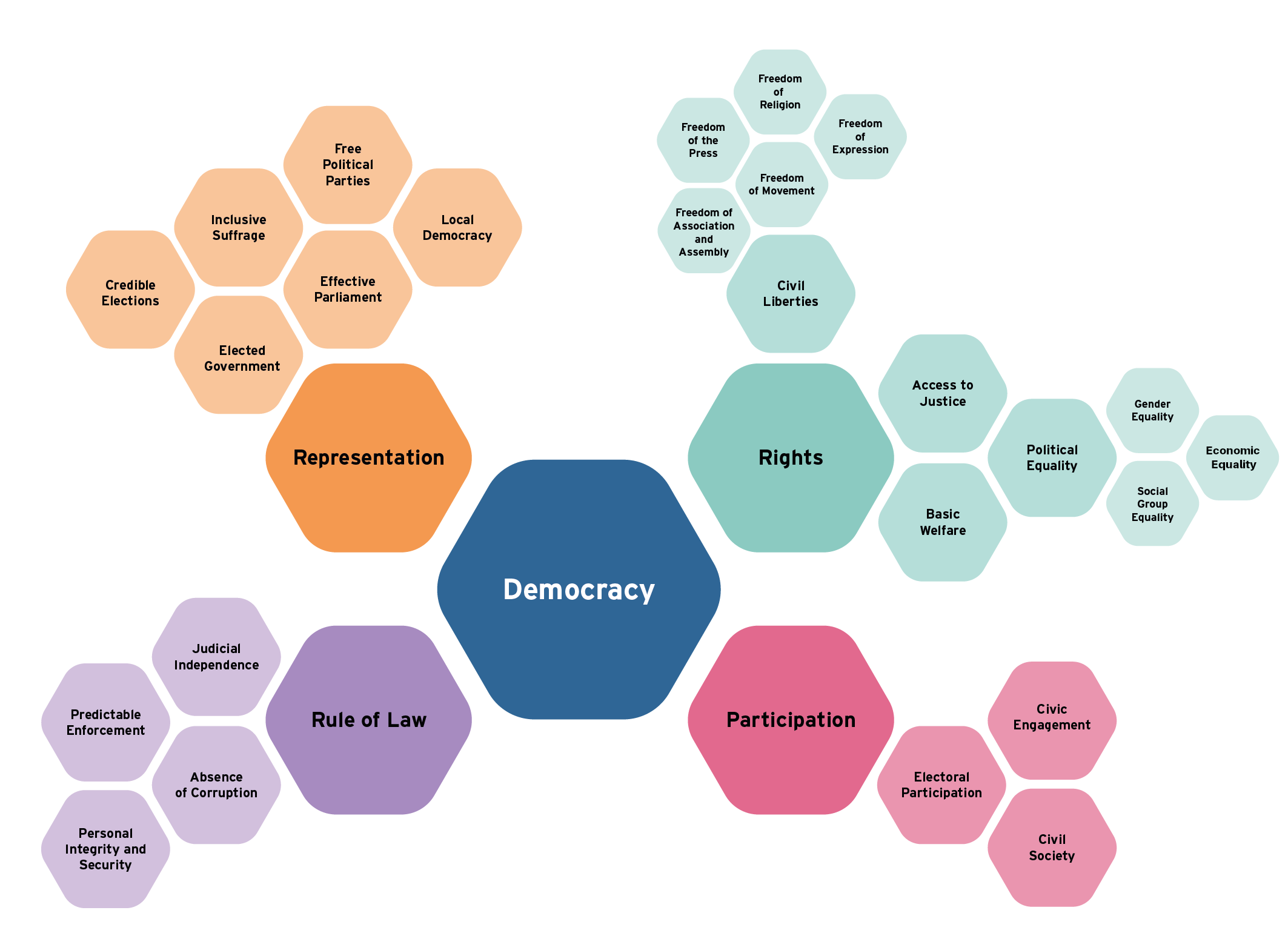
Libya performs at a low level across all categories of the Global State of Democracy framework. Contemporary life in Libya is coloured by a 13-years long civil conflict, marked by a severe humanitarian crisis, a devastated economy and persistent political instability. Compared to five years ago, measures of Economic Equality have notably declined. The conflict has also severely impacted the oil sector, which accounts for two-thirds of the country’s GDP.
Libya gained independence as a constitutional monarchy in 1951, following a period of Italian colonization (1912-1947) and occupation by British and French forces (1943-1951). The legacy of Ottoman rule (1551 – 1911), during which various provinces had their own administrations, has left behind ongoing centralization challenges. In 1969, Colonel Muammar Gaddafi overthrew King Idris I in a coup, instituting his "Jamahiriya" system, which rejected political parties in favor of direct governance and centralized rule. His 42-year autocratic regime ended in 2011 after a popular uprising that escalated into civil war and, coupled with a NATO intervention, led to Gaddafi’s overthrow and death.
Since Gaddafi's fall, Libya has lacked a unified government with nationwide authority. After a brief transition from 2012 to 2014, multiple attempts at unification have failed. Libya is now split between two rival administrations: the UN-backed Government of National Unity (GNU) and the Government of National Stability (GNS). Despite its attempts at inclusivity of different political factions through a quota-based system, the GNU, led by Abdul Hamid Dbeibah in Tripoli, faces criticism for overextending its mandate, relying on militias and cracking down on civil society. The GNS is supported by the House of Representatives (HoR) and Khalifa Haftar’s Libyan National Army (LNA), which has curbed dissent in the east. Foreign involvement deepens these divides. Competition over oil resources limits revenue and fuels ongoing disputes.
Tripoli, the western capital, benefits from better infrastructure but suffers frequent destabilization due to militia violence. In contrast, Eastern Libya enjoys improved security and rapid reconstruction, driven by the LNA's military dominance and access to significant funding. The southern region, largely outside GNU and GNS control, experiences severe neglect and lawlessness. This instability has led to protests targeting oil facilities, with local residents demanding improved services and a fairer distribution of resources.
Efforts to organize elections have seen some progress, but the lack of a comprehensive constitutional and electoral framework has led to popular frustration. The humanitarian crisis, marked by human rights abuses, internal displacement, and food insecurity, is compounded by Libya’s role as a major transit hub for EU-bound migrants. Migrants and asylum-seekers face dire conditions and risk abuse and violent detention by Libyan forces, supported by Frontex, while awaiting passage to Europe.
Libya also struggles with severe gender inequality. Violence against women and girls is exacerbated by widespread insecurity, impunity, and the proliferation of armed groups and weapons. Additionally, women experience political underrepresentation, restricted freedom of movement, and discriminatory family laws.
Looking forward, progress towards elections and the establishment of a unified government is crucial. Key areas to watch include a potential referendum on a draft constitution, resolutions to central bank governance disputes, and security sector reforms. While comprehensive peace talks remain elusive, any steps toward de-escalation or renewed dialogue will be crucial to watch.
Last updated: September 2024
https://www.idea.int/democracytracker/
May 2026
ICC holds first hearing to confirm charges against a Libyan suspect

From 19 to 21 May, the International Criminal Court (ICC) held a confirmation of charges hearing in the case of Khaled Mohamed Ali El Hishri, marking a significant step in accountability efforts related to the war in Libya. El Hishri is the first suspect to appear before the ICC in connection with the Libya situation since the Court opened its investigation in 2011. A former senior official of Libya's Special Deterrence Force (RADA), he faces 17 counts of war crimes and crimes against humanity allegedly committed at the Mitiga Prison in Tripoli between 2014 and 2020, including torture, murder, rape, sexual violence, unlawful imprisonment, enslavement and persecution. Following the hearing, the ICC's Pre-Trial Chamber has up to 60 days to confirm the charges or request additional evidence.
Update: On 16 July, the Pre-Trial Chamber unanimously confirmed all charges, paving the way for the commencement of the trial.
Sources: International Criminal Court, The Guardian, Human Rights Watch (1), Human Rights Watch (2), Reuters



April 2026
Rival administrations approve first unified national budget in over a decade
On 11 April, Libya’s two rival administrations approved the country’s first unified national budget in more than a decade. The agreement marks a tentative step toward restoring a unified public financial management system across the east and western-administered areas after years of institutional fragmentation. If implemented, the budget—covering public sector salaries, government operations, development projects, and subsidies—could enhance the predictability of resource allocation, strengthen central public administration, and reduce the parallel spending practices that have characterized the governance system since the 2014 fragmentation of state institutions.
Sources: Al Jazeera, United Nations Support Mission in Libya, Libya Herald

June 2025
Over 80 bodies found in Tripoli militia-run detention centers
In June, more than 80 bodies were discovered at multiple official and unofficial detention sites operated by a militia in Tripoli. The remains were uncovered after the militia lost territorial control over these sites following clashes between rival armed groups in May. According to UN High Commissioner for Human Rights Volker Türk, investigators also found instruments of torture and abuse near the victims, as well as evidence that may point to extrajudicial killings. The militia in question had reportedly been tasked with stopping migrants from reaching Europe. As a result, observers have suggested that many of the victims may be migrants.
Sources: United Nations, Organized Crime and Corruption Reporting Project, Info Migrants

May 2025
Tripoli clashes trigger protests against GNU government
On 13 May, heavy fighting broke out in Tripoli between rival armed groups associated with different parts of the Government of National Unity (GNU), one of Libya’s two competing administrations. The clashes started after a leader of an armed group was killed, escalating tensions between the different armed groups. At least eight civilians were killed during the clashes, which took place in residential areas and involved heavy weapons. A ceasefire was reached the next day. On 16 May, thousands of people began protesting against the GNU, calling for the dismantling of armed militias that have become entrenched in the state. Demonstrations continued weekly throughout the month, and amid mounting public pressure, three cabinet ministers resigned.
Sources: Middle East Eye, Reuters, Libya Observer, Arab News, Human Rights Watch, Libya Review, New Lines Magazine

Tripoli-based Government of National Unity (GNU) accepts ICC jurisdiction
On 12 May, the Tripoli-based Government of National Unity (GNU) accepted the International Criminal Court’s (ICC) jurisdiction over crimes committed in Libya between 2011 and 2027. This move took place under Article 12(3) of the Rome Statute, which allows non-member states to accept the Court’s authority for specific cases or periods, and transforms Libya’s cooperation with the ICC from a United Nations Security Council mandate (stemming from a 2011 referral of the Libyan situation), into a direct legal obligation under the Rome Statute. The declaration obligates Libya to surrender suspects, share evidence, support investigations, and protect victims and witnesses, enabling prosecution of war crimes and crimes against humanity. However, these obligations have yet to translate into practice, as cooperation to date is limited and key suspects have not been surrendered.
Sources: International Criminal Court, Libya Crimes Watch, The Libya Observer, The New Arab, International Commission of Jurists
See all event reports for this country
Global ranking per category of democratic performance in 2025

Basic Information
Human Rights Treaties
 State party
 Signatory
 No action
Performance by category over the last 6 months


Global State of Democracy Indices
Hover over the trend lines to see the exact data points across the years


Factors of Democratic Performance Over Time
Use the slider below to see how democratic performance has changed over time