

Algeria
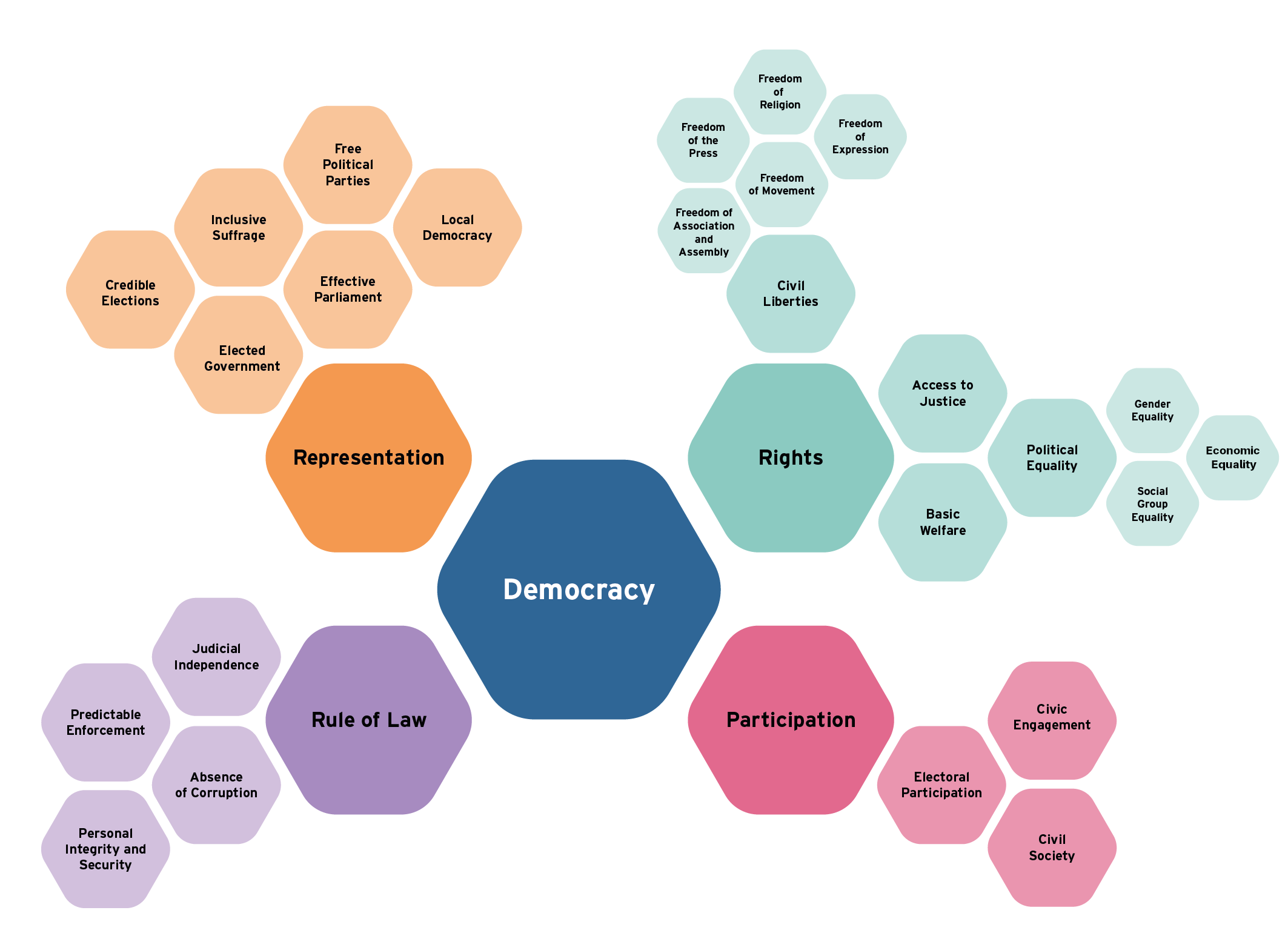
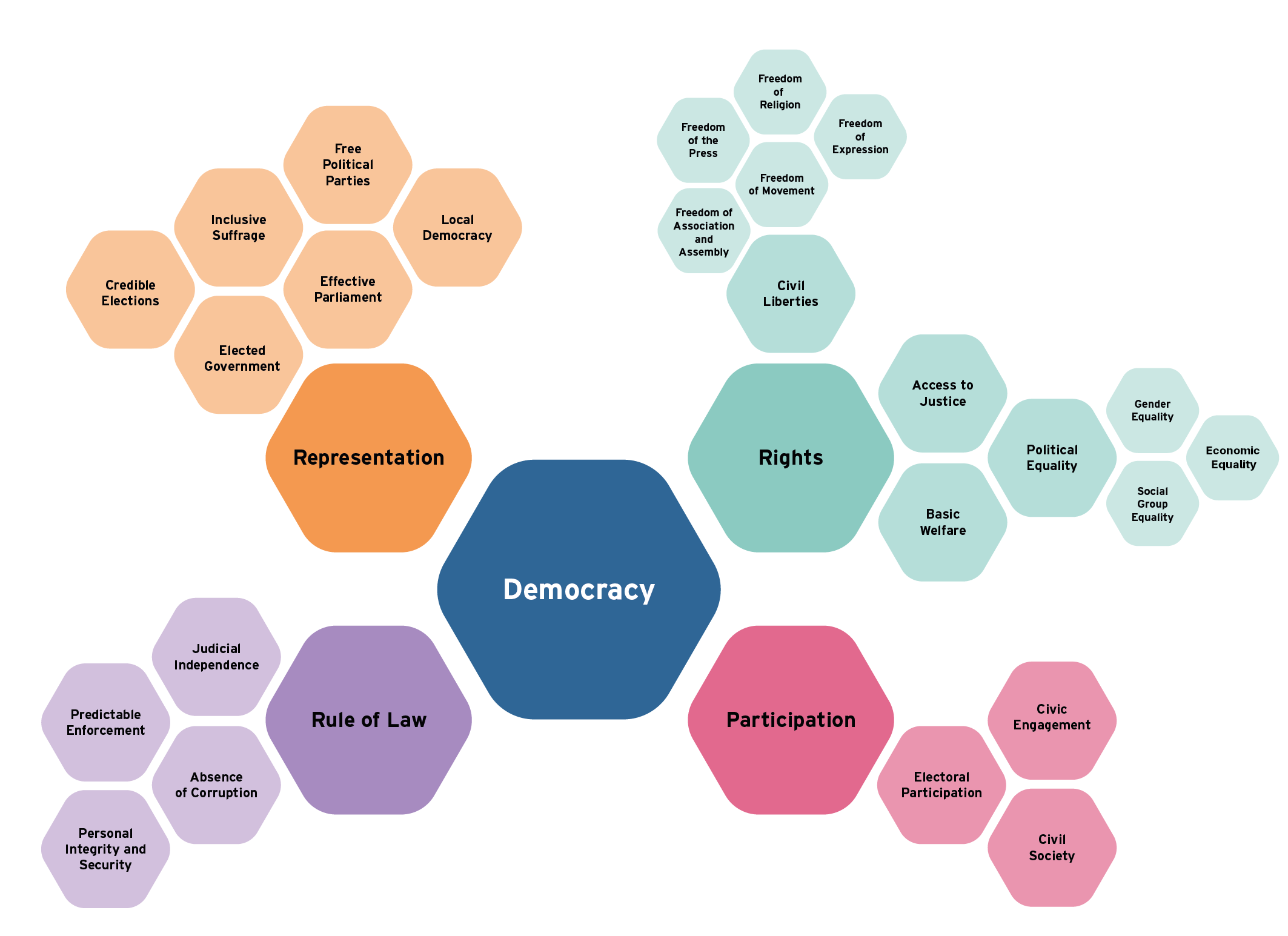
Algeria performs in the low range in Representation and Rule of Law and in the mid-range in the Rights and Participation categories of the Global State of Democracy framework. Compared to 2019, its performance has remained relatively stable, despite significant declines in Civil Liberties and Personal Integrity and Security. Economically, Algeria is a major hydrocarbon producer, and the economy is heavily dependent on oil and gas sectors.
Algeria gained independence in 1962 after 132 years of French colonial rule, preceded by three centuries under Ottoman control. French colonial rule was characterized by racialism and the violent suppression of nationalist movements. A brutal war of independence (1954-1962) brought the National Liberation Front (FLN), which had spearheaded the resistance, to power. It established a centralized one-party state grounded in socialist, nationalist, and anti-colonial ideals. Responding to socio-economic unrest, the FLN introduced a multi-party system in 1989. However, the 1991 legislative elections were derailed when the military staged a coup after the Islamic Salvation Front (FIS) won the first round. The military then annulled the elections and banned the FIS, sparking a decade-long civil war (1992-2002) between the state’s security forces and Islamist insurgents.
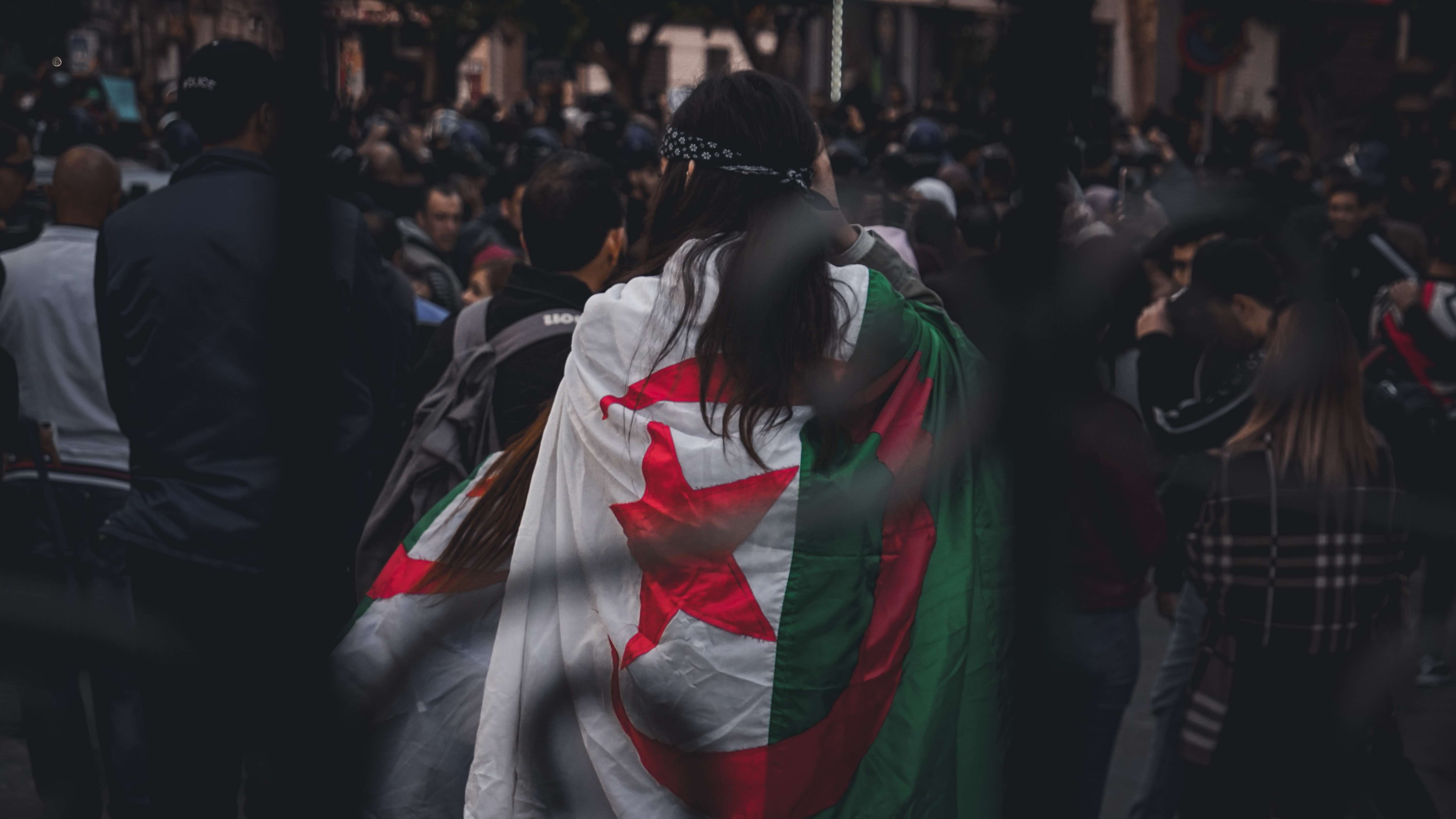
In 1999, FLN-affiliated Abdelaziz Bouteflika was elected president with military support. He pursued reconciliation through amnesty laws for insurgents, while power remained with Le Pouvoir, the military and intelligence elite. Bouteflika’s 2019 bid for a fifth term sparked the Hirak protests, which mobilized massive grassroots opposition and led to his resignation under military pressure. Regime insider Abdelmajid Tebboune won the next presidential election, and in 2020 constitutional reforms introduced presidential term limits and expanded parliamentary and judicial powers, while they also expanded the army’s formal role in the governance of the state. Despite these reforms and a campaign against government corruption, the government continues to arbitrarily detain protesters and activists, tighten restrictions on media and freedom of expression, and expand the penal code to strictly regulate online speech.
The prominence of the military in politics is a source of political tension. Public calls for civilian-led rule have clashed with government moves to expand military authority, most recently with a 2024 presidential decree that continued to broaden the army’s formal powers.
Although most Algerians have Amazigh (Berber) ancestry, only about 15 per cent primarily identify as such. Despite Tamazight’s official language status, many Amazigh regions remain marginalized, and groups like the (separatist) Movement for the Autonomy of Kabylie (MAK), which represents the Amazigh community in the region of Kabylie, clash with the state. Development gaps persist in rural and southern areas, fueling unemployment, social unrest, labor protests, and emigration. Additionally, Algeria hosts around 170,000 Sahrawi refugees in camps with limited basic services.
Algeria is a mid-performer on Gender Equality, yet women’s parliamentary representation is low and in decline, with broader progress hindered by low labor force participation and discriminatory family laws. LGBTQIA+ individuals face legal and social discrimination and same-sex relations are criminalized.
Looking ahead, it will be important to watch whether the momentum of the Hirak movement can be transformed into viable political alternatives, with potential impacts in Participation and Representation. Other areas to monitor are Access to Justice, in light of pending criminal legislation threatening procedural rights, and Free Political Parties, with proposed reforms raising the prospect of significant new restrictions.
Last Updated: August 2025
https://www.idea.int/democracytracker/
July 2026
Parliamentary elections held amid low voter turnout

On 2 July, Algeria held elections for all 407 seats in the People's National Assembly. The Constitutional Court confirmed the results on 18 July, with the ruling National Liberation Front (FLN) remaining the largest party with 91 seats, followed by the National Democratic Rally (RND) with 74 seats and the Future Front (El-Moustakbel) with 56 seats. The elections were marked by low voter participation, with turnout falling to 21.2 per cent of registered voters, down from 23 per cent in 2021. Women's representation also declined, with women winning 25 of 407 seats (6.1 per cent), down from 8.1 per cent in the previous legislature. Ahead of the vote, the National Independent Elections Authority's (ANIE) disqualified more than 3,700 prospective candidates over alleged links to financial and business networks.
Sources: Constitutional Court of Algeria, IPU Parline (1), IPU Parline (2), Al Jazeera


May 2026
Electoral reform expands number of diaspora seats from 8 to 12
On 4 May, an electoral reform reorganizing the electoral districts for the diaspora was published in the Official Gazette. The reform increases the number of parliamentary seats allocated to Algerians abroad from 8 to 12 and redistributes them across eight large transnational constituencies. France, home to the largest Algerian diaspora population, was allocated six of the twelve overseas parliamentary seats. The remaining seats were distributed among constituencies covering the rest of Europe, the Americas, Africa, the Middle East, and Asia-Oceania. According to the National Independent Authority for Elections (ANIE), the new distribution aims to better reflect the size and geographic spread of Algerian communities abroad and to strengthen their representation in the National People's Assembly. The reform was adopted ahead of the parliamentary elections scheduled for 2 July.
Sources: Official Gazette of the Republic of Algeria, Dzair Tube, Al 24 News, Algeria Press Service


April 2026
Amendments to political parties law enter into force
On 23 April, an amended Organic Law on political parties was published in the Official Gazette. The reform introduces stricter conditions for party formation and operation, including requirements to maintain a nationwide presence. It also allows parties to establish structures within the Algerian diaspora, with the stated aim of facilitating greater political engagement among citizens abroad. A key provision prohibits parties from boycotting two consecutive elections, with non-compliance potentially leading to dissolution. Critics argue that this effectively removes electoral boycott as a legitimate form of political expression, narrowing opposition strategies and limiting available modes of protest. As a result, the reform may constrain political pluralism and particularly impact smaller parties, despite its stated goal of strengthening party organization and participation.
Sources: Journal Officiel De La Republique Algerienne, Dzair Tube, Al Estiklal, Algeria News Gate

March 2026
Parliament passes constitutional amendments expanding executive powers
On 25 March, Parliament adopted a set of constitutional amendments that expand the president’s executive authority by introducing changes to the functioning of the High Council of the Judiciary and the National Independent Electoral Authority. Key provisions restructure the High Council of the Judiciary by increasing the president's role over its composition and decision-making, particularly in the appointment, promotion, and disciplinary oversight of senior judges. In addition, the mandate of the National Independent Electoral Authority has been revised and, while maintaining its broad supervisory role over elections, the responsibility for the material and logistical preparation of electoral operation has been transferred to state bodies under the Interior Ministry. While authorities have presented these amendments as technical revisions, observers argue that they weaken the role of countervailing institutions.
Sources: Journal Officiel de la Republique Algerienne, Algérie Presse Service, Le Monde, ConstitutionNet

See all event reports for this country
Global ranking per category of democratic performance in 2025

Basic Information

Human Rights Treaties
 State party
 Signatory
 No action
Performance by category over the last 6 months


Election factsheets
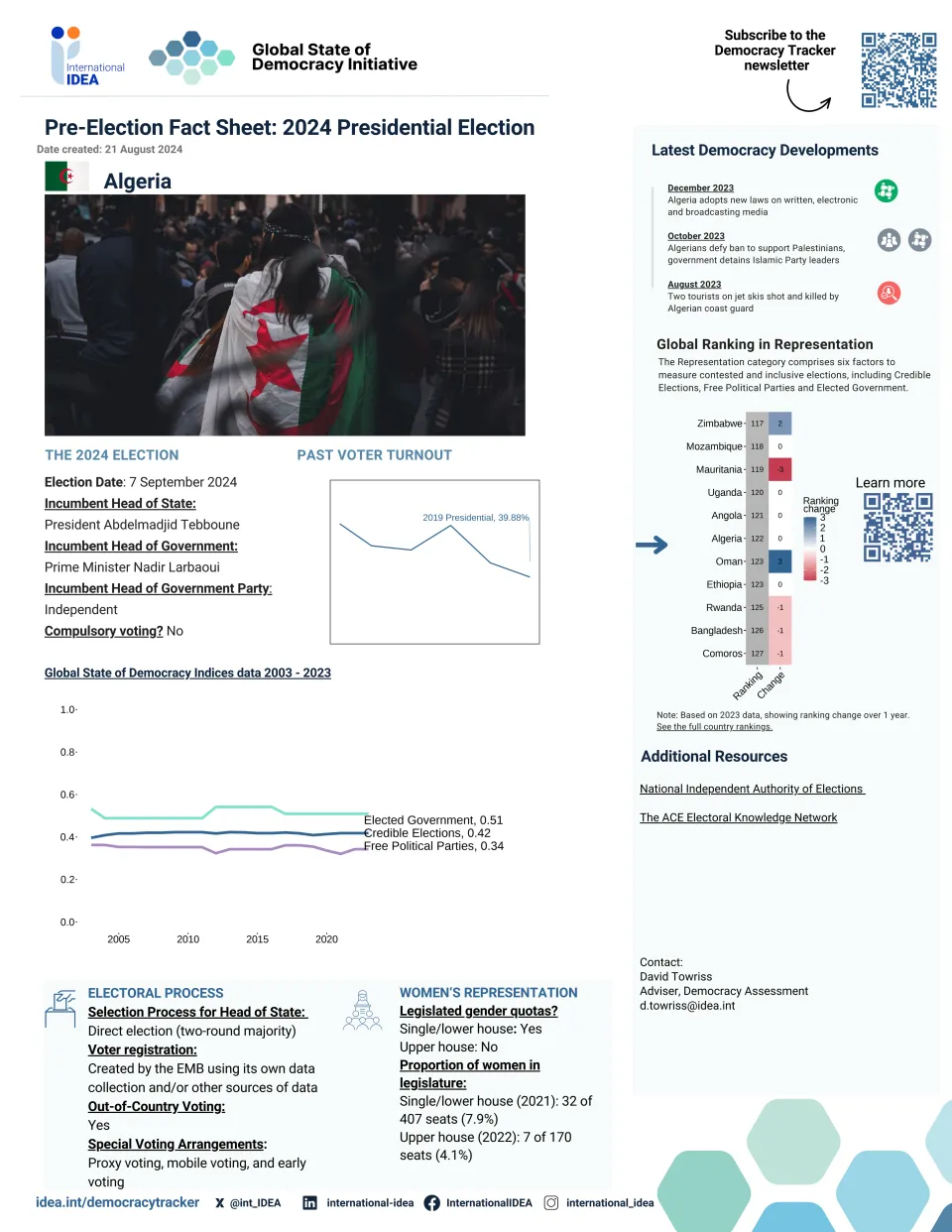
Global State of Democracy Indices
Hover over the trend lines to see the exact data points across the years


Factors of Democratic Performance Over Time
Use the slider below to see how democratic performance has changed over time