

Americas
In the second half of 2025, executive overreach, expanded surveillance and selective enforcement resulted in democratic representation and rights declining across much of the region, with some of the sharpest setbacks in the United States. Even so, some countries made meaningful progress on rights protections, particularly by improving the conditions of social groups and advancing gender equality. Other pockets of progress were notable in anti-corruption efforts and accountability for historic crimes. Despite security conditions deteriorating in several countries, civic engagement and large-scale citizen mobilizations increased in others.
Emerging patterns

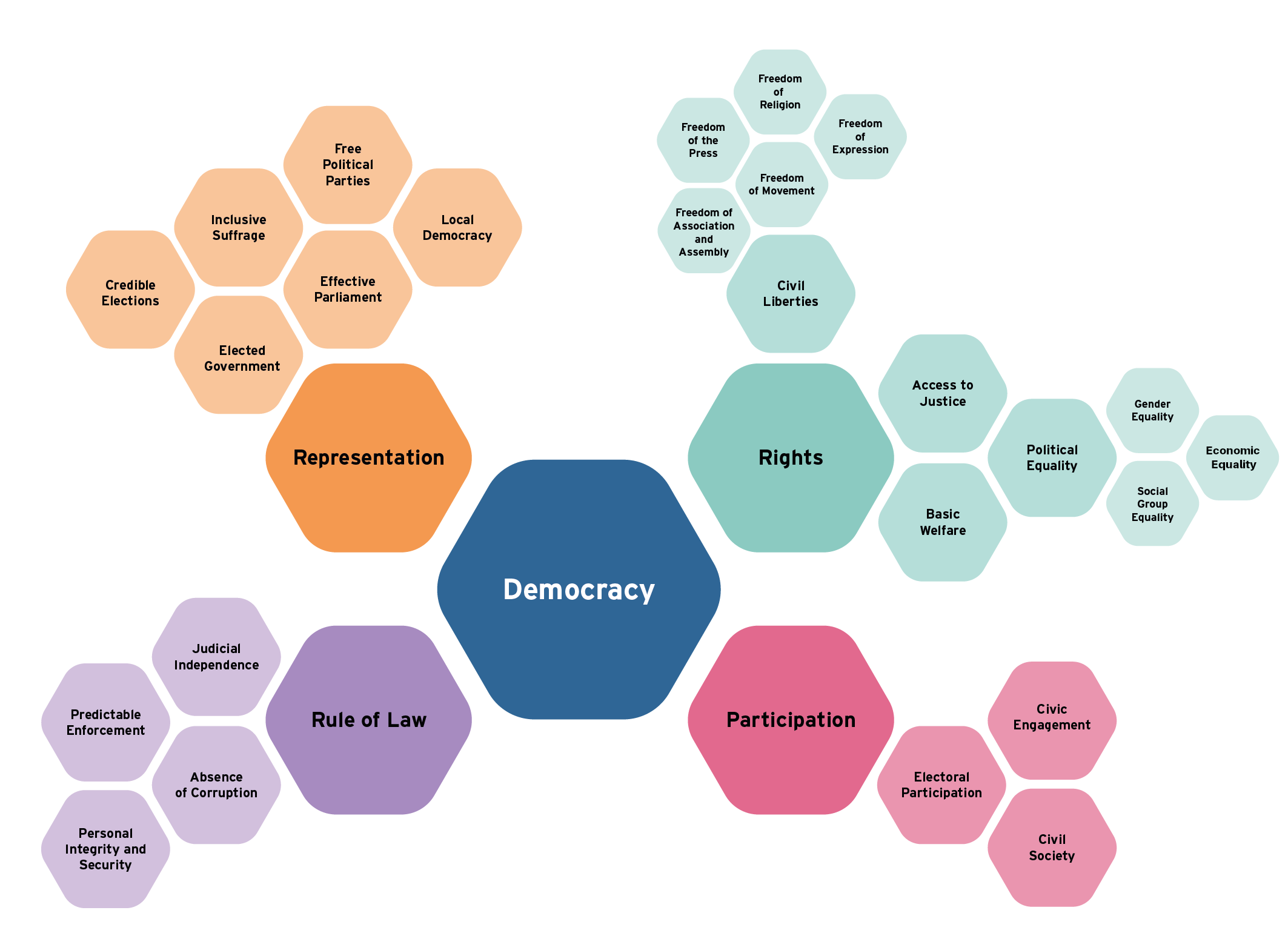
Representation
In the Representation category, insufficient checks on presidential power in the region weakened political pluralism and risked democratic stability. In El Salvador, the introduction of indefinite presidential re-election contributed to this decline, while the political crisis in Peru culminated in former president Dina Boluarte’s removal by Congress. In the United States, Congress’s weakened ability to check executive power was highlighted by continued strikes on alleged drug-smuggling boats despite lawmakers’ oversight concerns, an issue that escalated in January with the capture of Nicolas Maduro. The record-long U.S. government shutdown further illustrates declining congressional effectiveness, while deepening gerrymandering reflected a broader deterioration in political pluralism.
However, in a positive step for the political transition, Haiti launched a long awaited electoral calendar and adopted new electoral legislation, after having had no elected officials since January 2023. Paraguay also showed some positive developments with the introduction of reforms to the political campaign financing system that aim to improve transparency and oversight in the management of electoral funds.
Rights
Constraints on free speech and press were a recurring concern in late 2025, especially in the United States, where restrictions followed the assassination of Charlie Kirk, including through FCC threats. Journalists’ access to Pentagon reporting was also controlled, while the Trump administration’s calls to arrest Democratic party lawmakers and its executive actions on ‘domestic terrorism’ further undermined free expression. Additional setbacks emerged in Mexico, with new telecoms and intelligence legislation, and in Venezuela, with expanded surveillance.
In contrast, the region saw positive developments in Political Equality and Access to Justice. Bolivia advanced women’s political representation and girls’ rights, and Mexico adopted a significant policy to combat sexual abuse. Brazil introduced protections for migrants and asylum seekers, while Argentina took steps to improve the rights of persons with disabilities.
Progress on accountability for historic crimes also continued. In Colombia, the Special Jurisdiction for Peace issued its first rulings, alongside high-profile convictions. Chile ordered the heirs of Augusto Pinochet to return misappropriated funds, and Uruguay secured a notable conviction for dictatorship-era crimes. However, Peru’s adoption of an amnesty bill benefiting individuals accused of human rights violations highlighted continuing obstacles to full accountability and access to justice.
Rule of Law
Negative developments in how the law is enforced and in the region’s security situation were the most notable at the end of 2025. Rising criminal violence contributed to deterioration in Personal Integrity and Security in Uruguay, where a prosecutor survived an assassination attempt. In Colombia, airstrikes on FARC dissident groups prompted human rights concerns. And in Ecuador, a wave of gang-related explosions disrupted several regions. In Brazil a police operation in two favelas became the deadliest in the country’s history, highlighting racial bias in policing.
In the United States the September assassination of Charlie Kirk further exacerbated an already volatile environment of political violence. Further, concerns grew over the politicization of the Justice Department, pressure on economic regulators, and the federal deployment and control of police and the National Guard units over local objections.
There were, however, some improvements in Absence of Corruption, including the convictions of former leaders in Peru and Colombia on corruption-related crimes.
Participation
The most notable developments in Participation were advances in Civic Engagement. In Peru, Paraguay, Mexico and the United States, citizens mobilized to demand government action. In Peru and Paraguay, ‘Gen-Z’ groups organized large demonstrations, a global trend for youth participation, though the excessive use of force in some cases raised concerns about protesters’ rights and safety. In the United States, the October ‘No Kings’ protest became one of the largest in the country’s history, drawing millions.
Elections
National elections were held in six countries: Bolivia (August, with a run-off in October), Guyana (September), Jamaica (September), Argentina (October), Chile (November), and Ecuador (November). Guyana’s leader was re-elected, and Jamaica’s ruling Labour Party also secured victory. Bolivia ended nearly 20 years of Movimiento Al Socialismo leadership, with the election of opposition candidate Rodrigo Paz, and Chile likewise elected opposition leader José Antonio Kast. In Argentina, the ruling coalition won the most seats in mid-term legislative elections. In Ecuador, voters overwhelmingly rejected President Daniel Noboa’s referendum proposals.
As the United States’ domestic and international actions contribute to regional destabilization, particularly in Venezuela its democratic trajectory will continue to be critical. The 3 January capture of Nicolás Maduro, and threats of force against other countries has unsettled the international order, raising serious concerns for the international rule of law. Domestically, Judicial Independence will be crucial as federal courts and the Supreme Court review challenges to the federal government. Monitoring Rights will also be essential amid increasingly severe immigration enforcement and tactics such as racial profiling erode Civil Liberties and threaten civic participation.
Across the region, the Rule of Law will be shaped by major corruption investigations in Argentina, Bolivia, Paraguay and the Dominican Republic, involving current or former leaders and national institutions. It will be important to monitor the influence of criminal groups in countries such as Ecuador and Guatemala, where rising violence has already prompted states of emergency.
In the Rights category, Civil Liberties will be key as Argentina takes a hardline approach on immigration and Venezuela continues to target the opposition.
In Participation, civic engagement will be essential for countering executive overreach, as will Gen-Z mobilizations. In the next six months, national elections will take place in Costa Rica, Colombia, and Peru. In August, Haiti will hold long awaited elections.
Factors of Democratic Performance
Scores represent regional averages in 2025.
*Data represents an average of the entire region
Number of events reported
See the most frequently impacted categories of democratic performance over the last six months
Most impacted factors of democracy
| Predictable Enforcement |
|
16x |
| Absence of Corruption |
|
15x |
| Civil Liberties |
|
14x |
- Uruguay - December 2025 | Court issues landmark ruling for crimes committed during the dictatorship
- Haiti - November 2025 | New electoral calendar launched and electoral law adopted
- Brazil - September 2025 | Former President Jair Bolsonaro and allies are convicted for coup attempt
- El Salvador - July 2025 | Legislative Assembly approves indefinite presidential re-election
Democracy Notes


Archive
See past regional pages or use the archive to design a customized search to find exactly what you are looking for.