

Slovakia
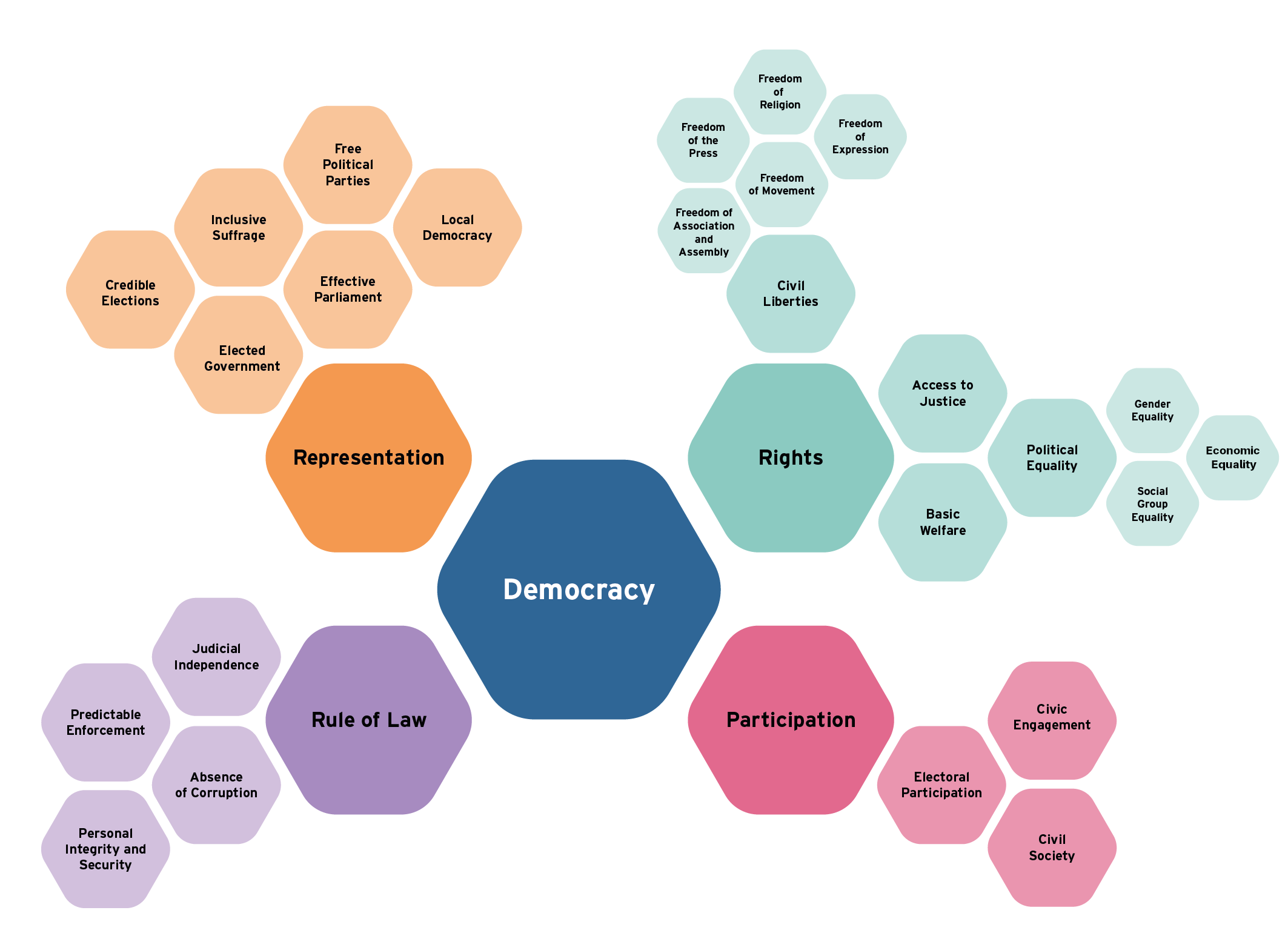
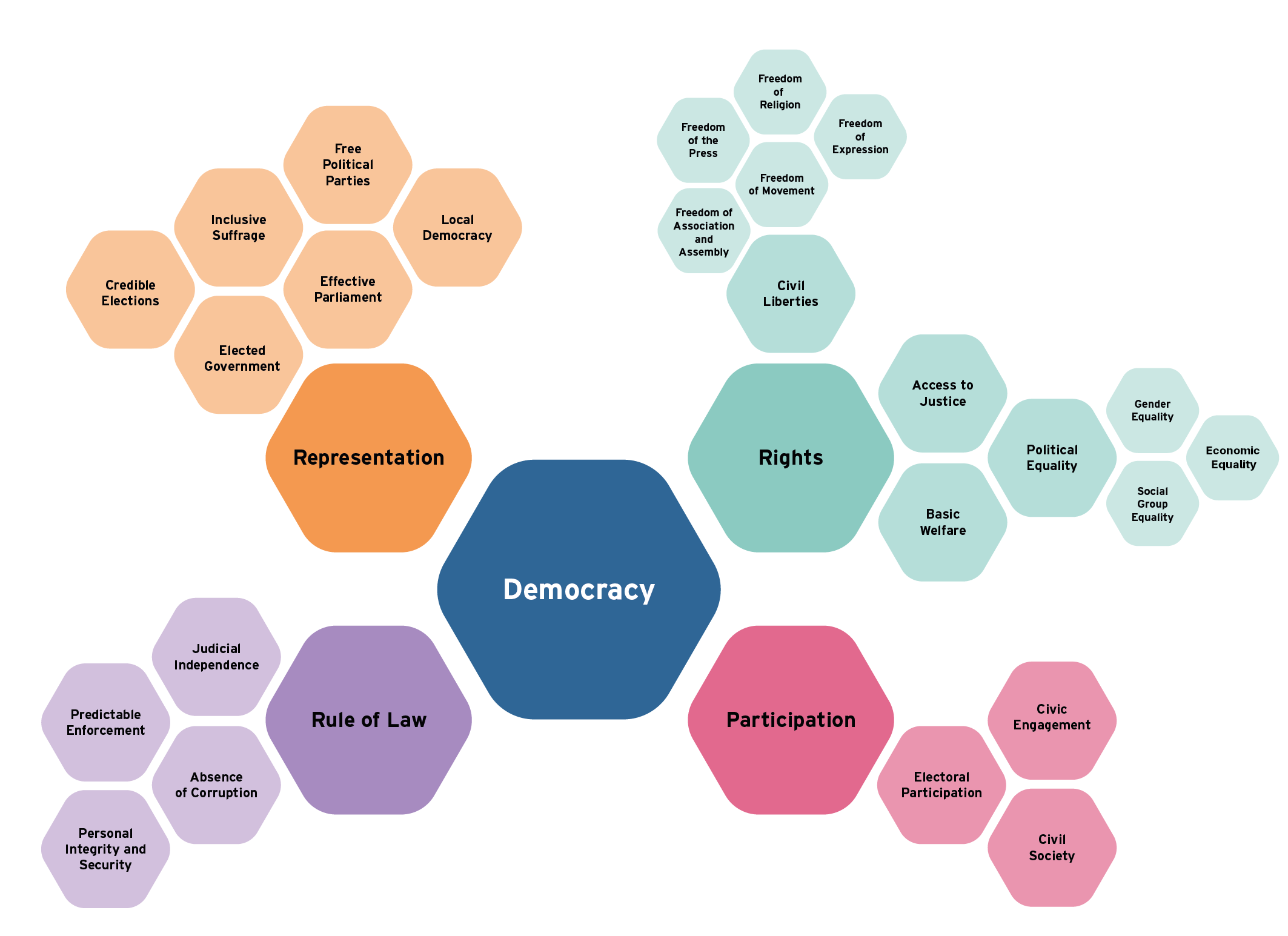
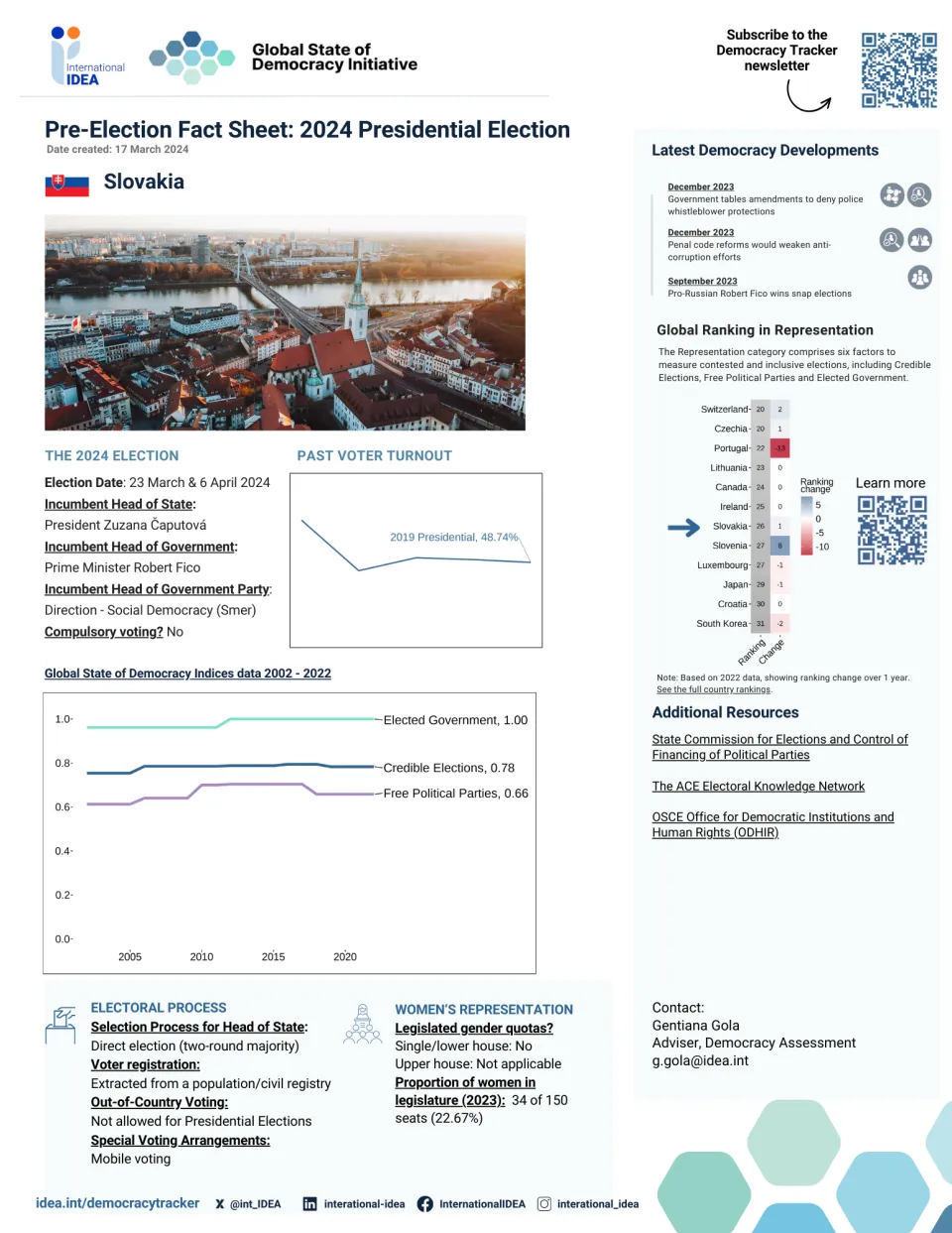
Slovakia, also known as the Slovak Republic, exhibits high performance in Representation, but mid-range performance with regards to all other categories of the Global State of Democracy Framework—experiencing significant declines in the Rule of Law. It is amongst the top 25 per cent of countries in many factors, including nearly all aspects of Representation (excluding Effective Parliament), Political Equality, and Judicial Independence. Between 2019-2024, Slovakia has shown significant declines in Civil Liberties (Freedom of Expression and Freedom of the Press), Predictable Enforcement, and Effective Parliament. A high-income economy largely based on services and manufacturing, Slovakia has one of the highest levels of Economic Equality compared to its regional counterparts. However, internal regional disparities exist between east and west.
The territory of Slovakia fell under the Kingdom of Hungary from the 11th century and the Austro-Hungarian Empire between 1867-1918. Becoming a constituent part of Czechoslovakia in 1918 despite socio-cultural differences, Slovakia was a satellite state of Nazi Germany (1939-1945) and the Soviet Union (1948-1989). Shortly after its transition from communism, Czechoslovakia peacefully split in the 1992 Velvet Divorce following elite-driven demands for decentralization and economic discrepancies. Politics in Slovakia today shows high degrees of electoral and political party volatility, alongside fragility in Elected Government. A cleavage exists between pro-European liberal parties and nationalist-populist parties, with political posturing on the Russian invasion of Ukraine being a key fault line. Significant protests have ensued against an alleged pro-Russian course and ‘Russian-style’ crackdowns on civil society and the state broadcaster. Political polarization is a growing area of concern, culminating in an assassination attempt on the Prime Minister in 2024, subsequent accusations of coup planning, and ‘Lex Assassination’ legislation. Corruption remains a central issue in Slovak politics, particularly spotlighted by the murder of investigative journalist Ján Kuciak and controversial penal code reform.
According to census data, 88.6 per cent of the population identify as Slovak, with Hungarians and Roma as the largest minority groups. Slovakia reportedly continues to deploy the Beneš Decrees, a Second World War remnant that allows the state to confiscate land belonging to ethnic Hungarians without compensation. Condemned at the European level, the Roma face discrimination, social exclusion, and educational segregation. Following the 2015 crisis, migration has risen as an issue area in Slovak politics.
Slovakia has been consistently mid-performing in Gender Equality. Progress has been challenged by low political participation, a wide gender pay gap, and a failure to ratify the Istanbul Convention. Abortion rights are subject to contestation, with the parliament also rejecting their inclusion in the European Charter of Fundamental Rights. Same-sex marriage is not legal in Slovakia, and the rights of the LGBTQIA+ community regularly come under threat from proposed legislative and constitutional amendments—despite a 2022 terrorist attack on an LGBTQIA+ bar.
Looking ahead, it will be important to monitor Freedom of Association and Assembly. The response to the attempted assassination of the Prime Minister threatens to adversely impact this sub-factor, alongside new legislation that endangers civic space. Recent and sustained counter-protests to this legislation and against the Slovak government’s foreign policy positions, however, may reinvigorate aspects of Participation. Lastly—amidst the abolition of Special Prosecutor’s Office and National Crime Agency—it will be important to watch for further declines in the Rule of Law, particularly Absence of Corruption and Judicial Independence.
Last Updated: June 2025
https://www.idea.int/democracytracker/
December 2025
Constitutional Court provisionally suspends abolition of Whistleblower Protection Office

On 17 December, the Constitutional Court provisionally suspended a law passed on 9 December that would abolish the Office for the Protection of Whistleblowers (UOO) and would significantly reduce whistleblower protections. The law, which sparked nationwide protests against the ruling coalition, was due to take effect on 1 January 2026 and would have replaced the UOO with a new office under direct government control. The UOO and existing whistleblower protections will remain in force until the Court issues a final ruling following a full review of the law.
Sources: EU Whistleblowing Monitor, The Slovak Spectator, ConstitutionNet, Euractiv, Balkan Insight, Al Jazeera



Constitutional Court invalidates legislation imposing tighter NGO rules
On 17 December, the Constitutional Court ruled that a 2025 law requiring non-governmental organisations to disclose their funding sources and identify major donors was unconstitutional. The judges ruled that requesting NGOs to reveal donor identities and donation amounts breaches privacy rights and is unnecessary for ensuring transparency or tackling crime. The Court warned that the rules could deter donations and threaten NGOs’ work. The law was referred to the Constitutional Court by 32 opposition MPs and Public Defender of Rights Róbert Dobrovodský, amid strong criticism from the non-profit sector. Once the ruling is published in the Collection of Laws, the law will no longer be in force. The governing coalition will then have to decide whether to amend the law so it aligns with the constitution.
Sources: International IDEA, The Slovak Spectator, ConstitutionNet, Constitutional Court of the Slovak Republic, Legalis

September 2025
Constitutional amendments target LGBTQIA+ and surrogacy rights
On 26 September, the Slovak Parliament passed a package of constitutional amendments with 90 votes in favor, meeting exactly the three-fifths majority required for constitutional changes. Framed as an assertion of Slovakia’s sovereignty in matters of national identity, the amendments prohibit surrogacy, restrict adoption to married heterosexual couples, and add a provision defining sex as strictly male or female as determined at birth. Among the amendments is an explicit constitutional guarantee of ‘equal pay for equal work’ for men and women.
Sources: Slov Lex, Council of Europe, Reuters, Al Jazeera, Amnesty International

April 2025
Parliament passes law imposing tighter rules for NGOs
On 16 April, Slovakia’s Parliament adopted a law through a fast-track procedure that defines non-governmental organisations as lobbyists. It requires those with an annual income exceeding EUR 35,000 to disclose their funding sources and identify major donors who contributed more than EUR 5,000 within a year. Non-compliance will be punished with fines and potential dissolution. Prime Minister Robert Fico stated that the law will increase transparency, while rights organisations argue the law restricts civil society and silences criticism. In a letter addressed to the Slovak Parliament, the Council of Europe Human Rights Commissioner said that the law sends ‘a worrying signal about the health of the rule of law and democracy’ in Slovakia. As part of ongoing protests that began in December 2024, thousands of people protested against the law, criticizing it for resembling Russia’s foreign agent legislation. The law was signed by President Peter Pellegrini on 7 May.
Update: On 17 December, the Constitutional Court ruled that the law was unconstitutional, and that requiring NGOs to reveal donor identities and donation amounts breaches privacy rights and is unnecessary for ensuring transparency or tackling crime.
Sources : Deutsche Welle, Article 19, Euronews, Pravda, SME, Politico, Council of Europe, International IDEA, The Slovak Spectator, ConstitutionNet, Constitutional Court of the Slovak Republic, Legalis

February 2025
Near-weekly protests against government's posture towards Russia grow in size
On 7 February, large crowds took to the streets of Slovakia, with over 42,000 protesters gathering in Bratislava, and called for Prime Minister Robert Fico’s resignation due to his alleged pro-Russian stance. The nearly weekly protests started on 23 December 2024, following Fico’s visit to Moscow, as one of the few European leaders to visit Russia after the invasion of Ukraine. The protests intensified in January, with over 100,000 protesters across Slovakia on 24 January. The protesters have been criticizing Fico’s ties to Russia, his verbal attacks on Ukraine and have been accusing him of undermining national and EU institutions. The protests are the largest in Slovakia since 2018, when tens of thousands of people demonstrated in response to the death of an investigative journalist.
Sources: Al Jazeera, MSN, France 24, Nový Čas, The Straits Times, British Broadcasting Company
See all event reports for this country
Global ranking per category of democratic performance in 2025

Basic Information

Human Rights Treaties
 State party
 Signatory
 No action
Performance by category over the last 6 months
 Representation
 Rights
Rule of law
Rights
Rule of law
 Participation
Election factsheets
Global State of Democracy Indices
Hover over the trend lines to see the exact data points across the years


Factors of Democratic Performance Over Time
Use the slider below to see how democratic performance has changed over time