Indonesia
The Republic of Indonesia performs in the mid-range in Representation, Rights and Rule of Law and is high-performing in Participation. It ranks in the top 25 per cent globally in Civil Society, Civic Engagement and Electoral Participation. Compared to five years prior, Indonesia has experienced declines in Access to Justice, Credible Elections, Effective Parliament, Judicial Independence and Predictable Enforcement. The fourth most populous nation in the world and home to the largest population of Muslims globally, Indonesia has a service-based economy largely dependent on domestic consumption.
Modern Indonesia encompasses an enormous diversity of ethnic and cultural groups on hundreds of islands and boasts both global megacities and uncontacted Papuan tribes. Over the course of the 20th century, Indonesians constructed a national identity through the conscious choice, primarily of youth, to promote the national language and a national motto of ‘Unity in Diversity.’ Following decades of struggle against a repressive Dutch colonial regime and Japanese occupation, the longtime nationalist leader Soekarno became the first president of independent Indonesia in 1945. Soekarno’s increasingly unstable rule ended in 1965, when the army general Soeharto seized power. He oversaw mass killings and a 32-year ‘New Order’ authoritarian regime. Riots fueled by the Asian Financial Crisis compelled his resignation in 1998, ushering in the reformasi period and a cycle of democratization, but party politics remain heavily fragmented and often depend on patronage and clientelist networks.
Contemporary national political cleavages revolve around secular and religious divides, with political parties maintaining distinct views on state-Islam relations. Gender is caught up in these cleavages, as conceptions of private morality and women’s roles in society are negotiated using these frameworks. In recent years laws have been more conservative; in December 2022, Parliament adopted a new law that criminalized extramarital sex and unmarried cohabitation. Over the past decade, Indonesia has made progress in achieving gender parity in education and increasing women’s political participation through legislated candidate quotas. However, women’s labor force participation remains low and gender-based violence is a pressing issue.
In recent years, the weakening of the country’s Corruption Eradication Commission (KPK) has been reflected in the Absence of Corruption metrics. Recent elections have seen allegations of governmental interference in the judiciary, including a controversial court ruling to lower the age limit of presidential candidates. There are also broad socio-economic disparities between Indonesia’s diverse islands; almost half the population lives in rural areas where access to basic services and resources is poor, with ‘circular migration’ to urban areas for work. Separatist movements have marked Indonesian history, including the secession of Timor Leste in 1999, the independence struggle in Aceh, which ended after the devastating tsunami in 2004 and ongoing unrest and armed groups aiming for independence in West Papua province.
The return of the military to politics in recent years indicates that it will be important to watch factors of the Rule of Law in the next several years. Judicial Independence in particular should be monitored, given recent politicized court rulings and jockeying for power between the various branches of government. Continued political conflict over the management of natural resources and environmental sectors may be reflected in Absence of Corruption or affect socio-political stability between the islands.
Last Updated: June 2025
https://www.idea.int/democracytracker/
October 2026
Court orders reform of military justice system
On 15 October, Indonesia’s Constitutional Court unanimously ruled the 1997 Military Justice Law to be conditionally unconstitutional, ordering the government and parliament to amend it by October 2028. The ruling requires clearer separation of military and non-military offences, enabling soldiers accused of ordinary crimes to be tried in civilian courts, and full integration of military courts under the Supreme Court. Currently, investigations, prosecutions and trials of soldiers remain largely within the military chain of command, a system criticized for shielding personnel accused of abuses against civilians. If the government fails to amend the law by October 2028, the Court ruling means it will become unconstitutional and have ‘no legal binding force.’


September 2026
Parliament adopts agrarian reform law targeting land inequality
On 22 September 2026, Indonesia's parliament passed a long-awaited Agrarian Reform Law aimed at accelerating land redistribution, improving land registration, and resolving longstanding land tenure disputes. The law establishes a central body for managing the reforms directly accountable to the president. The government argued that the legislation would strengthen legal certainty for and better protect the rights of farmers and rural communities. The lack of a centralized system for resolving land disputes has reportedly resulted in 3,234 legal conflicts concerning 7.4 million hectares and 1.8 million households between 2015 and 2024. Some civil society organizations, environmental groups, and Indigenous rights advocates expressed reservations, noting problems enforcing existing frameworks and a lack of clear appeal and oversight mechanisms.


August 2026
Court strikes down laws criminalizing insulting the government
On 29 August 2026, Indonesia's Constitutional Court struck down provisions of the 2023 Criminal Code that criminalized insulting the government or disseminating such insults. The Code had come into force in January 2026. The provisions, which carried penalties of up to three years' imprisonment, had been criticized by civil-society groups and legal experts for restricting free expression and discouraging public criticism of state institutions. The Court ruled that the articles risked criminalizing legitimate criticism and creating a chilling effect on public debate. The decision followed a judicial review petition filed by law students and is final and binding. Rights advocates welcomed the ruling as an important safeguard for freedom of expression and civic space, although some noted that other legal provisions which could be used against government critics remain law.
June 2026
Police officers to be allowed to hold more dual posts
On 9 June 2026, Indonesia’s parliament approved revisions to the National Police Law allowing serving police officers to occupy positions in civilian ministries and state agencies without resigning from the police force. The amendments permit active officers to hold posts related to public security, law enforcement and public services, and allow appointments at the request of the president or government agencies. Civil society groups, legal experts and human rights organizations criticized the reforms, arguing that they blur the distinction between civilian administration and law enforcement, weaken accountability mechanisms and contradict a 2025 Constitutional Court ruling requiring officers to resign before assuming non-police positions. The reform represents a significant institutional expansion of police influence within the civilian state apparatus and raises concerns about oversight, checks and balances, and the increasing role of security institutions in governance.

See all event reports for this country
Global ranking per category of democratic performance in 2025

Basic Information

Human Rights Treaties
 State party
 Signatory
 No action
Performance by category over the last 6 months


Election factsheets
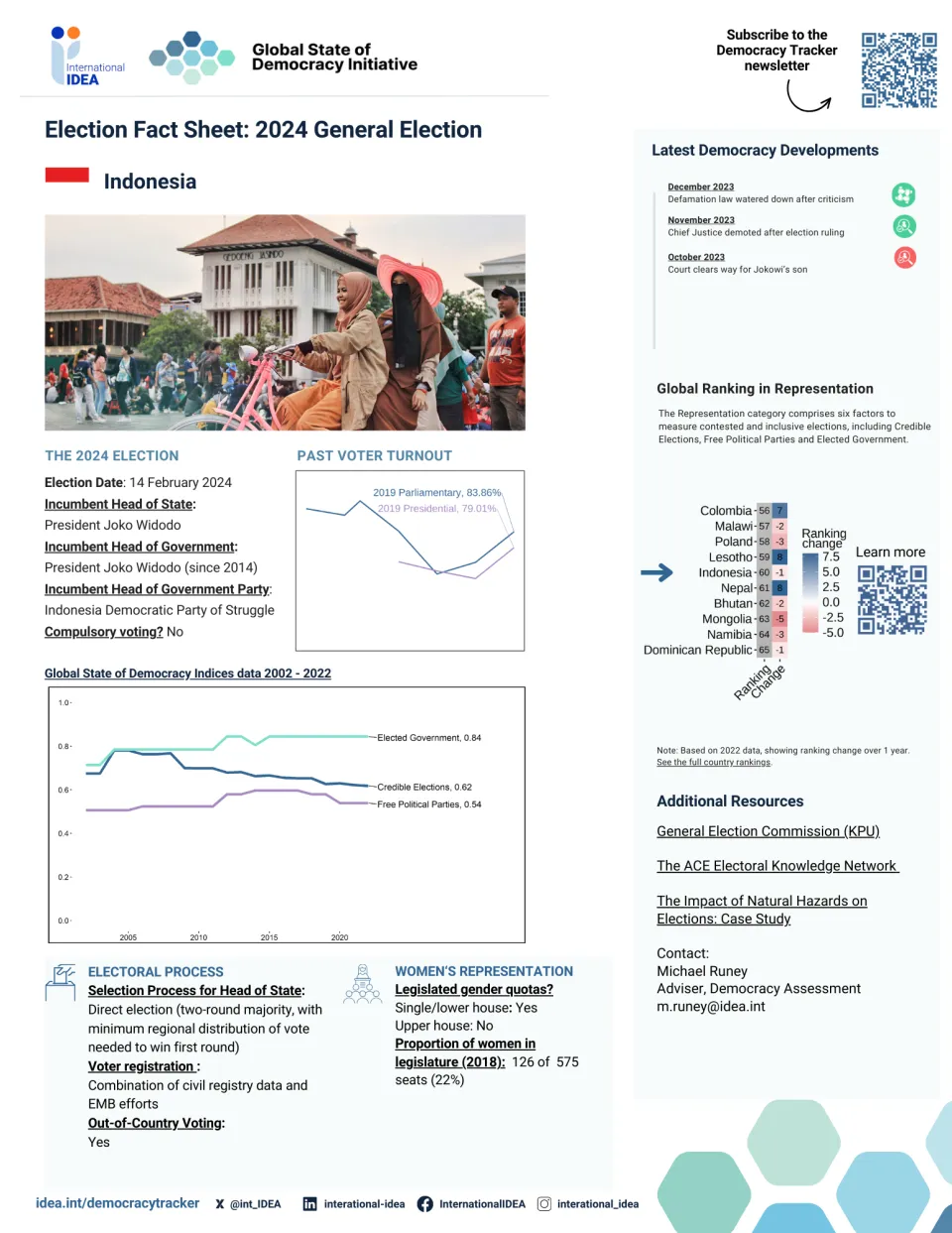
Global State of Democracy Indices
Hover over the trend lines to see the exact data points across the years


Factors of Democratic Performance Over Time
Use the slider below to see how democratic performance has changed over time