


United States of America
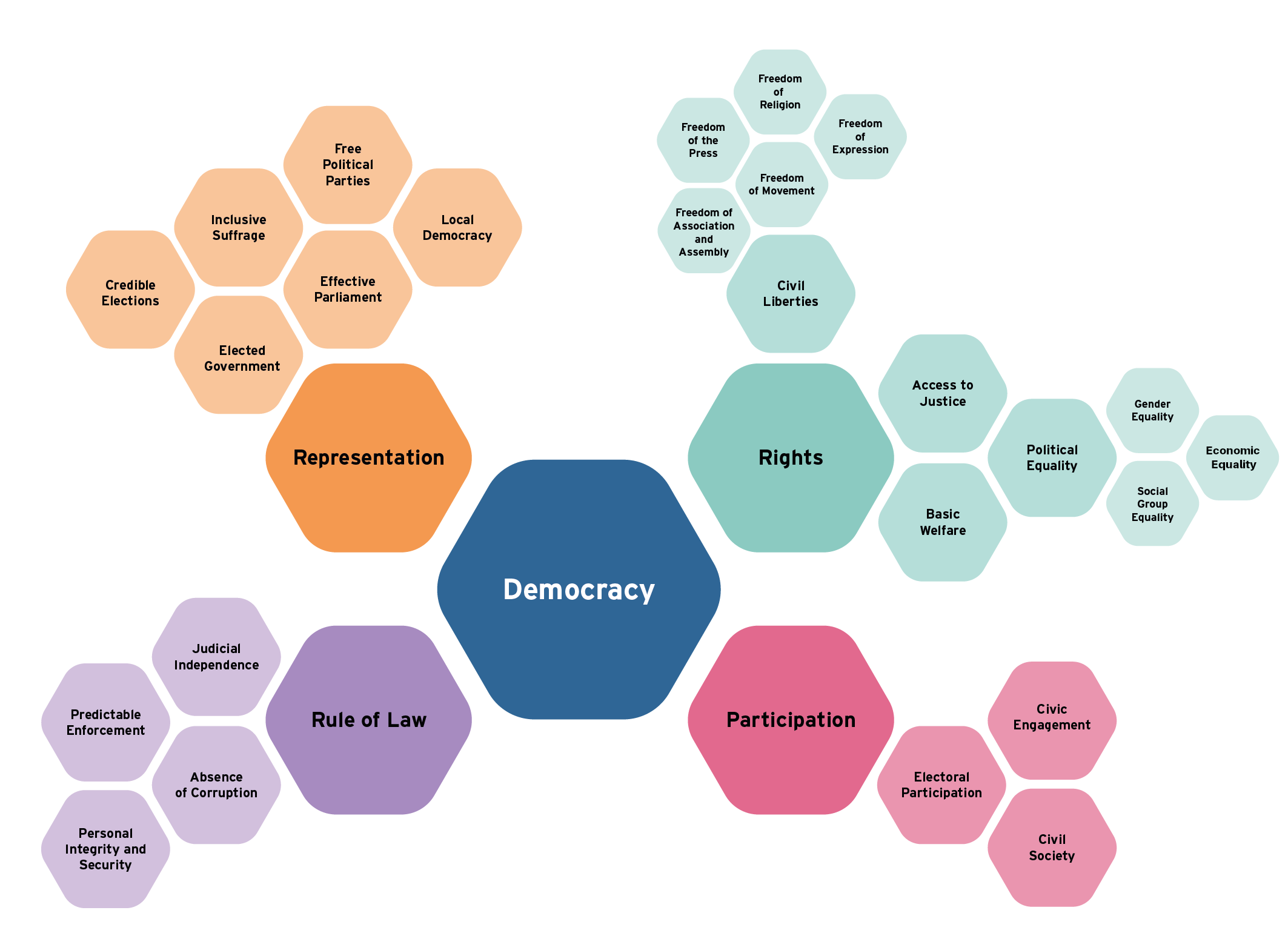
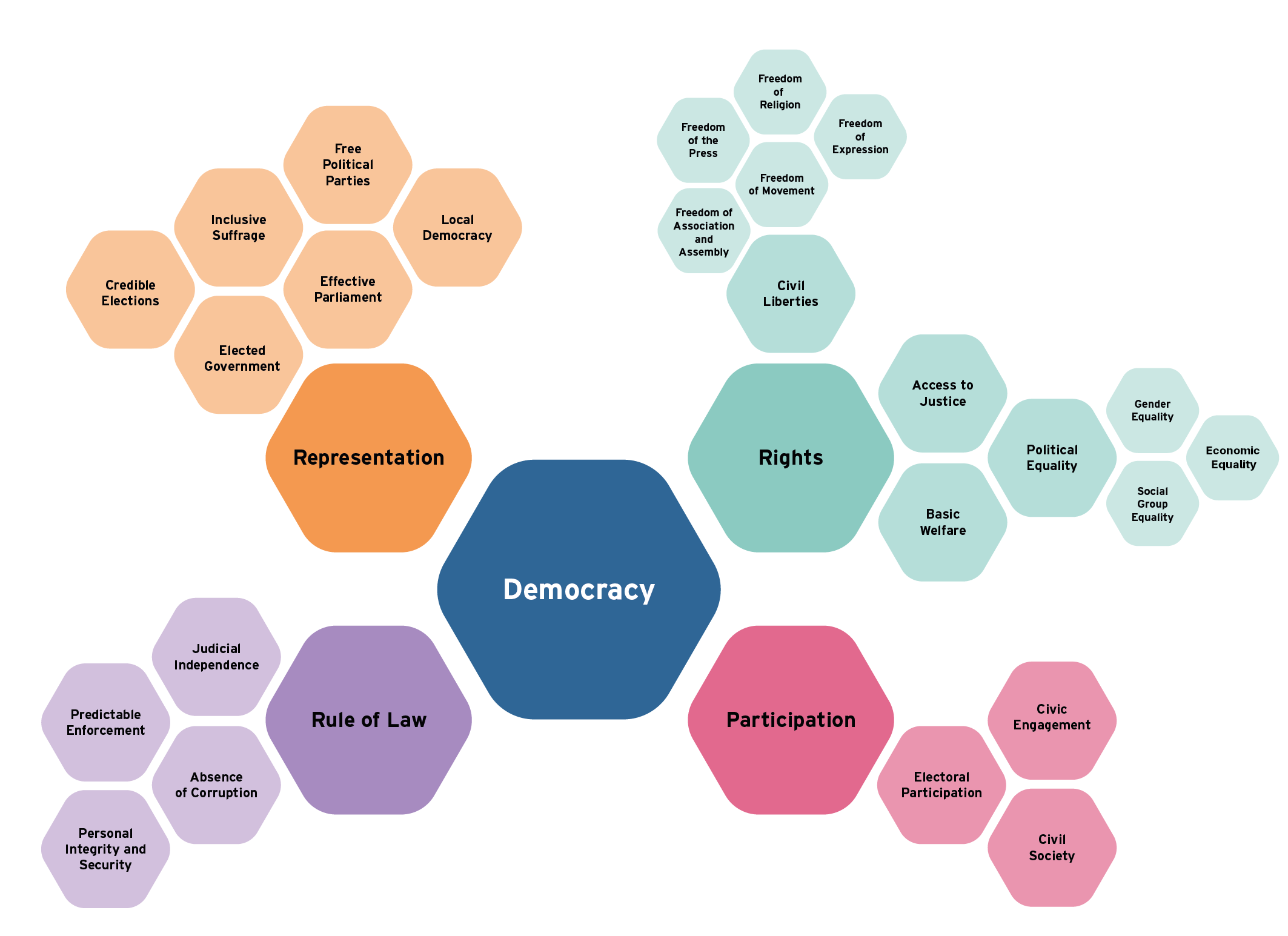
The United States of America (US) performs in the high-range across the Representation, Rights and Participation categories of the Global State of Democracy framework, and in the mid-range in Rule of Law. It performs among the top 25 per cent globally regarding most factors of democracy. Since 2019, it has experienced improvements in Credible Elections and Absence of Corruption and declines in Economic Equality. With the world’s largest economy (fueled considerably by the services and industry sectors) and largest military (by expenditure), the US plays a prominent economic and geopolitical role in the world.
The population of the US is mostly white, with Black, Hispanic, Asian, and Indigenous minorities. Four decades of increasing income inequality have produced a substantial wealth gap, with poverty rates disproportionately higher among minority communities. The history of African slavery, racial segregation and discrimination continues to be reflected in an expanding racial wealth gap and the disproportionate rate of Black incarceration. Race issues have gained new political salience in recent years (including increasing calls for reparations), especially around high-profile police killings of Black civilians, galvanizing the Black Lives Matter movement. But they have also been a polarizing cause, with the new government backtracking diversity initiatives and a recent ruling ending affirmative action in college admissions.
Although several important milestones for gender equality have been achieved in the US, women’s political participation continues to lag. The formal end of abortion rights and attempts to restrict access to contraception and sexual healthcare have further challenged and politicized women’s rights. Same-sex marriage has been legal in all states since 2015; however, LGBTQIA+ rights, particularly trans-rights and gender identity have become an increasingly polarizing issue.
The US’s two-party system is well-entrenched and stimulates nationally competitive elections, but gerrymandering has resulted in minimally competitive legislative districts. The weakening of the Voting Rights Act of 1965 (VRA) and voter suppression have also threatened electoral integrity for well over a decade. Refusal to concede defeat after the 2020 elections, and a violent riot at the US Capitol on 6 January 2021, laid the groundwork for a political movement that, to this day, casts doubt (without evidence) on the American electoral system.
Current political debates revolve around the newly elected administration’s efforts to fundamentally change the way the US government works and threaten the balance of power. Executive orders have halted the disbursement of congressionally approved funds and challenged the authority of the courts on a wide array of issues. As the government’s measures to curb undocumented migration push the boundaries of what is constitutionally permissible, more Americans are questioning these policies. The use of immigration enforcement against people with viewpoints opposing the new government has raised alarms among free speech advocates. The unevenly distributed socioeconomic fallout of the 1990s rollback of the welfare state and the rise of China, weak gun control and widespread mass shootings, are other salient issues in the US.
Persistent issues with voter disenfranchisement and gerrymandering are key to watch, due to their potential to impact Representation. The country is increasingly polarized, with levels of political violence at the highest since the 1970s. The Political Equality factor is also crucial, with emphasis on women’s reproductive rights, Economic Equality, the country’s racialized politics and immigration.
Last Updated: July 2025
https://www.idea.int/democracytracker/
June 2026
Supreme Court boosts president’s authority over regulators but exempts Federal Reserve
In separate rulings, the U.S. Supreme Court determined that President Trump’s firing of former Federal Trade Commissioner Rebecca Slaughter was within his executive power, but blocked the firing of Lisa Cook, a governor of the Federal Reserve. In the Slaughter case, the Court reasoned that protections preventing Federal Trade Commission members’ removal without a cause were contrary to the separation of powers enshrined in the constitution. It further determined that “those who fall within the President’s ‘general administrative control’ must be removable by the President at will.” In doing so the Court expanded presidential power over independent regulators, and appeared to endorse the unitary executive theory, which holds that the U.S. president has sole and final authority over the executive branch. However, in a separate ruling the Court exempted Federal Reserve member Lisa Cook from this broad executive authority, asserting the political independence of the country’s central bank.
Sources: Supreme Court of the United States (1), Supreme Court of the United States (2), NY Times



April 2026
Supreme Court ruling narrows Voting Rights Act
On 29 April, the Supreme Court ruled that a congressional map designed to create a second majority-Black district in Louisiana constituted unconstitutional racial gerrymandering. The majority held that the state had relied too heavily on race in drawing district boundaries and that compliance with Section 2 of the Voting Rights Act did not justify such race-conscious redistricting under the Equal Protection Clause. Section 2 establishes the prohibition of racial discrimination in voting practices or procedures. The decision substantially narrows how Section 2 can be applied. As a result, challenging redistricting decisions will now require plaintiffs to prove intentional racial discrimination, an extremely high burden. In dissent, the Court’s minority warned that the decision ‘renders Section 2 all but a dead letter,’ highlighting concerns about reduced protections for minority voters.
Sources: Supreme Court of the United States, The Guardian, ABC News, NPR, Governor of Louisiana


Trump administration ramps up denaturalization push
In March and April, media reported that the Trump administration had instructed the Department of Justice (DoJ) and Department of Homeland Security to drastically increase denaturalizations, or the process of revoking citizenship of naturalized citizens. US Citizenship and Immigration Services have been instructed to refer up to 200 cases every month to the DoJ, with staff reassigned for this purpose and regular prosecutors enlisted into the effort. Reportedly, the DoJ had identified by 23 April 384 individuals whose citizenship it wants revoked, though it was unclear on what basis. While denaturalization is required to meet a high legal threshold, critics have expressed concerns that cases could be used to intimidate activists, given the directive’s overly broad nature.
Sources: NBC, NYT, The Guardian, Newsweek
Prominent civil rights organization is indicted on federal charges
On 21 April, acting Attorney General Todd Blanche announced an indictment against the Southern Poverty Law Center (SPLC), a prominent civil rights organization, on fraud charges. The Department of Justice claimed that the SPLC’s practice of paying informants inside violent extremist organizations, such as the Ku Klux Klan, to track their activities amounted to fraud and money laundering. The SPLC had in the past collaborated with law enforcement by providing intelligence on violent groups, but the FBI had ended this practice in 2025, saying the SPLC defamed right-leaning groups.
Sources: CNN, The Guardian, AP, Department of Justice,

March 2026
Executive order on mail-in ballots and citizen verification raises concerns

In March 2026, President Donald Trump signed an executive order on citizenship verification and mail-in ballots, directing federal agencies to compile and transmit voter citizenship lists to state authorities and introducing new requirements related to ballot administration. Election law experts and civil society organisations warned that the order encroaches on powers constitutionally reserved for states and Congress, particularly under the Elections Clause. Critics further argued that the order would unduly empower the U.S. Postal Service to regulate mail-in ballots. The executive order gives the USPS 60 days to propose rules for mail-in or absentee ballot services, including regarding envelope design and verification of eligibility through mail voter lists compiled by federal agencies. Several organisations announced legal challenges, framing the measure as a potential threat to the integrity and balance of the electoral system, ahead of the 2026 midterm elections.
Update: On 29 June, a federal court ruled key provisions of the executive order to be unconstitutional. It held that federal agencies could not use the order as basis to interfere with states’ mail-in voting procedures or voter rolls, further barring the Postal Service from restricting mail ballots. The same day, the U.S. Supreme Court upheld, in a separate case, a Mississippi law that allowed counting mail-in ballots arriving up to five days after election day, provided they had been postmarked on or before the date of the election.
Sources: AP, Reuters, CNBC, White House, The Guardian, Brennan Center, ACLU, Supreme Court of the United States, BBC, The White House, ACLU

February 2026
Supreme Court rules Trump tariffs are unconstitutional
The Supreme Court struck down President Trump’s emergency tariffs on 20 February. A majority of the justices found that it was unconstitutional for the president to unilaterally set tariffs under the International Emergency Economic Powers Act. The decision was described by media outlets as ‘a rare rebuke’ and ‘a sharp blow’ to the Trump administration. Subsequently, companies affected have sued for refunds of duties already paid. President Trump declared he intended to circumvent the decision by using an alternative legal basis, and immediately implemented a 10 per cent global tariff, subsequently raised to 15 per cent, under a law known as Section 122. The government launched a digital claims system where importers can claim refunds on 20 April.
Update: The US Court of International Trade ruled on 7 May that the 10 per cent global tariff was unlawful, as the criteria for invoking Section 122 were not met. In response to the decision, President Trump insisted that his administration would ‘do it [raise tariffs] in a different way’.
Sources: AP, BBC, NBC, Time, France24, The Guardian, CNN, Politico

US launches campaign of airstrikes against Iran
The United States and Israel attacked Iran on 28 February, conducting airstrikes and launching missiles at targets across the country. One of the early strikes killed Supreme Leader Ayatollah Ali Khamenei, military leaders and civilians. In retaliation, Iran carried out multiple strikes across the Gulf region. Prior to the attack, the US government had been conducting diplomatic negotiations with Iran over a new nuclear deal. It offered several different justifications for the airstrikes, none of which addressed an imminent threat to the United States. Democratic party lawmakers criticized the strikes as being in contravention of the 1973 War Powers Resolution mandating congressional approval of military action in hostilities abroad. According to the Iranian Health Ministry, between the start of the war and 18 July, at least 3,500 people had been killed in Iran, including at least 383 children. By July, 17 US military personnel had also been killed.
Update: On 1 May, the conflict passed the 60-day threshold after which the President is required to halt the military’s participation in hostile activities unless Congress has declared war or authorized an extension. President Trump claimed that a ceasefire declared on 7 April meant no approval was needed, an interpretation that was disputed by experts.
See all event reports for this country
Global ranking per category of democratic performance in 2025

Basic Information

Human Rights Treaties
 State party
 Signatory
 No action
Performance by category over the last 6 months


Blogs
Election factsheets
Global State of Democracy Indices
Hover over the trend lines to see the exact data points across the years


Factors of Democratic Performance Over Time
Use the slider below to see how democratic performance has changed over time