


Solomon Islands
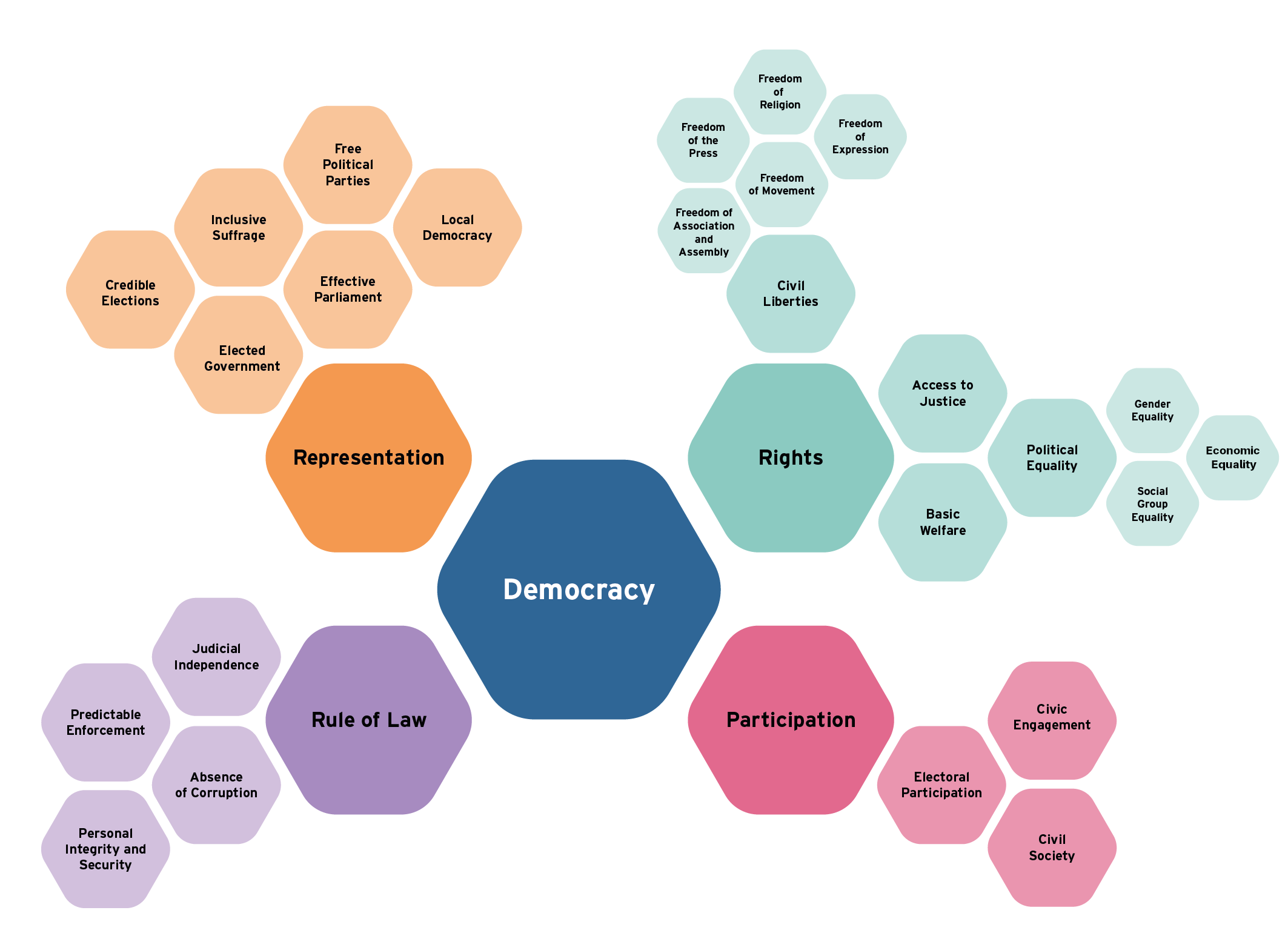
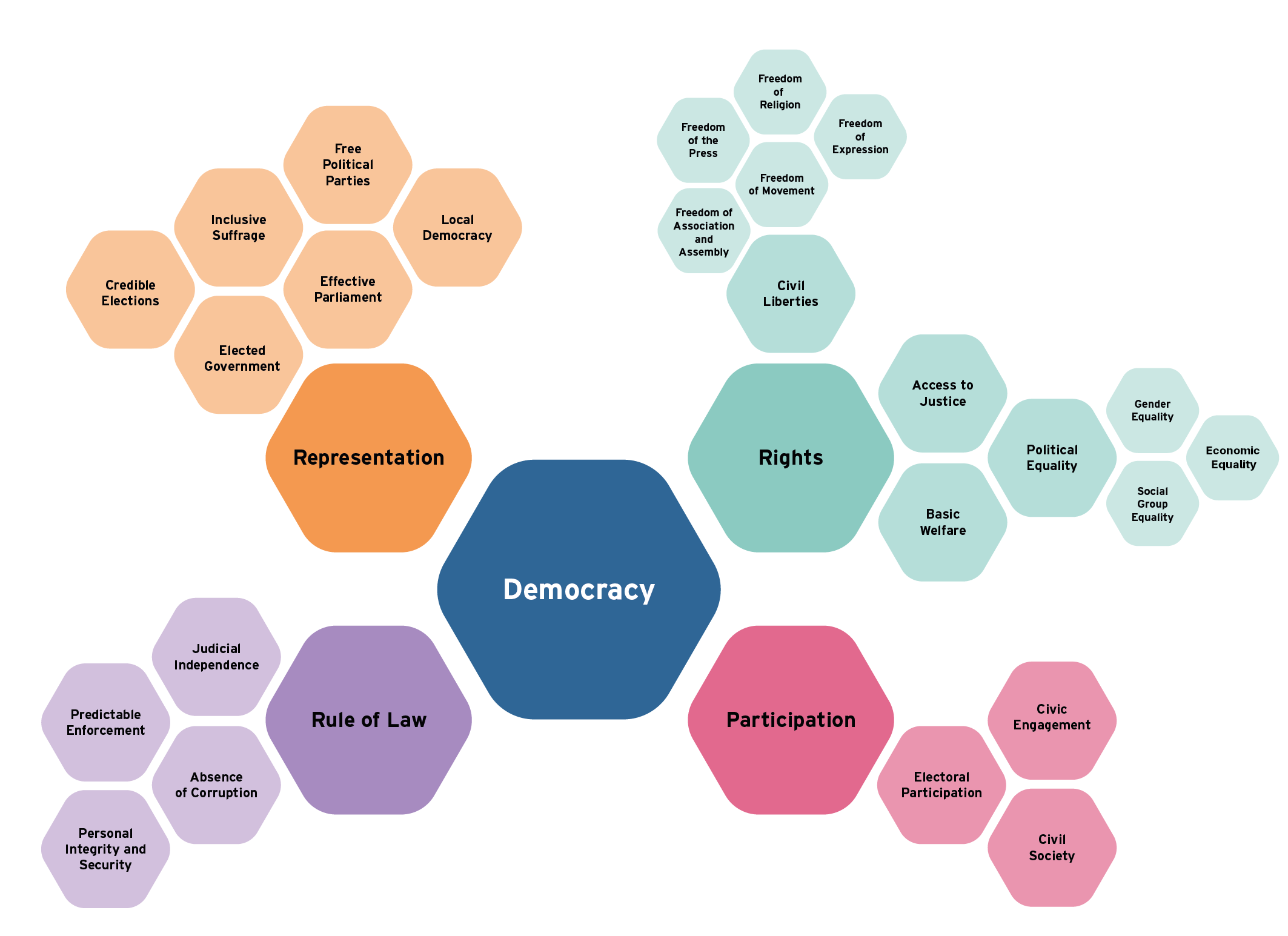
Solomon Islands exhibits mid-range performance across all categories of the Global State of Democracy Framework. The country falls within the top 25 per cent of the world’s countries with regard to Credible Elections, Elected Government, Free Political Parties, Access to Justice, Personal Integrity and Security, and Judicial Independence. At the same time, it is among the bottom 25 per cent in the world when it comes to Basic Welfare, Economic Equality and Gender Equality. Over the last five years, it has made significant advances in Access to Justice. The country’s economy is driven by the agriculture, forestry and fisheries industries, although over 80 per cent of the population relies on subsistence agriculture. The archipelago consists of 992 islands, with two-thirds of the population living on the largest islands of Malaita and Guadalcanal. Seventy-five per cent of the islands’ people live in rural areas. Solomon Islands also has the lowest per capita income in the Pacific Region.
The ‘British Solomon Islands Protectorate’ was established in 1893, although European presence and exertion of power had begun by the beginning of the nineteenth century. After approximately two decades of struggle, the country was granted independence in 1978. The population is largely indigenous Melanesian, with small Chinese, European, Micronesian and Polynesian minorities. Between 1998 and 2003, the country suffered from a low-intensity civil conflict known as “The Tensions” in which 200 died, 20,000 were displaced, and rape, gender-based violence, and other human rights violations were widespread. The conflict was fuelled by various intercommunal grievances, ethnic tensions, economic precarity, and contested inter-island migration. International peacekeepers departed finally in 2013, but intermittent violence has continued, pointing to unresolved issues over power-sharing and disagreements over peacebuilding processes. Issues related to land ownership, the unequal distribution of economic opportunities across the islands and youth frustration over the lack of employment opportunities persist.
Clientelist politics have also been a key driver of poor governance. Public dissatisfaction with and mistrust in the legitimacy of elections, the lack of a strong party system, issues with transparency and corruption in public affairs and social tensions over growing Chinese influence have led to sporadic anti-government riots. Geopolitics has also impacted political cleavages, with riots erupting in 2021 when the government switched its diplomatic recognition from Taiwan to China, exacerbating tensions between the central government and Malaita, which had received extensive support from Taipei.
Despite recent gains, Gender Equality remains weak in the country: patriarchal customary law is exempt from constitutional anti-discrimination measures and women struggle to be politically represented. only three of fifty parliamentarians are women. Moreover, the country has one of the highest rates of sexual violence in the world.
Looking ahead, it will be important to watch improvements in Gender Equality and how the new relationship with China impacts politics in the Solomon Islands, especially as Malaita is moving towards China. The country remains a site of geopolitical contestation between China and Australia and the United States. The increased influence of foreign powers may also have significant consequences for the internal security of the country and may impact independence demands from the poverty-stricken and under-resourced island of Malaita. The country is also at increasingly high-risk to rising seas and more powerful tropical storms due to climate change, which also further complicates tensions about land allocation.
Last updated: June 2025
https://www.idea.int/democracytracker/
May 2026
Prime Minister Manele ousted in confidence vote after lengthy standoff
On 7 May 2026, Solomon Islands Prime Minister Jeremiah Manele lost a parliamentary vote of no confidence by 26 votes to 22 after months of coalition fragmentation, ministerial resignations, and disputes over governance and accountability. Manele had refused to convene parliament for nearly two months in an attempt to prevent the vote, precipitating a potential constitutional crisis. However, he complied with a 1 May Court of Appeal ruling that he either resign or convene parliament by 7 May. Parliament elected Matthew Wale his successor on 15 May.
Sources: Asia Pacific Report, Lowy Institute, Solomon Islands Gazette, The Guardian, France 24, International IDEA




March 2026
Prime Minister refuses to convene parliament
In March 2026, Solomon Islands entered a constitutional impasse after Prime Minister Jeremiah Manele responded to the resignation or defection to the opposition of 19 MPs, including cabinet ministers, by refusing to convene Parliament. The move allows Manele to continue governing and avoid a convened parliament voting to remove him or calling new elections. Manele now has the apparent backing of only 11 of 50 MPs in parliament, and a new opposition coalition comprising a majority of the MPs filed a High Court challenge arguing the Prime Minister is constitutionally required to convene parliament within a reasonable time. On 31 March, the High Court indicated it would move quickly and considered the case a matter of national importance.
Sources: Radio New Zealand (1), Pacific Media Network , Solomon Star , Radio New Zealand (2)

October 2024
Former provincial leader arrested and charged over 2021 protests

On 3 October, Solomon Islands police arrested and charged the former premier of the Malaita province Daniel Suidani and his advisor Celsus Talifilu with instigating unlawful assemblies and protests in the province capital Auki in November 2021. Suidani has been an open critic of the Solomon Islands’ political cooperation with China, and in 2023 was prevented from taking a seat in the Malaita Provincial Assembly because of his refusal to publicly stand behind the central government’s decision to switch diplomatic recognition from Taiwan to China. While protests in Malaita remained peaceful, at the time protesters who travelled to the capital of Honiara stormed parliament and set several buildings and businesses on fire. Suidani claims he is being charged due to his openly critical view of the government’s switch of diplomatic recognition from Taiwan to China. Suidani’s escalating conflict with the central government is potentially volatile, given his popularity in Malaita and the strong sense of the island being overlooked or slighted by the national government in Guadalcanal that has periodically erupted into violence.
Sources: Radio New Zealand, BBC, In Depth Solomons, Solomon Business Online

April 2024
Manele succeeds Sogavare as Prime Minister

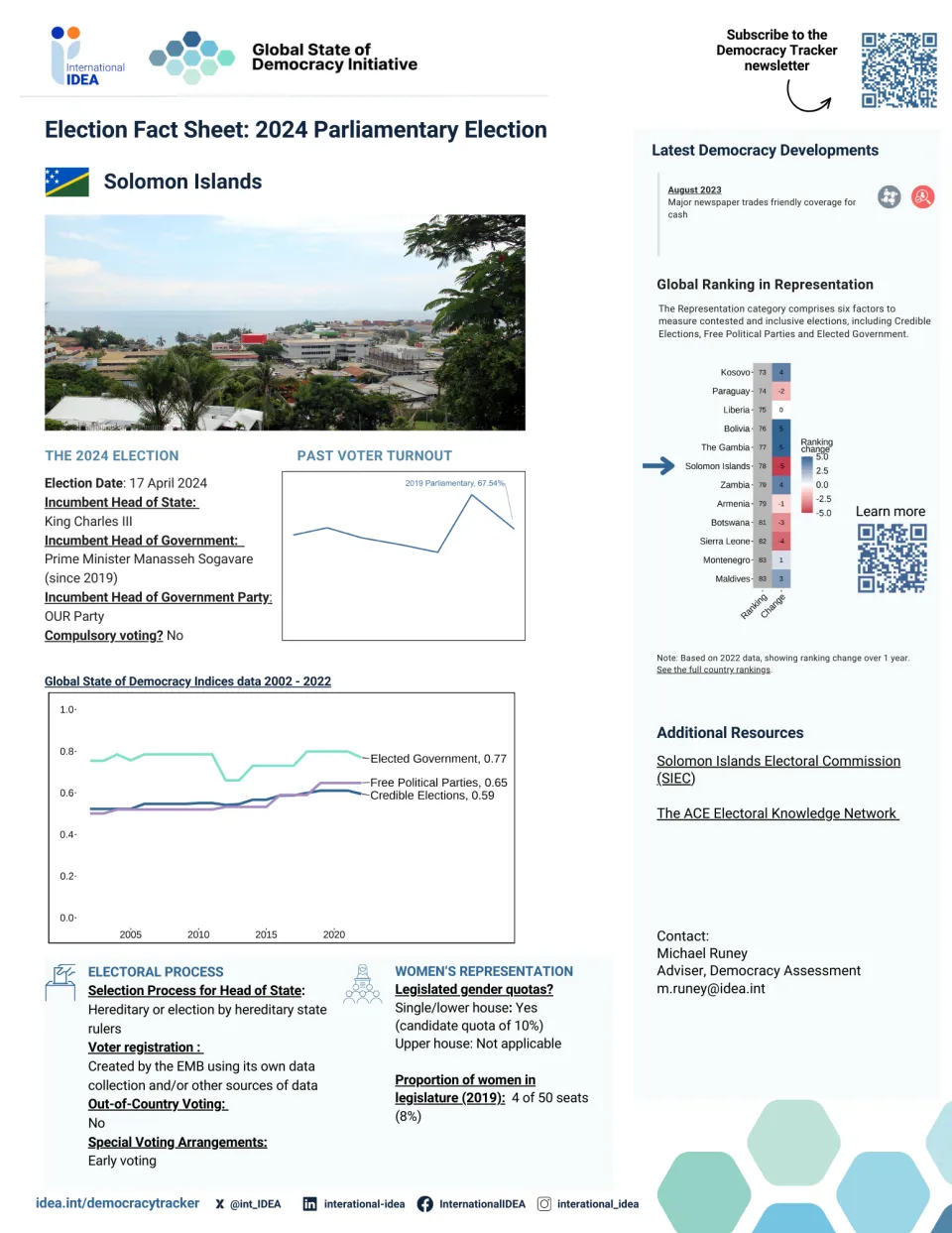
The Solomon Islands held a general election on 17 April in which incumbent Prime Minister Manasseh Sogavare’s OUR Party secured a plurality with 15 of 50 seats in parliament. Sogavare announced during coalition-building negotiations that he would not seek another term and resign as the head of his party in favour of Jeremiah Manele, who then secured sufficient support from the 21 independent MPs to win the secret-ballot parliamentary nomination for prime minister on 2 May. While international observers focused on the role of China in the election -as Sogavare switched recognition from Taiwan to Beijing in 2019 -, locally economic concerns were paramount. Zero women were elected to parliament, down from four in the previous sitting. Turnout was 82 per cent, up from 68 per cent in the 2019 elections. Elections were originally planned for 2023, but Sogavare had claimed that the country could not hold an election and host the Pacific Games in the same year.
Sources: al Jazeera, Reuters, Solomon Islands Election Commission
Increased voter turnout for parliamentary election
Solomon Islands general elections saw a decrease in women's representation in parliament and an increase in voter turnout from the previous elections. Three women were elected to parliament, down from four in the previous sitting. Turnout was 82 per cent, up from 68 per cent in the 2019 elections.
Sources: al Jazeera, Reuters, Solomon Islands Election Commission


See all event reports for this country
Global ranking per category of democratic performance in 2025

Basic Information

Human Rights Treaties
 State party
 Signatory
 No action
Performance by category over the last 6 months


Election factsheets
Global State of Democracy Indices
Hover over the trend lines to see the exact data points across the years


Factors of Democratic Performance Over Time
Use the slider below to see how democratic performance has changed over time