

Azerbaijan
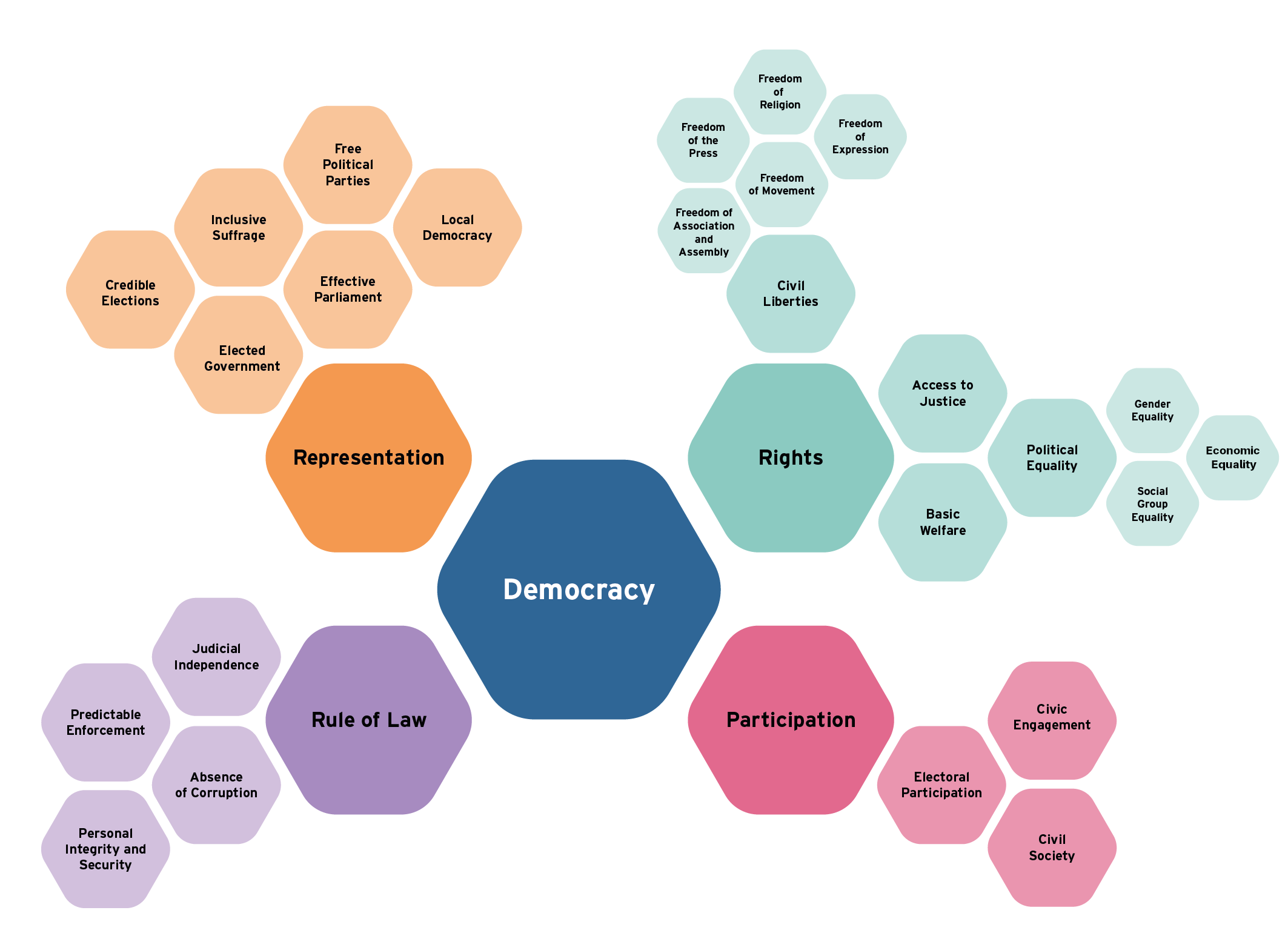
Azerbaijan exhibits low performance in all four categories in the Global State of Democracy (GSoD) framework, and is in the bottom 25 per cent globally in most factors. It has not experienced a significant decline or advance over the past five years. The country’s government and economy have largely been controlled by the family and close associates of Presidents Heydar (1993-2003) and Ilham Aliyev (2003-present). A major player in the oil industry since the 19th century, Azerbaijan’s economy is dependent on petrochemical exports and industries that allow elites to recycle petrodollars domestically, such as in construction.
The country’s defining political issue, dating back to its time as a part of the Soviet Union, has been the status of Nagorno-Karabakh, an ethnic Armenian enclave over which Azerbaijan fought two wars with neighboring Armenia before ethnically cleansing the Armenian population, disestablishing the de facto Nagorno-Karabakh Republic, and reintegrating the region in late 2023. The First Nagorno-Karabakh War arose out of a movement for Karabakh Armenian independence during perestroika, which escalated into intercommunal violence, pogroms, and attacks on civilians. The war ended in an Azerbaijani defeat, widespread ethnic cleansing and population transfers, tens of thousands of deaths, the displacement of over one million Armenians and Azerbaijanis, and the formation of the Nagorno-Karabakh Republic.
Although it historically hosted large Russian, Armenian, Talysh, Jewish, and other minorities, wartime population transfers, outmigration, and assimilation have created a modern Azerbaijan that is over 90 per cent ethnic Azerbaijani; though nearly entirely Muslim, religion has historically played little role in Azerbaijani politics, a trend strengthened by the arising of a distinct secular Azerbaijani identity in the early twentieth century and the intentional ‘de-Islamization’ of public life under the Soviet Union. After decades of personalized authoritarian rule, much of the population is depoliticized, although small, but heavily suppressed opposition parties such as the national-conservative Popular Front Party, the pan-Turkist Musavat, and Shi’a Islamist Muslim Unity Movement maintain committed followings.
The pre-Soviet Azerbaijan Democratic Republic was the first Musilm-majority country to enfranchise women in 1918 and since independence in 1991 equal rights have been guaranteed by law. However, gender violence and inequalities manifest in education, employment, and political participation and continue to negatively impact women. Furthermore, the increased visibility of feminist and LGBTQIA+ activists in recent years has been met with a violent backlash.
An influx of petrochemical wealth from the late 1990s through the mid-2000s following the construction of the Baku-Tbilisi-Ceyhan (BTC) oil pipeline and the discovery of the Shah Deniz gas field enabled the ruling elite to entrench complete political and economic control over the country. Political opposition movements, human rights activists, and independent journalists are frequently jailed and persecuted, and election outcomes are preordained. In 2025, the government began shutting down international media outlets and organizations, such as the Red Cross, operating in the country as well. Numerous bribery, embezzlement, and grand corruption scandals continue to taint the regime.
Looking forward, Shifting regional politics may lessen pressure on Azerbaijan to pay lip service to democratic norms, and recent years have seen the return of arbitrary prosecutions of journalists, civil society activists and opposition politicians. As a result Civil Liberties and Access to Justice scores are likely to decline in next several years. However, Freedom of Movement would increase if the country were to open its land borders – closed in 2020 as a Covid-19 protective measure but as of may 2025 not yet reopened - to civilian traffic.
Updated: May 2025
https://www.idea.int/democracytracker/
July 2026
Azerbaijan imprisons independent journalists in Toplum TV case
On 28 July 2026, the Baku Grave Crimes Court sentenced nine journalists and media workers affiliated with independent outlet Toplum TV and its partner organizations to prison terms of between 12 and 15 years. The sentences are the harshest since the current crackdown on independent media, which has ensnared dozens of journalists, bloggers, and activists, began in 2023. The charges were related to currency smuggling and other financial crimes and are widely held to be politically motivated retaliation for critical reporting. Most major media outlets are already under state influence or face significant restrictions.
Sources: Human Rights Watch ,Associated Press, OC Media



May 2026
Azerbaijan opens first land border crossing since 2020
The Azerbaijani Government resumed passenger rail services between Azerbaijan and Georgia on 26 May, marking the first reopening of a land-border crossing to non-freight traffic since pandemic-era restrictions were introduced in 2020. All other land border crossings remain closed. The measure allows for reunification for citizens and the hundreds of thousands of ethnic Azeris and Azerbaijani citizens living in Georgia, and constitutes a partial expansion of freedom of movement and a relaxation of a policy long criticized by activists and the affected communities. President Ilham Aliyev admitted in 2025 that quarantine policies remained in place not for public health reasons, but for unspecified security measures.
Sources: EurasiaNet, Anewz.com

December 2025
Baku police arrest over 100 LGBTQIA+ club patrons
Police in Baku raided a club on 27 December frequented by the LGBTQIA+ community and arrested 106 individuals. Those arrested were subjected by police to physical and psychological abuse and extortion. Several also reported being threatened with sexual assault. LGBTQIA+ advocates said the arrests were intended to exert control over social groups that are seen as outside the norms of mainstream Azerbaijani society. Police said the raid was in response to allegations of drug use, but police did not report discovering any narcotics. Those detained were sentenced to 15 to 30 days of administrative detention or fined for offenses such as smoking indoors. A raid similar in kind and scale was carried out in 2017, and a case at the European Court of Human Rights on behalf of its victims was dismissed by the Court in 2024 after the Azerbaijani government admitted guilt, agreed to pay damages, and pledged reforms.
Sources: Caucasian Knot, Jam News, Human Rights Watch

Internal Troops to report directly to President Aliyev
The law ‘On the Internal Troops of the Republic of Azerbaijan,’ approved by the Milli Majlis (National Assembly) on 9 December, transferred the direct control of the Internal Troops from the Ministry of the Interior to President Ilham Aliyev. President Aliyev signed the law on 25 December. The Troops are responsible for internal security and public order in the country and are a military, rather than police, body. The new law grants the Internal Troops the authority to arrest and detain suspects and investigate crimes, disperse demonstrations with force, and expands the list of situations where they may use lethal and non-lethal force. The changes further centralize power in the hands of the president and, critics say, provide the president with a personal police force that can be used to violently put down protests or any other internal challenges to his authority. Government officials dismissed these concerns, saying the changes are part of ‘necessary modernizations’ of the country’s security forces.
Sources; Jam News, Report.az, Ministry of Justice of Azerbaijan
March 2025
International organizations told to close offices and civil society pressured
The Azerbaijani government arrested, interrogated, and publicly accused many civil society activists and development workers of ‘acting against state interests’ in March. Country offices for United Nations organizations, the Red Cross, and more were ordered to close. The heads of two civil society organisations were placed in pre-trial detention on charges of illegally implementing foreign-funded grant projects, and many others were pressured or interrogated on similar charges for foreign-funded work that had been properly registered with the government at the time. Government spokespeople also said the work of international organizations is no longer needed due to the country’s economic development, but that some work would continue on a project-by-project basis. Media reports indicated the reason for the closures may instead be the reluctance of international officials to make official visits to the territories in Nagorno-Karabakh over which Azerbaijan gained control in 2020 and 2023.
Sources: OC Media (1), OC Media (2), Turkiye Today, World Bank

See all event reports for this country
Global ranking per category of democratic performance in 2025

Basic Information

Human Rights Treaties
 State party
 Signatory
 No action
Performance by category over the last 6 months


Election factsheets
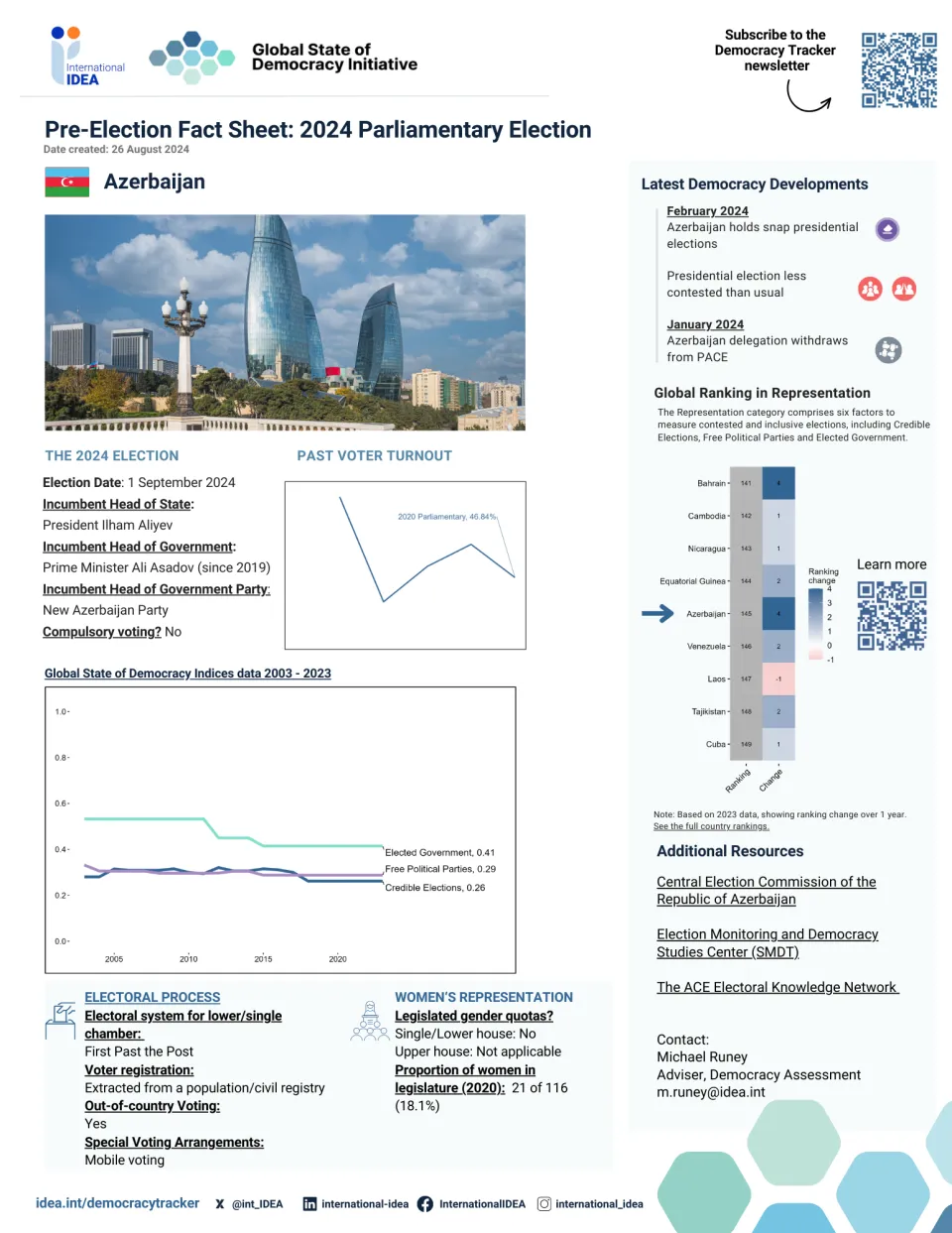
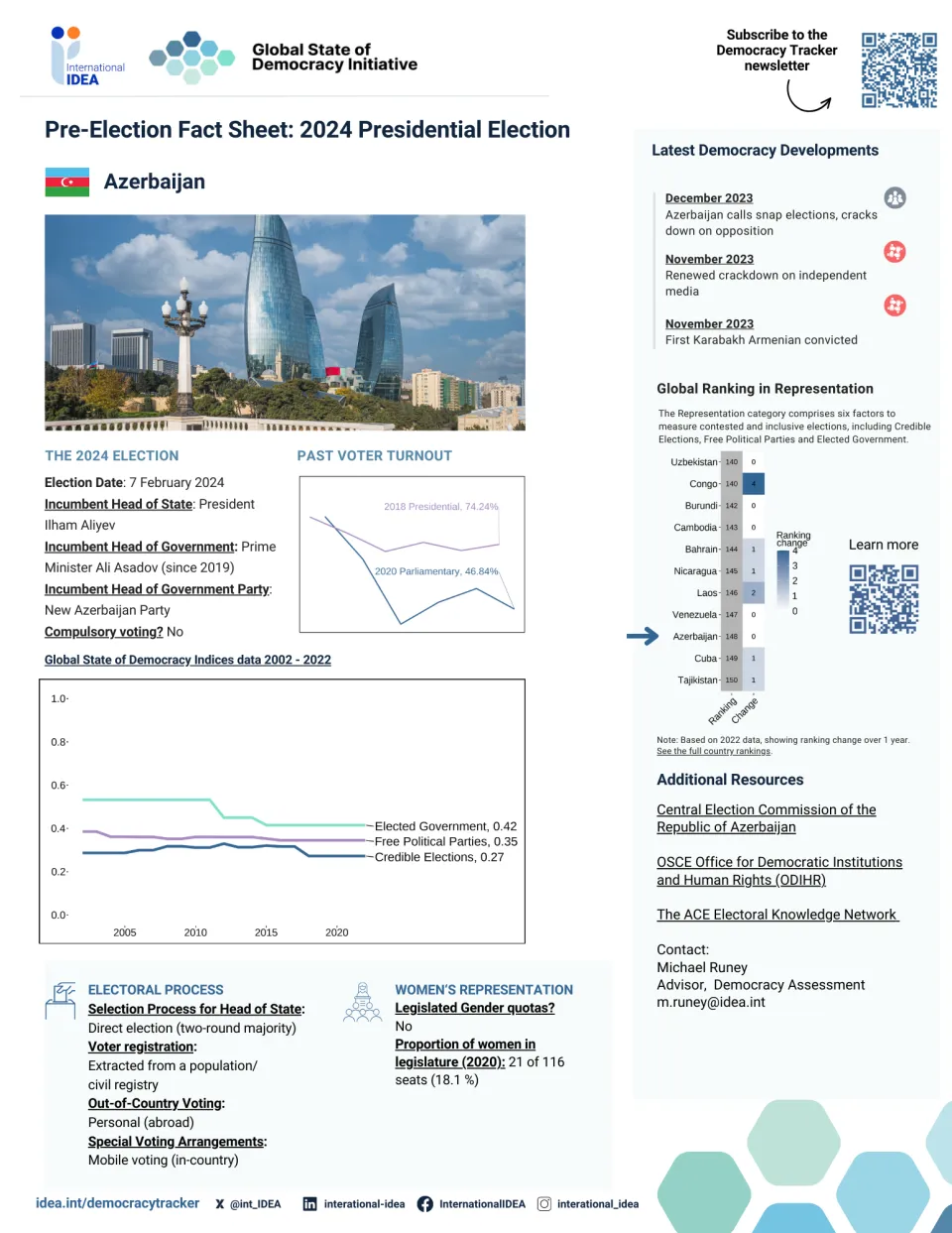
Global State of Democracy Indices
Hover over the trend lines to see the exact data points across the years


Factors of Democratic Performance Over Time
Use the slider below to see how democratic performance has changed over time