

Russian Federation
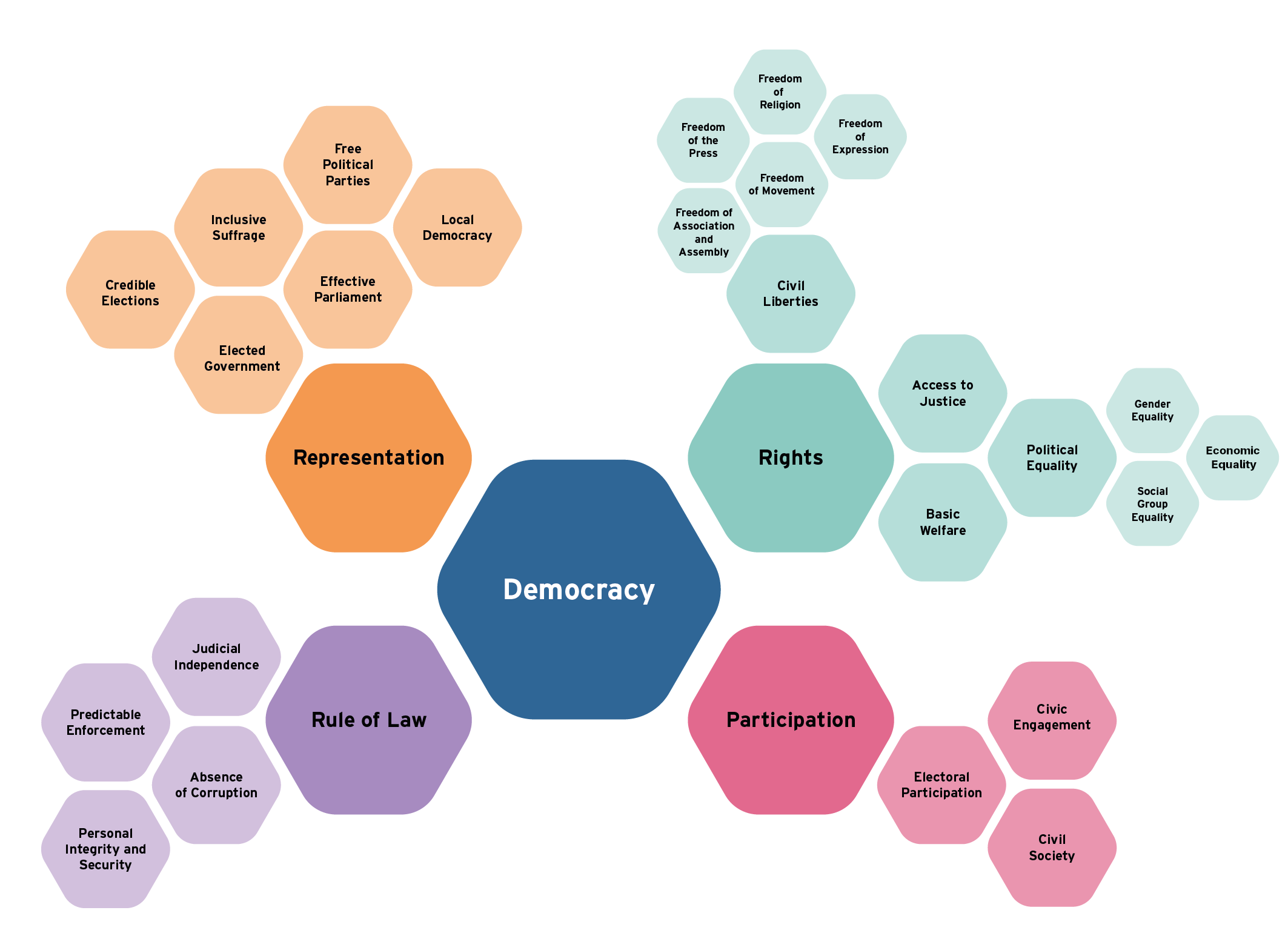
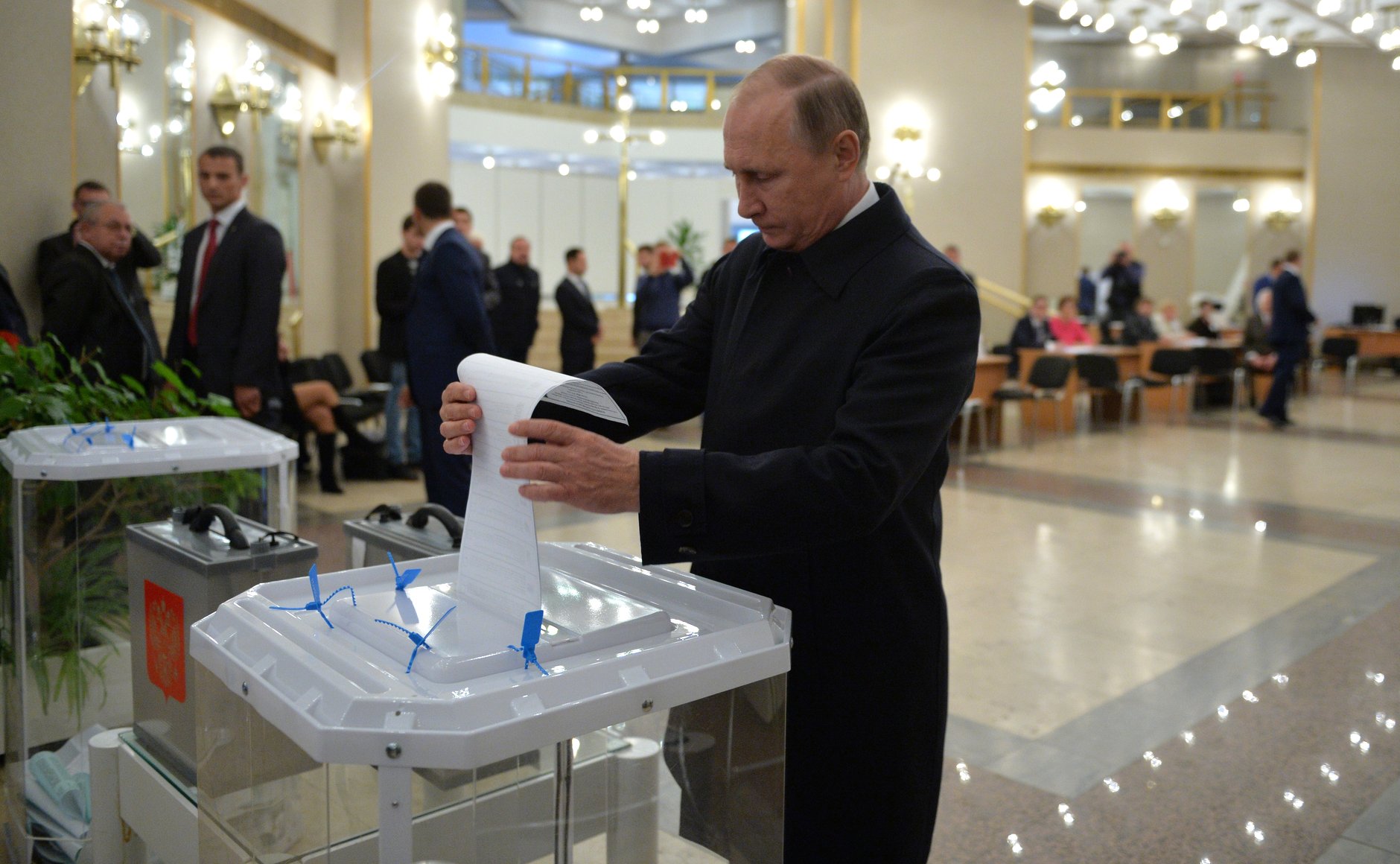
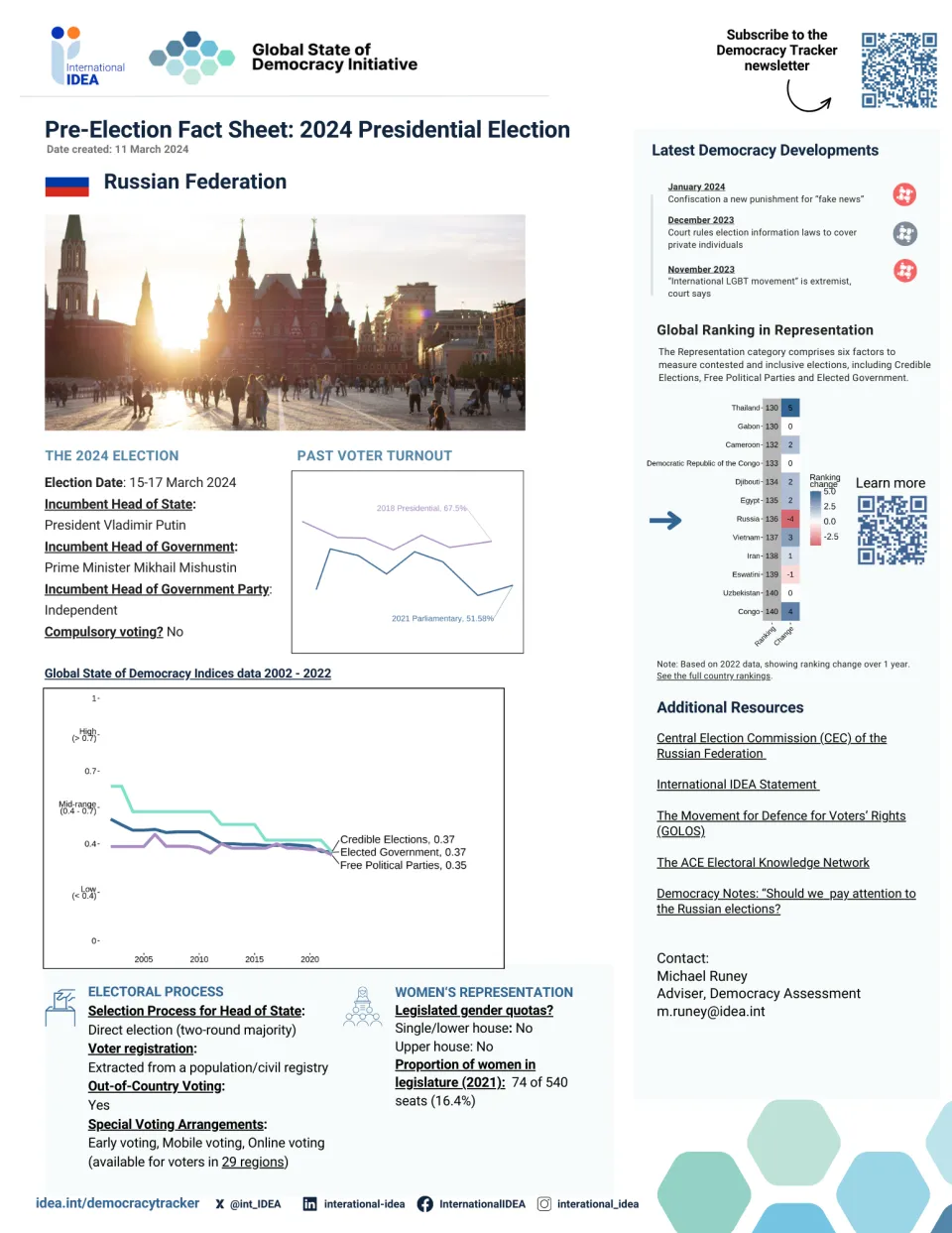
Russia performs in the low range across all Global State of Democracy (GSoD) categories of democracy. It falls in the bottom 25 per cent of the world with regard to several factors of Representation, Rights, Rule of Law and Participation. In the last five years, it has experienced significant declines in seven factors of democratic performance, including Civil Liberties, Credible Elections, Political Equality and Civil Society. Russia is an upper middle income country, heavily dependent on hydrocarbon and mineral exports. In more than two decades under President Vladimir Putin, the country has deteriorated from a heavily flawed democracy to an authoritarian police state.
In 2014, Russia responded to the Ukrainian Revolution of Dignity by launching a proxy war in the country’s east and illegally annexing the Crimean peninsula. In February 2022, Russia launched a full-scale invasion of Ukraine. Western nations responded with wide-ranging sanctions that have seriously damaged, but not crippled, the Russian economy, and the Russian state responded by cracking down on any and all independent civil society activity, antiwar protest, and remaining media freedom.
Russia is the largest country on earth by land area and a complex multi-confessional and multi-ethnic society, composing roughly four broad socioeconomic groups: Westernized and wealthy urban centers, mid-sized towns and cities dependent on state or major industrial employment, isolated and economically precarious villages, and “ethnic republics” that are a mix of the previous two groupings. In President Putin’s two decades in power, these “four Russias” were controlled through what the Kremlin euphemistically referred to as “managed democracy,” which in turn produced an increasingly personalized leadership system and the progressive depoliticization of various parts of Russian society. The persistence of the current political system lies in its ability to reward and discipline various parts of Russian society through the depoliticization of most spheres of life, the stoking of nationalist-conservative sentiment, the maintenance of an encompassing propaganda apparatus, and repressive and deadly violence. In recent years, the sticks of repression and more overt control and censorship of the media and internet become core tools of governance, culminating in the wide-ranging crackdown on even mild dissent and the suspicious death of opposition leader Alexei Navalny in a prison camp in February 2024
While the GSoD Indices data show that Russia’s performance on gender equality has been static (at mid-range) for the past several decades, the increasing repression has likely impacted the state of equality. Despite equality guaranteed by law, studies indicate an increase in gender inequality in recent years due to lack of a clear state policy and propaganda that reinforces patriarchal attitudes, making women more vulnerable to violence, discrimination, and lack of political opportunities.
Russia’s political trajectory in the years to come will be determined by the fate of its war on Ukraine, as victory of some sort has become a question not of national, but of regime security.
Barring a clear end to the war, potential elite fractures and the slowly increasing cost of international sanctions may lead to a chaotic breakdown of the current government system. However, the closing-off of public information spaces makes ascertaining the course of public opinion nearly impossible . All feasible outcomes point towards significant declines across measures of democracy as the country continues to depart further from the rule of law in order to maintain its war effort.
Updated: May 2025
https://www.idea.int/democracytracker/
November 2025
Persecuted rock band flees to Armenia
All members of a St. Petersburg rock band, Stoptime, were sentenced to repeated periods of administrative detention in October and November for performing songs by artists the state considers ‘foreign agents’. The band had performed street concerts for years without permits but had not been threatened with arrest until videos of their performances began to be shared widely on Russian social media. The case marks a new level of restrictions on speech in modern Russia, as the street musicians have neither taken any political stances nor played political songs. It remains unclear what specific actions the state considers sufficient to have warranted this action, and the lack of clarity marks a deepening of an already restricted space for free speech. Diana Loginova, Alexander Orlov and Vladislav Leontiev were first sentenced to 12- or 13-days imprisonment for ‘organizing a rally that causes public disorder,’ and then re-arrested and sentenced on different administrative charges twice more immediately upon exiting the city jail. Criminal charges of ‘discrediting the military’ were filed against all three in November, but on 23 November all three were not subjected to rearrest and successfully traveled to Armenia.
Sources: Meduza, Mezha, Amnesty International



October 2025
Report shows murder, torture to be tools of discipline in Russian army
The investigative journalism outlet Verstka has identified 101 Russian military officers who have been involved in torturing, murdering or sending soldiers under their command who are considered disobedient on suicide missions. Referred to as ‘zeroing out’ in the Russian military, Verstka reports its sources in the Main Military Prosecutor’s Office claim that there is an unstated ban on investigating such incidents while Russia’s war on Ukraine continues, and that the office has received almost 12,000 formal complaints related to ‘zeroing out’ since the war began. The scale of the findings indicates that the unofficial ban on investigations has led to the murder and torture of soldiers as a form of discipline to become normalized in combat positions. Another media outlet, Vot Tak, has separately confirmed more than half of Verstka’s findings.
Sources: Verstka, Moscow Times, Vot Tak

September 2025
Russian ministry blocks calls in popular messaging apps
The Russian communications agency Roscomnadzor began blocking all calls made on WhatsApp and Telegram, the country’s two most popular messaging apps, claiming both companies fail to comply with a law requiring that Russian users’ data be kept in the country. Simultaneously, the government has launched an ‘everything app’ modeled after China’s WeChat, Max, as a replacement. Max is not encrypted or anonymous, requires a Belarusian or Russian phone number, and collects extensive user data. Some security experts and ordinary Russians believe it is intended as a tool for mass surveillance. All phones sold in the country from 1 September must by law have the app installed. The block has triggered small protests around the country, media reports of which are unusual in wartime Russia. Both WhatsApp and Telegram are used by a large majority of Russians to manage their everyday affairs.
Russia withdraws from European convention on torture
President Vladimir Putin signed into law Russia’s withdrawal from the European Convention for the Prevention of Torture and Inhuman or Degrading Treatment or Punishment on 29 September. Russian officials said the move was a response to the Council of Europe’s ‘blocking’ Russian members from joining the European Committee for the Prevention of Torture. As a result, Russia will no longer permit international inspectors access to its detention centers, something that anti-torture activists say will lead to a degradation of prison conditions. Members of the Committee conducted thirty visits to Russian prisons and detention centers since Russia ratified the treaty in 1998, although as disclosure requires the approval of the host government, only four were publicly published.
Sources: European External Action Service, Meduza
August 2025
New law penalizes ‘extremist’ internet searches
A Russian law in effect from 1 September introduces penalties for deliberately searching the Internet for content the Russian government considers ‘extremist’ and for violating new rules on the usage of VPNs. The former offense is punishable with fines of up to RUB 5,000 (USD 60), and the latter with fines of RUB 80,000 to RUB 500,000 (USD 1,000 to USD 6,000) for individuals and businesses, respectively. Russia’s legal definition of extremist content is broad, and includes literature depicting same-sex relationships, social media activity by opposition political parties, content from independent media outlets and human rights groups, religious materials from Jehovah’s Witnesses, and more.
Sources: Meduza, Official Internet Portal for Legal Information
Update: Sergei Glukhikh, a medical student in the Ural town of of Kamensk-Uralsky, became the first person prosecuted under the law. Glukhikh searched for information about Ukraine’s Azov Battalion and a pro-Ukrainian Russian paramilitary group, by his account to remind himself who these organizations were, after coming across pictures of their insignias while reading on his phone. He was detained by agents of the Federal Security Service (FSB) three hours later, reportedly because his telecommunications operator immediately informed the FSB of his search
See all event reports for this country
Global ranking per category of democratic performance in 2024

Basic Information

Human Rights Treaties
 State party
 Signatory
 No action
Performance by category over the last 6 months


Global State of Democracy Indices
Hover over the trend lines to see the exact data points across the years


Factors of Democratic Performance Over Time
Use the slider below to see how democratic performance has changed over time