Russia - 2000 - Presidential Election
Russia’s political landscape in the late 1990s and early 2000s was marked by both the economic crisis that followed the collapse of the Soviet Union and hope among western powers as to what a new era of Russian democracy would look like. The 1998 financial collapse, rising social unrest, and a fragmented party system eroded confidence in President Boris Yeltsin’s leadership, while oligarchic networks and Kremlin insiders vied to shape the succession. The meteoric rise of the pro-Kremlin “Unity” party in the 1999 State Duma elections helped transform Putin, then a little-known former security official appointed prime minister in August, into the preferred strongman, presented as a guarantor of order and stability. Yeltsin’s surprise resignation on December 31, 1999, elevated Putin to acting president just months before the March 2000 election, allowing him to leverage incumbency, favorable media coverage, and wartime rhetoric to win in the first round and inaugurate a more centralized, controlled political system.
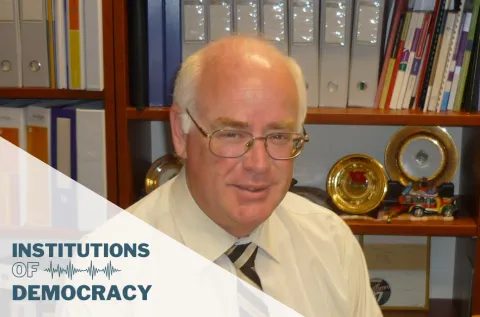
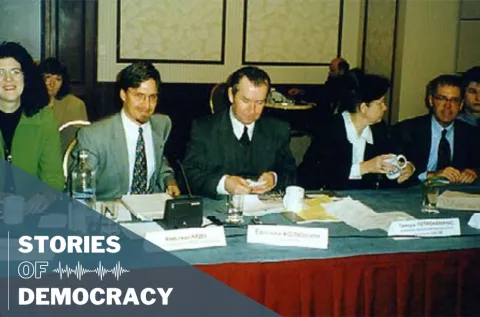
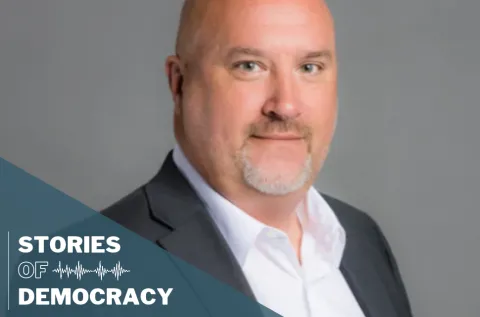
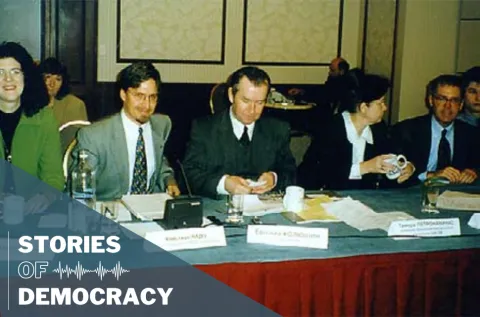
In this recording, Christian Nadeau discusses his experiences working for the International Foundation of Electoral Systems (IFES) in Russia from 1997 to 2001. During Mr. Nadeau’s tenure in Russia, he witnessed both the State Duma elections of 1999 and the presidential election of 2000, efforts to bring transparency to the Russian election system, the creation of the Institute for Elections in Moscow, and many other challenges to free and fair elections. In addition, he discusses the difficulty of doing election work in a highly controlled environment, under the evident observation of Russian intelligence operatives.
Christian Nadeau is an attorney and member of the Canadian Bar with extensive experience in international election law and democratic governance. From 1993 to 2001, he worked across Latin America, Africa, and Russia as a manager and election law expert, supporting democratic transitions and advising governments on electoral processes. From 1997 to 2001, he directed the Moscow office of the International Foundation for Electoral Systems (IFES), overseeing electoral legal reforms, administrator training, and a wide body of IFES publications documenting Russia’s evolving electoral framework. His contributions remain recognized within IFES alumni's features for strengthening election institutions during a critical post‑Soviet period. Mr. Nadeau’s focus was on campaign finance, election integrity, and media access during this time in Russia at both the Federal and provincial (Oblast) level.
In addition to his IFES leadership, Christian consulted for various governments and collaborated with major international organizations, including the Organization of American States (OAS) and the United Nations, contributing legal and technical expertise to election system development & observation in over 25 countries.
Since 2006, Christian has been the President & Founder of EcoDomo, a sustainable biomaterials company serving the architecture and design industry with innovative recycled‑leather surfaces.
Media