Maldives - 2008 - Presidential Election
After three decades of increasingly personalized and authoritarian rule under President Maumoon Abdul Gayoom, the Maldives entered 2008 amid mounting domestic and international pressure for democratic reform. That year, a new constitution—ratified in August—laid the legal foundation for multi-party competition by strengthening civil liberties, clarifying the separation of powers, and, crucially, creating an independent Elections Commission.
Once the new Elections Commission was sworn in, the country moved into an extraordinarily compressed 34-day period in which it had to draft regulations, finalize voter lists, register parties and candidates, and put in place procedures for the first genuinely competitive presidential election in Maldivian history. Despite the rushed timeline and the advantages of incumbency enjoyed by Gayoom, the opposition coalesced around long-time dissident Mohamed Nasheed, whose campaign linked demands for political liberalization with socioeconomic grievances and governance reform. The resulting two-round election not only ended Gayoom’s 30-year rule but also tested, in real time, whether the hastily implemented constitutional reforms and new electoral institutions were robust enough to deliver a peaceful transfer of power—making the 2008 contest both the centerpiece and the proving ground of the Maldives’ democratic transition.
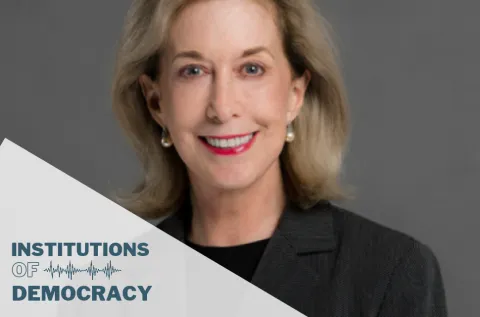
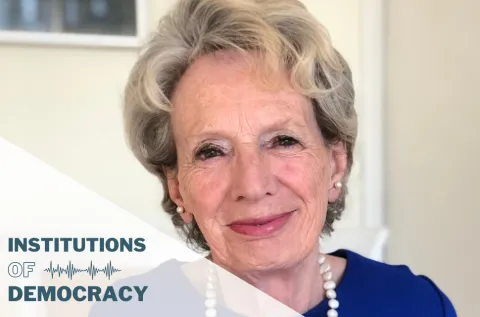
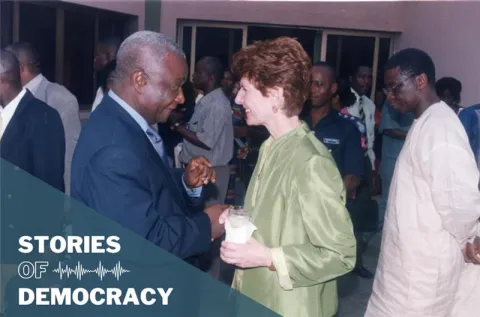
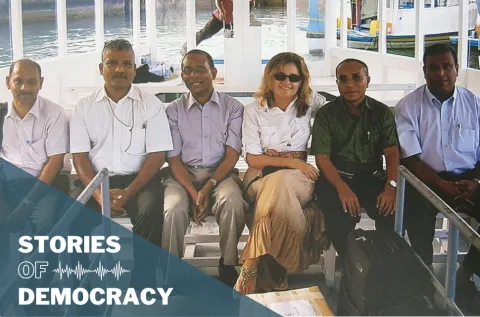
In this recording, Renata Tardioli recalls her experiences as a legal advisor to the Maldivian authorities during the 2008 election. Sent to the Maldives at the beginning of 2008 by the European Union, Renata offered technical assistance to the burgeoning democracy as they worked to implement a newly ratified constitution, including the establishment of an independent election commission and the drafting of laws and procedures related to the election commission. She additionally discusses the many logistical challenges associated with the October 2008 election, from incomplete voter rolls to a challenging time crunch to the expected difficulties of running an election in a country made up of 187 unique inhabited islands.
Renata Tardioli has a long and extensive experience in the electoral field in both observation, expert teams and technical assistance. She participated in over 50 electoral missions, word-wide and served in various capacities in different international organizations including the EU, OSCE/ODIHR, UN and IFES.
Among the recent missions undertaken, she was the Legal Expert/Analyst in observation missions to Lesotho, Ghana and the Maldives and the ODIHR Legal Analyst in Ireland, Bulgaria, Slovenia, Mongolia and the Netherlands and the Senior Legal Review Expert in Albania.
Renata attended various EODS trainings and seminars including the recent Advanced training on Campaign Finance in March 2024, Online Training on Recommendations and Follow-up, Seminar for Election Analyst, Seminar for Senior Legal Analysts; Training on Election Disputes Resolution and International Obligations and NEEDS (Network for Enhanced Electoral and Democratic Support) training for Deputy Chief Observer (DCO) in EOMs.
Renata has also worked, among others, for International IDEA in Sweden, the UN Department of Economic and Social Affairs, the United Nations High Commissioner for Refugees in Rome, and for the Leadership Academy of the UN University in Amman, Jordan.
Renata holds a Degree in Law (University of Perugia) and a Master (MPhil) in International Relations from University of Cambridge in the United Kingdom.
Media