Marshall Islands -1978 - Constitutional Referendum
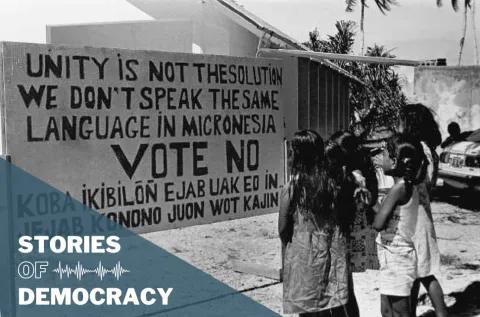
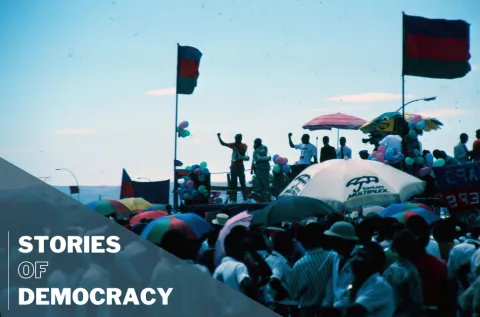
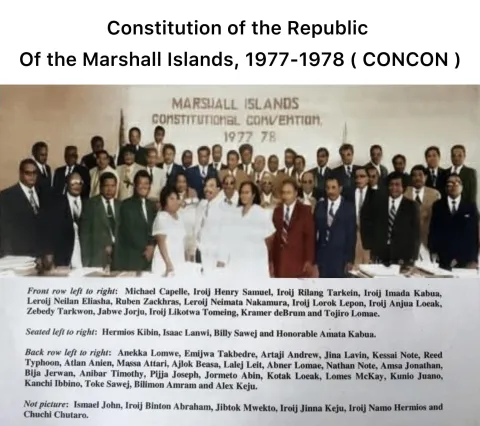
In the late 1970s, as the Trust Territory of the Pacific Islands moved toward disaggregation and new status arrangements, the Marshall Islands confronted a pivotal choice about their political future. In 1978, Marshallese voters participated in a territory-wide constitutional referendum that proposed a unified Federated States of Micronesia, but a majority in the Marshalls rejected the draft, signaling their desire to chart a separate path. This decision opened the way for Marshall Islands leaders to negotiate their own constitution and ultimately a Compact of Free Association with the United States, laying the institutional foundations for an independent Marshallese state.
In this recording, Ben Kiluwe, current Chief Electoral Officer at the Republic of the Marshall Islands, recalls his experiences as a child in the Marshall Islands when the referendum first took place.
Benjamin Kiluwe’s life reflects a steadfast commitment to service, faith, and leadership in the Republic of the Marshall Islands. He currently leads the Republic of the Marshall Islands Electoral Administration, ensuring statutory compliance, operational planning, and transparent public outreach. His work embodies participatory governance and cultural stewardship, safeguarding the democratic process for future generations.
His career in public service reflects a steady progression through key institutions: Assistant Clerk of Courts, RMI Judiciary (1999–2004), Trial Assistant, RMI Public Defender’s Office (2005–2009), Trial Counsel, Micronesian Legal Services Corporation (2009–2012), Presidential Aide and Special Assistant to the President, Office of the President and Cabinet (2012–2018), and Chief Electoral Officer, Ministry of Culture & Internal Affairs (2018–2020; reinstated 2022–present).
He studied political science at the University of the South Pacific from 1996 to 1999. He further strengthened his legal knowledge through courses in evidence and trial practice under the RMI Judiciary (2005–2006) and earned a diploma from the US National Institute on Trial Advocacy in Majuro (2007).
Beyond his professional achievements, Benjamin is a devoted father of six children from two marriages. He resides in Majuro, where his life continues to balance tradition, faith, and progress. His journey — from the classrooms of Jaluit and Majuro to the halls of government — stands as a testament to perseverance, resilience, and service to his nation.
Media