Search
Region
Country
Type
58 results
November 11, 2025
Events
October 31, 2025
The event will be held in a hybrid format, offering both in-person and online participation options.
Events
July 08, 2025 - July 09, 2025
In the current geopolitical climate, democracies in Eastern Europe face increasing threats to democratic institutions through opaque political financing, third-party influence, and hybrid interference strategies.
Events
July 02, 2024 - July 03, 2024
Money is an essential resource for politics and voter outreach. However, if not effectively regulated, it can compromise the integrity of political processes and democracies. Effective state regulation of funding of political parties and election campaigns (commonly known as political finance) and their implementation are vital for promoting the integrity, transparency, and accountability of democratic systems of government.
Events
April 16, 2024
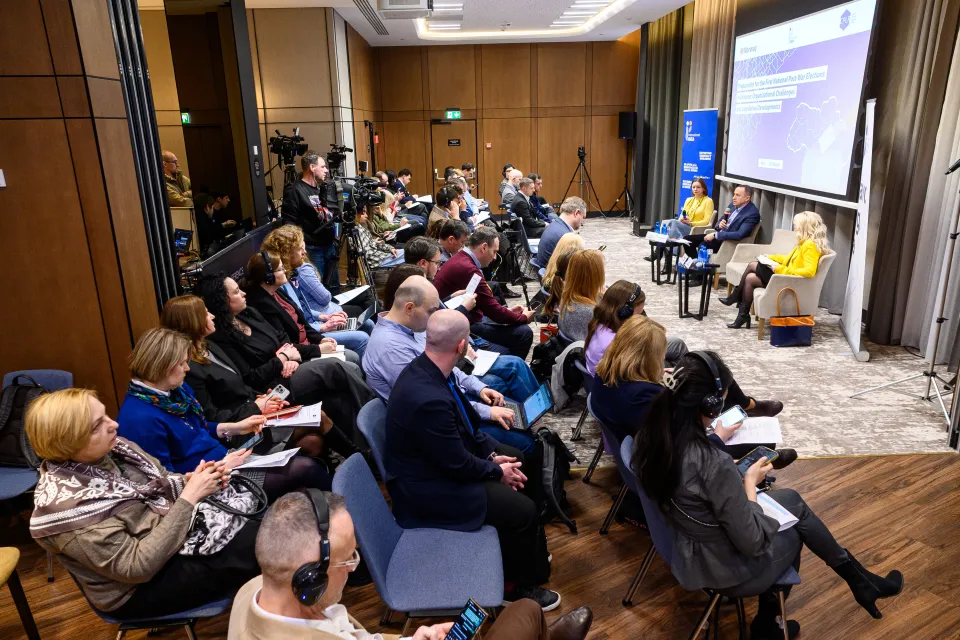
The International Institute for Democracy and Electoral Assistance (International IDEA) and the Rule of Law Centre of Finland (RoL Centre), in partnership with the Central Election Commission of Bosnia and Herzegovina, will host the regional conference “Which Role for Artificial Intelligence in Electoral Processes?”, taking place in Sarajevo, Bosnia and Herzegovina on 16 April 2024.
Events
December 18, 2023 - December 20, 2023
Events
November 22, 2023 - November 23, 2023
On the 22nd and 23rd of November 2023, the International Institute for Democracy and Electoral Assistance (International IDEA) in partnership with members of the Network for the Promotion of Constitutionalism in Eastern Europe is organizing a roundtable discussion 'Democratic Resilience: Does Institutional Design Matter?' in Yerevan, Armenia.
Events
April 02, 2026
On 16 March 2026, Ukrainian policymakers, regulators, civil society representatives and international experts gathered in Kyiv to discuss the growing role of virtual assets in political financing and the risks they may pose for future elections.
News
April 02, 2026
On 20 March 2026, Ukrainian lawmakers, electoral authorities, civil society representatives and international partners gathered in Kyiv to present the outcomes of the Working Group on the preparation of comprehensive legislative proposals on the specifics of the procedure for organizing and holding elections during a special period and/or post-war elections in Ukraine.
News
March 20, 2026
With approximately 2.4 million eligible voters, Armenia is entering the lead-up to its 7 June 2026 parliamentary elections in an environment shaped by regional instability, peace negotiations with Azerbaijan and risks of information manipulation and other forms of hybrid interference.
News
March 06, 2026
This week, International IDEA welcomed the electoral authorities of Albania, Moldova, North Macedonia, and Ukraine for a high-level advocacy visit to the European Union (EU) institutions in Brussels.
News
February 17, 2026
As part of ongoing efforts to prepare for inclusive, secure and credible post-war elections, representatives of the Central Election Commission of Ukraine (CEC) and the Ministry of Foreign Affairs of Ukraine (MFA), together with Ukrainian embassies, conducted consultative visits to Austria and the Czech republic from 5 to 10 February 2026.
News
February 12, 2026
As Armenia prepares for its June 2026 parliamentary elections, electoral institutions are operating in an increasingly complex environment shaped by political polarisation, information manipulation, operational pressures, and rising public expectations around transparency and accountability. Strengthening institutional capacity to anticipate, assess, and respond to such risks is therefore central to safeguarding electoral integrity and public trust in the democratic process.
News
February 02, 2026
On 29 January 2026, International IDEA supported the Central Election Commission of Ukraine (CEC) in conducting the second session of the learning series “Getting to Know ChatGPT: What You Need to Know to Use It Effectively”, bringing together approximately 130 participants. The session focused on strengthening institutional understanding of artificial intelligence tools and their responsible use in public sector work.
News
January 13, 2026
International IDEA, in strategic partnership with the Ukrainian Parliamentary Institute (UPI), is proud to announce the launch of "GROW-EU: Governance and Regional Opportunities for a Way into the EU." This new initiative is made possible through funding from the Swedish Institute (SI) Ukraine Cooperation Programme.
News
December 16, 2025
This case study analyses how Ukraine maintained electoral continuity and integrity between 2014 and 2020 while facing unprecedented challenges caused by Russia’s illegal annexation of Crimea and the armed conflict in Donetsk and Luhansk. Ukraine developed a series of adaptive mechanisms to protect election administration, ensure voter participation where possible and preserve the credibility of democratic processes despite crisis conditions.
Publication
December 16, 2025
As part of ongoing efforts to prepare for inclusive, secure and credible post-war elections, representatives of the Central Election Commission of Ukraine (CEC) and the Ministry of Foreign Affairs of Ukraine (MFA), together with Ukrainian embassies, conducted consultative visits to the Kingdom of the Netherlands and Ireland from 27 November to 2 December 2025.
News