


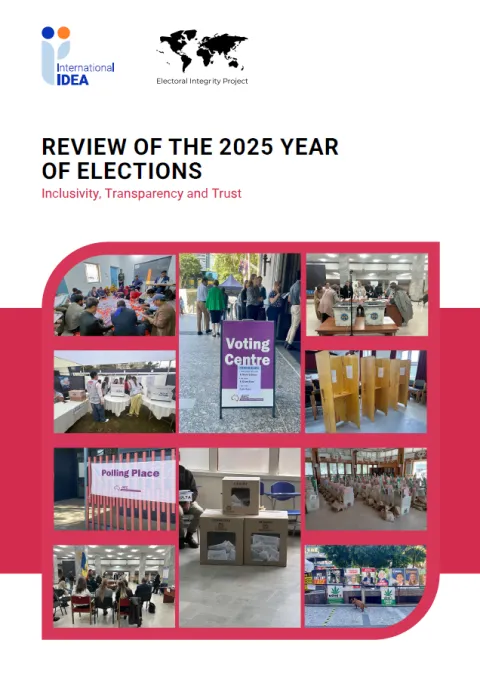
Review of the 2025 Year of Elections
Inclusivity, Transparency and Trust

The authors would like to acknowledge the following colleagues from International IDEA for their valuable comments and feedback throughout the drafting process: Olufunto Akinduro, Gavin Charles, Katarzyna Gardapkhadze, Yukihiko Hamada, Emma Kenny, Nicolás Liendo and Sam Scowen.
Moreover, the authors would like to acknowledge the work undertaken to develop the 2025 Global Election Monitor (GEM) briefs, which provided an important basis for the analysis presented in this report, in particular Martyna Baginska, Hank Blackburn, Siri Bjørgengen, Daniela Braw-Smith, Emmanuel Ajisafe, Jana Kessler, Emma Loeber, Alice McCarthy, Cianna Phelan, Benas Putrimas, Amali Thanthrige and Jacqueline Walters.
We would like to thank also Tom Rogers, the former AEC Commissioner and Jeff Pope, the current AEC Commissioner for their comments on the case study on Australia.
The authors also wish to thank Curtis Budden, Tendai Chinamora-Jönsson, Lisa Hagman, Stephanie Huitson and Tahseen Zayouna for their support with the administration and production of this report.
The overall management and coordination of the publication was undertaken by Erik Asplund and Julian Tucker.
In 2024 a super cycle of more than 70 national-level elections brought new focus to the vital role of elections in shaping and maintaining democracy. International IDEA engaged in this pivotal moment by emphasizing the need to protect elections, leveraging our unique intersecting capacities as a centre of research expertise on democracy, a programming partner for democracies worldwide, and a convenor and advocate of democratic dialogue. The keystone publication in our effort was a review of the super cycle, identifying trends, challenges and takeaways from the greatest year of elections in history. And when we saw the response—over 15,000 views of the report and robust global media coverage—we knew it could not be a one-time initiative. We thus decided to publish this successor report—in collaboration with the Electoral Integrity Project—covering 39 countries that held national elections in 2025.
Our latest report shows that many threats to elections remained in 2025—particularly in the context of electoral campaigns, which are unsurprisingly the weakest link in the electoral cycle. The report identifies numerous challenges for electoral integrity, including election-related violence, gender-based violence, mis- and disinformation, electoral management failures, natural hazards and cyberattacks. Media integrity and campaign finance, two critical elements of effective and credible elections, are especially vulnerable amid declines in press freedom and the digitalization of financial flows.
Yet the report also reveals cause for hope. Overall, election quality remains stable, though there is high variability among countries in key aspects such as voter turnout. Most positive, however, is that electoral management bodies and other actors have responded to the challenging environment with resolve and innovation. New inclusive voting arrangements, digital tools, regulatory reforms, risk management approaches and creative partnerships are helping to reinforce trust, strengthen resilience and protect elections in many contexts.
This report’s 9 chapters and 20 case studies of innovation across all continents prove that electoral management is a living project, capable of keeping pace with the diverse and dynamic demands of the modern world. Not every experiment is a success story—some merely provide valuable lessons—but they all reflect the commitment and creativity needed to ensure that elections, and thus democracy, are not only protected but renewed. And that is cause for hope indeed.
Dr Kevin Casas-Zamora
Secretary-General, International IDEA
Toby S. James, Holly Ann Garnett and Erik Asplund
The world of elections is changing at a rapid pace, including fast-moving technological developments (e.g. artificial intelligence), evolving strategies employed by would-be autocrats and shifting geopolitical environments. These transformations combine to create evolving and accelerating dangers. Those concerned about democracy and electoral integrity need to be vigilant and aware of how new tensions can rapidly emerge.
However, there have also been innovations by lawmakers, civil society groups and electoral management bodies (EMBs) to strengthen elections—partly in response to new challenges. These innovations provide plentiful opportunities for sharing knowledge and strengthening electoral integrity. It is therefore more important than ever to chart this evolving landscape.
Building on the International IDEA–Electoral Integrity Project publication from 2025 (James, Garnett and Asplund 2025), this report describes major election-related challenges and innovations identified in the 2025 calendar year. It aims to assist practitioners and academics by (a) providing summary data about global election quality trends; (b) detailing emerging challenges to electoral integrity; (c) and highlighting innovations and best practices.
This Introduction begins by defining key concepts, including ‘electoral integrity’, to build a common understanding. It then describes trends in electoral integrity data. Although narratives about ‘democratic backsliding’ commonly frame media debates, it is less clear that there has been a universal decline in election quality. Instead, there is a mixed picture of declines and problems—but also improvements in specific countries.
The Introduction then describes the electoral integrity challenges and responses that emerged in 2025, which are unpacked in detail in the following eight chapters. The 2025 Review expands on the 2024 Review by providing 20 case studies, including examples of election-related innovations from a range of countries. Listed at the end of this chapter, the case studies demonstrate that, although electoral integrity challenges are emerging, international and domestic communities have the capacity and reflexivity to work together to respond to them.
I.1. Key concepts
Electoral integrity
Elections are a social practice which can empower people around the world. They enable voters to express themselves, choose their representatives and shape the direction of government. Electoral events also enable discussion and contemplation about the future. What path should the country follow? What is best for me and my community? Elections make it possible to hold those in power to account.
Not all elections achieve these goals. Elections can be marred by voter intimidation, hate speech, unfair electoral rules, incumbents’ use of state resources to give themselves an unfair advantage, online disinformation and many other electoral malpractices. In these cases, elections are often described as ‘sham’, ‘unfair’, ‘fraudulent’ or similar.
Electoral integrity, by contrast, can be defined ‘as a set of principles to be achieved in elections that empower the everyday citizen and help to realize the ideals of democracy’ (James and Garnett 2026: 2). These principles are as follows:
- Contestation. All groups, individuals and parties can compete in an election in a fair environment.
- Deliberation. Debate is led by evidence, seeks consensus, and is free from hate and discrimination.
- Participation. There is wide and even participation across the whole population.
- Adjudication. Elections are conducted in line with fairly designed laws, and there are clear processes for raising and dealing with complaints (James and Garnett 2026: 17).
Elections which uphold these principles thereby contribute to building a democracy—a societal system where preconditions exist to fully empower all citizens to realize their individual potential, and where political power is distributed equitably (James 2024) and geared towards the wider goal of democracy and human fulfilment (Sen 1999; James 2024, forthcoming; UNDP 2025).
Protecting elections
Achieving the goals of electoral integrity is hardly a passive endeavour. Instead, elections need strengthening and safeguarding. International IDEA (2025b: 5) is now using the broader concept of ‘Protecting Elections’:
- as part of any broader effort to strengthen electoral integrity;
- defined as the effort to prevent, withstand, or recover from negative occurrences that may undermine the integrity of electoral processes and results;
- as functionally situated in the sphere of EMB work but requiring interagency and multi-stakeholder collaboration;
- as relying on extensive use of risk management, resilience-building and crisis management methods;
- as gender-sensitive and inclusive.
There are a variety of methods which can be used to protect elections. One method is the development and enforcement of international standards. Such standards are agreed commitments among multiple actors in the international community about the best way to run elections. They come in many forms—from legal agreements to best practices. A prominent recent example is the Model Commitments for Advancing Genuine and Credible Elections (The Carter Center et al. 2024). These emerging global norms play an essential role in helping countries to realize the principles of electoral integrity. They provide key carrots, sticks and, importantly, knowledge for strengthening elections.
Electoral integrity resilience
A related concept, ‘electoral integrity resilience’, was developed by the Electoral Integrity Project to refer to ‘the configuration of actors, resources and properties which enable societies to adapt to an external shock which could damage electoral integrity’ (James and Garnett 2025). Some countries may be institutionally rich in these resources, enabling them to navigate fresh challenges. However, others may find themselves without the resources to protect elections in the face of emerging threats.
The concept of electoral integrity resilience was developed in response to the Covid-19 pandemic, where the threat posed was an epidemiological shock. Not all societies navigated the pandemic successfully. Electoral integrity was compromised by problems such as voters being unable to cast ballots, parties being unable to campaign and leaders taking political advantage of the crisis. By contrast, some countries were able to adapt to the changed conditions relatively easily. For example, they adjusted voting procedures to give people various options for casting their ballots, enabled campaigns to continue and found cross-party ways to reach consensus about changing voting laws. The availability of resilience resources enabled social systems to adapt more effectively to the threats and challenges they faced (James, Clark and Asplund 2023).
I.2. The year 2025 in context
Democracy is thought to be retreating in many parts of the world (International IDEA 2025a; Nord et al. 2026). But what about the quality of elections? How did the quality of elections in 2025 compare with that of previous years?
Electoral Integrity Project data demonstrates no noticeable shift in overall electoral integrity in 2025 (Garnett et al. 2026). It should be noted that international IDEA’s 2025 Global State of Democracy report indicates a broader trend of democratic stagnation within the broader time period of 2020 to 2025, with more declines than advances globally (International IDEA 2025a). Figure I.1 suggests that average electoral integrity levels remain stable. This does not mean, of course, that there were not serious changes in individual countries—indeed, there are important examples of both backsliding and strengthening of electoral integrity. Some of these countries are profiled in the case studies included in this report.
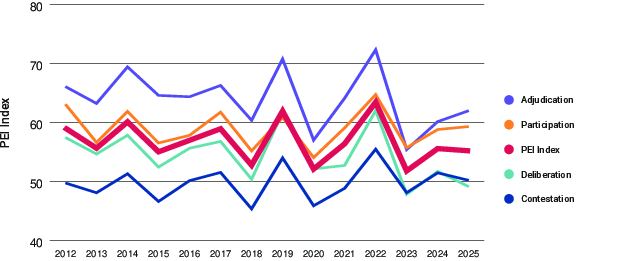

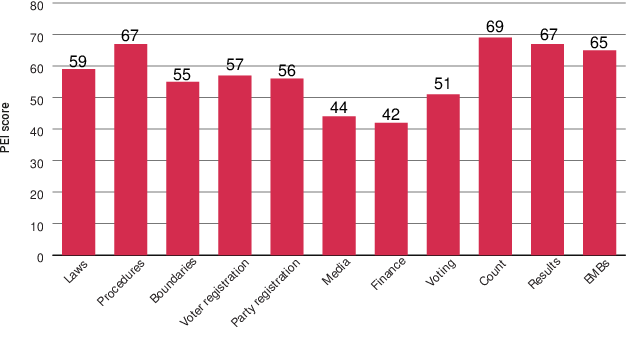
The Electoral Integrity Project Data also reveals, yet again, that the electoral campaign has continued to be the poorest-performing stage of the electoral cycle. Figure I.2 shows that the dimensions with the lowest scores were media and finance—a pattern found in previous reports (Garnett, James and Caal-Lam 2025). These low scores on the campaign-related dimensions of media and political financing are reflected in the poor performance of the contestation and deliberation principles of electoral integrity.
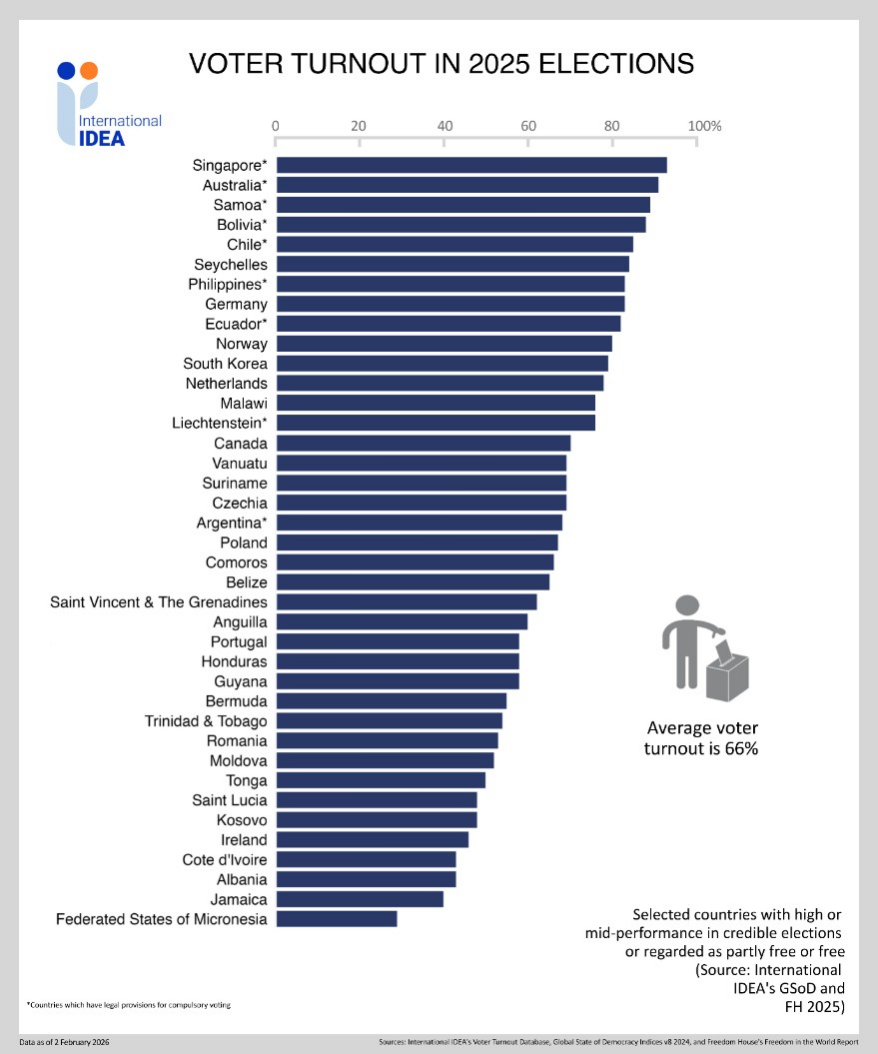
High participation is a crucial component of strong elections. Data from the International IDEA Voter Turnout Database shows, however, that voter turnout varied considerably in 2025. The average voter turnout across the 39 countries holding credible national elections in 2025 was 66 per cent. Sixteen countries had very high voter turnout (above 70 per cent), and more than half of these (56 per cent) had compulsory voting requirements in place. These overall country numbers, however, can mask uneven turnout among equity-deserving groups.
I.3. Global Election Monitor data
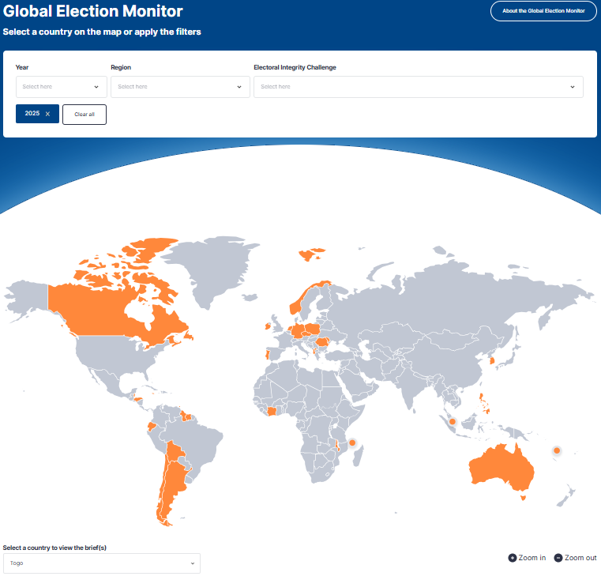
A further source of data on election quality is the Global Election Monitor (International IDEA n.d.), a tool designed to illustrate challenges to electoral integrity and innovations in electoral management practices (see Figure I.4), and it is used throughout this report.
The 2025 edition of the Global Election Monitor consists of 39 election briefs covering national elections around the world, based on desk research that draws on trusted open-source information, including authoritative media stories, election observation reports and press statements by EMBs themselves. International IDEA compiled this data in 2025 and 2026. The briefs are organized around a methodology centred on challenges to electoral integrity, adapted from International IDEA’s work on protecting elections, and are accessible through the Global Election Monitor dashboard.
Box I.1 presents the cumulative findings on specific electoral integrity challenges based on qualitative data from 39 national elections that were held in 2025, using the criteria set out in the Global Election Monitor Codebook (Asplund and Tucker 2025) and in the Elections Emergency and Crisis Monitor. For further information, see Annex A.
Box I.1. Electoral integrity problems in 2025
- Instances of election-related violence were recorded in at least 38 per cent of 39 national elections monitored.
- There were at least 22 instances of gender-based violence in national electoral contexts (out of 39), many of which were exacerbated by technology.
- Instances of mis- and disinformation narratives during elections were recorded in at least 62 per cent of 39 national elections.
- In 2025 at least 49 per cent of the 39 national elections monitored experienced electoral management malfunctions.
- Natural hazards such as floods, heatwaves and tropical storms affected 12 national and local elections in 11 countries monitored, showing the growing electoral impact of climate change (International IDEA 2024).
- At least 10 per cent of national elections monitored suffered reported cyberattacks in some form during the electoral cycle.
I.4. Overview of the report
The report describes how countries around the world faced common challenges and threats to electoral integrity. It also highlights how policymakers, practitioners and civil society responded with great agility to evolving situations. In many cases, these responses enabled elections to be protected and resilience to be strengthened.
Chapter 1. Innovation and evolving electoral management practice
Chapter 1 highlights some of the innovations that electoral management bodies undertook to respond to the challenges faced in 2025. These responses included the use of new technology, as well as the development of new voting arrangements, regulatory reforms and collaborative relationships. The shift away from a polling station–centric approach is a striking change. Special voting arrangements were made available to the general public, but they were also tailored for groups that find voting and registering particularly difficult. Apps and postal voting arrangements, for example, assisted expatriates and migrant worker populations, helping to make elections more inclusive. Overseas electors were reached through new online portals. The security of the electoral process was strengthened through the use of surveillance cameras both inside and outside vote-counting centres. AI-enabled chatbots and human operators were used to respond to citizens’ questions. These innovations highlight how some countries responded to new challenges in 2025.
Chapter 2. Electoral reform
Electoral reform is an inherently political activity. Changing the rules can create perceived winners and losers. As Chapter 2 outlines, the year saw the further evolution and embedding of international guideposts which practitioners could follow when undertaking electoral reform. These took the form of six principles to guide electoral reform. There was evidence of their application in some countries, which organized independent reviews of electoral rules. Courts also actively intervened in the design of electoral rules—finding some practices unconstitutional and in breach of fundamental rights. These interventions then rebooted the electoral reform process. However, 2025 also provided plenty of reminders that achieving political consensus among stakeholders on changes to electoral law is difficult. In many cases, electoral reforms were proposed but not passed because consensus could not be reached. The absence of consensus and failure to pass reforms could lead to a spiral of tensions. For example, legislation was introduced late ahead of elections in Gabon and Malawi, which put those responsible for running the elections under pressure.
Chapter 3. Campaign finance in elections
As noted above, campaign finance has been the stage of the electoral cycle which has scored poorest over several years across various data sources on electoral integrity. In 2025 campaign finance again emerged as a structural vulnerability in many of the 39 national elections covered in the Global Election Monitor. Chapter 3 outlines how positive steps were taken to address this challenge in 2025. For example, global norms were developed in December 2025, when the Conference of the States Parties, the main decision-making body of the United Nations Convention against Corruption, adopted a resolution calling for action. National laws were amended in countries including Germany, Moldova and Vanuatu to tighten regulations and improve oversight. However, problems occurred in many countries. Concerns about major corporate donations and the influence of ‘big money’ were found in Australia, the Netherlands and the United States. Examples could readily be found of the misuse of state resources, foreign interference and the use of digital campaigning to create an unfair playing field.
Chapter 4. Electoral malpractice
Electoral malpractice can take the form of manipulation of rules, manipulation of voters and manipulation of votes (Birch 2011). Chapter 4 profiles examples of each of these forms of manipulation around the world in 2025. For example, arguments were made that the electoral rules in the USA were manipulated through 2025 redistricting practices ahead of 2026 elections. Voters were manipulated through vote-buying practices in the Philippines. Votes were manipulated through tactics such as banning opposition candidates in Tanzania. The chapter argues that addressing these challenges requires multipronged approaches combining legal reforms, partisan and civil society engagement and, above all, sustained commitment to democratic principles. It also identifies successful legal reforms which can prevent electoral malpractice, such as ballot reforms in Argentina.
Chapter 5. Election-related violence
Election-related violence includes violence directed towards election workers, voters and political parties, as well as electoral infrastructure. Chapter 5 charts the persistence of such violence in 2025 and how it presented a threat to democratic consolidation. Targets included a Czech opposition leader and former prime minister who was physically assaulted. In the Philippines, at least 30 candidates and electoral officials were reported to have been killed during the election cycle. Ballot boxes were burned or stolen, often by groups seeking to invalidate results in areas where their preferred candidates were losing. The African Union reported the deaths of more than 1,000 people in Tanzania. However, there were also countervailing responses, such as citizen-led efforts to mitigate election-related violence. In Gabon, for example, monitoring and advocacy initiatives, led by civil society and youth groups, demonstrated the power of digital platforms in preventing incidents of election-related violence.
Chapter 6. Gender-based violence
Violence against women in elections refers to acts or threats of violence directed at women because of their gender and linked to electoral processes or political participation. Chapter 6 highlights how such violence was reported in countries including Egypt, Kyrgyzstan and Tajikistan. Reported incidents most frequently targeted women candidates and political leaders. Some elections saw severe forms of physical and sexual violence—including in Burundi, Gabon and Honduras. However, most documented cases involved technology-facilitated abuse. Innovations to address the problem also emerged in 2025. Several countries strengthened relevant frameworks, such as Albania and Chile. Law enforcement and electoral management were also strengthened in some cases. For example, Tanzania introduced police gender desks ahead of elections. Meanwhile, Mexico’s National Electoral Institute introduced a new organizational process for dealing with complaints, investigations, risk assessments, urgent protective measures and penalties.
Chapter 7. The information environment around elections
The information environment refers to the ecosystem in which information is produced, distributed and interpreted, and it plays a critical role in shaping electoral campaigns. Chapter 7 reports that elections held in 2025 took place in increasingly complex information environments characterized by the widespread circulation of misleading narratives, algorithms that reinforce such narratives, and persistent pressures on independent media. Media freedom was put under strain in countries including Côte d’Ivoire, Moldova and Romania. Digital platforms acted as key gateways for disseminating information, but misleading and false content spread rapidly across these platforms in many countries, including Czechia, Ireland and Romania. Minorities, marginalized groups and women were often disproportionately targeted. The year also saw major responses by EMBs, regulators and other government agencies. Fact-checking tools, debunking strategies and voter guidance were developed by authorities in countries including Australia, Germany and the Netherlands.
Chapter 8. Electoral management hurdles and malfunctions
Well-run elections are indispensable to ensuring that every voter and candidate is able to fully enjoy their democratic rights. Chapter 8 describes how measures were introduced in some countries to strengthen the autonomy, resources and personnel of electoral management bodies in 2025. Steps were taken to strengthen transparency through technology in countries including Ecuador and Guyana, while Australia developed a preventive approach to malfunctions. However, there were also plentiful examples of malfunctions and near misses. EMB autonomy was questioned in countries such as Ecuador, Guyana, India and Malawi. Resource constraints were experienced in countries including Côte d’Ivoire and the Philippines. Management and counting-centre malfunctions were reported in Kosovo. These difficulties, however, partly reflect the mounting challenges facing EMBs from natural hazards, technology-enabled disinformation, political attacks and hostile scrutiny.
I.5. Case studies and innovations
To profile emerging developments, the chapters include illustrative country case studies and examples of innovations from around the world in 2025:
- the use of private contractors for electoral administration in New Zealand (Introduction)
- digital kiosks to serve registrants in Panama (Chapter 1)
- communication as a strategy for promoting election security in the USA (Chapter 1)
- the National Commission for Electoral Reforms in Panama (Chapter 2)
- electoral reform and the Inclusive National Dialogue forum in Gabon (Chapter 2)
- new boundary delineation procedures in Malawi (Chapter 2)
- foreign interference in Romania’s 2025 presidential election (Chapter 3)
- civil society oversight and media monitoring in Bolivia (Chapter 3)
- attempts to counter electoral manipulation through electoral observation in Cameroon (Chapter 4)
- rapid responses to electoral violence in the Philippines from the media, the EMB and civil society (Chapter 5)
- condemnation by the African Union of electoral violence in Tanzania (Chapter 5)
- risk management to prepare for threats of violence in Moldova (Chapter 5)
- institutional responses to disinformation and gender-based digital violence in Chile (Chapter 6)
- consideration of the Spoil the Vote disinformation campaign in Ireland (Chapter 7)
- methods of managing false information and promoting voter confidence in Australia (Chapter 7)
- protecting electoral processes through multi-stakeholder cooperation (Chapter 7)
- the impact of natural hazards and the need for climate adaptation measures (Chapter 8)
- management and counting-centre malfunctions in Kosovo (Chapter 8)
- preventive methods for addressing malfunctions by the EMB in Australia (Chapter 8)
- voter registration management procedures in Nepal (Chapter 8)
The inclusion of innovations in electoral integrity demonstrates that new ways of working can be found.
Not all responses were entirely successful. Some were missteps. New policies and practices do not always have the desired effects—or they may create new problems. Box I.2 provides one such example. It examines how local elections in New Zealand were outsourced to the private sector, with negative consequences for electoral integrity. Policymakers, practitioners and civil society do not have perfect foresight, and some mistakes and errors are inevitably made. However, policy failures are as important for policy learning as exemplary successes.
Box I.2. Outsourcing of elections in New Zealand
Karen Bird
Challenges for Māori wards amid outsourced local elections in New Zealand
Unlike national parliamentary elections administered by the Electoral Commission, New Zealand’s local elections are run by individual councils, most of which outsource the work to private companies. There have been growing concerns about this model, but scrutiny has intensified in light of critical errors in the 2025 elections, which involved contentious referendums on whether to keep or abolish Māori wards. In December 2025, parliament established the Justice Select Committee Inquiry into the conduct of these elections and the integrity and performance of the local electoral system overall. The Inquiry is expected to report later in 2026.
Context of local elections
There are 78 local government councils in New Zealand, which hold elections every three years using either first-past-the-post or single-transferable-vote systems. These include 11 regional councils, which overlap with 67 city and town councils. Many also elect community boards. Voters thus receive multiple ballot papers for different bodies, often using different electoral systems simultaneously. Local elections are conducted entirely by postal voting, with increasing use of bright orange ballot bins at convenient drop-off points. In-person special voting is available at municipal offices in limited circumstances.
Māori ward elections and Māori ward polls
The 2025 electoral cycle also included 42 local referendums on Māori wards, which are designed to guarantee Māori representation through a separate electoral roll. The establishment of these wards was made possible by legislation introduced in 2021 under New Zealand’s Labour Government. Prior to that, councils could create a Māori ward; however, if a petition was signed by just 5 per cent of residents, it triggered a plebiscite on whether to keep or remove the ward. The Labour Government removed the petition and plebiscite provision, deeming it unfair to Māori. In 2024, however, the centre-right coalition government reversed that policy and required that all councils that had introduced Māori wards for the 2022 or 2025 elections hold a binding poll on the matter. The 2025 elections therefore saw simultaneous Māori ward elections (restricted to voters on the Māori roll) alongside district-wide referendums on whether to retain Māori wards beyond the 2025–2028 term. This gave rise to complexities and inconsistent practices across the companies running these electoral events.
Outsourcing local elections
New Zealand’s local authorities historically managed their own elections and referendums. Following amalgamations and sweeping reforms in 1989, however, councils increasingly turned to private providers (Fonseka and Niall 2019). Today, nearly all local elections are administered by one of two firms—Electionz.com or Independent Election Services. These companies also run elections for many other organizations, including corporations, unions, educational institutions and Māori governance entities. Under the Local Electoral Act, the national Electoral Commission’s role is limited to voter registration and maintaining the electoral rolls, allowing councils to contract out all other functions, including candidate nominations, ballot design and distribution, vote processing, results reporting and complaint resolution. In 2025, 53 district and regional councils used Electionz.com, while 22 contracted Independent Election Services. As Local Government New Zealand, the umbrella group for local bodies, explains in its submission to the Justice Select Committee (Local Government New Zealand 2026), these arrangements are governed by each council’s outsourcing policy and individual contracts with service providers. However, there is often a lack of clarity about the extent of the electoral officer’s role and, consequently, the role of deputy electoral officers. The implications of contracting out the electoral officer role (councils retain the role of deputy electoral officers in-house) have never been fully considered.
2025 election issues
Unfortunately, these elections were marked by significant irregularities, including the omission of Māori ward candidates from official voter information booklets in at least six districts. The errors occurred under both private election service providers, revealing a broader lack of care and consistency in how Māori ward materials were handled.
In Manawatū, for example, the incumbent Māori ward Councillor Bridget Bell received approval from the district official for her 150-word profile statement for the voter information package. Running unopposed, she crafted her text (in English and te reo Māori) to highlight the importance of having mana whenua representation (involving a mandate from Māori voters and customary authorities) on the council and to urge voters to retain the Māori ward. Yet, without warning, her profile was omitted from the voter package. Electionz.com, which produced the booklet, blamed quality-control errors and ‘outdated software’ that automatically removed candidate profiles in cases of acclamation (Dallas 2025).
There were additional localities beyond Manawatū where unopposed Māori ward candidates were similarly omitted from voter packages; there were also places where the booklets omitted entire slates of competing Māori ward candidates. The missing candidate profiles were eventually sent to Māori-roll voters in the affected areas, but districts ruled out sending the profiles to all voters because of costs. Māori leaders and opposition members of parliament argued that the unequal visibility disadvantaged Māori candidates, threatened the integrity of the referendum results and undermined trust in the voting process (Local Government New Zealand 2025b).
The Māori ward referendums also highlighted a significant gap in the legal framework around campaign spending. Because each referendum was run separately and no central authority monitored spending, nationally coordinated campaigns to keep or abolish Māori wards operated with little scrutiny. Critics warned that the absence of reporting requirements and spending caps for third parties could undermine democratic outcomes.
Finally, and unrelated to the Māori ward issue, investigations into vote fraud involving mailed ballots led the courts to void election results in the Papatoetoe subdivision of Auckland. The judge’s ruling pointed to critical vulnerabilities in the postal voting model, heightening public debate about whether to shift to in-person voting for future elections (Killick 2025; Hopkins 2026). This issue was addressed in two recently concluded national reviews. The Review into the Future for Local Government (New Zealand 2023), conducted under the Labour Government, and Refreshing Our Grassroots Democracy, the report of the Electoral Reform Working Group of Local Government New Zealand (Local Government New Zealand 2025a) argued that postal voting is increasingly unsustainable and recommended that future local elections be administered by the national Electoral Commission to better ensure consistency and integrity. This is also among the recommendations made in Local Government New Zealand’s submission to the Select Justice Committee Inquiry.
While it is impossible to know exactly how the Electoral Commission would have handled the 2025 cycle, it would almost certainly have operated with more uniform procedures, greater public oversight and stronger capacity to advise on and enforce nationwide referendum spending rules.
Conclusion and implications
Private companies are often part of the election supply chain infrastructure. However, the current situation in New Zealand—where two firms manage virtually all aspects of local elections—is unusual internationally. As elections everywhere grow more complex and the burden on administrators increases, governments may feel pressure to contract out additional functions. This case thus raises issues that extend beyond the New Zealand context, especially for smaller local jurisdictions and Indigenous communities that lack the capacity or resources to manage elections on their own.
In these instances, election outsourcing may seem justifiable on grounds of efficiency, cost savings and access to specialized technical expertise. Private vendors can offer scalable technologies and logistical capacity that small jurisdictions may struggle to maintain in-house. Yet these assumed benefits must be weighed against the risks of reduced transparency and public oversight, inconsistent standards across jurisdictions and limited avenues for democratic accountability.
I.6. Conclusion
In conclusion, 2025 saw the continued rapid transformation of elections. The combination of technological, attitudinal and geopolitical changes created challenges for elections. Long-standing problems affecting electoral integrity also persisted around the world. However, there was plentiful evidence of innovation and responses to strengthen elections. This report seeks to profile these challenges and responses as a guide for practitioners around the world. The concluding chapter consolidates the lessons learned into a series of key themes and recommendations.
References for the Introduction
Asplund, E. and Tucker, J., Global Election Monitor Codebook (Stockholm: International IDEA, 2025), <https://doi.org/10.31752/idea.2025.27>
Birch, S., Electoral Malpractice (Oxford: Oxford University Press, 2011), <https://doi.org/10.1093/acprof:oso/9780199606160.001.0001>
Carter Center, The, International Foundation for Electoral Systems, International IDEA, National Democratic Institute and Kofi Annan Foundation, ‘Model Commitments for Advancing Genuine and Credible Elections’, September 2024, <https://www.idea.int/sites/default/files/2024-09/CC_Model%20Commitments%20Report_B2_final.pdf>, accessed 3 July 2026
Dallas, M., ‘Old software blamed for wiping “face of Māori ward” from voter booklet’, The Post, 15 September 2025, <https://www.thepost.co.nz/nz-news/360824117/old-software-blamed-wiping-face-maori-ward-voter-booklet>, accessed 9 March 2026
Fonseka, D. and Niall, T., ‘Behind-the-scenes of the companies running the country’s local body elections’, Stuff, 16 August 2019, <https://www.stuff.co.nz/dominion-post/news/wellington/115060431/behindthescenes-of-the-companies-running-the-countrys-local-body-elections>, accessed 6 March 2026
Garnett, H. A., James, T. S. and Caal-Lam, S., ‘Electoral Integrity Global Report 2025’, Electoral Integrity Project, 2025, <https://static1.squarespace.com/static/58533f31bebafbe99c85dc9b/t/6866ad9714bd8c1f780fc489/1751559585725/Year+in+Elections+PEI+11+Report+.pdf>, accessed 5 July 2026
Garnett, H. A., James, T. S., Caal-Lam, S. and Darko, A., ‘Perceptions of Electoral Integrity, (PEI-12.0)’, Harvard Dataverse 2026, <https://dataverse.harvard.edu/dataverse/PEI>, accessed 4 July 2026
Hopkins, J., ‘Is it time to abandon postal voting for local elections?’, RNZ, 26 February 2026, <https://www.rnz.co.nz/news/political/587967/is-it-time-to-abandon-postal-voting-for-local-elections>, accessed 10 April 2026
International IDEA, Global Election Monitor, [n.d.], <https://www.idea.int/global-election-monitor>, accessed 12 June 2026
—, Election Emergency and Crisis Monitor: Mapping Impact and Response to Disasters, 2024, <https://www.idea.int/election-dashboard-election-emergency-and-crisis-monitor>, accessed 15 July 2026
—, The Global State of Democracy 2025: Democracy on the Move (Stockholm: International IDEA, 2025a), <https://doi.org/10.31752/idea.2025.53>
—, The Protecting Elections Guide: The Guide to Knowing and Using the Integrated Framework for Protecting Elections (Stockholm: International IDEA, 2025b), <https://doi.org/10.31752/idea.2025.80>
James, T. S., ‘Real democracy: A critical realist approach to democracy and democratic theory’, New Political Science, 46/3 (2024), pp. 228–58, <https://doi.org/10.1080/07393148.2024.2382644>
—, Real Democracy: Empowerment and Equality around the World (Manchester: Manchester University Press, forthcoming)
James, T. S., Clark, A. and Asplund, E., Elections During Emergencies and Crises: Lessons for Electoral Integrity from the Covid-19 Pandemic (Stockholm: International IDEA, 2023), <https://doi.org/10.31752/idea.2023.24>
James, T. S. and Garnett, H. A., ‘Electoral integrity resilience: Protecting elections during global risks, crises, and emergencies’, Democratization, 1/28 (2025), <https://doi.org/10.1080/13510347.2025.2551075>
—, What Is Electoral Integrity? Reconceptualising Election Quality in an Age of Complexity (New York: Cambridge University Press, 2026), <https://doi.org/10.1017/9781009534406>
T. S. James, H. A. Garnett and E. Asplund (eds), Review of the 2024 Super-Cycle Year of Elections: Trends, Challenges and Opportunities (Stockholm: International IDEA, 2025), <https://doi.org/10.31752/idea.2025.22>
Killick, J., ‘Judge overturns “infected” Auckland local election in “unprecedented” voter fraud case,’ The Post, 15 December 2025, <https://www.thepost.co.nz/nz-news/360917736/judge-overturns-infected-auckland-local-election-unprecedented-voter-fraud-case>, accessed 10 April 2026
Local Government New Zealand, ‘Refreshing Our Grassroots Democracy: Final Positions and Recommendations’, Local Government New Zealand’s Electoral Reform Working Group, July 2025a, <https://d1pepq1a2249p5.cloudfront.net/media/documents/ERWG_final_position_paper.pdf>, accessed 6 March 2026
—, ‘Voting pack failure for Māori Ward candidates deeply concerning – Te Maruata’, 11 September 2025b, <https://www.lgnz.co.nz/news/media-releases/voting-pack-failure-for-m%C4%81ori-ward-candidates-concerning>, accessed 10 April 2026
—, ‘The Justice Select Committee’s Inquiry into the 2025 Local Elections: Local Government New Zealand’s Submission’,12 February 2026, <https://www.lgnz.co.nz/policy-advocacy/submissions--policy-work/submissions/the-justice-select-committees-inquiry-into-the-2025-local-elections>, accessed 16 July 2026
New Zealand, Review into the Future for Local Government: He piki tūranga, he piki kōtuku (Wellington: 2023), <https://www.mcert.govt.nz/our-work/local-government/local-government-policy/future-for-local-government>, accessed 16 July 2026.
Nord, M., Altman, D., Fernandes, T., Good God, A. and Lindberg, S. I., Democracy Report 2026: Unraveling the Democratic Era? (Gothenburg, Sweden: University of Gothenburg and V-Dem Institute, 2026), <https://www.v-dem.net/publications/democracy-reports>, accessed 1 July 2026
Sen, A., Development as Freedom (Oxford: Oxford University Press, 1999), <https://global.oup.com/academic/product/development-as-freedom-9780192893307?lang=en&cc=nl>, accessed 4 July 2026
United Nations Development Programme (UNDP), A Matter of Choice: People and Possibilities in the Age of AI, Human Development Report 2025 (New York: UNDP, 2025), <https://hdr.undp.org/content/human-development-report-2025>, accessed 4 July 2026
Therese Pearce Laanela, Julian Tucker and Daniella Paulin with Amali Ranavi Thanthrige
This review publication highlights a range of challenges, varying in severity, that electoral management bodies (EMBs) faced in 2025. The myriad ways in which EMBs (the authorities responsible for the conduct of elections) responded to these challenges—reactively and proactively—are the focus of this chapter. These responses took many forms, including the adoption of new technology, the development of new practices, regulatory reforms and the establishment of new partnerships, collaborative relationships and working practices. These changes are inevitably interrelated. For example, the introduction of new technologies can generate new procedures for election workers and require new interdepartmental relationships, such as those between electoral practitioners and cybersecurity experts.
The movement of voters, both domestically and internationally, continues to generate intense interest in out-of-district and out-of-country registration and voting practices, in contexts as diverse as Canada, the Philippines and Ukraine. The widespread availability and relative simplicity of tools powered by artificial intelligence (AI) have not only driven the transformation of how electorates process information but also triggered cautious exploration of AI’s capabilities and potential for efficiency dividends. At the same time, an altered information environment in which false or misleading information is widely and rapidly circulated has in many places necessitated the consolidation of practices aimed at asserting the authority and trustworthiness of EMB information.
Risk and crisis awareness, heightened through elections held during the Covid-19 pandemic, continues to shape election administration practices in a period of global uncertainty and upheaval. The rapid, responsive and bold, albeit flawed, electoral events in Nepal and Syria in 2025 are reminders that global events and imperatives can outpace the timelines around which electoral planning is typically organized. At the same time, developments such as the dissolution of the United States Agency for International Development (USAID) and Europe’s increased focus on security have prompted a reimagining of global norms and modalities of international cooperation, reflected in initiatives such as the Stockholm Consensus on Electoral Integrity and the reconfiguration of the Global Network for Securing Electoral Integrity. Meanwhile, deliberate efforts to undermine electoral processes in the Americas, Europe and West Africa have focused attention on safeguards for EMB independence, designed to ensure reasonable conditions for conducting elections and to protect electoral processes from harm.
Elections are complex processes, the organization of which involves coordinating between many components that are the product of diverse social, political and historical contexts. Given this diversity, it is difficult to draw conclusions about universally applicable best practices, as norms and practice have always responded to contextual challenges. For example, formal election observation originated in the People Power Movement in the Philippines, mass voter education practices emerged from post-apartheid elections, and early emphasis on EMB independence was a response to experiences of dictatorship. No two countries’ elections are the same—and, indeed, no two successive elections are exactly alike. In this dynamic environment, policies and innovations aimed at achieving one specific outcome (such as increasing voter turnout) can have unintended consequences for another goal (such as building trust). Determining what constitutes good practice, or even ‘good enough’ practice, needs to be continuously reimagined, negotiated and validated through stakeholder consultation, election observation and professional peer learning.
1.1. How voting is changing
One of the most significant trends in electoral administration, the shift away from a polling station–centric approach towards models that include alternative voting options, remained evident in 2025. The term ‘special voting arrangements’ (SVAs) encompasses voting methods that take place outside ordinary voting at polling stations on election day, including advance voting, postal voting, mobile voting, electronic voting or institutional voting.1
While the shift to online voting can seem—and likely is—inevitable, the piloting and exploration of online voting as a complementary option are tempered by concerns about process transparency, ballot secrecy, public trust, and security or delivery failure. Out-of-country voting (OCV) is the area that shows most promise for early adoption, as the drawbacks or concerns are weighed against the difficulty of receiving ballots on time through normal postal methods.2 While many look to Estonia with interest as the first country to provide an online option for all voters, with uptake among almost half of voters, even there a small but vocal group continuously questions and criticizes the practice.
The 2025 explorations of SVAs more broadly, in the form of pilots, reforms, expansions and reviews, form part of a longer-term shift. Such explorations normally begin by accommodating designated groups, such as the elderly or voters whose duties require them to be stationed outside their home jurisdiction. Many countries are consolidating the lessons from accelerating and expanding SVAs during the Covid-19 pandemic, when the health advantages of allowing the electorate to vote from home or choose when to take part in elections across multiple days or venues made SVAs attractive policy options that prompted many national, state and local jurisdictions to expand the availability of SVAs from designated groups to include all voters (Barrat et al. 2023; James, Clark and Asplund 2023). The question is whether to make the temporary options introduced following the pandemic permanent for other reasons.
For example, while Ireland has high levels of electoral trust, a 2025 report highlights persistent participation gaps among voters whose work or personal circumstances prevent them from attending a polling station on election day due to work commitments, illness or caring responsibilities (RED C 2025). Extending postal voting or introducing advance in-person voting are two options that are being discussed to reach these groups. In the Philippines, special arrangements were introduced for elderly, pregnant and disabled individuals, giving them the possibility to vote earlier during the day (between 05:00 and 07:00), with assistance available for illiterate and disabled voters (International IDEA n.d.a; EU EOM 2025: 11; Asplund, Birch and Martínez i Coma 2026). Mail-in ballots are allowed for members of the armed forces or those working in global shipping. Furthermore, smartphone voting has recently been introduced to accommodate these voter groups, as well as advance voting for people who make a declaration that they will be away on polling day. Such smaller-scale, targeted pilots serve as testing grounds for potential future expansion.
The step towards expanding small-scale SVA initiatives to the general public is often aided by the reality that voters view the convenience of alternative arrangements positively, especially those who travel, study or work away from their designated polling place. Examples of this trend towards expanding voting options include the following:
- In preparation for the February 2026 parliamentary election, the Bangladesh Election Commission put in place measures for a mobile app called Postal Vote BD (Shahrukh 2025) to enable expatriates, including the significant migrant worker population, to register online, receive a physical ballot by mail and then return the completed ballot by mail to the Election Commission (International IDEA 2025).
- Kyrgyzstan introduced a new five-in-one voting technology for the parliamentary election in 2025 to enhance electoral integrity and enable out-of-district registration and voting. The system integrates several functions—biometric voter identification, closed-circuit video in polling stations, automated ballot scanning and counting, digital data transmission, and centralized tabulation and reporting (The Caspian Post 2025; Janob 2025).
- Estonia used its i-voting system for the country’s 2025 local elections. Voters authenticated themselves using the national ID system used for all digital government services, voted online and received confirmation that their vote had been received (Valimised n.d.b). The system is designed to anonymize voters while preserving auditability (Galbiati 2025).
The SVAs that facilitate out-of-precinct voting are increasingly part of EMB risk and crisis management portfolios for managing voting in areas affected by natural hazards such as floods, heatwaves or forest fires. In the Philippines, earlier voting hours and the use of air-conditioned malls for voting and registration were introduced as part of a broader effort to mitigate extreme weather, effectively ‘beating the heat’ in highly urbanized and densely populated areas (Ateneo de Manila 2024; Patinio 2024; Sicat 2024; Asplund, Birch and Martínez i Coma 2026). Such innovative responses to climatic conditions will likely become more common as weather events increasingly impact electoral management. The scale of the challenge is evident from the number of national, local and primary elections disrupted by weather-related events in 2025. Countries affected, in whole or in part, included Canada, Ecuador, India, Kenya, Myanmar, Pakistan, the Autonomous Region of Bougainville within Papua New Guinea, the Philippines, Saint Vincent and the Grenadines, the United States and Vanuatu (Asplund 2026; see also Box 8.1: The impact of natural hazards during 2025 elections).
A new reality in which SVAs are a normal feature rather than an exceptional part of the electoral process has implications for financing, logistics, voter information and trust. Each additional voting stream incurs new costs, operational demands and the risk of breakdowns. An election authority may effectively be set up to fail if it introduces new features while under-resourced, insufficiently staffed or operating under legislation ill-suited to accommodating such changes, particularly where multiple voting streams increase complexity.
Another compelling reason for hesitation about introducing or expanding SVAs is the very real risk of losing transparency and trust. SVAs are implemented outside the controlled environment of polling stations on election day, which means that rumours of integrity breaches will become more prominent as technological failures and other incidents occur. The proliferation of parallel voting streams offers extraordinary benefits for voter convenience, the inclusion of a diverse range of voters and the provision of practical alternatives when planned polling is interrupted by inclement weather. At the same time, polling stations have traditionally been the key to the integrity and transparency of elections. Visible registration lists, transparent ballot boxes, and the presence of election observers and party monitors enable polling station results to be intuitively tallied across polling stations in parallel vote tabulations, allowing for examination against national tallies as displayed in media centres and online. Additional voting streams add a complex layer to the EMB’s tasks of transparently ensuring and demonstrating the accuracy of the results and the correctness of procedures. Successful elections and accepted results are not only the result of sound administration but are equally shaped by public perception. Transparency and trust are pivotal to the acceptance of election results, particularly for political actors who need assurance that all critical tasks have been properly executed.
1.2. Out-of-country voting
Reaching and registering overseas voters remained a trending topic in 2025. Deliberations are not uncomplicated, adding layers of jurisdictional, regulatory, ballot security (chain of custody), logistical and political complexity. This complexity can explain the hesitation to advocate or move quickly towards expanding voting rights for citizens living abroad. For example, Nigerian voters living abroad are not allowed to participate in elections despite efforts by the chairman of the Independent National Electoral Commission to convince the National Assembly to introduce new constitutional rights and legislation (INEC n.d.). Similarly, Sierra Leone’s attorney general has called for amendments to electoral legislation that would allow diaspora voters to participate in upcoming elections (Redwood-Sawyerr 2025).
For EMBs responsible for administering voting from abroad, the key difficulties are how to identify potential voters through outreach on registration and voting procedures for eligible overseas voters, and how to develop systems whereby ballots cast overseas can be delivered on time and carry equal weight to their domestic counterparts. As an example of the logistical arrangements involved, New Zealand citizens living abroad have the option to have their ballot papers sent by post to their overseas address or to vote at a designated polling place abroad, such as an embassy or high commission, in select countries. They can also download their ballot papers and associated documents from the Electoral Commission of New Zealand’s website and then submit them through an online portal available to all registered voters (Electoral Commission New Zealand n.d.). When OCV arrangements include in-person options, such as overseas polling centres, there is likely a need for host-country negotiations and cooperation. For the Ukrainian Central Election Commission, with its millions of displaced citizens, 2025 was a year of intense travel and transnational cooperation to establish such arrangements.
In 2025 improving overseas voter turnout and the return rate of valid overseas votes was the subject of a Canadian parliamentary inquiry. Without fixed-date elections, Canadians can be called to the polls at very short notice, giving Elections Canada an almost impossibly narrow window of time in which to accommodate the necessary steps for out-of-country voting—informing citizens overseas, ensuring they are duly registered, sending voting kits, and receiving the appropriate documentation and ballots back from voters correctly and punctually. While Canadians living abroad can apply online to be added to the International Register of Electors, they must wait for their voting kits to arrive by mail and return them by mail, a requirement that can be vulnerable to delays. Short timeframes and inconsistencies in global postal systems lead to delayed and invalid ballots submitted in good faith, a perennial risk associated with mail-in ballots.
Canada is just one of several countries exploring options for OCV-related outreach and logistics. Mexico simplified its OCV registration in 2023, which led to an increase in the total number of registered voters (INE n.d.). Many countries’ diplomatic services offer drop-in visits for eligible voters seeking to register to vote or renew their voting card through embassies and consulates. In Germany, postal voting remains the only method for overseas Germans to vote; for the snap election scheduled on 23 February 2025, Germany’s federal returning officer announced that the German diaspora could use the official courier service to the Federal Foreign Office located in Berlin to reduce delays in ballot return (Socher and Girard 2025).
Each step in the OCV process that is digitalized reduces delays and the risk of invalidation. In 2025 the Philippines introduced online voting for overseas voters for the mid-term elections with the aim of addressing the obstacles to electoral participation faced by the Filipino diaspora (Mendoza and Spinelli 2025). In the case of the Philippines, electronic voting machines are employed not only domestically but also at embassies and consulates overseas. Several other countries that use electronic voting abroad include Armenia (for diplomatic missions), Estonia, France and Panama.
1.3. Registration, voter identification and surveillance concerns
Improving the accuracy of voter registers continues to be a major focus of electoral reform and innovation. Ensuring the accuracy of the voter register is a complex undertaking due to the dynamic nature of electorates: voters pass away, come of age, move between jurisdictions, leave the country or fail to respond to outreach efforts. The voter register is critical for outreach, planning and delivery, especially when multiple voting streams are involved.
An inaccurate voter register contains duplicates, ineligible individuals (e.g. non-citizens), deceased individuals or people registered in more than one place. For those seeking to undermine an election or question an unfavourable result, inaccuracies in the voter register present an opening for assaults on an EMB’s competence, capability and credibility.
With demographic shifts and voter expectations for convenience in an unpredictable external environment, the focus in 2025 was on testing and reassessing technologies to handle data and manage complex processes securely. Panama introduced multipurpose digital kiosks (Eco TV Panamá 2022) to provide citizens with voter registration services available 24 hours a day, 7 days a week (see Box 1.1). In August COMELEC, the Philippine EMB, piloted a programme—called Register Anywhere—that allowed citizens to register to vote in high-traffic public spaces, including hospitals, call centres, malls, airports and bus stations. Additionally, citizens turning 19 between the end date for registration and election day were also allowed to register (International IDEA n.d.a; EU EOM 2025: 11; Asplund, Birch S. and Martínez i Coma 2026).
Box 1.1. Digital inclusion kiosks and the ‘last mile’ of enfranchisement
Miguel Angel Lara Otaola
Electoral integrity is often discussed through the lens of high-level constitutional reforms or complex cybersecurity. For millions of citizens, however, democracy is about access and participation. Without a national ID or an updated voter registration, a citizen remains invisible to the state. In Panama, the deployment of multipurpose digital kiosks (quioscos multiservicio) by the Electoral Tribunal3 sought to bridge this gap by decentralizing access to democratic services. These kiosks represent a shift from centralized bureaucracy to a citizen-centric model of enfranchisement (Tribunal Electoral de Panamá 2023, 2025).
The innovation: 20+ procedures in under a minute
With a total of 120 service points across the country, these kiosks function as a one-stop digital office for both Panamanian citizens and permanent residents that is accessible 24 hours a day, 7 days a week, enabling them to complete civil registration, ID and election organization procedures. The innovation lies in the kiosks’ multifunctionality and speed, operating beyond traditional office hours.
Specifically, the kiosks allow over 20 different procedures—including birth, marriage and death certifications; national ID renewal; and political party affiliation and disaffiliation—all via an intuitive, user-friendly interface. Moreover, the system supports modern payment methods including Visa, Mastercard and the local Clave system.
The success of this innovation is best illustrated by its massive uptake and operational efficiency:
- Transaction volume. Since their deployment in 2020, the kiosks have processed approximately 850,000 transactions, 62.7 per cent of which have been related to elections (Juncá 2026).
- Efficiency as enfranchisement. With an average service time ranging from 30 to 60 seconds, the kiosks have effectively eliminated the time tax that often prevents marginalized populations from updating their status before an election.
- Updated registries. The ability to instantly process political party affiliations or disaffiliations ensures that the voter registry remains accurate in real time, reducing eligibility disputes on election day.
- Youth engagement. The intuitive touch-screen interface saw high usage among first-time voters, who said the self-service design made the kiosks easy to use and navigate (Tribunal Electoral de Panamá 2021).
Ultimately, the success of Panama’s kiosks serves as a reminder that the health of a democracy is not measured solely by grand institutional overhauls. True democratic integrity is found in the empowerment of the individual.
A simple kiosk in a public space does more than print documents; it grants citizens their identity and, by extension, their voice. It is through these accessible innovations that the abstract right to vote becomes a tangible reality. When the cost of participation is lowered, the value of democracy itself is raised.
To ensure the integrity of the voter register, handle concerns regarding its accuracy and mitigate post-election complaints, an established electoral practice dictates that voter registers should be made available for public inspection. A central dilemma in voter registration lies in striking a balance between protecting personal data and ensuring transparency. While voter registers contain sensitive personal information that must be safeguarded, access to these registers—at least for key stakeholders such as political parties, candidates, observers and citizens—has long been understood as a measure for ensuring electoral integrity, allowing stakeholders to verify accuracy and reliability. The need to allow stakeholders to verify the accuracy and reliability of voter registers is the principal reason why voter registration data is published in some form in nearly every jurisdiction. For example, the Elections Department Singapore (n.d.) allows voters, stakeholders and observers to review the voter register digitally, at designated community centres and overseas missions, as part of the election process. The Electoral Commission Seychelles (n.d.) encourages registered voters to review the registration list to ensure their personal information is up to date prior to an election. Similarly, the Malawi Electoral Commission (n.d.) publishes the full voter registration list on its website for anyone to access.
Beyond verifying the accuracy of the voter register, voter data may also be used for secondary purposes, such as campaigning. It is when data is employed for such activities that it has the potential to be misused. How wide-ranging such secondary uses are—or what possibilities there are for secondary uses—depends on what the legal framework allows, as well as the exact technical parameters governing how this data is released. In Canada, making voting data public has involved providing copies to political parties in advance of elections. In Sweden, the voter register is drawn from the tax registry, which is a publicly available data set. In the European Union, the General Data Protection Regulation (and the accompanying fines for breaches) also applies to political parties’ use of voter data.
Maintaining a balance between different aspects of public administration has long been a concern for EMBs. This balancing act is also an area in which new technologies and innovative behaviours can offer solutions while simultaneously creating new challenges. It is easy to envision a situation in which conflicts arise between transparency and privacy in the management of voter registration data. Voter register transparency was a challenging issue even in the era of paper-based voter registers, when the privacy implications of releasing paper voter lists were relatively limited. While personal details in voter registers need protection, access for stakeholders is vital to verify electoral integrity. Powerful tools mean voter databases can be easily shared and integrated into a broader commercial and social framework, and the urgency of the problem is undoubtedly much higher. Using personal data for purposes other than those for which it was collected, and without the consent of the data subject, creates risks for any actor, including political parties.
The shift from paper to digital databases, with their associated ease of sharing, further highlights the importance of limiting data collection to maintain both accuracy and trust while complying with privacy laws. Governments have been exploring ways to manage this balance and incorporate these considerations into EMBs’ regular practices. For example, the Privacy and Access Council of Canada has examined how voter data is collected and disclosed, while also foregrounding the privacy risks of excessive data collection and disclosure, including for criminal use. Similarly, in its parliamentary submission in October 2025, the Australian Electoral Commission (2025) asked for reconsideration of parties’ access to some aspects of voter data, such as phone numbers and addresses, citing, for example, the rise of spam calls and concerns about voter privacy and security.
Registration is particularly complex for OCV voters. The key to ensuring OCV integrity is confirming a voter’s identity. For this reason, countries such as Brazil and the Philippines store biometric data in their voter registers, including combinations of facial recognition, fingerprints and signatures (Federative Republic of Brazil n.d.; The Republic of the Philippines 2025). As Albania introduced out-of-country voting for its 2025 parliamentary election, diaspora voters were able to register to vote by using an Albanian biometric ID, either expired or valid, or a residence permit from a host country (ODIHR 2025). The snap general election in Samoa in 2025 saw only 10 completed overseas applications, despite the available provisions for online registration, representing less than 0.5 per cent of the total completed online registrations. The extremely low uptake was likely due to the biometric details required to complete registration; because the election curtailed a planned amendment to the Electoral Act that would have facilitated biometric capture from overseas, voters still had to return to Samoa to complete the process (Baker and Spinelli 2025).
Understandably, public concerns about the use of surveillance technology are such that other options may be more palatable for voters. Estonia uses digital ID for online voting identification and allows voting on any computer if the i-Voter app has been downloaded onto the device (Valimised n.d.a). In France, registered diaspora voters can vote from their homes via a website using credentials provided by the diplomatic mission in their country of residence (France Diplomatie 2025).
EMBs are exploring alternative ways to maintain the same level of confidence in accuracy and procedural compliance in the absence of the transparency assurances that are inherent in voting at polling stations. The 2024 US presidential election saw heightened scrutiny of electoral procedures, especially during ballot counting. Election officials were prompted to adopt unprecedented levels of transparency. Pinal County in Arizona built new election headquarters featuring expansive windows that allowed observation of the vote-counting process (Wingett Sanchez 2024), as well as the installation of numerous surveillance cameras both inside and outside the facility and the use of GPS trackers (Allen 2024) on the containers transporting ballots and equipment (Leingang 2024). These measures were implemented due to earlier incidents that had fuelled mistrust, such as claims about abandoned equipment. Furthermore, the wiring for voting machines was intentionally left visible through transparent grates to demonstrate that the equipment was not connected to the Internet, combating widespread fears about hacking (O’Keefe 2024; Wingett Sanchez 2024).
1.4. Innovating transparency, trust and security
In 2025, with the inherent vulnerabilities implicit in the introduction of special voting arrangements, EMBs were pushed to further tighten integrity safeguards, delivery capabilities and stakeholder engagement. This emphasis on stronger safeguards, delivery systems and stakeholder engagement reflects a growing recognition that opacity breeds conspiracy theories and mistrust, a phenomenon that has become increasingly prevalent in today’s information environment (see Chapter 5). While real or perceived weaknesses or failures understandably generate genuine concern among election stakeholders, they can also be deliberately amplified and exploited for political gain or to undermine trust, particularly amid pervasive disinformation and misinformation.
Although investments in transparency measures are commendable, the assumption that transparency alone will guarantee trust is problematic. First, the increasing complexity of elections can make transparency difficult to achieve in a way that is both meaningful and accessible. Second, electoral contests often generate strong emotions, particularly when the stakes are high; those facing defeat and their supporters may not be swayed by facts, regardless of how transparent the process is. Third, in a charged political climate, absolute transparency can inadvertently expose vulnerabilities and mistakes, which malicious actors may exploit. Paradoxically, being too open can undermine trust rather than reinforce it, underscoring the need for a balanced, thoughtful approach to transparency in electoral management.
Transparency in the form of access to data sets of voter and candidate information collides with the secrecy of the vote, data privacy and security, given the ease of sharing and concerns about doxing and other online harms. Accuracy in voter registers can come up against the principles of inclusion and trust if the methods for cleansing a voter register of duplicates, non-citizens or people registered in more than one place are seen as draconian. Releasing polling station information is another example of the tension between security and transparency. Arguments for putting information on the Internet include that it serves as a valuable resource for voters to make arrangements for voting day, for party officials in jurisdictions where last-minute campaigning or party monitoring is allowed and, importantly, for citizen observers to plan their work independently. Meanwhile, concerns about voter intimidation or attacks on polling station infrastructure raise questions about how far in advance, how detailed and how thoroughly lists of polling station locations should be made public. Security officers may advise caution about when and how information is shared, especially in response to intelligence on terrorist threats or voter intimidation. Increasingly, as in Australia, Estonia, Finland and Sweden, innovation in the form of formalizing structures for interagency and civil society partnerships can foster mutual familiarity with concerns and help devise strategies that reconcile conflicting priorities (International IDEA n.d.b).
These trust dynamics and imperatives have highlighted another important trend that continued in 2025—that of upgrading EMB public communication capacity. In New York State, perceptions of the security of the 2025 state elections were buoyed by the preceding Christmas-themed 12 Days of Security social media campaign (see Box 1.2). Public communication strategies aimed at reducing fear or misunderstanding among voters in India have included fact-checking teams that operate continuously at multiple levels to counter viral falsehoods. Meanwhile, South Africa is leveraging AI-enabled chatbots and human operators to provide personalized responses to citizens’ concerns and questions (Shekgola and Modiba 2025).
Box 1.2. Demystifying election security processes: New York State’s #12DaysOfElectionSecurity campaign
Thessalia Merivaki and Mara Suttmann-Lea
The 2020 and 2024 elections were among the most secure in US history (CISA 2020, 2024). Yet, confidence about the integrity of elections has been declining, and with wide gaps between Democrats and Republicans. Limited understanding of election procedures, coupled with persistent misinformation shared by political elites are driving these attitudes, particularly in the period after votes are cast. The post-election window creates conditions for increases in election scepticism; attention shifts from voting to vote counting, recounts and audits, and any ‘irregularity’ can be interpreted as a nefarious effort to change election outcomes. At the same time, voters whose candidate lost the election are more likely to express scepticism about the fairness of the election.
To build trust in the integrity of US elections, election officials have learned to become public communicators both offline and online. Research from the 2020 and 2022 US elections shows that trust-building messaging campaigns—explaining specific procedures accessibly, sustained consistently and timed strategically—were effective in increasing voter confidence even among those most prone to scepticism (Suttmann-Lea, Merivaki and Orey 2025).
In December 2024 the New York State Board of Elections launched the #12DaysOfElectionSecurity social media campaign, running from 12 to 23 December, the window during which ballots for the 2024 general election were being canvassed, audited and certified statewide. The campaign dedicated one daily post (text accompanied by an infographic) to a specific election security procedure, accompanied by the hashtag #12DaysOfElectionSecurity.
The 12 topics included pre- and post-election procedures, from voter eligibility rules (Day 1: only qualified New Yorkers may vote) to post-election auditing (Day 12: a post-election audit confirms election results). In between, the campaign covered voter list maintenance, equipment certification and secure storage, pre-election testing of voting systems, the absence of Internet connectivity in voting systems, paper trails, secret-ballot protections, signature verification, bipartisan oversight and emergency preparedness. Each post explained a concrete, verifiable procedure, clearly connecting it to the accuracy of election results. The countdown structure created sustained daily engagement across the certification period, conveying that election security is not a single event but a layered, ongoing process.
Did New York voters enter the 2025 election cycle informed about election security?
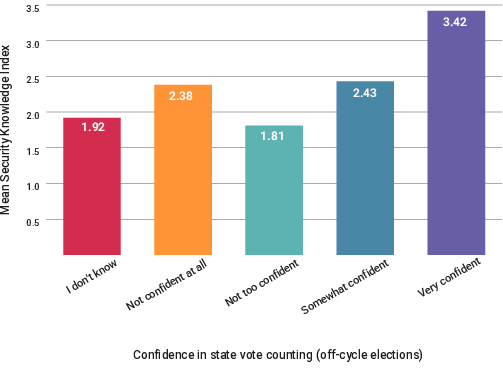
New York’s 4 November 2025 mayoral election offers an opportunity to evaluate the long-term effects of New York’s trust-building messaging campaign. In October 2025 the authors surveyed registered voters about their familiarity with election security procedures in their state, from rules about public and partisan observation, post-election audits and ballot storage, to pre-election testing of voting machines. The authors found that New Yorkers who correctly identified that New York implements these procedures expressed higher confidence in the accuracy of ballot counting. Though comparisons over time will be needed to confirm the finding, this association suggests that campaigns like #12DaysOfElectionSecurity can strengthen electoral efficacy beyond the election cycle for which they were designed (Suttmann-Lea 2025). These state-specific findings mirror patterns from across the USA, particularly in states that have deployed similar messaging campaigns, underscoring that voter communications are critical for voting literacy and bolstering trust in election integrity.
Artificial intelligence can play an important role in making electoral processes more effective, but it also necessitates measures that safeguard against bias, error and other forms of potentially damaging unintended consequences that can undermine electoral integrity and public trust. Institutional culture, training for electoral staff and an effective risk management system are as important as technological solutions in ensuring that AI is an asset to the electoral process rather than a detriment. Institutional guardrails which ensure data protection and mitigate the shortcomings of AI systems are essential for the effective integration of these technologies and should be designed to allow for human oversight of final decisions.
AI tools that are already in use or under development in South Africa include optical character recognition tools to validate voter registration documents of varying quality and to screen political party registrations to ensure that names, abbreviations and symbols remain distinctive among the hundreds of entries received during elections. A human services chatbot is designed to interact with the public by responding to queries and is carefully constrained to internal Electoral Commission documents to avoid hallucinations or speculative outputs. Additional applications include address anomaly detection to improve the accuracy of voter rolls and AI-enhanced threat detection systems that monitor irregular digital behaviour linked to cybersecurity risks (Martino 2025).
Mexico’s National Electoral Institute has formalized AI governance at the institutional level (Arizona State University n.d.), mandating human validation of AI outputs and enshrining the requirement that every AI system undergo a rigorous risk assessment before deployment. Pilot initiatives have included AI-assisted processing of images from preliminary results and tally sheets, predictive models to support voter participation strategies and the training of electoral staff, and AI assistants to improve both public information services and internal guidance. The Institute is also exploring automated document reading, summarization and template generation to reduce administrative burdens while maintaining institutional control over outputs.
Given the high stakes and vast reach of elections in India, the country’s Election Commission has adopted a deliberately restrained approach, carefully weighing risks before expanding the use of AI in electoral processes. The Commission has already taken several regulatory and preventive steps. These include issuing advisories requiring political parties and candidates to label synthetic or digitally enhanced campaign content with clear disclaimers, as well as imposing restrictions on AI-generated deepfakes. During elections, such content must be removed rapidly, often within hours, under the Model Code of Conduct and relevant election laws (Martino 2025).
1.5. Conclusion
Elections are conducted in an interplay between local realities and global events. Electoral standards and practice have always responded to contextual challenges. While EMBs have always been adaptive, the current environment demands creativity, courage and innovation at a pace and scale that are reshaping the field of election administration. Renewed attention is being given to trust building as a response to disinformation, to security measures and risk management practices as a response to emergencies and threats, and to the expansion of registration and voting options to accommodate a mobile population. The global events of 2025 will influence future election administration practices in ways that are not yet entirely clear, but they provide valuable lessons.
References for Chapter 1
Allen, M., ‘GPS ballot-tracking’, AXIOS, 27 October 2024, <https://www.axios.com/2024/10/27/gps-ballot-tracking-am>, accessed 8 June 2026
Arizona State University, Mechanics of Democracy Lab, ‘Country Profile – Mexico’, [n.d.], <https://modl.spa.asu.edu/resources/case-studies/country-profile-mexico>, accessed 8 June 2026
Asplund, E., ‘The impact of natural hazards on elections’, International IDEA, 22 April 2026, <https://www.idea.int/news-media/multimedia-reports/impact-natural-hazards-elections>, accessed 8 June 2026
Asplund, E., Birch, S. and Martínez i Coma, F., Managing Natural Hazards and Climate Risks in Elections (Stockholm: International IDEA, 2026), <https://doi.org/10.31752/98760>
Ateneo de Manila, ‘COMELEC Register Anywhere Project held onsite at Ateneo’, 29 April 2024, <https://www.ateneo.edu/news/2024/04/29/comelec-register-anywhere-project-held-onsite-ateneo>, accessed 8 June 2026
Australian Electoral Commission, ‘AEC Submission: Joint Standing Committee on Electoral Matters Inquiry into the 2025 Federal Election’, 2025, <https://www.aec.gov.au/media/parliamentary-submissions.htm>, accessed 8 June 2026
Baker, K. and Spinelli, A., The Absent Voters of the Pacific Islands: Challenges and Prospects for the Enfranchisement of Migrants (Stockholm: International IDEA, 2025), <https://doi.org/10.31752/idea.2025.99>
Barrat, J., Ellis, A., Orr, G., Vashchanka, V. and Wolf, P., Special Voting Arrangements: The International IDEA Handbook (Stockholm: International IDEA, 2023), <https://doi.org/10.31752/idea.2023.84>
Barrat i Esteve, J., Online Voting: Current and Future Practices (Stockholm: International IDEA, 2025), <https://doi.org/10.31752/idea.2025.69>
Brazil, Federative Republic of, Superior Electoral Court, ‘Biometrics’, [n.d.], <https://international.tse.jus.br/en/elections/biometrics>, accessed 8 June 2026
Caspian Post, The, ‘Kyrgyzstan launches nationwide test for remote voting ahead of snap elections’, 20 October 2025, <https://caspianpost.com/kyrgyzstan/kyrgyzstan-launches-nationwide-test-for-remote-voting-ahead-of-snap-elections>, accessed 8 June 2026
Cybersecurity and Infrastructure Security Agency (CISA), ‘Joint statement from Elections Infrastructure Government Coordinating Council and the Election Infrastructure Sector Coordinating Executive Committees’, 12 November 2020
—, ‘Statement from CISA Director Easterly on the security of the 2024 elections’, 6 November 2024
Eco TV Panamá, ‘Tribunal Electoral aumenta quioscos multiservicio en el país’ [Electoral Tribunal expands network of multipurpose digital kiosks nationwide], 19 September 2022, <https://www.ecotvpanama.com/nacionales/tribunal-electoral-aumenta-quioscos-multiservicio-el-pais-n5752323>, accessed 8 June 2026
Elections Department Singapore, ‘About Registers of Electors’, [n.d.], <https://www.eld.gov.sg/elections.html>, accessed 8 June 2026
Electoral Commission New Zealand, ‘How to vote from overseas’, [n.d.], <https://vote.nz/voting/how-to-vote/vote-from-overseas>, accessed 8 June 2026
Electoral Commission Seychelles, ‘Registration and Correction’, [n.d.], <https://ecs.sc/registration-correction>, accessed 8 June 2026
European Union Election Observation Mission (EU EOM), Philippines, National and Local Elections, 12 May 2025, ‘Preliminary Statement’, 14 May 2025, <https://www.eeas.europa.eu/sites/default/files/documents/2025/EUEOM%20PHIL25%20PS%20FINAL2_2.pdf>, accessed 8 June 2026
France Diplomatie, ‘Vote par internet’ [Online voting], 15 September 2025, <https://www.diplomatie.gouv.fr/fr/services-aux-francaises-et-aux-francais/vie-administrative-et-elections/modalites-de-vote/vote-par-internet>, accessed 8 June 2026
Galbiati, G., ‘The digital republic: How Estonia redefined voting’, Estonian World, 14 October 2025, <https://estonianworld.com/life/the-digital-republic-how-estonia-redefined-voting>, accessed 8 June 2026
Instituto Nacional Electoral (INE), ‘Voto de las y los mexicanos residentes en el extranjero’ [Vote of Mexicans living abroad], [n.d.], <https://www.votoextranjero.mx/web/vmre/historico>, accessed 8 June 2026
International IDEA, Global Election Monitor, [n.d.a], <https://www.idea.int/global-election-monitor>, accessed 8 June 2026
—, Protecting Electoral Processes in the Information Environment, [n.d.b], <https://www.idea.int/project/protecting-electoral-processes-information-environment>, accessed 8 June 2026
—, Special Voting Arrangements, [n.d.c], <https://www.idea.int/data-tools/tools/special-voting-arrangements>, accessed 7 June 2026—, Democracy Tracker, ‘Bangladesh - November 2025’, 2025, <https://www.idea.int/democracytracker/report/bangladesh/november-2025>, accessed 8 June 2026
James, T. S., Clark, A. and Asplund, E., Elections during Emergencies and Crises: Lessons for Electoral Integrity from the Covid-19 Pandemic (Stockholm: International IDEA, 2023), <https://doi.org/10.31752/idea.2023.24>
Janob, A., ‘Kyrgyzstan moves towards digital democracy with online voting initiative’, Trend, 1 December 2025, <https://www.trend.az/business/4124170.html>, accessed 8 June 2026
Juncá, A., member of the Electoral Tribunal of Panama, author’s interview, 10 May 2026
Leingang, R., ‘US election offices increase security measures amid ongoing threats’, The Guardian, 4 November 2024, <https://www.theguardian.com/us-news/2024/nov/04/election-office-security-threats>, accessed 8 June 2026
Malawi Electoral Commission, 2025 Voter Registration Statistics, [n.d.], <https://mec.org.mw/2025-voter-registration-statistics>, accessed 8 June 2026
Martino, E., ‘Member State exchange on artificial intelligence and elections’, International IDEA, 18 December 2025, <https://www.idea.int/news/member-state-exchange-artificial-intelligence-and-elections>, accessed 8 June 2026
Mendoza, G. A. S. and Spinelli, A., Online Overseas Voting: Key Insights from the 2025 Philippine Mid-Term Elections (Stockholm: International IDEA, 2025), <https://doi.org/10.31752/idea.2025.87>
Nigeria, Federal Republic of, Independent National Electoral Commission (INEC), ‘INEC, NASS make case for diaspora voting’, [n.d.], <https://inecnigeria.org/news-all/inec-nass-make-case-for-diaspora-voting>, accessed 8 June 2026
O’Keefe, E., ‘Arizona counties invest millions in new facilities to reassure voters of election security, transparency’, CBS News, 31 October 2024, <https://www.cbsnews.com/news/arizona-invests-new-facilities-reassure-voters-election-security-transparency-coconino-pinal-county>, accessed 8 June 2026
Organization for Security and Co-operation in Europe, Office for Democratic Institutions and Human Rights (ODIHR), Republic of Albania, Parliamentary Elections, 11 May 2025, ‘Final Report’, 23 October 2025, <https://odihr.osce.org/sites/default/files/f/documents/0/c/600028.pdf>, accessed 8 June 2026
Patinio, F., ‘Comelec keen on tapping malls as voting hubs’, Philippine News Agency, 14 March 2024, <https://www.pna.gov.ph/articles/1220821>, accessed 17 June 2026
Philippines, the Republic of the, Philippine Embassy, Washington, DC, ‘PH Embassy concludes historic first online voting for overseas Filipinos in the United States and the Caribbean’, 13 May 2025, <https://philippineembassy-dc.org/ph-embassy-concludes-historic-first-online-voting-for-overseas-filipinos-in-the-united-states-and-the-caribbean>, 8 June 2026
RED C, ‘National Election and Democracy Study: General Election 2024’, 2025, <https://www.electoralcommission.ie/app/uploads/2025/05/GE_NEDS.pdf>, accessed 8 June 2026
Redwood-Sawyerr, C., ‘Attorney General announces electoral reforms for diaspora’, Government of Sierra Leone, Ministry of Information and Civic Education, 2 October 2025, <https://moice.gov.sl/attorney-general-announces-electoral-reforms-for-diaspora/#respond>, accessed 8 June 2026
Shahrukh, S., ‘A historic shift: How Postal Vote BD could redefine voter participation for Bangladesh’, Dhaka Tribune, 19 November 2025, <https://www.dhakatribune.com/bangladesh/396746/a-historic-shift-how-postal-vote-bd-could>, accessed 8 June 2026
Shekgola, M. and Modiba, M., ‘Utilising an AI chatbot to support smart digital government for society 5.0 in South Africa’, South African Journal of Information Management, 27/1 (2025), <https://doi.org/10.4102/sajim.v27i1.1983>
Sicat, A., ‘You can now register anywhere: Your guide to Comelec’s nationwide voter registration’, Philippine Information Agency, 23 January 2024, <https://pia.gov.ph/regions/you-can-now-register-anywhere-your-guide-to-comelecs-nationwide-voter-registration>, accessed 8 June 2026
Socher, J. and Girard, R., ‘Voting from abroad ahead of Germany’s 2025 snap election: Practical challenges and legal implications of non-resident voting from a comparative perspective’, Verfassungsblog, 6 February 2025, <https://doi.org/10.59704/9462fe53952bc63b>
Suttmann-Lea, M., ‘The Right to (Know How to) Vote: Voter Education, Election Security, and Architectures of Trust in U.S. Election Administration’, Keynote address at the ‘Election Cybersecurity Summit: Protecting Democracy in a Shifting Landscape’, Brennan Center for Justice, 11 December 2025
Suttmann-Lea, M., Merivaki, M. and Orey, R., ‘When election officials speak, do voters listen? Trust-building communications, information seeking, and voter confidence in the 2022 US midterm elections’, Political Communication, 42/4 (2025), pp. 694–714, <https://doi.org/10.1080/10584609.2025.2499181>
Tribunal Electoral de Panamá, ‘Quioscos multiservicio del TE para trámites rápidos y seguros’ [TE multipurpose digital kiosks for fast and secure transactions], 11 November 2021, <https://www.tribunal-electoral.gob.pa/quioscos-multiservicio-del-te-para-tramites-rapidos-y-seguros>, accessed 8 June 2026
—, ‘Memoria Anual: Noviembre 2022 – Octubre 2023’ [Annual Report: November 2022 – October 2023], 2023, <https://repositorio.asamblea.gob.pa/bitstream/handle/001/2592/Memoria-Anual-2023%20TE.pdf?sequence=1&isAllowed=y>, accessed 8 June 2026
—, ‘Informe de Gestión: Julio-Diciembre 2025’ [Management Report: July–December 2025], 2025, <https://www.tribunal-electoral.gob.pa/wp-content/uploads/2026/02/Informe-de-Gestion-jul-dic.pdf>, accessed 8 June 2026
Valimised, ‘Internet voting in Estonia’, [n.d.a], <https://www.valimised.ee/en/internet-voting-estonia>, accessed 7 June 2026
—, ‘Introduction to i-voting’, [n.d.b], <https://www.valimised.ee/en/internet-voting/more-about-i-voting/introduction-i-voting>, accessed 7 June 2026
Wingett Sanchez, Y., ‘Latest strategy in fighting election scepticism: Radical transparency’, The Washington Post, 14 September 2024, <https://www.washingtonpost.com/politics/2024/09/24/election-transparency-voter-fraud-pinal-county-arizona>, accessed 8 June 2026
Toby S. James
In 2025 international principles for how to undertake the politically sensitive task of making changes to electoral laws were revised and further embedded around the world. These set out certain guiding principles and best practices that stakeholders can follow. They set aspirations, including that reformers should seek consensus, be transparent, be inclusive, use evidence, deliberate, set adequate timelines and provide accountable structures when reforms are considered.
Elections held in 2025, in turn, often took place using new electoral rules. In some cases, these new rules were derived from processes which saw the principles at least partially realized. Constitutional courts, for example, used evidence and intervened to rule that existing practices were unconstitutional and therefore required reform. There were also examples of attempts to reach consensus through independent reviews. However, 2025 also provided many reminders that achieving political consensus among stakeholders on changes to electoral law is difficult. In many cases, electoral reforms were proposed but not passed because of the absence of consensus. The failure to achieve consensus and pass reforms could lead to a spiral of tensions—and in some cases violence. The year also provided case studies of the late passage of electoral laws, which caused problems for those on the front line of elections seeking to provide the best service possible to voters. How to reform elections democratically remains a central challenge for practitioners and researchers.
2.1. Redesigning and embedding principles of electoral reform
The quality of elections around the world varies. Introducing changes to elections is therefore a necessary way to improve them. Even those countries which hold elections of the highest quality have areas in which they can improve. They will also periodically need new legislation to respond to a rapidly changing world. Changing the legal framework for elections, however, is politically complex and challenging. There is a danger that those in power may seek to block reforms which reduce their chances of winning the next election. Incumbent parties may seek to introduce laws which will restrict political opposition. However, there is also widespread public distrust of political elites. Reforms which could strengthen electoral integrity may therefore be met with suspicion among the public.
The process of undertaking electoral reform has received much less attention until recently. However, new academic research and international standards have been developed to provide guideposts for those undertaking this task. The Global Network for Securing Electoral Integrity developed a set of principles which it encouraged stakeholders to follow when reviewing the rules governing elections. In its landmark document published in 2024, it argued that the electoral reform process should be guided by a set of six principles (GNSEI 2024). These principles came to be gradually accepted as international norms in 2025. The Westminster Foundation for Democracy and the Electoral Integrity Project held an international event in March 2025 with nearly 400 delegates from 79 countries (Electoral Integrity Project 2025). The event gave practitioners an opportunity to reflect on and assess the principles, with speakers from organizations including the Asian Network for Free Elections (ANFREL), the International Institute for Democracy and Electoral Assistance (International IDEA) and the United Kingdom House of Commons. Academics also provided assessments of the principles, considered the extent to which they had been followed in historical cases, examined the barriers to achieving them and explored how they could be more easily followed (James forthcoming; James, Aleksov and Loeber 2026).
As result of these dialogues, the principles were revised as follows (GNSEI 2026):
- Political consensus building is foundational to any electoral reform process.
- Electoral reform processes should be transparent.
- Electoral reform processes should be inclusive.
- Electoral reform processes should be informed by evidence, deliberation and a long-term vision.
- Adequate timeframes and resources should be provided for a viable and democratic electoral reform process.
- Clear accountability structures are essential for electoral reform processes.
An academic study argued that one way to embed these principles is through an electoral reform policy cycle (James forthcoming; James, Aleksov and Loeber 2026). This is a heuristic tool for embedding the principles into the policy process. The first stage of the cycle is evidence collection. During the electoral period, systems should be in place to collect reliable information about the quality of the election to inform subsequent debate. In the second stage, the evidence review stage, there should be broad, open public debate about election quality and how it can be enhanced. In the third stage, official deliberation, parliamentary institutions should scrutinize formal legislative proposals. This stage should include broad consultation with civil society. In the final implementation stage, key stakeholders need to be notified of the changes in good time.
The research identified the following actions as best practice for helping fulfil the principles (James, Aleksov and Loeber 2026):
- establishing processes to ensure the reliable collection of data about the quality of elections to inform debates;
- establishing cross-party and/or independent inquiries to evaluate the electoral process based on the evidence; and
- ensuring that a rigorous parliamentary process is followed. Legislative proposals should involve a consultation stage, be scrutinized by a cross-party committee and receive full parliamentary scrutiny before passage.
2.2. The value of independent reviews
Returning to the real world of electoral reform practice in 2025, the year provided good examples of attentiveness to evidence and the use of independent reviews, as advocated in the GNSEI guidelines. The provision of high-quality evidence and deliberation can facilitate consensus building. One institutional forum which can bring evidence and deliberation into the electoral reform process is the establishment of cross-party reviews of electoral law.
Early parliamentary elections were held in the Netherlands in October 2025. Electoral law changes had been introduced since the previous parliamentary elections.4 Legislation was also proposed but was not adopted because of the dissolution of Parliament. A new Political Parties Act would have made major changes to electoral finance. Proposed measures included a subsidy of EUR 25 million (approximately USD 29 million) for local and regional political parties, greater transparency requirements for political advertising and provisions to ban parties. The Act would have allowed the Supreme Court to dissolve a party if it was determined to have compromised one or more of the fundamental principles of democracy and the rule of law, including free elections, democratic decision making, the separation of powers and an impartial judiciary (Dutch News 2024; Rijksoverheid 2024). According to Interior Minister Hanke Bruins Slot, the courts needed the power to ban parties ‘as a last resort if a party wants to destroy democracy’ (NL Times 2022).
The bill had its origins in an independent state committee on the Dutch parliamentary system established in 2018. The committee consisted of four members of parliament (MPs) and three senators and was chaired by Johan Remkes, a former Deputy Prime Minister. Its mandate was to review the challenges facing Dutch parliamentary democracy. The committee chair argued that ‘major societal and technological changes are making it necessary to secure our parliamentary system for the future’ (Tweede Kamer 2018). Proposed changes included revising the electoral system for the House of Representatives, implementing a binding corrective referendum, establishing a constitutional court, developing democratic knowledge and skills in the education system, and introducing a new Political Parties Act (Tweede Kamer 2018). The proposal received criticism from the Council for the Judiciary, which argued that the provisions for banning political parties were too vague for such a far-reaching measure. It also argued that more than one body should be involved in decisions on banning parties and that the proposal therefore posed a serious threat to the democratic constitutional state (Tweede Kamer 2018).
Elsewhere, in Germany, a parliamentary Commission for the Reform of the Electoral Law and the Modernization of Parliamentary Work was established in March 2022. In its final report in 2023, it recommended changes to the electoral system and a reduction in the number of Bundestag seats (Deutscher Bundestag 2023). The Commission comprised MPs and independent experts. Its recommendations informed revisions to the electoral system that came into force for the early parliamentary election held on 23 February 2025. Not all proposals were adopted, however, such as the extension of the voting age to 16, measures to increase the participation of women in parliament and extending the parliamentary term to five years (ODIHR 2025b: 6).
Meanwhile, in Panama, March 2025 saw the establishment of a National Commission for Electoral Reforms to discuss and approve reform proposals for the next general election in 2029 (see Box 2.1). The establishment of the Commission represents an opportunity for the GNSEI principles to be followed in practice.
The cases of the Netherlands and Germany show that independent reviews were successful in bringing evidence into the electoral reform process. The experiences of 2025 show, however, that barriers such as partisan divides can prevent consensus from being achieved.
Box 2.1. The National Commission for Electoral Reforms: Space for pluralistic dialogue in Panama
Alicia Del Aguila
Article 136 of Panama’s Electoral Code stipulates that the Electoral Tribunal convene a National Commission for Electoral Reforms, a pluralistic dialogue forum, one year after each election to assist in developing a reform bill. The first such Commission was established following the return to democracy in 1990. Over the years, this forum has been instrumental in advancing reforms to the electoral and political system.
The most recent Commission, established in March 2025 to discuss and approve reform proposals for the next general election in 2029, was composed of 15 members with speaking and voting rights—including representatives of legally constituted political parties, civil society (labour unions, academia, non-governmental organizations and private companies) and the Attorney General’s Office for Electoral Affairs. The Commission also included other members with speaking rights—the Ombudsman’s Office, representatives of the executive and legislative branches, political parties in the process of formation, the National Forum of Women in Political Parties, the Association of Panamanian Women Parliamentarians and Former Women Parliamentarians, a representative of the National Secretariat for Disabilities and others.
The Commission began its work in March 2025 and concluded one year later. It was chaired by Narciso Arellano, an Electoral Tribunal magistrate.
During this process, reforms were approved, including shortening the deadlines for parties to report campaign spending, extending the right to early remote (non-presential) voting to people with physical disabilities and requiring each party to adopt a protocol against gender-based violence.
It is expected that, in the second half of 2026, the Electoral Tribunal will present a report containing reform proposals to the National Assembly, which will debate and vote on them.
International IDEA accompanied the debate process (35 sessions in total), providing advice on issues such as political financing and oversight by the Electoral Tribunal, gender parity and seat allocation. International IDEA is currently supporting the Electoral Tribunal’s General Election Plan (PLAGEL), which specifies measures to be taken in preparation for the 2029 election. Part of the plan involves implementation of the reforms that are ultimately approved.
2.3. Courts as agents of change
The year also showed that electoral reforms are not always initiated by incumbent governments and political parties. The judiciary can play a central role in triggering electoral reforms.
Parliamentary elections were held in Albania on 11 May 2025 under new rules introduced as a result of judicial intervention. The Electoral Code was amended in July 2024 and February 2025, modifying the electoral system and campaign finance and introducing out-of-country voting. The latter was required by a Constitutional Court ruling. The Court ruled on 9 December 2022 that the absence of external voting was a violation of the constitutional rights of overseas citizens. It demanded that Parliament put provisions for overseas voting in place within a year. The Court had also ruled in 2021 that the criteria for the allocation of parliamentary mandates were unconstitutional. These provisions were therefore repealed (ODIHR 2025d).
Suriname also held elections in 2025 under a revised electoral system following judicial intervention. The Constitutional Court ruled in August 2022 that some provisions of the Electoral Act breached the Surinamese Constitution and certain international human rights treaties. Candidates in one constituency needed 7,000 votes to be elected, whereas only 300 votes were needed in another. This disparity was deemed to violate the constitutional principles of equality and non-discrimination (Republic of Suriname 2022). A system of proportional representation with a single electoral constituency was therefore proposed by lawmakers and unanimously adopted into law in 2023 (CMC 2023). The Organization of American States praised the reformed system in its observation report for being ‘pluralistic, promoting political collaboration for government formation and balancing recognition of individual leadership and strengthening of political parties’ (Schultz and Sawicki 2026).
The cases of Albania and Suriname demonstrate that electoral reforms can result from judicial interventions. Courts can decide that electoral rules are in breach of the constitution and therefore force change. As appears to be the case in these two countries, such judicial interventions can lead to improved electoral rules. However, courts do not always specify precisely what new rules should be put in place. Work therefore remains to be done by political parties and other stakeholders in drawing up revised electoral rules. Following the GNSEI principles remains essential in these instances.
2.4. Consensus breakdown and reform failure
The year 2025 provided plenty of reminders that achieving political consensus among stakeholders on electoral law changes is difficult. In many cases, electoral reforms were proposed but not passed because of the absence of consensus. This failure to reach consensus to pass reforms could lead to a spiral of tensions.
One example of the absence of consensus, failure to pass reforms and spiralling tensions was Poland. The May 2025 presidential election took place with no changes to the laws used in 2023. It has been argued that the Polish Constitutional Tribunal was ‘captured’ following reforms introduced by the Law and Justice party between 2015 and 2023 (Schultz and Sawicki 2026). After Law and Justice lost power in Parliament, the governing coalition proposed revisions to the electoral law and to the functioning of the Constitutional Tribunal. The coalition passed several bills which included changes to the structure and functioning of the Constitutional Tribunal, changes to the method for selecting members of the National Council of the Judiciary, changes to the process for appointing electoral officials, the expansion of postal voting and changes to the method of validating election results. However, these changes were either vetoed or referred to the Constitutional Tribunal by the president in 2024, who was from the Law and Justice party. According to the Organization for Security and Co-operation in Europe’s Office for Democratic Institutions and Human Rights, this action ‘effectively block[ed] the government’s agenda and exacerbating the long-standing political divide’ (ODIHR 2025a: 5). The reforms did not pass before the election and were subsequently declared unconstitutional by the Constitutional Tribunal in July 2025 (Schultz and Sawicki 2026: 12).
The breakdown of consensus was much more severe in Tanzania, where a general election took place on 29 October 2025. Some reforms had been made prior to the election. The 2024 Electoral Act introduced reforms such as changes to voter registration (The United Republic of Tanzania 2024). However, many actors claimed that the reforms did not go far enough in addressing key issues. For example, an African Union report on the general elections noted that constitutional reforms had not been implemented to provide for the appointment of commissioners through an independent body, to allow presidential election results to be challenged in court or to allow independent candidates to contest elections (African Union 2025). The Southern African Development Community (SADC) (2025: 8–9) also drew attention to article 41(7) of the Constitution, which governs the procedures for election of the president. It states that ‘When a candidate is declared by the Electoral Commission to have been duly elected in accordance with this Article, then no court of law shall have any jurisdiction to inquire into the election of that candidate.’
The main opposition party, Chadema, boycotted the election because of the government’s refusal to implement electoral reforms. The party’s leader, Tundu Lissu, had initially campaigned under the slogan ‘No reforms, no election’, arguing that electoral reforms were the only way to ensure free and fair elections. He was later barred from participating in the election, arrested and charged with treason (Rawnsley 2025).5
Although the immediate electoral period was described by observers as peaceful, unrest and demonstrations by opposition supporters were widespread across the country after election day. In response, the authorities imposed Internet shutdowns and a curfew in Dar es Salaam, the country’s largest city. Estimates of fatalities resulting from violence ranged from around 500 to over 1,000 (African Union 2025; Lukanga 2025).
Poland and Tanzania show that, despite their different contexts, electoral reforms can be blocked by incumbents for deeply political reasons. Their outright rejection can deepen underlying tensions, affect citizens’ trust in the system and spill over into violence.
2.5. Timeliness and late changes
Elections held in 2025 provided clear examples of the dangers and cascading effects of delays in passing legislation, which can put election delivery in jeopardy. The timing of electoral reforms can be important. Late legislation can be a problem for those running elections, as they are already working within tight electoral timetables. It can therefore lead to problems at the polls, such as shortages of stationery, equipment or staff. At the same time, late legislation may be needed to avert problems which have been detected only late in the process and need to be rectified.
An example of how the early passage of legislation can enable a smoother election day comes from Guyana, where general and regional elections took place in September 2025, following reforms enacted in 2022. The Representation of the People Act and the National Registrations Act were revised to streamline electoral laws and embed new transparency measures for the processing and transmission of results. New procedures for making corrections to a statement of poll,6 time limits for requesting recounts and increased penalties for various electoral offences were introduced. Observers reported that these provisions were introduced well ahead of polling day (European Union Election Observation Mission 2025a: 4).
Rule changes were less timely in Malawi, which held a general election on 16 September 2025 to elect the president and 229 members of the National Assembly, as well as 509 local government ward councillors.7 Parliament was recalled as late as 5 August 2025 to revise legislation in an emergency session. Amendments were passed to enable polling staff, candidate and party representatives, and security personnel on duty during polling to vote. Civil society groups had written to the president and the speaker of Parliament calling for the reform because they estimated that more than 50,000 people would otherwise have been unable to vote. They demanded special voting arrangements for those who could not be present at polling stations because of their electoral duties (Mmana 2025). The European Union Election Observation Mission reported that administrative preparations were completed in a timely manner for the election. However, it also noted:
the publication of the detailed polling station procedures, which was rather late, only 29 days before elections. Detailed tally centre procedures, for constituency, district and national levels, were not published at all. This left stakeholders uninformed of the details of this critical part of the process. (European Union Election Observation Mission 2025b: 5)
Meanwhile, in Gabon, a new constitution and electoral laws were proposed by a multi-stakeholder forum as part of the transition from military rule. The electoral reform process had to be truncated, however, because of forthcoming transitional elections. The constituent assembly had only 10 days to consider the draft constitution, and the transitional parliament had a similar timeframe to adopt a new electoral code. There was therefore limited opportunity for broad-based consultation and for structured, evidence-informed deliberation among stakeholders (see Box 2.2).
Box 2.2. Electoral reform in transitional contexts: The case of Gabon
Nicholas Matatu
The 2024 Principles for Democratic Electoral Reform Processes establish a normative framework for reform processes that advance more democratic elections. The 2025 electoral cycle in Gabon provides a case study in how reform processes unfold in a transitional context marked by changing power dynamics and rigid timelines.
In 2025 Gabon organized transitional presidential, legislative and local elections as part of its return to constitutional order following the August 2023 takeover by the military-led Committee for the Transition and Restoration of Institutions. In its Transitional Charter, the military committed itself to a two-year transition—a timeline that was reaffirmed in the report of the Inclusive National Dialogue (IND) in April 2024. This multi-stakeholder forum, tasked with establishing a transition roadmap, brought together representatives from the military, political parties, religious groups, academia and civil society. The IND recommended drafting a new constitution and electoral laws, featuring changes to the electoral administration architecture and eligibility criteria for presidential election candidates.
With a referendum in November 2024 and transitional elections due in 2025, the transitional authorities had limited time to complete the constitutional and electoral reform processes. Beyond the IND, there were limited formal opportunities for stakeholder consultation or contributions to the reforms. The constituent assembly, composed of both chambers of parliament, was given only 10 days to examine the draft constitution before it was submitted to the public and adopted by referendum, with limited stakeholder input or debate. The 2025 reform of the Electoral Code followed the same methodology, with Parliament examining the draft law during a 10-day extraordinary session. The January 2025 adoption of the Electoral Code paved the way for the organization of the transitional presidential election in April 2025, while further reforms to the political party and delimitation laws enabled the conduct of legislative and local elections in September 2025.
While Gabon’s 2025 Electoral Code brought major administrative reforms, underlying election processes remained largely unchanged. The independent electoral management body was dissolved, with electoral administration assigned to the Ministry of the Interior, supported by two temporary entities—the National Commission for the Organization and Coordination of Elections and Referendums, an interministerial coordination body chaired by the minister of the interior, and the Election and Referendum Supervisory Authority, an independent oversight authority whose mandate begins one month prior to election day. Other new measures included the requirement to post election results outside polling stations and, for the first time, the establishment of a framework for citizen electoral observation.
In contrast to some other contemporary transition processes, such as in the Sahel (Gaulme and Melly 2025; Fabricius 2026), the transitional authorities demonstrated political will to ensure that Gabon successfully returned to constitutional order within the timeframe outlined in the Transitional Charter. Electoral reforms secured broad consensus among the principal political stakeholders and provided an adequate framework for the organization of the transitional elections soon after the adoption of a new constitution (Kane 2025; Union Africaine 2025).
However, the reforms were adopted under considerable time pressure. As a result, the process afforded limited opportunity for broad-based consultations and structured, evidence-informed deliberations among stakeholders to address long-standing electoral integrity challenges, some of which resurfaced during the legislative and local elections (ROC 2025).
Post-election assessments highlighted the need for additional electoral reforms to address these challenges and improve electoral processes before the next general election in 2030.8 The Gabonese experience underscores the difficulty of implementing far-reaching electoral reforms in transitional contexts, where compressed timelines and competing political priorities often constrain the scope and depth of reform processes.
The cases of Guyana, Malawi (see Box 2.3) and Gabon exemplify the linkages between the timing of legislative reform and the delivery of elections and, importantly, the risks to delivery when reform timetables are unrealistic or delayed. The cases also illustrate the difficult trade-offs between passing late legislation which can improve election quality and imposing administrative challenges on those running elections. Achieving these principles and developing high-quality electoral legislation can be difficult when legislation is rushed.
Box 2.3. Redistricting in Malawi
Michael Wahman
As in many African democracies, Malawi’s first-past-the-post electoral system has suffered from extreme malapportionment (Boone and Wahman 2015). This means that parliamentary constituencies have varied drastically in population, distorting the principle of ‘one person, one vote’. Historically, Malawian electoral boundaries strongly favoured rural areas at the expense of a growing urban population.
The problem of malapportionment has increased with each election. The Malawi Constitution prescribes constituencies of roughly equal size and requires reviews of existing boundaries at intervals of no more than five years. Nevertheless, despite rapid population growth and urbanization, the Malawi Electoral Commission (MEC) has reviewed constituency boundaries only once since the transition to multiparty democracy in 1994. In the last redistricting exercise, the MEC drew heavy criticism for favouring the then-ruling party and for failing to substantially reduce malapportionment (Khembo 2004).
Against this backdrop, the MEC’s decision to embark on redistricting in preparation for the 2025 election was significant and long overdue. The redistricting process was designed to promote inclusion and transparency (Malawi Electoral Commission 2022). In the first step of the process, the MEC determined the number of seats in the enlarged parliament and the number of constituencies allocated to each of Malawi’s 28 councils. This determination was made in consultation with political parties and civil society. The number of constituencies per council was determined using a population-based formula. The MEC opted to use a population density criterion to determine the number of seats per council. Two primary variables were used—2025 population projections of eligible voters (based on the 2019 census) and land area (with greater weight assigned to the number of voters). Adjustments were made based on population density, ease of communication, geographical features and administrative areas when deemed appropriate (Malawi Electoral Commission 2022). The number of seats in parliament was increased from 193 to 229.
After the formula had been determined and seats allocated to each council, consultative district-level hearings were held in every district council. Stakeholders were invited to submit feedback on the preliminary maps. The final delimitation report was submitted to parliament in November 2022, almost three years ahead of the 2025 election (Malawi Electoral Commission 2022). The early determination of boundaries increased predictability and reduced the risk of political backlash in the period immediately preceding an election. Nevertheless, it also created a representation deficit for voters who had been placed in a new constituency without representation during the 2023–2025 period.
The final constituencies presented to parliament did not eradicate malapportionment but greatly reduced the problem. In 2019 the average urban constituency had 114 per cent more eligible voters than the average rural constituency. In 2025 the average urban constituency was only 18 per cent larger than the average rural constituency (Traore and Wahman 2026).
As many countries in Eastern and Southern Africa face problematically high levels of malapportionment, Malawi offers a potential blueprint for producing fairer electoral boundaries. The population quota significantly mitigated unequal representation, while the transparency and inclusiveness of the process strengthened legitimacy and reduced the risk of political conflict.
2.6. Constitutional electoral reforms
Examples from the 2025 election cycle highlighted the difficulty of passing constitutional changes. Many key components of the legal infrastructure for elections are embedded in constitutions, which can be more difficult to reform because they are designed to be enduring features of the political system which protect human rights. Large majorities may be needed to pass reforms, and approval may be required from multiple institutions. A central question which emerged was whether constitutional referendums should be used to gain public approval before amendments are made.
Elections in Micronesia followed major constitutional reforms adopted in July 2023. Nine constitutional reforms were put to the people in a referendum. These included provisions to restrict senatorial eligibility to those born in Micronesia and make it harder for Congress to override a presidential veto (IFES 2025). Seven of the nine proposals were adopted after reaching a 75 per cent threshold in the public vote (Federated States of Micronesia 2023). The 4 March 2025 elections were therefore held under the new rules.
A referendum was not used in Togo to legitimize constitutional reforms in 2024, which reshaped the 2025 election. It was widely argued that the reforms would enable President Faure Gnassingbé, who had been in power for 20 years, to remain in power indefinitely. The reforms moved Togo from a presidential to a parliamentary system by abolishing presidential elections (Agbenou 2025; Freedom House 2025). The Constitution now provided for a largely ceremonial head of state who would be elected by lawmakers for up to two four-year terms. There would also be a president of the Council of Ministers, who must be the leader of the majority party in the National Assembly. This office would have no term limits. The frequency of elections was also reduced, with parliamentary terms extended from five to six years. Gnassingbé ceased to be President and instead became President of the Council of Ministers.
In the absence of a referendum, some political parties and civil society groups called for widespread protests following the enactment of the reforms by lawmakers, claiming that they amounted to a coup d’état (Lawson 2024). Political rallies had been banned in 2022 (Siegle and Wahila 2025), and those which took place were met with violent police crackdowns (Lawson 2024). The period following the 2025 election saw further protests and violent suppression (Ekoué and Booty 2025).
These cases suggest that constitutional referendums can be important mechanisms for testing broad public support. However, public support expressed through a referendum alone does not guarantee that reforms strengthen electoral integrity. They should also improve elections against the criteria set out in the Introduction to this report.
2.7. Conclusions
Electoral rules are often in a state of flux. Many elections in 2025 took place under new electoral rules. While those elections were underway, many other countries were also in the process of reviewing, discussing and proposing to change their rules.
These decisions would have lasting effects on how future contests were held. However, the process by which electoral reforms were considered would also be consequential. The failure to achieve consensus over electoral rules can lead to greater polarization and, in some cases, violence and conflict. Reforming electoral rules in a hurry can cause problems at the polls.
The GNSEI principles provide clear guidelines for how this politically sensitive task can be undertaken. Mapping of the guidelines against past experiences and the cases from 2025 suggests that they represent an ideal which can be challenging to achieve—but is not unobtainable. Greater knowledge and use of the principles in the future stands to only increase the chances of their success. They can be used by governments to gain citizens’ trust and confidence as they bring forward legislative changes. They can be used by political parties, civil society and citizens to demand that those in power reform elections democratically—and not just in their own interest. In an age of democratic backsliding, they therefore provide an essential tool for strengthening democracy.
References for Chapter 2
African Union, Election Observation Mission to the October 2025 General Elections in the United Republic of Tanzania, ‘Preliminary Statement’, 5 November 2025, <https://allafrica.com/view/resource/main/main/id/00140430.html>, accessed 8 June 2026
Agbenou, M., ‘Togo’s Senate elections: A milestone in democracy or a step back?’, iciLome.com, 15 February 2025, <https://icilome.com/2025/02/togos-senate-elections-a-milestone-in-democracy-or-a-step-back>, accessed 8 June 2026
Boone, C. and Wahman, M., ‘Rural bias in African electoral systems: Legacies of unequal representation in African democracies’, Electoral Studies, 40/5 (2015), pp. 335–46, <https://doi.org/10.1016/j.electstud.2015.10.004>
Caribbean Media Corporation (CMC), ‘Suriname’s Parliament amends Electoral Law ahead of general elections in 2025’, Caribbean Today, 17 October 2023, <https://www.caribbeantoday.com/sections/politics/suriname-s-parliament-amends-electoral-law-ahead-of-general-elections-in-2025>, accessed 8 June 2026
Deutscher Bundestag, ‘Unterrichtung durch die Kommission zur Reform des Wahlrechts und zur Modernisierung der Parlamentsarbeit: Abschlussbericht’ [Briefing by the Commission on Electoral Reform and the Modernization of Parliamentary Work: Final Report], Document 20/6400, 12 May 2023, <https://dserver.bundestag.de/btd/20/064/2006400.pdf>, accessed 8 June 2026
Dutch News, ‘Dutch law seeks to ban political parties that threaten democracy’, 11 April 2024, <https://www.dutchnews.nl/2024/04/dutch-law-seeks-to-ban-political-parties-that-threaten-democracy>, accessed 8 June 2026
Ekoué, B. and Booty, N., ‘Three days of protests leave seven dead in Togo, rights groups say’, BBC, 30 June 2025, <https://www.bbc.com/news/articles/cj3rr57vkxro>, accessed 10 June 2026
Electoral Integrity Project, ‘Electoral Reform: Democratic Principles and Global Practice’, Online Workshop, 19–21 March 2025, last modified March 2025, <https://www.electoralintegrityproject.com/electoral-reform-workshop>, accessed 26 June 2026
European Union Election Observation Mission, ‘Preliminary statement: Competitive elections and peaceful voting, yet undue advantage of incumbency and legal gaps created uneven playing field’, in EU Election Observation Mission (EU EOM) Guyana: General and Regional Elections – 1 September 2025 (Georgetown: European External Action Service, 2025a), <https://www.eeas.europa.eu/sites/default/files/2025/documents/PS_EU%20EOM_Guyana_2025_3%20September_FINAL.pdf>, accessed 26 June 2026
—, Malawi, General Elections, 16 September 2025, ‘Preliminary Statement’, 18 September 2025b, <https://www.eeas.europa.eu/delegations/malawi/eu-election-observation-mission-malawi-2025-preliminary-statement_en>, accessed 8 June 2026
Fabricius, P., ‘The Madagascar upheaval – coup, revolution or “coupvolution”?’, Institute for Security Studies, 20 March 2026, <https://issafrica.org/iss-today/the-madagascar-upheaval-coup-revolution-or-coupvolution>, accessed 4 July 2026
Freedom House, Freedom in the World 2025, Togo, 2025, <https://freedomhouse.org/country/togo/freedom-world/2025>, accessed 8 June 2026
Gaulme, F. and Melly, P., ‘Gabon: Has an — almost — exemplary transition produced a new political model?’, French Institute of International Relations, 1 October 2025, <https://www.ifri.org/en/editorials/gabon-has-almost-exemplary-transition-produced-new-political-model>, accessed 4 July 2026
Global Network for Securing Electoral Integrity (GNSEI), ‘Principles for Democratic Electoral Reform Processes’, October 2024, <https://www.idea.int/sites/default/files/2024-09/gnsei-principles-for-democratic-election-reform-processes.docx%20(002).pdf>, accessed 8 June 2026
—, ‘Principles for Democratic Electoral Reform Processes’, 2nd edn, 2026
International Foundation for Electoral Systems (IFES), ‘Federated States of Micronesia: Referendum’, 4 July 2023, <https://www.electionguide.org/elections/id/4181>, accessed 8 June 2026
James, T. S. (ed.), Electoral Reform: Democratic Principles and Global Practice (Oxford: Oxford University Press, forthcoming)
James, T. S., Aleksov, D. and Loeber, L., ‘How to reform elections democratically’, Westminster Foundation for Democracy, 19 January 2026, <https://www.wfd.org/what-we-do/resources/how-reform-elections-democratically>, accessed 30 June 2026
Kane, M., ‘Gabon : adoption d’un nouveau code électoral’ [Gabon: Adoption of a new Electoral Code], Afrik.com, 21 January 2025, <https://www.afrik.com/gabon-adoption-d-un-nouveau-code-electoral>, accessed 4 July 2026
Khembo, N. S., ‘The anatomy of democracy in Malawi: Neo-authoritarianism in a multiparty state’, in J. Minnie (ed.), Outside the Ballot Box: Preconditions for Elections in Southern Africa 2004/5 (Johannesburg: Media Institute of Southern Africa, 2004), <https://www.academia.edu/1044977/Preconditions_for_free_and_fair_elections_A_Namibian_country_study>, accessed 8 June 2026
Lawson, A., ‘Togo constitutional changes spark calls for popular protests’, Reuters, 20 April 2024, <https://www.reuters.com/world/africa/togo-parliament-approves-contested-constitutional-reforms-2024-04-19>, accessed 10 June 2026
Lukanga, B., ‘Curfew lifted in Tanzania’s main city after election unrest’, BBC, 4 November 2025, <https://www.bbc.co.uk/news/articles/cp97jy3l77xo>, accessed 8 June 2026
Malawi Electoral Commission, ‘Report of the Electoral Commission to the National Assembly on the Number and Boundaries of Constituencies and Wards for the 2025 General Election’, October 2022, <https://mec.org.mw/wp-content/uploads/2022/11/2022-Boundary-review-report-final.pdf>, accessed 8 June 2026
Micronesia, Federated States of, National Election Office, ‘2023 Micronesian Constitutional Referendum Results’, 2023
Mmana, D., ‘Voter law jolts CSOs’, Malawi Times, 19 July 2025, <https://times.mw/voter-law-jolts-csos>, accessed 8 June 2026
NL Times, ‘Cabinet proposes new law to ban parties that undermine democracy’, 25 December 2022, <https://nltimes.nl/2022/12/25/cabinet-proposes-new-law-ban-parties-undermine-democracy>, accessed 8 June 2026
Organization for Security and Co-operation in Europe, Office for Democratic Institutions and Human Rights (ODIHR), Republic of Poland, Presidential Election, 18 May 2025, International Election Observation Mission, ‘Statement of Preliminary Findings and Conclusions’, 19 May 2025a, <https://odihr.osce.org/odihr/elections/poland/590960>, accessed 8 June 2026
—, Federal Republic of Germany, Early Elections to the Federal Parliament (Bundestag), 23 February 2025, ‘Final Report’, 23 June 2025b, <https://odihr.osce.org/odihr/elections/germany/593720>, accessed 8 June 2026
—, The Netherlands, Early Parliamentary Elections, 29 October 2025, ‘ODIHR Needs Assessment Mission Report’, 2 September 2025c, <https://odihr.osce.org/odihr/elections/netherlands/596998>, accessed 8 June 2026
—, Republic of Albania, Parliamentary Elections, 11 May 2025, ‘Final Report’, 29 October 2025d, <https://odihr.osce.org/odihr/elections/albania/600028>, accessed 8 June 2026
Rawnsley, J., ‘Tanzania’s main opposition party banned from election’, 12 April 2025, <https://www.bbc.co.uk/news/articles/c793qd2x7yzo>, accessed 8 June 2026
République Gabonaise, Loi organique N° 001/2025 du 19/01/2025 portant Code Electoral en République Gabonaise [Organic Law No. 001/2025 of January 19, 2025, Establishing the Electoral Code of the Gabonese Republic], Journal Officiel, No. 51 Ter, 22 January 2025a
—, ‘Rapport générale du dialogue national inclusif’ [General Report on the Inclusive National Dialogue], April 2025b, <https://admin.cere-gabon.org/wp-content/uploads/2025/09/Rapport-Dialogue-National.pdf>, accessed 8 June 2026
Réseau des Observateurs Citoyen (ROC), Mission d’observation citoyenne des élections législatives et locales du 27 septembre 2025 [Citizen Observation Mission for the Legislative and Local Elections on 27 September 2025], ‘Déclaration préliminaire’ [Preliminary Statement], 28 September 2025, <https://admin.cere-gabon.org/wp-content/uploads/2025/10/Declaration_ROC_preliminaire-version-finale.pdf>, accessed 10 April 2026
Rijksoverheid, ‘Wet op de politieke partijen voor advies naar de Raad van State’ [Political Parties Act refers to Council of State for advice], 8 April 2024, <https://www.rijksoverheid.nl/actueel/nieuws/2024/04/09/wet-op-de-politieke-partijen-voor-advies-naar-de-raad-van-state>, accessed 8 June 2026
Schultz, A. and Sawicki, J., ‘Polish(ing) a broken Tribunal: How to restore constitutional justice after a populist government’, Central Europe (2026), pp. 1–18, <https://doi.org/10.1080/14790963.2026.2646844>
Siegle, J. and Wahila, H., ‘Togo: An election without voting aimed at perpetuating Gnassingbé dynasty’, Africa Center for Strategic Studies, 13 January 2025, <https://africacenter.org/spotlight/2025-elections/togo>, accessed 10 June 2026
Southern African Development Community (SADC), ‘Preliminary Statement by the Right Honourable Richard Msowoya, Head of the SADC Electoral Observation Mission (SEOM) to the 2025 General Election of the United Republic of Tanzania’, 3 November 2025, <https://www.sadc.int/sites/default/files/2025-11/Tanzania%20SEOM%202025%20-%20Preliminary%20Statement%20-%20Final%203%20November%202025%20%28002%29.pdf>, accessed 26 June 2026
Suriname, Republic of, Constitutional Court, Case CH-02, 5 August 2022
Tanzania, the United Republic of, Act No. 1 of 2024, The Presidential, Parliamentary and Councillors’ Elections Act, 8 July 2024, <https://oagmis.oag.go.tz/storage/index-attachments/parliamentary-acts/IUhMaVSB2RXIazz4hvVcH3DbeJSmBonfNaqhLItr.pdf>, accessed 8 June 2026
Traore, S. and Wahman, M., ‘One person, one vote: Parliamentary boundary demarcation before the Malawi 2025 election’, University of Texas at Austin, April 2026, <https://www.researchgate.net/publication/403703757_One_Person_One_Vote_-Parliamentary_Boundary_Demarcation_Before_the_Malawi_2025_Election>, accessed 8 June 2026
Tweede Kamer, ‘Government Committee for the Parliamentary System publishes final report’, 13 December 2018, <https://www.houseofrepresentatives.nl/news/government-committee-parliamentary-system-publishes-final-report>, accessed 8 June 2026
Union Africaine, Mission d’observation électorale de l’Union Africaine à l’élection présidentielle du 12 avril 2025 en République gabonaise [African Union Election Observation Mission for the 12 April 2025 Presidential Election in the Gabonese Republic], Déclaration préliminaire [Preliminary Statement], April 2025, <https://www.peaceau.org/uploads/draft-declaration-preliminaire-election-presidentielle-gabon-2025.pdf>, accessed 4 July 2026
Khushbu Agrawal
3.1. Introduction
Money plays a central role in enabling political parties and candidates to operate, compete and engage meaningfully in elections. Without access to adequate funding, parties and candidates struggle to participate effectively in electoral contests, limiting voters’ ability to hear competing ideas and make informed choices. At the same time, when unevenly distributed or insufficiently regulated, money can also undermine the integrity of elections and distort democracy. Weak rules on permissible sources of campaign income, spending limits and transparency requirements can allow undue financial influence to distort electoral processes, affect candidate selection, shape campaign agendas and erode public confidence in electoral outcomes. Similarly, disparities in access to financial resources can skew electoral competition, amplify the voices of a narrow set of actors, and weaken principles of political equality and fair competition. The relationship between political finance and electoral integrity is therefore a fundamental concern for electoral systems (OECD 2016; Hamada and Agrawal 2025).
Political finance refers to the broader system of funding that supports political parties, candidates, and political activities both during and outside election periods. Campaign finance is a narrower subset of political finance, focused specifically on the resources raised and spent on electoral campaigns. While this chapter concentrates on campaign finance because of its direct impact on electoral integrity, the topic should not be considered in isolation. The flow of money in politics extends beyond electoral campaign periods, shaping party structures, political competition and access to power. As a result, gaps in the wider political finance framework can undermine the effectiveness of campaign finance regulations.
In the 2025 electoral cycle, campaign finance emerged as a structural vulnerability in many of the 39 national elections covered in the Global Election Monitor, reflecting long-standing weaknesses in political finance systems that were amplified by increasingly complex campaign environments (International IDEA n.d.a.). This is consistent with findings from the Electoral Integrity Project, which has identified the role of money in elections as one of the weakest aspects of electoral integrity over the years (Garnett, James and Caal-Laam 2025).
Oversight bodies are frequently constrained by limited resources, insufficient investigative powers and weak sanctioning mechanisms, limiting their ability to detect and deter violations in real time. Moreover, studies and global analyses show that the rapid rise of online political advertising has weakened transparency and accountability in campaign finance, enabling spending that is difficult to monitor and potentially allowing actors to circumvent traditional disclosure regimes because of limited regulatory coverage and the way digital platforms operate (Transparency International 2021; Wolfs 2025).
3.2. Overview of political and campaign finance regulatory frameworks
3.2.1. National political finance frameworks
Political finance regulations are critical to promoting integrity, transparency and accountability in any democracy. Appropriate regulations can limit undue influence and corruption in political and electoral processes, protect political equality and ensure fair competition in elections, and ultimately preserve public trust in democracy.
Almost all democratic countries in the world have some form of political finance regulation in place (International IDEA n.d.b). As such, during the 2025 electoral cycle, most elections took place under existing national regulatory frameworks, whether relating to limits on sources of funding, caps on campaign expenditure, reporting or disclosure requirements, or oversight and enforcement procedures. However, no political finance framework is flawless, and gaps and loopholes remain in many existing frameworks, enabling covert funding, unfair electoral competition and the circumvention of oversight procedures. The consequences of these gaps and loopholes were also evident during the 2025 electoral cycle, with campaign finance scandals gripping many countries that held elections. Issues ranged from the influence of ‘big money’ in politics and foreign interference to the abuse of state resources and the influence of non-contesting parties in electoral processes (see 3.3: Campaign finance trends in 2025 elections). These scandals underscored how shortcomings in transparency, monitoring and accountability continue to distort electoral competition, disproportionately affecting smaller parties, independent candidates and women; reinforcing the need to focus on designing effective political finance regimes; and strengthening the institutions responsible for implementing them.
There is no one-size-fits-all regulatory model, and countries differ in the frameworks they adopt, reflecting specific national contexts, particularly the political climate, forms of government and socio-economic conditions (Hamada and Agrawal 2025). Moreover, in the absence of a universally recognized global standard to guide political finance regimes, it has been difficult to apply legal frameworks consistently across jurisdictions. The situation has recently begun to change with the adoption of the first-ever global standard on political finance transparency in December 2025 (United Nations 2026) (see 3.2.2: Global norms of political finance).
3.2.2. Global norms of political finance
When the United Nations Convention against Corruption (UNCAC) entered into force in 2005, it contained a commitment on political finance in article 7.3, calling for transparency in the funding of candidates and political parties (UNODC 2004). However, UNCAC article 7.3 lacks detailed provisions on how to address complex political finance challenges in a comprehensive manner. Moreover, in the past two decades since the Convention entered into force, implementation has been uneven, leaving serious gaps that continue to undermine the integrity of political systems. A 2024 report by the United Nations Office on Drugs and Crime highlighted that 80 UNCAC signatory countries had received recommendations to strengthen measures in this area, particularly with respect to adequate limits on private donations, restrictions on anonymous and foreign donations, effective disclosure obligations, and oversight and audit mechanisms (United Nations 2024). These findings reinforced the need for a more comprehensive global standard for political finance to strengthen the integrity of political and electoral processes.
This call was heeded at the 11th session of the Conference of the States Parties. At the meeting, States Parties adopted Resolution 11/7, ‘Preventing and combating corruption through enhancing transparency in the funding of political parties, candidatures for elected public office, and electoral campaigns’. The resolution contains detailed recommendations on political finance transparency and integrity globally, providing essential guidance on how to implement UNCAC article 7.3 more effectively (United Nations 2026).
Proposed by Albania, Ghana, Mongolia and Norway and co-sponsored by nearly 60 countries, the resolution calls for a comprehensive approach to political finance transparency built around three pillars: (a) strengthening laws by placing caps on donations, banning foreign funding and the abuse of state resources, implementing rigorous bookkeeping requirements, requiring regular reporting and mandating disclosure of political advertising; (b) enhancing oversight through well-resourced independent institutions, accessible reporting systems, effective complaints mechanisms and ongoing capacity building; and (c) ensuring enforcement through coordinated action among oversight bodies, law enforcement agencies and the judiciary, supported by both criminal and administrative sanctions to address violations swiftly.
Although the adoption of the resolution was historic—signalling growing attention to the role of political finance in safeguarding democratic integrity—it is only an initial step. Turning the new transparency and accountability standards into practice will require sustained time, effort and resources, together with coordinated commitment from a wide range of actors, including lawmakers, political parties and candidates, oversight bodies, law enforcement institutions such as police and prosecutors, civil society organizations, academics and election observation groups.
3.3. Campaign finance trends in 2025 elections
The year 2025 ended on an encouraging note with the adoption of the resolution on political finance, and many countries introduced legislative reforms on political and campaign finance. At the same time, reports from many of the national elections held in 2025 highlighted persistent irregularities involving campaign spending, weak oversight and enforcement of existing laws, and interference by corporate and foreign interests.
3.3.1. Legislative reforms covering campaign finance
As highlighted, one of the most critical steps in ensuring integrity in campaign finance is addressing legislative shortcomings. Without laws in place, there is nothing to enforce, making comprehensive regulation the foundation of any effort to improve accountability (see Chapter 2: Electoral reform). It is equally important to review and update legislation continuously to keep pace with the evolving political finance landscape. In 2025 several countries reviewed their campaign finance laws or held their first elections under laws that were promulgated in recent years.
In Moldova, Law 100/2025 introduced amendments to 13 legislative acts, including the Electoral Code and the Law on Political Parties, with the aim of strengthening electoral integrity. The reform is widely regarded as one of the most far-reaching legislative overhauls in recent years (ADEPT 2025). A central element of the reform was the redefinition and expansion of the offence of electoral bribery. While the previous Criminal Code criminalized only the actual provision of money or goods to voters, the revised article 181 also penalizes the promise of such benefits, even when no transfer ultimately occurs. Sanctions range from substantial fines to prison sentences of up to 15 years. In addition, amendments to the Contraventions Code introduced penalties for campaigning outside the official campaign period. The law also explicitly prohibits campaign activities conducted by individuals or entities that are not registered as electoral contenders, including non-commercial organizations, trade unions, employers’ unions and representatives of religious groups (Venice Commission 2025).
In Germany, political party funding is regulated by the 1994 Political Parties Act, which was amended in 2024 to enhance campaign finance transparency and was in force for the 2025 elections. The amendments reduced the threshold for immediate reporting of donations, introduced further regulations on third-party campaigning and added new provisions requiring separate reporting of sponsorship (ODIHR 2025b). However, many loopholes remain. For example, there are no caps on the size of donations that individuals, corporations or groups can make to political parties; the publication of campaign finance accounts at the subnational level remains unregulated; and reporting is not sufficiently detailed or timely to allow voters to make informed choices (Gregson 2025; ODIHR 2025b).
Vanuatu’s political and campaign finance system has been largely unregulated territory. It was Electoral Act No. 16 of 2023 that introduced basic campaign finance disclosure provisions for candidates to improve oversight of campaign contributions and expenditures and promote greater transparency and accountability (Vanuatu Electoral Office n.d.). Political party and campaign finance in Vanuatu, however, continues to be affected by several shortcomings, including the absence of limits or restrictions on the amount or type of donations that political parties or candidates can receive or spend and the lack of an oversight or enforcement mechanism for political finance.
Elections in many countries took place without proper political and campaign finance laws in place. In Malawi, Saint Lucia and Suriname, there are no rules governing funding sources, spending limits or disclosure, creating an uneven playing field that favours political actors with greater resources while reinforcing structural disadvantages for certain political actors, such as women, new parties and smaller parties (EU EOM 2025d; King 2025; OAS 2025a).
3.3.2. Corporate donations and the influence of ‘big money’
Unchecked donations from corporations can result in policy capture, whereby politicians place corporate interests above those of the public, undermining trust in their responsiveness to public interests (Hamada and Agrawal 2025). Despite this, corporate donations remain common, and only 26 per cent of countries prohibit corporate donations to political parties, while only 23 per cent prohibit them for candidates (International IDEA n.d.b.).
In the United States, corporate political influence manifests through large-scale individual campaign donations, spending by independent expenditure-only political action committees (known as super PACs) and sustained lobbying activities. Although elections were held in 2024, President Donald Trump’s inauguration on 20 January 2025 received record donations from some of the largest US corporations. Companies including the big tech giants Amazon, Apple, Google, Meta and OpenAI, as well as BlackRock, General Motors, McDonald’s and Pfizer, contributed to the USD 239 million raised for the inauguration, which exceeded the combined fundraising total of the previous three inaugural committees (Fonrouge et al. 2025).
The phenomenon is not unique to the USA. Corporate influence has long been a feature of political finance, and the 2025 election year was no exception. Several elections were accompanied by debates over the influence of ‘big money’ through corporate donations. Ahead of the German parliamentary elections on 23 February 2025, political parties received record amounts of income through large donations. Under Germany’s political finance regulations, there is no cap on contributions to political parties. During the 2025 campaign, companies donated EUR 10 million (approximately USD 11.5 million), primarily to the Christian Democratic Union (CDU), the Social Democratic Party of Germany (SPD) and the Free Democratic Party (FDP). Alternative for Germany (AfD) also received its largest-ever contribution—EUR 1.5 million (approximately USD 1.7 million) from a single donor. These donations raised concerns about the potential for undue influence by private interests over political decisions (ODIHR 2025b: 21; Paternoster 2025).
In Australia, similar concerns were raised over record levels of financial support received by political parties from big corporations. Data from the Australian Electoral Commission (2026) showed that political parties raised AUD 490 million (approximately USD 340 million), with the majority of donations coming from the mining, technology, fossil fuel and financial sectors. The mining magnate Clive Palmer was the country’s largest single donor, giving his own Trumpet of Patriots party just over AUD 54 million (approximately USD 38 million). Climate 200 was the second-largest donor, contributing AUD 6.6 million (approximately USD 4.6 million) to a range of independent candidates and campaign groups. Coal Australia, a lobby group founded in 2024 to represent the interests of the coal mining sector, donated more than AUD 4 million (approximately USD 2.8 million) to campaign groups such as Australians for Prosperity and Jobs for Mining Communities. Many other individual and corporate donors also made contributions to various political parties (Butler and Evershed 2025; Griffiths and Bowes 2026).
Moreover, it has been reported that the sources of AUD 138 million (approximately USD 96 million) in donations made to political parties remain unknown because the contributions fell below the disclosure threshold. In response to concerns that have persisted for many years, new disclosure rules will come into effect in July 2026. The donation disclosure threshold will be lowered to AUD 5,000 (approximately USD 4,000), and donation data will be required to be disclosed within 7 days during an election period and within 21 days after the end of the month in which a donation was received at other times. The new rules also introduce caps on donations and electoral expenditure (Parliament of the Commonwealth of Australia 2025). These changes are expected to enhance transparency in party and campaign finance and reduce the influence of big money in politics.
The Netherlands provides an illustrative example in this regard. New legislation adopted in 2023 lowered thresholds for disclosure and reporting requirements. This change had a visible impact on the 2025 election campaign, with a notable decrease in donations from large donors (Dutch News 2025). Notably, the right-wing People’s Party for Freedom and Democracy (VVD) received EUR 1 million (approximately USD 1.15 million) less than it had before the new legislation, while donations to the Socialist Party decreased by more than EUR 850,000 (approximately USD 980,000) (NL Times 2025).
3.3.3. Abuse of state resources
Abuse of public resources was reported in many of the elections that occurred in 2025. In the lead-up to Albania’s parliamentary election on 11 May 2025, for example, the Central Electoral Commission received 166 complaints of election-related administrative offences, of which ‘a significant portion’ concerned alleged misuse of public resources and the gaining of institutional leverage (DG-ENEST 2025; ODIHR 2025e: 12). The head of the mission to Albania deployed by the Organization for Security and Co-operation in Europe’s Office for Democratic Institutions and Human Rights stated that, ‘[w]hile these elections were well managed, our long-term observers witnessed widespread intimidation and abuse of public resources during the campaign’ (ODIHR 2025a). Allegations indicated that senior government officials participated extensively in official events that frequently blurred into campaign activities, including the launch of social welfare initiatives and infrastructure projects, thereby conferring an unfair advantage on the ruling party (ODIHR 2025a). The ruling Socialist Party of Albania won its fourth consecutive election with 59.3 per cent (IPU n.d.).
The general election in Malawi took place on 16 September under relatively lax campaign finance regulations. While there is a ban on the use of state resources in election campaigns, general campaign finance regulations and enforcement are limited (EU EOM 2025d; International IDEA n.d.b). There are no expenditure limits for candidates, no caps on donations and no restrictions on the sources of donations. The weak legislative framework, coupled with limited resources and enforcement capabilities of the oversight body, favoured wealthy candidates and created an uneven playing field, while also blurring the lines between public and campaign expenditures (EU EOM 2025d). The EU Election Observation Mission reported that incumbent candidates used public resources, particularly vehicles and security services, in campaigning activities in 19.5 per cent of observed events (EU EOM 2025a).
Another notable example of the misuse of public funds occurred during the general election in Guyana held on 1 September 2025. During the election campaign, political parties and civil society representatives alleged that the ruling party used state-owned vehicles and public staff for its campaign efforts. With no state funding of political parties, opposition parties have limited campaign resources, which gives the ruling party a significant advantage in fundraising during the election campaign (The Carter Center 2025). Additionally, there were instances of alleged vote buying using public resources, including the promotion of more than 2,800 police officers, salary increases paid retroactively to civil servants and the launch of public and social programmes by the ruling party during the campaign period (EU EOM 2025b). In addition, the Commonwealth Observer Group raised concerns about media bias in state-controlled media favouring the governing party (Stabroek News 2025). Reports from various election observation missions and Chatham House also pointed to allegations of misuse of state resources in Ecuador, Iraq, Moldova, the Philippines, Romania, Suriname and Tanzania (see Chapter 4: Electoral malpractice).
3.3.4. Foreign interference
A second trend evident in the 2025 electoral cycle was foreign information manipulation and interference (FIMI) in elections, through political finance and anonymous spending. According to the European External Action Service, FIMI is a ‘pattern of behaviour that threatens or has the potential to negatively impact values, procedures and political processes. Such activity is manipulative in character, conducted in an intentional and coordinated manner. Actors of such activity can be state or non-state actors, including their proxies inside and outside their own territory’ (EEAS 2023: 25). Elections are the primary target of FIMI, particularly in countries with weak democratic institutions and inadequate political finance regulations, enabling foreign actors to exert influence and manipulate the information environment to serve their own interests (Sicurella and Morača 2025).
Moldova has faced threats to electoral integrity from illicit foreign financing by third-party actors for many years (Boțan, Culeac and Panainte 2025). In the country’s 2025 parliamentary elections, international observers reported that organized networks, allegedly funded by Russia, coordinated vote-buying schemes aimed at influencing voters (see Chapter 4: Electoral malpractice). Additionally, two of the contesting political parties were declared ineligible late in the campaign following allegations of illegal foreign funding (ODIHR 2025c). Moldova had amended its electoral legislation in 2025 to strengthen rules on party financing and foreign funding, as well as to allocate more resources to enforcement bodies (International IDEA n.d.b). Although this was a positive step towards strengthening electoral integrity, the practical implementation of the new legislation did not match the scale of violations detected during the 2025 election (see Chapter 7: The information environment around elections).
By contrast, Seychelles changed its political party financing legislation, allowing foreign donations. This step was criticized by observers who pointed to a lack of control mechanisms and transparency (Organisation Internationale de la Francophonie n.d.). In the Seychellois context, the influence of foreign actors on politics has become a prominent issue. Notably, former President Wavel Ramkalawan signed a controversial deal with Qatari investors, giving them permission to lease an island for the construction of a resort (Muirhead 2025). The winning candidate in the 2025 election, Patrick Herminie, condemned the interference of Qatari companies, accusing them of financially supporting his opponents’ campaigns to secure the continuation of the project (Le Monde 2025).
In the Philippines, there were ‘indications’ of Chinese interference in the 2025 general election, according to the National Security Council (Tulad 2025). Allegations included claims by the National Intelligence Coordinating Agency that the Chinese Embassy in Manila had paid a Philippine-based firm to operate a ‘troll farm’ on Facebook and X to spread disinformation during the election campaign, including anti-government narratives and the promotion of Chinese state interests. A few weeks before the election, Philippine Senator Francis Tolentino claimed that several of these troll accounts were promoting narratives intended to ensure that anti-China candidates lost the election. These allegations were firmly rejected by China’s Foreign Ministry (Ager 2025; Espiritu and Superable 2025; Reuters 2025).
Box 3.1. Romania’s 2025 presidential election: Foreign interference
Agnes Rocksén
In 2025 a repeat presidential election was held in Romania following the annulment of the 2024 election. The rerun was prompted by the Constitutional Court invoking article 146(f) of the Constitution, which permits the annulment of elections that do not meet legal standards of fairness and legitimacy (Constitute Project n.d.). One basis for this ruling was substantial evidence of foreign interference that benefited the pro-Russian independent candidate Călin Georgescu, who had unexpectedly won the first round in 2024. Reports concluded that Russian actors had meddled in the electoral process, including large-scale digital influence campaigns (see Chapter 7: The information environment around elections). Between 2016 and 2024 an advertising company with alleged connections to Russia reportedly directed at least EUR 2 million (approximately USD 2.3 million) to Romanian influencers and media promoting pro-Russian narratives, similar to those used in Georgescu’s election campaign (Digi24.ro 2024; Harward 2024; MCC Brussels 2025). As a result, Georgescu was barred from running in the repeat election (ODIHR 2025f; Radu 2025).
The rerun was held on 4 and 18 May 2025 and, in its aftermath, the international election observation mission deployed by the Organization for Security and Co-operation in Europe noted that ‘[r]ecent efforts by state authorities to improve electoral integrity were notable’ (ODIHR 2025f: 1). The mission reported, however, that some issues persisted, particularly regarding insufficient oversight of the campaign and the widespread use of inauthentic online behaviour by candidates (ODIHR 2025f: 1). After the second round of voting, which elected Nicușor Dan as President, the losing candidate submitted a complaint alleging foreign interference and disinformation. This claim was later unanimously dismissed by the Court as unfounded (ODIHR 2025f: 28). Nonetheless, the Romanian case underscores the risks that foreign interference poses to elections and shows that instances of illicit foreign manipulation during the 2024 election campaign can have lasting effects on perceptions of electoral integrity in the country.
One potential facilitator of foreign financial influence in Romania is its insufficient legislation on cryptocurrency. As a relatively recent phenomenon, cryptocurrencies have developed more rapidly than the legislative frameworks intended to regulate them. This gap allows funds from prohibited donors or derived from criminal activities to flow into the political system (Bay and Uribe Burcher 2025: 26). Romania’s campaign finance is governed by Law No. 334/2006 on Financing the Activity of Political Parties and Electoral Campaigns (Romania 2006), supplemented by regulations from the Permanent Electoral Authority. The law permits cryptocurrency donations to political parties and candidates after conversion to Romanian leu but imposes no legal requirement to disclose the origin of the money (ODIHR 2025f: 18). The absence of such a disclosure requirement effectively undermines existing regulation prohibiting, for instance, donations from foreign interests (article 15(1) and (2) of Law No. 334/2006). In sum, these decentralized currencies create significant challenges for financial oversight not only in Romania but also globally, as they have the capacity to bypass campaign finance laws and traditional banking regulations while providing complete donor anonymity (Venslauskas 2024: 8).
3.3.5. Online political advertising and spending by third parties
While FIMI operations are typically conducted through digital means, domestic political actors are also increasingly using online political advertising to reach voters. Political finance, like many other sectors, has undergone rapid digitalization over recent decades. Accelerated by the Covid-19 pandemic, many countries have seen a sharp increase in resources devoted to online political advertising (International IDEA 2020). Compared with traditional campaigning, online advertisements can reach larger audiences and spread more rapidly, raising concerns about disinformation, transparency of political messaging, disclosure of information on sponsors, cross-border campaigns and personalized advertising (Wolfs 2025). Online political advertising has been identified as a key vulnerability in political finance systems and regulatory frameworks, as weak regulation risks allowing problematic aspects of online campaigning to negatively affect electoral integrity (Agrawal, Hamada and Fernández Gibaja 2021).
In Poland, restrictions on online media advertising were introduced during the 2025 election period. They prohibit political parties, voters and third parties from directly financing electoral agitation, including the purchase of online advertisements (International IDEA n.d.b). Despite these regulations, two recently created Facebook profiles spent approximately PLN 500,000 (USD 135,000) on 136 video ads supporting one of the candidates, an amount surpassing the candidate’s own expenditure on online advertising. The National Cyber Security Authority identified the ads and referred the case to the Agency for Internal Security for investigation due to suspicions of illicit foreign funding (ODIHR 2025d: 20).
The prevalence of online political advertising has also amplified the challenges associated with third-party spending. The term ‘third party’ refers to stakeholders other than political parties and candidates themselves who engage in electoral campaigning. Regulating third-party spending online is challenging because digital platforms enable affiliated groups and proxy actors to campaign outside formal rules, often bypassing certification, spending limits and disclosure requirements. Weak regulation combined with limited platform transparency allows third parties to outspend official campaigns, obscure accountability and, in some cases, circumvent bans on certain types of contributions (Wolfs 2025).
In Iraq, where there are no regulations on third-party campaigning, candidates and political parties reportedly compensated influencers to promote campaign narratives and discredit competing candidates. Some of these influencers stated that payments for this type of sponsorship were significantly higher than in previous years, with a single post generating up to several thousand US dollars (Mansour 2025).
Norway also experienced an increase in online political advertising by third parties in 2025, with a surge in campaigning by influencers and podcasters. Key explanations include the increasing use of social media by Norwegian citizens as a source of political information, the ability of many influencers to reach audiences large enough to impact public opinion and active outreach by political parties to influencers and podcasters in order to reach specific audiences (Hoem Iversen 2025). Similarly, in Chile, influencers were paid to publish political content without disclosing who had sponsored them. Their posts targeted key presidential candidates and public officials associated with the government. Some of the influencers were later identified as part of an organized disinformation network (Gallardo et al. 2025).
Ireland’s 2022 Electoral Reform Act (Republic of Ireland 2022) offers a strong model for regulating online political finance, including campaigning by third parties. It requires detailed digital imprints on political advertisements—including buyer information, targeting methods, costs and audience data—alongside platform obligations to verify advertiser identities. Foreign-commissioned advertisements are strictly limited, and the Electoral Commission is empowered to monitor, investigate and enforce compliance. Third-party campaigners must register, maintain dedicated bank accounts and submit annual returns. Non-compliance carries serious sanctions: summary conviction can result in fines or imprisonment for up to one year, while conviction on indictment carries a sentence of up to five years’ imprisonment (Power 2024).
The Bolivian case (Box 3.2) illustrates how civil society organizations stepped in to fill institutional monitoring gaps during the 2025 general elections, particularly in tracking digital campaigning, disinformation and campaign finance transparency amid a weak regulatory framework.
Box 3.2. Enhancing electoral integrity in Bolivia’s 2025 general elections through civil society oversight and media monitoring
Alejandro González Ruiz
Bolivia’s general elections held on 19 October 2025 marked a pivotal moment in the country’s democratic history. They constituted the first presidential runoff under the 2009 Constitution and represented a critical step in rebuilding electoral trust. Rodrigo Paz Pereira of the Christian Democratic Party (Partido Demócrata Cristiano, PDC) won the presidency, signalling a peaceful alternation in power after two decades of rule by the Movement Toward Socialism (Movimiento al Socialismo, MAS), a period often characterized as competitive authoritarian (Gamboa 2022). A notable feature of Bolivia’s recent electoral trajectory has been the growing involvement of civil society in monitoring electoral processes, particularly campaign practices and financing.
This dynamic took shape in the aftermath of the 2019 electoral crisis, with civil society organizations expanding their role considerably in the lead-up to the 2025 elections, following years of constrained civic engagement and limited electoral transparency (Fundación Jubileo 2020; Fundación CONSTRUIR 2021). The Jubileo Foundation (Fundación Jubileo) played a key role in advancing the Citizen Election Observation Alliance for Democracy platform (Alianza Observación Ciudadana de la Democracia), bringing together universities, non-governmental organizations and religious organizations, supported by international actors (Fundación Jubileo and Alianza OCD Bolivia 2025; Fundación CONSTRUIR 2025). These initiatives complemented the work of the Supreme Electoral Tribunal (Tribunal Supremo Electoral, TSE), the highest authority within the electoral management body.
Within this broader monitoring landscape, campaign finance stands out as a challenging domain. Law No. 1096 (Plurinational State of Bolivia 2018), which regulates political parties, does not establish a general cap on private financing, and financial reports submitted by political parties are not required to be made public, limiting transparency (EU EOM 2025c: 17). The legal framework further lacks effective oversight mechanisms and provides limited regulations of digital campaigning and disinformation. These gaps are compounded by the TSE’s Technical Auditing Unit having limited capacity and personnel to verify whether reported expenditures reflect actual spending, particularly as campaign activity increasingly shifts online (Fundación Jubileo and Alianza OCD Bolivia 2025: 13; OAS 2025b: 24).
Against this backdrop, civil society organizations helped fill monitoring gaps, especially in the digital sphere. The Jubileo Foundation carried out systematic monitoring of both traditional media and social networks, identifying negative campaigning and disinformation patterns which informed early-warning electoral alerts to the TSE, flagging disinformation surrounding the preliminary results system, incitement to political violence, and instances of negative or ‘dirty’ campaigning (Fundación Jubileo and Alianza OCD Bolivia 2025). The Construir Foundation similarly conducted extensive media monitoring across both electoral rounds, identifying discriminatory discourse by candidates and propagandistic messaging by influencers (Fundación CONSTRUIR 2025: 58–64). Complementing these efforts, Bolivia Verifica and Chequea Bolivia provided digital verification and fact-checking tools during the electoral process, which proved to be effective amid the limited action by social media platforms in curbing disinformation and harmful content (EU EOM 2025c: 20; Observacom 2025). The expansion of civil society monitoring of campaign practices during the 2025 elections underscores a key development in Bolivia’s evolving electoral integrity framework.
3.4. Conclusions and lessons learned
The 2025 electoral cycle demonstrated that political finance remains one of the most persistent and consequential vulnerabilities affecting electoral integrity globally. Despite the near-universal existence of political finance regulations, gaps in legislative frameworks, uneven enforcement and the rapid evolution of campaign environments continue to undermine fairness, transparency and public trust in elections. While the adoption of the first global standard on political finance transparency at the 11th session of the Conference of the States Parties to the UN Convention against Corruption represents a milestone achievement, the experiences across the countries that held elections in 2025 illustrate that substantial challenges remain and that considerable efforts will be required to translate the standard into practice.
Uneven access to financial resources distorted electoral competition in many contexts, disadvantaging smaller parties, women and independent candidates. Simultaneously, the influence of large corporate donations, misuse of state resources, foreign interference and opaque digital campaigning all highlighted how financial practices can shape political narratives and outcomes. The escalating complexity of online political advertising—combined with weak oversight of third-party spending—further exposed regulatory blind spots that traditional political finance systems are ill-equipped to address.
Taken together, the 2025 elections underscore that strengthening political finance regulation is an essential democratic imperative. Effective reforms require holistic approaches that integrate legislation, political will, oversight capacity, interagency coordination and international cooperation. The experiences across diverse contexts point to several key lessons for strengthening political finance integrity. Stronger legal safeguards, clear limits and prohibitions on donations and expenditures, reporting and disclosure requirements, and prompt sanctions are needed to curb undue influence, including interference by foreign actors. While comprehensive legislative frameworks are essential, they remain ineffective without adequately resourced oversight bodies equipped with real investigative and enforcement powers. The adoption of UNCAC Resolution 11/7 marks a milestone in aligning global standards, but effective implementation requires coordinated action among legislatures, oversight bodies, international organizations, civil society and the media. Finally, political finance systems must continuously adapt to evolving campaign practices through regular reviews, technology-informed policy design and proactive risk assessment, all of which are essential to future-proofing political finance systems.
References for Chapter 3
Ager, M., ‘Tolentino bares evidence of China troll farm to discredit PH gov’t’, Philippine Daily Inquirer, 24 April 2025, <https://globalnation.inquirer.net/274167/tolentino-bares-evidence-china-paying-farm-troll-to-discredit-ph-govt>, accessed 18 February 2026
Agrawal, K., Hamada, Y. and Fernández Gibaja, A., Regulating Online Campaign Finance: Chasing the Ghost? (Stockholm: International IDEA, 2021), <https://doi.org/10.31752/idea.2021.6>
Association for Participatory Democracy (ADEPT), ‘ADEPT releases analytical note on Law No. 100/2025 aimed at combating electoral corruption’, 2 July 2025, <https://adept.md/en/activities/article/analiz-detaliat-a-legii-nr-1002025-privind-combaterea-corupiei-electorale>, accessed 27 February 2026
Australian Electoral Commission, AEC Transparency Website, February 2026, <https://transparency.aec.gov.au/Download>, accessed 24 March 2026
Bay, S. and Uribe Burcher, C., ‘Safeguarding Elections against Hybrid Threats: A Defensive Playbook’, Folke Bernadotte Academy, November 2025, <https://fba.se/media/xdshnqfe/fba_elections-and-hybrid-threats_report_digital_single_pages.pdf>, accessed 12 February 2026
Bolivia, Plurinational State of, Law No. 1096 on Political Organizations, 1 September 2018, <https://aceproject.org/ero-en/regions/americas/BO/bolivia-ley-1096-2018-de-organizaciones-politicas>, accessed 19 April 2026
Boțan, I., Culeac, P. and Panainte, P., Mapping of Election-Related FIMI Enablers and Incentives in the Republic of Moldova (Stockholm: International IDEA, 2025), <https://doi.org/10.31752/idea.2025.74>
Butler, J. and Evershed, N., ‘Donors gave $131m before Australia’s 2025 election. Here’s who they are’, The Guardian, 5 February 2026, <https://www.theguardian.com/australia-news/2026/feb/05/australia-2025-election-donors-mining-clive-palmer>, accessed 27 February 2026
Carter Center, The, ‘Guyana General Election Preliminary Statement’, 3 September 2025, <https://www.cartercenter.org/publication/guyana-general-election-preliminary-statement-sept-3-2025>, accessed 11 June 2026
Constitute Project, ‘Romania 1991 (rev 2003)’, [n.d.], <https://www.constituteproject.org/constitution/Romania_2003>, accessed 16 June 2026
Digi24.ro, ‘Curtea Constituțională a anulat alegerile prezidențiale și a decis că tot procesul va fi reluat de la zero. Principalele reacții’ [The Constitutional Court overturns the presidential election and rules that the whole process would be resumed from scratch: Main reactions], 6 December 2024, <https://www.digi24.ro/alegeri-prezidentiale-2024/curtea-constitutionala-a-decis-anularea-primului-turul-al-alegerilor-prezidentiale-3036247>, accessed 9 December 2025
Dutch News, ‘Big donors kept in check as election campaign heats up’, 23 September 2025, <https://www.dutchnews.nl/2025/09/big-donors-kept-in-check-as-election-campaign-heats-up>, accessed 19 February 2026
Espiritu, R. and Superable, R., ‘China influencing midterm polls outcome — NSC exec’, Manila Standard, 25 April 2025, <https://manilastandard.net/news/314582511/nsc-to-probe-alleged-china-interference-in-philippine-elections.html>, accessed 18 February 2026
European Commission, Directorate-General for Enlargement and Eastern Neighbourhood (DG-ENEST), ‘Statement by High Representative/Vice-President Kallas and Commissioner Kos on the parliamentary elections in Albania’, 13 May 2025, <https://enlargement.ec.europa.eu/news/statement-high-representativevice-president-kallas-and-commissioner-kos-parliamentary-elections-2025-05-13_en>, accessed 18 February 2026
European Commission for Democracy through Law (Venice Commission), ‘Republic of Moldova: Law for the Amendment of Certain Normative Acts (Efficient Combating of the Phenomenon of Electoral Corruption and Related Aspects)’, CDL-REF(2025)032, July 2025, <https://www.venice.coe.int/webforms/documents/default.aspx?pdffile=CDL-REF(2025)032-e>, accessed 19 March 2026
European External Action Service (EEAS), ‘1st EEAS Report on Foreign Information Manipulation and Interference Threats: Towards a Framework for Networked Defence’, February 2023, <https://www.eeas.europa.eu/eeas/1st-eeas-report-foreign-information-manipulation-and-interference-threats_en>, accessed 18 February 2026
European Union Election Observation Mission (EU EOM), Malawi, General Elections, 16 September 2025, ‘Preliminary Statement’, 18 September 2025a, <https://www.eeas.europa.eu/eom-malawi-2025/eu-election-observation-mission-malawi-2025-preliminary-statement_en?s=410500>, accessed 18 February 2026
—, Guyana, General and Regional Elections, 1 September 2025, ‘Final Report’, 18 November 2025b, <https://www.eeas.europa.eu/eom-guyana-2025/guyana-2025-final-report-general-and-regional-elections_en>, accessed 11 June 2026
—, Bolivia, General Elections, 17 August 2025 and Presidential Run-Off, 19 October 2025, ‘Final Report’, 8 December 2025c, <https://www.eeas.europa.eu/sites/default/files/2025/documents/EUEOM_Bolivia_2025_Final_Report.pdf>, accessed 10 January 2026
—, Malawi, General Elections, 16 September 2025, ‘Final Report’, 9 December 2025d, <https://www.eeas.europa.eu/eom-malawi-2025/eu-election-observation-mission-malawi-2025-final-report_en?s=410500>, accessed 18 February 2026
Fonrouge, G., Constantino, A. K., Josephs, L., Levy, A., Lucas, A., Repko, M., Son, H. and Wayland, M., ‘Corporate America shelled out millions for Trump’s inauguration. Now he’s upending many of their businesses’, CNBC, 23 April 2025, <https://www.cnbc.com/2025/04/23/trump-inauguration-donors-include-meta-amazon-target-delta-ford.html?msockid=225efcd419146ccc1e9eea3518c76db1>, accessed 19 February 2026
Fundación CONSTRUIR, ‘Observación electoral ciudadana: Elecciones Generales Bolivia 2020’ [Citizen Election Monitoring: 2020 Bolivian General Elections], 2021, <https://www.fundacionconstruir.org/wp-content/uploads/2021/10/ObservaBolivia.pdf>, accessed 10 January 2026
—, Informe final de la Misión de Observación Electoral Ciudadana de la Red Observa Bolivia (MOEC-OB) para las Elecciones Generales 2025 [Final Report of the Citizen Election Observation Mission of the Observa Bolivia Network (MOEC-OB) for the 2025 General Elections] (La Paz, Bolivia: Fundación CONSTRUIR, 2025), <https://www.fundacionconstruir.org/wp-content/uploads/2026/01/informefinal.pdf>, accessed 10 January 2026
Fundación Jubileo, ‘Organizaciones de sociedad civil inician un Estudio de Integridad Electoral para monitorear al TSE y a los TDE [Civil society organizations launch an Electoral Integrity Study to monitor the TSE and the TDE]’, 2 March 2020, <https://jubileobolivia.com/Publicaciones/Articulos/Organizaciones-de-sociedad-civil-inician-un-Estudio-de-Integridad-Electoral-para-monitorear-al-TSE-y-a-los-TDE>, accessed 12 January 2026
Fundación Jubileo and Alianza OCD Bolivia, ‘Informe sobre las Elecciones Generales 2025 en Bolivia’ [Report on the 2025 General Elections in Bolivia], December 2025, <https://moe.jubileobolivia.org.bo/wp-content/uploads/2025/12/INFORME-FINAL-MOE-JUBILEO-GENERALES-2025.pdf>, accessed 27 May 2026
Gallardo, R., Rivera, F., de Marval, V. and Sepúlveda, N., ‘El vínculo secreto de las AFP con fundación de Bernardo Fontaine que le pagaba a uno de los trolls que atacó en redes a Matthei y a Jara’ [The secret link between the AFPs and Bernardo Fontaine’s foundation, which paid one of the trolls who attacked Matthei and Jara on social media], Raportea and Vergara 240, 9 November 2025, <https://reportea.cl/2025/11/09/el-vinculo-secreto-de-las-afp-con-fundacion-de-bernardo-fontaine-que-le-pagaba-a-uno-de-los-trolls-que-ataco-en-redes-a-matthei-y-a-jara>, accessed 19 February 2026
Gamboa, L., Resisting Backsliding: Opposition Strategies against the Erosion of Democracy (Cambridge: Cambridge University Press, 2022), <https://doi.org/10.1017/9781009164085>
Garnett, H. A., James, T. S. and Caal-Lam, S., ‘Electoral Integrity Global Report 2025’, The Electoral Integrity Project, July 2025, <https://static1.squarespace.com/static/58533f31bebafbe99c85dc9b/t/6866ad9714bd8c1f780fc489/1751559585725/Year+in+Elections+PEI+11+Report+.pdf>, accessed 27 February 2026
Gregson, J., ‘German election 2025: How party and campaign financing works’, DW, 19 February 2025, <https://www.dw.com/en/german-election-2025-campaign-finance-laws-cdu-afd-spd-v2/a-71588209>, accessed 27 February 2026
Griffiths, K. and Bowes, M., ‘New data show where the parties got their money from in the lead-up to the 2025 election’, The Conversation, 2 February 2026, <https://doi.org/10.64628/AA.m3qyrcr5e>
Hamada, Y. and Agrawal, K., Combatting Corruption in Political Finance: Global Trends, Challenges and Solutions (Stockholm: International IDEA, 2025), <https://doi.org/10.31752/idea.2025.8>
Harward, C., ‘Likely Kremlin-Backed Election Interference against Romania Threatens Bucharest’s Continued Support for Ukraine and NATO’, Institute for the Study of War, 6 December 2024, <https://understandingwar.org/research/russia-ukraine/likely-kremlin-backed-election-interference-against-romania-threatens-bucharests-continued-support-for-ukraine-and-nato>, accessed 19 February 2026
Hoem Iversen, M., ‘Influensernes gjennombrudd i norsk valgkamp’ [The breakthrough of influencers in the Norwegian election campaign], Høyskolen Kristiania, 2025, <https://www.kristiania.no/forskning/forskningsgrupper/polcom/Valganalyse/valganalyse-2025/influensernes-gjennombrudd-i-norsk-valgkamp>, accessed 19 February 2026
International IDEA, Global Election Monitor, [n.d.a], <https://www.idea.int/global-election-monitor>, accessed 7 May 2026
—, Political Finance Database, [n.d.b], <https://www.idea.int/data-tools/data/political-finance-database>, accessed 12 February 2026
—, Adapting the New Normal: Political Parties during Lockdown and Social Distancing, Political Party Innovation Primer 6 (Stockholm: International IDEA, 2020), <https://doi.org/10.31752/idea.2020.52>
International Parliamentary Union (IPU), ‘Albania Parliament May 2025 Election’, [n.d.], <https://data.ipu.org/parliament/AL/AL-LC01/election/AL-LC01-E20250511>, accessed 16 June 2026
Ireland, Republic of, Electoral Reform Act 2022, <https://www.irishstatutebook.ie/eli/2022/act/30/enacted/en/print.html>, accessed 12 February 2026
King, N. A., ‘Electoral Observation Mission calls for reforms to improve St. Lucia’s electoral system’, Caribbean Life, 8 December 2025, <https://www.caribbeanlife.com/electoral-observation-mission-st-lucia>, accessed 27 February 2026
Le Monde, ‘Aux Seychelles, Patrick Herminie, le chef de l’opposition, remporte la présidentielle’ [In the Seychelles, opposition leader Patrick Herminie wins the presidential election], 12 October 2025, <https://www.lemonde.fr/afrique/article/2025/10/12/aux-seychelles-patrick-herminie-le-chef-de-l-opposition-remporte-la-presidentielle_6645799_3212.html>, accessed 18 February 2026
Mansour, R., ‘Iraq elections 2025: How votes are won and what the results could mean for Iraq’s fragile stability’, Chatham House, 21 October 2025, <https://www.chathamhouse.org/2025/10/iraq-elections-2025-how-votes-are-won-and-what-results-could-mean-iraqs-fragile-stability>, accessed 19 February 2026
MCC Brussels, ‘MCC Brussels files complaint with European Ombudsman over EU Commission’s concealment of DSA proceedings on Romanian presidential elections’, 28 April 2025, <https://brussels.mcc.hu/news/mcc-brussels-files-complaint-with-european-ombudsman-over-eu-commissions-concealment-of-dsa-proceedings-on-romanian-presidential-elections>, accessed 18 February 2026
Muirhead, P., ‘Why a tiny island’s fate could decide Seychelles’ next president’, BBC, 26 September 2025, <https://www.bbc.com/news/articles/c5yvqrvjrw7o>, accessed 18 February 2026
NL Times, ‘Dutch political donations drop to €3 million in 2025’, 27 October 2025, <https://nltimes.nl/2025/10/27/dutch-political-donations-drop-eu3-million-2025>, accessed 19 February 2026
Observacom, ‘Elecciones en Bolivia: Más desinformación electoral y sin participación activa de las plataformas’ [Elections in Bolivia: More electoral misinformation and no active involvement from social media platforms], 2 October 2025, <https://www.observacom.org/elecciones-en-bolivia-mas-desinformacion-electoral-y-sin-participacion-activa-de-las-plataformas>, accessed 12 April 2026
Organisation for Economic Co-operation and Development (OECD), Financing Democracy: Funding of Political Parties and Election Campaigns and the Risk of Policy Capture (Paris: OECD Publishing, 2016), <https://doi.org/10.1787/9789264249455-en>
Organisation Internationale de la Francophonie, ‘Seychelles : Premier bilan de la Mission électorale de la Francophonie’ [Seychelles: Initial Assessment by the Francophonie Election Mission], [n.d.], <https://www.francophonie.org/seychelles-premier-bilan-de-la-mission-electorale-de-la-francophonie-8168>, accessed 11 June 2026
Organization for Security and Co-operation in Europe, Office for Democratic Institutions and Human Rights (ODIHR), ‘Albania’s parliamentary elections competitive and well run but lacked level playing field, international observers say’, 12 May 2025a, <https://odihr.osce.org/odihr/elections/590610>, accessed 18 February 2026
—, Federal Republic of Germany, Early Elections to the Federal Parliament (Bundestag), 23 February 2025, ‘Final Report’, 24 June 2025b, <https://odihr.osce.org/odihr/elections/germany/593720>, accessed 18 February 2026
—, Republic of Moldova, Parliamentary Elections, 28 September 2025, ‘Statement of Preliminary Findings and Conclusions’, 29 September 2025c, <https://odihr.osce.org/odihr/elections/moldova/597800>, accessed 18 February 2026
—, Republic of Poland, Presidential Election, 18 May and 1 June 2025, ‘Final Report’, 16 October 2025d, <https://odihr.osce.org/odihr/elections/poland/599685>, accessed 18 February 2026
—, Albania, Parliamentary Elections, 11 May 2025, ‘Statement of Preliminary Findings and Conclusions’, 23 October 2025e, <https://odihr.osce.org/odihr/elections/albania/590598>, accessed 18 February 2026
—, Romania, Repeat Presidential Election, 4 and 18 May 2025, ‘Final Report’, 28 October 2025f, <https://odihr.osce.org/odihr/elections/romania/600295>, accessed 18 February 2026
Organization of American States (OAS), Suriname, 2025 General Elections, ‘Preliminary Report’, 27 May 2025a, <https://www.oas.org/fpdb/press/2025_SURINAME_EOM_General-Elections_Preliminary-Report_ENG.pdf>, accessed 27 February 2026
—, Bolivia, 2025 Presidential Runoff, ‘Preliminary Report’, 20 October 2025b, <https://www.oas.org/fpdb/press/2025_BOLIVIA_EOM_Presidential_Runoff_Preliminary_Report_ENG.pdf>, accessed 15 February 2026
Parliament of the Commonwealth of Australia, Electoral Legislation Amendment (Electoral Reform) Bill 2025, <https://parlinfo.aph.gov.au/parlInfo/download/legislation/bills/r7280_aspassed/toc_pdf/24146b01.pdf;file>, accessed 27 February 2026
Paternoster, T., ‘AfD receives a record donation of €1.5 million: How are political parties in Germany financed?’, Euronews, 22 January 2025, <https://www.euronews.com/my-europe/2025/01/22/afd-receives-a-record-donation-of-15-million-how-are-political-parties-in-germany-financed>, accessed 19 February 2026
Power, S., Keeping Up with Political Finance in the Digital Age in Albania: Prospects for Greater Regulation and Transparency (Stockholm: International IDEA, 2024), <https://doi.org/10.31752/idea.2024.11>
Radu, R., ‘Which urgent tech lessons must the EU take from Romania’s election?’, University of Oxford, 22 May 2025, <https://www.ox.ac.uk/news/2025-05-22-expert-comment-which-urgent-tech-lessons-must-eu-take-romania-s-election>, accessed 18 February 2026
Reuters, ‘Philippine president orders probe into alleged foreign interference in elections’, 25 April 2025, <https://www.reuters.com/world/asia-pacific/philippine-president-orders-probe-into-alleged-foreign-interference-elections-2025-04-25>, accessed 18 February 2026
Romania, Law No. 334/2006 on the Financing of Electoral Campaigns and the Activity of Political Parties, 21 July 2006, <
Sicurella, F. G. and Morača, T., Analysing Enablers and Incentives of Election-Related Foreign Information Manipulation and Interference: A Global Methodology (Stockholm: International IDEA, 2025), <https://doi.org/10.31752/idea.2025.48>
Stabroek News, ‘Elections fair but media bias, uneven access to resources were problems – Commonwealth’, 23 December 2025, <https://www.stabroeknews.com/2025/12/23/news/guyana/elections-fair-but-media-bias-uneven-access-to-resources-were-problems-commonwealth>, accessed 18 February 2026
Transparency International, Paying for Views: Solving Transparency and Accountability Risks in Online Political Advertising (Berlin: Transparency International, 2021), <https://files.transparencycdn.org/images/2021_Report_PayingForViews-OnlinePoliticalAdvertising_English.pdf>, accessed 27 February 2025
Tulad, V., ‘NSC flags possible Chinese interference in Philippine elections’, ABS-CBN News, 24 April 2025, <https://www.abs-cbn.com/news/nation/2025/4/24/nsc-flags-possible-chinese-interference-in-philippine-elections-1048>, accessed 18 February 2026
United Nations, Conference of the States Parties to the United Nations Convention against Corruption, ‘Implementation of Chapter II (Preventive Measures) of the United Nations Convention against Corruption’, CAC/COSP/IRG/2024/11, 3 July 2024, <https://track.unodc.org/uploads/documents/UNCAC/WorkingGroups/ImplementationReviewGroup/28Aug-6Sep2024/CAC-COSP-IRG-2024-11/2412118E.pdf>, accessed 27 February 2026
—, ‘Report of the Conference of the States Parties to the United Nations Convention against Corruption on its eleventh session, held in Doha from 15 to 19 December 2025’, CAC/COSP/2025/22, 6 February 2026, <https://track.unodc.org/uploads/documents/UNCAC/COSP/session11/CAC-COSP-2025-22/2600800E.pdf>, accessed 27 May 2026
United Nations Office on Drugs and Crime (UNODC), United Nations Convention against Corruption (New York: United Nations, 2004), <https://www.unodc.org/documents/brussels/UN_Convention_Against_Corruption.pdf>, accessed 27 February 2026
Vanuatu Electoral Office, ‘Electoral Systems and Legal Framework’, [n.d.], <https://electoral.gov.vu/about/electoral-systems-and-legal-framework>, accessed 27 February 2026
Venslauskas, J., Political Finance in the Digital Age: A Case Study of the United States, Case Study, November 2024 (Stockholm: International IDEA, 2024), <https://doi.org/10.31752/idea.2024.90>
Wolfs, W., Political Finance in the Digital Age: Towards Evidence-Based Reforms (Stockholm: International IDEA, 2025), <https://doi.org/10.31752/idea.2025.28>
Vasil Vashchanka
4.1. Introduction
The 2025 electoral calendar saw an array of electoral processes held across all continents. Alongside diverse electoral systems, electoral management designs and democratic practices, a variety of electoral malfeasance was also on display.9 Some of these malpractices are as old as voting itself, but they continue to evolve and are enriched by technological developments and the ingenuity of the perpetrators.
Understanding electoral malpractice is essential to protecting electoral integrity. There are numerous ways to undercut each of the constituent principles of electoral integrity—contestation, participation, deliberation and adjudication (James and Garnett 2025). Exploring how this undercutting occurs in practice enables integrity advocates to identify vulnerabilities and develop safeguards which make electoral processes more resilient.
This chapter examines different kinds of electoral malpractice observed during 2025 electoral contests, drawing on election observation reports, civil society monitoring and media documentation. In keeping with International IDEA’s focus, this overview draws primarily on democratic countries, although occasional examples also feature countries that are currently categorized as authoritarian regimes. Authoritarian contexts inevitably offer a great variety of examples of electoral malpractice (Schedler 2002). By definition, elections in such contexts fall short of many internationally recognized benchmarks for democratic processes.
Electoral malpractice encompasses a wide spectrum of irregularities that undermine the integrity of electoral processes, including vote buying, violence, manipulation of ballot counts, misuse of state resources and other malign practices. Different typologies of electoral malpractice may be advanced. One could, for example, distinguish between different kinds of malpractice based on the actors implicated in wrongdoing. The practical difficulty with using such a criterion is that electoral malpractice is often carried out in secret, and attribution of particular acts may be unclear. Instead, this chapter uses the typology developed by Sarah Birch (2011), who distinguished between three kinds of manipulation: (a) manipulation of rules; (b) manipulation of voters; and (c) manipulation of votes. Accordingly, the first part of this chapter deals with malpractices targeting electoral legal frameworks. The second part discusses interference with voters’ genuine or expressed choices. Finally, the third part explores wrongdoing which exploits election administration.
4.2. Manipulation of rules
As a form of malpractice, manipulation of rules targets the legal framework for elections. This subset of practices describes changes in the rules which either undercut fair competition or enable electoral manipulation (Birch 2011: 75). The rules in question may relate to the design of the electoral system, such as the size of constituencies and the vote-to-seat conversion formulas. Ruling parties across the globe often yield to the temptation to change institutional designs to their perceived benefit. Unlike other forms of electoral malpractice discussed below, manipulation of rules takes place in the open; it is normally public and sometimes well publicized.
One prominent example of alleged manipulation of electoral rules emerged in the United States, where Republican Party legislators in the state of Texas made global news in 2025 with their controversial mid-decade redistricting. After the idea was first floated by President Donald Trump, the Governor of Texas, Greg Abbott, called a special session of the state legislature to redraw the congressional district maps, with the stated goal of adding five congressional seats that the Republican Party could win in the 2026 midterm election. The Republicans hold 25 of Texas’s 38 seats in the House of Representatives. Trump won in 27 of the 38 congressional districts in 2024. Under the proposed new constituency boundaries, 30 districts would have gone to Trump in 2024, each by at least 10 percentage points (Birenbaum, Klibanoff and Astudillo 2025; Harvard Kennedy School 2025). Democratic legislators attempted to block the plan, with more than 50 of them temporarily leaving the state to prevent a vote from being held, but the new district boundary map was ultimately adopted, challenged in court and allowed to remain by the US Supreme Court (Li 2025).
The openly partisan redrawing of congressional constituencies in Texas prompted a chain of retaliatory partisan redistricting efforts in other US states. Republicans used their legislative majorities and control of the state executive to redraw congressional constituency maps in Missouri, North Carolina and Ohio and initiated a redistricting process in Florida. Democrats responded with new maps drawn in their favour in California, Maryland, New York, Utah and Virginia, although in some states legal challenges are still being reviewed by the courts (Ax 2026b). One of the effects of partisan redistricting is reduced electoral competitiveness. Pundits warn that control of the US House of Representatives in the upcoming midterm election, in 2026, will likely be determined by fewer than 10 per cent of Americans (Ax 2026a).
Beyond the fundamentals of electoral system design, electoral rules matter because essentially every aspect of the electoral legal framework may be crafted or modified to give an advantage to certain political forces. Voter registration and identification systems may effectively disenfranchise voters who do not possess certain types of identification documents. Candidate eligibility criteria may deny access to the ballot for aspiring challengers. Campaign rules may advantage incumbents, while campaign finance regulations may hinder fundraising by the opposition. When certain procedures are underregulated or poorly developed, such as vote counting or tabulation, this may constitute a case of ‘enabling’ rules manipulation—deliberate design choices that create room for other forms of electoral malpractice. This illustrates why rules matter. Each of these practices is commonly cited as a textbook example of electoral malpractice.
Examples of manipulation of electoral legal frameworks are easy to spot in countries with known democratic deficits. For example, Togo’s senatorial elections held in February 2025 were seen as a continuation of a power grab by President Faure Gnassingbé and were boycotted by the opposition. Political rallies have been banned in Togo since 2022, and even the Catholic Church was prevented from observing the 2024 parliamentary elections, which were widely believed to be fraudulent (Siegle and Wahila 2025). Similarly, the legislative and local elections held in Burundi in June 2025 took place in a context of severely restricted freedom of expression, media censorship, and intimidation and harassment of the opposition, helping to secure a landslide victory for the ruling party (Human Rights Watch 2025a).
However, accusations of manipulation of electoral rules are by no means confined to authoritarian regimes. In democracies, such concerns are often related to electoral reforms that fall short in some important respects. Understandably, the line between a poorly conceived electoral reform and a manipulative change may be blurry, but some criteria have been put forward to define the distinguishing features of a democratic electoral reform process, as discussed in Chapter 2 of this report. In particular, the Principles for Democratic Electoral Reform Processes, developed under the auspices of the Global Network for Securing Electoral Integrity, recommend that reforms be based on political consensus building, be transparent and inclusive, be informed by evidence and guided by a long-term vision, be given adequate time and resources, and be accompanied by clear accountability measures (GNSEI 2024). By contrast, reforms which are perceived as one-sided and carried out without a meaningful consultative process are more likely to attract criticism and be labelled self-serving.
One example was seen in Mexico, which has been sliding in recent democracy rankings (International IDEA 2025). President Claudia Sheinbaum created a commission on electoral reform in August 2025 to explore a broad array of issues, ranging from the regulation of political competition and the financing of party and campaign expenditure to election administration and electoral justice (Gobierno de México 2025). Even while recognizing that there is room for improvement in these areas, critics pointed out that the commission was composed entirely of ruling-party cadres and did not publish any documents related to its public consultations (Espinosa Silis 2026). Such composition and working modalities hardly pave the way for broad acceptance of the commission’s eventual recommendations.
In Japan, a reform initiative related to campaign finance was met with scepticism from the start. The ruling Liberal Democratic Party (LDP) established a reform body in 2024 to develop proposals for campaign finance reform in the wake of a funding scandal involving LDP politicians accumulating unreported cash through fundraising events. Commentators were quick to note that the newly created reform body included 10 lawmakers from the LDP faction who were suspected of receiving kickbacks (The Asahi Shimbun 2024). The reform body made little headway, as differences of opinion on how to strengthen regulations governing corporate and group donations could not be overcome. By 2025 the momentum for reform had waned (The Japan Times 2025).
4.3. Manipulation of voters
Manipulation of voters seeks to alter the free expression of the electors’ will by illicit means. It may take place by manipulating voters’ genuine preferences or influencing their expressed preferences. Manipulation of genuine preferences may be achieved through such means as media bias, misuse of state resources in the campaign, campaign overspending, manipulative campaign tactics, or candidate intimidation and obstruction (Birch 2011: 31). Undue influence on voters’ expressed preferences may take the form of carrots, such as bribes and other particularistic rewards, or sticks—coercion, intimidation or violence (Birch 2011: 34).
4.3.1. Challenges from manipulative interference online
Every election year brings new examples of attempts to manipulate voters’ preferences, and 2025 was no exception. Some of the ways in which voters’ choices are manipulated are discussed in Chapters 3 and 7 of this report—in particular those dedicated to campaign financing and online disinformation. Just a few short examples below illustrate how these forms of manipulation have appeared in old and new democracies alike.
Poland’s presidential campaign in May–June 2025 revealed a lack of impartiality on the part of the public broadcaster, according to international observers, who concluded that Telewizja Polska failed to meet its legal obligation to provide balanced coverage. Despite the National Broadcasting Council’s formal mandate to enforce media impartiality, observers noted its complete lack of active oversight during the campaign (ODIHR 2025b).
Disinformation targeting candidates was circulated across multiple platforms in Ireland’s October 2025 presidential election, including from unverified accounts, evidently seeking to derail candidates’ campaigns. Examples of disinformation included false claims about candidates’ past statements or positions, targeted personal attacks, and the use of generative artificial intelligence (AI) to disseminate false statements or fictional news reports about candidates (Institute for Strategic Dialogue and Hope and Courage Collective 2025).
Australian voters of Chinese descent were targeted with disinformation through apps like WeChat and RedNote. Election-related news on these apps misrepresented campaign speeches and spread false information on undocumented immigration, investor visas and changes to Australia’s diplomatic relations with countries such as India and the USA. An AI deepfake video of opposition leader Peter Dutton purported to show him speaking Mandarin Chinese and making campaign pledges to Chinese Australians (Hui 2025; Yang, Heemsbergen and Fordyce 2025).
A journalistic investigation by the BBC revealed a secret Russian-funded network attempting to disrupt elections in Moldova. The network promised to pay participants if they posted pro-Russian propaganda and fake news undermining Moldova’s pro–European Union ruling party ahead of the country’s September 2025 parliamentary election. Participants were also paid to carry out a ‘poll’, suggesting that the ruling Party of Action and Solidarity would lose, while official polls suggested that the party was ahead of the pro-Russian Patriotic Electoral Bloc (Marocico, Mirodan and Ings 2025).
These examples show that manipulative interference is an increasingly frequent feature in the battles for voters’ minds unfolding in the online information space. This trend is only likely to grow in the coming years, as generative AI presents new opportunities for manipulation. As noted previously, finding appropriate regulatory responses to malpractices in this domain and assessing the impact of manipulation in disputed elections will continue to be among the key challenges facing policymakers around the globe (James, Garnett and Asplund 2025).
4.3.2. Free expression of electors’ will—and its adversaries
When it comes to the manipulation of voters’ expressed preferences, examples of sticks in the form of coercion or intimidation are regularly encountered in authoritarian contexts. To take one example, Tanzania’s October 2025 elections were marred by intimidation of the opposition and the violent suppression of post-election protests by security forces (Muia and Fleming 2025; see Chapter 5: Election-related violence). Widespread voter intimidation was also reported in Burundi (Human Rights Watch 2025a).
However, elections in competitive regimes are also not free from this form of malpractice. For example, instances of intimidation of campaigners and voters were reported in the Philippines (EU EOM 2025a). Many of these were related to the practice of ‘red-tagging’, which refers to harassment, intimidation and vilification resulting from labelling individuals and groups as members or supporters of armed communist insurgents. Despite the Supreme Court’s 2024 finding that red-tagging was a threat to the fundamental rights to life, liberty and security, and a resolution by the Commission on Elections (COMELEC) banning the practice, election watchdogs reported that red-tagging persisted in the 2025 elections (ICHRP 2025). In Ecuador, further measures to protect ballot secrecy were undertaken after reports during the first-round vote in the 2025 presidential election that criminal groups had forced people to vote for certain candidates and provide photos as proof. Prior to the second round, the authorities imposed a prohibition on voters photographing their ballots, with fines ranging from USD 9,000 to USD 32,000 for violators (Cañizares 2025).
More prevalent in democratic elections, however, is the attempted use of incentives to sway voters’ choices (Joseph and Vashchanka 2022). Various forms of vote buying remained a persistent challenge in many 2025 elections. The examples below illustrate how these very similar practices were recorded across different continents.
In Guyana’s September 2025 elections, allegations of vote buying were widespread, particularly in vulnerable communities. Both the ruling People’s Progressive Party/Civic and the challenger We Invest in Nationhood party faced accusations of offering direct and indirect incentives to voters. More than 2,800 police officers received promotions and bonuses during the campaign period, with observers questioning the timing of these decisions. The Guyana Elections Commission responded by issuing bulletins reminding voters that vote buying was illegal and implemented measures to ban mobile devices in polling booths to counter vote buying (EU EOM 2025b).
In Moldova’s September 2025 parliamentary elections, observers reported on large-scale vote-buying operations connected to foreign-funded groups with alleged links to Russia. Authorities responded vigorously, conducting 844 searches, detaining 122 people, opening 13 criminal cases and issuing 46 preventive measures. The Central Electoral Commission took the extraordinary step of removing candidates from the Heart of Moldova Republican Party and cancelling the registration of the Greater Moldova (Moldova Mare) party due to accusations of hiding resources, receiving foreign money and bribing voters (ODIHR 2025a).
In Malawi, the EU Election Observation Mission witnessed vote buying through both goods and cash in the September 2025 elections. The Electoral Commission received over 400 complaints about the practice. Reports of partisan distribution of welfare payouts and the misuse of public resources were widespread, with the president and government members using state resources in their campaigning activities in at least one fifth of campaign events observed by the mission (EU EOM 2025c).
Vote buying has been a constant feature in the Philippines (Canare, Mendoza and Lopez 2018), and the May 2025 general elections were no exception. EU observers described vote buying as ‘entrenched and endemic’, noting that their mission witnessed credible indications of and received reports concerning vote buying through cash and goods, including so-called bidding wars among contestants (EU EOM 2025a: 8). These monitors directly observed at least five instances of vote buying through the distribution of goods and cash. Partisan distribution of welfare payouts was also reported, including packets bearing the president’s initials distributed on Labour Day weekend, along with free transportation services in Manila (EU EOM 2025a). Observers from the Asian Network for Free Elections (ANFREL) remarked that the misuse of state resources, especially social welfare programmes, ‘alongside rampant and widespread vote-buying, continues to blight the electoral landscape’ (ANFREL 2025). ANFREL also commented that ‘[s]uch practices have become so institutionalized that for many voters, participation in elections is increasingly shaped by the expectation of payment’ (ANFREL 2025).
These comments echo findings from academic research into vote buying in poor communities across the Philippines. One recent study delved into the lived experiences of rural voters with ‘sobre’ vote buying—so named after the envelope typically used for distributing cash (Naz and Fruto 2024). Interviews conducted by the researchers with voters in the coastal community of Bulan offer insights into how sobre vote buying is carried out, how it is perceived and the extent of its effectiveness.
Similarly to vote-buying structures in several other countries, such as Indonesia and Nigeria, sobre vote-buying operations are carried out by candidates and their agents through intermediaries, village community leaders, who in turn target family leaders. Family members typically vote for the candidate chosen by the family leader. The operation relies on voluntary commitment and reciprocity; there are no threats or intimidation involved. The practice of intermediaries compiling lists and distributing payments is well established and expected by voters. Payments are seen as a token of appreciation but also a sign of a candidate’s seriousness about winning office. Voters consider cash distribution a modicum of justice: since all candidates are corrupt and enrich themselves through the spoils of public office, it is only right that they should share at least a symbolic amount of their riches during elections (Naz and Fruto 2024).
These findings illustrate that overcoming entrenched vote buying remains a challenge. EU observers noted COMELEC’s efforts to address the issue through regulations and initiatives, including a dedicated task force. A popular e-pay application, GCash, restricted options for money transfers, including on election day, to combat vote buying (EU EOM 2025a). But change will remain a distant goal without addressing voters’ willingness to accept vote-buying arrangements. Researchers have recommended ‘aggressive and long-term voter education’ in vulnerable communities, as a multisectoral effort involving local civil society groups, religious groups and influential personalities (Naz and Fruto 2024: 74). Such campaigns should take on board unsuccessful prior experiences, when voter education messaging was found by many recipients to be disrespectful and condescending (Schaffer 2008).
These examples also illustrate how manipulative incentives may be conferred on voters not only as an individual transaction but also in the form of community benefits and incentives. The latter may not necessarily fall within a narrow definition of vote buying, but they raise important questions about manipulative interference with voters’ choices. For example, Guyana’s President, Irfaan Ali, launched an increasing number of public projects and social programmes during the campaign, often attended by supporters wearing party colours, with candidates’ speeches explicitly encouraging votes for the incumbent party (EU EOM 2025b). In the Philippines, EU observers reported countrywide partisan distributions of welfare payouts (ayuda). The distribution of rice packs branded with the president’s initials and free Manila transport on Labour Day weekend received extensive media coverage that amplified their appeal (EU EOM 2025a).
4.4. Manipulation of votes
As a category of malpractice, the manipulation of votes includes different activities which target the process of electoral administration. Manipulation may occur at different points in the process—from denial of candidate registration to falsification of voting results and maladministration in the adjudication of election-related disputes (Birch 2011: 35). Unlike the manipulation of voters discussed in the previous section, this form of malpractice requires the ability to exert malign influence on the administration of elections. As such, it is more readily available to incumbent authorities than to their challengers.
Indeed, incumbents benefited from the exclusion of challengers from the ballot in several notable examples in 2025. In Côte d’Ivoire, President Alassane Ouattara secured a controversial fourth term in office in the October 2025 election. His victory was all but assured after the two main opposition candidates, Tidjane Thiam and former President Laurent Gbagbo, had both been excluded from the race (Melly 2025). Gbagbo was the designated candidate of the African People’s Party–Côte d’Ivoire (PPA-CI), and Thiam was nominated by the Democratic Party of Côte d’Ivoire (PDCI). Analysts remarked that while Gbagbo’s electoral appeal was limited, Thiam represented a real threat to the incumbent, and the exclusion of these challengers was a ‘missed opportunity’ to give voters a genuine democratic choice (Melly 2025). The PPA-CI and PDCI criticized the process, describing the election as a ‘civilian coup d’état’ and an ‘electoral heist’, and branded Ouattara’s fourth term unconstitutional (ISS 2025). Sustained opposition criticism following the election eventually resulted in the dissolution of the Independent Electoral Commission (Reuters 2026).
Opposition candidates were barred from the October 2025 polls in Tanzania. Opposition leader Tundu Lissu was arrested and charged with treason after a rally at which he called for electoral reforms in April 2025. His Chadema party was subsequently barred from participating in the elections for failure to sign up to the Electoral Commission’s code of conduct. Chadema’s absence from the code of conduct signing ceremony was part of its campaign for electoral reforms. Under the slogan ‘No reforms, no election’, Lissu had argued that there was no possibility of free and fair elections without changes to how elections are run in Tanzania (Rawnsley 2025). The Electoral Commission then disqualified opposition presidential candidate Luhaga Mpina, who leads the country’s second-largest opposition party, the Alliance for Change and Transparency (ACT-Wazalendo), in September 2025, ignoring a High Court ruling and leaving President Samia Suluhu Hassan virtually unchallenged (Al Jazeera 2025; Reuters 2025).
Box 4.1. Cameroon’s 2025 presidential election: A pyrrhic victory
Vasil Vashchanka
Cameroon’s October 2025 presidential election pushed the country towards violence and a deepening crisis of legitimacy. The victory of Paul Biya, the world’s longest-serving head of state, who has been in power since 1982, was achieved at a high cost in terms of suspicion and repression. Credible allegations of electoral fraud and suppression of post-electoral protests cast a long shadow over the future of Cameroon’s system of governance.
The contest was essentially between Biya and Issa Tchiroma Bakary, a former government spokesman who had defected from the ruling establishment. Ten other candidates stood little chance of success, as they were nominated by small parties with neither the resources nor the nationwide name recognition needed to mount a serious challenge (Fomunyoh 2025).
Cameroon’s electoral rules show signs of manipulative design, while its institutions are widely seen as lacking independence. The voting age is set at 20, disenfranchising about 2 million young voters aged between 18 and 20 in a country where young people constitute the majority of the population (Newseta n.d.). The Constitutional Council upheld the electoral commission’s controversial rejection of one of the main opposition candidates, Maurice Kamto, tainting the credibility of the process already at the nomination stage (RFI 2025b).
Despite the repressive environment, civil society and opposition activists found ways to recruit, train and deploy thousands of observers to monitor the vote for greater transparency and accountability. These civic groups also raised awareness of the need to protect the expression of the people’s will at the ballot box, sharing their findings and galvanizing others to advocate for greater transparency (Fomunyoh 2025).
Observers’ findings and the opposition’s own tallying of votes stood in contrast to the official results, which took more than two weeks to be announced. While the Constitutional Council eventually declared Biya the winner, with 53.66 per cent of the vote, Tchiroma Bakary maintained that his victory had been stolen during a vote-tabulation process that lacked transparency and credibility (Fomunyoh 2025). Protests erupted across major cities including Bafoussam, Douala, Garoua and Yaoundé. Security forces responded with tear gas and live ammunition. United Nations sources reported that 48 people were killed; opposition sources put the toll at 55. Up to 2,000 people were detained, including minors. Some were held at the State Defence Secretariat, a facility with a documented history of torture (Human Rights Watch 2025b).
The narrow and stained electoral victory will do little to overcome a deeper structural crisis in Cameroon’s centralized governance model, built over four decades on patronage and political alliances and lacking a credible mechanism for transferring power. With Biya visibly frail and no designated successor in place, the risk of a violent factional scramble among the elite, or outright military intervention, is acute. The country is also suffering from an anglophone separatist conflict in its north-west and south-west regions and persistent Boko Haram incursions in the north. Without a constitutional roadmap for succession and genuine electoral reform, the long shadow of the 2025 election will continue to loom over the country’s uncertain future (Kinkoh and Dideberg 2025).
The presence of vote manipulation is an indicator of systemic problems in the administration of elections. These problems may include issues with the independence of the electoral management body (EMB) and its lack of capacity (or willingness) to prevent partisan meddling in the process. At a minimum, the manipulation of votes challenges the EMB’s ability to manage all electoral operations securely and competently. In this respect, malpractice may be difficult to distinguish from maladministration, with the latter being caused by poor staff competence or inadequate infrastructure rather than deliberate malicious interference. It may also be the case, however, that maladministration is present by design, precisely to allow sufficient room for manipulative interference.
Elections in 2025 illustrate these points, in particular showing how the line between maladministration and malpractice is often blurry. In Comoros’ January 2025 parliamentary elections, the main opposition party refused to take part, citing unaddressed concerns about a lack of transparency and integrity based on its experience in prior elections (Jamal 2025). Various irregularities were reported on election day, including the late opening of polling stations and ballot-box stuffing (RFI 2025a). The Supreme Court subsequently annulled results in four constituencies due to procedural irregularities, including ballot-box issues and inconsistencies in official records, leading to a rerun (International IDEA n.d.).
Malawi’s September 2025 elections revealed weaknesses in electoral procedures. Multiple kit boxes containing manual tally sheets and electoral management devices (EMDs), delivered from districts to the national tally centre in Lilongwe, were missing appropriate security seals, with the most serious case involving 42 of 45 kit boxes from Nkhata Bay lacking seals. These developments led to a dispute with political party representatives, who halted the handover process and demanded an explanation from the Malawi Electoral Commission (MEC). Commission officials eventually defused the situation after discussions with party agents, who agreed to allow the process to proceed on condition that the MEC produce printouts of the results captured by the EMDs and circulate hard copies for comparison with what party monitors had recorded on the ground (Nation Online 2025).
While systemic weaknesses which may be exploited in the electoral process are often well known, summoning the political will to address them may be difficult, as doing so involves overcoming opposition from those who benefit from the status quo. In 2025 Argentina provided an example of successful reform which addressed a long-standing concern. Party ballots, frequently used by party brokers in manipulative schemes, were replaced in the October 2025 legislative elections with a single paper ballot. The change was widely seen as a positive contribution to reducing the undue influence of party apparatuses. Faster counting was noted as an additional benefit, and the number of invalid votes did not rise, dispelling fears that voters might struggle to understand the new ballot format (Chaves 2025).
4.5. Conclusions
The 2025 electoral cycle demonstrated that electoral malpractice remains a persistent challenge across all regions and regime types, although its manifestations vary significantly by context. While established democracies often grappled with sophisticated disinformation campaigns and subtle forms of manipulation, countries with weaker institutions more frequently faced direct challenges, including intimidation, vote buying and administrative manipulation at the ballot box.
Concerns about the manipulation of voters are attracting increasing attention as the use of AI in social media creates new opportunities for generating and distributing content that undermines electoral processes. Addressing these challenges requires multipronged approaches combining legal reforms, partisan and civil society engagement, and a sustained commitment to democratic principles. The experiences examined in this chapter offer valuable insights and lessons for strengthening electoral integrity.
Many, if not all, examples of malpractice highlighted in this chapter are not new and represent systemic problems which resurface during elections. Often, solutions to these problems are also well known, but bringing about change remains difficult because of powerful vested interests. The consequences of ignoring deteriorating electoral processes, however, are profound and far-reaching. At a minimum, corroding electoral integrity breeds a loss of trust in elections and, ultimately, disappointment in democratic institutions. It may also lead to the erosion of social order, unrest and violence. Addressing electoral malpractice should therefore continue to be a priority for decision makers around the globe.
References for Chapter 4
Al Jazeera, ‘Tanzania votes in tense election as key opponents barred from race’, 29 October 2025, <https://www.aljazeera.com/news/2025/10/29/polls-open-in-tanzanias-election-as-key-opponents-barred>, accessed 12 June 2026
Asahi Shimbun, The, ‘Nine of 10 Abe faction members on reform body tied to kickbacks’, 13 January 2024, <https://www.asahi.com/ajw/articles/15111023>, accessed 12 June 2026
Asian Network for Free Elections (ANFREL), ‘Interim Report of the ANFREL International Election Observation Mission to the 2025 Philippine Elections’, 2025, <https://anfrel.org/interim-report-of-the-anfrel-ieom-to-the-2025-philippine-elections>, accessed 12 June 2026
Ax, J., ‘How redistricting and the Supreme Court have cut voters out of US House races’, Reuters, 3 May 2026a, <https://www.reuters.com/legal/government/how-redistricting-supreme-court-have-cut-voters-out-us-house-races-2026-05-03>, accessed 12 June 2026
—, ‘How Republicans are winning the war over US congressional redistricting, state by state’, Reuters, last updated 12 May 2026b, <https://www.reuters.com/world/us/how-war-over-us-congressional-redistricting-is-playing-out-state-by-state-2026-03-05>, accessed 12 June 2026
Birch, S., Electoral Malpractice (New York: Oxford University Press, 2011), <https://doi.org/10.1093/acprof:oso/9780199606160.001.0001>
Birenbaum, G., Klibanoff, E. and Astudillo, C., ‘Texas House Republicans unveil new congressional map that looks to pick up five GOP seats’, The Texas Tribune, 30 July 2025, <https://www.texastribune.org/2025/07/30/texas-redistricting-congressional-maps-house-republicans>, accessed 12 June 2026
Canare, T. A., Mendoza, R. U. and Lopez, M. A., ‘An empirical analysis of vote buying among the poor: Evidence from elections in the Philippines’, South East Asia Research, 26/1 (2018), pp. 58–84, <https://doi.org/10.1177/0967828X17753420>
Cañizares, A. M., ‘Quien tome fotos o video al votar en Ecuador se expone a fuertes multas. La medida ha desatado una lluvia de críticas’ [Anyone who takes photos or videos while voting in Ecuador faces heavy fines: The measure has sparked a barrage of criticism], CNN en Español, 15 March 2025, <https://cnnespanol.cnn.com/2025/03/15/latinoamerica/elecciones-ecuador-fotos-prohibicion-orix>, accessed 12 June 2026
Chaves, F., ‘La Boleta Única de Papel tuvo un debut exitoso: Las claves de una herramienta para votar que llegó para quedarse’ [The single paper ballot had a successful debut: The keys to a voting tool that is here to stay], Infobae, 27 October 2025, <https://www.infobae.com/politica/2025/10/27/la-boleta-unica-de-papel-tuvo-un-debut-exitoso-las-claves-de-una-herramienta-para-votar-que-llego-para-quedarse>, accessed 12 June 2026
Espinosa Silis, A., ‘La reforma electoral en México: Un nuevo intento’ [Electoral reform in Mexico: A new attempt], Agenda Estado de Derecho, 5 March 2026, <https://agendaestadodederecho.com/la-reforma-electoral-en-mexico-un-nuevo-intento>, accessed 12 June 2026
European Union Election Observation Mission (EU EOM), Philippines, National and Local Elections, 12 May 2025, ‘Preliminary Statement’, 14 May 2025a, <https://www.eeas.europa.eu/sites/default/files/documents/2025/EUEOM%20PHIL25%20PS%20FINAL2_2.pdf>, accessed 12 June 2026
—, Guyana, General and Regional Elections, 1 September 2025, ‘Preliminary Statement’, 3 September 2025b, <https://www.eeas.europa.eu/sites/default/files/2025/documents/PS_EU%20EOM_Guyana_2025_3%20September_FINAL.pdf>, accessed 12 June 2026
—, Malawi, General Elections, 16 September 2025, ‘Preliminary Statement’, 18 September 2025c, <https://www.eeas.europa.eu/sites/default/files/2025/documents/EU%20EOM%20MWI%202025%20-%20Preliminary%20Statement.pdf>, accessed 12 June 2026
Fomunyoh, C., ‘Cameroon’s election casts a long shadow’, Journal of Democracy, November 2025, <https://www.journalofdemocracy.org/online-exclusive/cameroons-election-casts-a-long-shadow>, accessed 12 June 2026
Global Network for Securing Electoral Integrity (GNSEI), ‘Principles for Democratic Electoral Reform Processes’, October 2024, <https://www.idea.int/sites/default/files/2024-09/gnsei-principles-for-democratic-election-reform-processes.docx%20(002).pdf>, accessed 12 June 2026
Gobierno de México, Tarjeta informativa 34/2025 [Information card 34/2025], 2 August 2025, <https://www.gob.mx/presidencia/prensa/tarjeta-informativa-34-2025>, accessed 12 June 2026
Harvard Kennedy School, ‘Understanding the mid-decade redistricting push in Texas’, 22 August 2025, <https://www.hks.harvard.edu/faculty-research/policy-topics/politics/explainer-understanding-mid-decade-redistricting-push-texas>, accessed 12 June 2026
Hui, E., ‘Chinese social media app RedNote fuels misinformation concerns ahead of Australian election’, ABC News Australia, 20 March 2025, <https://www.abc.net.au/news/2025-03-20/chinese-social-media-app-rednote-fuels-misinformation-concerns/105037266>, accessed 12 June 2026
Human Rights Watch, ‘Burundi: Elections without opposition’, 12 June 2025a, <https://www.hrw.org/news/2025/06/12/burundi-elections-without-opposition>, accessed 12 June 2026
—, ‘Cameroon: Killings, mass arrests follow disputed elections’, 12 November 2025b, <https://www.hrw.org/news/2025/11/12/cameroon-killings-mass-arrests-follow-disputed-elections>, accessed 12 June 2026
International Coalition for Human Rights in the Philippines (ICHRP), ‘Zero In: Red-Tagging Emerging as Top Campaign Violation in 2025 Midterm Elections’, 2025, <https://ichrp.net/zero-in-red-tagging-emerging-as-top-campaign-violation-in-2025-midterm-elections>, accessed 12 June 2026
International IDEA, Democracy Tracker, Comoros, [n.d.], <https://www.idea.int/democracytracker/country/comoros>, accessed 12 June 2026
—, Global State of Democracy 2025: Democracy on the Move (Stockholm: International IDEA, 2025), <https://doi.org/10.31752/idea.2025.53>
Institute for Security Studies (ISS), ‘Côte d’Ivoire’s presidential election entrenches democratic fragility’, 7 November 2025, <https://issafrica.org/iss-today/cote-d-ivoire-s-presidential-election-entrenches-democratic-fragility>, accessed 12 June 2026
Institute for Strategic Dialogue and Hope and Courage Collective, ‘Irish presidential election 2025: Renewed attacks on election integrity and repeated platform failures’, ISD Global, 31 October 2025, <https://www.isdglobal.org/digital-dispatch/irish-presidential-election-2025-renewed-attacks-on-election-integrity-and-repeated-platform-failures>, accessed 12 June 2026
Jamal, J., ‘Island nation of Comoros votes in 2nd round of parliamentary elections’, Anadolu Agency, 16 February 2025, <https://www.aa.com.tr/en/world/island-nation-of-comoros-votes-in-2nd-round-of-parliamentary-elections/3483552>, accessed 12 June 2026
James, T. S. and Garnett, H. A., What Is Electoral Integrity? Reconceptualizing Election Quality in an Age of Complexity (New York: Cambridge University Press, 2026)
T. S. James, H. A. Garnett and E. Asplund (eds), Review of the 2024 Super-Cycle Year of Elections: Trends, Challenges and Opportunities (Stockholm: International IDEA, 2025), <https://doi.org/10.31752/idea.2025.22>
Japan Times, The, ‘Momentum for political reform wanes in Japan’, 30 September 2025, <https://www.japantimes.co.jp/news/2026/02/07/japan/politics/political-reform-stalls-japan>, accessed 12 June 2026
Joseph, O. and Vashchanka, V., Vote Buying, International IDEA Electoral Processes Primer 2 (Stockholm: International IDEA, 2022), <https://doi.org/10.31752/idea.2022.61>
Kinkoh, H. and Dideberg, R., ‘Suppression of post-election protests in Cameroon will not solve the country’s looming succession crisis’, Chatham House, 31 October 2025, <https://www.chathamhouse.org/2025/10/suppression-post-election-protests-cameroon-will-not-solve-countrys-looming-succession>, accessed 12 June 2026
Li, M., ‘The Supreme Court messes with Texas’s voting map’, Brennan Center for Justice, 16 December 2025, <https://www.brennancenter.org/our-work/research-reports/supreme-court-messes-texass-voting-map>, accessed 12 June 2026
Marocico, O., Mirodan, S. and Ings, R., ‘How Russian-funded fake news network aims to disrupt election in Europe - BBC investigation’, BBC, 21 September 2025, <https://www.bbc.com/news/articles/c4g5kl0n5d2o>, accessed 12 June 2026
Melly, P., ‘Côte d’Ivoire election is a missed opportunity to give voters a real democratic choice’, Chatham House, last updated 22 October 2025, <https://www.chathamhouse.org/2025/10/cote-divoire-election-missed-opportunity-give-voters-real-democratic-choice>, accessed 12 June 2026
Muia, W. and Fleming, L., ‘Tanzania poll protesters defy army chief as concern mounts over casualties’, BBC, 31 October 2025, <https://www.bbc.com/news/articles/cz0x8vdvkjgo>, accessed 12 June 2026
Nation Online, ‘Parties tussle over unsealed vote tally kits’, 19 September 2025, <https://mwnation.com/parties-tussle-over-unsealed-vote-tally-kits>, accessed 3 July 2026
Naz, G. and Fruto, B., ‘Exploring the sobre vote-buying in rural villages: The lived experiences of poor voters in the Philippines’, Recoletos Multidisciplinary Research Journal, 12/2 (2024), pp. 61–75, <https://doi.org/10.32871/rmrj2412.02.05>
Newseta, ‘Vote 18 Advocacy’, [n.d.], <https://www.newseta.org/vote-18-advocacy>, accessed 12 June 2026
Organization for Security and Co-operation in Europe, Office for Democratic Institutions and Human Rights (ODIHR), Republic of Moldova, Parliamentary Elections, 28 September 2025, ‘Statement of Preliminary Findings and Conclusions’, 29 September 2025a, <https://odihr.osce.org/odihr/elections/moldova/597800>, accessed 12 June 2026
—, Republic of Poland, Presidential Election, 18 May and 1 June 2025, ‘Final Report’, 16 October 2025b, <https://odihr.osce.org/odihr/elections/poland/599685>, accessed 12 June 2026
Radio France Internationale (RFI), ‘Législatives aux Comores : Le premier tour boycotté par l’opposition, des incidents signalés’ [Legislative elections in the Comoros: First round boycotted by the opposition, incidents reported], 12 January 2025a, <https://www.rfi.fr/fr/afrique/20250112-législatives-aux-comores-le-premier-tour-boycotté-par-l-opposition-des-incidents-signalés>, accessed 12 June 2026
—, ‘Outcry in Cameroon as opposition leader Kamto barred from presidential race’, 6 August 2025b, <https://www.rfi.fr/en/africa/20250806-outcry-in-cameroon-as-opposition-leader-kamto-barred-from-presidential-race>, accessed 12 June 2026
Rawnsley, J., ‘Tanzania’s main opposition party banned from election’, BBC, 12 April 2025, <https://www.bbc.com/news/articles/c793qd2x7yzo>, accessed 12 June 2026
Reuters, ‘Tanzania opposition presidential candidate barred for second time’, 15 September 2025, <https://www.reuters.com/world/africa/tanzania-opposition-presidential-candidate-barred-second-time-2025-09-15>, accessed 12 June 2026
—, ‘Ivory Coast dissolves electoral commission after criticism’, 6 May 2026, <https://www.reuters.com/world/africa/ivory-coast-dissolves-electoral-commission-after-criticism-2026-05-06>, accessed 12 June 2026
Schaffer, F. C., The Hidden Costs of Clean Election Reform (Ithaca, NY: Cornell University Press, 2008), <https://www.jstor.org/stable/10.7591/j.ctt7v94b>, accessed 12 June 2026
Schedler, A., ‘Elections without democracy: The menu of manipulation’, Journal of Democracy, 13/2 (2002), pp. 36–50, <https://doi.org/10.1353/jod.2002.0031>
Siegle, J. and Wahila, H., ‘Togo: An election without voting aimed at perpetuating Gnassingbé dynasty’, Africa Center for Strategic Studies, 13 January 2025, <https://africacenter.org/spotlight/2025-elections/togo>, accessed 12 June 2026
Yang, F., Heemsbergen, L. and Fordyce, R., ‘This election, disinformation is swirling on Chinese social media: Here’s how it spreads’, The Conversation, 16 April 2025, <https://doi.org/10.64628/AA.vhsqhahhq>
Tim Murithi
5.1. Introduction
Elections function to imbue the incoming executive and legislature with legitimacy and credibility and therefore provide a framework for upholding the equality of all citizens and communities. In 2025 the phenomenon of election-related violence, including against election workers, persisted as a feature of the governance landscape, fomented by the rising tide of authoritarianism and anti-democratic trends fuelled by forces intent on corroding the gains made through constitutionalism and the rule of law.https://doi.org/10.31752/idea.2025.22
This chapter assesses the trend of election-related violence and discusses societal and institutional innovations that can be utilized to mitigate its manifestation. In particular, engaging with the nexus between transitional justice and elections is vital for addressing historical grievances, as well as political and socio-economic dynamics, within a society. In addition, there is an increasing role for citizen-led efforts to mitigate election-related violence. In particular, the growing phenomenon of youth-led digital advocacy and mobilization through civic education and social protests is functioning as a bulwark against the abuse of the apparatus of the state to project violence against citizens and voters. The chapter also explores how election risk management and crisis management can be effective safeguards against the threat of election-related violence.
5.2. Electoral violence and the threat to democratic consolidation
In 2025 electoral violence continued to be a threat to democratic consolidation in many countries. Incumbents utilized elections to extend and entrench their rule through the manipulation and amendment of constitutions, intimidation of opponents, excessive use of police force and, in some cases, the assassination of dissident voices (Taylor, Pevehouse and Straus 2017). The Global Election Monitor identified election-related violence resulting in physical harm targeting electoral actors, events, facilities or materials in 15 out of 39 (38 per cent) national elections held in 2025, but it does not measure the severity, extent or number of instances of election-related violence (International IDEA n.d.; Asplund and Tucker 2025). Across Africa and Asia, incumbents and challengers manipulated ethnic cleavages, in many cases to incite and mobilize a broader population base either to support them or to oppose their opponents, leading to political instability (Opongo and Murithi 2022: 3).
In several countries, violence before, during and after elections has become a regrettable norm rather than an exception. According to Human Rights Watch, Cameroon’s 2025 presidential poll was marred by violence, with international media indicating that some 48 people were killed during protests across Cameroon, while other sources put the death toll at around 55 (Human Rights Watch 2025: 1). According to the BBC, there were incidents of pre-election violence directed at political actors in Czechia, particularly during political rallies (Kola 2025: 1). In August 2025, for example, the Czech opposition leader and former Prime Minister Andrej Babiš was physically assaulted and struck on the head during a rally in Dobrá. He subsequently attributed the attack to the campaign of fear and division deployed through social media platforms (Kola 2025: 1). The 2025 elections in the Philippines provide a broad example of election-related violence (see box 5.1).
Box 5.1. Case study: Election-related violence in the Philippines, 2025
Tim Murithi
The 2025 local and national elections in the Philippines offer a stark illustration of how entrenched political rivalries, weak institutional safeguards and the proliferation of digital manipulation can converge to produce widespread election-related violence. While the Philippines has long experienced politically motivated violence, the 2025 cycle was notable for its intensity, geographic spread and the increasingly hybrid nature of the threats—combining traditional coercive tactics with sophisticated online disinformation campaigns.
According to the European Union Election Observation Mission (2025a: 1), the national and local elections in the Philippines ‘took place against the backdrop of … unacceptably high levels of election-related violence, mainly in municipal and city races, with at least ten people killed on election day’. Overall, at least 30 candidates and election officials were killed during this election cycle, and the Philippine National Police reported 111 election-related incidents across the country (EU EOM 2025a: 1).
More broadly, violence that erupts during elections is often a sign of weak governance institutions and entrenched impunity (Taylor, Pevehouse and Straus 2017). Electoral violence is mainly attributed to efforts to secure political power and access to resources, which can later be used to influence voting patterns, finance militia groups, protect electoral candidates and intimidate opponents (Adolfo et al. 2012).
This case study examines the drivers, manifestations and consequences of this violence, as well as the institutional and societal responses that emerged.
The Philippines’ political landscape is characterized by a mix of democratic institutions and deeply rooted patronage networks. Local political clans—some with private armed groups—continue to dominate electoral competition. While national elections often attract international attention, it is at the municipal and provincial levels that violence is most acute. Control of local government units provides access to state resources, patronage opportunities, and influence over policing and local development funds, creating powerful incentives for political actors to use coercion to secure electoral victory.
The 2025 elections occurred amid heightened political polarization and economic strain. Inflation, unemployment and public dissatisfaction with governance created fertile ground for populist rhetoric and disinformation. Social media platforms, already central to political communication in the Philippines, became battlegrounds for coordinated influence operations. These dynamics set the stage for a volatile electoral environment.
Drivers of violence
Political dynasties remain a defining feature of Philippine politics. In 2025 several high-stakes contests involved rival clans competing for control of key provinces. These rivalries often escalated into deadly violence, particularly in areas where private armed groups were active, underscoring the lethal nature of local political competition.
Vote buying has long been endemic in the Philippines, but the 2025 elections saw the practice reach an unprecedented level. The Commission on Elections (COMELEC) received more than 400 complaints of vote buying, while EU observers witnessed ‘at least 5 instances of vote buying through goods and cash’ (EU EOM 2025a: 2). In some regions, welfare payouts were selectively distributed to influence voter behaviour. These practices not only distort electoral outcomes but also create conditions for violence when rival groups attempt to disrupt or outbid each other (see also Chapter 4: Electoral malpractice).
Digital manipulation played a significant role in escalating tensions. Coordinated disinformation campaigns targeted candidates, journalists and election officials. Fake videos and audio recordings generated by artificial intelligence (AI) circulated widely, attributing fabricated crimes to political figures. As the EU Election Observation Mission noted, ‘artificial intelligence also had an impact on the online sphere, with numerous fake videos and audio recordings attributing crimes to politicians’ (EU EOM 2025a: 8). These digital attacks often translated into real-world threats, contributing to a climate of fear.
The deployment of security forces was intended to deter violence, but in some cases it exacerbated tensions. Allegations emerged that certain police units were reluctant to pursue offenders tied to local political actors, raising concerns about impartiality (EU EOM 2025b). In areas with active insurgent groups, such as parts of Mindanao, the presence of armed actors further complicated the security landscape (EU EOM 2025b).
Manifestations of violence
Election day alone saw at least 10 fatalities, with incidents ranging from ambushes of campaign convoys to shootouts near polling stations. In one province, a mayoral candidate’s security escort was attacked by unidentified gunmen, resulting in multiple deaths. These incidents disrupted voting in several municipalities and contributed to lower turnout in affected areas (EU EOM 2025b).
Reports surfaced of voters being threatened or coerced by local power brokers. Some polling stations experienced disruptions due to armed men attempting to influence the voting process. Election officials were also targeted; several were killed or threatened in the weeks leading up to the vote (EU EOM 2025b), highlighting the vulnerability of those tasked with safeguarding the electoral process.
In some municipalities, ballot boxes were burned or stolen, often by groups seeking to invalidate results in areas where their preferred candidates were losing. These acts of sabotage undermined public confidence in the integrity of the vote (EU EOM 2025b).
The online sphere became a parallel arena of conflict. Coordinated networks spread false claims of fraud, manipulated images of ballot tampering and fabricated allegations against election officials. These narratives fuelled public distrust and, in some cases, incited mobs to gather outside COMELEC offices demanding recounts or annulments (EU EOM 2025b).
Institutional and societal responses
COMELEC, in coordination with the police and military, deployed rapid-response teams to hotspots. While these measures likely helped to prevent some incidents, they were insufficient to fully contain violence in areas with entrenched armed groups.
Civil society organizations played a crucial role in documenting incidents and promoting transparency. Youth-led digital monitoring platforms provided real-time reporting of violence and irregularities. These initiatives helped counter disinformation and provided independent reporting and verification of events (EU EOM 2025b).
Independent media outlets and fact-checking groups worked to debunk false claims circulating online. However, their efforts were often overwhelmed by the volume and speed of disinformation.
In the aftermath of the elections, advocacy groups renewed calls for reforms, including stricter regulation of campaign finance, enhanced protection for election workers and stronger oversight of digital platforms.
Consequences and implications
The 2025 election-related violence had significant implications for democratic governance in the Philippines:
- Erosion of public trust. Widespread violence and disinformation undermined confidence in electoral institutions.
- Entrenchment of political dynasties. In many areas, violence often benefited incumbents or dominant clans by reinforcing existing power structures.
- Normalization of digital manipulation. The extensive use of AI-generated content signalled a new frontier in electoral interference.
- Increased vulnerability of election workers. The targeting of officials may deter future participation, weakening the electoral system.
The 2025 Philippine elections illustrate how electoral violence can evolve in complex and hybrid forms, combining traditional coercive tactics with digital manipulation. The persistence of political dynasties, weak institutional safeguards and the weaponization of online platforms created a volatile environment that resulted in deaths, intimidation and widespread irregularities. Yet the resilience of civil society—particularly youth-led digital monitoring—offers a pathway towards greater transparency and accountability. Addressing the root causes of electoral violence will require comprehensive reforms, sustained civic engagement and stronger protections for democratic institutions.
The following sections assess how electoral violence has clustered around highly polarized contests, fragile institutions and digital manipulation that erodes trust in electoral management.
5.3. Polarized electoral contests and democratic reversals
A polarized and divisive political situation renders elections more vulnerable to corruption, exploitation and fraud, which subsequently heighten tensions within society. According to Freedom House (2025), 2025 witnessed a resurgence of democratic reversals, while the sustained decline in civil and political rights continued to create permissive environments for electoral coercion, intimidation and manipulation. Democratic reversals, evident in the pre-election detention of opposition candidates, the suppression of the rights to assembly and association, media restrictions and the manipulation of institutions of governance, in effect create the catalytic conditions for societal protests and the escalation of violence. For example, according to the European Union Election Observation Mission’s Final Report on the February 2026 general elections in Bangladesh, the lead-up to the elections, spanning 2025, was marked by violent confrontations between ruling-party and opposition supporters, including arson attacks on polling stations and deadly street clashes (EU EOM 2026; see also Chowdhury and Chanda 2026: 1). Similarly, during the February 2025 elections in Pakistan, there were incidents of militant attacks on rallies and intimidation of voters (CIVICUS 2025: 1). In such contexts, the lead-up to and the aftermath of electoral processes represent moments of deep anxiety and fear fuelled by existing social conflicts, ethnic cleavages and an entrenched problem of impunity for crimes committed in the past that remain unresolved.
Elections can be vulnerable to manipulation as political actors jostle for advantage at the expense of their opponents. Some politicians are prone to utilizing the path of least resistance when it comes to mobilizing societal actors to do their bidding. In countries that are highly polarized by political tensions, state apparatuses and local power brokers can be mobilized to manipulate campaigns and voting periods, including by suppressing voter turnout and engagement (Opongo and Murithi 2022). For example, the August 2025 general elections in Bolivia were marred by protests and incidents of harassment of electoral officials (Vílchez 2025: 1).
Sarah Birch (2020), a leading scholar of electoral violence, in her seminal book Electoral Violence, Corruption, and Political Order, which generated cross-national data sets and analysed 14 detailed case studies from around the world, examined how violence is used to manipulate elections and argues that electoral violence is not random but deeply tied to how power is structured in society and how elites seek to maintain control. She further argues that countries with high levels of corruption and weak democratic institutions are especially vulnerable to manipulation by actors pursuing electoral interference, including vote buying and ballot stuffing.
5.4. Drivers of violence: Weak electoral integrity and the fragility of institutions
James, Matlosa and Shale (2023: 323) observe that the persistence of weak electoral integrity and concerns relating to the legitimacy of electoral management bodies (EMBs) can fuel and trigger violence. Failure to adhere to legal frameworks and the mismanagement of electoral processes can lead to negative electoral outcomes, electoral injustice and the fuelling of tensions and violence within a country. In particular, the credibility of EMBs in terms of voter registration integrity, results transmission, dispute resolution and ability to handle logistical challenges can create the conditions for the escalation of tensions and, ultimately, violence.
The media plays a central role in informing and moulding public discourse and debate in the lead-up to an election. The transparent transmission of information relating to electoral processes requires media institutions to adhere to standards of ethical journalism and to convey unbiased information and ensure integrity in reporting events so that narratives are not manipulated to foment violence. In situations in which media institutions are co-opted by certain interests or become deliberately and openly partisan and biased towards particular political actors or ethnic communities, this can fuel tensions within society. According to the EU Election Observation Mission in Bolivia (2025c: 8), for example, social media platforms were deployed to spread misinformation, including allegations of fraud and conspiracy theories targeting the Supreme Electoral Tribunal, which led to calls to invalidate votes during the campaign. Furthermore, ‘artificial intelligence also had an impact on the online sphere, with numerous fake videos and audio recordings attributing crimes to politicians or simply parodying them’ (EU EOM 2025c: 8).
5.5. Structural electoral violence and the phenomenon of digital manipulation
Subverting the pre-election landscape is a form of structural violence, to draw on Johan Galtung’s term, which undermines the rule of law and the norms of transparent democratic practice (Galtung 1969). Electoral processes that are corrupted, distorted or procedurally flawed are, in effect, theatres and instruments of structural violence (Murithi 2008). For example, the control and manipulation of electoral management bodies can skew voter registration, ballot design or vote counting in favour of one group of political actors (Bulman-Pozen and Seifter 2022). In addition, introducing restrictive voting laws and imposing biased criteria for voter identification, as well as gerrymandering and reducing the number of polling stations in opposition strongholds, disproportionately disenfranchise marginalized voter constituencies (Bulman-Pozen and Seifter 2022). The increasing instrumentalization of digital manipulation, including online harassment and fake news, can mobilize physical violence against electoral candidates, journalists and election officials. According to the Kofi Annan Foundation Electoral Vulnerability Index, digital manipulation is increasingly being used to target individuals and trigger violence (Kofi Annan Foundation n.d.). The 2025 elections in Tanzania exemplify human rights violations during the pre-election phases of the electoral cycle (see Box 5.2).
Box 5.2. The African Union’s 2025 statement on electoral violence in Tanzania
Tim Murithi
The escalation of electoral violence prior to and during the 2025 elections in Tanzania compelled the African Union to issue a report that was unusually critical of both the process leading up to the polls and the aftermath of the elections.
On 29 October 2025 Tanzania held its periodic presidential and national elections amid widespread allegations of undemocratic practices. The lead-up to the elections was marred by the distinct absence of a level playing field. Opposition leaders were incapacitated and, in effect, removed from the electoral process. In particular, key opposition candidates such as Tundu Lissu (Chadema) and Luhaga Mpina (Alliance for Change and Transparency, or ACT-Wazalendo) were barred from contesting or otherwise incapacitated, while censorship, intimidation and security crackdowns created an uneven playing field (Khan 2025: 1). The preliminary findings of the African Union Election Observation Mission highlighted serious irregularities that undermined the credibility, legitimacy and integrity of the electoral process. In particular, the Mission noted that an uncompetitive political environment did not promote the African Union’s principles relating to the right to participate freely in elections, as outlined in the African Charter on Democracy, Elections and Governance (AU EOM 2025: 7). During and immediately after the election period, there were widespread instances of violence as the state security apparatus forcefully suppressed protests by citizens and voters, resulting in deaths and injuries (AU EOM 2025: 9; Muia and Fleming 2025).
The findings of the African Union’s Election Observation Mission in Tanzania included the following:
- restrictions on political freedoms, including intimidation of opposition candidates and violence against citizens and voters, including the deaths of more than 1,000 people, as well as the curtailment of freedom of assembly and expression (AU EOM 2025: 4);
- lack of transparency in the administration of the elections, with reports of opaque vote tabulation processes and limited access for observers in key regions; in particular, ‘the Mission also observed some ballot stuffing at several polling stations, where voters [were] issued multiple ballots to vote, compromising electoral integrity’ (AU EOM 2025: 13);
- unequal access to state resources and media, including an Internet shutdown, which created a fundamentally uneven playing field for political contestants (AU EOM 2025: 3, 9–10);
- allegations of voter suppression and disenfranchisement, particularly in opposition strongholds, raising questions about the inclusivity of the process (AU EOM 2025); and
- failure to implement long-standing constitutional and electoral reforms, despite repeated calls from the African Union and other regional bodies (AU EOM 2025: 13).
The African Union noted that the incidences of electoral violence constituted a major violation of the norms of electoral democracy. In effect, according to the Mission, the 2025 Tanzanian elections lacked integrity because they did not uphold genuine democratic participation and representation (AU EOM 2025).
5.6. Opportunities: Societal and institutional innovation to mitigate electoral violence
Addressing electoral violence ought to be analysed within a much broader framework of conflict analysis, with a focus on understanding the major triggers of violence. Hence, addressing historical grievances is fundamental to strengthening democracy and subsequently guaranteeing peaceful elections. Electoral processes that are affected by violence necessitate mechanisms that lead to political and legal accountability, which are necessary to ensure that victims and survivors achieve redress and justice for the violations they have endured. More specifically, a key strategy for mitigating electoral violence includes ensuring that, during the period between elections, transitional justice processes are utilized to address the underlying tensions within society, surface grievances and implement societal healing interventions to reduce political polarization. Such measures can help mitigate the abuse of legal and constitutional frameworks and the subversion of fair and inclusive electoral outcomes (Opongo and Murithi 2022). Courts can function as deterrent institutions against electoral violence, given their role in pursuing suspected perpetrators of systematic violence. Victims often appeal to international bodies for redress and accountability for the harms and violations that they have endured, particularly when domestic remedies prove ineffective. For example, the International Criminal Court has been engaged to address the legacy of election-related violence, notably in the case of Kenya, which experienced electoral violence in 2007.
There is an increasing role for citizen-led efforts to mitigate election-related violence. In particular, the growing phenomenon of youth-led digital monitoring, advocacy and mobilization through civic education and social protests is functioning as a palliative against the abuse of the state apparatus to project violence against citizens and voters. A number of youth-led digital monitoring, reporting and advocacy initiatives have illustrated the power of digital platforms in challenging the lack of electoral integrity and inclusive governance. In Gabon, for example, civil society actors, including the Network of Human Rights Defenders in Central Africa (REDHAC) and Women Go for Peace, with the technical support of the International Institute for Democracy and Electoral Assistance (International IDEA), monitored and actively sought to prevent incidents of election-related violence (Matatu 2025: 2). In particular, digital monitoring platforms can ensure open access to data and provide real-time updates to prevent the manipulation of information and narratives by state apparatuses. In addition, digital monitoring and reporting can contribute to coordinated fact-checking to negate the effects of disinformation that can fuel electoral violence. In response to the risk of election-related violence, EMBs can make use of management safeguards, including election-related risk management and contingency protocols. This was the case in Moldova ahead of the 2025 parliamentary election, where such measures were implemented in response to bomb threats targeting polling stations (see Box 5.3).
Box 5.3. Keeping the vote going: Managing bomb-threat disruption in Moldova’s 2025 parliamentary elections
Dana Munteanu, Pavel Cabacenco and Laurențiu Hadîrcă
Parliamentary elections were held in Moldova on 28 September 2025. They were administered by the Central Electoral Commission (CEC) in a highly polarized environment shaped by tensions over the country’s geopolitical direction and a range of hybrid threats, including disinformation, illicit financing, cyber incidents and hoax bomb threats targeting polling stations both within the country and abroad (ODIHR 2026: 4). These threats created risks of disrupting the electoral process, intimidating voters and suppressing voter participation, particularly affecting diaspora voting and polling arrangements for voters from the Transnistria region (Gavin 2025). In this context, ensuring both voter safety and the continuity of the voting process became a key election risk management concern for the CEC (Comisia Electorală Centrală a Republicii Moldova 2025).
With support from the International Institute for Democracy and Electoral Assistance (International IDEA), the CEC rebuilt its approach to election risk management, shifting from a segmented and ad hoc practice towards a proactive, dynamic and systemic process. Within a short timeframe, the CEC conducted a self-assessment of its election risk management system and held a series of practical workshops with representatives of the country’s district electoral councils, CEC members and senior staff, during which it developed a risk register containing the key risks identified and assessed for the upcoming parliamentary elections (Stegarescu 2025).
Bomb threats directed at polling stations in Moldova were reported for the first time in 2024, during the presidential election and the European Union referendum (Nigai 2024). Accordingly, in preparation for the 2025 parliamentary elections, coordinated bomb threats were evaluated by the CEC as a high-likelihood risk with a potentially high impact on electoral integrity.
The CEC took a zero-tolerance approach to this risk, requiring both internal resource mobilization and strengthened interinstitutional coordination on election day. The CEC developed a new standard operating procedure (‘Procedure for Managing Crisis Situations at Polling Stations’) and convened an interinstitutional working group with the participation of law-enforcement and security agencies. As a result, election risk management was operationalized through pre-agreed continuity procedures rather than improvised crisis response. The CEC, police, Ministry of Foreign Affairs and other counterparts aligned around a standard sequence of actions: (a) threat received; (b) evacuate and secure sensitive materials; (c) verify; and (d) resume voting or activate reserve arrangements. This sequence provided a predictable decision-making framework for election officials and law-enforcement personnel, reducing the scope for improvisation or decisions that could be challenged at a later stage. In parallel, the CEC used its website and social media channels to issue rapid updates, narrowing the space for rumours while reinforcing that safety protocols and standard operating procedures would be followed and that voting would continue (CICDE 2025).
On election day, several bomb threats were reported at polling stations serving voters from the Transnistria region and at polling stations abroad in Belgium, Italy, Romania, Spain and the United States (ODIHR 2025: 23). Although the threats caused delays and long queues, they did not halt the election, thanks to an effective risk management process and newly introduced contingency protocols (ENEMO 2025: 68). The core lesson is that election risk management is most effective when it functions as a tested continuity playbook with clear operational procedures, triggers, designated risk owners and an integrated communications protocol explicitly linked to measures that sustain public confidence.
5.7. Conclusion
This chapter assessed how electoral violence persisted across elections around the world in 2025. The struggle to maintain the standards of constitutionalism and the rule of law is being systematically undermined by democratic reversals. The chapter also assessed the nature of polarized electoral landscapes and examined how political tensions and the manipulation of societal actors can fuel violence. In addition, it assessed the role of societal and institutional innovation in mitigating electoral violence, including the importance of addressing past grievances and implementing processes of redress, accountability and the restoration of the human dignity of citizens and communities that have endured violations and atrocities. Moreover, it provides lessons on how risk management and crisis management methods can be an effective approach for EMBs seeking to build resilience against the threat of election-related violence. Finally, it assessed the increasing role of citizen- and youth-led digital advocacy efforts in mitigating election-related violence, suggesting that opportunities exist to address such violence.
References for Chapter 5
Adolfo, E. V., Kovacs, M. S., Nyström, D. and Utas, M., ‘Electoral Violence in Africa’, The Nordic Africa Institute, Policy Notes 2012/3, September 2012, <https://www.diva-portal.org/smash/get/diva2:581667/FULLTEXT01.pdf>, accessed 13 June 2026
African Union Election Observation Mission (AU EOM), United Republic of Tanzania, General Elections, October 2025, ‘Preliminary Statement’, 5 November 2025, <https://au.int/sites/default/files/pressreleases/45624-pr-preliminary-statement-african-union-elections-obervation-mission-to-the-tanzania-2025-general-elections.pdf>, accessed 8 July 2026
Asplund, E. and Tucker, J., Global Election Monitor Codebook, Version 1 (Stockholm: International IDEA, 2025), <https://doi.org/10.31752/idea.2025.27>
Birch, S., Electoral Violence, Corruption, and Political Order (Princeton, NJ: Princeton University Press, 2020)
Bulman-Pozen, J. and Seifter, M., ‘Countering the new election subversion: The democracy principle and the role of state courts’, Wisconsin Law Review (2022), pp.1337–65
Centrul de Instruire Continuă în Domeniul Electoral (CICDE), ‘Alegerile Parlamentare 2025’ [2025 Parliamentary Elections], June 2025, <https://cicde.md/wp-content/uploads/2025/06/Poster_Actiuni-recomandate_A4_ro.pdf>, accessed 18 April 2026
Chowdhury, X. and Chanda, S., ‘Violence during campaign threatens election-day security as police keep high-risk centres under watch’, The Business Standard, 30 January 2026, <https://www.tbsnews.net/bangladesh-election-2026/violence-during-campaign-threatens-election-day-security-police-keep-high?utm>, accessed 15 January 2026
CIVICUS, ‘Pakistan: Government criminalises activists, increases online controls and cracks down on protests by the opposition and ethnic groups’, Monitor: Tracking Civic Space, 26 February 2025, <https://monitor.civicus.org/explore/pakistan-government-criminalises-activists-increases-online-controls-and-cracks-down-on-protests-by-the-opposition-and-ethnic-groups/?utm>, accessed 15 January 2026
Comisia Electorală Centrală a Republicii Moldova, ‘CEC continuă seria de activități dedicate gestionării riscurilor în perioada electorală a alegerilor parlamentare’ [CEC continues series of activities focused on risk management during parliamentary election period], 12 September 2025, <https://a.cec.md/ro/cec-continua-seria-de-activitati-dedicate-gestionarii-riscurilor-in-2781_115159.html>, accessed 18 April 2026
European Network of Election Monitoring Organizations (ENEMO), Moldova, Parliamentary Elections, 28 September 2025, ‘Final Report’, 20 December 2025, <https://enemo.org/post/enemo-publishes-final-report-on-the-28-september-2025-parliamentary-elections-in-the-republic-of-moldova-606>, accessed 20 April 2026
European Union Election Observation Mission (EU EOM), Philippines, National and Local Elections, 12 May 2025, ‘Preliminary Statement’, 14 May 2025a, <https://www.eeas.europa.eu/sites/default/files/documents/2025/EUEOM%20PHIL25%20PS%20FINAL2_2.pdf>, accessed 15 January 2026.
—, Philippines, National Midterm Elections, ‘Final Report’, July 2025b, <https://www.eeas.europa.eu/sites/default/files/2025/documents/EUEOM%20PHIL25%20Final%20Report_0.pdf>, accessed 8 July 2026
—, Bolivia, General Elections, 17 August 2025, and Presidential Run-off, 19 October 2025, ‘Final Report’, 8 December 2025c, <https://www.eeas.europa.eu/sites/default/files/2025/documents/EUEOM_Bolivia_2025_Final_Report.pdf>, accessed 15 January 2026
—, Bangladesh, Parliamentary Elections, 12 February 2026, ‘Final Report’, 4 April 2026, <https://www.eeas.europa.eu/sites/default/files/2026/documents/EU%20EOM%20Bangladesh%202026%20FR%20COMPLETE.pdf>, accessed 26 May 2026
Freedom House, ‘New report: Amid unprecedented wave of elections, political violence and armed conflict fueled 19th consecutive year of decline in global freedom’, 26 February 2025, <https://freedomhouse.org/article/new-report-amid-unprecedented-wave-elections-political-violence-and-armed-conflict-fueled>, accessed 30 November 2025
Galtung, J., ‘Violence, peace and peace research’, Journal of Peace Research, 6/3 (1969), pp.167–91, <https://doi.org/10.1177/002234336900600301>
Gavin, G., ‘Moldova embassy in Brussels evacuated after election day bomb threat’, POLITICO, 28 September 2025, <https://www.politico.eu/article/moldova-embassy-in-brussels-evacuated-after-election-day-bomb-threat/>, accessed 13 June 2026
Human Rights Watch, ‘Cameroon: Killings, mass arrests follow disputed elections’, 12 November 2025, <https://www.hrw.org/news/2025/11/12/cameroon-killings-mass-arrests-follow-disputed-elections>, accessed 13 June 2026
International IDEA, Global Election Monitor, [n.d.], <https://www.idea.int/global-election-monitor>, accessed 7 May 2026
James, T. S., Matlosa, K. and Shale, V., ‘Safeguarding election management bodies in the age of democratic recession’, South African Journal of International Affairs, 30/3 (2023), pp. 323–36, <https://doi.org/10.1080/10220461.2023.2278594>
Khan, A., ‘Tanzania’s 2025 elections overshadowed by repression, censorship and systematic rights violations’, Human Rights Research Centre, 27 October 2025, <https://www.humanrightsresearch.org/post/tanzania-s-2025-elections-overshadowed-by-repression-censorship-and-systematic-rights-violations>, accessed 17 January 2026
Kofi Annan Foundation, ‘Electoral Vulnerability Index: Predicting election-related violence’, [n.d.], <https://www.kofiannanfoundation.org/elections-democracy/electoral-vulnerability-index/>, accessed 17 January 2026
Kola, P., ‘Czech opposition leader hit in head with crutch during rally’, BBC, 1 September 2025, <https://www.bbc.com/news/articles/cr4e4xg7rrwo>, accessed 15 January 2026
Matatu, N., ‘Gabon’s elections: CSO monitor violence and disinformation’, International IDEA, 12 April 2025, <https://www.idea.int/news/gabons-elections-cso-monitor-violence-and-disinformation>, accessed 17 January 2026
Muia, W. and Fleming, L., ‘Tanzania poll protesters defy army chief as concern mounts over casualties?’, BBC, 31 October 2025, <https://www.bbc.com/news/articles/cz0x8vdvkjgo>, accessed 24 July 2026
Murithi, T., ‘The structural violence of elections: Post-election violence in Kenya’, African Renaissance, 5/3–4 (2008)
Nigai, B., ‘Alegeri prezidențiale // Alerte cu bombă în 14 secții din străinătate în ziua turului II’ [Presidential elections: Bomb threats at 14 polling stations abroad on the day of the second round], Moldova 1, 4 November 2024, <https://moldova1.md/p/38330/alegeri-prezidentiale--alerte-cu-bomba-in-14-sectii-din-strainatate-in-ziua-turului-ii?utm>, accessed 17 April 2026
https://doi.org/10.31752/idea.2025.22E. Opongo and T. Murithi (eds), Elections, Violence and Transitional Justice in Africa (London: Routledge, 2022), <https://doi.org/10.4324/9781003129936>
Organization for Security and Co-operation in Europe, Office for Democratic Institutions and Human Rights (ODIHR), Moldova, Parliamentary Elections, 28 September 2025, ‘Statement of Preliminary Findings and Conclusions’, 29 September 2025, <https://odihr.osce.org/odihr/elections/moldova/597800>, accessed 20 April 2026
—, Moldova, Parliamentary Elections, 28 September 2025, ‘Final Report’, 18 February 2026, <https://odihr.osce.org/odihr/662251>, accessed 20 April 2026
Stegarescu, A., ‘CEC Moldova strengthens capacity in electoral risk management ahead of 2025 parliamentary elections’, International IDEA, 22 August 2025, <https://www.idea.int/news/cec-moldova-strengthens-capacity-electoral-risk-management-ahead-2025-parliamentary-elections>, accessed 19 April 2026
Taylor, C. F., Pevehouse, J. C. W. and Straus, S., ‘Perils of pluralism: Electoral violence and incumbency in sub-Saharan Africa’, Journal of Peace Research 54/3 (2017), pp. 397–411, <https://doi.org/10.1177/0022343316687801>
Vílchez, D., ‘Journalists fear volatile Bolivia elections may escalate press attacks’, Committee to Protect Journalists, 12 August 2025, <https://cpj.org/2025/08/journalists-fear-volatile-bolivia-elections-may-escalate-press-attacks/>, accessed 13 June 2026
Julia Thalin
6.1. Introduction
Despite decades of progress, women’s political participation and representation continue to lag behind, with recent years marked by stagnation and, in some contexts, backlash against gender equality (Tabbush 2025). At the same time, digitalization has reshaped political engagement, expanding opportunities for visibility, mobilization and participation while also exposing women and marginalized people to new and intensified forms of violence.
These dynamics are increasingly visible in electoral environments. The rapid growth of online platforms has made technology-facilitated violence one of the most pervasive threats facing women in political life today—a concern reflected in the 2025 16 Days of Activism against Gender-Based Violence campaign, which focused on ending digital violence against all women and girls. In elections, digital abuse not only harms individuals but also distorts political competition, discourages participation, undermines electoral integrity and hinders the advancement of women’s collective empowerment and representation. This chapter examines how these trends manifested across the 2025 election cycle and identifies promising good practices and safeguards adopted by electoral stakeholders to mitigate and address technology-facilitated gender-based violence.
6.2. Defining violence against women in elections
Violence against women in elections (VAWE) refers to acts or threats of violence directed at women because of their gender and linked to electoral processes or political participation. As a gendered form of electoral violence, VAWE is driven both by attempts to influence electoral outcomes and by efforts to reinforce gender norms, punish perceived transgressions and restrict women’s political visibility and authority. It can target women candidates, elected officials, election administrators, journalists, activists, voters and others engaged in electoral processes, with women facing intersecting forms of discrimination often at heightened risk (see, for example, IFES 2011; NDI 2018; Bardall, Bjarnegård and Piscopo 2020; Schneider and Carroll 2020; ODIHR 2022; Ríos Tobar 2024).
VAWE exists on a continuum, encompassing physical, sexual and psychological violence across private, public and digital spaces. These forms frequently overlap and interconnect, with online abuse often reinforcing or escalating offline harm. Technology-facilitated gender-based violence constitutes a central and increasingly prevalent dimension of VAWE, referring to acts committed, enabled or amplified through digital technologies, including misinformation and defamation, cyber harassment, hate speech, impersonation, hacking and stalking, astroturfing, doxing and violent threats, and image- and video-based abuse, including deepfakes such as non-consensual sexual imagery (Jankowicz, Pepera and Middlehurst 2021; Bjarnegård and Zetterberg 2023; UN Women 2023, 2025; Becker Castellaro et al. 2025; Ríos Tobar 2024).
6.3. Impacts on electoral integrity
VAWE undermines electoral integrity by restricting equal participation, contestation and democratic deliberation. When women are threatened, harassed or attacked for engaging in electoral processes—as candidates, election officials, journalists, observers, activists or voters—it creates chilling effects that discourage participation, encourage self-censorship and distort political competition. It also transforms public narratives about women’s leadership and gender equality in the public sphere. These impacts disproportionately affect those already facing structural barriers, resulting in an unequal electoral playing field and reduced representative choice (NDI 2018).
As digital spaces and information and communication technologies have become central to political contestation, they have expanded opportunities for engagement while also increasing vulnerability to technology-facilitated violence. Digital tools enable abuse that is rapid, anonymous and scalable, allowing harm to be committed, enabled or amplified across online and offline contexts. Technology-facilitated violence against women in elections can thus function as a key mechanism through which women are silenced, deterred from participation and delegitimized in political life, with direct implications for electoral outcomes and democratic legitimacy. Weak accountability and widespread impunity further erode trust in institutions responsible for safeguarding electoral processes. When women participate under threat—or are pushed out altogether—elections become less inclusive, less competitive and less representative, posing a substantive threat to electoral integrity and democracy itself.
6.4. Violence against women in elections in 2025
In 2025 violence against women in elections remained widespread. While International IDEA’s Global Election Monitor (GEM) recorded 22 instances of gender-based violence in national electoral contexts (out of 39), additional cases identified in countries such as Egypt, Kyrgyzstan and Tajikistan suggest that the overall number of affected countries was higher.
To better capture the scope and nature of this phenomenon, this chapter draws on targeted desk research complementing GEM data. Based on election observation reports, media coverage and civil society documentation in English, French and Spanish, cases of VAWE were identified using keyword searches and assessed against established typologies of psychological, physical and sexual violence, as well as technology-facilitated forms of violence. Only incidents occurring during electoral periods or linked to electoral processes or actors were included, and cases were counted where at least one instance could be identified.
This approach reveals several consistent patterns (see the full findings in Annex A to this chapter). Reported incidents most frequently targeted women candidates and political leaders, reflecting both their heightened exposure and the greater visibility of such cases. At the same time, a substantial share of incidents involved violence committed, enabled or amplified through digital technologies. While some elections saw severe forms of physical and sexual violence—including in Burundi, Gabon and Honduras—most documented cases involved technology-facilitated abuse (see Figure 6.1). Often originating online, this violence extended across both digital and physical spaces. This reflects broader evidence that digital violence is among the fastest-growing and least regulated forms of violence against women in politics.
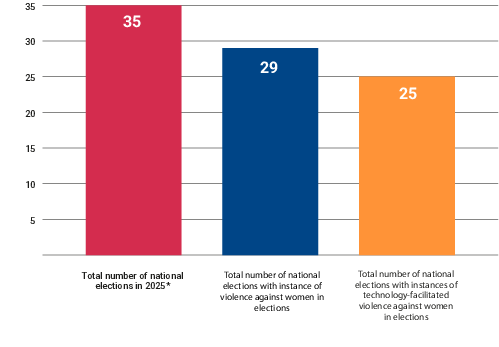
While the desk research provides a clear indication of the widespread nature and scope of VAWE in 2025, the findings should be interpreted as conservative estimates. The findings do not capture economic or institutional forms of VAWE and are constrained by language coverage, time limitations and persistent underreporting. In particular, violence affecting women beyond high-profile political roles is less likely to be documented. Digital violence targeting women in rural or Indigenous communities may also go largely unreported, while ‘non-response’ in surveys of women candidates—one of the primary tools for measuring violence at scale—further limits data availability. The findings should therefore be understood as indicative rather than exhaustive.
The following section examines selected cases in greater depth, illustrating how technology-facilitated violence against women in elections silences women’s voices, deters participation, and ultimately undermines electoral integrity and democratic competition.
6.4.1. Gendered motives: Violence aimed at silencing and excluding women
Across electoral contexts in 2025, VAWE was often driven by gendered motives that extended beyond political competition. Rather than contesting ideas or performance, such violence sought to discipline, silence and exclude women from political life, targeting them not for their views but for their presence in politics and drawing on broader cultural gender stereotypes. This dynamic was evident, for example, in the context of elections in both Albania and Bolivia, where women candidates and political leaders were subjected to sexualized, racist and degrading online abuse aimed at undermining their legitimacy and authority (see, for example, Arqimandriti et al. 2025; Observatorio de Género 2025). Similar motives were observed elsewhere and, taken together, these cases illustrate how VAWE functions as a mechanism of gendered exclusion, reinforcing boundaries around who is considered entitled to political power. The following section discusses how this violence manifests, with particular attention to the rapid rise of technology-facilitated forms of such violence in 2025.
6.4.2. Gendered forms of violence amplified through technology
In 2025 online and digital spaces were the primary arena in which VAWE manifested and intensified. Although many political actors faced online hostility, research consistently shows that women are disproportionately targeted, and the abuse they receive is distinct in its sexualized, misogynistic, racist, ageist and deeply personal nature. Enabled by digital tools that facilitate rapid, anonymous and large-scale attacks, this violence is aimed less at political critique and more at humiliation, intimidation and psychological harm. These attacks frequently invoke women’s bodies, morality or social roles, reinforcing patriarchal norms aimed at undermining their political legitimacy (Becker Castellaro et al. 2025). The gendered nature of technology-enabled abuse is stark: women account for an estimated 96 per cent of deepfake victims (McDermott and Davies 2022).
The 2025 election cycle in Bolivia provides illustrative examples of this pattern. Social media attacks against women candidates and political leaders included sexualized and dehumanizing harassment, racist and misogynistic slurs and calls for physical harm. Indigenous women candidates faced particularly acute abuse rooted in both gender and Indigenous identity, alongside escalating online harassment and demands for women’s removal from political life. In these cases, the abuse conveyed a message that went beyond political disagreement to assert that these women did not belong in politics at all (Observatorio de Género 2025).
Similar dynamics were observed elsewhere. In Albania, women members of parliament (MPs) and candidates were targeted with misogynistic and ageist online abuse focused on gender, morality and appearance, including calls for physical punishment (Arqimandriti et al. 2025). In Argentina, a female journalist reported coordinated harassment involving sexual deepfakes, rape and death threats, and amplification by political leaders, describing it as a strategy to silence and deter criticism (Jaureguy 2025). In Chile, monitoring identified a shift from misinformation to aggressive content targeting women candidates, with a significant share of hate speech motivated by gender, including coordinated campaigns questioning women’s mental capacity (Salas 2025). In Ecuador, EU observers documented 347 sexist online attacks against women candidates and election officials, including objectification, racialized abuse and efforts to undermine their authority, particularly targeting Indigenous and Afro-descendant women (EU EOM 2025b). Further monitoring by Lupa Media, an Ecuador-based fact-checking organization, during the 2025 campaign showed that the most common forms of aggression were insults (68.75 per cent), dissemination of sexual content (18.75 per cent), defamation (6.25 per cent) and attacks on physical appearance (6.25 per cent) (Navarro 2025).
Election observation and assessment missions deployed by the Organization for Security and Co-operation in Europe’s Office for Democratic Institutions and Human Rights in countries such as Canada, Germany, the Netherlands, North Macedonia, Portugal and Romania similarly reported that technology-facilitated political violence disproportionately affected women, often involving sexualized threats, visual manipulation, deepfakes and coordinated harassment. Women of migrant backgrounds, racialized women and queer women were consistently identified as facing heightened risk (ODIHR 2025a, 2025b, 2025c, 2025f, 2025g, 2025h). In New Zealand and Singapore, women candidates and elected officials likewise reported technology-facilitated sexist and racist abuse, including pornographic image manipulation (Lim 2025; Malay Mail 2025; McGregor 2025; Prendergast 2025).
The 2025 judicial elections in Mexico demonstrated that technology-facilitated violence affects judicial contests as well. Women candidates faced false accusations, rumours and targeted personal harassment, and of the 27 complaints received, 25 were filed by women, with 66 per cent involving abuse on social media (International IDEA 2025).
Taken together, these cases show that technology-facilitated violence against women in elections in 2025 was neither incidental nor isolated. It constitutes a widespread and increasingly normalized feature of electoral environments, operating as a targeted mechanism to control, silence and deter women’s political participation. The next section shifts focus to the impact of this type of violence.
6.4.3. Gendered impacts: Real-life consequences for women and electoral integrity
Examples of VAWE in 2025 demonstrate that technology-facilitated violence has tangible consequences and is closely intertwined with other forms of violence against women. As previous research has shown (Ríos Tobar 2024), these attacks affect women’s personal and professional lives, undermine their political participation, contestation and representation, and ultimately pose risks to electoral integrity. In Bolivia, for example, women candidates faced sustained online harassment, escalating threats and public pressure to withdraw from political life—forcing at least one candidate to step down. These cases illustrate how digital abuse can translate into coercive exclusion, narrowing voter choice and undermining the legitimacy of representation (Observatorio de Género 2025).
Comparable impacts were reported elsewhere. In Germany, online threats of a sexual nature, combined with AI-generated visual content featuring derogatory and sexualized elements, negatively affected women’s willingness and ability to engage actively in political life (ODIHR 2025b). In Kyrgyzstan, women’s political underrepresentation was linked to entrenched stereotypes and online violence, with intolerant speech online identified as a key deterrent (ODIHR 2025e). In Moldova, widespread psychological and online abuse—including intimidation and sexist threats—discouraged female candidates’ involvement and undermined the inclusiveness of the electoral process (IPN 2025; Necsutu 2025; ODIHR 2025d).
Technology-facilitated VAWE has also led to self-censorship and, in some cases, withdrawal from digital spaces. In Portugal, women MPs advocating for abortion reform or LGBTQ+ rights faced online harassment and cyberviolence, reflecting attempts to punish women for ‘controversial’ positions and shape not only whether, but also how and on which issues, they participate in political life (ODIHR 2025h). In New Zealand, the psychological toll of online violence led to direct withdrawal, with Wellington City Councillor Teri O’Neill reporting extensive sexist abuse, including pornographic image manipulation, severe mental health impacts and her eventual exit from online platforms (McGregor 2025; Prendergast 2025).
Taken together, these cases show that technology-facilitated gender-based violence is not a marginal issue in electoral processes. By silencing women’s voices, driving women out of races, deterring future candidates and shaping who feels safe to participate, it directly undermines equal competition, representative choice and democratic legitimacy. It also has a powerful impact on women’s everyday lives, affecting their capacity to perform at work, their personal interactions and their mental well-being. The next section turns to emerging good practices for preventing and responding to this violence.
6.5. Addressing violence against women in elections: Findings from 2025
Addressing the complexity, scale and persistence of violence against women in elections—including technology-facilitated violence—requires comprehensive, intersectional and multi-stakeholder approaches that integrate a gender perspective across prevention, protection, accountability, policy coordination and survivor support (NDI 2018; ODIHR 2022). No single measure is sufficient; rather, progress depends on coordinated action across the legal, institutional and operational dimensions of both electoral and broader societal systems.
This section highlights selected responses implemented in 2025 to prevent and mitigate technology-facilitated violence against women in elections, focusing on legal, institutional and management safeguards, as identified by International IDEA.10 While many of these efforts remain recent and their long-term impact has yet to be fully assessed, they nonetheless represent important emerging good practices in preventing and eliminating such violence and, hence, protecting electoral integrity.
6.5.1. Legal safeguards
Legal safeguards are central to preventing and addressing technology-facilitated violence against women in elections. They include both election-specific regulations and broader frameworks on gender equality, violence against women and online harms, which together define offences, establish standards and enable accountability.
In 2025 several countries strengthened their relevant frameworks. Albania adopted a new gender equality law reinforcing state obligations to address violence against women (Windelspecht 2025), while Canada introduced Criminal Code reforms to strengthen sentencing and improve survivor protection (Government of Canada 2025b). Some countries strengthened election-specific safeguards by reinterpreting existing frameworks to address gender-based violence in electoral contexts. In the Philippines, the Commission on Elections (COMELEC) expanded safeguards through new resolutions designating all election-related spaces—including online platforms—as ‘safe spaces’ and prohibiting gender-based harassment and abuse during campaigns, with clear mechanisms for enforcement (COMELEC 2025a, 2025b).
Earlier legal frameworks also remain influential. Australia’s Federal Register of Legislation has been used to penalize abusive AI-generated images targeting women (eSafety Commissioner 2025). South Korea has strengthened accountability for deepfake sexual violence by criminalizing its creation, distribution, possession and viewing, with 2025 measures operationalized through centralized responses and AI-enabled detection tools (Republic of Korea 2024). More recently, Moldova introduced reforms defining digital violence11 and classifying abusive online content—including discriminatory, sexist, threatening or obscene material—as grounds for court action,12 enabling content removal and protection orders.13 Together, these measures strengthen the legal basis for addressing technology-facilitated violence against women in elections.
At the international level, emerging AI governance frameworks increasingly address AI’s impact on information integrity and democratic processes but often overlook how generative AI and deepfakes are weaponized as technology-facilitated gender-based violence targeting women in politics (Becker Castellaro et al. 2025). At the national level, some countries have gone further. Mexico has developed one of the most comprehensive frameworks, integrating digital violence into laws on political violence against women, linking such offences to electoral eligibility through the ‘3 of 3 against violence’ rule, later expanded to the ‘8 of 8 against violence’ rule,14 and criminalizing online abuse through the Olimpia Law (International IDEA 2025). This approach was reinforced by a landmark ruling annulling a municipal election in Irimbo, in which the court found that digital gender-based violence compromises electoral integrity (Humphrey Jordan 2024; TEPJF 2024). Similarly, Ecuador classifies gender-based political violence—including digital forms—as a serious electoral offence. Increased use of this classification in the 2025 elections suggests growing awareness and uptake, though concerns were raised that the broad definition may enable misuse (Republic of Ecuador 2020: article 280; EU EOM 2025b).
Overall, these examples illustrate how legal safeguards—whether explicitly electoral or embedded in broader legislation on digital safety and violence against women—form a necessary foundation for addressing technology-facilitated violence against women in elections. While laws alone are insufficient without effective implementation and enforcement, particularly in countries with structural vulnerabilities in the rule of law, they do establish essential standards, clarify responsibilities and signal state commitment to protecting women’s political rights and electoral integrity.
6.5.2. Institutional safeguards
Institutional safeguards refer to the mandates, resources, coordination mechanisms and operational capacity of state and non-state actors to address VAWE. Given the complexity of VAWE, particularly the evolving nature of its technology-facilitated forms, effective responses require cooperation, coordination and norm-changing efforts beyond traditional electoral stakeholders.
The security sector is central to addressing VAWE, highlighting the need for gender-sensitive law enforcement that ensures protection, reporting and accountability. In 2025 Tanzania introduced police gender desks ahead of elections, though their impact was limited by resource constraints, training gaps and stigma-related underreporting (AU EOM 2025). Broader capacity-building initiatives in countries such as Malawi offer other useful examples of gender-responsive, survivor-centred policing (Likaka 2025; Mlamba 2025).
Political parties, as key gatekeepers, also contribute to prevention and response. In Germany, parties supported candidates through training on harassment and online abuse, social media moderation and internal support systems (ODIHR 2025b). In Mexico, party guidelines, including the ‘8 of 8 against violence’ principle, bar individuals with histories of gender-based violence, including digital and political violence, from candidacy (International IDEA 2025). These measures show how party-level mechanisms can complement legal safeguards.
Cooperation and coordination—particularly with digital platforms—emerged as a key area of innovation and good practice in 2025. In Mexico, the National Electoral Institute worked with platforms such as Meta and TikTok to remove content constituting gender-based political violence (International IDEA 2025). Similar efforts to strengthen institutional capacity and platform cooperation were observed in Brazil and Chile (Peres Osorio et al. 2022; SERVEL 2025b). In Cabo Verde, the National Electoral Commission established an Electoral Fact-Checking Unit, in partnership with national institutions and TikTok, to monitor and counter electoral disinformation, marking a first step towards institutionalized cooperation with digital platforms. Similarly, in the Philippines, COMELEC established a mis- and disinformation task force15 that operates under memorandums of understanding with several technology companies, enabling takedown requests for viral false content and supporting internal efforts—through Task Force SAFE (see 6.5.3: Management safeguards)—to address gender-based harassment and abuse online during electoral periods.
Civil society and election observation missions remain critical for monitoring, awareness raising and evidence-based advocacy. By documenting incidents, they increase visibility, challenge normalization and inform institutional responses. In 2025, in Honduras, the Women’s Political Observatory developed monitoring tools and reporting on political violence against women, supporting advocacy and preventive action (Observatorio Político de Mujeres n.d.; PNUD Honduras 2025). In the Netherlands and Moldova, gender-focused election observation and research initiatives generated evidence on gender-based and online violence to inform awareness raising, accountability and institutional responses (Asociația Gender-Centru 2025; Gender Concerns International 2025). Global campaigns such as the 16 Days of Activism further supported awareness and norm change.
Taken together, these examples highlight the importance of institutional safeguards in translating legal frameworks into practice. While capacity and coordination challenges remain, strengthened mandates, interagency cooperation, engagement with digital platforms and partnerships with civil society constitute key institutional foundations for addressing VAWE.
6.5.3. Management safeguards
Management safeguards refer to the operational processes and procedures put in place by electoral management bodies (EMBs) and other actors to address VAWE in practice. They are essential, as legal and institutional frameworks alone are often insufficient to respond to evolving challenges, including technology-facilitated gender-based violence in electoral processes.
In 2025 several EMBs strengthened such measures. Mexico’s National Electoral Institute stands out for its comprehensive approach, with a clear Special Sanctioning Procedure for complaints, investigations, risk assessments and urgent protective measures—such as restraining orders, police protection and content removal—alongside a public registry of sanctioned individuals, enabling candidacy bans. These mechanisms are complemented by preventive and support-oriented measures such as specialized training and psychosocial assistance (International IDEA 2025). Similar approaches can be observed elsewhere. In Paraguay, the Superior Electoral Court, together with the Ministry of Women, jointly developed a protocol to guide the prevention of and response to gender-based political violence (Cámara de Diputados del Paraguay 2025). In Bolivia, the Supreme Electoral Tribunal introduced systems to monitor complaints and forced resignations related to political violence against women (Órgano Electoral Plurinacional 2025).
In the Philippines, COMELEC operationalized anti-discrimination standards through the Task Force SAFE,16 which monitors and investigates discriminatory conduct—including online abuse—verifies incidents and initiates accountability procedures (COMELEC 2025a). It operates alongside an internal mis- and disinformation task force that, in cooperation with social media platforms, enables content takedowns and coordinated responses. Supported by public reporting and field-level verification, this approach represents a significant step towards integrating responses to VAWE within EMB processes.
Cabo Verde’s National Electoral Commission (CNE) further illustrates how internal management tools can support gender-responsive electoral administration. Through its 2020 Gender Policy, the CNE has integrated gender equality across institutional and electoral processes, including by promoting parity in staffing, equal opportunities and pay, and preventing workplace harassment. A designated gender focal point further strengthens these efforts, demonstrating how internal policies can translate commitments into sustained practice (CNE 2025). By integrating gender equality into the core functions and accountability mechanisms of electoral management, the EMB has laid a strong foundation for addressing VAWE more broadly.
Together, these examples demonstrate how management safeguards operationalize legal and institutional commitments through practical tools, procedures and workflows. By enabling timely responses, consistent enforcement and data-driven approaches, they are critical to addressing VAWE and ensuring inclusive and credible elections.
Box 6.1. Disinformation and gender-based digital violence: Institutional responses in Chile
Marcela Rios Tobar
Electoral disinformation is rising globally, and Chile is no exception (Anguita et al. 2023a). The country has experienced declining information integrity alongside increasing digital violence against women (Diario Uchile 2025; El Mostrador 2025). This context raises a key question: how can countries without the structural power of large democracies effectively respond to these challenges? Chile offers an example of an emerging approach to addressing digital violence and mitigating risks in the electoral information environment.
Between 2023 and 2025 the government designed a multilayered agenda to promote information integrity, establishing the Advisory Commission on Disinformation, which produced a baseline evaluation containing 72 recommendations (Anguita et al. 2023a, 2023b). This was followed by public campaigns aimed at strengthening citizens’ critical skills and improving access to official information during the 2024 and 2025 elections (SEGEGOB 2024; SEGPRES 2025).
At the same time, the autonomous Electoral Service (SERVEL) strengthened its institutional response by creating the Governance Roundtable for Electoral Information Integrity. This multi-stakeholder initiative brought together public institutions, digital platforms, media and civil society to address disinformation, hate speech and digital violence. It was complemented by an Ethical Commitment for Electoral Information Integrity, as well as monitoring tools such as eMonitor+, developed by the UN Development Programme, and direct coordination with platforms to correct misleading information and prevent gender-based violence (PNUD Chile 2025).
SERVEL (2026), together with International IDEA (n.d.c), also worked to promote technical dialogue and capacity building on disinformation, artificial intelligence and digital electoral governance, with a particular focus on addressing gendered digital violence. International IDEA has also fostered public awareness and multi-stakeholder networks to confront gender-based digital violence through a regional study.
The Ministry of Women and Gender Equity, alongside women legislators, advanced a comprehensive law to address all forms of violence against women (Biblioteca del Congreso Nacional de Chile 2024) and introduced a Senate motion to sanction online violence (República de Chile 2020).
Overall, Chile is moving beyond reactive debunking towards a coordinated model based on multi-stakeholder coordination, digital monitoring, platform cooperation and civic education. The challenge going forward is to consolidate these efforts into long-term state policies.
6.6. Conclusion
The 2025 election cycle confirmed that VAWE remains a persistent and global feature of contemporary electoral environments. Despite widespread underreporting and normalization, evidence shows that women in different roles across contexts continue to face gender-based violence aimed at silencing, deterring and excluding them from political life. Technology-facilitated violence stands out as the most pervasive and rapidly evolving threat, operating at scale, with limited accountability and with impacts that extend beyond online spaces into women’s lives in other spheres. At the same time, VAWE is reshaping public discourse, media narratives and perceptions of women’s political leadership. Regressive narratives are re-emerging, reinforcing exclusion and undermining progress towards gender equality. The cumulative effect is a distortion of political competition, reduced representative choice and an erosion of electoral integrity.
Encouragingly, 2025 also highlighted emerging good practices and institutional innovations. While responsive legal frameworks remain essential, their effectiveness continues to be constrained by weak enforcement, implementation gaps, unclear provisions and fragmented approaches. Legal protection must also be complemented by stronger institutional and management safeguards. In several contexts, enhanced coordination among electoral stakeholders—including digital platforms and civil society—has supported more effective responses, alongside improvements in complaints mechanisms, sanctioning procedures and the integration of gender and inclusion expertise within electoral management bodies.
As digitalization continues to reshape political participation, technology-facilitated violence against women in elections is likely to intensify and evolve. Addressing these threats requires sustained, coordinated action—robust and adaptable legal frameworks, consistent enforcement, strengthened institutional resilience and inclusive, multi-stakeholder approaches that embed gender perspectives across prevention, protection, accountability and survivor support. Responsibility cannot rest with those targeted; political parties, EMBs, legislatures and governments must assume active preventive and prosecutorial roles in collaboration with civil society organizations.
Without urgent and sustained action, VAWE will continue to constrain women’s political participation and representation, with direct consequences for electoral integrity and democratic legitimacy.
References for Chapter 6
African Union Election Observation Mission (AU EOM), ‘Preliminary statement of the African Union Election Observation Mission to the October 2025 general elections in the United Republic of Tanzania: The African Union Election Observation Mission calls for urgent constitutional reforms and inclusive politics’, 5 November 2025, <https://au.int/ar/node/45624>, accessed 14 June 2026
Anguita, P., Bachmann, I., Brossi, L., Elórtegui, C., Escobar, M. J., Ibarra, P., Lara, J. C., Padilla, F. and Peña, P., ‘El fenómeno de la desinformación: Revisión de experiencias internacionales y en Chile’ [The Phenomenon of Disinformation: A Review of International Experiences and the Situation in Chile], Comisión Asesora contra la Desinformación, 28 August 2023a, <https://minciencia.gob.cl/uploads/filer_public/26/cb/26cb92cb-5614-4e7c-a46e-f001a2b838b1/informe_i_-_el_fenomeno_de_la_desinformacion_global_y_en_chile_1.pdf>, accessed 14 June 2026
—, ‘Recomendaciones para contrarrestar la desinformación en Chile’ [Recommendations for Countering Misinformation in Chile], Comisión Asesora contra la Desinformación, December 2023b, <https://minciencia.gob.cl/uploads/filer_public/f5/fc/f5fc81c1-a990-4eec-87be-f3b43108beeb/informe_ii-comision_contra_la_desinformacion-04-12-23.pdf>, accessed 14 June 2026
Arqimandriti, M., Cekov, A., Dimova, N. and Hoxha, E., ‘Findings on Gender-Based Violence in Media and Social Media Networks during the 2025 Electoral Campaign’, Westminster Foundation for Democracy, June 2025, <https://www.gadc.org.al/media/files/upload/Raporti%20final%20ne%20anglisht_VAWP.pdf>, accessed 14 June 2025
Asociația Gender-Centru, ‘RAPORT de monitorizare a discursului și comportamentului sexist al candidaților şi a candidatelor din campania electorală pentru alegerile parlamentare 2025’ [Report on monitoring the sexist discourse and behaviour of candidates in the electoral campaign for the 2025 parliamentary elections], 2025, <https://gender-centru.md/wp-content/uploads/2025/10/RAPORT-VIFA-ALEGERI-PARLAMENTARE-2025-1.pdf>, accessed 14 June 2026
Ballington, J., Bardall, G. and Borovsky, G., Preventing Violence against Women in Elections: A Programming Guide (UN Women and UN Development Programme, 2017), <https://www.unwomen.org/sites/default/files/Headquarters/Attachments/Sections/Library/Publications/2017/Preventing-VAW-in-elections-en.PDF>, accessed 15 June 2026
Bardall, G., Bjarnegård, E. and Piscopo, J. M., ‘How is political violence gendered? Disentangling motives, forms, and impacts’, Political Studies, 68/4 (2020), pp. 916–35, <https://doi.org/10.1177/0032321719881812>
Becker Castellaro, S., Carvalho, M., Fernández Gibaja, A., Grassi, A., Hammar, C., Müller, J., Pereira, L., Piaia, V. and Ruediger, M. A., Artificial Intelligence and Information Integrity: Latin American Experiences, Policy Paper No. 34 (Stockholm: International IDEA, 2025), <https://doi.org/10.31752/idea.2025.39>
Biblioteca del Congreso Nacional de Chile, Ley 21.675, Estatuye Medidas para Prevenir, Sancionar y Erradicar la Violencia en Contra de las Mujeres, en Razón de su Género [Law 21.675 Establishing Measures to Prevent, Punish and Eradicate Gender-Based Violence against Women], 14 June 2024, <https://www.bcn.cl/leychile/navegar?idNorma=1204220>, accessed 14 June 2026
E. Bjarnegård and P. Zetterberg (eds), Gender and Violence against Political Actors (Philadelphia, PA: Temple University Press, 2023)
Bolivia Verifica Elecciones, ‘La otra guerra sucia: Cómo operó la violencia política digital contra candidatas mujeres’ [The Other Dirty War: How Digital Political Violence Targeted Female Candidates], 16 November 2025, <https://boliviaverifica.bo/la-otra-guerra-sucia-como-opero-la-violencia-politica-digital-contra-candidatas-mujeres-2>, accessed 16 June 2026
Cámara de Diputados del Paraguay, ‘Socializan protocolo que busca evitar casos de violencia política contra las mujeres’ [A protocol is being promoted aimed at preventing cases of political violence against women], 27 October 2025, <https://www.diputados.gov.py/noticias/noticias/871>, accessed 14 June 2026
Carter Center, The, ‘Guyana General Election Preliminary Statement’, 3 September 2025, <https://www.cartercenter.org/publication/guyana-general-election-preliminary-statement-sept-3-2025>, accessed 14 June 2026
Comissão Nacional de Eleições (CNE). (2025). Boas práticas da CNE na integração da perspetiva de género nos processos eleitorais [Good practices of the National Electoral Commission in integrating a gender perspective into electoral processes]. Cidade da Praia, Cabo Verde
Coyne, E., ‘Joe Brolly video depicting sex act by presidential candidate is “misogynistic”, says Heather Humphreys’, The Irish Times, 10 October 2025, <https://www.irishtimes.com/politics/2025/10/10/joe-brolly-video-depicting-sex-act-by-presidential-candidate-is-misogynistic-heather-humphreys-says>, accessed 15 June 2026
Cristosal Derechos Humanos and Heinrich Boll Stiftung, ‘Democracia bajo Amenaza: Violencia Política en el Proceso Electoral en Honduras’ [Democracy under Threat: Political Violence in the Electoral Process in Honduras], 2025, <https://cristosal.org/wp-content/uploads/2025/11/Democracia-bajo-amenaza-Violencia-politica-en-el-proceso-electoral-de-Honduras.pdf>, accessed 15 June 2026
Diario UChile, ‘Mayoría de las candidatas en elecciones 2024 señala haber vivido violencia digital’ [Most female candidates in the 2024 elections report having experienced online abuse], 2 October 2025, <https://radio.uchile.cl/2025/10/02/mayoria-de-las-candidatas-en-elecciones-2024-senala-haber-vivido-violencia-digital>, accessed 14 June 2026
Ecuador, Republic of, Ley 2. Ley Orgánica electoral, código de la democracia [Law 2. Organic Election Law, the Code of Democracy], vLex Ecuador, 2020, <https://vlex.ec/vid/ley-2-ley-organica-643461725?utm>, accessed 14 June 2026
El Mostrador, ‘El ataque troll a Evelyn Matthei’ [The troll attack on Evelyn Matthei], 13 July 2025, <https://www.elmostrador.cl/politica/2025/07/13/el-ataque-troll-a-evelyn-matthei>, accessed 14 June 2026
eSafety Commissioner, ‘Court orders $343,500 penalty for posting deepfakes of Australian women’, 26 September 2025, <https://www.esafety.gov.au/newsroom/media-releases/court-orders-343500-penalty-for-posting-deepfakes-of-australian-women>, accessed 14 June 2026
European Union Election Observation Mission (EU EOM), Kosovo, Parliamentary Elections, 9 February 2025, ‘Final Report’, 15 May 2025a, <https://www.eeas.europa.eu/eom-kosovo-2025/eu-eom-kosovo-2025-final-report_en?s=410457>, accessed 15 June 2026
—, Ecuador, Legislative and Presidential Elections, 9 February 2025, and Presidential Run-off, 13 April 2025, ‘Final Report’, 30 June 2025b, <https://www.eeas.europa.eu/sites/default/files/2025/documents/Final%20Report%20EU%20EOM%20Ecuador%202025%20EN%20Total%20-%20Cover.pdf>, accessed 14 June 2026
—, Guyana, General and Regional Elections, 1 September 2025, ‘Preliminary Statement’, 3 September 2025c, <https://www.eeas.europa.eu/sites/default/files/2025/documents/PS_EU%20EOM_Guyana_2025_3%20September_FINAL.pdf>, accessed 14 June 2026
—, Bolivia, General Elections, 17 August 2025, and Presidential Run-off, 19 October 2025, ‘Preliminary Statement’, 21 October 2025d, <https://www.eeas.europa.eu/sites/default/files/2025/documents/PS%20run-off.pdf>, accessed 14 June 2026
Gender Concerns International, ‘GEOM NL 2025 will observe the upcoming election in The Netherlands from a distinct gender perspective’, 29 October 2025, <https://www.genderconcerns.org/news/october-29-geom-nl-2025-will-observe-the-upcoming-election-in-the-netherlands>, accessed 14 June 2026
Gleaner, The, ‘Poster destruction and intimidation claims mount as election campaign heats up’, 27 July 2025a, <https://past.jamaica-gleaner.com/article/news/20250727/poster-destruction-and-intimidation-claims-mount-election-campaign-heats>, accessed 15 June 2026
—, ‘PNP complains of political intimidation in Rose Heights’, 1 September 2025b, <https://past.jamaica-gleaner.com/article/news/20250901/pnp-complains-political-intimidation-rose-heights>, accessed 15 June 2026
Gobierno de Chile, Ministerio Secretaría General de Gobierno (SEGEGOB), ‘“Aguanta, chequea, comparte”: Gobierno lanza campaña con foco ciudadano para combatir la desinformación’ [‘Wait, check, share’: Government launches citizen-focused campaign to combat misinformation], 18 June 2024, <https://msgg.gob.cl/wp/2024/06/18/aguanta-chequea-comparte-gobierno-lanza-campana-con-foco-ciudadano-para-combatir-la-desinformacion>, accessed 14 June 2026
—, Ministerio Secretaría General de la Presidencia (SEGPRES), ‘“Chile Vota Informado”: Gobierno lanza campaña para promover la participación ciudadana en las Elecciones Primarias Presidenciales 2025’ [‘Chile Votes Informed’: Government launches campaign to promote citizen participation in the 2025 presidential primary elections], 6 June 2025, <https://msgg.gob.cl/wp/2025/06/06/chile-vota-informado-gobierno-lanza-campana-para-promover-la-participacion-ciudadana-en-las-elecciones-primarias-presidenciales-2025>, accessed 26 June 2026
Gong, ‘Presidential elections on social media: Defamation, bots, and questionable research’, 23 January 2025, <https://gong.hr/en/2025/01/23/presidential-elections-on-social-media-defamation-bots-and-questionable-research>, accessed 15 June 2026
Government of Canada, Security and Intelligence Threats to Elections Task Force: Threats to the Liberal Party of Canada 2025 Leadership Campaign (Ottawa: His Majesty the King in Right of Canada, 2025a), <https://publications.gc.ca/site/archivee-archived.html?url=https%3A%2F%2Fpublications.gc.ca%2Fcollections%2Fcollection_2025%2Fbcp-pco%2FCP22-234-2025-eng.pdf>, accessed 5 July 2026
—, Department of Justice, ‘Canada overhauls Criminal Code to protect victims and keep kids safe from predators’, 9 December 2025b, <https://www.canada.ca/en/department-justice/news/2025/12/canada-overhauls-criminal-code-to-protect-victims-and-keep-kids-safe-from-predators.html>, accessed 14 June 2026
Hae-rin, L., ‘Reform Party candidate under fire for misogynistic remark during TV debate’, The Korea Times, 28 May 2025, <https://www.koreatimes.co.kr/southkorea/politics/20250528/reform-party-candidate-under-fire-for-misogynistic-remark-during-tv-debate>, accessed 15 June 2026
Humphrey Jordan, C., ‘Otra elección más, anulada por violencia política contra las mujeres en razón de género’ [Yet another election derailed by gender-based political violence against women], La Silla Rota, 19 September 2024, <https://lasillarota.com/opinion/columnas/2024/9/19/otra-eleccion-mas-anulada-por-violencia-politica-contra-las-mujeres-en-razon-de-genero-502276.html>, accessed 15 June 2026
International Foundation for Electoral Systems (IFES), IFES 2011: Annual Report (2011), <https://www.ifes.org/sites/default/files/migrate/ifes_2011_annual_report.pdf>, accessed 15 June 2026
International IDEA, ‘An integrated framework for protecting elections’, [n.d.a], <https://www.idea.int/an-integrated-framework-for-protecting-elections>, accessed 14 June 2026
—, Global Election Monitor, [n.d.b], <https://www.idea.int/global-election-monitor>, accessed 7 May 2026
—, ‘Ecosistemas democráticos bajo presión: La integridad electoral frente a la desinformación y la violencia política de género. Un protocolo de acción’ [Democratic Ecosystems Under Pressure: Electoral Integrity in the Face of Disinformation and Gender-Based Political Violence – A Protocol for Action], [n.d.c], <https://www.idea.int/sites/default/files/2026-01/Relator%C3%ADa%20Encuentro%20Regional%20Chile.pdf>, accessed 14 June 2026
—, Misión de Acompañamiento Técnico Electoral al Instituto Nacional Electoral de México, Proceso Electoral Extraordinario del Poder Judicial de la Federación Junio 2025 [Technical Electoral Support Mission to Mexico’s National Electoral Institute, Special Election for the Federal Judiciary, June 2025], ‘Informe final’ [Final Report], July 2025, <https://repositoriodocumental.ine.mx/xmlui/bitstream/handle/123456789/184732/INFORMEFINAL.IDEA.MEXICO2025.pdf>, accessed 14 June 2026
IPN, ‘Eight out of ten candidates in the parliamentary elections faced violence, report’, 10 December 2025, <https://ipn.md/en/eight-out-of-ten-candidates-in-the-parliamentary-elections-faced-violence-report>, accessed 15 June 2025
Jankowicz, N., Pepera, S. and Middlehurst, M., ‘Addressing Online Misogyny and Gendered Disinformation: A How-To Guide’, National Democratic Institute, 2021, <https://www.ndi.org/sites/default/files/Addressing%20Gender%20&%20Disinformation%202%20%281%29.pdf>, accessed 14 June 2026
Jaureguy, M., ‘Argentine journalists denounce state harassment under President Milei at IACHR’, Buenos Aires Herald, 20 November 2025, <https://buenosairesherald.com/society/argentine-journalists-denounce-state-harassment-under-president-milei-at-iachr>, accessed 14 June 2026
Korea, Republic of, Act on Special Cases Concerning the Punishment, etc. of Sexual Crimes, Enforcement Date: 21 June 2025, Act No. 20575, 20 December 2024, Partially Amended, National Law Information Center, 2024, <https://www.law.go.kr/lsInfoP.do?lsiSeq=267313&viewCls=lsRvsDocInfoR&utm>, accessed 14 June 2026
Lihiru, V., ‘Malawi’s 2025 elections failed its women, again’, London School of Economics and Political Science [blog], 27 November 2025, <https://blogs.lse.ac.uk/africaatlse/2025/11/27/malawis-2025-elections-failed-its-women-again>, accessed 15 June 2026
Likaka, R., ‘Eastern Region commissioner of police drills police pros on GBV’, Malawi24, 17 February 2025, <https://malawi24.com/2025/02/17/eastern-region-commissioner-of-police-drills-police-pros-on-gbv>, accessed 14 June 2026
Lim, R., ‘Former President Halimah Yacob targeted by deepfake video of her criticising the government’, CNA, last updated 21 April 2025, <https://www.channelnewsasia.com/singapore/halimah-yacob-deepfake-video-criticisng-government-ge2025-police-report-5066581>, accessed 14 June 2026
Malay Mail, ‘Sexist, racist abuse of women candidates in Singapore GE2025 draws backlash from gender equality NGO’, 2 May 2025, <https://www.malaymail.com/news/singapore/2025/05/02/sexist-racist-abuse-of-women-candidates-in-singapore-ge2025-draws-backlash-from-gender-equality-ngo/175318>, accessed 14 June 2026
McDermott, S. and Davies, J., ‘Deepfaked: “They put my face on a porn video”’, BBC, 21 October 2022, <https://www.bbc.com/news/uk-62821117>, accessed 14 June 2026
McGregor, C., ‘Women councillors are experiencing a staggering level of online abuse’, The Spinoff, 16 September 2025, <https://thespinoff.co.nz/the-bulletin/16-09-2025/women-councillors-are-experiencing-a-staggering-level-of-online-abuse>, accessed 14 June 2026
Mlamba, A., ‘Gender mainstream drill to improve fight against GBV — Yolamu’, MBC, 19 February 2025, <https://mbc.mw/gender-mainstream-drill-to-improve-fight-against-gbv-yolamu>, accessed 14 June 2026
Muwotcha, A., ‘Women aspirants face violence ahead of Malawi’s elections’, Yoneco FM, 13 September 2025, <https://www.yonecofm.com/index.php/2025/09/13/women-aspirants-face-violence-ahead-of-malawis-elections>, accessed 15 June 2026
National Democratic Institute, ‘#NotTheCost: Stopping Violence against Women in Politics’, Submission to the UN Special Rapporteur on Violence against Women, June 2018, <https://www.ndi.org/sites/default/files/NDI%20Submission.pdf>, accessed 14 June 2026
Navarro, V., ‘Violencia política de género: Datos y desinformación’ [Gender-based political violence: Facts and misinformation], Lupa Media, 6 March 2025, <https://lupa.com.ec/explicativos/violencia-politica-genero-ecuador-datos-desinformacion>, accessed 14 June 2026
Necsutu, M., ‘Hate speech grips divided Moldova ahead of key election’, Balkan Insight, 8 September 2025, <https://balkaninsight.com/2025/09/08/hate-speech-grips-divided-moldova-ahead-of-key-election/bi>, accessed 15 June 2026
Observatorio de Género, ‘Elecciones 2025: Organizaciones defensoras de derechos alertan sobre 5 casos de acoso y violencia política contra candidatas’ [2025 Elections: Human rights organizations report five cases of harassment and political violence against female candidates], 30 July 2025, <https://www.coordinadoradelamujer.org.bo/observatorio/archivos/destacados/NotadeprensacasosAVPvdifjulio2025_261.pdf>, accessed 15 June 2026
Observatorio Político de Mujeres, [n.d.], <https://observatoriopoliticomujeres.hn>, accessed 25 June 2026
Organization for Security and Co-operation in Europe, Office for Democratic Institutions and Human Rights (ODIHR), Addressing Violence against Women in Politics in the OSCE Region: Toolkit, Tool 1, Introduction to Violence against Women in Politics (Warsaw: ODIHR, 2022), <https://www.osce.org/files/f/documents/e/7/530272_1.pdf>, accessed 14 June 2026
—, Republic of Tajikistan, Parliamentary Elections, 2 March 2025, ‘Needs Assessment Mission Report’, 31 December 2024, <https://odihr.osce.org/odihr/584344>, accessed 15 June 2026
—, Canada, Early Federal Election, 28 April 2025, ‘Needs Assessment Mission Report’, 16 April 2025a, <https://odihr.osce.org/odihr/elections/canada/589517>, accessed 15 June 2026
—, Federal Republic of Germany, Early Elections to the Federal Parliament, 23 February 2025, ‘Final Report’, 23 June 2025b, <https://odihr.osce.org/odihr/elections/germany/593720>, accessed 14 June 2026
—, The Netherlands, Early Parliamentary Elections, 29 October 2025, ‘ODIHR Needs Assessment Mission Report’, 2 September 2025c, <https://odihr.osce.org/odihr/elections/netherlands/596998>, accessed 14 June 2026
—, Moldova, Parliamentary Elections, 28 September 2025, ‘Statement of Preliminary Findings and Conclusions’, 29 September 2025d, <https://odihr.osce.org/odihr/elections/moldova/597800>, accessed 15 June 2026
—, Kyrgyzstan, Early Parliamentary Elections, 30 November 2025, ‘Needs Assessment Mission Report’, 9 October 2025e, <https://odihr.osce.org/odihr/elections/kyrgyzstan/598918>, accessed 15 June 2025
—, North Macedonia, Local Elections, First Round, 19 October 2025, ‘Statement of Preliminary Findings and Conclusions’, 20 October 2025f, <https://odihr.osce.org/odihr/elections/north-macedonia/599568>, accessed 14 June 2026
—, Romania, Repeat Presidential Election, 4 and 18 May 2025, ‘Final Report’, 28 October 2025g, <https://odihr.osce.org/odihr/elections/romania/600295>, accessed 14 June 2026
—, Portugal, Early Parliamentary Elections, 18 May 2025, ‘Final Report’, 12 November 2025h, <https://odihr.osce.org/odihr/elections/portugal/601359>, accessed 14 June 2026
—, Poland, Presidential Election, 18 May and 1 June 2025, ‘Final Report’, 16 October 2025i, <https://odihr.osce.org/odihr/elections/poland/599685>, accessed 15 June 2026
Organization of American States (OAS), Jamaica, General Elections, 2025, ‘Preliminary Report’, 4 September 2025, <https://www.oas.org/fpdb/press/Preliminary-Report_Jamaica-2025.pdf>, accessed 15 June 2026
Órgano Electoral Plurinacional, ‘El TSE socializa el nuevo sistema de registro de renuncias y denuncias por acoso y violencia política hacia las mujeres’ [TSE publicizes new system for registering resignations and complaints of harassment and political violence against women], 9 July 2025, <https://web.oep.org.bo/institucional-institucional/el-tse-socializa-el-nuevo-sistema-de-registro-de-renuncias-y-denuncias-por-acoso-y-violencia-politica-hacia-las-mujeres>, accessed 1 July 2026
Othman, H., ‘25 groups demand action on cyberviolence against women candidates’, Manassa, 23 October 2025, <https://manassa.news/en/news/27984>, accessed 15 June 2026
Peres Osorio, A. R., Franco Alvim, F., Siqueira, G., Rocha de Barcelos, J., Martin Vargas, M. A. and Rodrigues e Thiago Rondon, T. P., ‘Programa permanente de lucha contra la desinformación en el marco de la justicia electoral de Brasil: plan estratégico elecciones 2022’ [Ongoing Programme to Combat Disinformation within the Framework of Brazil’s Electoral Justice System: Strategic Plan for the 2022 Elections], Tribunal Superior Electoral, 2022, <https://www.justicaeleitoral.jus.br/desinformacao/arquivos/tse-brasil-programa-de-lucha-contra-la-desinformacion-2022-1.pdf>, accessed 14 June 2026
Philippines, the Republic of the, Commission on Elections (COMELEC), Resolution No. 11127, Supplemental Resolution to Comelec Resolution No. 17715 Entitled ‘Antidiscrimination and Fair Campaigning Guidelines for Purposes of the 12 May 2025 National and Local Elections, and Barmm Parliamentary Elections’ and Declaration of All Election Related Activities and Venues Including Campaign Rallies, Caucuses, Polling Places, Precincts, Canvassing Centers, and Online Platforms as Safe Spaces, 2025a, <https://comelec.gov.ph/php-tpls-attachments/2025NLE/Resolutions/com_res_11127.pdf>, accessed 14 June 2026
—, Resolution No. 11116, Prohibiting Gender-Based Harassment and Online Abuse during the Campaign, 2025b, <https://comelec.gov.ph/php-tpls-attachments/2025NLE/Resolutions/com_res_11116.pdf>, accessed 14 June 2026
Prendergast, E., ‘“It broke me”: Female councillors on horrifying online abuse’, 1News, 8 April 2025, <https://www.1news.co.nz/2025/04/08/it-broke-me-female-councillors-on-horrifying-online-abuse>, accessed 14 June 2026
Presto, A. C., ‘Misogynistic politics endures in the Philippines despite crackdown’, East Asia Forum, 12 July 2025, <https://eastasiaforum.org/2025/07/12/misogynistic-politics-endures-in-the-philippines-despite-crackdown>, accessed 15 June 2026
Programa de las Naciones Unidas para el Desarrollo Chile (PNUD Chile), ‘PNUD Chile aborda la violencia digital contra las mujeres en contextos electorales’ [UNDP Chile addresses online violence against women in electoral contexts], 1 December 2025, <https://www.undp.org/es/chile/noticias/pnud-chile-aborda-la-violencia-digital-contra-las-mujeres-en-contextos-electorales>, accessed 14 June 2026
PNUD Honduras, ‘Observatorio Político de Mujeres presenta el primer boletín sobre violencia política’ [The Women’s Political Observatory presents its first report on political violence], 31 July 2025, <https://www.undp.org/es/honduras/noticias/observatorio-politico-de-mujeres-presenta-el-primer-boletin-sobre-violencia-politica>, accessed 14 June 2026
República de Chile, Senado, Boletín N° 13.928-07, Tipifica y sanciona la violencia digital [Bulletin No. 13.928-07: Classifies and Punishes Digital Violence], 1 December 2020, <https://tramitacion.senado.cl/appsenado/templates/tramitacion/index.php?boletin_ini=13928-07>, accessed 14 June 2026
Ríos Tobar, M., Violencia política de género en la esfera digital en América Latina [Gender-Based Political Violence in the Digital Sphere in Latin America] (Stockholm: International IDEA, 2024), <https://doi.org/10.31752/idea.2024.93>
Rogowska, K., ‘Rzeczniczka Brauna zhejtowana, bo nie głosowała na Nawrockiego. “Takie goliło się na łyso”’ [Braun’s spokeswoman targeted with online hate for not voting for Nawrocki: ‘Women like that used to have their heads shaved’], Tokfm, 4 June 2025, <https://www.tokfm.pl/polityka/tokfm-7-103087-31996962-rzeczniczka-brauna-zhejtowana-bo-nie-glosowala-na>, accessed 5 July 2026
Salas, V., ‘Contaminación informativa en elecciones: Un desafío democrático que urge enfrentar’ [Information pollution in elections: A democratic challenge that must be addressed urgently], El País Chile, 4 November 2025, <https://elpais.com/chile/2025-11-04/contaminacion-informativa-en-elecciones-un-desafio-democratico-que-urge-enfrentar.html>, accessed 14 June 2026
Schneider, P. and Carroll, D., ‘Conceptualizing more inclusive elections: Violence against women in elections and gendered electoral violence’, Policy Studies, 41(2–3), 28 November 2020, pp. 172–89, <https://doi.org/10.1080/01442872.2019.1694651>
Servicio Electoral de Chile (SERVEL), ‘Presidenta de Servel participa en lanzamiento de estudio de MinMujer y Usach sobre violencia política digital de género’ [SERVEL president attends launch of MinMujer and Usach study on digital gender-based political violence], 2 October 2025, <https://www.servel.cl/Ch/app/servel-profundizo-sus-conocimientos-sobre-ia-en-taller-organizado-por-idea-internacional/noticias/>, accessed 14 June 2025
—, ‘Servel profundizó sus conocimientos sobre IA en taller organizado por IDEA Internacional’ [SERVEL expands its knowledge of AI at workshop organized by International IDEA], 9 January 2026, <https://www.servel.cl/Ch/app/servel-profundizo-sus-conocimientos-sobre-ia-en-taller-organizado-por-idea-internacional/noticias/>, accessed 14 June 2025
SOS Digital, ‘Locas, putas y jairas: Radiografía de la violencia política digital contra candidatas en Bolivia’ [Crazies, Whores and Harlots: An Analysis of Digital Political Violence against Female Candidates in Bolivia], 2025, <https://sosdigital.internetbolivia.org/violencia-politica-digital/>, accessed 5 July 2026
Tabbush, C., ‘Understanding Backlash against Gender Equality: Evidence, Trends and Policy Responses’, United Nations Research Institute for Social Development and UN Women, 2025, <https://www.unwomen.org/en/digital-library/publications/2025/09/understanding-backlash-against-gender-equality-evidence-trends-and-policy-responses>, accessed 14 June 2025
Tribunal Electoral del Poder Judicial de la Federación (TEPJF), ‘TEPJF confirmó nulidad de elección del ayuntamiento de Irimbo, Michoacán, por haberse acreditado violencia política en razón de género contra una candidata’ [TEPJF confirms the annulment of the election of the Irimbo, Michoacán, city council due to proven gender-based political violence against a candidate], Sala Superior, 422/2024, 31 August 2024, <https://te.gob.mx/front3/bulletins/detail/25917/0>, accessed 14 June 2026
United Nations, ‘Burundi: UN experts alarmed by increase in serious human rights violations during election period’, 1 September 2025, <https://www.ohchr.org/en/press-releases/2025/09/burundi-un-experts-alarmed-increase-serious-human-rights-violations-during>, accessed 15 June 2026
UN Women, ‘Technology-Facilitated Violence against Women’, Report of the meeting of the Expert Group, 15–16 November 2022, New York, 2023, <https://www.unwomen.org/sites/default/files/2023-03/Expert-Group-Meeting-report-Technology-facilitated-violence-against-women-en.pdf>, accessed 14 June 2025
—, UN Women Strategy: Preventing and Eliminating Technology-Facilitated Violence against Women and Girls (New York: UN Women, 2025), <https://www.unwomen.org/sites/default/files/2025-12/un-women-strategy-preventing-and-eliminating-technology-facilitated-violence-against-women-and-girls-en.pdf>, accessed 15 June 2026
Westminster Foundation for Democracy, ‘Gender-based violence in media and social media networks during the 2025 electoral campaign in Albania’, 17 July 2025, <https://www.wfd.org/what-we-do/resources/gender-based-violence-media-and-social-media-networks-during-2025-electoral>, accessed 15 June 2026
WiLDAF, ‘16 Days of Activism against Gender Based Violence Campaign’, [n.d.], <https://wildaftanzania.or.tz/16-days-of-activism-against-gender-based-violence-campaign>, accessed 15 June 2026
Windelspecht, D., ‘Albania’s parliament passes landmark gender equality law’, Human Rights Research Center, 14 November 2025, <https://www.humanrightsresearch.org/post/albania-s-parliament-passes-landmark-gender-equality-law>, 15 June 2026
Annex A to Chapter 6. Consolidated desk research findings: Instances of violence against women in elections in 2025
The data set in this annex is based on consolidated desk research aimed at identifying documented instances of violence against women in elections (VAWE) and technology-facilitated VAWE during 2025. It is intended to complement the findings from International IDEA’s Global Election Monitor (GEM), which covers only national elections in free democracies. This additional desk research helps illustrate the broader prevalence of VAWE across a wider range of electoral contexts and sheds particular light on the prevalence and scope of its technology-facilitated forms. Cases were gathered from publicly available sources, including election observation reports, media coverage and civil society documentation in English, French and Spanish.
Each incident was identified using keyword searches based on established VAWE typologies—psychological, physical and sexual violence—as well as technology-facilitated forms such as misinformation and defamation, cyber harassment, hate speech, impersonation, hacking and stalking, astroturfing, image- and video-based abuse, doxing and violent threats (UN Women 2025). Only incidents occurring during an electoral period or linked to electoral processes or actors were included. A case was counted when at least one identifiable instance was documented.
The table that follows presents:
- Column 1—Country: Lists each country included in the review. Countries highlighted in orange are not part of International IDEA’s Global Election Monitor because they do not meet the GEM criteria (e.g. non-free contexts, subnational elections or other exclusions). They are included here to illustrate that VAWE also affects local and non‑free electoral environments.
- Column 2—Identified VAWE instances (2025): Summarizes documented cases of violence against women in elections during 2025, with brief narrative descriptions and source links.
- Column 3—Technology‑facilitated component: Indicates whether at least one of the identified incidents involved a technology‑facilitated element.
This approach is intended to shed light on the prevalence and patterns of VAWE. Its limitations should, however, be acknowledged—particularly the fact that the findings are conservative and do not capture the full scope of the problem. The data set is constrained by language coverage, uneven reporting across countries and persistent under‑documentation, especially in cases affecting women outside high‑profile political roles, in rural or Indigenous communities or in digital spaces where monitoring remains limited. The findings should therefore be interpreted as indicative rather than exhaustive.
| Total number of countries with incidents of VAWE | 31 (29 national elections) |
|---|---|
| Total number of countries with at least one technology-facilitated incident | 27 (25 national elections) |
| Country | Description of violence | Technology‑facilitated component |
|---|---|---|
| Albania | Hate speech, harassment and threats targeting women candidates, members of parliament, and women political and civil society activists included coordinated misogynistic attacks, sexualized insults, delegitimization campaigns, and threats made through social and traditional media (e.g. attacks against Luljeta Bozo and other high-profile women politicians) (Westminster Foundation for Democracy 2025). | Yes |
| Argentina | Women journalists and media figures faced online violence and political harassment, including AI-generated sexual content, death and rape threats, and public vilification amplified by senior political actors, aimed at silencing criticism and creating fear (Jaureguy 2025). | Yes |
| Bolivia | Patterns of intimidation, public shaming, stigmatization, delegitimization and coercion—including pressure to withdraw candidacies—led at least one woman to resign (Observatorio de Género 2025). Women candidates at the national level (including vice-presidential, Senate and Chamber of Deputies candidates) were targeted with online violence such as systematic campaigns of hate speech, coordinated misogynistic insults, threats, intimidation, disinformation, and delegitimization on social and traditional media, as well as sexualized harassment, racist and classist abuse, humiliation, ridicule, incitement to violence and even calls for candidates to ‘disappear’, placing some candidacies at risk. In the second round, haBox teful content resurged and intensified—including racist, sexist and homophobic attacks—even though no women, LGBTQ+ or Indigenous candidates were competing (Bolivia Verifica Elecciones 2025; EU EOM 2025d; Observatorio de Género 2025; SOS Digital 2025). | Yes |
Burundi (not free, not included in GEM) | Women and girls (including perceived opposition supporters) were targeted with sexual violence, including rape, as tools of intimidation during the electoral period, contributing to broader patterns of election-related threats and coercion (United Nations 2025). | No |
| Canada | Women political leaders and candidates were targeted by online harassment and disinformation, including coordinated campaigns spreading sexist, racist and misleading narratives, such as those directed at one of the candidates, Chrystia Freeland, which reached millions on social media | Yes |
| Chile | Women candidates, especially at the regional and municipal levels, faced online harassment in the form of sexist insults, aggressive and inflammatory language and hate speech, often from anonymous accounts, with gender driving 38 per cent of hateful content (Salas 2025). | Yes |
Croatia (first round of presidential elections included in GEM 2024) | Ivana Kekin, a presidential candidate, was subjected to a coordinated smear campaign and false allegations spread on social media, amplified via TikTok and other platforms (Gong 2025). | Yes |
| Ecuador | Women leaders and candidates, including National Electoral Council President Diana Atamaint and assembly candidate Paola Cabezas, faced online abuse from both ordinary and high-profile accounts, including sexist insults, objectification, denigration of women’s roles, and racist or ethnic slurs, with at least 347 documented incidents during the campaign (EU EOM 2025b). | Yes |
Egypt (not free, not included in GEM) | Women MPs and candidates faced online abuse, including the deliberate leak of a private audio clip involving a sitting female MP and a smear campaign against a candidate who supported her (Othman 2025). | Yes |
Gabon (not free, not included in GEM) | Marlène Essola Efoutame, a presidential candidate, was targeted by online violence, including cyberbullying and coordinated harassment on social media, following the rejection of her candidacy. In a separate incident, a female member of the Democratic Union of Builders was brutally assaulted and stripped naked during a political meeting after being falsely accused of electoral misconduct, illustrating the use of intimidation and gender-based humiliation. | Yes |
| Germany | Women politicians, particularly those of migrant origin and queer candidates, were subjected to online violence, including derogatory and sexualized content, manipulative or AI-generated posts and disinformation campaigns, often involving threats of a sexual nature. These messages were predominantly visual and relied on sexualized and degrading imagery (ODIHR 2025b). | Yes |
| Guyana | Women candidates, politicians, the minister of education and opposition-leaning women social media influencers were subjected to online violence, involving degrading narratives, sexist language and online abuse aimed at undermining political participation and credibility (The Carter Center 2025; EU EOM 2025c). | Yes |
| Honduras | Women candidates and political actors were subjected to online violence, including digital harassment, defamation campaigns through social and mass media, and misogynistic and homophobic discourse. Reported cases included coordinated campaigns with highly sexist messaging, hateful statements broadcast on live programmes and the circulation of defamatory content portraying women as unfit for office. Women were targeted through gendered slurs, sexualized narratives and attacks on their emotional capacity, while LGBTQ+ candidates and observers also faced harassment based on sexual orientation. These incidents were often accompanied by threats, information leaks and symbolic acts of intimidation (Cristosal Derechos Humanos and Heinrich Boll Stiftung 2025). | Yes |
| Ireland | Heather Humphreys, a presidential candidate, was subjected to online violence, including misogynistic sexualized mockery and humiliation (Coyne 2025). | Yes |
| Jamaica | Women candidates and their campaign teams were subjected to gender stereotyping, threats, intimidation, restricted access to communities, destruction of campaign materials and harassment intended to undermine participation and deter political engagement (The Gleaner 2025a, 2025b; OAS 2025). | No |
| Kosovo | Women candidates were subjected to online violence such as hostile social media and broadcast commentary criticizing their appearance, emotional state or marital status, and promoting traditional gender roles (EU EOM 2025a). | Yes |
Kyrgyzstan (not free, not included in GEM) | Women politicians were subjected to online violence, including intolerant speech and online harassment discouraging political engagement (ODIHR 2025e). | Yes |
| Malawi | Female candidates, including the independent aspirant Eurita Ntiza Valeta, faced multiple forms of intimidation, including blocked motorcades, threats, demeaning language, restricted access to campaign areas and warnings aimed at deterring political activity (Muwotcha 2025). Women candidates also experienced online violence, although this was largely limited to isolated hostile comments rather than coordinated attacks (Lihiru 2025). | Yes |
| Mexico (judicial elections, not included in GEM) | Women candidates faced political violence primarily in digital spaces, including disinformation, online harassment, public denigration and institutional obstacles, with 66 per cent of reported attacks occurring on social media and aimed at delegitimizing and excluding women from political participation (International IDEA 2025). | Yes |
| Moldova | Women candidates, including participants in parliamentary elections, faced intimidation, harassment, sexist threats and online violence, including on social media, messaging apps, online media and broadcast television (IPN 2025; Necsutu 2025; ODIHR 2025d). | Yes |
| The Netherlands | Women, particularly from certain ethnic backgrounds, faced disproportionate threats and abuse online (ODIHR 2025c). | Yes |
New Zealand (local elections, not included in GEM) | Female local councillors, including Teri O’Neill, Kaydee Zabelin and Rebecca Matthews, were subjected to online violence such as sexist name calling, slurs, doctored sexualized images, detailed tracking of personal movements and coordinated online attacks. The abuse caused panic attacks, emotional distress and fear of real-life violence, undermining safety and full political participation (McGregor 2025; Prendergast 2025). | Yes |
North Macedonia (local elections, not included in GEM) | Women candidates and women civil society representatives were subjected to online harassment, misogynistic attacks, threats, verbal abuse and graphic content, often amplified via fake accounts (ODIHR 2025f). | Yes |
| Philippines | Women candidates were subjected to sexist and degrading public discourse, including comments that trivialized women’s bodies, reinforced harmful gender stereotypes and questioned women’s legitimacy in political life. Reported incidents included sexualized remarks targeting single mothers, statements suggesting that political opportunities should be reserved for ‘beautiful women’, ageist comments aimed at women candidates and proposals that objectified solo parents in campaign messaging (Presto 2025). | Yes |
| Poland | Female political figures, including Marta Czech (the spokeswoman for Grzegorz Braun, the leader of the far-right Confederation of the Polish Crown), faced online violence, including sexist, hateful and threatening comments on social media in response to political activity or public positions (ODIHR 2025i; Rogowska 2025). | Yes |
| Portugal | Women MPs and politicians faced online violence, including cyberviolence, death threats, intimidating social media posts, and intersectional verbal attacks linked to advocacy on gender-related policies, as well as reproductive and sexual rights (ODIHR 2025h). | Yes |
| Romania | In the first round, issues related to gender equality and women’s socio-economic empowerment received little attention, and presidential candidates Crin Antonescu and George Simion addressed women primarily in the context of traditional societal roles such as mothers, wives and homemakers. Women presidential candidates were subjected to online violence, particularly during the second round, including misogynistic, homophobic, transphobic, anti-Roma and anti-Semitic messages, often disseminated by inauthentic accounts and aimed at discrediting and intimidating them (ODIHR 2025g). | Yes |
| Singapore | Former President Halimah Yacob and other women candidates were targeted by online violence, including a deepfake video falsely attributing negative statements to Yacob, as well as racist and sexist attacks, objectifying remarks and commentary focusing on physical appearance rather than policy (e.g. comments concerning Alexis Dang, Liyana Dhamirah, Sun Xueling, Bernadette Giam) (Lim 2025; Malay Mail 2025). | Yes |
| South Korea | Reform Party candidate Lee Jun-seok made a widely condemned misogynistic, sexually explicit remark during a televised debate, provoking national backlash, complaints and calls for his resignation (Hae-rin 2025). | No |
Tajikistan (not free, not included in GEM) | Female politicians faced more personal attacks than their male counterparts (ODIHR 2024). | No |
| Tanzania (not free, not included in GEM) | The 2025 elections saw increased risks of digital violence, with women candidates, journalists and activists targeted by online harassment, smear campaigns and intimidation aimed at silencing participation. While legislation prohibits violence against women in elections, enforcement remains weak (WiLDAF n.d.). | Yes |
Bianca Canevari
7.1. Introduction
Elections held in 2025 took place in increasingly complex information environments shaped by the widespread circulation of misleading narratives, digital platform dynamics and persistent pressures on independent media. The information environment refers to the ecosystem in which information is produced, distributed and interpreted, encompassing the actors, technologies, content and interactions that shape how individuals and societies understand electoral processes. It includes not only the content itself but also the systems through which information is amplified, moderated or suppressed. Distortions within this environment can affect how elections are perceived, even where electoral processes are conducted in line with legal and procedural standards. As a result, elections are increasingly shaped not only by how they are administered but also by how they are interpreted in public discourse.
Across the 39 national elections monitored by the Global Election Monitor (International IDEA n.d.a), 24 instances (or 62 per cent) of disinformation, online manipulation and politically polarized media coverage were documented in diverse contexts, indicating that information integrity challenges have become a routine feature of electoral processes rather than isolated or exceptional events.
These dynamics unfolded alongside structural vulnerabilities in media systems and shifting patterns of information consumption. Independent journalists continued to face harassment and political pressure in several contexts, while digital platforms increasingly functioned as primary gateways for political information, enabling the rapid dissemination of content and complicating verification and correction efforts. Electoral management bodies (EMBs) were increasingly required to respond within these fast-moving digital environments, using online communication channels to rebut false claims and clarify electoral procedures, reflecting the growing integration of information integrity measures into electoral operations.
Addressing risks in the information environment requires coordinated responses across multiple actors. Protective efforts span regulatory frameworks, institutional arrangements, and practical countermeasures and benefit from cooperation among EMBs, governments, media, civil society and technology platforms.
Against this backdrop, elections in 2025 demonstrated the consolidation of broader trends identified in previous cycles, including the growing role of digital platforms in shaping political narratives, the targeting of marginalized communities, the use of hybrid interference tactics and the expanding integration of artificial intelligence (AI) into electoral information ecosystems.
Box 7.1. Protecting electoral processes through multi-stakeholder cooperation
Bianca Canevari
Protecting electoral processes from information-related challenges requires cooperation beyond electoral management bodies (EMBs). To support such cooperation, International IDEA’s Protecting Electoral Processes in the Information Environment project, funded by the German Federal Foreign Office, brings together EMBs, civil society organizations, media and fact-checkers, academia and other key electoral stakeholders to strengthen resilience through a whole-of-society approach.
The project follows a structured yet adaptable methodology that enables multi-stakeholder groups to develop a shared understanding of their country’s electoral information environment. Through mapping exercises, experts identify key actors, vulnerabilities and opportunities for cooperation before jointly developing nationally owned roadmaps that outline practical actions for protecting electoral processes. Implementation is supported through continued dialogue, peer learning and exchanges of experiences across participants, while allowing each country to tailor activities to its own institutional and political context.
The project has contributed to a range of collaborative initiatives across participating countries. In Paraguay, stakeholders established the Paraguayan Electoral Integrity Network to strengthen cooperation on electoral integrity and promote public dialogue (Canevari, Filártiga-Callizo and Wolf 2025). In Libya, collaboration between the High National Elections Commission and other stakeholders led to the development of the Filter platform for monitoring and fact-checking election-related narratives, alongside a Code of Conduct for Countering Digital Risks (Canevari, Wolf and Sghair 2026). In Iraq, the project supported the establishment of a similar Filter platform and strengthened cooperation between the Independent High Electoral Commission, civil society organizations and other national actors to improve preparedness ahead of the 2025 parliamentary elections (Canevari, Ayari and Wolf 2026). In Fiji, cooperation between the Fijian Elections Office, the Online Safety Commission and civil society has strengthened institutional coordination and preparedness during the upcoming pre-election period (Canevari, Murti and Wolf 2026). Together, these experiences illustrate how sustained multi-stakeholder cooperation can strengthen institutional resilience, improve public communication and enhance trust in electoral processes in increasingly complex information environments.
7.2. Media freedom under strain and the fragmentation of the information environment around elections
Press freedom and media independence continued to deteriorate in 2025, reflecting a further decline in the conditions for independent journalism globally (RSF 2025). Journalists faced harassment, intimidation, surveillance and violence in multiple electoral contexts, while impunity for crimes against media workers remained widespread (United Nations 2025; Vesteinsson and Baker 2025). Such pressures constrained reporting on issues of public interest (Amnesty International 2025), weakening the integrity of electoral information environments.
The marginalization of independent journalism was reinforced by structural weaknesses in national media landscapes, including economic fragility, shrinking audiences and concentrated media ownership, limiting editorial autonomy and viewpoint diversity (RSF 2025). Across elections held in 2025, information environments were frequently described as polarized, constrained or fragmented, with legacy media struggling to compete with partisan or digitally amplified narratives (International IDEA n.d.a).
Bias in media coverage, a lack of neutrality and the instrumentalization of media for political purposes emerged as recurring concerns during elections in 2025. In several contexts, ruling parties benefited from disproportionate exposure in state or state-aligned media, opposition parties faced unequal access, and journalists reported pressure and self-censorship. In Argentina, these pressures also intersected with a broader hostile environment for the press. Monitoring reports documented an increase in aggression against journalists covering public events and protests, alongside sustained public attacks on the media by political authorities, contributing to heightened harassment and further constraining independent reporting (Caminos 2025).
Media fragmentation and polarization also shaped election coverage in contexts without overt state control. Across several electoral contexts, politically aligned media coverage reinforced confrontational campaign narratives and deep political divides. In Moldova, for instance, intimidation and harassment of journalists by non-state actors further constrained reporting (ODIHR 2025a), while in Romania allegations of foreign interference and partisan bias circulated widely, undermining trust in both media and electoral institutions (ODIHR 2025b).
Access to reliable, pluralistic information remained uneven, with limited media capacity, economic constraints and threats against journalists reducing the availability of verified election information. In Côte d’Ivoire, for instance, broader restrictions on online expression, including the arrest of cyber activists and concerns over surveillance practices that could potentially limit dissent in the lead-up to the elections (ADDO 2025), illustrated the shrinking civic and information space in which citizens accessed electoral information. Taken together, these dynamics illustrate how declining media freedom, structural vulnerabilities and indirect political pressures continued to fragment electoral information environments in 2025, with potential implications for voters’ ability to make informed choices (Bunce 2025).
7.3. Digital platforms as dominant gateways for electoral information
Digital platforms continued to consolidate their role as primary gateways for election-related information in 2025, reflecting broader shifts in news consumption habits (Robertson 2025). As a result, an increasing share of political content circulated within platform-mediated environments shaped by algorithmic logics rather than editorial standards, with uneven application of verification, accountability and correction mechanisms (Hastuti et al. 2025).
Visual formats and short-form videos featured prominently in the online information environment, with algorithmic systems prioritizing engagement and shaping exposure to political content (Baig 2025). In such environments, voters often encountered political information incidentally and in emotionally charged or entertainment-oriented formats, complicating efforts to distinguish credible from misleading content (Park, Lee and McGuinness 2025).
These dynamics contributed to increasingly fragmented electoral information environments (Castorina 2024). Misleading and false content spread rapidly across platforms, while corrections and official information typically circulated more slowly and with more limited reach (Baig 2025). Opaque content-ranking and moderation systems further complicated efforts to address mis- and disinformation once it had gained traction (Vesteinsson and Baker 2025).
Country-level assessments documented similar patterns across diverse contexts. In Czechia, Ireland and Romania, for instance, social media platforms played a central role in circulating false claims about electoral integrity, candidates and voting procedures, including misleading campaign narratives that gained visibility through influential online accounts and platform amplification (see Box 7.1 for a detailed case study) (Jochecová and Gkritsi 2025; Radu 2025). In Guyana, platforms such as Facebook and TikTok functioned as dominant arenas of electoral discourse, where political messaging was driven by partisan influencers and digital media aligned with competing campaigns. The online environment was characterized by widespread misleading content, limited moderation and a lack of non-partisan fact-checking, making it difficult for voters to distinguish credible information (EU EOM 2025a).
In response, several EMBs increasingly incorporated digital platforms into their communication strategies. For example, the Australian Electoral Commission (AEC) used social media to issue rapid clarifications regarding false claims and directed voters to a public disinformation register (see Box 7.2 for a detailed case study). The false claims included allegations about missing ballot papers, voter fraud and misleading guidance on invalid voting, which the AEC addressed through direct engagement with users, fact-checking partnerships and platform reporting mechanisms (AEC 2025). Similar practices were also observed in Germany, where authorities debunked viral manipulation claims circulating online, including fabricated videos suggesting ballot tampering and missing candidates (Lunday 2025). Overall, these developments suggest that digital platforms are no longer simply channels for political communication but structural components of the information environment around elections, shaping how narratives emerge, spread and gain legitimacy. Moreover, across contexts, online electoral discourse increasingly reflected blurred boundaries between civic engagement, misleading information and identity-based or polarizing narratives, highlighting the complex and often ambiguous role of social media platforms in mediating political participation.
Box 7.2. Ireland’s 2025 presidential elections and the Spoil the Vote campaign
Bianca Canevari
Ireland held a presidential election on 24 October 2025, resulting in the victory of the independent candidate Catherine Connolly, who succeeded outgoing President Michael D. Higgins (International IDEA 2025). The election itself was conducted without major procedural disruption, but the campaign period was marked by a highly active online information environment shaped by misleading narratives and platform-driven amplification.
Research documented misleading claims questioning the integrity of the election, false allegations targeting candidates and the circulation of manipulated or AI-generated content across major social media platforms, where platform recommender systems amplified emotionally charged and polarizing material (Institute for Strategic Dialogue and Hope and Courage Collective 2025; O’Connor 2025). These dynamics unfolded primarily on major social media platforms, including Facebook, TikTok, X and YouTube (Institute for Strategic Dialogue and Hope and Courage Collective 2025), reflecting the growing role of platform-mediated communication during electoral cycles.
A notable feature of the campaign period was the Spoil the Vote campaign (Spoil the Vote n.d.), which encouraged voters to intentionally invalidate their ballots as a form of protest. While ballot spoiling is a lawful democratic act, research found that some online messaging associated with the campaign incorporated misleading claims that the election was unfair or ‘rigged’, blurring the boundary between legitimate protest and narratives that questioned electoral legitimacy (Institute for Strategic Dialogue and Hope and Courage Collective 2025; McCarron and McDonald 2025).
The campaign gained substantial visibility through social media discussion and amplification by influential online figures (Institute for Strategic Dialogue and Hope and Courage Collective 2025; McCarron and McDonald 2025), coinciding with an unprecedented number of spoiled ballots in the final results (Deloy 2025). Research also showed that some spoiled ballots and related online content included racist and anti-immigrant messages, illustrating how protest framing in digital environments sometimes intersected with broader hostile and exclusionary narratives (Flynn 2025; Institute for Strategic Dialogue and Hope and Courage Collective 2025).
The information environment also included synthetic and manipulated media targeting candidates. AI-generated images and deepfake videos circulated online, including content imitating reports from the national broadcaster RTÉ that falsely claimed a candidate had withdrawn and that the election had been cancelled (Institute for Strategic Dialogue and Hope and Courage Collective 2025). Much of this content circulated with limited corrective context or visible platform intervention, enabling misleading narratives to gain visibility during the campaign. In this context, the Irish case highlights how platform-amplified narratives and synthetic media can shape electoral discourse even in otherwise well-administered elections.
7.4. Targeting of minorities, marginalized groups and communities
During elections in 2025, minorities, marginalized groups and diaspora communities were often exposed to distinct vulnerabilities within electoral information environments. These vulnerabilities were shaped by unequal access to official information, language barriers and the circulation of identity-based narratives that disproportionately affected specific groups.
In several electoral contexts, minority communities faced structural obstacles in accessing verified election information. In Romania, for instance, election-related materials were not systematically available in minority languages. Simultaneously, voter education efforts remained limited and did not address the specific needs of minority communities, including Roma populations, who also reported broader barriers to accessing public information. These gaps, combined with the circulation of identity-based hate speech, further constrained inclusive engagement in electoral processes (ODIHR 2025b). Comparable challenges were observed in geographically fragmented contexts such as Micronesia, where structural constraints on media access limited the availability of pluralistic election information. Media infrastructure and Internet connectivity remain concentrated around urban centres, with less than half of the population having regular Internet access, and many remote islands relying primarily on radio or limited local media. As a result, access to pluralistic election coverage is uneven, particularly for geographically marginalized populations (ABC International Development 2025).
Minority groups were also targeted by disinformation narratives exploiting ethnic, religious or national identities. In Czechia, for instance, misleading claims targeting Ukrainians, such as exaggerated crime rates or allegations of preferential treatment, circulated widely online, reinforcing existing social tensions (CEDMO 2025).
Diaspora communities likewise experienced fragmented information environments. In Australia, many voters of Chinese descent rely on messaging platforms such as WeChat and RedNote, which operate largely outside the domestic media ecosystem. Research found that editorial content circulating on these platforms misrepresented political statements, used sensational or misleading headlines, and amplified narratives around migration and foreign policy that exploited existing community concerns (Yang, Heemsbergen and Fordyce 2025). These dynamics contribute to informational isolation and uneven access to verified election information among linguistically distinct voter groups.
Across elections held in 2025, these cases illustrate how minorities and diaspora communities were often exposed to both information gaps and targeted narratives, underscoring the importance of inclusive and accessible approaches to safeguarding information integrity.
7.5. Aggression and gendered disinformation
Against the backdrop of broader patterns of identity-based targeting, women candidates, journalists and other politically active women, including election officials and poll workers, were disproportionately exposed to gendered aggression and disinformation in 2025, particularly in online spaces. Attacks frequently combined gender stereotypes, sexualized narratives and intimidation, contributing to hostile conditions for women’s political participation.
Across several contexts, gendered aggression and disinformation included online harassment, sexist threats, and manipulated or misleading content targeting women’s credibility and identity. While the forms of abuse varied in their manifestations and intensity, they reflect a broader pattern of gendered targeting within electoral information environments. These issues are examined in greater detail in Chapter 6 on gender-based violence in elections, which provides a more comprehensive analysis of technology-facilitated abuse and its impact on women’s political participation.
7.6. Hybrid threats and blurred responsibilities
The information environment around elections in 2025 was increasingly shaped by hybrid threats that blurred the boundaries between foreign interference and domestic political activity. Rather than relying primarily on overt, state-attributed operations, information manipulation more often took the form of locally embedded and deniable interventions operating within domestic political debates and digital ecosystems (Rodenas 2025). These activities frequently relied on anonymous or inauthentic actors, emotional provocations, and the exploitation of existing social and political divisions, making attribution difficult and responsibility diffuse (Folke Bernadotte Academy 2026).
Across multiple electoral contexts, misleading narratives and disruptive information activities were difficult to attribute conclusively to foreign actors, even when aligned with external strategic interests. This reflects a broader pattern whereby interference increasingly exploits open information spaces, domestic polarization and societal vulnerabilities rather than visible foreign messaging (Rodenas 2025).
In Moldova, for instance, parliamentary elections unfolded amid a convergence of disinformation, cyberattacks and operational disruptions that hindered access to reliable information (ODIHR 2025a). The campaign involved large-scale distributed denial-of-service (DDoS) attacks, phishing attempts, impersonation of electoral institutions and cloned websites, alongside narratives amplified by Russian state media alleging election falsification and foreign occupation (PACE 2025). These activities were compounded by intimidation of journalists and bomb threats targeting polling stations, including several abroad (ODIHR 2025a).
Similar patterns were also observed in Romania, where hybrid threats combined information manipulation and cyber incidents during the presidential election (ODIHR 2025b). False narratives alleging foreign interference circulated widely online, including a nationally disseminated Telegram message accusing France of electoral manipulation (Radu 2025). These narratives coincided with cyberattacks attributed to Russian hacker groups targeting government institutions, electoral bodies and candidates. Together, these activities reinforced perceptions of external interference while remaining largely digital and anonymous in nature (Paun 2025).
Similarly, coordinated disinformation campaigns exploiting digital platforms were observed across multiple electoral contexts. In Germany, fabricated videos alleging ballot manipulation circulated widely before being debunked by authorities, with subsequent investigations linking the activity to a pro-Russia propaganda group (Tagesschau 2025). In Czechia, networks of fake TikTok accounts amplified pro-Russian narratives, disinformation and deepfake content questioning electoral legitimacy (Ferenčík 2025; Jochecová and Gkritsi 2025). Across elections held in 2025, these cases illustrate how hybrid threats increasingly relied on domestic platforms, anonymous amplification and the convergence of cyber and information operations rather than overt state-linked propaganda (BECID 2025). This ambiguity complicates detection and response efforts, placing additional strain on electoral authorities and oversight mechanisms. Such dynamics are closely linked to broader patterns of foreign information manipulation and interference, including through political finance and covert influence operations, as discussed in Chapter 3 on campaign finance in elections.
7.7. Artificial intelligence as an embedded layer of the information environment around elections
Artificial intelligence became an increasingly embedded feature of the information environment around elections in 2025, shaping how political content was produced, distributed and interpreted rather than acting as a standalone disruption. Across elections, AI tools were integrated into broader ecosystems of digital campaigning, mis- and disinformation, and online harassment, reinforcing patterns of rapid circulation and weak attribution (Vesteinsson and Baker 2025).
AI-related risks during the 2025 electoral cycle stemmed less from individual deepfakes altering electoral outcomes than from the volume, speed and plausible deniability enabled by automated and semi-automated content production (BECID 2025). AI-assisted techniques lowered the cost of producing misleading material, allowing narratives to be replicated and redistributed across platforms faster than verification or rebuttal mechanisms could respond (Vesteinsson and Baker 2025).
These dynamics appeared across diverse electoral contexts. In Chile, AI-generated images and videos falsely attributed statements or affiliations to candidates, including fabricated visuals portraying meetings with foreign leaders (El Mostrador 2025), contributing to confusion and personal attacks during campaigning. In Bolivia, AI-generated audio and video recordings featured in wider smear campaigns and conspiracy narratives targeting candidates and electoral authorities (EU EOM 2025b). In Jamaica, AI-generated disinformation, including a fabricated video involving Donald Trump, circulated online during the campaign (Edwards 2025). In Cameroon, AI-assisted manipulation extended to fabricated institutional content and campaign materials, including altered images of rallies, synthetic voices and fake official announcements, contributing to broader uncertainty around electoral procedures (AfricTivistes Citizen Lab 2026).
AI-related risks also extended beyond content generation to the mediation of political information itself. In the Netherlands, the National Data Protection Authority warned voters against relying on AI chatbots for voting advice ahead of the parliamentary elections after testing revealed that several tools produced biased or misleading recommendations that frequently favoured the same political parties regardless of users’ stated preferences (The Guardian 2025). This finding raised concerns about the growing role of AI systems as informal information intermediaries in elections, given that these systems often operate without transparency, accountability or electoral safeguards.
AI dynamics also intersected with gendered and identity-based targeting, with AI-generated and manipulated content reinforcing existing patterns of harassment and delegitimization in electoral contexts. For a more detailed analysis and country-level examples, see Chapter 6 on gender-based violence.
Beyond synthetic content itself, AI contributed to a broader erosion of trust in authentic information. In polarized environments, awareness of AI-generated manipulation enabled actors to dismiss verified reporting or genuine evidence as fabricated, weakening shared factual baselines (OHCHR 2025). This ‘liar’s dividend’ effect compounded challenges for journalists, fact-checkers and electoral authorities seeking to establish authoritative accounts during election periods (DISA 2025).
Overall, elections held in 2025 confirm that AI is no longer a novel or exceptional factor but an established and enduring layer of the information environment around elections. Rather than acting as a standalone disruptive force, AI primarily amplified existing disinformation dynamics by accelerating the production and circulation of misleading content, increasing ambiguity around authorship and intent, and contributing to declining confidence in authentic information, reinforcing the need for systemic and preventive approaches to information integrity in future elections (OHCHR 2025).
Box 7.3. Disinformation Register in Australia
Svitlana Chernykh and Costanza Sanhueza Petrarca
Almost half (47 per cent) of Australians reported encountering false information during the 2025 federal election campaign. Voters who perceived greater exposure to false information expressed significantly lower confidence in the fairness of the election, underscoring the broader impact of mis- and disinformation on democratic trust (Biddle et al. 2025). This finding is consistent with comparative evidence suggesting that democracies are particularly vulnerable to disinformation in election years (Maerz, Chernykh and Sanhueza Petrarca 2025).
Over the past four years, the Australian Electoral Commission (AEC) has introduced several measures to counter the spread of false information during election campaigns, including the Stop and Consider campaign and the Disinformation Register. Launched ahead of the 2022 federal election, the Disinformation Register was presented as ‘the latest tool in the AEC’s ongoing fight against misleading and deceptive information about how elections are run’ (AEC 2022).
Each instance of disinformation identified by the AEC related to the electoral process was recorded in the online register, along with details about the platform on which it appeared and the time it was posted. Each entry also includes the correct information and the action taken by the AEC to address it. Former AEC Commissioner Tom Rogers stated, ‘The message here is simple: the AEC will not tolerate the spread of mis or disinformation about our electoral system, no matter the source’ (AEC 2022).
The AEC Disinformation Register identified and corrected 31 instances of disinformation during the 2022 federal election, 14 during the 2023 Australian Indigenous Voice referendum and 9 during the 2025 Australian federal election. These included a video purporting to show an AEC official erasing votes marked with pencil. The small number of entries is, however, explained by the Register’s limited scope: it covers only disinformation related to the electoral process that falls within the AEC’s remit and that it is therefore in an authoritative position to correct. The AEC openly acknowledges that it is not the arbiter of truth when it comes to broader political communication and campaigning and does not seek to censor political debate. However, as the body responsible for overseeing the electoral process, the AEC is well placed to correct mis- and disinformation about elections and to document actions taken to minimize their impact on public perceptions, thereby strengthening public trust in the electoral process and its outcomes.
The Disinformation Register, along with the Stop and Consider campaign, formed part of the Reputation Management Strategy, initiated to help uphold and strengthen the AEC’s reputation and electoral integrity (AEC n.d.). The initiatives were highly successful and contributed to the AEC being rated as the most trusted federal agency in Australia in 2023, as well as the agency with the highest levels of service satisfaction (AEC 2023).17 In a world where election results are frequently contested and trust in elections is declining sharply (Chernykh 2024), this is a remarkable achievement. Although the level of use of the register has not been tracked and it is therefore difficult to determine how frequently voters accessed the site, it was widely mentioned in the mainstream media and in social media posts during the election.
Electoral management innovations such as the Disinformation Register will become increasingly important for democracies in the age of generative artificial intelligence. This case study highlights the value of well-resourced electoral management bodies with clearly defined mandates, enabling them to act decisively and credibly in the face of mis- and disinformation. It is critical to devote adequate resources to electoral commissions and other election bodies to address AI-related challenges, update the training of election officials, and implement monitoring systems to detect and mitigate mis- and disinformation during elections. Future research should further examine the extent to which the public engages with the Register during elections, as well as explore the development and implementation of additional measures to counter mis- and disinformation that the AEC considers outside its scope of responsibility.
7.8. Conclusions and lessons learned
The elections held in 2025 indicate that challenges related to the information environment around elections are increasingly structural features of contemporary democratic processes rather than episodic threats emerging during exceptional moments. Across the 39 electoral contexts analysed, pressures on independent media, rapid platform-driven information flows, and the widespread use of digital platforms and communication technologies combined to produce environments that were often fragmented, polarized and vulnerable to manipulation. Information integrity concerns were therefore not peripheral to elections but embedded within the conditions under which electoral competition now takes place.
A central trend observed throughout the chapter is the weakening of traditional information gatekeepers alongside the growing influence of digital platforms as primary arenas of political communication. Structural pressures on journalism, uneven media pluralism and declining trust in information institutions reduced the availability of verified information in many contexts. At the same time, platform dynamics accelerated the circulation of narratives that frequently outpaced correction mechanisms. In response, some electoral authorities increasingly adapted their communication strategies to fast-moving digital environments where trust and attention are fragmented, reflecting a shift from reactive response strategies towards active engagement with information dynamics during elections.
The analysis also demonstrates that information challenges are increasingly decentralized and socially embedded. Campaign narratives, misleading information and identity-based attacks were often amplified by informal networks, anonymous social media users and online personalities, blurring boundaries between civic engagement, political expression, and the circulation of misleading and polarizing content, as well as distinctions between domestic political debate and external influence. Hybrid threat dynamics, as well as AI-enabled content production, further intensified this blurring of boundaries by enabling deniable and widely distributed forms of manipulation. Importantly, these dynamics frequently intersected with pre-existing social inequalities, disproportionately affecting minorities, diaspora communities and women, and underscoring how information vulnerabilities reflect broader societal divides.
AI added an additional layer of complexity, not as a disruptive innovation but as an increasingly integrated element of the information environment around elections. Its primary effect was to accelerate existing dynamics by lowering production costs for misleading content, increasing the speed of dissemination and expanding uncertainty around authenticity. The growing awareness of synthetic media also contributed to a wider erosion of trust, enabling actors to dismiss genuine information as manipulated and weakening shared factual baselines.
Taken together, the findings suggest that safeguarding information integrity around elections can no longer rely solely on crisis response or isolated interventions by EMBs, platforms or regulators. Electoral information environments are shaped by interactions among media systems, digital infrastructures, political actors, civil society, researchers and citizens. Addressing vulnerabilities therefore requires approaches that recognize these environments as ecosystems rather than isolated problem areas.
References for Chapter 7
ABC International Development, ‘State of the Media: Federated States of Micronesia, 2025’, 4 March 2025, <https://www.abc.net.au/abc-international-development/state-of-the-media-fsm-2025/105005146>, accessed 28 January 2026
African Digital Democracy Observatory (ADDO), ‘No “good peaceful strategy” in Côte d’Ivoire ahead of 2025 election’, Medium, 26 May 2025, <https://disinfo.africa/no-good-peaceful-strategy-in-c%C3%B4te-d-ivoire-ahead-of-2025-election-df38a75f80cd>, accessed 31 January 2026
AfricTivistes Citizen Lab, ‘Fake News et Élections 2025 : Désordre informationnel, recomposition du pouvoir symbolique et vulnérabilités démocratiques’ [Fake news and the 2025 elections: Information chaos, the reconfiguration of symbolic power and democratic vulnerabilities], 10 January 2026, <https://citizenlabcameroun.org/2026/01/10/fake-news-et-elections-2025-desordre-informationnel-recomposition-du-pouvoir-symbolique-et-vulnerabilites-democratiques>, accessed 28 January 2026
Amnesty International, ‘What is the state of global press freedom in 2025?’, 2 May 2025, <https://www.amnesty.org/en/latest/campaigns/2025/05/what-is-the-state-of-global-press-freedom-in-2025>, accessed 2 February 2026
Australian Electoral Commission (AEC), ‘Reputation Management System (RMS)’, [n.d.], <https://www.aec.gov.au/About_AEC/files>, accessed 16 April 2026
—, ‘AEC launches disinformation register ahead of 2022 poll’, 7 March 2022, <https://www.aec.gov.au/media/2022/03-07.htm>, accessed 16 April 2026
—, ‘AEC tops public service trust and satisfaction rankings’, last updated 12 December 2023, <https://www.aec.gov.au/media/trust-and-satisfaction.htm>, accessed 16 April 2026
—, ‘Disinformation Register’, 2025, <https://www.aec.gov.au/media/disinformation-register-2025.htm>, accessed 2 February 2026
Canevari, B., Ayari, M. and Wolf, P., ‘Iraq: Building electoral resilience in a complex information environment’, International IDEA, 12 January 2026, <https://www.idea.int/news/iraq-building-electoral-resilience-complex-information-environment>, accessed 29 June 2026
Baig, R., ‘Fact check: The disinformation we debunked in 2025’, DW, 30 December 2025, <https://www.dw.com/en/fact-check-the-disinformation-we-debunked-in-2025/a-75283770>, accessed 22 January 2026
Baltic Engagement Centre for Combating Information Disorders (BECID), ‘Strengthening Media Resilience in a Time of Elections and Hybrid Threats’, Quarterly Brief, Autumn 2025, <https://becid.ut.ee/quarterly-brief-autumn-2025-strengthening-media-resilience-in-a-time-of-elections-and-hybrid-threats>, accessed 11 February 2026
Biddle, N., Chernykh, S., Sanhueza Petrarca, C. and Farthing, S., ‘Artificial Intelligence, False Information, and Electoral Integrity Perceptions’, Australian Resilient Democracy Research and Data Network Discussion Paper 12, Australian National University, December 2025, <https://australiandemocraticresilience.substack.com/p/discussion-paper-12-artificial-intelligence>, accessed 14 June 2026
Bunce, M., ‘Decline in media freedom “hand-in-hand” with democratic backsliding’, The Foreign Policy Centre, 29 January 2025, <https://fpc.org.uk/decline-in-media-freedom-hand-in-hand-with-democratic-backsliding>, accessed 13 January 2026
Caminos, M., ‘Se duplicó la represión en 2025: Más violencia estatal, espionaje ilegal y armas prohibidas en protestas’ [Repression doubled in 2025: More state violence, illegal surveillance, and banned weapons at protests], elDiarioAR, last updated 13 January 2026, <https://www.eldiarioar.com/politica/duplico-represion-2025-violencia-estatal-espionaje-ilegal-armas-prohibidas-protestas_1_12902407.html>, accessed 5 February 2026
Canevari, B., Filártiga-Callizo, C. and Wolf, P., ‘Paraguay: Enhancing electoral integrity through civil society networks’, International IDEA, 18 December 2025, <https://www.idea.int/news/paraguay-enhancing-electoral-integrity-through-civil-society-networks>, accessed 29 June 2026
Canevari, B., Murti, R. and Wolf, P., ‘Fiji: Strengthening electoral integrity through stakeholder engagement’, International IDEA, 5 February 2026, <https://www.idea.int/news/fiji-strengthening-electoral-integrity-through-stakeholder-engagement>, accessed 29 June 2026
Canevari, B., Wolf, P. and Sghair, M., ‘Libya: Bridging institutional information gaps in a fragmented information environment’, International IDEA, 25 March 2026, <https://www.idea.int/news/libya-bridging-institutional-information-gaps-fragmented-information-environment>, accessed 29 June 2026
Castorina, C., ‘Le prime elezioni nell’era della frammentazione dei media’ [The first elections in the age of media fragmentation], Mediatrends, 3 November 2024, <https://www.mediatrends.it/le-prime-elezioni-dellera-della-frammentazione-dei-media>, accessed 21 January 2026
Central European Digital Media Observatory (CEDMO), ‘91% of the Czech population does not believe that politicians fulfill their promises: Skepticism and misinformation mutually reinforce one another’, 9 October 2025, <https://cedmohub.eu/91-of-the-czech-population-does-not-believe-that-politicians-fulfill-their-promises-skepticism-and-misinformation-mutually-reinforce-one-another>, accessed 4 February 2026
Chernykh, S., The Dilemma of Compliance: Political Parties and Post-Election Disputes (Ann Arbor, MI: The University of Michigan Press, 2024), <https://doi.org/10.1353/book.131331>
Deloy, C., ‘Catherine Connolly wins the Irish presidential election’, Fondation Robert Schuman, 28 October 2025, <https://www.robert-schuman.eu/en/observatoire/6649>, accessed 2 February 2026
Disinformation Social Media Alliance (DISA), ‘Deepfakes and the liar’s dividend: Amplifying misinformation in a post-truth society’, 16 April 2025, <https://disa.org/deepfakes-and-the-liars-dividend-amplifying-misinformation-in-a-post-truth-society>, accessed 3 February 2026
Edwards, A., ‘Trump calls on Jamaicans not to vote for “Andrew Holiness”?: Jamaican politicians must guard against AI-generated misinformation and smear tactics’, Our Today, 23 August 2025, <https://our.today/ai-generated-trump-video-aims-at-holness-jamaican-politicians-must-guard-against-misinformation-and-smear-tactics>, accessed 11 February 2026
El Mostrador, ‘Las desinformaciones que han circulado sobre los presidenciables 2025 en Chile’ [The misinformation that has been circulating about the 2025 presidential candidates in Chile], 3 June 2025, <https://www.elmostrador.cl/noticias/pais/2025/06/03/las-desinformaciones-que-han-circulado-sobre-los-presidenciables-2025-en-chile> accessed 12 February 2025
European Union Election Observation Mission (EU EOM), Guyana, General and Regional Elections, 1 September 2025, ‘Preliminary Statement’, 3 September 2025a, <https://www.eeas.europa.eu/sites/default/files/2025/documents/PS_EU%20EOM_Guyana_2025_3%20September_FINAL.pdf>, accessed 4 February 2026
—, Bolivia, General Elections, 17 August 2025, and Presidential Run-off, 19 October 2025, ‘Final Report’, 8 December 2025b, <https://www.eeas.europa.eu/sites/default/files/2025/documents/EUEOM_Bolivia_2025_Final_Report.pdf>, accessed 30 January 2026
Ferenčík, J., ‘Russian propaganda spreading on Czech TikTok ahead of elections’, Radio Prague International, 30 September 2025, <https://english.radio.cz/russian-propaganda-spreading-czech-tiktok-ahead-elections-8864264>, accessed 30 January 2026
Flynn, V., ‘Why did so many people spoil their votes? We asked people and politicians in Jobstown’, The Journal, 25 October 2025, <https://www.thejournal.ie/jobstown-spoiled-votes-6855767-Oct2025>, accessed 16 February 2026
Folke Bernadotte Academy, ‘Hybrid threats and free elections’, 2026, <https://fba.se/en/what-we-do/areas-of-expertise/democratic-resilience/hybrid-threats-and-free-elections>, accessed 2 February 2026
Guardian, The, ‘Don’t use AI to tell you how to vote in election, says Dutch watchdog’, 21 October 2025, <https://www.theguardian.com/world/2025/oct/21/ai-chatbots-unreliable-biased-advice-voters-dutch-watchdog>, accessed 2 February 2026
Hastuti, H., Maulana, H. F., Lawelai, H. and Suherman, A., ‘Algorithmic influence and media legitimacy: A systematic review of social media’s impact on news production’, Frontiers, 10 (2025), <https://doi.org/10.3389/fcomm.2025.1667471>
Institute for Strategic Dialogue and Hope and Courage Collective, ‘Irish presidential election 2025: Renewed attacks on election integrity and repeated platform failures’, 31 October 2025, <https://www.isdglobal.org/digital-dispatch/irish-presidential-election-2025-renewed-attacks-on-election-integrity-and-repeated-platform-failures>, accessed 1 February 2026
International IDEA, Global Election Monitor, [n.d.a], <https://www.idea.int/global-election-monitor>, accessed 7 May 2026
—, Protecting Electoral Processes in the Information Environment, [n.d.b], <https://www.idea.int/project/protecting-electoral-processes-information-environment>, accessed 29 June 2026
—, Democracy Tracker, ‘Ireland - October 2025’, 2025, <https://www.idea.int/democracytracker/report/ireland/october-2025>, accessed 11 February 2026
Jochecová, K. and Gkritsi, E., ‘TikTok shuts some accounts over Czech election meddling’, POLITICO, 3 October 2025, <https://www.politico.eu/article/tiktok-shuts-down-some-accounts-meddling-in-czech-elections>, accessed 2 February 2026
Lunday, C., ‘Russia-linked fake videos spread German election fraud claims, authorities warn’, POLITICO, 21 February 2025, <https://www.politico.eu/article/russia-linked-fake-videos-spread-german-election-fraud-claims-authorities-warn>, accessed 2 February 2026
Maerz, S. F., Chernykh, S. and Sanhueza Petrarca, C., ‘Addressing the Risks of Generative AI for Democracy’, European University Institute, Global Initiative for the Future of the Internet, 2025, <https://globalgovernanceprogramme.eui.eu/publication/adressing-the-risks-of-generative-ai-for-democracy>, accessed 16 April 2026
McCarron, J. and McDonald, K., ‘Who was behind the “Spoil the Vote” campaign?’, RTÉ, 25 October 2025, <https://www.rte.ie/news/primetime/2025/1025/1540566-who-was-behind-the-spoil-the-vote-campaign>, accessed 12 February 2026
O’Connor, C., ‘Jim Gavin won’t be the last victim of a smear campaign. When will platforms act?’, The Irish Times, 27 September 2025, <https://www.irishtimes.com/opinion/2025/09/27/ciaran-oconnor-jim-gavin-wont-be-the-last-victim-of-a-smear-campaign-what-will-it-take-for-platforms-to-act>, accessed 13 February 2026
Office of the United Nations High Commissioner for Human Rights (OHCHR), ‘Freedom of expression and elections in the digital age: Report of the Special Rapporteur on the promotion and protection of the right to freedom of opinion and expression, Irene Khan’, A/HRC/59/50, 11 June 2025, <https://www.ohchr.org/sites/default/files/documents/hrbodies/hrcouncil/sessions-regular/session59/advance-version/a-hrc-59-50-aev.pdf>, accessed 21 January 2026
Organization for Security and Co-operation in Europe, Office for Democratic Institutions and Human Rights (ODIHR), Republic of Moldova, Parliamentary Elections, 28 September 2025, ‘Statement of Preliminary Findings and Conclusions’, 29 September 2025a, <https://odihr.osce.org/odihr/elections/moldova/597800>, accessed 14 June 2026
—, Romania, Repeat Presidential Election, 4 and 18 May 2025, ‘Final Report’, 28 October 2025b, <https://odihr.osce.org/odihr/elections/romania/600295>, accessed 14 June 2026
Park, S., Lee, J. Y. and McGuinness, K., ‘Misinformation was rife during the 2025 election. New research shows many people were unable to identify it’, The Conversation, 23 October 2025, <https://doi.org/10.64628/AA.fvnmgudpr>
Parliamentary Assembly of the Council of Europe (PACE), ‘Observation of the parliamentary elections in Republic of Moldova (28 September 2025)’, Election Observation Report, Document 16296, 20 November 2025, <https://pace.coe.int/en/files/35722/html>, accessed 28 January 2026
Paun, C., ‘Russian hacker group attacks Romanian government websites on election day’, POLITICO, 4 May 2025, <https://www.politico.eu/article/russia-hacker-group-romania-election-day-constitutional-court-vote>, accessed 30 January 2026
Radu, R., ‘Which urgent tech lessons must the EU take from Romania’s election?’, University of Oxford, 22 May 2025, <https://www.ox.ac.uk/news/2025-05-22-expert-comment-which-urgent-tech-lessons-must-eu-take-romania-s-election>, accessed 1 February 2026
Reporters Sans Frontiers (RSF), ‘RSF World Press Freedom Index 2025: Economic fragility a leading threat to press freedom’, 2025, <https://rsf.org/en/rsf-world-press-freedom-index-2025-economic-fragility-leading-threat-press-freedom?data_type=general&year=2025>, accessed 30 January 2026
Robertson, C. T., ‘People are turning away from the news. Here’s why it may be happening’, Reuters Institute, 21 February 2025, <https://reutersinstitute.politics.ox.ac.uk/news/people-are-turning-away-news-heres-why-it-may-be-happening>, accessed 21 January 2026
Rodenas, I., ‘Election interference in the age of hybrid warfare’, Centre for Youth and International Studies, 8 July 2025, <https://www.cyis.org/post/election-interference-in-the-age-of-hybrid-warfare>, accessed 2 February 2026
Spoil the Vote, [n.d.], <https://spoilthevote.ie>, accessed 10 February 2026
Tagesschau, ‘Gefälschte Videos zur Briefwahl aufgetaucht’ [Fake videos about mail-in voting have surfaced], 21 February 2025, <https://www.tagesschau.de/inland/bundestagswahl/desinformation-russland-briefwahl-100.html>, accessed 8 February 2026
United Nations, ‘Journalism facing new threats from AI and censorship’, UN News, 2 May 2025, <https://news.un.org/en/story/2025/05/1162856>, accessed 2 February 2026
Vesteinsson, K. and Baker, G., ‘An uncertain future for the global Internet’, in K. Vesteinsson, G. Baker, J. Brody, A. Funk, C. Grothe and A. Slipowitz (eds), Freedom on the Net 2025 (Freedom House, 2025), <https://freedomhouse.org/sites/default/files/2025-12/FOTN%202025_final_digital_120525.pdf>, accessed 2 February 2026
Yang, F., Heemsbergen, L. and Fordyce, R., ‘This election, disinformation is swirling on Chinese social media. Here’s how it spreads’, The Conversation, 16 April 2025, <https://doi.org/10.64628/AA.vhsqhahhq>
Sonali Campion
8.1. Introduction
In 2025, 19 out of 39 national elections covered in the Global Election Monitor experienced management malfunctions—that is, administrative deficiencies which jeopardized the perceived or actual integrity of contests (International IDEA n.d.b). In some cases, these malfunctions arose because the electoral management bodies (EMBs) responsible for organizing and regulating elections made mistakes or lacked the capacity to deliver on all aspects of their mandate. In others, challenging operating environments required EMBs to adapt their processes close to polling day. The political climate also presented difficulties, as EMBs in countries ranging from Ecuador and Poland to Côte d’Ivoire had to navigate highly polarized environments and direct political attacks.
Effective electoral management is necessary for the realization of electoral integrity principles: it enables eligible citizens to compete as candidates and participate as voters, contributes to creating a conducive environment for deliberation and ensures that electoral rules are properly applied (James and Garnett 2025). With so many temporary workers, interconnected processes and complex logistics, some hurdles and errors are inevitable in electoral administration. However, an EMB’s approach to managing problems and learning from experience can make the difference between a peaceful political transition and a disputed result.
This chapter considers the administrative problems that arose in 2025, reflecting on both weaknesses and good practice. It begins by outlining the factors which enable and constrain effective electoral management before reviewing the malfunctions and near misses that occurred in 2025. It concludes with lessons for EMBs and other stakeholders on safeguarding electoral management going forward.
8.2. What shapes EMB performance?
A badly run election is unlikely to deliver results that inspire confidence, even if there is no outright malpractice (i.e. deliberate manipulation; see Chapter 4: Electoral malpractice). An EMB’s ability to deliver on its mandate is shaped by three main interrelated factors—autonomy, resources and personnel.
First, EMBs should be able to undertake their core functions free from political interference, regardless of their formal legal structure. An EMB’s autonomy, or de facto independence, may be influenced by the control it exercises over resources and budgets, the method by which its leaders are appointed and their professionalism (Garnett and James 2025). Public perceptions of EMB autonomy may be shaped by how transparently it undertakes its functions and how it engages with other actors, particularly political parties and government bodies (GNSEI 2024; IFES 2024).
Second, EMBs need predictable access to sufficient resources. Elections are expensive, involving complex logistics and large-scale procurement. An EMB’s ability to implement an electoral cycle approach, whereby electoral management is an ongoing process rather than a periodic exercise, relies on guaranteed budgets and timely disbursements. These must be sufficient for all the tasks that an EMB is expected to deliver. For example, if the law is changed to allow for a new voting modality, extra funding and support must be provided to establish and manage that channel. Resources also include infrastructure, equipment and technology. Even when funds are available, it can be hard for EMBs to secure enough suitable polling venues or appropriate transport to deploy staff and materials. Technology needs to be context-appropriate, properly tested and supported by robust contingency plans.
Third, high-quality human resources are critical. EMBs require capable and impartial permanent staff to manage planning and operations on an ongoing basis. These officials need to be well versed in electoral regulations and procedures, while also possessing non-technical soft skills that contribute to enhancing their EMB’s professionalism and effectiveness (Asplund 2023). EMBs also need hundreds, if not thousands, of competent temporary staff to take on frontline roles. Recruiting sufficient personnel for electoral events is a challenge for EMBs globally, and one that appears to have intensified since the Covid-19 pandemic (James and Alihodzic 2020). Training temporary staff to implement key processes in line with principles of good electoral practice18 is also a demanding component of election delivery (James et al. 2023).
It can be difficult to determine what constitutes sufficient staff and resources for a given election because EMBs operate in unpredictable environments. External factors can constrain performance if an EMB is not equipped to respond. For example, 2025 saw several early elections where EMBs came under pressure to deliver within a curtailed timeframe. Extreme weather events pose a major challenge for EMBs by displacing voters or damaging the infrastructure they rely on to run elections, often requiring officials to make significant operational changes at short notice (Asplund, Birch and Martínez i Coma 2026; see Box 8.1).
EMBs also operate within a network of other actors, all of whom play important roles in delivering an election (James 2019). An EMB’s job becomes much more difficult if these actors prove unwilling or unable to fulfil their responsibilities. If government agencies do not provide pre-agreed support, such as security or logistics, electoral processes become more vulnerable to disruption. Political attacks on the credibility of the EMB or disinformation about an election can weaken citizen participation and trust in the results.
Box 8.1. The impact of natural hazards during 2025 elections
Erik Asplund
During 2025, according to International IDEA’s Election Emergency and Crisis Monitor, at least 12 elections, including local and national polls in 11 countries, were affected by natural hazards, with consequences for millions of voters around the world (International IDEA n.d.a).19 National elections affected by natural hazards included those in Ecuador, Myanmar, the Philippines, Saint Vincent and the Grenadines, and Vanuatu, as well as the Autonomous Region of Bougainville within Papua New Guinea. Floods were by far the most disruptive type of hazard to affect elections in 2025, impacting national elections and by-elections in Bougainville, Ecuador and Kenya, as well as subnational, local or primary elections in Canada, India, Pakistan and the USA.
After floods, the next most common natural hazards impacting election periods were heatwaves and earthquakes. Other natural hazards, such as tropical storms and winter weather, were less frequent compared with the 2024 super-cycle year of elections (James, Garnett and Asplund 2025). Moreover, many of these natural hazards impacted elections during different phases of the electoral cycle, in particular the campaign, voting operations and results verification phases.
According to the World Economic Forum’s Global Risks Report, climate change–driven extreme weather events are anticipated to become even more severe over the next decade (World Economic Forum 2026). This suggests that extreme weather events will continue to affect elections and that election stakeholders will need to consider climate adaptation measures to reduce the likelihood and impact of electoral management malfunctions (Asplund, Birch and Martínez i Coma 2026).
8.3. Malfunctions and near misses in 2025
8.3.1. Autonomy
In 2025 actual or perceived political interference posed practical problems in the management of several elections. In Guyana, the EMB struggled to make decisions due to partisan divisions within its leadership, which hampered its effectiveness and communication with stakeholders (Commonwealth Observer Group 2025; International IDEA n.d.b). Ecuador’s National Electoral Council (CNE) came under sustained pressure from the executive, which, combined with divisions within the CNE, late changes to electoral rules and insufficient communication, compromised its perceived impartiality (OAS 2025). Although observers deemed the legislative and presidential elections to have been broadly well run, these factors contributed to both administrative confusion and political tensions. The CNE and its president faced targeted disinformation and attacks, and both main presidential candidates made unfounded claims of fraud at different stages of the election, fuelling mistrust in the process and its outcomes (EU EOM 2025b).
Perceived bias also presented challenges in Malawi, where opposition parties objected to the appointment of the chief electoral officer in 2022 and a new chairperson of the Malawi Electoral Commission (MEC) in 2024, arguing that both were compromised by ties to the ruling party. These objections resulted in legal challenges and protests that threatened to disrupt electoral preparations. However, transparent communications contributed to growing public confidence in the MEC as polling day approached, and the legal challenge against the chairperson’s appointment was dismissed due to a lack of evidence of partisan behaviour (IPOR 2025; Mkandawire 2025). The opposition’s decisive victory further calmed tensions between the MEC and its critics.
8.3.2. Resources
Resource constraints contributed to several malfunctions. In Côte d’Ivoire, the registration period closed almost a year before the October 2025 presidential election, even though the number of registered electors was well below the estimated eligible population. The EMB claimed that it was unable to update the roll further due to a lack of time and resources (IRI 2025). As well as disenfranchising eligible voters, the EMB’s failure to address opposition concerns regarding the credibility of the register heightened tensions and undermined confidence in the wider electoral process (ECOWAS and AU 2025).
In the Philippines, the EMB opted to establish fewer, larger polling stations in 2025 to save money and because some areas lacked suitable premises. The adoption of these clustered precincts effectively increased the maximum number of voters per polling location from 200 to 1,000. As many of these polling stations were also poorly laid out, there were widespread problems with overcrowding, queue management and ballot secrecy (ANFREL 2025). People classed as vulnerable—including those with disabilities and pregnant women—were given the opportunity to cast their vote early (between 05:00 and 07:00), and accessible polling stations were established across the country. However, these measures were not always implemented effectively or clearly explained (ANFREL 2025).
Although there were concerns that delays in the disbursement of funds would hinder preparations for Malawi’s tripartite elections, these problems did not materialize, and the Malawi Electoral Commission consistently maintained that it had the funding it needed in the run-up to the election (International IDEA n.d.b; Chitsulo 2025). However, the MEC did occasionally have to improvise to secure equipment for key processes. For example, when logistical problems delayed the delivery of electricity generators, it borrowed 1,500 generators from Zambia for the registration exercise (Nzangaya 2024).
Technology is now widely used in results processes around the world, with almost 40 per cent of respondents in the latest Electoral Management Survey reporting the use of electronic vote tabulation (James et al. 2025). In Ecuador and Guyana, results were also published online in real time, enhancing transparency and enabling stakeholders to undertake their own verification (Commonwealth Observer Group 2025; EU EOM 2025b). In Kosovo, however, IT failures seriously disrupted tabulation and delayed the results, underscoring the necessity of testing new systems and ensuring that backup procedures are in place (Box 8.2). The Global Election Monitor also identified reported cyberattacks in at least four national elections (Federated States of Micronesia, Moldova, Poland and Romania), underscoring that this type of attempted interference is increasingly common and that robust safeguards are critical to protect EMB systems (International IDEA n.d.b).
Box 8.2. Management and counting-centre malfunctions in Kosovo
Sonali Campion
Kosovo held parliamentary elections on 9 February 2025. Despite ample planning time compared with previous elections, poor management and limited EMB capacity produced numerous malfunctions. From the outset, the Secretariat responsible for operational aspects of election delivery lacked sufficient staff to fulfil all aspects of its mandate. It also faced challenges due to partisan behaviour by members of the Central Election Commission (CEC), who at times overstepped their authority and interfered with administrative activities (Democracy in Action 2025: 15).
Management issues included delayed and unclear instructions, poor internal and external coordination, and centralized decision making that disregarded the knowledge and experience of officials appointed to municipal electoral bodies (Democracy in Action 2025: 16; EU EOM 2025a: 17). Problems with the procurement of logistics, materials and counting equipment also hindered preparations. Several conditional voting centres, established for those who were unable to vote at their assigned polling station on election day, experienced IT problems and ballot paper shortages (EU EOM 2025a: 19).
Late communication on key procedures and problems with the recruitment of temporary staff delayed training for frontline workers. Training quality varied, with insufficient detail on counting procedures in particular. As a result, many polling station officials missed integrity checks, determined ballot validity inconsistently and had difficulty completing the results protocol correctly (EU EOM 2025a: 43).
In 2025 only party votes were counted in polling stations, while the full preferential count and results transmission took place at municipal counting centres. These centres were disorganized, and a string of technical failures meant that they functioned poorly. On election night, the CEC’s IT systems failed for several hours, which delayed the publication of preliminary results until the following day (EU EOM 2025a: 9). Missing equipment and software malfunctions delayed the start of preferential vote counting, in some cases by as much as six days. Even then, problems with Internet connectivity persisted and slowed the process further (Democracy in Action 2025: 18).
Public confidence in the CEC was further eroded by weak communication. Ahead of the election, little effort was made to address stakeholder concerns or counter electoral misinformation. When problems at the municipal counting centres delayed preliminary results and counting, the CEC provided little information, which fuelled suspicion of manipulation (Democracy in Action 2025: 44).
8.3.3. Personnel
The recruitment and training of temporary staff presented challenges for several EMBs. During Poland’s presidential elections, international observers reported that precinct election commission staff often lacked motivation and that there was a high rate of attrition both before the election and between the first and second rounds. While training was mandatory, the format was not standardized, so key polling station procedures were communicated inconsistently. Moreover, when frontline staff dropped out, their replacements were rarely provided with additional training (ODIHR 2025).
Recruiting temporary staff requires balancing formal qualifications with election experience. In an effort to recruit more highly motivated workers, Ecuador’s CNE prioritized students enrolled in tertiary education and excluded those who had served in three or more elections (EU EOM 2025b). Many temporary staff therefore lacked practical election experience, and the training proved insufficient to prepare them for their roles. As a result, election day procedures were applied inconsistently, and counting was often poorly organized (EU EOM 2025b).
Even if staff have worked at an election before, procedures change, or they may have forgotten certain aspects of the role, so it is always necessary to train them. However, there is not always sufficient capacity to provide comprehensive instructions on every aspect of the process. In 2025 several incidents were caused by insufficient training on counting and tabulation procedures. In Guyana, Kosovo and Malawi, polling was generally smooth, but counting was characterized by procedural errors and inconsistencies (Commonwealth Observer Group 2025; International IDEA n.d.b; see Box 8.2). The Australian Electoral Commission has sought to address this challenge by treating polling and counting as distinct roles and providing separate training for each (Box 8.3).
When errors do occur, they can exact a high cost in terms of an election’s perceived credibility. Following the announcement of the results in Poland’s presidential election, the Supreme Court authorized recounts at multiple polling stations in response to allegations of irregularities. The recounts identified around 1,500 incorrectly assigned votes, but the errors did not affect the final results (ODIHR 2025). While local election officials were subsequently charged in connection with the misattribution of votes, their cases were not treated as deliberate fraud, and prosecutors indicated that the problems were caused by a series of procedural failures (Ptak 2025).20 Nevertheless, in an already highly polarized environment, the errors prompted thousands of formal complaints from citizens and fuelled wider suspicion about the accuracy of the results (Lepiarz 2025).
Box 8.3. Australia’s preventive approach to malfunctions
Sonali Campion
Elections in Australia are particularly complex due to several factors, including the electoral system, the range of voting modalities and the size of the country. Despite this complexity, the Australian Electoral Commission (AEC) has a strong track record of delivering credible elections, in part because it takes a proactive approach to minimizing the likelihood of malfunctions.
For example, the establishment of the Electoral Integrity Assurance Taskforce in 2018 enabled the AEC to coordinate more effectively with other government agencies to monitor the electoral environment and manage risks relating to physical security and cybersecurity, mis- and disinformation, and foreign interference (Australian Electoral Commission 2025b). The AEC also uses an election readiness framework to set milestones and detailed delivery timelines for elections. A key component of the framework involves testing readiness through assurance activities such as exercises, rehearsals and interviews (Australian Electoral Commission 2025a). This testing makes it possible to identify and rectify potential problems in advance.
The complexity of Australian elections means that a range of temporary workers are required—for example, to administer different voting modalities. Applicants are therefore assigned to roles based on their skills and availability and may perform more than one role (e.g. during polling and counting). For the 2025 election, workers were required to complete core modules online alongside specific programmes for each role they performed. This more tailored approach proved effective (Australian Electoral Commission 2025a: 42). However, like many electoral management bodies, the AEC still faced challenges recruiting sufficient staff and managing high drop-out rates.
Malfunctions still occurred during the 2025 elections. For example, a box of ballot papers went missing en route to the counting centre and was later recovered from the home of a transport officer (McGrath 2025). Almost half of the ballots from a small polling station in New South Wales were declared invalid, with voters reporting that they had been given incorrect instructions by election officials (Rushforth 2025). Nevertheless, the AEC’s approach ensured that such incidents were rare, and in both cases the impact was limited: security protocols and routine recounts enabled the AEC to confirm that the missing materials had not been tampered with, and the 50 invalid votes would not have changed the constituency result. The problems were also investigated, and lessons were learned for future events (Australian Electoral Commission 2025a: 90).
8.3.4. External pressures
Timing proved challenging in countries where early elections were called in 2025. In theory, an EMB should be poised to deliver an election in accordance with legal timeframes regardless of when it is called. In practice, it is difficult to maintain the necessary degree of readiness, particularly in resource-constrained environments. In Vanuatu, the principal electoral officer acknowledged that the snap election made it difficult to adequately inform voters about polling arrangements. Election day therefore saw would-be voters arriving with the wrong form of identification or discovering, after queuing for a long time, that they had been registered incorrectly (Roberts 2025). In Nepal, youth-led protests triggered an early election and prompted a legal amendment extending voter registration. In order to deliver an inclusive electoral roll, the Election Commission had to coordinate with government officials and bureaucrats to overcome technical problems and enable online registration (Box 8.4).
Box 8.4. Innovating under pressure: Voter registration reform after Nepal’s Gen Z uprising
Sushav Niraula
The Gen Z uprising (8–9 September 2025) in Nepal was part of a broader global wave of youth-led protests against corruption and wider governance deficits, culminating in the overthrow of the Government led by K. P. Sharma Oli (Adhikari 2026). The uprising led to an Interim Government, which announced a snap general election within six months. This decision placed the country’s Election Commission and the Interim Government under extreme pressure. Both bodies had to bring together youth groups and the country’s former political establishment, which had stood on opposite sides during the uprising (NEOC 2026). Operating within this constrained environment, voter registration was one area that saw innovation driven by pressure from youth groups and civil society, helping ensure that the general election reflected the demands of the uprising.
Beyond demands relating to accountability and transparency, youth inclusion in decision making was central to the spirit of the uprising. Yet Nepal’s 2016 Voter Registration Act barred new registrations once an election was announced, leaving many young people aged 18 or above who had driven the uprising legally unable to vote (ANFREL 2026: 23; DRCN 2026: 7). Amid pressure from youth groups, the Interim Government—which derived its mandate from the uprising—issued an ordinance amending the 2016 Act and extending voter registration until 16 November (DRCN 2026: 8).
The Election Commission of Nepal (ECN) received a high volume of new voter registration requests, overwhelming its technical capacity and leading to technical glitches and multiple server failures. There was also duplication of biometric data collection, as eligible voters had to physically visit district election offices even though many of them already had their biometric data stored through the Department of National ID and Civil Registration’s national identity card (NID) initiative. The NID, a biometric smart card launched by the Government in 2020, aims to replace fragmented identification systems with a single interoperable card that links critical public services, including social security, banking, driving licences and voter registration (Bhusal 2024).
Amid technical glitches and duplicated biometric data collection, a coalition of actors began exploring whether biometric data already held through the NID could be integrated into voter registration, removing the need to visit ECN offices and enabling online registration. The coalition included advisors and analysts embedded within the Interim Government, reform-minded bureaucrats within the Department of National ID and Civil Registration and the ECN, technocratic ministers within the Interim Government and youth mobilizers who had established credibility during the uprising. While making NID data interoperable was part of the Government’s long-term plan (Bhusal 2024), the ECN’s leadership was sceptical of experimenting with just four months remaining before the general election (Awasthi 2026; Ghimire 2026). However, following a coordinated push by the coalition on 13 November, the integration was implemented just three days before the close of registration (Awasthi 2026; Ghimire 2026; NEOC 2026: 10).
The integration led to an exponential increase in registrations, with 38,000 new voters added within the first 24 hours (The Kathmandu Post 2025). This increased pressure on the ECN, which was reluctant to extend the deadline for fear of falling behind its electoral calendar (Ghimire 2025). The collective pressure—from youth groups and the supportive Interim Government—again prevailed, and on 14 November the ECN announced that the registration deadline would be extended to 21 November. Registration continued throughout the final week. By the close of registration, 837,094 new voters had registered following the passage of the ordinance (Bajagain 2025). Of the total number of new voters, 41 per cent (344,914) registered through the district process over approximately two months, while 59 per cent (492,180) registered online during the nine days in which the integration was available (Bajagain 2025). The nine-day online window, enabled by the biometric integration, thus outpaced two months of in-person registration by 18 percentage points.
Overall, Nepal’s voter registration process demonstrated how the Interim Government, youth groups, a select group of reform-minded bureaucrats and the country’s Election Commission could remain flexible and innovate within a tight schedule. The bureaucracy had to adjust its general aversion to risk, as the Gen Z uprising expanded the space for risk taking. The collective risk paid off, aided by the technical preparation undertaken in advance by the department leading the NID initiative.
The announcement of an early general election in Samoa posed a particular challenge, as the EMB was re-registering all eligible voters following a slate of legal amendments in 2024, and the register was only 48 per cent complete when parliament was dissolved (Tinetali-Fiavaai 2025). The EMB had just six weeks to register the remaining eligible voters, resulting in long queues, and election officials routinely worked overtime to process everyone. The EMB ultimately registered an estimated 87 per cent of the eligible population, leaving around 15,000 people unregistered. There were also concerns that the rushed process impacted the quality of the data collected, and several people were charged with attempted registration fraud (Samoa Global News 2025).
Extreme weather events disrupted national polls across the globe (Box 8.1). Mid-term elections in the Philippines coincided with a heatwave that led to one reported death and several cases of voters collapsing during polling (International IDEA n.d.b). The heat also caused new automatic counting machines to malfunction, which slowed voting and necessitated the deployment of backup machines in a handful of cases (International IDEA n.d.b). Vote counting and tabulation during the general elections in the Autonomous Region of Bougainville, in Papua New Guinea, were delayed due to major flooding and the late delivery of ballot boxes from five provinces to regional centres (RNZ Pacific 2025). The deadline for the finalization of results and the return of writs was ultimately extended by two weeks to compensate for the delays (Wasuka 2025).
In Ecuador, floods and landslides in early 2025 affected over 185,000 people and caused significant infrastructure damage (El Comercio 2025). As a result, the CNE relocated 24 polling stations (out of 4,349) in 10 provinces ahead of the presidential election run-off (EU EOM 2025b). The decision was criticized by opposition parties, which claimed that the move was opaque and fraudulent and would benefit the incumbent President, Daniel Noboa (Trujillo 2025). The CNE denied the allegations and indicated that technical reports informed by monitoring of the condition and accessibility of venues had been used to determine whether polling stations should be relocated (EU EOM 2025b; Trujillo 2025).
EMBs also faced challenges when other institutions with key electoral roles struggled to perform effectively, whether due to capacity or legitimacy limitations. In Malawi, the national ID card was the only form of identification that could be used to register for the 2025 election. However, as the registration period approached, the National Registration Bureau lacked the capacity to register and issue IDs to all those who needed them, most notably first-time voters (Mvona 2024). As well as being held jointly responsible for the problems by opposition parties, the MEC had to organize a supplementary voter registration exercise targeting more than 250,000 eligible citizens who had been impacted by the ID issues (Malawi Electoral Commission 2025; Mhone 2025).
In Poland, there were questions about the legitimacy and independence of the chamber within the Supreme Court that ruled on challenges to the election result, and its handling of the cases was criticized for a lack of transparency and procedural flaws (Lepiarz 2025; ODIHR 2025). The dispute resolution procedures could not therefore fully reassure the Polish public that the EMB had managed the election effectively, even though none of the investigations—by the EMB, the national prosecutor or the Supreme Court—suggested that there was intentional manipulation (ODIHR 2025).
8.4. Conclusion
Taken together, the malfunctions and near misses that occurred in 2025 demonstrate that strengthening EMB autonomy, guaranteeing predictable and adequate resources and professionalizing the temporary workforce are essential to delivering elections that inspire public trust.
As unpredictable operating environments become the norm, EMBs need to cultivate a higher degree of readiness and adaptability. Preparing for different eventualities through risk management and scenario planning is an essential starting point. The Australian case further demonstrates that, by testing systems and processes, monitoring the electoral environment and adopting a collaborative approach to risk management, problems are both less likely to arise and easier to manage.
Such a proactive approach requires effective management and investment in EMB capacity throughout the electoral cycle. Expanding collaboration with other actors can help an EMB access the information it needs to monitor the environment and avert or mitigate malfunctions before they escalate.
At the same time, in the face of technology-enabled disinformation, political attacks and hostile scrutiny, EMB autonomy must be cultivated on an ongoing basis. Transparency is essential but must be supported by robust civic and voter education so that citizens understand what constitutes a legitimate election. Without this understanding, they may struggle to assess the information they encounter, particularly in crowded information environments where competing claims may emerge.
EMBs also need clear, multi-channel communication strategies that cut through the noise and keep voters and stakeholders informed. If things go wrong, EMBs must be ready to provide prompt and accurate updates on the problem and how it is being addressed to avoid false narratives or speculation filling the gap. Technology can be a useful tool for providing information, but only when the platforms used are properly tested, reliable and secure.
Finally, consideration must be given to how the network of actors involved in electoral management operates. The capacity and impartiality of other institutions, from government agencies to the judiciary, have a bearing on the integrity of elections, so ensuring that they are also equipped to fulfil their electoral roles is critical to delivering credible processes.
References for Chapter 8
Adhikari, B., ‘Nepal’s Gen Z movement and constitutional crisis’, ConstitutionNet, 21 January 2026, <https://constitutionnet.org/news/voices/nepals-gen-z-movement-and-constitutional-crisis>, accessed 24 June 2026
Asian Network for Free Elections (ANFREL), High Turnout, Low Competition: Resilient Participation in a Constrained Electoral Landscape – 2025 Philippines National and Local Elections: Final Report (Bangkok: ANFREL Foundation, 2025), <https://anfrel.org/high-turnout-low-competition-resilient-participation-in-a-constrained-electoral-landscape-2025-philippine-elections-final-report>, accessed 14 June 2026
—, Rebuilding Trust, Restoring Credibility: Accountability and Electoral Integrity in Nepal 2026 – Final Assessment Mission Report: 2026 House of Representatives Election in Nepal (Bangkok: ANFREL Foundation, 2026), <https://anfrel.org/wp-content/uploads/2026/05/ANFREL_2026-Nepal_Final-Report-ol-1.pdf>, accessed 24 June 2026
Asplund, E., Training and Professional Development in Electoral Administration, Policy Paper No. 28 (Stockholm: International IDEA, 2023), <https://doi.org/10.31752/idea.2023.34>
E. Asplund, S. Birch and F. Martínez i Coma (eds), Managing Natural Hazards and Climate Risks in Elections (Stockholm: International IDEA, 2026), <https://doi.org/10.31752/98760>
Australian Electoral Commission, 2025 Federal Election Report (Canberra: Commonwealth of Australia, 2025a), <https://www.aec.gov.au/Elections/federal_elections/2025/2025-Federal-Election-Report.pdf>, accessed 16 June 2026
—, ‘Electoral Integrity Assurance Taskforce’, 2025b, <https://www.aec.gov.au/about_aec/electoral-integrity.htm>, accessed 16 June 2026
Awasthi, D., former Policy Analyst at the Secretariat of former Home Minister of Nepal Om Prakash Aryal, author’s interview, Kathmandu, March 2026
Bajagain, R., ‘Over 1 million new voters added as Nepal prepares for March 2026 election’, OnlineKhabar, 23 November 2025, <https://english.onlinekhabar.com/one-million-voter-added-for-election.html>, accessed 10 March 2026
Bhusal, T. L., ‘National ID number is sufficient. You don’t need a hard copy’, The Kathmandu Post, 16 June 2024, <https://kathmandupost.com/interviews/2024/06/16/national-id-number-is-sufficient-you-don-t-need-a-hard-copy>, accessed 24 June 2026
Catt, H., Ellis, A., Maley, M., Wall, A. and Wolf, P., Electoral Management Design, rev. edn (Stockholm: International IDEA, 2014), <https://www.idea.int/publications/catalogue/electoral-management-design-revised-edition>, accessed 16 June 2026
Chitsulo, L., ‘MEC optimistic on financing for elections’, Nation Online, 21 May 2025, <https://mwnation.com/mec-optimistic-on-financing-for-elections>, accessed 14 June 2026
Commonwealth Observer Group, Guyana, General and Regional Elections, ‘Final Report’, 2025, <https://thecommonwealth.org/publications/guyana-general-and-regional-elections>, accessed 16 June 2026
Democracy in Action, ‘Election Observation Report: Elections for the Assembly of Kosovo’, 9 February 2025, <https://kdi-kosova.org/wp-content/uploads/2025/06/05-Raporti-5-Raport-i-Vezhgimit-te-Zgjedhjeve-per-Kuvendin-e-Kosoves-WEB-ENG-01.pdf>, accessed 14 June 2024
Democracy Resource Center Nepal (DRCN), ‘House of Representatives Election 2026: Observation Report’, 2026, <https://www.democracyresource.org/wp-content/uploads/2026/06/DRCN_House-of-Representatives-Election-2026-Observation-Report_English_2026-1.pdf>, accessed 24 June 2026
Economic Community of West African States (ECOWAS) and African Union (AU), Côte d’Ivoire, Presidential Election, ‘Joint ECOWAS–AU Preliminary Declaration’, 27 October 2025, <https://www.peaceau.org/uploads/preliminary-declaration-rci.pdf>, accessed 14 June 2026
El Comercio, ‘Las lluvias en Ecuador dejan 48 fallecidos y más de 185 000 afectados en lo que va de 2025’ [Rainfall in Ecuador has left 48 dead and more than 185,000 people affected so far in 2025], 3 May 2025, <https://www.elcomercio.com/actualidad/ecuador/lluvias-ecuador-48-fallecidos-afectados-2025>, accessed 14 June 2026
European Union Election Observation Mission (EU EOM), Kosovo, Parliamentary Elections, 9 February 2025, ‘Final Report’, 15 May 2025a, <https://www.eeas.europa.eu/eom-kosovo-2025/eu-eom-kosovo-2025-final-report_en?s=410457>, accessed 14 June 2026
—, Ecuador, Legislative and Presidential Elections, 9 February 2025, and Presidential Run-off, 13 April 2025, ‘Final Report’, 30 June 2025b, <https://www.eeas.europa.eu/sites/default/files/2025/documents/Final%20Report%20EU%20EOM%20Ecuador%202025%20EN%20Total%20-%20Cover.pdf>, accessed 14 June 2026
Garnett, H. A. and James, T. S., ‘Electoral management’, in H. A. Garnett and T. S. James (eds), The Oxford Handbook of Electoral Integrity (Oxford University Press, 2025), <https://doi.org/10.1093/oxfordhb/9780197777497.013.0008>
Ghimire, A., former member of Secretariat to former interim Prime Minister of Nepal Sushila Karki, author’s interview, Kathmandu, May 2026
Ghimire, B., ‘EC: Extending voter registration deadline can hit poll schedule’, The Kathmandu Post, 13 November 2025, <https://kathmandupost.com/national/2025/11/13/ec-extending-voter-registration-deadline-can-hit-poll-schedule>, accessed 10 March 2026
Global Network for Securing Electoral Integrity (GNSEI), ‘Guidelines for Safeguarding Election Management Body Independence in Engagement with Other Public Institutions’, September 2024, <https://www.wfd.org/sites/default/files/2024-12/FINAL_GNSEI%20EMB%20GUIDELINES_ENGLISH%20%28003%29.pdf>, accessed 16 June 2026
Institute of Public Opinion Research (IPOR), 2025 Malawi Pre-Election Survey II, 2025, <https://www.ipormw.org/images/news/485698.pdf>, accessed 16 June 2026
International Foundation for Electoral Systems (IFES), Strengthening Election Management Body Communications with Political Parties in Elections (Washington, DC: IFES, 2024), <https://www.ifes.org/publications/strengthening-election-management-body-communications-political-parties-elections>, accessed 16 June 2026
International IDEA, Election Emergency and Crisis Monitor: Mapping Impact and Response to Disasters, [n.d.a], <https://www.idea.int/election-dashboard-election-emergency-and-crisis-monitor>, accessed 14 June 2026
—, Global Election Monitor, [n.d.b], <https://www.idea.int/global-election-monitor>, accessed 7 May 2026
International Republican Institute (IRI), ‘Statement of Findings and Recommendations: IRI Pre-Election Assessment Mission to Côte d’Ivoire’, 26 September 2025, <https://www.iri.org/resources/statement-of-findings-and-recommendations-iri-pre-election-assessment-mission-to-cote-divoire>, accessed 14 June 2026
James, T. S., Comparative Electoral Management: Performance, Networks and Instruments (London and New York: Routledge/Taylor & Francis Group, 2019), <https://doi.org/10.4324/9781315545172-7>
James, T. S. and Alihodzic, S., ‘When is it democratic to postpone an election? Elections during natural disasters, COVID-19, and emergency situations’, Election Law Journal: Rules, Politics, and Policy, 19/3 (2020), pp. 344–62, <https://doi.org/10.1089/elj.2020.0642>
James, T. S. and Garnett, H. A., ‘Introduction: Defining electoral integrity’, in H. A. Garnett and T. S. James (eds), The Oxford Handbook of Electoral Integrity (Oxford University Press, 2025), <https://doi.org/10.1093/oxfordhb/9780197777497.013.0035>
T. S. James, H. A. Garnett and E. Asplund (eds), Review of the 2024 Super-Cycle Year of Elections: Trends, Challenges and Opportunities (Stockholm: International IDEA, 2025), <https://doi.org/10.31752/idea.2025.22>
James, T. S., Garnett, H. A., Asplund, E. and Campion, S., ‘Election staff training: Tracing global patterns of institutionalisation’, South African Journal of International Affairs, 30/3 (2023), pp. 415–35, <https://doi.org/10.1080/10220461.2023.2269890>
James, T. S., Garnett, H. A., Campion, S. and Caal-Lam, S., Electoral Management Survey 3.0, Version 1.0., Harvard Dataverse, 2025, <https://doi.org/10.7910/DVN/WE3RT2>
Kathmandu Post, The, ‘Election Commission extends voter registration deadline by five days’, 14 November 2025, <https://kathmandupost.com/national/2025/11/14/election-commission-extends-voter-registration-deadline-by-five-days>, accessed 10 March 2026
Lepiarz, J., ‘Were there irregularities in Poland’s presidential election?’, DW, 24 June 2025, <https://www.dw.com/en/were-there-irregularities-in-polands-presidential-election/a-73025266>, accessed 14 June 2026
Malawi Electoral Commission, ‘MEC announces dates for supplementary voter registration’, 2025, <https://mec.org.mw/2025/01/19/mec-announces-dates-for-supplementary-voter-registration>, accessed 16 June 2026
McGrath, P., ‘Almost 2,000 missing ballots found at election worker’s home’, ABC News, 13 May 2025, <https://www.abc.net.au/news/2025-05-14/aec-investigating-after-ballot-papers-missing-barton-sydney/105286812>, accessed 16 June 2026
Mhone, M., ‘MEC, NRB face fresh bashing’, Nation Online, 21 January 2025, <https://mwnation.com/mec-nrb-face-fresh-bashing>, accessed 14 June 2026
Mkandawire, L., ‘Court rebuffs DPP on MEC CEO query’, Nation Online, 21 August 2025, <https://mwnation.com/court-rebuffs-dpp-on-mec-ceo-query>, accessed 14 June 2026
Mvona, R., ‘NRB acknowledges delays on IDs order’, Nation Online, 1 November 2024, <https://mwnation.com/nrb-acknowledges-delays-on-ids-order>, accessed 14 June 2026
National Election Observation Committee (NEOC), ‘House of Representatives Election 2026: Comprehensive Observation Report’, 2026, <https://anfrel.org/wp-content/uploads/2026/04/Comprehensive-Observation-Report_House-of-Representatives-Election_2026.pdf>, accessed 24 June 2026
Nzangaya, A., ‘MEC borrows 1,500 gensets from Zambia’, Malawi 24, 4 September 2024, <https://malawi24.com/2024/09/04/mec-borrows-1500-gensets-from-zambia>, accessed 14 June 2026
Organization for Security and Co-operation in Europe, Office for Democratic Institutions and Human Rights (ODIHR), Republic of Poland, Presidential Election, 18 May and 1 June 2025, ‘Final Report’, 16 October 2025, <https://odihr.osce.org/odihr/elections/poland/599685>, accessed 14 June 2026
Organization of American States (OAS), Ecuador, 2025 Presidential Runoff, ‘Preliminary Report’, 15 April 2025, <https://www.oas.org/fpdb/press/2025_MOE_Ecuador_Segunda_Vuelta_Preliminar_ENG.pdf>, accessed 14 June 2026
Ptak, A., ‘Nine Polish election officials charged over vote count error’, Notes From Poland, 4 September 2025, <https://notesfrompoland.com/2025/09/04/nine-polish-election-officials-charged-over-vote-count-error>, accessed 14 June 2026
RNZ Pacific, ‘Bougainville vote counting begins after multiple delays’, 12 September 2025, <https://www.rnz.co.nz/news/pacific/572860/bougainville-vote-counting-begins-after-multiple-delays>, accessed 14 June 2026
Roberts, A., ‘Right to vote comes with responsibility: PEO’, Vanuatu Daily Post, 17 January 2025, <https://www.dailypost.vu/news/right-to-vote-comes-with-responsibility-peo/article_3b8da76d-3756-5755-a6ba-7fd60af9a53e.html>, accessed 14 June 2026
Rushforth, C., ‘AEC investigates high informal vote at Missabotti election polling place’, ABC News, 29 May 2025, <https://www.abc.net.au/news/2025-05-30/missabotti-informal-vote-skyrockets-federal-election/105307104>, accessed 14 June 2026
Samoa Global News, ‘Citizens charged with identity theft and voter registration fraud’, 8 July 2025, <https://samoaglobalnews.com/citizens-charged-attempting-voter-registration-fraud>, 16 June 2026
Tinetali-Fiavaai, G., ‘July 4 deadline for voters to enrol for Samoa election’, RNZ, 12 June 2025, <https://www.rnz.co.nz/news/pacific/563784/july-4-deadline-for-voters-to-enrol-for-samoa-election>, accessed 14 June 2026
Trujillo, S., ‘CNE anuncia cambiar los recintos electorales por lluvias’ [CNE announces change in polling places due to rain], La Prensa Ecuador, 7 April 2025, <https://laprensa.com.ec/cne-anuncia-cambiar-los-recintos-electorales-por-lluvias/#google_vignette>, accessed 14 June 2026
Wasuka, E., ‘Vote counting extended in Bougainville’, ABC Pacific, 21 September 2025, <https://www.abc.net.au/pacific/programs/pacificbeat/bougwritdelay/105800778>, accessed 14 June 2026
World Economic Forum, The Global Risks Report 2025, 20th edn, Insight Report (Geneva: World Economic Forum, 2025), <https://reports.weforum.org/docs/WEF_Global_Risks_Report_2025.pdf>, accessed 12 March 2026
Holly Ann Garnett, Therese Pearce Laanela, Toby S. James and Erik Asplund
The year 2025 saw policymakers, practitioners and civil society harness technology, reform processes and new management strategies to strengthen election operations and defend electoral integrity. The chapters in this report highlight these initiatives, where they have been successful in achieving their goals and where challenges remain under the ongoing pressures facing elections. The themes of inclusivity, transparency and trust can help provide direction for scholars and practitioners preparing for elections in 2026 and beyond.
9.1. Inclusivity
As modalities for citizen empowerment, elections must be inclusive, allowing all individuals and groups to participate in every aspect of the electoral process. This need for inclusivity, while most readily apparent in the voting process, also extends to other stages of the electoral cycle. Starting with the voting process itself, the theme of inclusivity was reflected in 2025 in the work of electoral management bodies seeking to improve voter turnout and the participation of equity-deserving groups. The continued expansion of special voting arrangements (SVAs), described in Chapter 1, reflects efforts to adapt to demographic shifts, mobility, migration and participation gaps. The digital kiosks serving registrants in Panama (Chapter 1) exemplify how innovative engagement strategies can better serve the goal of wider electoral participation.
The principle of inclusivity is also highlighted in Chapter 2, which focuses on electoral law reform processes. The chapter describes global norm building and advocacy for opening up electoral reform processes to a more diverse group of stakeholders.
The spirit of an inclusive election is jeopardized by aggression and both online and offline violence against candidates, election officials and other stakeholders. Chapters 5, 6 and 7 present evidence from 2025 of the deliberate targeting of minorities, marginalized groups and communities to push them out of election-related spaces for deliberation, contestation and participation through the use of disturbing and deeply personal content. The difficulties of ensuring a safe working environment during elections, as well as an environment in which political actors can debate and deliberate without fear, are pushing safeguards for the security and well-being of candidates, officials, voters and election observers to the top of the agenda. The importance of coordinated solutions is exemplified by the Chile case (Chapter 6), with its ‘whole-of-society’ response to disinformation and technology-facilitated gender-based violence through interagency coordination, commitments from digital platforms and civic engagement.
9.2. Transparency
Transparency—that is, the ability to allow scrutiny of the electoral process to engender confidence and promote good conduct—is a second cross-cutting theme running through the discourse, initiatives and concerns discussed in the report.
Chapter 1 highlights the inherent tensions in the roll-out of SVAs between the benefits of voter convenience and the challenges of transparency. The tabulation and presentation of multiple voting streams are more difficult to explain and less intuitive to understand, and they can also give the impression of being a ‘black box’ or a potential source of fraud in a polarized environment where the integrity of an election is questioned.
The review of electoral reform processes and examples of manipulation of electoral rules in Chapters 2 and 4 reinforced the trust benefits of clear reform processes, transparency in those processes and independent reviews so that reforms can withstand scrutiny as being in the long-term public interest rather than the short-term political interest. For example, Malawi’s electoral redistribution (boundary delimitation) process was explicitly designed to promote inclusivity and transparency (Chapter 2), in an era when gerrymandering of districts is common in many countries. Even if the initiative ultimately does not solve all equality issues, this example shows that progress towards fairer electoral processes is possible.
The campaign phase remains the part of the electoral cycle facing the most serious integrity challenges. Chapter 3 shows the continued opaque flow of money in politics, with inadequate oversight and transparency in campaign finance. At the same time, new technologies for campaigning, notably AI-generated content, can make the campaign environment even less transparent, as voters (and administrators) become less certain which images or information are authentic. Digital manipulation and AI-generated content represent a new form of electoral violence (Chapters 5, 6 and 7) and are particularly conducive to gender-based violence (Chapter 6). This cumulative reality represents a new and challenging frontier for electoral regulatory frameworks.
While recognizing the importance of transparency in electoral management, electoral reform and campaign finance for trustworthy electoral processes, transparency has limitations as a solution to every threat to electoral integrity. Where there are limits to the transparency that is viable or appropriate (e.g. for reasons of data integrity, freedom of speech or ballot secrecy), public communication can be an important complement to address waning public confidence when warranted.
9.3. Trust
The 2025 electoral cycle provides myriad examples of the complex interplay between new technologies and electoral trust, not least the acceleration of artificial intelligence capabilities and their potential impact on electoral processes. Year by year, electoral management bodies (EMBs) and political finance regulators look to early adopters of evolving technologies to understand how best to speed up results, improve voter registration and track new forms of campaign revenue and expenditure (Chapters 1, 2 and 3), as well as the risks when such innovations fail (Chapter 8). In 2025 particular attention focused on potential harms arising at the intersection of artificial intelligence, data sets managed by EMBs and biometrics, and on the importance of due caution, manual oversight, human override and protection against inappropriate uses—for example, citizen surveillance or inadvertent mass disenfranchisement (see Chapters 1, 7 and 8). These protective strategies are crucial to building and maintaining the trust of all stakeholders.
Meanwhile, voters increasingly rely on social media as their dominant source of information, making manipulation of the information environment one of the greatest challenges to electoral integrity (Chapters 4 and 7). As Chapter 8 shows, EMBs continued to struggle to communicate effectively, to assuage concerns and to ensure that the public had sufficient knowledge to trust electoral processes in 2025. At the same time, technology was also used to demonstrate how electoral security was being protected, as in the example of New York State, which proactively used public communication as a strategy for promoting election security and public knowledge (Chapter 1). In sum, elections in 2025 were characterized by efforts to embrace innovation while maintaining public trust.
9.4. Reflection and renewal
A 2025 gathering of 40 EMBs in Stockholm described the challenges to electoral processes as follows:
The challenges to electoral processes are serious. Complex procedures, time pressure and the rise of aggressive and anti-social behaviour against election workers have implications for recruitment, delivery and security. EMBs are working in a rapidly changing information and security environment with mounting threats to democracy by foreign and domestic actors. Alarming examples of threats to electoral integrity include attempts to curb the independence of electoral administration, undue political pressure on electoral justice institutions, widespread disinformation campaigns, institutional and legal changes intended to tilt the electoral playing field unfairly, inappropriate interference with voting or results processes, and the proliferation of narratives that seek to discredit and undermine public trust in electoral processes and EMBs.
— Stockholm Consensus, June 2025
Importantly, many of the issues discussed in the quote and in this publication, such as undue influence and financial flows, transcend national borders. The year 2025 was marked by explicit recognition that domestic regulatory frameworks may be insufficient to accommodate the confluence of a globally politically active citizenry, volatile and high-stakes geopolitics and the Internet as the principal conduit for information. In response, in 2025 we saw the rise of task forces and initiatives to counter foreign influence operations, including illicit financial flows, cyberattacks and deliberate disinformation campaigns (see Chapters 3, 4, 7 and 8). Another noteworthy development from 2025 was a commitment to increased international cooperation, as articulated in the Stockholm Consensus, which calls for transnational cooperation to tackle complex cross-border challenges. One concrete example is the support extended by European and other EMBs to the Ukrainian Central Election Commission to facilitate out-of-country voting in future elections.
Lessons learned from the Covid-19 pandemic underpin EMBs’ capacity to respond to a rapidly changing environment and to climate- or security-related rapid-onset crises or operational failures (as described in Chapters 1, 4 and 8). Electoral management practices are shifting from straightforward planning and delivery towards anticipating, cataloguing and monitoring known and unknown risks, developing risk management protocols, pre-identifying and pre-bunking online narratives, and strengthening interagency cooperation to protect electoral processes.
Taken together, the experiences of 2025 demonstrate that preparing for, administering and monitoring elections are difficult endeavours. Nevertheless, forward-looking policymakers, officials and electoral stakeholders are adapting to this new environment in ways that are reshaping the field. Broader ownership to protect the integrity of electoral processes, visible operational excellence, data protection, active and engaged communication strategies, responsive regulatory frameworks and courageously non-partisan electoral authorities are central to that effort.
About the authors
Khushbu Agrawal is an Adviser for Money in Politics at International IDEA, where she supports political finance reforms around the world by providing evidence-based policy analysis and technical assistance to oversight agencies and other stakeholders. Her work focuses on the comparative analysis of political finance systems and the promotion of inclusive, responsive and accountable institutions and processes. She previously worked at the Institute’s Regional Office for Latin America and the Caribbean in Chile, where she was responsible for the implementation of all programme activities at the regional level, with a special focus on electoral integrity, political finance, equitable political participation and democracy strengthening. She also has a wide range of international development experience through her work at organizations such as Save the Children, the International Organization for Migration and South Asia Partnership International. She holds a master’s degree in public policy from the Australian National University.
Erik Asplund is a Senior Advisor in the Electoral Processes Programme at International IDEA, with over 18 years of experience supporting electoral management bodies and civil society organizations across Africa, Asia, Europe and Latin America. He specializes in elections during emergencies and crises, risk management in elections, and training and professional development in electoral administration. Erik has authored and co-authored a wide range of publications and led the end-to-end development of this report, overseeing its planning, coordination, production and outreach. He is an accredited BRIDGE workshop facilitator and curriculum writer and is part of the Folke Bernadotte Academy’s election observation resource pool. Prior to joining International IDEA, Erik worked with Tostan International and the Stockholm International Peace Research Institute. He holds a master’s degree in international studies from Uppsala University and a bachelor’s degree in modern history, economic history, and politics from Royal Holloway, University of London.
Bianca Canevari is an international development professional specializing in democracy, electoral processes and digitalization. She works with the Electoral Processes team International IDEA, where she focuses on protecting electoral processes in the information environment. Her work involves programme management, research, and the development of knowledge products on information integrity and digital risks in electoral contexts. She has experience supporting multi-country programmes, stakeholder engagement and capacity development initiatives across diverse regional contexts.
Sonali Campion is an ESRC SeNSS–funded doctoral researcher at the University of East Anglia in the United Kingdom. Her PhD project explores the concept of capacity in electoral management bodies and identifies the organizational, environmental and relational factors that influence an EMB’s ability to deliver credible elections. Her work builds on professional experience delivering election observation missions and training in Africa, Asia, the Caribbean and the Pacific. She is an Affiliated Researcher at the Electoral Integrity Project and has been a visiting researcher at International IDEA in Stockholm, the Australian National University in Canberra and Griffith University in Brisbane.
Holly Ann Garnett is the Class of 1965 Professor of Leadership and a Professor in the Department of Political Science and Economics at the Royal Military College of Canada. She is cross-appointed faculty at the School of Policy Studies and Department of Political Studies at Queen’s University and an Honorary Research Fellow at the University of East Anglia. Holly Ann is co-director of the Electoral Integrity Project. She is co-editor of the Oxford Handbook of Electoral Integrity (Oxford, 2026, with Toby S. James) and author of Who Gives? Who Gets? Who Wins? Money in Canadian Federal Elections (University of Toronto Press, 2026).
Toby S. James is a Professor of Politics and Public Policy at the University of East Anglia in the United Kingdom and Co-Director of the Electoral Integrity Project. His research expertise covers democracy, electoral integrity, the policy process and political research methodology.
Tim Murithi, Professor, is Senior Advisor for Transitional Justice at the Institute for Justice and Reconciliation, Cape Town, South Africa, and a Visiting Professor in the Department of International Relations at the London School of Economics and Political Science. He is also an Extraordinary Professor at the Security Institute for Governance and Leadership in Africa, University of Stellenbosch, and Extraordinary Professor of African Studies at the Centre for African and Gender Studies, University of the Free State, in South Africa; Visiting Scholar at the Centre for Pan-African Studies, School of Oriental and African Studies, University of London; and a Research Associate at the Institute for Democracy, Citizenship and Public Policy in Africa, University of Cape Town. He was formerly Head of Programme at the Institute for Security Studies, Addis Ababa, Ethiopia. He was a member of the High-Level Panel of African Experts on the Reform of the Multilateral System convened by the president of Namibia. He has more than three decades of experience in governance, peace, security and transitional justice in Africa. He has authored and edited 13 books and over 120 journal articles, book chapters and policy papers. He is co-editor of Elections, Violence and Transitional Justice in Africa (Routledge, 2022); Routledge Handbook of Africa’s International Relations (Routledge, 2014); and The African Union: Autocracy, Diplomacy and Peacebuilding (I.B. Tauris, 2018).
Daniella Paulin is an Associate Programme Officer in the Electoral Processes team at International IDEA. She previously worked as a Research Assistant at International IDEA, managing the various electoral databases hosted by the institution. She specializes in election risk management, data and policy analysis. Daniella holds an MSc in European Studies from the University of Gothenburg and a BA in History and International Studies from the Vrije Universiteit Amsterdam.
Therese Pearce Laanela is Head of Programme, Electoral Processes, at International IDEA. She served as a founding staff member at International IDEA and as Assistant Director for the Democracy Program at the Carter Center. Through work with the International Foundation for Electoral Systems, the United Nations Development Programme and International IDEA, Therese has been deeply involved in the development of a variety of seminal publications, networks, databases and training curricula on electoral administration, including the Global Network for Securing Electoral Integrity, the ACE Electoral Knowledge Network and the BRIDGE course package.
Amali Ranavi Thanthrige is an early-career researcher and practitioner with a background in Sociology and International and European Relations. She holds bachelor’s degrees from the University of Kelaniya, Sri Lanka, and Hankuk University of Foreign Studies, Republic of Korea, and a master’s degree from Linköping University, Sweden. During her six-month internship at International IDEA in 2026, she contributed to projects focused on electoral processes. Amali also completed the UNESCO Youth As Researchers programme and currently serves as the Head of Local Branches at Polaris Electoral Observatory in Sweden.
Julia Thalin is an Associate Programme Officer in the Electoral Processes team at International IDEA. Her work focuses on supporting electoral stakeholders to strengthen election protection through gender-sensitive risk management, resilience building and crisis management, with a particular emphasis on addressing exclusion, discrimination and gender-based violence in electoral processes. Before joining International IDEA, she worked at the Swedish Ministry for Foreign Affairs on gender equality and international development. Julia holds an MA in Political Science from Uppsala University and a BSc in Global Studies from the University of Gothenburg.
Julian Tucker is an Associate Programme Officer in the Electoral Processes team at International IDEA. He previously worked at the Konrad-Adenauer-Stiftung’s Nordic Countries Office and the Institute for Security and Development Policy. He has worked on a variety of projects, including Arctic governance, European security, social and environmental change in the post-socialist context, as well as human rights. Julian holds an MA in Central Asian Studies form the Humboldt University in Berlin and a BA in Anthropology from McGill University in Montreal, Canada.
Vasil Vashchanka holds a Master of Laws degree from Central European University (Budapest) and is currently an external researcher at the Research Centre for State and Law of Radboud University in Nijmegen, the Netherlands, focusing on political rights and campaign finance. Vasil worked on rule of law and democratization at the Organization for Security and Co-operation in Europe’s Office for Democratic Institutions and Human Rights in Warsaw between 2002 and 2012. He was an officer with International IDEA’s Electoral Processes team in Stockholm between 2012 and 2014. Vasil regularly serves as a consultant for international organizations on legal and electoral issues. He has participated in numerous international election observation missions, authored expert reviews and reports, and published academic work.
About the case study authors
Alicia Del Aguila is the Programme Manager at International IDEA’s Panama office. She has extensive experience as an international cooperation expert—including in multilateral agencies and as a researcher and academic. Her main themes are electoral systems, gender equality, inclusive democracy and political history. She is the author of more than 20 books or chapters and has published numerous academic and newspaper articles.
Karen Bird is a Professor of Political Science, specializing in comparative politics at McMaster University, Ontario, Canada.
Pavel Cabacenco is an Electoral Risk Management Advisor at International IDEA. He is an election administration and training specialist with extensive experience supporting electoral institutions through capacity building, strategic planning, and electoral risk management to strengthen integrity and resilience.
Svitlana Chernykh is a Senior Lecturer at the School of Politics and International Relations at the Australian National University.
Alejandro González Ruiz is a PhD student in political science at the University of Notre Dame, affiliated with the Kellogg Institute for International Studies. His research focuses on election administration, electoral justice, electoral integrity and contested elections. He has experience working in the Mexican Government and in multilateral organizations such as the Organization of American States.
Laurențiu Hadîrcă is an Electoral Risk Management Officer at International IDEA. Laurențiu is an experienced lawyer, specializing in human rights, legislative reform, anti-corruption, conflict prevention and international relations in the Balkans, Central and Eastern Europe, the South Caucasus and Central Asia.
Miguel Angel Lara Otaola is an electoral integrity practitioner and scholar with experience across 30 countries in Africa, the Americas, Europe and the Pacific. He holds a PhD in Politics from the University of Sussex and an MSc in Comparative Politics from the London School of Economics.
Dana Munteanu is a career election official with over 10 years of experience. Since December 2022, she has served as Secretary and a member of the Central Electoral Commission of Moldova, with a strong focus on managing electoral risks.
Nicholas Matatu is the Programme Manager at International IDEA’s Africa and West Asia country office in Libreville, Gabon. He has over 20 years of electoral assistance experience, working closely with electoral management bodies and other election stakeholders throughout the African continent. His areas of expertise are electoral operations, electoral planning, capacity building, civic and voter education, electoral violence, electoral security and electoral risk management.
Thessalia Merivaki is Associate Teaching Professor and Associate Research Professor at Georgetown University’s McCourt School of Public Policy and Massive Data Institute and a non-resident Fellow at the Center for Democracy and Technology.
Sushav Niraula is a Governance Advisor at the Foreign, Commonwealth and Development Office in Nepal, where he works on electoral governance, the political economy of development and public sector reform. The views expressed are his own.
Marcela Rios Tobar is the Director for Latin America and the Caribbean at International IDEA. Marcela oversees country programmes in Chile, Panama, and Peru, as well as the regional portfolio. She holds a PhD in Political Science from the University of Wisconsin–Madison and previously served as Chile’s Minister of Justice and Human Rights.
Agnes Rocksén is a Research Assistant in Political Participation and Representation at International IDEA. She holds a master’s degree in political science from Uppsala University, and her expertise lies in the fields of international political economy and international relations, with a focus on the relationship between domestic corruption and development finance. Prior to joining International IDEA, she worked in academia, including roles in both administration and research.
Constanza Sanhueza Petrarca is a Senior Lecturer at the School of Politics and International Relations at the Australian National University.
Mara Suttmann-Lea is Associate Professor of American Politics in the Department of Government and International Relations at Connecticut College and an Andrew Carnegie Fellow (2024–2026).
Michael Wahman holds a PhD in Political Science (Lund University, Sweden). He is a Professor of Public Affairs at the University of Texas at Austin’s LBJ School of Public Affairs. His research focuses on elections and political representation, particularly in Africa.
| Countries | Mis- and disinformation | Election-related violence | Reported cyberattacks | Electoral management malfunctions | Gender-based violence in elections |
|---|---|---|---|---|---|
| Albania | X | X | X | ||
| Anguilla | |||||
| Argentina | X | X | X | ||
| Australia | X | X | X | ||
| Belize | |||||
| Bermuda | |||||
| Bolivia | X | X | X | X | |
| Canada | X | X | X | ||
| Chile | X | X | |||
| Comoros | X | ||||
| Côte d’Ivoire | X | X | X | ||
| Czechia | X | X | |||
| Ecuador | X | X | X | X | |
| Germany | X | X | X | X | |
| Guyana | X | X | X | ||
| Honduras | X | X | X | X | |
| Ireland | X | X | |||
| Jamaica | X | X | X | ||
| Kosovo | X | X | X | ||
| Liechtenstein | |||||
| Malawi | X | X | X | ||
| Micronesia | X | X | X | X | X |
| Moldova | X | X | X | X | X |
| The Netherlands | X | ||||
| Norway | X | X | |||
| The Philippines | X | X | X | ||
| Poland | X | X | X | X | |
| Portugal | X | X | |||
| Romania | X | X | X | X | |
| Saint Lucia | |||||
| Saint Vincent and the Grenadines | X | ||||
| Samoa | |||||
| Seychelles | |||||
| Singapore | X | X | |||
| South Korea | X | X | X | ||
| Suriname | X | X | |||
| Tonga | |||||
| Trinidad and Tobago | |||||
| Vanuatu | |||||
| Total (39) | 24 | 15 | 4 | 19 | 22 |
Source: International IDEA, Global Election Monitor, [n.d.], <https://www.idea.int/global-election-monitor>, accessed 12 June 2026.
About the EIP
An independent academic project founded in 2012, the Electoral Integrity Project addresses four questions:
- What is the quality of elections around the world - throughout the electoral cycle?
- How, when and why do elections empower or disempower citizens?
- What are the consequences of failed elections, such as for security, accessibility and trust?
- And what can be done to mitigate these problems, based on academic evidence?
The Electoral Integrity Project produces innovative and policy-relevant research comparing elections worldwide. It publishes the annual Global Electoral Integrity report and holds regular open workshops and conferences. The project is currently directed by Professor Holly Ann Garnett and Professor Toby S. James and is housed at the Royal Military College of Canada and Queen’s University in Canada, and the University of East Anglia.
- For a global overview, categories and definitions, see Barrat, J., Ellis, A., Orr, G., Vashchanka. V. and Wolf, P., Special Voting Arrangements: The International IDEA Handbook (Stockholm: International IDEA, 2023), <https://doi.org/10.31752/idea.2023.84>; and International IDEA, Special Voting Arrangements, [n.d.], <https://www.idea.int/data-tools/tools/special-voting-arrangements>, accessed 7 June 2026.
- For a global overview of online voting practices, see J. Barrat i Esteve, Online Voting: Current and Future Practices (Stockholm: International IDEA, 2025), <https://doi.org/10.31752/idea.2025.69>. For an extensive case study, see G. A. S. Mendoza and A. Spinelli, Online Overseas Voting: Key Insights from the 2025 Philippine Mid-term Elections (Stockholm: International IDEA, 2025), <https://doi.org/10.31752/idea.2025.87>.
- Panama’s electoral management body (Tribunal Electoral de Panamá). See https://www.tribunal-electoral.gob.pa.
- The Elections Act was altered by the 2024 Election Results Software Act to adjust some deadlines, such as for voters to apply to change the polling station at which they voted. The legislation also clarified the responsibilities within government agencies and election commissions. Changes in the following year (2025 Electoral Decree on Election Results) altered the software for determining the results (ODIHR 2025c: 5).
- Following the election, the African Union criticized Tanzania for not implementing recommendations from earlier reports and called on authorities to ‘prioritise electoral and political reforms to address the root causes of its democratic and electoral challenges’ (African Union 2025). The SADC (2025: 8–9) also called for changes.
- A statement of poll serves as a complete record of the voting results at a polling station. It details the total number of votes received by each candidate and is crucial for ensuring transparency and accuracy in the electoral process.
- Major changes to electoral law since the previous contests included amendments to the Constitution; the 2023 Presidential, Parliamentary and Local Government Elections Act; and the 2023 Electoral Commission Act. These changes consolidated existing laws and strengthened the independence of the electoral management body (European Union Election Observation Mission 2025b).
- The assessment was not published but was shared with the author.
- In 2025 International IDEA’s Global Election Monitor recorded allegations of electoral fraud that were made in the public domain—without verifying their credibility—in the following 13 countries: Albania, Belize, Comoros, Ecuador, Guyana, Honduras, Malawi, Micronesia, Moldova, the Philippines, Samoa, Seychelles and Vanuatu.
- Complementary frameworks, such as the six key areas of action identified by the United Nations Development Programme and UN Women—ranging from monitoring and election observation to legal reform, electoral arrangements, political party engagement and norm change (Ballington, Bardall and Borovsky 2017)—largely overlap with and reinforce this safeguards-based approach.
- Law No. 252 of 10 July 2025 on amending certain normative acts.
- Article 2 of Law No. 1069/2000 regarding informatics now classifies ‘abusive content data’ (discriminatory, sexist, threatening or obscene materials) as a basis for prosecution. Law No. 45/2007 on preventing and combating violence against women and domestic violence defines the term ‘computer data with abusive content’.
- According to article 2152 of the Criminal Procedure Code of the Republic of Moldova.
- The ‘3 of 3 against violence’ rule bars individuals with a record of gender-based violence, sexual offences or failure to meet family support obligations from running for office. It was expanded in 2024 through the ‘8 of 8 against violence’ rule, which adds further disqualifying criteria, including forms of digital and political violence (International IDEA 2025).
- The Task Force KKK, which stands for katotohanan (truth), katapatan (honesty or integrity) and katarungan (justice).
- Special Task Force on Safeguarding against Fear and Exclusion in Elections.
- The AEC remained a trusted agency in 2025 as well. However, the survey methodology was changed in 2023, meaning the findings are not directly comparable.
- These principles include integrity, impartiality, independence, transparency, efficiency, service-mindedness and professionalism (Catt et al. 2014)
Canada, Ecuador, India, Kenya, Myanmar, Pakistan, Papua New Guinea (Autonomous Region of Bougainville), the Philippines, Saint Vincent and the Grenadines, the United States and Vanuatu. In some instances, such as India, natural hazards affected more than one local election in 2025. - The cases remained pending at time of writing.
Abbreviations
| AI | Artificial intelligence |
|---|---|
| EMB | Electoral management body |
| EMD | Electoral management device |
| FIMI | Foreign information manipulation and interference |
| GEM | Global Election Monitor |
| MP | Member of parliament |
| OCV | Out-of-country voting |
| SVA | Special voting arrangement |
| UNCAC | United Nations Convention against Corruption |
| VAWE | Violence against women in elections |


© 2026 International Institute for Democracy and Electoral Assistance
This publication is independent of specific national or political interests. Views expressed in this publication do not necessarily represent the views of ANFREL or International IDEA, their respective Boards or Council members.
The boundaries and names shown and the designations used on maps in this publication do not imply official endorsement or acceptance by International IDEA or its Member States. This report is part of a collaborative project between the Electoral Integrity Project and International IDEA.
With the exception of any third-party images and photos, the electronic version of this publication is available under a Creative Commons Attribution-NonCommercial-ShareAlike 4.0 (CC BY-NC-SA 4.0) licence. You are free to copy, distribute and transmit the publication as well as to remix and adapt it, provided it is only for non-commercial purposes, that you appropriately attribute the publication, and that you distribute it under an identical licence. For more information visit the Creative Commons website:
<http://creativecommons.org/licenses/by-nc-sa/4.0>.
International IDEA
Strömsborg
SE–103 34 Stockholm
SWEDEN
Tel: +46 8 698 37 00
Email: info@idea.int
Website: <https://www.idea.int>
Cover illustration: International IDEA
Design and layout: International IDEA
Copyeditor: Curtis Budden
DOI: <https://doi.org/10.31752/25712>
ISBN: 978-91-8137-206-9 (PDF)
ISBN: 978-91-8137-208-3 (Print)
ISBN: 978-91-8137-207-6 (HTML)


