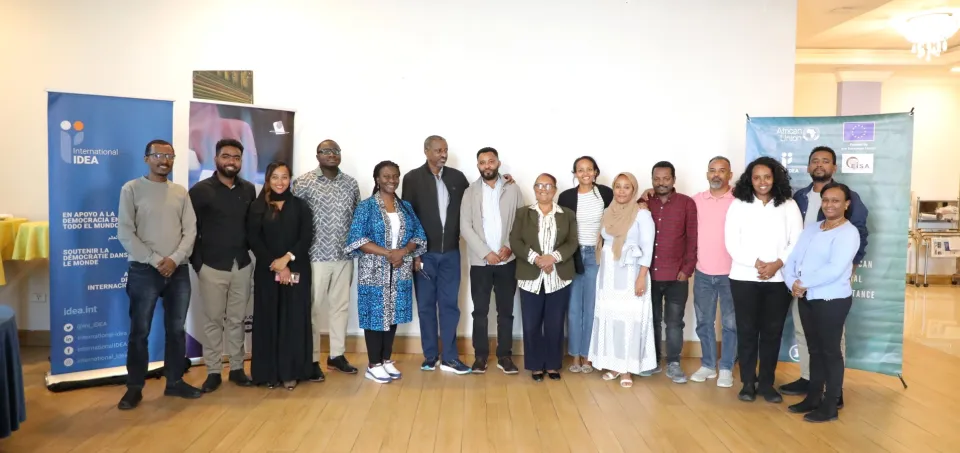
International IDEA and the Caucasus Institute for Peace, Democracy and Development (CIPDD) organized a conference in Tbilisi, Georgia, in 2005 on constitutional and political reform in Georgia, Armenia and Azerbaijan. It was dedicated to the exchange of information about the reform process in the three South Caucasus countries and the prospects for their European integration.
Search
Region
Country
Type
4634 results
August 15, 2005
Publication
July 01, 2005
One of the most poignant lessons learned from peacebuilding endeavours in recent years is that, while the international community must immediately reconstruct and recreate legitimate national-level administration in countries emerging from civil war, without simultaneous initiatives to develop legitimate local-level governance sustainable peace will remain elusive.
Publication
June 01, 2005
The choice of electoral system is one of the most important institutional decisions for any democracy.
Publication
June 01, 2005
Los partidos son cruciales, pero no son bien vistos.
Este informe presenta un diagnóstico preliminar de la situación de los partidos políticos en América Central, Panamá y República Dominicana. Su objetivo es aportar insumos útiles para un debate sobre el estado actual y las perspectivas de los partidos de la región.
Publication
June 01, 2005
Examina aspectos de la vida democrática en la Región Andina. Incluye una revisión de la evolución de los ciudadanos frente a la democracia en la última década, y una evaluación de los sistemas de partidos andinos así como obstáculos y efectos de la participación política de mujeres e indígenas.
Publication
June 01, 2005
Es un placer entregarles en este libro las ponencias del seminario Nuevas Reglas para Elegir Mejor, que se realizó el pasado 7 de diciembre de 2004 en Lima. Este seminario representa la continuación de esfuerzos destinados a alentar un debate público sobre la reforma de las instituciones democráticas del Perú.
Publication
June 01, 2005
This publication draws on the November 2004 Forum of Latin American Women Political Leaders. The book covers subjects like the concept of power, political party financing and the media’s role and impact on politics.
Publication
May 17, 2005
The process of building democracy in complex transitions is a daunting but necessary task.
The design of political, institutional and legal systems can play a critical role in ensuring the sustainability and the advancement of democratic systems, by providing adequate mechanisms to manage conflicts within limits of peaceful coexistence and by promoting consensus around a set of core principles.
Publication
May 16, 2005
The Declaration of Principles for International Election Observation and the Code of Conduct for International Election Observers establish the basis for credible international election observation.
Publication
May 01, 2005
Internal pressures and advocacy for change have raised awareness and precipitated debates about the nature and need for reform processes in many Arab countries.
Such debates have drawn in a diverse range of groups articulating interests and defining their own political programmes. In this context, electoral processes, women's participation and political parties have emerged as central issues in political reform agendas in the Arab world.
Publication
March 01, 2005
This report examines women’s political representation in Europe.
Although the overall representation of women in European Parliaments (including the members of the Commonwealth of Independent States) stands at approximately 18 percent, the differences among the many countries are staggering; from a low of three percent in Kyrgyzstan to a high of 45 percent in Sweden.
Publication
January 01, 2005
This 2005 edition of Women in Parliament: Beyond Numbers covers women’s access to the legislature in three steps.
Publication
January 01, 2005
Basándose en la experiencia de 5 países (Argentina, Chile, El Salvador, Guatemala y Perú) este publicación presenta los desafíos de la reconciliación en el contexto de procesos de democratización.
Partiendo de una perspectiva en la que no existe una solución única para el reto de la conciliación, este libro expone opciones existentes y sus consecuencias con el objetivo de brindar insumos para futuros procesos.
Publication
December 31, 2004
Se presentan ponencias sobre la situación de los partidos políticos en la Región Andina, específicamente en Bolivia, Colombia, Ecuador, Perú y Venezuela.
Publication
September 01, 2004
This report examines women’s political representation on the African continent, and shows how quotas have contributed to increasing women’s access to political power.
Publication
July 27, 2004
Collaboration between the World Bank, the United Nations Economic Commission for Latin America and the Caribbean, and International IDEA goes back to November 2000. It includes roundtables on national dialogue, country development strategies, and middle-income countries’ development experience, with a focus on Latin America.
Publication
July 01, 2004
These essays tell the story of elections that took place in 2003 in the three countries of the South Caucasus, Armenia, Azerbaijan and Georgia, seen through the eyes of nine regional participants and commentators.
The authors therefore write with the immediacy and the vibrancy that comes with close engagement, and sometimes take strong judgments based on their individual standpoints as the processes unfolded.
Publication
February 02, 2004
This report contains the findings and recommendations that emerged from the comprehensive evaluations of democracy at the local level in four cities in East and Southern Africa.
Publication
January 01, 2004
This regional report on voter turnout is based on the IDEA Voter Turnout Database, which contains statistics from 170 countries for parliamentary and presidential elections since 1945 and is continually updated.
Publication
April 01, 2003
Increasing women’s representation and participation in decision-making bodies requires well-developed strategies and information about which measures have worked successfully in different countries with different political systems.
Publication