The event will be held in a hybrid format, offering both in-person and online participation options.
Search
Region
Country
Type
50 results
October 31, 2025
Events
July 02, 2024 - July 03, 2024
Money is an essential resource for politics and voter outreach. However, if not effectively regulated, it can compromise the integrity of political processes and democracies. Effective state regulation of funding of political parties and election campaigns (commonly known as political finance) and their implementation are vital for promoting the integrity, transparency, and accountability of democratic systems of government.
Events
December 18, 2023 - December 20, 2023
Events
November 17, 2023
With Hadja Lahbib, Minister of Foreign Affairs of Belgium; Dr. Adam Bodnar, Elected Senator of the Polish Senate; Erica Gerretsen, Director at the European Commission; H.E Anders H.
Events
October 18, 2023
Democracies across the world – from established to emerging – are facing a new challenge in the rise of online campaigning, and the way in which political actors increasingly spend money in this space. Online campaigning often operates in a space where rules are unclear, malign actors thrive, and regulators struggle to keep up with the rapidly changing digital landscape.
Events
April 02, 2026
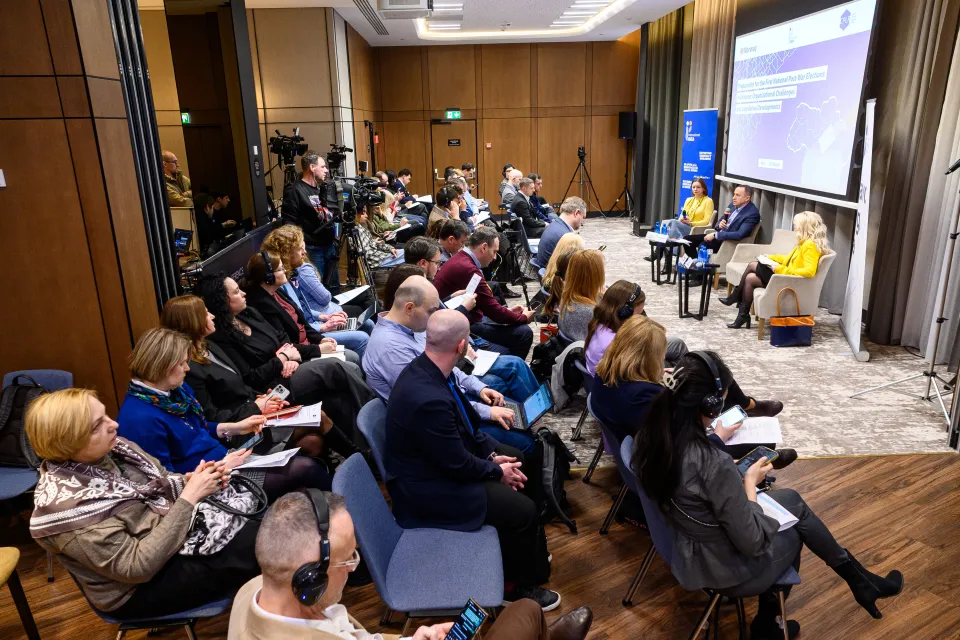
On 20 March 2026, Ukrainian lawmakers, electoral authorities, civil society representatives and international partners gathered in Kyiv to present the outcomes of the Working Group on the preparation of comprehensive legislative proposals on the specifics of the procedure for organizing and holding elections during a special period and/or post-war elections in Ukraine.
News
April 02, 2026
On 16 March 2026, Ukrainian policymakers, regulators, civil society representatives and international experts gathered in Kyiv to discuss the growing role of virtual assets in political financing and the risks they may pose for future elections.
News
March 20, 2026
With approximately 2.4 million eligible voters, Armenia is entering the lead-up to its 7 June 2026 parliamentary elections in an environment shaped by regional instability, peace negotiations with Azerbaijan and risks of information manipulation and other forms of hybrid interference.
News
February 17, 2026
As part of ongoing efforts to prepare for inclusive, secure and credible post-war elections, representatives of the Central Election Commission of Ukraine (CEC) and the Ministry of Foreign Affairs of Ukraine (MFA), together with Ukrainian embassies, conducted consultative visits to Austria and the Czech republic from 5 to 10 February 2026.
News
February 12, 2026
As Armenia prepares for its June 2026 parliamentary elections, electoral institutions are operating in an increasingly complex environment shaped by political polarisation, information manipulation, operational pressures, and rising public expectations around transparency and accountability. Strengthening institutional capacity to anticipate, assess, and respond to such risks is therefore central to safeguarding electoral integrity and public trust in the democratic process.
News
February 02, 2026
On 29 January 2026, International IDEA supported the Central Election Commission of Ukraine (CEC) in conducting the second session of the learning series “Getting to Know ChatGPT: What You Need to Know to Use It Effectively”, bringing together approximately 130 participants. The session focused on strengthening institutional understanding of artificial intelligence tools and their responsible use in public sector work.
News
December 16, 2025
As part of ongoing efforts to prepare for inclusive, secure and credible post-war elections, representatives of the Central Election Commission of Ukraine (CEC) and the Ministry of Foreign Affairs of Ukraine (MFA), together with Ukrainian embassies, conducted consultative visits to the Kingdom of the Netherlands and Ireland from 27 November to 2 December 2025.
News
December 15, 2025
On 15 December 2025, an expert dialogue titled “On the Path to the EU: Overview of OSCE/ODIHR Recommendations on Elections in Ukraine” was held in Kyiv, bringing together over 160 representatives of Ukrainian state institutions, politicians, parliament, civil society, and international partners to discuss priorities for electoral reform.
News
December 11, 2025
International IDEA convened more than 60 participants for an event in Brussels on 9 December to discuss the European Democracy Shield in greater practical detail.
News
November 05, 2025
As part of ongoing efforts to strengthen democratic resilience and institutional preparedness for Ukraine’s post-war elections, representatives of the Central Election Commission of Ukraine (CEC) and the Ministry of Foreign Affairs (MFA), together with Ukrainian embassies, conducted consultative visits to France and Belgium from 9 to 14 October 2025.
News
October 14, 2025
The prospect of EU membership continues to drive democratic reforms in Albania, Moldova, North Macedonia and Ukraine. This report—Part 2 of a broader analysis—focuses on electoral processes and the impact of digitalization in these four candidate countries. It assesses progress in aligning with the EU acquis, particularly in areas such as data protection, cybersecurity and digital governance, while identifying persistent gaps in oversight and institutional capacity.
Publication