


The Global State of Democracy 2026
Democracy in an Age of Conflict
The modern world is being reshaped by a whirlwind of rapid changes across social, economic, technological, and political life. The acceleration of economic inequalities, the rupture of the international order, the insertion of ever more powerful algorithms into ever more parts of life, and the global spread of polarized politics are all making the future increasingly uncertain. In this unstable context, strong and resilient democracies, rooted in public trust, adaptable processes, and inclusive institutions, are best placed to achieve stability, security, and peace.
While the above changes are certainly significant, International IDEA’s 2026 Global State of Democracy report shows that—so far—they are aggravating, not transforming, the long-standing struggles of democracy. Indeed, when it comes to the state and fate of democracy, there is much continuity. For the 11th consecutive year, more countries declined in performance than advanced. The most extensive deteriorations were seen in the same areas as last year, including Freedom of Expression, Freedom of the Press, and Effective Parliament. And if we look at all indicators of democracy across all countries, the vast majority (81 percent) experienced no change at all: a story of stagnation, not transformation. Change takes time, even in a whirlwind.
Nonetheless, our report suggests some areas for particular concern. Among the four categories of democracy measured by our report (Representation, Rights, Rule of Law, and Participation), Rule of Law stands out as especially vulnerable: not just declining but doing so from a low baseline. Many newer democracies never consolidated their judicial systems, anti-corruption institutions, or enforcement mechanisms in the first place. These vital democratic safeguards are now further weakened as authoritarian populism challenges independent judiciaries and as the normative infrastructure of international law is weakened by disuse and abuse. Of course, not only young democracies are vulnerable: the United States has become the most prominent example and accelerator of the disturbing trend toward a belittled and diminished Rule of Law. Indeed, the negative trajectory of democracy in the United States across the board stands out as a serious concern in the global story covered in our report.
The quality of governance must ultimately be measured by its impact on the governed—and in this regard, the greatest promise of democracy is peace. The second part of this report assesses the interactions between democracy’s recent challenges and the resurgence of conflict within and between states. Our analysis reinforces points of historical continuity in this domain too, including the persistence of interstate democratic peace: in one of the great empirical findings of political science, democracies do not go to war with each other, thus making democracy an indisputable asset for international relations. Yet the relationship between democracy and peace is not linear, and the countries with the highest risk of conflict are those that are neither fully autocratic nor consolidated democracies. The current era of democratic decline is producing more countries in the messy middle of democratization.
We have known for decades that democratic consolidation is part of the pathway to peace. Since then, however, years of democratic erosion have returned us to a dangerous limbo. In many places, democratization has removed the potential for arbitrary repression as a method of conflict resolution but has not replaced it with effective representation and oversight. As this report shows, investments in democracy can pay a glorious dividend; but to enjoy that reward, the job cannot be left half-finished. Helping our Member States and partner countries advance this crucial task is the mission of International IDEA. This report is a contribution to that end and, hence, to peace.
Dr Kevin Casas-Zamora
Secretary-General, International IDEA
The findings of the 2026 Global State of Democracy (GSoD) report reflect what the Institute for Economics and Peace has called a “Great Fragmentation” (IEP 2026: 2) of historical alliances and partnerships, compounding a long-standing climate of radical uncertainty (Casas-Zamora 2024). As historical political alliances are questioned, new blocs emerge, and safety and security wane around the world, democracies are struggling to lead the way ahead in a decisive and authoritative manner.
Notably, one of the clearest trends in the Global State of Democracy Indices dataset is stagnation: in 81 percent of cases in which shifts at the factor1 level were possible, there was no change in countries’ performance. Since current levels of performance are largely middling, with most countries continuing to be clustered in the mid- and low-performance ranges across all categories, this stagnation is concerning. The relative dominance of mid-range performance is particularly worrying because it suggests that many countries remain in politically fragile “in-between” conditions. As discussed in Part 2, such contexts, especially those at the lower end of the mid-range band, are associated with heightened risks of instability and conflict (Gleditsch et al. 2009).
When change in the quality of democracy did occur, it was more often negative than positive. In 2025, 98 countries—representing 57 percent of all countries assessed—suffered a decline in at least one factor of democratic performance compared with their own performance five years earlier. In contrast, only 55 countries (32 percent) advanced in at least one factor over that period.2 This represents a substantial shift compared with a decade earlier: in 2015, 31 percent of all countries experienced at least one decline, and 27 percent saw at least one improvement. In 2025, deterioration was concentrated across many of the fundamental building blocks of democratic systems—credible elections, effective legislatures, freedom of expression, freedom of the press, and access to a fair legal system in the pursuit of justice.
The most extensive global decline occurred in Freedom of Expression, which impacted 42 countries (24 percent of all countries in the dataset). This was followed closely by Freedom of the Press, whose scores fell in 23 percent of countries, and Access to Justice, which declined in 18 percent of countries. Much of the deterioration is rooted in coups, conflict, and the centralization of power, and the ongoing challenges affecting some of the most fundamental aspects of democratic governance raise questions about the extent to which the mechanisms relied upon to channel public priorities into policy remain fit for purpose.
Weakness in these fundamentals is compounded by the fragile state of Rule of Law, which includes measures of Judicial Independence, Absence of Corruption, Predictable Enforcement, and Personal Integrity and Security—factors that underpin the stability and legal predictability so central to well-being and security. Rule of Law was the weakest category in 2025, with 71 countries (41 percent) categorized as low-performing. It is also deteriorating quickly: the highest number of declines at the category level occurred in Rule of Law, with 29 countries (17 percent of those assessed, most of them low- or mid-range-performing) registering downturns in 2025. Global declines reflect weakening Judicial Independence in many countries as well as the rapidly shifting state of international law, which has been upended by the current US administration’s threats and actions against multiple countries, including historical allies.
While people continue to push back against democratic deterioration, civic space is narrowing. Civil Society and Civic Engagement have suffered, due in part to the widespread use of strategic lawsuits against public participation (SLAPPs), foreign agent laws, and the criminalization of peaceful protests, even in high-performing contexts. Still, positive change was clear in cases such as Australia, whose improvements were due in part to multiple consultations with civil society groups on a range of issues and policies, including children’s online privacy; an anti-racism strategy; and women, peace, and security. This kind of consultation helped catapult the country 16 places in the global rankings in the Participation category.
Improvements were also seen elsewhere, though they occurred on a smaller scale. Notably, some of the steepest advances took place in transitional contexts, including Poland and Syria. In Bangladesh, Nepal, and Sri Lanka, where popular protests unseated long-serving leaders, there have also been advances, though it has proven difficult to create far-reaching, meaningful reform in a short period of time. In all these cases, it will be important to watch the extent to which new leadership can advance the reforms for which—in multiple cases—people have given their lives.
In 2025, the global challenges to democracy and the difficulty in stemming its erosion were both exemplified and compounded by political developments in the United States. There, President Donald Trump quickly amassed power in the executive branch and wielded it to further a narrow set of personal goals and pursue retaliation against perceived enemies. In that environment, which is marked by constricted space for both public expression and institutional checks on power, resistance is increasingly unsafe. The results have been far-reaching, undermining the rule of law domestically and internationally and testing long-standing alliances and multilateral cooperation.
The second part of this report discusses the broader implications of global democratic decline, especially as they relate to violent conflict. After decades of relative peace, the world is again in an era in which the relationship between democracy and conflict is in the spotlight. Violent conflicts are growing in number as the quality of democracy declines: data from the Uppsala Conflict Data Program (UCDP) show that 2025 had the most violent conflicts of any year since its data series began in 1946 (65), including the most interstate conflicts (8) that it has recorded (Davies et al. 2026).
As striking as the correlation between the number of conflicts and the number of countries with democratic declines is, the links between the two phenomena are complex. What has been observed is not the spread of conflict all over the world but, instead, a multiplication of conflicts in countries and regions that were already affected by conflict in the recent past.
However, analysis of the scholarly literature and the most recent data confirms that there are contexts of nondemocracy and democratic decline that are associated with more violent conflict. In particular, countries that have some democratic procedures (such as multiparty elections) but lack real political competition or enforceable rights (often characterized as hybrid regimes) have been involved in both interstate and intrastate conflicts more often than either fully autocratic countries or well-functioning democracies. A couple of decades ago, the connection between deeply flawed democratic governance and conflict led to increased attention to the need to consolidate democracy in many countries. Now, amid a continuing democratic recession, the erosion in the quality of democratic governance in many countries is once again raising concerns about the likelihood of conflict and the need to reverse the prevailing negative trends.
Key Findings
- Democratic peace remains a predictable feature of the international system: democracies do not go to war with democracies. Since the number of democracies is declining, the scope of the interstate democratic peace has been significantly reduced. Furthermore, research has found that the lower quality of existing democracies also increases the risk of future conflict (Altman et al. 2021).
- There is a higher risk of conflict (both interstate and intrastate) for countries that are between consolidated democracy and consolidated autocracy. This is because the relationship between democracy and peace is not linear—where more democracy always leads to more peace—but follows an inverted-U shape: at lower levels of democratic performance, more democracy is associated with more war (Gleditsch and Hegre 1997). While democracies reduce the motive for violence by providing mechanisms to peacefully resolve disagreements, they also limit the capacity to suppress the emergence of armed conflicts through repression, thereby increasing the opportunity for violence (Gleditsch et al. 2009).
- Decades into the process of globalization, the notable recent increase in internationalized intrastate conflicts (where third-party governments have intervened) demonstrates that declines in democracy anywhere are of concern to all governments. Conflict often has significant consequences for trade, migration, and health, giving many governments an interest in intervening once violent conflict starts. For example, recent events have highlighted the vulnerability of the global economy to conflict-related disruptions in access to critical resources. Over the past decade, countries separated from particular conflicts by whole oceans and continents have understood it to be in their interest to intervene, and this pattern is likely to continue.
Policy Recommendations
1. Governments should invest in democracy support abroad as a core pillar of their national security strategies
Scaling up investment in democracy support is part of an effective response to the increasing number of conflicts and security threats worldwide. Building and maintaining peace requires more than preparing defensively for war. It also requires actively mitigating the conditions and drivers of war, many of which arise in contexts where democracy is weak or eroding. By limiting the unchecked use of power, stronger democratic systems reduce the risk of conflict. Additionally, conflict and weak democracy are both associated with low levels of state capacity. Addressing state capacity as part of democracy-support programming is therefore also key to preventing conflict.
In this regard, even modest increases in funding for democracy deliver significant gains (Gisselquist et al. 2021; Gafuri 2022)—and at far lower costs than procuring military hardware. Beyond the human costs of conflict, even short military interventions involve large expenditures, while multiyear programs to support the development of sustainable democracy often cost only a few million euros. When it comes to democracy and security, an ounce of prevention is worth a pound of cure.
2. Governments, donors, and civil society organizations should work to strengthen social cohesion and social accountability at home and abroad
Research shows that social accountability generated by an active civil society is a key factor in reducing the risk of conflict (Hegre et al. 2020). Long-term investments in social cohesion, civic engagement, and independent civil society are the foundations of positive peace. Strengthening social accountability enables citizens to hold decision-makers to account, building resilient societies that can address grievances before they contribute to violent conflict. Amid increasingly internationalized conflicts, support should extend to both local civil society actors and transnational or global civil society led by expatriates and diaspora networks.
3. Governments, donors, and businesses should pay particular attention to countries whose democratic declines increase the risk of conflict. They should reserve ready-to-deploy resources, including funding and partners, and be prepared to act quickly in these contexts
All declines in democratic performance are a loss for the citizens of the affected country, but some declines are also associated with broader risks of conflict. These include declines that (a) threaten to push countries where democratic governance is already weak into even lower performance bands and (b) involve countries with unresolved international disputes that have led to violence in the past. Intervening early in vulnerable contexts with support for democracy is even more important than supporting countries where there are openings for positive change. Actors with the ability and legitimacy to intervene early in vulnerable contexts should do so, including through prearranged mechanisms that are underpinned by flexible funding that can be applied creatively as situations evolve. These mechanisms should also be anchored in evidence that highlights what works, practical lessons from other contexts, and local and international partners that can galvanize broad support and cooperation.
Data Sources
The Global State of Democracy (GSoD) report, the flagship publication of the International Institute for Democracy and Electoral Assistance (International IDEA), provides annual analysis of democratization across the globe.
Version 10 of the GSoD Indices, a quantitative dataset, provides the majority of the data on which this report is based (unless otherwise stated). The Indices measure national performance across discrete areas of democracy, broadly understood as a system in which there is public control over decision-making and decision-makers and equality in the exercise of that control. While this report refers to the five-year period from 2020 through December 2025, the complete dataset covers the years 1975–2025.
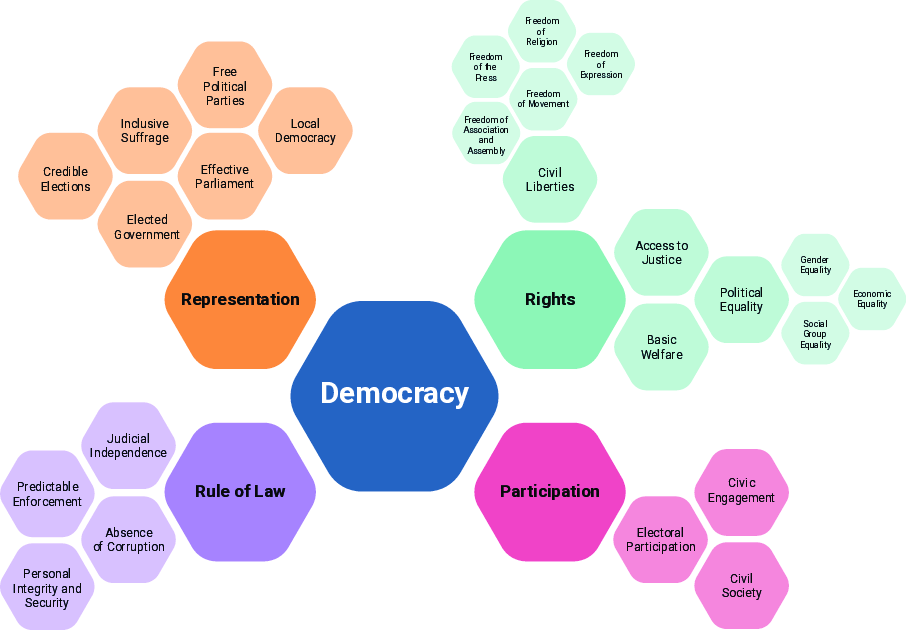
The Indices employ a hierarchical conceptual framework oriented around four core categories of democratic performance—Representation, Rights, Rule of Law, and Participation (see figure 0.1). Each category is subdivided into factors (such as Credible Elections or Judicial Independence) and subfactors (such as Freedom of Expression or Social Group Equality).

The GSoD Indices aggregate indicators from 23 data sources (see table 0.1), which include observational data from United Nations agencies, expert-coded data from academic programs, and some data collected directly by International IDEA. The Indices are based on a total of 155 indicators. The result is a collection of 1,951,184 data points covering 174 countries over 51 years.
| Dataset | Data provider | Reference |
|---|---|---|
| Bertelsmann Stiftung’s Transformation Index (BTI) | Bertelsmann Stiftung | https://bti-project.org |
| Bjørnskov-Rode Regime Data (BRRD) | Bjørnskov and Rode | https://sites.google.com/unav.es/martin-rode/home/data |
| Child Mortality Estimates (CME) | UN Inter-agency Group for Child Mortality Estimation | https://childmortality.org |
| Civil Liberties Dataset (CLD) | Møller and Skaaning | https://doi.org/10.7910/DVN/0TKJWX |
| Food and Agricultural Organization of the United Nations (FAO) Food Balances | Food and Agricultural Organization of the United Nations (FAO) | https://www.fao.org/faostat/en/#data/FBS |
| Freedom in the World | Freedom House | https://freedomhouse.org/report/freedom-world |
| Freedom on the Net | Freedom House | https://freedomhouse.org/report/freedom-net |
| Global Educational Attainment Distributions | Institute for Health Metrics and Evaluation (IHME) | https://ghdx.healthdata.org/record/ihme-data/global-educational-attainment-distributions-1970-2030 |
| Global Findex Database | World Bank | https://data.worldbank.org |
| Global Gender Gap Report | World Economic Forum | https://www.weforum.org/publications/global-gender-gap-report-2025/ |
| Global Health Observatory | World Health Organization (WHO) | https://www.who.int/data/gho/data/themes/topics/indicator-groups/indicator-group-details/GHO |
| Global Media Freedom Dataset (MFD) | Whitten-Woodring and Van Belle | https://faculty.uml.edu//Jenifer_whittenwoodring/MediaFreedomData_000.aspx |
| ILOSTAT | International Labour Organization (ILO), Department of Statistics | https://ilostat.ilo.org |
| International Country Risk Guide (ICRG) | Political Risk Services | http://epub.prsgroup.com/products/icrg |
| Lexical Index of Electoral Democracy (LIED) | Skaaning, Gerring, and Bartusevičius | https://doi.org/10.7910/DVN/WPKNIT |
| Political Terror Scale (PTS) | Gibney, Cornett, Wood, Haschke, Arnon, and Pisanò | http://www.politicalterrorscale.org |
| Polity5 | Marshall, Jaggers, and Gurr | http://www.systemicpeace.org/inscrdata.html |
| Standardized World Income Inequality Database (SWIID) | Solt | https://fsolt.org/swiid |
| United Nations E-Government Survey | UN Department of Economic and Social Affairs | https://publicadministration.un.org/egovkb/en-us/Reports/UN-E-Government-Survey-2024 |
| Varieties of Democracy dataset | V-Dem Project | https://www.v-dem.net |
| Voter Turnout Database | International IDEA | https://www.idea.int/data-tools/data/voter-turnout |
| World Population Prospects (WPP) | UN Department of Economic and Social Affairs Population Division | https://population.un.org/wpp |
A complementary source of evidence for this report is International IDEA’s Democracy Tracker, a qualitative dataset that provides event-centric information on democratic developments in 173 countries,3 with a data series beginning in August 2022 and updated every month through December 2025. The Democracy Tracker includes limited updates in 2026, with priority attention given to the United States. The Tracker reports democracy-related developments that may signal significant advances or declines in a country’s democratic performance in a particular month and monitors developing events that could signal that such a change is very likely in the following year (International IDEA 2026g). This edition of the GSoD report reflects key democratic trends through June 2026, adding depth to country-specific discussions, including cases where notable developments occurred after December 2025.
Some country examples featured in the report, such as those from the USA, are included based on the relevance of their democratic developments to broader regional or global patterns. The Tracker ensures that these examples are evidence-based and grounded in recent developments.
In Part 2 of the report, data is used from the Uppsala Conflict Data Program (UCDP), a leading global dataset on organized violence and the world’s oldest ongoing data collection effort on civil war. Specifically, the Dyadic Dataset, the Country-Year Dataset on Organized Violence within Country Borders, and the Onset Dataset are used. The Lexical Index of Electoral Democracy (LIED) and the Institute for Economics and Peace’s Global Peace Index (GPI) are also used in Part 2 of the analysis.
In addition to data, the report also draws on the subject-matter and regional expertise of International IDEA’s staff at the Institute’s headquarters in Sweden, as well as the work of staff at regional and country offices across Africa and West Asia, the Americas, Asia and the Pacific, and Europe. The insights of International IDEA staff who are closely involved in democracy-building efforts help contextualize the data and identify critical trends as they unfold.
Structure and Approach of the Report
Part 1 of the report describes what has changed within each category (the top-level of aggregation, under which sit factors and subfactors) of democratic performance in the GSoD Indices—Representation, Rights, Rule of Law, and Participation (see figure 0.1). It uses country cases to provide illustrative examples and highlight notable patterns. These descriptions are meant to serve not as exhaustive lists of the events that are driving change but as illustrations of the kinds of developments that explain what the data reflect. In most cases, the analysis illustrates advances and declines with reference to statistically significant changes in comparison with country scores from five years earlier. When that is not the case, the specific interval is indicated.
Quantitative scores from the GSoD Indices for each category, factor, and subfactor are also categorized into performance levels. All indices at the different levels have been normalized to range from 0 (lowest achievement) to 1 (highest achievement). If a country’s score exceeds 0.7, its performance is labeled “high.” Scores below 0.4 correspond to “low” performance. Scores between 0.4 and 0.7 classify a country’s performance as “mid-range.”
Part 1 also provides snapshots of developments at the regional level, including in Africa and West Asia, the Americas, Asia and the Pacific, and Europe. In these sections, the analysis provides a brief overview of changes at the category level, highlighting subregions or countries that have shown particularly notable developments. These regional overviews also include a “What to Watch” section, drawing readers’ attention to events on the horizon that could impact the shape or direction of democracy. This year, given the particularly severe declines in the USA, Part 1 is followed by an in-depth case study of changes in that country. This case study details how declines in US democracy have impacted the domestic context as well as the international rule of law. In addition to the US case study, the report offers shorter analyses of developments in Syria, threats against election workers in the USA, the state of ongoing transitions in South Asia, and advances in Czechia.
In response to growing global insecurity and a resurgence of intra- and interstate armed conflict, Part 2 of the report focuses on the nexus between conflict and democracy. It explains how democratic governance contributes to and strengthens peace and security, both domestically and internationally. This part of the report also includes a set of recommendations for policymakers who are considering how to protect democratic institutions and norms while safeguarding national security.
In 2026, the global political landscape is fractured. Around the world, countries are looking increasingly inward, shoring up national reserves and resources in the face of frayed bonds with historical allies and neighbors and declining faith in the effectiveness of multilateral institutions. This “Great Fragmentation” (IEP 2026: 2) as the Institute for Economics and Peace has called it, is also marked by increasing rates of violent conflict, including interstate war and intrastate wars that often splinter, sometimes pulling in third parties that provide various types of support and resources. Combined with new competition among major and middle powers, these developments threaten the common rules that once bound many countries and groups of countries together, compounding the “radical uncertainty” (Casas-Zamora 2024) that has come to characterize the current era.
A significant proportion of the current instability can be traced to US President Donald Trump, whose administration has reshaped political culture in the USA, where power is now personalized and used to further narrow individual goals and pursue vendettas against those critical of the president or his policies. Comparing 2025 to 2020, the change in the quality of US democracy was entirely negative: the country experienced seven statistically significant declines across multiple measures of representative governance, civil liberties, and the rule of law. There were no corresponding advances.
The Trump administration’s actions have not stopped at the borders of the USA. Since 2025, the US Government’s threats and actions against other countries have undermined national sovereignty as well as international law and risked provoking more widespread violent conflict (AP 2026b; Longobardo 2026; OHCHR 2026a, 2026b). These developments only add to ongoing conflicts in places such as Haiti, Sudan, and Ukraine, deepening concerns about the ways in which wars impact the state of democracy and human dignity around the world.
The ramifications of these actions for the future legitimacy of the democratic model are multifold, far-reaching, and difficult to overstate. The stark declines in the USA and the global repercussions of the Trump administration’s actions are the subject of a special in-depth case study (see case study 3.1).
This fragmentation and instability have far-reaching consequences, testing both the capacity of democratic institutions and public confidence in democratic performance and compounding other trends observed around the world. The clearest such trend is that significant change in the quality of democracy is rare, but when it does occur, it is largely negative. When comparing 2025 to 2020, the most far-reaching declines occurred in Credible Elections, Effective Parliament, Freedom of Expression, Freedom of the Press, and Access to Justice. The drivers of many of these declines cluster around coups, conflict, and executive overreach, seen in countries as diverse as Afghanistan and Burkina Faso, as well as El Salvador and Slovakia.
Yet there are also stories of resilience, recovery, and even nascent transformation. The limited advances (outside of pandemic-related recovery in Basic Welfare and Freedom of Movement) are seen mostly in Freedom of Expression and Access to Justice. These cases of improvement are fragile, as exemplified by contexts such as Syria’s transition following the collapse of the regime of President Bashar al-Assad, Poland’s post-2023 reforms, and the South Asian post-uprising trio of Bangladesh, Nepal, and Sri Lanka. In Australia, the rise of a new kind of community-supported independent candidate is a sign of broader innovation that is also occurring in many other countries, often at the local level, but is not reflected in the GSoD data. Critically, in many of these examples, mass public participation and the work of civil society groups have been instrumental in achieving change (Khoury and Pearlman 2025; Civitates 2026; Hasan et al. 2026).
It is important, however, not to lose sight of another, often overlooked, aspect of the story—stagnation at relatively low levels of performance around the world. When considering the extent to which countries’ performance shifted in any one of the factors measured, the findings show that most countries experienced no change during the period covered (2020–2025). Given that only about one-quarter of those cases are classified as high-performing, however, this stasis is also a prompt for action.
Going forward, it is essential to act on lessons learned, especially those related to the role of civil society and public participation in stories of democratic advances. It will also be important to act on research findings illustrating that participation is the aspect of democracy that is key to reducing the risk of conflict. In this regard, civil society plays a pivotal role in generating social accountability. In the current era of fragmentation, this clear link between the exercise of democracy and peace sets an agenda for the way ahead.
1.1. Democracy and Violent Conflict
After decades of relative peace, violent conflict is again in the spotlight. As countries around the world respond to rising insecurity with increased expenditures on military procurement while also seeking protection from a host of new digital threats, attention to safeguarding democratic institutions and norms risks being deprioritized. In so doing, there is a danger that the conditions that lead to conflict could continue to grow, while the response is to prepare for war instead of working to create the conditions that can sustain peace. It is more necessary than ever to consider the conflict-reducing effects of democracy and the risks that declines in democracy entail.
Violent conflicts are growing in number as the quality of democracy declines around the world in multiple areas, including Credible Elections, Freedom of Expression, Freedom of the Press, and Access to Justice. Part 2 of this report examines the extent to which the weakening of democracy leads to more interstate and intrastate conflict. Data from the UCDP show that 2025 had the largest number of violent conflicts of any year since its data series began in 1946 (65), including the most interstate conflicts (8) it has recorded (Davies et al. 2026).
As striking as the correlation between the number of conflicts and the number of countries with democratic declines is, there may not have been a direct causal link between them in 2025. What was observed was not the spread of conflict all over the world but, instead, a multiplication of conflicts in countries and regions that were already affected by conflict in the recent past. For example, four of the eight interstate conflicts ongoing in 2025 were in West Asia, three of which involved Israel. Similarly, Myanmar accounted for 5 of the 35 intrastate conflicts, as the violence that began after the 2021 coup continued to cause deaths and destruction in several parts of the country.
However, analysis of the scholarly literature and the most recent data confirms that there are contexts of nondemocracy and democratic decline that are associated with more violent conflict. In particular, countries that have some democratic procedures (such as multiparty elections) but lack real political competition or enforceable rights (often characterized as hybrid regimes) have been involved in both interstate and intrastate conflicts more often than either fully autocratic countries or well-functioning democracies. A couple of decades ago, this finding directed attention to the need to consolidate democracy in many countries. Now, amid a continuing democratic recession, some countries’ regressions are once again raising concerns about the likelihood of conflict.
Global patterns show that the dominant trend with regard to the state of democracy is stasis. When considering the extent to which countries experienced a shift in their performance (comparing 2025 to 2020) along any of the factors measured between 2020 and 2025, 81 percent of cases showed no change. Stagnation has long been the most common feature of country performance, though it is clear that change is slowly becoming more prevalent (see figure 2.1).
In 2025, 98 countries—representing 57 percent of all countries assessed—suffered a decline in at least one factor of democratic performance. In contrast, 55 countries (32 percent) experienced improvements in at least one factor of democratic performance when comparing 2025 to 2020 (see figure 2.2). This represents only a 2-percentage-point increase in the share of countries experiencing at least one decline and no change in the number of countries experiencing advances since the 2025 Global State of Democracy assessment.
It is important to note that the analysis presented here does not include the Basic Welfare factor, because improvements in Basic Welfare, largely due to recovery from the Covid-19 pandemic, distort the overall picture of improvement. These advances, which were due to recoveries in life expectancy after the end of the pandemic, account for a disproportionate share (37 percent) of the apparent progress. They reflect only the disparity between the first year of the pandemic (2020) and the comparative normalcy of 2025. Gains in Basic Welfare dwarf the next-largest group of advances, 18 in the Freedom of Movement subfactor, which were also due to the lifting of pandemic-era travel restrictions.
2.1. Global Declines and Advances
The State of Play in 2025
In 2025, most countries were mid-range-performing across all categories of democratic performance. High performance was comparatively rare, most starkly so in Rule of Law, where the number of low-performing countries was more than double the number of high performers (see figure 2.3). This distribution of countries’ performance has remained largely stable over the past two decades (see figure 2.4). The dominance of mid-range performance is concerning because it suggests that many countries remain in politically fragile in-between conditions. As discussed in Part 2, such contexts, especially those at the lower end of the mid-range band, are associated with heightened risks of instability and conflict (Gurr 1968).
In 2025, Representation stood out for having the most even distribution of countries across the performance bands (but the large number of zero scores in figure 2.3 should be noted), while Participation was unique for multiple reasons: this category included a relatively small number of low-performing countries, a relatively balanced proportion of high- and low-performing countries, and the largest group of mid-range performers.

Changes at the Factor Level
When change occurred between 2020 and 2025, it tended to be more negative than positive. The largest numbers of declines occurred in the categories of Representation (Credible Elections and Effective Parliament), Rights (Access to Justice and Civil Liberties), and Rule of Law (Judicial Independence and Predictable Enforcement). Importantly, high-range performance did not preclude significant deterioration in the quality of democratic governance. This was most apparent in areas such as Civil Liberties and Credible Elections, where a relatively large number of high-performing countries showed deterioration (five countries in Civil Liberties and four in Credible Elections). Key examples include Germany, Portugal, and the United Kingdom, each of which saw declines in both areas.
Countries showed improvements on a smaller scale, most commonly in Access to Justice (9 percent of countries) and Absence of Corruption (8 percent). As with declines, countries at all performance levels experienced advances, though mid-range performers accounted for half of this group. Countries that experienced some of the largest numbers of advances include Bangladesh, Brazil, Poland, Sri Lanka, and Syria.
Changes at the Regional Level
Countries in all regions experienced some degree of change in democratic performance (see figure 2.5), though declines and advances were unevenly distributed. Globally, African and European countries accounted for the largest shares of deterioration (33 and 27 percent, respectively, of all declines at the category, factor, and subfactor levels), while Asia and the Pacific led in improvements. West Asia’s small share of declines reflects how few of the region’s countries had room to fall further.
At the same time, Europe and the Americas saw the most degradation within their respective regions, with more than half of the countries in each region experiencing at least one decline at the factor level. By contrast, Asia and the Pacific saw the broadest improvements, which impacted 46 percent of the countries there. (Figure 2.5 illustrates the regional shares of advances and declines, with a background gray bar providing a reference for each region’s size.)
Standout Countries
Some countries experienced numerous declines across a wide range of factors (when comparing 2025 to 2020). Examples include Afghanistan (declining in 11 factors), Burkina Faso (12), El Salvador (8), Georgia (8), Guinea-Bissau (8), Myanmar (12), Russia (8), and Tunisia (11). In many of these cases, this far-reaching deterioration can be attributed largely to ongoing violent conflict or illegal transfers of power. In contexts such as El Salvador and Georgia, however, declines in the quality of democracy are rooted in the respective administration’s efforts to centralize power in the executive and clamp down on dissent.
Some of the most substantial improvements were due to political transitions. Syria and Poland, for example, recorded the largest improvements in Freedom of Expression (comparing 2025 scores to 2020). In Syria, the advances were due largely to the lifting of restrictions that had been in place during the civil war and under the previous administration (see box 2.3 for more details on Syria’s advances). In Poland, improvements have been linked to reforms that the new government, which took office in 2023, has been pursuing to open up civic space (see 2.3: Rights for more details).
2.2. Representation
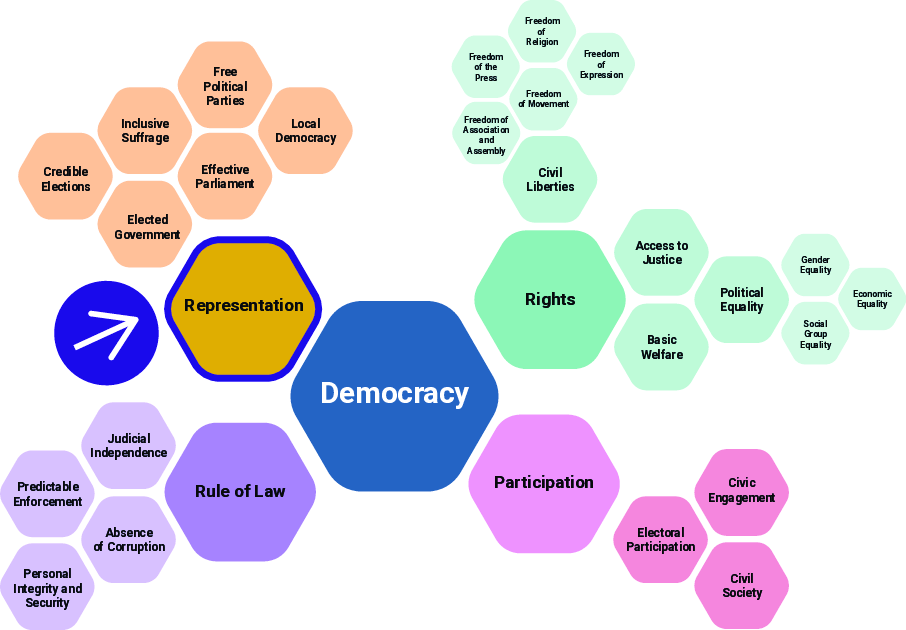
In the GSoD Indices, Representation is an aggregate measure of the extent of representative democracy, built from component measures of credible elections, inclusive suffrage, freedom to organize through political parties, the effectiveness of the legislature, and the practice of democracy at the local level.
Representation symbolizes the classic markers of democracy. It is the engine of contemporary democratic governance: political parties offer people choices regarding the future of their communities and countries, and the people make their voices heard by casting ballots in credible electoral processes. In the legislature, those voices are transformed into policies, and elected leaders ensure that the people’s will is balanced against executive action.
Figure 2.6 highlights the top 10 countries in Representation performance for 2025, showing both limited regional diversity and year-on-year movement in the rankings. Denmark and Germany continue to lead globally, but the top performers stand out against broader global trends.
The overall trend in Representation is negative: there were 17 significant declines in this category, compared with only 4 advances. Though all regions saw deterioration, most of these declines impacted low-performing countries. The severest drops were in Burkina Faso, Guinea-Bissau, Madagascar, Myanmar, and Niger—all countries that have experienced coups d’état or other illegal transfers of power. At the same time, mid-range-performing countries (El Salvador, Georgia, Peru, Sierra Leone, and Tunisia) and one high-performing country (Slovakia) were also affected.
Myanmar’s most recent elections, which took place between December 2025 and January 2026, illustrate the extremes of election manipulation and demonstrate how electoral processes are interlinked with multiple other organs of a political system. The polls were conducted amid armed conflict, mass displacement, and severe repression, limiting meaningful and widespread participation. Major political parties, including those that won a clear mandate from the people in 2020, were banned or forced to boycott, while voters and candidates faced intimidation and arrest. Multiple international experts and institutions, including the UN special rapporteur on the situation of human rights in Myanmar, the European Union, the Association of Southeast Asian Nations, and International IDEA, concurred that the elections did not meet the minimum conditions for being free, fair, or inclusive (International IDEA 2026e). While the country faces severe challenges that go well beyond elections, the regime’s insistence on holding elections exemplifies how polls can be instrumentalized for a self-serving “recalibration of power, engineered through selective participation, territorial exclusion, and coerced consent” (Shahid 2026).
Comparing 2025 to 2020, improvements in Representation were recorded in just four countries—mid-range-performing Sri Lanka and Thailand and high-performing Latvia and Mauritius. It is important to note, however, that Thailand’s advances have plateaued since 2023, when the Constitutional Court ordered the dissolution of the party that had won the most votes in the general election. Mauritius saw the largest gains during this period, due in part to the 2024 electoral cycle, which was marked by strong public trust in the office of the electoral commissioner, efficient polling station management, special arrangements for voters with special needs, adequate and timely funding for electoral processes, and the high representation of women among polling station staff (Electoral Commissions Forum of SADC Countries 2024).
Though Representation continues to be the category in which the highest number of countries perform at a high level, it is precisely in the factors of Representation where some of the broadest declines have occurred: Credible Elections and Effective Parliament saw the broadest downturns, impacting roughly one in five countries each (see figure 2.7). Notably, even high-performing contexts have proven fragile, as explored in more depth below. The mechanisms people depend on to choose their leaders are faltering, and, once elected, representatives struggle to fulfill their mandates to check executive overreach and maintain the balance of democratic power.
Credible Elections
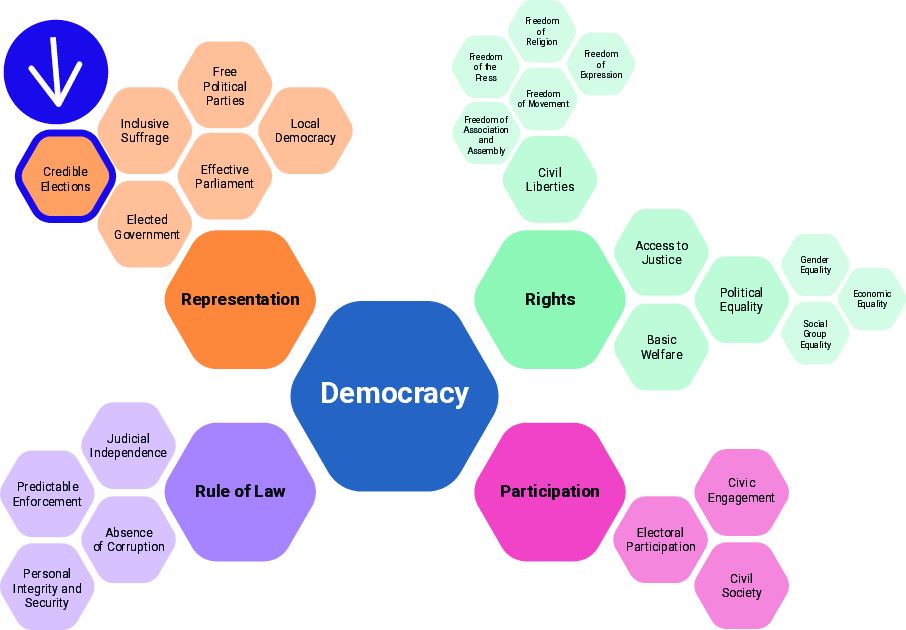
The Credible Elections index aggregates indicators that measure the extent to which elections for national representative political office are free from irregularities, such as flaws and biases in the voter registration and campaign processes, voter intimidation, and fraudulent counting. The Credible Elections index measures the electoral context, providing a signal of the overall political environment in a country.
As of the end of 2025, GSoD Indices data showed that 32 countries (18 percent of those covered) recorded declines in Credible Elections compared with 2020. Countries with declines were found at all performance levels, from higher performers such as Germany and the United Kingdom to low-performing contexts such as Cambodia and Nicaragua. Some of the steepest declines took place in countries that were impacted by coups or other illegal transitions of power, including Burkina Faso, Guinea-Bissau, Haiti, Madagascar, and Myanmar.
Weaknesses in higher-performing countries are important signals of change. In the UK, for example, the Elections Act 2022 has been criticized for giving the government the power to set the “strategic and policy priorities” for elections and “the role and responsibilities of the [Electoral] Commission” (Elections Act 2022) in supporting these priorities. The act also empowers the government to issue guidance in areas for which the Commission has responsibility. In response, multiple parliamentary bodies and civil society groups warned about the risks that the reform poses to the Commission’s independence. In 2025, Labour leaders, many of whom had initially opposed the act, proposed a new set of electoral reforms that retained this government power (Goodrich 2025; Hawley and Parrett-Jung 2025). See also Box 2.1 that describes increasing threats of violence against election workers in the USA.
Box 2.1. Election workers at risk in the United States
President Donald Trump, his allies, and numerous cabinet officials continue to falsely insist that a broad conspiracy of national, state, and local election officials “stole” the 2020 presidential election (Marley and Sanchez 2026). As a result, threats and violence against election workers and other local officials have become far more frequent and widespread (see figure 2.8).
A Princeton University study of threats and violence against election officials during the 2024 election found that the election was “conducted in an environment of significant hostility for election workers,” exacerbating the decades-old challenge of retaining qualified staff (Bridging Divides Initiative 2024). Similarly, surveys of US election workers show that they are increasingly concerned about political interference and a lack of government support. One-quarter of the election workers surveyed by the Brennan Center for Justice said that they worried about being physically assaulted, and most said that they were worried about their colleagues’ safety (Edlin and Norden 2026).
The USA is no stranger to broad-based political violence. The country’s elections were famously violent until the early 20th century, and deadly force was used to suppress the Southern Black vote until the 1960s (Anbinder 1992; Grinspan 2021; Trelease 2023). Most of this violence, however, was directed at political opponents and minority groups—the 19th-century Know Nothings against Irish Catholic immigrants, and the Ku Klux Klan and other Southern paramilitary groups against Black Southerners—rather than at election officials themselves.
An additional challenge in protecting election officials is the somewhat unique decentralized US system of election administration. Individual states, rather than the national government, organize elections according to their own laws (Norris 2017; Ferrer et al. 2024; National Conference of State Legislatures 2026). Some states have highly centralized election commissions, while others leave much of the organization to local or county-level officials, resulting in an uneven distribution of resources both between and within the 50 states and US territories (Hale et al. 2015; Ritter and Tolbert 2024).
The distribution of authority for administering elections also entails a distribution of responsibility for responding to threats and ensuring election workers’ safety. Under a program initiated by President Barack Obama and, by all accounts, run effectively during the first Trump and Biden administrations, elections were designated as “critical infrastructure,” and federal agencies worked to coordinate among electoral management bodies, share intelligence, and provide support for both physical security and cybersecurity (Nickel 2025; Huseman 2026). During his second term, President Trump has sharply reduced funding for or abandoned much of this coordination and intelligence-sharing work, while also seeking to involve the federal government in electoral processes to an unprecedented degree—going so far as claiming the right to “nationalize” the process (Norden 2025; Corasaniti 2026). While subnational governments and civil society can theoretically fill the coordination gap, there is no clear replacement for the threat and risk analysis provided by federal officials.
Much of the risk faced by election officials stems from unfounded skepticism and conspiratorial accusations about special voting arrangements (most notably voting by mail) and electronic voting machines (Marley and Sanchez 2026). Such theories are perpetuated through partisan social media and dozens of spurious court cases, including cases brought by President Trump himself and, since his reelection, by the Department of Justice (Grado 2025; Corasaniti et al. 2026; Campaign Legal Center n.d.). Threats and violence are also concentrated in counties and cities that vote heavily Democratic or have a majority minority population in swing states, such as Fulton County, Georgia, and Detroit, Michigan (Edlin and Norden 2024; Brumback 2026).
It will be important to watch the upcoming 2026 US midterm elections in this regard.
In other cases, declines in Credible Elections were due to a highly restricted political context that left little room for democratic debate. In Tanzania, for example, the lead-up to the 2025 election was marked by the abduction and torture of opposition politicians and civil society activists. As evidence of irregularities came to light on election day, the government blocked access to the Internet and targeted journalists and protesters with deadly violence. It is estimated that 700 people were killed in the post-election violence (Gavin 2025; IPI 2025). Election observers also raised serious concerns. For example, observers from the Southern African Development Community (SADC) cited incidents or threats of violence during voting, closing, and counting processes; the disqualification of opposition candidates; and the detention and trial of Tundu Lissu, the leader of the main opposition party, on charges of treason. SADC observers noted that voters could not express their democratic will in most areas and that the election fell short of the SADC Principles and Guidelines Governing Democratic Elections (SADC 2025). In February 2026, the UN Human Rights Council Working Group on Arbitrary Detention found Lissu’s detention to be unlawful and called on the Government of Tanzania to release him and provide compensation (Amsterdam & Partners 2026).
Despite significant problems, elections in many contexts continue to be the key platform through which citizens can make their voices heard. Comparing 2025 to 2020, 11 countries around the world (6 percent) experienced improvements in Credible Elections. A plurality of the advances (5 countries) were in Africa, while 3 countries each in the Americas and Asia and the Pacific also experienced improvements in this factor.
Mid-range-performing Bolivia stands out in this regard. The 2025 elections, which resulted in party turnover for the first time in two decades, took place in a competitive but peaceful environment. EU observers noted the Supreme Electoral Tribunal’s commitment to the efficient organization of elections despite operational challenges due to fuel shortages, inflation, underbudgeting, and understaffing. Electoral authorities held interinstitutional dialogues, which helped the branches of government and competing political organizations reaffirm their commitment to the democratic electoral process. The participation of party representatives, citizen observers, and civil society also helped create a transparent environment. The observers also noted general respect for freedom of expression and freedom of the press, as well as a historic high for women’s representation in the legislative assembly (EEAS 2025).
Effective Parliament
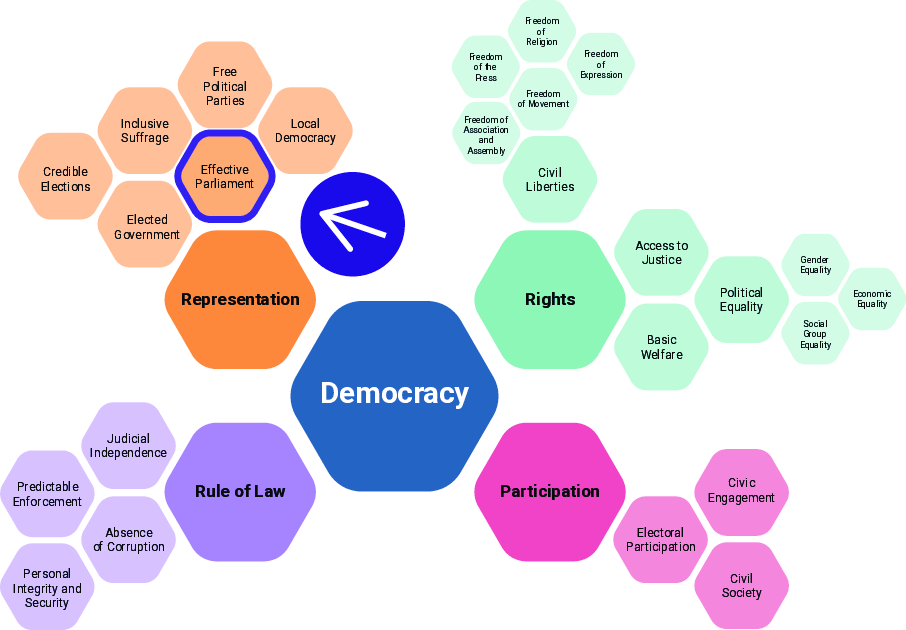
The Effective Parliament index aggregates indicators that measure the presence of opposition parties, legislative investigations, and questioning of officials, as well as broader measures of executive oversight and constraints. Overall, the Effective Parliament index presents a picture of how well lawmakers exercise their power to keep the executive in check and hold that branch accountable to the public.
When comparing 2025 to 2020, nearly one in five countries experienced a decline in Effective Parliament, signaling problems with legislatures’ capacity or willingness to exercise their powers. A total of 33 countries (19 percent) registered declines, while only 13 (8 percent) showed improvements. Italy was the only high-performing country to experience a decline; the remainder were split almost evenly between low-performing and mid-range-performing contexts.
In Italy, the government has increasingly relied on emergency decrees and votes of confidence to pass or change laws. The former bypass standard legislative procedures, while the latter make it challenging for the legislature to propose amendments or to hold debates that allow for changes. In 2025, for example, the UN raised concerns about the government’s use of an emergency decree to enact a security bill that could leave Italy at odds with international human rights law (Kushi et al. 2025; OHCHR 2025a). In addition, constitutional amendments passed in 2020 have raised concerns about the legislature’s effectiveness. The amendments reduced the size of the legislature, and critics have questioned whether the resulting increase in parliamentarians’ workloads might reduce their effectiveness.
Many of the lowest performers experiencing deteriorating performance have undergone coups d’état or other undemocratic transfers of power or are affected by ongoing violent conflicts: examples include Afghanistan, Burkina Faso, Guinea-Bissau, Haiti, Niger, Myanmar, and Russia. Others, such as Bangladesh, Madagascar, and Syria, are in transitional periods after wars or popular protests that unseated previous leaders (Box 2.2 discusses the role of parliaments in transitional context in South Asia in greater detail). In the mid-range performance band, deteriorating parliamentary effectiveness is also evident, impacting all regions and including countries as diverse as Albania, Ecuador, Lesotho, Pakistan, and the USA.
Box 2.2. Effective Parliament and post-uprising transitions in South Asia
In just three years, Sri Lanka, Bangladesh, and, most recently, Nepal have seen regimes toppled by youth-led protests. The Aragalaya movement in Sri Lanka (2022) unseated both the prime minister and the president, Bangladesh’s July 2024 uprising ended former Prime Minister Sheikh Hasina’s 15-year rule, and Nepal’s 2025 Gen Z protests led to the prime minister’s resignation.
While democratic gains remain fragile, these protest-driven transitions have created political openings for parliamentary reform that previously appeared out of reach. Subsequent elections in Sri Lanka (2024), Bangladesh (2026), and Nepal (2026) were atypically peaceful (given violence in past elections in these countries), sparking hopes for democratic renewal.
Research shows that institutional gains from protest-driven transitions often take several years to materialize (Kim and Kroeger 2019; Méon and Sekkat 2022). These changes largely depend on constitutional reforms, elite negotiations, and adjustments within judicial and bureaucratic systems. Consistent with this finding, the Global State of Democracy Indices indicate that Bangladesh and Nepal experienced significant declines in Effective Parliament between 2020 and 2025, while Sri Lanka showed modest improvements.
In Sri Lanka, the 2024 election marked a rare moment in which a left-leaning party under Anura Kumara Dissanayake secured a supermajority, translating the 2022 uprising into an organized political mandate for reform. To date, however, Sri Lanka has been slow to strengthen parliamentary effectiveness. Early steps include reestablishing oversight committees for parliamentary scrutiny, enhancing procedures such as post-legislative review, and passing broader anti-corruption legislation (WFD 2026). Yet lawmakers have been slow to act on what was promised as a more systematic parliamentary reform agenda, which includes abolishing the executive presidency and establishing a public prosecutor to strengthen oversight of the executive. Additionally, civil society experts criticized the emergency laws declared in the wake of Cyclone Ditwah as reflecting a return to the routine use of emergency powers in times of crisis, recalling a long history of previous administrations’ misuse of such powers. These concerns were reinforced by the government’s repeated monthly extensions throughout 2026 (Centre for Policy Alternatives 2026). Sustained public and civil society pressure will continue to be key to ensuring that the government delivers on its election promises.
In Bangladesh, parliamentary effectiveness will depend on the implementation of the July Charter reforms drafted by the interim government and endorsed by a referendum (Kenny 2026). The 2026 election saw the dominant Bangladesh Nationalist Party (BNP) return to power after more than 15 years. The BNP has affirmed that it remains committed to the July Charter reforms, including a provision to introduce prime ministerial term limits. However, the BNP continues to have reservations about provisions such as introducing proportional representation for an upper chamber (Kabir 2026). Disagreements over reform design and appropriate adoption mechanisms remain a key point of contention between the BNP and opposition and interim actors (Siddiq 2026). By April 2026, parliament had converted most of the 133 interim ordinances into bills but allowed several crucial ones to lapse. Still, political analysts note that “the heated debate among [members of parliament] over the ordinances [suggests] that parliament may begin to fulfil its remit after decades as little more than a rubber stamp” (International Crisis Group 2026: 16).
In Nepal, parliamentary reforms are being advanced by the relatively new, protester-aligned Rastriya Swatantra Party, which secured nearly a two-thirds majority in the 2026 election (Mulmi 2026). This breaks with decades of entrenched dominance by older parties and frequent coalition turnover, pointing to a potentially more responsive parliamentary landscape. The government’s time-bound 100-point reform agenda is an encouraging signal of greater accountability, though its impact depends on follow-through (Giri 2026).
Clearly, translating recent mobilizations into genuine institutional reforms is at a nascent stage in all three countries. Continued civic and international pressure will be crucial in shaping how governments respond to demands for accountability.
In the USA, the legislature’s unwillingness to check executive power has been most starkly apparent with regard to hostilities in Iran. In May 2026, after eight attempts to advance a bill that would have removed the US military from Iran without specific congressional approval, the Senate voted to advance the legislation (Lindsay 2026). This situation appears to flout clear legal stipulations in both the US Constitution and the War Powers Resolution of 1973, which empower only Congress to declare war and limit unauthorized force to 60 days, respectively (International IDEA 2026f). The apparently illegal use of force in Iran, however, is only the latest example of a severely weakened legislature. Congress has also been unwilling to push back against the executive’s usurpation of its power of the purse, use of emergency powers, and flouting of subpoenas and court orders. Importantly, these recent developments are part of a long-standing pattern of gradually waning congressional power to enforce laws governing the use of force. This pattern has been especially apparent in the post–World War II era, beginning as early as 1950, when President Harry Truman failed to seek congressional approval for the use of force in Korea (Dudziak 2023) (see case study 3.1 for a full overview of such developments in the USA).
Thirteen countries (8 percent of those in the dataset) showed improvement in measures of Effective Parliament, including five in Asia and the Pacific—Fiji, Papua New Guinea, Taiwan, Tajikistan, and Thailand. Among these, Tajikistan is the only low performer in this factor. Poland saw the largest increases, moving from mid-range to high performance in 2024. Several concrete actions contributed to the improvements. The Sejm (parliament) strengthened the rules governing consultations to improve the quality of legislation, including by amending its rules of procedure to introduce mandatory impact assessments and public consultations for draft laws. In addition, two of the Sejm’s new special investigative committees (looking into possible misuse of funds in the 2020 election and an alleged cash-for-visas scheme) completed their work and reported on the scope of criminal liability of public officials, which requires action (European Commission 2025).
2.3. Rights
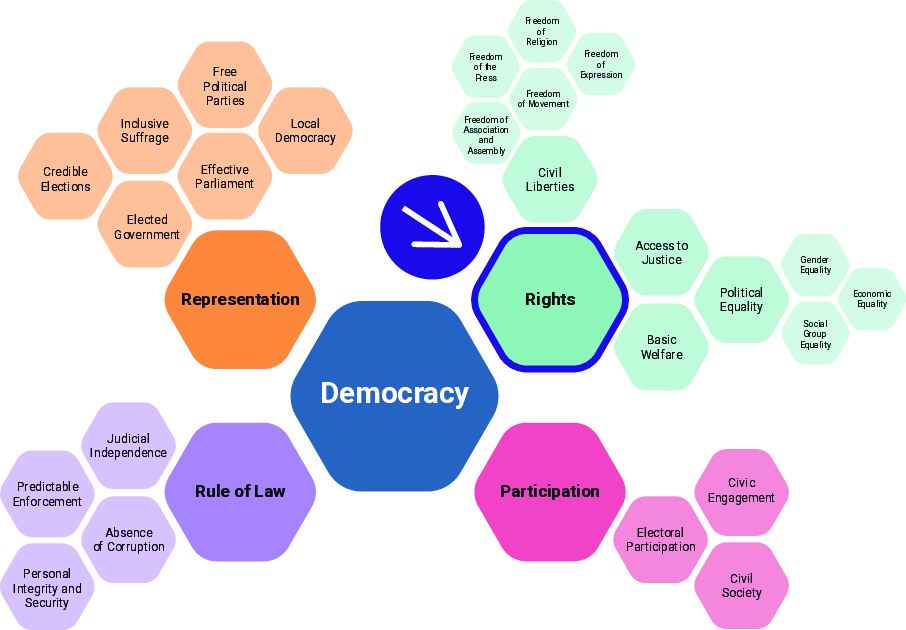
In the GSoD Indices, the Rights category is made up of liberal and social rights that support both fair representation and accountability. It is built upon four component measures—Access to Justice; Civil Liberties, including Freedom of the Press, Freedom of Expression, Freedom of Association and Assembly, Freedom of Religion, and Freedom of Movement; Basic Welfare; and Political Equality, including Gender Equality, Social Group Equality, and Economic Equality.
A small group of countries continues to lead in rights protections. As illustrated in Figure 2.6, Denmark, Switzerland, and Germany held the top three positions in 2024 and 2025, maintaining stable performance. These top performers represent the global standard in respecting and protecting certain rights and freedoms.
Comparing 2020 to 2025, global performance in the Rights category remained relatively stagnant: only nine countries (5 percent of all countries) showed any change in this category. Three (low-performing Somalia and Syria and high-performing Vanuatu) saw advances, but Somalia and Syria improved from very low starting points, due in part to years of devastating conflict. These two contexts merit close monitoring to determine whether or not recent developments, which have occurred in environments that are still unstable, will evolve into lasting change. Six countries saw declines, including low-performing Afghanistan, El Salvador, Mauritania, Myanmar, and Russia, as well as mid-range-performing Burkina Faso, which is on the border between mid-range and low performance, entrenching long-standing problems. The steepest declines took place in Afghanistan and Myanmar, which were among the countries with the largest number of declines across many factors (in all categories) when comparing 2020 to 2025.
In Afghanistan, the overall context continues to deteriorate. Severe poverty is widespread, and a 2025 shutdown of the country’s fiber-optic network disrupted health care, emergency services, aviation, and banking systems. The situation is particularly dire for women and girls. In January 2026, women civil servants who had been told to stay home since 2021 were informed that their employment was being terminated. The process was marked by a lack of due process and mitigation measures. In addition, women are banned from all education above sixth grade, and books authored by women have been removed from bookstores and libraries. Other human rights violations include public executions and floggings and the arbitrary arrest and detention of journalists. Volker Türk, the UN high commissioner for human rights, called Afghanistan a “graveyard for human rights” (OHCHR 2026c).
Within the Rights category, declines were most common in Freedom of Expression and Freedom of the Press, impacting almost one in four countries each, followed by Access to Justice and Civil Liberties (see figure 2.9). This trend was reflected across all regions, with Africa and Europe accounting for the largest shares of global declines in each of these factors.
There were a large number of apparent improvements in factors within Rights, but it is important to contextualize these changes. A total of 65 countries experienced advances in Basic Welfare, representing 38 percent of all countries in the dataset. These improvements, however, must be understood in the context of the time period under review (2020–2025), which was marked by the Covid-19 pandemic. Most of the advances were due to improvements in life expectancy metrics after the end of the pandemic, representing recovery rather than new or structural improvements.
Beyond pandemic-related advances, other more structural improvements were rare. A cluster of positive change was seen in Access to Justice and Civil Liberties, including Freedom of Expression, while Freedom of Movement also improved. Such improvements impacted between 9 and 10 percent of the countries in the GSoD Indices. Gains in Freedom of Movement were largely due to the lifting of pandemic-era restrictions that had limited people’s ability to travel freely.
Box 2.3. Syria’s political transition
Syria is among the countries that showed the most significant improvements in the Global State of Democracy Indices in 2025, driven by the political transition following the fall of Bashar al-Assad in December 2024. In the aftermath of the offensive led by the paramilitary group Hay’at Tahrir al-Sham (HTS), interim authorities convened a National Dialogue Conference in February 2025, although criticism of its short duration and top-down design raised questions about the inclusiveness of the process (al-Issa and Ibrahim 2025). A Constitutional Declaration issued in March 2025 then set out a five-year transition, concentrating broad powers in the presidency of former HTS leader Ahmad al-Sharaa (Constitution Net 2025; International IDEA 2025i; Syrians for Truth and Justice 2025), while envisaging a future permanent constitution and elections by 2030.
Developments in representation and participation have been uneven. The interim government includes Sunni, Kurdish, Christian, Druze, and Alawite figures, but the appointment of only one woman to the cabinet highlighted the limited depth of inclusion in practice (International IDEA 2025h). Likewise, the indirect parliamentary elections held in most provinces in October 2025 created a transitional representative structure, with the combination of electoral colleges and presidential appointments reinforcing concerns regarding executive dominance (Haid 2025; Al-Ali 2026). Elections were held in Kurdish provinces in May 2026 but were still pending in Sweida (New Arab 2026b).
The broader enabling environment, however, remains challenging. Ongoing territorial fragmentation and the presence of external actors such as Israel and Türkiye continue to shape the transition. More than 3,500 people were killed in 2025, including in major episodes of violence in coastal areas and Sweida (International IDEA 2025x; SNHR 2026a). Symbolic steps have been taken toward Kurdish national rights and cultural recognition (Al Jazeera 2026a), alongside early efforts to integrate armed actors into national security structures. However, these efforts remain constrained by the unresolved integration of the Syrian Democratic Forces, despite an agreement reached in early 2026 (Hawach and Drevon 2026; Schiavi 2026; SNHR 2026b).
Access to Justice has shown some improvement. While a comprehensive transitional justice framework is still pending (Syria Justice and Accountability Centre 2025), the creation of commissions on transitional justice and missing persons, together with the opening of the first trial linked to mass killings, indicates early institutional steps toward accountability (International IDEA 2025n, 2025as).
Overall, the first stages of the transition have created openings that could, if properly exploited, lay the foundation for a more democratic future. Whether such a foundation is established will depend on the interim authorities’ ability to address severe socioeconomic and humanitarian pressures (UNDP 2025a), navigate the unresolved balance between centralization and decentralization in the constitutional process (Hyyppä 2025), and broaden meaningful inclusion beyond a narrow transitional elite by creating more credible channels for participation in and oversight of the transition and its outcomes (Al-Ali 2026).
Freedom of Expression and Freedom of the Press
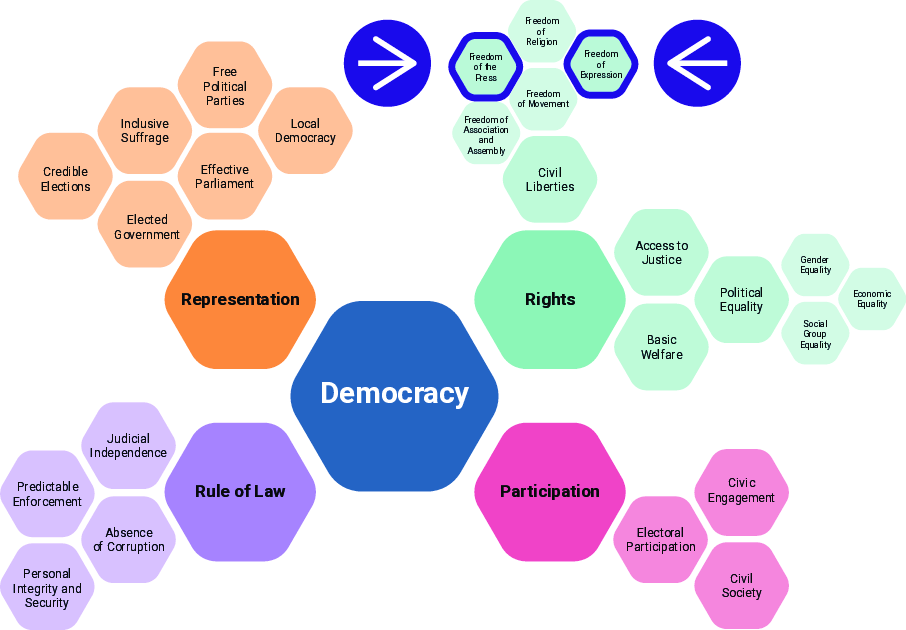
The Freedom of Expression subfactor refers to the right to openly discuss political issues and express political opinions outside the mass media, as well as considerations of the broader information environment.
The Freedom of the Press subfactor measures the extent to which the news media are diverse, honest, critical of the government, and free from government or self-imposed censorship; it also measures media independence.
Both these rights saw significant and broad declines, impacting almost one in four countries around the world and continuing a trend from International IDEA’s 2025 GSoD analysis, which found that Freedom of the Press faced the most far-reaching deterioration in the history of the GSoD dataset.
When comparing 2025 to 2020, it was Freedom of Expression that saw the broadest declines, impacting 24 percent of countries at all performance levels and in all regions. The declines were widely distributed across regions, though Africa and Europe accounted for 29 percent each, followed closely by the Americas at 24 percent (see figure 2.10 for an overview).
The 10 steepest declines affected countries at all performance levels. At the top of this list are the closed and insecure contexts of low-performing Afghanistan and Myanmar, followed by mid-range-performing Portugal and Georgia. Other steep decliners include low-performing Burkina Faso, Mali, and Russia; mid-range-performing Germany and Peru; and high-performing Denmark.
Though fewer in number, there are signs of progress. Sixteen countries spanning all regions registered advances in Freedom of Expression. Low-performing Syria and high-performing Poland saw the steepest improvements, demonstrating how pivotal changes in leadership can be. In the aftermath of the fall of the regime of Syrian President Bashar al-Assad, many journalists in Syria have described stark improvements in basic freedoms that allow them to move and report freely, including on stories critical of the government. At the same time, reforms have reportedly had a limited impact in an overall fragile environment. Media advocacy groups have accused the government of restricting the media and being involved in the detention of journalists in certain parts of the country where fighting is ongoing (Rashid 2025; CPJ 2026c) (see box 2.3 for an in-depth overview of Syria’s transition).
A transition in leadership has also ushered in change in The Gambia, where Freedom of Expression has improved, though the context remains difficult. Many of these advances are due largely to a rare opening for significant reform that has marked the period since 2017, when Adama Barrow ousted former President Yahya Jammeh from power. Some of the most recent improvements have been due to major reforms, including the 2021 Access to Information Law, the return of exiled journalists, increased safety for the media, and more vibrant online activism (MFWA 2021; Freedom House 2024). At the same time, however, systemic challenges remain. In 2025, advances in Freedom of Expression could be traced to developments such as the passage of the Criminal Offence and Procedure Bill, which replaced colonial-era laws and eliminated statutes that had criminalized defamation and sedition. However, the inclusion of provisions that allow the government to ban certain publications and the reintroduction of a Jammeh-era “false publication” offense risk restricting civic space (CIVICUS 2025).
Such change is encouraging, but it is also tenuous, given that other long-standing challenges remain unresolved. It will be important to watch the degree to which advances in such environments can endure and to understand the mechanisms that help or hinder continued progress. These lessons may be increasingly relevant as conflict becomes more widespread around the world.
Similar downturns occurred in Freedom of the Press, with declines in 39 countries (23 percent) globally. Notably, European countries accounted for almost half (46 percent) of the global declines in this subfactor, with mid-range-performing Italy experiencing the most substantial deterioration in the region. Italy’s decline was due partly to verbal threats and harassment of journalists, which the Media Freedom Rapid Response consortium cites as the most common form of press freedom violations in Italy in 2026. One example is that of Adriano Cappellari, a journalist who was threatened for months over his coverage of an anti-mafia priest known for his work against organized crime. In May, unknown assailants attempted an arson attack at the journalist’s home. Other journalists have also been threatened for their mafia-related reporting (Mapping Media Freedom 2026). Italy’s challenges continued into 2026, when the country fell from 49th to 56th place in the World Press Freedom Index. This drop was attributed to the extent to which Italian journalists face “obstacles stemming from criminal pressure, intimidation by extremist groups, and the increasing use of judicial instruments with chilling effects on the media. Of particular concern is the growing recourse to so-called SLAPPs (Strategic Lawsuits Against Public Participation), legal actions brought against journalists and media outlets with intimidatory rather than compensatory purposes. These concerns are compounded by regulations regarded as restrictive of access to judicial information” (Universita di Padovà 2026; see also RSF n.d.-c).
Challenges were also evident in weaker contexts. In Georgia, for example, conditions for the press continue to deteriorate. Since 2025, the legislature has sought to build on the so-called foreign agent law. New provisions expand the definition of “grants” to “cover virtually any form of remuneration or assistance from abroad if it serves vaguely defined political goals” (CPJ 2026a). Those who receive such funding without government approval face criminal charges and up to six years in prison. Independent media outlets and media advocacy organizations are especially threatened (CPJ 2026a; CSO Meter 2026). Events in 2026 suggest that the trend is continuing. In May, a group of nongovernmental organizations (NGOs) established a Russophobia Monitoring Council, which aims to track and analyze what its members describe as “anti-Russian rhetoric” and discrimination in the public space. Some analysts warn that the move should be seen in the context of new Russian legislation that seeks to justify intervention or annexation to “protect” Russian communities in other countries. Given that the criteria for what is considered “anti-Russian” are unclear, there are also concerns about a chilling effect on speech (JAMnews 2026; Kokaia 2026).
There were also limited examples of advances. In Poland, a key step was the advancement of reforms to the Polish Broadcasting and Television Act (1992), which seek to align Polish law with the European Media Freedom Act (2024). At the time of writing, the proposed reforms had undergone a public consultation process and were scheduled to go before a standing government committee for review and then to parliamentary debate. These reforms include the dissolution of the National Media Council, which had been dominated by the former ruling party and had assumed the authority to appoint and dismiss the management of the National Broadcasting Council (KRRiT). The reforms aim to expand the mandate of the KRRiT, strengthen the criteria for the selection of its members, ensure greater independence among its members, introduce a new system for transparent tracking of media ownership and state advertising in the media, and make several other amendments. At the same time, concerns remain about whether proposed changes to the funding mechanism for public media threaten its sustainability (Ministry of Culture and National Heritage of Poland 2025; ECPMF 2026).
Mauritius saw the third-largest increase in Freedom of Expression when comparing 2020 to 2025, due in part to the newly elected administration’s Government Programme 2025–2029. The government revoked the previous administration’s mandatory SIM card reregistration and identification program and instructed mobile operators to eliminate databases containing user photographs and personal data previously collected for the registration exercise (Republic of Mauritius 2025a, 2025b). The Government Programme also includes provisions to restore the independence of the Mauritius Broadcasting Corporation, which will be watched closely. These moves have helped alleviate previous concerns about privacy and free speech.
Access to Justice
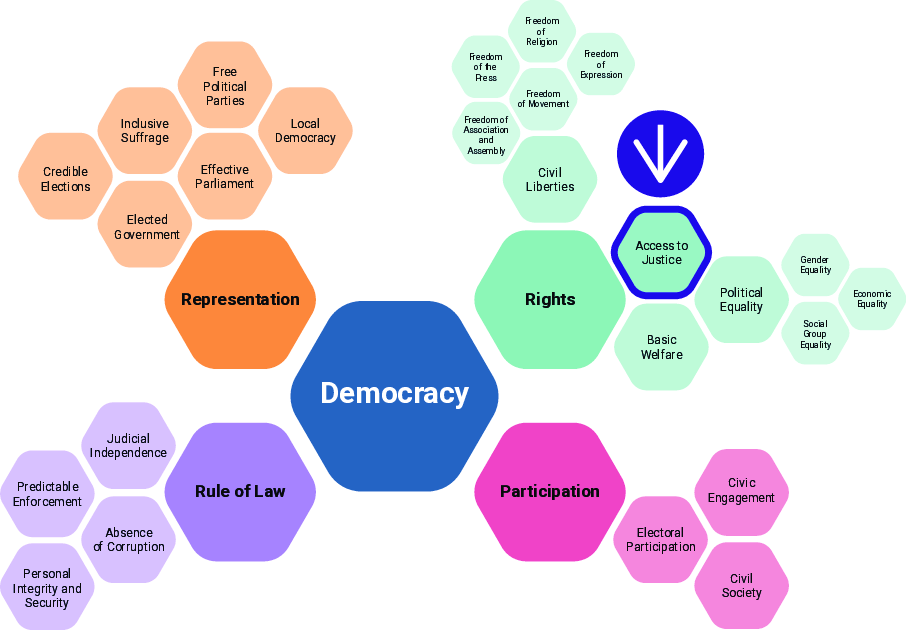
The Access to Justice factor denotes the extent to which the legal system is fair—that is, citizens are not subject to arbitrary arrest or detention and have the right to be under the jurisdiction of and to seek redress from competent, independent, and impartial tribunals without undue delay.
Comparing 2025 with 2020, performance in Access to Justice declined in 31 countries, more than twice the number of countries (15) that recorded advances. The majority of these declines occurred in mid-range-performing contexts, but two countries with much higher baseline performance—Greece and South Korea—also experienced notable deterioration in this area. At the regional level, Africa and Europe together accounted for the majority (65 percent) of all declines in Access to Justice.
The three steepest drops worldwide occurred in low-performing Afghanistan, Mauritania, and Myanmar, but mid-range-performing Georgia, Israel, Malawi, Serbia, and the USA were also among the countries that experienced the largest deteriorations.
In Israel and the USA, the use of vague laws exemplifies how legal frameworks can be weaponized to obstruct due process and accountability. Israel’s so-called Death Penalty for Terrorists Law (2026) mandates death by hanging for “terrorism-related” offenses. As written, the law applies only to Palestinians. Sentences cannot be commuted or reduced and must be carried out within 90 days of the final ruling. The law also restricts access to legal representation, family visits, and external oversight, as well as accountability for those who carry out executions. The UN characterized the law as “a discriminatory regime of capital punishment” and called on the Supreme Court to “invalidate this manifestly unlawful legislation without delay, before it gives rise to irreversible harm and further entrenches discrimination, arbitrariness and cruel, inhuman or degrading punishment against Palestinians” (OHCHR 2026d; see also ACRI 2026; Bedard 2026).
In the USA, research shows that there are long-standing financial and procedural barriers to accessing justice, especially for marginalized communities, including people who live in rural areas, people with disabilities, and members of minority groups. Minority groups are particularly impacted, and people of color account for 7 in 10 people in prison, the result of systemic drivers such as a history of racial discrimination and charging and sentencing practices that impose harsher punishments on people of color (Nellis and Pearce 2026). These trends continued into 2026 and were particularly evident in the handling of immigration. Immigration enforcement tactics, which include warrantless home entries, arrests at schools and places of worship, the use of masked and unidentified agents, and witness intimidation, have created a chilling effect, including among American citizens. In at least two instances, people have been killed while protesting against immigration policies and tactics (International IDEA 2026a; see case study 3.1 for more details). In the first nine months of the second Trump administration, as many as 170 citizens were detained by immigration authorities (American Immigration Council 2026; Ray and Sanchez 2026). This context has also raised serious due process concerns, especially as some states allow federal immigration agents to seize people from county jails, where they are often held for minor offenses that are wholly separate from any alleged immigration law violations (Buchele 2025). Other allegations include the widespread denial of bond hearings to people detained by US Immigration and Customs Enforcement (ICE) (ACLU 2025).
Fifteen countries also registered improvements (see figure 2.11). These countries were distributed relatively evenly across performance levels and regions, with the exception of West Asia, where only one country, Syria, recorded an advance in this factor.
Nigeria provides a compelling example of how digital tools can enhance the provision of and access to justice. In Lagos, the State Judiciary is a leader in the use of virtual court proceedings (Sahara Reporters 2020; Okeke 2026). Other innovations include the development of e-case management and videoconferencing that allows prisoners to participate in virtual case hearings, helping to alleviate the significant backlog in the court system (UNODC n.d.). Another innovation is the use of citizens’ mediation centers, which provide free dispute resolution services outside the formal court system. In Lagos, the Citizens’ Mediation Bureau provides dispute resolution assistance related to landlord–tenant disputes, employment, family matters, inheritance, land matters, monetary claims, local relationships, and commercial disputes. The bureau has helped to significantly alleviate court backlogs (Lagos State Ministry of Justice n.d.). Lagos is also home to the continent’s first court-connected alternative dispute resolution center (Lagos Multi-Door Courthouse n.d.).
Similarly, Bangladesh’s advances are due in part to the use of digital technology. There, a 2025 amendment to the Legal Aid Act requires pre-case mediation and enforceable settlements, landmark reforms that prioritize resolution over litigation. The reforms also integrate online tools, virtual mediation, and digital case management to reduce backlogs, cut costs, and ensure more efficient dispute resolution (UNDP 2025b).
2.4. Rule of Law
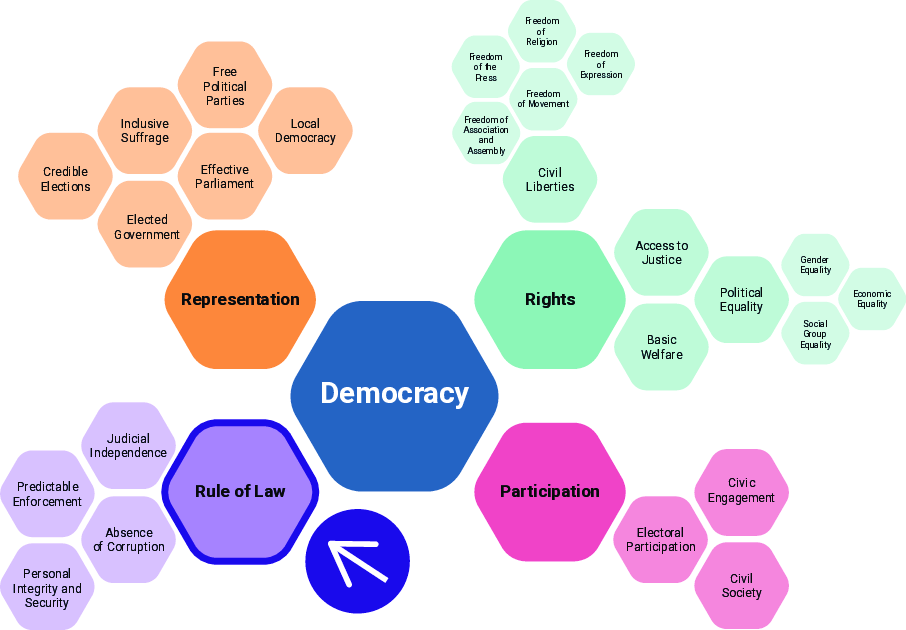
In the GSoD Indices, Rule of Law is an aggregate measure that includes assessments of the independence of the judiciary from government influence, the extent to which public administrators use their offices for personal gain, the predictability of law enforcement, and the degree to which people are free from political violence. Overall, the index provides a snapshot of the extent to which everyone is subject to the law and the level of safety that exists.
Unlike the other categories, Rule of Law showed dynamism between 2020 and 2025, with 25 percent of all countries experiencing some change. The trend was negative: declines in 2025 compared with 2020 more than doubled advances, with 14 countries advancing and 29 declining. At the same time, however, several countries maintained strong levels of performance, with little change within this group (see figure 2.6 for the top 10 countries in this category in 2025).
Yet the deteriorations at the country level stand in stark contrast to these positive examples. Most countries experiencing declines were low-performing, though mid-range- and high-performing countries in the Americas and Europe were also impacted. Overall, African and European countries accounted for 69 percent of the declines. Judicial Independence accounted for the largest share of all Rule of Law–related declines (33 percent), followed by Predictable Enforcement (25 percent), Absence of Corruption (23 percent), and Personal Integrity and Security (19 percent) (see figure 2.12 for a regional breakdown and figure 2.13 for an overview of how trends in Judicial Independence, Predictable Enforcement, and Absence of Corruption changed between 2020 and 2025).
Mid-range-performing Slovakia stands out, having experienced the third-steepest decline in Rule of Law, after only Myanmar and Afghanistan, with particular deterioration in Absence of Corruption and Predictable Enforcement. This pattern reflects a spate of scandals over the past several years, including allegations of procurement processes rigged by an organized crime group that resulted in EUR 8.75 million (approximately USD 10 million) in fraudulently obtained EU funds between 2024 and 2025 (EPPO 2025). Another recent example is Podlimit, a scandal involving nine companies allegedly engaged in large-scale customs fraud and VAT evasion. It is estimated that these actions resulted in EUR 24 million (approximately USD 27.5 million) in unpaid customs duties and more than EUR 113 million (approximately USD 129.5 million) in unpaid VAT (EPPO 2026). These cases are set in a broader context marked by the government’s attempt to dismantle whistleblower protection laws, internal conflict between the prime minister and the prosecutor general, and a European Parliament vote urging the European Commission to launch conditionality proceedings that could result in the suspension of some EU funds (Lauková 2026; Silenská 2026).
In other places, however, the causes are different. In the USA, for example, Rule of Law continued to be under pressure in 2025, having moved from high to mid-range performance in 2024. The challenges are especially stark with regard to Personal Integrity and Security, which shifted from high to mid-range performance in 2025. The 2025 score for this factor is the lowest it has been since 2007. In 2025, political violence became increasingly common in the USA, with some experts noting that rates of violence doubled between 2024 and 2025 (Shiffman et al. 2025). Prominent examples include the assassination of the right-wing political activist Charlie Kirk (International IDEA 2025ae), the murders of Minnesota state representative Melissa Hortman and her husband (International IDEA 2025q), the shooting of Democratic state senator John Hoffman and his wife, the attempted assassination of Pennsylvania Governor Josh Shapiro, and multiple attacks against ICE facilities.
In 2026, political violence intensified, with ICE agents killing two US citizens during protests against the administration’s immigration policies and tactics (International IDEA 2026a). In April, a suspected assassination attempt against President Trump continued the pattern. While a flurry of bipartisan resolutions condemning political violence were passed in response to the violence against the above-mentioned Minnesota politicians, some leaders made light of the violence (Burga 2025a; Dunphey 2025). The increase in violence comes in the context of the government’s deprioritization of efforts to counter domestic extremism and its focus on redefining domestic terrorism to include multiple viewpoints out of favor with the executive, including “anti-Americanism, anti-capitalism, and anti-Christianity; support for the overthrow of the United States Government; extremism on migration, race, and gender; and hostility towards those who hold traditional American views on family, religion, and morality” (Patel 2025). The degree to which the use of political violence is normalized in the future will be a determining factor in the extent to which the rule of law is able to guarantee basic safety and security in the USA (see case study 3.1 for a full overview of developments in the USA).
Advances in Rule of Law were more limited, impacting four countries each in the Americas (mid-range-performing Brazil, Guatemala, Honduras, and Suriname), Asia and the Pacific (mid-range-performing Bangladesh, Fiji, Maldives, and Sri Lanka), and Europe (mid-range-performing Poland and high-performing Czechia, Denmark, and Latvia). Only one country in Africa (Somalia) and one country in West Asia (Syria) showed improvement. Notably, the advances in Syria were the most pronounced of all countries, though it remains low-performing in this category. Bangladesh moved from low-performing to mid-range-performing between 2024 and 2025.
Absence of Corruption
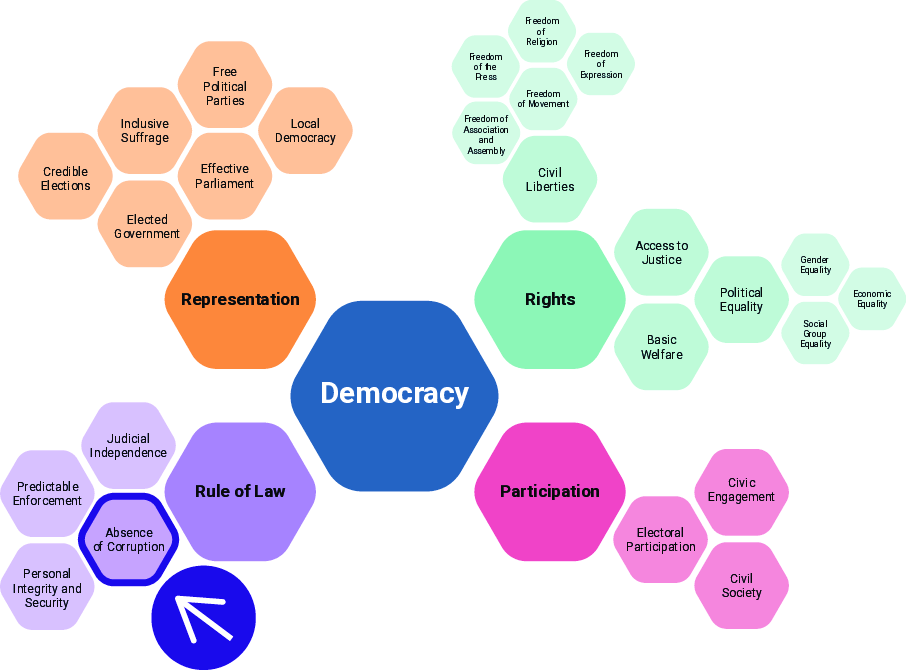
The Absence of Corruption factor denotes the extent to which the executive and the public administration more broadly do not abuse their offices for personal gain. When leaders and institutions fail to serve the public, it can result in disenfranchisement and a disconnect between leaders and the publics they are mandated to serve. This factor is based on four indicators that measure corruption in the executive and public administration; it does not address courts or legislatures.
Unlike in previous years, when more countries seemed to be making progress in the fight against corruption, the latest data show that advances and declines were almost evenly matched, with 14 countries improving and 16 declining. Half of all declines occurred in Europe, including in low-performing Russia; mid-range-performing Armenia, Austria, Georgia, Lithuania, and Slovakia; and high-performing Finland and Spain. Declines in other regions were more evenly distributed—two in the Americas (low-performing Bolivia and mid-range-performing Peru), two in Asia and the Pacific (low-performing Myanmar and Papua New Guinea), and four in Africa and West Asia (mid-range-performing Botswana and Tunisia and low-performing Mozambique and Uganda).
In Uganda, corruption is a long-standing and entrenched challenge. Systemic financial mismanagement, particularly within parliament, sparked an online campaign and an in-person protest movement in 2024 (Nyeko 2024; Rédaction Africanews 2024). One target of the protests was former Speaker of Parliament Anita Annet Among, who had been sanctioned by foreign governments in connection with corruption charges related to the diversion of housing materials meant for vulnerable communities to prominent politicians and their families (FCDO 2024). Protesters had also raised suspicions about her efforts to increase her benefits, including a change in per diem allowances from USD 990 to USD 4,400, as well as her accumulation of assets, including multiple properties and luxury vehicles. In 2026, Uganda’s security agencies launched an investigation into her wealth, which is suspected to have been obtained illicitly (Okoth 2026).
Gains in Absence of Corruption were recorded in 14 countries (8 percent) across all regions (see figure 2.14). The steepest advance was in Syria, though it remains low-performing in this factor. In 2025, article 7 of the Constitutional Declaration affirmed that the state guarantees the fight against corruption. Since then, President al-Sharaa has also issued orders requiring officials to disclose investments, abstain from private business dealings that might compromise their duties, and avoid allowing personal relationships to influence governance. At the same time, the impact of such reforms is limited, as the government faces serious structural challenges, including fragmented and weak administrative capacity, widespread poverty, and the presence of armed groups outside its control (Al-Jabassini and Daher 2026).
Judicial Independence and Predictable Enforcement
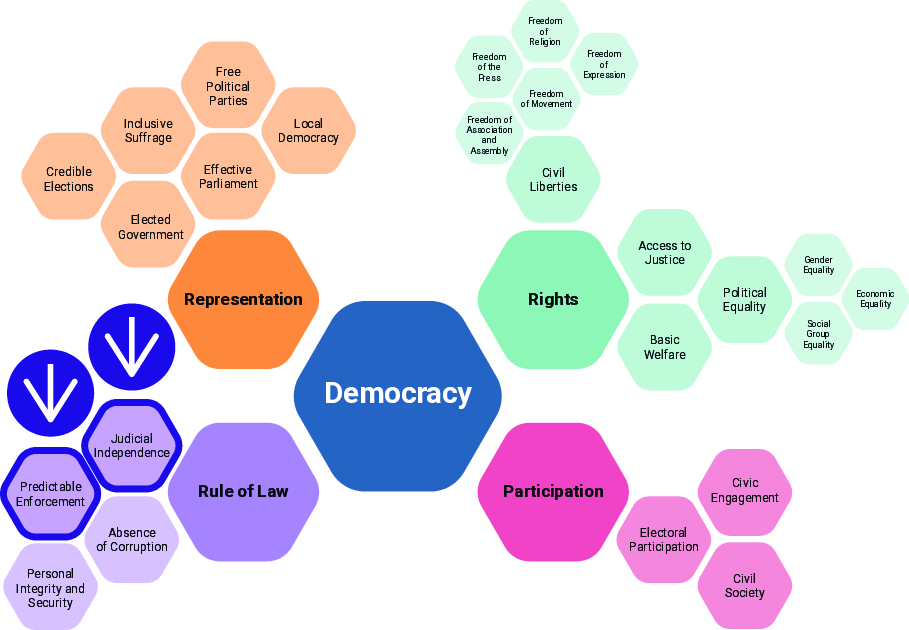
The Judicial Independence factor denotes the extent to which the courts are not subject to undue influence from the other branches of government, especially the executive. This factor provides insight into respect for the balance of power.
The Predictable Enforcement factor denotes the extent to which the executive and public officials enforce laws in a predictable manner. Predictable Enforcement builds public trust, protects individual rights, and allows citizens to plan their lives with relative certainty.
Judicial Independence deteriorated (when comparing 2020 to 2025) across countries in the low and mid-range performance, impacting 13 percent of all countries in the dataset. Declines were concentrated in Africa, while other regions were less affected (see figure 2.15 for an overview of advances and declines in Judicial Independence).
While the most severe declines were observed in contexts facing significant instability and violence, including Burkina Faso, Chad, and Myanmar, countries such as El Salvador and Tunisia were also impacted. The latter two countries have not suffered from the same kind of civil conflict but have instead been marked by the centralization of executive power and an associated weakening of democratic checks and balances. Mid-range-performing countries also suffered declines. Examples include Argentina, Belgium, India, Nigeria, Taiwan, and the USA. Both Taiwan and the USA fell from high to mid-range performance in this factor in 2025.
In the USA, the chief justice of the Supreme Court, John Roberts, warned that violence, intimidation, disinformation, and threats to defy judgments threatened judicial independence. His 2024 year-end report cited more than 1,000 serious threats against federal judges between 2019 and 2024, as well as the murders of judges in Maryland and Wisconsin in retaliation for adverse judgments. He also referenced cases in which public officials had intimidated judges, including by suggesting political bias without evidence, as well as the doxxing of judges (Roberts 2024). In 2025, Elon Musk repeatedly posted on social media about impeaching judges who opposed President Trump’s plans, and the Trump administration targeted Justice Department officials who had worked on criminal investigations into the president, as well as private law firms that defended causes with which Trump disagreed (Lucas and Johnson 2025) (see case study 3.1 for more details on developments in the USA).
Judicial independence was in the spotlight in India in 2025 as well. There, the declines were partly rooted in contentious parliamentary impeachment proceedings against a high court judge in the state of Tamil Nadu, which prompted questions about undue influence on the judiciary. The charges, brought by the opposition, were in response to the judge’s ruling that executive authorities could not obstruct religious practice in the absence of legal authority to do so. The case has highlighted a recent history of similar impeachment attempts, which the retired justices described as the weaponization of impeachment (Mishra 2025). The International Commission of Jurists (ICJ) also warned of the challenges elected political bodies may face in acting as impartial tribunals in matters of judicial evaluation and described parliamentary impeachment processes as “inappropriate.” The ICJ warned that the “political character of Parliamentary bodies itself creates a risk of abuse” and recommended that independent judicial councils or disciplinary tribunals exercise such functions “so as to effectively safeguard judicial independence” (ICJ 2025).
Despite these developments, public opposition and debate are encouraging signs of democratic vitality in India. In response to the impeachment proceedings, which alleged misconduct and lack of impartiality, dozens of retired judges issued a statement of solidarity with the targeted judge, condemning the proceedings and warning that the efforts would have a “chilling effect on the judiciary and embolden political intimidation of judges whose decisions do not align with particular ideological or political expectations” (Mishra 2025).
A small number of countries (eight) showed improvement in Judicial Independence, including in the Americas (high-performing Brazil and Guatemala and mid-range-performing Honduras), Asia and the Pacific (mid-range-performing Bangladesh, Fiji, and Sri Lanka), and Europe (mid-range-performing Poland and high-performing Czechia).
Predictable Enforcement also faced challenges around the world, with declines recorded in 17 countries (10 percent) across all levels of performance, including three high-performing countries—the Netherlands, Spain, and the UK. Regionally, African and European countries accounted for 65 percent of the global declines in this factor, followed by the Americas and Asia and the Pacific (see figure 2.16).
The UK, which performs in the high range for Predictable Enforcement, is experiencing worrying declines in this area. One contributing factor is the lack of meaningful guardrails to protect public integrity. While a new anti-corruption strategy has been praised for providing for a government review of asset and beneficial ownership to identify criminal vulnerabilities and for expanding the Domestic Corruption Unit to investigate corruption cases, critical gaps related to public integrity remain. Specifically, concerns persist about the lack of caps on donations and the failure to reduce spending limits (TI UK 2025). Additionally, a new Ethics and Integrity Commission has been welcomed by watchdogs, but its limited powers have raised concerns. The commission’s lack of statutory funding leaves its existence vulnerable to government whims, and the absence of a requirement for the government to respond to its recommendations calls its potential impact into question (Spotlight on Corruption 2025). Public integrity concerns continued into 2026, exemplified by the former UK ambassador to the USA, Peter Mandelson, who is under investigation for allegedly passing confidential information that he received in his capacity as a minister to the late convicted pedophile Jeffrey Epstein and his associates. It is suspected that the information was part of a quid pro quo arrangement in which both men shared financially beneficial information with each other (Horder 2026).
Low-performing Madagascar, which is in the midst of a significant political transition after youth-led protests and a subsequent military coup unseated President Andry Rajoelina, is also experiencing declines in Predictable Enforcement. Much of the deterioration can be traced to the actions of the new military government, which came to power in the wake of those protests. Upon assuming office, the new head of state, Colonel Michael Randrianirina, vowed to address the protesters’ grievances, including demands for accountability for the police brutality they had suffered. Reports documented the use of tear gas, beatings, and live ammunition (Nciko wa Nciko 2026; Savage 2026). Thus far, the regime has failed to act on these demands (Nciko wa Nciko 2026; Rosen 2026). The pattern continued in 2026, with activists arrested for attending a protest calling for an election date to be set (Savage 2026).
Eleven countries across all levels of performance experienced improvements in Predictable Enforcement. Most of these cases were in Asia and the Pacific (mid-range-performing Bangladesh, Fiji, Maldives, and Sri Lanka) and Europe (high-performing Czechia, Denmark, and Latvia and mid-range-performing Poland). Czechia (see box 2.4) and Denmark stand out for notably large improvements.
Box 2.4. Changes in Czechia strengthen the rule of law
In Czechia, the Government Anti-Corruption Strategy for 2023–2026 and the Government’s Action Plan to Fight Corruption for 2025–2026 have helped strengthen and promote transparency and accountability and lay fresh groundwork for a future marked by increased rules-based predictability. The Organisation for Economic Co-operation and Development (2026a) praised Czech authorities for incorporating public feedback into the anti-corruption strategy and noted “an extended consultation process, which included inputs from the Government Council for coordinating the fight against corruption, consisting of representatives from government, law enforcement authorities, territorial self-governing units, economic partners, professional chambers, non-profit organisations and the academic sector.” Czech advances are also due to the adoption of Act No.168/2025 on Lobbying, which formally defines lobbying activities, identifies lobbyists, and corrects the previous absence of a dedicated legal framework. The act established institutional oversight through the designation of the Ministry of Justice and the creation of a publicly accessible lobbying register, which helps enhance transparency (OECD 2026a). This helps close previous loopholes and makes it easier to identify and act on potential violations.
2.5. Participation
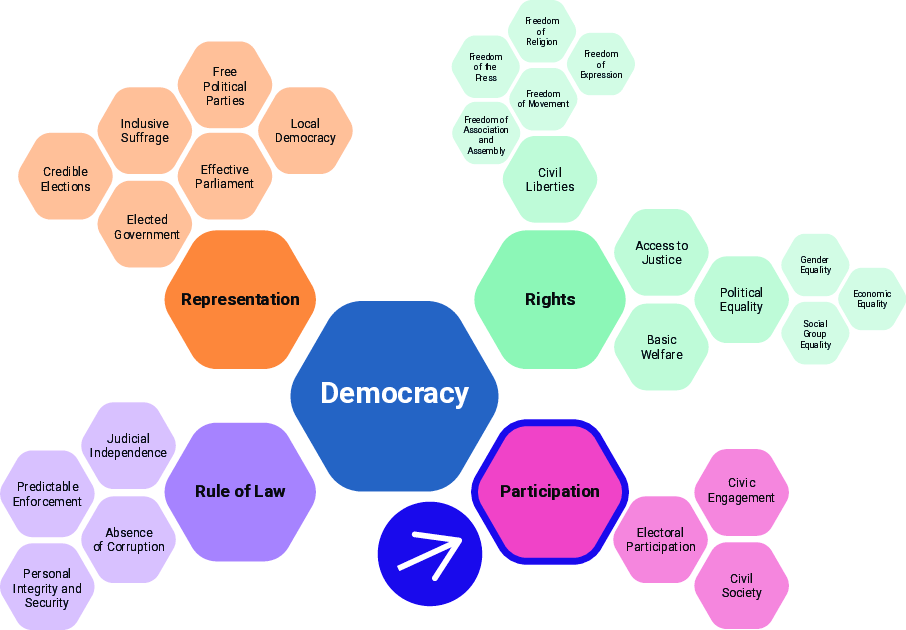
In the GSoD Indices, Participation is an aggregate measure of the extent to which people are actively involved at all levels of government. It is comprised of three factors that measure the space for civil society to operate freely (Civil Society), the extent to which people engage in political and non-political associations and trade unions (Civic Engagement), and voter turnout (Electoral Participation).
Participation is, in many ways, the daily life of democratic environments. Active citizens help maintain popular control over decision-makers and help ensure government responsiveness. Higher levels of different forms of popular participation reflect more inclusive and representative involvement than very low levels of popular participation. Without popular involvement, democratic institutions become empty and meaningless shells. The Participation index measures the quality of the space for public engagement, assessing levels of voter turnout, civil society’s freedom to operate, and the ability of the public to join associations of interest.
Comparing 2020 with 2025, the category of Participation experienced relatively few country-level changes (16), with declines (13) outweighing advances (3). See figure 2.6 for the top 10 countries in Participation. Unlike in other categories, there was one notable change in this group. Australia moved 16 places in the ranking and now ranks fifth in the world.
One driver of Australia’s improvements, which are rooted in the indicator that measures the extent to which civil society is consulted on policies that are relevant to its members, is the high level of consultation with and among civil society groups. In 2025, for example, the Australian Government consulted with a range of stakeholders, including civil society, on an online privacy code for children and published a strategic plan on anti-racism that reflected a range of submissions and consultations (Australian Anti-Slavery Commissioner 2025; Office of the Australian Information Commissioner 2025). Also in 2025, the government and civil society gathered to discuss the implementation of Australia’s second National Action Plan on Women, Peace and Security. The event included participants from government, NGOs, UN agencies, community-based organizations, diaspora groups, academia, practitioners, and private-sector organizations. The report that was published as a result of the convening highlighted opportunities to strengthen implementation of the National Action Plan on Women, Peace and Security through regional engagement, institutional reform, and more inclusive policy approaches (Humanitarian Advisory Group 2025). A coalition of civil society groups also submitted a report to the UN Human Rights Council as part of the country’s 2025–2026 Universal Periodic Review (Human Rights Law Centre 2025).
Australia also stands out for its community groups, which have mobilized and organized to tackle long-standing problems with government responsiveness. These community groups have supported the rise of so-called community independent candidates, who purposefully focus on meaningful representation, promising to listen to and engage with the local community, free from the constraints that may come with party affiliation. These candidates emerged in earnest in 2022, when local community groups formed in 33 of Australia’s 151 House of Representatives federal electorates, aiming to strengthen the quality, integrity, and impact of political representation. In 22 of these electorates, a local community group endorsed a community independent candidate, many of whom ran on strong anti-party platforms. While such candidates cannot fully perform all the functions of traditional political parties, they provide voters with alternatives, increase electoral competition, and strengthen effective political communication, especially with regard to political issues and processes. One goal is increased civic engagement: “The idea is that people have good ideas to share and contributions to make, and that they need to be listened to and empowered through their involvement and active engagement. If they are active and included, it is argued that they will learn more about their political system and the issues it faces and mobilise others” (Reid et al. 2025). The rise of community independent candidates has sometimes been referred to as the Voices movement.
Australia is also home to other innovations in electoral candidacies, including the Teal Wave, which included women (many funded in part by political funding group Climate 200) who target seats held by Liberal members of parliament. These candidates generally combined the Liberal Party’s conservative fiscal policies with environmental policies that are closer to those promoted by the Greens (Yallop 2025). Like community independent candidates, these candidates are independents who rely on strong links to their communities.
Sri Lanka offers another example of improvements in indicators of Participation. In the aftermath of the 2022 Aragalaya protests that unseated President Gotabaya Rajapaksa and other members of the Rajapaksa political dynasty, Sri Lanka has undergone a limited transformation thus far. A new leftist government, led by a party that is the first ever to emerge from the Sinhalese-dominant south of the country and still win in the conflict-affected north and east, pledged to act on protesters’ demands (EU SEE 2025; Fonseka 2025; Timberman 2025). Progress has been apparent but slow, especially because of the government’s lack of a structured, systematic approach to the inclusion of civil society. Still, notable developments related to public participation have included civil society’s contribution to anti-corruption laws and action plans, government consultations with election monitoring organizations on drafting electoral reforms, public consultations with regard to a new anti-terrorism law, and consultations on a proposed NGO law (EU SEE 2025).
Many of the declines in Participation occurred in countries that were already low-performing, including Afghanistan, Belarus, Myanmar, Nicaragua, Russia, and Sudan, but mid-range-performing Argentina, Armenia, Burkina Faso, Indonesia, Mali, Pakistan, and Tunisia were also impacted. The three countries that experienced improvement were high-performing Australia, mid-range-performing Sri Lanka, and low-performing Syria.
Civil Society and Civic Engagement
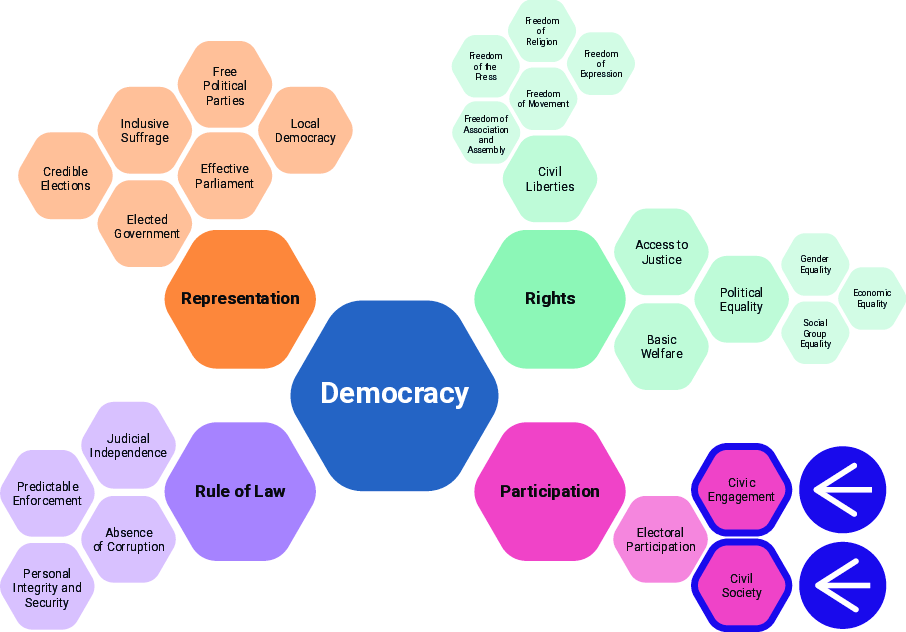
The Civil Society index aggregates indicators that measure the extent to which organized, voluntary, self-generating, and autonomous social life is institutionally possible, providing a sense of the environment in which civil society organizations (CSOs) and other associations operate. It also helps illustrate the state of civic space more broadly.
The Civic Engagement index measures the extent to which people engage in political and nonpolitical associations and trade unions, as well as mobilization for democracy. It also includes an indicator of civil society traditions.
Civil society is a cornerstone of any thriving democracy, serving as a critical check on government actions and helping amplify the voices of local communities and individuals, especially those who may be neglected at higher levels of decision-making. The Civil Society index measures the quality of the environment in which CSOs operate. In combination with the indices of Free Political Parties and Freedom of Association and Assembly, it helps illustrate the state of civic space more broadly.
Compared with 2020, declines in Civil Society were seen in 17 countries and were evenly distributed across all regions, with the exception of the Americas, which saw only two declines in this factor (Argentina and Nicaragua) and one in Civic Engagement (Nicaragua). Notably, the Americas region performs relatively strongly in the factors of Participation. Only two countries (Cuba and Nicaragua) are low-performing in Civic Engagement, and only three countries are low-performing in Civil Society (Cuba, Nicaragua, and Venezuela) (see figure 2.17 for an overview of performance in the Americas).
The declines in this index largely occurred in mid-range-performing countries, but low-performing countries and one high-performing country (Finland) were also impacted. The five steepest declines in this factor occurred in contexts already marked by instability and, in some cases, conflict, including low-performing Afghanistan, Myanmar, and Sudan and mid-range-performing Burkina Faso and Tunisia.
Sudan serves as a compelling example of the threats that even resilient civil society groups face. There, emergency response rooms (ERRs) and community-organized service delivery initiatives (takaaya), which provide everything from hot meals and cash transfers to health and evacuation services, have long been a backbone of the Sudanese response to various types of emergencies, including the Covid-19 pandemic and outbreaks of violence. Many ERRs are also democratically organized. In Khartoum, for example, an ERR established in 2023 included a parliamentary body with three representatives from each of the city’s districts, term limits, and executive committees for programming and finance. A charter set out values of transparency, equality, participation, and accountability (Islamic Relief Worldwide 2025). In 2024 and 2025, Sudan’s ERRs were nominated for the Nobel Peace Prize. Despite the lifelines they have provided, ERRs and takaaya are at risk of collapse in the face of funding cuts; shortages of food, water, and fuel; and sheer exhaustion among the people involved. As conflict continues and infrastructure deteriorates, unreliable Internet access and limited communications capacity reduce organizers’ ability to coordinate with supporters and document humanitarian needs. Local relationships and interactions with external humanitarian actors are also complex, reflecting political and conflict dynamics. Without additional support, these civil society initiatives will not be sustainable (Chatham House 2025; Islamic Relief Worldwide 2025; Usher 2025).
In seven countries, the environment for civil society improved between 2020 and 2025. These countries include mid-range-performing Sri Lanka, Syria, and Zambia and high-performing Australia, Brazil, Fiji, and Poland. In Brazil, gains have been apparent since 2023. Notable developments include the reestablishment of participatory councils that integrate civil society into policymaking, ease barriers to philanthropic financing, and offer tax relief for civil society, and new legislation that facilitates formal civil society partnerships in disaster and climate contexts (ICNL n.d.).
The story is similar with regard to Civic Engagement—14 declines in low- and mid-range-performing countries compared with one advance (high-performing France). Low-performing Belarus and mid-range-performing Mali experienced the largest deteriorations in this factor. Belarus has long been declining across several factors, and the current context is marked by more than 1,000 political prisoners, the absence of independent media, and a severely restricted environment for civil society. Many activists and human rights defenders have gone into exile, reorganizing abroad. The result is a widespread hollowing out of civic space, with people too afraid to engage and more focused on protecting their basic safety (ALDA 2025; CIVICUS Lens 2025). In France, significant gains have plateaued since 2023. Still, ongoing innovations such as Civic Hour (L’Heure Civique) keep the momentum alive. Developed in 2020 in response to declining rates of volunteerism, this initiative asks people to volunteer for one hour each month in their communities. The initiative has spread to 250 municipalities and includes 24,000 volunteers (Yeung 2026; L’Heure Civique n.d.).
A final metric of Participation is Electoral Participation, which measures voter turnout (as a proportion of the voting-age population) in national elections. Comparing 2025 with 2005, it is evident that the number of low-range-performing countries has increased (see figure 2.18). Some of the expansion of low performance is rooted in the growing number of cases in which there are no regularly scheduled elections. There is also, however, growing concern about a lack of youth interest in elections and voting (Baloch and Barrail 2025; Wunderlich 2025). It will be important to watch how public engagement in elections changes in the years ahead, especially as multiple countries struggle with decreasing trust in political elites and institutions and young people in many parts of the world prefer other forms of political engagement.
Public participation can be decisive in building community bonds and broader societal resilience. As the world faces more conflict, these relationships may serve as bridges between communities and help facilitate peacebuilding. This is of particular relevance in the context of increasing rates of violent conflict. As explored in Part 2 of this report, scholarship has found that civil society’s ability to provide social accountability is pivotal in minimizing the risk of conflict.
3.1. Africa and West Asia
Overview
In Africa and West Asia, the overall factor-level trend from 2020 to 2025 was negative—106 significant declines versus 53 advances.
The declines were concentrated in Rights and Representation—Elected Government, Access to Justice, Credible Elections, Effective Parliament, and Civil Liberties—which together accounted for 60 of the 106 declines (57 percent). The advances were led by Basic Welfare (45 percent of all improvements), but these largely reflect recovery from the Covid-19 pandemic rather than democratic gains. Setting them aside, genuine improvements were limited and concentrated in three factors—Credible Elections, Elected Government, and Personal Integrity and Security—each of which advanced in five countries, even as Credible Elections and Elected Government also ranked among the factors with the largest number of declines elsewhere in the region (see figures 3.1 and 3.2).
Geographically, the declines in these measures—Elected Government, Access to Justice, Credible Elections, Effective Parliament, and Civil Liberties—occurred in 31 countries, with West African countries representing more than a third of this total (11). Burkina Faso and Togo stand out, each having experienced declines in at least four of the five factors. In Burkina Faso and Niger, these declines reflect the consolidation of power by increasingly entrenched military regimes, which have restricted political freedoms and dissolved democratic institutions (International IDEA 2025w, 2025ab, 2025av). Alleged electoral irregularities, state repression of protests, and attacks on press freedom are likely to have contributed to these trajectories in Togo (International IDEA 2024b, 2025r).
The picture in Africa and West Asia, however, is complex and not without incipient bright spots. Excluding Basic Welfare, which shows more generalized improvements across 24 countries, Syria alone accounts for nearly one-quarter of all recorded advances. The fall of the regime of President al-Assad in 2024 and the subsequent political transition have precipitated improvements in some key performance areas, including Access to Justice, Civil Liberties, and Political Equality. Early steps have included the establishment of transitional justice mechanisms and the formation of a more ethnically and religiously diverse government. However, these developments remain limited, and their trajectory will depend on the transition’s ability to broaden meaningful inclusion and address ongoing governance and security constraints (International IDEA 2025h, 2025n) (see box 2.3 for a detailed analysis of the changes in Syria).
More broadly, advances at the factor level are concentrated in a small number of subregions, with Southern Africa and West Asia accounting for most positive shifts. There have, however, also been improvements in other transitional contexts, including in Gabon, which experienced a significant advance in Elected Government after holding its first elections since a 2023 coup d’état that deposed President Ali Bongo Ondimba (International IDEA 2025j). The effects of The Gambia’s democratization continue to be felt, with the country experiencing a significant improvement in Freedom of Expression when comparing its 2025 and 2020 scores. Illustrative of this trend, the adoption of the Access to Information Law in 2021 marked the first time The Gambia formally recognized the right to access information as a human right (ARTICLE 19 2021). The trend is also reflected in growing media pluralism—The Gambia now has dozens of radio stations and multiple television channels, the majority privately owned—and a marked decrease in attacks against journalists (RSF n.d-b).
2025 Performance at the Category Level
While a number of African countries continue to perform in the high range across multiple factors and subfactors (see figure 3.3), they are exceptions: across the region, most countries perform in the low range in almost all categories (see figures 3.3 and 3.4). Notably, however, Cabo Verde, Ghana, Mauritius, and South Africa are all high-performing in Representation.
The only exception to the broader trend of poor performance continues to be Participation, with 69 percent of African countries performing in the mid-range. The two weakest categories of performance for both regions are Representation and Rule of Law.
While the causes of this weak regional performance are manifold, insecurity is a major driver, with armed conflict widespread in many parts of sub-Saharan Africa and West Asia, where it inflicts some of the world’s highest death tolls (Davis and Pfeifer Cruz 2025; ACLED n.d.). But declines are not driven by conflict alone. Unconstitutional changes of government—particularly in West Africa—have also played a significant role, often reflecting efforts by incumbents or military actors to retain or seize power. Developments in 2025 once again illustrate that the impact of these dynamics on democracy extends well beyond casualty counts.
In the Democratic Republic of the Congo, government efforts to control the narrative around the conflict in the east of the country led to media bans and growing intolerance toward opposition parties (International IDEA 2025p, 2025ao). Persistent allegations of genocide in Palestine and Sudan and widespread sexual violence in Sudan and the Democratic Republic of the Congo highlight the damage that armed conflict inflicts on Political Equality, including by undermining social cohesion (International IDEA 2024c, 2025c, 2025u, 2025y, 2025am). The destruction of critical medical infrastructure and disruptions to food supplies in these war zones have highlighted how conflict restricts access to Basic Welfare—the material foundation for democracy—even as recent gains largely reflect post-pandemic recovery rather than structural strengthening (International IDEA 2025aa, 2025aj, Skaaning and Hudson 2025).
What to Watch
Armed conflict and insecurity look set to continue to shape democracy’s prospects in Africa and West Asia. In Lebanon, the resumption of conflict between Israel and Hezbollah threatens to slow democratic progress, having already triggered the postponement of parliamentary elections (Diab 2026). In Iran, wartime conditions have so far led to tighter enforcement against dissent, including intensified surveillance and arrests linked to online expression (Reuters 2026). In this regard, current dynamics point to a reinforcement of authoritarianism (Kurlantzick 2026; Motamedi 2026), even if some observers initially suggested that the war could create openings for domestic political change (Adaramola 2026; Block 2026; Borger 2026). Similar patterns are being seen across the Gulf, where public dissent is increasingly met with fresh restrictions on civic space and freedoms (ARTICLE 19 2026). Rising fuel prices are also set to exacerbate economic inequalities, particularly in vulnerable East African economies (Sheikh 2026).
Taken together, these trends point to the growing relevance of the transnational dimension of democratic declines, whereby countries’ external actions feed back into democratic practices and outcomes at home. In Israel, the continuation of warfare has led not only to expanded executive authority and tighter policing of protest and speech but also to constraints on judicial functioning (Lurie 2026) and has fueled the advancement of legislation reinforcing discriminatory practices toward Palestinians (OHCHR 2026d). In parallel, political recalibration within Palestine is unfolding, with early signs including the April 2026 municipal elections4—the first held in parts of Gaza5 in over two decades—and a presidential decree scheduling the first direct elections to the Palestine Liberation Organization for November 2026 (Al Jazeera 2026b; New Arab 2026a). Looking ahead, as conflict continues to shape democratic practice, a key area to watch is how governments respond to insecurity and perceived threats. These responses, often directed outward beyond their borders, can also feed back into domestic politics and entrench securitized approaches that may weaken democratic practices at home. In this regard, this year’s Israeli legislative election, scheduled for 27 October 2026 at the time of writing,6 will be a significant event for the region. Beyond determining the composition of the next government, the outcome is expected to provide relevant insights into the future direction of Israeli politics and the country’s policies toward Palestine and the broader region. Part 2 of this report examines these dynamics in greater depth, focusing on the relationship between democracy and international security.
3.2. The Americas
Overview
Comparing 2025 to 2020, the Americas saw 37 advances (across 16 countries) and 46 declines (also across 16 countries) at the factor level. Most declines occurred in Effective Parliament (9 countries), Free Political Parties (7), Credible Elections (5), and Judicial Independence (5). Declines in country–factor pairs were mostly concentrated in Central America, followed by South America. Meanwhile, most countries with at least one factor-level advance were in South America. Beyond Basic Welfare (where advances reflect pandemic recovery rather than more structural improvements), most advances were in Absence of Corruption, Access to Justice, Credible Elections, Effective Parliament, Judicial Independence, and Personal Integrity and Security (3 countries in each factor).
The USA experienced four factor-level declines, including in Free Political Parties, Effective Parliament, Access to Justice, and Judicial Independence. It also saw declines in the subfactors of Freedom of Expression, Freedom of the Press, and Economic Equality. Except for Free Political Parties, US scores on these measures are at their lowest levels since 1975 (see case study 3.1 for a detailed look at changes in the USA).
El Salvador was the country with the most declines at the factor level (8), followed by Nicaragua (6) and Peru (6). All three countries saw declines in Civil Liberties, Credible Elections, and Free Political Parties, as well as in the category of Representation. In El Salvador and Nicaragua, leaders have co-opted institutions after being elected, blurring the lines between branches of government and ensuring the near-total control of the ruling parties—Nuevas Ideas (El Salvador) and the Sandinista National Liberation Front (Nicaragua) (Gavarrete 2024; International IDEA 2024e, 2025a; Azpuru n.d.). Both have also experienced substantial drops in Civil Liberties over the past decade, with Nicaragua’s decline being more profound during this period. El Salvador performs in the mid to low range in almost all measures (except Inclusive Suffrage and Electoral Participation), while Nicaragua performs in the low range in nearly all measures of democracy (the exceptions being Inclusive Suffrage, Basic Welfare, Gender Equality, and Electoral Participation). Unchecked executive power in Nicaragua has enabled the repression of opposition actors, civil society, and religious institutions. Since 2018, more than 342,000 Nicaraguans have sought asylum, and 31,000 have been granted refugee status (HRW 2026d). A constitutional amendment in 2025 formalized unbounded executive authority in the form of the Daniel Ortega and Rosario Murillo co-presidency, with the power to “coordinate” the legislature, judiciary, and electoral council (International IDEA 2024e, 2025a; DW 2025).
Peru experienced six factor-level declines—Credible Elections, Free Political Parties, Effective Parliament, Civil Liberties, Absence of Corruption, and Judicial Independence. The two steepest drops were in Effective Parliament and Freedom of Expression. The legislature’s systematic use of oversight mechanisms has weakened the executive and generated an imbalance of powers. One result is extreme volatility, as reflected in Peru having had eight presidents in just over 10 years (Landa 2023; International IDEA 2025ak; De La Quintana 2026). Emergency decrees that suspend certain rights as a means of curbing insecurity and reports of excessive use of force against protesters help explain the considerable drop in Civil Liberties and related subfactors (International IDEA 2025al).
At the subfactor level, most declines affected Freedom of Expression (10), Freedom of the Press (8), and Economic Equality (8), highlighting the region’s alarming conditions for journalists as well as the profound inequality that has made Latin America and the Caribbean the world’s most unequal region by income (OECD 2025; DW 2026; Ríos Tobar 2026). At least 17 journalists were killed in the Americas in 2025, and many more experienced censorship, selective prosecutions, threats, harassment, and other types of violence (CPJ 2026b; France 24 2026; RSF n.d.-a). Despite slight improvements in recent years, 25.5 percent of people in Latin America and the Caribbean still experience income poverty (CEPAL 2025; UN News 2025).
Compared with 2020, Basic Welfare saw by far the most advances (13), reflecting recovery from the impacts of the Covid-19 pandemic rather than structural democratic gains. Modest advances occurred in Absence of Corruption, Access to Justice, Credible Elections, Effective Parliament, Judicial Independence, and Personal Integrity and Security (three advances in each factor).
2025 Performance at the Category Level
Regional performance remains stable overall, with most countries performing in the mid-range in all four main categories of democracy (see figure 3.6). The region excels in Representation, the category in which the greatest number of countries perform in the high range (10), while Rule of Law has the greatest number of low-range performers (8). Compared with 2024, there has been little movement in the distribution of countries across performance bands. Cuba and Venezuela perform in the low range in all categories, while most of the other low-performing countries are in Central America.
One notable change, however, concerns the USA. In 2024, the USA performed in the high range in three categories, but in 2025 its high performance was limited to Participation. It performs in the mid-range in the remaining three categories (see case study 3.1 on the USA’s democratic performance).
What to Watch
The impact of transnational insecurity on the region’s democratic trajectory will be an important aspect to watch. The increasingly transnational character of organized crime and its growing impact beyond security, including on politics, the economy, and social structures, remains a key concern for the region. Governments’ responses to this phenomenon, including the increasing popularity of strong-arm policies, could further impact Personal Integrity and Security (The changes in this measure of democratic performance are described in more detail in Box 3.1). An additional transnational security concern relates to the potentially destabilizing effects on the region of US democratic decline and of the so-called Donroe Doctrine (see case study 3.1). This is especially true as the USA has attempted to influence elections in countries such as Argentina, Colombia, and Honduras; appears to be focused now on possible regime change in Cuba; continues to carry out military strikes against small boats in the Caribbean Sea and Pacific Ocean; and dictates political terms to Venezuelan leader Delcy Rodríguez in the wake of its removal of Nicolás Maduro from power (International IDEA 2026b; Collinson 2026; de Córdoba and Pérez 2026). Measures such as Elected Government and Personal Integrity and Security should be watched particularly closely in this regard.
Box 3.1. Personal Integrity and Security in the Americas
In the factor of Personal Integrity and Security, advances outnumbered declines in the Americas (three advances—in Brazil, Chile, and Suriname—compared with one decline, in Ecuador). Still, these advances should not be interpreted as an overall improvement in the security situation. During the same five-year period, the regional average for the Americas declined marginally, as did the scores for all its subregions. In this sense, the broader trend over the past five years is one of stagnation, while most countries continue to perform in the mid-range in Personal Integrity and Security.
Long-standing and emerging security challenges have had a particular impact on Latin America and the Caribbean. Most notably, these are related to the rapid expansion of organized crime, which has transcended borders and increasingly operates through transnational networks and diversified illicit activities, ranging from drug trafficking to illegal mining, extortion, and trafficking in persons (Paúl 2024). As criminal structures and gangs extend their territorial reach and consolidate their influence, concerns about their interference in political processes and the consequent weakening of governance and the rule of law have grown (Luna and Feldmann 2025).
According to Latinobarómetro, an annual public opinion survey conducted across Latin America, violence stemming from gangs and organized crime is what concerns Latin Americans most (Latinobarómetro 2025). Insecurity has also played a determining role in popular support for hardline and security-driven policies, even at the expense of individual rights (International IDEA 2025ay). An uptick in violence in recent years in countries such as Colombia and Peru, as well as the perception that regional leaders have failed to meaningfully improve public security, have been major drivers of Latin America’s current rightward political shift (Eisele 2026; Garcia Cano and Debre 2026; Shifter 2026).
At the same time, government strategies adopted to contain domestic and transnational organized crime, including the militarization of public security and the use of states of exception, highlight underlying limitations in state capacity (Ferri 2025; IACHR 2026b; Santacecilia 2026b).
Country-level advances were most pronounced in Brazil (eight), followed by Guatemala and Honduras (five each). Many of Brazil’s improvements can be traced to shifts in policy since former President Jair Bolsonaro left power. The current administration has emphasized issues related to rights and civic space such as Access to Justice, Civil Liberties, Freedom of Expression, Freedom of the Press, and Civil Society, including through the restoration of measures to address historical crimes, while high-profile convictions help explain progress in Access to Justice (International IDEA 2024a, 2024d, 2024g).
Honduras’s improvements, including in Credible Elections, are ripple effects of the 2021 election and that year’s peaceful transition of power, as well as the overall peaceful conditions of the 2025 election, which Nasry Asfura won (Blanco Abellan et al. 2025). Honduras has also made some progress in recent years in factors relating to Rights and Rule of Law. High rates of criminality have impacted performance in a range of democratic measures, although the homicide rate declined from 26.1 per 100,000 people in 2024 to 15.3 in 2025 (HRW 2026b). Still, the country remains one of the most dangerous for human rights defenders and climate activists (Global Witness 2026; Pinnow 2026). Despite an improvement in Absence of Corruption, the country’s baseline was and remains in the low range. The inability to establish a United Nations–backed international commission to combat impunity stands out as a major shortcoming of the administration of Xiomara Castro (Méndez Dardón 2026).
Latin America has become the most politically polarized region in the world after a rapid rise in polarization over the past decade (UNDP 2026; V-Dem n.d.). Highly contentious issues such as the economy, migration, and insecurity, as well as the increasing success of anti-establishment politicians who capitalize on divisive identity-based narratives and “us versus them” politics, have contributed to an erosion of democratic dialogue (Kessler and Vommaro 2024; Bruni 2025; Fuentes 2026; UNDP 2026). As the ideological center loses ground, toxic levels of polarization have, in turn, contributed to institutional and governance weaknesses, including impasses in policymaking, the degradation of institutional norms, and the exacerbation of social conflict. Bolivia and Peru are countries where toxic political polarization has led to both volatility and social conflict (Colmenares 2025; Fernández Aguilar 2025; Centenera and Ruvenal 2026; IACHR 2026a).
Polarization has also become particularly apparent in electoral processes taking place in 2026. Presidential races in Colombia, Costa Rica, and Peru saw ideological opponents compete in sharply polarized environments, where disinformation and unfounded allegations of fraud contributed to distrust in institutions and the weakening of political dialogue (Blanco Abellan and Liendo 2026; Fuentes 2026; Ríos Tobar et al. 2026; Santacecilia 2026a; UNDP Peru 2026). In October, Brazil will see incumbent Luiz Inácio Lula da Silva attempt to secure a fourth term, facing Flávio Bolsonaro in a context where polarization fueled political violence during the previous presidential election.
Increasing polarization comes as disaffection with incumbents shapes the political landscape and the region shifts ideologically to the right. The recent elections of Rodrigo Paz in Bolivia, Nasry Asfura in Honduras, José Antonio Kast in Chile, Abelardo de la Espriella in Colombia, and Keiko Fujimori in Peru illustrate the rightward shift in politics, which in some cases is driven by anti-incumbency and dissatisfaction with ruling parties, among other country-specific factors (Orduz 2026; Reid 2026; Spinetto 2026; Suhr 2026). As centrism loses salience, the extent to which newly elected governments deliver on their promises of security, stability, rapid economic growth, and upward social mobility will be key to containing hyperpolarization and maintaining popular support for democracy in the Americas.
3.3. Asia and the Pacific
Overview
Significant declines at the factor level from 2020 to 2025 outnumbered advances by 52 to 45 across the region as a whole. Twenty-three of these declines occurred in just two countries, Afghanistan and Myanmar. If these two countries were excluded from the count, the overall trend in Asia and the Pacific would instead be positive, with 44 advances and 29 declines.
The factors that saw the most change across the region were Credible Elections and Effective Parliament (changes in 10 countries), followed by Access to Justice, Basic Welfare, and Judicial Independence (9 countries). As in other regions, advances in Basic Welfare appear to have been driven by post-pandemic recovery rather than by broader democratic reforms (see figure 3.7 for a breakdown of all advances and declines at the factor level).
For the fifth consecutive year, the majority of factor-level changes occurred in the subregions of South and Southeast Asia, which accounted for 71 of 97 changes.7 As shown in figure 3.8, even when accounting for the different number of countries in each subregion, South and Southeast Asia have long been, and remain, the center of democratic change, for better or worse, in the wider region. In Oceania, Fiji is primarily responsible for variations in the degree of change. The country has experienced two coups, a constitutional crisis, and the removal of a dictator from office via the ballot box since 2000 (Runey 2023).
At the country level, Bangladesh experienced the most changes in the region (excluding Myanmar), followed by Sri Lanka. Bangladesh had three declines related to the discredited January 2024 election and the subsequent removal of Prime Minister Sheikh Hasina (Credible Elections, Elected Government, and Effective Parliament), as well as seven advances, including in Absence of Corruption, Civil Liberties, and Personal Integrity and Security. The advances align with key legal reforms and ordinances introduced by the interim government, such as the repeal of restrictive digital-speech laws and Bangladesh’s first legal framework criminalizing enforced disappearances. Following the 2026 election, however, not all interim-era ordinances were automatically enacted by parliament, with several left for further parliamentary deliberation, including the enforced-disappearance law (Dhaka Tribune 2026; HRW 2026a). It remains to be seen whether these recent gains will be sustained.
Sri Lanka experienced eight advances, including in Absence of Corruption, Civil Society, Predictable Enforcement, Elected Government, and Credible Elections. These developments reflect reform momentum emerging from the 2022 Aragalaya protest movement, reinforced by the 2024 presidential and parliamentary elections. The passage of landmark anti-corruption legislation in 2025 and accountability measures—such as the removal of public figures accused of abuse of power—signals promising progress in Absence of Corruption and Predictable Enforcement (International IDEA 2025l, 2025ac). However, key reforms remain pending, such as overhauling the country’s controversial counterterrorism legislation and fulfilling the promise of constitutional reform to abolish the executive presidency (see box 2.2).
Indonesia and Pakistan suffered the most declines in the region (four each), with the exception of Afghanistan and Myanmar. The recent declines in these two countries reflect the centralization of power in the executive and military through legal and constitutional amendments, alongside weakening checks on the judiciary and broader restrictions on opposition parties (International IDEA 2025ar). In Indonesia, a law permitting active-duty military officers to hold civilian posts and conflicts between the Constitutional Court and the government over police officers holding second government jobs have raised concerns about a return to the dual-function role of the military (known as the Dwifungsi doctrine) that characterized three decades of authoritarian rule under President Suharto (1967–1998) (International IDEA 2025d, 2025ap).
India remains the region’s largest and most influential democracy, with domestic developments that have implications for the wider region. India advanced in two measures (Basic Welfare and Freedom of Movement), largely reflecting the lifting of Covid-19 restrictions and increased life expectancy. However, the expansion of welfare schemes and rural development initiatives by the government also played a visible role (International IDEA 2025au; Kumar et al. 2025). At the same time, India also saw recent declines in Judicial Independence and Free Political Parties, the latter partly due to repeated federal investigations into opposition leaders ahead of the 2024 election (CIVICUS 2024; Economist 2024). The evolution of the Credible Elections indicator points to a more complex story. This factor remained broadly stable between 2024 and 2025 and remains well above the regional average for Asia and the Pacific. Nonetheless, it has experienced a gradual decline over several years, a process that predates the 2024 election. In fact, despite preelection concerns, independent observers assessed the 2024 election—the world’s largest democratic exercise—as credible and well administered, a perception supported by the fact that all major political actors readily accepted the outcome (Hollstein 2024). India’s vast and diverse federal structure also means that national-level developments do not always capture the health of the country’s democratic institutions: research has shown that democratic performance varies considerably across Indian states, with some demonstrating particularly robust electoral competition and democratic practices over time (Harbers et al. 2019).
Performance at the Category Level
The big picture shows that regional averages remain high in comparison with the 1980s and 1990s but have largely stagnated over the past 15 years (see figure 3.9).
Remarkably, this stagnation has taken place during decades of monumental socioeconomic change. China alone has accounted for about one-third of global growth in the 21st century, and in recent years Asia more broadly has accounted for 60 percent of annual gross domestic product growth (Prasad 2023; Truitt 2024). However, countries in the region have not emulated China’s authoritarian state-capitalist model of government, suggesting that regional elites are skeptical of its long-term durability and wary of warning signs that the country’s long economic boom has entered a “gilded age” (Ang 2022). The region’s size and diversity also obscure major upheavals at the national level, such as the revolutions in Bangladesh, Nepal, and Sri Lanka (see box 2.2); state collapse in Afghanistan and Myanmar; and the failed self-coup, removal, and successful prosecution of South Korean President Yoon Suk Yeol in late 2024 and early 2025 (International IDEA 2025v; Kenny 2025). Yoon’s life sentence for insurrection in February 2026 marked, in many respects, the close of a major chapter in South Korea’s political crisis, underscoring the resilience of its democratic institutions. Still, the long-term implications of this period in South Korea will depend on the success of reforms to limit future executive overreach (Kwon 2026).
What to Watch
South and Southeast Asia remain in political flux. The advances and reform processes in Bangladesh, Nepal, and Sri Lanka will continue to warrant close monitoring, particularly in the aftermath of youth-led movements and post-election governance transitions. At the same time, the enduring influence of executive and military actors in countries such as Indonesia and Pakistan continues to constrain prospects for greater civilian oversight and the rule of law. Amid border tensions and conflict-related incidents involving India and Pakistan, Cambodia and Thailand, and the Taiwan Strait in 2025, regional stability and the risk that securitized pressures will shape democratic governance will also be important to watch (International IDEA 2025o, 2025s).
3.4. Europe
Overview
Europe saw 77 declines and 42 advances at the factor level when comparing 2020 to 2025. Civil Liberties experienced the most setbacks (10 countries), followed by Access to Justice and Credible Elections (9 each) (see figure 3.10). Beyond Basic Welfare (whose advances were driven by pandemic-era recovery), Absence of Corruption showed the most improvements (five countries), followed by Predictable Enforcement, Effective Parliament, and Access to Justice (four countries each). Each of these factors remains net negative, since declines outweigh advances across Europe.
More than one-third of regional declines at the level of country–factor pairs occurred in Eastern Europe (28 out of 77), with the remainder fairly evenly distributed across the other subregions (18 in Central Europe, 16 in Southern Europe, and 15 in Northern and Western Europe). Country-level declines were concentrated in Georgia and Russia (eight each), followed by Armenia, Portugal, and Slovakia (six each). Russia’s wide-ranging declines stemmed from the continued wartime crackdown on dissent and civil liberties, and Georgia’s similar autocratization was fueled by elite suspicion over the benefits of Euro-Atlantic integration (Erpyleva and Kappinen 2024; International IDEA 2025z, 2025an, 2025at; Gunitsky and Morris 2026; Rustamova and Liutova 2026).
Armenia’s decline in Civil Society is largely driven by deterioration in the indicator that measures engaged society, capturing public awareness of major policy debates and the ability to participate in them. This decline may reflect growing distrust in political institutions stemming from the country’s defeat and loss of Nagorno-Karabakh. The ongoing integration of Karabakh Armenian refugees has placed considerable pressure on the country’s social protection systems and public services (Lannebo 2025). Despite these declines, Armenia’s scores on five of these factors (Civil Society, Credible Elections, Absence of Corruption, Effective Parliament, and Judicial Independence) remain higher than before the peaceful 2018 revolution that brought Prime Minister Nikol Pashinyan to power (Abrahamian and Shagoyan 2018).
In contrast, a different pattern of institutional strain is emerging in Slovakia. There, efforts to weaken whistleblower protections (International IDEA 2025aw) reflect broader institutional erosion, while constitutional amendments restricting minority rights (International IDEA 2025af), as well as intensifying political polarization (Dlhopolec 2026) and pressure on civic space (International IDEA 2025aw), are creating a challenging environment ahead of the 2027 parliamentary elections.
From 2020 to 2025, advances overwhelmingly occurred in Central Europe (27 out of 42 including Basic Welfare, 15 out of 23 with it excluded). The remainder were split evenly between Eastern Europe and Northern and Western Europe. There were no advances in Southern Europe during this period. Advances in Poland (seven) dwarfed gains in any other country and extended across all four categories. Improvements in Civil Society, Effective Parliament, and Freedom of the Press were driven by simplified CSO registration, stronger consultation rules to improve legislative quality, parliamentary investigative committees that enhanced accountability, and proposed reforms to improve media independence.
Czechia also stands out for gains across multiple areas, including Effective Parliament, Judicial Independence, and Predictable Enforcement, though recent mass protests against the new government signal popular concerns that the country may be shifting away from democratic values and toward policies perceived as more aligned with Russia (Oelofse 2026). Reforms introduced in 2024 to strengthen safeguards for dismissing senior prosecutors marked progress in Judicial Independence (European Commission 2024).
Deterioration in Civil Liberties, particularly Freedom of Expression and Freedom of the Press, deepened further compared with 2024, primarily in Northern and Western Europe, including in long-standing democracies such as Iceland, Italy and the UK (Freedom of the Press), and Denmark and Germany (Freedom of Expression). Germany’s long-standing commitment to preventing a resurgence of extremism has increasingly translated into broader constraints on political speech, amplified by deep polarization that leaves many reluctant to share dissenting views (Lissowsky 2026). In 2025, a group of UN experts criticized the criminalization of Palestinian solidarity activism, noting the expansion of restrictions on peaceful protests and condemning police violence that has caused injuries (OHCHR 2025b). Recent developments in Denmark have intensified debates about the boundaries of legitimate political expression, as prison sentences for individuals accused of “condoning terrorism” on social media (Drachmann 2024) have raised concerns among civil society about vague legal definitions (Amnesty International n.d.).
Serbia recorded the highest number of new declines compared with the previous year, notably in Access to Justice, Freedom of Association and Assembly, and Personal Integrity and Security, amid recent legislation weakening prosecutorial autonomy and restrictions on civic space (Miljojkovic 2026).
Performance at the Category Level
Many European countries are in the high performance band across multiple factors, with a particularly strong showing in Representation. In contrast, Rule of Law remains relatively weak in the region (see figure 3.11). The four Rule of Law factors (Absence of Corruption, Judicial Independence, Personal Integrity and Security, and Predictable Enforcement) have the largest shares of low performers aside from Local Democracy. Azerbaijan, Russia, and Türkiye stand out as low-performing across all four factors.
Within that broadly resilient picture, however, policies framed around security are expanding state powers in ways that erode civil liberties for marginalized and migrant groups. Slovenia’s “security zones” legislation, which enables warrantless police entry and disproportionately affects Roma communities, reflects how security narratives can justify intrusive measures against minority groups. Securitization is also visible in migration governance. The UK’s expanded surveillance powers over migrants’ electronic devices and Greece’s stricter penalties for rejected asylum seekers illustrate how migration is increasingly treated as a security issue rather than a rights-based one. At the same time, Spain’s ongoing debate over a large-scale regularization of undocumented migrants, which would grant them legal status and formally integrate them into the workforce, offers a contrasting example, indicating that alternative approaches exist within this broader European context (International IDEA 2024f; Hedgecoe 2026).
What to Watch
Looking forward, it will be important to safeguard the position of Civil Liberties among the region’s strongest-performing areas, particularly as a security logic increasingly collides with principles of proportionality, accountability, and equal treatment. In particular, it will be important to closely monitor whether measures initially introduced as temporary or narrowly targeted, such as expanded surveillance powers or emergency-style migration controls (Ministry of the Interior Finland 2025), become institutionalized and normalized, risking a gradual shift in baseline democratic standards across Europe. This risk stands in contrast to alternative approaches such as Spain’s debate over the regularization of undocumented migrants, which illustrates that different policy pathways are being explored.
Across Europe, a broader struggle can be observed over what kind of democracy the region can protect and cultivate in the years ahead. Questions that remain to be answered include whether countries such as Hungary and Poland can meaningfully reverse democratic decline, whether opposition forces in places like Georgia can halt further declines, and whether fundamental rights will be safeguarded amid increasingly restrictive anti-immigrant policy agendas.
Hungary’s recent elections delivered a historic result, as the opposition Tisza Party defeated Viktor Orbán after 16 years in power in the country’s highest turnout election since 1990 (International IDEA n.d.-b). Close attention should be paid to the recent government proposal to amend the Constitution (Government of Hungary 2026; HRW 2026c). Among other measures, the proposal would enable the replacement of the sitting president and the head of the Constitutional Court. It would also target the Sovereignty Protection Office (International IDEA 2023b), whose extensive investigative powers allow it to scrutinize NGOs and journalists with limited judicial oversight (Barrett 2024). The new government’s approach to reform will be an important factor in Hungary’s democratic trajectory, particularly the extent to which changes extend beyond dismantling legacy institutions through its supermajority to rebuilding independent institutions and procedural guardrails that remove the underlying machinery of capture. It will also be important to watch whether constitutional and institutional changes are fast-tracked or pursued through inclusive, deliberative reform processes, with implications for the restoration of constitutional norms.
Ongoing pressures on civic space, the media, and civil society in Serbia also warrant close attention. As Serbia remains engaged in the EU accession process, the EU’s rule-of-law benchmarks give the Union significant leverage to require the reversal of these restrictions.
Attention should extend beyond headline elections to focus on gradual legal and electoral changes. In this regard, it will be important to monitor political representation in Georgia, as recent restrictions on suffrage (notably for out-of-country voters) and political party participation point to the continued narrowing of democratic space (International IDEA 2025an, 2025at). Recent reforms in Moldova, which has seen advances in Gender Equality, may contribute to stronger protection for women against emerging forms of domestic violence online, including the criminalization of online abuse (Gerth-Niculescu 2026; UN Women Moldova 2026).
3.5. Summary of Part 1
The data and trends presented here describe a world in which far-reaching change in the quality of countries’ democracies is rare. This stagnation should not necessarily be interpreted as stability, however. The fact that most countries remain in the mid-range band of democratic performance increases the likelihood of conflict, as will be seen in Part 2 of this report. Where change occurs, however, it tends to be negative. That pattern is concerning for many reasons that will be taken up in Part 2. First, fewer democracies result in fewer democratic pairs that enjoy peaceful relationships. Moreover, the deterioration seen in high-performing countries should motivate early attention and action because it is easier to mitigate problems at an early stage than when challenges have had more time to become entrenched. Indeed, the analysis in Part 2 shows that the level of democracy is also relevant to the risk of conflict: higher mean scores are associated with a lower risk of violence. Also, it continues to be important to address declines in already low-performing contexts, particularly in countries that move from the lower end of the mid-range performance band into the low range. Many of these declines have taken place in the context of broader institutional crises, and they have frequently been associated with higher rates of violent conflict. Part 2 of this report explores the implications of declines in weaker democratic contexts in depth.
Case Study 3.1. The United States
The USA is experiencing a period of marked democratic decline. While this has manifested most spectacularly during the second Trump administration, the roots of these declines reach far deeper and stem from unresolved conflicts over questions of equality, social hierarchies, and economic distribution (Norris and Inglehart 2019; Ganz 2024; Silva-Leander and Rogers 2024; Slobodian 2025; Cooper 2026). As will be seen below, the USA’s unique geopolitical and economic place in the world means that its ongoing crisis has had, and will continue to have, severe consequences far beyond the country’s borders.
The USA saw seven statistically significant declines from 2020 to 2025—in Access to Justice, Economic Equality, Effective Parliament, Freedom of Expression, Freedom of the Press, Free Political Parties, and Judicial Independence—and it saw no corresponding advances beyond Basic Welfare, which is not included because the improvements were due solely to recovery from the pandemic. With the exception of Free Political Parties, these factors are now at their lowest-ever levels in the history of the GSoD dataset (see figure 3.13). Some declines, such as those in Free Political Parties, Freedom of the Press, and Judicial Independence, have roots in the first Trump presidency (2016–2020), while others, such as the decline in Freedom of Expression, have even earlier roots. Freedom of Expression also fell most sharply and, along with Access to Justice and Judicial Independence, moved from the high to the mid-range performance band between 2020 and 2025. The decline in Economic Equality coincides with the onset of the Covid-19 pandemic in 2020, and there has been no improvement since (see figure 3.12).
These declines are driven in part by executive aggrandizement. The second Trump administration has worked to concentrate the power of the federal government within the White House. This concentration has come at the expense of the legislature, the federal judiciary, and the rest of the executive branch (International IDEA 2025ax). In some cases, these countervailing institutions have been filled with Trump allies who bend the rule of law to support the president’s agenda (International IDEA 2023c; NPR 2023; International IDEA 2026i).8 In others, civil servants, judges, and legislators have been reluctant to use their authority out of fear of legal or violent retribution from the administration and its supporters (Collinson 2025; Hurley 2026). While this process often appears chaotic, it is backed by a philosophical approach to government that both proponents and critics call the “unitary executive theory”—which holds that the US president has sole and final authority over the entire executive branch—radical presidentialism, or Caesarism (Whimster 2019; Anton 2020; Crouch et al. 2020; Short 2025; Nunziata 2026; Just Security 2026). This shift lies behind many of the lowest or near-lowest scores the USA has had in the history of the GSoD Indices (see figure 3.13, which illustrates the score for each year relative to the highest and lowest values for the USA). While many of the USA’s problems long predate the Trump administration, this approach to government has both caused new crises and brought new life to challenges many thought to have been consigned to the ash heap of history.
The consequences of this shift are not only institutional; they also have real ramifications for the rights and welfare of millions of US citizens and noncitizens, as well as for multiple governments and populations around the world. While institutional resistance has been piecemeal, citizens and advocacy groups have persistently challenged the administration in the courts and through mass protests and even through programs of large-scale civil disobedience and mutual aid, most notably in the city of Minneapolis, where residents engaged in collective organization against the city’s de facto occupation by federal Immigration and Customs Enforcement (ICE) officers (Chazan 2026; Leingang 2026; Witt 2026).
The failure of Congress, controlled by a Republican Party subservient to the president to a historically anomalous degree, to assert its power and constitutional authority in the face of White House actions has led to the USA’s lowest Effective Parliament score in the history of the GSoD Indices (International IDEA 2026c). In moves that legal scholars argue have little or no basis in law or precedent, leading White House officials have usurped Congress’s constitutional authority to appropriate public funding, primarily through novel applications of the president’s power to “impound” or “rescind” already budgeted government funds (Bouie 2025; Joyce 2025; O’Connor et al. 2025; Sandy 2025; Kramer 2026). The manner and speed with which the White House has assumed congressional powers during the second Trump administration are novel, but they are part of a decades-old trend in which Congress has increasingly deferred to the president on matters encompassed by ever more broader definitions of national security (Wills 2011). In April 2026, the Department of Justice went so far as to invoke “national security” grounds in a legal filing seeking permission to build a new White House ballroom.9
In contrast to Congress, courts across the country have demonstrated judicial independence, but the Supreme Court’s support for executive actions has contributed to an overall decline. As of June 2026, there were 332 active court cases challenging administrative actions and a further 24 brought by the administration against state and local laws (Lawfare n.d.-b). These cases have largely succeeded in at least pausing or slowing the administration’s efforts to govern by executive order. However, a review of court documents by the Associated Press in May 2026 found that the administration was violating court orders restraining its actions in one in eight of the hundreds of cases before federal courts (Thanawala 2026).
Conversely, the Supreme Court has often sided with the Trump administration in expanding executive power and privilege (International IDEA 2026i). In Trump v. Slaughter,10 the court recently appeared to endorse the unitary executive theory, ruling that protections preventing the removal of members of the Federal Trade Commission without cause contravened the constitutional separation of powers. In doing so, it determined that “those who fall within the President’s ‘general administrative control’ must be removable by the President at will.”11 The court has also made extensive use of the shadow docket to intervene in lower-court proceedings and halt the implementation of orders unfavorable to the government (Vladeck 2025; Bannon and Maciolek 2026).
These orders can have irreparable consequences for petitioners. In May 2025, for example, the Supreme Court blocked the implementation of a lower-court decision in a case contesting the legality of the administration’s revocation of Temporary Protected Status for 300,000 Venezuelan legal residents, thereby allowing the government to proceed with deportations before the question of legality had been settled (Hurley 2025).12 The court provided no legal reasoning for its decision and, in October 2025, blocked the implementation of an appeals court order that concurred with the original ruling, again offering no legal analysis.13 The government has also been able to flout lower-court orders without significant penalty. This has occurred most frequently in cases of immigration law, where watchdogs have recorded over 400 instances of noncompliance with federal habeas corpus orders (Jouvenal 2025; New York Times 2026; Lawfare n.d.-a).
Watchdogs have similarly drawn attention to threats against politicians and public officials. The decline in Free Political Parties has been driven by a stark increase in such threats and violence, as well as by an increasingly uneven playing field driven by gerrymandering. A study by the University of Chicago found that the number of threats and attacks against members of Congress increased sixfold from the final Obama administration to the first Trump administration and has remained elevated (Pape 2025). A survey published by the Brennan Center in 2024 found that 43 percent of state legislators and 18 percent of local officeholders had personally experienced threats, with a significant proportion of respondents saying that this climate made them less likely to run for reelection, address sensitive issues, communicate via social media, or hold events in public (Ramachandran et al. 2024) (see box 2.2 for more information about these threats to election workers).
The Supreme Court is also a key actor in this decline. In Rucho v. Common Cause (2019), the court decided by a vote of 5–4 that “partisan gerrymandering” was beyond its purview, allowing states to redraw electoral maps to disadvantage their opponents (Chemerinsky 2026). States including California, Louisiana, Missouri, Texas, and Virginia have since sought to redraw their electoral maps to dilute and minimize the ability of the minority party in each state to compete for office. While both major political parties have engaged in partisan gerrymandering, the results to date have favored the Republican Party and disadvantaged Black Americans in the Deep South most concretely (Dennie 2025; International IDEA 2026h; Li 2025; Robertson and Lieb 2026; SCOTUSblog n.d.).
Declines can also be tangibly felt beyond state institutions. Freedom of Expression and Freedom of the Press, enshrined in the First Amendment to the Constitution, are considered bedrocks of US democracy, and the USA has long been regarded on the global stage as a staunch advocate of free speech. The parameters of protected speech have historically been broad, while lawful exceptions or restrictions have been narrow and limited compared with those in other high-performing democracies and have been subject to rigorous analysis by the courts.14 However, both GSoD measures have been in decline since the first Trump administration and in 2025 reached their lowest scores since 1975.
While criticizing European counterparts for their freedom-of-expression records and directing federal agencies to refrain from measures that might result in censorship, even when intended to combat disinformation, the Trump administration has made a startling departure from the USA’s First Amendment tradition (Franke 2025; The White House 2025).
This departure is illustrated by measures intended to intimidate or silence critics; the use of such measures has been increasing since 2025 (Kaste 2026). Amid high levels of political polarization and an increase in political violence, the government has assigned blame to what it characterizes as radical left-wing extremism (Polarization Research Lab n.d.). In September, executive orders designated Antifa (short for “anti-fascist”) a “domestic terrorist organization,” asserting that it calls for the overthrow of the government, and established measures against “organized political violence.” Antifa is a loose network with no centralized organization, leadership, structure, or single defined ideology (Doyle 2025). Because of the overly broad language used in the executive orders, they appear to target groups that are critical of the administration (International IDEA 2025ai).
In a tone frequently compared with McCarthyism, high-ranking officials encouraged people to report comments disparaging conservative activist Charlie Kirk following his assassination and suggested investigations into “left-leaning” organizations, including philanthropic organizations. Officials also made implicit threats to revoke the licenses of a network’s affiliate stations because of critical comments by the comedian Jimmy Kimmel (International IDEA 2025ag, 2025ah; Bennett and Norris 2026). More broadly, foreign legal residents and visa holders have been targeted through the immigration system for their political views (International IDEA 2025f).
Executive measures affecting funding and academic freedom in universities, including efforts to influence accreditation and hiring processes, provide a further example of the decline in Freedom of Expression. Purportedly intended to combat anti-Semitism or promote viewpoint diversity, these measures have led to threats and actions against academic institutions such as Columbia and Harvard, including the withholding of federal funds. Universities have also faced pressure to scale back diversity, equity, and inclusion initiatives (International IDEA 2025k; Charbonneau 2026).
Cuts to funds already appropriated by Congress for National Public Radio, the Public Broadcasting Service, and the US Agency for Global Media contributed to the decline in Freedom of the Press (International IDEA 2025m), as have the president’s and other high-ranking officials’ ad hominem attacks on journalists, particularly women, and lawsuits against media organizations such as The New York Times, The Wall Street Journal, and the BBC (Burga 2025c; Gerstein 2026; Ramey 2026). Journalists’ access to federal officials and agencies has been blocked or severely restricted (International IDEA 2025ad). In January 2026, the independent journalists Don Lemon and Georgia Fort were arrested and indicted by a grand jury on charges of conspiracy and interference with worshippers’ First Amendment rights while reporting on a protest against immigration enforcement in a Minneapolis church (AP 2026a; Duster 2026; International IDEA 2026d). The U.S. Press Freedom Tracker recorded 305 incidents involving apparent press freedom restrictions in 2025, up from 215 in 2024, ranging from arrests and criminal charges to chilling statements and denial of access. In the first four months of 2026 alone, 120 incidents were recorded (U.S. Press Freedom Tracker n.d.).
This arbitrary use of the immigration system is the starkest example of the decline in Access to Justice. Although barriers and inequalities based on race and class are long-standing features of the US justice system, federal officers have trampled due process rights and the right to a fair trial to an unprecedented extent in pursuit of the government’s mass-deportation agenda (Bryant 2025). Both people with legal status and undocumented migrants have borne the brunt of policies that prioritize expedited removals over the right to have their cases heard in court (International IDEA 2025g). By invoking the 1798 Alien Enemies Act and using the legally dubious designation of the Tren de Aragua gang as a terrorist organization, the government summarily apprehended 137 Venezuelans (often with little or no established connection to the gang) and expedited their removal to El Salvador, while hundreds more were swiftly deported to third countries without due process (Riccardi 2025; Martínez-Beltrán 2026). Others have been deported to countries with which they have no connection, such as the Democratic Republic of the Congo or South Sudan, and left in legal limbo (Hagan and Chothia 2025; Maclean et al. 2026). People with legal status, and even citizens, have also been arrested or deported through expedited procedures (Burga 2025b; Bustillo 2026).
The January 2026 events in Minneapolis spotlighted the lack of accountability mechanisms and avenues for redressing harm in immigration enforcement operations that contributed to declines in Access to Justice (International IDEA 2026a; Ray and Sanchez 2026). ICE agents reportedly used intimidation, violence, chemical irritants, and excessive force against protesters. In this context, ICE officers shot and killed Renee Good and Alex Pretti, both US citizens. High-ranking officials attempted to justify the killings as self-defense by falsely characterizing Good and Pretti as domestic terrorists (International IDEA 2026a; Levinson-Waldman 2026).
Protesters have also been intimidated through targeted prosecutions in which some individuals responsible for organizing mobilizations are charged with conspiracy rather than with offenses related to specific damage or harm. This occurred in the cases of numerous protesters against immigration enforcement who were involved in incidents at a Minneapolis church and in Spokane, Washington, who were charged under conspiracy and civil rights statutes (Griffin 2026). Executive actions against law firms and lawyers that have employed or represented perceived political adversaries further undermine Access to Justice, given the apparent objective of deterring such firms from providing legal representation, thereby affecting the right to legal counsel (International IDEA 2025e).
Voters in the 2024 election overwhelmingly cited concerns about the economy and inflation in explaining their support for the reelection of President Trump, but little has changed for the better, and US performance in Economic Equality remains in decline (Navigator Research 2024). The current decline can be traced to the beginning of the Covid-19 pandemic, but economic inequality has persisted for decades. In 2025, the bottom 50 percent of US households held 2.5 percent of the country’s wealth, while the top 1 percent held more than 30 percent (Federal Reserve n.d.). A more profound racial wealth gap has long hampered upward social mobility for Black Americans and other racial minorities (McIntosh et al. 2020). Among the 10 largest economies according to the Organisation for Economic Co-operation and Development, the USA has the highest level of relative poverty. More than 40 percent of the population and nearly half of all children currently live in poverty or in low-income families (Riddell 2025).
Despite this entrenched inequality, since the beginning of the Trump administration social safety net policies have been impacted by federal funding cuts. The adoption of the so-called One Big Beautiful Bill on 4 July 2025 tightened eligibility for health care subsidies, increasing the number of people at risk of losing coverage, while reducing support for nutrition assistance programs that combat food insecurity (International IDEA 2025t).
The International Effects of US Democratic Decline
The sweeping political shifts in the USA since 2025, as well as during President Trump’s first term, have had consequences for democracy beyond the country’s borders. Democratic erosion in the USA appears to coincide with a growing willingness to circumvent international law and advance national interests through unilateral action. Reflected in the America First agenda, this approach has shaped executive decision-making, with effects that extend both internationally and domestically. One example is the dismantling of the US Agency for International Development (USAID) in 2025, which has had profound and widespread impacts on global health, food security, education, and conflict-affected populations (International IDEA 2025b; Domena and Mugabi 2026; Kent and Hansler 2026; Oxfam America 2026; Rascoe et al. 2026). As US democracy assistance has plummeted, other traditional donors have followed suit with further cuts to official development assistance (Global Democracy Coalition 2025; OECD 2026b).
Beyond the effects on democracy assistance, the USA’s shift on the world stage, from a champion of democratic values to a detractor from the rules-based international order, has had tangible consequences for the quality of democracy around the globe. Although not universally accepted, the notion of a post–World War II rules-based international order, in which international law, multilateralism, and nonbinding political norms converge, supported the relative success of the international system of collective security. Admittedly, not all major powers have abided by that order, and the system has operated unevenly due to geopolitical and structural imbalances, such as the composition of the UN Security Council (Lehne 2024; Latham 2025; Tobin 2025; Heller 2026). However, the discourse around democratic values at least provided openings for democracy support. Under the current Trump administration, deviation from the system has seemingly become the norm, placing significant strain on the credibility of multilateral institutions.
Indirectly, by abandoning certain democratic values, the USA has emboldened authoritarian leaders since Trump’s first term (Lawrence 2019; Hyde 2020; Mandala et al. 2025). Former President Jair Bolsonaro’s attempt to remain in power in Brazil after losing the 2022 election and the 8 January 2023 storming of government buildings by his supporters echoed the aftermath of the 2020 election in the USA (International IDEA 2023a; n.d.-c). In Serbia, officials referred to Trump’s claims of mismanagement at USAID to justify raids on CSOs (Faiola 2025; Mandala et al. 2025). Argentinian President Javier Milei has also resorted to executive decrees to roll back progress in areas such as environmental protection and LGBTQ+ rights (Sánchez-Garzoli 2025).
A Weakened Rules-Based International Order
The USA has also directly leveraged its economic and military power to exert pressure on other countries, including through attempts to influence the outcome of elections in Argentina, Colombia, and Honduras, which has fueled distrust in those countries over foreign interference (Muñoz-Ledo 2026). The Trump administration has threatened military intervention against Colombia, Cuba, and Mexico; expressed interest in acquiring territory in Panama; and carried out a military operation in Venezuela that resulted in the capture and transfer of Nicolás Maduro to the USA to face drug-trafficking charges, actions that are aligned with the so-called Donroe Doctrine, which envisions US dominance in the Western Hemisphere enforced through military action (Aydıntaşbaş and Herrmann 2026; Hale 2026; International IDEA 2026b).
Although Maduro’s removal signified hope of a political transition for many, no clear plan for Venezuela’s democratization had been established at the time of writing. For example, no conditions had been established for Maduro’s successor, Delcy Rodríguez, to engage in dialogue with the Venezuelan opposition (Buxton 2026). In contrast, measures concerning Venezuelan oil appear to have been clearly delineated, signaling the prioritization of short-term US economic interests over long-term democratic renewal in Venezuela and continued uncertainty for pro-democracy actors in the country (U.S. Department of State 2026; Weller 2026; The White House 2026).
Multilateralism Under Strain
As a result of these actions, the international system of collective security has come under considerable strain. Declining trust in multilateralism resulting from geopolitical imbalances has deepened as the USA contributes to greater transnational insecurity and the UN Security Council remains limited in its ability to respond when a permanent member is involved (Security Council Report 2026). Between September 2025 and June 2026, the US military carried out 66 strikes on small boats in the Caribbean Sea and Pacific Ocean, killing 221 people. While numerous legal experts have characterized these strikes as extrajudicial killings, the response from Security Council members has been relatively restrained (International IDEA 2025aq; Gamio et al. 2026.; Security Council Report 2026).
Moreover, despite the lack of proof of imminent aggression by Iran, the USA and Israel initiated a war in February based on claims that were dubious and sometimes contradictory. The USA acted without congressional authorization and bypassed the UN Charter’s collective-security mechanisms (International IDEA 2026f). Together with rhetoric that appears to disregard international law and established rules of engagement, these actions have contributed to a decline in confidence in multilateral institutions and the rules-based international order (Dannenbaum et al. 2026).
Just as the rule of law is eroding domestically in the USA, its actions abroad undermine the principle of the peaceful settlement of disputes and the multilateral institutions that uphold the international rule of law. This weakens democratic governance globally by diminishing people’s ability to exercise meaningful control over their political futures: national outcomes risk being shaped less by popular will than by external coercive pressure.
As the UN secretary-general observed in early 2026, “Around the world, the rule of law is being replaced by the law of the jungle” (Mishra 2026). Canadian Prime Minister Mark Carney described a rupture in the rules-based order (World Economic Forum 2026). US threats to withdraw from the North Atlantic Treaty Organization (NATO) have cast doubt on the reliability of the alliance (Molle and Blackburn 2026). The credibility and effectiveness of multilateral institutions have been severely damaged in recent years, and the USA has played an important part in this decline.
4.1. Introduction
Part 1 of this report documented the pattern of democratic decline that has characterized the past decade. That story is by now well known, but the broader implications of this democratic decline are only beginning to emerge. Part 2 of this report explores one of those implications—the nexus between democratic decline and violent conflict. Drawing on the same GSoD Indices data, the analysis shows that the deconsolidation of democracy that Part 1 described can often create the conditions that academic research has consistently associated with a risk of violent conflict—namely, a hybrid regime between democracy and autocracy. Fundamentally, instability and state weakness are the primary concerns, and both democratization and autocratization have been linked to conflict since the 1990s.
The analysis proceeds in three steps. First, it sets out the theories linking democracy to two major forms of violent conflict—interstate (international) and intrastate (domestic or civil). Second, it examines what the data on violent conflict and democracy reveal about that link today. Third, it draws out the security implications of a continued democratic decline. The policy recommendations can be found in full in chapter 6, but the central point can be stated simply here: preparing for war is vastly more expensive than taking action to reduce the likelihood of violent conflict, such as supporting the development of sustainable democracy in conflict-prone states.
At the outset, it is useful to reflect on the changing salience of conflict in policy discussions over the past half-century. After the spike in intrastate conflict in the 1990s, the world entered a period where conflict seemed to be rare despite long-running wars in places such as Iraq (following an illegal US-led invasion), Afghanistan, and the Democratic Republic of the Congo. The relationship between democracy and conflict has now once again become a matter of vital interest for a great many countries. As illustrated in figure 4.1 (and discussed in Part 1 of this report), the present period is marked by both a decline in democracy (considering all factor indices except Basic Welfare) and a rise in conflict. Conflict has dominated the headlines in 2026, including through the continuing war between Russia and Ukraine, Israel’s campaign in Gaza, civil wars in Myanmar and Sudan, and the joint US and Israeli attack on Iran. The latest data from the Uppsala Conflict Data Program (UCDP) show that 2025 had the largest number of conflicts in a single year since its data series began in 1946, with 65 ongoing state-based conflicts, including a record eight interstate wars (Davies et al. 2026).
The connection between democratic decline and an increased propensity for violent conflict was clearly illustrated when autocratic Russia invaded democratic Ukraine, first in 2014 and on a much larger scale in 2022. These invasions took place in the context of Russia’s long decline from an already low level of democracy that began in 1999. Moreover, potential conflicts that had at one time been unimaginable have become imaginable as, for example, US President Donald Trump has made statements that indicate an interest in territorial acquisition in Canada, Greenland, and Panama. As described in case study 3.1, democratic decline in that country appears to be linked to an increased willingness to violate international norms and aggressively (and unilaterally) pursue narrow foreign policy goals.
The values that inform democracy and warfare are in acute tension. Democracy requires the limitation, distribution, and accountable exercise of power. Warfare pushes in exactly the opposite direction. As Jouvenel ([1948] 1962: 143) wrote in the aftermath of World War II, “Power is linked with war, and a society wishing to limit war’s ravages can find no other way than by limiting the scope of Power.” For normative reasons, many governments pursue both peace and democracy. That may lead one to assume that “all good things go together,” but history has shown this to be a false expectation (Grimm and Leininger 2012; Packenham 1973). Rather, there are complex relationships between deeply connected societal characteristics that are reflected in the high-level association between democracy and peace. In some cases, democracy (or at least the procedures associated with it) provides an excuse or trigger for organized violence, as in the case of post-election violence (Fjelde and Höglund 2016; Fjelde and Olafsdottir 2025) and the resumption of conflict in post-election periods (Brancati and Snyder 2013).
There are good reasons to be concerned about the possibility that the strong correlation between democracy and conflict may not be evidence of a direct causal relationship; instead, the two phenomena may move together because they are both influenced by the same deeper societal and institutional characteristics (Møller and Skaaning 2023: 227). Yet democracy and the level of conflict in the world clearly move together: the recent decline in democracy worldwide has been accompanied by an increase in violent conflict (figure 4.1), just as the period of intense democratization that took place in the 1990s was also accompanied by a large increase in the number of conflicts. Moreover, scientific research has shown that there are good reasons to expect that a failure to address the decline in democracy will create new contexts in which conflict is likely.
At present, the decline in democracy constitutes a future risk of violent conflict: more countries are entering a low to mid-level of democratic performance, and this is the political context in which most conflicts have taken place in the past. However, as a later section will show, most of the conflicts taking place today are not the result of a gradual slide in democratic quality. Instead, the number of conflicts has increased as challenging governance contexts have devolved into increasing complexity and violence. Looking at the data for 2025, the connection between democracy and conflict is not yet fully realized, as more countries now exhibit a political condition historically associated with conflict but are not yet involved in violent conflicts.
It may be helpful to clarify a few key terms at the beginning. The concern here is with violent political conflict. All social interactions have some potential for conflict in the broadest sense—conflicts of interests, goals, status, or resource distribution (Coser 1957; Oberschall 1978). Indeed, peacefully managing conflict is a key goal and function of democracy (Przeworski 1991: 19). However, in some cases, conflict turns violent and pits one group of individuals against another or against the state or one country against another (and many combinations of this kind). The analysis broadly follows the influential distinction between conflict and war developed by the UCDP: a conflict exists when an “incompatibility” between two groups results in at least 25 battle-related deaths, including civilian deaths, in a given year, while a war exists when an incompatibility results in at least 1,000 battle-related deaths in a given year (Gleditsch et al. 2002; Davies et al. 2026). A war can therefore be understood as a more extreme form of conflict. Most of the discussion below refers to conflicts, making extensive use of the conflict datasets produced by the UCDP.
The two sections that follow summarize the scholarly literature on conflict and democracy, dividing the discussion with reference to the international dimension of conflict. This distinction between interstate (international) and intrastate (domestic or civil) conflicts has been common in the literature for decades. More recently, however, it has been complicated by growth in an intermediate category of conflict that has both domestic and international participants, called internationalized intrastate conflicts. Such conflicts occur “between the government of a state and internal opposition groups with intervention from other states” and were rare before the 1950s (Gleditsch et al. 2002: 619). In the theoretical discussion that follows, these conflicts are included with other intrastate conflicts. However, given that the growth in internationalized intrastate conflict “has become a defining trend in 21st-century organized violence” (Schissler et al. 2026: 1), these related forms of conflict are kept separate in the data analysis.
4.2. The Theory of Democracy and International Conflict
In Western political thought, the argument that democracy reduces conflict between countries is often credited to Kant, who introduced the “democratic peace” thesis in his 1795 essay on perpetual peace. Kant wrote specifically of a “republican constitution” that is almost synonymous with what is understood today as representative democracy. While the world, and the practice of democracy, has certainly changed since 1795, Kant’s theory of why democracies would be less prone to war than autocracies remains pertinent to the challenges of the present. Kant’s central claim was that if the people who are likely to bear the costs of war (those who will be exposed to violence, pay higher taxes, and see their children sent to fight) are the ones who have the power to decide whether war will be declared, wars will be much less common (Kant [1795] 1903: 122–23).
For at least two centuries following the publication of this argument, the theory (and, as will be seen, the data) was compelling. War remained a tremendously costly enterprise, entailing the destruction of people, food supplies, and commerce and leaving pestilence and famine in its wake. When social science research began to employ quantitative methods to study Kant’s assertions, it found that the evidence was mixed. On the positive side, the “democratic peace” thesis attained near-law-like status. As Mansfield and Snyder (1995: 5) put it, “One of the best-known findings of contemporary social science is that no democracies have ever fought a war against each other, given reasonably restrictive definitions of democracy and of war.”
Reflecting on this empirical regularity in the modern era, Levy (1988: 662) suggested that the “absence of war between democracies comes as close as anything we have to an empirical law in international relations.” As Møller and Skaaning (2023: 226) memorably simplified the claim, “if all countries of the world were to become democracies, we could beat our swords into ploughshares.” To express the strength of the association in comparative terms, Imai and Lo (2021: 901) noted that the finding that democracies do not go to war with each other is “five times as robust as that between smoking and lung cancer.”
In the 1990s, a variation on the theory expanded the argument to include economic liberalization and globalization. This new wave was encapsulated in the journalist Thomas Friedman’s (1996) assertion that “No two countries that both have a McDonald’s have ever fought a war against each other”. This claim was likely first contradicted by the NATO air campaign against Serbia in 1999 (AP 1999). However, other commentators have noted that, in a strange way, the theory was vindicated when McDonald’s withdrew from Russia following Russia’s 2022 invasion of Ukraine (Bernstein 2026). Even so, the causal mechanism through which democracy supports peace has long been the subject of scholarly controversy (Fearon 1994; Lipson 2003; Gartzke 2007; Mousseau 2013), and when the question of which countries should be considered democracies is examined more closely, cases in which democracies have fought each other can be found (Møller and Skaaning 2023).
Whatever the theoretical appeal of Kant’s claim that democracies would be less prone to war than autocracies, the data on conflict have consistently shown that the claim has limited scope. As noted above, it is true that democracies almost never go to war with other democracies. However, democracies are not less prone to interstate conflict in general. Democracies have regularly engaged in warfare with nondemocracies (Risse-Kappen 1995; Geis and Wagner 2011). The democratic peace operates between pairs of countries (dyads) and is not determined by the qualities of one country alone. Consequently, research on democracies’ propensity for conflict has proposed that there is a “democratic war” that is the flipside of the democratic peace (Geis and Müller 2013). A further inconvenient truth is that, just as democracies rarely go to war with each other, consolidated autocracies rarely engage in interstate conflict with similarly governed states—although the effects of joint democracy are stronger than those of joint autocracy (Bennett 2006). Moreover, despite the strong empirical regularity of the non-occurrence of violent conflict between pairs of democratic countries, scholars have disputed the causal role of democracy in preventing conflict (Rosato 2003).
The narrow scope of the democratic peace thesis should not be overlooked: it applies only to pairs of countries that are both democracies (Babst 1964). This has important implications for expectations of conflict today. Gleditsch and Hegre (1997) argued that the relationship between democracy and peace at the global, or system, level is not linear (with more democracy always resulting in more peace) but follows an inverted-U shape, meaning that, at some points, more democracy is associated with more war. In a highly autocratic global environment, there are few mismatched dyads, pairs of countries in which one is a democracy and the other an autocracy. Similarly, in a highly democratic world, there are relatively few mismatched dyads. The world is a more dangerous place when democracies and autocracies interact, especially if they share a border or are otherwise geographically close (Werner 2000). However, Gleditsch and Hegre’s (1997) analysis suggested that the then-ongoing process of widespread democratization might have progressed far enough toward democracy to reduce the probability of further conflict.
Observing the world today requires consideration of the increasing risk of conflict that is entailed by the widespread deconsolidation of democracy. It may be the case that, whereas the global context had improved sufficiently by the 1990s to move beyond the most dangerous condition of a large number of mixed pairs of countries (one democracy and one autocracy), the world is now in a different position as democracy weakens globally. Furthermore, recent research has added nuance to the empirical claim, finding that the average level of democracy in a pair of countries is also informative: a very high level of democracy on one side still reduces the probability of war (Altman et al. 2021). This implies that problems in high-performing democracies should also be of concern, even if they do not approach the collapse of democracy, since they reduce the average level of democracy between the two countries in the dyad. Finally, the specific kind of decline in democratic quality may matter. There is a great deal of concern, for more normative reasons, about the shrinking of civic space in recent years (European Union Agency for Fundamental Rights 2024). This also matters for conflict, as research has shown that the aspect of democracy that has the most explanatory power concerning the risk of conflict is “the social accountability provided by an active civil society” (Hegre et al. 2020: 32).
The final sentence of Gleditsch and Hegre’s 1997 article seems prescient given what transpired soon afterward in the US-led Global War on Terror. Having observed that regime change has often followed war, they noted the following: “Of course, if the idea gains currency that war may be pursued as a deliberate strategy of democratization, the world could be in for a transitory unpeaceful period” (Gleditsch and Hegre 1997: 308). For some, the un-peacefulness of the USA is proof that the democratic peace thesis is false (Hobson 2011; Singh 2015), yet it is consistent with the expectations of democratic-peace theorists. The broader tendency toward ostensibly pro-democratic engagements in warfare that the USA seems to exemplify has been termed “democratic war” by some scholars, who argue that there are “specific features of democratic politics or liberal thought which induce democracies to choose military options” (Brock et al. 2006: 8).
A related point that connects the dangers of the present with what has been observed in history is that nonconsolidated democracies are especially conflict-prone. As Mansfield and Snyder (2005: 2) put it, “the beginning stages of transitions to democracy often give rise to war rather than peace.” The causal mechanism they identified was an interaction between weak institutions and attempts by political leaders to rally support through claims of foreign threats to the integrity of the nation. Their analysis was especially concerned with stalled transitions to democracy. However, criticism of Mansfield and Snyder’s work has suggested that their criteria for democratizing states were too inclusive (Cederman et al. 2008) and encompassed some states that had the procedural aspects of democracy but could be better understood as hybrid regimes (Møller and Skaaning 2023).
Yet the characteristics of a stalled transition (as it was understood in the later years of the third wave of democratization) or merely hybrid regime are materially similar to the deconsolidation or decline in democratic quality observed in so-called backsliding countries today. For example, both a stalled transition and a deconsolidated democracy may have the institutional forms of democracy, such as parliaments elected in multiparty elections, but, either by design or dysfunction, deprive these institutions of the political power and functions that allow them to reduce the risk of violence, such as through a vibrant civil society (Hegre et al. 2020).
4.3. The Theory of Democracy and Domestic Conflict
As theoretically important and materially destructive as interstate wars are, they have been relatively rare over the past 80 years. Far more common are intrastate wars and, increasingly, internationalized intrastate wars (Schissler et al. 2026). This kind of conflict may have a distinct relationship with democracy compared with that described by the interstate democratic peace thesis. Scholars have therefore distinguished the intrastate version of this relationship by raising the possibility that there is also a “democratic civil peace” (Hegre et al. 2001; Gleditsch et al. 2009: 155). There is, however, one striking similarity: countries between democracy and autocracy face a greater risk of conflict. As will be seen in the next section, the number of intrastate wars has been increasing since around 2011, making the present trend in conflict contemporaneous with a global shift from democratic growth to democratic decline and, consequently, with an increase in the number of countries possessing institutional characteristics associated with hybrid regimes between democracy and autocracy.
Using a minimal, procedurally oriented concept of democracy and a clear distinction between democracy and nondemocracy, it is clear that there have been fewer intrastate wars in democracies (Krain and Myers 1997). However, many countries defy this simple categorization, and understanding democracy in gradations rather than as a binary distinction provides more useful evidence (Elkins 2000). Much as with interstate war, empirical research shows that it is the countries that are between democracy and autocracy that are most at risk of intrastate war (Hegre et al. 2001; Gleditsch et al. 2009).
However, the statistical regularity of the relationship does not always hold when alternative explanations are considered. When other factors that may predict intrastate conflict (such as population size, terrain, oil wealth, ethnic and religious fractionalization, and instability) are included in the model, some studies have found that democracy is no longer predictive of the risk of intrastate war (Fearon and Laitin 2003). This debate in the literature once again highlights the difficulty of establishing a simple causal relationship between democracy and conflict.
Influential early work in this field used the Polity dataset (Marshall et al. 2018). Countries can be coded with mid-range Polity scores (sometimes called “anocracies” in the Polity-derived literature) as a result of violence, making the association between anocracy and intrastate conflict in those data true by definition (Vreeland 2008; Møller and Skaaning 2023). Nevertheless, the broad empirical regularity that most conflict takes place in countries with lower-mid-range levels of democracy (which could be called hybrid regimes) holds even when alternative measures are used.
The causal mechanism through which consolidated democracy reduces the risk of conflict (while an intermediate state of hybridity increases it) is related to the central function of politics—deciding how scarce resources are allocated (Lasswell 1936; Acemoglu and Robinson 2006). When politics fails, either domestically or internationally, actors may resort to war, which Clausewitz ([1832] 2006: 252) famously described as “a continuation of political intercourse, with a mixture of other means.” In this way, the outbreak of an intrastate war depends on both motive and opportunity, and democracy then has a complex effect: it reduces motive but creates opportunity (Gleditsch et al. 2009). Gleditsch et al. (2009) argue that this complex effect explains the frequently observed inverted-U-shaped relationship between democracy and intrastate war that has been frequently found (Gurr 1968; Muller and Weede 1990; see also figure 4.4). At the extremes, autocracies limit opportunities for armed challenges to the government through repression, while democracies reduce the motivation for such challenges by providing opportunities for the peaceful resolution of political conflicts (Gleditsch et al. 2009).
It can be helpful to understand the impact of change (rather than status alone), along with regime classification, especially during the current period of widespread democratic decline. As Hegre et al. (2001) found, both the magnitude and direction of democratic change are important: large declines in democratic quality that leave a country in a state of “semi-democracy” are associated with the largest increase in the risk of intrastate war, although any large change is associated with increased conflict risk. This pattern is clearly observable in conflict trends over time: the period that saw the most widespread democratization, the 1990s, also experienced a large number of intrastate wars.
Intrastate war is clearly connected with internal features of the state. An influential study by Fearon and Laitin (2003) identified state weakness as a condition that underlies both intrastate warfare and nonconsolidated democracy. Drawing primarily on historical data from the mid-to-late 20th century, they emphasized that the manner in which decolonization had taken place had created “a large number of financially, bureaucratically, and militarily weak states” (Fearon and Laitin 2003: 88). Countries with these characteristics were (and remain) at much greater risk of internal conflict for reasons that also impede their ability to consolidate democracy. Fearon and Laitin (2003) concluded that, while spreading democracy abroad was a normatively laudable goal, it would not be effective in reducing intrastate warfare. This point will be revisited in a later section, but the implication has clear policy relevance: endeavors to strengthen democracy must include efforts to strengthen the capacity of the state.
The connection among state capacity, intrastate war, and democracy has interested scholars and practitioners for decades, but it has perhaps received less attention in the narrower field of democracy promotion than it deserves, though some studies have addressed the topic (Zulueta-Fülscher 2014). Moreover, it has important implications in the current era of democratic decline. Once again, understanding the causal mechanisms (over and above contemporaneous trends) is vital to an effective policy response.
To that end, moving beyond the classic connection between the levels of “social requisites” of democracy (Lipset 1959), scholars have sought to understand the sequence of social developments that allows for the establishment and consolidation of democracy (Rustow 1970). Of particular importance to the present inquiry, this research has extended to analyzing the sequence of steps toward both peace and democracy and to the possibility that pursuing democracy too quickly may endanger peace. Rustow’s (1970) classic work emphasized the necessity of national unity for democracy. Considering similar problems in the context of the UN peacebuilding missions of the 1980s and 1990s, Paris (2004) argued for “institutionalization before liberalization,” with the establishment of institutions capable of managing conflict as the first priority for post-conflict states. As Pereira Watts (2023) observed, the end of an intrastate war can be understood as the beginning of a different kind of war—a conflict over the political transition. Building on this observation, she argued against a sequentialist impulse and in favor of gradualism and context specificity (Pereira Watts 2023: 23). However, a complete account of these dynamics must also recognize that, in some cases, while the violent aspects of a conflict may cease, the underlying conflict continues and shapes competing visions of the country in the post-transition period.
This argument about sequencing and continued conflict is supported by other research on the timing of elections, which has found that, in post-conflict contexts, the risk of renewed conflict decreases in the year before a transitional election but increases in the year after it (Collier 2007: 152–53; Collier et al. 2008). International IDEA has also produced research on this topic, arguing for a broader electoral-cycle approach that positions transitional elections within a much longer process of democratic consolidation (Alihodžić et al. 2019).
4.4. Conflict Trends
Using two UCDP datasets, figure 4.2 illustrates trends over time in both the number of countries participating in conflict and the number of countries that have violent conflict of any kind occurring on their territory, including violence without the participation of a government actor. The left-hand panel graphs the number of countries participating in some form of conflict each year from 1989 to 2025. The trend shows a clear increase in the number of countries participating in conflict after 2000. It should be noted, however, that participation means contributing military personnel to one side of a conflict but has a very low threshold and may include support for a conflict in which the country plays only a limited role.15 This trend is consistent with the rise in internationalized intrastate conflicts (Schissler et al. 2026).
The right-hand panel graphs the number of countries in which organized violence occurred during the same period. The 1990s and the period from 2015 to 2023 experienced more widespread violence than the 2000s and early 2010s. A comparison between this graph and figure 4.1 produces an important finding: the number of conflicts is growing, but the number of conflict locations is not. What has been observed in the past few years is a multiplication of conflicts in countries that were already experiencing violent conflict. For example, Israel was involved in three of the eight interstate conflicts that were ongoing in 2025. Similarly, in Myanmar, the violence that began after the 2021 coup has become more complex over time, and the country accounted for 5 of the 35 intrastate conflicts that were taking place in 2025.
It is possible to gain greater insight into the level of conflict over time by breaking it down by conflict type. Figure 4.3 illustrates the number of unique conflicts ongoing in each year since 1975, as coded by the UCDP, with a panel for each major type of conflict.16 The left-hand panel clearly illustrates that interstate conflicts remained rare between 1975 and 2025; however, there were relatively more interstate conflicts before 1995 and after 2015. The end of the line here is worth noting. As the UCDP has documented, the number of interstate conflicts doubled year over year in both 2024 and 2025—from two to four and then to eight (Davies et al. 2026). There were more interstate conflicts ongoing in 2025 than in any year since the UCDP’s coverage began in 1946.
The majority of the conflict that has taken place over the past 50 years has been intrastate, as shown in the middle panel of figure 4.3. Intrastate conflicts reached a high of 49 in 1991 and declined in the final stages of the third wave of democratization. They increased again after 2010, with 35 active intrastate conflicts in 2025. The right-hand panel graphs the trend in the number of internationalized intrastate conflicts per year over the same period. This form of conflict has been growing since the late 2000s, though there was a decline after 2020. As noted above, the increasing involvement of international actors supporting one or more sides in an ostensibly intrastate conflict is one of the defining features of the current state of conflict around the world. Such conflicts include international involvement to aid the government side through counterinsurgency operations in Afghanistan, Iraq, and Mali and help to explain the rise in the number of countries participating in conflict, as shown in the left-hand panel of figure 4.2. Many democracies have participated in conflicts in this way since 2005.
4.5. Conflict and Democracy
The debate in the scholarly literature on the relationship between democracy and interstate conflict sets expectations for how measures of these phenomena interact both over time and in the most recent years that can be analyzed. One should expect to find a broad negative association between democracy and conflict, and a positive association between democracy and peace, while noting that there are important limitations to this association. When using graded or continuous measures of democracy (instead of a binary distinction between democracy and nondemocracy), one should expect to find an inverted-U-shaped relationship, with most conflicts taking place in countries that perform at the lower end of the mid-range band in the GSoD Indices and very few conflicts in very high-performing and very low-performing countries.
Figure 4.4 provides a high-level test of the extent to which that expectation matches reality. Version 26.1 of the UCDP Dyadic Dataset was used to determine the type of conflict, if any, in which each country was involved during each year from 1975 to 2025. These conflict observations were then associated with each country’s level of democratic performance, measured as the average score across the four GSoD Indices categories: Representation, Rights, Participation, and Rule of Law. Figure 4.4 presents a ridgeline plot that graphs the distribution of scores for each conflict category (no conflict, intrastate, internationalized intrastate, and interstate) for each year in which that conflict categorization was relevant. Note that, with this organization of the data, some countries appear in more than one distribution—for example, when simultaneously engaging in separate interstate and internationalized intrastate conflicts. Beginning at the top with the “no conflict” category, a wide distribution is observed with an average score near the middle of the possible range, at 0.48 (out of 1). The contrast with countries that have experienced intrastate conflict is readily apparent and in line with expectations: this is a much more concentrated distribution, with an average score of 0.38, at the boundary between the mid-range and low performance bands used in the GSoD Indices. However, there are perhaps more autocratic (very low-performing) countries with this type of conflict than the literature would lead one to expect.
The picture becomes more complicated for the next two conflict categories. The “internationalized intrastate conflict” category has a roughly bimodal (twin-peaked) distribution, with groups of countries in the low- and mid-range bands as well as the high-range band. This is explained by the broader trend in conflict introduced earlier: there is increasing international involvement in ostensibly intrastate conflicts. Many of the foreign countries intervening in conflicts are high-performing democracies that are engaged in some kind of assistance to the government side. This distribution is somewhat similar to that for countries that have engaged in interstate conflict. As the literature on this type of conflict has suggested, democracies, including high-performing ones, do sometimes engage in interstate conflict. However, the bulk of the observations are still in the lower end of the mid-range band and in the low-range band, indicating that there is still support for the expectation that interstate conflicts are more common among hybrid regimes and low-performing democracies.
Beyond a simple measure of the level of democratic performance, one should also pay attention to the relationship between transitions to and from democracy and the outbreak of new conflicts. Using a minimalist measure of democracy from the Lexical Index of Electoral Democracy (LIED) (Skaaning et al. 2015), the partial or stalled transitions that Mansfield and Snyder (1995) considered in their work on the conflict risks of such incomplete transitions can be included.
Figure 4.5 incorporates data from the UCDP and LIED regarding the temporal dynamics in these important processes. The data for all three types of events are quite volatile, so both the actual values and the smoothed trend are graphed in figure 4.5, with data covering the period from 1975 to 2024. Largely agreeing with what would be expected given the trends in ongoing conflicts (figure 4.3), there was a dip in the number of new conflicts initiated following the large number of transitions to democracy in the 1990s. However, the number of democratic breakdowns has been growing almost since the peak in transitions to democracy in the mid-1990s. The picture that emerges when all three trends are viewed together is one in which democratization preceded a decline in the initiation of new conflicts, and democratic breakdowns preceded the resurgence of conflict initiation.
Comparing the peaks in the left-hand panel of figure 4.5 with the trends in the center and right-hand panels confirms the nonlinear expectations about democracy and conflict that are found in the academic literature. It appears that both democratization and democratic breakdown are associated with conflict. This finding is consistent with the argument that stable democracy and stable autocracy are less associated with conflict than the regimes between them (Werner 2000) and, likewise, that any large change in the level of democracy is associated with an increased risk of conflict (Hegre et al. 2001). However, it should also be noted that, in some cases, conflict does not follow democratic breakdown in a causal chain; instead, the breakdown of democracy and the conflict are, in essence, two manifestations of the same crisis. For example, democratic breakdowns were accompanied by conflicts in Lebanon (1975–1976) and Nigeria (1983).
Again, splitting the discussion by type of conflict enables a more in-depth examination of interstate conflict. As discussed above, the interstate democratic peace thesis has a dyadic specification wherein pairs of countries that are both democracies almost never go to war. This suggests that the risk of interstate war is generally higher when there are more mixed (democracy and nondemocracy) dyads in the international system. It is possible to estimate the share of interstate dyads in each condition in a simple way using the LIED data.17 This simple distinction between democracy and nondemocracy shows the expected trends given the more detailed analysis in Part 1 of this report. Namely, the number of democracies in the world, as defined by the LIED, peaked at 130 in 2015 and declined to 117 in 2025 (out of 199 countries in the dataset). A decline in the number of democracies will be reflected in a change in the balance of the dyads.
Figure 4.6 therefore graphs the percentages of dyads in the international system that comprise (a) two democracies; (b) two nondemocracies; and (c) a democracy and a nondemocracy. This figure considers only regime type and does not include the actual incidence of conflict. The graph shows steady growth in the proportion of democratic dyads (particularly after 1990), at the expense of both mixed and nondemocratic dyads. Since 2015, the share of democratic dyads has declined slightly, while both other categories have increased. Specifically, the percentage of all interstate dyads in the world in which both countries were at least minimal democracies peaked in 2015 at 42.6 percent. By 2025, this percentage had declined to only 34.4 percent, a drop of over 8 percentage points.
Crucially, this finding illustrates the decreasing scope of application for the democratic peace: there are fewer democratic dyads. However, the change here remains slow (particularly the growth in mixed dyads), and therefore the expectation for the number of interstate conflicts is the continuation of the growth already captured in figure 4.3, but the number will not continue to double year after year.
As valuable as simple regime classifications have been to the development of theories of democracy and conflict, one would do well to recall the finding from Altman et al. (2021) that the average level of democracy in a dyad also matters. The declines in democratic performance detailed in Part 1 of this report suggest that the average level of democracy in the remaining democratic dyads is decreasing, implying a greater change in the risk of conflict than the simple regime-dyad analysis yet shows. There are, then, two implications of the decline in democracy for interstate conflict. First, the decreasing number of democratic dyads suggests that there are fewer pairs of countries for which conflict is an extremely remote possibility. Second, and of more importance at present, the mean level of democracy within many dyads is falling as both low-quality democracies decline into more repressive regimes and high-performing democracies experience various degrees of backsliding.
Given the increasing numbers of both intrastate conflicts and internationalized intrastate conflicts over the past decade, the increasing number of countries with characteristics that the scholarly literature has associated with the risk of intrastate conflict, namely hybrid regimes and low-performing democracies, is especially concerning. Beyond the regime type itself, scholars have identified state weakness and limited space for political organization around issues of concern to social groups as characteristics associated with conflict (Fearon and Laitin 2003; Gleditsch et al. 2009). The GSoD Indices data can be used to develop a classification of countries that are at greater risk of internal conflict.
Again using simple and crisp distinctions, a type of country can be defined that has performance levels in the lower part of the mid-range band in the GSoD Indices, using the category measures—Representation, Rights, Rule of Law, and Participation. In the analysis that follows, each country is classified into performance quintiles (five equal-sized groups) within these category measures. Following the arguments of Gleditsch et al. (2009), countries with the highest values on these measures are unlikely to provide the motivation for violent conflict, while those with the lowest values are unlikely to provide the opportunity. Where weak or ineffective democratic institutions fail to provide opportunities for groups to resolve their problems in a peaceful manner, but the country is not so repressive as to quash all dissent, there is an increased risk of intrastate war.
Figure 4.7 illustrates the occurrence of intrastate conflict in each quintile of performance across the four category measures of the GSoD Indices and the overall average across these four measures (bottom row). The 25 panels presented in this figure illustrate a few things at once. The leftmost column shows that the number of countries in the lowest quintile declined significantly from 1975 to 2005. It also indicates that a fair number of countries in this quintile, across all measures, experienced intrastate conflict. The second column from the left (second quintile) shows less dramatic variation, but the number of countries so classified across all categories increased between 1975 and 1990. Most notably, this is the performance quintile that has the highest share of intrastate conflicts, as theory would lead us to expect. The middle column (third quintile) and the second column from the right (fourth quintile) show similar dynamics: more countries moved into these quintiles after 1990. Note, however, that the number of countries in the third quintile (middle column) has declined since 2015. Additionally, while the fourth quintile shows some conflict, the third quintile shows less. Finally, it is worth noting that hardly any countries in the fifth (highest) quintile have experienced intrastate conflict, but there has been a decline in the number of countries that have maintained this level of performance.
The key message from this admittedly complicated figure 4.7 is that the performance quintiles that are most concerning as locations of potential conflict are the second and third. It is possible to gain a clearer understanding of how the risk of conflict in the world has changed over time by simplifying the analysis considerably by using only the category average and examining how the proportion of countries in each of these performance quintiles has evolved. Figure 4.8 illustrates how the number of countries in each quintile has changed since 1975. Of particular interest is the movement between 2015 and 2025. During this period, significant numbers of countries dropped to lower quintiles, with movements from the fourth to third quintiles and from the third to the second raising particular concern about conflict. The main shift in quintiles over the past decade has been from the third quintile to the second, indicating deterioration toward the hybrid regime context, which is of concern.
However, it is important to clarify the limitations of what these two graphs show. In essence, there are just two simple messages from this part of the analysis: (a) over the past 50 years, most conflicts have taken place in contexts with lower-mid-range levels of democratic performance; and (b) many countries have moved to these lower levels of performance over the past 20 years. These graphs do not directly show that the declines that are presently being observed are tied to the increase in conflict. To understand this last and critical point, it is essential to put names to the numbers and see what is happening in the world in a more direct way.
The most recent UCDP data show that there were 65 conflicts occurring in 2025. That is almost double the number of conflicts that were taking place in 2010 (31) and is the highest number of ongoing conflicts in a year since 1946 (Davies et al. 2026). Eight conflicts were interstate (ordered by the number of battle-related deaths in 2025)—Russia–Ukraine (94,741), Israel–Iran (1,222), USA– and UK–Yemen (781), Cambodia–Thailand (252), Afghanistan–Pakistan (178), Israel–Yemen (164), India–Pakistan (67), and Israel–Syria (35) (Davies et al. 2026). In terms of the simple dichotomous regime classification from the LIED used earlier in this part of the report, these conflicts involved six mixed dyads and two nondemocratic dyads. As one would expect, no democratic dyads were involved in interstate conflict.
Most of the conflicts in 2025 were low-intensity (between 25 and 999 battle-related deaths in a given year), and many were taking place in countries that were beset by complex challenges, such as Burkina Faso, Mali, Myanmar, Sudan, and Yemen. Africa has become the continent with the greatest number of conflicts, and many of these conflicts involved transnational Islamist groups such as the Al-Shabaab, Jama’at Nusrat al-Islam wal-Muslimin, or Islamic State in Iraq and Syria (ISIS) (Davies et al. 2026). The significant increase in the number of ongoing conflicts is related in part to increasingly complex contexts of state failure in which a government may be involved in several conflicts on its territory (Rustad 2025). This complicates the account of motivation and opportunity in intrastate conflicts introduced earlier (Gleditsch et al. 2009): some countries are weak enough democratically to provide the motivation for conflict and so structurally weak that they lack the effective repressive capacity to deny groups the opportunity to contest power violently. Indeed, one subtle but important message of figure 4.7 is that the incidence of conflict in the lowest quintile is increasing. This means that the risk of conflict in lower-mid-range-performing countries has not yet been fully realized, while the overall number of conflicts is heavily influenced by the increasingly complex challenges in countries experiencing broader breakdowns in the capacity and authority of the state.
4.6. Peace and Democracy
As would be expected, there is a robust correlation between democracy and peacefulness. Here, the analysis draws on the Global Peace Index (GPI), created by the Institute for Economics and Peace (2025). In some ways like the GSoD Indices, the GPI is a holistic measure of the most relevant dimensions of peace and conflict at the national level, incorporating both negative peace (the absence of violence) and positive peace (social justice) (Galtung 1969), as well as internal and external violence. Unlike the GSoD Indices, however, the GPI provides a single overall score for a country’s peacefulness, with a composite score ranging from 1 (most peaceful) to 5 (least peaceful).
In figure 4.9, the category measures from the GSoD Indices are compared with overall GPI scores, using data for 2025 only. The four GSoD category measures are, of course, closely related to one another both theoretically and empirically and are therefore themselves correlated. Matching them with the GPI reveals a strong association with this measure of peacefulness, though with some interesting variation among them.
Taking the four panels in turn, one sees that Representation (here standing in for a minimal, procedural definition of democracy) has a robust negative correlation with the GPI—due to the different directions of the measures—indicating that high levels of Representation are most often found alongside high levels of peacefulness. However, note that Representation scores in the GSoD Indices are set by rule to zero under some extraordinary circumstances (e.g., coups d’état and dissolutions of legislatures), and that these zero values are spread across a wide range of GPI scores. Consistent with the inverted-U-shaped relationship between democracy and conflict described in the previous sections, there are also many countries with high GPI scores (less peaceful) and mid-range values in Representation.
The relationship between the GPI and Rights is even stronger than that between the GPI and Representation, perhaps due to the large number of zero values for Representation. As figure 4.9 illustrates, there is a robust negative correlation between Rights, as measured by the GSoD Indices and the GPI, indicating that countries that protect rights to a greater extent also tend to experience less conflict. This strong relationship is intuitive, as the GPI includes measures of internal peacefulness that may reflect outcomes associated with rights protection, such as incarceration rates, violent demonstrations, and political terror (IEP 2025: 102).
The bottom-left panel shows that Rule of Law has the strongest correlation with the GPI. Again, this is intuitive, as the component measures within the GSoD Rule of Law category include data on how the state uses violence against its own citizens through the Personal Integrity and Security factor and, to some extent, the level of accountability that the justice system provides through the Judicial Independence factor. Causal analysis would be complicated by this conceptual overlap, but, for the purposes of this report, the figure illustrates the close association between this aspect of democracy and the peacefulness of the state.
Finally, the correlation is weakest in the case of Participation. As noted in previous editions of this report, Participation sometimes remains relatively strong even when many other aspects of democracy face significant challenges. The bottom-right panel of figure 4.9 shows two kinds of outliers. Countries with high levels of participation but low levels of peacefulness (e.g., Brazil, South Africa, and the USA) are concentrated in the middle and near the top. By contrast, countries with high levels of peacefulness but low levels of Participation (e.g., Oman, Qatar, and Singapore) are concentrated on the left-hand side, closer to the bottom. Even so, the larger picture that emerges from this graph is a strong association between the level of political participation and the level of peacefulness.
4.7. Summary of Part 2
The theoretical connection between democracy and conflict has been understood for centuries, while the empirical association has been well established for decades. Yet it is remarkable how little this relationship has featured in current debates about global security and democratic decline. This report has brought the two trends into more direct conversation, probing the extent to which they are connected. A few points bear repeating here.
First, the democratic peace is not infallible, but it remains a predictable feature of the international system: democracies do not go to war with democracies. The current democratic recession is therefore a concern in two respects. The first is that, while the decline is not dramatic, the share of country pairs in which both countries are democracies has fallen by 8 percentage points over the past decade. The coverage of the interstate democratic peace has narrowed significantly on that basis. The second is that, among country pairs that are not both democracies, the broader decline in democratic quality is also a concern, as other research has found that the average level of democracy across a pair predicts conflict risk (Altman et al. 2021). This implies that the level of future risk may be increasing.
Second, the risk of both interstate and intrastate conflict is higher for countries that are between consolidated democracy and consolidated autocracy. In earlier periods, this insight was applied to countries that had adopted the formal institutions of democracy but had been unable to consolidate a deeper democratic political culture. Today, the same set of circumstances is again a cause for concern, but this time from the perspective of democratic decline.
Third, many of the ongoing conflicts today are taking place in complex contexts where a government with limited capacity is simultaneously engaging multiple insurgent groups. While the literature and data on democracy suggest that there is an “autocratic peace” where governments deny groups the opportunity to organize for conflict, the increasing number of so-called ungoverned spaces, in which the central state’s authority is weak and other actors vie for control (Raleigh and Dowd 2013), suggests that such contexts may experience more conflicts in the future.
Fourth, decades into the process of globalization, it is clear that, to paraphrase Donne ([1624] 1923: 98) no country is an island, regardless of its geography. While the scope of the democratic peace was long limited by the fact that vast distances between pairs of countries meant that they faced no meaningful risk of conflict with one another, the increase in internationalized intrastate conflicts demonstrates that declines in democracy anywhere should be of concern to governments everywhere. In the current context, countries separated from particular conflicts by oceans and continents have nevertheless understood it to be in their interests to intervene, and this pattern is likely to continue.
Part 1 showed that, in aggregate terms, the gains in democratic performance that were made during the third wave of democratization are being eroded by declines in democratic performance across a wide range of countries. At the same time, conflict is reaching levels last seen in the 1990s. These concurrent trends warrant renewed consideration of the appropriate policy response.
It is therefore worth reconsidering the argument that President Bill Clinton (1994) advanced in his 1994 State of the Union Address: “Ultimately, the best strategy to ensure our security and to build a durable peace is to support the advance of democracy elsewhere.” That was a sensible and cost-effective policy then, and it remains so today. It spoke to a consent-based ethic of mutual aid, from which the USA departed significantly in its attempts at democratization through invasion during the Global War on Terror and its more recent attempts at regime decapitation in Iran and Venezuela. The strategy outlined by President Clinton has implications for sequencing and, ultimately, for cost: providing support to enhance governance can be more effective and less expensive than engaging in military operations following more extensive state failure. Moreover, conflict-sensitive programs that support democratic consolidation have been shown to be effective in reducing violent conflict (Fiedler et al. 2026).
This report has presented evidence that substantiates trends that have been well known for some time but are rarely considered together. First, democracy is declining, in ways large and small, both in consolidated democracies and in countries that have struggled to institutionalize free and fair elections. Moreover, while the declines draw attention, Part 1 of this report highlighted the fact that, most of the time, democratic performance remains unchanged. In some cases, this represents a level of democratic performance that should be protected. In others, it represents a failure to improve democracy, to innovate, or to develop democracy into a set of institutions that deliver what people need.
Second, there were more violent conflicts (both interstate and intrastate) in 2025 than in any year since the end of World War II. Some of these conflicts are likely to be limited and short-lived, while others have continued to splinter and spread, creating conditions that will not be resolved quickly. The connections between the current increase in violent conflict and the decline in democracy are not necessarily causal, but a review of the historical data and scholarly literature highlights the fact that the conditions previously associated with an increased risk of conflict, such as a hybrid condition between democracy and autocracy, are becoming more prevalent. There is good reason to be concerned about the potential, in the coming years, for intrastate wars to affect countries that have experienced declines from low-range democratic performance into a hybrid condition. At the same time, the extent to which the international democratic peace thesis applies has been shrinking: interstate conflict is not unimaginable in as many places today as it was 10 years ago.
The impact of these concurrent trends, and their interaction, could be significant for much of the world in the years to come. The current policy response in many countries seems to follow the ancient dictum that, if we would have peace, we should prepare for war (Vegetius Renatus 1767). At the same time, funding to support democracy abroad has declined significantly. The concurrent trends in resource allocation risk creating a context in which too little is done to support the development of conditions that could prevent war, while a great deal is done to prepare to wage it.
At the same time, preoccupation with the world’s problems can be demotivating. Throughout this report, many positive developments point toward actions that actors of all kinds can take to support positive and effective practices, recognize vulnerabilities, and minimize risks. For one, an active civil society is both a vital support for democracy and a key bulwark against violent conflict. For another, while the democratic recession is real, the current period of decline began from a remarkably high level of global democratic achievement. The practices that supported this growth in democracy at all levels are known—civil society participation, an open civic space, a commitment to alternation between parties in power, accountability for the misuse of power and resources, and genuine delivery for citizens—and this is not the time to abandon them. The policy recommendations that follow suggest ways forward.
6.1. Governments should invest in democracy support abroad as a core pillar of their national security strategies
Scaling up investment in democracy support is part of an effective response to the increasing number of conflicts and security threats worldwide. By limiting the unchecked use of power, stronger democratic systems can reduce the risk of conflict. In addition, conflict and weak democracy are both associated with low levels of state capacity. Addressing state capacity through democracy-support programming is therefore key to preventing conflict. In this regard, even modest increases in funding for democracy can deliver significant gains—and at far lower cost than procuring military hardware (Gafuri 2022; Gisselquist et al. 2021). Beyond the human costs of conflict, even short military interventions involve substantial expenditures, while multiyear programs to support the development of sustainable democracy often cost only a few million dollars. In short, when it comes to democracy and security, an ounce of prevention is worth a pound of cure.
- Historical experience demonstrates that sustained, coordinated democracy assistance can play a decisive role in enabling democratic transitions and post-conflict recovery. For example, in South Africa in the early 1990s, Timor-Leste after 1999, and Liberia following the 2003 peace agreement, support for elections, institutions, and civil society contributed to democratic transitions, state-building, and peaceful transfers of power (AJAR and Transitional Justice Asia Network 2017; Lappin 2019; National Endowment for Democracy 2024).
- More recent examples highlight the continuing relevance and impact of such investments. In Moldova, progress in strengthening democratic governance and the rule of law has been driven primarily by sustained domestic political commitment, reinforced by the incentives and reform requirements associated with the country’s EU accession process. European and international partners have complemented these efforts by providing targeted technical assistance, institutional capacity development, and policy expertise in areas such as judicial reform, public integrity, electoral governance, public procurement, and anti-corruption. Together, these mutually reinforcing efforts have supported the gradual alignment of Moldova’s governance framework with European standards, strengthened institutional resilience, and enhanced the country’s capacity to respond to increasingly complex democratic and security challenges (Council of Europe 2025; Government of Moldova 2025). International IDEA has supported the Central Electoral Commission in strengthening its capacity to monitor compliance with electoral legislation in the digital information environment through specialized methodologies and digital monitoring tools. This work has enhanced the Commission’s ability to detect potential violations, support evidence-based enforcement, and respond more effectively to emerging online electoral risks (International IDEA n.d.-a).
6.2. Governments, donors, and civil society organizations should work to strengthen social cohesion and social accountability at home and abroad
Long-term investments in social cohesion, civic engagement, and independent civil society are the foundations of positive peace. Strengthening social accountability enables citizens to hold decision-makers to account, building resilient societies that can address grievances before they contribute to violent conflict. Research shows that social accountability generated by an active civil society is a key factor in reducing the risk of conflict (Hegre et al. 2020). Amid increasingly internationalized conflicts, support should extend to local civil society actors as well as transnational and global civil society led by expatriates and diaspora networks.
- Congolese, Burmese, Somali, Sudanese, and Syrian diaspora CSOs and communities in countries such as Canada, Sweden, and the UK have acted as bridges in local integration efforts in host countries while also supporting education, reconciliation, and peacebuilding efforts in their countries of origin. For example, the Syrian diaspora association Al Seeraj has contributed to diaspora integration in Sweden through cultural activities against racism while simultaneously using its platform to strengthen Syrian civil society networks (Kleist 2018; Ragab and Katbeh 2018; Löjmand 2025). The Syria Justice and Accountability Centre, headquartered in Washington, DC, conducts investigations, builds legal cases in support of transitional justice, and provides capacity-building support to the Syrian Government and independent institutions inside Syria. Its documentation of evidence of crimes, which began during the war, is used to inform public advocacy reports and criminal trials. Such work helps pursue justice for victims regardless of political affiliation (Syria Justice and Accountability Centre n.d.).
- Following Russia’s full-scale invasion, Ukraine’s wartime resilience has been underpinned by a whole-of-society model of defense in which civil society organizations, local leaders, and the private sector have mobilized to fill in crucial gaps in state capacity (Lutsevych and Barbieri 2026). Beyond providing essential services, these mobilizations are helping to shape a more participatory recovery and reconstruction process by deepening cooperation between the state and society and informing discussions about Ukraine’s postwar social contract.
- Moldova’s 2022 Alliance of Hometown Associations, supported by the UN Development Programme and the Swiss Government, channels diaspora engagement into local development and social cohesion (IOM 2023; Camplone 2025). The alliance has helped support hundreds of local projects, including improvements to infrastructure and social services, while organizing dialogues and youth summer camps to combat prejudice and social fragmentation. While Moldova has not been affected by recent active conflict, it hosts the world’s largest number of Ukrainian refugees per capita. This initiative provides a useful example of preventive community development that strengthens societal resilience.
6.3. Governments, donors, and businesses should pay particular attention to countries where democratic decline raises the risk of conflict; reserve ready-to-deploy resources, including funding; and identify partners that are able to act quickly in contexts where democratic decline raises the risk of conflict
All declines in democratic performance represent a loss for the citizens of the affected country, but some are also associated with broader risks of conflict. Intrastate conflicts cost many lives, cause untold misery, disrupt commerce, destroy infrastructure, and generate refugee flows. Interstate conflicts have even greater potential for destruction, including significant impacts on global trade and commodity prices. Declines in democratic performance that increase the likelihood of violent conflict are therefore risk factors for many international actors. Intervening in these vulnerable contexts with support for democracy is even more important than supporting countries where there are openings for positive change. Actors with the ability and legitimacy to intervene early in vulnerable contexts should do so. Of particular concern are declines from lower-mid-range performance that may increase the likelihood of intrastate conflict, as well as significant declines in democratic performance in countries with unresolved international disputes that have led to violence in the past.
- In some cases, the democratic decline is abrupt and is followed quickly by violent conflict, as occurred in Myanmar in 2021. Myanmar had been making steady progress across many measures of democracy between 2010 and 2020. In the months after the military coup in February 2021 that ousted the elected government, violent conflict reemerged between the military authorities and ethnic armed organizations, while other resistance groups responded to increasing levels of violent repression by arming themselves (Linn 2025; Takhun 2025).
- Elections can often be critical moments where progress toward deeper democracy or the outbreak of conflict are both possible. Examples include the role of the delayed 2020 election in Ethiopia in provoking an intrastate conflict between the central government and Tigrayan groups (Jima 2023; Tronvoll 2024), and in Côte d’Ivoire in 2010 when the refusal of Laurent Gbagbo to accept the election outcome contributed to the outbreak of an intrastate war between supporters of the two main contenders for the presidency (Banegas 2011; Straus 2011).
- Democratic decline can also increase the risk of interstate conflict. One example is Israel’s increased use of military force in disputes with other countries in the region, including conflicts ongoing in 2025 with Iran, Syria, and Yemen. While these conflicts have other geopolitical causes, some observers link the increased resort to force to domestic politics under the government of Benjamin Netanyahu (Day and Zeedan 2025; MacKinnon 2025). This report has also highlighted the increasing propensity toward conflict in the USA and the link that this has with democratic decline in that country.
- Because the greatest gains from prevention policies are realized before the onset of violence, investment in early-warning systems and democracy assistance is essential to enable timely, well-targeted responses and strengthen resilience (Bousquet et al. 2025). The EU’s conflict Early Warning System provides an example, as it has facilitated conflict prevention measures based on the analysis of data on the risk of conflict from non-EU countries (EEAS 2022).
Abrahamian, Levon, and Gayane Shagoyan. 2018. “Velvet Revolution, Armenian Style.” Demokratizatsiya: The Journal of Post-Soviet Democratization 26 (4): 509–29. https://muse.jhu.edu/article/707884.
Acemoglu, Daron, and James A. Robinson. 2006. Economic Origins of Dictatorship and Democracy. Cambridge University Press. https://doi.org/10.1017/CBO9780511510809.
ACLED (Armed Conflict Location & Event Data). n.d. “Conflict Index.” Accessed 1 July 2026. https://acleddata.com/series/acled-conflict-index.
ACLU (American Civil Liberties Union). 2025. “New Class-Action Lawsuit Challenges Widespread Denial of Due Process in Immigration Courts.” Press release. 23 September. https://www.aclu.org/press-releases/new-class-action-lawsuit-challenges-widespread-denial-of-due-process-in-immigration-courts.
ACRI (Association for Civil Rights in Israel). 2026. “The Death Penalty Law: Q&A.” 30 March. https://www.english.acri.org.il/post/the-death-penalty-bill-q-a.
Adaramola, Ismail. 2026. “Internal Instability in Iran and Noises of Regime Change.” Middle East Monitor, 1 February. https://www.middleeastmonitor.com/20260201-internal-instability-in-iran-and-noises-of-regime-change/.
AJAR (Asia Justice and Rights) and Transitional Justice Asia Network. 2017. Transitional Justice: Timor-Leste Case Study. 1st ed. October. https://asia-ajar.org/wp-content/uploads/2022/03/CS-TJ_Timor-Leste_English.pdf.
Al-Ali, Zaid. 2026. Syria at a Crossroads: Enhancing Inclusiveness in a Highly Centralized Political Transition. Policy Brief, April. International IDEA. https://doi.org/10.31752/81713.
al-Issa, Jana, and Hassan Ibrahim. 2025. “National Dialogue Conference: Criticisms Surround Syria’s National Entitlement.” Enab Baladi, 25 February. https://english.enabbaladi.net/archives/2025/02/national-dialogue-conference-criticisms-surround-syrias-national-entitlement/.
Al-Jabassini, Abdullah, and Joseph Daher. 2026. “Anti-Corruption Efforts in Syria: Security Sector Reform and Economic Governance”. U4 Issue 2026:1. U4 Anti-Corruption Resource Centre, Chr. Michelsen Institute, 2 February. https://www.u4.no/publications/anti-corruption-efforts-in-syria-security-sector-reform-and-economic-governance.
Al Jazeera. 2026a. “Syria Decree Grants Kurds New Rights, Formally Recognising Kurdish Language.” 17 January. https://www.aljazeera.com/news/2026/1/17/syria-decree-grants-kurds-new-rights-formally-recognising-kurdish-language.
Al Jazeera. 2026b. “Gaza Area Votes in First Municipal Election in 20 Years.” 25 April. https://www.aljazeera.com/news/2026/4/25/polls-open-in-gaza-area-in-first-municipal-election-in-20-years.
Al-Quds al-Arabi. 2025. “Fasayil filastinia tutalib Abbas bisahb qanun alintikhabat almahaliya” [Palestinian factions call on Abbas to withdraw the local elections law]. 26 November. https://www.alquds.co.uk/%D9%81%D8%B5%D8%A7%D8%A6%D9%84-%D9%81%D9%84%D8%B3%D8%B7%D9%8A%D9%86%D9%8A%D8%A9-%D8%AA%D8%B7%D8%A7%D9%84%D8%A8-%D8%B9%D8%A8%D8%A7%D8%B3-%D8%A8%D8%B3%D8%AD%D8%A8-%D9%82%D8%A7%D9%86%D9%88%D9%86-%D8%A7/.
ALDA (European Association for Local Democracy). 2025. “Building Bridges for Democratic Engagement: ALDA and Wrocław Municipality Host Dialogue with Belarusian Exiled Communities.” 14 October. https://www.alda-europe.eu/alda-and-wroclaw-municipality-host-dialogue-with-belarusian-exiled-communities/.
Alihodžić, Sead, Nicholas Matatu, Oliver Joseph, and Katrin Lewis. 2019. Timing and Sequencing of Transitional Elections. International IDEA Policy Paper No. 18. International IDEA. https://doi.org/10.31752/idea.2019.13.
Altman, David, Federico Rojas-de-Galarreta, and Francisco Urdinez. 2021. “An Interactive Model of Democratic Peace.” Journal of Peace Research 58 (3): 384–98. https://doi.org/10.1177/0022343319883672.
American Immigration Council. 2026. “How ICE Went Rogue: A Brief Analysis of the Legal Authorities Governing ICE and CBP Operations – And How They’re Being Undermined and Violated by Policy and Practice.” Fact sheet. 11 February. https://www.americanimmigrationcouncil.org/fact-sheet/ice-cbp-legal-analysis/.
Amnesty International. n.d. “Denmark 2025.” Accessed 18 July 2026. https://www.amnesty.org/en/location/europe-and-central-asia/western-central-and-south-eastern-europe/denmark/report-denmark/.
Amsterdam & Partners. 2026. “UN Working Group on Arbitrary Detention Rules Detention of Tanzanian Opposition Leader Tundu Lissu Is Arbitrary After Amsterdam & Partners LLP Application Calls for His Immediate Release and Compensation.” Press release. 23 February. https://amsterdamandpartners.com/press-release-un-working-group-on-arbitrary-detention-rules-detention-of-tanzanian-opposition-leader-tundu-lissu-is-arbitrary-after-amsterdam-partners-llp-application-calls-for-his-immediate-release-and-compensation.
Anbinder, Tyler. 1992. Nativism and Slavery: The Northern Know Nothings and the Politics of the 1850s. Oxford University Press. https://doi.org/10.1093/oso/9780195072334.001.0001.
Ang, Yuen Yuen. 2022. “The Clash of Two Gilded Ages.” Noema, 31 August. https://www.noemamag.com/the-clash-of-two-gilded-ages/.
Anton, Michael. 2020. The Stakes: America at the Point of No Return. Regnery Publishing. https://www.regnery.com/9781684510610/the-stakes/.
AP (Associated Press). 1999. “McDonald’s One of a Handful of Successful Eateries in Serbia.” Yale Daily News, 20 September. https://ydnhistorical.library.yale.edu/?a=d&d=YDN19990920-01.2.18&e=-------en-20--1--txt-txIN--------false.
AP (Associated Press). 2026a. “Read the Full Indictment Against Don Lemon, Georgia Fort and Others Charged in Minnesota.” PBS News, 30 January. https://www.pbs.org/newshour/nation/read-the-full-indictment-against-don-lemon-georgia-fort-and-others-charged-in-minnesota.
AP (Associated Press). 2026b. “U.S. Kills 3 in Strike on Alleged Drug Boat in Pacific Ocean.” PBS News, 19 June. https://www.pbs.org/newshour/nation/u-s-kills-3-in-strike-in-pacific-ocean-on-alleged-drug-boat.
ARTICLE 19. 2021. “The Gambia: Access to Information Bill Is a Step Towards Greater Transparency.” 8 September. https://www.article19.org/resources/the-gambia-access-to-information-bill-is-a-step-towards-greater-transparency/.
ARTICLE 19. 2026. “Gulf States: Governments Must End the Crackdown on Information.” 19 May. https://www.article19.org/resources/gulf-states-governments-must-end-the-crackdown-on-information/.
Australian Anti-Slavery Commissioner. 2025. “Strategic Plan 2025-2028.” 22 October. https://www.antislaverycommissioner.gov.au/publications/strategic-plan-2025-2028.
Aydıntaşbaş, Aslı, and Chris Herrmann. 2026. “Venezuela, Trump’s ‘Donroe Doctrine’ and Three Dilemmas Facing Europe.” European Council on Foreign Relations, 4 January. https://ecfr.eu/article/venezuela-trumps-donroe-doctrine-and-three-dilemmas-facing-europe/.
Azpuru, Dinorah. n.d. “Interview with Dr. Dinorah Azpuru on the State of Democracy in Latin America.” International IDEA, Democracy Tracker. Accessed 8 July 2026. https://www.idea.int/democracytracker/node/1689.
Babst, Dean V. 1964. “Elective Governments—A Force for Peace.” The Wisconsin Sociologist 3 (1): 9–14.
Baloch, Shally, and Santiago Barrail. 2025. “The Youth Participation Crisis.” Open Government Partnership, 16 September. https://www.opengovpartnership.org/stories/the-youth-participation-crisis/.
Banegas, Richard. 2011. “Post-Election Crisis in Côte d’Ivoire: The Gbonhi War.” African Affairs 110 (440): 457–68. https://doi.org/10.1093/afraf/adr025.
Bannon, Alicia, and Ashleigh Maciolek. 2026. “The Supreme Court Shadow Docket Comes into the Light.” Brennan Center for Justice, 24 April. https://www.brennancenter.org/our-work/analysis-opinion/supreme-court-shadow-docket-comes-light.
Barrett, Henry. 2024. “The Sovereign Protection Office as the Tip of the Iceberg: Instrumentalizing Constitutionalism for Regime Preservation in Hungary.” Verfassungsblog, 15 March. https://doi.org/10.59704/1eb748ca92bbb91c.
Bedard, Hayley. 2026. “Israel Passes Mandatory Death Penalty for Palestinians Convicted of Terrorism, Flouting International Law and Drawing Widespread Condemnation.” Death Penalty Information Center, 6 April. https://deathpenaltyinfo.org/israel-passes-mandatory-death-penalty-for-palestinians-convicted-of-terrorism-flouting-international-law-and-drawing-widespread-condemnation.
Bennett, D. Scott. 2006. “Toward a Continuous Specification of the Democracy–Autocracy Connection.” International Studies Quarterly 50 (2): 313–38. https://doi.org/10.1111/j.1468-2478.2006.00404.x.
Bennett, Geoff, and Courtney Norris. 2026. “FCC Threatens ABC’s Licenses as Trump Calls for Kimmel’s Firing.” PBS News, 28 April. https://www.pbs.org/newshour/show/fcc-threatens-abcs-licenses-as-trumps-call-for-kimmels-firing.
Bernstein, Steven. 2026. “What McDonald’s Gets Right About War and Peace.” Times of Israel, 18 April. https://blogs.timesofisrael.com/what-mcdonalds-got-right-about-war-and-peace/.
Blanco Abellan, Blanca, and Nicolás Liendo. 2026. “Costa Rica 2026: Elecciones con integridad en tiempos de polarización” [Costa Rica 2026: Elections with Integrity in Times of Polarization]. International IDEA, 5 February. https://www.idea.int/es/news/costa-rica-2026-elecciones-con-integridad-en-tiempos-de-polarizacion.
Blanco Abellan, Blanca, Nicolás Liendo, and Manuel Rodríguez. 2025. “Elections in Honduras 2025: Democratic Resilience in the Face of Persistent Challenges.” International IDEA, 3 December. https://www.idea.int/news/elections-honduras-2025-democratic-resilience-face-persistent-challenges.
Block, Daniel. 2026. “Will Iranians Rise Up? Here Are the Odds.” Politico, 1 March. https://www.politico.com/news/magazine/2026/03/01/iran-uprising-trump-khamenei-regime-change-00806179.
Borger, Julian. 2026. “Four Scenarios: What Are the Possible Outcomes of the US-Israel War on Iran?” Guardian, 3 March. https://www.theguardian.com/world/2026/mar/03/what-next-for-iran-after-the-bombing-four-scenarios.
Bouie, Jamelle. 2025. “How Far Gone Are We?” New York Times, 12 March. https://www.nytimes.com/2025/03/12/opinion/trump-musk-congress-constitution.html.
Bousquet, Franck, Paul M. Bisca, Christopher Rauh, and Benjamin Seimon. 2025. “How Sound Economic Policy Can Help Prevent Conflict.” IMF Blog, 13 March. https://www.imf.org/en/blogs/articles/2025/03/13/how-sound-economic-policy-can-help-prevent-conflict.
Brancati, Dawn, and Jack L. Snyder. 2013. “Time to Kill: The Impact of Election Timing on Postconflict Stability.” Journal of Conflict Resolution 57 (5): 822–53. https://doi.org/10.1177/0022002712449328.
Bridging Divides Initiative. 2024. “Analysis of Threat and Harassment Data for the 2024 Election.” Princeton University. https://bridgingdivides.princeton.edu/analysis-threat-and-harassment-data-2024-election.
Brock, Lothar, Anna Geis, and Harald Müller. 2006. “Introduction: The Theoretical Challenge of Democratic Wars.” In Democratic Wars: Looking at the Dark Side of Democratic Peace, edited by Anna Geis, Lothar Brock, and Harald Müller. Palgrave Macmillan. https://doi.org/10.1057/9780230626560.
Brumback, Kate. “Justice Department Can Keep 2020 Ballots Seized from Fulton County in Georgia, Judge Rules.” PBS News, 6 May. https://www.pbs.org/newshour/politics/justice-department-can-keep-2020-ballots-seized-from-fulton-county-in-georgia-judge-rules.
Bruni, Leandro. 2025. “Polarization in Latin America: Black Swan or Trend?” Latinoamérica21, 6 April. https://latinoamerica21.com/en/polarization-in-latin-america-black-swan-or-trend/.
Bryant, Erica. 2025. “What Does ‘Due Process’ Mean for Immigrants and Why Is It Important?” Vera Institute of Justice, 4 June. https://www.vera.org/news/what-does-due-process-mean-for-immigrants-and-why-is-it-important.
Buchele, Mose. 2025. “ICE Seizing Migrants from County Jails, Raising Due Process Concerns.” NPR, 3 November. https://www.npr.org/2025/11/03/nx-s1-5590206/ice-seizing-migrants-from-county-jails-raising-due-process-concerns.
Burga, Solcyré. 2025a. “Trump Allies Falsely Link Democrats to Minnesota Shooting Suspect—Despite His Pro-Trump Views.” Time, 17 June. https://time.com/7295227/minnesota-shooting-marxism-utah-senator/.
Burga, Solcyré. 2025b. “The People Judges Say Trump Has Wrongly Deported So Far.” Time, 25 June. https://time.com/7297802/trump-administration-wrongful-deportations/.
Burga, Solcyré. 2025c. “‘Ugly, Both Inside and Out’: Trump Escalates Attacks on Female Journalists.” Time, 26 November. https://time.com/7337058/trump-female-journalist-attacks-new-york-times-katie-rogers/.
Bustillo, Ximena. 2026. “His Mistaken Deportation Was Thought to Be Unique. But ‘the Problem Is Getting Worse.’” NPR, 3 February. https://www.npr.org/2026/02/03/g-s1-108426/trump-kilmar-abrego-garcia-immigration-mistaken-deportations.
Buxton, Julia. 2026. “How Venezuela Has – and Hasn’t – Changed Since Maduro’s Capture.” The Conversation, 8 May. https://doi.org/10.64628/AB.mh6sgvavy.
Campaign Legal Center. n.d. “Results of Lawsuits Regarding the 2020 Elections.” Accessed 8 July 2026. https://campaignlegal.org/results-lawsuits-regarding-2020-elections.
Camplone, Fabrizia. 2025. Taking Stock: From Insight to Impact—Diaspora Engagement in the Humanitarian, Development and Peace Nexus (HDPN). International Organization for Migration. https://publications.iom.int/books/taking-stock-insight-impact-diaspora-engagement-humanitarian-development-and-peace-nexus-hdpn.
Casas-Zamora, Kevin. 2024. “Kevin Casas-Zamora on Democracy in an Age of Radical Uncertainty.” Economist, 23 February. https://www.economist.com/by-invitation/2024/02/23/kevin-casas-zamora-on-democracy-in-an-age-of-radical-uncertainty.
Cederman, Lars-Erik, Simon Hug, and Andreas Wenger. 2008. “Democratization and War in Political Science.” Democratization 15 (3): 509–24. https://doi.org/10.1080/13510340801972247.
Centenera, Mar, and Caio Ruvenal. 2026. “Bolivia, al borde del estado de excepción” [Bolivia, on the Brink of a State of Emergency]. El País, 6 June. https://elpais.com/america/2026-06-07/bolivia-al-borde-del-estado-de-excepcion.html.
Central Elections Commission of Palestine. n.d. “Local Elections.” Accessed 1 July 2026. https://www.elections.ps/tabid/1309/language/en-US/Default.aspx.
Centre for Policy Alternatives. 2026. “CPA Statement on Cautioning Against the Extension of the Declaration of Emergency and Emergency Regulations Promulgated 28 May 2026, by Virtue of Extraordinary Gazette No. 2490/06.” 22 June. https://www.cpalanka.org/cpa-statement-on-cautioning-against-the-extension-of-the-declaration-of-emergency-and-emergency-regulations-promulgated-28-may-2026-by-virtue-of-extra-ordinary-gazette-no-2490-06-on-the-no-2490-06.
CEPAL (Comisión Económica para América Latina y el Caribe). 2025. Panorama social de América Latina y el Caribe, 2025: Cómo salir de la trampa de alta desigualdad, baja movilidad social y débil cohesión social [Social Panorama of Latin America and the Caribbean 2025: How to Escape the Trap of High Inequality, Low Social Mobility, and Weak Social Cohesion]. 27 November. https://www.cepal.org/es/publicaciones/84175-panorama-social-america-latina-caribe-2025-como-salir-la-trampa-alta-desigualdad.
Charbonneau, Louis. 2026. “Academic Freedom in the US Under Threat.” Human Rights Watch, 18 March. https://www.hrw.org/news/2026/03/18/academic-freedom-in-the-us-under-threat.
Chatham House. 2025. “Sudan Grassroots Aid Groups Awarded 2025 Chatham House Prize.” Press release. 21 November. https://www.chathamhouse.org/2025/11/sudan-grassroots-aid-groups-awarded-2025-chatham-house-prize.
Chazan, Guy. 2026. “‘We Are the Good Samaritans’: Minneapolis Hits Back at ICE.” Financial Times, 26 January. https://www.ft.com/content/48115f71-c6e2-4b3f-8c8a-7154d1f496d3.
Chemerinsky, Erwin. 2026. “The Gerrymandering Mess.” SCOTUSblog, 11 February. https://www.scotusblog.com/2026/02/the-gerrymandering-mess.
CIVICUS. 2024. “India: Crackdown on the Opposition, Divisive Rhetoric and Targeting of Activists and Critics Persist Around the Elections.” CIVICUS Monitor, 30 May. https://monitor.civicus.org/explore/india-crackdown-on-the-opposition-divisive-rhetoric-and-targeting-of-activists-and-critics-persists-around-the-elections.
CIVICUS. 2025. “New Criminal Law and Draft Cybercrime Bill in The Gambia Threatens Press Freedom, Freedom of Expression and Digital Rights.” CIVICUS Monitor, 23 October. https://monitor.civicus.org/explore/new-criminal-law-and-draft-cybercrime-bill-in-the-gambia-threatens-press-freedom-freedom-of-expression-and-digital-rights.
CIVICUS Lens. 2025. “‘Belarus Is Closer Than Ever to Totalitarianism, with Closed Civic Space and Repression a Part of Daily Life.’” 14 October. https://lens.civicus.org/interview/belarus-is-closer-than-ever-to-totalitarianism-with-closed-civic-space-and-repression-a-part-of-daily-life/.
Civitates. 2026. “The Long Road to Redemocratisation.” 7 May. https://civitates-eu.org/the-long-road-to-redemocratisation.
Clausewitz, Carl von. (1832) 2006. On War. Translated by Michael Howard and Peter Paret. Oxford University Press.
Clinton, William Jefferson. 1994. “State of the Union Address.” Miller Center, 25 January. https://millercenter.org/the-presidency/presidential-speeches/january-25-1994-state-union-address.
Collier, Paul. 2007. The Bottom Billion: Why the Poorest Countries Are Failing and What Can Be Done About It. Oxford University Press.
Collier, Paul, Anke Hoeffler, and Måns Söderbom. 2008. “Post-Conflict Risks.” Journal of Peace Research 45 (4): 461–78. https://doi.org/10.1177/0022343308091356.
Collinson, Stephen. 2025. “What Marjorie Taylor Greene’s Political Revolt May Say About Trump.” CNN, 17 November. https://edition.cnn.com/2025/11/17/politics/marjorie-taylor-greene-trump-epstein-analysis.
Collinson, Stephen. 2026. “Trump Seeks Redemption in Cuba After His Regime-Change Failure in Iran.” CNN, 21 May. https://edition.cnn.com/2026/05/21/politics/trump-cuba-castro-indictment-iran-war-analysis.
Colmenares, Maritza. 2025. “Estudios de conflictividad social en Perú” [Studies of Social Conflict in Peru]. International IDEA, 18 February. https://www.idea.int/es/news/estudios-de-conflictividad-social-en-peru.
ConstitutionNet. 2025. “Constitutional Declaration of the Syrian Arab Republic.” https://constitutionnet.org/sites/default/files/2025-03/2025.03.13%20-%20Constitutional%20declaration%20%28English%29.pdf.
Cooper, Melinda. 2026. Counterrevolution: Extravagance and Austerity in Public Finance. Zone Books. https://press.princeton.edu/books/paperback/9781945861154/counterrevolution.
Corasaniti, Nick. 2026. “Trump’s Call to ‘Nationalize’ Elections Adds to State Officials’ Alarm.” New York Times, 4 February. https://www.nytimes.com/2026/02/04/us/politics/trump-election-states-midterms.html.
Corasaniti, Nick, Richard Faussett, and Alan Feuer 2026. “Trump Administration Demands Names of 2020 Election Workers in Georgia.” New York Times, 4 May. https://www.nytimes.com/2026/05/04/us/politics/trump-2020-georgia-election-workers.html.
Coser, Lewis A. 1957. “Social Conflict and the Theory of Social Change.” The British Journal of Sociology 8 (3): 197–207. https://doi.org/10.2307/586859.
Council of Europe. 2025. “Partnership for Good Governance: Republic of Moldova – Main Achievements.” September. https://rm.coe.int/partnership-for-good-governance-republic-of-moldova-main-achievements-/488028aabc.
CPJ (Committee to Protect Journalists). 2026a. “Georgia Moves to Tighten Restrictive Media Funding Laws, Add Lengthy Jail Terms.” 2 February. https://cpj.org/2026/02/georgia-moves-to-tighten-restrictive-media-funding-laws-add-lengthy-jail-terms/.
CPJ (Committee to Protect Journalists). 2026b. “Record 129 Press Members Killed in 2025; Israel Responsible for 2/3 of Deaths.” 25 February. https://cpj.org/special-reports/record-129-press-members-killed-in-2025-israel-responsible-for-2-of-3-of-deaths/.
CPJ (Committee to Protect Journalists). 2026c. “German, Turkish Journalists Missing in Syria.” 11 March. https://cpj.org/2026/03/german-turkish-journalists-missing-in-syria/.
Crouch, Jeffrey P., Mark J. Rozell, and Mitchel A. Sollenberger. 2020. The Unitary Executive Theory: A Danger to Constitutional Government. University Press of Kansas. https://www.jstor.org/stable/j.ctv1ft83xf.
CSO Meter. 2026. “Georgia Roundup: Restrictions on Grants Adopted, Changes to Election Code and Other Updates.” 6 March. https://csometer.info/updates/georgia-roundup-restrictions-grants-adopted-changes-election-code-and-other-updates.
Dannenbaum, Tom, Rebecca Hamilton, Adil Ahmad Haque, Oona A. Hathaway, and Gabor Rona. 2026. “Over 100 International Law Experts Warn: U.S. Strikes on Iran Violate UN Charter and May Be War Crimes.” Just Security, 13 April. https://www.justsecurity.org/135423/professors-letter-international-law-iran-war/.
Davies, Shawn, Therése Pettersson, and Magnus Öberg. 2026. “Organized Violence 1989–2025, and Violent Political Protests.” Journal of Peace Research 63 (4): 705–23. https://doi.org/10.1093/jopres/xjag046.
Davis, Ian, and Claudia Pfeifer Cruz. 2025. “Armed Conflict and Conflict Management.” In SIPRI Yearbook 2025: Armaments, Disarmament and International Security. Stockholm International Peace Research Institute. https://www.sipri.org/yearbook/2025/02.
Day, Asaf, and Rami Zeedan. 2025. “Populism in Israel: Netanyahu and the Strategic Approach.” Mediterranean Politics: 1–36. https://doi.org/10.1080/13629395.2025.2545671.
de Córdoba, José, and Santiago Pérez. 2026. “With Castro Indictment, Trump Bets His Venezuela Playbook Will Work in Cuba.” Wall Street Journal, 20 May. https://www.wsj.com/world/americas/with-castro-indictment-trump-bets-his-venezuela-playbook-will-work-in-cuba-79f46a7b.
De La Quintana, Jimena. 2026. “Perú ha tenido ocho presidentes en 10 años: Este es el dramático legado de cada uno” [Peru Has Had Eight Presidents in 10 Years: Here Is the Dramatic Legacy of Each One]. CNN Español, 6 April. https://cnnespanol.cnn.com/2026/04/06/latinoamerica/peru-8-presientes-10-anios-legado-orix.
Dennie, Madiba K. 2025. “The Republican Justices Are Getting Ready to Finish Off the Voting Rights Act.” Balls and Strikes, 13 October. https://ballsandstrikes.org/scotus/louisiana-v-callais-supreme-court-oral-argument-preview-roberts/.
Dhaka Tribune. 2026. “Parliament Accepts 98 Ordinances, Drops 20, Reviews Others.” 2 April. https://www.dhakatribune.com/bangladesh/parliament/406818/parliament-accepts-98-ordinances-drops-20.
Diab, Jasmin Lilian. 2026. “Lebanon’s Political Elites Are Using Displacement and Humanitarian Crisis to Delay Elections Again.” The Conversation, 5 April. https://doi.org/10.64628/AAI.gtk9q3x3x.
Dlhopolec, Peter. 2026. “Slovakia in 2026: A Year of Further Polarisation.” Balkan Insight, 14 January. https://balkaninsight.com/2026/01/14/slovakia-in-2026-a-year-of-further-polarisation/.
Domena, Adwoa Tenkoramaa, and Isaac Mugabi. 2026. “Ebola Outbreak: Can Africa Hold the Line After USAID Cuts?” DW. Audio, 21 May. https://www.dw.com/en/ebola-outbreak-can-africa-hold-the-line-after-usaid-cuts/audio-77247442.
Donne, John. (1624) 1923. Devotions upon Emergent Occasions. Edited by John Sparrow. Cambridge University Press. https://archive.org/details/devotionsuponeme00donn_1.
Doyle, Kieran. 2025. “Q&A: Antifa Is Not a Single Group, So What Is It?” ACLED, 23 September. https://acleddata.com/qa/qa-antifa-not-single-group-so-what-it.
Drachmann, Hans. 2024. “Her er de sager om billigelse af terror, som skal eller har været i retten” [These Are the Cases Concerning Endorsement of Terrorism That Will Be or Have Been Heard in Court]. Politiken, 10 November. https://politiken.dk/danmark/art10146978/Her-er-de-sager-om-billigelse-af-terror-som-skal-eller-har-v%C3%A6ret-i-retten.
Dudziak, Mary L. 2023. “The Gloss of War: Revisiting the Korean War’s Legacy.” Michigan Law Review 122 (2). https://repository.law.umich.edu/mlr/vol122/iss2/2/.
Dunphey, Kyle. 2025. “Mike Lee Outrages Minnesota Politicians with Social Media Jabs About Lawmaker’s Murder.” Utah News Dispatch, 16 June. https://utahnewsdispatch.com/2025/06/16/mike-lee-minnesota-shooting-social-media-posts/.
Duster, Chandelis. 2026. “Don Lemon and Georgia Fort Vow to Continue Reporting Following Arrests Tied to Anti-ICE Protest.” NPR, 31 January. https://www.npr.org/2026/01/31/nx-s1-5695230/don-lemon-georgia-fort-release.
DW. 2025. “Ortega y Murillo consagran su poder absoluto en Nicaragua” [Ortega and Murillo Cement Their Absolute Power in Nicaragua]. 31 January. https://www.dw.com/es/ortega-y-murillo-consagran-su-poder-absoluto-en-nicaragua/a-71464520.
DW. 2026. “Grave deterioro en libertad de expresión y prensa en América” [Severe Deterioration in Freedom of Expression and Press Freedom in the Americas]. 10 March. https://www.dw.com/es/sip-alerta-sobre-dram%C3%A1tico-deterioro-en-libertad-de-expresi%C3%B3n-y-prensa-en-am%C3%A9rica/a-76297594.
Economist. 2024. “India Throws Another Opposition Leader in Jail as Elections Loom.” 22 March. https://www.economist.com/asia/2024/03/22/india-throws-another-opposition-leader-in-jail-as-elections-loom.
ECPMF (European Centre for Press and Media Freedom). 2026. “Poland: Opinion on EMFA Reform of Broadcasting Law.” 28 January. https://www.ecpmf.eu/poland-opinion-on-emfa-reform-of-broadcasting-law/.
Edlin, Ruby, and Lawrence Norden. 2024 “Election Officials in Communities of Color Face More Abuse.” Brennan Center for Justice, 17 July. https://www.brennancenter.org/our-work/analysis-opinion/election-officials-communities-color-face-more-abuse.
Edlin, Ruby, and Lawrence Norden. 2026. “Survey Finds Election Officials Remain Concerned About Safety, Lack of Government Support.” Brennan Center for Justice, 13 April. https://www.brennancenter.org/our-work/analysis-opinion/survey-finds-election-officials-remain-concerned-about-safety-lack.
EEAS (European External Action Service). 2022. “EU Conflict Early Warning System.” Factsheet. https://www.eeas.europa.eu/sites/default/files/documents/Factsheet%20-%20EWS.pdf.
EEAS (European External Action Service). 2025. EU Election Observation Mission, Bolivia, General Elections 17 August 2025, Presidential Run-Off 19 October 2025. “Final Report.” 8 December. https://www.eeas.europa.eu/sites/default/files/2025/documents/EUEOM_Bolivia_2025_Final_Report.pdf.
Eisele, Ines. 2026. “Latin America: Why Are Voters Turning to the Right?” DW, 25 June. https://www.dw.com/en/latin-america-why-are-voters-turning-to-the-right/a-77711864.
Elections Act 2022. https://www.legislation.gov.uk/ukpga/2022/37/part/3/crossheading/strategy-and-policy-statement.
Electoral Commissions Forum of SADC Countries. 2024. “Preliminary Statement of ECF-SADC on the National Assembly Elections of Mauritius 2024.” 12 November. https://www.ecfsadc.org/preliminary-statement-of-ecf-sadc-on-the-national-assembly-elections-of-mauritius-2024/.
Elkins, Zachary. 2000. “Gradations of Democracy? Empirical Tests of Alternative Conceptualizations.” American Journal of Political Science 44 (2): 293–300. https://doi.org/10.2307/2669311.
EPPO (European Public Prosecutor’s Office). 2025. “Slovakia: Arrests and Seizures in €8.75 Million EU Subsidy Fraud Investigation.” 25 March. https://www.eppo.europa.eu/en/media/news/slovakia-arrests-and-seizures-eu875-million-eu-subsidy-fraud-investigation.
EPPO (European Public Prosecutor’s Office). 2026. “Investigation Podlimit: Nine Czech Companies Under Scrutiny in Large-Scale Import Fraud Case Involving Chinese Goods.” 10 April. https://www.eppo.europa.eu/en/media/news/investigation-podlimit-nine-czech-companies-under-scrutiny-large-scale-import-fraud-case.
Erpyleva, Svetlana, and Sofia Kappinen, eds. 2024. “We Need to Carry On”: Ethnography of Russian Regions During Wartime. Public Sociology Laboratory. https://publicsociologylab.com/en/reports/live-somehow.html.
EU SEE (European Union System for an Enabling Environment for Civil Society). 2025. “Sri Lanka Country Focus Report 2025.” 11 March. https://eusee.hivos.org/document/sri-lanka-country-focus-report/.
European Commission. 2024. “2024 Rule of Law Report: Country Chapter on the Rule of Law Situation in Czechia.” Document SWD (2024) 803 Final, 24 July. https://commission.europa.eu/document/download/47ec6130-cb4d-407d-a8aa-481e4fe73eb2_en?filename=12_1_58057_coun_chap_czechia_en.pdf.
European Commission. 2025. “2025 Rule of Law Report: Country Chapter on the Rule of Law Situation in Poland.” Document SWD (2025) 921 Final, 8 July. https://commission.europa.eu/document/download/bac7fb6c-b5f2-4593-b62a-b9a4b87269e4_en?filename=2025%20Rule%20of%20Law%20Report%20-%20Country%20Chapter%20Poland.pdf.
European Union Agency for Fundamental Rights. 2024. Fundamental Rights Report 2024. Publications Office of the European Union. https://doi.org/10.2811/999261.
Faiola, Anthony. 2025. “Autocrats Roll Back Rights and Rule of Law—and Cite Trump’s Example.” Washington Post, 22 March. https://www.washingtonpost.com/world/2025/03/22/trump-orban-erdogan-lgbtq-democracy/.
FCDO (Foreign, Commonwealth and Development Office). 2024. “UK Sanctions Corrupt Politicians in Uganda Who Stole from Vulnerable Communities.” Press release. 30 April. https://www.gov.uk/government/news/uk-sanctions-corrupt-politicians-in-uganda-who-stole-from-vulnerable-communities.
Fearon, James D. 1994. “Domestic Political Audiences and the Escalation of International Disputes.” American Political Science Review 88 (3): 577–92. https://doi.org/10.2307/2944796.
Fearon, James D., and David D. Laitin. 2003. “Ethnicity, Insurgency, and Civil War.” American Political Science Review 97 (1): 75–90. https://www.cambridge.org/core/journals/american-political-science-review/article/abs/ethnicity-insurgency-and-civil-war/B1D5D0E7C782483C5D7E102A61AD6605.
Federal Reserve. n.d. “Distributional Financial Accounts.” Accessed 11 July 2026. https://www.federalreserve.gov/releases/z1/dataviz/dfa/distribute/table.
Fernández Aguilar, Cristina. 2025. “Elecciones 2026: Entre la conflictividad social y desconfianza institucional” [2026 Elections: Between Social Conflict and Institutional Distrust]. Revista Memoria, 4 December. https://idehpucp.pucp.edu.pe/revista-memoria/elecciones-2026-entre-la-conflictividad-social-y-desconfianza-institucional/.
Ferrer, Joshua, Igor Geyn, and Daniel M. Thompson. 2024. “How Partisan Is Local Election Administration?” American Political Science Review 118 (2): 956–71. https://doi.org/10.1017/S0003055423000631.
Ferri, Pablo. 2025. “El magma criminal asfixia a América Latina” [The Criminal Maelstrom Is Suffocating Latin America]. El País, 30 November. https://elpais.com/mexico/2025-11-30/el-magma-criminal-asfixia-a-america-latina.html.
Fiedler, Charlotte, Jasmin Lorch, Karina Mross, and Julia Leininger. 2026. Entwicklungszusammenarbeit als Konfliktprävention? Was die Forschung sagt [Development Cooperation as Conflict Prevention? What the Research Says]. IDOS Policy Brief 4/2026. German Institute of Development and Sustainability. https://doi.org/10.23661/ipb4.2026.
Fjelde, Hanne, and Kristine Höglund. 2016. “Electoral Institutions and Electoral Violence in Sub-Saharan Africa.” British Journal of Political Science 46 (2): 297–320. https://doi.org/10.1017/S0007123414000179.
Fjelde, Hanne, and Gudlaug Olafsdottir. 2025. “Viewing Violence Through a Partisan Lens: How Electoral Violence Shapes Citizens’ Support for Democracy.” Government and Opposition 60 (2): 313–34. https://doi.org/10.1017/gov.2024.17.
Fonseka, Bhavani. 2025. “Sri Lanka’s Elusive Democratic Renewal.” Carnegie Endowment for International Peace, 10 November. https://carnegieendowment.org/research/2025/11/sri-lanka-democracy-protest-one-year-later.
France 24. 2026. “La ley del silencio en Latinoamérica: Radiografía de una región letal para periodistas” [The Law of Silence in Latin America: A Portrait of a Deadly Region for Journalists]. 11 May. https://www.france24.com/es/am%C3%A9rica-latina/20260511-la-ley-del-silencio-en-latinoam%C3%A9rica-radiograf%C3%ADa-de-una-regi%C3%B3n-letal-para-periodistas.
Franke, Benedikt, ed., 2025. Munich Security Conference 2025: Speech by JD Vance and Selected Reactions. Selected Key Speeches, vol. 2. Munich Security Conference. https://securityconference.org/en/publications/books/key-speeches-volume-ii-jd-vance-msc-2025/.
Freedom House. 2024. “The Gambia.” Freedom in the World 2024. https://freedomhouse.org/country/gambia/freedom-world/2024.
Friedman, Thomas L. 1996. “Foreign Affairs Big Mac I.” Opinion. New York Times, 8 December. https://www.nytimes.com/1996/12/08/opinion/foreign-affairs-big-mac-i.html.
Fuentes, Fernando. 2026. “América Latina: ¿La región más polarizada del mundo?” [Latin America: The World’s Most Polarized Region?]. La Tercera, 6 June. https://www.latercera.com/mundo/noticia/america-latina-la-region-mas-polarizada-del-mundo/.
Gafuri, Adea. 2022. “Can Democracy Aid Improve Democracy? The European Union’s Democracy Assistance 2002–2018.” Democratization 29 (5): 777–97. https://doi.org/10.1080/13510347.2021.2012654.
Galtung, Johan. 1969. “Violence, Peace, and Peace Research.” Journal of Peace Research 6 (3): 167–91. https://doi.org/10.1177/002234336900600301.
Gamio, Lazaro, Matthew Rosenberg, and Charlie Savage. 2026. “Tracking U.S. Military Killings in Boat Attacks.” New York Times, updated 1 July. https://www.nytimes.com/interactive/2025/10/29/us/us-caribbean-pacific-boat-strikes.html.
Ganz, John. 2024. When the Clock Broke: Con Men, Conspiracists, and How America Cracked Up in the Early 1990s. Farrar, Straus and Giroux. https://us.macmillan.com/books/9780374605445/whentheclockbroke/.
Garcia Cano, Regina, and Isabel Debre. 2026. “As Crime Surges in Some Latin American Countries, a Far-Right Backlash Is Brewing.” AP News, 17 June. https://apnews.com/article/latin-america-crime-immigration-backlash-politics-a4c4534f11ba474c9df3ba5ca492b4b1.
Gartzke, Erik. 2007. “The Capitalist Peace.” American Journal of Political Science 51 (1): 166–91. https://doi.org/10.1111/j.1540-5907.2007.00244.x.
Gavarrete, Julia. 2024. “El partido de Bukele impone su hegemonía en El Salvador” [Bukele’s Party Imposes Its Hegemony in El Salvador]. NACLA, 7 March. https://nacla.org/partido-de-bukele-impone-hegemonia-el-salvador/.
Gavin, Michelle. 2025. “Protest and Crackdown in Tanzania.” Council on Foreign Relations, 25 November. https://www.cfr.org/articles/protest-and-crackdown-tanzania.
Geis, Anna, and Harald Müller. 2013. “Investigating ‘Democratic Wars’ as the Flipside of ‘Democratic Peace.’” In The Militant Face of Democracy: Liberal Forces for Good, edited by Anna Geis, Harald Müller, and Niklas Schörnig, 3–23. Cambridge University Press. https://doi.org/10.1017/CBO9781139764391.002.
Geis, Anna, and Wolfgang Wagner. 2011. “How Far Is It from Königsberg to Kandahar? Democratic Peace and Democratic Violence in International Relations.” Review of International Studies 37 (4): 1555–77. https://doi.org/10.1017/S0260210510000999.
Gerstein, Josh. 2026. “Trump Is Still Going After the Press in Court. Here’s Where His Lawsuits Stand.” Politico, 4 March. https://www.politico.com/news/2026/03/04/donald-trump-media-lawsuits-00812525.
Gerth-Niculescu, Maria. 2026. “Moldova Legislates Against Online Abuse, but Threat Keeps Growing.” Balkan Insight, 25 March. https://balkaninsight.com/2026/03/25/moldova-legislates-against-online-abuse-but-threat-keeps-growing/.
Giri, Anil. 2026. “Government Unveils Ambitious 100-Point Roadmap for Effective Governance.” The Kathmandu Post, 29 March. https://kathmandupost.com/national/2026/03/29/government-unveils-ambitious-100-point-roadmap-for-effective-governance.
Gisselquist, Rachel M., Miguel Niño-Zarazúa, and Melissa Samarin. 2021. “Does Aid Support Democracy? A Systematic Review of the Literature.” WIDER Working Paper 14/2021. UNU-WIDER. https://doi.org/10.35188/UNU-WIDER/2021/948-8.
Gleditsch, Nils Petter, and Håvard Hegre. 1997. “Peace and Democracy: Three Levels of Analysis.” Journal of Conflict Resolution 41 (2): 283–310. https://doi.org/10.1177/0022002797041002004.
Gleditsch, Nils Petter, Håvard Hegre, and Håvard Strand. 2009. “Democracy and Civil War.” In Handbook of War Studies III: The Intrastate Dimension, edited by Manus I. Midlarsky. University of Michigan Press. https://press.umich.edu/Books/H/Handbook-of-War-Studies-III2.
Gleditsch, Nils Petter, Peter Wallensteen, Mikael Eriksson, Margareta Sollenberg, and Håvard Strand. 2002. “Armed Conflict 1946–2001: A New Dataset.” Journal of Peace Research 39 (5): 615–37. https://doi.org/10.1177/0022343302039005007.
Global Democracy Coalition. 2025. “When Aid Fades: Impacts and Pathways for the Global Democracy Ecosystem.” November. https://globaldemocracycoalition.org/when-aid-fades-impacts-and-pathways-for-the-global-democracy-ecosystem.
Global Witness. 2026. “On Landmark Anniversary, Honduras Remains One of the World’s Deadliest Places for Environmental Defenders.” Statement, 3 March. https://globalwitness.org/en/press-releases/on-landmark-anniversary-honduras-remains-one-of-the-worlds-deadliest-places-for-environmental-defenders/.
Goodrich, Steve. 2025. “Protecting Democracy from Big Money: Why the UK’s New Elections Strategy Doesn’t Go Far Enough.” Transparency International UK, 17 July. https://www.transparency.org.uk/news/protecting-democracy-big-money-why-uks-new-elections-strategy-doesnt-go-far-enough.
Government of Hungary. 2026. “Társadalmi párbeszéd az Alaptörvény 17. módosításáról” [Public Dialogue on the 17th Amendment to the Fundamental Law]. 7 February. https://egyeztetes.kormany.hu/egyeztetes/tarsadalmi-parbeszed-az-alaptorveny-17-modositasarol.
Government of Moldova. 2025. “OECD Report: Moldova Makes Progress in the Field of Justice and Anti-Corruption.” 11 July. https://old.gov.md/en/content/oecd-report-moldova-makes-progress-field-justice-and-anti-corruption.
Grado, Gary. 2025. “Pima County Official Blasts Threats Spurred by Video of Election Workers.” Votebeat, 7 November. https://www.votebeat.org/arizona/2025/11/07/election-workers-in-pima-county-followed-the-law-with-ballot-transfer-official-says/.
Griffin, Anna. 2026. “Conspiracy Trial Will Test Trump’s Aggressive Tactics Against Protesters.” New York Times, 17 May. https://www.nytimes.com/2026/05/17/us/a-federal-case-will-test-if-protesters-are-conspirators.html.
Grimm, Sonja, and Julia Leininger. 2012. “Not All Good Things Go Together: Conflicting Objectives in Democracy Promotion.” Democratization 19 (3): 391–414. https://doi.org/10.1080/13510347.2012.674355.
Grinspan, Jon. 2021. The Age of Acrimony: How Americans Fought to Fix Their Democracy, 1865–1915. Bloomsbury Publishing. https://www.bloomsbury.com/uk/age-of-acrimony-9781635574623/.
Gunitsky, Seva, and Jeremy Morris. 2026. “The Inertia of Russia’s War: Why Putin Can’t End the Conflict.” Foreign Affairs, 3 June. https://www.foreignaffairs.com/russia/inertia-russias-war.
Gurr, Ted. 1968. “A Causal Model of Civil Strife: A Comparative Analysis Using New Indices.” American Political Science Review 62 (4): 1104–24. https://doi.org/10.2307/1953907.
Hagan, Rachel, and Farouk Chothia. 2025. “US Deports Eight Men to South Sudan After Legal Battle.” BBC News, 6 July. https://www.bbc.com/news/articles/c80p315krr4o.
Haid, Haid. 2025. “Syria’s Parliamentary Elections Explained: Six Key Issues to Watch.” Arab Reform Initiative, 12 September. https://www.arab-reform.net/publication/syrias-parliamentary-elections-explained-six-key-issues-to-watch/.
Hale, Erin. 2026. “Trump Threatens Colombia’s Petro, Says Cuba Looks ‘Ready to Fall.’” Al Jazeera, 5 January. https://www.aljazeera.com/news/2026/1/5/trump-threatens-colombias-petro-says-cuba-looks-like-its-ready-to-fall.
Hale, Kathleen, Robert Montjoy, and Mitchell Brown. 2015. Administering Elections: How American Elections Work. Palgrave Macmillan. https://doi.org/10.1057/9781137388452.
Harbers, Imke, Jos Bartman, and Enrike van Wingerden. 2019. “Conceptualizing and Measuring Subnational Democracy Across Indian States.” Democratization 26 (7): 1154–75. https://doi.org/10.1080/13510347.2019.1606797.
Hasan, Mahedi, Sharmila Siddika Mila, Abdulla Al Masud, Md Jubayer Mahmud, and Md Abu Bakkar Siddik. 2026. “The South Asian Spring: Flash Social Movements from Sri Lanka to Nepal.” South Asian Studies 42 (1): 184–95. https://doi.org/10.1080/02666030.2026.2619200.
Hawach, Nanar, and Jerome Drevon. 2026. “The Struggle to Pacify Syria’s Foreign Legions.” International Crisis Group, 13 May. https://www.crisisgroup.org/cmt/middle-east-north-africa/syria/struggle-pacify-syrias-foreign-legions.
Hawley, Susan, and Sam Parrett-Jung. 2025. “Democracy in Danger: Why the Government Must Restore the Electoral Commission’s Full Independence.” Spotlight on Corruption, 28 September. https://www.spotlightcorruption.org/report/democracy-in-danger-report/.
Hedgecoe, Guy. 2026. “Spain Approves Plan to Give around 500,000 Undocumented Migrants Legal Status.” BBC News, 14 April. https://www.bbc.com/news/articles/cy511nln2xvo.
Hegre, Håvard, Michael Bernhard, and Jan Teorell. 2020. “Civil Society and the Democratic Peace.” Journal of Conflict Resolution 64 (1): 32–62. https://doi.org/10.1177/0022002719850620.
Hegre, Håvard, Tanja Ellingsen, Scott Gates, and Nils Petter Gleditsch. 2001. “Toward a Democratic Civil Peace? Democracy, Political Change, and Civil War, 1816–1992.” American Political Science Review 95 (1): 33–48. https://www.jstor.org/stable/3117627.
Heller, Claude. 2026. “La crisis del multilateralismo” [The Crisis of Multilateralism]. Otros Diálogos, 24 March. https://otrosdialogos.colmex.mx/la-crisis-del-multilateralismo.
Hobson, Christopher. 2011. “Towards a Critical Theory of Democratic Peace.” Review of International Studies 37 (4): 1903–22. https://doi.org/10.1017/S0260210510001634.
Hollstein, Tanja. 2024. “Lessons from South Africa and India’s 2024 Elections.” Westminster Foundation for Democracy, 8 July. https://www.wfd.org/commentary/lessons-south-africa-and-indias-2024-elections.
Horder, Jeremy. 2026. “What Exactly Is Misconduct in Public Office and Could Peter Mandelson Be Convicted?” The Conversation, 5 February. https://doi.org/10.64628/AB.asxdqxsqr.
HRW (Human Rights Watch). 2026a. “Bangladesh: Urgently Pass the National Human Rights Commission and Enforced Disappearance Prevention and Remedy Ordinances.” Statement, 8 April. https://www.hrw.org/news/2026/04/08/bangladesh-urgently-pass-the-national-human-rights-commission-and-enforced.
HRW (Human Rights Watch). 2026b. “Honduras.” In World Report 2026: Events of 2025. https://www.hrw.org/world-report/2026/country-chapters/honduras.
HRW (Human Rights Watch). 2026c. “Hungary: Rushed Constitutional Changes Undermine Rule of Law.” News release, 25 June. https://www.hrw.org/news/2026/06/25/hungary-rushed-constitutional-changes-undermine-rule-of-law.
HRW (Human Rights Watch). 2026d. “Nicaragua.” In World Report 2026: Events of 2025. https://www.hrw.org/world-report/2026/country-chapters/nicaragua.
Human Rights Law Centre. 2025. “2025-26 Australia’s UN Universal Periodic Review.” 1 July. https://www.hrlc.org.au/projects/universal-periodic-review-2025-26/.
Humanitarian Advisory Group. 2025. “2025 Government–Civil Society Dialogue on Women, Peace and Security: Summary Report.” June. https://humanitarianadvisorygroup.org/wp-content/uploads/2025/08/2025-Govt-Civil-Society-Dialogue-on-WPSv6-1.pdf.
Hurley, Lawrence. 2025. “Supreme Court Allows Trump to Revoke Protected Status for Thousands of Venezuelans.” NBC News, 19 May. https://www.nbcnews.com/politics/supreme-court/supreme-court-allows-trump-revoke-protected-status-thousands-venezuela-rcna205657.
Hurley, Lawrence. 2026. “More Federal Judges Warn of Increase in Violent Threats.” NBC News, 19 March. https://www.nbcnews.com/politics/politics-news/federal-judges-warn-increase-violent-threats-rcna264162.
Huseman, Jessica. 2026. “Election Officials Say Trust with CISA Is Broken—And May Not Come Back.” Votebeat, 15 January. https://www.votebeat.org/2026/01/15/cisa-election-security-trust-broken-trump-chris-krebs-denise-merrill/.
Hyde, Susan D. 2020. “How Trump’s Shameful Behavior Emboldens Rogue Leaders Abroad.” Los Angeles Times, 23 November. https://www.latimes.com/opinion/story/2020-11-23/op-ed-how-trumps-shameful-behavior-emboldens-rogue-leaders-abroad.
Hyyppä, Tiina. 2025. “Decentralization in Post-Assad Syria: A Façade or Bottom-Up Local Governance?” In Syria after Assad, POMEPS Studies 57. Project on Middle East Political Science. https://pomeps.org/wp-content/uploads/2025/12/POMEPS_Studies_57_Final-rev2.pdf.
IACHR (Inter-American Commission on Human Rights). 2026a. “CIDH expresa preocupación por la escalada de la conflictividad social y sus impactos en derechos humanos en Bolivia” [IACHR Expresses Concern over Escalating Social Conflict and Its Impacts on Human Rights in Bolivia]. Press release. 2 June. https://www.oas.org/es/cidh/prensa/comunicados/2026/097.asp.
IACHR (Inter-American Commission on Human Rights). 2026b. “IACHR Reiterates Concern over Use of States of Emergency in the Caribbean.” Press release. 16 June. https://www.oas.org/en/IACHR/jsForm/?File=/en/iachr/media_center/PReleases/2026/107.asp.
ICJ (International Commission of Jurists). 2025. Judicial Independence in India: Tipping the Scale. January. https://www.icj.org/india-icj-urges-major-structural-reforms-to-ensure-fair-administration-of-justice-under-the-rule-of-law-in-its-new-report/.
ICNL (International Center for Not-for-Profit Law). n.d. “Brazil.” Civic Freedom Monitor. Accessed 6 July 2026. https://www.icnl.org/resources/civic-freedom-monitor/brazil.
IEP (Institute for Economics and Peace). 2025. Global Peace Index 2025: Identifying and Measuring the Factors That Drive Peace. June. https://www.economicsandpeace.org/wp-content/uploads/2025/06/GPI-2025-web.pdf.
IEP (Institute for Economics and Peace). 2026. Global Peace Index 2026: Identifying and Measuring the Factors That Drive Peace. June. https://www.economicsandpeace.org/wp-content/uploads/2026/06/Global-Peace-Index-2026-Report.pdf.
Imai, Kosuke, and James Lo. 2021. “Robustness of Empirical Evidence for the Democratic Peace: A Nonparametric Sensitivity Analysis.” International Organization 75 (3): 901–19. https://doi.org/10.1017/S0020818321000126.
International Crisis Group. 2026. “Bangladesh’s New Government Gets Down to Business.” Asia Briefing No. 187. 23 April. https://www.crisisgroup.org/brf/asia-pacific/bangladesh/b187-bangladeshs-new-government-gets-down-business.
International IDEA. n.d.-a. “Reinforcing Moldova’s Resilience against Electoral Interference.” Accessed 11 July 2026. https://www.idea.int/impact-stories/reinforcing-moldovas-resilience-against-electoral-interference.
International IDEA. n.d.-b. “Voter Turnout Database—Hungary.” Accessed 18 July 2026. https://www.idea.int/data-tools/data/country?country=101&database_theme=293.
International IDEA. n.d.-c. “Brazil.” Democracy Tracker. https://www.idea.int/democracytracker/country/brazil.
International IDEA. 2023a. “Bolsonaro Supporters Storm Congress and Other Government Buildings.” Democracy Tracker, January. https://www.idea.int/democracytracker/report/brazil/january-2023?pid=4005.
International IDEA. 2023b. “Parliament Passes ‘Sovereignty Law.’” Democracy Tracker, December. https://www.idea.int/democracytracker/report/hungary/december-2023?pid=6939.
International IDEA. 2023c. “What Are Countervailing Institutions?” In The Global State of Democracy 2023: The New Checks and Balances. https://www.idea.int/gsod/2023/chapters/introduction/box/what-are-countervailing-institutions.
International IDEA. 2024a. “Brazil Apologizes for Atrocities Against Indigenous Peoples During Dictatorship.” Democracy Tracker, April. https://www.idea.int/democracytracker/report/brazil/april-2024?pid=7204.
International IDEA. 2024b. “Ruling Party Wins 96 Per Cent of Seats in Legislative Elections.” Democracy Tracker, April. https://www.idea.int/democracytracker/report/togo/april-2024?pid=7230.
International IDEA. 2024c. “Intensified Fighting in North Darfur’s Capital Prompts Genocide Warnings.” Democracy Tracker, May. https://www.idea.int/democracytracker/report/sudan/may-2024?pid=7505.
International IDEA. 2024d. “Lula Restores Commission That Investigates Political Disappearances Under the Dictatorship.” Democracy Tracker, July. https://www.idea.int/democracytracker/report/brazil/july-2024?pid=7450.
International IDEA. 2024e. “Constitutional Amendments to Give More Power to the Ortega-Murillo Regime.” Democracy Tracker, November. https://www.idea.int/democracytracker/report/nicaragua/november-2024.
International IDEA. 2024f. “Council of Ministers Approves New Immigration Regulations.” Democracy Tracker, November. https://www.idea.int/democracytracker/report/spain/november-2024?pid=7762.
International IDEA. 2024g. “Two Convicted of the 2018 Assassination of Councilwoman Marielle Franco.” Democracy Tracker, November. https://www.idea.int/democracytracker/report/brazil/november-2024?pid=7715.
International IDEA. 2025a. “National Assembly Ratifies Constitutional Amendments That Establish Ortega-Murillo ‘Co-Presidency.’” Democracy Tracker, January. https://www.idea.int/democracytracker/report/nicaragua/january-2025.
International IDEA. 2025b. “Trump Administration Dismantles USAID.” Democracy Tracker, February. https://www.idea.int/democracytracker/report/united-states-america/february-2025?pid=7918.
International IDEA. 2025c. “Crime and Insecurity Surge in Eastern DRC as M23 Advances Continue.” Democracy Tracker, February. https://www.idea.int/democracytracker/report/democratic-republic-congo/february-2025?pid=7883.
International IDEA. 2025d. “Concerns Raised over the Military’s Return to Politics.” Democracy Tracker, February. https://www.idea.int/democracytracker/report/indonesia/february-2025?pid=7875.
International IDEA. 2025e. “Trump Administration Targets the Legal Profession.” Democracy Tracker, March. https://www.idea.int/democracytracker/report/united-states-america/march-2025?pid=7995.
International IDEA. 2025f. “Trump Administration Uses Immigration System Against Pro-Palestinian Students and Speech.” Democracy Tracker, March. https://www.idea.int/democracytracker/report/united-states-america/march-2025?pid=7994.
International IDEA. 2025g. “Trump Administration’s Expedited Deportations Undermine Due Process.” Democracy Tracker, March. https://www.idea.int/democracytracker/report/united-states-america/march-2025?pid=7992.
International IDEA. 2025h. “President Al-Sharaa Appoints New Transitional Government.” Democracy Tracker, March. https://www.idea.int/democracytracker/report/syrian-arab-republic/march-2025?pid=7975.
International IDEA. 2025i. “President Al-Sharaa Signs Constitutional Declaration for Five-Year Transition.” Democracy Tracker, March. https://www.idea.int/democracytracker/report/syrian-arab-republic/march-2025?pid=7974.
International IDEA. 2025j. “First Post-Coup Presidential Election Keeps Brice Clotaire Oligui Nguema in Power.” Democracy Tracker, April. https://www.idea.int/democracytracker/report/gabon/april-2025?pid=8047.
International IDEA. 2025k. “Government Targets Universities’ Funding and Academic Freedom.” Democracy Tracker, April. https://www.idea.int/democracytracker/report/united-states-america/april-2025?pid=8010.
International IDEA. 2025l. “Parliament Passes Landmark Anti-Corruption and Asset Recovery Act.” Democracy Tracker, April. https://www.idea.int/democracytracker/report/sri-lanka/april-2025?pid=8003.
International IDEA. 2025m. “Trump to End Federal Funds for NPR and PBS.” Democracy Tracker, May. https://www.idea.int/democracytracker/report/united-states-america/may-2025?pid=8070.
International IDEA. 2025n. “New Transitional Justice and Missing Persons Commissions Formed.” Democracy Tracker, May. https://www.idea.int/democracytracker/report/syrian-arab-republic/may-2025?pid=8107.
International IDEA. 2025o. “India and Pakistan Engage in Worst Fighting Since 1971.” Democracy Tracker, May. https://www.idea.int/democracytracker/report/pakistan/may-2025-0?pid=8112.
International IDEA. 2025p. “Regulator Bans Media Coverage of Former President Kabila’s Political Party.” Democracy Tracker, June. https://www.idea.int/democracytracker/report/democratic-republic-congo/june-2025?pid=8160.
International IDEA. 2025q. “Minnesota Lawmaker and Spouse Assassinated, and a Second Lawmaker Shot.” Democracy Tracker, June. https://www.idea.int/democracytracker/report/united-states-america/june-2025?pid=8235.
International IDEA. 2025r. “Security Forces Crack Down on Protests over Constitutional Reforms.” Democracy Tracker, June. https://www.idea.int/democracytracker/report/togo/june-2025.
International IDEA. 2025s. “Cross-Border Fighting over Long-Contested Temples Results in Civilian Casualties.” Democracy Tracker, July. https://www.idea.int/democracytracker/report/cambodia/july-2025?pid=8213.
International IDEA. 2025t. “Budget Bill Impacts Social Safety Net Policies.” Democracy Tracker, July. https://www.idea.int/democracytracker/report/united-states-america/july-2025?pid=8237.
International IDEA. 2025u. “UN Commission of Inquiry Concludes That Israel Has Committed Genocide in Gaza.” Democracy Tracker, July. https://www.idea.int/democracytracker/report/palestine/july-2025.
International IDEA. 2025v. “Government Revises Martial Law Rules to Limit Executive Overreach.” Democracy Tracker, July. https://www.idea.int/democracytracker/report/republic-korea/july-2025?pid=8215.
International IDEA. 2025w. “Junta Dissolves Electoral Commission.” Democracy Tracker, July. https://www.idea.int/democracytracker/report/burkina-faso/july-2025?pid=8195.
International IDEA. 2025x. “Druze-Bedouin Clashes in Sweida Escalate with Government and Israeli Intervention.” Democracy Tracker, July. https://www.idea.int/democracytracker/report/syrian-arab-republic/july-2025?pid=8202.
International IDEA. 2025y. “UN Commission of Inquiry Concludes that Israel has Committed Genocide in Gaza”. Democracy Tracker, July. https://www.idea.int/democracytracker/report/palestine/july-2025.
International IDEA. 2025z. “NGO Crackdown Continues with Bank Account Freezes.” Democracy Tracker, August. https://www.idea.int/democracytracker/report/georgia/august-2025.
International IDEA. 2025aa. “Insurgent Attacks Cause Mass Displacement in Northern Mozambique.” Democracy Tracker, August. https://www.idea.int/democracytracker/report/mozambique/august-2025?pid=8275.
International IDEA. 2025ab. “Justice Sector Unions Dissolved amid Growing Restrictions.” Democracy Tracker, August. https://www.idea.int/democracytracker/report/niger/august-2025?pid=8250.
International IDEA. 2025ac. “Parliament Votes to Remove Former Chief of National Police Force.” Democracy Tracker, August. https://www.idea.int/democracytracker/report/sri-lanka/august-2025?pid=8270.
International IDEA. 2025ad. “Pentagon Restricts Press Access.” Democracy Tracker, September. https://www.idea.int/democracytracker/report/united-states-america/september-2025?pid=8387.
International IDEA. 2025ae. “Conservative activist Charlie Kirk Is Assassinated”. Democracy Tracker, September. https://www.idea.int/democracytracker/report/united-states-america/september-2025?pid=8383.
International IDEA. 2025af. “Constitutional Amendments Target LGBTQIA+ and Surrogacy Rights.” Democracy Tracker, September. https://www.idea.int/democracytracker/report/slovakia/september-2025.
International IDEA. 2025ag. “FCC Threatens Action over Comedian Jimmy Kimmel’s Monologue.” Democracy Tracker, September. https://www.idea.int/democracytracker/report/united-states-america/september-2025?pid=8385.
International IDEA. 2025ah. “Freedom of Speech Restricted in the Aftermath of Charlie Kirk’s Assassination.” Democracy Tracker, September. https://www.idea.int/democracytracker/report/united-states-america/september-2025?pid=8384.
International IDEA. 2025ai. “Government Adopts Controversial Measures to Combat Domestic Terrorism and Political Violence.” Democracy Tracker, September. https://www.idea.int/democracytracker/report/united-states-america/september-2025?pid=8386.
International IDEA. 2025aj. “Al-Qaeda-Affiliated JNIM Impose Economic Blockade in the West.” Democracy Tracker, September. https://www.idea.int/democracytracker/report/mali/september-2025?pid=8349.
International IDEA. 2025ak. “President Boluarte Is Removed from Office by Congress.” Democracy Tracker, October. https://www.idea.int/democracytracker/report/peru/october-2025.
International IDEA. 2025al. “President Jeri Decrees State of Emergency as Protesters Demand His Resignation.” Democracy Tracker, October. https://www.idea.int/democracytracker/report/peru/october-2025-0?pid=8451.
International IDEA. 2025am. “Reports of Mass Ethnic Killings as el-Fasher Captured by RSF.” Democracy Tracker, October. https://www.idea.int/democracytracker/report/sudan/october-2025.
International IDEA. 2025an. “Georgian Dream Seeks to Ban Political Opposition.” Democracy Tracker, October. https://www.idea.int/democracytracker/report/georgia/october-2025.
International IDEA. 2025ao. “Government Suspends 12 Parties and Seeks Their Dissolution.” Democracy Tracker, October. https://www.idea.int/democracytracker/report/democratic-republic-congo/october-2025?pid=8530.
International IDEA. 2025ap. “Police Officers to Be Barred from Holding Second Government Jobs.” Democracy Tracker, November. https://www.idea.int/democracytracker/report/indonesia/november-2025?pid=8539.
International IDEA. 2025aq. “U.S. Strikes Against Alleged Drug-Smuggling Boats Raise Legal Concerns.” Democracy Tracker, November. https://www.idea.int/democracytracker/report/united-states-america/november-2025?pid=8459.
International IDEA. 2025ar. “Controversial Constitutional Amendment Restructures Executive, Judiciary and Military Powers.” Democracy Tracker, November. https://www.idea.int/democracytracker/report/pakistan/november-2025.
International IDEA. 2025as. “Court Opens First Major Trial over March Coastal Mass Killings.” Democracy Tracker, November. https://www.idea.int/democracytracker/report/syrian-arab-republic/november-2025?pid=8497.
International IDEA. 2025at. “Parliament Approves End of Out-of-Country Voting (OCV).” Democracy Tracker, November. https://www.idea.int/democracytracker/report/georgia/november-2025.
International IDEA. 2025au. “Government Implements Biggest Workforce Reforms in Decades.” Democracy Tracker, November. https://www.idea.int/democracytracker/report/india/november-2025?pid=8537.
International IDEA. 2025av. “Junta Orders Suspension of Hundreds of NGOs.” Democracy Tracker, November. https://www.idea.int/democracytracker/report/niger/november-2025?pid=8495.
International IDEA. 2025aw. “Constitutional Court Provisionally Suspends Abolition of Whistleblower Protection Office.” Democracy Tracker, December. https://www.idea.int/democracytracker/report/slovakia/december-2025.
International IDEA. 2025ax. The Global State of Democracy 2025: Democracy on the Move. https://doi.org/10.31752/idea.2025.53.
International IDEA. 2025ay. “Personal Integrity and Security in El Salvador.” In The Global State of Democracy 2025: Democracy on the Move. https://doi.org/10.31752/idea.2025.53.
International IDEA. 2026a. “Federal Agents Kill Two US Citizens Participating in Protests in Minneapolis.” Democracy Tracker, January. https://www.idea.int/democracytracker/report/united-states-america/january-2026?pid=8612.
International IDEA. 2026b. “Nicolás Maduro Captured by US Forces.” January. https://www.idea.int/democracytracker/report/united-states-america/january-2026?pid=8615.
International IDEA. 2026c. “President Trump Sues IRS and US Treasury for $10 Billion.” Democracy Tracker, January. https://www.idea.int/democracytracker/report/united-states-america/january-2026?pid=8617.
International IDEA. 2026d. “Concerns over Press Freedom as Journalists Are Searched, Arrested.” Democracy Tracker, January. https://www.idea.int/democracytracker/report/united-states-america/january-2026?pid=8613.
International IDEA. 2026e. “International IDEA Statement: Marking Five Years Since Myanmar’s Military Coup.” 4 February. https://www.idea.int/news/international-idea-statement-marking-five-years-myanmars-military-coup.
International IDEA. 2026f. “US Launches Campaign of Airstrikes Against Iran.” Democracy Tracker, February. https://www.idea.int/democracytracker/report/united-states-america/february-2026?pid=8619.
International IDEA. 2026g. Democracy Tracker Methodology and User Guide. Version 3, April 2026. https://doi.org/10.31752/68325.
International IDEA. 2026h. “Supreme Court Ruling Narrows Voting Rights Act.” Democracy Tracker, April. https://www.idea.int/democracytracker/report/united-states-america/april-2026?pid=8621.
International IDEA. 2026i. “Supreme Court Boosts President’s Authority over Regulators but Exempts Federal Reserve.” Democracy Tracker, June. https://www.idea.int/democracytracker/democracytracker/report/united-states-america/june-2026?pid=8624.
IOM (International Organization for Migration). 2023. “Sixty Hometown Associations Have Come Together to Discuss the Development of Local Communities Through Increased Social Engagement and Cohesion.” 28 October. https://moldova.iom.int/news/sixty-hometown-associations-have-come-together-discuss-development-local-communities-through-increased-social-engagement-and-cohesion.
IPI (International Press Institute). 2025. “Tanzania: IPI Strongly Condemns Attacks on Journalists amid Post-Election Protest Crackdown.” 21 November. https://ipi.media/tanzania-ipi-strongly-condemns-attacks-on-journalists-amid-post-election-protest-crackdown/.
Islamic Relief Worldwide. 2025. “Takaaya: How Community Kitchens Offer a Local Lifeline to Sudan’s Hunger Crisis.” https://www.islamic-relief.org.uk/sudans-community-kitchen-lifeline-at-risk-of-collapse-as-starvation-spreads-new-islamic-relief-report-warns/.
JAMnews. 2026. “Pro-Russian Groups in Georgia Have Created a Council for Monitoring Russophobia.” 26 May. https://jam-news.net/pro-russian-groups-have-created-a-council-for-monitoring-of-russophobia-in-georgia-opinion/.
Jima, Abdisa Olkeba. 2023. “Ethiopian Political Crisis After Reform: Causes of Tigray Conflict.” Cogent Social Sciences 9 (1). https://doi.org/10.1080/23311886.2023.2209991.
Jouvenal, Justin. 2025. “Trump Officials Accused of Defying 1 in 3 Judges Who Ruled Against Him.” Washington Post, 21 July. https://www.washingtonpost.com/politics/2025/07/21/trump-court-orders-defy-noncompliance-marshals-judges/.
Jouvenel, Bertrand de. (1948) 1962. On Power: Its Nature and the History of Its Growth. Translated by J. F. Huntington. Beacon Press. https://archive.org/details/onpoweritsnature00injouv.
Joyce, Philip. 2025. “High Noon for the Separation of Powers? Trump and the Impoundment Control Act.” Public Budgeting & Finance 45 (4): 3–14. https://doi.org/10.1111/pbaf.70004.
https://cz.boell.org/en/2026/05/22/hungary-after-orban-era-country-cusp-changeJust Security. 2026. “Litigation Tracker: Legal Challenges to Trump Administration Actions.” 17 July. https://www.justsecurity.org/107087/tracker-litigation-legal-challenges-trump-administration/.
Kabir, Imranul. 2026. “The July Charter, Bicameral Parliament and the Political Discordant: A Legal Perspective.” Bangladesh Law Digest, 20 April. https://bdlawdigest.org/july-charter-article-70-legal-analysis.html.
Kant, Immanuel. (1795) 1903. Perpetual Peace: A Philosophical Essay. Translated by Mary Campbell Smith. George Allen & Unwin. https://www.gutenberg.org/ebooks/50922.
Kaste, Martin. 2026. “Free Speech Lawsuits Mount After Charlie Kirk Assassination.” NPR, 12 February. https://www.npr.org/2026/02/12/nx-s1-5667213/free-speech-lawsuits-since-kirk-killing.
Kenny, Emma. 2025. “Unpacking President Yoon’s Martial Law Attempt: A Q&A with Dr Jeong-In Yun on South Korea’s Democracy.” Democracy Notes (International IDEA blog), 6 February. https://www.idea.int/blog/unpacking-president-yoons-martial-law-attempt-qa-dr-jeong-yun-south-koreas-democracy.
Kenny, Emma. 2026. “Explainer: A Poll and Referendum to Define Bangladesh’s Next Chapter.” Democracy Notes (International IDEA blog), 10 February. https://www.idea.int/blog/explainer-poll-and-referendum-define-bangladeshs-next-chapter.
Kent, Lauren, and Jennifer Hansler. 2026. “US Funding Cuts Have Hampered Response to the Deadly Ebola Crisis, Aid Workers Say.” CNN, 22 May. https://edition.cnn.com/2026/05/22/africa/ebola-us-aid-cuts-drc-uganda-intl.
Kessler, Gabriel, and Gabriel Vommaro. 2024. “¿Cómo se organiza el descontento en América Latina? Polarización, malestar y liderazgos divisivos” [How Is Discontent Organized in Latin America? Polarization, Malaise, and Divisive Leadership]. Nueva Sociedad, 310: 92–105. https://nuso.org/articulo/310-como-se-organiza-el-descontento-en-america-latina/.
Khoury, Rana B., and Wendy Pearlman. 2025. “Why Syria’s Civil Society Is the Key.” Journal of Democracy 36 (2): 59–67. https://doi.org/10.1353/jod.2025.a954563.
Kim, Nam Kyu, and Alex M. Kroeger. 2019. “Conquering and Coercing: Nonviolent Anti-Regime Protests and the Pathways to Democracy.” Journal of Peace Research 56 (5): 650–66. https://doi.org/10.1177/0022343319830267.
Kleist, Nauja. 2018. Somali Diaspora Groups in Sweden: Engagement in Development and Relief Work in the Horn of Africa. Delmi Report 2018:1. Delegation for Migration Studies. https://www.delmi.se/en/publications/report-and-pb-20181-somali-diaspora-groups-in-sweden-engagement-in-development-and-relief-work-in-the-horn-of-africa/.
Kokaia, Lana. 2026. “Pro-Russian NGOs Launch ‘Russophobia Monitoring Council’ in Georgia.” Georgia Today, 26 May. https://georgiatoday.ge/pro-russian-ngos-launch-russophobia-monitoring-council-in-georgia/.
Krain, Matthew, and Marissa Edson Myers. 1997. “Democracy and Civil War: A Note on the Democratic Peace Proposition.” International Interactions 23 (1): 109–18. https://doi.org/10.1080/03050629708434903.
Kramer, Irwin. 2026. “Judicial Declarations of Independence: Resisting Imperial Impoundments.” University of Pennsylvania Journal of Constitutional Law 28. https://doi.org/10.2139/ssrn.5221633.
Kumar, Santosh, Sarla Meena, and Madiha Iqbal. 2025. “Empowering Rural Communities: Flagship Schemes Driving Growth.” Press Information Bureau, Government of India, 1 February. https://static.pib.gov.in/WriteReadData/specificdocs/documents/2025/feb/doc202521494801.pdf.
Kurlantzick, Joshua. 2026. “The Iran War Is Highlighting—and Expanding—Authoritarian Collaboration.” Council on Foreign Relations, 21 April. https://www.cfr.org/articles/the-iran-war-is-highlighting-and-expanding-authoritarian-collaboration.
Kushi, Alda, Federico Russo, and Marcello Carammia. 2025. “Parliamentary Downsizing and Legislative Behaviour: Evidence from Italy.” South European Society and Politics 30 (1): 57–83. https://doi.org/10.1080/13608746.2025.2483506.
Kwon, Jake. 2026. “How South Korea’s Democracy Rallied After the President Tried to Impose Military Rule.” BBC News, 22 February. https://www.bbc.com/news/articles/cwygnw91wl0o.
Lagos Multi-Door Courthouse. n.d.. “Lagos Multi-Door Courthouse.” https://www.lagosmultidoor.org.ng.
Lagos State Ministry of Justice. n.d. “Citizens’ Mediation Bureau.” Accessed 11 July 2026. https://lagosstatemoj.org/cmc/.
Landa, César. 2023. “The Political Crisis in Peru: Is There a Constitutional Solution?” ConstitutionNet, 27 February. https://constitutionnet.org/news/political-crisis-peru-there-constitutional-solution.
Lannebo, Sara. 2025. “The Political Fallout from Armenia’s Refugee Response.” SCEEUS Commentary No. 9. Stockholm Centre for Eastern European Studies, 30 April. https://sceeus.se/en/publications/the-political-fallout-from-armenias-refugee-response/.
Lappin, Richard. 2019. “Bridging the Capabilities–Expectations Gap: Lessons Learned from Post-Conflict Democracy Assistance to Liberia.” Democracy and Security 15 (3): 248–70. https://doi.org/10.1080/17419166.2018.1519801.
Lasswell, Harold D. 1936. Politics: Who Gets What, When, How. Peter Smith. https://archive.org/details/politicswhogetsw0000haro.
Latham, Andrew. 2025. “What Is the Rules-Based Order? How This Global System Has Shifted from ‘Liberal’ Origins – And Where It Could Be Heading Next.” The Conversation, 17 March. https://doi.org/10.64628/AAI.37qnrn7eg.
Latinobarómetro. 2025. “Informe Latinobarómetro 2024: La democracia resiliente” [Latinobarómetro Report 2024: Resilient Democracy]. 1 May. https://www.latinobarometro.org/news/informe-latinobarometro-2024-la-democracia-resiliente.
Lauková, Lucia. 2026. “European Parliament Urges Freezing EU Funds for Slovakia over Rule-of-Law Concerns.” Euractiv, 29 April. https://www.euractiv.com/news/european-parliament-urges-freezing-eu-funds-for-slovakia-over-rule-of-law-concerns.
Lawfare. n.d.-a. “Tracking Government Non-Compliance in Habeas Corpus Cases.” Accessed 9 July 2026. https://www.lawfaremedia.org/projects-series/trials-of-the-trump-administration/tracking-government-non-compliance-in-habeas-corpus-cases.
Lawfare. n.d.-b. “Trump Administration Litigation Tracker.” Accessed 9 July 2026. https://www.lawfaremedia.org/projects-series/trials-of-the-trump-administration/tracking-trump-administration-litigation.
Lawrence, Adria. 2019. “Trump’s Enabling Role in Rising Regional Repression.” Middle East Research and Information Project, 16 December. https://merip.org/2019/12/trumps-enabling-role-in-rising-regional-repression/.
Lehne, Stefan. 2024. “The Rules-Based Order vs. the Defense of Democracy.” Carnegie Endowment for International Peace, 18 September. https://carnegieendowment.org/research/2024/09/rules-based-order-vs-the-defense-of-democracy.
Leingang, Rachel. 2026. “‘We’re Fighting for the Soul of the Country’: How Minnesota Residents Came Together to Face ICE.” Guardian, 1 February. https://www.theguardian.com/us-news/2026/feb/01/minnesota-twin-cities-ice-protests.
Levinson-Waldman, Rachel. 2026. “Labeling Renee Good a ‘Domestic Terrorist’ Distorts the Law.” Brennan Center for Justice, 16 January. https://www.brennancenter.org/our-work/analysis-opinion/labeling-renee-good-domestic-terrorist-distorts-law.
Levy, Jack S. 1988. “Domestic Politics and War.” Journal of Interdisciplinary History 18 (4): 653–73. https://doi.org/10.2307/204819.
L’Heure Civique. n.d. “La Solidarité de Proximité Comme Levier d’Engagement Citoyen” [Local Solidarity as a Catalyst for Civic Engagement]. Accessed 6 July 2026. https://lheurecivique.fr/le-contexte.
Li, Michael. 2025. “The Supreme Court Messes with Texas’s Voting Map.” Brennan Center for Justice, 16 December. https://www.brennancenter.org/our-work/research-reports/supreme-court-messes-texass-voting-map.
Lindsay, James M. 2026. “Congress Declines to Demand a Say in the Iran War.” Council on Foreign Relations, 6 March. https://www.cfr.org/articles/congress-declines-to-demand-a-say-in-the-iran-war.
Linn, Soe Nandar. 2025. “Path to Peace in Myanmar: Resistance, Resilience and Limits of Military Control.” Journal of International Peacekeeping 28 (2): 180–202. https://doi.org/10.1163/18754112-28020006.
Lipset, Seymour Martin. 1959. “Some Social Requisites of Democracy: Economic Development and Political Legitimacy.” American Political Science Review 53 (1): 69–105. https://doi.org/10.2307/1951731.
Lipson, Charles. 2003. Reliable Partners: How Democracies Have Made a Separate Peace. Princeton University Press. https://doi.org/10.1515/9781400850723.
Lissowsky, Michaela. 2026. “UN Report on Freedom of Expression in Germany.” Friedrich Naumann Foundation, 17 June. https://www.freiheit.org/human-rights-hub-geneva/un-report-freedom-expression-germany.
Löjmand, Ida. 2025. “After Assad: This Is How the Syrian Diaspora in Sweden Wants to Contribute to Rebuilding Their Homeland.” FUF, 2 June. https://fuf.se/en/magasin/efter-assad-sa-vill-syriska-diasporan-i-sverige-bidra-till-att-ateruppbygga-hemlandet.
Longobardo, Marco. 2026. “Maduro’s Removal from Power in Venezuela and International Law.” Journal on the Use of Force and International Law, 1–11. https://doi.org/10.1080/20531702.2026.2643527.
Lucas, Ryan, and Carrie Johnson. 2025. “Justice Department Moves to Fire at Least 12 Officials Who Investigated Trump.” NPR, updated 28 January. https://www.npr.org/2025/01/27/nx-s1-5276334/justice-department-firings-trump-special-counsel-jack-smith.
Luna, Juan Pablo, and Andreas E. Feldmann. 2025. Criminalidad y democracia en América Latina [Crime and Democracy in Latin America]. International IDEA. https://doi.org/10.31752/idea.2025.89.
Lurie, Guy. 2026. “Reduction in Court Activity During Wartime.” Israel Democracy Institute, 30 March. https://en.idi.org.il/articles/51115.
Lutsevych, Orysia, and Jaroslava Barbieri. 2026. “Why a ‘Whole-of-Society’ Model Is Essential for Ukraine’s Recovery: Restoring the Country’s Human Capital Through State–Civil Society Cooperation.” Chatham House. 2026-06-22-whole-of-society-approach-ukraines-recovery-lutsevych-and-barbieri.
MacKinnon, Mark. 2025. “Israel's Attack on Iran Puts Netanyahu’s Addiction to War in the Spotlight.” The Globe and Mail, updated 14 June. https://www.theglobeandmail.com/world/article-israel-attack-iran-netanyahu-addicted-to-war-in-spotlight/.
Maclean, Ruth, Emiliano Rodriguez Mega, Pranav Baskar, and Justin Makangara. 2026. “U.S. Migrants Deported to Congo: ‘Where on Earth Is This Place?’” New York Times, 15 May. https://www.nytimes.com/2026/05/15/world/africa/deportation-congo-migrants-trump.html.
Mandala, Sadhana, Dan Herman, and Robert Benson. 2025. “A Green Light for Authoritarianism: How the Trump Administration Fuels Global Autocracy.” Center for American Progress, 19 September. https://www.americanprogress.org/article/a-green-light-for-authoritarianism-how-the-trump-administration-fuels-global-autocracy/.
Mansfield, Edward D., and Jack Snyder. 1995. “Democratization and the Danger of War.” International Security 20 (1): 5–38. https://doi.org/10.2307/2539213.
Mansfield, Edward D., and Jack Snyder. 2005. Electing to Fight: Why Emerging Democracies Go to War. MIT Press. https://doi.org/10.7551/mitpress/2660.001.0001.
Mapping Media Freedom. 2026. “Journalist Adriano Cappellari Intimidated and Threatened Following Article in L’Altopiano.” 16 February. https://www.mapmf.org/alert/34529.
Marley, Patrick, and Yvonne Wingett Sanchez. 2026. “Trump Is Trying to Change How the Midterm Elections Are Conducted.” Washington Post, 12 January. https://www.washingtonpost.com/politics/2026/01/12/trump-midterms-elections-voting-redistricting.
Marshall, Monty G., Ted Robert Gurr, and Keith Jaggers. 2018. POLITY IV Project: Dataset Users’ Manual. Center for Systemic Peace. https://www.systemicpeace.org/inscr/p4manualv2018.pdf.
Martínez-Beltrán, Sergio. 2026. “Federal Judge Orders Return of Venezuelan Migrants Deported to El Salvador Under Alien Enemies Act.” NPR, 12 February. https://www.npr.org/2026/02/12/nx-s1-5712542/federal-judge-orders-return-of-venezuelan-migrants-deported-to-el-salvador-under-alien-enemies-act.
Mauritius, Republic of. 2025a. “Government Programme 2025-2029: A Bridge to the Future.” 24 January. https://pmo.govmu.org/Communique/Government%20Programme%202025-2029.pdf.
Mauritius, Republic of. 2025b. The Information and Communication Technologies Act. https://www.icta.mu/documents/2025/01/Revocation_of_SIM_Registration_Regulations.pdf.
McIntosh, Kriston, Emily Moss, Ryan Nunn, and Jay Shambaugh. 2020. “Examining the Black-White Wealth Gap.” Brookings Institution, 27 February. https://www.brookings.edu/articles/examining-the-black-white-wealth-gap/.
Méndez Dardón, Ana María. 2026. “Honduras After the Elections: A Political Transition with Weak Legitimacy, High Institutional Risks, and Key Challenges for U.S. Policy.” WOLA, 26 January. https://www.wola.org/analysis/honduras-after-the-elections-a-political-transition-with-weak-legitimacy-high-institutional-risks-and-key-challenges-for-u-s-policy.
Méon, Pierre-Guillaume, and Khalid Sekkat. 2022. “A Time to Throw Stones, a Time to Reap: How Long Does It Take for Democratic Transitions to Improve Institutional Outcomes?” Journal of Institutional Economics 18 (3): 429–43. https://doi.org/10.1017/S1744137421000540.
MFWA (Media Foundation for West Africa). 2021. “Freedom of Expression in The Gambia: A Quiet Transition from the Doldrums of Notoriety to the Doorsteps of Celebrity.” 29 November. https://mfwa.org/freedom-of-expression-in-the-gambia-a-quiet-transition-from-the-doldrums-of-notoriety-to-the-doorsteps-of-celebrity.
Miljojkovic, Teodora. 2026. “The Pseudo-Technical Purge: Serbia’s ‘Mrdić Laws’ and the Re-engineering of the Justice System.” Verfassungsblog, 2 March. https://doi.org/10.59704/eeccee85fc56aeba.
Ministry of Culture and National Heritage of Poland. 2025. “Projekt Ustawy o Zmianie Ustawy o Radiofonii i Telewizji i Niektórych Innych Ustaw (UC 130)” [Draft Act Amending the Broadcasting Act and Certain Other Acts (UC 130)]. 8 December. https://www.gov.pl/web/kultura/projekt-ustawy-o-zmianie-ustawy-o-radiofonii-i-telewizji-i-niektorych-innych-ustaw-uc-130.
Ministry of the Interior Finland. 2025. “Validity of Border Security Act to Be Extended Until 31 December 2026.” Press release. 18 June. https://intermin.fi/en/-/validity-of-border-security-act-to-be-extended-until-31-december-2026-.
Mishra, Sukriti. 2025. “‘Weaponising Impeachment Undermines Democracy’, Say Former Judges in Support of Justice GR Swaminathan.” LawBeat, 20 December. https://lawbeat.in/news-updates/weaponising-impeachment-undermines-democracy-say-former-judges-in-support-of-justice-gr-swaminathan-1548944.
Mishra, Vibhu. 2026. “UN Chief Warns ‘Law of the Jungle’ Is Replacing Rule of Law.” UN News, 26 January. https://news.un.org/en/story/2026/01/1166832.
Molle, Christina, and Gavin Blackburn. 2026. “Trump Undermining NATO by Creating Doubt About US Commitment, Macron Says.” 2 April. https://www.euronews.com/2026/04/02/trump-undermining-nato-by-creating-doubt-about-us-commitment-macron-says.
Møller, Jørgen, and Svend-Erik Skaaning. 2023. Democratization and Autocratization in Comparative Perspective: Concepts, Currents, Causes, Consequences, and Challenges. Routledge. https://doi.org/10.4324/9781003324348.
Motamedi, Maziar. 2026. “How Iran Has Changed, and How It Hasn’t, in Two Months of War.” Al Jazeera, 28 April. https://www.aljazeera.com/news/2026/4/28/how-iran-has-changed-and-how-it-hasnt-in-two-months-of-war.
Mousseau, Michael. 2013. “The Democratic Peace Unraveled: It’s the Economy.” International Studies Quarterly 57 (1): 186–97. https://doi.org/10.1111/isqu.12003.
Muller, Edward N., and Erich Weede. 1990. “Cross-National Variation in Political Violence: A Rational Action Approach.” Journal of Conflict Resolution 34 (4): 624–51. https://doi.org/10.1177/0022002790034004003.
Mulmi, Amish Raj. 2026. “A New Generation Takes Power in Nepal.” Carnegie Endowment for International Peace, 31 March. https://carnegieendowment.org/research/2026/03/balen-shah-nepal-election-RSP-gen-z.
Muñoz-Ledo, Rocío. 2026. “Trump da su respaldo ‘completo y total’ a Abelardo de la Espriella de cara a la segunda vuelta en Colombia” [Trump Gives His “Complete and Total” Endorsement to Abelardo de la Espriella Ahead of Colombia’s Second Round]. CNN en Español, 2 June. https://cnnespanol.cnn.com/2026/06/02/colombia/trump-respaldo-abelardo-espriella-segunda-vuelta-colombia-orix.
National Conference of State Legislatures. 2026. “Election Administration at State and Local Levels.” Updated 13 January. https://www.ncsl.org/elections-and-campaigns/election-administration-at-state-and-local-levels.
National Endowment for Democracy. 2024. National Endowment for Democracy 2024 Annual Report. https://www.ned.org/democracy-at-thirty/.
Navigator Research. 2024. “2024 Voters Survey: Ideological Debates of the Election.” 3 December. https://navigatorresearch.org/wp-content/uploads/2024/12/Navigator-Update-12.03.2024.pdf.
Nciko wa Nciko. 2026. “From Gen Z Revolt to Junta Control, Madagascar’s Promise of Change Is Slipping Away.” Amnesty International, 30 March. https://www.amnesty.org/en/latest/news/2026/03/from-gen-z-revolt-to-junta-control-madagascars-promise-of-change-is-slipping-away/.
Nellis, Ashley, and Sabrina C. Pearce. 2026. “Mass Incarceration Trends.” The Sentencing Project, 9 April. https://www.sentencingproject.org/reports/mass-incarceration-trends/.
New Arab. 2026a. “Palestinian President Abbas Calls First-Ever PLO Parliament Elections.” 3 February. https://www.newarab.com/news/palestinian-president-abbas-calls-plo-parliament-elections.
New Arab. 2026b. “Syria Names New Lawmakers After Vote in Former Kurdish-Held Northeast.” 25 May. https://www.newarab.com/news/syria-names-lawmakers-after-vote-former-sdf-held-northeast.
New York Times. 2026. “Read Judge Schiltz’s Order.” 26 February. https://www.nytimes.com/interactive/2026/02/26/us/schiltz-order.html.
Nickel, Dana. 2025. “CISA’s Next Chapter on Election Security.” Politico Weekly Cybersecurity, 28 July. https://www.politico.com/newsletters/weekly-cybersecurity/2025/07/28/cisas-next-chapter-on-election-security-00479555.
Norden, Lawrence. 2025. “How the Federal Government Is Undermining Election Security.” Brennan Center for Justice, 14 April. https://www.brennancenter.org/our-work/research-reports/how-federal-government-undermining-election-security.
Norris, Pippa. 2017. Why American Elections Are Flawed (and How to Fix Them). Cornell University Press. https://doi.org/10.7591/cornell/9781501713408.001.0001.
Norris, Pippa, and Ronald Inglehart. 2019. Cultural Backlash: Trump, Brexit, and Authoritarian Populism. Cambridge University Press. https://doi.org/10.1017/9781108595841.
NPR (National Public Radio). 2023. “How Trump Appointees Have Helped Transform the Fifth Circuit.” NPR, 1 January. https://www.npr.org/2023/01/01/1146528811/how-trump-appointees-have-helped-transform-the-fifth-circuit.
Nunziata, Gregg. 2026. “The Age of American Caesarism.” Atlantic, 27 April. https://www.theatlantic.com/ideas/2026/04/trump-caesar-executive-power/686846/.
Nyeko, Oryem. 2024. “Anti-Corruption Protesters Arrested in Uganda.” Human Rights Watch, 24 July. https://www.hrw.org/news/2024/07/24/anti-corruption-protesters-arrested-uganda.
O’Connor, Devin, Sam Berger, and Jacob Leibenluft. 2025. “Trump Rescission Proposal Builds on Illegal Impoundments, Would Undermine Future Funding Deals.” Center on Budget and Policy Priorities, 10 July. https://www.cbpp.org/research/federal-budget/trump-rescission-proposal-builds-on-illegal-impoundments-would-undermine.
Oberschall, Anthony. 1978. “Theories of Social Conflict.” Annual Review of Sociology 4: 291–315. https://doi.org/10.1146/annurev.so.04.080178.001451.
OECD (Organisation for Economic Co-operation and Development). 2025. Social Mobility and Inequality in Latin America and the Caribbean: Insights from Education and Skills. OECD Publishing. https://doi.org/10.1787/428fa0a6-en.
OECD (Organisation for Economic Co-operation and Development). 2026a. Anti-Corruption and Integrity Outlook 2026: Czechia. OECD Publishing, 24 March. https://www.oecd.org/en/publications/anti-corruption-and-integrity-outlook-2026_0c8910f8-en/czechia_5ecd87ba-en.html.
OECD (Organisation for Economic Co-operation and Development). 2026b. “A Historic Decline in Foreign Aid: Preliminary 2025 ODA Data.” 9 April. https://www.oecd.org/en/data/insights/data-explainers/2026/04/a-historic-decline-in-foreign-aid-preliminary-2025-oda-data.html.
Oelofse, Louis. 2026. “Mass Prague Rally Hits Babis over Democracy Concerns.” DW, 21 March. https://www.dw.com/en/mass-prague-rally-hits-babis-over-democracy-concerns/a-76470345.
Office of the Australian Information Commissioner. 2025. “Children’s Online Privacy Code (Consultation for Industry, Civil Society, Academia and Other Interested Stakeholders).” Updated 3 September. https://www.oaic.gov.au/engage-with-us/consultations/childrens-online-privacy-code-consultation-for-industry,-civil-society,-academia-and-other-interested-stakeholders.
OHCHR (Office of the United Nations High Commissioner for Human Rights). 2025a. “Italy: UN Experts Concerned by Administrative Enactment of Problematic Security Bill.” Press release. 14 April. https://www.ohchr.org/en/press-releases/2025/04/italy-un-experts-concerned-administrative-enactment-problematic-security.
OHCHR (Office of the United Nations High Commissioner for Human Rights). 2025b. “UN Experts Urge Germany to Halt Criminalisation and Police Violence against Palestinian Solidarity Activism.” 16 October. https://www.ohchr.org/en/press-releases/2025/10/un-experts-urge-germany-halt-criminalisation-and-police-violence-against.
OHCHR (Office of the United Nations High Commissioner for Human Rights). 2026a. “UN Experts Condemn US Aggression Against Venezuela.” Press release. 7 January. https://www.ohchr.org/en/press-releases/2026/01/un-experts-condemn-us-aggression-against-venezuela.
OHCHR (Office of the United Nations High Commissioner for Human Rights). 2026b. “Iran: UN Experts Call for De-escalation and Accountability.” Press release. 4 March. https://www.ohchr.org/en/press-releases/2026/03/iran-un-experts-call-de-escalation-and-accountability.
OHCHR (Office of the United Nations High Commissioner for Human Rights). 2026c. “Report – Afghanistan’s Human Rights Situation ‘Continues to Deteriorate Dramatically.’” 30 March. https://www.ohchr.org/en/stories/2026/03/report-afghanistans-human-rights-situation-continues-deteriorate-dramatically.
OHCHR (Office of the United Nations High Commissioner for Human Rights). 2026d. “Israel’s Death Penalty Law Constitutes Discriminatory Regime of Capital Punishment: UN Experts.” Press release. 2 April. https://www.ohchr.org/en/press-releases/2026/04/israels-death-penalty-law-constitutes-discriminatory-regime-capital.
Okeke, Uchenna C. 2026. “Enhancing Access to Justice Through Technology in Developing Countries: Technology-Based Initiatives, Challenges and Emerging Technologies.” International Journal for Court Administration 16 (3). https://doi.org/10.36745/ijca.635.
Okoth, Brian. 2026. “Rolls-Royce Cullinan Belonging to Uganda’s Outgoing Speaker Anita Among Seized in Corruption Probe.” TRT Afrika, 18 May. https://www.trtafrika.com/english/article/911105cfc60f.
Orduz, Juan Esteban. 2026. “América Latina gira a la derecha: ¿Crece el Club del Escudo de las Américas?” [Latin America Turns to the Right: Is the Club of the Shield of the Americas Growing?]. El País, 14 April. https://elpais.com/us/2026-04-14/america-latina-gira-a-la-derecha-crece-el-club-del-escudo-de-las-americas.html.
Oxfam America. 2026. “What USAID Did, and the Effects of Trump’s Cuts on Lifesaving Aid.” 27 January. https://www.oxfamamerica.org/explore/issues/making-foreign-aid-work/what-do-trumps-proposed-foreign-aid-cuts-mean/.
Packenham, Robert A. 1973. Liberal America and the Third World: Political Development Ideas in Foreign Aid and Social Science. Princeton University Press. https://doi.org/10.1515/9781400868667.
Pape, Robert A. 2025. “Rising Threats to Members of Congress: New CPOST Study Shows Threats Against Members of Congress Increased Sharply in 2017, Targeting both Democrats and Republicans.” Chicago Project on Security and Threats, 8 October. https://cpost.uchicago.edu/publications/rising_threats_to_members_of_congress/.
Paris, Roland. 2004. At War’s End: Building Peace After Civil Conflict. Cambridge University Press. https://doi.org/10.1017/CBO9780511790836.
Patel, Faiza. 2025. “Trump’s Orders Targeting Anti-Fascism Aim to Criminalize Opposition.” Brennan Center for Justice, 9 October. https://www.brennancenter.org/our-work/research-reports/trumps-orders-targeting-antifascism-aim-criminalize-opposition.
Paúl, Fernanda. 2024. “4 cambios que muestran cómo se ha transformado el crimen organizado en América Latina” [Four Changes That Show How Organized Crime Has Transformed in Latin America]. BBC News Mundo, 26 February. https://www.bbc.com/mundo/articles/cjmd4v847ewo.
Pereira Watts, Izabela. 2023. Peace or Democracy? Peacebuilding Dilemmas to Transition from Civil Wars. Routledge. https://doi.org/10.4324/9781003279976.
Pinnow, Fritz. 2026. “‘Justice Is Optional’: Why Trump’s Pardon of Honduran Ex-President Scares Nature Defenders.” Guardian, 31 January. https://www.theguardian.com/global-development/2026/feb/01/honduras-human-rights-environment-activists-impunity-juan-orlando-hernandez-pardon-trump.
Polarization Research Lab. n.d. “Political Violence.” America’s Political Pulse. Accessed 8 July 2026. https://americaspoliticalpulse.com/violence.
Prasad, Eswar S. 2023. “Has China’s Growth Gone from Miracle to Malady?” NBER Working Paper 31151. National Bureau of Economic Research. https://doi.org/10.3386/w31151.
Przeworski, Adam. 1991. Democracy and the Market: Political and Economic Reforms in Eastern Europe and Latin America. Cambridge University Press. https://doi.org/10.1017/CBO9781139172493.
Ragab, Nora Jasmin, and Amer Katbeh. 2018. “Syrian Diaspora Groups in Europe: Mapping Their Engagement in Denmark, France, Germany, Sweden, Switzerland and the United Kingdom.” Danish Refugee Council. https://drc.ngo/media/uvxdyh3h/drc-diaspora-programme_study_syrian-diaspora-groups-in-europe_web.pdf.
Raleigh, Clionadh, and Caitriona Dowd. 2013. “Governance and Conflict in the Sahel’s ‘Ungoverned Space.’” Stability: International Journal of Security and Development 2 (2). https://doi.org/10.5334/sta.bs.
Ramachandran, Gowri, Chisun Lee, Maya Kornberg, et al. 2024. “Intimidation of State and Local Officeholders: The Threat to Democracy.” Brennan Center for Justice, 25 January. https://www.brennancenter.org/our-work/research-reports/intimidation-state-and-local-officeholders.
Ramey, Corinne. 2026. “Judge Dismisses Trump’s Defamation Lawsuit Against WSJ Publisher.” Wall Street Journal, 13 April. https://www.wsj.com/business/media/trump-lawsuit-murdoch-dow-jones-epstein-letter-7d925a4b.
Rapaport, Nadav. 2026. “Israeli Parliament Advances Bill to Dissolve Itself and Trigger Early Elections.” Middle East Eye, 2 June. https://www.middleeasteye.net/news/israeli-parliament-advances-bill-dissolve-itself-and-trigger-early-elections.
Rascoe, Ayesha, Dave Mistich, and Dianna Douglas. 2026. “How Funding Cuts to USAID Are Impacting the Ebola Outbreak in DR Congo.” NPR, 24 May. https://www.npr.org/2026/05/24/nx-s1-5830015/how-funding-cuts-to-usaid-are-impacting-the-ebola-outbreak-in-dr-congo.
Rashid, Soran. 2025. “A Year After Assad’s Fall, Syrian Journalists Enjoy Freedom but Also New Risks.” Committee to Protect Journalists, 5 December. https://cpj.org/2025/12/a-year-after-assads-fall-syrian-journalists-enjoy-freedom-but-also-new-risks.
Ray, Rashawn, and Gabriel R. Sanchez. 2026. “ICE Expansion Has Outpaced Accountability. What Are the Remedies?” Brookings Institution, 26 January. https://www.brookings.edu/articles/ice-expansion-has-outpaced-accountability-what-are-the-remedies/.
Rédaction Africanews. 2024. “An Online Protest Movement Exposes Corruption in Uganda. Officials and Others Are Rattled.” Africanews, updated 13 August. https://www.africanews.com/2024/03/04/an-online-protest-movement-exposes-corruption-in-uganda-officials-and-others-are-rattled/.
Reid, Michael. 2026. “América Latina gira a la derecha” [Latin America Turns to the Right]. New York Times, 2 February. https://www.nytimes.com/es/2026/02/02/espanol/opinion/america-latina-derecha-elecciones-trump.html.
Reid, Richard, Carolyn M. Hendriks, and Anika Gauja. 2025. “An Alternative to the Party? Australia’s Movement for Community Independents.” Party Politics, 9 July. https://doi.org/10.1177/13540688251356900.
Reuters. 2026. “Iran Arrests 466 People Accused of Online Activity Undermining National Security, IRNA Says.” 24 March. https://www.reuters.com/world/middle-east/iran-arrests-466-people-accused-online-activity-undermining-national-security-2026-03-24/.
Riccardi, Nicholas. 2025. “Trump Cannot Use Alien Enemies Act to Deport Members of Venezuelan Gang, Appeals Court Rules.” PBS News, 3 September. https://www.pbs.org/newshour/politics/trump-cannot-use-alien-enemies-act-to-deport-members-of-venezuelan-gang-appeals-court-rules.
Riddell, Rebecca. 2025. Unequal: The Rise of a New American Oligarchy and the Agenda We Need. Oxfam America, 3 November. https://www.oxfamamerica.org/explore/research-publications/unequal-the-rise-of-a-new-american-oligarchy-and-the-agenda-we-need/.
Ríos Tobar, Marcela. 2026. “Libertad de prensa nuevamente bajo asedio en América Latina” [Freedom of the Press Once Again Under Siege in Latin America]. La Prensa, 7 May. https://www.prensa.com/opinion/libertad-de-prensa-nuevamente-bajo-asedio-en-america-latina/.
Ríos Tobar, Marcela, Nicolás Liendo, and Marcelo Vera. 2026. Desinformación Electoral en Colombia [Electoral disinformation in Colombia]. International IDEA, May. https://doi.org/10.31752/99371.
Risse-Kappen, Thomas. 1995. “Democratic Peace — Warlike Democracies? A Social Constructivist Interpretation of the Liberal Argument.” European Journal of International Relations 1 (4): 491–517. https://doi.org/10.1177/1354066195001004005.
Ritter, Michael J., and Caroline J. Tolbert. 2024. “Measuring County Election Administration in the United States.” Election Law Journal: Rules, Politics, and Policy 23 (3): 258–76. https://doi.org/10.1089/elj.2023.0027.
Roberts, John G. 2024. “2024 Year End Report on the Federal Judiciary.” Supreme Court of the United States. https://www.supremecourt.gov/publicinfo/year-end/2024year-endreport.pdf.
Robertson, Gary D., and David A. Lieb. 2026. “Virginia Supreme Court Considers Whether to Block Voter-Approved US House Map Favoring Democrats.” Associated Press, 27 April. https://apnews.com/article/redistricting-congress-virginia-court-trump-8b6faf14a1786a3f90cb2d3941e41103.
Rosato, Sebastian. 2003. “The Flawed Logic of Democratic Peace Theory.” American Political Science Review 97 (4): 585–602. https://doi.org/10.1017/S0003055403000893.
Rosen, Jonathan W. 2026. “How Madagascar’s Gen Z Revolution Turned into a Military Takeover.” Economist, 23 January. https://www.economist.com/interactive/1843/2026/01/23/how-madagascars-gen-z-revolution-turned-into-a-military-takeover.
RSF (Reporters Without Borders). n.d.-a. “América: En lugar de ayudar a los periodistas perseguidos, las autoridades los amenazan” [The Americas: Instead of Helping Persecuted Journalists, the Authorities Threaten Them]. Accessed 8 July 2026. https://rsf.org/es/region/am%C3%A9rica.
RSF (Reporters Without Borders). n.d.-b. “The Gambia.” Accessed 1 July 2026. https://rsf.org/en/country/gambia.
RSF (Reporters Without Borders). n.d.-c. “Italy.” Accessed 8 July 2026. https://rsf.org/en/country/italy.
Runey, Michael. 2023. “Case Study: Fiji.” In Global State of Democracy 2023 Report. International IDEA, November. https://doi.org/10.31752/idea.2023.63.
Rustad, Siri Aas. 2025. Conflict Trends: A Global Overview, 1946–2024. PRIO Paper. Peace Research Institute Oslo. https://www.prio.org/publications/14453.
Rustamova, Farida, and Margarita Liutova. 2026. “FSB’s Online Crackdown Divides Russian Elite.” Vlast, 10 April. https://www.vlast.is/p/elitedivide.
Rustow, Dankwart A. 1970. “Transitions to Democracy: Toward a Dynamic Model.” Comparative Politics 2 (3): 337–63. https://doi.org/10.2307/421307.
SADC (Southern African Development Community). 2025. “Preliminary Statement by the Right Honourable Richard Msowoya, Former Speaker of Parliament of the Republic of Malawi and Head of the SADC Electoral Observation Mission (SEOM), to the 2025 General Election of the United Republic of Tanzania.” 3 November. https://www.sadc.int/document/preliminary-statement-right-honourable-richard-msowoya-former-speaker-parliament-republic.
Sahara Reporters. 2020. “Nigeria Holds First Online Court Sitting in Lagos, Man Sentenced to Death for Murder.” 4 May. https://saharareporters.com/2020/05/04/nigeria-holds-first-online-court-sitting-lagos-man-sentenced-death-murder.
Sánchez-Garzoli, Gimena. 2025. “Three Ways That Argentina’s Milei Is Trump’s Doppelganger.” WOLA, 25 February. https://www.wola.org/analysis/three-ways-that-argentinas-milei-is-trumps-doppelganger.
Sandy, Mark. 2025. “Trump Is Usurping Congress’s Power of the Purse.” Lawfare, 25 November. https://www.lawfaremedia.org/article/trump-is-usurping-congress-s-power-of-the-purse.
Santacecilia, María. 2026a. “La polarización marca las elecciones 2026 en América Latina” [Polarization Shapes the 2026 Elections in Latin America]. DW, 10 February. https://www.dw.com/es/la-polarizaci%C3%B3n-marca-las-elecciones-2026-en-am%C3%A9rica-latina/a-75902832.
Santacecilia, María. 2026b. “¿Se militariza América Latina para combatir la criminalidad?” [Is Latin America Becoming Militarized to Combat Crime?]. DW, 12 March. https://www.dw.com/es/se-militariza-am%C3%A9rica-latina-para-combatir-la-criminalidad-internacional/a-76339292.
Savage, Rachel. 2026. “Arrests Fuel Fears Among Madagascar’s Gen Z Protesters That New Regime No Better Than One They Overthrew.” Guardian, 20 April. https://www.theguardian.com/world/2026/apr/20/madagascar-gen-z-protesters-fear-new-regime.
Schiavi, Francesco Salesio. 2026. “What SDF Integration Means for the Future of Syria’s Army.” New Arab, 4 February. https://www.newarab.com/analysis/what-sdf-integration-means-future-syrias-army.
Schissler, Frederik, Hanna Pfeifer, Constantin Ruhe, Regine Schwab, and Jonas Wolff. 2026. “The Internationalization of Intrastate Conflict: A Network Perspective on Empirical Evidence and Theoretical Explanations.” Cooperation and Conflict, 1 April. https://doi.org/10.1177/00108367251413148.
SCOTUSblog. n.d. “Tangipa v. Newsom (25A839).” Accessed 8 July 2026. https://www.scotusblog.com/cases/tangipa-v-newsom/.
Security Council Report. 2026. “In Hindsight: The Security Council’s Muted Response to the Venezuela Crisis.” Monthly Forecast, 1 February. https://www.securitycouncilreport.org/monthly-forecast/2026-02/in-hindsight-the-security-councils-muted-response-to-the-venezuela-crisis.php.
Shahid, Rudabeh. 2026. “Neither Free Nor Fair: What Myanmar’s ‘Sham’ Elections Mean for the Country and Its Neighbors.” Atlantic Council, 9 January. https://www.atlanticcouncil.org/dispatches/neither-free-nor-fair-what-myanmars-sham-elections-mean-for-the-country-and-its-neighbors/.
Sheikh, Hafsa Abdiwahab. 2026. “How the Iran War Is Hitting Africa’s Economy, Geography and Politics.” TRT Afrika, 13 April. https://www.trtafrika.com/english/article/f38cbc0c7d64.
Shiffman, John, Ned Parker, and Linda So. 2025. “Nation on Edge: Experts Warn of a ‘Vicious Spiral’ in Political Violence After Kirk Killing.” Reuters, 11 September. https://www.reuters.com/world/us/nation-edge-experts-warn-vicious-spiral-political-violence-after-kirk-killing-2025-09-11/.
Shifter, Michael. 2026. “Colombia se lanza al vacío” [Colombia Takes a Leap into the Void]. New York Times, 23 June. https://www.nytimes.com/es/2026/06/23/espanol/opinion/colombia-elecciones-espriella-petro.html.
Short, Jodi L. 2025. “Administrative Law: Major Questions About Presidentialism.” The Judges’ Book, vol. 9. https://repository.uclawsf.edu/judgesbook/.
Siddiq, Imran A. 2026. “A Mandate Deferred: The Ruling Party’s Obstruction of Constitutional Reform in Bangladesh.” ConstitutionNet, 15 April. https://constitutionnet.org/news/voices/mandate-deferred-ruling-partys-obstruction-constitutional-reform-bangladesh.
Silenská, Natália. 2026. “Slovakia’s Anti-Corruption Slide Sparks Rift Between Fico and Prosecutor General.” Euractiv, 10 February. https://www.euractiv.com/news/slovakias-anti-corruption-slide-sparks-rift-between-fico-and-prosecutor-general/.
Silva-Leander, Annika, and Madeleine Rogers. 2024. Beyond Polarized Narratives: Unveiling the Comparative Nuances of the State of Democracy in the United States. International IDEA. https://doi.org/10.31752/idea.2024.91.
Singh, Rashmi. 2015. “‘Defensive Liberal Wars’: The Global War on Terror and the Return of Illiberalism in American Foreign Policy.” Revista de Sociologia e Política 23 (53): 99–120. https://doi.org/10.1590/1678-987315235306.
Skaaning, Svend-Erik, John Gerring, and Henrikas Bartusevičius. 2015. “A Lexical Index of Electoral Democracy.” Comparative Political Studies 48 (12): 1491–525. https://doi.org/10.1177/0010414015581050.
Skaaning, Svend-Erik, and Alexander Hudson. 2025. The Global State of Democracy Indices Methodology: Conceptualization and Measurement Framework, Version 9. International IDEA. https://doi.org/10.31752/idea.2025.29.
Slobodian, Quinn. 2025. Hayek’s Bastards: Race, Gold, IQ, and the Capitalism of the Far Right. Zone Books. https://doi.org/10.2307/jj.26769562.
Spinetto, Juan Pablo. 2026. “The Year of the Right Is Looming in Latin America.” Japan Times, 9 January. https://www.japantimes.co.jp/commentary/2026/01/09/world/year-of-the-right-looms-for-latin-america/.
Spotlight on Corruption. 2025. “New Ethics Watchdog a Good Start but Serious Gaps Remain.” 13 October. https://www.spotlightcorruption.org/new-ethics-watchdog-gaps-remain.
Straus, Scott. 2011. “‘It’s Sheer Horror Here’: Patterns of Violence During the First Four Months of Côte d’Ivoire’s Post-Electoral Crisis.” African Affairs 110 (440): 481–89. https://doi.org/10.1093/afraf/adr024.
Suhr, Henning. 2026. “Latin America’s Party Landscape Shifts to the Right: Polarisation, Populism, Pragmatism.” International Reports, no. 1/2026. Konrad-Adenauer-Stiftung, 2 April. https://www.kas.de/en/web/auslandsinformationen/artikel/detail/-/content/latin-america-s-party-landscape-shifts-to-the-right.
Syria Justice and Accountability Centre. n.d. “Documentation.” Accessed 8 July 2026. https://syriaaccountability.org/documentation/.
Syria Justice and Accountability Centre. 2025. “A Roadmap for Transitional Justice in Syria – September 2025.” 24 September. https://syriaaccountability.org/a-roadmap-for-transitional-justice-in-syria-september-2025.
Syrian Network for Human Rights (SNHR). 2026a. “The Death of 3,666 Individuals, Including 328 Children and 312 Women, and 32 Deaths due to Torture Recorded in the Year 2025 in Syria.” 1 January. https://snhr.org/blog/2026/01/01/the-death-of-3338-individuals-including-328-children-and-312-women-and-32-deaths-due-to-torture-recorded-in-the-year-2025-in-syria/.
Syrian Network for Human Rights. 2026b. “The Fundamental Kurdish Rights in Decree 13: A Foundational Step in the Right Direction.” 22 January. https://snhr.org/blog/2026/01/22/the-fundamental-kurdish-rights-in-decree-13-a-foundational-step-in-the-right-direction/.
Syrians for Truth and Justice. 2025. “The Constitutional Declaration in Syria: Exceptional Powers for the Transitional President and the Risks of Entrenching Authoritarian Rule Hindering the Transition to Democracy.” 9 July. https://stj-sy.org/en/the-constitutional-declaration-in-syria-exceptional-powers-for-the-transitional-president-and-the-risks-of-entrenching-authoritarian-rule-hindering-the-transition-to-democracy.
Takhun, Richard. 2025. “The Cost of Myanmar’s Coup d’état and Ongoing Civil War.” Journal of Southeast Asian Economies 42 (1): 1–27. https://doi.org/10.1355/ae42-1a.
Thanawala, Sudhin. 2026. “Trump Flexes Executive Power with Unprecedented Flouting of Lower Court Rulings.” Associated Press, 2 May. https://apnews.com/article/trump-courts-contempt-defiance-7b94b24901d42961afe323d02e352733.
TI UK (Transparency International UK). 2025. “UK Anti-Corruption Strategy: Ambitious Plan Undermined by Political Integrity Gaps.” 8 December. https://www.transparency.org.uk/news/uk-anti-corruption-strategy-ambitious-plan-undermined-political-integrity-gaps.
Timberman, David G. 2025. “The Aragalaya Protest Movement and the Struggle for Political Change in Sri Lanka.” Carnegie Endowment for International Peace, 27 August. https://carnegieendowment.org/research/2025/08/sri-lanka-aragalaya-protest-movement-oust-wickremesinghe-rajapaksa.
Tobin, James. 2025. “Challenges to a Rules-Based International Order.” House of Lords Library, 9 January. https://lordslibrary.parliament.uk/challenges-to-a-rules-based-international-order.
Trelease, Allen W. 2023. White Terror: The Ku Klux Klan Conspiracy and Southern Reconstruction. Louisiana State University Press. https://lsupress.org/9780807178744/white-terror.
Tronvoll, Kjetil. 2024. “Voting for War, to Secure Peace: Weaponising the Tigray 2020 Election in Ethiopia.” Journal of Modern African Studies 62 (1): 53–77. https://doi.org/10.1017/S0022278X24000089.
Truitt, Jack Stone. 2024. “Asia to Drive 60% of Global GDP Growth in 2024, Led by India: IMF.” Nikkei Asia, 19 April. https://asia.nikkei.com/Economy/Asia-to-drive-60-of-global-GDP-growth-in-2024-led-by-India-IMF.
UN News. 2025. “América Latina avanza en la reducción de la pobreza pero la desigualdad persiste” [Latin America Makes Progress in Reducing Poverty, but Inequality Persists]. 26 November. https://news.un.org/es/story/2025/11/1540820.
UN Women Moldova. 2026. “Moldova Highlights Progress in Strengthening Protection for Survivors of Violence and Improving Access to Justice at CSW70.” 19 March. https://moldova.unwomen.org/en/stories/noutati/2026/03/republica-moldova-a-prezentat-progresele-in-consolidarea-protectiei-pentru-supravietuitoarele-violentei-si-imbunatatirea-accesului-la-justitie-in-cadrul-csw70.
UNDP (United Nations Development Programme). 2025a. “The Impact of the Conflict in Syria: A Devastated Economy, Pervasive Poverty and a Challenging Road Ahead to Social and Economic Recovery.” February. https://www.undp.org/sites/g/files/zskgke326/files/2025-02/undp-sy-seia-final-24022025_compressed.pdf.
UNDP (United Nations Development Programme). 2025b. “Bangladesh Launches Digital Legal Aid Project to Expand Access to Justice.” Press release. 26 August. https://www.undp.org/bangladesh/press-releases/bangladesh-launches-digital-legal-aid-project-expand-access-justice.
UNDP (United Nations Development Programme). 2026. Democracias bajo presión: Reimaginar los futuros de la democracia en América Latina y el Caribe 2026 [Democracies Under Pressure: Reimagining the Futures of Democracy in Latin America and the Caribbean 2026]. 11 May. https://www.undp.org/es/latin-america/publicaciones/informe-sobre-democracia-y-desarrollo-democracias-bajo-presion-reimaginar-los-futuros-de-la-democracia-en-america-latina.
UNDP Peru. 2026. “Decide con información: Especialistas analizan cómo enfrentar la desinformación de cara a las elecciones 2026” [Make an Informed Decision: Experts Examine How to Confront Disinformation Ahead of the 2026 Elections]. 19 March. https://www.undp.org/es/peru/noticias/decide-con-informacion-especialistas-analizan-como-enfrentar-la-desinformacion-de-cara-las-elecciones-2026.
Università di Padova. 2026. “Reporters Without Borders: Italy Regresses in the World Press Freedom Index 2026.” https://unipd-centrodirittiumani.it/en/news/reporters-without-borders-italy-regresses-in-the-world-press-freedom-index-2026.
UNODC (United Nations Office on Drugs and Crime). n.d. “How UNODC Is Leveraging Technology to Expand Access to Justice for Inmates in Nigeria.” Accessed 8 July 2026. https://www.unodc.org/conig/en/stories/how-unodc-is-leveraging-technology-to-expand-access-to-justice-for-inmates-in-nigeria.html.
U.S. Department of State. 2026. “Actions to Implement President Trump’s Vision for Venezuelan Oil.” Office of the Spokesperson, 13 February. https://www.state.gov/releases/office-of-the-spokesperson/2026/02/actions-to-implement-president-trumps-vision-for-venezuelan-oil.
U.S. Press Freedom Tracker. n.d. “Incident Database.” Accessed 8 July 2026. https://pressfreedomtracker.us/all-incidents/?date_lower=2025-01-01&date_upper=2026-04-30.
Usher, Barbara Plett. 2025. “Sudan’s Life-Saving Community Kitchens on Verge of Collapse.” BBC News, 6 November. https://www.bbc.com/news/articles/ckgkl4nx784o.
V-Dem. n.d. “Country Graph.” Accessed 8 July 2026. https://v-dem.net/data_analysis/CountryGraph/.
Vegetius Renatus, Flavius. 1767. Military Institutions of Vegetius, in Five Books, Translated from the Original Latin: With a Preface and Notes. Translated by John Clarke. W. Griffin.
Vladeck, Stephen I. 2025. “The Supreme Court’s (Self-Defeating) Supremacy.” Supreme Court Review, 25 October. https://doi.org/10.2139/ssrn.5661011.
Vreeland, James Raymond. 2008. “The Effect of Political Regime on Civil War: Unpacking Anocracy.” Journal of Conflict Resolution 52 (3): 401–25. https://doi.org/10.1177/0022002708315594.
Weller, Marc. 2026. “The US Capture of President Nicolás Maduro – and Attacks on Venezuela – Have No Justification in International Law.” Chatham House, 4 January. https://www.chathamhouse.org/2026/01/us-capture-president-nicolas-maduro-and-attacks-venezuela-have-no-justification.
Werner, Suzanne. 2000. “The Effects of Political Similarity on the Onset of Militarized Disputes, 1816–1985.” Political Research Quarterly 53 (2): 343–74. https://doi.org/10.1177/106591290005300207.
WFD (Westminster Foundation for Democracy). 2026. “WFD Supports Parliamentary Strengthening in Sri Lanka.” 31 March. https://www.wfd.org/story/wfd-supports-parliamentary-strengthening-sri-lanka.
Whimster, Sam. 2019. “Max Weber and Federal Democracy.” Journal of Classical Sociology 19 (4): 346–60. https://doi.org/10.1177/1468795X19851344.
White House. 2025. “Restoring Freedom of Speech and Ending Federal Censorship.” 20 January. https://www.whitehouse.gov/presidential-actions/2025/01/restoring-freedom-of-speech-and-ending-federal-censorship/.
White House. 2026. “Fact Sheet: President Donald J. Trump Safeguards Venezuelan Oil Revenue for the Good of the American and Venezuelan People.” 9 January. https://www.whitehouse.gov/fact-sheets/2026/01/fact-sheet-president-donald-j-trump-safeguards-venezuelan-oil-revenue-for-the-good-of-the-american-and-venezuelan-people/.
Wills, Garry. 2011. Bomb Power: The Modern Presidency and the National Security State. Penguin Books. https://www.penguinrandomhouse.com/books/298677/bomb-power-by-garry-wills/.
Witt, Emily. 2026. “The Battle for Minneapolis.” New Yorker, 25 January. https://www.newyorker.com/news/dispatch/the-battle-for-minneapolis.
World Economic Forum. 2026. “Davos 2026: Special Address by Mark Carney, Prime Minister of Canada.” 20 January. https://www.weforum.org/stories/2026/01/davos-2026-special-address-by-mark-carney-prime-minister-of-canada/.
Wunderlich, Leonie. 2025. “Disinterested and Disillusioned? Information and Political Engagement Practices of Young People from Disadvantaged Backgrounds.” Youth & Society 57 (7): 1210–31. https://doi.org/10.1177/0044118X251315206.
Yallop, Rania. 2025. Who Are the Teals? SBS Our House, podcast episode, 29 April. https://www.sbs.com.au/news/podcast-episode/who-are-the-teals/n9t05nqie.
Yeung, P. 2026. “The ‘Civic Hour’ Is Reinventing Volunteering.” Reasons to Be Cheerful, 18 June. https://reasonstobecheerful.world/the-civic-hour-volunteering/.
Zulueta-Fülscher, Kimana. 2014. “Democracy-Support Effectiveness in ‘Fragile States’: A Review.” International Studies Review 16 (1): 29–49. https://doi.org/10.1111/misr.12101.
The GSoD Indices provide annual global rankings of country performance for each of the categories of democratic performance—Representation (figure and table A1), Rights (figure and table A2), Rule of Law (figure and table A3), and Participation (figure and table A4)—rather than classifying regimes on an overall basis.
The focus on category-level performance (rather than on something like regime types) allows for a more nuanced understanding of where democracy is thriving and where it is suffering. It also shifts the focus from the broad idea of democracy generally to specific and narrower aspects of democracy, which are more appropriate to target for reform and intervention.
The tables on the following pages provide each country’s score in each category, accompanied by the level of uncertainty around that score. The rankings are based on the score itself, but we have also provided a range of possible rankings that take the uncertainty into account. Each country’s real ranking could fall within the given range. Year-on-year changes in the rankings should be interpreted with this uncertainty in mind. Many changes in the rankings are not due to statistically significant changes.
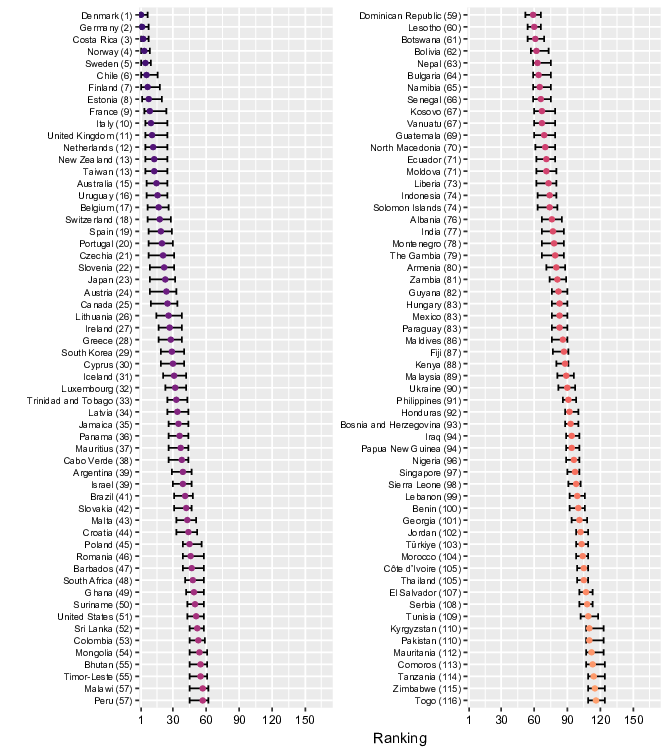
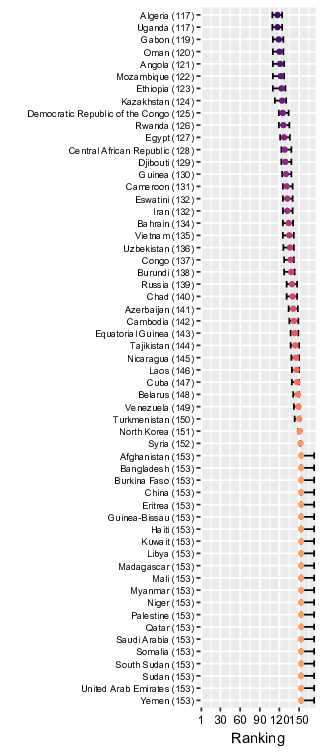
| Country | Score (uncertainty) | Ranking | Range of possible rankings | Year-on-year ranking change |
|---|---|---|---|---|
| Denmark | 0.894 (0.038) | 1 | 1–7 | 1 |
| Germany | 0.886 (0.040) | 2 | 1–8 | 2 |
| Costa Rica | 0.884 (0.039) | 3 | 1–8 | – 2 |
| Norway | 0.877 (0.039) | 4 | 1–9 | – 1 |
| Sweden | 0.871 (0.037) | 5 | 1–10 | 0 |
| Chile | 0.863 (0.037) | 6 | 1–16 | 1 |
| Finland | 0.860 (0.039) | 7 | 1–18 | 2 |
| Estonia | 0.849 (0.038) | 8 | 2–20 | – 2 |
| France | 0.839 (0.038) | 9 | 4–24 | 5 |
| Italy | 0.837 (0.039) | 10 | 5–25 | 0 |
| United Kingdom | 0.834 (0.040) | 11 | 5–25 | 4 |
| Netherlands | 0.833 (0.039) | 12 | 5–25 | – 1 |
| Taiwan | 0.832 (0.038) | 13 | 5–25 | 5 |
| New Zealand | 0.832 (0.039) | 13 | 5–25 | – 1 |
| Australia | 0.829 (0.039) | 15 | 6–25 | – 3 |
| Uruguay | 0.828 (0.037) | 16 | 6–25 | 4 |
| Belgium | 0.824 (0.037) | 17 | 7–26 | – 9 |
| Switzerland | 0.823 (0.038) | 18 | 7–28 | 1 |
| Spain | 0.819 (0.038) | 19 | 8–29 | 4 |
| Portugal | 0.818 (0.040) | 20 | 8–30 | – 5 |
| Czechia | 0.811 (0.038) | 21 | 8–31 | – 4 |
| Slovenia | 0.809 (0.038) | 22 | 9–31 | – 1 |
| Japan | 0.806 (0.038) | 23 | 9–32 | 1 |
| Austria | 0.803 (0.039) | 24 | 9–33 | 2 |
| Canada | 0.800 (0.039) | 25 | 10–34 | – 3 |
| Lithuania | 0.790 (0.040) | 26 | 15–38 | – 1 |
| Ireland | 0.787 (0.038) | 27 | 17–38 | 0 |
| Greece | 0.786 (0.039) | 28 | 17–38 | 0 |
| South Korea | 0.782 (0.039) | 29 | 19–40 | 7 |
| Cyprus | 0.781 (0.040) | 30 | 19–40 | 0 |
| Iceland | 0.777 (0.039) | 31 | 21–42 | 0 |
| Luxembourg | 0.770 (0.038) | 32 | 23–42 | 0 |
| Trinidad and Tobago | 0.765 (0.037) | 33 | 25–43 | 7 |
| Latvia | 0.763 (0.038) | 34 | 25–44 | 3 |
| Jamaica | 0.761 (0.038) | 35 | 26–44 | 3 |
| Panama | 0.759 (0.039) | 36 | 26–44 | – 1 |
| Mauritius | 0.756 (0.039) | 37 | 26–44 | 15 |
| Cabo Verde | 0.755 (0.039) | 38 | 26–44 | – 5 |
| Argentina | 0.744 (0.040) | 39 | 29–47 | 0 |
| Israel | 0.744 (0.037) | 39 | 30–47 | 1 |
| Brazil | 0.741 (0.039) | 41 | 31–48 | 1 |
| Slovakia | 0.740 (0.037) | 42 | 31–47 | – 13 |
| Malta | 0.730 (0.038) | 43 | 33–51 | 1 |
| Croatia | 0.729 (0.040) | 44 | 33–52 | – 10 |
| Poland | 0.711 (0.039) | 45 | 39–56 | 4 |
| Romania | 0.710 (0.039) | 46 | 39–58 | 13 |
| Barbados | 0.707 (0.039) | 47 | 39–58 | 0 |
| South Africa | 0.703 (0.039) | 48 | 41–58 | – 3 |
| Ghana | 0.701 (0.039) | 49 | 42–58 | – 1 |
| Suriname | 0.697 (0.039) | 50 | 43–58 | 5 |
| United States | 0.696 (0.038) | 51 | 43–58 | – 8 |
| Sri Lanka | 0.690 (0.038) | 52 | 45–58 | 3 |
| Colombia | 0.687 (0.038) | 53 | 45–59 | – 2 |
| Mongolia | 0.678 (0.038) | 54 | 45–61 | 4 |
| Bhutan | 0.677 (0.038) | 55 | 45–61 | – 2 |
| Timor-Leste | 0.677 (0.040) | 55 | 45–61 | – 5 |
| Peru | 0.672 (0.039) | 57 | 45–62 | – 3 |
| Malawi | 0.672 (0.039) | 57 | 45–62 | 10 |
| Dominican Republic | 0.652 (0.039) | 59 | 52–66 | 1 |
| Lesotho | 0.649 (0.037) | 60 | 54–66 | 1 |
| Botswana | 0.648 (0.039) | 61 | 54–69 | 3 |
| Bolivia | 0.637 (0.038) | 62 | 57–73 | 18 |
| Nepal | 0.627 (0.037) | 63 | 59–75 | – 1 |
| Bulgaria | 0.626 (0.040) | 64 | 59–75 | – 1 |
| Namibia | 0.625 (0.039) | 65 | 59–75 | 0 |
| Senegal | 0.624 (0.039) | 66 | 59–75 | 0 |
| Kosovo | 0.611 (0.039) | 67 | 60–79 | 1 |
| Vanuatu | 0.611 (0.039) | 67 | 60–79 | – 21 |
| Guatemala | 0.610 (0.039) | 69 | 60–79 | 1 |
| North Macedonia | 0.609 (0.039) | 70 | 61–79 | – 1 |
| Ecuador | 0.606 (0.038) | 71 | 62–79 | – 14 |
| Moldova | 0.606 (0.039) | 71 | 62–80 | 0 |
| Liberia | 0.602 (0.039) | 73 | 62–80 | 1 |
| Indonesia | 0.595 (0.038) | 74 | 63–80 | – 3 |
| Solomon Islands | 0.595 (0.040) | 74 | 63–81 | 1 |
| Albania | 0.584 (0.037) | 76 | 67–85 | – 5 |
| India | 0.579 (0.039) | 77 | 67–87 | 0 |
| Montenegro | 0.578 (0.039) | 78 | 67–87 | – 2 |
| The Gambia | 0.576 (0.039) | 79 | 67–87 | 0 |
| Armenia | 0.568 (0.040) | 80 | 71–88 | – 2 |
| Zambia | 0.557 (0.039) | 81 | 74–89 | 0 |
| Guyana | 0.553 (0.037) | 82 | 76–90 | 5 |
| Mexico | 0.550 (0.039) | 83 | 76–90 | 1 |
| Paraguay | 0.550 (0.038) | 83 | 76–90 | 0 |
| Hungary | 0.550 (0.039) | 83 | 76–90 | – 2 |
| Maldives | 0.546 (0.038) | 86 | 76–90 | – 1 |
| Fiji | 0.543 (0.039) | 87 | 77–91 | – 2 |
| Kenya | 0.533 (0.038) | 88 | 80–91 | 0 |
| Malaysia | 0.526 (0.039) | 89 | 81–96 | 1 |
| Ukraine | 0.517 (0.037) | 90 | 82–97 | 2 |
| Philippines | 0.508 (0.039) | 91 | 86–98 | – 2 |
| Honduras | 0.495 (0.039) | 92 | 88–100 | – 1 |
| Bosnia and Herzegovina | 0.493 (0.040) | 93 | 88–100 | 0 |
| Iraq | 0.489 (0.041) | 94 | 89–101 | 4 |
| Papua New Guinea | 0.489 (0.038) | 94 | 89–101 | 1 |
| Nigeria | 0.487 (0.039) | 96 | 89–101 | – 2 |
| Singapore | 0.486 (0.038) | 97 | 90–101 | – 1 |
| Sierra Leone | 0.472 (0.037) | 98 | 91–102 | – 1 |
| Lebanon | 0.467 (0.039) | 99 | 92–106 | 3 |
| Benin | 0.466 (0.038) | 100 | 92–106 | 1 |
| Georgia | 0.453 (0.037) | 101 | 94–108 | – 1 |
| Jordan | 0.440 (0.038) | 102 | 98–109 | 1 |
| Türkiye | 0.435 (0.040) | 103 | 98–109 | 0 |
| Morocco | 0.433 (0.039) | 104 | 98–109 | 3 |
| Côte d’Ivoire | 0.431 (0.039) | 105 | 99–109 | – 6 |
| Thailand | 0.431 (0.039) | 105 | 99–109 | 6 |
| El Salvador | 0.423 (0.039) | 107 | 101–113 | – 2 |
| Serbia | 0.422 (0.036) | 108 | 101–113 | 1 |
| Tunisia | 0.412 (0.040) | 109 | 102–118 | 1 |
| Kyrgyzstan | 0.391 (0.038) | 110 | 107–123 | 4 |
| Pakistan | 0.391 (0.038) | 110 | 107–123 | 3 |
| Mauritania | 0.390 (0.038) | 112 | 107–123 | 3 |
| Comoros | 0.387 (0.040) | 113 | 107–124 | 5 |
| Tanzania | 0.382 (0.038) | 114 | 109–124 | – 9 |
| Zimbabwe | 0.381 (0.039) | 115 | 109–124 | 2 |
| Togo | 0.379 (0.038) | 116 | 109–124 | – 4 |
| Uganda | 0.378 (0.040) | 117 | 109–124 | 3 |
| Algeria | 0.378 (0.038) | 117 | 109–124 | 2 |
| Gabon | 0.371 (0.038) | 119 | 110–126 | 33 |
| Oman | 0.370 (0.039) | 120 | 110–126 | 1 |
| Angola | 0.366 (0.040) | 121 | 110–127 | 1 |
| Mozambique | 0.365 (0.039) | 122 | 110–127 | 0 |
| Ethiopia | 0.358 (0.039) | 123 | 110–129 | 1 |
| Kazakhstan | 0.350 (0.037) | 124 | 113–130 | 1 |
| Democratic Republic of the Congo | 0.336 (0.038) | 125 | 119–134 | 1 |
| Rwanda | 0.333 (0.039) | 126 | 119–135 | 1 |
| Egypt | 0.331 (0.038) | 127 | 121–136 | 2 |
| Central African Republic | 0.320 (0.038) | 128 | 123–138 | 3 |
| Djibouti | 0.319 (0.039) | 129 | 123–138 | 1 |
| Guinea | 0.318 (0.039) | 130 | 124–138 | 22 |
| Cameroon | 0.311 (0.038) | 131 | 125–140 | – 3 |
| Eswatini | 0.310 (0.038) | 132 | 125–140 | 0 |
| Iran | 0.310 (0.036) | 132 | 125–140 | 5 |
| Bahrain | 0.300 (0.039) | 134 | 125–141 | 1 |
| Vietnam | 0.296 (0.039) | 135 | 125–142 | 1 |
| Uzbekistan | 0.295 (0.039) | 136 | 126–142 | 2 |
| Congo | 0.293 (0.038) | 137 | 127–142 | – 3 |
| Burundi | 0.292 (0.038) | 138 | 127–143 | – 5 |
| Russia | 0.277 (0.040) | 139 | 131–147 | 0 |
| Chad | 0.275 (0.038) | 140 | 131–147 | 0 |
| Azerbaijan | 0.264 (0.038) | 141 | 134–148 | 1 |
| Cambodia | 0.260 (0.037) | 142 | 135–149 | 1 |
| Equatorial Guinea | 0.255 (0.038) | 143 | 137–149 | 1 |
| Tajikistan | 0.254 (0.039) | 144 | 137–150 | 2 |
| Nicaragua | 0.253 (0.038) | 145 | 138–150 | 0 |
| Laos | 0.252 (0.038) | 146 | 139–150 | – 5 |
| Cuba | 0.245 (0.037) | 147 | 139–150 | 0 |
| Belarus | 0.236 (0.038) | 148 | 141–150 | 0 |
| Venezuela | 0.225 (0.037) | 149 | 142–150 | 0 |
| Turkmenistan | 0.216 (0.040) | 150 | 143–151 | 0 |
| North Korea | 0.188 (0.040) | 151 | 149–151 | 0 |
| Syria | 0.118 (0.039) | 152 | 152–152 | 0 |
| Haiti | 0.000 (0.038) | 153 | 153–173 | – 1 |
| Guinea-Bissau | 0.000 (0.038) | 153 | 153–173 | – 37 |
| Mali | 0.000 (0.038) | 153 | 153–173 | – 1 |
| Niger | 0.000 (0.039) | 153 | 153–173 | – 1 |
| Burkina Faso | 0.000 (0.038) | 153 | 153–173 | – 1 |
| Somalia | 0.000 (0.038) | 153 | 153–173 | – 1 |
| Eritrea | 0.000 (0.039) | 153 | 153–173 | – 1 |
| Madagascar | 0.000 (0.038) | 153 | 153–173 | – 45 |
| Libya | 0.000 (0.039) | 153 | 153–173 | – 1 |
| Sudan | 0.000 (0.038) | 153 | 153–173 | – 1 |
| South Sudan | 0.000 (0.039) | 153 | 153–173 | – 1 |
| Palestine | 0.000 (0.039) | 153 | 153–173 | – 1 |
| Saudi Arabia | 0.000 (0.040) | 153 | 153–173 | – 1 |
| Yemen | 0.000 (0.038) | 153 | 153–173 | – 1 |
| Kuwait | 0.000 (0.038) | 153 | 153–173 | – 1 |
| Qatar | 0.000 (0.038) | 153 | 153–173 | – 1 |
| United Arab Emirates | 0.000 (0.038) | 153 | 153–173 | – 1 |
| Afghanistan | 0.000 (0.038) | 153 | 153–173 | – 1 |
| China | 0.000 (0.039) | 153 | 153–173 | – 1 |
| Bangladesh | 0.000 (0.038) | 153 | 153–173 | – 1 |
| Myanmar | 0.000 (0.039) | 153 | 153–173 | – 1 |
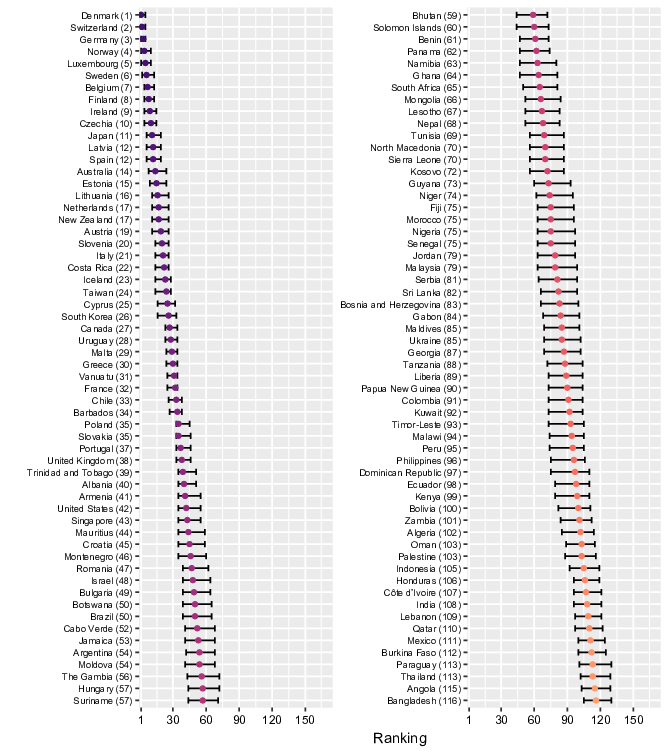
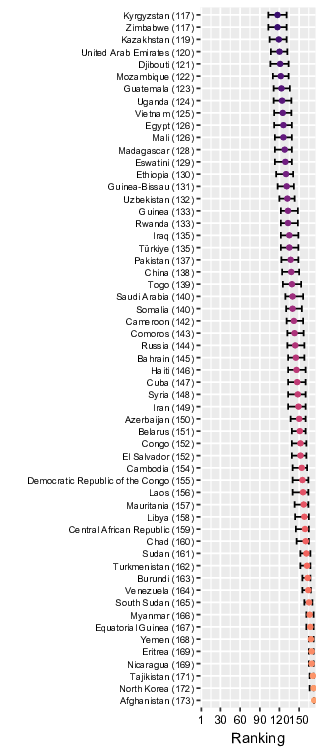
| Country | Score (uncertainty) | Ranking | Range of possible rankings | Year-on-year ranking change |
|---|---|---|---|---|
| Denmark | 0.946 (0.051) | 1 | 1–5 | 0 |
| Switzerland | 0.938 (0.051) | 2 | 1–5 | 1 |
| Germany | 0.936 (0.048) | 3 | 1–5 | – 1 |
| Norway | 0.912 (0.052) | 4 | 1–10 | 1 |
| Luxembourg | 0.910 (0.049) | 5 | 1–10 | 1 |
| Sweden | 0.887 (0.051) | 6 | 2–13 | 1 |
| Belgium | 0.874 (0.050) | 7 | 4–13 | – 3 |
| Finland | 0.872 (0.047) | 8 | 4–13 | 0 |
| Ireland | 0.864 (0.050) | 9 | 4–15 | 1 |
| Czechia | 0.862 (0.051) | 10 | 4–15 | – 1 |
| Japan | 0.848 (0.051) | 11 | 6–19 | 0 |
| Spain | 0.846 (0.048) | 12 | 6–19 | – 1 |
| Latvia | 0.846 (0.050) | 12 | 6–19 | 1 |
| Australia | 0.823 (0.049) | 14 | 8–24 | 0 |
| Estonia | 0.819 (0.051) | 15 | 9–24 | 0 |
| Lithuania | 0.805 (0.052) | 16 | 11–26 | 0 |
| Netherlands | 0.802 (0.048) | 17 | 11–26 | 0 |
| New Zealand | 0.802 (0.049) | 17 | 11–26 | 2 |
| Austria | 0.801 (0.050) | 19 | 11–26 | – 1 |
| Slovenia | 0.795 (0.049) | 20 | 14–26 | 2 |
| Italy | 0.794 (0.048) | 21 | 14–26 | – 1 |
| Costa Rica | 0.792 (0.050) | 22 | 14–26 | – 1 |
| Iceland | 0.786 (0.049) | 23 | 14–28 | 0 |
| Taiwan | 0.779 (0.047) | 24 | 14–28 | 0 |
| Cyprus | 0.759 (0.049) | 25 | 16–32 | 0 |
| South Korea | 0.756 (0.052) | 26 | 16–33 | 5 |
| Canada | 0.740 (0.049) | 27 | 23–34 | – 1 |
| Uruguay | 0.739 (0.050) | 28 | 23–34 | 0 |
| Malta | 0.732 (0.050) | 29 | 24–34 | 0 |
| Greece | 0.731 (0.050) | 30 | 24–34 | 5 |
| Vanuatu | 0.728 (0.048) | 31 | 25–34 | 0 |
| France | 0.721 (0.050) | 32 | 25–34 | – 2 |
| Chile | 0.707 (0.049) | 33 | 26–38 | 0 |
| Barbados | 0.696 (0.050) | 34 | 27–38 | 0 |
| Poland | 0.670 (0.048) | 35 | 33–45 | 4 |
| Slovakia | 0.670 (0.049) | 35 | 33–46 | 2 |
| Portugal | 0.663 (0.049) | 37 | 33–46 | – 1 |
| United Kingdom | 0.662 (0.050) | 38 | 33–46 | 0 |
| Trinidad and Tobago | 0.644 (0.050) | 39 | 35–51 | 1 |
| Albania | 0.641 (0.050) | 40 | 35–51 | 3 |
| Armenia | 0.634 (0.050) | 41 | 35–55 | 1 |
| United States | 0.633 (0.049) | 42 | 35–55 | – 15 |
| Singapore | 0.631 (0.049) | 43 | 35–55 | 0 |
| Mauritius | 0.624 (0.050) | 44 | 35–59 | 24 |
| Croatia | 0.623 (0.049) | 45 | 35–59 | – 2 |
| Montenegro | 0.622 (0.050) | 46 | 35–60 | 1 |
| Romania | 0.606 (0.049) | 47 | 39–62 | 3 |
| Israel | 0.603 (0.051) | 48 | 39–64 | 3 |
| Bulgaria | 0.601 (0.050) | 49 | 39–64 | 0 |
| Brazil | 0.600 (0.050) | 50 | 39–65 | 12 |
| Botswana | 0.600 (0.051) | 50 | 39–65 | 2 |
| Cabo Verde | 0.588 (0.052) | 52 | 41–68 | 1 |
| Jamaica | 0.587 (0.048) | 53 | 41–68 | – 12 |
| Argentina | 0.586 (0.047) | 54 | 42–68 | -8 |
| Moldova | 0.586 (0.049) | 54 | 41–68 | 0 |
| The Gambia | 0.581 (0.050) | 56 | 43–72 | – 1 |
| Suriname | 0.579 (0.048) | 57 | 44–71 | – 10 |
| Hungary | 0.579 (0.050) | 57 | 44–72 | 0 |
| Bhutan | 0.578 (0.050) | 59 | 44–72 | – 3 |
| Solomon Islands | 0.574 (0.051) | 60 | 44–73 | 0 |
| Benin | 0.567 (0.049) | 61 | 47–73 | 0 |
| Panama | 0.563 (0.049) | 62 | 47–74 | – 5 |
| Namibia | 0.556 (0.051) | 63 | 47–80 | 1 |
| Ghana | 0.555 (0.051) | 64 | 47–81 | – 1 |
| South Africa | 0.551 (0.049) | 65 | 50–81 | 1 |
| Mongolia | 0.544 (0.053) | 66 | 52–84 | 5 |
| Lesotho | 0.543 (0.049) | 67 | 52–83 | 4 |
| Nepal | 0.541 (0.049) | 68 | 52–83 | 2 |
| Tunisia | 0.536 (0.049) | 69 | 56–87 | – 2 |
| North Macedonia | 0.534 (0.049) | 70 | 56–87 | – 1 |
| Sierra Leone | 0.534 (0.048) | 70 | 56–87 | 3 |
| Kosovo | 0.532 (0.049) | 72 | 56–87 | 2 |
| Guyana | 0.525 (0.050) | 73 | 60–93 | 3 |
| Niger | 0.515 (0.049) | 74 | 62–95 | 3 |
| Senegal | 0.511 (0.051) | 75 | 63–97 | – 1 |
| Nigeria | 0.511 (0.050) | 75 | 63–97 | 24 |
| Morocco | 0.511 (0.050) | 75 | 63–96 | 3 |
| Fiji | 0.511 (0.050) | 75 | 63–96 | – 10 |
| Jordan | 0.509 (0.049) | 79 | 63–97 | 0 |
| Malaysia | 0.509 (0.052) | 79 | 63–99 | 2 |
| Serbia | 0.505 (0.049) | 81 | 64–99 | – 24 |
| Sri Lanka | 0.500 (0.049) | 82 | 66–99 | 8 |
| Bosnia and Herzegovina | 0.497 (0.049) | 83 | 66–100 | – 1 |
| Gabon | 0.492 (0.050) | 84 | 68–101 | 0 |
| Ukraine | 0.490 (0.051) | 85 | 69–102 | 1 |
| Maldives | 0.490 (0.048) | 85 | 69–101 | 0 |
| Georgia | 0.489 (0.051) | 87 | 69–102 | – 7 |
| Tanzania | 0.484 (0.049) | 88 | 72–104 | – 5 |
| Liberia | 0.481 (0.051) | 89 | 73–104 | 2 |
| Papua New Guinea | 0.480 (0.050) | 90 | 73–104 | – 3 |
| Colombia | 0.479 (0.050) | 91 | 73–104 | – 4 |
| Kuwait | 0.477 (0.050) | 92 | 73–104 | – 3 |
| Timor-Leste | 0.475 (0.050) | 93 | 73–105 | – 1 |
| Malawi | 0.474 (0.049) | 94 | 74–105 | 0 |
| Peru | 0.473 (0.050) | 95 | 74–105 | – 2 |
| Philippines | 0.465 (0.047) | 96 | 75–106 | 0 |
| Dominican Republic | 0.461 (0.052) | 97 | 75–110 | 0 |
| Ecuador | 0.460 (0.051) | 98 | 79–110 | – 3 |
| Kenya | 0.459 (0.050) | 99 | 79–110 | – 2 |
| Bolivia | 0.451 (0.051) | 100 | 82–111 | 0 |
| Zambia | 0.444 (0.049) | 101 | 84–112 | 1 |
| Algeria | 0.440 (0.050) | 102 | 85–114 | 1 |
| Palestine | 0.435 (0.050) | 103 | 88–116 | 3 |
| Oman | 0.435 (0.047) | 103 | 89–115 | 2 |
| Indonesia | 0.428 (0.050) | 105 | 92–119 | – 4 |
| Honduras | 0.423 (0.048) | 106 | 96–119 | 1 |
| Côte d’Ivoire | 0.418 (0.052) | 107 | 96–121 | 1 |
| India | 0.417 (0.048) | 108 | 96–121 | 3 |
| Lebanon | 0.415 (0.049) | 109 | 97–121 | 0 |
| Qatar | 0.413 (0.050) | 110 | 97–122 | 4 |
| Mexico | 0.407 (0.049) | 111 | 100–124 | 1 |
| Burkina Faso | 0.401 (0.050) | 112 | 100–125 | – 3 |
| Paraguay | 0.393 (0.052) | 113 | 101–130 | – 9 |
| Thailand | 0.393 (0.049) | 113 | 102–129 | 2 |
| Angola | 0.390 (0.048) | 115 | 103–129 | 1 |
| Bangladesh | 0.386 (0.048) | 116 | 105–130 | 13 |
| Zimbabwe | 0.384 (0.050) | 117 | 103–131 | – 4 |
| Kyrgyzstan | 0.384 (0.051) | 117 | 103–131 | 0 |
| Kazakhstan | 0.383 (0.051) | 119 | 105–131 | – 1 |
| United Arab Emirates | 0.372 (0.050) | 120 | 107–132 | – 1 |
| Djibouti | 0.371 (0.053) | 121 | 106–134 | 0 |
| Mozambique | 0.365 (0.049) | 122 | 110–134 | 1 |
| Guatemala | 0.363 (0.048) | 123 | 111–136 | 5 |
| Uganda | 0.360 (0.050) | 124 | 111–138 | – 1 |
| Vietnam | 0.355 (0.050) | 125 | 112–138 | – 3 |
| Mali | 0.350 (0.047) | 126 | 113–139 | – 7 |
| Egypt | 0.350 (0.051) | 126 | 112–139 | – 3 |
| Madagascar | 0.349 (0.050) | 128 | 113–139 | – 2 |
| Eswatini | 0.346 (0.049) | 129 | 113–139 | 1 |
| Ethiopia | 0.342 (0.051) | 130 | 115–141 | 2 |
| Guinea-Bissau | 0.336 (0.049) | 131 | 117–142 | – 4 |
| Uzbekistan | 0.329 (0.050) | 132 | 120–143 | 1 |
| Guinea | 0.320 (0.050) | 133 | 122–148 | 3 |
| Rwanda | 0.320 (0.050) | 133 | 122–148 | 4 |
| Türkiye | 0.317 (0.049) | 135 | 122–149 | – 1 |
| Iraq | 0.317 (0.051) | 135 | 122–149 | 3 |
| Pakistan | 0.312 (0.051) | 137 | 123–149 | – 2 |
| China | 0.311 (0.050) | 138 | 124–150 | 1 |
| Togo | 0.305 (0.051) | 139 | 125–153 | – 8 |
| Somalia | 0.297 (0.048) | 140 | 130–154 | 0 |
| Saudi Arabia | 0.297 (0.050) | 140 | 129–156 | 1 |
| Cameroon | 0.290 (0.050) | 142 | 131–156 | 1 |
| Comoros | 0.281 (0.050) | 143 | 132–157 | 4 |
| Russia | 0.280 (0.050) | 144 | 132–158 | – 2 |
| Bahrain | 0.276 (0.048) | 145 | 133–158 | 2 |
| Haiti | 0.274 (0.051) | 146 | 133–160 | 0 |
| Cuba | 0.273 (0.049) | 147 | 133–160 | – 2 |
| Syria | 0.272 (0.050) | 148 | 133–160 | 17 |
| Iran | 0.269 (0.051) | 149 | 133–160 | – 5 |
| Azerbaijan | 0.262 (0.051) | 150 | 137–160 | 0 |
| Belarus | 0.261 (0.048) | 151 | 139–160 | 1 |
| El Salvador | 0.257 (0.050) | 152 | 139–161 | – 5 |
| Congo | 0.257 (0.049) | 152 | 139–161 | – 1 |
| Cambodia | 0.254 (0.050) | 154 | 140–162 | 0 |
| Democratic Republic of the Congo | 0.250 (0.049) | 155 | 140–164 | 0 |
| Laos | 0.249 (0.048) | 156 | 140–164 | – 3 |
| Mauritania | 0.238 (0.048) | 157 | 143–164 | – 2 |
| Libya | 0.231 (0.049) | 158 | 144–165 | – 3 |
| Central African Republic | 0.228 (0.050) | 159 | 145–165 | 0 |
| Chad | 0.225 (0.050) | 160 | 146–165 | – 2 |
| Sudan | 0.210 (0.050) | 161 | 152–167 | 3 |
| Turkmenistan | 0.207 (0.051) | 162 | 152–167 | – 2 |
| Burundi | 0.203 (0.050) | 163 | 155–167 | – 1 |
| Venezuela | 0.202 (0.050) | 164 | 155–168 | – 3 |
| South Sudan | 0.183 (0.052) | 165 | 158–170 | 2 |
| Myanmar | 0.171 (0.049) | 166 | 161–172 | – 1 |
| Equatorial Guinea | 0.166 (0.049) | 167 | 161–172 | – 4 |
| Yemen | 0.152 (0.047) | 168 | 165–172 | 0 |
| Nicaragua | 0.145 (0.050) | 169 | 165–172 | 1 |
| Eritrea | 0.145 (0.051) | 169 | 165–172 | – 1 |
| Tajikistan | 0.129 (0.049) | 171 | 166–172 | 0 |
| North Korea | 0.126 (0.051) | 172 | 166–172 | 0 |
| Afghanistan | 0.059 (0.050) | 173 | 173–173 | 0 |
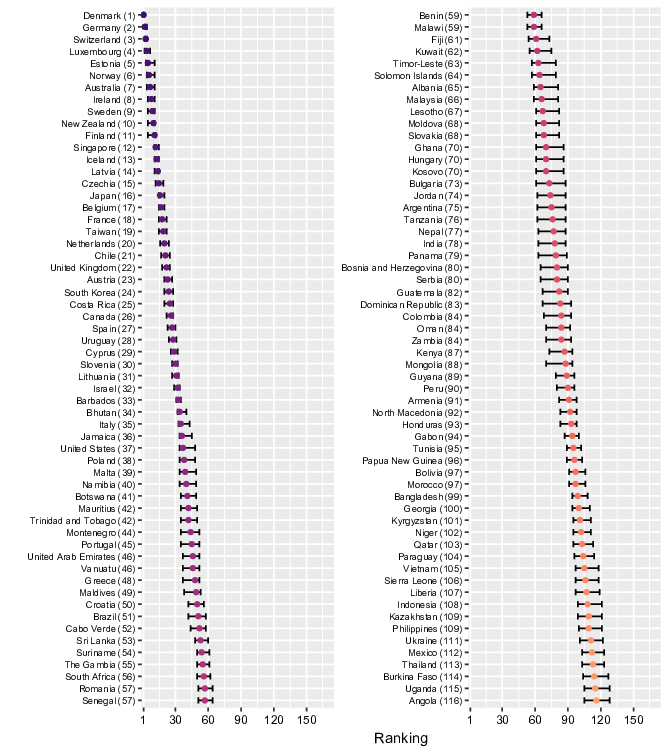
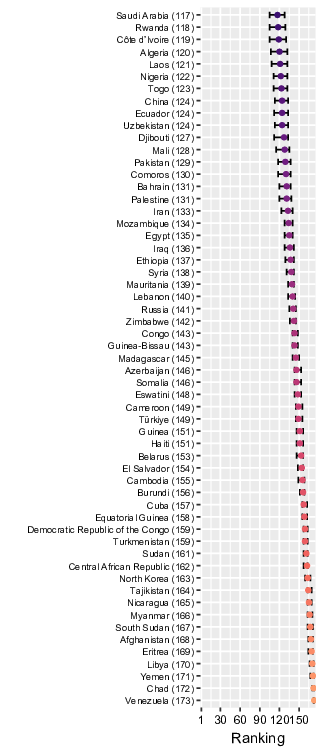
| Country | Score (uncertainty) | Ranking | Range of possible rankings | Year-on-year ranking change |
|---|---|---|---|---|
| Denmark | 0.985 (0.031) | 1 | 1–1 | 0 |
| Germany | 0.908 (0.029) | 2 | 2–4 | 0 |
| Switzerland | 0.893 (0.030) | 3 | 2–4 | 0 |
| Luxembourg | 0.884 (0.029) | 4 | 2–7 | 0 |
| Estonia | 0.863 (0.030) | 5 | 3–11 | 2 |
| Norway | 0.860 (0.031) | 6 | 4–11 | 0 |
| Australia | 0.859 (0.029) | 7 | 4–11 | – 2 |
| Ireland | 0.852 (0.030) | 8 | 5–11 | 0 |
| Sweden | 0.846 (0.030) | 9 | 5–11 | – 1 |
| New Zealand | 0.845 (0.029) | 10 | 5–11 | 0 |
| Finland | 0.841 (0.028) | 11 | 5–12 | 0 |
| Singapore | 0.813 (0.029) | 12 | 11–15 | 2 |
| Iceland | 0.812 (0.029) | 13 | 11–15 | 0 |
| Latvia | 0.811 (0.030) | 14 | 11–15 | – 2 |
| Czechia | 0.787 (0.031) | 15 | 12–19 | 0 |
| Japan | 0.775 (0.030) | 16 | 15–20 | 0 |
| Belgium | 0.772 (0.030) | 17 | 15–20 | 0 |
| France | 0.765 (0.030) | 18 | 15–22 | 1 |
| Taiwan | 0.759 (0.028) | 19 | 15–22 | – 1 |
| Netherlands | 0.747 (0.029) | 20 | 16–24 | 0 |
| Chile | 0.742 (0.029) | 21 | 17–25 | 1 |
| United Kingdom | 0.739 (0.030) | 22 | 18–25 | – 1 |
| Austria | 0.727 (0.030) | 23 | 20–27 | 6 |
| South Korea | 0.720 (0.031) | 24 | 20–28 | 13 |
| Costa Rica | 0.717 (0.030) | 25 | 20–28 | – 2 |
| Canada | 0.710 (0.029) | 26 | 22–28 | – 1 |
| Spain | 0.706 (0.029) | 27 | 23–30 | – 3 |
| Uruguay | 0.691 (0.030) | 28 | 24–31 | – 1 |
| Cyprus | 0.681 (0.029) | 29 | 26–32 | 2 |
| Slovenia | 0.679 (0.029) | 30 | 27–32 | – 4 |
| Lithuania | 0.676 (0.031) | 31 | 27–33 | – 1 |
| Israel | 0.656 (0.030) | 32 | 29–34 | 0 |
| Barbados | 0.647 (0.030) | 33 | 31–35 | 1 |
| Bhutan | 0.628 (0.030) | 34 | 32–40 | 1 |
| Italy | 0.618 (0.028) | 35 | 33–43 | 1 |
| Jamaica | 0.616 (0.029) | 36 | 34–45 | 2 |
| United States | 0.609 (0.029) | 37 | 34–48 | – 9 |
| Poland | 0.608 (0.029) | 38 | 34–48 | 3 |
| Malta | 0.606 (0.030) | 39 | 34–49 | 0 |
| Namibia | 0.605 (0.030) | 40 | 34–49 | 0 |
| Botswana | 0.596 (0.031) | 41 | 35–49 | 5 |
| Trinidad and Tobago | 0.591 (0.030) | 42 | 35–50 | 4 |
| Mauritius | 0.591 (0.030) | 42 | 35–50 | 22 |
| Montenegro | 0.589 (0.030) | 44 | 35–52 | 0 |
| Portugal | 0.588 (0.030) | 45 | 35–52 | – 12 |
| United Arab Emirates | 0.584 (0.030) | 46 | 37–52 | – 1 |
| Vanuatu | 0.584 (0.029) | 46 | 37–52 | – 4 |
| Greece | 0.581 (0.030) | 48 | 37–52 | – 6 |
| Maldives | 0.579 (0.029) | 49 | 38–53 | 12 |
| Croatia | 0.565 (0.029) | 50 | 42–56 | 0 |
| Brazil | 0.561 (0.030) | 51 | 42–58 | 0 |
| Cabo Verde | 0.560 (0.031) | 52 | 44–58 | – 3 |
| Sri Lanka | 0.552 (0.029) | 53 | 48–60 | 1 |
| Suriname | 0.545 (0.028) | 54 | 50–61 | 2 |
| The Gambia | 0.544 (0.029) | 55 | 50–61 | – 1 |
| South Africa | 0.536 (0.029) | 56 | 50–62 | – 4 |
| Romania | 0.533 (0.029) | 57 | 51–64 | 16 |
| Senegal | 0.533 (0.030) | 57 | 51–64 | 1 |
| Benin | 0.527 (0.029) | 59 | 53–66 | 7 |
| Malawi | 0.527 (0.029) | 59 | 53–66 | – 2 |
| Fiji | 0.519 (0.030) | 61 | 54–73 | – 13 |
| Kuwait | 0.514 (0.030) | 62 | 55–75 | 1 |
| Timor-Leste | 0.506 (0.030) | 63 | 57–79 | 2 |
| Solomon Islands | 0.505 (0.030) | 64 | 57–79 | 9 |
| Albania | 0.501 (0.030) | 65 | 59–81 | 3 |
| Malaysia | 0.500 (0.031) | 66 | 59–81 | 3 |
| Lesotho | 0.497 (0.029) | 67 | 61–82 | 20 |
| Slovakia | 0.495 (0.029) | 68 | 61–82 | – 15 |
| Moldova | 0.495 (0.029) | 68 | 61–82 | 8 |
| Hungary | 0.493 (0.030) | 70 | 61–86 | – 4 |
| Kosovo | 0.493 (0.029) | 70 | 61–86 | 0 |
| Ghana | 0.493 (0.030) | 70 | 61–86 | 12 |
| Bulgaria | 0.490 (0.030) | 73 | 61–88 | – 15 |
| Jordan | 0.489 (0.029) | 74 | 62–88 | 7 |
| Argentina | 0.486 (0.028) | 75 | 62–88 | – 14 |
| Tanzania | 0.485 (0.029) | 76 | 62–88 | – 16 |
| Nepal | 0.484 (0.029) | 77 | 63–88 | – 5 |
| India | 0.483 (0.029) | 78 | 63–88 | – 1 |
| Panama | 0.480 (0.029) | 79 | 63–89 | – 4 |
| Serbia | 0.474 (0.029) | 80 | 65–90 | – 9 |
| Bosnia and Herzegovina | 0.474 (0.029) | 80 | 65–90 | 3 |
| Guatemala | 0.469 (0.029) | 82 | 67–90 | 6 |
| Dominican Republic | 0.466 (0.031) | 83 | 67–93 | 0 |
| Colombia | 0.465 (0.030) | 84 | 68–93 | – 5 |
| Zambia | 0.465 (0.029) | 84 | 70–93 | – 1 |
| Oman | 0.465 (0.028) | 84 | 70–92 | – 5 |
| Kenya | 0.462 (0.030) | 87 | 73–94 | – 1 |
| Mongolia | 0.461 (0.031) | 88 | 70–94 | – 10 |
| Guyana | 0.452 (0.030) | 89 | 79–96 | 1 |
| Peru | 0.447 (0.030) | 90 | 80–96 | – 2 |
| Armenia | 0.439 (0.030) | 91 | 82–98 | 0 |
| North Macedonia | 0.438 (0.029) | 92 | 83–98 | 1 |
| Honduras | 0.437 (0.029) | 93 | 83–98 | 2 |
| Gabon | 0.433 (0.030) | 94 | 87–100 | 3 |
| Tunisia | 0.427 (0.029) | 95 | 89–102 | 1 |
| Papua New Guinea | 0.424 (0.030) | 96 | 89–103 | 6 |
| Bolivia | 0.411 (0.030) | 97 | 91–106 | – 5 |
| Morocco | 0.411 (0.030) | 97 | 91–106 | 2 |
| Bangladesh | 0.407 (0.029) | 99 | 94–108 | 13 |
| Georgia | 0.405 (0.030) | 100 | 94–110 | – 7 |
| Kyrgyzstan | 0.402 (0.030) | 101 | 95–111 | 8 |
| Niger | 0.401 (0.029) | 102 | 95–111 | – 4 |
| Qatar | 0.397 (0.030) | 103 | 95–113 | 1 |
| Paraguay | 0.393 (0.031) | 104 | 96–114 | 2 |
| Vietnam | 0.385 (0.030) | 105 | 97–118 | 0 |
| Sierra Leone | 0.384 (0.029) | 106 | 97–118 | – 7 |
| Liberia | 0.381 (0.030) | 107 | 97–119 | 4 |
| Indonesia | 0.379 (0.030) | 108 | 99–121 | – 9 |
| Kazakhstan | 0.378 (0.030) | 109 | 99–121 | 1 |
| Philippines | 0.378 (0.028) | 109 | 100–121 | – 1 |
| Ukraine | 0.373 (0.030) | 111 | 101–122 | 4 |
| Mexico | 0.370 (0.029) | 112 | 103–123 | 5 |
| Thailand | 0.369 (0.029) | 113 | 103–123 | 3 |
| Burkina Faso | 0.366 (0.030) | 114 | 104–127 | 0 |
| Uganda | 0.361 (0.030) | 115 | 105–128 | – 2 |
| Angola | 0.360 (0.028) | 116 | 105–128 | 2 |
| Saudi Arabia | 0.359 (0.029) | 117 | 105–128 | 5 |
| Rwanda | 0.356 (0.029) | 118 | 105–129 | 1 |
| Côte d’Ivoire | 0.355 (0.031) | 119 | 105–130 | – 12 |
| Algeria | 0.351 (0.030) | 120 | 107–132 | 0 |
| Laos | 0.350 (0.029) | 121 | 108–132 | 9 |
| Nigeria | 0.347 (0.030) | 122 | 111–132 | 5 |
| Togo | 0.343 (0.030) | 123 | 111–132 | – 2 |
| Ecuador | 0.339 (0.030) | 124 | 112–133 | – 21 |
| Uzbekistan | 0.339 (0.030) | 124 | 113–133 | – 1 |
| China | 0.339 (0.030) | 124 | 113–133 | 2 |
| Djibouti | 0.338 (0.032) | 127 | 112–133 | – 4 |
| Mali | 0.333 (0.028) | 128 | 115–135 | 5 |
| Pakistan | 0.327 (0.030) | 129 | 118–137 | – 2 |
| Comoros | 0.326 (0.030) | 130 | 118–137 | – 1 |
| Palestine | 0.324 (0.030) | 131 | 120–138 | 0 |
| Bahrain | 0.324 (0.029) | 131 | 120–137 | 2 |
| Iran | 0.312 (0.031) | 133 | 123–140 | – 8 |
| Mozambique | 0.307 (0.029) | 134 | 128–140 | – 1 |
| Egypt | 0.306 (0.031) | 135 | 128–140 | 6 |
| Iraq | 0.304 (0.030) | 136 | 128–142 | 3 |
| Ethiopia | 0.301 (0.030) | 137 | 129–142 | 1 |
| Syria | 0.295 (0.030) | 138 | 131–142 | 23 |
| Mauritania | 0.294 (0.029) | 139 | 133–142 | – 2 |
| Lebanon | 0.287 (0.029) | 140 | 133–144 | 2 |
| Russia | 0.276 (0.030) | 141 | 135–145 | – 1 |
| Zimbabwe | 0.275 (0.030) | 142 | 136–145 | 2 |
| Guinea-Bissau | 0.261 (0.029) | 143 | 140–148 | – 7 |
| Congo | 0.261 (0.029) | 143 | 140–148 | 0 |
| Madagascar | 0.257 (0.030) | 145 | 140–150 | – 13 |
| Azerbaijan | 0.238 (0.030) | 146 | 143–153 | – 1 |
| Somalia | 0.238 (0.028) | 146 | 143–153 | 2 |
| Eswatini | 0.235 (0.029) | 148 | 143–153 | – 1 |
| Cameroon | 0.229 (0.030) | 149 | 145–155 | 0 |
| Türkiye | 0.229 (0.029) | 149 | 145–155 | – 3 |
| Haiti | 0.223 (0.031) | 151 | 146–156 | 0 |
| Guinea | 0.223 (0.030) | 151 | 146–156 | 1 |
| Belarus | 0.217 (0.029) | 153 | 146–156 | 3 |
| El Salvador | 0.206 (0.030) | 154 | 148–156 | – 1 |
| Cambodia | 0.202 (0.030) | 155 | 149–158 | 0 |
| Burundi | 0.198 (0.030) | 156 | 151–158 | – 6 |
| Cuba | 0.174 (0.029) | 157 | 155–162 | 1 |
| Equatorial Guinea | 0.173 (0.029) | 158 | 155–162 | – 1 |
| Democratic Republic of the Congo | 0.160 (0.029) | 159 | 157–163 | – 5 |
| Turkmenistan | 0.160 (0.030) | 159 | 157–163 | 0 |
| Sudan | 0.159 (0.030) | 161 | 157–163 | 6 |
| Central African Republic | 0.155 (0.030) | 162 | 157–163 | 0 |
| North Korea | 0.142 (0.030) | 163 | 159–167 | 0 |
| Tajikistan | 0.124 (0.029) | 164 | 163–169 | – 4 |
| Nicaragua | 0.122 (0.030) | 165 | 163–169 | 3 |
| Myanmar | 0.118 (0.029) | 166 | 163–170 | – 2 |
| South Sudan | 0.112 (0.031) | 167 | 163–171 | – 1 |
| Afghanistan | 0.104 (0.030) | 168 | 164–171 | 4 |
| Eritrea | 0.097 (0.031) | 169 | 164–171 | 0 |
| Libya | 0.091 (0.029) | 170 | 166–172 | 0 |
| Yemen | 0.087 (0.028) | 171 | 167–172 | 0 |
| Chad | 0.063 (0.030) | 172 | 170–173 | – 7 |
| Venezuela | 0.041 (0.030) | 173 | 172–173 | 0 |
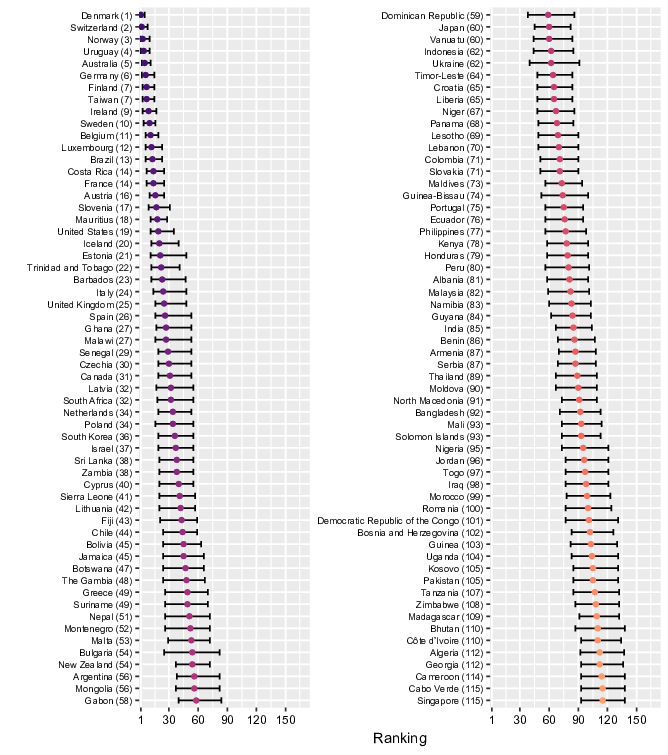
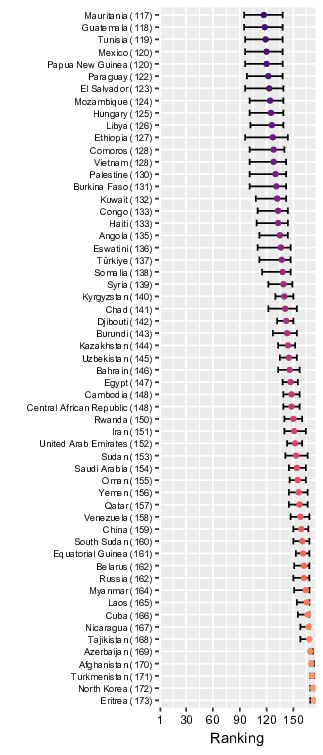
| Country | Score (uncertainty) | Ranking | Range of possible rankings | Year-on-year ranking change |
|---|---|---|---|---|
| Denmark | 0.964 (0.090) | 1 | 1–5 | 0 |
| Switzerland | 0.939 (0.086) | 2 | 1–8 | 0 |
| Norway | 0.910 (0.074) | 3 | 1–10 | 1 |
| Uruguay | 0.907 (0.077) | 4 | 1–10 | – 1 |
| Australia | 0.887 (0.075) | 5 | 2–11 | 16 |
| Germany | 0.868 (0.082) | 6 | 2–15 | 3 |
| Finland | 0.858 (0.068) | 7 | 3–15 | 0 |
| Taiwan | 0.858 (0.068) | 7 | 3–15 | 0 |
| Ireland | 0.847 (0.069) | 9 | 3–17 | 0 |
| Sweden | 0.843 (0.064) | 10 | 4–16 | 2 |
| Belgium | 0.822 (0.064) | 11 | 6–19 | 2 |
| Luxembourg | 0.806 (0.066) | 12 | 6–23 | 2 |
| Brazil | 0.804 (0.067) | 13 | 6–23 | – 7 |
| Costa Rica | 0.792 (0.068) | 14 | 7–25 | 1 |
| France | 0.792 (0.067) | 14 | 7–25 | – 3 |
| Austria | 0.783 (0.063) | 16 | 10–25 | 6 |
| Slovenia | 0.779 (0.072) | 17 | 9–31 | 0 |
| Mauritius | 0.774 (0.062) | 18 | 11–28 | 10 |
| United States | 0.765 (0.062) | 19 | 11–35 | – 14 |
| Iceland | 0.752 (0.064) | 20 | 12–40 | – 4 |
| Estonia | 0.751 (0.085) | 21 | 11–48 | – 2 |
| Trinidad and Tobago | 0.750 (0.063) | 22 | 12–41 | – 4 |
| Barbados | 0.742 (0.074) | 23 | 12–47 | 2 |
| Italy | 0.728 (0.067) | 24 | 14–48 | – 1 |
| United Kingdom | 0.725 (0.062) | 25 | 16–48 | – 1 |
| Spain | 0.715 (0.072) | 26 | 16–53 | 3 |
| Ghana | 0.714 (0.068) | 27 | 17–53 | 14 |
| Malawi | 0.714 (0.071) | 27 | 16–53 | 16 |
| Senegal | 0.711 (0.062) | 29 | 19–53 | – 3 |
| Czechia | 0.709 (0.061) | 30 | 19–53 | 3 |
| Canada | 0.708 (0.065) | 31 | 19–53 | 1 |
| Latvia | 0.706 (0.076) | 32 | 17–55 | – 1 |
| South Africa | 0.706 (0.068) | 32 | 18–55 | 11 |
| Netherlands | 0.705 (0.062) | 34 | 19–53 | – 14 |
| Poland | 0.705 (0.077) | 34 | 16–55 | – 4 |
| South Korea | 0.702 (0.063) | 36 | 19–55 | 0 |
| Israel | 0.698 (0.072) | 37 | 19–55 | – 3 |
| Zambia | 0.693 (0.063) | 38 | 20–55 | 5 |
| Sri Lanka | 0.693 (0.061) | 38 | 20–55 | 12 |
| Cyprus | 0.689 (0.063) | 40 | 20–55 | – 2 |
| Sierra Leone | 0.688 (0.065) | 41 | 20–57 | – 2 |
| Lithuania | 0.686 (0.066) | 42 | 20–57 | 0 |
| Fiji | 0.684 (0.067) | 43 | 21–59 | – 16 |
| Chile | 0.677 (0.062) | 44 | 24–59 | – 1 |
| Jamaica | 0.673 (0.068) | 45 | 24–66 | 28 |
| Bolivia | 0.673 (0.063) | 45 | 24–63 | 5 |
| Botswana | 0.672 (0.066) | 47 | 24–66 | 1 |
| The Gambia | 0.667 (0.066) | 48 | 24–67 | 1 |
| Suriname | 0.658 (0.062) | 49 | 26–70 | – 15 |
| Greece | 0.658 (0.062) | 49 | 26–70 | – 9 |
| Nepal | 0.655 (0.062) | 51 | 26–72 | 14 |
| Montenegro | 0.652 (0.066) | 52 | 26–72 | 8 |
| Malta | 0.651 (0.060) | 53 | 29–72 | 2 |
| Bulgaria | 0.641 (0.084) | 54 | 25–82 | 0 |
| New Zealand | 0.641 (0.060) | 54 | 37–72 | 4 |
| Argentina | 0.626 (0.070) | 56 | 38–82 | – 9 |
| Mongolia | 0.626 (0.074) | 56 | 37–82 | 33 |
| Gabon | 0.619 (0.070) | 58 | 40–84 | 5 |
| Dominican Republic | 0.617 (0.077) | 59 | 38–86 | – 7 |
| Japan | 0.613 (0.060) | 60 | 45–82 | – 1 |
| Vanuatu | 0.613 (0.067) | 60 | 44–84 | 1 |
| Ukraine | 0.611 (0.079) | 62 | 40–91 | – 9 |
| Indonesia | 0.611 (0.068) | 62 | 44–85 | – 26 |
| Timor-Leste | 0.608 (0.061) | 64 | 48–84 | 4 |
| Croatia | 0.607 (0.060) | 65 | 48–84 | 0 |
| Liberia | 0.607 (0.060) | 65 | 48–84 | – 1 |
| Niger | 0.604 (0.065) | 67 | 48–86 | – 2 |
| Panama | 0.601 (0.061) | 68 | 49–85 | – 6 |
| Lesotho | 0.599 (0.064) | 69 | 49–90 | 22 |
| Lebanon | 0.597 (0.062) | 70 | 49–90 | – 1 |
| Colombia | 0.595 (0.061) | 71 | 51–90 | 11 |
| Slovakia | 0.595 (0.062) | 71 | 51–90 | 1 |
| Maldives | 0.579 (0.060) | 73 | 56–94 | 13 |
| Guinea-Bissau | 0.576 (0.076) | 74 | 52–100 | 2 |
| Portugal | 0.572 (0.061) | 75 | 56–95 | – 20 |
| Ecuador | 0.571 (0.062) | 76 | 56–95 | 14 |
| Philippines | 0.565 (0.061) | 77 | 56–98 | – 6 |
| Kenya | 0.563 (0.062) | 78 | 58–100 | – 23 |
| Honduras | 0.562 (0.061) | 79 | 58–100 | – 1 |
| Peru | 0.560 (0.066) | 80 | 56–101 | – 6 |
| Albania | 0.559 (0.060) | 81 | 58–100 | 0 |
| Malaysia | 0.557 (0.060) | 82 | 59–101 | 2 |
| Namibia | 0.552 (0.064) | 83 | 60–103 | – 1 |
| Guyana | 0.551 (0.060) | 84 | 62–103 | 2 |
| India | 0.544 (0.060) | 85 | 67–104 | 12 |
| Benin | 0.540 (0.060) | 86 | 69–107 | 6 |
| Serbia | 0.538 (0.061) | 87 | 69–108 | 6 |
| Armenia | 0.538 (0.060) | 87 | 70–108 | – 10 |
| Thailand | 0.537 (0.069) | 89 | 67–109 | 10 |
| Moldova | 0.536 (0.067) | 90 | 67–109 | – 6 |
| North Macedonia | 0.533 (0.061) | 91 | 73–109 | – 13 |
| Bangladesh | 0.527 (0.069) | 92 | 71–113 | 22 |
| Mali | 0.520 (0.063) | 93 | 73–114 | – 23 |
| Solomon Islands | 0.520 (0.060) | 93 | 73–113 | 3 |
| Nigeria | 0.517 (0.066) | 95 | 73–121 | – 20 |
| Jordan | 0.509 (0.060) | 96 | 77–121 | 11 |
| Togo | 0.508 (0.062) | 97 | 77–121 | – 19 |
| Iraq | 0.507 (0.060) | 98 | 77–121 | 8 |
| Morocco | 0.504 (0.060) | 99 | 78–123 | 0 |
| Romania | 0.503 (0.063) | 100 | 77–124 | 12 |
| Democratic Republic of the Congo | 0.498 (0.070) | 101 | 77–131 | 12 |
| Bosnia and Herzegovina | 0.494 (0.060) | 102 | 83–126 | – 1 |
| Guinea | 0.493 (0.064) | 103 | 82–130 | 6 |
| Uganda | 0.488 (0.063) | 104 | 83–131 | 5 |
| Kosovo | 0.484 (0.062) | 105 | 85–131 | – 4 |
| Pakistan | 0.484 (0.060) | 105 | 85–131 | – 10 |
| Tanzania | 0.482 (0.065) | 107 | 85–132 | – 13 |
| Zimbabwe | 0.479 (0.060) | 108 | 87–132 | – 3 |
| Madagascar | 0.473 (0.060) | 109 | 91–132 | 7 |
| Côte d’Ivoire | 0.465 (0.061) | 110 | 93–134 | – 22 |
| Bhutan | 0.465 (0.073) | 110 | 87–138 | – 1 |
| Georgia | 0.461 (0.063) | 112 | 93–136 | – 9 |
| Algeria | 0.461 (0.066) | 112 | 92–137 | 18 |
| Cameroon | 0.459 (0.066) | 114 | 93–138 | – 6 |
| Cabo Verde | 0.457 (0.064) | 115 | 93–138 | 2 |
| Singapore | 0.457 (0.063) | 115 | 93–138 | 2 |
| Mauritania | 0.455 (0.064) | 117 | 95–138 | 3 |
| Guatemala | 0.453 (0.064) | 118 | 95–138 | 7 |
| Tunisia | 0.452 (0.060) | 119 | 96–138 | – 15 |
| Mexico | 0.451 (0.061) | 120 | 96–138 | 13 |
| Papua New Guinea | 0.451 (0.062) | 120 | 96–138 | 3 |
| Paraguay | 0.446 (0.060) | 122 | 98–138 | – 1 |
| El Salvador | 0.444 (0.068) | 123 | 96–139 | – 8 |
| Mozambique | 0.441 (0.061) | 124 | 101–139 | 0 |
| Hungary | 0.439 (0.060) | 125 | 101–139 | 0 |
| Libya | 0.435 (0.061) | 126 | 102–139 | 4 |
| Ethiopia | 0.434 (0.082) | 127 | 96–144 | – 6 |
| Comoros | 0.431 (0.067) | 128 | 101–140 | – 1 |
| Vietnam | 0.431 (0.069) | 128 | 101–142 | 0 |
| Palestine | 0.430 (0.068) | 130 | 101–142 | – 11 |
| Burkina Faso | 0.429 (0.070) | 131 | 101–142 | – 34 |
| Kuwait | 0.420 (0.060) | 132 | 108–142 | 0 |
| Haiti | 0.412 (0.063) | 133 | 109–144 | 2 |
| Congo | 0.412 (0.061) | 133 | 110–144 | 1 |
| Angola | 0.403 (0.060) | 135 | 112–144 | 1 |
| Eswatini | 0.402 (0.068) | 136 | 110–147 | – 7 |
| Türkiye | 0.398 (0.064) | 137 | 112–147 | 1 |
| Somalia | 0.395 (0.064) | 138 | 115–147 | 1 |
| Syria | 0.383 (0.067) | 139 | 122–149 | 29 |
| Kyrgyzstan | 0.366 (0.063) | 140 | 130–150 | 0 |
| Chad | 0.365 (0.085) | 141 | 122–154 | 1 |
| Djibouti | 0.364 (0.064) | 142 | 132–150 | – 1 |
| Burundi | 0.356 (0.078) | 143 | 127–154 | 3 |
| Kazakhstan | 0.355 (0.060) | 144 | 133–152 | – 1 |
| Uzbekistan | 0.343 (0.064) | 145 | 135–154 | 3 |
| Bahrain | 0.337 (0.076) | 146 | 133–157 | – 2 |
| Egypt | 0.336 (0.061) | 147 | 138–155 | – 2 |
| Central African Republic | 0.318 (0.066) | 148 | 139–157 | 1 |
| Cambodia | 0.318 (0.065) | 148 | 139–157 | 2 |
| Rwanda | 0.304 (0.068) | 150 | 140–160 | 1 |
| Iran | 0.296 (0.079) | 151 | 140–164 | 3 |
| United Arab Emirates | 0.295 (0.062) | 152 | 143–160 | 1 |
| Sudan | 0.285 (0.080) | 153 | 141–166 | – 16 |
| Saudi Arabia | 0.284 (0.067) | 154 | 145–164 | 5 |
| Oman | 0.278 (0.061) | 155 | 146–164 | 1 |
| Yemen | 0.275 (0.074) | 156 | 145–166 | – 9 |
| Qatar | 0.270 (0.073) | 157 | 145–166 | – 2 |
| Venezuela | 0.246 (0.090) | 158 | 147–168 | – 6 |
| China | 0.245 (0.065) | 159 | 150–167 | 1 |
| South Sudan | 0.242 (0.066) | 160 | 150–168 | – 2 |
| Equatorial Guinea | 0.232 (0.062) | 161 | 153–168 | 4 |
| Russia | 0.230 (0.075) | 162 | 150–168 | – 1 |
| Belarus | 0.230 (0.065) | 162 | 151–168 | 1 |
| Myanmar | 0.218 (0.080) | 164 | 151–168 | 0 |
| Laos | 0.216 (0.068) | 165 | 154–168 | – 8 |
| Cuba | 0.212 (0.070) | 166 | 155–168 | 0 |
| Nicaragua | 0.194 (0.067) | 167 | 158–168 | 0 |
| Tajikistan | 0.178 (0.067) | 168 | 158–168 | – 6 |
| Azerbaijan | 0.101 (0.075) | 169 | 169–172 | 0 |
| Afghanistan | 0.092 (0.077) | 170 | 169–173 | 0 |
| Turkmenistan | 0.060 (0.086) | 171 | 169–173 | 0 |
| North Korea | 0.030 (0.094) | 172 | 169–173 | 0 |
| Eritrea | 0.016 (0.096) | 173 | 169–173 | 0 |
| Denmark | 0.964 (0.090) | 1 | 1–5 | 0 |
- The GSoD Indices are organized around four core categories of democratic performance—Representation, Rights, Rule of Law, and Participation. Each of the four categories includes several factors, such as Credible Elections or Judicial Independence.
- The analysis presented here does not include advances in the Basic Welfare factor, because improvements in Basic Welfare, largely due to recovery from the Covid-19 pandemic, distort the picture of improvement. These advances, which are due to recoveries in life expectancy after the end of the pandemic, account for a disproportionate amount of the apparent progress. They reflect only the disparity between the first year of the pandemic (2020) and the comparative normalcy of 2025 rather than deeper change.
- The full GSoD Indices, which include data beginning in 1975 tracks 174 countries. After the reunification of Germany in 1990, the total number of countries dropped to 173.
- The municipal elections took place under an electoral reform introducing a requirement for candidates to sign a declaration committing to the program of the Palestine Liberation Organization, which was rejected by five political parties (Al-Quds al-Arabi 2025).
- Some 70,449 voters from the city of Deir al-Balah, in Gaza, were eligible to take part in the election (Central Elections Commission of Palestine n.d.).
- As of June 2026, the Knesset (Israel’s parliament) had advanced a bill to dissolve itself, opening up the possibility of early elections as soon as September 2026 (Rapaport 2026).
- While South and Southeast Asia also have more countries than the other subregions, these results hold even when adjusted for the number of countries in each subregion.
- Trump v. United States (Supreme Court of the United States, 1 July 2024), No. 23-939; State of Texas and The Heritage Foundation v. Equal Employment Opportunity Commission et al. (United States District Court for the Northern District of Texas, 15 May 2025), 2:24-CV-173-Z; A.A.R.P. et al. v. Donald J. Trump et al. (United States Court of Appeals for the Fifth Circuit, 20 May 2025), No. 25-10534.
- National Trust for Historic Preservation v. National Park Service et al. (United States District Court for the District of Columbia, 27 April 2026), Case No. 1:25-cv-04316-RJL.
- Trump, President of the United States, et al. v. Slaughter (Supreme Court of the United States, 29 June 2026), No. 25-332.
- Trump, President of the United States, et al. v. Slaughter (Supreme Court of the United States, 29 June 2026), No. 25-332.
- Noem, Sec., DHS, et al. v. Nat. TPS Alliance, et al. (605 U.S., 19 May 2025), 24A1059.
- Kristi Noem, Secretary, Department of Homeland Security, et al. v. National TPS Alliance, et al. (Supreme Court of the United States, 3 October 2025), No. 25A326.
- New York Times Co. v. Sullivan (Supreme Court of the United States, 376 U.S. 254, 9 March 1964); Brandenburg v. Ohio (Supreme Court of the United States, 395 U.S. 444, 9 June 1969).
- For example, since Iceland contributed personnel to the NATO-led International Security Assistance Force in Afghanistan, it is counted as a conflict participant from 2006 to 2014.
- UCDP data also include a fourth type, called extrasystemic conflict. However, there have not been any extrasystemic conflicts since 1975.
- The lexical index is a sum of a series of binary variables that measure the presence of qualities that are necessary for democracy. Countries with a score of 6 (out of 6) can be understood to meet all the criteria for a minimal threshold for electoral democracy, in which there are competitive elections for the legislature and the executive.
Abbreviations
| CSO | Civil society organization |
|---|---|
| GPI | Global Peace Index |
| GSoD | Global State of Democracy |
| ICE | Immigration and Customs Enforcement (United States) |
| LGBTQ+ | Lesbian, gay, bisexual, transgender, and queer |
| LIED | Lexical Index of Electoral Democracy |
| NATO | North Atlantic Treaty Organization |
| NGO | Nongovernmental organization |
| UCDP | Uppsala Conflict Data Program |
| USAID | United States Agency for International Development |


© 2026 International Institute for Democracy and Electoral Assistance
International IDEA publications are independent of specific national or political interests. Views
expressed in this publication do not necessarily represent the views of International IDEA, its Board or its
Council members.
The country names shown in this publication do not imply official endorsement or acceptance by
International IDEA or its Member States.
International IDEA
Strömsborg
SE–103 34 Stockholm
SWEDEN
Tel: +46 8 698 37 00
Email: info@idea.int
Website: https://www.idea.int
Cover illustration: By International IDEA using ChatGPT
Design and layout: International IDEA
Copyeditor: Curtis Budden
DOI: https://doi.org/10.31752/56702
ISBN: 978-91-8137-211-3 (PDF)
ISBN: 978-91-8137-213-7 (HTML)
ISBN: 978-91-8137-212-0 (Print)


