Explainer: A poll and referendum to define Bangladesh’s next chapter
Disclaimer: Opinions expressed in this commentary are those of the authors and do not necessarily represent the institutional position of International IDEA, its Board of Advisers or its Council of Member States.
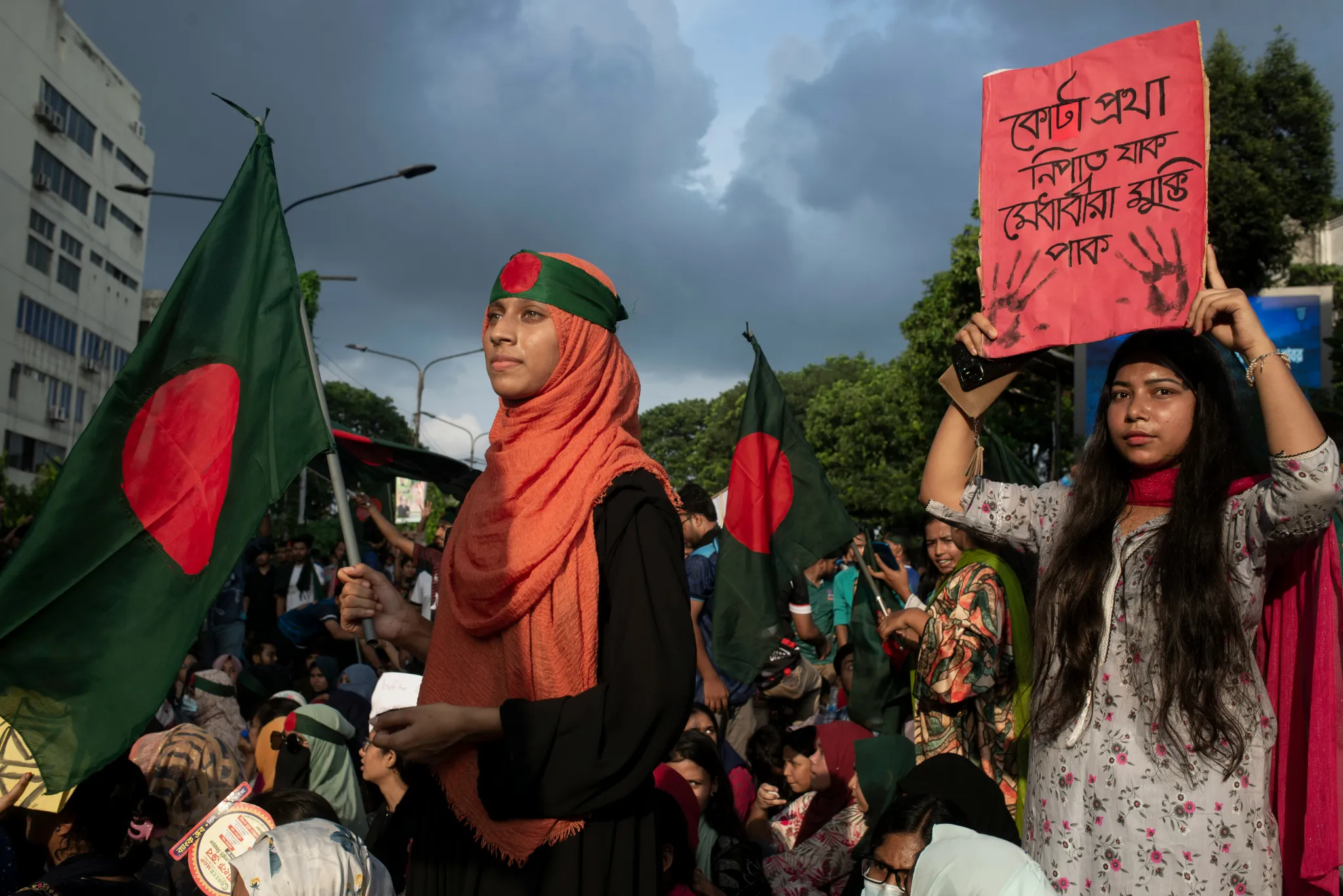
Bangladesh faces a pivotal democratic test in 2026, as the country gears up for its first national election since the 2024 student-led uprising that ousted former Prime Minister Sheikh Hasina.
Nobel laureate Muhammad Yunus was appointed interim Chief Adviser on 8 August 2024, meeting a core protester demand. The interim government, formed in consultation with students, the military and civil society, pledged to hold elections after crucial reforms.
Now, for the first time in the country’s history, a joint election and constitutional referendum will be held on 12 February, determining not only who will govern for the next five years, but how those in power will govern. In a historic first, the vote will also include diaspora participation.
The July Charter and referendum
The referendum aims to give political force to the ‘July Charter’ – a landmark document with over 80 reform proposals which seeks to reshape Bangladesh’s system of governance. The Charter was drafted by the interim government’s National Consensus Commission, drawing on recommendations from six reform commissions focused on the constitution, judiciary, electoral system, police, public administration and anti-corruption. Key charter reforms include increasing women’s political representation, imposing prime ministerial term limits, enhancing presidential powers, expanding fundamental rights, and protecting judicial independence.
Voters will cast a single Yes/No vote on four consolidated issues:
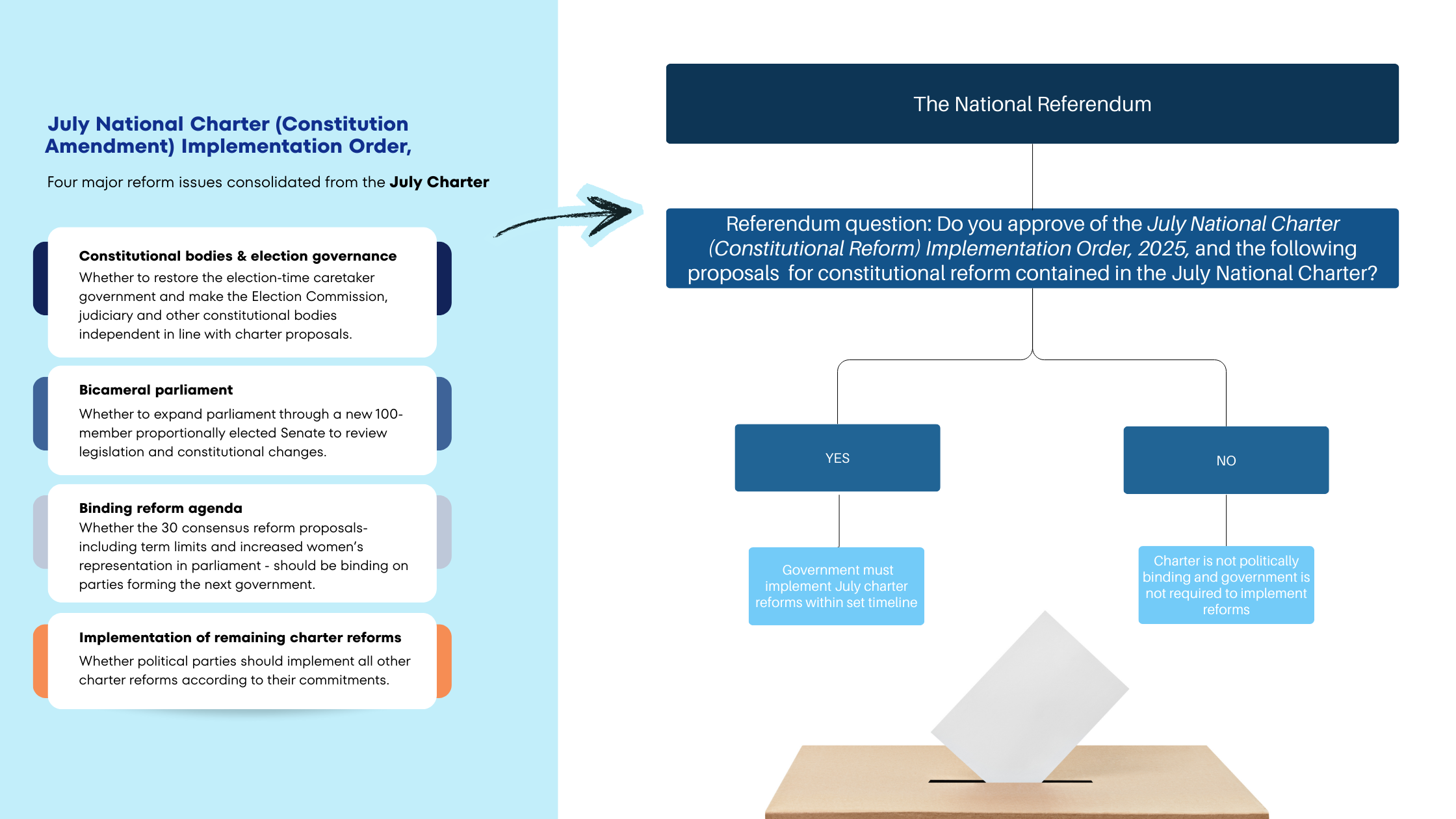
(Click figure for enlarged view)
If the “Yes” vote prevails, the newly elected parliament will have a public mandate to implement the Charter’s provisions within 180 working days (or 270 full days), functioning as a Constitutional Reform Council. Yet its successful implementation still depends on the next parliament’s political will. It remains to be seen what the legal consequences of failing to enact reforms will be, given the removal of an earlier automatic-enactment clause after 180 days. The clause was removed to avoid constitutional challenges and address concerns about maintaining parliamentary legitimacy.
If the “No” vote wins, then uncertainty looms as the incoming parliament will not be politically bound to implement the Charter provisions, leaving critical reforms vulnerable to government discretion. Proponents of the Charter warn that a ‘no’ vote would risk stalling reform momentum and put the country at risk of returning to what resembles a one-party state. Still, political observers note that the incoming parliament would likely face public pressure to implement at least some of the Charter’s reforms it had initially supported.
The July Charter, endorsed by 24 political parties in October 2025 after lengthy debate, still contains some unresolved issues. Some signatory parties disagreed with certain provisions, and these are expected to be taken up in subsequent debates. These issues primarily concern implementation details, including the composition and powers of the proposed upper house and degree of independence granted to oversight bodies. On a broader level, critics also warn that the referendum design reduces complex issues into a binary choice, with limited public understanding. However, referendum’s design was chosen to reconcile conflicting demands of key political parties while maintaining voter engagement.
Election integrity amid ongoing electoral reforms
Bangladesh’s past three elections (2014, 2018 and 2024) were marred by electoral manipulation, violence and repression perpetrated by the erstwhile ruling-party. The last vote broadly regarded as free and fair occurred in 2008 under a non-partisan caretaker government (CG).
To learn more about the current electoral landscape, I spoke with Md Abdul Alim, prominent elections expert and member of the Electoral Reform Commission. While concerns of political violence persist, he notes that statistics indicate incidents of violence so far remain low compared to previous elections.
Alim also revealed that that the interim government has taken important steps to bolster the credibility of the upcoming election. He states that “roughly 50 of the Electoral Reform Commission’s 250 recommendations have already been adopted into Bangladesh’s legal framework. These include strengthening the Election Commission’s administrative powers, provisions for overseas voting and measures to increase polling transparency.” Moreover, the law now bans party figures from remaining inside polling stations throughout the voting process (previously a common practice in Bangladesh and across many other countries), giving the presiding officer authority to remove and take legal actions against them.
While these changes improve past electoral management practices, Alim notes that many electoral reforms remain pending, such as the independent appointment of election commissioners, among broader proposals in the July Charter.
The political landscape
The election unfolds amid a reconfigured party landscape. Hasina’s Awami League (AL), which governed for 15 years, will not appear on the ballot following a ban on its political activities in 2025. While former AL figures may still stand as independents, the party’s absence marks a major break from the long-standing competition between AL and the Bangladesh Nationalist Party (BNP).
The BNP is hoping to fill this power vacuum and is widely viewed as the frontrunner according to recent polling. At the same time, the student-led National Citizen Party (NCP), born out of the July 2024 mobilizations, has also joined an alliance with Bangladesh’s largest Islamist party, Jamaat-e-Islami. Overall, the electoral field appears more fragmented and unpredictable – raising questions about voter alignments. Nevertheless, nearly all major political parties have said they support holding the referendum and broadly back the Charter, despite reservations around its institutional design.
Looking ahead
Beyond the election winner, it remains to be seen whether the vote will yield a durable system of governance. In many respects, this election marks the first chapter of the substantive reforms which lie ahead. In speaking with Alim, it became clear that he also sees a successful referendum vote as the starting point for a more stable and democratic path to reform. He further noted that it will be important to watch the relationship among the political parties during the post-electoral period. This cooperation will be essential in restoring public trust amid ongoing reconciliation and reform processes. Like other youth uprisings globally, this election will be a litmus test for whether popular movements can translate into genuine democratic change.
Note: This blog is the second in a three-part series on Bangladesh’s democratic transition. The first blog post can be read here. Stay tuned for our next blog exploring the reforms in a post-electoral context.


About the author