Elections in Honduras 2025: democratic resilience in the face of persistent challenges
A complex and highly competitive process
Honduras established a presidential system and a unicameral Congress in its 1980 Constitution. Although historically dominated by a two-party system between the Liberal Party and the National Party, a third party emerged in the last decade: the Liberty and Refoundation Party (Libre). Honduras elects its presidential, legislative and municipal authorities on a single election day, making the process a considerable logistical challenge. The system of open lists unblocked by departmental districts for Congress presents complications in voting and counting. There are simultaneous, non-compulsory primaries with parity, which register a 43 per cent turnout.
A key reform following the irregularities noted in 2017, which culminated in a disputed victory for a second term for then-President Juan Orlando Hernández, divided the former Supreme Electoral Tribunal into two bodies: the Electoral Justice Tribunal (TJE) and the CNE. However, in the last year, significant discrepancies within the electoral bodies have hampered operational decisions and transparency in the electoral process.
The 2025 general elections were marked by extreme polarisation, disinformation campaigns and selective impediments to the work of the press, institutional tensions and unfounded accusations of fraud from the main parties. The campaign focused on attacks between candidates rather than on policy proposals. As the European Union's preliminary report states: "Fundamental freedoms were respected during the election campaign, despite the fact that a state of emergency had been declared in most municipalities. Political parties were able to campaign without hindrance." Polls pointed to a technical tie, and the unusual public endorsement by the US president of opposition candidate Tito Asfura, just three days before the election, added to the tension, which was exacerbated by the pardon granted to former president Juan Orlando Hernández, who had been charged and convicted of drug trafficking in the United States.
Election day and the first results
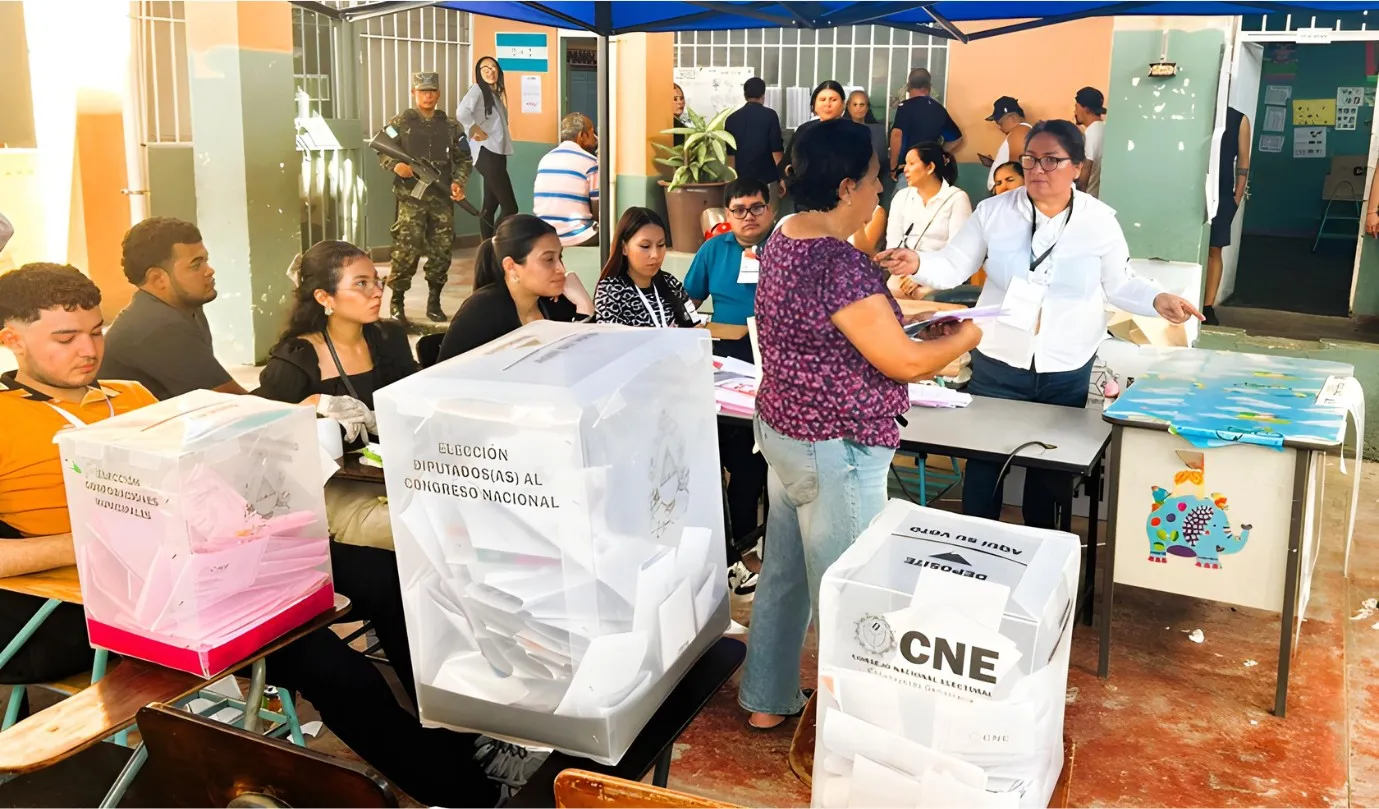
Despite prior tensions, election day proceeded relatively calmly, with isolated incidents reported by the European Union observation mission. International IDEA visited polling stations in Comayagua and Tegucigalpa, where turnout was high, especially among young people. However, the process was slow and involved multiple steps, which led to long queues and forced the CNE to extend voting by an hour. There were also flaws in the implementation of the biometric system, accessibility challenges and difficulties in voting for people with disabilities, incidents of "open voting" and a large military presence.
The count progressed slowly at the polling stations: by 10:30 p.m. on Sunday, 30 November, only 34 per cent of the presidential ballots had been processed. In addition, the rapid transmission system (TREP) was suspended when 57 per cent of the records had been uploaded, which increased mistrust among the parties and the public.
Current data show a slight lead for Salvador Nasralla of the Liberal Party (40.33 per cent), followed by Nasry Asfura of the National Party (39.57 per cent) and, in third place, the ruling party candidate, Rixi Moncada of the Libre Party (19.01 per cent). Data as of 3 December, with 79.1 per cent of polling stations counted.
On Tuesday, 2 December, the CNE acknowledged technical failures in the disclosure of the results and demanded a solution from the contracted company. As a temporary measure, it enabled controlled access for the media and political parties while the pending and contingency results are being processed.
In light of these latest developments, a period of uncertainty has begun. At International IDEA, we call on all actors to act rationally and with democratic commitment to respect the will of the people and the final results, and we urge the electoral authorities to act diligently and transparently so that, as required by law, the official results are published on 30 December and a new government that reflects the will of the voters takes office on 27 January 2026.
Central America has experienced a significant deterioration in democracy over the last decade, evidenced by a reduction in civic space and setbacks in press freedom, according to the Global State of Democracy. In this context, Honduras remains a formally democratic country—unlike the authoritarian turns in Nicaragua or El Salvador—although it has historical vulnerabilities that limit the quality of its institutions.
Since July 2024, International IDEA has been implementing the project Improving the Resilience of Democracy in Central America, funded by the Government of the Grand Duchy of Luxembourg to strengthen democratic capacities in Central America, including Honduras.


About the authors