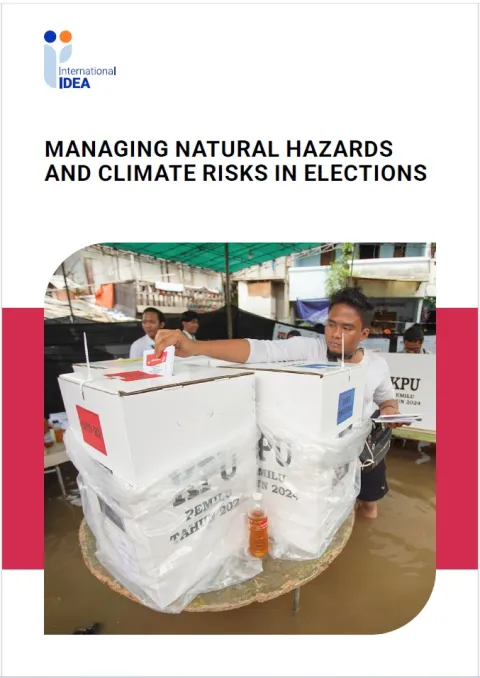
Managing Natural Hazards and Climate Risks in Elections
Elections are the cornerstone of democracy, but like all public functions they are vulnerable to disruption by events in the natural world, including earthquakes, floods, wildfires and heatwaves. As the climate changes, many natural hazards are increasing in frequency and severity, prompting electoral practitioners to seek ways to protect the vote from such phenomena. Managing Natural Hazards and Climate Risks in Elections surveys the risk that meteorological and geological events pose to elections and offers an analysis of the strategies that electoral management bodies (EMBs) around the world have put in place to safeguard electoral processes.
The report draws on a rich database of more than 100 cases of disaster-disrupted elections between 2006 and 2025 to document the various effects that events in the natural world can have on all aspects of the electoral cycle and to delineate the range of strategies that are available to electoral administrators to minimize their adverse consequences. The report also includes 13 chapters that present detailed studies from 6 continents in which hazards such as storms, floods, heatwaves and earthquakes have interfered with campaigning and polling. Each case includes an evaluation of the measures that EMBs have taken to ensure the smooth running of the electoral process and a summary of lessons learned from the case in question. Together, the analyses contained in this report provide a foundation for understanding and managing the risk that natural hazards pose to elections in the contemporary world, and they foreground the numerous ways that coping with them has enabled practitioners to strengthen electoral institutions.
For more information, visit the project page: The Impact of Natural Hazards on Elections.


Details

Staff author
Contents
Acknowledgements
Foreword
Preface
Executive summary
Introduction
1. Impacts of natural hazards on electoral processes
2. Protecting elections throughout the electoral cycle
3. Conclusion and main findings
4. Managing Elections during Floods: The Case of Victoria, Australia
5. The impact of floods and landslides on the 2024 local elections in Bosnia and Herzegovina
6. The Impact of the 2023 Wildfires on Subnational Elections in Canada
7. The Impact of Natural Hazards on Haiti’s 2010 Presidential and legislative Elections
8. Natural Hazards and Elections in India: Lessons in Adaptation and Mitigation
9. Taming the Twin Hazards: Indonesia’s 2020 Direct Local Election
10. Heatwaves and the 2024 general elections in Mexico
11. Cyclones and their effects on the 2019 elections in Mozambique
12. Managing elections to withstand natural hazards in Peru
13. Elections and Heatwaves: Philippines’ May 2025 Midterm General Elections
14. The Impact of the 2023 Earthquakes on Türkiye’s Presidential and Parliamentary Elections
15. Wildfire and Elections in California, USA
16. Weathering the Storm: Hurricane Sandy and the 2012 US Federal Election
Annex A. 2024 Electoral Management Survey
Annex B. Election emergency and crisis monitor country briefs
About the authors
Give us feedback
Do you have a question or feedback about this publication? Leave us your feedback, and we’ll get back to you
Send feedbackManaging Natural Hazards and Climate Risks in Elections


 Download PDF

| Total views | 12410 |
|---|---|
| Downloads | 514 |
| Rating |

|
Staff author
Give us feedback
Do you have a question or feedback about this publication? Leave us your feedback, and we’ll get back to you
Send feedback
Related publications