


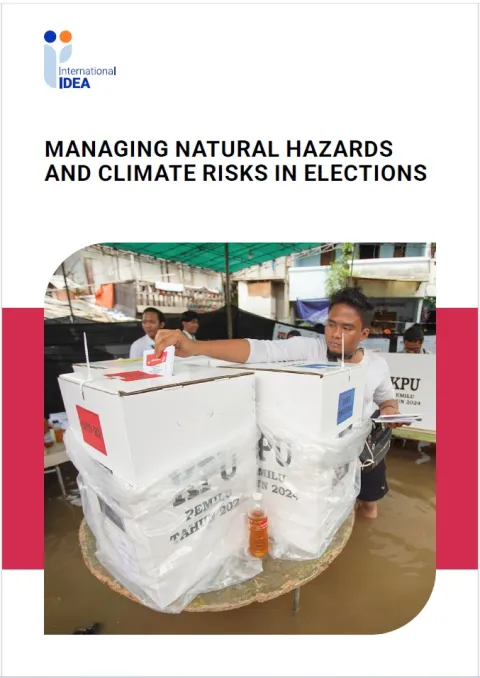
Managing Natural Hazards and Climate Risks in Elections

Democratic elections have always required organization, trust and time. Today, they also require resilience. The extraordinary threatens to become the ordinary as electoral processes increasingly unfold in contexts of crisis. Public authorities are called upon to organize elections amid emergencies ranging from natural hazards and climate-related events to public health crises, conflict, foreign interference or cyberthreats or even attacks and other large-scale disruptions. As the recent years have shown, crises are therefore no longer exceptional interruptions but, unfortunately, recurrent realities under which authorities must guarantee citizens the effective exercise of their political rights.
This evolution challenges a basic expectation of representative democracy that elections can be organized within stable and predictable conditions. Electoral calendars, voter registration, campaigning and observation all depend on physical infrastructure, administrative continuity and public confidence. When these are disrupted, the consequences go beyond practical difficulties and raise questions about democratic legitimacy itself. Postponing a vote, modifying procedures at short notice, or limiting participation in the name of safety can be necessary. Yet each of these measures carries risks if it is not prepared in advance, transparently communicated and grounded in law.
States, international organizations, election officials and policymakers have been accelerating their response to these challenges. Aided by the expertise and research of International IDEA, I had the privilege of serving as rapporteur in the Parliamentary Assembly of the Council of Europe (PACE) on the report Elections in Times of Crisis, adopted in January 2026. It followed a conference on the same theme organized in Berne in 2023 by PACE and the Swiss Parliament. Its central message was simple: emergencies must not suspend democracy, but democracies must prepare for emergencies. Anticipation, legal clarity and institutional coordination are essential to ensuring that the protection of life and the protection of political rights are not seen as competing obligations.
This publication by International IDEA deepens these broader efforts to strengthen our shared democratic security by offering a rich contribution to understanding elections in times of crisis. At a time when it is increasingly clear that electoral authorities must work closely with disaster risk management and civil protection services, it points to practical ways for public authorities and political actors to cooperate before a crisis occurs. We are also reminded that resilience is not only technical; it is institutional and societal. Public trust depends on predictability, fairness and equal access to the vote, especially under difficult conditions.
The challenge ahead is to integrate electoral integrity into broader emergency preparedness and contingency planning. This is essential to safeguarding elections over the long term. An important element for democracies is not only how they conduct elections in normal times, but how they uphold them when circumstances are most adverse. Resilience is key. This book encourages policymakers, administrators and legislators to recognize elections as a core component of democratic security and to ensure that, even in times of crisis, citizens are heard and are still in control.
Damien Cottier
Member of Parliament of Switzerland
Rapporteur of the Parliamentary Assembly of the Council of Europe on Elections in Times of Crisis
Chairperson of the 2023 Berne Conference on Elections in Times of Crisis
Since the International Institute for Democracy and Electoral Assistance (International IDEA) was founded in 1995, it has helped develop many of the frameworks, interpretations and procedures that today define best practice in electoral management. Yet this field is evolving faster than ever, and many of these foundations must now be reconsidered. Natural hazards are a case in point: once viewed primarily as episodic crises, they are increasingly recognized as chronic challenges demanding sustained attention and innovative responses.
While the electoral management community has long recognized the profound and growing impact of climate change on elections, this book represents the most definitive collection of evidence to date on how climate change affects electoral processes and outcomes. It examines in detail the consequences of acute climate events—such as hurricanes, floods and heatwaves—and provides recommendations for maintaining the continuity of electoral operations, including the distribution of election materials, registration, voting and counting, under the most challenging circumstances that nature can impose.
Equally significant, though less immediately visible, are the impacts on electoral process design of slower-onset phenomena such as prolonged heat, sea-level rise and persistent drought, as well as the resultant migration patterns. The book shows how these changes are impacting key practical decisions about registration for out-of-area voters and the design and use of voting methods and equipment. Yet the impact on democracy runs even deeper, as precarity and trauma from natural hazards can exacerbate affected citizens’ existing grievances, facilitate the spread of conspiracy theories and impose additional hardship on society’s most vulnerable people.
These are not distant risks; they are real threats that democratic institutions everywhere—including the electoral management bodies at the heart of this book—must face with urgency, combining the mitigation and adaptation efforts that underpin the broader societal response to climate change. The findings presented in this publication demonstrate that democratic institutions, particularly elections, should be treated as critical infrastructure that is susceptible to environmental threats and in need of special protections. Similarly, countries should consider including electoral processes in their national climate adaptation plans and national disaster risk reduction strategies. The disruption of democratic processes by natural hazards also underscores the value of skills and modalities needed for broader institutional resilience in an era of uncertainty, including backup capacity, contingency planning, flexibility and interagency cooperation.
International IDEA is proud to be at the forefront of this growing field related to the protection of elections. The lessons outlined in this book will inform our own work and that of electoral management bodies around the world, thus helping to ensure that elections are effective, accessible and resilient for generations to come.
Dr Kevin Casas-Zamora
Secretary-General, International IDEA
Natural hazards are increasingly becoming a threat to elections, as they are likely to cause damage to people and infrastructure, as well as population displacement throughout the electoral cycle. In the last 20 years, at least 94 elections and referendums in 52 countries, held at different levels, have been affected by natural hazards. The electoral challenges triggered by extreme weather events such as floods, hurricanes, heatwaves and wildfires, exacerbated by climate change and other geophysical disasters such as earthquakes and volcanic activity, are illustrated throughout this book. The aim of this book is to enable election officials and policymakers to use these experiences of risk and response as guidance for protecting elections and building resilient electoral processes.
In 2024 alone, at least 23 elections—national, subnational, primary and supranational—in 18 countries were affected by extreme weather events, exacerbated by climate change. The damage and displacement from hurricanes Helene and Milton four weeks before the 2024 presidential election in the United States is a stark reminder of the potential disruptive impacts of extreme weather on campaign events, voter registration and voting operations.
Equality of participation, the effectiveness of electoral management and fairness in contestation will continue to face significant threats from natural hazards that cause extensive damage to critical infrastructure and displacement throughout the electoral cycle. As climate change worsens, extreme weather will have an increasing impact on electoral processes worldwide. The range, timing and location of rapid-onset disasters and the variation in how electoral management bodies prepare provide insights into different forms of electoral resilience.
This book offers the first global cross-country analysis of the impact of natural hazards on electoral processes and how elections have been protected throughout the electoral cycle. The findings are supported by evidence drawn from more than 100 briefs that make up the Election Emergency and Crisis Monitor and 13 in-depth case studies covering all the regions included in this book, which explore the challenges of holding an election during times of crisis.
The findings emphasize the need for countries to recognize democratic institutions, particularly elections, as critical infrastructure susceptible to disasters. Cross-disciplinary collaboration among electoral management, meteorological, climate change and disaster risk reduction communities and other election stakeholders is crucial at the local, national and global levels. This collaboration can strengthen knowledge sharing and resilience, ensure voter access during natural hazards and ultimately safeguard democracy.
Building national and subnational partnerships as part of a whole-of-government approach emerges as the essential step towards climate adaptation to safeguard electoral processes. In the meantime, election stakeholders can adopt an integrated approach to protect elections which includes risk management, resilience building and crisis management.
Ultimately, the book concludes that, without addressing carbon emissions, the root cause of climate change, extreme weather will continue to intensify, limiting the effectiveness of election stakeholders’ efforts to prepare and making the organization and delivery of elections more complicated.
Nevertheless, electoral authorities can take a large number of measures to minimize risks in this domain. This report includes 11 action-oriented recommendations that focus on protecting elections against the impact of natural hazards, including those driven by a changing climate:
- Seasonal disasters and extended timelines. Elections should be held when disasters are least likely, and electoral management bodies (EMBs) should consider extending timelines for voter registration and voting to reduce the likelihood of disruption by short-lived disasters.
- Redundancy (backup capacity) in design. Voter registration and voting can be protected by building redundancy into their design—in other words, by introducing backup capacity.
- Temporary measures. Electoral institutions should have the legal authority to implement temporary measures like expanding special voting arrangements, moving polling stations, or introducing health and safety measures during emergencies and crises.
- Coordination with other agencies. Electoral stakeholders should coordinate with meteorological, environmental protection, disaster relief and humanitarian agencies to benefit from early-warning systems, to embed elections into disaster management plans and to develop standing joint working mechanisms with disaster relief agencies.
- Training and contingency planning. EMBs should prepare for a variety of natural hazards that could affect elections. Preparation should focus on budgeting, detailed risk management and contingency plans specific to hazards that could potentially affect elections in the country in question, materials procurement, and training in risk management and crisis management.
- Revising the electoral law. The electoral law should be revised to clearly specify the circumstances under which an election (in whole or in part) may be postponed in emergency situations—and to provide the flexibility needed for election officials to rapidly respond to an emergency situation.
- Timely and sufficient funding. Sufficient funding must be provided on a timely basis in case an emergency situation arises and to adapt to a changing climate.
- Clear internal and external communication strategies. EMBs and their partners must develop internal and external communication strategies that include countermeasures against mis- and disinformation.
- Cross-cutting international engagement. More engagement is needed between electoral, climate change, meteorological and disaster risk reduction communities. Until countries decrease carbon emissions, extreme weather events will become more frequent and intense.
- Building back better. Post-election reviews involving multiple stakeholders should consider making adaptive measures implemented during an emergency permanent in order to prepare for similar threats to electoral integrity in the future.
- Critical infrastructure. Governments should consider designating electoral processes as critical infrastructure that require protection during emergencies and disasters caused by natural hazards. Moreover, electoral processes can be considered in national adaptation plans and national strategies for disaster risk reduction to strengthen climate resilience and disaster risk reduction at the national level.
Sarah Birch, Erik Asplund and Ferran Martínez i Coma
Natural hazards1 are increasingly affecting all human activities, including elections. The changing climate is leading to unpredictable and extreme weather in many parts of the world, a situation that can be expected to worsen in the years to come. Recent events have brought this risk to the attention of people around the globe who are involved in elections as managers, temporary election workers, voters, candidates and observers. Fortunately, there are now a number of well-established strategies that can be deployed to protect elections against risks of this sort. This book provides a survey of the various ways that phenomena such as floods, wildfires and heatwaves have interfered with electoral processes and draws together lessons from countries in different regions of the world whose experiences can help practitioners to minimize the disruption that natural hazards cause.
This Introduction starts by conceptualizing the threats that the natural world may pose to the effective delivery of elections before describing the unique challenges that arise in this context, outlining a range of measures that can be taken to address these challenges and providing a preview of the remainder of the book.
I.1. Natural hazards as a growing threat to electoral integrity
Elections are complex events that unfold over a multistage cycle, often mandated by a country’s constitution. In this sense, electoral procedures are vital to democratic life, and they require a commensurately high level of protection from shocks of all kinds. Measures have been in place for a long time to ensure that elections are professionally run and free of the types of misconduct that are known vulnerabilities (Birch 2011; Global Commission on Elections, Democracy and Security 2012; Norris, Frank and Martínez i Coma 2014). However, some shocks are virtually impossible for those in charge of elections to foresee or control, including a wide range of meteorological, climatological, hydrological and geophysical phenomena that are commonly associated with disastrous disruptions to social practices (Saulnier et al. 2021).
In recent years, extreme weather events, intensified by rising global temperatures, have accelerated efforts by many countries to engage in climate adaptation. According to the World Meteorological Organization, 2024 was the hottest year on record to date, with annual average temperatures more than 1.5°C above pre-industrial levels (Rowlatt and Poynting 2025; WMO 2025). There is growing recognition that governments worldwide need to act swiftly to bolster defences, including enhancing early-warning systems, investing in response teams and collaborating with local communities—rural and urban—to prepare effective response strategies and reduce the vulnerability of both existing and new infrastructure (UNDRR 2015).
It is less widely understood that the feasibility of holding elections and the ability to maintain electoral integrity during emergencies and crises are part of this adaptation challenge. Yet recent developments have brought greater attention to this risk. The super-cycle election year of 2024, when half the world’s eligible citizens had the opportunity to vote, also coincided with the tail end of an El Niño period. El Niño (the cyclic alteration of weather patterns formally known as the El Niño–Southern Oscillation) and the coincidence of this phenomenon with an intense period of electoral activity resulted in numerous challenges. Over the course of 2024 alone, at least 23 elections were affected by extreme weather events during primary, subnational, national or supranational elections (Asplund 2024).
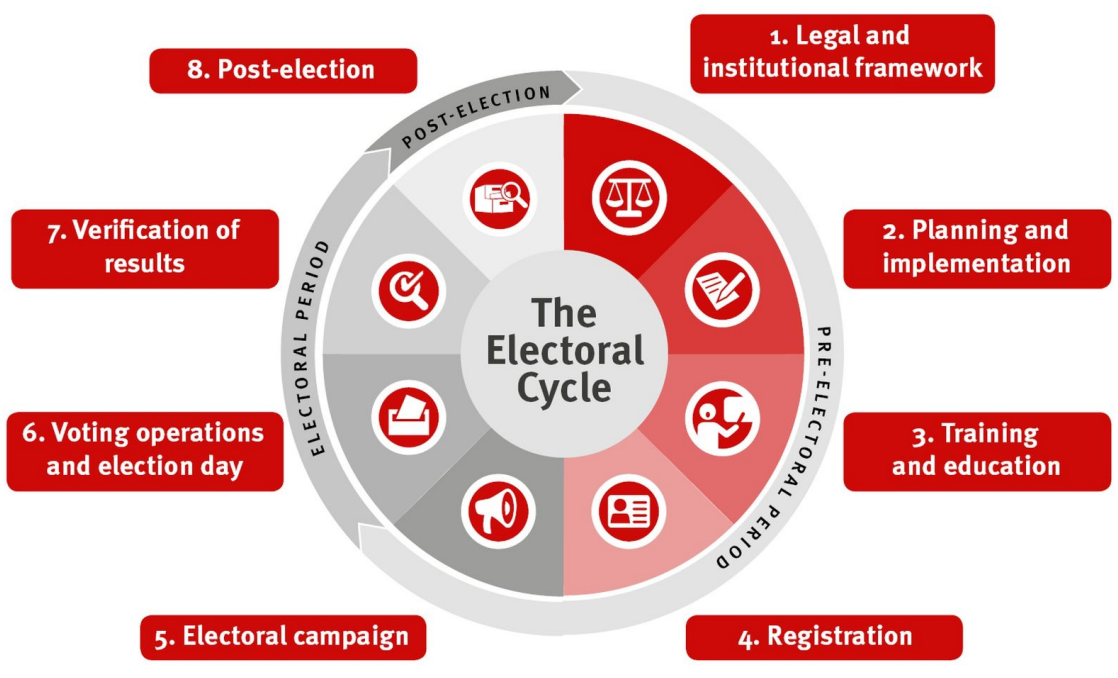
These headline-grabbing polls led to more widespread awareness of the ways in which weather-related disasters such as floods, hurricanes, heatwaves and wildfires can disrupt the entire electoral process. Other phenomena that can have similar effects are earthquakes and volcanic eruptions. These events can threaten the basic electoral principles of deliberation, contestation, participation and adjudication in various ways across the electoral cycle (see Figure I.1), including the periods before, during and after an election. Such events can at times force the postponement of elections, though planned elections are generally held in the aftermath of extreme weather events and similar disasters. More often, events of this type interfere with deliberation and contestation by upending campaign activities. They can also obstruct participation by creating logistical hurdles for electoral operations—such as the destruction of polling stations and counting centres and the displacement of voters, poll workers and election officials. Moreover, such crises can influence voter turnout and even alter the decisions that voters make: the humanitarian, economic and political impacts of natural hazards thus interact. Disasters can also impair the ability of domestic and international observers to assess the integrity of the electoral process in all parts of the country. Reduced observation capacity may result in less impartial evidence of how the election is being run, which can potentially have knock-on consequences for popular confidence in the electoral process. When states of emergency are declared, freedom of association and freedom of movement can be curtailed, compromising election campaign activities and potentially access to polling places.
There are means of addressing these challenges, however. For example, when floods affected the 2024 Senegalese elections, firefighters helped bring observers to polling stations (APS 2025). The 2024 local election in the Fojnica region of Bosnia and Herzegovina was postponed during a state of emergency put in place due to flooding (see Chapter 5: Bosnia and Herzegovina). When Hurricane Sandy struck the United States in 2012, voting went ahead in New York and New Jersey while a state of emergency was in force. The redundancy device of special voting arrangements was employed, and some polling stations were moved in order to enable voting to take place (see Chapter 16: USA, New York and New Jersey).
In some cases, natural hazards can also lead to serious violations of electoral norms such as vote buying, disinformation and electoral violence. Disaster relief can become a ‘good’ that is traded for votes by means of politicized allocation, as revealed by research in a wide variety of contexts, including Bulgaria, Honduras and Madagascar (Francken, Minten and Swinnen 2012; Nikolova and Marinov 2017; Birch and Martínez i Coma 2023). In Brazil, floods in advance of the 2024 municipal elections promoted a wave of disinformation about aid being blocked by political actors (Fox 2024). In other contexts, the disruption that communities experience during catastrophic events has prompted violent protests and episodes of civil unrest (Birch 2025), especially when electoral authorities are suspected of having dealt with the logistical challenges they face in ways that advantage one group over another (see Chapter 7: Haiti and Chapter 11: Mozambique). For example, civil unrest was exacerbated by misinformation connected with a disaster situation in Mozambique, where measures taken to deal with a cholera outbreak in the wake of a tropical storm led to violence and intimidation that are suspected to have reduced electoral participation (see Chapter 11: Mozambique).
Even when events linked to natural hazards do not reach crisis proportions, they can still impact many aspects of elections. Strong rainstorms often lead to localized flooding, which can require polling stations to be closed or moved; adverse weather conditions can deter voters from going out to the polls; and even variations in wind speed have been found to alter the parties voters opt to support (Gasper and Reeves 2011; Leslie and Arı 2018; Mo et al. 2024). It is no exaggeration to say that all elections are in some way affected by natural phenomena, but the recent rise in extreme weather events has increased this threat to a point where none of those involved in elections can afford to disregard the risks posed by the natural world (see Box I1).

The World Economic Forum’s 2025 annual global risk report states that extreme weather events are a key concern both in the short and in the long term (WEF 2025). The frequency of weather-related natural hazard events has tripled in the past four decades, consistent with the predictions of climate scientists (Thomas and López 2015; IPCC 2021). Although most of these hazards occur naturally, climate change increases their incidence and intensity. The contribution of Working Group II to the Intergovernmental Panel on Climate Change’s Sixth Assessment Report (IPCC 2023) found that extreme weather events are increasing in frequency and/or intensity due to global heating. In 2021 the World Meteorological Organization (2021) reported that the number of weather-related disasters had quintupled over the previous 50-year period, and the number is predicted to increase as the climate continues to change. Current trends and scientific evidence very strongly suggest that elections will be more frequently impacted by natural hazards in future years.
The methods that enable scientists to attribute specific extreme weather events to climate change have improved greatly in recent years, such that we now often have quantifiable proof that many hazards have been made worse by greenhouse gas emissions (Florini and Hill 2024), strengthening the evidence that elections will face increased threats from the natural world in the future.
Protecting elections from natural hazards contributes to achieving United Nations Sustainable Development Goal 13 (Climate Action) (United Nations Regional Information Centre for Western Europe n.d.a) by dampening the impacts of climate change on electoral processes. Protecting elections also helps realize Sustainable Development Goal 16 (Peace, Justice and Strong Institutions) (United Nations Regional Information Centre for Western Europe n.d.b) by enabling electoral institutions to withstand natural threats.
This book describes various hazards, focusing on flooding, hurricanes, wildfires, heatwaves and earthquakes, and how they have affected elections in all regions of the globe. It distinguishes between rapid-onset and slow-onset environmental events. Rapid-onset events include earthquakes and floods, for example, while droughts and sea-level rise are slow-onset events. The terms slow- and rapid-onset events are ‘both useful in terms of aiding understanding, as well as identifying key policy implications’ (Black, Kniveton and Schmidt-Verkerk 2011: 437), although there can be a crossover between the two categories (Hunter, Luna and Norton 2015). In Indonesia, for example, sea-level rise, a slow-onset hazard, resulted in coastal flooding, a rapid-onset disaster that impacted the 2020 direct local election (see Chapter 9: Indonesia). While this book focuses more on sudden disasters and the challenges they bring about, long-term environmental changes are also in the picture as triggers. Another example is drought, which catalyses climate migration (Mohan and Roberts 2021). This phenomenon was seen in Somalia when pastoralists were forced to relocate due to a lack of rainfall. The impact of the resulting drought on nomads led to suspended voter registration and multiple postponements (Walls n.d.).
Box I.1. Natural disasters do not exist
According to the United Nations, natural phenomena such as earthquakes and extreme weather generated by human activity become disasters only when they affect vulnerable communities. Communities are often vulnerable due to a failure to put in place measures that might reduce the impact of hazards.
Source: Compiled by the authors based on PreventionWeb, ‘Natural disasters do not exist’, [n.d.], <https://www.preventionweb.net/hubs/risk-media-hub/natural-disasters-do-not-exist>, accessed 12 December 2025; and United Nations Office for Disaster Risk Reduction, ‘Why are disasters not natural?’, [n.d.], <https://www.undrr.org/our-impact/campaigns/no-natural-disasters>, accessed 12 December 2025.
There is also a crossover between hazard types. A severe storm, for example, may trigger extensive flooding, as as the case in September 2024 when Storm Boris, a low-pressure system with windspeeds of 100 km/h, brought record-breaking rainfall to Central Europe. Campaign events and voting operations in Austria and Czechia were both affected by the severe flooding that resulted (Asplund 2024). Hurricane Milton, which hit the USA one month before the 2024 presidential election, brought heavy winds, a storm surge, rainfall and floods and also triggered more than 100 tornadoes (Bartels 2024).
In addition, meteorological and geological hazards can have impacts on elections at the same time as other shocks, such as the 2010 cholera outbreak in Haiti, which coincided with an earthquake and a tropical storm, all of which affected the delivery of that year’s election (see Chapter 7: Haiti), and the global Covid-19 pandemic, which was raging at the same time that a number of elections were struck by extreme weather events (Birch and Martínez i Coma 2023; see also Chapter 9: Indonesia).
Such compound hazards are examples of a wider phenomenon whereby a natural shock impacts an election at the same time as another sort of shock, ranging from an outbreak of violent conflict to a terrorist attack or a chemical spill. In other cases, natural and human-made disasters may interact, as happened in 2024 in Bosnia and Herzegovina when flood-induced landslides dislodged landmines whose location had previously been marked (see Chapter 5: Bosnia and Herzegovina). There is also worrying evidence that natural hazards that occur at election time may actually lead to episodes of conflict, thus sparking a series of further disruptions to electoral processes (Birch 2025; see also Chapter 11: Mozambique).
With nature posing increasing risks and research fine-tuning our understanding of the threat to elections that these risks represent, there is ample evidence to indicate that measures need to be taken to safeguard electoral processes from natural hazards. Compiling the best evidence in this domain is the task this book sets itself. A word is in order as to what is not attempted here: beyond the chapter on India (see Chapter 8), this book does not cover climate mitigation or how election stakeholders can reduce the environmental impact of elections (Asplund, Grace Prieto and Lindemann 2024; UNDP and IFES 2025). Although climate mitigation is of undoubted importance—as electoral management bodies (EMBs) can take action to reduce the carbon footprint of elections—the focus of this book is on safeguarding elections from threats.
I.2. The practical challenge of protecting elections from natural hazards
If the disaster-affected 2024 election cycle served as a wake-up call for electoral administrators, it also offered an opportunity to test many of the measures that have been put in place to safeguard electoral institutions in the face of natural hazards.
Alihodžić (2023) offers a useful tripartite distinction between risk management, resilience building and crisis management. All are important features of an integrated approach to protecting elections from natural hazards. Risk management is a pre-emptive approach that requires minimizing exposure to risk; in the context of natural hazards, this approach might entail climate change mitigation (which is outside the scope of this book), but it is can also involve strategies such as adjustments to the timing of elections. Resilience building is a matter of designing electoral institutions so that they are resilient to shocks by embedding adaptive capacity within institutions and among personnel, which is a major focus of the investigations undertaken here. Finally, crisis management involves effectively responding to disasters that affect elections once they have occurred. The three approaches can be separated analytically, but they are most effective when linked. As Alihodžić (2023: 12) notes, ‘Ideally, risk management, resilience-building and crisis management should work together. … However, employing the three methods in a way that unlocks synergies between them may be easier said than done’ (International IDEA 2025).
An issue that arises in this context is the need to protect the independence and autonomy of EMBs, while at the same time developing mechanisms to enable efficient coordination with other agencies during times of crisis. The establishment of independent EMBs in most countries in modern times was a significant administrative achievement. Not only are EMBs capable of independent action insulated from political pressure, but they also have internal governance structures that enable them to operate on their own, without being dependent to any great extent on other administrative agencies (Catt et al. 2014). However, the increasing frequency and intensity of natural hazards call into question the desirability of fully autonomous EMBs. Although the importance of maintaining de facto independence from political control is not in question, complete operational autonomy is another matter. In theory, EMBs might be able to develop their own early-warning systems, hire meteorological teams and set up internal disaster management teams, but taking these steps would generally not be cost-effective and would most likely be suboptimal, given the superior capacity of the existing scientific and emergency agencies of the country in question. Moreover, coordination among agencies is paramount in a crisis situation so that voters and others are not given conflicting messages, and so that lives are protected. The increasing challenge posed by natural hazards may thus require electoral managers to consider new ways of working, which might involve cultural as well as structural changes. In this sense, the institutional embeddedness of natural-hazard management distinguishes it from some of the better-known risks to elections, such as fraud and other forms of malpractice, which are more closely tied specifically to electoral administration. Addressing the electoral risks associated with natural hazards could in some cases involve embedding EMB operations within a broader emergency response framework (including civil protection, local authorities, security and health services) to ensure coherent crisis communication and effective operational support.
It is also necessary for EMBs to develop strategies for coordinating effectively with other actors in the electoral process, including voters, candidates, parties, electoral observers and journalists. Clear and timely public information strategies and established lines of communication with key groups can be effective in avoiding emergency situations and minimizing the risk associated with electoral processes that are carried out during or after disasters, as the case studies in this book will show. For example, it may be necessary to restrict access by election campaigners to risky areas, and the justification needs to be clearly explained so that the restriction is not interpreted as a partisan move. Likewise, domestic and international observers might need to be warned that certain locations are inaccessible or too dangerous to access; providing this information as early as possible will enable observer groups to make alternative plans and adapt their activities. Assuming a larger coordination function may also require EMBs to adapt their understanding of their core functions.
In short, the increase in the frequency and intensity of natural hazards will require all actors in the electoral process to adjust their activities and to reconceptualize their roles. This can have the beneficial outcome of making elections more resilient to shocks of all kinds, but it can also put strain on administrative and organizational capacity.
I.3. Structure of the book
The chapters that follow offer detailed accounts of how elections have been affected by extreme weather events and other natural hazards, as well as analyses of the various ways in which countries have worked to address these challenges. Chapter 1 (Impacts of natural hazards on electoral processes) provides a systematic examination of the impacts of natural hazards on different phases of the electoral cycle, including the decision to hold an election, voter registration, campaigning, voting operations and verification of results. The chapter also includes an analysis of climate attribution science and the information environment in elections during times of crisis. The analysis presented in this chapter partly draws on findings from the Electoral Management Survey 3.0 completed in 2024 by EMBs in 50 jurisdictions (James et al. 2025) and International IDEA’s Election Emergency and Crisis Monitor (Asplund 2024; see also Figure I.2).
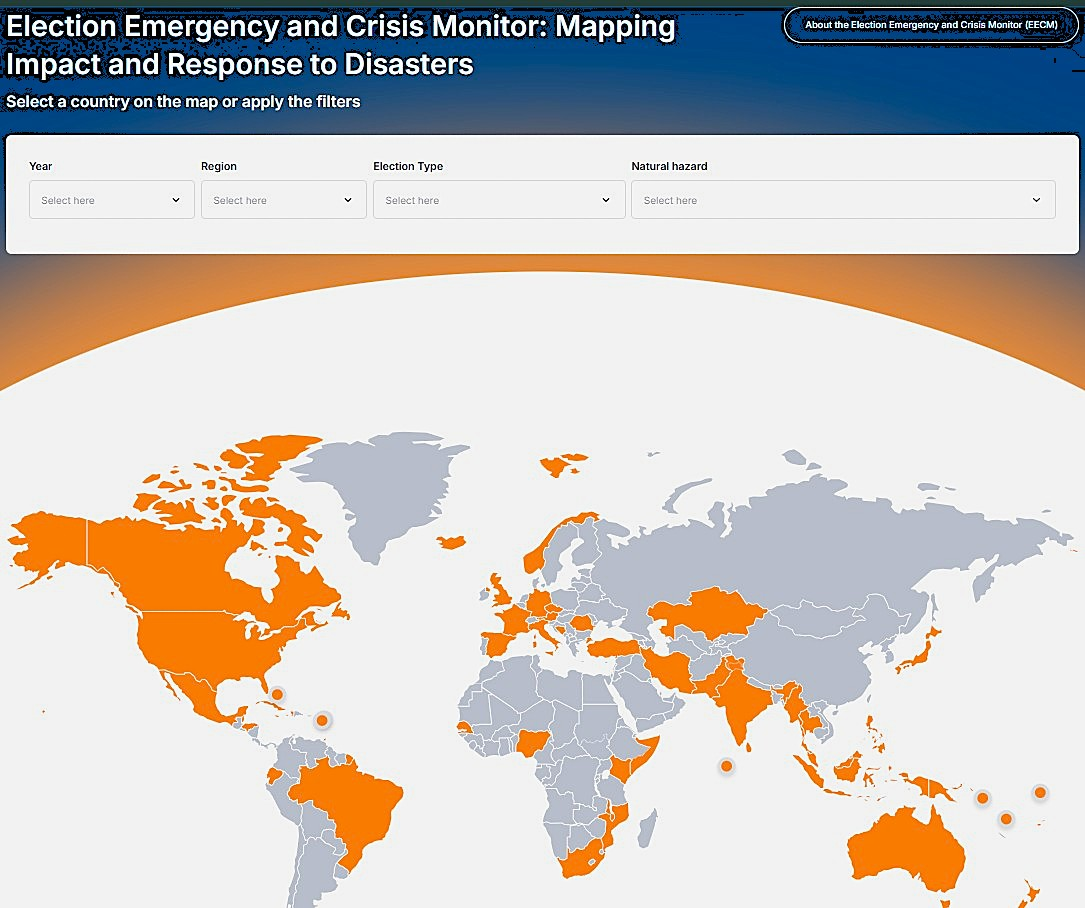
As of January 2026, this online Election Emergency and Crisis Monitor (EECM) resource contained more than 100 short briefs on primary, subnational, national and supranational electoral events and referendums in 52 countries that were affected by natural hazards between 2006 and 2025. Mining this rich resource reveals the multitude of different ways in which electoral processes can be shaped by forces in the natural world.
Chapter 2 (Protecting elections throughout the electoral cycle) turns to analysis of the various measures that countries have taken to protect their elections from natural hazards. This chapter, which is again structured around key phases of the election cycle, considers measures designed to safeguard electoral processes in the pre-election, electoral and post-election phases, presenting data from the findings of the 2024 Electoral Management Survey (James et al. 2025). The analysis finds that electoral actors have at their disposal a very wide range of procedures and strategies to ensure that elections are resilient in the face of hazardous conditions.
Chapter 3 (Conclusion and main findings) draws together insights from the comparative analyses in Chapters 1 and 2 and develops recommendations for policymakers and practitioners. Protecting elections from natural hazards will require concerted efforts both before and during crisis periods, as well as the development of new ways of working that integrate electoral administration into other spheres of activity such as emergency planning and disaster risk reduction. The chapter identifies a range of possible approaches that have been employed effectively in a variety of contexts and highlights remaining challenges in this sphere.
Following these 3 overview chapters, the text presents 13 in-depth case studies from countries around the world that are at elevated risk of natural hazards. Each case study describes in detail the impact on elections of specific events, such as earthquakes, tropical storms, floods, wildfires and heatwaves (see Figure I.3 and Table I.1).2 The case studies include an account of the effects of Tropical Cyclones Kenneth and Idai on the 2019 elections in Mozambique; an analysis of how wildfires impacted the 2023 elections in the Canadian regions of Alberta and the Northwest Territories; an assessment of the role of extreme heat in shaping electoral process at the time of the 2023 election in Mexico and the 2025 elections in the Philippines; consideration of the rains that affected the 2022 elections in Peru; an investigation into how an earthquake and a tropical storm combined to disrupt the 2010 election in Haiti; an assessment of the influence of Hurricane Sandy on 2012 electoral processes in the US states of New York and New Jersey; an overview of the effect of wildfires on 2016 and 2018 elections in the US state of California; a study of the electoral effects of flooding in the Australian state of Victoria in 2022; a survey of measures in place to protect Indian elections from natural hazards, with an afterword detailing how these measures helped to protect voting from a heatwave at the time of the 2024 elections; a report on the dual effects of Covid-19 and storm surges on the 2020 election in Indonesia alongside an afterword on floods and the 2024 elections, an assessment of the ways in which flooding and landslides affected the 2024 election in Bosnia and Herzegovina; and an evaluation of the effects of the 2023 earthquakes in Türkiye on the election that followed shortly thereafter.
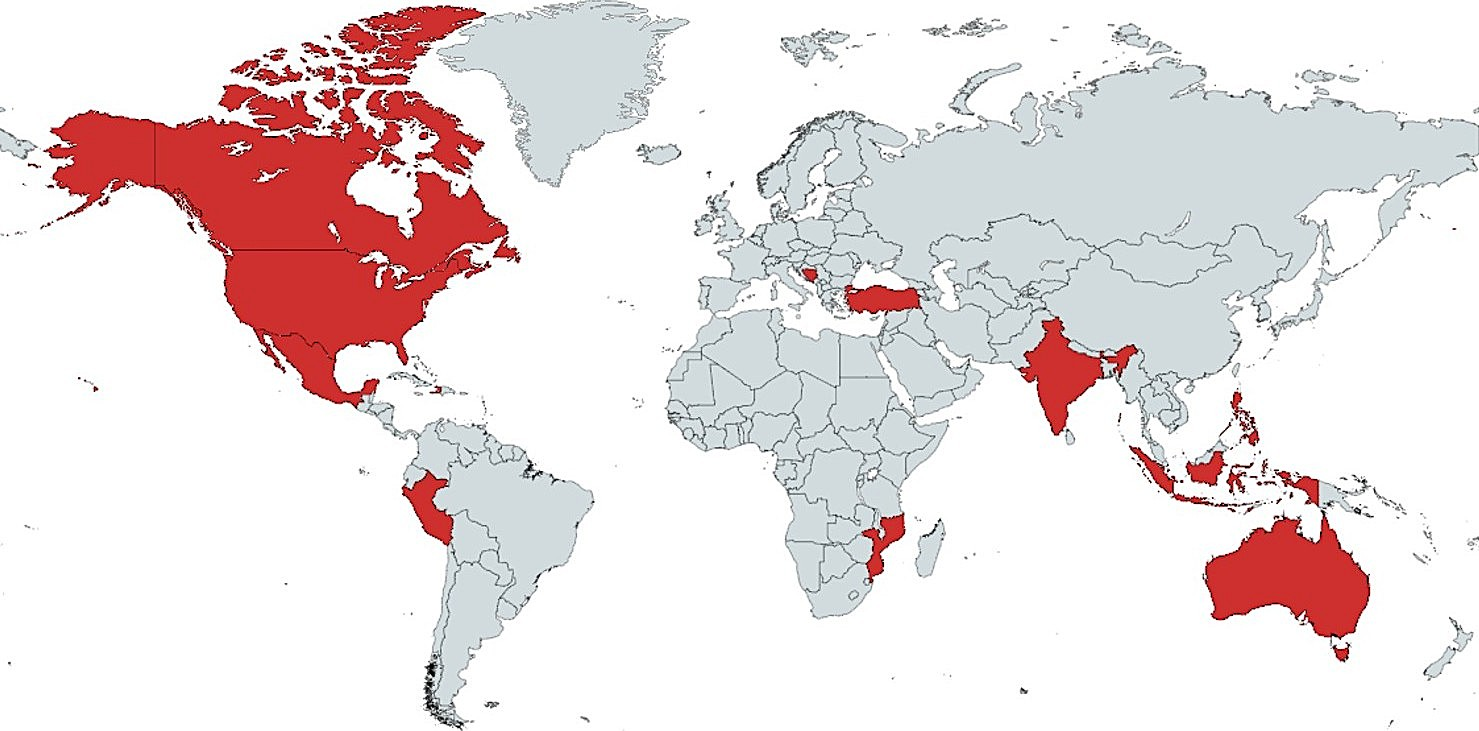
| Continent | Country | World Risk Index rank |
|---|---|---|
| Africa | Mozambique | 7 |
| Americas | Canada | 25 |
| Haiti | 54 | |
| Mexico | 5 | |
| Peru | 11 | |
| USA (2) | 19 | |
| Asia-Pacific | Australia | 23 |
| India | 3 | |
| Indonesia | 2 | |
| The Philippines | 1 | |
| Bosnia and Herzegovina | 141 | |
| Wider Europe | Türkiye | 35 |
These analyses address electoral disruptions wrought by natural hazards, with a focus on postponement, voter registration, campaigning, voting operations, voter turnout and electoral dispute adjudication. They also offer insights into the information environment in the aftermath of a disaster and electoral risks relating to disinformation. In addition, the case studies assess context-specific lessons learned on what election stakeholders can do to mitigate the threats discussed.
References
Alihodžić, S., Protecting Elections: Risk Management, Resilience-Building and Crisis Management in Elections, Discussion Paper 4/2023 (Stockholm: International IDEA, 2023), <https://doi.org/10.31752/idea.2023.44>
APS, ‘Podor: des déplacés de la crue du fleuve Sénégal ont pu voter (préfet)’ [Podor: People displaced by flooding of the Senegal River were able to vote (prefect)], 28 May 2025, <https://aps.sn/podor-des-deplaces-de-la-crue-du-fleuve-senegal-ont-pu-voter-prefet>, accessed 12 December 2025
E. Asplund (ed.), Election Emergency and Crisis Monitor: Mapping Impact and Response to Disasters, International IDEA, 12 November 2024 (and updated), <https://www.idea.int/election-dashboard-election-emergency-and-crisis-monitor>, accessed 12 December 2025
Asplund, E., Grace Prieto, N. and Lindemann, C., ‘Reducing the environmental impact of elections: Lessons from the Asia-Pacific’, International IDEA, 3 June 2024, <https://www.idea.int/news/reducing-environmental-impact-elections-lessons-asia-pacific>, accessed 12 December 2025
Bartels, M., ‘Why Hurricane Milton caused so many tornadoes’, Scientific American, 10 October 2024, <https://www.scientificamerican.com/article/why-hurricane-milton-caused-so-many-tornadoes>, accessed 12 December 2025
Birch, S., Electoral Malpractice (Oxford: Oxford University Press, 2011), <https://doi.org/10.1093/acprof:oso/9780199606160.001.0001>
—, ‘Extreme weather and electoral contention’, Journal of Peace Research, 62/4 (2025), pp. 1144–58, <https://doi.org/10.1177/00223433241279379>
Birch, S. and Martínez i Coma, F., ‘Natural disasters and the limits of electoral clientelism: Evidence from Honduras’, Electoral Studies, 85 (2023), <https://doi.org/10.1016/j.electstud.2023.102651>
Black, R., Kniveton, D. and Schmidt-Verkerk, K., ‘Migration and climate change: Towards an integrated assessment of sensitivity’, Environment and Planning A: Economy and Space, 43/2 (2011), pp. 431–50, <https://doi.org/10.1068/a43154>
Catt, H., Ellis, A., Maley, M., Wall, A. and Wolf, P., Electoral Management Design, rev. edn (Stockholm: International IDEA, 2014), <https://www.idea.int/publications/catalogue/electoral-management-design-revised-edition>, accessed 12 December 2025
Florini, K. and Hill, A., ‘Disenfranchised by Climate Change’, Climate Central, September 2024, <https://www.climatecentral.org/report/disenfranchised-by-climate-change>, accessed 30 December 2025
Fox, M., ‘As Brazil copes with floods, officials face another scourge: Disinformation’, Al Jazeera, 22 May 2024, <https://www.aljazeera.com/news/2024/5/22/as-brazil-copes-with-floods-officials-face-another-scourge-disinformation>, accessed 12 December 2025
Francken, N., Minten, B. and Swinnen, J. F. M., ‘The political economy of relief aid allocation: Evidence from Madagascar’, World Development, 40/3 (2012), pp. 486–500, <https://doi.org/10.1016/j.worlddev.2011.07.007>
Gasper, J. T. and Reeves, A., ‘Make it rain? Retrospection and the attentive electorate in the context of natural disasters’, American Journal of Political Science, 55/2 (2011), pp. 340–55, <https://doi.org/10.1111/j.1540-5907.2010.00503.x>
Global Commission on Elections, Democracy and Security, ‘Deepening Democracy: A Strategy for Improving the Integrity of Elections Worldwide’, September 2012, <https://www.idea.int/sites/default/files/publications/deepening-democracy.pdf>, accessed 12 December 2025
Hunter, L. M., Luna, J. K. and Norton, R. M., ‘Environmental dimensions of migration’, Annual Review of Sociology, 41 (2015), pp. 377–97, <https://doi.org/10.1146/annurev-soc-073014-112223>
Intergovernmental Panel on Climate Change (IPCC), Climate Change 2021 – The Physical Science Basis: Working Group I Contribution to the Sixth Assessment Report of the Intergovernmental Panel on Climate Change (Cambridge University Press, 2023), <https://doi.org/10.1017/9781009157896>
—, Climate Change 2022 – Impacts, Adaptation and Vulnerability: Working Group II Contribution to the Sixth Assessment Report of the Intergovernmental Panel on Climate Change (Cambridge University Press, 2023), <https://doi.org/10.1017/9781009325844>
International IDEA, The Protecting Elections Guide: The Guide to Knowing and Using the Integrated Framework for Protecting Elections (Stockholm: International IDEA, 2025), <https://doi.org/10.31752/idea.2025.80>
James, T., Garnett, H., Campion, S. and Caal-Lam, S., Electoral Management Survey 3.0, 2025, Harvard Dataverse, V1, <https://doi.org/10.7910/DVN/WE3RT2>
Leslie, P. A. and Arı, B., ‘Could rainfall have swung the result of the Brexit referendum?’, Political Geography, 65 (2018), pp. 134–42, <https://doi.org/10.1016/j.polgeo.2018.05.009>
Mo, C. H., Jachimowicz, J. M., Menges, J. I. and Galinsky, A. D., ‘The impact of incidental environmental factors on vote choice: Wind speed is related to more prevention-focused voting’, Political Behavior, 46 (2024), pp. 2723–27, <https://doi.org/10.1007/s11109-024-09923-z>
Mohan, V. and Roberts, H., Electoral Rights of Environmentally Displaced Persons (Arlington, VA: International Foundation for Electoral Systems, 2021), <https://www.ifes.org/electoral-rights-environmentally-displaced-persons>, accessed 19 March 2026
Nikolova, E. and Marinov, N., ‘Do public fund windfalls increase corruption? Evidence from a natural disaster’, Comparative Political Studies, 50/11 (2017), pp. 1455–88, <https://doi.org/10.1177/0010414016679109>
P. Norris, R. W. Frank and F. Martínez i Coma (eds), Advancing Electoral Integrity (Oxford: Oxford University Press, 2014)
Rowlatt, J. and Poynting, M., ‘Planet-warming gas levels rose more than ever in 2024’, BBC News, 16 January 2025, <https://www.bbc.com/news/articles/c30dn5dn53jo>, accessed 12 December 2025
Saulnier, D., Mani Dixit, A., Nunes, A. and Murray, V., ‘Disaster risk factors – hazards, exposure and vulnerability’, in World Health Organization, WHO Guidance on Research Methods for Health Emergency and Disaster Risk Management (Geneva: World Health Organization, 2021), <https://iris.who.int/server/api/core/bitstreams/4b46a78d-1399-4cbe-b86f-defbff52a0be/content>, accessed 12 December 2025
Thomas, V. and López, R., ‘Global Increase in Climate-Related Disasters’, Asian Development Bank, Working Paper No. 466, November 2015, <https://www.adb.org/sites/default/files/publication/176899/ewp-466.pdf>, accessed 12 December 2025
United Nations Development Programme (UNDP) and International Foundation for Electoral Systems (IFES), Elections for People and Planet: A Practical Guide to Managing Environmental Impacts and Risks of Electoral Processes (New York: UNDP, 2025), <https://www.undp.org/publications/elections-people-and-planet-practical-guide-managing-environmental-impacts-and-risks-electoral-processes>, accessed 12 December 2025
—, Sendai Framework for Disaster Risk Reduction 2015–2030 (UNDRR, 2015), <https://www.undrr.org/media/16176/download?startDownload=20250101>, accessed 12 December 2025
United Nations Regional Information Centre for Western Europe, Goal 13: Take Urgent Action to Combat Climate Change and Its Impacts, [n.d.a], <https://unric.org/en/sdg-13>, accessed 12 December 2025
—, Goal 16: End Poverty in All Its Forms Everywhere, [n.d.b], <https://unric.org/en/sdg-16>, accessed 12 December 2025
Walls, M., ‘Somaliland – Expert Briefing’, Africa Research Institute, [n.d.], <https://africaresearchinstitute.org/wordpress/somaliland-expert-briefing>, accessed 12 December 2025
World Economic Forum (WEF), The Global Risks Report 2025: Insight Report, 20th edn (Geneva: World Bank, 2025) <https://reports.weforum.org/docs/WEF_Global_Risks_Report_2025.pdf>, accessed 12 December 2025
World Meteorological Organization (WMO), ‘Weather-related disasters increase over past 50 years, causing more damage but fewer deaths’, 31 August 2021, <https://wmo.int/media/news/weather-related-disasters-increase-over-past-50-years-causing-more-damage-fewer-deaths>, accessed 12 December 2025
—, ‘WMO confirms 2024 as warmest year on record at about 1.55°C above pre-industrial level’, 10 January 2025, <https://wmo.int/news/media-centre/wmo-confirms-2024-warmest-year-record-about-155degc-above-pre-industrial-level>, accessed 12 December 2025
Erik Asplund, Sarah Birch and Ferran Martínez i Coma
The impact of natural hazards on electoral processes can severely affect the ability of electoral authorities to deliver an election. Not only do natural hazards put severe stress on a country’s electoral system, but they also strain election stakeholders. Any natural hazard can potentially affect election events, facilities, materials and people and therefore jeopardize the integrity of an election by potentially undermining equality of participation, contestation, opportunities for deliberation and certainty about the rules.
The most noticeable disruption that a natural hazard can cause involves damaged and destroyed polling places. Such disruptions may result in polling stations being reduced in size or moved, which may diminish voter access if voters are not informed about new locations or if those locations are difficult to reach. On some occasions, a disaster can disrupt the power supply needed for a voter registration facility or polling station to operate, resulting in last-minute changes in voting locations that are not effectively communicated to voters. Communication networks between election officials and with election stakeholders can also be disrupted, especially if telecommunications towers have been damaged or Internet service is not available. In many cases, roads leading to polling places can also be rendered inaccessible, potentially leaving many voters disenfranchised. Disasters can also damage or destroy electoral materials, including national identification cards, needed by voters to register or vote during an election. Disasters may also result in fatalities, missing persons and displacement of voters, thereby creating further administrative and logistical challenges to voter registration and voting processes. Foremost, natural hazards can significantly disrupt the planning of an election, forcing electoral management bodies (EMBs) to delay voter registration drives, electoral education campaigns, early voting or even election day itself. Such disruptions can undermine expectations concerning established election calendars and timetables, potentially leading contestants to question or reject election results.
Political campaigns, which enable genuine competition, may also be affected by natural hazards. For example, a campaign event held during a heatwave can pose health risks to voters, campaign staff and candidates. Alternatively, a heatwave can prompt a change in the timing of large-scale gatherings or the mode in which policies are communicated. Amid a flash flood, candidates may postpone or cancel campaign events to focus on humanitarian and relief efforts. Beyond the direct impact of natural hazards, malign online actors may try to capitalize on disruptions by sharing false or misleading information about government-led humanitarian relief efforts ahead of election day for political capital or to confuse voters on voting procedures or polling locations in the aftermath of a disaster.
Since 2006 at least 94 supranational, national, subnational and primary elections and referendums in 52 countries have been affected by one or more natural hazards (Asplund 2024; see also Annex B). In 2024 alone, at least 23 elections, at different levels, in 18 countries were impacted by extreme weather events such as tropical storms, floods, heatwaves, wildfires and other natural phenomena such as volcanic eruptions (Asplund 2022). Many of these natural hazards were exacerbated by climate change. The overall impacts of disasters on electoral processes were wide-ranging and depended to a large extent on the type of hazard, exposure to the disaster and the vulnerability of the exposed population.
This chapter provides a broad overview of the meteorological, hydrological, climatological and geophysical disasters that have affected elections between 2006 and 2025. It explores the type of hazards that have impacted elections and offers a brief overview of extreme weather events that are linked to climate change. The chapter also provides some insights into compound (or compounding) disasters as well as into how natural hazards can result in catastrophic human-made disasters.
The chapter goes on to identify natural hazards that have had an impact on one or more phases of the electoral cycle and how natural hazards can lead to the postponement of election activities, including election day. The chapter ends with an overview of the main findings and conclusions.
The Election Emergency and Crisis Monitor (EECM), launched in 2024 by the International Institute for Democracy and Electoral Assistance (International IDEA), represents the main point of reference for this chapter (Asplund 2024). As of writing, the EECM includes more than 100 briefs, covering 52 countries around the globe, which focus both on disasters’ broader impact on specific jurisdictions and on electoral processes during the period between 2006 and 2025. All the cases that make up the EECM were identified through a combination of media monitoring, Google alerts and literature reviews and were completed through desk research. The analysis in this chapter also benefits from the findings of the Electoral Management Survey completed in 2024 in 50 jurisdictions (James et al. 2025) and the country chapters in this book.
1.1. The impact of natural hazards on electoral processes
Based on the current EECM data, at least 94 elections and referendums, at different jurisdictional levels, in 52 countries have been affected by one or more natural hazards between 2006 and 2025 (see Figure 1.1 and Table A.1 in Annex A). In most instances, natural hazards affecting elections were local or regional in scope rather than country-wide. Natural hazards affected elections in low-, middle- and high-income countries, showing that they represent a threat to electoral processes in all countries around the globe regardless of their level of development.
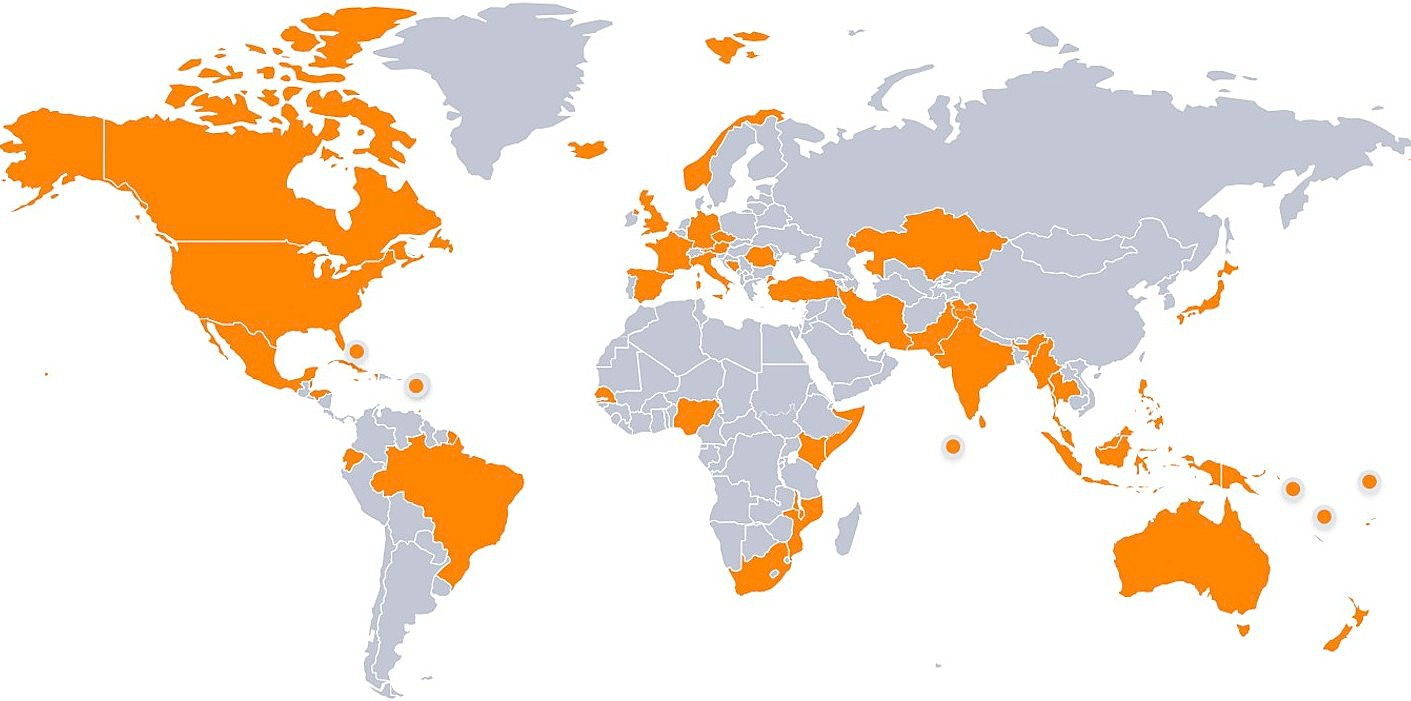
The 52 countries covered in the EECM represent 27 per cent of all the 193 countries recognized by the United Nations. This percentage is in line with survey findings from the 2024 Electoral Management Survey 3.0, which includes a question on whether any natural hazards other than Covid-19 had adversely affected elections in the respondents’ countries in the past five years. Thirteen (or 26 per cent) out of 50 respondents answered ‘yes’ to this question (see Table A.1 in Annex A).
Moreover, in the same survey, respondents were asked whether extreme weather events were impacting the work of their organization on an ongoing basis. In response, a respondent in 1 jurisdiction indicated ‘on a regular basis’, respondents in 3 jurisdictions indicated ‘often’, respondents in 16 jurisdictions indicated ‘occasionally’, and respondents in only 13 jurisdictions indicated ‘never’ (see Table A.2 in Annex A). These findings clearly show that extreme weather events are having an impact on the work of EMBs around the globe.
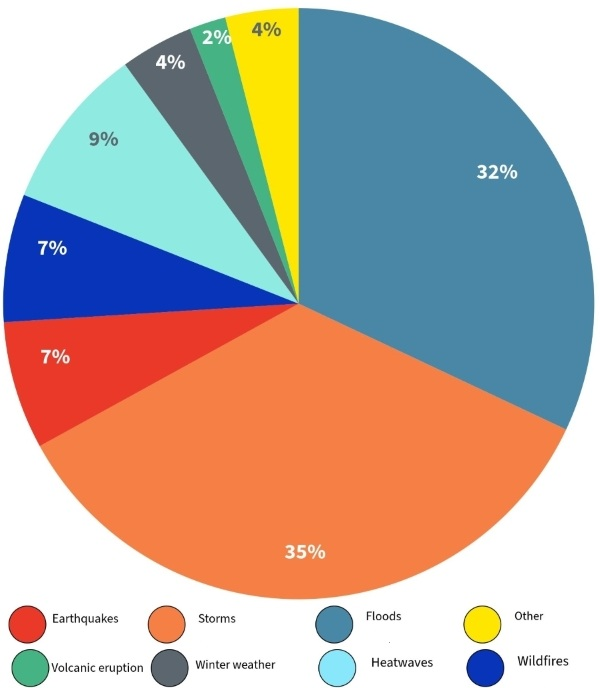
The most common hazard affecting elections is sudden or rapid-onset in character—that is, disruptions triggered by a hazardous event that emerges quickly or unexpectedly, such as a storm or a flood. Together, tropical storms and floods represent 67 per cent of all cases recorded in the EECM (see Figure 1.2). Other noteworthy hazard types that have affected elections, based on the EECM, include heatwaves (9 per cent), earthquakes (7 per cent) and wildfires (7 per cent). In addition to driving climate migration, slow-onset disasters, such as drought or sea-level rise, can also have a direct impact on elections.4 Typically, prolonged drought will make the impact of rapid-onset disasters such as floods worse. The same is true for sea-level rise, which increases the frequency and intensity of coastal flooding from storms. Rapid-onset disasters, such as storms, floods, heatwaves and wildfires, and their adverse effect on affected elections are addressed in more detail throughout this chapter.
A cross-cutting consequence of these hazards is population displacement, with direct effects on voter access and electoral administration. Rapid-onset events such as floods, storms, landslides and wildfires can force evacuations that separate voters from their assigned polling stations; many then move to temporary shelters, schools, public buildings or informal settlements where electoral infrastructure and registration services are limited or absent, creating ad hoc disenfranchisement. Slow-onset change has more enduring consequences: progressive land loss, salinization, desertification and sea-level rise drive out-migration from coastal or drought-affected areas, reshaping voter distribution and, at times, electoral districts (Spinelli forthcoming 2026).
1.1.1. Storms
At least 34 elections in 24 countries5 were affected by one or more severe storms (including cyclones, hurricanes and typhoons) between 2006 and 2025.6 Recent examples include the impact of Hurricanes Helene and Milton on the 2024 presidential election in the USA. Hurricane Helene alone caused at least 250 fatalities in six south-eastern US states (Florida, Georgia, North Carolina, South Carolina, Tennessee and Virginia), 95 of which were the result of flooding, landslides and debris flows, while the others were caused primarily by high winds, falling trees and structural collapses (Harty and Asplund 2024; Erdman 2025). The devastation caused by the hurricanes, both of which underwent rapid intensification—a phenomenon where a storm’s wind speeds increase significantly over a short period—damaged and destroyed critical infrastructure, including election facilities and materials in key swing states, leading to the activation of contingency plans (Cooper et al. 2025; Kolenovsky and Despa 2024). Witness testimony from the US Congress provides insights into the impact of Hurricane Helene on the administration of elections in North Carolina (United States Congress 2025; see also Box 1.1).
Box 1.1. Hurricane Helene and the 2024 US presidential election
‘The week that Helene struck, we had just started sending out absentee-by-mail ballots, which had been delayed because of a candidate withdrawal dispute. On Monday, September 30th, 14 county election offices were unable to open as scheduled, and we had limited ability to communicate with local election officials and their staff. In some cases that week, we did not know if the elections staff were okay or not. Cell phone towers were down. There was no power and no internet. Since analog phone lines are mostly obsolete and email requires working computers or smart phones, communication from county to county or across the state was difficult and even non-existent in some circumstances. In the first 24 hours, the State Emergency Management Director and I were on the phone. He made it clear that State Emergency Management (NCEM), in the midst of their rescue efforts and standing up essential services, understood that elections were underway and would be supported just like other critical infrastructure. He had already taken steps to designate elections as a priority because of the proximity of in-person early voting starting in less than 20 days, their understanding that absentee ballots still had go out and be received, and that voter registration was at its peak. Over the first few days, NCEM provided resources to ensure voting could continue, and we conveyed this to North Carolinians as early as the second business day after the storm passed – the election would happen and voters would be able to vote. Through NCEM, FEMA [the Federal Emergency Management Agency], and the state’s emergency fund, we were immediately provided with the financial, personnel, and logistical resources that we did not have in our operating budget. This fulfillment was so seamless, I even conveyed this to the legislative staff when asked in the first few days what resources were needed. As a relief package was put together in October, we requested approximately USD 2.5 million, and the legislature authorized USD 5 million. Because so much was supported through NCEM and FEMA, we only needed approximately USD 500,000 of the legislative funding to ensure those impacted by the hurricane could vote safely and securely.’
Another notable example is Storm Boris, which caused unusually heavy rainfall in Austria and Czechia in September 2024, when both countries were preparing for elections. In Austria, political parties postponed or cancelled campaign events to focus on emergency and relief efforts, while, in Czechia, polling stations were moved to tents, to shipping containers or into the open air when the schools that were initially designated as polling stations were submerged and damaged (AP News 2024; Murphy 2024).
The Intergovernmental Panel on Climate Change predicts that, while the total number of tropical storms will decrease or remain the same, the proportion of intense storms will increase (IPCC 2021). This finding suggests that authorities will need to keep a close eye on storms that could rapidly intensify in a very short period of time, moving from a category one storm to a category three storm, for example, in hours rather than days.
1.1.2. Floods
At least 33 elections, at different levels, have been affected by floods between 2014 and 2025 in 24 countries.7 Floods are by far the most common natural hazard and often have considerable adverse effects on society (WMO 2025c), and experts from the World Meteorological Organization see ‘no end’ to floods and storms as global temperatures rise (UN News 2025b).
Recent examples include the Ecuadorian presidential election in April 2025, which was affected by flooding in the coastal region and southern part of the country. As a result, 24 polling stations were reallocated to serve as shelters for displaced people, and some polling stations were deemed unfit because of damage caused by the floods (Primicias 2025a, 2025b).
Another example is the flooding that took place during the parliamentary election in Senegal in November 2024. Both the 1,086-kilometre-long Senegal River and the 1,120-kilometre-long Gambia River overflowed their banks due to torrential rains that fell throughout October 2024, submerging entire villages and forcing 56,000 people to leave their homes. Ahead of the election, the EMB worked closely with the Civil Protection Agency and the National Fire Brigade to avert disenfranchisement among the displaced (Gueye 2024).
In the state of Rio Grande do Sul, Brazil, floods in April and May 2024 devastated several cities and resulted in the deaths of at least 170 people and the displacement of 386,000 more, triggering a state of emergency (Correio do Povo 2024; Deutsche Welle 2024; UN OCHA 2024). The floods also damaged voting machines and disrupted voter registration ahead of the October municipal elections. In-person biometric registration services at electoral offices were forced to close due to the floods, and the loss of electronic voting machines led to a discussion within the Superior Electoral Court (Tribunal Superior Eleitoral) about postponing the election in the state (Brígido 2024; UOL Notícias 2024).
1.1.3. Heatwaves
At least 10 elections have been affected by heatwaves between 2022 and 2025 in 8 countries.8 Recent examples include the 2025 New York mayoral primary election (Small 2025), which was held amid an early-summer heatwave with maximum temperatures of between 37°C and 39°C. The EMB made several procedural changes to address the public health risk, including distributing water and portable fans at polling stations and coordinating with utility providers to ensure a stable power supply at all polling stations throughout New York. Despite the heat, the elections took place as planned, with some isolated incidents of equipment malfunctioning at some polling stations due to humidity causing ‘ballots to stick together’ and ‘signal issues with scanners’ (McCarthy, Andrews and Propper 2025).
Similar problems with election materials, due to heat and humidity, were identified in the Philippines during the 2025 general election. Some of the vote counting machines used in Metro Manila on election day overheated and ejected ballots that they had previously accepted (Antalan 2025). Moreover, there was one report claiming that the colour, and thus the effectiveness, of the ink used for voter identification was affected by high temperature (see Chapter 13: The Philippines). Sometimes described as silent killers, heatwaves can also harm voters and polling station officials. For example, one person died at a polling station in Oas, in the province of Albay, when casting his vote, and six people collapsed while queuing to vote in Cotabato province (Magbanua 2025; Mier-Manjares 2025).
During the last days of India’s seven-phase national election of 2024, temperatures of above 45°C were recorded, leading to the deaths of at least 33 temporary polling officials on the same day in Uttar Pradesh because of heat-related illnesses (Dash 2024). Voters also fell ill or died of heatstroke despite the efforts of the Election Commission of India and the National Disaster Management Authority to introduce numerous health and safety measures (Mishra 2024; see also Chapter 8: India).
The year 2024 (referred to as the super-cycle election year due to the large number of elections held) was confirmed as the warmest year on record, with the annual average temperature exceeding 1.5°C above pre-industrial levels for the first time (Rowlatt and Poynting 2025; WMO 2025a), which could be the reason why so many elections around the globe, including in Mexico (see Chapter 10: Mexico), were adversely affected by heatwaves. According to a 2025 report from the World Meteorological Organization (2025b), ‘Global climate predictions show temperatures are expected to continue at or near record levels in the next five years, increasing climate risks and impacts on societies, economies and sustainable development’.
1.1.4. Wildfires
Wildfires (also known as bushfires, forest fires or firestorms) are typically described as long-term and migrating disasters, as they can spread over large areas depending on the topography, available fuel and weather conditions (wind and heat). Between 2016 and 2025, at least seven elections were affected by wildfires in Canada and the USA. In the latter, wildfires disrupted several national elections (see Chapter 15: USA, California), but the most recent case was the presidential primary election in Texas in March 2024. A series of fires lasting from February to March 2024 in north-western counties burned millions of hectares of land, destroying homes, businesses and infrastructure. The Smokehouse Creek fire, the second-largest in US history, was declared a disaster by the Texas governor only weeks before election day. Despite nearby fires, the election went ahead as planned, with some changes to the location of polling stations because of fire threats and power outages (Oliva and Kessler 2024).
Another recent example includes the 2023 subnational elections in the Canadian province of Alberta and the Northwest Territories. At the time, Canada was experiencing one of the worst wildfires on record. In Alberta, a state of emergency was declared, and some elected officials called for the election to be postponed. In the end, the election took place on schedule but included special voting arrangements for 29,000 Albertans affected by an evacuation order (see Chapter 6: Canada). In the weeks leading up to election day, 65 per cent of the residents of the Northwest Territories were evacuated because of the wildfire. In the end, the election in the Northwest Territories was postponed by six weeks due to large-scale evacuation and safety concerns.
Wildfires, which are occurring earlier in the year and lasting longer than in the past due to rising temperatures and drought, are a concern for the administration of elections, and therefore moving election day to a period when wildfires are less likely to occur could reduce the risk. Elections Alberta has taken such a step, moving the fixed election date from May, during wildfire season, to October. The move will take effect in 2027.
1.1.5. Climate attribution science
Climate attribution science provides evidence on whether, and to what extent, human-induced climate change has affected the likelihood of specific weather events (Florini and Hill 2024). According to Climate Central, a US-based group of independent scientists and communicators, ‘the climate fingerprint on elections is increasingly obvious—and quantifiable’ (Florini and Hill 2024: 3). Reports by World Weather Attribution have identified several extreme weather events attributable to climate change. Notably, at least 10 of these events occurred during 2024 election periods (see Box 1.2). Examples include Hurricane Helene and Hurricane Milton, which affected the US presidential election; heatwaves in Asia that impacted the general election in India and the Maldives, as well as heatwaves in North and Central America that affected elections in Mexico; and floods in Europe that impacted national and regional elections in Austria and Czechia, as well as floods in southern Brazil (WWA 2024a, 2024b, 2024c, 2024d, 2024e, 2024f). This quantifiable evidence shows how climate change is having a tangible impact on elections around the world.
Box 1.2. The impact of natural hazards during the 2024 super-cycle election year
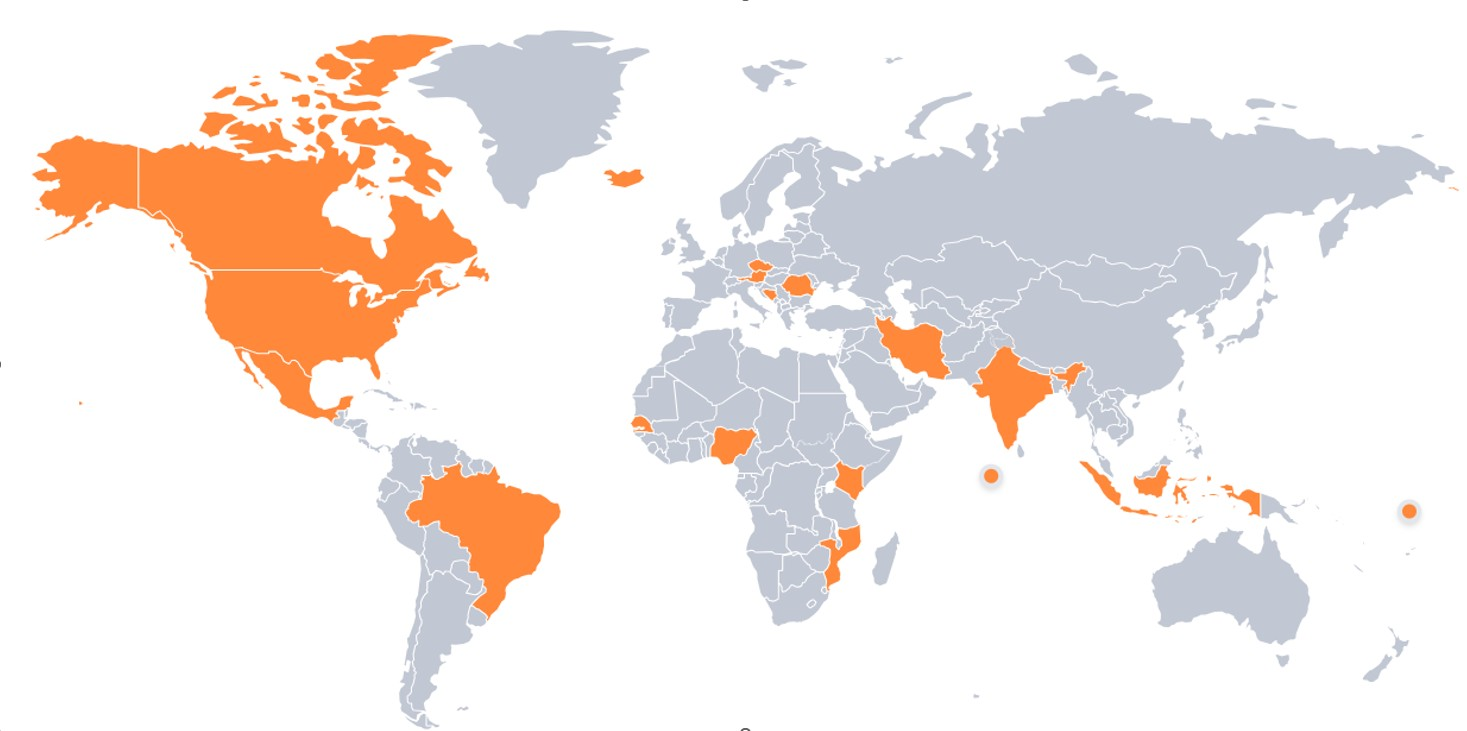
During the 2024 super-cycle election year, at least 23 elections—including primary, subnational, national and supranational polls—in 18 countries were affected by natural hazards, impacting millions of voters around the world (see Figure 1.3). In some instances, different types of natural hazards affected multiple elections in the same country. This was the case in Austria, Indonesia and the USA. In Indonesia, for example, during the February general election, severe floods delayed polling in several villages in Demak and North Jakarta (Al Hamasy 2024; Utami 2024). During November regional elections in Indonesia, floods, landslides and a volcanic eruption affected polling in different parts of the country (Dewi Purnamasari 2024; The Jakarta Post 2024). In the USA, multiple hazards adversely affected elections at different stages of the electoral cycle, including extreme cold, wildfires, heatwaves, hurricanes and floods during four separate elections, including the presidential election (Asplund et al. 2025). These findings from the EECM illustrate the magnitude of the challenge that many electoral stakeholders faced in 2024.
1.1.6. Compound hazards
Electoral processes can be further disrupted when a country is facing simultaneous or sequential crises and emergencies, often called compound hazards or multiple interacting hazards (Birch and Martínez i Coma 2023). Between 11 March 2020 and 5 May 2023, at least 17 countries held 25 national and local elections amid a natural hazard while also addressing disruptions caused by the Covid-19 pandemic (Asplund 2024). For example, Indonesia was affected by a tropical cyclone, floods (made worse by sea-level rise) and the Covid-19 pandemic during 2020 local elections (see Chapter 9: Indonesia). The Australian state of Victoria suffered serious floods only six weeks before the state election in 2022, further complicating preparations for an election that also included extraordinary public health and safety measures to reduce the transmission of Covid-19 (see Chapter 4: Australia, Victoria). Likewise, the Bihar state election in India was held amid floods and the Covid-19 pandemic (see Chapter 8: India).
Certain disasters, such as earthquakes and hurricanes, can create conditions that significantly increase the risk of outbreaks of cholera and other infectious diseases, through water contamination and disruption of sanitation. Such outbreaks occurred in Mozambique ahead of the 2019 general election (see Chapter 11: Mozambique) and in Haiti ahead of the 2010 presidential and legislative elections, which were postponed for 10 months (see Chapter 7: Haiti).
Natural hazards can also trigger human-made disasters. For example, an earthquake under the seabed near Japan in 2011 unleashed a tsunami that interrupted the power supply to a nuclear power plant, which in turn resulted in the Fukushima nuclear catastrophe. Beyond the immediate destruction caused by the tsunami, Fukushima was evacuated due to the radiation levels, impacting all activities related to the 2011 local elections, including an eight-month delay for Fukushima’s local election (see Box 1.3). Additionally, the 2024 local elections in Bosnia and Herzegovina and the 2006 municipal and mayoral elections in New Orleans, Louisiana, in the USA, were affected by natural and human-made hazards (Christian 2007). A landslide triggered by heavy rains and floods buried a Bosnian settlement in the Jablanica municipality under debris, including rocks from a quarry, making it impossible to hold elections as planned (see Chapter 5: Bosnia and Herzegovina). Hurricane Katrina, which in August 2005 destroyed artificial levees in New Orleans, flooded much of the city, resulting in mass evacuations among residents and contributing to the postponement of the elections from December 2005 to April 2006 (Brox 2009).
Box 1.3. Compound hazards: Japan’s 2011 unified local elections
On 11 March 2011, a 9.0-magnitude earthquake occurred in the Pacific Ocean, 72 km east of the Oshika Peninsula. The earthquake caused a large tsunami that devastated many coastal areas, notably in the Tohoku region. The tsunami further resulted in a major nuclear accident at the Fukushima Daiichi Power Plant, damaging backup generators and leading to partial meltdowns of the fuel rods. On 11 March 2011 Prime Minister Naoto Kan declared a state of emergency around Fukushima’s plant No. 1. Residents within a 4 km radius were told to evacuate, and an estimated 3,000 residents moved out (Deutsche Welle 2011; McCurry 2011a). It is estimated that around 18,500 people were killed in the aftermath of the earthquake and tsunami. Four years after the disaster, some 230,000 people were still displaced, many due to the continued enforcement of the evacuation zone around the Fukushima plant.
Impact on the electoral process
The unified elections took place on 10 and 24 April 2011. However, elections in certain municipalities hard-hit by the earthquake and tsunami were postponed until August, September and November 2011, including the Sendai city council election (postponed until 28 August), the Iwate prefectural governor election and council election (11 September), the Miyagi prefectural assembly and parliamentary elections (13 November) and the Fukushima prefectural assembly election (20 November).
Voter registration before the election was difficult because of population displacement. Voter registration in Japan is decentralized and automatic, meaning that polling officials do not need to assess individual voters’ eligibility. However, voter registration is based on other civic registration systems (family and residence) that were disrupted by the disaster. Coastal municipalities therefore improvised voter registration, including by mail. Since many municipalities had lost personnel, implementing these measures required the involvement and coordination of many local governments (Kawamura 2012).
Political information, including on candidates, was not widely available for voters from the disaster areas. Again, municipalities improvised new systems, such as mailing information to voters. Some put election information on their websites; however, connectivity was poor in the temporary housing for displaced persons. Evacuees (some of whom were elderly and with limited mobility) were encouraged to vote early; some municipalities set up mobile early-voting stations for temporary housing complexes or multiple early-voting stations. In Fukushima prefecture, town hall functions were relocated 200 km away to Kazo, in the Saitama prefecture. These functions included vote counting, which was conducted for the first time ever outside of the prefecture where the election was taking place (Kawamura 2012).
Such changes were possible within the existing legal framework, which allows the central government (Ministry of Internal Affairs and Communications), which retains the right to interpret all electoral laws and regulations, to issue instructions on electoral management in addition to the normally decentralized operations. The disaster spurred some discussion about reform, including the potential benefits of e-voting (Kawamura 2012).
Some displaced voters failed to replace their residence cards—in the expectation of returning home—before election day and were thus unable to vote (Kawamura 2012). The reduction in polling stations created a spike in the number of absentee ballots; the authorities extended the official campaign period by several days to allow displaced residents to make their decision and submit their ballot papers (McCurry 2011b). According to one study, the disaster resulted in a 6 per cent increase in participation in political groups in heavily affected regions and a 2.5 per cent increase in turnout. Individuals motivated to vote by the disaster and response conditions are thought to have been those with large social networks (Jenkins 2019).
1.3. The impact of natural hazards on different phases of the electoral cycle
Natural hazards have the potential to disrupt elections throughout the electoral cycle, including during critical phases related to voter registration, electoral campaigns, voting operations and verification of results (see Figure I.1). Moreover, a hazard can also lead to the postponement of an election. The level of disruption is dependent on several factors. Beyond the type, duration, scale and intensity of the hazard, two key factors include the vulnerability of exposed communities and local adaptive capacity (Rydén et al. 2024). In addition, for electoral administrators, the timing of a disaster in relation to the election calendar will be very significant for contingency planning.
This section of the book explores each of these critical phases in more detail, starting with examples of when elections were postponed in whole or in part. It also provides anecdotal evidence of criticism directed against EMBs for decisions—to hold or postpone elections or whether or not to move polling stations—made during a disaster. Such decisions demand clear and open communication during a crisis or emergency.
1.2.1. Postponing an election due to a natural hazard
In some cases, the impacts of a natural hazard are greater than an EMB can mitigate, resulting in the postponement of an election, as mandated by the country’s electoral legal framework. In total, 26 national, local and primary elections and referendums were postponed in whole (13) or in part (13) between 2006 and 2025 in 22 countries (see Table 1.1). Rapid-onset disasters such as tropical storms and earthquakes were the main reason for the postponement of an entire election. This may not be surprising given that these disasters took place in relatively small island states (Haiti, Jamaica, Cuba, Tuvalu and Vanuatu) where the entire country was exposed to the hazard. Other cases included Honduras (LADB 2008) and specific jurisdictions, such as the Northwest Territories, in Canada (see Chapter 6: Canada), New South Wales, in Australia (The National Tribute 2020), and the state of Louisiana, in the USA (Thomas and Heyen 2021), which faced disasters within their respective regions. The length of the delay varied considerably and depended on the severity of the disaster, its proximity to election day and other factors.
| Country, year and election type | Natural hazard | Postponed (as a whole) | Postponed (in part) | Length of delay (days) |
|---|---|---|---|---|
| Jamaica, 2007 general election | Tropical storm | Yes | 7 | |
| Myanmar, 2008 constitutional referendum | Tropical storm | Yes | 14 | |
| Honduras, 2008 primary elections | Tropical storm | Yes | 14 | |
| Haiti, 2010 presidential and legislative elections | Earthquake | Yes | 273 | |
| Japan, 2011 unified elections | Earthquake and tsunami | Yes | 140–223 | |
| Philippines, 2013 village (barangay) elections | Earthquake | Yes | 28 | |
| Tuvalu, 2015 general election | Tropical storm | Yes | 12 | |
| Haiti, 2016 presidential election | Tropical storm | Yes | 42 | |
| Cuba, 2017 municipal elections | Tropical storm | Yes | 35 | |
| Fiji, 2018 general election | Floods | Yes | 3 | |
| India, 2019 Odisha State Assembly election | Tropical storm | Yes | 21 | |
| Papua New Guinea, 2019 local government elections | Volcanic eruption | Yes | 16 | |
| Vanuatu, 2020 general election | Tropical storm | Yes | 1 | |
| Australia, 2020 New South Wales council elections | Drought, wildfires, Covid-19 | Yes | 447 | |
| Somalia, 2021 Somaliland parliamentary and local elections | Various reasons, including drought | Yes | 2,190 | |
| Malaysia, 2022 general election | Floods | Yes | 2 | |
| USA, 2022 Louisiana statewide local elections | Tropical storm | Yes | 35 | |
| Thailand, 2023 general election | Storm | Yes | 7 | |
| Pakistan, 2023 local government elections in Sindh | Floods | Yes | 177 | |
| Canada, 2023 Northwest Territories general election | Wildfire | Yes | 42 | |
| Indonesia, 2024 general election | Floods | Yes | 4 | |
| Indonesia, 2024 local elections | Floods | Yes | 4 | |
| Bosnia and Herzegovina, 2024 local elections | Floods | Yes | 14–28 | |
| Kenya, 2024 Orange Democratic Movement grass-roots election | Floods | Yes | 215 | |
| Vanuatu, 2025 general election | Earthquake | Yes | 2 | |
| India, 2025 Punjab Zila Parishad (district-level rural council) and Panchayat Samiti (block council) elections | Floods* | Yes | 197 |
The postponement of complete elections varied from two days (which was the case in Vanuatu ahead of the 2025 general election) (K. Hawkins 2025) due to an earthquake to as long as six years (in Somaliland ahead of the 2021 parliamentary and local elections) due to a combination of reasons, including drought (Asplund n.d.a). Other illustrative examples include Haiti, which first postponed its 2010 presidential and legislative elections for 242 days because of an earthquake (see Chapter 7: Haiti) and then the 2016 presidential election for 42 days due to a hurricane (BBC 2016). Haiti shows how the same jurisdiction can delay an election for different durations, depending on the hazard, exposure, vulnerability, and capacity to respond to and recover from the hazard itself.
In many instances, rather than postponing an entire election, EMBs will suspend voting in particular municipalities or at specific polling stations, taking into account humanitarian and logistical considerations. Such targeted suspensions took place in 13 countries holding elections, for different offices, between 2007 and 2025. For instance, local elections in five municipalities in Bosnia and Herzegovina were postponed in October 2024 due to flooding and landslides, for periods of 14–28 days, affecting 63,180 registered voters (see Chapter 5: Bosnia and Herzegovina). During Malaysia’s 2022 general election, voting was suspended for 2 days at 11 polling stations in the Sarawak parliamentary constituency of Baram, affecting approximately 6,000 registered voters, until it was safe for front-line election officials and voters to reach flooded polling locations (Ringgit 2022; Yeong 2022). In Indonesia, flooding led to the temporary closure of several polling stations on election day during the 2024 local elections. Plaintiffs representing candidates in the city of Medan rejected the results of the election on the grounds that the flooding had affected nine subdistricts, preventing citizens from voting on schedule. As a response, the EMB held elections in all of the 56 polling stations that had been temporarily closed, although this did not stop the plaintiffs from requesting a rerun of the election on the grounds that the change of date had not been effectively communicated to voters as indicated by the low voter turnout (see Chapter 9: Indonesia).
Several countries have legal provisions allowing elections to be rescheduled in whole or in part in the aftermath of a disaster. Bosnia and Herzegovina’s election law (Chapter 14, article 14.2) gives the EMB the power to postpone an election at a particular polling station or in a particular constituency for up to 30 days (Bosnia and Herzegovina n.d.; see also Chapter 5: Bosnia and Herzegovina). Many US states have the option of postponing elections under specified circumstances (McKeever 2020; NCSL 2024). In other countries, the head of state has the power to issue decrees, often through the mechanism of a state of emergency (Bulmer 2018). In Mauritius, the Representation of the People Act 1958 has sections for extreme weather that permit the president—after consultation with the Election Commission and the prime minister—to postpone polling and counting and to change polling or counting stations to limit disruptions to the electoral process (Republic of Mauritius 2016).
Election postponement decisions can raise concerns about the integrity of democratic processes. Clear postponement guidelines, agreed and set in advance, can provide much-needed institutional certainty. When facing natural hazards, certain flexibility—after establishing criteria regarding the circumstances, duration and competent authority for a postponement (which, in some jurisdictions, may be constitutionalized)—can strengthen democratic rights protections and decrease the likelihood of postponement and manipulation for political gain (James and Alihodzic 2020; James, Clark and Asplund 2023). Any decision to postpone—and in some cases not to postpone—an election after a humanitarian catastrophe requires transparent communication to the public and other stakeholders in order to preserve electoral legitimacy.
In some cases, efforts to legitimize authoritarian rule take precedence over humanitarian assistance or democratic considerations. This was the case ahead of the 2008 Myanmar constitutional referendum, which was held on schedule despite protests among opposition voices and independent media related to the need to focus on humanitarian relief efforts following the devastation caused by Cyclone Nargis, which killed more than 80,000 (see Box 1.4). Similar concerns emerged ahead of the December 2025 general election in Myanmar despite the devastation caused by two major earthquakes, with an official death toll of more than 3,000 (Strangio 2025), and the ongoing armed conflict that has resulted in thousands of deaths and 3.5 million displaced (AFP 2025; Mishra 2025). Similarly, the decision to continue the preparations for the March 2024 general election in Iran’s Sistan and Baluchestan province was criticized by citizens, ‘accusing authorities of neglecting flood victims in favour of political pursuits’ (Iran International 2024).
Box 1.4. Myanmar constitutional referendum, 10 May 2008
Cyclone Nargis struck Myanmar on 2–3 May 2008, making landfall in the Ayeyarwady Delta with wind speeds of over 200 km/h and a storm surge rising nearly 4 m inland (International Medical Relief n.d.). In the immediate aftermath, the official death toll stood at 84,537, with a further 53,836 reported missing and around 20,000 injured (DPA 2008). In total, approximately 2.4 million people were severely affected, many of whom lost family members, homes, food reserves, livestock and livelihoods. Of the 7.35 million residents living in the most affected townships, such as Bogale, Labutta, Pyinsalu and Yangon, nearly a third were directly impacted (International Medical Relief n.d.). The destruction of farmland, food reserves and livestock created an immediate threat of famine and long-term food insecurity (International Crisis Group 2008).
Impact on the electoral process
On 6 May 2008 the military government announced that a constitutional referendum would take place as planned on 10 May for most of Myanmar. Opposition voices and independent media criticized the government’s insistence on holding the referendum amid a humanitarian catastrophe. A representative of the media organization Democratic Voice of Burma commented: ‘They [the State Peace and Development Council] would be very stupid to go ahead with it. Thousands of people are dying or missing. It is very difficult to get around or get food and water. How can people vote?’ (Martin and Margesson 2008). International non-governmental organizations also called for postponement, arguing that all state capacity should be devoted to disaster relief rather than political consolidation (Human Rights Watch 2008).
At the time, Myanmar’s legal framework allowed for some procedural flexibility in the face of natural disasters. Under such circumstances, article 20 of the February 2008 Referendum Law empowered township subcommissions to postpone voting at specific polling stations or across entire areas (Thomas 2008). This provision made it possible to delay the referendum in the regions hardest hit by the cyclone (townships surrounding Yangon and seven townships in the Irrawaddy region), allowing the government to proceed with the process in a phased manner (Martin and Margesson 2008). The 47 townships that did not hold the referendum on 10 May were scheduled to conduct it on 24 May 2008 (Mizzima News/Nay Thwin 2008).
The floods impacted the organization of the referendum but not the military’s behaviour. On 15 May 2008 authorities claimed a turnout of 99 per cent in the areas where voting took place—a figure widely condemned as fraudulent (Human Rights Watch 2008). The military government went on to claim that over 26.8 million had participated in the referendum, with 92.48 per cent voting in favour of adopting a new constitution (ILO 2008). Commentators condemned the referendum as a sham designed to reinforce the 46-year rule of Myanmar’s military, as the draft constitution guaranteed the armed forces a quarter of all parliamentary seats (MacKinnon 2008).
On the day before the referendum, a truck circulated through villages near Yangon, the capital, promoting the referendum and offering free transport to villagers who lived too far to walk to the nearest polling station (Time 2008). When voting took place, reports of irregularities and coercion were widespread. According to Human Rights Watch, the referendum was conducted under conditions of official intimidation, with voters followed into polling booths, ‘no’ votes discarded and polling staff threatened with dismissal if their stations returned unfavourable results (Human Rights Watch 2008). Some voters reported arriving at polling stations as they opened, only to find ballot boxes already filled with ‘yes’ votes, which officials attributed to so-called advance votes (MacKinnon 2008).
1.2.2. The impact of natural hazards on the voter registration phase
The EECM identified 27 instances where natural hazards disrupted voter Table 1.1. or materials. Examples include Haiti’s 2010 presidential and legislative elections, Türkiye’s 2023 presidential and legislative elections and Mozambique’s 2019 general election.
Ahead of Haiti’s 2010 elections, the Provisional Electoral Council (the EMB) was not able to remove from the voter rolls the 250,000 voters who had died during the 12 January 2010 earthquake. This failure was because the voter register was maintained by a separate authority (the National Identification Office), which required the issuance of a death certificate before a name could be removed. Moreover, the Provisional Electoral Council was not able to effectively administer so-called polling reallocation requests, especially among voters residing in camps for internally displaced persons. The inability to update the voter register in combination with the low level of trust in the Provisional Electoral Council (its reputation had been seriously damaged by fraud-marred Senate elections in June 2009) called the integrity of the elections into question. Moreover, shortcomings in efforts to register and provide polling stations for internally displaced persons likely contributed to the low voter turnout of 22.9 per cent, in particular in the capital and adjacent areas where the number of displaced voters was the greatest (see Chapter 13: Haiti).
Similarly, the voter list ahead of Türkiye’s May 2023 legislative election included voters who were missing due to the 6 February earthquakes but who had not been declared deceased, impacting the accuracy of the voter register. Moreover, the 2 million voters affected by the earthquake were not given sufficient time to change their address to their new location and therefore could vote only by returning to their previous address (OSCE/ODIHR 2023). Both issues and ineffective efforts by the Supreme Election Council (the Turkish EMB) to communicate with the public led to serious problems in compiling voter rolls (see Chapter 14: Türkiye).
In Mozambique, Tropical Cyclone Idai hit two weeks before the voter registration phase of the 2019 elections, destroying road networks, power infrastructure for biometric registration and 3,200 classrooms used by the Technical Secretariat for Electoral Administration (the EMB) for registration purposes. Also, 160,000 people lost their identity documents. Ultimately, the EMB suspended the training of registration teams and civic education campaigns and delayed the voter registration process by 15 days. The government took this decision despite a request from the EMB (in consultation with other election stakeholders) for a minimum delay of 45 days to offset the cyclone’s impact on the process. In the end, the EMB had only six weeks to register 7.3 million additional voters. Once voter registration had started, Tropical Cyclone Kenneth flooded northern districts, displacing 300,000 people and destroying election materials being used during voter registration in two provinces, which were also affected by terrorism. Despite the overwhelming challenges, the government did not allow for any further postponements, resulting in approximately 2.2 million voters not being registered. Also, the general response from the EMB during the crisis was ad hoc, given the general lack of risk management and crisis management processes (see Chapter 10: Mozambique).
In India, the voter list update for the 2025 Bihar election was also more challenging than normal, as election officials had to travel across the region to locate registered voters (The Hindu 2025).
The cases of Haiti, India, Mozambique and Türkiye clearly show how natural hazards can impact the voter registration process and bring into question the accurate preparation of voter lists, which is vital for upholding the integrity of elections.
1.2.3. The impact of natural hazards on the campaign phase
The EECM identified 18 instances of disruptions impacting campaign events, actors, facilities and materials.
An intense summer heatwave during a snap election in Spain in 2023 and frigid winter temperatures during the USA’s Iowa caucuses in 2024 forced candidates in each case to change rally venues and cancel some campaign events—disrupting their schedules and forcing parties to find alternative ways to connect with voters. Other illustrative cases include Mexico’s 2024 general election, the USA’s 2024 presidential election, India’s 2024 general election and the 2025 general election in the Philippines. In Mexico, a woman in Guanajuato required medical attention during a campaign event due to a heatwave; later, during the election itself, a man died while waiting to vote. In Morelia, political party supporters abandoned a rally after it was delayed by one hour, citing the extreme heat (see Chapter 10: Mexico). In June 2024, 18 political party supporters sought medical attention for heatstroke during several campaign events held during a heatwave in Phoenix, Arizona, and Las Vegas, Nevada (Asplund n.d.c). Also in the USA, freezing temperatures and snow disrupted campaign events connected with the Iowa caucuses. Ahead of the caucuses, all the main candidates cancelled campaign events due to the low temperatures and hazardous road conditions (Asplund n.d.b). Hurricane Sandy made landfall one week before the election, and the two presidential candidates stopped campaigning for a few days to help with relief efforts (see Chapter 16: USA, New York and New Jersey).
Politicians sometimes raise concerns about emergency response and thereby change their messaging substantially during the campaign period. A bid for support from disaster-afflicted voters was seen in Malaysia during the November 2022 general election, for example, when the incumbent candidate cancelled campaign stops to instead focus on a region heavily affected by flooding (Ng 2022).
While political dynamics can be seen throughout the electoral cycle during natural hazards, abuse of power and undue politicization must be minimized through pre-existing protocols that are apolitical and created by a multitude of electoral stakeholders. Moreover, there is a need to uphold codes of conduct during times of crisis and to scrutinize candidates who are engaged in vote buying under the guise of emergency relief, as documented in Sri Lanka ahead of the 2015 elections (CMEV 2015), in India ahead of the 2025 Bihar assembly election (The Times of India 2025) and in Honduras ahead of the 2021 general elections (Birch and Martínez i Coma 2023). Monitoring and reporting by independent watchdogs, both within EMBs and by civil society, have an important role to play, as does the media and the international election observer community.
1.2.4. The impact of natural hazards on the voting operations phase
The EECM identified 90 instances of disruptions to voting operations impacting election events, actors, facilities and materials. When natural hazards affect voting operations on or near election day, EMBs can face a multitude of challenges, including damaged critical infrastructure such as polling stations and electoral materials and shortages of front-line staff.
To overcome a crisis, there may be a need to expand special voting arrangements (SVAs) to accommodate more voters. However, if SVAs are not properly tested, they may fail, thereby raising doubts about electoral management or even the outcome of the vote. For instance, eight days before the November 2012 US presidential election, Hurricane Sandy made landfall on the east coast of the USA, particularly affecting New York and New Jersey. One day before the landfall, President Barack Obama issued an emergency declaration. In the aftermath of the hurricane, election officials had limited time to deal with flooding and destroyed polling stations and power outages. Many of the obstacles were addressed thanks to close collaboration between government agencies and civil society, including a decision to allow people to submit provisional ballots at any voting location. However, a sudden decision to expand email voting for voters in New Jersey—previously available to military personnel only—overwhelmed election workers and technological capacities, resulting in some ballots not being processed in time (see Chapter 16: USA, New York and New Jersey).
False claims notwithstanding, emergency responses to natural hazards do present election contestants with opportunities to gain political capital. For example, the expanded use of SVAs across Republican counties, but not Democratic counties, following a hurricane in Florida in 2022 led to accusations that emergency measures were being selectively applied for political advantage (Oladipo 2022).
Moreover, EMBs may lack the necessary mechanisms for communicating and cooperating with other government agencies to effectively respond to crises. For instance, two days before the 2024 local elections in Bosnia and Herzegovina, flash floods and landslides struck the country, causing fatalities and extensive damage to buildings, roads and railways. The Hydrometeorological Institute, in accordance with the country’s Protection and Rescue Operation Plan, issued a weather warning several days before the floods in conjunction with the Adriatic Sea Watershed Agency, leading to the notification of specific stakeholders and the media. The Central Election Commission (CEC) was not involved in the protection and rescue plan and therefore was not provided with formal updates on the situation on the ground. After learning about the impact of the floods from various media outlets, the CEC contacted security and civil protection agencies and requested information about relief efforts to help them determine the viability of holding elections in municipalities heavily affected by floods and landslides. While local elections did go ahead, the CEC postponed elections in five municipalities (see Chapter 5: Bosnia and Herzegovina).
Additionally, upholding public safety for voters and the duty of care among permanent and temporary staff when an extreme weather event coincides with election activities is critical for the reputation of the EMB and the organization of future elections. At times, even efforts to mitigate a disaster will not be sufficient to isolate the EMB from criticism.
India’s seven-phase national election in 2024 was held amid a heatwave that resulted in many deaths of front-line poll workers in Uttar Pradesh and Bihar (Dash 2024; PTI 2024). Despite the efforts of the Election Commission of India in collaboration with the National Disaster Management Authority to mitigate risks to voters and poll workers, the chief election commissioner made a public statement about the challenge that the heatwave represented and that future elections should be completed before the summer (Kumar 2024; Tripathi 2024; see also Chapter 8: India).
As women and marginalized groups are disproportionately more vulnerable than men to the impact of natural hazards (Escovar Bernal and Balduzzi Fiallos 2024), it is crucial that responses adopted by EMBs consider their different needs (L. Hawkins 2025). The diversity of the electorate—including multiple and reinforcing bases of social discrimination (intersectionality)—is part of the challenge of building effective electoral processes and strengthening democracy more broadly (Marino and Faas 2020). Disasters often compound existing social inequalities—and may undo the EMB’s routine mechanisms for addressing them. If recurrent extreme storms or floods force EMBs to identify alternative locations for polling stations, for example, accessibility requirements for these new locations are no less important than under normal (non-hazard) conditions (L. Hawkins 2025). During the 2025 provincial elections in Ontario, Canada, for example, disability advocates raised concerns about how holding a snap election during winter weather conditions would reduce accessibility to and around polling stations and would be contrary to existing legislation on public access for persons with disabilities (AODA Alliance 2025; CBC 2025). That said, certain voting arrangements designed to enhance accessibility for persons with disabilities may also provide greater protection during a heatwave. In the Philippines, for example, between 05:00 and 07:00 on election day, when temperatures are lower, polling stations are open exclusively for pregnant women, the elderly and persons with disabilities (see Chapter 13: The Philippines).
1.2.5. The impact of natural hazards on the verification of results (tabulation of results, official results)
The EECM identified five instances of disruptions during the verification of results, in particular relating to the tabulation of results and the timely announcements of official results. For example, a typhoon in Japan disrupted vote counting and the tabulation of votes in Hagi, Yamaguchi prefecture, during Japan’s 2017 general election. The EMB announced that the count and tabulation were delayed because ballots from certain offshore islands could not be moved due to the cancellation of ferry services caused by the typhoon (VEK 2020). Similar cases were recorded in the Aichi, Miyazaki and Saga prefectures. Twelve municipalities postponed vote counts because of the typhoon, which in turn delayed the announcement of the final results (Taylor 2017). During the 2025 Bougainville general election, vote counting and tabulation, which are conducted at regional centres, were delayed by several days due to challenges involved in delivering ballots to the mainland as a result of floods (IFES 2025; RNZ Pacific 2025). Due to the various logistical challenges and compressed timeframe, the announcement of the final result was delayed (Wasuka 2025). Likewise, during the 2020 general election in Vanuatu, two tropical cyclones disrupted the distribution of voting materials by capsizing boats, causing a delay in the announcement of the results. This delay was further compounded by pandemic-related social-distancing rules that restricted the number of staff who could work together as vote counters (VEK 2020).
While a comparison of voter turnout following a hazard-affected election with previous turnout does not necessarily demonstrate the impact of the hazard on turnout (as there are far too many other factors that shape voter turnout), systematic studies have shown that disasters tend to lower turnout, largely due to physical disruption and dislocation (Leslie and Ari 2018; Rudolph and Kuhn 2018; Damsbo-Svendsen and Hansen 2023; Zelin and Smith 2023). However, concern over performance in response to disasters can also have a mobilizing effect (Fair et al 2017; Jenkins 2019), and disaster relief can mobilize voters as well, which may produce divergent effects on turnout, whereby participation increases for some voters while decreasing among others (Sinclair, Hall and Alvarez 2011).
1.3. Information environment in elections during times of crisis
Misinformation and disinformation are major challenges to public trust in electoral periods, especially during times of crisis. Misinformation during elections negatively impacts the public perception of electoral integrity (Mauk and Grömping 2023). In the USA, for example, conspiracy theories propagated online impacted the flow of aid to affected communities and sparked increased political tensions in the lead-up to the 2024 presidential election (Tarrant 2024). One rumour that was circulated online after Hurricane Helene alleged that pro-Trump counties were targeted by weather modification technology in an attempt to suggest a disproportionate and targeted political impact (University of Washington 2024). Other online rumours included discussions of politicians diverting emergency management funding to other causes, and of partisan intervention to limit mail-in voting in specific areas (by supposedly targeting post offices for closure). Several politicians echoed these baseless theories on their online platforms. The US secretary of homeland security called for the end of hurricane-related misinformation so close to the election, stating that ‘it causes people to lose confidence in the integrity of the election system, and we need people in positions of authority to actually communicate accurate information to the voting public’ (Hubbard 2024). Similar false narratives were spread in Canada during 2023 wildfires, suggesting that they were acts of arson and ecoterrorism and that they had been started by elites (see Chapter 6: Canada). And in Australia, cloud seeding, which is a real weather modification technology, was falsely claimed as the reason for dramatic flooding in July 2022: online conspiracy theorists argued that the government was using cloud seeding to deliberately create the floods (Silva 2022). In Brazil, following the 2024 floods in Rio Grande do Sul, there was a large influx of disinformation designed to discredit the government; according to certain reports, it was designed to sway voters away from President Luiz Inácio Lula da Silva and his political allies during the October 2024 municipal elections (Fox 2024).
Electoral processes need to be adjusted to accommodate voting during extreme weather events. These adjustments can be the subject of mis- and disinformation, as the intentions of EMBs are misunderstood or misinterpreted (Asplund and Casentini 2024). As disaster events occur with more frequency, EMBs can seek to strengthen their capacity to identify false narratives by, for example, pre-bunking or debunking false claims and coordinating with the fact-checking units of disaster relief agencies (FEMA n.d.).
1.4. Main findings
This chapter has highlighted global comparative findings on the impact of natural hazards on elections. Key findings include the following:
- Since the beginning of the millennium, at least 94 supranational, national, subnational and primary elections and referendums in 52 countries have been affected by one or more natural hazards. In 2024 alone, at least 23 elections, at different levels, in 18 countries were impacted by extreme weather events such as tropical storms, floods, heatwaves, wildfires and other natural phenomena such as volcanic eruptions. The most common hazards affecting electoral processes are rapid-onset hazards, particularly storms (including tropical storms) and floods.
- Science provides quantifiable evidence that many extreme weather events that have affected elections worldwide, in particular in 2024, were made worse by climate change.
- Natural hazards impact electoral processes—primarily in the regions directly affected by the hazards. The impact on elections varies depending on the type of hazard, exposure to the resulting disaster and the vulnerability of the exposed population. Between 2006 and 2025, disasters were at times too devastating for EMBs to mitigate, resulting in the postponement of 26 elections and referendums (in whole or in part), at different jurisdictional levels.
- Natural hazards disrupt elections primarily in the voter registration, campaign, voting operations and results verification phases of the electoral cycle. Voting operations was the phase that was the most adversely affected.
- Compound hazards—that is, two or more natural, environmental or human-made hazards happening at the same time—were a reality for many EMBs delivering elections during the Covid-19 pandemic. The occurrence of compound hazards undoubtedly led to increased complexity in the delivery of elections.
- All natural hazards represent a challenge for the administration of elections during election periods; however, heatwaves, typically characterized as a silent killer, deserve special consideration, given how they tend to be less noticeable and alarming, especially compared with sudden-onset disasters that demand immediate attention. Heatwaves can result in the death of voters and election officials and also make equipment inoperable. Moreover, there is a risk that a heatwave can disrupt the power supply needed on election day if not adequately managed with utility services.
- Holding an election amid a disaster can, and in some cases has, called into question the integrity of elections. In Myanmar, for example, the decision to hold a referendum in 2008 following a disaster, despite the need for the state to strengthen humanitarian and relief efforts, called into question the equality of participation, contestation, opportunities for deliberation and certainty about the rules.
- In efforts to counter mis- and disinformation, EMBs may consider external factors such as natural hazards to be triggers for false narratives about the electoral process.
- There exists evidence that voter turnout may decrease in the aftermath of a natural hazard. However, there is also evidence that concerns over performance in response to a disaster may have a mobilizing effect and that disaster relief may also mobilize voters, so there may be divergent effects.
References
Accessibility for Ontarians with Disabilities Act Alliance (AODA Alliance), ‘Calling snap election in snowy February creates new barriers to accessible voting for voters with disabilities’, 22 February 2025, <https://www.aodaalliance.org/whats-new/calling-snap-election-in-snowy-february-creates-new-barriers-to-accessible-voting-for-voters-with-disabilities>, accessed 15 October 2025
AFP, ‘Quake-hit Myanmar city becomes epicentre of junta election offensive’, France 24, 26 September 2025, <https://www.france24.com/en/live-news/20250926-quake-hit-myanmar-city-becomes-epicentre-of-junta-election-offensive>, accessed 20 October 2025
Al Hamasy, A. I., ‘Flood damaged logistics, 18 polling stations in North Jakarta hold supplementary elections’, Kompas.id, 15 February 2024, <https://www.kompas.id/baca/english/2024/02/15/en-logistik-teredam-banjir-18-tps-di-jakarta-utara-akan-gelar-pemilu-susulan>, accessed 8 October 2025
Antalan, M., ‘COMELEC blames extreme heat for ballot ejection from counting machines’, DZRH, 12 May 2025, <https://dzrh.com.ph/post/comelec-blames-extreme-heat-for-ballot-ejection-from-counting-machines>, accessed 14 December 2025
AP News, ‘Czechs vote in Senate and regional elections in the aftermath of massive flooding’, 20 September 2024, <https://apnews.com/article/czech-senate-regional-elections-4a4ed139541afcd5491870206dacfb2f>, accessed 10 October 2025
E. Asplund (ed.), Somalia, Parliamentary and Local Elections, 31 May 2021, International , [n.d.a], <https://www.idea.int/node/156989>, accessed 14 December 2025
—, United States, Iowa Caucus, 15 January 2024, International IDEA, [n.d.b], <https://www.idea.int/node/156965>, accessed 14 December 2025
—, United States, Presidential Election, 5 November 2024, International IDEA, [n.d.c], <https://www.idea.int/node/156967>, accessed 14 December 2025
—, ‘The impact of natural hazards on elections’, International IDEA, 1 September 2022 (and updated), <https://www.idea.int/news-media/multimedia-reports/impact-natural-hazards-elections>, accessed 12 December 2025
—, Election Emergency and Crisis Monitor: Mapping Impact and Response to Disasters, International IDEA, 12 November 2024 (and updated), <https://www.idea.int/election-dashboard-election-emergency-and-crisis-monitor>, accessed 12 December 2025
Asplund, E. and Casentini, S., ‘Protecting elections in the face of online malign threats’, International IDEA, 9 January 2024, <https://www.idea.int/news/protecting-elections-face-online-malign-threats>, accessed 16 January 2026
Asplund, E., Bicu, I., Campion, S., Garnett, H. A., Harty, M., James, T. S., Olafsdottir, G., Pearce Laanela, T., Thalin J. and Vashchanka, V., Review of the 2024 Super-Cycle Year of Elections: Trends, Challenges and Opportunities (Stockholm: International IDEA, 2025), <https://doi.org/10.31752/idea.2025.22>
BBC, ‘Storm-hit Haiti to hold delayed elections on 20 November’, 14 October 2016, <https://www.bbc.com/news/world-latin-america-37654200>, accessed 1 October 2025
Birch, S. and Martínez i Coma, F., ‘Natural disasters and the limits of electoral clientelism: Evidence from Honduras’, Electoral Studies, 85 (2023), <https://doi.org/10.1016/j.electstud.2023.102651>
Bosnia and Herzegovina, Election Law of Bosnia and Herzegovina, [n.d.], <https://www.izbori.ba/Documents/documents/ZAKONI/BiH_Election_Law_last_consolidated_version.pdf?v-4>, accessed 30 December 2025
Brígido, C., ‘Juízes dizem que eleição no RS será mantida mas apostam em abstenção alta’ [Judges say election in Rio Grande do Sul will go ahead but predict high abstention rates], UOL Notícias, 14 May 2024, <https://noticias.uol.com.br/colunas/carolina-brigido/2024/05/14/juizes-dizem-que-eleicao-no-rs-sera-mantida-mas-apostam-em-abstencao-alta.htm>, accessed 12 December 2025
Brox, B., ‘Elections and voting in post-Katrina New Orleans’, Southern Studies, 16/2 (2009), pp. 1–23, <https://www2.tulane.edu/~bbrox/BroxSoSt.pdf>, accessed 13 November 2025
Bulmer, E., Emergency Powers, International IDEA Constitution-Building Primer 18 (Stockholm: International IDEA, 2018), <https://doi.org/10.31752/idea.2018.29>
CBC, ‘Make sure polling stations are accessible despite the snow, advocates tell city ahead of election day’, 25 February 2025, <https://www.cbc.ca/news/canada/toronto/accessibility-ontario-election-snow-people-with-disabilities-1.7467541>, accessed 15 October 2025
Centre for Monitoring Election Violence (CMEV), ‘Final Report on Election-Related Violence: Presidential Election 2015’, January 2015, <https://cmev.org/wp-content/uploads/2015/06/final-report-presidential-election-2015_cmev.pdf>, accessed 6 November 2025
Christian, J. T., ‘Lessons from Hurricane Katrina’, The Bridge, 37/1 (2007), pp. 5–11, <https://www.nae.edu/7652/LessonsfromHurricaneKatrina>, accessed 9 February 2026
Cooper, C. A., Adams, S., Anderson, T., Bamodu, A., Guyer, K., Johnson, H., Kish, M., Morgan, J., Robinson, K., Rogers, H., Speier, N. and Sweeney, S., ‘A buoy in the storm: Election administration as public administration in the wake of Hurricane Helene’, Journal of Public Affairs Education (2025), <https://doi.org/10.1177/15236803251392737>
Correio do Povo, ‘RS tem mais de 170 mortos pelas enchentes’ [Rio Grande do Sul has more than 170 deaths due to flooding], 1 June 2024, <https://www.correiodopovo.com.br/notícias/cidades/rs-tem-mais-de-170-mortos-pelas-enchentes-1.1499711>, accessed 14 December 2025
Damsbo-Svendsen, S. and Hansen, K. M., ‘When the election rains out and how bad weather excludes marginal voters from turning out’, Electoral Studies, 81 (2023), <https://doi.org/10.1016/j.electstud.2022.102573>
Dash, J., ‘India heatwave kills at least 33, including election officials’, Reuters, 31 May 2024, <https://www.reuters.com/world/india/least-15-dead-eastern-india-over-24-hours-temperatures-soar-2024-05-31>, accessed 14 December 2025
Deutsche Presse Agentur (DPA), ‘Number of dead and missing in Myanmar cyclone raised to 138,000’, ReliefWeb, 24 June 2008, <https://reliefweb.int/report/myanmar/number-dead-and-missing-myanmar-cyclone-raised-138000>, accessed 20 October 2025
Deutsche Welle, ‘Nuclear power’, 3 November 2011, <https://www.dw.com/en/japanese-pm-declares-nuclear-power-emergency-situation/a-6467113>, accessed 19 September 2025
—, ‘Brazil floods: State of emergency in Rio Grande do Sul’, 5 March 2024, <https://www.dw.com/en/brazil-floods-state-of-emergency-in-rio-grande-do-sul/a-68984831>, accessed 14 December 2025
Dewi Purnamasari, D., ‘13.000 pemilih terdampak erupsi Lewotobi, KPU kaji opsi pindahkan TPS ke pengungsian’ [13,000 voters affected by Lewotobi eruption, KPU examines options for moving polling stations to evacuation shelters], Kompas.id, 13 November 2024, <https://www.kompas.id/artikel/13000-pemilih-terdampak-letusan-lewotobi-kpu-kaji-opsi-pindahkan-tps-ke-pengungsian?open_from=Search_Result_Page>, accessed 12 October 2025
Erdman, J., ‘Most shocking things from Hurricane Helene’s final report’, Weather.com, 8 July 2025, <https://weather.com/storms/hurricane/news/2025-03-19-hurricane-helene-final-report-nhc-deaths-damage-flooding>, accessed 20 October 2025
Escovar Bernal, M. A. and Balduzzi Fiallos, M. S., ‘International Women’s Day: The unequal impact of disasters on women’, Inter-American Development Bank [blog], 7 March 2024, <https://www.iadb.org/en/blog/nature-climate-and-disaster-risk/international-womens-day-unequal-impact-disasters-women>, accessed 10 October 2025
Fair, C. C., Kuhn, P. M. Malhotra, N. and Shapiro, J. N., ‘Natural disasters and political engagement: Evidence from the 2010–11 Pakistani floods’, Stanford University Graduate School of Business Research Paper No. 17-42, 31 May 2017, <https://papers.ssrn.com/sol3/papers.cfm?abstract_id=2978047>, accessed 6 November 2025
Florini, K. and Hill, A., ‘Disenfranchised by Climate Change’, Climate Central, September 2024, <https://www.climatecentral.org/report/disenfranchised-by-climate-change>, accessed 30 December 2025
Fox, M., ‘As Brazil copes with floods, officials face another scourge: Disinformation’, Al Jazeera, 22 May 2024, <https://www.aljazeera.com/news/2024/5/22/as-brazil-copes-with-floods-officials-face-another-scourge-disinformation>, accessed 12 December 2025
Gueye, T., ‘Vote pour les Législatives : Ce qui est prévu pour les électeurs touchés par les crues du fleuve Sénégal’ [Legislative election: What is planned for voters affected by the flooding of the Senegal River], Sene News, 31 October 2024, <https://www.senenews.com/actualites/vote-pour-les-legislatives-ce-qui-est-prevu-pour-les-electeurs-touches-par-les-crues-du-fleuve-senegal_514615.html>, accessed 12 October 2025
Harty, M. and Asplund, E., ‘What Hurricane Helene might mean for voting in the 2024 presidential elections in the states most affected’, USAPP – American Politics and Policy [LSE blog], 3 October 2024, <https://blogs.lse.ac.uk/usappblog/2024/10/03/what-hurricane-helene-might-mean-for-voting-in-the-2024-presidential-elections-in-the-states-most-affected>, accessed 20 October 2025
Hawkins, K., ‘Polling underway in Vanuatu’, RNZ News, 19 January 2025a, <https://www.rnz.co.nz/international/pacific-news/539119/polling-underway-in-vanuatu>, accessed 14 October 2025
Hawkins, L., ‘How does extreme weather impact women during elections?’, Nadja, 3 April 2025b, <https://nadja.co/2025/04/03/how-does-extreme-weather-impact-women-during-elections>, accessed 14 October 2025
Hindu, The, ‘Bihar elections: Rising Ganga poses a major challenge for development projects’, YouTube, 22 July 2025, <https://www.youtube.com/watch?v=aZ3EBO01SP0>, accessed 13 October 2025
Hubbard, K., ‘Homeland Security Secretary Alejandro Mayorkas says election disinformation is “extremely damaging”’, CBS News, 13 October 2024, <https://www.cbsnews.com/news/alejandro-mayorkas-homeland-security-election-disinformation>, accessed 31 December 2025
Human Rights Watch, ‘Burma: Reject constitutional referendum’, 17 May 2008, <https://www.hrw.org/news/2008/05/17/burma-reject-constitutional-referendum>, accessed 19 September 2025
Intergovernmental Panel on Climate Change (IPCC), Climate Change 2021: The Physical Science Basis. Contribution of Working Group I to the Sixth Assessment Report of the Intergovernmental Panel on Climate Change (Cambridge and New York: Cambridge University Press, 2021), pp. 33−144, <https://www.ipcc.ch/report/ar6/wg1/>, accessed 19 March 2026
International Crisis Group, ‘Burma/Myanmar after Nargis: Time to normalise aid relations’, ReliefWeb, 20 October 2008, <https://reliefweb.int/report/myanmar/burmamyanmar-after-nargis-time-normalise-aid-relations>, accessed 20 October 2025
International Foundation for Electoral Systems (IFES), ‘Elections in the Autonomous Region of Bougainville: 2025 general elections’, 2025, <https://www.ifes.org/tools-resources/election-snapshots/elections-autonomous-region-bougainville-2025-general-elections>, accessed 13 October 2025
International Labour Organization (ILO), Individual Case (CAS) - Discussion: 2008, Publication: 97th ILC session (2008) Forced Labour Convention, 1930 (No. 29) - Myanmar (Ratification: 1955), 2008, <https://normlex.ilo.org/dyn/nrmlx_en/f?p=NORMLEXPUB:13100:0::NO::P13100_COMMENT_ID%2CP13100_COUNTRY_ID:2556289%2C103159>, accessed 19 September 2025
International Medical Relief (IMR), Myanmar/Burma – Cyclone Nargis 2008, [n.d.], <https://internationalmedicalrelief.org/disaster-relief/myanmar-burma-cyclone-nargis-2008>, accessed 20 October 2025
Iran International, ‘Iranian Government accused of abandoning flood victims’, 6 March 2024, <https://www.iranintl.com/en/202403057310>, accessed 20 October 2025
Jakarta Post, The, ‘Disasters prevent millions from casting their votes in Indonesia’s regional head polls’, The Kathmandu Post, 28 November 2024, <https://kathmandupost.com/world/2024/11/28/disasters-prevent-millions-from-casting-their-votes-in-indonesia-s-regional-head-polls>, accessed 12 October 2025
James, T. S. and Alihodzic, S., ‘When is it democratic to postpone an election? Elections during natural disasters, COVID-19, and emergency situations’, Election Law Journal, 19/3 (2020), pp. 344–62, <https://doi.org/10.1089/elj.2020.0642>
T. S. James, A. Clark and E. Asplund, E. (eds), Elections during Emergencies and Crises: Lessons for Electoral Integrity from the Covid-19 Pandemic (Stockholm: International IDEA, 2023), <https://doi.org/10.31752/idea.2023.24>
James, T., Garnett, H., Campion, S. and Caal-Lam, S., Electoral Management Survey 3.0, 2025, Harvard Dataverse, V1, <https://doi.org/10.7910/DVN/WE3RT2>
Jenkins, M. D., ‘Natural disasters and political participation: The case of Japan and the 2011 triple disaster’, Journal of East Asian Studies, 19/3 (2019), pp. 361–81, <https://doi.org/10.1017/jea.2019.26>
Kawamura, K., Local Election Management in the Disaster-Affected Regions, The Information Network Law Association Japan, 2012
Kolenovsky, Z. and Despa, A., ‘How could Hurricane Helene affect the election in North Carolina?’, The Chronicle, 10 October 2024, <https://www.dukechronicle.com/article/2024/10/duke-university-hurricane-helene-general-election-voting-logistics-north-carolina-swing-state-13-affected-counties-emergency-resolution-infrastructure-turnout>, accessed 10 December 2025
Kumar, D., ‘CEC Rajiv Kumar shares biggest lesson from Lok Sabha elections 2024: “Should not be completed before…..”‘, Livemint.com, 3 June 2024, <https://www.livemint.com/elections/cec-rajiv-kumar-shares-biggest-lesson-from-lok-sabha-elections-2024-should-not-be-completed-before-11717403645567.html>, accessed 14 December 2025
Latin America Digital Beat (LADB), ‘Devastating rains wash out Honduran elections’, 6 November 2008, <https://digitalrepository.unm.edu/noticen/9659>, accessed 13 December 2025
Leslie, P. A. and Arı, B., ‘Could rainfall have swung the result of the Brexit referendum?’, Political Geography, 65 (2018), pp. 134–42, <https://doi.org/10.1016/j.polgeo.2018.05.009>
MacKinnon, I., ‘Constitution ballot “blatantly rigged”’, The Guardian, 12 May 2008, <https://www.theguardian.com/world/2008/may/12/cyclonenargis.burma2>, accessed 19 September 2025
Magbanua, W., ‘6 voters collapsed due to heat in Cotabato town precinct’, Inquirer.net, 12 May 2025, <https://www.inquirer.net/442069/6-voters-collapsed-due-to-heat-in-cotabato-town-precinct>, accessed 14 December 2025
Marino, E. K. and Faas, A. J., ‘Is vulnerability an outdated concept? After subjects and spaces’, Annals of Anthropological Practice, 44/1 (2020), pp. 33–46<https://doi.org/10.1111/napa.12132>
Martin, M. F. and Margesson, R., ‘Cyclone Nargis and Burma’s Constitutional Referendum’, Congressional Research Service, Document RL34481, 2008, <https://www.congress.gov/crs_external_products/RL/PDF/RL34481/RL34481.7.pdf>, accessed 19 September 2025
Mauk, M. and Grömping, M., ‘Online disinformation predicts inaccurate beliefs about election fairness among both winners and losers’, Comparative Political Studies, 57/6 (2023), pp. 965–98, <https://doi.org/10.1177/00104140231193008>
Mauritius, Republic of, Representation of the People Act (1958) as amended 2016, <https://electoral.govmu.org/oec/?page_id=562>, accessed 1 December 2025
McCarthy, C., Andrews, D. and Propper, D., ‘More than 546K voters head to polls in hotly contested NYC mayoral primary despite 100-degree temps’, New York Post, 24 June 2025, <https://nypost.com/2025/06/24/us-news/more-than-445k-voters-head-to-polls-in-hotly-contested-nyc-primary-election-despite-100-degree-temps>, accessed 14 October 2025
McCurry, J., ‘Japan’s Fukushima nuclear plant under state of emergency after quake’, The Guardian, 11 March 2011a, <https://www.theguardian.com/world/2011/mar/11/japan-declares-nuclear-emergency-quake>, accessed 13 October 2025
—, ‘Japan’s nuclear disaster towns hold remote local elections’, The Guardian, 20 November 2011b, <https://www.theguardian.com/world/2011/nov/20/japan-nuclear-disaster-towns-elections>, accessed 13 December 2025
McKeever, A., ‘The U.S. has never delayed a presidential election. Here’s why it’s so tricky’, National Geographic, 31 July 2020, <https://www.nationalgeographic.com/history/article/united-states-never-delayed-presidential-election-why-tricky>, accessed 31 December 2025
Mier-Manjares, M. A., ‘Elderly voter dies after casting ballot in Albay’, Inquirer.net, 12 May 2025, <https://www.inquirer.net/441753/elderly-voter-dies-after-casting-ballot-in-albay>, accessed 14 December 2025
Mishra, S., ‘India’s deadly heat kills over 200 people, including dozens of poll workers as elections wrap up’, The Independent, 3 June 2024, <https://www.independent.co.uk/climate-change/news/india-heatwaves-deaths-election-2024-b2555692.html>, accessed 19 June 2025
Mishra, V., ‘Myanmar human rights crisis deepens as aid collapses, attacks intensify’, UN News, 27 June 2025, <https://news.un.org/en/story/2025/06/1165041>, accessed 10 December 2025
Mizzima News/Nay Thwin, ‘Referendum voting in 47 cyclone-hit townships postponed to May 24’, Burma News International, 6 May 2008, <https://www.bnionline.net/en/government-activities/item/4064-referendum-voting-in-47-cyclone-hit-townships-postponed-to-may-24.html>, accessed 19 September 2025
Murphy, F., ‘Austrian parties scrap election events due to floods’, Reuters, 16 September 2024, <https://www.reuters.com/world/europe/austrian-parties-scrap-election-events-due-floods-2024-09-16>, accessed 10 October 2025
National Conference of State Legislatures (NCSL), Election Emergencies, updated 16 September 2024, <https://www.ncsl.org/elections-and-campaigns/election-emergencies>, accessed 13 December 2025
National Tribute, The, ‘Postponed elections allow councils to focus on critical issues facing their communities’, 12 June 2020, <https://www.nationaltribune.com.au/postponed-elections-allow-councils-to-focus-on-critical-issues-facing-their-communities>, accessed 14 December 2025
Ng, E., ‘Some Malaysia GE candidates suspend campaigning as flash floods hit parts of Selangor’, The Straits Times, 11 November 2022, <https://www.straitstimes.com/asia/se-asia/malaysia-s-election-candidates-suspend-campaigning-as-flash-floods-hit-selangor>, accessed 14 December 2025
Oladipo, G., ‘Anger as DeSantis eases voting rules in Republican areas hit by hurricane’, The Guardian, 14 October 2022, <https://www.theguardian.com/us-news/2022/oct/14/ron-desantis-florida-hurricane-ian-voting-rules>, accessed 1 January 2026
Oliva, A. and Kessler, J., ‘Polling places in wildfire-affected counties’, Myhighplains.com, 4 March 2024, <https://www.myhighplains.com/news/your-local-election-hq/polling-places-in-wildfire-affected-counties>, accessed 8 October 2025
Organization for Security and Co-operation in Europe Office for Democratic Institutions and Human Rights (OSCE/ODIHR), Republic of Türkiye, General Elections 14 May and Presidential Election, Second Round 28 May 2023, ODIHR Election Observation Mission, ‘Final Report’, 29 September 2023, <https://www.osce.org/files/f/documents/1/f/553966.pdf>, accessed 13 October 2025
Primicias, ‘CNE habla de cambiar recintos electorales por las lluvias, el correísmo se enfurece y amenaza’ [National Electoral Council discusses changing polling stations due to rain, Correísmo reacts angrily and makes threats], 6 April 2025a, <https://www.primicias.ec/elecciones/ecuador2025/presidenciales/cne-recintos-electorales-lluvias-correismo-segunda-vuelta-electoral-93394>, accessed 20 October 2025
—, ‘Estos son los recintos reubicados para la segunda vuelta de las elecciones en Ecuador 2025’ [These are the polling stations that have been relocated for the second round of the 2025 Ecuadorian elections], 8 April 2025b, <https://www.primicias.ec/elecciones/ecuador2025/presidenciales/nuevos-recintos-electorales-lluvias-cne-segunda-vuelta-93548>, accessed 20 October 2025
PTI, ‘At least 25 poll staff among 40 heat-related deaths as north India boils’, The Hindu, last updated 31 May 2024, <https://www.thehindu.com/news/national/poll-staff-among-heat-related-deaths-in-india/article68237124.ece>, accessed 14 December 2025
Ringgit, M, ‘Voting in Baram resumes’, Sarawak Tribune, 21 November 2022, <https://www.sarawaktribune.com/voting-in-baram-resumes>, accessed 14 December 2025
RNZ Pacific, ‘Bougainville vote counting begins after multiple delays’, RNZ, 12 September 2025, <https://www.rnz.co.nz/international/pacific-news/572860/bougainville-vote-counting-begins-after-multiple-delays>, accessed 13 October 2025
Rowlatt, J. and Poynting M., ‘Planet-warming gas levels rose more than ever in 2024’, BBC News, 17 January 2025, <https://www.bbc.com/news/articles/c30dn5dn53jo>, accessed 20 October 2025
Rudolph, L. and Kuhn, P. M., ‘Natural disasters and political participation: Evidence from the 2002 and 2013 floods in Germany’, German Politics, 27/1 (2018), pp. 1–24, <https://doi.org/10.1080/09644008.2017.1287900>
Rydén, O., Povitkina, M., Jagers, S. C. and Sjöstedt, M., ‘Political Consequences of Natural Disasters: Accidental Democratization?’, Varieties of Democracy Institute, Working Paper Series, No. 148, June 2024, <https://doi.org/10.2139/ssrn.4855028>
Silva, M., ‘Australia floods: Unfounded cloud seeding claims spread online’, BBC News, 7 July 2022, <https://www.bbc.co.uk/news/science-environment-62049654>, accessed 1 January 2025
Sinclair, B., Hall, T. E. and Alvarez, R. M., ‘Flooding the vote: Hurricane Katrina and voter participation in New Orleans’, American Politics Research, 39/5 (2011), pp. 921–57, <https://doi.org/10.1177/1532673X10386709>
Small, C., ‘The heat that seared New York City’s primary voters is just one impact of global warming on elections’, Inside Climate News, 4 July 2025, <https://insideclimatenews.org/news/04072025/heat-impact-on-elections>, accessed 20 October 2025
Spinelli, A., The Absent Voters of South Asia: Challenges and Prospects for the Enfranchisement of Migrants (Stockholm: International IDEA, forthcoming 2026)
Strangio, S., ‘Myanmar junta affirms December election despite earthquake chaos’, The Diplomat, 10 April 2025, <https://thediplomat.com/2025/04/myanmar-juntas-affirms-december-election-despite-earthquake-chaos>, accessed 20 October 2025
Tarrant, R., ‘Misinformation has surged following Hurricane Helene. Here’s a fact check’, CBS News, 7 October 2024, <https://www.cbsnews.com/news/hurricane-helene-fact-check-misinformation-conspiracy-theories>, accessed 1 January 2025
Taylor, A., ‘Abe retains supermajority in Japan’s election, may push to amend constitution’, The Washington Post, 22 October 2017, <https://www.washingtonpost.com/world/japanese-voters-brave-typhoon-to-cast-ballot-in-snap-election/2017/10/22/8c7aeab4-b5dd-11e7-9e58-e6288544af98_story.html>, accessed 13 October 2025
Thomas, R. and Heyen, C., ‘Louisiana’s fall 2021 elections rescheduled due to impacts of Hurricane Ida’, KSLA News 12, 8 September 2021, <https://www.ksla.com/2021/09/08/fall-2021-elections-la-rescheduled-due-impact-hurricane-ida>, accessed 10 December 2025
Thomas, S., ‘Referendum postponed in some areas’, Democratic Voice of Burma, 6 May 2008, <https://english.dvb.no/referendum-postponed-in-some-areas>, accessed 19 September 2025
Time, ‘Burma holds vote despite cyclone aftermath’, 10 May 2008, <https://time.com/archive/6943305/burma-holds-vote-despite-cyclone-aftermath>, accessed 19 September 2025
Times of India, The, ‘Bihar elections: Case filed against MP Pappu Yadav for distributing money to flood victims in Vaishali’, 10 October 2025, <https://timesofindia.indiatimes.com/city/patna/bihar-elections-case-filed-against-mp-pappu-yadav-for-distributing-money-to-flood-victims-in-vaishali/articleshow/124445080.cms>, accessed 6 November 2025
Tripathi, B., ‘“My body and phones gave up”: Covering India’s heatwave election’, Context, 5 June 2024, <https://www.context.news/climate-risks/my-body-and-phones-gave-up-covering-indias-heatwave-election>, accessed 18 June 2025
UN News, ‘“No end” expected to floods and storms as global heating continues’, 18 September 2025, <https://news.un.org/en/story/2025/09/1165873>, accessed 20 October 2025
United Nations Office for the Coordination of Humanitarian Affairs (UN OCHA), ‘Brazil: Rio Grande do Sul Flood Emergency: Snapshot #4’, 7 July 2024, <https://www.unocha.org/publications/report/brazil/brazil-rio-grande-do-sul-flood-emergency-snapshot-4-07-july-2024>, accessed 12 December 2025
United States Congress, ‘Committee on House Administration Rescheduled Elections Subcommittee Hearing, “Maintaining Election Operations in the Face of Natural Disasters”‘, House Event 118461, September 2025, <https://www.congress.gov/event/119th-congress/house-event/118461>, accessed 15 January 2026
United States Federal Emergency Management Agency (FEMA), Hurricane Rumor Response, [n.d.], <https://www.fema.gov/disaster/recover/rumor/hurricane-rumor-response>, accessed 16 January 2026
University of Washington, Center for an Informed Public, ‘Making sense of election rumors emerging from Hurricane Helene’, Rapid Research Blog, 9 October 2024, <https://www.cip.uw.edu/2024/10/09/hurricane-helene-election-rumors>, accessed 19 November 2025
UOL Notícias, ‘Eleitor do Rio Grande do Sul tem até quinta-feira para regularizar, transferir ou emitir título’ [Voters in Rio Grande do Sul have until Thursday to register, transfer or issue voter registration cards], 20 May 2024, <https://noticias.uol.com.br/ultimas-noticias/agencia-estado/2024/05/20/eleitor-do-rio-grande-do-sul-tem-ate-quinta-feira-para-regularizar-transferir-ou-emitir-titulo.htm>, accessed 12 December 2025
Utami, K. D., ‘Elections in 10 villages in Demak postponed due to floods, 27,000 voters affected’, Kompas.id, 13 February 2024, <https://www.kompas.id/baca/english/2024/02/13/en-pemilu-di-10-desa-di-demak-ditunda-karena-banjir-27000-pemilih-terdampak>, accessed 8 October 2025
Vanuatu Electoral Commission (VEK), ‘Election Report 2020: Republic of Vanuatu’, 2020, <https://electoral.gov.vu/images/PDFs/General_Election_Report_2020.pdf>, accessed 19 November 2025
Wasuka, E., ‘Vote counting extended in Bougainville’, ABC Pacific, 21 September 2025, <https://www.abc.net.au/pacific/programs/pacificbeat/bougwritdelay/105800778>, accessed 13 October 2025
World Weather Attribution (WWA), ‘Climate change made the deadly heatwaves that hit millions of highly vulnerable people across Asia more frequent and extreme’, 14 May 2024a, <https://www.worldweatherattribution.org/climate-change-made-the-deadly-heatwaves-that-hit-millions-of-highly-vulnerable-people-across-asia-more-frequent-and-extreme>, accessed 9 December 2025
—, ‘Climate change, El Niño and infrastructure failures behind massive floods in southern Brazil’, 3 June 2024b, <https://www.worldweatherattribution.org/climate-change-made-the-floods-in-southern-brazil-twice-as-likely>, accessed 6 November 2025
—, ‘Extreme heat killing more than 100 people in Mexico hotter and much more likely due to climate change’, 20 June 2024c, <https://www.worldweatherattribution.org/extreme-heat-killing-more-than-100-people-in-mexico-hotter-and-much-more-likely-due-to-climate-change>, accessed 9 December 20245
—, ‘Climate change and high exposure increased costs and disruption to lives and livelihoods from flooding associated with exceptionally heavy rainfall in Central Europe’, 25 September 2024d, <https://www.worldweatherattribution.org/climate-change-and-high-exposure-increased-costs-and-disruption-to-lives-and-livelihoods-from-flooding-associated-with-exceptionally-heavy-rainfall-in-central-europe>, accessed 9 December 2025
—, ‘Climate change key driver of catastrophic impacts of Hurricane Helene that devastated both coastal and inland communities’, 9 October 2024e, <https://www.worldweatherattribution.org/climate-change-key-driver-of-catastrophic-impacts-of-hurricane-helene-that-devastated-both-coastal-and-inland-communities>, accessed 9 December 2025
—, ‘Yet another hurricane wetter, windier and more destructive because of climate change’, 11 October 2024f, <https://www.worldweatherattribution.org/yet-another-hurricane-wetter-windier-and-more-destructive-because-of-climate-change>, accessed 9 December 2024
World Meteorological Organization (WMO), ‘WMO confirms 2024 as warmest year on record at about 1.55°C above pre-industrial level’, 10 January 2025a, <https://wmo.int/news/media-centre/wmo-confirms-2024-warmest-year-record-about-155degc-above-pre-industrial-level>, accessed 20 October 2025
—, ‘Global climate predictions show temperatures expected to remain at or near record levels in coming 5 years’, 28 May 2025b, <https://public.wmo.int/news/media-centre/global-climate-predictions-show-temperatures-expected-remain-or-near-record-levels-coming-5-years>, accessed 20 October 2025
—, ‘Devastating floods highlight need and challenges for warnings’, 6 August 2025c, <https://public.wmo.int/media/news/devastating-floods-highlight-need-and-challenges-warnings>, accessed 20 October 2025
Yeong, A., ‘EC suspends voting at 11 flooded polling stations in Baram, Sarawak until further notice’, Malaymail, 19 November 2022, <https://www.malaymail.com/news/malaysia/2022/11/19/ec-suspends-voting-at-11-flooded-polling-stations-in-baram-sarawak-until-further-notice/40692>, accessed 17 February 2026
Zelin, W. A. and Smith, D. A., ‘Weather to vote: How natural disasters shape turnout decisions’, Political Research Quarterly, 76/3 (2023), <https://doi.org/10.1177/10659129221093386>
Ferran Martínez i Coma, Erik Asplund and Sarah Birch
This chapter presents some of the measures that countries have taken to protect the different stages of the electoral process from natural hazards. It follows the sequential structure presented in Figure 2.1 and details the different protective measures implemented by the respective electoral authorities and actors—such as parties, candidates and voters, among others—when facing natural hazards during the electoral cycle. The initial assumption is that building resilience in the face of natural hazards is served best by adopting an integrated approach to protecting elections (Alihodžić 2023), such as the International Institute for Democracy and Electoral Assistance’s (International IDEA) framework for protecting elections (International IDEA n.d.c). By adopting such a framework, safeguards can be tailored to specific moments of each component of the electoral cycle (Figure 2.1) and become mutually reinforcing over time.
Additionally, the chapter presents some results from the 2024 Electoral Management Survey 3.0 (James et al. 2025). Overall, the results show that electoral actors have available many procedures and strategies with which to ensure that elections are resilient in the face of hazardous conditions. The chapter also points out learning opportunities across jurisdictions.
The electoral cycle covers the following periods—pre-election, involving the different election preparation stages such as planning and implementation, training and education and voter registration; the election itself, including the election campaign, voting operations on election day and the release and verification of results; and the post-election period, encompassing all the processes and events after the election, which, after reflection from the proper actors, may bring about changes in the legal framework, and leading to the next election.10 This chapter addresses each of them in turn, providing examples of the measures taken.
Several of the measures outlined below are context-dependent. While they could be implemented in some settings, they may not be transferable to other contexts, either because the institutions implementing them do not envisage or permit the necessary decisions or changes, or because what may be a problem in one country is not a problem in another country. One example of a situation where the relevant institution did not envisage changes is Mozambique. The country adopted an electoral law in 2014 that did not contain provisions for addressing elections affected by natural hazards. When Tropical Cyclone Idai hit, the legal tools available were rather limited (see Chapter 11: Mozambique). On the contrary, Indonesia’s Law on Governing Elections does consider how to run elections amid natural hazards in broad terms, and the General Election Commission has to interpret it at the regional level (see Chapter 9: Indonesia). An example of an issue that is a problem in some contexts but not in others is automatic voter registration. In many countries (e.g. Belgium, Spain, Sweden), voter registration is a state responsibility, and citizens are automatically registered when they reach a certain age (usually 18 years old). If the register is properly stored and protected in countries with an automatic registration system in place, voter registration is not a problem in the event of a natural hazard. When looking for examples to follow, such national circumstances should be considered.
2.1. Pre-election period (planning, implementation, training, education, registration)
The pre-election period includes planning, training for election officials, voter education/information and voter registration; operational plans and budgets are developed for each of these aspects. As is shown below, operational plans in a growing number of countries are accompanied by guidelines for how electoral authorities and emergency and disaster management agencies should respond to natural hazards. Typically, such plans are developed by national or federal emergency organizations, meteorological agencies, urban planning and infrastructure support groups, and subnational counterparts.
2.1.1. Planning
Responses to natural hazards during elections can be embedded within the electoral authorities’ strategic planning processes, as these processes are often the basis for the development of operational plans. In this regard, the Election Commission of Sri Lanka and the national Disaster Management Centre developed an operational plan ahead of the 2019 and the 2024 general elections. Under the plan, more than 20 agencies were on standby in case of a natural hazard during the elections (Asia Pacific Alliance for Disaster Management Sri Lanka 2019; Disaster Management Centre and Election Commission of Sri Lanka 2024). The plan verified that polling sites were safe from flooding through input from the National Building Research Organization and the Irrigation Department and provided detailed guidelines for a Joint Election Emergencies Operation Unit and the media (Disaster Management Centre and Election Commission of Sri Lanka 2024). The plan also called for close collaboration with the meteorological agency, which sent the electoral authority weather reports every three hours to keep all stakeholders updated (ADA Derana 2024; Ranatunga 2025). This included the integration of disaster preparedness into the budget process, with such efforts being financed through special budget allocations designated for emergency situations (Vashchanka 2025).
The persistent threat of wildfires in the state of California in the United States has prompted a state requirement for each county to develop a detailed electoral contingency plan for disasters likely to affect it (see Chapter 15: USA, California). Similarly, as a consequence of wildfires in British Columbia, Manitoba and Ontario, Elections Canada created the Forest Fire Task Force to work with public safety officials and media in the lead-up to the 2021 general election (Elections Canada 2022), while Indian states such as Bihar, Himachal Pradesh and Odisha have developed plans for conducting elections affected by flooding, earthquakes, heatwaves and other disasters (see Chapter 8: India and Afterword). Likewise, Peru is developing a contingency plan for risks that may materialize into threats or crises that, while not focusing solely on natural hazards, will include them. Additionally, Peruvian authorities are developing an Electoral Conflict Alert Map to identify and address threats during electoral processes (see Chapter 12: Peru). Plans also need to be updated with some regularity, as natural hazards that were not initially contemplated may emerge. See, for example, the case of the state of Veracruz in Mexico (see Chapter 10: Mexico).
2.1.2. Training
Operational training and professional development can better equip an electoral authority’s front-line staff to implement contingency measures in the event of a disaster (Asplund 2023). For example, the county election board in New Jersey organized tabletop activities on disaster scenarios ahead of elections in 2020 (see Chapter 16: USA, New York and New Jersey). Likewise, all permanent and temporary election staff in Peru receive training in disaster risk management despite the fact that there have been few emergencies caused by natural hazards in the country (see Chapter 12: Peru). Training events are also an ideal setting for developing scenarios and preparing action plans, and for electoral authorities to explain their own duty-of-care obligations to staff as employers.
2.1.3. Information (and documentation)
In terms of voter information, electoral authorities need to effectively communicate any changes to registration and polling arrangements to all voters. Effective communication means using a wide range of channels and, whenever possible, debunking any disinformation related to freedom of assembly, association or access to the polls. For example, when floods hit Bosnia and Herzegovina in 2024, the Central Election Commission was forced to postpone the election in five municipalities (see Chapter 5: Bosnia and Herzegovina). To prevent the spread of misinformation and disinformation, the Commission issued periodic press releases informing citizens of the measures and steps taken to protect their safety and the integrity of the electoral process.
Information also needs to be shared with those parties and candidates who are required to register as well as those election observers who must be accredited. In addition, the electoral authority should consider civil society organizations that are able to reach minority groups. In the USA, for example, New Jersey election officials reached out to the American Civil Liberties Union, Disability Rights New Jersey and the League of Women Voters to increase voter participation among minority groups during Hurricane Sandy (see Chapter 16: USA, New York and New Jersey).
2.1.4. Registration
During the registration (and voting) phase, electoral authorities can make use of geographic information systems and other climate tools when identifying and informing voters about registration stations (Florini and Hill 2024).
Registration requirements may be made more flexible, allowing for registration throughout the country and not just in voters’ place of permanent or registered residence. Türkiye presents an extreme case, where the 453,000 people displaced due to 2023 earthquakes were allowed to register at new locations without providing the usual necessary documentation, given the scale of internal displacement and potential disenfranchisement (on flexible identification, see also 2.2: Election period (nomination, campaign, voting, results)). A total of 317,100 voters changed their addresses to places that were not in earthquake-affected regions in order to vote (see Chapter 14: Türkiye). In 2020, The Bahamas, a country regularly affected by hurricanes (see Box 2.1), changed its voter registration system from a periodic system to a continuous one (International IDEA n.d.a; Jones 2020).
Box 2.1. Impacts on voter registration in The Bahamas
On 1 September 2019 Hurricane Dorian hit The Bahamas as a category six storm with winds of 298 km/h (BBC 2019), bringing 57.9 cm of rain. At least 74 people died, and 245 people were reported missing. Widespread damage left about 29,500 people without homes or jobs; roughly 87 per cent of the destruction occurred on the Abaco Islands, in the northern Bahamas. Total losses were estimated at USD 3.4 billion (Avila et al. 2020). The Covid-19 pandemic slowed recovery, and some of the hardest-hit areas had yet to begin rebuilding even a year later (Inter-American Development Bank 2022).
In December 2020 The Bahamas amended its Parliamentary Elections Act to make updates to the voter register continuous rather than periodic, aiming to add more voters more efficiently, to remove deceased voters and to process constituency transfers throughout the electoral cycle (Jones 2020). The amendments enabled citizens displaced by Dorian to transfer their registration to a new constituency (Commonwealth Observer Group 2021).
The Parliamentary Registration Department implemented several adjustments following public debate that was informed by both Dorian and the pandemic. However, observers noted that public communication was inadequate, creating ‘uncertainty and anxiety among some electoral stakeholders’ (Commonwealth Observer Group 2021).
A new constituency was added for the 2017 general election following a boundary review. Because only four years had passed, no further review was legally required in 2021. Even so, the Commonwealth Observer Group suggested that an additional update would have been advisable to reflect population displacement after Dorian (Commonwealth Observer Group 2021).
2.2. Election period (nomination, campaign, voting, results)
The election period typically includes candidate nomination, campaigning, voting operations and the announcement of results. This period is the most vulnerable to natural hazards, given that it is when parties and candidates are most likely to interact and engage with voters in public spaces.
To be resilient in the face of climate challenges, candidates need to learn how to overcome hurdles presented by natural hazards and to communicate clearly with the public on new protocols (see Box 2.2.). On this front, electoral authorities and other government agencies may be well positioned to provide health and safety guidelines, as they did during the Covid-19 pandemic (James, Clark and Asplund 2023). For both nominations and campaigning, social media and other online meeting spaces can be used when in-person events pose unacceptable risks. Protecting elections during natural hazards means ensuring the safety of voters, poll workers and candidates through responses that are proportionate to the level of risk. For example, to cope with a heatwave in India, the Election Commission of India provided drinking water, shade and medical kits at all polling stations, with some also receiving mist fans and air coolers (see Chapter 8: India and Afterword). Obviously, protective measures for a heatwave are quite different from those taken for floods, tropical storms and other natural hazards.
Box 2.2. Impacts on campaigning in India, Spain and the USA
When freezing temperatures hit the US state of Iowa during the January 2024 Republican caucuses, all three candidates cancelled campaign events. A few rally venues were also changed to ensure proper heating. Candidates pushed for supporters to ‘brave the elements’ to participate in the political nomination process, with some telling supporters that their candidate may not win ‘if you stay at home’ (Debusmann and Honderich 2024). Later, in June, thousands of people in the state of Arizona stood outside in a heatwave waiting to enter a campaign event. Eleven people were hospitalized with complications from the scorching temperatures (Vardy, Morris and Faguy 2024). In Spain, a heatwave impacted outdoor campaign venues and rallies. Political parties’ decisions to move events to air-conditioned indoor spaces and to hold rallies in the morning hours, ahead of the blazing afternoon heat, reflect the adaptability of political stakeholders and their willingness to adjust their plans to ensure voter safety (Carreño and Latona 2023). Likewise, India was suffering the effects of a heatwave, with temperatures around 50°C in some states, during its seven-phase national election in 2024. Given such circumstances, some parties changed their campaign hours to the early morning and late evening (see Chapter 8: India and Afterword).
One common practice for protecting elections during this phase is to relocate polling sites rendered inaccessible to voters by hazards. During the 2024 European Parliament election in Austria, municipal electoral administrators had to relocate polling stations following flash flooding (NL Times 2024). Likewise, in Lismore, New South Wales, the Australian Electoral Commission had to find other voting locations when some of the usual polling places were washed away by floods before the May 2022 federal election (Rose 2022). Following Hurricane Katrina (2005), displaced voters in the USA were allowed to vote at special polling stations or satellite polling locations across Louisiana. Special polling stations also aided South Africans, when the provincial electoral authority in KwaZulu-Natal, together with local agencies, set up tents to be used as polling stations due to flooding that occurred ahead of the 2019 general election (Matatu 2023). Additionally, when authorities are aware of flood-prone areas and can anticipate flooding, they can move polling locations on voting day. In Indonesia in 2020, for example, when tidal floods were not too high, voting was held in outdoor areas and moved to higher indoor places in the afternoon when the tidal flooding got higher (see Chapter 9: Indonesia).
The existence of clear guidelines on when, how and where to move polling sites, or to create new ones, provides a less bureaucratic framework for election officials, enabling them to act decisively during times of crisis. Changes to the location of polling stations are critical for the integrity of decision making as well as public safety, and their effectiveness will depend on clear and timely communication to voters through all available channels. In this regard, the Indonesian approach—based on the principle that polling stations that have been relocated should remain easily accessible to voters—is a good rule of thumb. As logical as this approach is, it is not without its challenges. In Bihar, India, for example, floods forced electoral authorities to create over 33,000 auxiliary polling stations, to inform the public about them and to identify more than 2,500 additional buildings for election purposes (see Chapter 8: India).
One of the key measures that electoral authorities can use to mitigate hazard impacts, provided there is scope in the electoral framework, is to allow alternative forms of voter identification. Following displacement and destruction caused by Hurricane Dean in Jamaica, voters without documents could be fingerprinted or verified through an alternative data set and process (OAS 2007).
Likewise, in Australia voters are allowed to choose their preferred polling place within and outside their electoral district. In Peru, the National Office of Electoral Processes allows voters to choose their preferred polling place as long as it is within the electoral district where they are registered and that they do so at least six months before the election.
Special voting arrangements (SVAs)—including mobile ballot box voting, telephone voting, special polling stations for displaced voters and, where possible, postal voting—provide another example of flexibility in the face of natural hazards (Barrat et al. 2023). Some countries with established SVAs have adapted their use. For example, during the 2022 election in the Australian state of Victoria, voters who were isolated by floodwaters were permitted to vote by phone, a method that is usually available only for eligible voters such as those who are blind or with low vision or those who have a motor impairment. Further, holding in-person voting over several days in Australia—at both the federal and the state level—reduces the chances that an emergency will obstruct voting entirely (Martínez i Coma and Smith 2025). In Canada’s Northwest Territories, voters affected by wildfires in 2023 had seven different ways to vote, including online and mail-in absentee voting, voting at mobile polling sites and voting at a variety of in-person polling site locations (see Chapter 6: Canada). Canada’s province of British Columbia has introduced assisted telephone voting as an extra backup voting method—for example, for voters who are caught at home or in their vehicle.
Any changes to polling locations or SVAs need to be effectively communicated by the electoral authority and preferably civil society organizations so that all voters, including marginalized groups, understand any procedural or location changes associated with an election that has been affected by a disaster.
Other territories have installed electronic voting machines, as was the case in the districts of Jagatsinghpur and Gajapati during the 2019 assembly election in the Indian state of Odisha, when the Election Commission of India ordered the change because of the risks posed by Cyclone Fani (see Chapter 8: India).
SVAs are more successful when they are introduced ahead of a crisis and implemented based on standard operating procedures. When SVAs are expanded or adjusted in response to a crisis, electoral authorities should carry out targeted voter information campaigns. For example, the US state of Florida adjusted its timetable for early voting due to Hurricane Debby, which struck the state in August 2024 (Perry 2024).
Other measures are, perhaps, less demanding but can make a significant difference. In Indonesia, for example, the law establishes that ballot boxes must be made of a waterproof double-wall cardboard material with a coating on the outside. Additionally, in order to protect against water damage, plastic bags are provided for storing ballot papers, administrative reports and certificates (see Chapter 9: Indonesia). When floods and landslides affected the 2024 local elections in Bosnia and Herzegovina, and several voters lost the documents they needed to identify themselves at polling stations, the Central Election Commission decided that voters who reported to the Ministry of Interior that their documentation had been lost would be issued a form of photo identification that could be used for voting purposes (see Chapter 5: Bosnia and Herzegovina).
2.3. Post-election period (strategy, review, reform)
The post-election period typically provides an opportunity for election stakeholders to develop or update strategic plans, review election-related events and engage in policy reforms, in addition to conducting joint reviews of their previous strategy, taking stock of lessons learned and applying those lessons in their new strategic plans. This period provides a key opportunity for the electoral authority and other stakeholders involved in crisis management to build familiarity and develop joint strategies. Establishing or reinforcing joint groups or task forces during this time can help strengthen interagency and interprofessional relationships. Such a comprehensive government or administration approach is particularly important not only because electoral authorities’ capacities to deal with natural hazards are usually limited but also because natural hazards affect important parts of the community, requiring the involvement of multiple government agencies to address the consequences. In Australia, for example, the Victorian Electoral Commission holds regular meetings with Emergency Management Victoria between state elections (see Chapter 4: Australia, Victoria). The Election Commission of India has recognized the importance of contingency planning in case of severe storms and power outages (see Chapter 8: India).
Taking time for review allows all officials to test and familiarize themselves with revised protocols. In Tuvalu, for example, the Attorney General’s Office and the Office of the Secretary of Government faced constitutional constraints on delaying elections and, in order to respect mandated timelines, initiated joint discussion on the possibility of introducing hybrid elections in the future (Smith 2024). These types of cross-stakeholder discussions about electoral calendars are increasingly necessary. In some cases, and where legally provided for, strategic reform of the voting season in accordance with contemporary weather patterns may be necessary to reduce hazard risks in the longer term. In other words, in settings prone to seasonal natural hazards, it may be necessary to shift the usual timing of elections (for example, moving them from the height of the rainy season to a drier, safer part of the year) if the legal framework allows.
The post-election period also provides an opportunity to make strategic changes that may be needed to safeguard the integrity of the electoral system or the voter registration process and to embed such strategic changes in the electoral authority’s planning process so that the changes can trickle down to norms, procedures, operations, behaviours, and so on. For example, consideration may be given to moving away from geographically constraining single-member-district (first-past-the-post) electoral systems or periodic voter registration arrangements that bind voters to specific locations and may thereby conflict with population movements resulting from hazard responses (see Box 2.1). Such measures should be considered in conjunction with other political and social conditions.
Electoral system reform can also increase the system’s flexibility and resilience to disasters, as seen when Montserrat replaced its single-member-district electoral system with a proportional system following a series of volcanic eruptions that displaced much of the population and made the district-based system unviable (International IDEA n.d.b).
Likewise, the post-election period provides a good opportunity to study and enact certain legal safeguards that allow the relevant authority to postpone elections for humanitarian reasons that were not initially foreseen. The use of such safeguards in practice can be illustrated by two examples. In Bosnia and Herzegovina in 2024 (see Chapter 5: Bosnia and Herzegovina), the Central Election Commission decided to postpone local elections in five municipalities in anticipation of severe flooding, acting according to a legal framework that allows the authorities to postpone elections for 7–30 days. In Vanuatu, in contrast, the Constitution requires that elections must be held no later than 60 days after postponement. Following a motion of no confidence in the president that was passed on 18 November 2024, a 7.3-magnitude earthquake occurred on 17 December in Port Vila, affecting 80,000 people, about 25 per cent of Vanuatu’s total population. Under these circumstances, Vanuatu’s Electoral Commission delayed the election for as long as it was legally permitted to.
When proposing or enacting new arrangements, good practice requires that electoral laws be agreed upon well in advance of elections—typically six months (ECOWAS 2001: article 2) to one year (Venice Commission 2018). This requirement ensures the stability of electoral laws and enhances predictability, allowing electoral stakeholders to plan and prepare with confidence, to understand what they need to do to comply with the law and to prepare to hold elections. It is important to distinguish between major changes to the electoral system, which require more time for implementation, and more rapid technical adjustments (Martínez i Coma 2017)—such as expanding SVAs—that usually fall within the competence of electoral management bodies (James, Clark and Asplund 2023). Achieving broad consensus on new arrangements enhances both the integrity of elections and public trust in their outcome.
When a system or sector is designated as part of a nation’s critical infrastructure, it becomes subject to monitoring and protection against physical and cybersecurity breaches—for example, risks posed by hybrid warfare. It also facilitates information sharing between stakeholders at different levels. Given that threat updates, alerts, security events or other political concerns are easier to share on an interagency basis, electoral systems have been designated as critical infrastructure in Sweden and the USA (Humphreys 2019; MSB 2023). Under US law, critical infrastructure refers to systems and assets for which ‘incapacity or destruction ... would have a debilitating impact on security, national economic security, national public health or safety or any combination [thereof]’ (Humphreys 2019).
At the time of writing, the US Congress had introduced the Climate Resilient Elections Act, aiming to operationalize the idea that election infrastructure should be protected against climate-related risks. The draft legislation highlights that extreme weather such as hurricanes, tornadoes and wildfires has affected multiple elections across the USA. The bill requires ‘certain States to submit a continuity of operations plan for elections in the event of a major disaster’, ‘the Comptroller General of the United States to report on assistance for election administration in the event of a major disaster’ and ‘the Election Assistance Commission to award grants to strengthen elections against climate change-driven disasters, and for other purposes’ (United States Congress 2025). As of December 2025 the act had been referred to the House Committee on House Administration (on 16 September 2025), and no further action (e.g. committee markup, reporting or placement on the House floor calendar) had been recorded (United States Congress 2025).
As extreme weather events exacerbated by climate change continue to wreak havoc worldwide (Borenstein et al. 2024), the case grows ever stronger for recognizing electoral and other democratic institutions as critical infrastructure vulnerable to disasters. Strengthening electoral and governance systems will help safeguard their ability to deliver public goods and services that are essential to society. State authorities focusing on disaster risk reduction and climate change are well placed to provide technical advice on how to achieve this forward-looking shift (Popovski 2023) by, for example, considering electoral infrastructure and processes as specific issues to be included in national adaptation plans and national disaster risk reduction strategies.11 Such integration would also feed into United Nations Framework Convention on Climate Change (UNFCCC) processes as well as strengthen the implementation of the Sendai Framework, which seeks to reduce disaster risk and losses by strengthening disaster risk management and resilience (UNDRR 2015). As an initial step, national focal points for disaster risk reduction and the UNFCCC may hold consultations with the national electoral management body; identify educational facilities and other public buildings used for electoral purposes (e.g. community centres used for voter registration and voting) that were destroyed or damaged by natural hazards during election periods, as part of Sendai Framework Monitoring12 (UNDRR n.d.); and assess vulnerabilities using standardized disaster risk reduction methods (e.g. stress testing).
The Parliamentary Assembly of the Council of Europe has highlighted in international forums how natural disasters distort elections. The final declaration of the 2023 parliamentary conference ‘Elections in Times of Crisis’ stated that ‘a single framework that combines best practices from risk management, resilience building and crisis management further strengthens a whole-of-society approach to the delivery of elections during or after emergencies’ (PACE 2023).
2.4. Electoral Management Survey
The Electoral Management Survey conducted by the Electoral Integrity Project is now used to assess whether and how elections in a country have been adversely affected by natural hazards other than Covid-19 (e.g. floods, wildfires, earthquakes) in the past five years. The survey asks electoral authorities in the surveyed countries about information that is not easily accessible via laws or websites. It includes three questions on how environmental hazards may impact elections. The information relied on for this report comes from the responses to the third survey.
Thirteen of the 50 countries that responded to the survey declared that they have been affected by natural hazards. For example, bushfires affected mobile polling during Australia’s 2023 referendum. Likewise, floods impacted voting centres during Victoria’s state election in 2022 (see Chapter 4: Australia, Victoria). Tuvalu was affected by tropical cyclones, while Canada suffered a series of wildfires. In 2018 Fiji was affected by torrential rain and flash flooding. Floods also caused trouble in Ecuador and Norway, forcing authorities to relocate voting places or complicating the opening of voting centres, respectively. Since not all countries responded to the survey, the following chapters provide only a sample of electoral management bodies’ strengths, weaknesses, measures and decisions when facing natural hazards. The measures described may not encompass all those that electoral authorities have in fact implemented, but they are comprehensive for those that responded to the survey.
The survey included a question about the measures that different countries have taken to prevent electoral processes from being adversely affected by natural hazards (floods, wildfires, earthquakes, etc.). Of the 50 countries that responded to the survey, 29 (58 per cent) declared that they had adopted contingency plans, 22 (44 per cent) stated that they had engaged in interagency cooperation, 12 (24 per cent) said that they had embraced a specific risk management framework, and 8 (16 per cent) stated that they relied on the use of SVAs, among other measures (see Table 2.1). In two cases (Cameroon and Canada), electoral management bodies declared that there existed a dedicated lead person responsible for environmental issues (see Figure 2.2 for a map showing the geographical distribution of such measures).
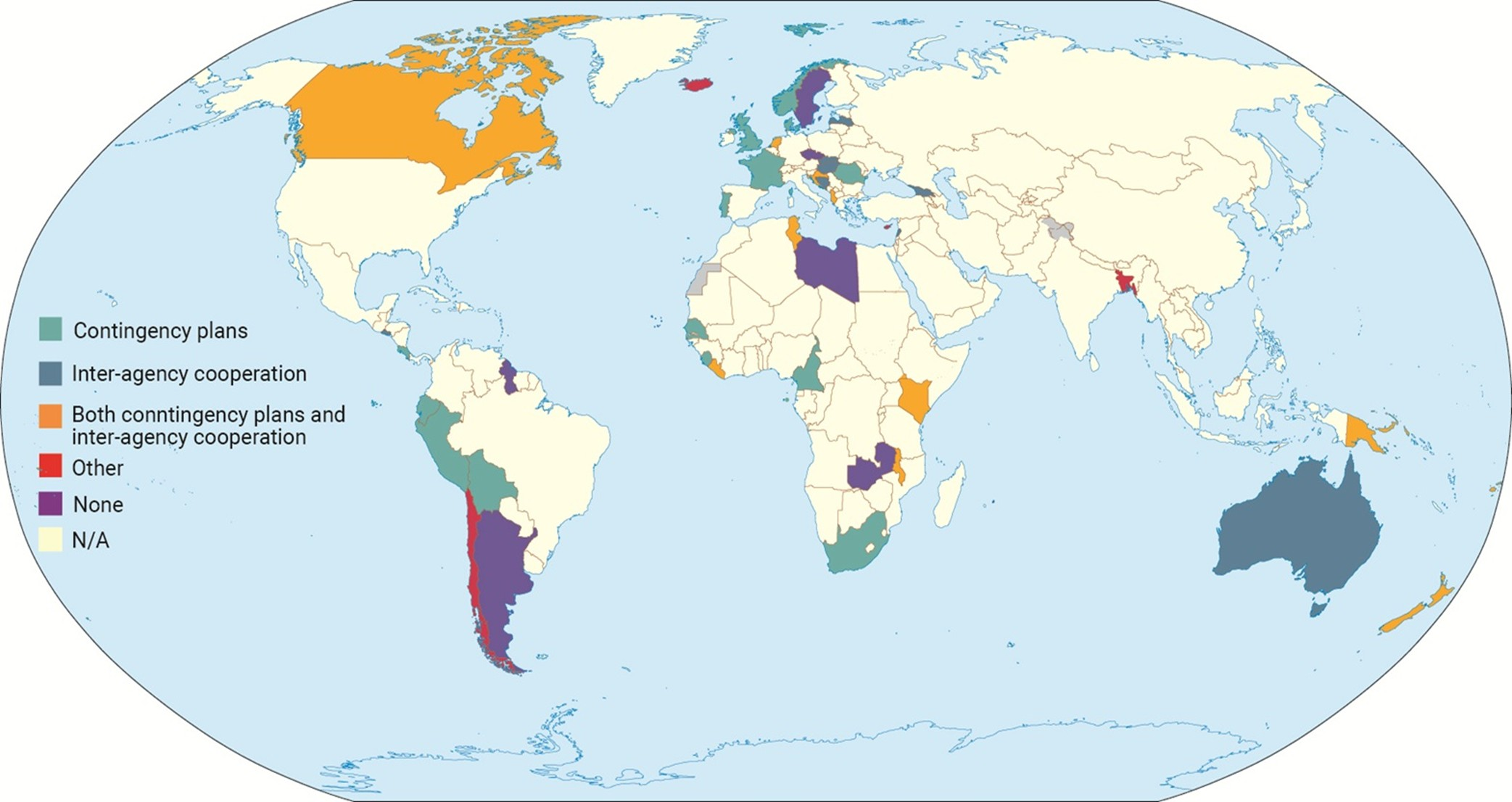
One strength of the current data is that it allows for a distinction between the types of measures that are available to electoral authorities, specifically between measures that have been put in place because of natural hazards and others that can be used in response to natural hazards. For example, some countries designate a single official who is responsible for environmental or natural hazard–related issues, reflecting recognition that the risks presented by such hazards justify dedicated officials and resources. The same logic may apply for environmental policy, although the extent and scope of such policies and the degree to which they are enforced are unknown.
In contrast, there is no differentiation when it comes to SVAs. In Australia, for example, in-person early voting, postal voting and telephone voting—traditionally limited to very specific types of voters but expanded to include those affected by Covid-19—have been available for decades, before natural hazards affected elections. This finding suggests that there are two types of measures: (a) those put in place specifically because of natural hazards; and (b) those that may be used in response to natural hazards, among other elements. Along the same lines, contingency plans, risk management frameworks and interagency cooperation most likely fall into the second type of measures, as they could be applied in response to both natural and human-made hazards such as terrorist attacks or pandemics.
| Prevention measures | Frequency | Country |
|---|---|---|
| Environmental policy | 7/50 (14%) | Bangladesh, Cameroon, Canada, Costa Rica, Liberia, the Netherlands, Sao Tome and Principe |
| A lead person responsible for environmental issues | 2/50 (4%) | Cameroon, Canada |
| Contingency plans | 29/50 (58%) | Albania, Bolivia, Cameroon, Canada, Costa Rica, Croatia, Denmark, Dominica, Ecuador, Fiji, France, Kenya, Liberia, Malawi, the Netherlands, New Zealand, Norway, Papua New Guinea, Peru, Portugal, Romania, Samoa, Sao Tome and Principe, Senegal, Sierra Leone, South Africa, Tunisia, Tuvalu, United Kingdom |
| A specific risk management framework | 12/50 (24%) | Albania, Bolivia, Cameroon, Canada, Costa Rica, Croatia, Cyprus, Kenya, Latvia, New Zealand, South Africa, Tunisia |
| Special voting arrangements (e.g. remote or early voting options) | 8/50 (16%) | Australia, Canada, Fiji, Iceland, Liberia, New Zealand, Norway, Sao Tome and Principe |
| Interagency cooperation | 22/50 (44%) | Albania, Australia, Bosnia and Herzegovina, Canada, Croatia, Dominica, El Salvador, Fiji, Georgia, Hungary, Kenya, Latvia, Lebanon, Liberia, Malawi, the Netherlands, New Zealand, Papua New Guinea, Samoa, Slovakia, Tunisia, Tuvalu |
| Other | 6/50 (12%) | Chile, Costa Rica, Denmark, Georgia, Senegal, Romania |
More generally, such measures are sometimes implemented to respond to environmental factors impacting the work of the electoral authorities. For example, 20 countries—including Peru, Liberia, Norway and Tuvalu—reported that extreme weather events had impacted the organization and management of elections (see Annex A). Ten countries—including Bangladesh, Cameroon, Lebanon and Papua New Guinea—declared that changing temperatures had affected the functions of their respective electoral authorities (see Annex A). Likewise, according to the survey, electoral authorities in 10 countries—for example, Canada, Dominica, Kenya and Samoa—stated that citizens had been displaced for environmental reasons, affecting the organization of an election (see Annex A).
In four instances—Cameroon, Papua New Guinea, Samoa and Zambia—electoral authorities declared that environment-related conflicts had affected an election.
2.5. Conclusions
The analysis presented in this chapter is based on the premise that institutional contexts can shape the implementation of specific measures, particularly through legal constraints. Following the stages of the electoral cycle, several of these measures are examined in light of the experience of different countries. Some of these measures were designed explicitly to address natural hazards, while others have been adapted for use under such circumstances.
Drawing on the experiences of a number of countries, the following principles have been identified that can be helpful in organizing elections that may be threatened by natural hazards:
- Preparation. As natural hazards are increasingly harder to predict, preparation via risk management and contingency planning or protocols is a sensible way to at least mitigate the impact of hazards and guarantee the continuation of planned electoral activities.
- Coordination. The impact of natural hazards goes beyond elections, as is evident from national adaptation plans and national disaster risk reduction strategies. When natural hazards occur, elections are another element to consider. Interagency coordination and collaboration are fundamental both for addressing the challenges raised by natural hazards and for maximizing the use of usually limited resources. Constant communication and protocols need to be in place and tested before a natural hazard happens to assess strengths and weaknesses of the approach.
- Flexibility and adaptability. Whenever possible, the process for responding to natural hazards must be flexible and adaptable. For example, Indonesia’s ability to move polling places on election day or Peru’s ability to enable voters to choose their polling station can make it easier for citizens to vote when natural hazards occur, while also making it easier for the electoral authorities to deliver elections.
- Inclusion and innovation. It is essential to ensure that the public are aware of any decisions taken, as exemplified by Indonesia’s approach of ensuring that relocated polling stations remain easily accessible to voters (see Chapter 8: Indonesia).
- Predictability and legal certainty. Exceptional measures tend to be more effective and less likely to be contested when they are based on a clear, solid legal framework adopted ahead of elections and applied consistently, enabling stakeholders to anticipate and make the necessary preparations.
There are several limitations to planning, coordination, flexibility, inclusion and predictability. First is a lack of resources, which can greatly limit the implementation of any contingency plan or protocol. Additionally, some measures that could be implemented require additional funding in the face of budget constraints. Second, the inclusion of such measures is conditioned by both the institutional context and the severity of the natural hazard. For example, electoral authorities could consider changing the dates of elections to periods that are less prone to natural hazards in some areas. However, some national legal frameworks require all voting to take place simultaneously. Hence, even when flexibility is desirable, electoral laws may lack provisions for adapting schedules. Third, despite the fact that flexibility may make it easier for citizens to vote and for the authorities to carry out an election successfully, the reallocation of resources can be challenging (not to mention more costly). Fourth, new measures can sometimes be implemented, but reaching those most affected by a natural hazard may be a challenge. Finally, when natural hazards occur, the response needs to be integrated, as it is unlikely for any electoral authority to have the capacity to deal with the effects of hazards on its own. Given that hazards affect most, if not all, parts of society, all levels of government must be involved in any response.
As natural hazards are becoming more frequent, more difficult to predict and more severe, the challenges they are creating are of utmost importance. Addressing them properly in an effective way will improve the resilience of elections and strengthen their integrity.
References
ADA Derana, ‘EC prepared for any potential weather disruptions during presidential election’, 19 September 2024, <https://www.adaderana.lk/news.php?nid=102072>, accessed 13 December 2025
Alihodžić, S., Protecting Elections: Risk Management, Resilience-Building and Crisis Management in Elections, Discussion Paper 4/2023 (Stockholm: International IDEA, 2023), <https://doi.org/10.31752/idea.2023.44>
Asia Pacific Alliance for Disaster Management Sri Lanka, ‘Launch of the election document- Right to vote amidst disasters’, 8 November 2019, <https://apad.lk/launch-of-the-election-document-right-to-vote-amidst-disasters>, accessed 30 December 2025
Asplund, E., Training and Professional Development in Electoral Administration, Policy Paper No. 28 (Stockholm: International IDEA, 2023), <https://doi.org/10.31752/idea.2023.34>
—(ed.), Election Emergency and Crisis Monitor: Mapping Impact and Response to Disasters, International IDEA, 12 November 2024 (and updated), <https://www.idea.int/election-dashboard-election-emergency-and-crisis-monitor>, accessed 12 December 2025
Avila, L. A., Stewart, S. R., Berg, R. and Hagen, A. B., ‘Hurricane Dorian’, National Hurricane Center Tropical Cyclone Report, Document Al052019, 20 April 2020, <https://www.nhc.noaa.gov/data/tcr/index.php?season=2019&basin=atl>, accessed 30 September 2025
Barrat, J., Ellis, A., Orr, G., Vashchanka, V. and Wolf, P., Special Voting Arrangements: The International IDEA Handbook (Stockholm: International IDEA, 2023), <https://doi.org/10.31752/idea.2023.84>
BBC, ‘Hurricane Dorian: Path of destruction’, 9 September 2019, <https://www.bbc.com/news/world-latin-america-49553770>, accessed 30 September 2025
Borenstein, S., Naishadham, S., Arasu, S. and Maisonnave, F., ‘Extreme weather wreaks havoc around the world’, PBS News, 8 May 2024, <https://www.pbs.org/newshour/world/extreme-weather-wreaks-havoc-around-the-world>, accessed 30 December 2025
Carreño, B. and Latona, D., ‘Spain election: Campaigners seek shelter from July heat’, Reuters, 18 July 2023, <https://www.reuters.com/world/europe/spain-election-campaigners-seek-shelter-july-heat-2023-07-18>, accessed 30 December 2025
Commonwealth Observer Group, ‘The Commonwealth of The Bahamas General Election’, 16 September 2021, <https://production-new-commonwealth-files.s3.eu-west-2.amazonaws.com/s3fs-public/2022-08/The%20Bahamas%20COG%20Report%20FINAL.pdf?VersionId=TVyUeGYJ0DJxku4X7Dp52qEUA_4q0aHM>, accessed 30 September 2025
Debusmann Jr, B. and Honderich, H., ‘Iowa caucuses: Storm disrupts final stretch of high-stakes Republican race’, BBC, 13 January 2024, <https://www.bbc.com/news/world-us-canada-67963211>, accessed 30 December 2025
Disaster Management Centre and Election Commission of Sri Lanka, ‘Presidential Election – 2024: Right to Vote Amidst Disasters – Guidelines and Operational Plan’, 2024, <https://www.dmc.gov.lk/images/pdfs/2024/PRESIDENTIAL_ELECTION_EMERGENCIES__Guidelines_-_2024.pdf>, accessed 30 December 2025
Economic Community of West African States (ECOWAS), Protocol A/SP1/12/01 on Democracy and Good Governance Supplementary to the Protocol relating to the Mechanism for Conflict Prevention, Management, Resolution, Peacekeeping and Security, December 2001, <https://www.eisa.org/pdf/ecowas2001protocol.pdf>, accessed 30 December 2024
Elections Canada, ‘Delivering the General Election: Report on the 44th General Election of September 20, 2021’, 2022, <https://www.elections.ca/content.aspx?section=res&dir=rep/off/sta_ge44&document=p2&lang=e>, accessed 16 December 2025
European Commission for Democracy through Law (Venice Commission), ‘Code of Good Practice in Electoral Matters: Guidelines and Explanatory Report’, Opinion No. 190/2002, Document CDL-AD(2002)023rev2-cor, 25 October 2018, <https://www.venice.coe.int/webforms/documents/default.aspx?pdffile=CDL-AD(2002)023rev2-cor-e>, accessed 20 November 2025
Florini, K. and Hill, A., ‘Disenfranchised by Climate Change’, Climate Central, September 2024, <https://www.climatecentral.org/report/disenfranchised-by-climate-change>, accessed 30 December 2025
Frank, R. W. and Martínez i Coma, F., ‘How election dynamics shape perceptions of electoral integrity’, Electoral Studies, 48 (2017), pp. 153–65, <https://doi.org/10.1016/j.electstud.2017.05.007>
Humphreys, B. E., ‘The Designation of Election Systems as Critical Infrastructure’, Congressional Research Service, updated 18 September 2019, <https://crsreports.congress.gov/product/pdf/IF/IF10677>, accessed 1 January 2026
Inter-American Development Bank, ‘COVID-19 effects and impacts on The Bahamas estimated at $9.5 billion’, 6 July 2022, <https://www.iadb.org/en/news/covid-19-effects-and-impacts-bahamas-estimated-95-billion>, accessed 30 September 2025
International IDEA, Bahamas, General Election, 16 September 2021, [n.d.a], <https://www.idea.int/node/156986>, accessed 16 December 2025
—, Montserrat, General Election, 2 April 2001, [n.d.b], <https://www.idea.int/node/157000>, accessed 17 January 2026
—, Protecting Elections, [n.d.c], <https://www.idea.int/project/protecting-elections>, accessed 16 January 2026
James, T., Garnett, H., Campion, S. and Caal-Lam, S., Electoral Management Survey 3.0, 2025, Harvard Dataverse, V1, <https://doi.org/10.7910/DVN/WE3RT2>, accessed 15 January 2026
T. S. James, A. Clark and E. Asplund (eds), Elections during Emergencies and Crises: Lessons for Electoral Integrity from the Covid-19 Pandemic (Stockholm: International IDEA, 2023), <https://doi.org/10.31752/idea.2023.24>
Jones Jr, R., ‘Bill seeks to establish permanent voter register’, Eyewitness News, 3 December 2020, <https://ewnews.com/bill-seeks-to-establish-permanent-voter-register>, accessed 31 December 2025
Martínez i Coma, F., ‘Electoral reform’, in P. Norris and A. Nai (eds), Election Watchdogs: Transparency, Accountability and Integrity (Oxford University Press, 2017)
Martínez i Coma, F. and Smith, R., ‘Correlates of early voting’, Government and Opposition, 60/1 (2025), pp. 1–18, <https://doi.org/10.1017/gov.2023.12>
Matatu, N., Protecting electoral integrity: The case of South Africa, Case Study (Stockholm: International IDEA, 2023), November 2023, <https://doi.org/10.31752/idea.23.88>
Myndigheten för samhällsskydd och beredskap (MSB), Lista med viktiga samhällsfunktioner. Utgångspunkt för att stärka samhällets beredskap [List of Important Social Functions: Starting Point for Strengthening Society’s Preparedness] (MSB, 2023), <https://rib.msb.se/filer/pdf/31176.pdf>, accessed 1 January 2026
NL Times, ‘Floods in Austria complicate EU elections, polling stations destroyed’, 9 June 2024, <https://nltimes.nl/2024/06/09/floods-austria-complicate-eu-elections-polling-stations-destroyed>, accessed 3 December 2025
Norris, P., Strengthening Electoral Integrity (Cambridge University Press, 2017), <https://doi.org/10.1017/9781107280656>
Organization of American States (OAS), ‘Final Report of the Electoral Observation Mission in Jamaica: General Election 2007’, 2007, <https://view.officeapps.live.com/op/view.aspx?src=https%3A%2F%2Faceproject.org%2Fero-en%2Fregions%2Famericas%2FJM%2Fjamaica-oas-report-on-eom-in-jamaica-for-2007&wdOrigin=BROWSELINK>, accessed 1 January 2026
Parliamentary Assembly of the Council of Europe (PACE), ‘Final Declaration’, Parliamentary Conference on ‘Elections in Times of Crisis: Challenges and Opportunities’, Bern, Switzerland, 9–10 May 2023, <https://rm.coe.int/adopted-declaration-bern-conference-10-may-2023/1680ab3191>, accessed 9 December 2025
Perry, M., ‘First day of early voting cancelled in some Florida counties due to Hurricane Debby’, Florida Phoenix, 5 August 2024, <https://floridaphoenix.com/briefs/first-day-of-early-voting-cancelled-in-some-florida-counties-due-to-hurricane-debby>, accessed 1 January 2026
Popovski, V., ‘Critical infrastructure must be resilient...it’s critical’, United Nations Development Programme Europe and Central Asia, 20 July 2023, <https://www.undp.org/eurasia/blog/critical-infrastructure-must-be-resilientits-critical>, accessed 1 January 2026
Ranatunga, G., Protecting Elections in Sri Lanka with a Focus on Natural and Human-Made Hazards (Stockholm: International IDEA, 2025), <https://doi.org/10.31752/idea.2025.37>
Rose, T., ‘“Washed away”: Residents angry as one polling booth opens in flood-hit Lismore’, The Guardian, 11 May 2022, <https://www.theguardian.com/australia-news/2022/may/12/washed-away-residents-angry-as-one-polling-booth-opens-in-flood-hit-lismore>, accessed 7 March 2025
Smith, M., ‘Tuvalu to conclude delayed election this week, official says’, ABC News, 21 February 2024, <https://www.abc.net.au/pacific/programs/pacificbeat/tuvaluelectionupdate/103497118>, accessed 1 January 2026
United Nations Office for Disaster Risk Reduction (UNDRR), Sendai Framework Monitor, [n.d.], <https://sendaimonitor.undrr.org>, accessed 10 December 2025
—, Sendai Framework for Disaster Risk Reduction 2015–2030 (Geneva: UNDRR, 2015), <https://www.undrr.org/media/16176/download?startDownload=20250101>, accessed 12 December 2025
United States Congress, H.R.5407 - Climate Resilient Elections Act, 16 September 2025, <https://www.congress.gov/bill/119th-congress/house-bill/5407/text>, accessed 1 December 2025
Vardy, E., Morris, R. and Faguy, A., ‘Extreme heat sends 11 to hospital at Arizona Trump rally’, BBC, 7 June 2024, <https://www.bbc.com/news/articles/crgge744qpeo>, accessed 16 January 2026
Vashchanka, V., Financing Electoral Management Body and Electoral Activity Costs in Sri Lanka (Stockholm: International IDEA, 2025), <https://doi.org/10.31752/idea.2025.55>
Erik Asplund, Sarah Birch and Ferran Martínez i Coma
This book illustrates how natural hazards are impacting electoral processes worldwide. Since the beginning of the new millennium, at least 94 supranational, national, subnational and primary elections and referendums in 52 countries have been impacted by one or more natural hazards. In 26 cases, elections at different levels have been partially or wholly postponed due to natural hazards as well as meteorological and other phenomena that are the result of anthropogenic climate change. In 2024 alone, at least 23 elections, at different levels, in 18 countries were impacted by extreme weather events, many of which were exacerbated by climate change, as proven by climate attribution science. This book demonstrates how natural hazards can disrupt elections throughout the electoral cycle and even lead to the total or partial postponement of elections and referendums at various jurisdictional levels.
Based on the evidence from this century so far, electoral integrity has become inseparable from emergency preparedness. Even powerful coalitions of state authorities and other stakeholders cannot anticipate every eventuality when it comes to natural hazards. Yet, as with other critical infrastructure, there is scope for policies, interventions and institutional adjustments that enable elections to be conducted despite the growing likelihood of adverse environmental conditions. For this reason, climate adaptation needs to be integrated into decision making and electoral planning, as a core element of resilience against the impact of natural hazards on elections.
Electoral management bodies (EMBs) around the world have already made considerable progress in developing effective means of protecting elections that occur during or after events such as floods, heatwaves, earthquakes or wildfires. The cases analysed in this publication highlight a number of different strategies that can be adopted not only to protect elections from natural hazards but also to make them climate-resilient:
- Elections are time-specific and time-sensitive. Once an election is called, the components of the electoral cycle unfold according to rigorous and legally binding timelines that are vulnerable to disruption by natural hazards. Measures to mitigate such disruptions include the following:
- The seasonality of weather patterns should be taken into consideration when setting election dates, and typical periods for flooding, wildfires, extreme heat, torrential rains or winter storms should be avoided whenever possible. This book gives the example of Alberta, Canada, which permanently changed its election dates because of wildfires.
- The flexibility to extend timelines for voter registration and voting can reduce the likelihood that short-lived disasters will be disruptive. Where not currently available, civil registries or continuous or automatic voter registration may be introduced to ensure the readiness of voter registers at any time. The flexibility to extend the timing of voting through early (advance) voting or multiple days of in-person voting can help voters better plan their movements and accommodate their personal, family and logistical responsibilities. The flexibility provided by allowing voters to select their polling place enables them to opt for a less disaster-prone locale.
- Redundancy (backup capacity) in design. Voter registration and voting itself are two points in the electoral cycle that are especially vulnerable to disruption by disasters. Both can be protected from natural hazards if redundancy is built into their design; if there are several ways in which voters can register and cast their ballot, then an event that affects one mode is less likely to have a catastrophic impact.
- Temporary measures. In addition to redundancy, EMBs benefit from flexibility in having the legal authority to put temporary measures in place. These might include extensions or modifications to special voting arrangements or the use of polling locations that would normally be deemed inappropriate but that can avert disenfranchisement in emergency situations. Any temporary arrangements made in response to a crisis should be proportional, time-bound and periodically reviewed, and they should be communicated proactively, transparently and in a timely manner to all electoral stakeholders, with their rationale clearly explained. If EMBs have plans and procedures in place that are flexible, they will find it much easier to cope with the sorts of disasters that are most disruptive to elections.
- Coordination with other agencies. EMBs’ communication, co-planning and joint actions with other agencies—meteorological, disaster relief and humanitarian branches of the state as well as relevant non-state actors—are critical to early warning of potential disasters. This book provides examples of EMBs in Australia, India, South Africa and Sri Lanka involved in joint contingency planning with local or national disaster management authorities. Established partnerships through a whole-of-government approach and regular exchange of information can enhance early warning, coordination, communication and decision making during a crisis.
- Training and contingency planning. Training and contingency planning (including risk management and crisis management planning) are vital for ensuring that EMBs are prepared for different natural hazards that could affect elections. Advance preparation includes the provision of staff training in key functions that might be required in emergency situations, emergency materials procurement, stress-testing and the integration of disaster preparedness into the budget process. Context-specific contingency plans at polling stations and at both the district and central levels improve the timeliness and effectiveness of EMB responses by clearly delineating responsibilities and activities required in different scenarios. Examples include the county-specific contingency plans in California and state- and disaster-specific action plans in India.
- Revising the electoral law. Elections may need to be postponed (in part or in whole) if the EMB is unable to withstand the shock of a disaster for logistical or humanitarian reasons. Any decision to postpone an election should be made based on the legal framework and preferably in broad consultations with relevant state agencies and political parties. Moreover, any postponement should be proportionate to the disaster and time-bound (e.g. Bosnia and Herzegovina). In addition, the rationale for the postponement should be clearly communicated to all electoral stakeholders. Reforms to the legal framework on postponements may include specific mention of disasters and hazard type in addition to circumstances for delays and the duration of any delays. Amendments to the electoral law may also include a provision outlining the circumstances when election officials may adopt flexible measures, such as moving polling stations, extending special voting arrangements, introducing health and safety measures, and conducting recruitment and training.
- Timely and sufficient funding. Electoral administration costs more when elections are held during a crisis. Therefore, EMBs should have easy access to contingency funding to organize safe and accessible elections. At the same time, EMBs can adopt dedicated budget lines for adaptation which can facilitate the design of materials and support systems to withstand future and unknown adverse weather conditions, thereby safeguarding electoral integrity and the well-being of front-line election officials and voters and likely decreasing the overall cost of the election.
- Clear internal and external communication. Any election-related changes, such as moving voting locations, expanding special voting arrangements or altering the election timetable, as a result of a disaster must be clearly and comprehensively communicated to voters, in particular vulnerable and marginalized groups, through multiple means of communication and languages. Also, internal communication, beyond what has already been communicated to voters, should include regular updates on the disaster and emergency measures taken by the EMB as well as information related to duty of care, which should include provisions for occupational safety, psychosocial support and insurance mechanisms. Efforts should also focus on identifying and countering disinformation related to the emergency and the electoral process, in coordination with other election stakeholders.
- Cross-cutting international engagement. More cross-cutting, multidisciplinary and international engagement is needed between the electoral, climate change, meteorological and disaster risk reduction communities. Such engagement would strengthen peer-to-peer exchange and learning across borders about what can be done to protect elections and enfranchise voters in the face of natural hazards. Such cooperation can also mobilize technical expertise, resources and regional frameworks that strengthen EMB capacity and help set common standards for conducting elections under disaster conditions.
- Building back better. Any natural hazard has the potential to cause extensive damage and destruction, but it also represents an opportunity for EMBs to build the confidence of citizens via effective communication about special arrangements put in place to enable voting during or following a disaster. The period following an affected election is also a time when the EMB may be able to conduct multistakeholder post-election reviews that can help mobilize support and funding for new procedures, training and reforms that enhance the inclusivity and democratic quality of elections overall.
- Critical infrastructure. As extreme weather exacerbated by climate change wreaks havoc, countries should consider formally recognizing electoral processes as critical infrastructure whose functioning is jeopardized by disasters. Such a designation can secure the extra support of state institutions needed to ensure that elections and orderly political transitions can take place even under extreme circumstances. Moreover, electoral infrastructure and processes can be considered when national focal points update national adaptation plans and national disaster risk reduction strategies to strengthen climate adaptation and risk reduction efforts at the national level and to inform United Nations processes.
Lastly, until countries tackle the root cause of climate change by decreasing carbon emissions, extreme weather events will become even more frequent and intense, no matter the emergency preparations. While EMBs can take action to reduce the carbon footprint of elections, emissions that have already been released are bound to have a significant impact on elections in the coming years.
There are many additional topics that merit consideration in future investigations, including the strategies that EMBs will employ to further develop their capacity to adapt to increasingly severe natural hazards as the climate changes, as well as the ways in which political actors will take advantage of natural events to manipulate elections to their advantage, and the electoral contention that may result. The studies presented in Chapters 4–16 have only begun to examine the many important channels through which meteorological and geological shocks shape elections. Nevertheless, the analyses contained in this book will hopefully go some way towards helping EMBs and others to ensure that electoral processes continue to be safe and vibrant expressions of democracy, even in the face of natural threats.
Ferran Martínez i Coma
Publishing date: 17 June 2023
Introduction
Victoria held state elections on Saturday 26 November 2022. Six weeks previously, the state had suffered serious floods. Home to over 6.6 million inhabitants and 4.4 million voters, its 79 local government areas (LGAs) are classified as cities (34), shires (38), rural cities (6) and boroughs (1). At 227,444 square kilometres, Victoria’s land area is as big as Ghana, Laos or Romania. Such a comparison is important in grasping the scale of the 2022 floods. In order to provide financial assistance to the natural-disaster-declared areas in each state or territory, there are the Disaster Recovery Funding Arrangements (DRFA), a joint Australian, state and territory governments’ initiative. DRFA measures include, among others, relief for personal hardship and distress; removal of debris from residential properties, counter-disaster operations; restoration of damaged essential public assets; and concessional interest rate loans or/and freight subsidies (Australian Government 2023).
Victoria is the ‘most distinctive fire region of Australia and the most dangerous in the world’ (Griffiths 2009) followed by California and Greece (Cook 2022). The state’s mountain topography is one of steep slopes, ridges and valleys that channel hot air. If a high-pressure system stalls in the Tasman Sea, then hot winds flow across the south-eastern forests. When temperatures rise to extreme levels and humidity evaporates, lightning hits the ground ‘raging fires suddenly upon its victims’ (Griffiths 2009). But September 2022 was wetter and colder than usual, and floods hit.
The bulk of the problems with the floods were in October, six weeks before the election. There were no major incidents directly impacting the success of the election and, given the timeline, it could be argued that the Victorian Electoral Commission (VEC) had plenty enough time to prepare. After all, Australia is a wealthy and developed country where elections usually run smoothly. However, there are at least five reasons to subject that argument to detailed examination in this case study.
First, as it is shown below, time and resources per se guarantee neither that the organizer can run the election perfectly in all districts, nor that the public is fully satisfied. Second, shaping how the response to the hazardous event is configured is extremely important and there may be different approaches (with significant variations and impacts) even within the same jurisdiction, as Birch and Fisher (2022) show for the Californian case. Third, planned responses need to be in place and so preparation before the event—regardless of its nature or scale—is of paramount importance. In that regard, the lessons that can be drawn from the Victorian case can be adapted for use in other jurisdictions, in some cases even perhaps as a blueprint. Fourth, the impact of floods goes far beyond the flooding period itself. Once waters recede many problems may arise—from affected homes and infrastructure to lost or damaged crops and harvests, to individuals’ distress—to mention just a few. Fifth, the floods in Victoria are an important case as this type of environmental hazard (and others) will continue and worsen in Australia due to climate change (RCNNDAR 2020). Unfortunately, Australia is not alone in this. Several other countries will face very similar challenges or are already doing so.
Therefore, the aims of this case study are, first, to give an overview of how the floods and related events unfolded in Victoria. Second, to explain the legal and institutional background of the VEC (the main organization in charge of carrying out the elections), the electoral system and modes of voting, and how these were affected by the floods, likewise turnout and campaigning. Third, to describe which risk management (and resilience-building) tools were used to address the challenges. The crisis management approach, understood as the ‘pathway for effective recovery when the integrity of electoral processes and institutions is significantly damaged or lost’. (Alihodžić 2023: 13) did not feature—although the VEC does have crisis management plans in place—and so will not be addressed in this case study. Fourth, to close, it presents some of the lessons learned along with some general reflections on the modes of voting, participation and campaigning.
The research for this case study is supported by diverse materials. Public documentation was offered by the VEC in the form of service plans, annual reports, and press releases. The author gathered further official documentation from parliamentary submissions at both the federal and the state level. Readers can find links to the mentioned documents in the reference section. In analysing the participation results, the author relied on data offered by the VEC which at the time of writing has not been published as definitive. Several semi-structured interviews were conducted with key actors involved in the elections. The questions put to these respondents are available in the annex and the insights obtained from the interviews have been incorporated into the case study. Finally, the author also used documentation provided by the International Institute for Democracy and Electoral Assistance (International IDEA) such as reports, working papers and transcriptions.
Legal and institutional background
On 26 November 2022, 4.4 million eligible Victorians were called to cast their vote to elect the 60th Victorian Parliament. The responsible agency for managing every election of the Victorian state election is the VEC. There follows a snapshot of the VEC’s origins, features and responsibilities. Then the Victorian electoral system is addressed, which is not replicated anywhere else in Australia.
The Victorian Electoral Commission
It was in 1851, when the state of Victoria achieved independence from New South Wales, that elections to the Victorian Parliament started. The first Chief Electoral Inspector of the state was appointed to lead the State Electoral Office in 1910. For 70 years, this office was part of the public service department. As time passed, it was deemed necessary to separate the conduct of elections from ministerial direction. Accordingly, on 1 January 1989, the independent statutory office of Electoral Commissioner was established. The Electoral Commissioner was to report to the Parliament rather than a minister. The State Electoral Office was renamed the VEC in 1995.
The VEC’s functions are to maintain the electoral enrolment register; conduct state, local and statutory elections and polls as well as fee for service13 elections; conduct reviews of electoral boundaries; and administer the laws on political funding and donation disclosure. The VEC has also duties to conduct electoral research, provide education services and communication with stakeholders, and inform and engage Victorians in the democratic process (VEC 2022a).
All such functions are delimited by six acts that are, chronologically: (1) the Constitution Act (1975) which determines who is entitled to enrol as an elector, who can be elected to Parliament, and the size and term of Parliament; (2) The Electoral Boundaries Commission Act (1982) which determines and governs state electoral boundaries; (3) The Financial Management Act (1994) defining how the VEC manages finances and financial reporting; (4) The Electoral Act (2002) setting out the VEC as an independent statutory authority, establishing its functions and powers and prescribing processes for state elections (see: Victoria (2002), especially section 9(2) on the VEC’s powers); (5) The Infringements Act (2006) covering aspects of compulsory voting enforcement; and (6) The Local Government Act (2020) setting out the conduct of local government elections (and which replaces the 1989 Act) (VEC 2022a).
As is well established, in times of peace elections are among the ‘costliest and most administratively and logistically burdensome’ operations that a democracy can undertake (International IDEA 2020). The VEC is exclusively funded by ‘Government special appropriations’ (VEC 2022b). Specifically, the total funding received for 2021–2022 was AUD 50.12 million (approximately USD 35 million). In times of crisis or emergencies such funding may need to be increased.
Two additional contextual features of the 2022 election must be considered from the VEC’s organizational perspective: (a) the need to expand services in line with population growth of around 230,000 electors since the previous election in 2018; and (b) the redrawing of electoral boundaries within the state, which had resulted in a transfer between districts of over 910,000 (just over 21 per cent) of electors. This latter event limits the scope of the comparisons that can be made.
The VEC is structured around two main functional units, the Electoral Functions Group, led by the Deputy Electoral Commissioner, and the Corporate Services Group, led by the Executive Director, Corporate Services. Both are overseen by the Electoral Commissioner. In the case of the VEC, it is the Executive Director, Corporate Services who is responsible, in coordination with the rest of the VEC, for risk management (see ‘Voting operations’ below).
Electoral system
Victoria’s state elections use two versions of the preferential voting system, in which voters can order their preferred candidates in the ballot. Specifically, the Lower House, also known as the Legislative Assembly and which has 88 seats, relies on full preferential voting to choose its members. This means that voters write a ‘1’ by their most preferred candidate and then must rank all the remaining candidates in their preferred order. If the voter fails to fill every single box in the electoral division, the vote is not valid and not counted.
The Upper House, known as the Legislative Council, relies on optional preferential voting, as several candidates are elected per region. There are eight electoral regions, each selecting five Legislative Council members per region. 14 Voters can do one of two things: either to vote ‘above the line’ or ‘below the line’. The latter means that voters cast the ballots as for the House, assigning preferences to individual candidates. In the former, the voter here supports only a list of candidates rather than individual candidates. Such a list of candidates is previously registered with the electoral commission. Voters then just write the number one in the box of the group they support and leave the rest of the ballot paper blank. This opens the door for negotiations and trading among parties. Also known as ticket voting, in Australia it only happens in elections to the Victorian Upper House.
Natural hazards and elections
Australia is no stranger to natural hazards affecting its elections. For example, fires that covered about 60 per cent of the shire were present in the federal by-election of Eden-Monaro in 2020, where the Australian Labour Party candidate Kristy McBain was the mayor of the Bega Valley LGA that lost 467 homes and four lives (McKnight 2021) and the Coalition candidate Fiona Kotvojs almost lost her farm to the fires. When Covid-19 arrived to Australian shores, it also impacted the management of local elections in Queensland. The Electoral Commission Queensland had to implement a series of safety measures as Covid-19 was at its peak in the state (Martínez i Coma 2020). In New South Wales elections were postponed for over a year. In Victoria, the local election in 2020 was run via postal voting only due to a change in the Local Government Act—which proved helpful in the context of Covid. It is worth remembering, however, that Victoria had the second longest continuous Covid-19 lockdown in the world.
In the run-up to Australia’s federal elections on 21 May 2022, the New South Wales city of Lismore was ravaged by floods in February and March 2022 (SCU 2022). Residents had to evacuate as the waters rose over 14.4 metres, the highest level ever recorded (VST and Gilmore 2022). At the peak of the first flood, engineering and science professor Bradley Eyre declared that the water ‘would have filled an Olympic-sized swimming pool in just over a second’ (SCU 2022). More rain would hit Lismore in early May, just weeks before the federal polls. The UN’s Intergovernmental Panel on Climate Change states that more extreme weather events are expected for Australia in the near future (IPPC 2022).
Early voting in Australia currently represents over 40 per cent of the ballots cast (Martínez i Coma and Smith 2023) and if the early voting centres are affected by floods, there may be problems of accessibility. Unsurprisingly, some voters in Lismore found voting difficult in the federal election (Rose 2022) as securing new voting locations is not an easy task, taking resources and time. Moreover, any changes in electoral delivery introduce the chance of complications.
Flooding ahead of the Victoria State election
On 13 September 2022, the Bureau of Meteorology (BoM) declared that Australia was officially under the third La Niña. The BoM warned the eastern communities, especially those on the coast, to be prepared for more rain. This was the third consecutive year featuring La Niña, previously seen in 1954–1957, 1973–1976 and 1998–2001 (Hannam 2022). In addition, there was the Indian Ocean Dipole, a climate phenomenon affecting rainfall patterns (Reuters 2022).
According to the BoM, September of 2022 in Victoria was wetter than average and colder. State-wide, rainfall was 34 per cent above the 1961–1990 average and the highest since 2016. Some sites had their highest September daily rainfall on record (BoM 2022a). Some central and northern catchments of the states suffered minor to moderate flooding. And the largest dam of the state, Dartmouth, spilled over. Its previous spill was in 1996 (Brown 2022). Overall, during the first nine months of 2022, rainfall was 12 per cent above average across the state.
When there is cold weather less water evaporates, increasing the probability of floods. All the rain of September implied that in many areas the ground was already saturated. Hence, more rain would make the state ‘primed for floods’ (Cook 2022). When the rains hit again in October, soil moisture was very high (see Figure 1) and with the predicted result.
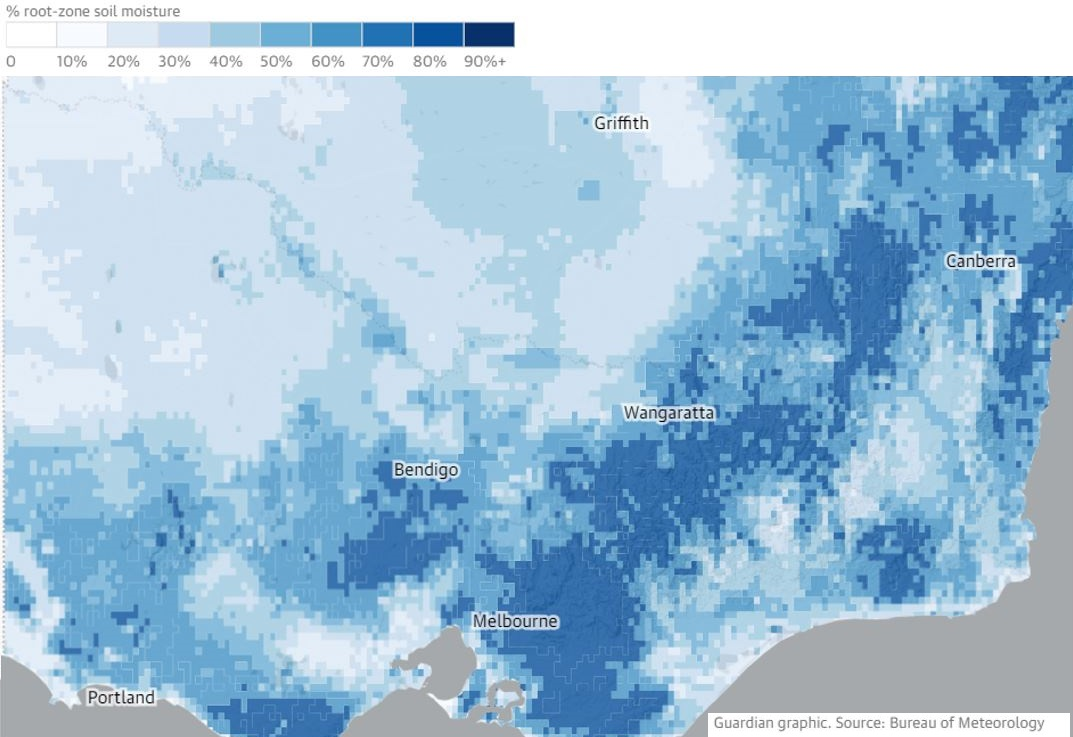
October was a much wetter than average month in most of the state. In some parts it was the wettest October on record (BoM 2022b) or for at least 20 years (BoM 2022b), and the state average was more than double the average for Octobers during 1961–1990. A total of 63 LGAs were affected by the floods, commencing on 6 October 2022.15 These local government areas reached their highest October daily rainfall on record between the 12th and 14th of the month, which was reflected in more than 90 flood warnings throughout the state. Several sites recorded their two wettest consecutive days. Parts of the state suffered their worst flooding in five decades. Evacuation orders were in place and homes in the west of Melbourne were inundated (ABC 2022a). Schools were closed, ‘roads swamped and power to around 5,000 households cut’ (Davies 2022a). Victoria State Emergency Service (VICSES), during the 24-hour period of 14 October, received 2,679 assistance requests, among them 119 flood rescues (Davies 2022a). Up to 450 personnel from the Australian Defence Force were deployed to support emergency services in the ‘relief and recovery efforts in areas such as Echuca, Wangaratta, Shepparton, Swan Hill and Bendigo, from October 17’ (ADF 2022). Figure 2 presents a BoM map showing the flooding along many rivers in Victoria (and also New South Wales and Tasmania). The Lake Eildon dam spilled for the first time in 28 years (Lu 2022). Overall, during the first 10 months of 2022, rainfall in Victoria was 29 per cent above average, the highest since 1974.
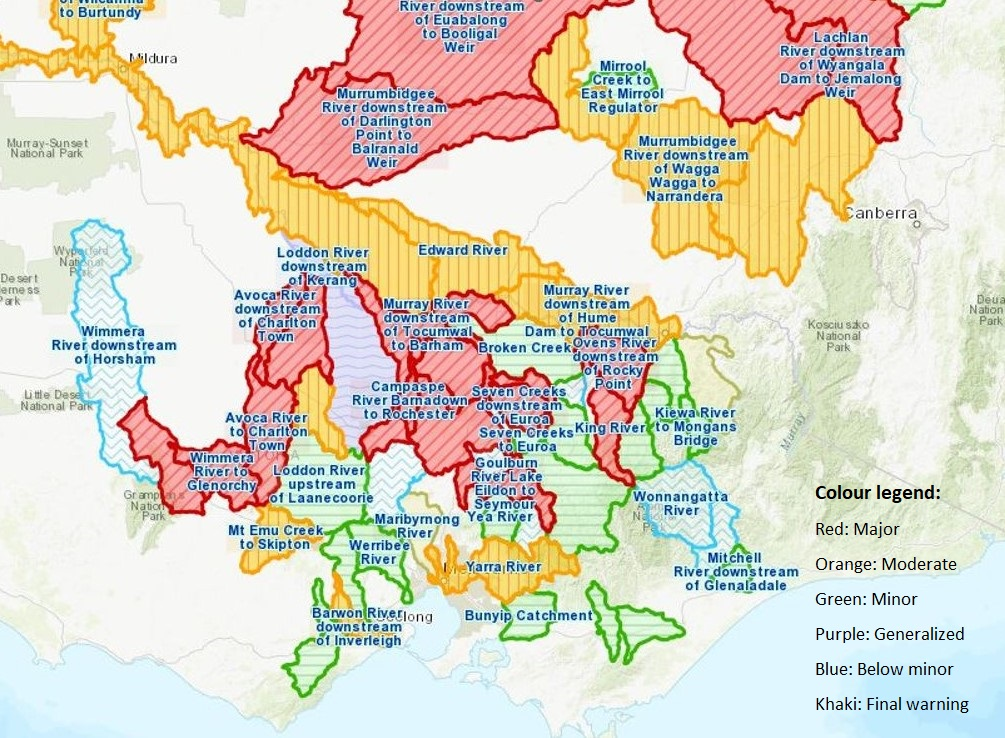
The fifth wettest November on record had a negative impact on Victoria as rainfall state-wide was 96 per cent above the 1961–1990 average (BoM 2022c). It was the rainiest November since 1954. Evacuation warnings were issued during the second week of November (Salvo 2022); some sites had their highest November daily rainfall on record on the 13th and the 14th, as shown in Table 1, and many also had their highest total November rainfall on record or for at least 20 years (BoM 2022c). There were flash floods in several sites, as high rainfall over previous months had already inflicted severe flooding. VICSES addressed more than 780 calls for assistance and rescued more than 50 people (Davies 2022b). Due to flash floods there were reports of landslides, damaged roads and even the derailment of a freight train (Evans and Marin 2022). Overall, during the first 11 months of 2022, rainfall in Victoria was 35 per cent above average, the highest since 1974. Table 1 provides an overview of the main weather and election logistics events in the state.
Given the impact of the floods and the intensity and frequency of the ‘rain bursts’ (Environment Victoria 2022), the Environment and Planning Committee of the Victorian Parliament launched an inquiry in February 2023 into ‘the state’s preparedness for and response to Victoria’s major flooding event of October 2022’ (Legislative Council 2023).
| Event | Date/days before polling | 2022 Victorian state election |
|---|---|---|
| BoM declares third La Niña for Australia | 13 September (74) | |
| Widespread rainfalls and showers | 6 October (51) | |
| Widespread rainfalls and showers | 7 October (50) | |
| 3,049 requests for assistance (including 1,766 flood incidents and 128 rescues) | 13 October (44) | |
| More than 90 flood warnings in Victoria | 14 October (43) | |
| Around 34,000 homes inundated or isolated | 17 October (40) | |
| 2 November (24) | First day for submission of postal vote applications | |
| Evacuation warnings issued | 7 November (19) | |
| 8 November (18) | Close of electoral rolls | |
| BoM issues severe weather warnings for heavy rainfall | 13 November (13) | Close of group voting ticket lodgements |
| Cars and trucks driven through floodwater in Melbourne’s west suburbs | 14 November (12) | Early voting commences Mobile voting commences |
| More than 650 calls for help across the state | 15 November (11) | |
| 23 November (3) | Close of submission of postal vote applications | |
| 25 November (1) | Close of early voting | |
| 26 November (0) | Election day |
Campaigning
In interview Will Fowles MP, Chair of the Electoral Matters Committee of Victoria, pointed out that although the floods affected many parts of the state, campaigning was not much affected overall in many seats because they came six weeks in advance of polling. Campaigning was carried out as usual with MPs and candidates reaching out to the respective communities in the usual forms such as meet and greet, neighbour meetings, candidates and parties’ stalls, town halls, door knocking, etc.
The Australian Labor Party MP suggested, however, that there were exceptions: in the seats of Shepparton, Euroa and Lowan campaigning was not conducted as usual because of the impacts of the flood (Fowles 2023).
The author interviewed Shepparton’s representative, independent MP Suzanna Sheed. She lost to National Party candidate Kim O’Keefe after serving two terms. The seat, covering 3,289 square kilometres, had previously supported the National and Country parties since 1945.
For Sheed, the campaigning period was significantly shorter than in 2018, the main reason being that she was working on duties associated with the role. As her district was impacted by the floods, she had to participate in coordination meetings with emergency services, work with ministers to address problems, go to flooded areas, meet with locals, etc. Once the main urgencies of the district were addressed and it was campaigning time, she was ‘exhausted’ (Sheed 2023). Had the floods not happened, the campaigning would have been different, at least on her part.
Sheed also mentioned that when campaigning she felt two kinds of ‘moods’ within the public: those that were affected by the floods and those that were not. Among the former, the election was not a priority as they were dealing with other priorities such as house repairs. This may be reflected in the turnout findings below. Regarding the delivery of the election, she commented positively that the VEC was ‘proactive and supportive’ (Sheed 2023).
Voting Operations
Victorians can cast their vote through in-person voting, early voting, postal voting, mobile voting, telephone assisted voting, and interstate and overseas voting. Additionally, the VEC ensures that Victorians in the Antarctic division can vote.
Full causal analysis of whether and how the floods may have affected the mode of voting is beyond the scope of this case study. However, comparing the 2022 election data with 2018 (see Table 2) and with the interviews provides some context and likely impacts.
The traditional voting mode is for voters on election day to come to their preferred voting centre and cast their ballot in person. There were over 1,700 voting centres on election day, similar to the number in 2018. Two voting centres were abolished (closed with no new location opened) and a handful more were moved, so the total available did not change markedly due to the floods.
Early voting has been gaining traction in recent years and in 2022 represented about 48 per cent of all the ballots cast, compared to 35 per cent in 2018. More than 400,000 Victorians cast their votes in the first three days of early voting (VEC 2022e), which was available for two weeks before election day. Because this was approximately one month after the height of the floods, early voting centres could open without problems. In 2018, there had been 103 early voting centres, with at least one centre per district. In 2022 the figure increased to 155, with two centres in those districts where a high number of early votes was anticipated. Early voting centres were opened all weekdays, in some cases with extended operating hours until 20:00. Additionally, early voting centres were open during Saturday 19 November (VEC 2022a, 2022f). The VEC’s public information campaign specifically targeted voters in flooded districts, informing them about voting modes available (see more detail below). Victoria is not alone in the use of early voting; as recently shown by Martínez i Coma and Smith (2023), the upsurge of early voting is also a federal trend.
Postal voting has been widely available in Australia since the early times of the federation, at both the state and the federal level. It increased in the 2022 elections as Table 2 shows. Traditionally, at least at the federal level, older voters rely more on postal voting (Martínez i Coma and Smith 2023) and its popularity is usually quite stable. However, between 2018 and 2022 there was an upsurge of about 3 percentage points, to 10.5 per cent. There may be several reasons for this increment. One may be that Victorians took advantage of the postal voting option because the rain continued. Recent experience of the previous local government elections that were entirely postal, in October 2020, could have also played a role (Doyle 2023). Finally, Covid-19 concerns could also have played a role.
During the early voting period, mobile voting teams visit nursing homes, homelessness support agencies, Aboriginal community locations and other institutions. Such teams enable citizens to vote who are unable to attend an early voting centre. Compared to 2018, the numbers of votes gathered by mobile voting were lower. This was mainly because of adherence to Covid-19 protocols in hospitals and care homes for the elderly.
Telephone voting eligibility was expanded due to the floods. Telephone voting in Australia—also available in New Zealand—consists of two phone calls. In the first call, voters are registered and obtain a unique code. In the second, voters use the code provided to cast their vote, guaranteeing that voters remain unidentified and assuring ballot secrecy. Citizens follow either of the systems described earlier, only they give their preferences to the operator who writes them down. The operator is observed by a second operator, ensuring that the preferences are fully transcribed.
Telephone voting is acknowledged to be a resource-intensive system; it was initially designed for citizens who are blind or partially sighted or have a mobility impairment and so cannot vote without assistance. However, the VEC extended eligibility to voters in areas that were impacted by floods (occurring on or after 13 October) and who were unable to access a voting centre (from 19 November to 18:00 on 26 November) (VEC 2022c). To use this mode, citizens had to make a declaration that their place of residence and their mobility had been so impacted (VEC 2022d). As Table 2 shows, telephone voting grew more than fivefold in comparison with the 2018 elections. The interview with the VEC executive confirmed the efforts invested in telephone voting.
Regarding Covid-19, the VEC opened a voting centre for those citizens with evidence of a positive rapid antigen test (RAT) or polymerase chain reaction (PCR). There was only one site (available for just three days, inclusive of election day itself), as there was insufficient time to find and lease ‘any other premises large enough to handle the demand’ (Hall 2022).
| Voting channel | 2018 (total votes taken by number and %) | 2022 (total votes taken by number and %) |
|---|---|---|
| In-person election day voting | 2,058,506 (55.1) | 1,513,071 (39) |
| Early voting | 1,328,419 (35.6) | 1,854,736 (47.8) |
| Postal voting | 281,823 (7.5) | 404,850 (10.4) |
| Mobile voting | 54,788 (1.5) | 46,737 (1.2) |
| Telephone assisted voting | 1,199 (.03) | 5,518 (0.14) |
| Interstate voting | 3,160 (.08) | 3,360 (.08) |
| Overseas attendance voting | 4,173 (0.11) | n/a |
| Drive-through voting (Covid-19 positive voters) | n/a | 519 (0.01) |
| Enrolled voters | 4,139,326 | 4,394,465 |
| Total votes counted | 3,732,068 | 3,877,213 |
| Informal voting | 217,592 | 214,410 |
Turnout
Compulsory voting is one of the notable features of elections in Victoria and Australia as a whole. Registration is compulsory and, in contrast to many European countries, is not automatically done by the state but is an individual responsibility. Once the citizen registers for the first time, they remain on the electoral roll and the electoral commission can verify whether a vote has been cast. If the citizen has not voted, the commission can issue a fine. Every time the citizen changes residence, it must be communicated to the electoral commission, as it is likely that the citizen moves to a different district.
Overall, voter turnout was lower in 2022 (88.2 per cent) compared with 2018 (90.2 per cent). A decline of 2 percentage points does not seem much. But a comparison between the districts that were flooded and those that were not, shows an interesting pattern: the decline was significantly higher in those districts that were flooded. Specifically, within the unflooded districts turnout declined an average of 1.4 percentage points (ranging from -1.78 to -1.05 points) while within the flooded districts the average decline was -2.1 percentage points (ranging between -2.3 and -1.83). Certainly, this association cannot be taken as definitive as some electoral boundaries were rewritten, as mentioned above.
In compulsory voting settings, invalid or informal voting is usually higher than in voluntary voting settings (Martínez i Coma and Werner 2019). Across districts there was a 5.4 per cent average of spoiled ballots. The average in non-flooded districts was 4.8 per cent (ranging from 4.1 to 5.4 per cent); in districts that were affected by floods, the average was 5.7 per cent (ranging from 5.2 to 6.2 per cent). Although the differences are not statistically significant, there were thus slightly higher rates of spoiled ballots in flood-affected districts.
Inter-agency collaboration
Emergency Management Victoria (EMV), established in 2014, is a state government statutory authority responsible for leading emergency response. The agency works with all the emergency services in the state in a coordination and information sharing role. The VEC’s crisis management approach is aligned with this agency. The VEC is in regular contact with EMV and when the elections get closer, contacts intensify to the point that the Electoral Commissioner is represented at all State Emergency Management Team (SEMT) meetings. This approach started in 2018, and by building relationships with the emergency sector, the VEC ‘works not in a vacuum but in cooperation’ (Doyle 2023). By liaising closely, EMV is provided with information on where all the election sites are, while the VEC receives information on for example, ‘natural disasters, security threats, and other sorts of information that might impact on the delivery of [the] election. So, [the VEC takes] advice and information from them’ (Benjaminsen 2022).
The institutional relationship between the two agencies has been built progressively and has translated into sharing resources. For example, the GIS (Geographic Information System) mapping teams of both organizations collaborate and share data. By using emergency response maps, the VEC could overlap theirs to detect the electoral districts with the most flood-affected people. In short, the VEC was receiving specific information on the weather for each of the districts and the degree of coordination was important. As approximately 50 per cent of those on the Victorian electoral roll have provided email addresses and/or mobile phones to the VEC, the latter could identify flood-affected voters and message them with reminders of the voting options available (Doyle 2023). That could be a factor in explaining why the proportion of early voters was very similar between flooded and non-flooded districts.
In the interview with Doyle, the author asked about how she thought the election would have gone without EMV’s coordination. Although a counterfactual, her response was clear: the VEC would have managed, because of the timing and the skills. But the process would have been much more stressful and less efficient.
Risk management
Risk management17 is ‘appropriate for identifying and preventing risks from materializing or avoiding them’ (Alihodžić 2023: 2). There are many ways in which risk management processes can be organized; common denominators usually include risk identification, assessment, analysis and evaluation, communication and treatment (Alihodžić 2023: 5). In order to identify whether the emergent event is an ‘issue’ or ‘crisis’, internally, the VEC uses established plans to follow a decision-making process combining six risk themes—onset, urgency, threat of escalation, predictability, electoral integrity and finance—with seven event characteristics: human resources, legal and governance, reputation, service quality, operations, regulatory compliance, and management (Tables 3 and 4). Depending on each of these themes and characteristics, the event is considered either an ‘issue’ or a ‘crisis’, and the response is configured accordingly.
One of the main features of this approach is that it is consequence led. This means that, regardless of whether a voting centre is lost to a flood or a fire, for example, the plan is set in case of a lost centre. More generally, there are different response approaches according to whether the issue is classified as a ‘problem’, ‘issue’ or ‘crisis’ for each of the categories. For example, when facing an issue, staff pay extra attention by perhaps bringing people together or changing part of the processes. In contrast, if there is a ‘major event that can really heavily impact on the VEC’, there is ‘a specific crisis management plan’ (Doyle 2023).
| Risk themes | Problem | Issue | Crisis |
|---|---|---|---|
| 1. Onset | Short-notice, gradual disruptive events | No notice, disruptive events | Sudden, unforeseen, escalating with strategic implications |
| 2. Urgency | Response over short time frame, resolved before long-term/permanent impacts | High urgency over a short time frame | High urgency over long time frame |
| 3. Threat of escalation | Minimal | Possible | Significant |
| 4. Predictability | Generally foreseeable, but timing/nature unpredictable | Unforeseen but manageable | Rare, unforeseen, poorly managed |
| 5. Electoral integrity | Adverse event, operational error, omission, or noncompliance with statutory obligations that is understood and can be addressed within the existing capacity of the elections team without any potential impact on the integrity of an election. | Adverse event, operational error, omission, or noncompliance with statutory obligations requiring an immediate coordinated response and management oversight to ensure election integrity is protected. | Adverse event, operational error, omission, or noncompliance with statutory obligations that is an immediate threat to the successful execution of an election in whole or in part, or where legislated timelines for election delivery are not met. Challenge to an election due to VEC failure. |
| 6. Finance | Potential additional costs can be absorbed within the normal budget. | Manageable impact to funding outside of the current budget. | Expenditure levels require additional funding. Reduction in operating baseline funding. |
| Event characteristics | Problem | Issue | Crisis |
|---|---|---|---|
| 7. Human resources | Minor impact to staff numbers. Easily managed. | Minor injuries, potential loss of 10 per cent of the workforce. | Death or serious injury. More than 10 per cent loss of senior election staff after opening of election office and until close of an election. |
| 8. Legal and governance | Fines and remediation manageable within branch authority. No breach of any standing directions, legal, professional or regulatory requirements. No reported internal fraud, collusion or theft. And the problem is a non-reportable incident to the Office of the Victorian Information Commissioner (OVIC). | Fines and remediation manageable within the VEC authority. Possible breach of any standing directions, legal, professional and regulatory requirements. No reported internal fraud, collusion or theft. And the problem is a non-reportable incident to OVIC. | Legal action, fines, or remediation costs within or exceeding the VEC’s legal exposure. Confirmed breach of standing directions, legal, professional or regulatory requirements. Reported internal fraud, collusion or theft. And the problem is a reportable incident to OVIC. The accountable officer faces criminal action. |
| 9. Reputation | Minor or external stakeholder reaction, news coverage and/or social media chatter. | Stakeholder complaints and dissatisfaction and/or high-profile news coverage and/or social media chatter. Growing negative social media chatter. | Sustained high-profile news coverage and/or majority of stakeholders dissatisfied, complaints from candidates or electors who are adversely impacted, loss of credibility and public trust. Significant negative social media chatter. |
| 10. Service quality | Adverse events that are understood and addressable via predefined response. No impact on post-election survey results for: 1. Customer satisfaction survey; 2. People Matters Survey; and 3. Reputation survey index. | Adverse events that require a coordinated response and management oversight. No impact on post-election survey results for: 1. Customer satisfaction survey; 2. People Matters Survey and 3. Reputation survey index. | Complex and uncertain, affects entire organization. Critical resources and functions are affected. Possible impact on post-election survey results for: 1. Customer satisfaction survey; 2. People Matters Survey; and 3. Reputation survey index. |
| 11. Operations/facilities issue not related to the execution of an election | Adverse events that are understood and addressable via predefined response. Low value property damage. | Adverse events that require a coordinated response and management oversight. Low value property damage, some critical resources affected. | Complex and uncertain, affects entire organization. High value property damage or denial of access. Critical resources affected. |
| 12. Regulatory compliance (not related to election execution) | Fines and remediation manageable within branch authority. | Legal action, fines, or remediation costs of up to AUD 500,000. | Legal action, fines, or remediation costs exceed AUD 500,000. The accountable officer faces criminal action. |
| 13. Managed through established plans | Resolution known to work well. | Resolution may not be fully proven to address all aspects of the issue. | Inherent uncertainty, potential scale, and extended duration requires flexibility, creativity and clarity of corporate values. |
Overall, if the institutionalization of risk management by an electoral commission ‘must be supported by the leadership, build on processes and resources that already exist, and include collaboration with other state and non-state agencies once risk management is established’ (Alihodžić 2023: 5), it seems that VEC conforms to this understanding both internally and externally, in its partnership with EMV.
Conclusion and lessons learned
In closing this case study, there are some lessons and reflections to keep in mind when organizing elections affected by natural events, such as floods. From the analysis of the available documentation and the interviews carried out, the lessons appear to be:
- Establish and maintain ongoing communication and cooperation with the emergency management sector. Keep the relationship active even when there are no elections in the near-term.
- Prepare, establish and issue a risk management process (as exemplified by Tables 3 and 4).
- Allow for flexible legal framework arrangements to expand on special voting arrangements (SVAs) such as telephone voting.
- Plan for targeted communication about the election for those affected by the hazard/flood.
- Have a GIS team ready to detect and forecast how natural hazards may impact the election. Such effects could take multiple forms: from the distribution of voting centres, to losing some of them.
As can be seen, much of the outlined lessons are about preparation, implying that the main efforts should be carried out well in advance of the election taking place.
Victoria’s 2022 experiences also prompt some general reflections that go well beyond the particular case, which are relevant to elections—and other workings of democracy—in strained situations:
- Special voting arrangements. It is imperative to anticipate and plan for the impact of extreme weather events on early voting, as these condition not only its availability but also increase the costs of delivery if early voting centres are affected. This can be especially relevant in lower income contexts.
- Voter participation. The correlations between Victoria’s floods, turnout and rates of invalid voting do not prove causality, but may be worth exploring in more detail. If participation is lower in flooded areas and invalid votes seem to be higher, specific outreach efforts might be considered—especially if, as is the case in Australia (and many other countries), those most affected by the floods are the most disadvantaged.
- Campaigning. Candidates who are MPs or other incumbents in elected office must balance addressing the urgent problems their constituents may have, against their own need to campaign. As well as being the right thing to do, being sufficiently active and effective on the former may confer media exposure and voter approval on the incumbent—in ways unavailable to challengers. Conversely, if MPs are effectively unable to campaign when other candidates are doing so, this may be a disadvantage. Independent candidates may also confront tougher choices than candidates of institutionalized parties, which are usually better resourced (Kefford 2020) and, at least in theory, better able to respond to emergency conditions. While the issue of a ‘level playing field’ in emergencies is a matter of a country’s decisions on legal and institutional design, the reputational and ethical position of incumbents touch upon an inherent democratic tension that is worth analysing further.
- Public health and Covid-19. When the floods arrived in October 2022, Covid-19 had not been eradicated in Victoria. Although neither disasters were at their peaks during this election, a convergence between the pandemic and extreme weather events would have compounded the complexity of electoral delivery. As other countries have demonstrated, compound disasters do occur and preparation is fundamental. A country’s level of development is fundamental to assessing and planning for its electoral resourcing needs.
References
Alihodzic, S., ‘Protecting Elections: Risk Management, Resilience-Building and Crisis Management in Elections’, International IDEA, June 2023, <https://doi.org/10.31752/idea.2023.44>
Alihodžić, S., ‘Protecting Elections’, IPSA workshop Delivering Trusted Elections: New Challenges in Electoral Integrity, June 2021, <https://www.electoralintegrityproject.com/2021-lisbon-workshop>, accessed 30 May 2023
Australian Broadcasting Corporation (ABC), ‘Thousands under flood evacuation orders across Victoria, New South Wales and Tasmania’, 14 October 2022, <https://www.abc.net.au/news/2022-10-14/flood-updates-across-victoria-nsw-and-tasmania/101538890>, accessed 30 May 2023
Australian Defence Force (ADF), ‘ADF’s flood assistance to South Australia’, 17 December 2022, <https://www.defence.gov.au/news-events/news/2022-12-17/adfs-flood-assistance-south-australia>, accessed 30 May 2023
Australian Government, ‘Victorian floods: 6 October 2022–13 January 2023’, updated 2 February 2023, <https://www.disasterassist.gov.au/Pages/disasters/current-disasters/Victoria/victoria-floods-06102022.aspx>, accessed 30 May 2023
Benjaminsen, C., Compliance and Risk Manager, Victorian Electoral Commission, interview with International IDEA, 2022
Birch, S. and Fischer, J., ‘Wildfire and elections in California’, Case Study, 1 September 2022, <https://www.idea.int/sites/default/files/multimedia_reports/EP_naturalhazards/wildfire-and-elections-in-california-en.pdf>, accessed 30 May 2023
Brown, A., ‘Dartmouth Dam spills for the fifth time bringing trepidation downstream’, Australian Broadcasting Corporation, 4 October 2022, <https://www.abc.net.au/news/2022-10-04/dartmouth-dam-spills-weir-keeper-downstream/101495690>, accessed 30 May 2023
Bureau of Meteorology (BoM), ‘Victoria in September 2022: Wetter than average, cold days’, 2 October 2022a, <http://www.bom.gov.au/climate/current/month/vic/archive/202209.summary.shtml>, accessed 30 May 2023
—, ‘Victoria in October 2022: Wettest month on record, very warm nights’, 1 November 2022b, <http://www.bom.gov.au/climate/current/month/vic/archive/202210.summary.shtml>, accessed 30 May 2023
—, ‘Victoria in November 2022: Fifth-wettest November on record, cold days’, 2 December 2022c, <http://www.bom.gov.au/climate/current/month/vic/archive/202211.summary.shtml>, accessed 30 May 2023
Cook, M., ‘Floods in Victoria are uncommon. Here’s why they’re happening now – and how they compare to the past’, University of the Sunshine Coast, 13 October 2022, <https://doi.org/10.64628/AA.vc75ykp4a>
Davies, R., ‘Australia – major floods prompt evacuations in Victoria, Tasmania and NSW’, Floodlist, 14 October 2022a, <https://floodlist.com/australia/floods-victoria-tasmania-newsouthwales-october-2022>, accessed 30 May 2023
—, ‘Australia – hundreds rescued, towns isolated after more floods in New South Wales’, Floodlist, 14 November 2022b, <https://floodlist.com/australia/floods-nsw-victoria-november-2022>, accessed 30 May 2023
Doyle, M., Executive Director Corporate Services (and team) at the Victorian Electoral Commission, interview with the author, online meeting, March 2023
Environment Victoria, ‘Victoria, flooding and climate change’, blog post, 21 November 2022, <https://environmentvictoria.org.au/2022/11/21/victoria-flooding-climate-damage>, accessed 30 May 2023
Evans, J. and Marin, M., ‘The November 2022 Floods’, Risk Frontiers Briefing Note 473, 17 November 2022, <https://riskfrontiers.com/insights/november-2022-floods>, accessed 30 May 2023
Fowles, W., MP (member for Burwood), interview with the author, online meeting, March 2023
Griffiths, T., ‘We have still not lived long enough. Testimony from the 1939 and 2009 fires reveals what we haven’t learnt from history’, Inside Story, 16 February 2009, <https://insidestory.org.au/we-have-still-not-lived-long-enough>, accessed 30 May 2023
Hall, A., ‘Do It Yourself: Former Bunnings site to host drive-through voting for Victoria election,’ Special Broadcasting Service, 24 November 2022, <https://www.sbs.com.au/news/article/do-it-yourself-former-bunnings-site-to-host-drive-through-voting-for-victoria-election/iqzlelznk>, accessed 30 May 2023
Hannam, P., ‘Bureau of Meteorology declares third La Niña is officially under way for Australia’, The Guardian, 13 September 2022, <https://www.theguardian.com/australia-news/2022/sep/13/bureau-of-meteorology-to-declare-third-la-nina-is-under-way-for-australia>, accessed 30 May 2023
Intergovernmental Panel on Climate Change (IPPC), ‘Regional fact sheet – Australasia’, Sixth Assessment Report, 2022, <https://www.ipcc.ch/report/ar6/wg1/downloads/factsheets/IPCC_AR6_WGI_Regional_Fact_Sheet_Australasia.pdf>, accessed 30 May 2023
International IDEA, ‘Inquiry on the future conduct of elections operating during times of emergency situations. Submission of the International Institute for Democracy and Electoral Assistance’, Parliament of Australia, Joint Standing Committee on Electoral Matters, 13 November 2020, <https://www.idea.int/sites/default/files/IDEA%20JSCEM%20Submission%20-%20Future%20conduct%20of%20elections%20-%20201113%20to%20replace.pdf>, accessed 30 May 2023
Kefford, G., ‘The minor parties’ in A. Gauja, M. Sawer and M. Simms (eds) Morrison’s Miracle: The 2019 Australian Federal Election (Canberra: ANU Press, 2020), <https://doi.org/10.22459/MM.2020.17>
Legislative Council, Committees. Environment and Planning Committee, <https://new.parliament.vic.gov.au/parliamentary-activity/hansard/hansard-details/HANSARD-974425065-20233#wysiwyg>, accessed 30 May 2023
Lu, D., ‘“Everything is saturated”: What’s driving the latest floods in eastern Australia’, The Guardian, 17 October 2022, <https://www.theguardian.com/australia-news/2022/oct/18/everything-is-saturated-whats-driving-the-latest-floods-in-eastern-australia>, accessed 30 May 2023
Martínez i Coma, F., ‘Running local elections during the COVID-19 crisis: Queensland, Australia’, Case Study, 10 August 2020, (Stockholm: International IDEA, 2020), <https://www.idea.int/sites/default/files/running-local-elections-during-the-covid-19-crisis-queensland-australia_en.pdf>, accessed 30 May 2023
Martínez i Coma, F. and Smith, R., ‘Correlates of early voting’, Government and Opposition, First View (2023), pp. 1–18, <https://doi.org/10.1017/gov.2023.12>
Martínez i Coma, F. and Werner, A., ‘Compulsory voting and ethnic diversity increase invalid voting while corruption does not: An analysis of 417 parliamentary elections in 73 countries’, Democratization, 26/2 (2019), pp. 288–308, <https://doi.org/10.1080/13510347.2018.1524879>
McKnight, A., ‘Two years after Black Summer bushfires, the Bega Valley continues to rebuild’, aboutregional.com, 31 December 2021, <https://aboutregional.com.au/two-years-after-black-summer-bushfires-the-bega-valley-continues-to-rebuild>, accessed 30 May 2023
Reuters, ‘Explainer: Australia floods: Why the country is battling weather again’, 15 October 2022, <https://www.reuters.com/world/asia-pacific/australia-floods-why-country-is-battling-weather-again-2022-10-15>, accessed 30 May 2023
Rose, T., ‘“Washed away”: Residents angry as one polling booth opens in flood-hit Lismore’, The Guardian, 11 May 2022 <https://www.theguardian.com/australia-news/2022/may/12/washed-away-residents-angry-as-one-polling-booth-opens-in-flood-hit-lismore>, accessed 30 May 2023
Royal Commission into National Natural Disaster Arrangements (RCNNDAR), Royal Commission into National Natural Disaster Arrangements: Report, 30 October 2020, <https://naturaldisaster.royalcommission.gov.au/publications/royal-commission-national-natural-disaster-arrangements-report>, accessed 30 May 2023
Salvo, F., ‘Victoria’s flood disaster continues to unfold as Murray River floodwater moves west, affecting Echuca, Swan Hill and Koondrook’, Australian Broadcasting Corporation, 6 November 2022, <https://www.abc.net.au/news/2022-11-07/victoria-flood-emergency-murray-river-rise/101620902>, accessed 30 May 2023
Sheed, S. (former MP for Shepparton), interview with the author, telephone interview, March 2023
Southern Cross University (SCU), ‘Lismore floodwater enough to fill half of Sydney Harbour’, 23 May 2022, <https://www.scu.edu.au/engage/news/latest-news/2022/lismore-floodwater-enough-to-fill-half-of-sydney-harbour.php>, accessed 30 May 2023
Victorian Electoral Commission (VEC), ‘2022 State Election: Service Plan’, August 2022a, <https://www.vec.vic.gov.au/about-us/publications/state-election-reports-and-plans>, accessed 30 May 2023
—, ‘2021–22 Annual Report: Sharpening our Focus’, October 2022b, <https://www.vec.vic.gov.au/about-us/publications/annual-reports>, accessed 30 May 2023
—, ‘Voting options expanded for flood-affected Victorians’, 2022c, <https://www.vec.vic.gov.au/about-us/media/voting-options-expanded-for-flood-affected-victorians>, accessed 30 May 2023
—, Telephone voting extended to flood affected voters, 2022d, <https://www.vec.vic.gov.au/about-us/media/telephone-voting-extended-to-flood-affected-voters>, accessed 30 May 2023
—, ‘Early voting opens for the 2022 state election’, 2022e, <https://www.vec.vic.gov.au/about-us/media/early-voting-opens-for-the-2022-state-election>, accessed 30 May 2023
—, ‘Poor behaviour blemishes commencement of early voting’, 17 November 2022f, <https://www.vec.vic.gov.au/about-us/media/poor-behaviour-blemishes-commencement-of-early-voting>, accessed 30 May 2023
—, Voting. Types of Elections. Other Elections, [n.d.], <https://www.vec.vic.gov.au/voting/types-of-elections/other-elections>, accessed 30 May 2023
Victoria, State Government of, Electoral Act 2002 (Act No. 23 of 2002, Version 062 incorporating amendments as of 6 April 2020), <https://www.legislation.vic.gov.au/in-force/acts/electoral-act-2002/062>, accessed 30 May 2023
Visual Stories Team (VST) and Gilmore, H., ‘Anatomy of the Lismore Disaster’, Sydney Morning Herald, 30 June 2022, <https://www.smh.com.au/interactive/2022/lismore-flooding>, accessed 30 May 2023
Annex A
Questions for current and former MPs
- Was campaigning conditioned by the floods? If so, how? How was campaigning possible?
- What is your view of the work performed by the VEC?
- In reputation terms, what does the Electoral Matters Committee (ECM) think about how the VEC managed the election in flooded areas?
- The floods affected all the state. So is it right to assume that all parties were evenly affected?
- Overall, and on reflection, what are the lessons learned from the floods as regards campaigning?
Questions for the VEC
On logistics:
- Were the different modes of voting affected by the floods? Can you provide the figures for in-person voting, early voting, postal and phone voting for the 2022 and 2018 elections? This will be for comparison.
How many venues were available for election day? For the 2022 election, there were 155 early voting centres. Do you recall how many were there in 2018? And, more importantly, did you have to change/look for new early voting places due to the floods?
Did the floods take away voting sites as in other places (e.g. Lismore)? How did you sort out alternative polling places in such a short period of time?
Was mobile voting affected by the floods? If so, how?
Was campaigning conditioned by the floods? If so, how?
- How many people did not vote in 2022? Which proportion of these do you think was due to the floods?
- Did the floods affect VEC’s budgeting for the election? If so, how? The annual report states that the funding received for 2021–22 was AUD 50.12 million. Did funding have to increase because of the floods? If so, by approximately how much?
- Relatedly, how much did the election cost in 2022 per Victorian [per capita in the state]? And in 2018?
On the VEC organization:
- The position of the Emergency Management Commissioner. Can you provide their features? What are their main roles? What support does the Commissioner have? What is the relationship with the VEC Commissioner? How to prioritize?
- VEC had a very detailed organization-wide safety plan, especially in regards to the pandemic. But what about the floods?
- Overall, do you think the VEC should/could have other abilities/powers to make their response more agile? Or, differently framed, how can VEC react to unexpected events?
On VEC and public relations:
- How does the VEC manage stakeholder engagement (deliberations) with time pressures?
- In reputation terms, how does the VEC think that it managed concerning the election in flooded areas?
- How does the VEC achieve a positive election experience for citizens in those districts affected by floods?
- How do you think that the floods impacted VEC’s capability [in ways] that could impact the trust and confidence in democracy and electoral integrity?
On main impacts of floods:
- Do you know whether the floods impacted the VEC’ efforts regarding:
Media literacy campaign
Early voting
The location strategy
The tracking and handling of the ballot papers
Candidates’ campaigning
Specific engagement campaigns aimed at young electors?
Overall, and on reflection, what are the lessons learned from the floods as regards organizing elections?
About the author
Ferran Martínez i Coma, PhD, Professor, School of Government and International Relations at Griffith University, Queensland. His current research specializes in elections. Ferran has worked at the University of Sydney within the Electoral Integrity Project and at the Centro de Investigaciones y Docencia Economicas (CIDE) in Mexico City. He has also been a policy practitioner at the national level as a senior adviser in the Policy Unit of Spain’s Prime Minister’s office, and at municipal level (as a technical adviser in the Department of Studies and Evaluation at Barcelona City Hall). Ferran has published in top-leading journals in political science, sociology and economics.
Acknowledgements
The author would like to thank Máiréad Doyle, Executive Director Corporate Services at the Victorian Electoral Commission, and her team, as well as William Fowles MP (Burwood) and Suzanna Sheed MP (former member for Shepparton) for being interviewed. All errors, my own.
Mubera Vulovic
Publishing date: 12 May 2025
Introduction
BiH has experienced several large-scale floods over the last two decades, including two catastrophic floods in 2010 and 2014. Extreme weather events have become more frequent, causing loss of life, human displacement and damage to property and infrastructure (BiH and UNDP 2021). The trend seen in BiH aligns with the findings of the Intergovernmental Panel on Climate Change, whose Sixth Assessment Report (IPCC 2022) predicts that damage and losses from coastal and river floods will substantially increase in Europe this century.
The 2014 floods had some impact on the electoral process, including campaigning (OSCE/ODIHR 2015). As in 2010, they occurred in May and December and were caused by unusually high precipitation. According to the BiH Federation Hydro-Meteorological Institute, rainfall exceeded previous records with over 420 mm recorded in the north of the country. Until October 2024, however, no extreme weather event had coincided with election day itself. This paper will focus on the most recent floods in BiH, which occurred in October 2024—just two days before the local elections. Therefore, this was the first time in the recent history of BiH that EMBs’ natural hazard preparedness, response and coordination mechanisms were tested at all levels.
This case study will first describe the legal and institutional background, not least because BiH’s constitutional setup is complex and decentralized. Subsequently, the case study will delve into actions and steps taken by the BiH CEC to address new challenges and to make the elections accessible to all citizens. It then concludes with the main findings, lessons learned and actions that could increase capacity and resilience to confront future electoral emergencies.
1. Legal and institutional context
The Constitution of BiH states that it consists of two entities, the Federation of Bosnia and Herzegovina and the Republika Srpska. The Constitution also prescribes that Brčko District of BiH exists ‘under the sovereignty of Bosnia and Herzegovina and falling under the responsibilities of the institutions of Bosnia and Herzegovina, which territory is jointly owned by the Entities, shall be a local self-government unit with its institutions, laws, and regulations’ (BiH 1995: article VI.4
While electoral responsibilities are divided between the state and entity-level institutions, there is a state-level election law. The Election Law of Bosnia and Herzegovina (BiH 2024) was first adopted in 2001 and has seen numerous amendments aimed at technical improvement of the electoral process. In March 2024, 43 days before the CEC announced the elections, amendments to the BiH Election Law were introduced by the Office of the High Representative in BiH (OHR 2024) in an attempt to increase the integrity and transparency of the electoral process. The OHR is an ad hoc international institution responsible for overseeing implementation of the civilian aspects of the 1995 Dayton Peace Agreement (OHR n.d.).
The EMBs in BiH include the following election commissions and polling station committees: the BiH CEC; municipal and city election commissions;18 the Election Commission of Brčko District of BiH; and polling station committees, appointed for each election. There are in total 143 election commissions. The CEC is appointed by the Parliamentary Assembly of BiH, while the municipal/city election commissions are appointed by the municipal/city assemblies/councils, subject to the CEC’s approval.
Elections are held every four years, with a two-year gap between general and local elections, which are held separately. Local elections are held for the following institutions: municipal councils in the Federation of BiH; municipal assemblies in the Republika Srpska; municipal mayors in BiH; city councils in the Federation of BiH; city assemblies in the Republika Srpska; city mayors in BiH; and the Assembly of Brčko District of BiH.
There were a total of 26,089 candidates on the ballots for the 2024 local elections, representing 110 political parties, 58 coalitions, 78 independent candidates, 43 independent candidates from national minorities, and 9 lists of independent candidates (BiH CEC 2024a). A total of 3,402,246 voters were registered to vote. Registration in BiH is passive, meaning that all citizens who are 18 years of age and obtain an identification (ID) card are automatically recorded in the Central Voters’ Register. Depending on their residence, the voters received two ballots and could cast them at 5,817 polling stations19 established in the country. Polling stations are organized for categories of voters as follows:
- Regular voters—who vote at regular polling stations unless bedridden or living in institutional settings—in which case they have the right to vote by mail.
- Those voting in absentia—people with displaced person status whose current permanent or temporary residence differs from the constituency for which they vote.
- In-person voters—who have displaced person status and who have registered to vote in person in their municipality of permanent residence from 1991, as well as the BiH citizens who have refugee status (if not registered to vote outside BiH).
- Out-of-country voters—refugees and persons temporarily residing outside BiH, who vote either by mail or at BiH’s diplomatic and consular offices (having applied and registered to do so).
Voters elect their representatives through two election systems: for municipal/city mayors and representatives of national minorities a majority system is used, while proportional representation operates for electing municipal/city council/assemblies and the Assembly of Brčko District of BiH.
Postponing elections
The electoral process—including the deadlines for the conduct of elections and publishing the confirmed results—is prescribed in detail by the BiH Election Law and regulations passed by BiH CEC. Article 14.2 of the BiH Election Law sets forth that a decision to postpone elections at a particular polling station or a constituency is issued by the BiH CEC based on the facts indicating that the election cannot be conducted in line with the law. Paragraph 4 of this article reads that the postponed elections are to be conducted within 7 days, and no later than 30 days, from the day designated for voting in the regular elections (BiH 2024). This is the only mechanism in place to ensure that voters affected by any incident can exercise their right to vote.
The 2020 local elections, scheduled for 4 October 2020, were postponed due to a delay in providing the funds necessary for their conduct (AP 2020). This came about as a result of the Covid-19 pandemic, which had a profound impact on all aspects of society in BiH throughout 2020. While the election administration modified regulations such that individuals diagnosed with Covid-19 or in isolation due to the virus had the right to cast their vote on election day, concerns were raised about the fact that some citizens were unable to exercise this right—largely due to poor organization and a lack of coordination between relevant institutions (Pod lupom 2021).
Natural hazards in Bosnia and Herzegovina
The United Nations Office for Disaster Risk Reduction defines a hazard as ‘a process, phenomenon, or human activity that may cause loss of life, injury or other health impacts, property damage, social and economic disruption, or environmental degradation’ (UNDRR n.d.a). It further notes that ‘natural hazards’ are predominantly associated with natural processes, where hydrometeorological factors may play a significant role. It also argues that a hazard becomes a ‘disaster’ only when it impacts a society or a community lacking adequate protection mechanisms, including financial resources, coordination, and warning systems (UNDRR n.d.b). On this account, hazards may sometimes be natural but disasters are not.
BiH has always been susceptible to disasters due to being very rich in river systems, but also very reliant on its hydro potential. This reliance on water exploitation can contribute to flooding and landslides, as seen in October 2024. The first ‘major’ flood happened in November 1925. Several measurement stations recorded maximum water levels (rivers Una, Vrbas, Sava and Neretva). The next ‘major’ flood occurred in April 1932, primarily affecting areas along the River Sava. In November 1934, the River Neretva again reached unprecedented water levels. All these floods caused devastation and loss of life. During the period 1965–1976, abundant rainfall caused high water levels of rivers and their tributaries, with catastrophic floods occurring on average every two years (Duranović 2020).
More recently the United Nations Development Programme notes that, according to the World Risk Report from 2017, BiH is ranked among those with high exposure to natural hazards. Specifically, out of 145 local government units, 91 have a significant risk of floods and landslides, while 27 have a high risk (UNDP n.d.). Most of the territory experienced a slight increase in annual precipitation in the period 1961–2016, with no significant changes in extreme precipitation indices from 1991 to 2016 (BiH and UNDP 2021). However, according to the same report (under the UN Framework Convention on Climate Change), BiH can expect a temperature rise ranging between 1°C and 6°C, depending on climate scenarios, and with that, seasonal extreme weather events (high temperatures and heavy rainfall). Climate change—or, our current 1.1°C warmer world—has already affected Europe via extreme events during the spring and autumn. BiH is no exception, with events so far this century including flooding (in 2004, 2010, 2014 and 2024) and drought (2012).
Flood-affected elections in 2014
In the third week of May 2014, heavy rains fell across the country, resulting in massive flooding in the northern, eastern and central regions near the borders with Croatia and Serbia. A low-pressure system, referred to as ‘Yvette’ or ‘Tamara’, affected a vast area of Southeastern and Central Europe, bringing floods and landslides. Some areas in BiH received more than 250 mm (and in some cases up to 300 mm) of rain per square metre, marking the highest rainfall recorded in the country for 120 years. This caused severe and sudden flooding in several major rivers including the Bosna, Drina, Una, Sava, Sana and Vrbas, along with their tributaries. Landslides were also triggered, dislocating previously marked mine fields. BiH has the highest density of land mine contamination in the world. During the wars of the 1990s landmines were laid in strategic areas of the country, for example along border areas and riverbanks. Between 1,300 and 1,800 km2 are thought to still be contaminated with landmines and unexploded munitions, across over 13,000 different locations. There are 25,000 warning signs of landmines across the country (Davies 2014).
Urban, industrial and rural areas were submerged, leaving them cut off from electricity and communication, significantly damaging roads and transportation infrastructure. As a result, numerous homes were destroyed or left underwater, displacing many households, and 23 people lost their lives (Dnevnik.hr 2014). The 2014 floods were estimated to have caused damage and losses equivalent to 9.3 per cent of Global domestic product (GDP) (EUR 1.27 billion) and 5.6 per cent of GDP (EUR 763.4 million) respectively, a total of nearly 15 per cent GDP that year. The hardest hit economic sectors were agriculture, transport and manufacturing (BiH et al. 2014).
The 2014 floods impacted electoral campaigning, meaning that campaign activities were notably less visible in flood-affected areas. Some political parties (such as the Social Democratic Party of BiH) decided to forego campaign billboards and posters to give financial assistance to flood victims (OSCE/ODIHR 2015). It is worth noting that the BiH CEC was one of the first EMBs globally to pilot the Electoral Risk Management Tool. Developed by International IDEA and first tested in 2012 for pilot projects and analysis of elections, BiH CEC then used it for the 2014 elections to monitor the effects of the floods, monitor the election results process, analyse invalid ballots, and sanction members of the polling station committees for any irregularities in their work. The analysis showed that 183 polling station locations were submerged at the time of flooding, with some municipalities experiencing destruction of infrastructure, premises and equipment, including ballot boxes. This disaster led to the internal displacement of around 25,353 voters (Hadžiabdić 2015).
Floods and the 2024 Local Elections
The Ministry of Security, acting as a coordination mechanism in protection and rescue efforts, had prepared a natural hazards risk assessment in 2012 and updated it in 2017 and 2020 (Ministry of Security 2020). According to the assessment, the total surface of BiH exposed to a high risk of floods (category 4) is 97,391 hectares, with some 284,000 citizens living in these high-risk areas. However, due to the complex administrative setup of BiH, lower administrative units each have their plans and competent bodies, which in turn also organize their operations centres (in the case of the Federation of BiH (FBiH), the FBiH Civil Protection Administration’s Operations Centre coordinates with the entity level). Further, each level of authority has its coordination mechanism prescribed by either a plan or a regulation. At the federation level, the relevant coordination system in place is the FBiH Operation Flood Defence Plan (part of the Protection and Rescue Operation Plan). This involves various stakeholders (FBiH Hydro-Meteorological Institute, Agency of Watershed of the Adriatic Sea, FBiH Civil Protection Administration and BiH Ministry of Security).
In October 2024, severe rainstorms resulted in catastrophic floods and landslides across central and southern Bosnia, causing 27 fatalities and extensive property damage. Jablanica municipality was particularly affected, with landslides burying an entire settlement under debris, including rocks from a quarry (Emric 2024). Human activities (like quarrying and hydroelectric power) and natural factors (such as water saturation and steep slopes) resulted in a dangerous combination of natural and human-made hazards, leading to landslides. The Civil Protection Administration estimated that total damages amounted to some EUR 158 million. This figure includes damage to railway and road infrastructure.
On 5 October, the FBiH Government declared a state of natural disaster for the FBiH. Additionally, on 7 October, the government decided to designate 8 October 2024 as a day of mourning after the loss of 27 lives. The fact that this day of mourning was not extended to all of BiH highlights the country’s complex political environment.
Chronology and decision to postpone
On 8 May 2024, the BiH CEC announced local elections on 6 October. According to the Election Law, elections are held on the first Sunday in October—unless the date conflicts with the observance of a religious holiday of one of the constituent peoples of BiH, in which case it is rescheduled for the nearest Sunday without such a conflict. On 2 October, only four days before polling, the FBiH Hydro-Meteorological Institute issued an orange weather warning for 3 October for Herzegovina and west, south-west and parts of central Bosnia. Expected precipitation was 30 to 60 l/m2, locally even 80 l/m2.
Under the colour-coded weather risk system, orange is above green and yellow and represents a significant risk, where unusual weather conditions may pose a danger to typical activities, requiring caution. (Red signifies extreme weather risk, characterized by exceptional weather events of intense severity, posing a very high level of danger to the population and necessitating immediate attention and preparedness.) In line with the Protection and Rescue Operation Plan of the FBiH this information was immediately forwarded to the Agency of Watershed of the Adriatic Sea, which subsequently notified all relevant stakeholders and the media of expected flash floods and landslides (N1 Sarajevo 2024).
The BiH CEC is not part of the protection and rescue coordination mechanism, and therefore it received no formal information or updates about the situation on the ground. Nevertheless, based on the available media information, it wrote to all relevant stakeholders20 on 4 October, requesting to be kept informed of developments to ensure smooth and unhindered conduct of the electoral process (Anon. 2025) (Figure 1). The same day, the FBiH Civil Protection Administration reported that the Civil Protection Unit of the City of Konjic declared a state of natural incident due to heavy rainfall and that the road and communication infrastructure in Konjic and Jablanica municipalities had been interrupted. A major landslide from a quarry above Donja Jablanica had destroyed a great number of houses and there were many casualties and missing persons. Fojnica municipality was also facing casualties.
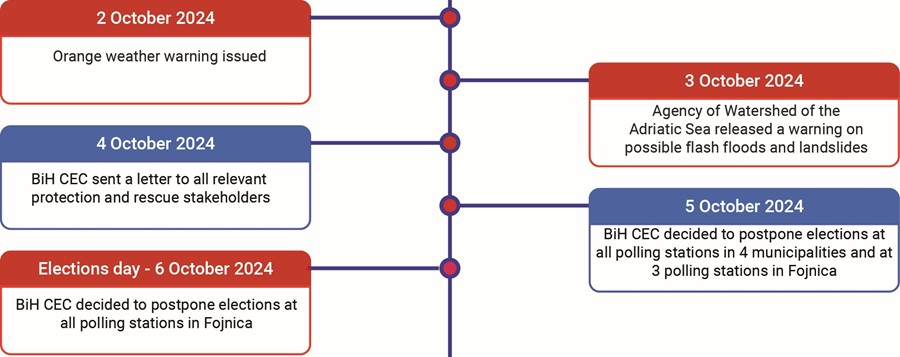
Based on the information received, the BiH CEC contacted all municipal/city election commissions that were at risk or already affected (Bihać, Breza, City of Konjic, City of Mostar, City of Visoko, Drvar, Fojnica, Jablanica, Kiseljak, Kreševo and Prozor-Rama). The main concern was not the ability to conduct polling, but rather the logistics of collecting the election materials afterward (Anon. 2025). There are two rounds of transporting sensitive election materials (such as ballots, stamps and poll books) since ballots cast by mobile teams, tendered ballots and absentee ballots are not counted at the polling stations but at the main counting centre in Sarajevo. It was crucial to have accurate information because election materials are transported from the municipal or city election commissions to the polling stations a day before the elections, and their integrity had to be ensured. In the event of a postponement, the materials would stay with municipal or city election commissions under police protection.
Bihać, Breza, Drvar and Prozor-Rama municipalities and the City of Visoko confirmed that the polling stations could be opened. However, the Kiseljak EMB proposed postponing the elections since most poll workers were trying to save their homes. Jablanica also reported that elections could not be held due to the emergency. The election commission of Konjic reported that there was no power or cell-phone signal in some parts of the municipality, stating that they would send their proposals on 5 October after a meeting of the city’s central crisis team. Kreševo proposed postponement of the election, while the election commission in Fojnica reported that they could not access three polling stations (Anon. 2025).
After carefully considering all available information, the BiH CEC postponed the elections at all polling stations in Jablanica, Kiseljak, Konjic and Kreševo, and at three polling stations in Fojnica. However, public pressure concerning the possibility of conducting elections in Fojnica was building, and the BiH CEC requested a new report from the FBiH Civil Protection Administration, which it did not receive. It next (Anon. 2025) consulted the municipal election commission of Fojnica to inquire if conducting the elections was feasible, meanwhile instructing it not to open any polling stations pending a new decision. On the morning of election day, the Fojnica EMB reported that additional polling stations were affected and requested the BiH CEC make an urgent decision. It then did so, postponing elections at all polling stations in Fojnica (BiH CEC 2024c). It is worth noting that the BiH CEC made efforts to collect all relevant information, including from local election commissions that had first-hand knowledge of the unfolding situation. To prevent any dis/misinformation concerning postponement, the central EMB issued regular press releases informing the public of all steps undertaken to protect the safety of voters and the integrity of the electoral process.
The election campaign period in BiH starts 30 days before election day and ends 24 hours before the opening of the polling stations. It is a busy period with political parties putting up billboards, organizing rallies, distributing flyers, doing street actions and participating in TV debates. In the 2024 local elections, the last day of the election campaign was Saturday, 5 October. Most political parties that had planned to hold central rallies at the close decided instead to halt their campaigns immediately as an expression of sympathy and support, inviting their members and supporters to donate towards the flood relief fund.
Elections in the rest of the country were held as scheduled, and there were no issues with the transport of election materials. The voter registration process was also not affected since, as mentioned, voter registration for in-country voters in BiH is passive; registration of out-of-country voters is still active but is done online, and the voters’ registers for mobile teams were concluded 20 days prior. A comparison of voter turnout in 2020 (when local elections were also held) reveals a slight decline: 48.41 per cent in 2024 compared to 50.4 per cent in 2020. While 1,705,520 voters participated in 2020, the number was 1,637,847 in 2024 (BiH CEC n.d.). This trend may be attributed to the widespread dissatisfaction with the authorities’ response to the catastrophic floods and landslides, but also the fact that people were more concerned about saving their properties and livelihoods than going to the polls. Having in mind the very complex administrative setup of the country, there was a delay in response, which was even evident months after the events (Radio Slobodna Evropa 2024).
Public perceptions
During the campaign period the BiH CEC regularly informed the public about developments concerning likely postponement of the elections. Some public figures entered the debate such as film director Jasmila Žbanić, who argued that this would be an irresponsible waste of resources (an additional EUR 10 million) (Dveni Avaz 2024). The figure Žbanić quoted had been previously reported by the central EMB at a press conference on 4 October 2024 (BiH CEC 2024b). Her argument—in line with much of public opinion—was that the elections should have been postponed nationwide as a gesture of solidarity with those affected by the floods; however, she went further in arguing that funds for repeating the election could instead be used to help relief efforts.
An opinion poll of persons over 15 years of age by Klix.ba on 4 October (Klix 2024) showed that 74 per cent of respondents strongly supported electoral postponement (‘yes, absolutely’) while 26 per cent were against. According to unpublished research conducted by the marketing agency DirectMedia, Klix. ba was the most viewed news portal in the country at this time (Table 1). Also lending weight to the finding, Klix.ba became a trusted platform for real-time data during the Covid-19 pandemic, and in a highly divided society (BBC News 2024) it is nonetheless visited by users in both entities of BiH (and in Brčko District of BiH).
| Website | Reach-census | Reach-Internet | Visitors (real users) | Page views |
|---|---|---|---|---|
| Klix.ba | 21% | 53% | 729,582 | 73,246,173 |
| Olx.ba | 16% | 42% | 573,016 | 6,645,910 |
| Radiosarajevo.ba | 13% | 33% | 449,475 | 7,826,511 |
| Srpskainfo.com | 11% | 28% | 391,034 | 7,093,623 |
| Nezavisne.com | 11% | 28% | 390,431 | 16,641,666 |
| oslobodjenje.ba | 10% | 25% | 348,292 | 5,610,077 |
| Raporta.ba | 9% | 24% | 334,143 | 5,077,223 |
| bljesak.info | 9% | 24% | 325,520 | 6,869,924 |
| n1info.ba | 9% | 23% | 323,940 | 3,659,305 |
| slobodna-bosna.ba | 9% | 23% | 311,369 | 10,320,114 |
| sportsport.ba | 8% | 21% | 296,042 | 10,820,736 |
| fokus.ba | 8% | 21% | 287,512 | 1,706,768 |
| hercegovina.info | 7% | 19% | 259,013 | 2,780,077 |
| tuzlanski.ba | 7% | 18% | 254,334 | 2,047,585 |
| faktor.ba | 7% | 18% | 243,957 | 2,321,557 |
A total of BAM 11.5 million Convertible Marks (around EUR 5.8 million) was originally approved for the conduct of the 2024 local elections by the BiH CEC, although EUR 17 million was requested (Parliamentary Assembly 2023). The basic budget request was EUR 5.8 million with an annex to the budget request for EUR 5.5 million for the introduction of new technologies. An additional EUR 3.3 million was to be paid by the cities and the municipalities in line with article 1.2a of the BiH Election Law. Only 55.58 per cent of the budget was executed, and at the time of writing the BiH CEC has not released figures for the amount spent.
Rescheduled elections
In line with the BiH Election Law, Jablanica, Fojnica, Kiseljak, Konjic and Kreševo were to conduct their postponed elections preferably within 7 days, and no later than 30 days from the election day.
In the days to come the BiH CEC regularly communicated with the affected municipalities to determine the date for rescheduled elections. Four out of the five reported that elections could be held—the central EMB decided to hold elections in Fojnica, Kiseljak, Konjic and Kreševo on 20 October 2024. The disaster in Jablanica being far more severe, its elections were rescheduled for 3 November 2024, was the latest date compatible with the law (Anon. 2025).
Election material stored at the local EMBs had survived the floods and landslides. Since polling operations in Fojnica had not been postponed until the course of election day itself, some polling stations had opened and started counting received materials, as per normal procedures. The votes in this municipality were not cast and the public was informed about postponement of the elections (N1 BiH 2024). Voters were informed that the new date would be timely communicated, along with the necessary information. Since the boxes with ballots were already opened at some polling stations, but not used, the BiH CEC decided to change the stamp used for ballots in Fojnica, making a new one that read ‘postponed elections’.
In terms of additional costs that might have been incurred due to the floods and landslides, the interviewed officer stated that these were negligible. Budget items included the preparation of the new stamp for polling stations in Jablanica and covering the costs of EMB staff who monitored postponed elections in the five municipalities/cities (Anon. 2025).
Voter ID and special voting arrangements
Two new instructions were issued for all the five affected constituencies. First, since some of the voters had lost their valid forms of ID in the floods (ID cards, passports and driving licences), an alternative option was introduced. A voter who came to an office of the Ministry of Interior and reported their ID documents had been destroyed would be issued a form ‘LK-01-4’ (with a photograph) that could be used at the polling station. Local EMBs were required to report to the BiH CEC the exact number of such voters and their respective polling stations.
In Konjic, six additional mobile teams were established—supplementing the existing two—for voters who, despite not wishing to evacuate, could not reach polling stations due to being cut off from road infrastructure. The mobile teams were accompanied by search and rescue teams from the Civil Protection Services, who used their vehicles to reach voters. Three polling stations in Konjic were relocated, and voters were informed of the new locations. The new mobile teams used the contingency ballots from the relocated polling stations. Additionally, the BiH CEC deployed staff to polling stations in all five affected municipalities on election days (20 October and 3 November) to ensure smooth operations and provide assistance. The situation in Jablanica was far more challenging in terms of ensuring the conditions necessary for safe elections. Only one polling station in Jablanica was relocated, and voters were informed of the new location.
Registration, turnout and results
The rulebooks and instructions used for the original election date were also applied to the postponed elections. No new Central Voters’ Register was prepared, meaning that the register used was that concluded on 5 October, except for the excerpts from the Central Voters’ Register for voters voting by mobile teams. The BiH CEC passed a new decision on determining excerpts from the Central Voters’ Register for these voters to include all voters who were to vote at a polling station, but now due to infrastructural damage to the roads and inaccessibility would have to vote by newly established mobile teams.
The postponed elections were conducted without any incidents, in a calm but sombre atmosphere due to the scale of destruction and loss of life. All the international observation missions present in BiH on 6 October (the Organization for Security and Co-operation in Europe’s Office for Democratic Institutions and Human Rights (OSCE/ODIHR), Association of World Election Bodies, Congress of Local and Regional Authorities) left the country before postponed elections were held. However, the elections on 20 October and 3 November were observed by other international organizations present in BiH, including the European Union Delegation, the Office of the High Representative, foreign embassies, and domestic non-governmental organizations. One of the largest domestic observation missions organized by the Coalition for Free and Fair Elections ‘Pod lupom’ concluded that the postponement had allowed flood-affected citizens to exercise their right to vote and in safe conditions (Pod lupom 2024). In its final report, the OSCE/ODIHR mission reported on the events that led to the postponement of elections, also mentioning the steps the central EMB took to ensure safe and credible elections (OSCE/ODIHR 2025). No special recommendations were issued.
According to the BiH Election Law, election results must be confirmed within 30 days following election day. This obligation was largely met: results were confirmed on 5 November, exceptions being the four localities voting on 20 October—Jablanica, Kiseljak, Konjic and Kreševo—as well as Čapljina, the City of Mostar, Foča, Gacko and Prozor-Rama. The reason more municipalities and cities had unconfirmed results is that except for Fojnica, which voted later, mobile and tendered votes from areas where elections were postponed had not yet been counted. Mobile and tendered ballots, as well as postal votes, are counted at the main counting centre in Sarajevo, and the process involves a series of verifications prior to the counting. Tendered ballots are used by voters whose current permanent or temporary residence differs from the constituency for which they vote. So a person in Jablanica could vote for Prozor-Rama or Mostar if internally displaced or, for example, residing in a nursing home. This means that the results for these two municipalities could not be published until all the voters had cast their ballot. However, all results for every level of authority were confirmed on 16 November 2024.
There was a slight decrease in voter turnout across all municipalities and cities compared with 2020’s local elections, including in areas where electoral postponement took place (Table 2). In some, such as Konjic, there was a slight decrease in the number of registered voters, affecting the final turnout. It should be noted that nor was 2020 a ‘normal’ local election year, taking place during a very different kind of natural hazard—the Covid-19 pandemic. So instructive comparisons may be difficult to draw.
| Municipality/city | 2020 local elections | 2024 local elections | ||||
|---|---|---|---|---|---|---|
| Registered in CVR* | Voted | Percentage | Registered in CVR | Voted | Percentage | |
| Fojnica | 10.581 | 5.793 | 54,7% | 10.561 | 5.449 | 51,5% |
| Kiseljak | 17.689 | 9.371 | 53% | 17.940 | 8.365 | 46,6% |
| Jablanica | 8.970 | 5.977 | 66,6% | 8.827 | 5.853 | 66,3% |
| Konjic | 22.280 | 12.697 | 56,9% | 21.965 | 12.093 | 55% |
Conclusion and lessons learned
While the 2024 local elections were generally regarded as successfully managed—despite the challenges posed by floods and landslides—a thorough analysis reveals several key areas for improvement.
First of all, the situation exposed weaknesses in interagency collaboration. It is symptomatic that no agency reached out to the BiH CEC to coordinate an electoral emergency response. Secondly, the crisis demonstrated that emergencies and crises call for a prompt response by all relevant stakeholders. In this case, the central EMB had to find innovative ways to include all voters, while observing the legislative framework. Thirdly, adaptability is important, as seen during the Covid-19 pandemic, and can make the difference between success and failure. Resilience can be strengthened by introducing special voting arrangements—as in this case—or allocating additional human and financial resources, for example (Alihodžić 2023). But if an EMB fails to adapt, this can lead to lower turnout or the derailing of the election schedule which, at scale, may undermine the integrity of elections.
As discussed in International IDEA research on electoral integrity and the Covid-19 pandemic (James, Clark and Asplund 2023), countries were in a weak position to respond if they had poorly designed electoral laws and codes, under-investment in elections, or fewer voting channels available to citizens. The floods and landslides of 2024 have yet to lead to any major reforms concerning the legislative framework or operational regulations in BiH.
Several steps could be taken at the legislative and technical/operational levels. The BiH authorities might consider adding a provision in the Election Law to include postponement of elections in cases of emergency—because it may not be possible in the future to recover and conduct elections within the 30-day deadline. Such a reform also entails changing the provision related to the deadline for confirmation of results. This would be of strategic benefit, not least because some local government bodies cannot be established until all votes are counted. The central EMB should request additional contingency funds, a need substantiated by the existing reports of the Intergovernmental Panel on Climate Change (IPCC 2022), which states that many changes in the climate system intensify as global warming increases and include more frequent and severe hot extremes, marine heatwaves and heavy rainfall events, as well as, in some regions, greater agricultural and ecological drought. In pursuing the necessary flexibility in crisis response, the BiH authorities should consider amending the public procurement procedures to allow the EMB to procure additional ballots or hire additional staff, as may be necessary and proportionate.
It is also important to build the EMB’s capacity to respond to crises and emergencies more widely. The BiH CEC is currently understaffed, lacking the capability to deploy available risk management or foresight tools. Specifically, due to limitations imposed by the EMB’s staff establishment plan, the ERMTool, which was piloted in 2012 and 2014, has not been used since. The main reason is an unwillingness on the part of the EMB to recruit. Rather, increasing the number of employees is a lengthy process and ultimately requires approval by the BiH Council of Ministers. Further, this process is often influenced by various political preferences. Even once the staff establishment plan is approved, authorities frequently fail—more often than not—to adopt the budget for BiH’s institutions on time, that is, by the end of the year for the following year. This, in turn, halts the recruitment process due to a lack of funds. As an illustration of this situation, it should be noted that the BiH CEC has forwarded its proposed staff employment plan but is awaiting responses.
Together, International IDEA’s ERMTool and the Organisation for Economic Co-operation and Development’s horizon scanning tool could afford BiH’s electoral stakeholders excellent strategic foresight. Being able to predict new or emerging risks or threats, including to electoral integrity, would enable the central EMB and local counterparts to better plan human resources, finances and communication. Broad and exploratory or focused on specific project goals, horizon scanning analysis and use of related tools would require an analytic unit to be established and, as mentioned, recruitment of staff. Such a unit would be responsible for feeding in the information and data and preparing the scenarios necessary for adequate planning design. Fortunately, the BiH CEC already has a Centre for Education. While not yet fully operational, the centre would be very well placed to provide training on the use of the ERMTool to all interested parties, and in particular to the lower-tier EMBs. The centre could also provide training on horizon scanning, offering practical exercises or peer-to-peer learning.
While the BiH CEC provided timely information regarding the postponement of local elections in 2024, it is crucial in future to go beyond issuing statements and take a more proactive role in directly addressing citizens’ concerns. Social media platforms offer an effective channel for the BiH CEC to engage with the public, clarify doubts and offer real-time updates. Leveraging these channels to their full potential ultimately depends on the EMB’s human resources—a challenge that cuts across all areas of its operations, from crisis management to voter education. Without sufficient personnel, the CEC struggles to maintain the level of transparency, responsiveness and public engagement required to build trust and participation. These are critical dimensions of electoral resilience and the broader legitimacy of the system.
Importantly, the country remains flood-prone, and the broader governance system is complex and decentralized. These contextual factors heighten the urgency of strengthening institutional capacity and resilience. Proposed investments must therefore be understood within this dual context of environmental vulnerability and administrative complexity. Ensuring that the EMB is equipped to function effectively amid such challenges is essential not only for electoral integrity but also for overall democratic resilience.
Abbreviations
BiH Bosnia and Herzegovina CEC Central Election Commission EMB Electoral management body ERMTool Electoral Risk Management Tool FbiH Federation of Bosnia and Herzegovina GDP Gross domestic product ID Identification ODIHR Office for Democratic Institutions and Human Rights OHR Office of the High Representative in BiH OSCE Organization for Security and Co-operation in Europe
References
Alihodžić, S., ‘Electoral Risk Management Tool source codes are now available to democracy practitioners’, International IDEA, 28 September 2020, <https://www.idea.int/news/electoral-risk-management-tool-source-codes-are-now-available-democracy-practitioners>, accessed 27 March 2025
—, Protecting Elections: Risk Management, Resilience-Building and Crisis Management in Elections (Stockholm: International IDEA, 2023), <https://doi.org/10.31752/idea.2023.44>
Anonymous election officer (Anon.), Secretariat of the BiH Central Election Commission, author’s interview, 2025
Associated Press (AP), ‘Bosnia postpones local elections due to lack of funding’, 23 May 2020, <https://baynews9.com/fl/tampa/ap-online/2020/05/23/bosnia-postpones-local-elections-due-to-lack-of-funding>, accessed 27 March 2025
BBC News, ‘Bosnia-Herzegovina media guide’, 11 October 2024, <https://www.bbc.com/news/world-europe-17211939>, accessed 27 March 2025
Bosnia and Herzegovina (BiH), Constitution of 1995 (revised 2009), <https://www.constituteproject.org/constitution/Bosnia_Herzegovina_2009>, accessed 31 March 2025
—, Election Law of Bosnia and Herzegovina (2001 consolidated text with amendments through 2024), 2024, <https://www.izbori.ba/Documents/documents/ZAKONI/BiH_Election_Law_last_consolidated_version.pdf?v-4>, accessed 27 March 2025
Bosnia and Herzegovina, Government of (BiH) with European Union, World Bank Group and United Nations, ‘Bosnia and Herzegovina Floods, 2014: Recovery Needs Assessment’, 2014, <https://www.gfdrr.org/sites/default/files/BiH-rna-report.pdf>, accessed 27 March 2025
Bosnia and Herzegovina, Government of (BiH) and United Nations Development Programme (UNDP), ‘Fourth National Communication of Bosnia and Herzegovina under the United Nations Framework Convention on Climate Change’, October 2021, <https://unfccc.int/sites/default/files/resource/FNC%20BiH_ENG%20fin.pdf>, accessed 27 March 2025
Central Election Commission of Bosnia and Herzegovina (BiH CEC), Statistika izbora [Election statistics], [n.d.], <https://www.izbori.ba/Default.aspx?Lang=3&CategoryID=431>, accessed 27 March 2025
—, Election statistics 2024, 2024a, <https://www.izbori.ba/Documents/2024/zbirna_statistika_2024.pdf>, accessed 27 March 2025
—, ‘Lokalni izbori 2024. godine – osnovne informacije’ [Local elections 2024 – basic information], press release, 4 October 2024b, <https://www.izbori.ba/?Lang=3&CategoryID=64&Id=5396>, accessed 27 March 2025
—, ‘Central Election Commission of BiH postpones elections at All polling stations in Fojnica’, press release, 6 October 2024c, <https://www.izbori.ba/?Lang=6&CategoryID=183&Id=5582>, accessed 27 March 2025
Davis, R., ‘Bosnia floods and land mines’, FloodList, 21 May 2014, <https://floodlist.com/europe/bosnia-floods-land-mines>, accessed 27 March 2025
DirectMedia Agency, Media market overview Bosnia and Herzegovina, presented at a workshop organized by the Directorate for European Integration, Sarajevo, 13 and 14 March 2025 (unpublished)
Dnevnik.hr, ‘BiH: Povlačenje vode moglo bi trajati mjesecima, raste broj mrtvih’ [BiH: Water withdrawal could last for months, number of fatalities increasing], 24 May 2014, <https://dnevnik.hr/vijesti/svijet/broj-mrtvih-u-poplavama-u-bih-povecan-na-22---337454.html>, accessed 27 March 2025
A. Duranović (ed.), ‘Poplava, Zemljotres, Smog: Prilozi ekohistoriji Bosne i Hercegovine u 20. Stoljeću’ [Floods, Earthquake, Smog: Contributions to the environmental history of Bosnia and Herzegovina in the 20th century], revised edition (Sarajevo: UMHIS/Edicija Zbornici, 2020), <https://ba.boell.org/sites/default/files/2020-07/Poplave%20i%20zemljotresi_web.pdf>, accessed 27 March 2025
Dveni Avaz, ‘Jasmila Žbanić: Odgađanje izbora bila bi greška, bilo bi neodovorno platiti novih 20 miliona KM’ [Jasmila Žbanić: Postponing elections would be a mistake, it would be irresponsible to pay an additional EUR 10 million], 4 October 2024, <https://avaz.ba/showbiz/film-i-tv/932121/jasmila-zbanic-odgadjanje-izbora-bila-bi-greska-bilo-bi-neodgovorno-platiti-novih-20-miliona-km>, accessed 27 March 2025
Emric, E., ‘Rescue teams search for missing after floods, landslides kill at least 16 in Bosnia’, AP News, 5 October 2024, <https://apnews.com/article/balkans-bosnia-floods-rain-missing-b771f8846c1e015b21a7e97321c9fd2f>, accessed 27 March 2025
Hadžiabdić I., ‘Electoral Risk Management in B&H’, presentation at the Global Electoral Risk Management Conference, African Union and International IDEA, Addis Ababa, 1–3 December 2015, <https://www.idea.int/sites/default/files/events/IDEA-%26-AU-ERM-Conference-Powerpoint6-2015.pdf>, accessed 27 March 2025
Intergovernmental Panel on Climate Change (IPCC), Climate Change 2022: Impacts, Adaptation and Vulnerability. Contribution of Working Group II to the Sixth Assessment Report of the Intergovernmental Panel on Climate Change (Cambridge and New York: Cambridge University Press, 2022), <https://doi.org/10.1017/9781009325844>
T. S. James, A. Clark and E. Asplund, E., (eds), Elections during Emergencies and Crises: Lessons for Electoral Integrity from the Covid-19 Pandemic (Stockholm: International IDEA, 2023), <https://doi.org/10.31752/idea.2023.24>
Klix, ‘Šta vi mislite? Treba li CIK odgoditi izbore u nedjelju? Poginulo je 15 ljudi, a prekinuta je i putna žila kucavica’ [What do you think? Should the CEC postpone the elections on Sunday? 15 people died, and a major road artery was cut off], 4 October 2024, <https://www.klix.ba/vijesti/bih/treba-li-cik-odgoditi-izbore-u-nedjelju-poginulo-je-15-ljudi-a-prekinuta-je-i-putna-zila-kucavica/241004105>, accessed 27 March 2025
Ministry of Security, Natural hazards risk assessment for Bosnia and Herzegovina in 2012 (and updated) [Serbo-Croatian] (Sarajevo: BiH Ministry of Security, 2020), <https://msb.gov.ba/PDF/13072022.pdf>, accessed 17 March 2025
N1 BiH, ‘Centralna izborna komisija BiH odgodila izbore na svim biračkim mjestima u Fojnici’ [The Central Election Commission of BiH postponed the elections at all polling stations in Fojnica], 6 October 2024, <https://n1info.ba/vijesti/centralna-izborna-komisija-bih-odgodila-izbore-na-svim-birackim-mjestima-u-fojnici>, accessed 17 March 2025
N1 Sarajevo, ‘Orange warning issued for heavy rainfall in parts of Bosnia’, 3 October 2024, <https://n1info.ba/english/news/orange-warning-issued-for-heavy-rainfall-in-parts-of-bosnia>, accessed 27 March 2025
Office of the High Representative to Bosnia and Herzegovina (OHR), ‘General information’, [n.d.], <https://www.ohr.int/about-ohr/general-information>, accessed 31 March 2025
—, ‘Decision Enacting the Law on Amendments to the Election Law of Bosnia and Herzegovina’, 26 March 2024, <https://www.ohr.int/decision-enacting-the-law-on-amendments-to-the-election-law-of-bosnia-and-herzegovina-11>, accessed 27 March 2025
Organization for Security and Co-operation in Europe, Office for Democratic Institutions and Human Rights (OSCE/ODIHR), ‘Bosnia and Herzegovina General Elections 12 October 2014: Election Observation Mission Final Report’, 7 January 2015, <https://www.osce.org/files/f/documents/8/7/133511.pdf>, accessed 27 March 2025
—, ‘Bosnia and Herzegovina Local Elections 6 October 2024: Election Observation Mission Final Report’, 25 February 2025, <https://www.osce.org/files/f/documents/7/3/586134.pdf>, accessed 27 March 2025
Parliamentary Assembly of Bosnia and Herzegovina, ‘Odgovor na poslaničko pitanje – Predstavnički dom’ [A response to an MP’s question – House of Representatives], 6 december 2023, <https://static.parlament.ba/doc/162708_2298%20-%20%c5%a0emsudin%20Dedi%c4%87%20-%20odgovor%20CIK%20BiH.pdf>, accessed 27 March 2025
Pod lupom, ‘Local Election in Bosnia and Herzegovina: Final Report on Civic, Non-partisan Observation of Local Election’, March 2021, <https://podlupom.org/wp-content/uploads/document/793/original/Pod-lupom-Final-report-on-civic-non-partisan-observation-of-local-election.pdf>, accessed 27 March 2025
— ‘Finalni izvještаj o građanskom, nestranačkom posmatranju lokalnih izbora 2024. godine u Bosni i Hercegovini’ [Final Report on civic, non-partisan observation of 2024 local elections in Bosnia and Herzegovina], December 2024, <https://podlupom.org/posmatranje-izbora/izvjestaji-o-posmatranju-izbora/finalni-izvjestaj-o-gradanskom-nestranackom-posmatranju-lokalnih-izbora-2024-godine-u-bih>, accessed 27 March 2025
Radio Slobodna Evropa, ‘Milione za poplavljene u BiH blokirala politika’ [Politics blocked millions as assistance to affected areas], 16 December 2024, <https://www.slobodnaevropa.org/a/pomoc-poplave-bih-donacije-eu/33239018.html>, accessed 14 April 2025
United Nations Office for Disaster Risk Reduction (UNDRR), ‘Definition: Hazard’, [n.d.a], <https://www.undrr.org/terminology/hazard>, accessed 27 March 2025
—, ‘Why are disasters not natural?’, [n.d.b], <https://www.undrr.org/our-impact/campaigns/no-natural-disasters>, accessed 31 March 2025
United Nations Development Programme (UNDP), ‘Disaster Risk Reduction for Sustainable Development in Bosnia and Herzegovina – Phase II’, [n.d.], <https://www.undp.org/bosnia-herzegovina/projects/disaster-risk-reduction-sustainable-development-bosnia-and-herzegovina-phase-ii>, accessed 27 March 2025
Annex A. Interview questions on floods and the local elections
Decision-making process
- What was the time frame for the EMB’s decision-making process?
- What are legislative assumptions for rescheduling the elections?
- Were good communication mechanisms in place to make an informed decision?
Specific issues
- Did the floods and landslides affect voter registration and campaigning? If yes, in which ways?
- Did the EMB undertake some specific measures to ensure the inclusiveness of voters affected by natural disasters?
- Given the specifics of the administrative setup in Bosnia and Herzegovina, did the EMB have appropriate information on protection and rescue coordination mechanisms at all levels of authority in BiH? If yes, how did it become part of the reporting?
Financing
- Did the rescheduling of elections cause any additional costs?
- Were the funds to finance the additional costs available?
About the author
Mubera Vulovic holds a master’s degree in English language and interpretation. She has been working with the Central Election Commission of Bosnia and Herzegovina since 2006, first as the international cooperation officer/interpreter and later as the head of the Public Relations, International Cooperation and Protocol Department. Mubera Vulovic was deputy director of the Main Counting Centre in Sarajevo for the 2024 local elections. She is a certified LEAD trainer—Leadership and Electoral Conflict Management Skills for Electoral Stakeholders—and is a certified OSCE/ODIHR long-term observer.
Valere Gaspard, Holly Ann Garnett and Nicole Goodman
Publishing date: 10 February 2025
Introduction
There has been an increase in the intensity and frequency of weather-related natural hazards in recent years (UNDRR 2024).21 For example, data from the United States shows that in the 1980s natural hazards occurred on average 3.3 times per year across the country, whereas in the past decade that number has exceeded 17 (USAFacts Team 2024). Natural hazards can have catastrophic economic, social and political impacts. This includes impacts on electoral integrity.
All stages of the electoral cycle can be impacted by natural hazards, including the pre- and post electoral stages. However, the threat to elections is most acute when a hazard (such as an extreme weather event) coincides with campaigning or the day of the election. This may lead to election postponement (James and Alihodžić 2020), voter disenfranchisement (Zelin and Smith 2023), or even increased corruption (Birch and Martínez i Coma 2023). In the face of natural hazards, it is much harder for EMBs, as public administrative bodies, to fulfil their roles and responsibilities. When hazards occur, election administrators might be forced to pivot away from their regular electoral management strategies to ensure democratic elections continue to take place.
In this case study, we examine the effects of natural hazards on EMBs and the administration of elections by drawing on the example of two Canadian jurisdictions. In the summer of 2023, wildfires affected much of Canada, with major cities under the haze of smoke, and towns evacuated from coast to coast. For the Canadian province of Alberta and one of the country’s territories, the Northwest Territories, wildfires occurred during the time of general (subnational) elections, posing significant challenges for their administration and access to ballots. By documenting their election experiences during the exogenous shocks, the case study outlines lessons learned for practitioners and scholars to better prepare and respond in an age where natural hazards are becoming more frequent and intense (UNDRR 2024).
Methods
To prepare this case study secondary sources were collected, including media articles and reports from the election agencies. To provide additional explanatory insight and obtain details not published in the public record or in official reports, two interviews were conducted with the Chief Electoral Officers of Elections Alberta and Elections Northwest Territories between 13 September and 1 October 2024. Interviews were semi-structured, lasting up to one hour, and were conducted virtually via Microsoft Teams. Questions were fact-based. They probed challenges posed by the wildfires, the time frame for decision-making processes, factors considered when making decisions in response to the fires, specific impacts on different aspects of the election, impacts on cost, lessons learned, and key reforms or changes (see the Annex for the questionnaire). Interviews served to bolster the information already collected and to provide key reflections from the EMBs’ leaders.
Natural hazard context
In Alberta, summer wildfires are a regular occurrence. The 2023 wildfires, however, burned an unprecedented 2.2 million hectares (Derworiz 2024) or approximately 22,000 km2, affecting six electoral districts in the province. This means that of Alberta’s total land area—635,000 km2 (Statistics Canada 2022)—3.46 per cent was affected. While precautions had been put in place such as requiring permits for burning, additional firefighter training and moving firefighting equipment, dry conditions suggested the 2023 wildfire season would be especially bad (The Weather Network 2023). In addition to local states of emergency, a province-wide state of emergency was declared on 6 May 2023 (Markov 2023). At least 48 communities were affected by these fires, and over 38,000 Albertans were evacuated, including 13 whole communities, due to the threat of either the wildfire moving in or smoke (Canadian Interagency Forest Fire Centre 2023). While there were no reported civilian deaths (Jones et al. 2024), at least one firefighter died as a result of the fires (Aziz 2023).
Meanwhile, 303 wildfires in the neighbouring Northwest Territories burned an unprecedented 4.1 million hectares of forest (41,000 km2), displacing up to 70 per cent of the population at their height (Dunbar 2024; Northwest Territories 2024; Ridgen 2024). Of the territory’s total land area, 1,172,000 km2 (Government of Canada 2017), this represented 3.5 per cent. Although local fire crews had been deployed early in anticipation of a difficult wildfire season, it became necessary to also bring in fire crews from other countries and provinces due to the fires’ unprecedented severity (O’Neill and Otis 2023). A territory-wide state of emergency was called on 15 August 2023 (DeLaire 2023). The Behchoko-Yellowknife and Hay River wildfires caused over CAD 60 million in insured damages (Insurance Bureau of Canada 2023). The damage was so severe in the hamlet of Enterprise that 90 per cent of the community was destroyed (CBC News 2023).
As in Alberta, a summer wildfire season is common, but extreme drought conditions, high temperatures and high winds resulted in the most severe fires the territory had ever seen (Northwest Territories 2024). In both cases it was commonly reported that the unprecedented scale and severity of the fires was linked to climate change (Derworiz 2024). The scope and magnitude of the wildfires were exacerbated by increased heat waves and drier forests which increase the risk of fires but also extend the wildfire season. This problem is intensified in Northern Canada and Arctic areas, where the rate of global warming is possibly several times higher than the rate elsewhere in the world, causing unusually warm and dry spring and summer seasons (Shingler 2023).
Electoral management and constitutional context
Alberta and the Northwest Territories are both subnational jurisdictions within Canada. Alberta is one of 10 Canadian provinces, while the Northwest Territories is one of the country’s three territories. Although the differences between a province and territory are constitutionally meaningful within the context of Canadian politics, the distinction is less relevant to our discussion of election management. In 2023, both were scheduled to have a general election to elect representatives to their respective legislatures. Details about both elections, as well as the administrative decisions that were made about the wildfires, are discussed more fully below.
Alberta
The province’s general election took place on 29 May 2023, after a 28-day election period which began on 1 May 2023. The date was determined in accordance with the province’s Election Act, which states that Alberta’s fixed election date is to occur in the fourth year after the last general election, on the last Monday in May (Elections Alberta 2024).
Because it was a general election, all 87 electoral districts were up for contest. In Alberta, one candidate is elected per electoral district, meaning that its Legislative Assembly has the same number of seats as it does electoral districts. Since Alberta has a single-member plurality electoral system, an election occurs in every electoral district between that district’s candidates. Elections Alberta, the independent and non-partisan EMB responsible for managing provincial elections in Alberta, is therefore responsible for administering the election in each electoral district.
Elections Alberta’s wildfire response
Wildfires in Alberta occurred throughout the election period and impacted many communities across the province. While Alberta’s legislated wildfire season begins on 1 March and ends on 31 October every year (Alberta 2024b: s. 17(1)), the province-wide state of emergency that was declared on 6 May 2023 coincided with the province’s general election (1–29 May).
Under the province’s Election Act, when the Chief Electoral Officer believes an emergency or natural hazard might impact the opening of, or voting at, a voting place, they have the power to move it to a different location on the same day or to change its opening time on that day (Alberta 2024a: s. 4(3.1)).
However, it is important to note that the law does not allow the Chief Electoral Officer to adjourn voting in an electoral district past election day. If adjourning past election day—what is formally called ‘discontinuing’ the election—is required, then the Chief Electoral Officer must apply to a judge of the Court of King’s Bench (the Superior Trial Court for the province). If the court approves the application to discontinue the election in that district, then the election in that district must occur within six months of the application date (Alberta 2024a: s. 4(3.5–3.6)).
While Elections Alberta reports that there were many calls to discontinue the election (Elections Alberta 2024: 109), it did not apply to discontinue the election in any of the 87 electoral districts. Even though six electoral divisions—Drayton Valley-Devon, Athabasca-Barrhead-Westlock, Central Peace-Notley, Lesser Slave Lake, Peace River, West Yellowhead—could have been postponed, doing so would have left approximately 163,214 voters without any kind of representation in Alberta’s legislature until a by-election could be held (Petrowsky 2024).
Instead, the EMB and its staff acted to ensure that voters who were displaced by the wildfires had access to voting places or ballots. This involved Returning Officers—the individual in charge of the administration of an election in an electoral district—consulting with emergency personnel and community leaders to inform their decision making. Doing so helped Returning Officers in the affected electoral districts to identify potential risks and provide voters with different options for how to vote (Elections Alberta 2024: 113). While advance voting was a substantial part of this, Elections Alberta also opened access to requesting a special ballot—a write-in ballot that does not have the names of the candidates running in the electoral division, which allows electors to vote by mail. Special ballots were distributed (a) by using Alberta Forestry (the department in charge of wildfire management and prevention) to deliver ballots to emergency personnel; and (b) by utilizing mail services, which created new opportunities at evacuation centres to vote (Petrowsky 2024).
Northwest territories
The territory’s general election took place on 14 November 2023, after a 30-day election period which began on 16 October 2023. This is notable as the original election period was supposed to start on 4 September 2023, with election day on 3 October 2023, but was postponed due to the wildfires. Therefore, while Alberta is a case example of an EMB administering the election through the natural hazard, the case of the Northwest Territories shows an alternative strategy to postpone elections until emergency conditions subside.
Elections in the Northwest Territories are planned and administered by a non-partisan and independent EMB: Elections Northwest Territories (Elections NWT). During a general election, Elections NWT is responsible for informing the public about voting procedures and electoral rights, appointing and training election officers, reviewing the financial reports of candidates, maintaining voter lists, enforcing election law, supervising the ballot casting process, reporting election results and recommending changes to election legislation (Elections NWT n.d.).
All 19 electoral districts, and thus all seats in the Legislative Assembly of the Northwest Territories, were up for contest. While only one candidate is elected per electoral district—since the Northwest Territories also follows a single-member plurality electoral system across all its electoral districts—it should be noted that the Northwest Territories does not have political parties (White 2001), making campaigns entirely about the candidates as individuals.
Elections NWT’s wildfire response
Evacuations commenced in May 2023 and ended in mid-September, with the vast majority of those displaced being evacuated out of territory. As mentioned, displacement affected some 70 per cent of the territory’s total population (41,070—Statistics Canada 2024). Up until July, the EMB had contingency plans in place for implementing the original schedule, that is four years since previous polling. That election period was to start on 4 September 2023, with election day on 3 October. Contingency plans involved setting up temporary polling locations in evacuee shelters (Elections NWT 2024: 19). If an electoral district was more severely impacted, Elections NWT was prepared to withdraw the writ of election in that district.
Because the wildfires continued into August—impacting the capital city of Yellowknife, as well as regional centres like Hay River and Fort Smith, among others—the Chief Electoral Officer began looking at possible options to delay the entire territorial election. On 13 August, discussions began with the Clerk of the Legislative Assembly and a review of what was permitted under the territory’s legislation occurred the next morning.
While the Chief Electoral Officer has the authority under the territory’s Elections and Plebiscites Act to recommend to the Commissioner that the writ of the election for that district be rescinded (with a new writ required within three months), they do not have the power or authority to alter the date of the election for a district absent of the withdrawal of the writ, or to delay the entire election. Nor did the legislation allow for Elections NWT to open polling stations in evacuee shelters or other locations outside of the territory. Due to these legal limitations, the Chief Electoral Officer (with the support of the Clerk of the Legislative Assembly) requested that a new bill be drafted by the territory’s Department of Justice which would change the date of the territorial election, notwithstanding the fixed date otherwise set out in the Act (Elections NWT 2024).
This recommendation came on 16 August 2023, the day after the entire territory had come under a state of emergency. A post-election report by Elections NWT highlights two reasons for delaying the election. First, since polling locations could not be set up outside of the territory, there were concerns that evacuees might not have the required identification needed to vote by absentee ballot. A second concern was logistical issues caused by the wildfires—such as the difficulty of setting up returning offices in affected communities, the (in)ability to send election materials to electoral districts that were not evacuated, and the safety of election workers.
While waiting for the bill to be passed, Elections NWT set up operations at the headquarters of Elections Alberta, to the south. This was in case Elections NWT needed to mobilize to administer elections in some electoral districts. However, as noted, by 28 August 2023 the Legislative Assembly unanimously passed the bill to postpone the election day, thus giving additional time for conditions to improve throughout the territory. Additionally, on 29 August the Chief Electoral Officer delivered instructions that the displacement or absence of a voter from their electoral district would not be regarded as a change to their residence, even if the residence has been destroyed. This was to ensure that voters would not be disenfranchised because of the fires (Elections NWT 2024; Dunbar 2024). By 11 September 2023 the staff of Elections NWT had returned to their offices in the territory. The final evacuation order in the territory was lifted on 18 September (Elections NWT 2024: 20). This gave electoral staff more than a month to prepare before the start of the new election period (16 October until election day on 14 November 2023).
It is noteworthy that Elections NWT also researched various alternatives should the evacuation order continue. These included the use of an electronic absentee ballot. Remote online ballots had already been offered to absentee voters (in this and the previous, 2019, territorial elections) so this voting channel could have been expanded if needed.
Measures taken to enable conduct of elections
The previous section demonstrates that while the magnitude of the wildfires differed, in both Alberta and the Northwest Territories the respective legal framework impacted how the EMB could respond. Whereas the wildfires and election laws in Alberta led to a situation where Elections Alberta’s staff focused on ensuring electors had access to voting opportunities and voting places, the situation in the Northwest Territories led to a legislative change to postpone the entire territorial election.
The next focus of this case study is on the measures taken by both jurisdictions to manage the following five topics: planning for the election before and during a natural hazard; voter registration; the campaign period; election day; and the information environment.
Planning for the election
Both EMBs developed risk management frameworks and undertook resilience-building in anticipation of the wildfires. In this context, risk management is the act of creating processes for identifying potential problems the EMB might face, while resilience-building consists of strengthening the EMB so that it can continue to fulfil its administrative duties even when emergencies occur (Alihodžić 2023: 11). EMBs may adopt different crisis management responses to a similar issue based on the circumstances of the election, the relevant legislation and the resources available. Elections Alberta, for example, established two ‘alternate returning office teams’ that could be deployed in any electoral district where circumstances prevented the on-ground team from fulfilling their duties (Elections Alberta 2024: 24). One of these teams was sent to the West Yellowhead electoral district to provide training to local staff which had been delayed due to the wildfires. As mentioned, Elections NWT originally set up contingency plans for evacuees to vote while displaced in shelters, before shifting to postponement.
Also key in planning is up-to-date information, which was difficult to obtain as the situations evolved rapidly in both contexts. In Alberta, for example, the information the agency was receiving from Alberta Forestry and Alberta Emergency Management was not sufficient to determine voting area impact and had to be filled in by an internal global information system (GIS) team. The team consisted of four staff members who worked on overlays and maps, turning the information the EMB was receiving into workable data for timely planning decisions (Petrowsky 2024). In the Northwest Territories, concern quickly turned into an evacuation order giving a majority of the territory’s residents 36 hours to leave. Improved information in the case of future natural hazards was noted as a top consideration (Dunbar 2024).
Voter registration
Both jurisdictions have designated approaches on how to conduct voter registration ahead of, and during, elections.
Alberta provides five periods in which an elector can either register to vote or update their information: any time between election events, during a provincial voter registration campaign (‘enumeration period’), during a revision period (the time between the issue of the writs of election and prior to the start of advance voting) or at a voting place—up to and including on polling day itself. Finally, if an elector registered during a previous election, they do not need to register again unless they wish to update their information (Elections Alberta 2024: 52). This flexibility means the impacts of wildfires on voter registration are less severe, or costly to rectify—so long as they register ahead of time or can get to a voting place on a voting day, then eligible Albertans can register. Providing ways for electors to get to voting places (or alternative ways to register if they are unable to in-person on a voting day) is nevertheless crucial for electors who have not registered ahead of time. Since between 80 and 90 per cent of permanent electors in Alberta were already registered and only 14 per cent of those who voted chose to register at the polls (Petrowsky 2024), it is unlikely that the wildfires had a major impact on voter registration in Alberta.
In the Northwest Territories, electors can register outside of election periods within the territory, but most tend to do so during elections (Elections NWT 2024: 18). Elections NWT sent cards in the mail in May 2023 to encourage individuals to register. Registration can be done online or in-person and can occur both before and during election periods—as in Alberta, electors can vote at polling stations even if they are not registered beforehand (Northwest Territories 2007: s. 177–78). Elections NWT’s report about the administration of the 2023 territorial election and our interview with Chief Electoral Officer (Dunbar 2024) suggest that the wildfires did not cause any major issues for voter registration.
Voter information campaign
Elections Alberta manages the campaign period via a Returning Officer who administers the election in each electoral division. The EMB’s central headquarters then coordinates province-wide electoral communications and publicity while supporting the local needs of each returning office (Elections Alberta 2024: 83). Elections Alberta erects road signs with key milestones relating to the administrative aspect of the campaign and updates them throughout the campaign. These include messages about hiring, advance poll dates, and when election day will be. Some of these signs could not be updated because either the wildfires blocked access to them, or they were in areas under evacuation. While the EMB also ran newspaper, television, social media and radio advertisements, it is notable that this mainstay of physical advertisements was lost.
To provide information to electors and to support recruitment efforts in electoral districts that were impacted by wildfires, Elections Alberta utilized targeted social media and online advertisements on Facebook, X (formerly Twitter), Instagram, Snapchat, TikTok, YouTube, Quora, Native Touch, Google Display, Google Search and Bing Search. It also placed billboards and conducted media interviews (Elections Alberta 2024). Targeted radio advertisements were used in six electoral districts (see Figure 1), which included essential voter information such as ways to vote in those districts and changes to polling locations.
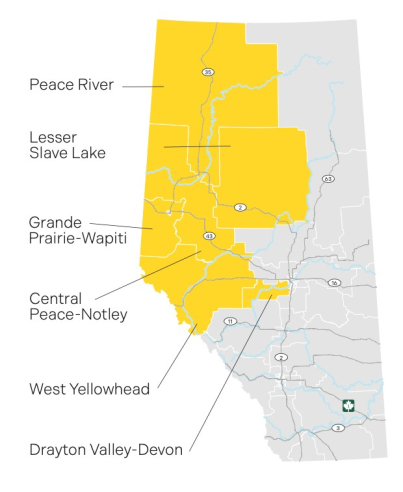
Public information through a variety of channels proved to be very important during Alberta’s wildfire emergencies, as false information about both wildfires and election rules was also in circulation (Roley 2023; Weingarten 2023). The wildfires also affected the campaigns of several candidates and party leaders in Alberta, some of whom had responsibilities both to run a campaign and to assist evacuation efforts (Boynton 2023).
By contrast, the campaign period in the Northwest Territories avoided many disruptions because the entire election was postponed.
Election day
Election day in Alberta took place on 29 May 2023, with 1,216 voting places and 4,714 voting stations throughout the province. In response to the ongoing wildfires, access to special ballots was expanded to electors that were displaced by a natural hazard or emergency, as well as to emergency personnel and firefighters that were outside of their electoral district (Elections Alberta 2024: 104, 111). The EMB also utilized mobile voting in evacuation centres. Unlike most other voting channels, the province’s election laws do not require identification to be shown for mobile voting (mobile voters instead sign a declaration stating their address and that they have not already voted). This has clear advantages in averting disenfranchisement during emergency and evacuation, when voters might not have all their documents with them. The trade-off between security and accessibility in voter identification is currently a major debate in other countries like the USA. However, in the Canadian context, there is currently no evidence of widespread voter fraud when electors have the option to use an affidavit as proof of their identification.
Some voting places were relocated in advance of, or on, election day because of the wildfires and voter displacement. For example, in the electoral district of Lesser Slave Lake, evacuees from Chipewyan Lake could vote at the relocated voting place in Wabasca-Desmarais or at Northern Lakes College—Slave Lake Campus if they instead relocated to Slave Lake (Elections Alberta 2024: 114). In summary, Elections Alberta’s wildfire response broadly extended the ways to vote across the province (specifically by special ballot) while also providing more specific extensions (such as mobile voting or relocating voting places) in affected areas.
By comparison, there were seven ways for electors to cast a ballot during the Northwest Territories’ 2023 postponed territorial election period: casting an absentee ballot online, casting a mail-in absentee ballot, voting in the returning office of their electoral district, voting at a mobile poll, voting at an advance poll, voting at a returning office in a regional centre (a multi-district poll), and voting on election day.
The Northwest Territories face challenges to the administration of elections—unrelated to wildfires—which make multiple voting channels advantageous in any case. The territory has several rural and remote areas that experience logistical challenges in receiving election materials. A recent paper on online absentee voters in the territory explains that ‘[s]everal communities can only be accessed by airplanes, and some [communities with road access] are inaccessible when river crossings are not solidly frozen in the fall months. In addition, the northern location of the territory means it can experience unpredictable weather, including heavy fog and blizzards, which can complicate ballot and election delivery’ (Goodman, Hayes and Dunbar 2024: 90). Given their rurality, Canada’s three territories are exceptional in that Canada Post, the national postal service, does not guarantee delivery times. Therefore, while postponing the election prevented further complications caused by the wildfires, the territory still has environmental and geographical factors that continuously impact the operations of Elections NWT.
Information environment
Disinformation campaigns are not a new phenomenon in elections (Garnett and James 2020: 117) but have changed substantially in the last decade with the shift to social media and other online platforms. During the 2023 wildfires in Canada, false information circulated about both the wildfires and the administration of elections. Some popular narratives claimed that all wildfires were started by arsonists, that they were state-driven cases of arson, that they were started by elites to control people, or that ecoterrorism was the cause of the wildfires; in fact, investigators concluded that only 0.01 per cent of the total land affected by wildfires in 2023 in Canada was arson-related (Russill et al. 2024; Laucius 2024). In addition to these broader false narratives about the wildfires, false information also circulated that directly impacted the elections.
In Alberta, photos of wildfires from 2016 were widely shared via Facebook, producing confusion about which communities were currently affected (Weingarten 2023). Elections Alberta also had to clarify how its scanners and tabulators work to count hand-marked votes, in response to baseless claims circulating online to the effect that its voting technology was being pre-loaded in favour of one political party (Roley 2023).
In the Northwest Territories, by comparison, false information was focused mostly on the proximity of wildfires to communities and the speed at which they were spreading (Tran and Semple 2023). Because this false information circulated prior to the postponed election period, it likely did not affect electoral administration. However, Elections NWT does note in its post-election report that ‘election misinformation is an unfortunately growing issue’ and that while most cases are not impactful, the institution has begun to use videos to promote itself as the trusted source of election information (Elections NWT 2024: 12).
At least one study shows that the presence of online disinformation during elections has a negative effect on the public’s perceptions of electoral fairness (Mauk and Grömping 2023), while another demonstrates that when there are unsubstantiated claims about voter fraud that reduce confidence in electoral integrity, fact-checking does not easily mitigate their effects (Berlinski et al. 2023). Therefore, EMBs must seriously consider how false information about the administration or rules of an election may impact public perceptions. During natural hazards, ensuring EMBs are trusted sources of information may especially be important in cases where alternative ways of voting are offered to accommodate emergency circumstances.
Cost of elections
Despite the unexpected effects of the wildfires, both EMBs managed to keep costs relatively close to their intended budget, noting small additions to the total cost of the election.
While Elections Alberta did not officially track additional costs caused by the wildfires, the extra expenses incurred seemed modest in relation to the election budget (Petrowsky 2024), which exceeded CAD 36 million in 2023. Previous budgets amounted to approximately CAD 24.4 million in 2019 and CAD 19 million in 2015 (Elections Alberta 2020). Looking at a breakdown of costs from 2019 to 2023 we see that the largest increases were in the areas of freight and postage, contract services, rentals for the Returning Officer’s office, technology services, and election materials and supplies (see Elections Alberta 2024 for a breakdown). Election delivery in 2023 also had to contend with a population increase of 8.7 per cent and an inflation increase of 14.9 per cent from 2019 (Elections Alberta 2024).
Specifically, extra budget was approved for advertising across traditional social media sources to inform electors whose voting places were being moved. Extra costs were also incurred for staffing, including hiring election officers to replace those displaced from the fires as well as having additional trainers and IT support to help some districts hire and train new staff. Finally, there were added costs in transporting ballots—extra staff were hired to transport special ballots and ballot boxes to evacuation centres to help facilitate voting and then return the completed ballots to Elections Alberta (Petrowsky 2024).
In the case of the Northwest Territories, the 2023 election cost approximately CAD 50,000 more than the 2019 general territorial election, amounting to just under CAD 992,000. While some of this increase may have been attributable to inflation and the rising costs of election materials, especially post pandemic, there were specific expenses that increased because of the postponement caused by the wildfires. Printing costs were one of these increases. At the time of the fires, ballots had not yet been printed and the EMB had to reprint a lot of election materials on temporarily relocating their operations to Elections Alberta. Additionally, costs to ship materials such as voter information letters changed, and the delays caused by the colder climate in the territory blocked road access to many communities. The colder temperatures in the territory also meant that ferries were out of the water and thus Elections NWT had to rely more heavily on on-air cargo—a more costly form of transportation. In addition to printing and transportation costs, additional fees for procurement were incurred (Dunbar 2024). Overall, Elections NWT experienced a modest increase in costs, which is perhaps not surprising since the EMB must frequently be nimble in its election delivery given the rural and remote nature of the territory. For example, because the postal service does not guarantee delivery times across the territory, Elections NWT must often pivot to alternative modes of transportation, including snowmobiles and helicopters.
Election results and turnout
In Alberta, the election resulted in a United Conservative Party (UCP) government, with 52.6 per cent of the vote. Danielle Smith, leader of the Alberta UCP, was re-elected to a second term. Turnout in Alberta was at 60.5 per cent in 2023, lower than the 67.5 per cent in 2019, but higher than the 53 per cent in 2015 (Elections Alberta 2023).
The Northwest Territories operates under a consensus government—there are no political parties and the elected officials select who will serve as Premier. After the 2023 election, R. J. Simpson was chosen as the Premier (Northwest Territories 2023). Turnout in this election was down slightly at 52.54 per cent compared to 54 per cent in 2019 but higher than the 44 per cent turnout in 2015 (Elections NWT 2024, 2019b, 2015).
To estimate the potential effects of the wildfires on turnout, turnout from the previous 2019 and 2023 elections was collected per electoral district. The electoral district boundaries were overlayed on a map of wildfire danger, provided by the Interactive Canadian Wildland Fire Information System (Natural Resources Canada 2023), set to the date of the scheduled election for each jurisdiction and the predominant coding of danger for that electoral district at the time. This method is approximate but provides some indication of how much the wildfires impacted the region.
In Alberta, election day saw 66 per cent of electoral districts predominately in the ‘extreme’ range of threat, with another 30 per cent in the ‘very high’ range. A comparison of turnout changes from 2019 to 2023 for each of the Alberta electoral districts does not show any statistically significant difference in mean turnout between those electoral districts at a very high versus extreme fire threat level (difference is –.22, p>0.1).
A similar comparison of turnout in Northwest Territories is difficult since by the time the scheduled election date arrived, the fire threat levels lowered substantially, with most of the province at a low or moderate level of threat. Furthermore, the number of electoral districts in the territory is considerably smaller (19 electoral districts), making statistical tests impractical.
Reform
Several legal and regulatory reforms were either made at the time of the wildfires or identified as being necessary in the future, after the impact of the fires on the election was assessed. The month of May, when Alberta’s elections are typically held, tends to be the emergency season in the province for wildfires. Recognizing this, and to minimize risk exposure, Elections Alberta recommended to Alberta’s legislature that the fixed election date should no longer be in May. Before Elections Alberta’s post-election report was given to the Alberta legislature, the Alberta Government proceeded to pass Bill 21, which moves the fixed election date to the third Monday in October every four years. This bill will take effect in 2027.
While no reforms have yet been made in the Northwest Territories, one stands out as necessary to consider. As explained earlier, standalone legislation was required to delay the territorial election. Thus, a recommendation to be better prepared for future elections would be to expand the emergency powers of the Chief Electoral Officer of Elections NWT so that they could decide to postpone the election without the Legislative Assembly needing to pass legislation during a rapidly evolving natural hazard. In 2023, it was unclear if the assembly would be able to meet for an emergency session to pass the required legislation before its scheduled dissolution. Providing standalone powers to the Chief Electoral Officer in cases of emergencies or natural hazards could be an effective way to avert this kind of uncertainty. While there may be objections to giving an EMB such power, given the checks and balances in Canada’s stable democracy, the risk posed to free and fair elections is low.
Main findings and lessons learned
Both Chief Electoral Officers and their respective teams learned lessons from administering an election either during, or immediately following, the wildfires. These findings and lessons are relevant to any government or EMB facing the administration of an election during an exogenous shock related to climate change. Below, we list five key lessons from the two jurisdictions.
A top concern for both agencies was safeguarding the well-being of staff and voters. EMBs have a duty of care to do everything in their powers to keep core stakeholders out of harm’s way, making it a top priority that influenced decision making. In some cases, election staff needed to be relieved of their duties to tend to personal and familial emergencies relating to the wildfires. Knowing how to work with sudden changes—while supporting staff—was an important takeaway from 2023.
A second takeaway is the need for clear and up-to-date communications—which enables an EMB to adapt to unfolding circumstances. An important part of this is the sharing of reliable and timely data. In the case of Alberta, the information that Elections Alberta received from forestry and emergency management agencies was not sufficient to assess operational impacts in the tight timeframes required; sometimes decisions needed to be made in a few hours. As noted above, a special segment of the EMB—the Global Information System (GIS) Team—worked to fill gaps and translate the information into workable data that allowed officials to make decisions and inform voters of the same. This included tracking evacuations and estimating displacements to keep stakeholders safely informed. Elections NWT likewise experienced challenges with being kept fully informed by its counterparts. Part of the reason for this was that previous wildfires did not behave in the same way as the ones in 2023, which made it difficult for all government agencies to determine what would occur next, or the appropriate response. Such unpredictability is an increasing challenge that governments and EMBs will have to adapt to as climate crises and natural hazards continue to change and grow in magnitude.
Third, a standardized approach to emergency preparedness is required. A primary takeaway for Elections Alberta was the need to have a standardized contingency plan in place. In the case of Elections NWT, contingencies relate to the transport and logistical challenges of the terrain outlined above. While each natural hazard may require its own unique contingency plan based on the circumstances of the situation, having some standard options in place can help EMBs think through what they could consider as climate-related emergencies arise.
Fourth, cross-agency collaboration was often key to the foregoing considerations—either within the jurisdiction or across adjacent jurisdictions. In Alberta, for example, collaboration with another government department, Alberta Forestry, facilitated preparation, distribution and collection of special ballot applications for firefighters in Northern Alberta. In the Northwest Territories, due to an abrupt evacuation at only 36 hours’ notice, collaboration was more clearly seen across agencies outside of the territory. Upon notice of the evacuation, staff drove 18 hours to reach Elections Alberta, where they set up temporary offices. Elections Alberta offered key support by providing Elections NWT with office space and printing supplies. Among Canada’s other provincial EMBs, Elections New Brunswick offered to support communications, while Elections Ontario, Elections Nova Scotia, and Elections Newfoundland and Labrador provided advice, documents and contingency plans from past incidents, as did the federal agency, Elections Canada. Such cross-agency collaboration was crucial in supporting Elections NWT in their preparations for the upcoming election and other core operations.
A fifth and final lesson relates to changes in electoral legislation or an EMB’s powers to permit rapid and decisive natural hazard responses. In Canada, the powers of Chief Electoral Officers vary dramatically by province and territory. In some, like the province of Ontario, the Chief Electoral Officer has the authority to change the day of the election, while in others, like the Northwest Territories, the Chief Electoral Officer does not. In the latter case, vesting the EMB with this power might be an important step in emergency preparedness. Likewise, modifications to legislation in Alberta could have provided the agency with even greater flexibility in its response. For example, rules on access to special ballots could conceivably be made less restrictive.
These five lessons from the experiences of Alberta and the Northwest Territories serve as important case examples for EMBs that must administer elections during natural hazards like wildfires.
References
Alberta, Province of, ‘Election Act’ (amended 2022), Office Consolidation, 30 May 2024a, <https://kings-printer.alberta.ca/1266.cfm?page=E01.cfm&leg_type=Acts&isbncln=9780779847785>, accessed 6 December 2024
—, ‘Forest and Prairie Protection Act’ (amended 2022), Office Consolidation, 30 May 2024b, <https://kings-printer.alberta.ca/1266.cfm?page=F19.cfm&leg_type=Acts&isbncln=9780779847815>, accessed 6 December 2024
Alihodžić, S., Protecting Elections: Risk Management, Resilience-Building and Crisis Management in Elections (Stockholm: International IDEA, 2023), <https://doi.org/10.31752/idea.2023.44>
Aziz, S. ‘In the line of fire: Firefighters face perilous conditions amid record season’, Global News, 2 August 2023, <https://globalnews.ca/news/9869441/canada-firefighter-deaths-dangers-wildfires>, accessed 6 December 2024
Berlinski, N., Doyle, M., Guess, A. M., Levy, G., Lyons, B., Montgomery, J. M., Nyhan, B. and Reifler, J., ‘The effects of unsubstantiated claims of voter fraud on confidence in elections’, Journal of Experimental Political Science, 10/1 (2023), pp. 34–49, <https://doi.org/10.1017/XPS.2021.18>
Birch, S. and Martínez i Coma, F., ‘Natural disasters and the limits of electoral clientelism: Evidence from Honduras’, Electoral Studies, 85 (2023), 102651, <https://doi.org/10.1016/j.electstud.2023.102651>
Boynton, S., ‘As wildfires upend Alberta election campaign, here’s where the race stands’, Global News, 14 May 2023, <https://globalnews.ca/news/9695646/alberta-election-wildfires-smith-notley-west-block>, accessed 6 December 2024
Canadian Interagency Forest Fire Centre. ‘Canada Report: 2023 Fire Season’, September 2023, <https://ciffc.ca/sites/default/files/2024-03/03.07.24_CIFFC_2023CanadaReport%20%281%29.pdf>, accessed 6 December 2024
CBC News, ‘Enterprise, N.W.T., “90 per cent gone” after wildfire ravages community’, 15 August 2023, <https://www.cbc.ca/news/canada/north/enterprise-damage-wildfire-1.6936652>, accessed 6 December 2024
DeLaire, M., ‘Parts of the Northwest Territories to remain under state of emergency into October’, CTV News, 19 September 2023, <https://www.ctvnews.ca/climate-and-environment/parts-of-the-northwest-territories-to-remain-under-state-of-emergency-into-october-1.6568553>, accessed 6 December 2024
Derworiz, C., ‘Wildfires in Alberta burned 10 times more area in 2023 than the five-year average’, CBC News, 5 January 2024, <https://www.cbc.ca/news/canada/edmonton/wildfires-in-alberta-burned-10-times-more-area-in-2023-than-the-five-year-average-1.7075263>, accessed 6 December 2024
Dunbar, S., Chief Electoral Officer of Elections NWT, authors’ online interview, Canada, 13 September 2024
Elections Alberta, ‘Provincial Electoral Divisions’, December 2017, <https://www.elections.ab.ca/uploads/2019Boundaries_ALBERTA_11X17.pdf>, accessed 6 December 2024
—, ‘2019 General Election: A Report of the Chief Electoral Officer’, March 2020, <https://www.elections.ab.ca/uploads/Volume-1-2019-Provincial-General-Election-Report.pdf>, accessed 6 December 2024
—, ‘Provincial Results: Provincial General Election May 29, 2023’, 23 June 2023, <https://officialresults.elections.ab.ca/orResultsPGE.cfm?EventId=101>, accessed 6 December 2024
—, 2023 Provincial General Election Report (Edmonton, Alberta: Elections Alberta, 2024), <https://www.elections.ab.ca/uploads/2023-Provincial-General-Election-Report.pdf>, accessed 6 December 2024
Elections NWT, ‘About Elections NWT’, [n.d.], <https://www.electionsnwt.ca/en/about-elections-nwt>, accessed 6 December 2024
—, ‘2015 Official Voting Results’, 21 December 2015, <https://www.electionsnwt.ca/sites/electionsnwt/files/2015-12-21_official_voting_results_of_the_2015_general_election_englishweb.pdf>, accessed 6 December 2024
—, ‘Electoral Districts of the NWT (ED Map), 21 March 2019a, <https://www.electionsnwt.ca/sites/electionsnwt/files/all_nwt_ed_2019.pdf>, accessed 6 December 2024
—, ‘Territorial General Election 2019: Official Results Report’, 25 October 2019b, <https://www.electionsnwt.ca/sites/electionsnwt/files/nwt_elections_7528_official_results_report_eng_web_0.pdf>, accessed 6 December 2024
—, ‘Territorial General Election 2023 Official Results Report’, January 2024, <https://www.electionsnwt.ca/sites/electionsnwt/files/2023_nwt_general_election_results_report_en.pdf>, accessed 6 December 2024
Garnett, H. A. and James, T. S., ‘Cyber elections in the digital age: Threats and opportunities of technology for electoral integrity’, Election Law Journal, 19/2 (2020), pp. 111–26, <https://doi.org/10.1089/elj.2020.0633>
Goodman, N., Hayes, H. A. and Dunbar, S., ‘Absentee Online Voters in the Northwest Territories: Attitudes and Impacts on Participation’, in D. Duenas-Cid et al. (eds) Electronic Voting. E-Vote-ID 2024. Lecture Notes in Computer Science, Vol. 15014 (Cham: Springer, 2024), <https://doi.org/10.1007/978-3-031-72244-8_6>
Government of Canada, ‘Northwest Territories’ territorial symbols’, 15 August 2017, <https://www.canada.ca/en/canadian-heritage/services/provincial-territorial-symbols-canada/northwest-territories.html>, accessed 6 December 2024
Insurance Bureau of Canada, ‘Behchoko-Yellowknife and Hay River wildfires cause over $60 million in insured damage’, 20 November 2023, <https://www.ibc.ca/news-insights/news/behchoko-yellowknife-and-hay-river-wildfires-cause-over-60-million-in-insured-damage>, accessed 6 December 2024
James, T. S. and Alihodžić, S., ‘When is it democratic to postpone an election? Elections during natural disasters, COVID-19 and emergency situations’, Election Law Journal, 19/3 (2020), pp. 344–62, <https://doi.org/10.1089/elj.2020.0642>
Jones, M. W., Kelley, D. I., Burton, C. A., Di Giuseppe, F., Barbosa, M. L. F., Brambleby, E., Hartley, A. J., Lombardi, A., Mataveli, G., McNorton, J. R., Spuler, F. R., Wessel, J. B., Abatzoglou, J. T., Anderson, L. O., Andela, N., Archibald, S., Armenteras, D., Burke, E., Carmenta, R., Chuvieco, E., Clarke, H., Doerr, S. H., Fernandes, P. M., Giglio, L., Hamilton, D. S., Hantson, S., Harris, S., Jain, P., Kolden, C. A., Kurvits, T., Lampe, S., Meier, S., New, S., Parrington, M., Perron, M. M. G., Qu, Y., Ribeiro, N. S., Saharjo, B. H., San-Miguel-Ayanz, J., Shuman, J. K., Tanpipat, V., van der Werf, G. R., Veraverbeke, S. and Xanthopoulos, G., ‘State of wildfires 2023–2024’, Earth System Science Data, 16/8 (2024), pp. 3601–85, <https://doi.org/10.5194/essd-16-3601-2024>
Laucius, J., ‘Flame wars: Carleton researcher on team tracking how misinformation spread in last year’s wildfires’, Ottawa Citizen, 3 August 2024, <https://ottawacitizen.com/news/local-news/flame-wars-carleton-researcher-on-team-tracking-how-misinformation-spread-in-last-years-wildfires>, accessed 6 December 2024
Markov, K., ‘Alberta wildfire season 2023: How does it compare?’, CTV News, 10 May 2023, <https://edmonton.ctvnews.ca/alberta-wildfire-season-2023-how-does-it-compare-1.6391711>, accessed 6 December 2024
Mauk, M. and Grömping, M., ‘Online disinformation predicts inaccurate beliefs about election fairness among both winners and losers’, Comparative Political Studies, 57/6 (2023), pp. 1–34, <https://doi.org/10.1177/00104140231193008>
Natural Resources Canada, ‘Interactive map’, 28 May 2023, <https://cwfis.cfs.nrcan.gc.ca/interactive-map?zoom=2¢er=-140875.62861366407%2C1091512.145556278&month=5&day=28&year=2023#iMap>, accessed 6 December 2024
Northwest Territories, Government of the, ‘Elections and Plebiscites Act’, 7 January 2007, <https://www.justice.gov.nt.ca/en/files/legislation/elections-and-plebiscites/elections-and-plebiscites.a.pdf>, accessed 6 December 2024
—, ‘Premier R. J. Simpson’, 20 December 2023, <https://www.gov.nt.ca/en/premier-rj-simpson>, accessed 6 December 2024
—, ‘Independent reviews of wildfire and emergency response for 2023 wildfire season underway’, 15 February 2024, <https://www.gov.nt.ca/en/newsroom/independent-reviews-wildfire-and-emergency-response-2023-wildfire-season-underway-0>, accessed 6 December 2024
O’Neill, N. and Otis, D., ‘Military deploys 350 soldiers to Northwest Territories, 68 per cent of population evacuated’, CTV News, 21 August 2023, <https://www.ctvnews.ca/canada/military-deploys-350-soldiers-to-northwest-territories-68-per-cent-of-population-evacuated-1.6527811>, accessed 6 December 2024
Petrowsky, L., Chief Electoral Officer of Elections Alberta, authors’ online interview, Canada, 1 October 2024
Ridgen, M., ‘“Highway out was on fire”: Calls for inquest grow into “slow” N.W.T fire response’, Global News, 5 February 2024, <https://globalnews.ca/news/10267109/wildfire-nwt-inquest-2023>, accessed 6 December 2024
Roley, G., ‘Election technology misinformation spreads as Alberta heads to polls’, AFP Canada, 25 May 2023, <https://factcheck.afp.com/doc.afp.com.33FY4KT>, accessed 6 December 2024
Russill, C., Bridgman, A., Hayes, H. A., Khoo, M., Alrasheed, G., Tollefson, H., Ross, C. and Peterson, L., Flame Wars: Misinformation and Wildfire in Canada’s Climate Conversation (Montreal: Re.Climate/Centre for Media, Technology and Democracy/Climate Action Against Disinformation, 2024), <https://foe.org/wp-content/uploads/2024/06/2024-Final-REPORT%E2%80%93Wildfire-Misinformation-01d-2.pdf>, accessed 6 December 2024
Shingler, B., ‘What’s driving the powerful wildfires in the Northwest Territories’, CBC News, 17 August 2023, <https://www.cbc.ca/news/climate/northwest-territories-wildfires-1.6939337>, accessed 6 December 2024
Statistics Canada, ‘Focus on Geography Series, 2021 Census of Population: Alberta, Province’, 16 December 2022, <https://www12.statcan.gc.ca/census-recensement/2021/as-sa/fogs-spg/Page.cfm?Lang=E&Dguid=2021A000248&topic=1>, accessed 6 December 2024
—, ‘Census Profile, 2021 Census of Population: Northwest Territories [Territory]’, 2 August 2024, <https://www12.statcan.gc.ca/census-recensement/2021/dp-pd/prof/details/page.cfm?Lang=E&SearchText=Northwest%20Territories&DGUIDlist=2021A000261&GENDERlist=1,2,3&STATISTIClist=1&HEADERlist=0>, accessed 29 October 2024
Tran, P. and Semple, J., ‘How does wildfire misinformation affect communities in N.W.T. and B.C.?’, Global News, 20 August 2023, <https://globalnews.ca/news/9908441/wildfire-misinformation-chaos-northwest-territories-b-c>, accessed 6 December 2024
United Nations Office for Disaster Risk Reduction (UNDRR), GAR Special Report 2024: Forensic Insights for Future Resilience Learning from Past Disasters (Geneva: UNDRR, 2024), <https://www.undrr.org/media/100220/download?startDownload=20241106>, accessed 6 December 2024
—, ‘Why are disasters not natural?’, [n.d.], <https://www.undrr.org/our-impact/campaigns/no-natural-disasters>, accessed 6 December 2024
USAFacts Team, ‘Are major natural disasters increasing?’, 6 September 2024, <https://usafacts.org/articles/are-the-number-of-major-natural-disasters-increasing>, accessed 6 December 2024
Weather Network, The, ‘2023 is off to a dry start, and Alberta’s fire danger rating is rising’, 27 April 2023, <https://www.theweathernetwork.com/en/news/weather/severe/2023-is-off-to-a-dry-start-and-albertas-fire-danger-rating-is-rising>, accessed 6 December 2024
Weingarten, N., ‘False wildfire and election information is thriving online. Here’s how you can tackle it’, CBC News, 22 May 2023, <https://www.cbc.ca/news/canada/edmonton/wildfire-election-tackling-misinformation-1.6847916>, accessed 6 December 2024
White, G., ‘Beyond Westminster: The new machinery of subnational government: Adapting the Westminster model: Provincial and territorial cabinets in Canada’, Public Money & Management, 21/2 (2001), pp. 17–24, <https://doi.org/10.1111/1467-9302.00255>
Zelin, W. A. and Smith, D. A., ‘Weather to vote: How natural disasters shape turnout decisions’, Political Research Quarterly, 76/2 (2023), pp. 553–64, <https://doi.org/10.1177/10659129221093386>
Annex A. Interview questions on wildfires and the election
Decision-making process
- What were the biggest challenges [EMB] faced regarding the wildfires?
- When responding to challenges caused by the wildfires, what was the time frame for [EMB]’s decision-making processes?
- Which factors did [EMB] consider when making decisions about the election in response to the wildfires? How were these factors weighed against each other?
Specific issues
- Did the wildfires impact some ridings more than others? If yes, in which ways?
- Did any of these communities already have challenges before the wildfires that may have compounded the impact?
- Did the wildfires impact voter registration? If yes, in which ways?
- Did inaccurate information impact the administration of the election? If yes, in which ways?
Cost of the election
- Did the wildfires impact the cost of the election? If yes, in which ways?
- How much was the total cost of the administration of the election?
Concluding questions
- What are the major takeaways or ‘lessons that you learned’ from the election?
- Are there any reforms or changes that were implemented in response to the wildfires that the agency plans to keep? Likewise, is there anything the agency would have done differently?
- Is there any other information about the wildfires that would be helpful to know for our case study?
Acknowledgements
The authors would like to thank Stephen Dunbar (Chief Electoral Officer, Elections NWT) and LaRae Petrowsky (former Acting Chief Electoral Officer, Elections Alberta) for their responses during their interviews and for taking the time to answer our questions. We also thank Samantha Curry, a research assistant at Queen’s University in Canada. We appreciate the support of the International IDEA staff and thank them for their role in the publishing process.
About the authors
Valere Gaspard is a PhD candidate in the School of Political Studies at the University of Ottawa, and a Research Fellow at Western University and Trent University’s Leadership and Democracy Lab. His research projects focus on Canadian politics, satisfaction with democracy, elections and electoral management bodies. The views of the author do not reflect those of any employer.
Holly Ann Garnett is the Class of 1965 professor of leadership and an associate professor of Political Science at the Royal Military College of Canada. She is cross-appointed faculty at Queen’s University Canada and an honorary research fellow at the University of East Anglia, the United Kingdom. Garnett is co-director of the Electoral Integrity Project, a global network of academics and practitioners that engages in empirical research, publicly accessible data collection and stakeholder engagement on issues relating to election quality around the world.
Nicole Goodman is an associate professor of Political Science at Brock University, Ontario. Her research examines civic participation and governance with a specific focus on digital technology. Her work has appeared in leading journals and is frequently consulted by domestic and international governments, not-for-profit organizations and parliamentary committees.
David Towriss
Publishing date: 1 September 2022
Introduction
Voting in the first round of Haiti’s 2010 presidential and legislative elections took place on 28 November 2010, 10 months after the country had been hit by a Richter Scale-7 earthquake, 23 days after the passage of Hurricane Tomas and in the midst of a rapidly spiralling cholera epidemic. The imperative of holding the elections, however, was significant. The postponement of the legislative elections from 28 February and 3 March 2010 to 28 November 2010 had meant that the terms of the legislators whose seats were being contested had long expired, leaving the country without a functioning legislative branch for almost seven months (Taft-Morales 2011). The Constitution required the presidential elections to take place on 28 November 2010 specifically and left no room for postponement or the extension of outgoing President René Préval’s term of office (Lagueny and Dérose 2010).
The challenge of holding the elections was made considerably more difficult by low levels of trust in the country’s electoral management body (EMB), the Provisional Electoral Council (CEP). Envisioned by the 1987 Constitution as a transitional body that would make way for a permanent EMB, the CEP had had its lifespan repeatedly extended. Once again in 2009 it was mandated to manage the 2010 elections (OAS/CARICOM 2011). The CEP’s reputation had been seriously damaged by fraud-marred Senate elections in June 2009 and so later that year it was reconstituted through a selection process led by President Préval and the National Assembly, in which his party (Inité) had a majority. Civil society actors were engaged to confirm the selection of council members, but as a confidence-building measure the CEP’s reconstitution had little success. Widely perceived to favour Inité, the process produced a CEP that looked very similar to its besmirched predecessor (ICG 2010). While an in-depth examination of stakeholder distrust of the CEP is beyond the scope of this case study, it is vital to understanding Haiti’s 2010 elections, in which it was a protagonist—the CEP was responsible for organizing and overseeing all electoral operations and hearing and deciding electoral disputes (OAS/CARICOM 2011).
Progressing chronologically, this case study explores the challenges that election administrators faced in holding the first round of the 2010/2011 presidential and legislative elections in the wake of three natural hazards (a chronology is presented in Table 1). Starting with the decision to postpone the elections and ending with the publication and verification of results, it addresses the administration of each of the electoral processes, including the roles played by the multiplicity of domestic and international actors. The case study concludes with the lessons that Haiti’s 2010 elections offer for post-natural-hazard election management.
| Date | Event |
|---|---|
| 2010 | |
| 12 January | Richter Scale-7 earthquake hits Haiti, killing 250,000 and displacing 1.5 million. |
| 19 January | UN Security Council passes Resolution 1908 authorizing the deployment of an additional 1,500 police officers and 2,000 troops to reinforce the United Nations Stabilization Mission in Haiti (MINUSTAH). |
| 27 January | The Provisional Electoral Council (CEP) announces the postponement of the legislative elections. |
| 28 February | Originally scheduled date for Senate and Chamber of Deputies elections in nine of Haiti’s Departments. |
| 3 March | Originally scheduled date for Senate and Chamber of Deputies elections in Haiti’s Centre Department. |
| 20 April | Haitian National Assembly passes state of emergency law transferring powers to the executive for a period of 18 months. |
| 29 April | IFES publishes its elections feasibility study. |
| 10 May | UN presents the results of its elections feasibility study. |
| 10 May | Expiry of the terms of National Assembly members whose seats were due to be contested in the elections originally scheduled for 28 February and 3 March. |
| 4 June | UN Security Council passes Resolution 1927 authorizing the deployment of an additional 680 police officers to further reinforce MINUSTAH ahead of the elections. |
| 30 June | President Préval signs a decree calling both parliamentary and presential elections for 28 November. |
| 19 August | The CEP launches two-month Operation and Verification Centre campaign, which gave voters the opportunity to change their allocated polling station. |
| 27 September | The election campaign period begins with the ‘silent’ phase. During this period, candidates are only permitted to campaign through visual material. |
| 12 October | Death of the first cholera victim living in the town of Mirebalais. |
| 15 October | The silent phase of the election campaign ends. Until the end of the election campaign on 26 November, candidates are able to campaign through the media and public events. |
| 5 November | Hurricane Tomas hits Haiti. |
| 10 November | Cholera confirmed in Port-au-Prince. |
| 15 November | Anti-UN demonstrations break out in Cap-Haitien and other cities. |
| 19 November | CEP opens election call centre to help voters locate their allocated polling station. |
| 20 November | Four presidential candidates publish a joint statement calling for the postponement of the elections on the basis of the worsening cholera epidemic. |
| 26 November | The electoral campaign period ends at 23:59. Cholera death toll reaches 1,600 with 70,000 more confirmed infections. |
| 28 November | Election day. |
| 29 November | Organization of American States-Caribbean Community election observation mission reports ‘serious irregularities’ in the election but states these were insufficient to invalidate the election. |
| 7 December | Preliminary result of the first round of the presidential election is published by the CEP, which places Mirlande Manigat in first place, Jude Célestin in second place and Michael Martelly in third. The result triggers violent protests from Martelly’s supporters, which claim five lives. |
| 13 December | President Préval invites the Organization of American States (OAS) to verify the tabulation of the presidential election results. |
| 2011 | |
| 13 January | OAS submits a tabulation verification report which challenges the CEP’s preliminary results. It places Michel Martelly and not Jude Célestin in second place. |
| 20 March | Second round of presidential and legislative elections. |
The perfect storm
Of the three natural hazards that hit Haiti in 2010, the 12 January earthquake was the most devastating. An estimated 1.5 million Haitian residents were displaced and a further 250,000 lost their lives (ICG 2010). Haiti’s West Department—the country’s most populous, and home to the country’s capital, Port-au-Prince—was most affected. The majority of government offices located there were either destroyed or damaged, including the CEP’s headquarters and some polling stations (ICG 2010). The damage to CEP’s headquarters was particularly severe and included the complete destruction of its annex, which resulted in the deaths of 12 people and the loss of all the equipment stored there (IFES 2010). A second large-scale humanitarian disaster loomed when Hurricane Tomas was forecast to hit Haiti. Predicted to bring winds of 140 kilometres per hour and to deliver 25 cm of rain, Tomas had the potential to inflict significant damage on Port-au-Prince’s tented IDP (internally displaced persons) camps, which were at the time home to 1.05 million Haitians (UN 2011). When it arrived on 5 November, however, the category 1 hurricane only ‘clipped’ the southwest of the country, sparing the capital the heaviest winds and rains (BBC 2010a). Yet the coastal areas closest to the eye of the storm did suffer severe flooding and mudslides; 35 deaths were subsequently attributed to the hurricane (Pasch and Kimberlain 2011). The first cholera death occurred on 12 October (McNeil 2012), but by 26 November it had already proved itself to be far more fatal than Hurricane Tomas, with a death toll of 1,600 and 70,000 more confirmed infections (Al Jazeera 2010). Noteworthy, too, is the significant fear and anger that the epidemic aroused in many Haitians, an impact that will be explored in greater detail below.
Postponed elections and a state of emergency
Prior to the earthquake, legislative elections to replace the entire House of Representatives and one-third of the Senate had been scheduled to take place on 28 February 2010 in nine of Haiti’s Departments, and on 3 March 2010 in the Centre Department. However, the devastation wrought by the 12 January earthquake prompted the CEP to postpone the elections, which decision they announced on 27 January 2010. No new date had been set at the time the announcement was made (Lagueny and Dérose 2010).
The postponement of the elections threw up several constitutional issues. The most important of these was the expiry of the terms of National Assembly members whose seats were due to be contested in the February and March elections, which was to occur on 10 May 2010. After this date, Haiti’s National Assembly would have none of its 99 Chamber of Deputies (lower house) members left in office and only 18 of its 30 Senators (upper house) (Taft-Morales 2011). This would mean that it had no functioning legislative branch, as there would be no quorum for the exercise of the National Assembly’s major powers; nor was there constitutional provision for the extension of these legislators’ terms (Lagueny and Dérose 2010). A short-term solution for this was found in a State of Emergency Law that, when passed by the National Assembly in April, transferred these powers to the executive for 18 months until October 2011 (Taft-Morales 2011). However, legislative elections needed to be held as soon as possible.
Presidential elections needed to be held too. The constitutional provisions governing the timing of the presidential elections were very prescriptive, requiring that they take place on the ‘last Sunday of November in the fifth year of the President’s term’—which, it should be noted, falls at the end of the regular hurricane season (Lagueny and Dérose 2010). The Constitution specifically prohibited the extension of a president’s five-year term, and President Préval’s term was due to expire on 7 February 2011, five years after his election (IPU 2013). These provisions notwithstanding, the National Assembly extended President Préval’s term by three months out of concern that a power vacuum might emerge in the event of a delayed presidential election (CBS/AP 2011). The extension, which was supported by the United States and other nations, was made on the grounds that a presidential term should be calculated according to time served and that because Préval’s 2006 inauguration had been delayed by three months it was constitutional for him to remain in office until 17 May 2011 (Cave 2011).
The feasibility of elections
Determining the date for the postponed legislative elections and the presidential elections was not, however, a purely legal exercise. It required an assessment of the capacity of the relevant Haitian institutions and the political environment in the country. An April 2010 feasibility study commissioned by the US Agency for International Development (USAID) and carried out by the International Foundation for Electoral Systems (IFES) did just that and identified eight issues that needed to be addressed and solved (Lagueny and Dérose 2010). Some of these issues had materialized out of the earthquake or were pre-existing and exacerbated by it. (Given the natural-hazard focus of this case study, those issues which fall outside these two categories and are less closely related to the earthquake will be addressed more superficially.)
One of the most pressing issues identified in the study was the production and distribution of identity cards to two categories of voters: those who had lost them as a result of the earthquake and new registrants. UN assessments indicated that ‘a very large number’ of identity cards had been lost in the earthquake while Haiti’s National Identification Office (ONI) figures suggested that between January and 28 September 2010 (the registration cut-off date) an additional 315,000 identity cards would be needed for new registrants (ICG 2010). Related to this was the need for timely international funds to finance the production and distribution of these identity cards—and other electoral activities. The earthquake also posed a set of further registration challenges. The estimated 250,000 deceased voters would have to be removed from the voters’ roll and displaced voters would have to be reallocated to accessible polling stations—although the fact that the majority of displaced voters continued to live near to their former residences and polling stations reduced the scale of the reallocation challenge (Lagueny and Dérose 2010; Taft-Morales 2011). The study recognized that the removal of deceased voters from the roll could not realistically be achieved before election day, but that the implementation of additional measures such as photographic identification (ID) and indelible ink could protect the integrity of the election.
Finally, the study noted that the earthquake made Haiti’s long-standing security problems even more threatening, having destroyed police stations; caused the death or disappearance of over 500 police officers (out of 9,000 in the Haitian National Police Force, PNH); and made possible the escape of 4,000 prisoners from one of Port-au-Prince’s prisons. The shortage of police officers would later undermine the PNH’s capacity to provide electoral security. Other issues that IFES identified were: a lack of credibility and trust in the CEP; the related need for civil society involvement in the public information and observation processes; the general population’s lack of understanding of governance issues; and weak political parties (Lagueny and Dérose 2010).
The IFES feasibility study stated that if these issues were addressed and solved, it believed the elections could be held before the end of 2010. A UN feasibility study published in May 2010, and commissioned by President Préval, reached a similar conclusion (ICG 2010). On 30 June, the President signed a decree calling both parliamentary and presential elections for 28 November (IPU 2013). As detailed below, the arrival and rapid spread of cholera on Haiti in October and November 2010 caused some to suggest that the context had changed to such an extent as to render the elections no longer feasible. Before examining these concerns, however, this case study will first address the measures that were taken to tackle the issues raised in the IFES feasibility study.
Voter registration
Under Haitian law, responsibility for voter registration is shared between the CEP and the ONI (OAS/CARICOM 2011). The CEP produces the register of voters on the basis of data supplied by the ONI from the civil registry it maintains (Haiti Libre 2012; ONI n.d.). The ONI also has responsibility for issuing national identity cards to Haitian citizens when they turn 18 (Haiti Libre 2012; OAS/CARICOM 2011). These national identity cards are the only accepted form of voter ID and are a mandatory part of the polling process. The UN’s initial forecasts of very large numbers of missing ID cards were not borne out in the number of applications for replacement cards (see ICG 2010: the ONI disputed the UN’s assessments, stating that citizens tended to carry their ID cards on their person or could retrieve them from damaged structures. They referred to the fact that in the wake of 2008 floods in Gonaives, Artibonite Department, only 10,000 requests for replacement cards were made—well short of the 200,000 estimated by an OAS-USAID project). Nevertheless, between January and September 2010, the 28,857 applications received represented a significant increase in the card production and distribution workload.
Approximately 400,000 national ID cards were produced in total, the overwhelming majority of which were for new registrants (Taft-Morales 2011). The distribution of these cards proved to be the most challenging part of the process, with organizational problems causing significant delays that translated into long queues of frustrated citizens at collection centres (Beaubien 2010). The distribution operation that ran up to the day before the election ended with boxes of undistributed cards (Miroff 2010). These distribution difficulties occurred in spite of the expansion of the ONI’s ID card workforce (OAS/CARICOM 2011) and the assistance it received from a voter ID campaign—supported by the Organization of American States (OAS) and bilaterally by Canada—which provided a mobile ID card distribution service, among others (Haiti Libre 2010; OAS 2010).
As mentioned, the task of updating the voters’ roll consisted of two parts: the reallocation of voters to accessible polling stations and the purging of deceased voters from the register. To address the first part, the CEP launched a two-month Operation and Verification Centre (OVC) campaign, which began on 19 August (OAS/CARICOM 2011). The campaign established 1,480 such centres throughout Haiti (ICG 2010) where voters could make polling reallocation requests; 42 of these were mobile centres serving the West Department’s 14 IDP camps (OAS/CARICOM 2011). Those who did not request to change their polling station had to vote at the one they had used in the 2009 elections. It should be noted that between the 2006 and the 2009 elections changes had been made to the polling stations to which voters had been assigned and because the turnout in 2009 had been very low (10–11 per cent), many voters would have been unaware that they had been moved to a different polling station (IFES 2010).
The OVC campaign was conducted in parallel to the regular civil registration activities carried out by the ONI, which included entering new voters onto its civil registry and processing address changes on the same registry (ICG 2010). At the conclusion of the OVC campaign, the data compiled by the OVC was entered into a database alongside the data provided by the ONI, which was then used to draw up the voters’ roll. The roll, including voters’ full names and polling stations, was published on 28 October and displayed in all Communal Election Bureaus for inspection by the electorate. From 19 November, voters were also able to check the location of their polling station by contacting a 24-hour call centre (OAS/CARICOM 2011; IFES 2010).
The voter reallocation process was hampered by a number of impediments. Of particular concern to observers was the late deployment of the mobile OVC serving the IDP camps, as was the tardy and inadequate voter education campaign which failed to sufficiently explain the OVC campaign and clarify how it related to the work being carried out by the ONI. Also noted was the rain damage to publicly displayed copies of the voters’ roll and the short operational period of the call centre, which impaired voters’ ability to verify their polling station. In relation to these challenges, the Organization of American States-Caribbean Community Electoral Observation Mission concluded ‘this situation is understandable in light of Haiti’s infrastructural deficiencies, which were aggravated by the damage caused by the earthquake’ (OAS/CARICOM 2011).
As the IFES feasibility study had predicted, the purging of Haiti’s voters’ roll of deceased voters was not possible to achieve in the period before election day and was deferred to after the election. The principal reason for this was Haiti’s antiquated civil registry system, which required the issuance of a death certificate before a name could be removed from the civil register on which the voters’ roll was drawn—something beyond the mandate of the CEP and ONI at the time. Efficiently removing the names of the 250,000 voters who died in the earthquake (as well as the backlog of deceased voters whose deaths had pre-dated the earthquake) required a systematic modernization, something the OAS was facilitating at the time (ICG 2010).
Electoral Security
The task of supporting the depleted PNH in guaranteeing security and stability fell to the United Nations Stabilization Mission in Haiti (MINUSTAH). The mission, which had been established by the UN Security Council in April 2004 to restore security and stability in Haiti (UN Security Council 2004) following a February 2004 coup d’etat that had removed President Bertrand Aristide, had had a peacekeeper presence in the country since June that year (UN 2004). While the Security Council Resolution establishing MINUSTAH had restricted its police component to 1,622 civilian police and its military component to 6,700 troops (UN Security Council 2004), in the immediate wake of the earthquake an additional 1,500 police and 2,000 additional military personnel were authorized. Among other purposes, this reinforcement was intended to serve as a reserve force in the event of a deterioration of the security situation (UN 2010a). MINUSTAH’s work was focused on protecting the civilian population. This included ‘joint community policing in [IDP] camps … strengthening mechanisms to address sexual and gender-based violence… [and] tackling the risk of a resurgence of gang violence, organized crime, drug trafficking and the trafficking of children’ (UN 2010b).
In the lead up to the election, however, MINUSTAH also played an important role in providing security for campaigning activities and at polling stations on election day. Alongside the PNH, whose capacity had been diminished by the earthquake (see above), MINUSTAH police played a role in organizing and policing meetings and debates among candidates and political parties, assessing security risks in all voting areas and developing a comprehensive security plan (OAS/CARICOM 2011). Anticipating the additional resources that this election security work would require, on 4 June the Security Council authorized the deployment of an additional 680 police, which took the total MINUSTAH security force to 4,391 police and 8,940 military troops (UN Security Council 2010). The effectiveness of this enhanced security presence was tested during the campaign period.
Campaigning during a cholera epidemic
The campaign period was split into two phases. During the first (the ‘silent’ phase), which ran from 27 September to 15 October, candidates were only permitted to campaign through visual material such as posters and banners. Then from 15 October to 26 November, candidates could campaign through the media and public events (OAS/CARICOM 2011). It was mid-way through this second phase that a relatively calm atmosphere was shattered by several incidents of serious violence perpetrated by protestors against UN peacekeepers and by candidates and their supporters against rivals. Connected to this violence was the worsening cholera epidemic, which by 20 November had prompted calls for the elections to be postponed (ABC/AFP 2010). Understanding the dynamics of the tumultuous second campaign requires a closer look at the impact of the epidemic.
From the death of the first victim in the town of Mirebalais on 12 October, cholera spread very rapidly (McNeil 2012). By 10 November the disease had claimed 582 more victims and reached Port-au-Prince (BBC 2010b). By 26 November the death toll had reached 1,600 and there were 70,000 more infections (Al Jazeera 2010). Because cholera had not been present in Haiti for decades (Sidder 2016), local knowledge of it—including how it is spread—was very limited (Carroll 2010a). This gave rise to widespread fear and suspicion, with many Haitians believing that it was not a natural or preventable disease (Grimaud and Legagneur 2011). To counter these misconceptions, Haiti’s Ministry of Health launched a public health campaign through messaging in the mass media and education materials which promoted hand washing, safe food handling and prompt treatment (PAHO 2010).
Fears relating to cholera were nonetheless widespread as polling approached and, while campaigning went on as usual, the cholera epidemic became a highly charged theme on the campaign trail (Katz 2010). Its politicization was fuelled by reports that the epidemic might have been brought to Haiti by a contingent of Nepalese peacekeepers and, some commentators suggested, the UN’s slow and dismissive response to the rumours (Fox and Katz 2010) which were widely believed—and subsequently shown to be true. (Experts later determined that the source of the cholera epidemic was indeed a UN peacekeeping camp and the UN accepted it played some role in the outbreak. See: Domonoske 2016.) Tensions reached a peak on 15 November, when anti-UN protests broke out in a number of cities, including Haiti’s second largest, Cap-Haitien. The protestors, who the UN claimed had been manipulated by political and criminal ‘spoilers’, burned cars, stoned UN bases and demanded the soldiers leave the country (Guyler Delva 2010a).
The anti-UN demonstrations were not the only instances of violence during the election campaign. Unverified complaints were made to OAS-CARICOM observers of intimidation and aggression between rival candidates and their supporters. Reported, too, were an ambush of a bus carrying journalists to a public meeting featuring one of the presidential candidates; an attack on the home of an executive director of one of the parties; and the ransacking of a government minister’s car (Al Jazeera 2010). It should be noted, however, that electoral violence had been a feature of previous Haitian elections and on 26 November Edmond Mulet, the Head of MINUSTAH, assessed the situation to be ‘calm, peaceful, serene and without violence’ by comparison (Al Jazeera 2010).
Calls for further postponement denied
Eight days before the election, in a joint statement 4 of the 19 presidential candidates (none of whom were frontrunners) called for the election to be further postponed, citing the spiralling cholera epidemic (ABC/AFP 2010). The international organizations supporting the election made clear their opinion that it should proceed as scheduled and, according to Edmond Mulet, no postponement discussions were held with the Haitian Government and electoral authorities (Guyler Delva 2010b). In explaining the UN’s position, Mulet stated that the technical and security preparations had been completed and that postponing the elections would create a political vacuum which would further destabilize the country (Guyler Delva 2010b). The Pan American Health Organization (PAHO) pointed out that ‘the kind of movement and congregating you see with people going to vote is not the kind of movement that creates an increased risk of cholera transmission’, which is generally transmitted through contaminated water and food (Al Jazeera 2010). Both of these messages were echoed by the European Union, whose electoral experts had been deployed (Gaestel 2010). UN data show a moderate increase in the number of observed cases in the three days following election day, but this cannot be directly attributed to the conduct of electoral processes (UN 2011).
Election Day
On election day, Haitian voters cast their ballots at over 11,000 polling stations across the country, including makeshift booths in the IDP camps (Al Jazeera 2010). To limit the spread of cholera, hand sanitizers were made available to voters at polling stations, which also displayed PAHO and World Health Organization posters describing how to prevent and treat the disease (Carroll 2010a).
Polling was observed by over 100 observers from the OAS-CARICOM Election Observation Mission and approximately 6,000 domestic election observers (OAS/CARICOM 2011).
Election Observation Mission findings
The report of the joint observation mission found that ‘the day of elections was marred by disorganization, dysfunction, various types of irregularities, ballot stuffing and incidents of intimidation, vandalism of polling stations and violence’ (OAS/CARICOM 2011a). Between them, election observers and the media described late opening of polling stations (one, in the Delma neighbourhood of Port-au-Prince had not opened ‘hours’ after the official 06:00 start time—see: Guyler Delva 2010c); voters experiencing difficulties in finding their polling station and their names on the voters’ list (a voter list for a polling centre serving one of the IDP camps contained only 39 names—see: Johnston and Weisbrot 2011); voters finding the names of deceased voters on the voters’ list (Carroll 2010b); a saturated call centre; voters still missing ID cards; and polling station officials unwilling to allow voters to cast their ballots on the basis of an affidavit (OAS/CARICOM 2011).
Many voters, including those in the IDP camps, therefore found themselves unable to vote (Johnston and Weisbrot 2011; Guyler Delva and Fletcher 2010). The frustration that this engendered, combined with the low levels of trust in the CEP, led voters to quickly interpret the chaos as the manifestation of widely anticipated fraud. By late morning, tensions in Port-au-Prince began to boil over into violence, with increasing incidents of polling stations being ransacked. These tensions were further fuelled when a majority of presidential candidates released a joint statement alleging fraud and calling for the cancellation or suspension of polling. In response to the ‘downward spiral’, the OAS-CARICOM mission withdrew its observers from the West Department and later from the North Department, the areas where the violence was most prevalent. Voting nonetheless continued until the scheduled closure of polling stations at 16:00. Despite identifying ‘serious irregularities’ the observation mission reported on 29 November that these were insufficient to invalidate the election (OAS/CARICOM 2011).
Results
The preliminary presidential election result published on 7 December put Mirlande Manigat in first place with 31.37 per cent of the vote, Jude Célestin (the candidate backed by President Préval) in second place with 22.48 per cent, and Michel Martelly in a close third with 21.84 per cent. None of the presidential candidates won an absolute majority and as such a run-off was required between the two highest placed candidates (Georgetown University 2011,). Placing Martelly out of qualification for the run-off, the publication of the results triggered violent demonstrations from his supporters in Port-au-Prince, Les Cayes, Cap-Haitien and elsewhere, in which five people were killed (see Guyler Delva 2010c; IPU 2013). In a bid to resolve the post-election crisis, President Préval invited the OAS to verify the tabulation of the presidential election results and postponed their publication until this had been completed (OAS 2011). On 13 January 2011 the OAS submitted a report which determined that Michel Martelly and not Jude Célestin had won the second highest number of votes, and he eventually went on to contest and win a run-off election against Mirlande Manigat (on 20 March 2011). In the legislative elections, 22 candidates for the Chamber of Deputies and 4 candidates for the Senate secured the absolute majorities required; the remainder of the contested seats in both houses went to a second round of elections, also held on 20 March (Johnston and Weisbrot 2011).
Voter turnout
Voter turnout for the presidential and legislative elections was 22.9 per cent overall, but just 12.8 per cent in Port-au-Prince and as low as 6 per cent in other areas (Johnston and Weisbrot 2011). This was down by 37 per cent from the 2006 presidential election, when turnout was 59 per cent, while turnout in the legislative elections (20 per cent) was down by 8 per cent (International IDEA n.d.). Some commentators have suggested that the low turnout was attributable to voters’ fear of violence and cholera (CBS/AP 2011). Analysis conducted by the Center for Economic and Policy Research states that shortcomings in efforts to register and provide polling stations for IDPs likely contributed to ‘the extremely low participation rate in the capital, Port-au-Prince and surrounding areas where the number of IDPs is the greatest’ (Johnston and Weisbrot 2011, p.6).
Lessons Learned
The challenges faced by electoral administrators in holding Haiti’s 2010 elections were extreme. Even before the country was confronted with the effects of the compound disasters addressed in this case study, it was dealing with long-term societal and institutional problems that severely impeded electoral administration. Haiti’s EMB was distrusted by stakeholders, voter turnout was declining, the country suffered from chronic security problems, and the electoral provisions of its Constitution had not been complied with—including the timely organization of elections (Lagueny and Dérose 2010). What little institutional capacity existed at the end of 2009 was largely eviscerated during the course of the next 11 months as Haiti was hit by an earthquake, a hurricane and a cholera outbreak (OAS/CARICOM 2011). The extent of these capacity limitations, the severity of the natural hazards and the scale of international assistance mean that Haiti’s experience of managing its 2010 elections is in many ways exceptional. There are, however, a number of lessons from these elections that are likely to be applicable to other contexts:
- When setting election dates, countries vulnerable to natural hazards need to consider the annual patterns of these phenomena (where such patterns exist). This is particularly important when the election date is to be enshrined in law. The fact that Haiti’s constitutionally prescribed presidential election date fell within the regular hurricane season increased the risk that the 2010 presidential elections would be hurricane-affected.
- Where natural hazards result in fatalities, efficiently purging the voters’ roll of deceased voters is important to the perceived integrity of an election, even where additional safeguards have been implemented. An inefficient correction process, which may require considerable inter-agency cooperation, can undermine voters’ confidence in a post-hazard election.
- The rapid physical damage inflicted by many natural hazards can result in the loss or destruction of voter ID cards. In countries where voter ID cards are mandatory, a failure to replace such cards before election day can lead to the disenfranchisement of affected voters. The Haitian experience shows that even with significant international and domestic assistance, the distribution of ID cards in the aftermath of natural hazards can present a significant logistical challenge.
- The task of registering internally displaced voters at accessible polling stations (and the degree of disruption it causes to local electorates) is shaped by the distance of displacement as much as by the numbers of IDPs involved. The fact that the majority of voters displaced by Haiti’s 2010 earthquake continued to reside near their former residences and polling stations limited the dislocation.
- Natural hazards may necessitate significant changes to electoral processes. Communicating these changes to the electorate through a clear and timely voter education campaign is essential to the functioning of the voting process, and to voter trust.
- How voters interpret dysfunctions in electoral processes (which are more likely in a hazard-affected election) is strongly shaped by their confidence in electoral administrators. Where voter trust in an EMB is low, as was the case during Haiti’s 2010 elections, problems such as undistributed voter ID cards and names missing from voter rolls can quickly be interpreted as electoral fraud and increase the risk of violence.
- Natural hazards may fuel political polarization. In such circumstances, the involvement of international actors in electoral assistance can also become politicized, placing them at risk of violence. The ability of international actors to fend off such politicization is likely to be undermined where they do not communicate on their activities in a responsive and transparent manner.
References
ABC News/AFP, ‘Four candidates seek election delay in cholera-hit Haiti’, 20 November 2010, <https://www.abc.net.au/news/2010-11-21/four-candidates-seek-election-delay-in-cholera-hit/2344992>, accessed 22 June 2022
Al Jazeera, ‘Fraud fears ahead of Haiti election’, 26 November 2010, <https://www.aljazeera.com/news/2010/11/26/fraud-fears-ahead-of-haiti-election>, accessed 22 June 2022
BBC News, ‘Fatal floods as Hurricane Tomas sweeps over Haiti’, 6 November 2010a, <https://www.bbc.com/news/world-latin-america-11700977>, accessed 22 June 2022
—, ‘Haiti: cholera confirmed in Port-au-Prince’, 10 November 2010b, <https://www.bbc.com/news/world-latin-america-11721995>, accessed 22 June 2022
Beaubien, J., ‘Haitians await ID cards ahead of vote’, NPR, 25 November 2010, <https://www.npr.org/2010/11/25/131594729/haiti-prepares-for-elections-amid-cholera-epidemic>, accessed 22 June 2022
Carroll, R., ‘Apathy rules as Haiti approaches “crucial” presidential election’, The Guardian, 25 November 2010a, <https://www.theguardian.com/world/2010/nov/25/apathy-in-haiti-election>, accessed 22 June 2022
—, ‘Haiti votes in historic election as reports of fraud emerge’, The Guardian, 28 November 2010b, <https://www.theguardian.com/world/2010/nov/28/haiti-presidential-election-fraud-reports>, accessed 22 June 2022
Cave, D., ‘Haiti’s president to stay three months past term’, The New York Times, 7 February 2011, <https://www.nytimes.com/2011/02/08/world/americas/08haiti.html>, accessed 22 June 2022
CBS News/AP, ‘Haiti’s president confirms 3-month term extension’, 7 February 2011, <https://www.cbsnews.com/news/haitis-president-confirms-3-month-term-extension>, accessed 22 June 2022
Domonoske, C., ‘U.N. admits role in Haiti cholera outbreak that has killed thousands’, NPR, 18 August 2016, <https://www.npr.org/sections/thetwo-way/2016/08/18/490468640/u-n-admits-role-in-haiti-cholera-outbreak-that-has-killed-thousands>, accessed 22 June 2022
Fox, B. and Katz, J. M., ‘Skirmishes raise specter of violent Haiti election’, Taiwan News/AP, 25 November 2010, <https://www.taiwannews.com.tw/en/news/1443013>, accessed 22 June 2022
Gaestel, A., ‘Postponing Haiti polls could threaten stability: EU’, Reuters, 22 November 2010, <https://www.reuters.com/article/us-haiti-elections-idINTRE6AL31N20101122>, accessed 22 June 2022
Georgetown University, ‘Republic of Haiti: electoral system’ (Political Database of the Americas), updated 21 June 2011, <https://pdba.georgetown.edu/ElecSys/Haiti/haiti.html>, accessed 22 June 2022
Grimaud, J. and Legagneur, F., ‘Community beliefs and fears during a cholera outbreak in Haiti’, Intervention, 9/1 (2011), pp. 26–34, <https://doi.org/10.1097/WTF.0b013e3283453ef2>
Guyler Delva, J., ‘“Spoilers” trying to sabotage Haiti elections: U.N.’, Reuters, 16 November 2010a, <https://www.reuters.com/article/us-haiti-idUSTRE6AF5L220101116>, accessed 22 June 2022
—, ‘Storm, cholera tolls rise, but Haiti vote still on’, Reuters, 8 November 2010b, <https://www.reuters.com/article/haiti-idUSN0822961920101108>, accessed 22 June 2022
—, ‘Haiti protesters rampage against election results’, Reuters, 8 December 2010c, <https://www.reuters.com/article/us-haiti-elections-idUSTRE6B70HJ20101208>, accessed 22 June 2022
Guyler Delva, J. and Fletcher, P., ‘Haiti elections rocked by fraud charges and protests’, Reuters, 28 November 2010, <https://www.reuters.com/article/us-haiti-elections-idUSN2814515320101128>, accessed 22 June 2022
Haiti Libre, ‘Haiti—elections: The National Identification Office deploys its mobile units’, 9 September 2010, <https://www.haitilibre.com/en/news-1152-haiti-elections-the-national-identification-office-deploys-its-mobile-units.html>, accessed 22 June 2022
—, ‘Haiti—Social: Civil registry project concludes—2,000 ONI employees have been trained’, 29 June 2012, <https://www.haitilibre.com/en/news-6015-haiti-social-civil-registry-project-concludes-2-000-oni-employees-have-been-trained.html>, accessed 22 June 2022
ICG (International Crisis Group), Haiti: The Stakes of the Post-Quake Elections, Latin America/Caribbean Report No.35 (Brussels: International Crisis Group, 2010), <https://gisf.ngo/wp-content/uploads/2020/02/0006-International-Crisis-Group-2010-Haiti-the-stakes-of-the-post-quake-elections10.pdf>, accessed 22 June 2022
IFES (International Foundation for Electoral Systems), ‘Haiti’s upcoming elections’, 22 November 2010, <https://www.ifes.org/news/haitis-upcoming-elections>, accessed 22 June 2022
International IDEA, ‘Haiti’, Voter Turnout Database [n.d.], <https://www.idea.int/data-tools/country-view/125/40>, accessed 22 June 2022
IPU (Inter-Parliamentary Union), ‘Haiti (Sénat), elections in 2010’, PARLINE Database, updated 2013, <http://archive.ipu.org/parline-e/reports/arc/2138_10.htm>, accessed 22 June 2022
Johnston, J. and Weisbrot, M., Haiti’s Fatally Flawed Election (Washington D.C.: Center for Economic and Policy Research, 2011), <https://core.ac.uk/download/pdf/71345564.pdf>, accessed 23 May 2022
Katz, J. M., ‘Campaigning in cholera complicates Haiti election’, Taiwan News, 17 November 2010, <https://www.taiwannews.com.tw/en/news/1435714>, accessed 22 June 2022
Lagueny, S. and Dérose, R., Post-disaster Assessment on the Feasibility of Organizing Free and Fair Elections in Haiti (Washington D.C.: IFES and USAID, 2010), <https://www.ifes.org/sites/default/files/final_ifes_haiti_assessment_report_with_appendices.pdf>, accessed 22 June 2022
McNeil Jr, D. G., ‘Haiti: cholera epidemic’s first victim identified as river bather who forsook clean water’, The New York Times, 9 January 2012, <https://www.nytimes.com/2012/01/10/health/haitian-cholera-epidemic-traced-to-first-known-victim.html>, accessed 22 June 2022
Miroff, N., ‘Haitians struggle to secure ID cards needed to vote’, Washington Post, 28 November 2010, <http://www.washingtonpost.com/wp-dyn/content/article/2010/11/27/AR2010112703602.html>, accessed 22 June 2022
OAS (Organization of American States), ‘OAS helps launch identification campaign in Haiti ahead of presidential elections’, Press Release, 10 September 2010, <https://www.oas.org/en/media_center/press_release.asp?sCodigo=E-327/10>, accessed 22 June 2022
—, Final Report: Expert Verification Mission of the Vote Tabulation of the November 28, 2010 Presidential Election in the Republic of Haiti (Port-au-Prince, Haiti: Organization of American States, 2011), <http://scm.oas.org/pdfs/2011/CP25512E.pdf>, accessed 22 June 2022
OAS and CARICOM, Report of the Joint Electoral Observation Mission of the Organization of American States (OAS) and the Caribbean Community (CARICOM): Presidential and Legislative Elections First and Second Rounds, Republic of Haiti, November 28, 2010 and March 20, 2011 (Washington D.C.: Organization of American States, 2011), <http://caribbeanelections.com/eDocs/election_reports/ht/HT_OAS_2010_EN.pdf>, accessed 22 June 2022
—, ‘Report of the OAS-CARICOM Joint Electoral Observation Mission on the First Round of the Presidential and Legislative Elections of 28 November 2010 in Haiti’, Press Releases, 18 February 2011, <http://www.oas.org/en/media_center/press_release.asp?sCodigo=E-01>, accessed 22 June 2022
ONI (Office National d’Identification), ‘Accueil’ [n.d.], <https://oni.gouv.ht>, accessed 23 May 2022
PAHO (Pan-American Health Organization), ‘Elections not expected to increase cholera spread in Haiti’, 25 November 2010, <https://www3.paho.org/hq/index.php?option=com_content&view=article&id=4498:2010-elections-not-expected-increase-cholera-spread-haiti&Itemid=1926&lang=en>, accessed 22 June 2022
Pasch, R. J. and Kimberlain, T. B., ‘Tropical Cyclone Report: Hurricane Tomas’, National Hurricane Center, Miami, 7 March 2011, <https://www.nhc.noaa.gov/data/tcr/AL212010_Tomas.pdf>, accessed 22 June 2022
Sidder, A., ‘How cholera spread so quickly through Haiti: the UN admits it played a role in a deadly outbreak of the disease’, National Geographic, 18 August 2016, <https://www.nationalgeographic.com/science/article/haiti-cholera-crisis-united-nations-admission>, accessed 22 June 2022
Taft-Morales, M., ‘Haiti’s National Elections: Issues, Concerns, and Outcome’, Congressional Research Service (Report R41689), 18 July 2011, <https://www.files.ethz.ch/isn/131912/169368.pdf>, accessed 22 June 2022
United Nations, ‘UN launches peacekeeping operation in Haiti’, UN News, 1 June 2004, <https://news.un.org/en/story/2004/06/105352-un-launches-peacekeeping-operation-haiti>, accessed 22 June 2022
—, ‘Security council authorizes 3,500 more un peacekeepers for Haiti’, UN News, 19 January 2010a, <https://news.un.org/en/story/2010/01/326922-security-council-authorizes-3500-more-un-peacekeepers-haiti>, accessed 22 June 2022
—, ‘Security council, reviewing Haiti mission mandate in Resolution 1944 (2010), looks to review of situation after pending elections, new government’, UN: Meetings Coverage and Press Releases, 14 October 2010b, <https://www.un.org/press/en/2010/sc10054.doc.htm>, accessed 22 June 2022
—, Report of the United Nations in Haiti 2010: Situation, Challenges and Outlook (New York: United Nations, 2011), <https://reliefweb.int/sites/reliefweb.int/files/resources/F9DE84C8F12B844B8525781B0053C3F6-Full_Report.pdf>, accessed 22 June 2022
United Nations Security Council, UN Doc S/RES/1542 (2004),<https://digitallibrary.un.org/record/520532?ln=en>, accessed 22 June 2022
—, Resolution 1927, UN Doc S/RES/1927 (2010), <https://digitallibrary.un.org/record/683778>, accessed 23 May 2022
About the Author
David Towriss is an Advisor in International IDEA’s Democracy Assessment Unit, where he works as part of the team producing the Democracy Tracker. His research is principally focused on Democracy and Human Rights in the Africa and West Asia region. He was previously a Research Assistant in International IDEA’s Electoral Processes Programme. He holds an LL.M. in International Law from the University of Pennsylvania Carey Law School.
Saket Ambarkhane
Publishing date: 22 February 2024
Introduction
India faces extremely high exposure to ecological threats (IEP 2020) and, therefore, it is important to consider the effects of natural hazards on electoral processes in the country. India’s natural disasters such as floods and cyclones are becoming increasingly common, frequent and intense, many of them exacerbated by climate change. Linking climate change with electoral processes and outcomes is no longer restricted to academia but has come to the forefront of political discourse in some countries, India among them (Masiero and Santarossa 2021; Koerth 2022). Non-governmental organizations and citizens have demanded better emergency relief measures from their elected representatives and the issue has featured in political parties’ election pledges, so grave has the situation been in some areas (Jaiswal 2021; Verma 2019).
This case study first provides some background on the institutional and legal context of elections in India. The paper then explores adaptive measures adopted by the Electoral Commission of India (ECI) to safeguard the electoral process from natural hazards, with examples from state assembly elections in Himachal Pradesh, Bihar and Odisha between 2019 and 2022. Examples of measures that have been adopted at the national level include contingency planning and the utility of assured minimum facilities (AMF). The paper goes on to explore environmental efforts introduced by the ECI with a focus on electronic voting machines, the ban on single-use plastics, management of biomedical waste, and the introduction of ‘green elections’, albeit an overview of total carbon emissions associated with elections in India is outside the present scope.
Institutional and legal context
The ECI is a constitutional body created under article 324 of the Constitution (India 1950). The ECI conducts elections to the offices of President and Vice President of India, both Houses of Parliament, State Legislative Assemblies and State Legislative Councils. The election machinery is headed by Chief Electoral Officers (CEOs) at the state/Union Territory level, and by District Election Officers at the district level. The functions of the Commission may be delegated by the Chief Election Commissioner and Election Commissioners (under section 19A of the Representation of the People Act 1951 to the Deputy Election Commissioner or the Secretary to the Commission (India 1951). The administrative machinery for the conduct of elections is detailed in part IV of this Act (MG and Ambarkhane 2018).
During elections, a large number of central and state government officials are deployed to work for election on duties related to polling/security/election observation etc. All such persons are deemed to be on deputation to the Commission and are subject to its control, supervision and discipline, and report only to the Commission during the period of the election (MG and Ambarkhane 2018). The overall establishment of the Commission engaged in preparation and delivery of elections is summarized in Box 1. Most work related to disaster management is dealt at the level of District Election Officer (DEO) and his/her team. This would ideally include Returning Officers, sector and zonal officers, nodal officers and so on. Returning Officers are in charge of a particular constituency where the election is being held, a sector or zonal officer is in charge of 10 or more polling stations and nodal officers are appointed by the DEO for specific tasks. An overarching policy for disaster management during elections does not exist at ECI level; however, some aspects of resilience-building measures for a natural hazard during an election are covered in the Manual on Electoral Risk Management (ECI 2023f).
Box 1. Electoral Commission functionaries, functional divisions and field staff
Section Commission of India Chief Election Commissioner Election Commissioners | |
|---|---|
ECI Secretariat Functionaries Deputy election commissioners and directors general Director/Principal secretary Secretary/Joint director/Deputy secretary/Assistant director Under secretary Section officer Assistants/Clerks Functional Divisions Office Planning Electoral rolls Election materials Automation and technology Judicial Political parties Statistics and documentation Voter education and participation (SVEEP programme) International cooperation Secretarial coordination Election expenditure monitoring Training/India International Institute for Democracy and Election Management (IIIDEM) Conduct of elections Protocol Administration Finance | Field level Chief electoral officers Additional chief electoral officer Joint chief electoral officer Deputy chief electoral officer District election officers Returning officers/Electoral registration officers Police and Security Personnel Sector/Zonal officers Nodal officers of district election office Media certification and monitoring committee members Candidate expenditure monitoring teams Trainers Booth level officers Polling personnel Counting personnel |
The Constitution of India adopted a parliamentary form of government. Parliament consists of the President of India and the two Houses—Upper House (Rajya Sabha) and Lower House (Lok Sabha). India, being a Union of states, has separate state legislatures for each state. State legislatures consist of the Governor and two Houses—Legislative Council and Legislative Assembly. The country is divided into 543 parliamentary constituencies, each of which returns one MP to the Lok Sabha. The Federal Democratic Republic of India has 36 constituent units. All the 29 states and 2 of the 7 Union Territories have their own assemblies—Vidhan Sabhas. The 31 assemblies have 4,120 constituencies (ECI 2018b).
Since its establishment in 1950, the ECI has managed the conduct of over 17 national and over 395 state assembly elections (ECI 2021c) even during times of crisis. Several state assembly elections were held throughout the country during the Covid-19 pandemic for an electorate of over 900 million (Ambarkhane 2021; Ghoshal 2019).
Measures on prevention and adaptation applied at the subnational level
India is prone to various natural hazards including floods, storms, droughts, extreme heat, and earthquakes (IEP 2022). In 2022, the Centre for Science and Environment, a New Delhi-based public interest research and advocacy organization, tracked extreme weather events in India. It found that India experienced extreme weather events on 314 out of 365 days, meaning at least one extreme weather event was reported in some part of India on each of these days. The report concluded that these events caused more than 3,000 deaths in 2022, affected about 2 million hectares (4.8 million acres) of arable land, killed approximately 70,000 livestock animals and destroyed roughly 420,000 houses (Krishnan 2023). According to the Intergovernmental Panel on Climate Change, more intense heatwaves and future floods are projected across India (IPCC 2023: 1156–57, 1569). Himachal Pradesh, Bihar and Odisha are among the states more prone to certain types of natural hazards and as a result have developed more capacity in disaster management.
Himachal Pradesh assembly election 2022
This example is about managing the threat of infrastructure damage in an ecologically sensitive zone during elections, and contingency planning to avert this with inter-agency collaboration. Himachal Pradesh’s 13th state assembly was to expire on 8 January 2023 and ECI announced election to the 14th assembly on 14 October 2022 (ECI 2022c). Twelve days later the Himachal Pradesh Chief Electoral Officer accordingly published a disaster management plan (CEO Himachal 2022) which details the state’s profile in relation to hazards like floods, landslides, earthquakes and avalanches. The landslide hazard map is shown in Figure 1. Although for Himachal Pradesh flash floods are a common occurrence due to its location in the Himalayas, large infrastructure developments in ecologically sensitive zones tend to be unregulated (Panwar 2023). The Election Office’s disaster management plan also details the institutional mechanisms and response strategies such as district response teams, emergency support, resource inventory, search and rescue standard operating procedures, and emergency communication directory (CEO Himachal 2022). This was the only state-level plan of its kind—i.e. electoral—to be developed in such detail in 2022, although all states do have a disaster management authority for natural hazards.
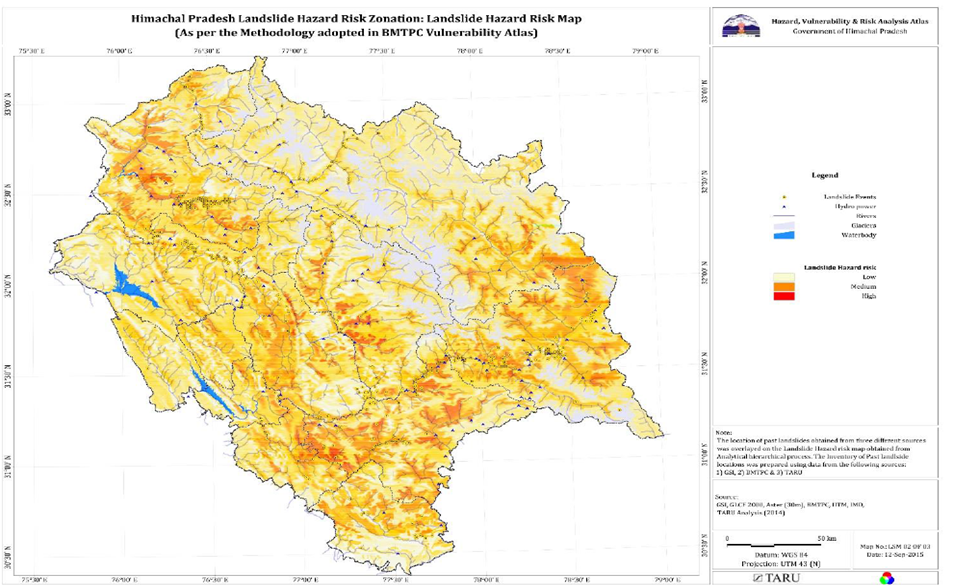
The national Manual on Electoral Risk Management (ECI 2023f) includes a specific section on mitigation of risks from natural disasters, mostly focused on disaster prone areas. As a part of the response mechanism, 1,035 officials of the National Disaster Response Force (NDRF) were deployed in the state during the 2022 election. Himachal Pradesh State Disaster Response Force also deployed 165 officials for emergency response (CEO Himachal 2022). The Disaster Management Department along with the CEO Himachal Office also identified polling stations that are off-road and the distances involved in reaching them. This was to identify and develop an early response mechanism with district-level detail, in case of a natural disaster (CEO Himachal 2022). Thankfully, none occurred during the 2022 cycle.
Bihar state assembly election 2020
This example is about damage to infrastructure and multiple logistical challenges due to a natural disaster before an election and during the first wave of Covid-19. Contrary to expectations, there was no impact on voter turnout. In Bihar, the state assembly election was conducted in October–November 2020 during the pandemic’s early peak, which followed a severe flood in July (Ambarkhane 2021; Kumar 2020). At least 12 districts were flooded affecting a population of 760,000 people. The state government had initiated several steps for flood rescue and rehabilitation including deployment of 13 NDRF teams and 8 state disaster response force teams (Tripathi 2020). The mitigation strategy for floods as a hazard had to be zonal rather than general and based on the general characteristics of rivers (Disaster Management Department 2020). The floods affected 14 districts of Bihar, with the toll of damage to infrastructure being heaviest in the rural areas. Most of the polling stations were in schools and the long school closures due to Covid-19 meant these sites were dirty even before accumulation of mud from flooding. Restoration of voting infrastructure within a short span of time amid threat of infectious disease was a mammoth task (Disaster Management Department 2020). Figure 2 shows the multiple hazard zones of the state.
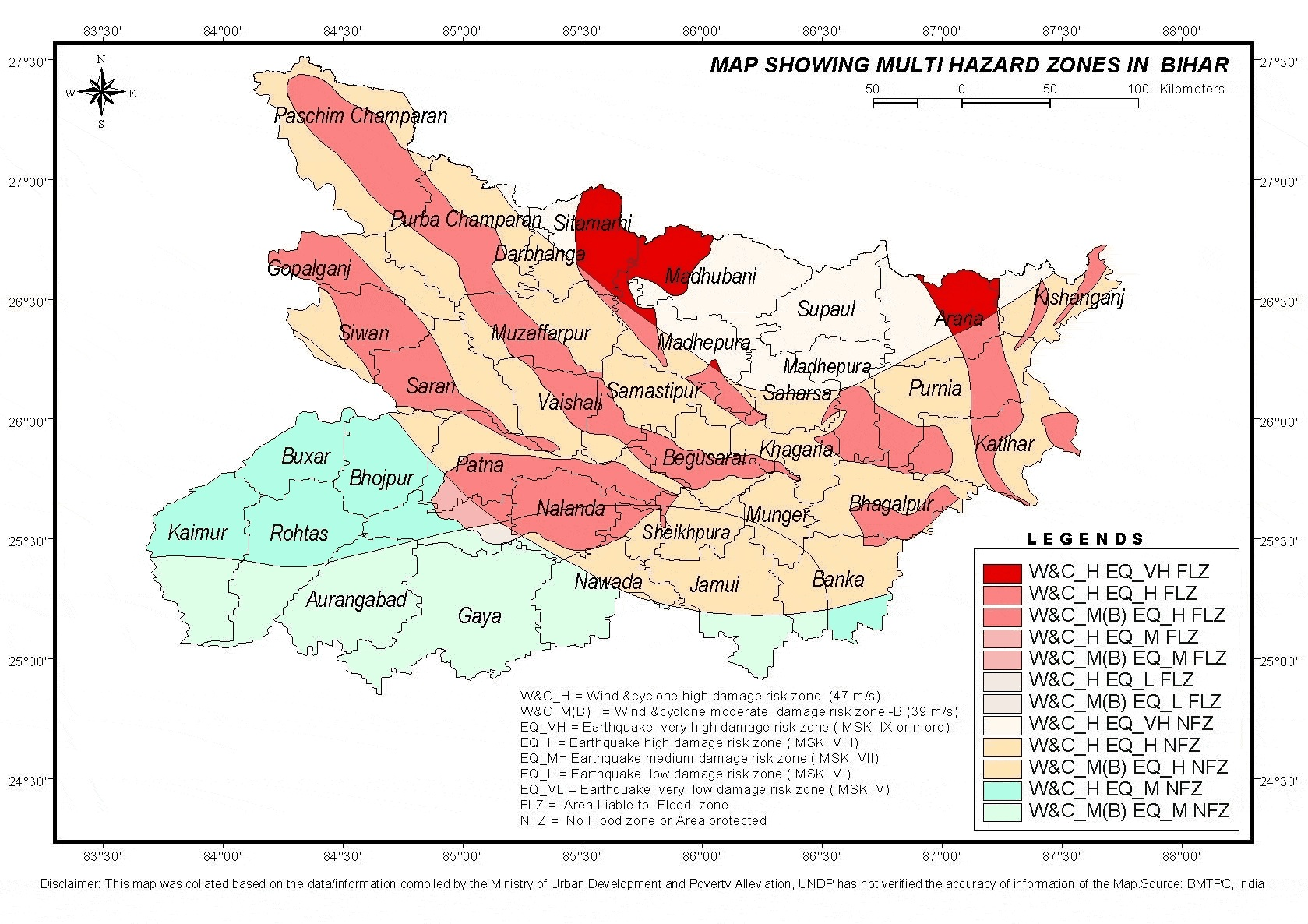
Due to the floods, infrastructure such as roads, bridges and schools in 12 districts was damaged which led the electoral authorities to create and publicize auxiliary polling stations (CEO Bihar 2021). There were 33,792 auxiliary polling stations set up in addition to the 72,723 main polling stations. This challenge involved identifying over 2,500 additional buildings and the same number of additional booth level officers for voter verification, as well as ‘Convincing the public whose livelihood was severely impacted due to the flood to participate in democratic process’ (CEO Bihar 2021). Further, a large number of migrant workers originally from Bihar had returned to the state due to lack of jobs during Covid-19. Hence, a special registration drive was conducted to enrol them in time for the elections (Ambarkhane 2021).
Despite the tight timescale for this, the 10 most flood-affected districts managed to increase voter turnout between 0.4 and 3.4 per cent as compared with Bihar’s previous election (ECI 2021a). Hence, the devastation caused due to flood and the health and migration crisis due to the Covid-19 pandemic did not deter the voters from exercising their franchise and the efficient arrangements by the CEO office Bihar and ECI helped.
Odisha state assembly election 2019
In this example, the possibility of infrastructure damage in a constituency due for election led to postponement of the said election. On 3 May 2019, Cyclone Fani wreaked havoc on the coastal areas of Odisha and West Bengal. In the eastern state of Odisha, where the cyclone’s effects were felt the most, 64 people died while 1.2 million were evacuated to cyclone shelters (World Bank 2019). Despite a category four hurricane with windspeed of 180 kmph, about 1.5 million people were shifted within 24 hours to 9,177 safety shelters before landfall (Jena and Kishor 2021).
National elections in India were taking place at the same time; while the simultaneous election (for national and state assembly) had already taken place in four phases on 11, 18, 23 and 29 April 2019 for most of the constituencies in Odisha state, election to one state assembly constituency of Patkura was left (ECI 2019b). Voting in Patkura had been scheduled for 29 April 2019, four days before the landfall of Cyclone Fani (ECI 2019d). Due to the risks of destruction of electoral materials, the ECI instructed the CEO office to move electronic voting machines (EVMs) from the districts of Jagatsinghpur and Gajapati. To uphold the principles of transparency, the entire process was conducted in the presence of all candidates and under video surveillance. A joint team of central and state police forces accompanied the vehicles transporting EVMs and voter verifiable paper audit trails (VVPATs), as did the presiding officer of each centre (India Today 2019).
The Chief Minister of Odisha urged the ECI to postpone the election in Patkura due to the Cyclone Fani alert (Bisoyi 2019). The Bharatiya Janata Party (BJP), the opposition party in the state and the ruling party in the federal government, opposed the proposal of the Chief Minister. Yet the ECI decided to postpone the election (Bisoyi 2019; ECI 2020a), first to 19 May 2019 due to the death of a contesting candidate and then to 20 July 2019 due to Cyclone Fani (ECI 2019d).
Measures on prevention and adaptation applied at the national level
In response to natural hazards, the ECI has also adopted risk management and resilience-building measures at the national level. This includes specific references to natural hazards in the risk management manual (ECI 2023f), the election disaster management plan (CEO Himachal 2022), contingency plans and assured minimum facilities (AMF) at all polling stations (ECI 2023d). All of the aforementioned measures are described below.
Manual on Electoral Risk Management and Disaster Management Plan
Elections to some state assemblies or by-elections to some constituencies are held throughout the year during any season, as per the expiry of the five-year term (ECI 2023a). Hence, contingency planning has been adopted by the ECI to ensure smooth conduct of elections during events like storms and floods to ensure voting rights of citizens.
The ECI at the national level has prescribed proactively designing a mitigation strategy in case of natural disasters in its Manual on Electoral Risk Management, updated on 28 July 2023 along with an Election Disaster Management Plan. First published in 2018, the second edition of the manual now states that damage from risks that are ‘uncontrollable such as a natural disaster (cloudburst/ floods, cyclone), outbreak and escalation of local/communal conflict, Covid pandemic etc. can be prevented by proactively designing a mitigation strategy which shall entail clearly defined roles for everyone involved in the process’ (ECI 2023f: 5). The manual identifies multiple risk categories along with mitigation measures to be undertaken and by which authority. While a range of risks are covered, from training of staff to communication during disasters and inundation of polling materials, the document focuses mostly on contingency measures for disaster prone areas only. Table 1 is an extract from the manual on disaster risk and its mitigation.
| Work area | Risk identified | Mitigation measures/action points | Level at which action to be taken* |
|---|---|---|---|
| 1. Election Disaster Management Plan | Not covering all facets of various types of disasters. | Advance planning required for ensuring this. Frequent, timely meeting of SDMA and District Disaster Management Authority. | SDMA/CEO/DDMA |
| 2. Training | Untrained personnel do not know how to face disaster and panic. | Training of election officials on particular disaster handling in disaster prone areas should be provided. | CEO/DEO/RO |
| 3. Awareness of disaster | The election personnel are unaware of the updates/happening of disaster. | Live weather updates to be integrated with communication plan, provision for putting alert and mechanism of SOS generation should be there. | DEO/RO/PO |
| 4. Poll materials | The election materials getting damaged/drenched due to water. | Procurement/use of polythene bags in rain prone areas for covering election materials. | DEO/RO |
| 5. Communication | Normal communication fails due to load shedding, mobile connection non-functional. | Back up communication plan to be kept ready in case mobile phones becomes non- functional. Sufficient power banks to be provided to polling parties. Allow mobile phones to all polling personnel, not only to Presiding Officer. | DEO/RO |
| 6. DCRC (Distribution Centres/Receiving Centres) | DCRC temporary structure being blown away due to cyclone/natural disaster. | Avoid temporary structures of DCRC in cyclone prone areas. | DEO/RO |
| 7. Polling station | Polling stations of low-lying areas get submerged under water due to flood. | Pre-identification of alternative building on highland for shifting of polling station in case of sudden flood. | CEO/RO |
| Load-shedding at polling station after evening, the poll materials may be misplaced lost. | Arrangement of alternate/rechargeable light or other source of light. | DEO/RO | |
| 8. Polling parties [voters] | The polling parties are frightened and unaware of alternate routes. | Civil defence volunteer/local volunteer with polling party in disaster prone areas. | DEO/RO |
| No electricity, no light endangers all the personnel. | Torch or flash lights to be provided with polling parties. | DEO/RO | |
| The polling personnel are drenched and infected with cold. | Raincoats may be stored at sector for special requirements in such disaster-prone areas, if any. | DEO/RO |
From the Table 1, it is evident that most of the contingency planning is to be conducted at the district or constituency level. Some states which are disaster prone should consider developing a disaster management plan in coordination with state disaster management authorities. Also, states where only a few districts or constituencies are affected could look at preparing a specific plan for these districts in association with relevant district disaster management authorities.
At an ECI meeting for sharing of experiences from states having gone to the polls in 2016, one of the lessons was the need for contingency planning for unexpected weather conditions on polling day like severe storms, widespread rain and power failures. The Union Territory of Puducherry had faced a crisis on election day owing to a storm-induced blackout and ‘panic’ arrangements for lamps had to made at polling stations (ECI 2018a).
The Handbook for Returning Officers is a key document with standard operating procedures (SOPs) for the lead officer responsible for the conduct of elections in a constituency (ECI 2019a). It mentions various measures for contingency planning, stating:
Under section 57(1) of the Representation of the People Act, 1951, the Presiding Officer of a polling station is empowered to adjourn the poll on account of:
i). a natural calamity like flood, heavy snowfall, a severe storm and the like, or
ii). non-receipt or loss or damage to essential polling materials like EVMs, ballot boxes, ballot papers, authentic copy of electoral roll and the like, or
iii). disturbance of peace at the polling station making it impossible to take the poll; or
iv). non-arrival of the polling party at the polling station due to obstruction on the way or any other serious difficulty, or
v). any other sufficient cause.
—The ECI, Handbook for Returning Officers (2019: S.13.60.1)
The Handbook for Returning Officer also deals with instructions to avoid setting up temporary structures for polling stations and counting centres in case of fire, rain and dust storms (ECI 2019a: sections 2.2 and 15.4) and to protect election materials from hazards such a fire, rain etc. The ECI favours use of permanent structures like school buildings as polling stations, which exist in every corner of the country. Only in very remote places where a school does not exist, a temporary structure may be permitted to create a polling station. In a recent instruction, the ECI has also instructed districts to create permanent, wheelchair friendly ramps (with a 1:12 gradient) at all schools which will act as polling stations (ECI 2023e).
Improving voter experience during extreme heat
Extreme heat can discourage voters from standing in queues, especially afternoon hours when temperatures and voter numbers both peak (Times of India 2016). Hence, over the past several years, the ECI has introduced assured minimum facilities (AMF) at all polling booths. These facilities provide voters with shade from the sun, drinking water, seating arrangements and toilet facilities, as well as medical kits in case of emergencies. The AMF is a framework to enable polling personnel to discharge their duties in an efficient manner (ECI 2023d). Election officials can manage complaints and identify which facilities are not available in which polling stations, making corrective arrangements as required.
Recent updates on AMF instructions include sufficient numbers of environmentally friendly disposable glasses for drinking water, canopies for waiting areas (minimum 15 square feet in area and sufficient seating with preference for ‘ladies/senior citizens/nursing mothers/differently abled voters and children accompanying them’ (ECI 2023d)). Figure 3 shows a voter getting checked for hypertension at a polling station equipped with drinking water and first aid kits during 2014’s national election.
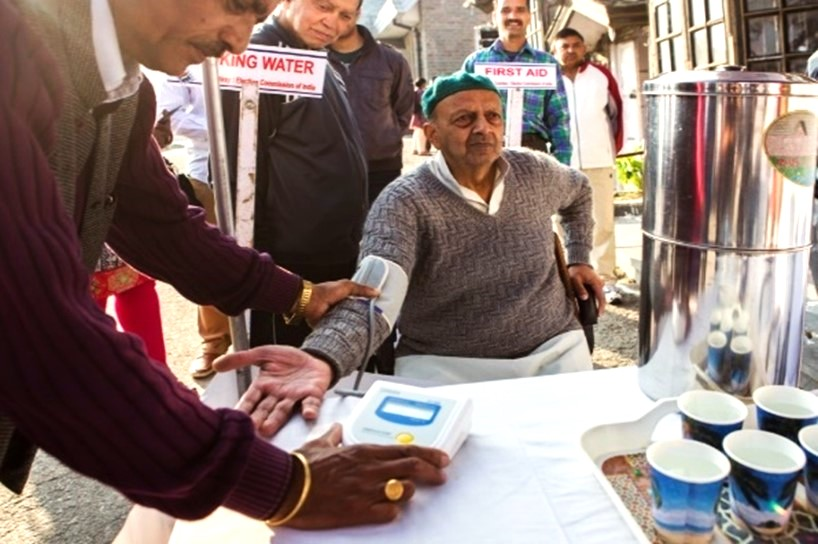
The AMF is of vital importance also because apart from cases of EVMs malfunctioning due to heat (Dua 2018), some deaths of people standing in queues were also reported during the last national election (Singh 2019).
Mitigation measures to reduce carbon emissions during elections
Focus on reducing pollutants during elections is an integral part of the ECI strategy to reduce carbon emissions (ECI 1999). During elections in India, the ECI issues a large number of instructions and circulars along with SOPs for smooth conduct of elections. Over time, ECI has moved from paper ballots to electronic voting to save paper, introduced a ban on single-use plastics during elections and undertaken ‘green election’ initiatives (ECI 2022a).
Electronic voting
India introduced the use of EVMs to record votes cast in 1982, on a pilot basis (ECI n.d.; ECI 2022b, n.d.). After judicial review and positive responses from political parties and other stakeholders, the reach of EVMs was expanded and they were finally used across India from the national elections of 2004 onward. Judicial pronouncements on the need for EVMs during their pilot-testing phase mostly refer to ease of counting and being a safeguard against ballot stuffing (ECI 2022b). However, multiple news articles discuss the importance of introducing EVMs for environmental reasons, while a scientific paper refers to EVMs as an ‘eco-friendly’ option that ‘saved the cost spent on transportation of large number of ballot boxes, cost spends on papers, cost spends on stamps etc’ (Verma et al. 2015). Media reports also talk about EVMs saving trees, given that ‘in the 1996 national election 8,000 tonnes of paper was used for printing ballot papers and in 1998 national polls the paper use was marginally lower at 7,700 tonnes’ (PTI/Rediff.com 2004). This would need upwards of 150,000 trees to be felled. Another media report pointed out that if EVMs had not been used in the 2009 national elections, 10,000 tonnes of paper would have been consumed due to the increase in registered voters (Hindustan Times 2009).
In comparing EVMs with paper ballots, the ECI itself says, ‘EVM voting saves time, energy and money, not to speak of the millions of trees it saves in the process’ (ECI n.d.). Amid the demand for a return to physical ballot papers, a former Chief Election Commissioner commented that this would lead to wastage of paper (Hindu 2018). While the ECI has completely switched to using EVMs during national, state and presidential/vice-presidential elections, some State Election Commissions—which are responsible for the conduct of municipal, village and local polls—still use paper ballots. In 2019, the electoral management body (EMB) of the most populous state, Uttar Pradesh State Election Commission (UPSEC), was inviting bids to dispose of around 286 metric tonnes of used ballot paper waste. UPSEC was planning to use ‘EVMs in all the cities beyond municipal corporations where they are already used’ (Hindustan Times 2019).
India’s EVM is a stand-alone, non-networked, one time-programmable (OTP) machine. Not being computer controlled nor connected to the Internet or any network (ECI n.d.) and battery operated, it does not require further electricity to function.
Set against this, EVMs do need to be securely moved around the country during election periods. EVMs are transferred to polling stations from dispatch centres and from polling stations to designated strong rooms by GPS-fitted container trucks and escorted by both central and state police vehicles, depending upon the logistics plan devised by the District Election Officer (DEO) (ECI n.d.). While the exact number of vehicles used during elections is not available, in the last national election in 2019, the ECI commissioned 2.23 million ballot units, 1.63 million control units and 1.73 million VVPATs (Paliwal 2019). Transportation of such a large number of EVMs and polling personnel to polling stations, especially in hilly and remote areas, represents significant carbon emissions.
Ban on single-use plastics during elections
According to reports for year 2017–2018, the Central Pollution Control Board (CPCB) estimated that India generates approximately 9.4 million tonnes per annum of plastic waste (26,000 tonnes per day). Out of this approximately 5.6 million tonnes are recycled (15,600 tonnes per day) and 3.8 million tonnes is left uncollected or littered (9,400 tonnes per day). The per capita consumption, however, has been low at 11 kg per annum, compared to the global average of 28 kg. Among developed nations, the United States has a per capita consumption of 139 kg per annum, while the European Union’s is 65 kg (CSE 2019). Data on how much of this plastic waste can be attributed to electoral activities is not available (MoHUA 2019).
Given the extent of the problem, efforts to reduce the use of single-use plastics have been ongoing for some years (Sailaja Bhattacharya et al. 2018) as India had committed to do away with single-use plastics by 2022. At the 4th United Nations Environment Assembly held in 2019, India piloted a resolution on the issue. The Plastic Waste Management Amendment Rules first issued in 2016 and amended in 2021 by the Ministry of Environment, Forest and Climate Change (MOEFCC) put a ban on ‘manufacture, import, stocking, distribution, sale and use of identified single use plastic items, which have low utility and high littering potential, all across the country from July 1, 2022’ (Government of India 2022b). Covering 19 items, including disposable plastic cutlery and straws, the ban triggered the development and manufacturing of innovative eco-alternatives and their uptake, including by state governments and local authorities (Yadav 2023).
The ECI started the campaign against single-use plastics (Figure 4) early, with support from High Courts and the National Green Tribunal (NGT)—a specialized judicial body equipped with expertise solely for the purpose of adjudicating environmental cases in India, established in 2010 (NGT n.d.). As early as July 1999, the ECI first urged political parties and candidates to avoid the use of plastic/polythene for preparation of posters and banners, based on an appeal by World Wide Fund for Nature–India. The ECI issued similar letters in 2003, 2004 and 2006 (ECI 1999). In January 2016, before the Tamil Nadu state elections in May, the Madras High Court ordered the ECI to frame plans to reduce the use of plastics in electoral campaigns. In the state elections in December 2018 in Rajasthan, Madhya Pradesh and Chhattisgarh, advisories were issued on reducing use of plastics. The ECI evoked the Solid Waste Management Rules (CPCB 2016) and Plastic Waste Management Rules 2016 for parties and authorities to adhere to (Mahapatra 2019).
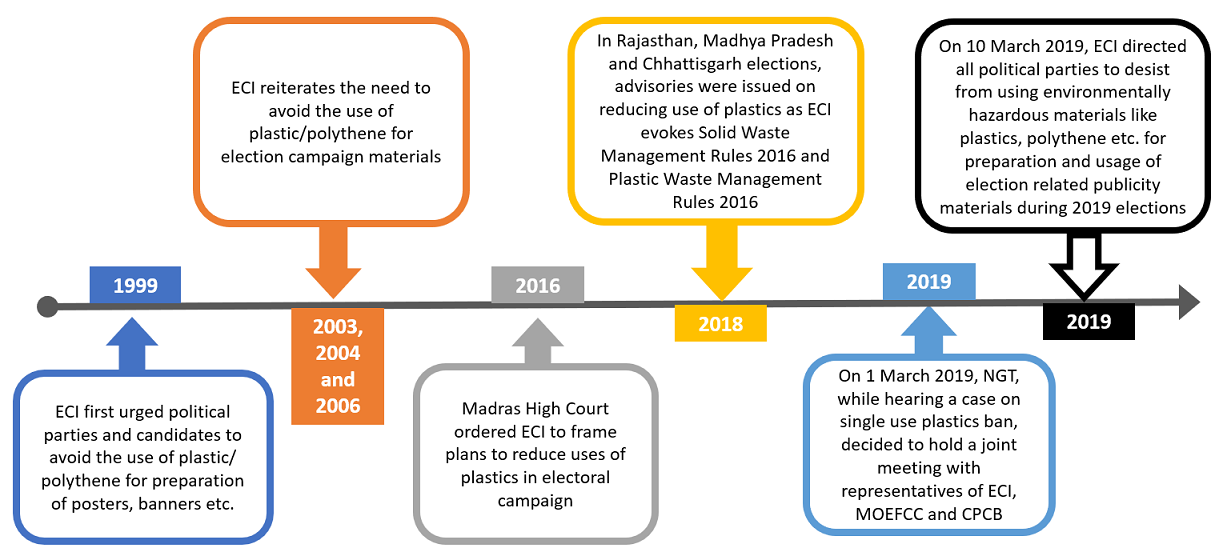
However, the implementation of these instructions by the ECI is a work in progress (Mahapatra 2019). Kerala was the first state where election-related plastic was banned by the High Court. The directive may not have been followed effectively, but it was a step in the right direction and almost all political party workers reported being aware of green protocols (Anand 2019). Other states like Karnataka, Maharashtra, Himachal Pradesh, Telangana and Sikkim already had some form of single-use plastic ban in place, but not all of them extended to campaigning (Verchot 2019). Finally, effective enforcement and analysis of these regulations’ effects is not possible without data gathering efforts.
A booklet was published explaining all the ways in which the green protocol could be adhered to and enforced in the state. Not just that, all activities conducted by the Commission at the state level and even at the district level were entirely ‘green’ events and promoted the plastic-free message. Special events were organized by the district election officials to promote the green message including cycle rallies, processions by students and green protocol volunteers in different districts, a signature campaign on cloth banners, street plays on green elections, flash mobs, a beach run, sand art, quizzes, local celebrity endorsements and other activities. All of this was under the aegis of the ECI’s SVEEP (Systematic Voters’ Education and Electoral Participation Programme) in the state (ECI 2019c).
Box 2. Green elections
The ECI has initiated new activities like green polling stations in areas with forest covers given that Kerala’s High Court, for example, banned the use of flex and nonbiodegradable campaign materials such as plastic hoardings for the 2019 national election. An advisory/recommendation was issued by the CEO immediately afterward asking all political parties to refrain from using single-use plastic materials in poll campaigning, and instead use eco-friendly options (such as wall graffiti and paper or cloth posters). A primary focus was reusable alternatives to plastic cutlery and bottles, such as glass/stainless steel/porcelain (ECI 2019c).
Various CEOs have undertaken similar innovative initiatives. Model eco-friendly polling stations have been set up in Goa (Figure 5), Gujarat and Puducherry using coconut shells, and palm and banana leaves; eco-friendly seed pens have been adopted by polling personnel in Meghalaya. A ‘Grow with Democracy’ plantation drive took place in Assam’s Kakoijana Reserve Forest, with 32,000 saplings planted in a record time of 32 minutes. A major push has been given for eco-friendly infrastructure, with many CEOs adopting LED lighting, rainwater harvesting systems and solar panels in their office premises and EVM warehouses (ECI 2022a).
Celebrating the World Environment Day on 5 June 2022, Election Commissioner Shri Anup Chandra Pandey said, ‘Reduce, Reuse and Recycle is an integral motto of ECI’s approach for environmentally sound election management practices’. He added that ECI initiatives like online assistance with voter registration/candidate nominations and an extensive suite of mobile apps for citizens are all part of ensuring environmentally friendly elections (ECI 2022a).
Biomedical waste management during Covid-19
The ECI has held 16 state assembly elections since the Covid-19 pandemic began (ECI 2023b). Of these, 11 state assembly elections were held during peaks of infection which by mid-2022 meant the voting rights of over 444 million voters were upheld (ECI 2023b). In order to ensure safety of polling staff, they were all provided one packet of personal protective equipment (PPE) containing hand sanitizer, six 3-ply face masks, one face shield and gloves (Business Insider 2020). Disposal of these materials post-election was a massive task. Elaborate guidelines were issued for custody, handling, use and disposal of Covid-19 safety equipment (ECI 2020b). According to a report by the MOEFCC, India produced over 962 tonnes per day of biomedical waste (BMW) between May 2020 and March 2022 (Government of India 2022a). Tagging of polling booths along with other places where BMW was being generated, sanitization, collection and disposal were closely supervised by district administrations, with waste management teams themselves equipped with PPE (Bhardwaj 2020). For example, during the 2022 Punjab assembly election, waste materials were collected from all 24,740 polling booths of the state within two hours of the end of polling and 603 collection centres were set up for this purpose. The ECI insisted on tracking the vehicles to ensure all waste was disposed of efficiently (Bhardwaj 2020). The Bihar state election team had developed a mobile application to track the movement of vehicles so engaged (CEO Bihar n.d.), which was likewise adopted by other states in 2021—West Bengal (ECI 2021b) and Kerala.
Conclusion and lessons learned
This case study has described resilience-building measures adopted by the ECI at the national and state levels to protect elections against natural disasters. At the state level, this paper highlights inter-agency collaboration between the ECI and National Disaster Response Forces as well as the introduction of the first disaster management plan, specifically for Himachal Pradesh state assembly elections. The introduction of more than 33,000 auxiliary polling stations as a result of the twin hazards during the 2020 Bihar election is a notable example of adaptation and flexibility, while the ECI’s postponement of elections in one constituency of Odisha due to Cyclone Fani demonstrated the flexibility in the legal framework to respond to humanitarian and operational concerns.
A potential advantage of a more decentralized approach to disaster management is that some states plan innovative solutions that others can then adopt. A potential disadvantage is that other states might face natural disasters with no measures in place at all. Only a minimal requirement for contingency planning at national level is proposed in the Manual on Electoral Risk Management (ECI 2023f), and it still focuses on disaster prone areas. There are at present no specific contingency planning measures proposed at a national level for all states and Union Territories that look at all manner of natural disasters. The next national election will be conducted in April–May 2024, which is peak summer in India. Within this timescale it may be feasible for the ECI to develop a comprehensive plan on ensuring voting rights are preserved during floods, droughts and extreme heat.
Efforts made by the ECI, various state high courts and the NGT have enabled a partial ban on plastics during election campaigning. However, more needs to be done by various agencies to enforce existing regulations and widen them to ensure all aspects of elections are more environmentally friendly. Many innovative ideas on reducing use of plastics and taking up eco-friendly measures to reduce carbon emissions have been discussed in this study. Use of eco-friendly materials for ballot papers, voting booths and other election materials can significantly reduce the environmental impact of elections (Prasher 2019) but, as pointed out earlier, while most political parties are aware of the ECI’s instructions, data gathering is not in place and there is no information to suggest that they adhere to ECI guidelines strictly. The ECI needs to analyse the effects of its ban and to respond accordingly. Sustainable and progressive contributions to climate change mitigation could involve conducting carbon costing of electoral activities of ECI offices, political parties and other key stakeholders.
During emergencies, EMBs may need to transport hazardous biomedical waste and therefore they need to have plans in place for it. Therefore, any attempt to decrease the overall carbon emissions of an election needs to also take into account extra materials that are needed to hold elections during emergency periods. Strict norms by the MOEFCC for the implementation of biomedical waste management for elections held during Covid-19 have enabled environmentally friendly elections. Similar strict implementation of plastics bans can lead to pollution-free elections.
Political will—along with express action by constitutional bodies such as the ECI, Supreme Court of India and other High Courts—can make a difference to ensure a green election and reduce carbon emissions. Electronic voting systems can significantly reduce the amount of paper required for elections, as well as reduce transportation and storage requirements. However, it is important to ensure that these systems are secure, robust, reliable and accepted by all stakeholders.
During times of emergencies and crisis like Covid-19, there may be a need for the EMB to make use of more materials (that need transportation and disposal) after election day compared to elections in normal times. All the indications are that these burdens and their associated carbon emissions will become more frequent. The carbon footprint of elections is ultimately bound up with India’s infrastructure and wider economy. Using renewable energy sources such as solar and wind power can help reduce the environmental impact, as can encouraging voters to use public transport to reach their polling stations. Free public transport on election day can also make a big difference in ensuring higher voter turnout. Educating voters about the importance of environmentally friendly practices, such as reducing waste and using renewable energy, can help raise awareness and promote more sustainable practices on polling day and beyond.
Afterword
17 September 2025
India concluded its national election in April–June 2024 with the total electorate in the country at 968.8 million (ECI 2024a). The seven-phase election was held in different constituencies on 19 April, 26 April, 7 May, 13 May, 25 May and 1 June, and represented the largest democratic election in history (Vaishnav and Mallory 2024). During the election period a deadly heatwave swept across India, initially spreading over the western states before eventually reaching the northern parts of the country (Pradhan 2024). Many places around the country reported record-high temperatures, including Rajasthan’s Churu which recorded a temperatures of 50.5 degrees Celsius, which was the highest temperature in India in eight years (ANI 2024). Based on data from India’s health ministry, the heatwave led to more than 100 deaths and over 40,000 suspected cases of heatstroke (Arasu and Pathi 2024). Others put the death toll at over 200, the most heavy casualties being among poll workers (Mishra 2024). According to the World Weather Attribution, ‘climate change [in South Asia] made the extreme heat [in April] about 30 times more likely and 1 degree hotter’ (WWA 2024).
The heatwave represented an electoral integrity challenge due to the obstacle it posed to deliberation, contestation and participation. For many, especially vulnerable groups, standing outdoors in the scorching heat during a campaign event or while queueing to vote represented a significant health risk.
Official campaigning for the Lok Sabha election started in April and continued until the end of May 2024. During this time, several politicians contesting the elections had fainted or fallen sick. For example, a politician from the ruling Bharatiya Janata Party (BJP) fainted and collapsed on stage during campaigning (Pradhan 2024). Another party head from the Trinamool Congress (TMC) reported being exhausted from campaigning under such conditions (Indian Express 2024).
To respond to the extreme heat, the federal government had adopted an ‘integrated approach’ to preparation which involved various ministries including Jal Shakti (Waterways), Agriculture and Health, according to India Meteorological Department (IMD) chief, Mrutyunjay Mohapatra (PTI/Economic Times 2024). Federal Minister for Earth Sciences, Kiren Rijiju said, ‘All stakeholders, including state governments, have made elaborate preparations’ (PTI/Economic Times 2024). Some political parties resorted to campaigning during early mornings and late evenings. In Lucknow, for example, the BJP changed its strategy from mass rallies (a common feature in Indian elections) to intense door-to-door campaigning (NDTV 2024). Canvassers representing TMC in West Bengal were recommended to bring umbrellas, hats and water (Pillai 2024).
On 22 April 2024, the Election Commission of India (ECI) issued a letter requiring strict compliance with ‘dos and don’ts’ issued by the National Disaster Management Authority (NDMA) about minimizing the impact of the heatwave—and with assured minimum facilities (AMF) at polling stations including shade for voters in queues, drinking water, medical aid, toilets and so on (ECI 2024b). Elaborate arrangements were made by staff on the ground to ensure AMF on all polling days. Provisions were also made to collect votes from senior citizens and differently-abled persons (Kunal 2024). This was done through a vote-from-home service (mobile ballot box voting) for individuals aged over 85 and those with over 40 per cent benchmark disability (PIB 2024a).
Local election offices also arranged air coolers and mist fans for voters and polling staff in the penultimate phase (sixth polling day) when Delhi and Punjab voted (The Hindu 2024; Kunal 2024). State election offices prepared individual polling staff welfare plans for their own states according to the local conditions (see e.g. CEO HP n.d.; CEO Andaman n.d.). In Odisha, doctors and paramedic staff were deployed with polling officials in readiness to attend to heatstroke emergencies among voters or polling staff (CEO Odisha 2024).
The Delhi Disaster Management Authority (DDMA) developed its own heat action plan with recommendations to different local departments during the election period. This included availability of shade, drinking water and oral rehydration sachets at bus and local transport stands; proper shade for traffic police; use of non-functioning schools as shelters; and altering the timing of outdoor workers to minimize exposure (Agarwal 2024). At the national level, in mid-April 2024 the ECI announced it had formed a task force to monitor heatwave conditions involving officials also from the IMD, the NDMA and the Ministry of Health and Family Welfare. Its remit was to review the impact of heatwaves and humidity, and any necessary mitigation measures, five days before each polling phase (ECI 2024c; H. Mitra 2024).
Despite these efforts there were multiple casualties from the heat, as mentioned. On the last day of voting on 1 June, at least 33 polling officials died of heatstroke in Uttar Pradesh (Al Jazeera 2024; E. Mitra 2024; Adil 2024). This led to dissatisfaction among poll workers about the level of care22 provided by the ECI (Tripathi 2024). Once voting ended, the Chief Election Commissioner Rajiv Kumar accepted that the intense heatwave conditions became a significant challenge during elections, and stated that his biggest lesson learned was that the poll process should be completed before summer. His remarks came amid criticism of the EMB from various quarters that it was inappropriate for the seven-phase elections to stretch until June (Devesh 2024).
Heatwaves in India are expected to become only more intense in coming years. However, implementing the acknowledged need to ensure that elections are not conducted during summer months is not straightforward, intersecting as it does with the politics of other reform proposals. The government has proposed a ‘One Nation, One Election’ law whereby national, state and local elections to all legislative bodies in the country would be conducted simultaneously. According to IMD Chief Mohapatra, the authorities should certainly take weather conditions and the climate into consideration when planning for such a massive exercise (Business Standard/PTI 2024). Meanwhile, opposition parties are vehemently opposed to synchronized elections calling the proposal an ‘assault on democracy’ which would variously and unfairly decrease or increase the tenures of state assemblies currently sitting (Chakraborty 2024).
The government argues that synchronizing electoral timelines will address logistical challenges, reduce costs and minimize disruptions caused by frequent elections. Elections were held simultaneously in the past before the cycle was disrupted due to various reasons including imposition of presidential rule (PIB 2024b).
When the ‘One Nation, One Election’ bill was tabled in the Parliament on 17 December 2024, opposition MP Asaduddin Owaisi (of the AIMIM party) claimed its intent was partisan, ‘aimed at maximizing political gains to a certain party [and would] pave the way for a presidential form of government’ (Doordarshan News 2024). Other opposition parties similarly criticized the bill as having anti-constitutional or authoritarian potential. The legislation, a longstanding campaign pledge of the ruling coalition, is currently with an all-party joint parliamentary committee which is examining its provisions.
References
Election Commission of India (ECI)
Chief Electoral Officer Bihar (CEO Bihar), ‘Bihar Assembly Election 2020’ (presentation slides), 4 September 2021, <https://indiaawebcentre.org/files/file/47-bihar-assembly-election-2020> accessed 17 December 2023
—, ‘ELE Traces: Election Tracking Enabled System’, [n.d.], <https://eletraces.bih.nic.in/bihar>, accessed 17 December 2023
Chief Electoral Officer Himachal (CEO Himachal), Disaster Management Plan during Himachal Pradesh Vidhan Sabha [Assembly] Election 2022 (New Delhi: ECI, 2022), <https://ceohimachal.nic.in/CommonControls/ViewCMSFile?qs=KI3gZ53zz1wW9H2IggWkQt6AMp4fx4pdDgcoJeKb%2BByf16%2B%2F5WxmaWssdU%2F77%2BZaBTfPBajMw6CFxxJ9e5rsEgljS3rhwGrHaaWk1%2BB4uAtt6kr9zzbiL59HBrmZp%2BlS>, accessed 18 January 2024
MG and Ambarkhane, ‘Narrative and Statistical Report General Election to Lok Sabha, 2014’, Election Commission of India, 13 September 2018, <https://www.eci.gov.in/eci-backend/public/api/download?url=LMAhAK6sOPBp%2FNFF0iRfXbEB1EVSLT41NNLRjYNJJP1KivrUxbfqkDatmHy12e%2FzVx8fLfn2ReU7TfrqYobgIiWsKNw80sVQQTurmfLsaRPntO5zzMHfx%2B2yGWjALHfdIqvEPy9J%2BR2k0iP4MKyGyVCXWS6O7ZEzFZqGg8EquKQfaoY5iFf%2BNhdkotT9UprguJHvF4JqpCLHnJYOf%2FcvfvXoJE9GzXzfieGjq4BSBSw%3D>, accessed 16 January 2024
Electoral Commission of India (ECI), Status Paper on Electronic Voting Machine (EVM), [n.d.], <https://ceo.karnataka.gov.in/uploads/media_to_upload1637061008.pdf>, accessed 17 December 2023
—, ‘Pollution of environment on account of use of plastic sheets for making use of posters/banners during the election campaign’, 16 July 1999, <https://old.eci.gov.in/files/file/1115-pollution-of-environment-on-account-of-use-of-plastic-sheets-for-making-use-of-postersbanners-during-the-election-campaign>, accessed 17 December 2023
—, Experiences & Lessons Learnt from the Poll Gone States 2016 (New Delhi: ECI, 2018a), <https://old.eci.gov.in/files/file/5666-experiences-lessons-learnt-from-the-poll-gone-states-2016>, accessed 17 December 2023
—, Electoral Statistics Pocket Book 2017 (New Delhi: ECI, 2018b), <https://old.eci.gov.in/files/file/5668-electoral-statisitics-pocket-book-2017>, accessed 17 December 2023
—, Handbook for Returning Officer February 2019 (Document 23, Edition1) (New Delhi: ECI, 2019a), <https://old.eci.gov.in/files/file/9400-hand-book-for-returning-officer-february-2019>, accessed 17 December 2023
—, ‘Announcement of schedule for general elections to Lok Sabha and Legislative Assemblies in Andhra Pradesh, Arunachal Pradesh, Odisha and Sikkim, 2019’ (press release), 10 March 2019b, <https://old.eci.gov.in/files/file/9396-announcement-of-schedule-for-general-elections-to-lok-sabha-and-legislative-assemblies-in-andhra-pradesh-arunachal-pradesh-odisha-sikkim-2019>, accessed 17 December 2023
—, ‘Conducting a green election in Kerala’, 25 June 2019c, <https://ecisveep.nic.in/articles.html/new-initiative/conducting-a-green-election-in-kerala-r104>, accessed 17 December 2023
—, ‘Schedule for general elections to fill vacancy from 96-Patkura assembly constituency in the State Legislative Assembly of Odisha where poll was adjourned’ (press release), 4 July 2019d, <https://old.eci.gov.in/files/file/10321-schedule-for-general-elections-to-fill-vacancy-from-96-patkura-assembly-constituency-in-the-state-legislative-assembly-of-odisha-where-poll-was-adjourned>, accessed 17 December 2023
—, ‘ECI defers Rajya Sabha Poll in view of Covid-19; fresh date to be announced later’ (press release), 24 March 2020a, <https://old.eci.gov.in/files/file/11983-eci-defers-rajya-sabha-poll-in-view-of-covid-19-fresh-date-to-be-announced-later>, accessed 17 December 2023
—, ‘Broad Guidelines for Conduct of General Elections/By-elections during Covid-19’ (Document No. 324.6.EPS.OT.001.2020), 21 August 2020b, <https://old.eci.gov.in/files/file/12167-broad-guidelines-for-conduct-of-general-electionbye-election-during-covid-19>, accessed 17 December 2023
—, ‘Bihar Legislative Election 2020’ (results), 13 January 2021a, <https://old.eci.gov.in/files/file/12787-bihar-legislative-election-2020>, accessed 17 December 2023
—, ‘CEC holds a review meeting with CS West Bengal’ (press release), 24 April 2021b, <https://old.eci.gov.in/files/file/13347-cec-holds-a-review-meeting-with-cs-west-bengal>, accessed 17 December 2023
—, ‘Electoral Statistics Pocket Book 2021 (as on 31st December)’, 31 December 2021c, <https://old.eci.gov.in/files/file/14181-electoral-statistics-pocket-book-2021-as-on-31st-december>, accessed 17 December 2023
—, ‘ECI celebrates World Environment Day’ (press release), 5 June 2022a, <https://old.eci.gov.in/files/file/14201-eci-celebrates-world-environment-day>, accessed 17 December 2023
—, Legal History of EVMs and VVPATs (New Delhi: ECI, 2022b), <https://old.eci.gov.in/files/file/14525-legal-history-of-evms-and-vvpats>, accessed 17 December 2023
—, ‘General Election to Legislative Assembly of Himachal Pradesh, 2022 -reg’ (press release), 14 October 2022c, <https://old.eci.gov.in/files/file/14491-general-election-to-legislative-assembly-of-himachal-pradesh-2022-reg>, accessed 17 December 2023
—, ‘Term of the Houses’, 2023a, <https://old.eci.gov.in/elections/term-of-houses>, accessed 17 December 2023
—, ‘Election Results – Full Statistical Reports’, 2023b, <https://old.eci.gov.in/statistical-report/statistical-reports>, accessed 17 December 2023
—, ‘Assured Minimum Facilities and Other Facilities at Polling Stations-reg’, 10 June 2023d, <https://ceodelhi.gov.in/PDFFolder/planning/Assured_Minimum_Facilities_(AMF)_issued_by_ECI.pdf>, accessed 18 January 2024
—, ‘Inclusive and Participative Elections – Setting up of All Women/PwD/Youth managed Polling Station’, letter to Chief Electoral Officers of All States/UTs, 30 August 2023e, <https://www.eci.gov.in/eci-backend/public/api/download?url=LMAhAK6sOPBp%2FNFF0iRfXbEB1EVSLT41NNLRjYNJJP1KivrUxbfqkDatmHy12e%2FzVx8fLfn2ReU7TfrqYobgIm3oWfm8hZDWv6FfRd42QeY1couyYw%2FoSLRDdDGZ%2BA%2BTIr3gLHm6lpiChmkU8hcSVXcJMvOlCI%2BNHmEVjVSQhj9UpyGVFqMTjZoK%2FJnG4EEj>, accessed 16 January 2024
—, Manual on Electoral Risk Management 2023, Edition 2 (Document No. 324.6.EPS:MA:005: 2023), 28 June 2023f, <https://ceomadhyapradesh.nic.in/Links/Manual/Manual%20on%20Electoral%20Risk%20Management%20FINAL.pdf>, accessed 18 January 2024
—, ‘Announcement of Schedule for General Elections to Lok Sabha and Legislative Assemblies of Andhra Pradesh, Arunachal Pradesh, Odisha and Sikkim, 2024’, 16 March 2024a, <https://elections24.eci.gov.in/docs/press-note-no-23.pdf>, accessed 18 June 2025
— ‘General Election to Lok Sabha, 2024 – Advisory on prevention of Heat wave impact’, 16 March 2024b, <https://elections24.eci.gov.in/docs/ylOTCbXfik.pdf>, accessed 18 June 2025
— ‘Press Note: IMD forecasts Normal weather for Phase 2 Lok Sabha Poll; ECI constitutes task force to watch heat conditions before every phase of the poll; Commission holds meeting with IMD, NDMA and MoHFW’, 22 April 2024c, <https://www.pib.gov.in/PressReleaseIframePage.aspx?PRID=2018459>, accessed 18 June 2025
Other
Adil, A., ‘Heat wave killed 33 poll staffers on last day of Indian elections, say officials’, AA, 3 June 2024, <https://www.aa.com.tr/en/asia-pacific/heat-wave-killed-33-poll-staffers-on-last-day-of-indian-elections-say-officials/3238019>, accessed 18 June 2025
Agarwal, P., ‘Heat action plan promises succour, but remains on paper as city sweats’, Times of India, 3 June 2024, <https://timesofindia.indiatimes.com/city/delhi/delhis-heat-action-plan-implementation-challenges/articleshow/110574871.cms>, accessed 18 June 2025
Al Jazeera, ‘Heatstroke kills 33 polling staff in a state on last day of India election’, 2 June 2024, <https://www.aljazeera.com/news/2024/6/2/heatstroke-kills-33-polling-staff-in-a-state-on-last-day-of-india-election>, accessed 19 June 2025
Ambarkhane, S., ‘Covid-19 and elections: The case of Bihar Legislative Assembly, India’, 5 December 2021, <https://www.idea.int/sites/default/files/covid-19-and-elections-to-the-bihar-legislative-assembly-india-en.pdf>, accessed 17 December 2023
Anand, N., ‘For the first time, an Indian state has kept the elections clean and green’, Quartz, 23 April 2019, <https://qz.com/india/1602042/kerala-election-update-first-indian-state-with-green-polls>, accessed 17 December 2023
ANI News, ‘Rajasthan: Churu records 50.5 °C amid ongoing heatwave; Pilani breaks record of highest ever temperature’, 28 May 2024, <https://www.aninews.in/news/national/general-news/rajasthan-churu-records-505-176c-amid-ongoing-heatwave-pilani-breaks-record-of-highest-ever-temperature20240528224843>, accessed 19 June 2025
Arasu, S. and Pathi, K., ‘Extreme heat in India has killed more than 100 people in the past three and a half months’, AP, 20 June 2024, <https://apnews.com/article/india-heatwave-deaths-heat-stroke-climate-change-880f26e3b8eeb066d2db2308502783d2>, accessed 19 June 2025
Bhardwaj, D., ‘Bihar polls amid Covid-19: An election of many firsts’, Hindustan Times, 3 November 2020, <https://www.hindustantimes.com/bihar-election/bihar-polls-amid-covid-19-an-election-of-many-firsts/story-bXkEjZJyJ7rxbx4iMrtCnI.html>, accessed 17 December 2023
Bisoyi, S. K., ‘Odisha: ECI postpones Patkura assembly election in the aftermath of cyclone Fani’, Times of India, 6 May 2019, <https://timesofindia.indiatimes.com/elections/assembly-elections/odisha/news/odisha-eci-postpones-patkura-assembly-election-in-the-aftermath-of-cyclone-fani/articleshow/69204693.cms>, accessed 17 December 2023
Business Insider, ‘Bihar Assembly Election 2020 – Here’s how Covid-19 has changed the election preparations’, 25 September 2020, <https://www.businessinsider.in/india/news/heres-how-covid-19-has-changed-the-bihar-election-2020-preparations/articleshow/78313687.cms>, accessed 17 December 2023
Business Standard/PTI, ‘Consider weather, climate inputs while planning one nation, one poll: IMD’, 7 April 2024, <https://www.business-standard.com/elections/lok-sabha-election/consider-weather-climate-inputs-while-planning-one-nation-one-poll-imd-124040700138_1.html>, accessed 18 June 2025
Central Pollution Control Board (CPCB), ‘National Action Plan for Municipal Solid Waste Management’, 2016, <https://cpcb.nic.in/uploads/MSW/Action_plan.pdf>, accessed 17 December 2023
Centre for Science and Environment (CSE), ‘The Problem of Plastics’, 2019, <https://cdn.cseindia.org/attachments/0.57139300_1570431848_Factsheet1.pdf>, accessed 16 January 2024
CEO Andaman, ‘Polling Staff Welfare Provisions’, [n.d.], <https://ceoandaman.nic.in/election/ActionPlan/POLLING%20STAFF%20WELFARE%20PROVISIONS.pdf>, accessed 18 June 2025
CEO HP, ‘Polling Personnel Management and Staff Welfare’, [n.d.]
CEO Odisha, ‘Heat wave mitigation measures for Simultaneous General Election, 2024’, 30 April 2024
Chakraborty, P., ‘BJP bats for One Nation One Election, Congress calls it weapon of mass distraction’, India Today, 26 September 2024, <https://www.indiatoday.in/india/story/bjp-congress-one-nation-one-election-india-today-mumbai-conclave-lok-sabha-state-assemblies-2606765-2024-09-26>, accessed 18 June 2025
Devesh, K., ‘CEC Rajiv Kumar shares biggest lesson from Lok Sabha elections 2024: “Should not be completed before…”’, Mint, 3 June 2024, <https://www.livemint.com/elections/cec-rajiv-kumar-shares-biggest-lesson-from-lok-sabha-elections-2024-should-not-be-completed-before-11717403645567.html>, accessed 18 June 2025
Disaster Management Department, Bihar, Reflections on 2020 Floods in Bihar [Hindi] (Patna: Government of Bihar, 2020), <https://state.bihar.gov.in/cache/7/Media%20Gallery/Publications/17.pdf>, accessed 18 December 2023
Doordarshan News, ‘“One Nation, One Election” Bill tabled in Lok Sabha, opposition protests’, 17 December 2024, <https://ddnews.gov.in/en/one-nation-one-election-bill-tabled-in-lok-sabha-opposition-protests/>, accessed 18 June 2025
Dua, R., ‘UP bypolls: EC blames hot weather for EVM snags’, Times of India, 29 May 2018, <https://timesofindia.indiatimes.com/city/lucknow/up-bypolls-ec-blames-hot-weather-for-evm-snags/articleshow/64362776.cms>, accessed 16 January 2024
Economic Times, The, ‘Doordarshan TV anchor faints live on air while reading heatwave updates in Bengal 2024’, 21 April 2024, <https://economictimes.indiatimes.com/news/india/doordarshan-tv-anchor-faints-live-on-air-while-reading-heatwave-updates-in-bengal/articleshow/109481168.cms?from=mdr>, accessed 18 June 2025
Ghoshal, D., ‘Factbox: Key issues in India’s massive general election’, Reuters, 10 April 2019, <https://www.reuters.com/article/us-india-election-issues-factbox-idUSKCN1RM05P>, accessed 3 January 2024
Government of India, Press Information Bureau/Ministry of Environment, Forest and Climate Change, ‘Disposal of Bio-Medical Wastes’, 7 April 2022a, <https://pib.gov.in/PressReleaseIframePage.aspx?PRID=1814553>, accessed 3 January 2024
—, ‘Ban on identified single use plastic items from 1st July 2022’, 28 June 2022b, <https://pib.gov.in/PressReleasePage.aspx?PRID=1837518>, accessed 3 January 2024
Hindu, The, ‘Air coolers, fans at polling stations in Punjab amid prediction of extreme heat’, 9 April 2024, <https://www.thehindu.com/elections/lok-sabha/air-coolers-fans-at-polling-stations-in-punjab-amid-prediction-of-extreme-heat/article68046487.ece>, accessed 18 June 2025
Hindustan Times, ‘Things you did not know about EVMs’, 17 March 2009, <https://www.hindustantimes.com/delhi/things-you-did-not-know-about-evms/story-gb9tZ4PhHixJVCM8geJjlM.html>, accessed 17 December 2023
—, ‘Amid call for ballot system, SEC to dispose of 286 MT ballot paper’, 1 February 2019, <https://www.hindustantimes.com/lucknow/amid-call-for-ballot-system-sec-to-dispose-of-286-mt-ballot-paper/story-9kLSJMrR0KH8nT8LWIzhaJ.html>, accessed 3 January 2024
India, Republic of, Constitution of 1950, <https://www.refworld.org/docid/3ae6b5e20.html>, accessed 17 December 2023
—, Republic of, Representation of the People Act 1951, <https://www.indiacode.nic.in/bitstream/123456789/2096/5/a1951-43.pdf>, accessed 18 January 2024
India Today, ‘EC nod for shifting EVMs in Odisha over Cyclone Fani fears’, 1 May 2019, <https://www.indiatoday.in/india/story/evm-odisha-fani-1514371-2019-05-01>, accessed 17 December 2023
Indian Express, The, ‘Amid marathon campaigning, rising temperatures, “drained out” Mamata claims exhaustion’, 26 April 2024, <https://indianexpress.com/elections/lok-sabha-elections-2024-mamata-feels-the-heat-literally-9291348>, accessed 18 June 2025
Institute for Economics and Peace (IEP), Ecological Threat Register 2020: Understanding Ecological Threats, Resilience and Peace (Sydney: IEP, 2020), <https://www.visionofhumanity.org/wp-content/uploads/2020/10/ETR_2020_web-1.pdf>, accessed 17 December 2023
—, Ecological Threat Report 2022: Analysing Ecological Threats, Resilience and Peace, (Sydney: IEP, 2022), <https://www.economicsandpeace.org/wp-content/uploads/2023/10/ETR-2022-web.pdf>, accessed 17 December 2023
Intergovernmental Panel on Climate Change (IPCC), ‘Chapter 11: Weather and climate extreme events in a changing climate’, in Climate Change 2023: Synthesis Report. Contribution of Working Groups I, II and III to the Sixth Assessment Report of the Intergovernmental Panel on Climate Change (Geneva: IPCC, 2023), <https://doi.org/10.1017/9781009157896.013>
International IDEA, The 2024 Global Elections Super-Cycle (Database), [n.d.], <https://www.idea.int/initiatives/the-2024-global-elections-supercycle>, accessed 18 June 2025
—, ‘The Impact of Natural Hazards on Elections’, updated 10 January 2023, <https://www.idea.int/news-media/multimedia-reports/impact-natural-hazards-elections>, accessed 17 December 2023
Jaiswal, U., ‘Elections come and go, but Assam’s flood problems linger’, The Telegraph Online, 5 April 2021, <https://www.telegraphindia.com/north-east/assam-assembly-elections-2021-polls-come-and-go-but-states-flood-problems-linger/cid/1811534>, accessed 18 December 2023
Jena, P. and Kishor, P. K., ‘The Fani: A case study of Odisha disaster management’, in A. N. Gupta et al. (eds), Health Adaptation and Resilience to Climate Change and Related Disasters (New Delhi: National Institute of Disaster Management, 2021), <https://www.researchgate.net/publication/358009339_THE_FANI_A_CASE_STUDY_OF_ODISHA_DISASTER_MANAGEMENT>, accessed 18 December 2023
Kemp, J., ‘India runs power plants flat out to keep cool in heatwave and election’, Reuters, 3 June 2024, <https://www.reuters.com/world/india/india-runs-power-plants-flat-out-keep-cool-heatwave-election-kemp-2024-05-31>, accessed 18 June 2025
Koerth, M., ‘Can focusing on climate change help win elections?’, Five Thirty Eight, 17 October 2022, <https://fivethirtyeight.com/features/can-focusing-on-climate-change-help-win-elections>, accessed 17 December 2023
Krishnan, M., ‘Climate change in India: A growing environmental crisis’, DW, 7 November 2023, <https://www.dw.com/en/climate-change-in-india-a-growing-environmental-crisis/a-66190451>, accessed 12 January 2024
Kumar, A., ‘Bihar assembly election 2020: State faces flood challenge in run-up to polls’, Hindustan Times, 30 September 2020, <https://www.hindustantimes.com/bihar-election/bihar-assembly-election-2020-state-faces-flood-challenge-in-run-up-to-polls/story-Z64wZAOJUSFSmZXjSKSyxH.html>, accessed 17 December 2023
—, ‘The hidden story behind India’s remarkable election results: lethal heat’, The Guardian, 5 June 2024, <https://www.theguardian.com/commentisfree/article/2024/jun/05/india-election-results-heat-bjp-cllmate-crisis>, accessed 18 June 2025
Kunal, K., 2024, ‘Air coolers, mist fans among facilities planned for Delhi voters on polling day’, India Today, 4 May 2024, <https://www.indiatoday.in/elections/lok-sabha/story/air-coolers-mist-fans-among-measures-planned-for-delhi-voters-on-polling-day-2535103-2024-05-04>, accessed 18 June 2025
Mahapatra, R., ‘Election Commission, NGT, environment ministry say no to plastics in 2019 poll campaigning’, Down To Earth, 12 March 2019, <https://www.downtoearth.org.in/news/pollution/election-commission-ngt-environment-ministry-say-no-to-plastics-in-2019-poll-campaigning-63546>, accessed 17 December 2023
Masiero, G. and Santarossa, M., ‘Natural disasters and electoral outcomes’, European Journal of Political Economy, 67/2 (2021), <https://doi.org/10.1016/j.ejpoleco.2020.101983>
Ministry of Housing and Urban Affairs (MoHUA), Swachh Bharat Mission (Urban) Plastic Waste Management: Issues, Solutions and Case Studies (New Delhi: Government of India, 2019), <http://swachhbharaturban.gov.in/writereaddata/SBM%20Plastic%20Waste%20Book.pdf>, accessed 18 December 2023
Mishra, S., ‘India’s deadly heat kills over 200 people, including dozens of poll workers as elections wrap up’, Independent, 3 June 2024, <https://www.independent.co.uk/climate-change/news/india-heatwaves-deaths-election-2024-b2555692.html>, accessed 19 June 2025
Mitra, E., ‘Dozens killed by extreme heat in India as polls close in world’s largest election’, CNN, 3 June 2024, <https://edition.cnn.com/2024/06/02/india/india-heatwave-poll-worker-deaths-intl-hnk/index.html>, accessed 18 June 2025
Mitra, H., ‘EC forms task force to monitor heat wave conditions as temperatures continue to soar during polling’, India TV News, 23 April 2024, <https://www.indiatvnews.com/news/india/ec-forms-task-force-to-monitor-heat-wave-conditions-as-temperatures-continue-to-soar-during-polling-latest-2024-04-23-927540>, accessed 18 June 2025
National Green Tribunal (NGT), ‘FAQs’, [n.d.], <https://www.greentribunal.gov.in/faqs>, accessed 18 December 2023
NDTV, ‘Parties tweak election campaign strategy as temperature soars’, 29 April 2024, <https://www.ndtv.com/india-news/parties-tweak-election-campaign-strategy-as-temperature-soars-5550556>, accessed 18 June 2025
Paliwal, A., ‘Election Commission data shows EVM-VVPAT tally was completely correct’, India Today, 25 May 2019, <https://www.indiatoday.in/elections/lok-sabha-2019/story/election-commission-data-shows-evm-vvpat-tally-was-completely-correct-1534194-2019-05-24>, accessed 16 January 2024
Panwar, T. S., ‘Explained | Himachal floods: a man-made disaster?’, The Hindu, 30 July 2023, <https://www.thehindu.com/news/national/other-states/explained-himachal-floods-a-man-made-disaster/article67121119.ece>, accessed 18 December 2023
Pillai, S., ‘Election fever & extreme heat alert—state govts yet to learn from Kharghar deaths’, The Print, 15 April 2024, <https://theprint.in/ground-reports/election-fever-extreme-heat-alert-state-govts-yet-to-learn-from-kharghar-deaths/2039438>, accessed 18 June 2025
Pradhan, B., ‘“Unbearable”: Will 45C heatwaves affect who India chooses in election?’, Al Jazeera, 14 May 2024, <https://www.aljazeera.com/news/2024/5/14/india-election-will-a-forty-five-degree-heat-wave-affect-who-voters-choose>, accessed 18 June 2025
Prasher, K., ‘NGT Demands Action on Plastic Pollution During Election. What Can Parties Do?’, The Weather Channel, 6 March 2019, <https://weather.com/en-IN/india/news/news/2019-03-05-ngt-demands-action-on-plastic-pollution-during-election-what-parties-can>, accessed 18 December 2023
Press Information Bureau (PIB), Government of India, ‘ECI walks the extra mile to reach at the doorstep of elderly and PwD voters. Citizens above 85 years & PwDs starts voting from home: 18th Lok Sabha Election makes history. Over 1.7 crore 85+ voters and persons with disabilities (PwD) voters can avail facility’ (press release), 12 April 2024a, <https://pib.gov.in/PressReleaseIframePage.aspx?PRID=2017764>, accessed 18 June 2025
—, ‘One Nation, One Election’, 17 December 2024b, <https://pib.gov.in/PressReleaseIframePage.aspx?PRID=2085082>, accessed 18 June 2025
PTI/Economic Times, ‘After 2018 floods, Keralites want climate change to drive poll narrative’, 26 March 2019, <https://economictimes.indiatimes.com/news/elections/lok-sabha/india/after-2018-floods-keralites-want-climate-change-to-drive-poll-narrative/articleshow/68576091.cms?from=mdr>, accessed 3 January 2024
—, ‘Extreme weather predicted during Lok Sabha polls, preparation in advance crucial: Rijiju’, 1 April 2024, <https://economictimes.indiatimes.com/news/elections/lok-sabha/india/india-predicted-to-experience-extreme-weather-this-year-coinciding-with-lok-sabha-polls-kiren-rijiju/articleshow/108945035.cms>, accessed 18 June 2025
PTI/The Hindu, ‘Reverting to paper ballots will be a retrograde step, says ex-CEC Krishnamurthy’, 19 March 2018, <https://www.thehindu.com/news/national/reverting-to-paper-ballots-will-be-a-retrograde-step-says-ex-cec-krishnamurthy/article23294291.ece>, accessed 3 January 2024
Sailaja Bhattacharya, R. R. N. et. al., ‘Discussion paper: Challenges and opportunities—plastic waste management in India’, Energy and Resources Institute, 2018, <https://www.teriin.org/research-paper/discussion-paper-challenges-and-opportunities-plastic-waste-management-india?url=https://www.teriin.org/research-paper/discussion-paper-challenges-and-opportunities-plastic-waste-management-india&?campaign=1433443194&>, accessed 18 December 2023
Singh, K., ‘Over 10 voters have died amid history’s biggest election—and it’s not even halfway done’, Quartz, 26 April 2019, <https://qz.com/india/1604603/india-election-voters-die-in-kerala-west-bengal-chhattisgarh>, accessed 16 January 2024
Times of India/Times News Network, ‘Noida: E-services to make assembly elections smooth and more transparent’, 29 December 2016, <https://timesofindia.indiatimes.com/city/noida/noida-e-services-to-make-assembly-elections-smooth-and-more-transparent/articleshow/56227462.cms>, accessed 18 December 2023
Tripathi, B., ‘“My body and phones gave up”: covering India’s heatwave election’, Context, 5 June 2024, <https://www.context.news/climate-risks/my-body-and-phones-gave-up-covering-indias-heatwave-election>, accessed 18 June 2025
Tripathi, P., ‘10 north Bihar districts affected by flood, 7.6 lakh people affected’, Times of India, 24 July 2020, <https://timesofindia.indiatimes.com/city/patna/10-north-bihar-dists-hit-by-flood-7-6l-people-affected/articleshow/77134359.cms>, accessed 18 December 2023
Vaishnav, M. and Mallory, C., ‘A Guide to India’s 2024 Elections’, Carnegie Endowment for International Peace, 2024, <https://carnegieendowment.org/features/india-elects-2024?lang=en>, accessed 19 June 2025
Verchot, M., ‘How ‘‘green’’ are India’s elections?’, 22 April 2019, <https://www.cnbctv18.com/economy/how-green-are-indias-elections-3034091.htm>, accessed 16 January 2024
Verma, G. et al., ‘Hardware implementation of an eco-friendly electronic voting machine’, Indian Journal of Science and Technology, 8/17 (2015) pp. 1–4, <https://doi.org/10.17485/ijst/2015/v8i17/79496>
Verma, S., ‘Will India have its green moment in politics?’, Down To Earth, 10 June 2019, <https://www.downtoearth.org.in/blog/climate-change/will-india-have-its-green-moment-in-politics--65009>, accessed 18 December 2023
World Bank, ‘What states can learn from Odisha in disaster preparedness and mitigation’ (interview with Deepak Singh, Lead Disaster Risk Management Specialist, World Bank), 14 June 2019, <https://www.worldbank.org/en/news/speech/2019/06/14/odisha-fani-disaster-preparedness>, accessed 18 December 2023
World Weather Attribution (WWA), ‘Climate change made the deadly heatwaves that hit millions of highly vulnerable people across Asia more frequent and extreme’, 14 May 2024, <https://www.worldweatherattribution.org/climate-change-made-the-deadly-heatwaves-that-hit-millions-of-highly-vulnerable-people-across-asia-more-frequent-and-extreme>, accessed 19 June 2025
Yadav, B., ‘India is moving away from single-use plastics’, Hindustan Times, 30 June 2023, <https://www.hindustantimes.com/opinion/indias-successful-journey-towards-beating-plastic-pollution-a-year-of-bans-alternatives-and-ecoinnovation-101688136783729.html>, accessed 18 December 2023
Abbreviations
AMF Assured minimum facilities BJP Bharatiya Janata Party BMW Biomedical waste CEO Chief Electoral Officer DEO District Election Officer ECI Electoral Commission of India EMB Electoral management body EVM Electronic voting machine IMD India Meteorological Department MOEFCC Ministry of Environment, Forest and Climate Change NDMA National Disaster Management Authority NDRF National Disaster Response Force NGT National Green Tribunal PPE Personal protective equipment SOP Standard operating procedure TMC Trinamool Congress VVPAT Voter verifiable paper audit trail
About the Author
Saket Ambarkhane has worked as a consultant with Election Commission of India (ECI) and as a Programme Manager at IIIDEM (India International Institute of Democracy and Election Management) for over seven years. He has also worked as Programme Officer for Electoral Support at International IDEA’s office in Nay Pyi Taw, Myanmar. Ambarkhane has 12 years’ experience in the private, development and public sectors in total, including work on democratic governance and electoral management, research and documentation, capacity building, development consulting and media.
Yogi Setya Permana
Publishing date: 30 November 2022
Introduction
The first case of Covid-19 in Indonesia was identified on 2 March 2020. On 13 April, the Indonesian Government declared Covid-19 a national disaster and declared a national emergency. The year 2020 was therefore very challenging for electoral stakeholders and administrators; direct local elections were held simultaneously in all regions of the country amid the pandemic. Compounding this challenge, the 2020 direct local elections were held on 9 December, which coincides with the peak period of the rainy season in Indonesia.
The direct local election is held to elect the heads of local government at the provincial and lower (district or municipal) levels. The 2020 direct local election was held in 9 provinces, 224 districts and 37 municipalities with registered voters numbering 100,359,152 million.
During the rainy season, flooding is prone to occur in all areas. The increasing sea-surface temperature due to global warming contributes to an increase in tropical cyclone intensity during the rainy season; Indonesia is projected to have increased extreme river flood risk and sea-level rise, too, in the coming decades (World Bank/ADB 2021: 18). The country will thus be more exposed to hazards such as floods, droughts, hurricanes, tornadoes and landslides (Djalante, Jupesta and Aldrian 2021). Flooding is the most significant among these hazards because it happens most frequently and affects a larger population (Djalante et al. 2017: 3).
Despite this risk-prone context—and specific Covid-19 legislation aside—Indonesia’s election laws have yet to fully specify how to deal with natural disasters. For example, in organizing general elections the General Elections Commission (Komisi Pemilihan Umum, KPU) instead refers to relevant articles of Law No. 7 (on Governing Elections) (Indonesia 2017). Article 431 regulates continuing elections when disasters disrupt some part of the election process; article 193 explains that election officials can discount particular electoral districts that have been destroyed by natural disasters; article 372 explains that voting can be repeated when disasters make voting impossible; and article 432 proposes repeating an election from its early stages when disasters make it difficult to implement all of the election processes. However, this law does not explain such responses in further detail or distinguish different types of natural disasters.
As such, no particular section in the 2017 law regulates how to run elections amid disasters. On the technical side, the KPU has not provided more detailed rules and procedures for implementing elections in locations with specific disaster characteristics (Liando 2019). Nor does it have a detailed risk management framework or crisis management procedure, at either national or local level. This was seen in the 2020 direct local election, where no specific regulations responded to flood hazards. Therefore, the discretion of the regional electoral commission (Komisi Pemilihan Umum Daerah, KPUD) in the crisis was crucial.
This case study elaborates experiences of local election officials and what they have prepared for the future, with a focus on two contrasting districts: Semarang City (capital of Central Java Province—which was not flooded on election day itself) and to its east Demak, one of Indonesia’s most severely flood-affected regions. What changes have they made to legal frameworks and operations, to mitigate the impact of flooding in elections? This study will also explore how flooding and Covid-19 interact and how election officials (alongside others such as meteorological agencies) dealt with these hazards simultaneously. Issues covered include the relocation of polling stations, existing mitigation plans, challenges for election officials in the field, the campaigning process, voter registration and voter education.
Flood profile: Demak District
Located to the east of Semarang City (the capital of Central Java Province), Demak District is one of Indonesia’s most severely flood-affected regions, experiencing land subsidence and sea-level rise. According to data from the Global Surface Water Explorer, flood trace has spread in all the Demak District’s coastal areas in the last 40 years (European Commission n.d.). The flood came from the river overflow and the sea (a tidal flood is referred to locally by the term rob).
Due to rising seas, some of the coastal areas in Demak have been sinking for some years, with areas predicted to flood also increasing yearly (Utami, Subardjo and Helmi 2017). The coastal area in Demak District experiences erosion and land subsidence of about 4 cm to 12 cm every year (Dinkominfo 2021). A researcher reported that coastal development and over-extraction of groundwater are among the causes of the flooding (Syambudi 2021).
Background and Institutional Context
Electoral law and administration
There are two types of election in Indonesia. First is the general election which contains the presidential and National Assembly elections. Second is the election to elect a governor and mayor/head of the district. The general election is governed by Law No. 7 of 2017 as already mentioned. Meanwhile, the governor and mayor/head of district election is governed by a series of laws: Law No. 1 of 2015, Law No. 8 of 2015, Law No. 10 of 2016, and the latest, Law 6 of 2020. The Indonesian Government enacted Law No. 6 of 2020 to implement local-level elections amid the Covid-19 pandemic (Indonesia 2020c).
The agency responsible for organizing all stages of the general elections nationwide is the General Elections Commission (Komisi Pemilihan Umum, KPU). Another parallel government institution involved in elections in Indonesia is the General Election Supervisory Agency (Bawaslu), whose task it is to monitor and supervise all stages of the election process organized by the KPU. The KPU has units at provincial and district/municipal levels called the Regional Elections Commissions (Komisi Pemilihan Umum Daerah, KPUD). The provincial level of KPU is responsible for organizing the election of the governor and their deputy, while the municipal and district level of KPU is responsible for organizing the election of the mayor and head of the district. Similarly to the KPU, Bawaslu exists at every election administration level for oversight of local elections.
In line with Law No. 1, 2015, the simultaneous direct local elections were originally to be held in September 2020. However, the National Assembly approved Law No. 2, 2020, proposed by the executive (President and his cabinet) to postpone the elections to December 2020 due to the Covid-19 pandemic. The postponement enjoyed the support of all political parties sitting in the National Assembly, including opposition parties. The government decided that the simultaneous direct local elections would be held on 9 December 2020. Previously, on 21 March 2020, the KPU had postponed pre-election processes such as the appointment of village-level election officers, administrative assessment for the candidates, and updating voters’ data. Meanwhile, the national Bawaslu decided to dismiss field supervisors temporarily and instruct its provincial and district/city branches to supervise the postponement decision at the local level.
Indonesia adopts an in-person voting mechanism at the polling station on voting day and the mobile ballot box. Special voting arrangements such as early voting, postal voting or proxy voting are not provided. However, there has been discussion about e-voting. In March 2022, the Minister of Communication and Information Technology proposed implementing an e-voting system in the 2024 election (Sari 2022), arguing that adopting digital technology would strengthen its legitimacy by making the electoral process more effective and efficient. This proposal has sparked a public debate because many areas in Indonesia are still without Internet connection or a stable electricity supply (Sari 2022) and concerns about the security of voting data results remain.
Covid-19 coordination and protocols
To coordinate and supervise its pandemic response, the Indonesian Government formed a Covid-19 Response Acceleration Task Force (Gugus Tugas Percepatan Penanganan Covid-19). This task force was to accelerate synergy among government agencies at national, regional (provincial) and local government levels. Reporting to the National Disaster Management Agency, the task force involved the health authorities, national police and armed forces. Regarding the 2020 direct local election, the task force fully supported the KPU and Bawaslu in all stages of the election process. The task force also helped to develop health protocols that election officials and participants must obey. The KPU formalized its collaboration with the Covid-19 task force through decree 531 of 2020. Through this decree, the national KPU also ordered all regional KPUs to similarly cooperate with the task force in their respective areas.
The 2020 direct local election during the pandemic triggered heated debates in the preceding months. Controversy about conducting the election in December emerged in the public debate. At the time, a vaccine had not yet been found and the infection and mortality rates were increasing. There was much concern that the election would trigger an uncontrollable escalation in the epidemic. There were 71 days of campaigning and more than 300,000 polling stations on voting day, posing an apparent risk of virus transmission clusters. The Centre for Political Studies at the Indonesian Institute of Sciences (LIPI—a public body) argued for a further postponement, suggesting that an election in December contradicted the government’s agenda to limit public gatherings (Santoso 2020). However, the government held with its decision to conduct the direct local election as scheduled.
The KPU issued Regulation No. 6 of 2020, which specifically regulates the organization of elections during the pandemic (Indonesia 2020c). This regulation serves as a guideline for all KPUDs and contains health protocols that must be applied in all election processes: from voter registration and verification to candidate registration, campaigning and polling. Among the Covid mitigation measures (such as mandatory personal protective equipment, PPE), the maximum number of voters in each polling station was reduced from 800 to 500 people.
Regulation No. 6 of 2020 also mentioned that voters who are (or are suspecting of being) infected with coronavirus, hospitalized, or self-isolating due to Covid-19 still have the right to vote. Voters who are undergoing hospitalization, self-isolating or positively infected with Covid-19 (based on data from the Covid-19 Response Acceleration Task Force in the local area) can vote at a polling station adjacent to hospital. For voters undergoing self-isolation and unable to come to the polling station, the polling station official will visit them while prioritizing their confidentiality.
The KPU’s Regulation No. 13 of 2020 limits face-to-face campaign activities and prioritizes social media or online campaigns. This regulation prohibits public meetings and similar activities that gather many people, imposing limits on the numbers of participants at public debates.
Flood preparedness
As a country with two seasons, high rainfall in Indonesia during the rainy season is normal. It makes some areas prone to flooding. The National Disaster Management Agency (Badan Nasional Penanggulangan Bencana, BNPB) noted that from 7 January 2020 to 7 December 2020, there were 2,745 disasters in Indonesia. Floods are the most frequent disaster, reaching 993 cases (Databoks 2020). The other disasters were landslides, tornados, drought, earthquakes, forest fires and volcano eruptions.
The 2020 simultaneous direct local elections occurred in December, which poses a high risk of flooding. On 10 November 2020, the Meteorology, Climatology and Geophysics Agency (Badan Meteorologi, Klimatologi, dan Geofisika, BMKG), in collaboration with the Ministry of Public Works and Housing and the Geospatial Information Agency (Badan Informasi Geospasial, BIG), released a map of flood-prone areas in Indonesia. The author connected the BMKG data of flood-prone areas with the local election locations. The result was that 84 per cent of local election locations had (high, medium or low) flood vulnerabilities, with only 16 per cent being safe from flooding. Most regions have a medium level of vulnerability, while 4 per cent have a high vulnerability to flooding.
Most election materials, such as ballots and other voting equipment, are easily damaged by water. The KPU, through Regulation No. 7 of 2020, has regulated the specifications of the 2020 election logistics materials. For example, article 8, paragraph 1 stipulates that the ballot box is made of a waterproof double-wall cardboard material that uses coating or laminating on the outside. Furthermore, the ballot box must be in the shape of a box, with sturdy sides. There is a hole on the top side to install a connecting cable padlock, cable ties, or other security devices. Plastic bags are provided in large and medium sizes to make equipment safe from water damage. Large plastic bags are used to store containers that contain ballot papers, administrative reports and certificates. Meanwhile, medium-sized plastic bags are used for polling station equipment such as ID cards for election officials, pens, glue and stickers.
As the authorities responsible for organizing the elections, the national and regional KPUs have thus taken several practical measures to mitigate the effects of flooding on elections. However, there was no formal cooperation between the KPU and BNPB to anticipate flooding in the 2020 direct local elections. Therefore, the discretion of the regional KPU was crucial. Four days before voting, the KPU of Medan City took anticipatory precautions by shifting some polling stations prone to flooding. They shifted the location of polling stations to a higher place but still within the same village (Muhardiansyah 2020). The Bandung District KPU also anticipated floods during the 2020 election and coordinated with the Local Agency for Disaster Response (Badan Penanggulangan Bencana Daerah, BPBD). They prepared to pick up voters using rubber boats in case of flooding. Given that there had been predictions of extreme weather in the region, the Bandung District KPU also mapped 203 polling stations prone to flooding and landslides. The KPU assessed that BPBD Bandung District is well trained in dealing with disasters during elections (Ripaldi 2020).
Flooding and Covid-19 in 2020: The national picture
Before the election, BMKG noticed a tropical cyclone seedling in the Indian Ocean, precisely south of West Java. This tropical cyclone impacted high waves in the waters west of Lampung and south of Java. In addition, tropical cyclone seeds also have the potential for heavy rain and strong winds (Banten Province 2020). BMKG’s prediction was proven by the high rainfall in several areas, causing floods such as those in Banten Province. Floods hit three regions that held simultaneous direct local elections. They are Serang District, Pandeglang District and Cilegon City.
Based on data from BNPB and news tracing from the media, the author assessed that 91 (or 41 per cent) of the regions where the 2020 simultaneous direct local elections were located had suffered flooding disasters. This assessment was taken from 13 August 2020 to 31 December 2020. During this period, there were stages of the direct local elections that required fieldwork from the election officials. These include voter registration (14 July–6 December), the campaign period (5–8 December), voting day (9 December), and the tabulation of vote results (11–26 December). Some of the locations flooded before voting day such as Berau, East Kalimantan, Medan, Pandeglang, Serang and Sidoarjo. In addition, several areas flooded on the voting day, such as Demak, Lima Puluh Kota, Pandeglang and Serang.
At the same time, Bawaslu faced significant challenges in supervising the 2020 direct local elections, being guided by various new health protocols: Regulations 6 and 14 already discussed, but also Regulations No. 16, No. 17 and No. 1823 (on voting, vote counting and results) (Indonesia 2020a, 2020d). Its task was to ensure that voter participation remained high while at the same time ensuring compliance with social distancing and other health protocols on the part of election staff, candidates, campaigners and voters (Asyilin 2021).
Some epidemiologists suspected the election contributed to new transmission clusters—which the government denied—complaining also that contact tracing was weak, so they could not determine the accuracy of the virus transmission rate (BBC News 2020). After the election, the KPU reported that several election officials and participants were indeed exposed to Covid-19 (Hutabarat 2021). Seventy candidates who ran for the election were infected with Covid-19, three of whom died. Forty KPUD commissioners were infected, and two died, namely the heads of the KPU South Sumatra Province and the KPU South Tangerang Municipal. Three leaders were infected at the national KPU level, and more than 100 employees were also exposed to Covid-19.
The twin hazards in Demak and Semarang—overview
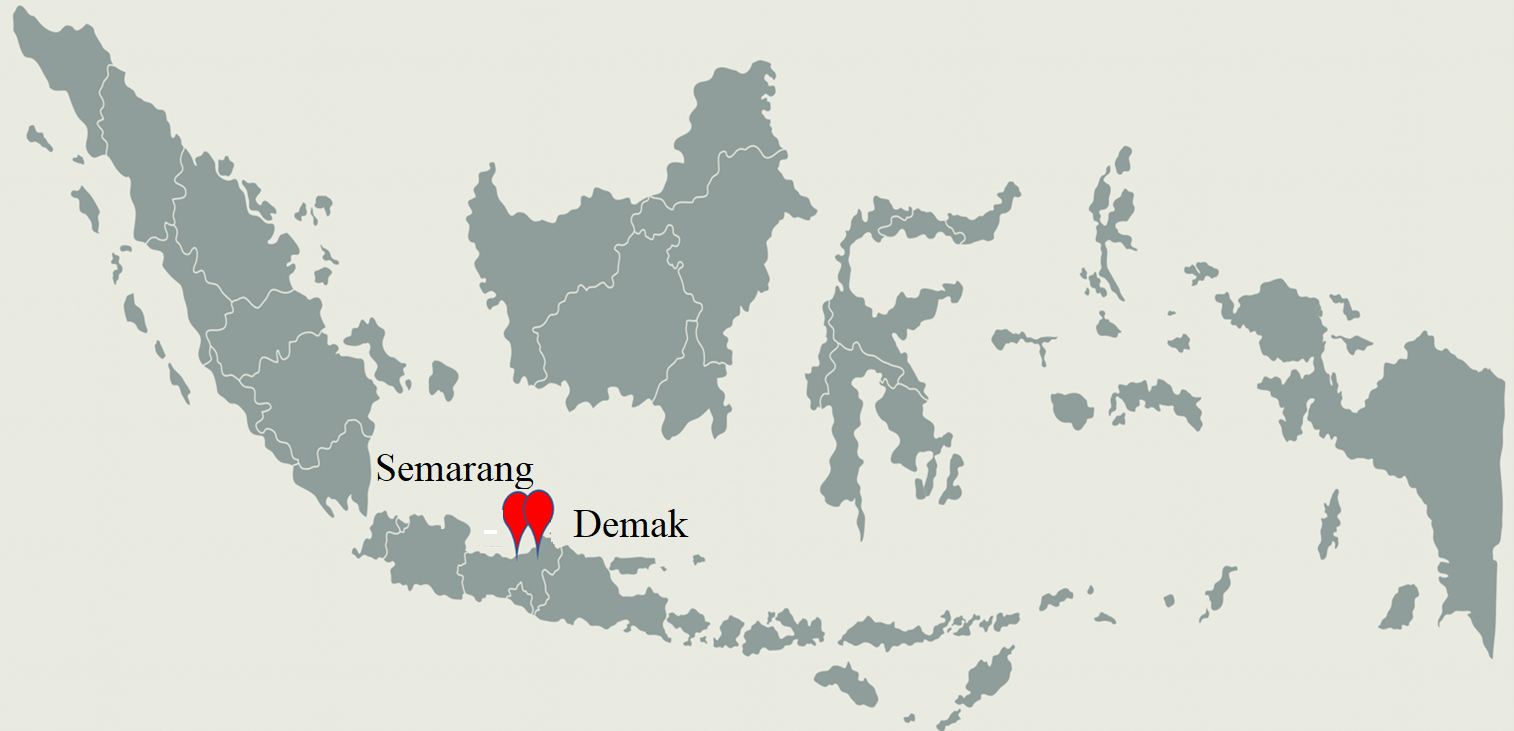
To examine the dynamics of the 2020 direct local election in more depth, Demak District is the primary case study and Semarang is an additional insight for comparison. As a coastal region, Demak District is often subject to tidal flooding. At least four sub-districts in Demak are adjacent to the sea, namely Bonang, Karangtengah, Sayung and Wedung sub-districts. Sayung and Bonang sub-districts have been affected by tidal floods for decades (Figure 1).
There was a tidal flood in Demak during voting day on 9 December 2020. The high rainfall exacerbated the tidal flood (rob) because the river also overflowed. More than 800,000 registered voters attended more than 2,000 polling stations across Demak District. The Chairperson of the Demak KPU said that 51 polling stations in Demak were affected by flooding (Budi 2022). The flood-affected polling stations were spread across four coastal areas of Demak, namely Bonang (42 polling stations), Sayung (5), Karangtengah (3) and Wedung (1). Tidal floods inundated the access to the polling stations, and the water even flowed into the voters’ waiting room. The tidal water reached 15–20 cm (Budi 2022). Tidal flooding had also occurred during the 2019 national election in Demak. Even though voters had to walk across the tidal flood to reach the polling station, voting day went ahead (Widodo 2019).
Regarding Covid-19, Abdul Latif, an election official at Demak KPU, reported that recruiting officials for the village level and polling stations was very energy-consuming (Latif 2022) because all of these officers had to take an antigen test first. Abdul Latif revealed that the 2020 direct local elections in Demak had 2,206 polling stations. There are 7 election officials per polling station, totalling 15,442 officers. Only officers who test negative for Covid-19 are allowed to serve, so it was inevitable that the KPU would have to replace some officers at the last minute.
A similar opinion was expressed by the head of the Demak Bawaslu, Khairul Saleh. The 2020 simultaneous direct local elections amid a pandemic obliged Bawaslu Demak to replace officers several times because they tested positive for Covid-19 (Saleh 2022), a necessary step to maintain public confidence that polling stations were safe to visit. Saleh (2022) also reported difficulty in recruiting volunteers to work in the field because the pandemic made many people afraid to apply. The 2020 elections saw increased responsibilities for Bawaslu; in addition to safeguarding against violations of electoral laws and rules, they also monitored and enforced implementation of health protocols during campaigning.
The head of the Sayung sub-district election official team, Aris Bimono, said that Covid-19 was a challenge (Bimono 2022). However, Aris reported that the Sayung sub-district was well prepared and that health protocols enjoyed the trust and support of local communities. The presence of special voting booths for people infected with Covid-19 or with body temperatures above 37.5 degrees Celsius was one solution in place. These special voting booths were subject to disinfectant cleaning and were placed at a distance from other booths. Meanwhile, a Bonang sub-district election official, Samsul Ma’arif, stated that organizing elections during the pandemic requires extra time and energy (Ma’arif 2022). He set an example by wearing gloves, a mask and other facial protection.
Voter registration
Bawaslu Demak emphasized that there were several problems during the finalization of voter registration. Directly verifying voter data in the field was difficult due to the tidal floods, which had submerged the access to voters’ houses. Tracking voters was also hampered because some people had evacuated or moved. Confirmation of registered voters must be conducted directly where the voter lives, based on their home address on the Indonesian ID card. Citizens vote in the polling station located nearest their home address. The Bawaslu officer in the field also must ensure that voter data updating officers from Demak KPU perform their duties according to the rules.
Regarding Covid-19, voter registration officers were provided with manual guidelines and PPE (hand sanitizers, masks, gloves and face shields). According to the manual, officers must use all PPE and follow the health protocol for door-to-door voter registration. ‘It was quite difficult. When we went to the field, the tidal flood was about 30 cm on the road. We had to use bamboo sticks to pass through because the main road could not be travelled. So that residents’ houses were isolated’ (Saleh 2022).
Bawaslu Demak coordinated with KPU Demak to ensure that voter registration officers came to the location in response to the tidal floods. The village-level officers then took the personal initiative to adjust their work with the tidal time. Field officers accessed information on tidal times through the BMKG Demak website and Twitter posts. However, it needs to be underlined that this action was a personal initiative of the field officers, not stipulated by the official Standard Operation Procedure (SOP) of KPU Demak. Demak KPU itself does not have official cooperation arrangements between institutions in the context of implementing the elections. Therefore, one member of Bawaslu Demak, Amin Wahyudi, considered that tidal data from BMKG should inform every stage of the election process, including the voter data verification, as a formal guideline. In addition, he also admitted that Bawaslu had difficulty monitoring the voter registration process in the field because there was only one officer in each village. Therefore, the Bawaslu officers used a sampling technique to check the voters’ list registration and verification. This situation differs from the KPU officers, who can be found at each polling station (Wahyudi 2022b).
Tidal flooding commonly occurred in Sayung sub-district, so voter registration officers had to use boats and enter into the inlets of mangroves and round the sea to be able to visit people’s houses. Meanwhile, the voter data registration schedule coincided with rising Covid-19 cases in Semarang, so the implementation was finally postponed. However, KPU officers were helped by local people to verify voter data in coastal and other flood-prone areas. The local people actively provided suggestions and input regarding the closest potential polling station locations—those relatively safe from flooding (Gultom 2022).
In search of a flood mitigation plan
While Regulation 18 (Indonesia 2020b—which provides for postponing or repeating the voting) guided the Demak KPU in responding to tidal floods, Bambang Setya Budi (2022), the head of the Demak KPU, admitted that there is no detailed SOP for conducting elections under flood conditions. As mentioned, Regulation No.7 of 2017 only regulates elections during disasters in broad terms, which the KPU must interpret at regional level. The head of the Demak KPU said that the most likely course of action during a tidal flood is to relocate polling stations or reschedule the voting day—as happened with polling stations in Morodemak, Margolinduk and Purwosari, which were moved to higher ground (Budi 2022). The mechanism for moving or shifting polling stations is regulated in the KPU regulation on voting. The principle, emphasized by the respondent, is that the new polling station should not be far from the community: ‘When you move it, the voters should be able to reach it easily’ (Budi 2022).
In addition, voters within a family should not have separate polling station locations because it will impact voter participation (Budi 2022). There was also an idea to create floating polling stations or polling stations located on boats. However, floating polling stations—to which voters would be taken by boat—could not be implemented due to budgetary rules.
Demak KPU gathered election officials at the sub-district level to map detailed flood-prone areas to anticipate floods. They conducted the mapping a week before voting, especially in areas with potential tidal flooding. When tidal floods occurred on voting day, election officials in the field already understood the needs regarding relocation of polling stations to safer places. Election officials at the polling stations marked the route of the newest location so that voters could read it. The voters also understood the new locations having generally been consulted beforehand. So, if the polling station was changed in the middle of the day, the voters knew where they should go to vote. Equally important, voting equipment had to be secured, including PPE and hand sanitizers. One strategy was that voting in the morning was carried out in outdoor areas because the tidal floods were not too high, and was moved to higher places when counting votes in the afternoon (tidal flooding gets higher after 13:00).
Bawaslu has also discussed the tidal flood with Bawaslu members at the sub-district level to come directly to inspect locations. The aim is to know actual conditions in the field. Based on the field survey, Bawaslu provides input to the KPU to maintain high voter participation. However, Amin Wahyudi (2022b) also admitted that several polling stations remained in their original places on voting day in 2020 because no alternative locations were available nearby.
Sayung sub-district implemented the elections relatively smoothly having taken anticipatory steps from the 2019 election experience, when it was the only sub-district to flood. In the 2020 elections, Bonang sub-district experienced flooding for the first time. The Demak KPU responded by ordering election officials in Bonang to check the conditions in polling station locations, and subsequently to move 30 of them. In addition, they ensured that all voting equipment and PPE was safe by wrapping it in plastic bags.
Demak Bawaslu has an election vulnerability index created by the national KPU containing information on potential natural and non-natural disasters. Demak Bawaslu took the initiative to create an SOP for its own operations in the event of flooding during elections, which emphasizes continuity of service, voter access and protection of election materials.
In Semarang, both Bawaslu and KPU Semarang referred to the election vulnerability index created by the national KPU. Thus, the Semarang KPU maps the tidal disaster-prone areas as the basis for determining the location of polling stations before the election. Mohammad Amin, Commissioner of Bawaslu Semarang, recounted the mitigation carried out by Bawaslu, especially before the election (Amin 2022). Semarang Bawaslu officers came to the field to map vulnerable areas by discussing with the sub-district and village-level election officials the development of scenarios and routes for relocating polling stations if necessary.
Abdul Latif, an election official from Demak KPU, described the KPU’s own mapping of areas affected by tidal floods (Latif 2022), an activity still ongoing in respect of mapping the vulnerability of polling stations. However, he stated that the KPU is constrained in how far it can commit resources to this because tidal floods (rob)—unlike flooding due to heavy rain—are not defined as a disaster in the national law (National Disaster Law No. 24, Indonesia 2007; Gumilang 2018). Similarly, Bawaslu Demak has attempted to engage the district government on flood mitigation but the latter was unable to assist due to this particular legal gap. For example, floating polling stations could not be implemented (as mentioned earlier) because of this same constraint on local ‘disaster’ spending, as legally defined. The same was true of efforts to boost numbers of electoral staff in tidal flood areas. Yet the rob is in fact more disruptive, and destructive, than floods due to rainfall. In the meantime, the two electoral management bodies’ separate and limited efforts in flood mapping are valid exercises in downward accountability to communities.
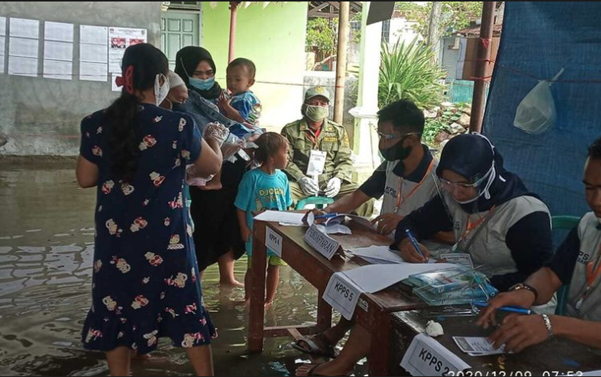
Many of the election officials at the polling stations were without adequate footwear and wore wet clothes. According to Demak Bawaslu’s Commissioner, ‘The honorarium for officers to supervise at the polling stations is used for motorcycle maintenance because they should go through the tidal water. The officers there, if you wear regular shoes, you cannot (move). There were even village-level officers who complained about asking for boots’ (Wahyudi 2022a).
The field officers responsible for polling said that the salary they received was not commensurate with the workload (Khamid 2022) because of the uncertain duration of their work. Before voting day, they worked until dawn to set up a polling station because of the tidal flood. On voting day itself, they then had to be ready for a full day’s duties at the polling stations.
Voter turnout
The head of the Demak KPU, Bambang Setya Budi, reported that public participation in Demak during the 2020 direct local elections was higher than in 2015 (Budi 2022), having increased from 67.5 per cent to 73 per cent (see Table 1). According to Budi (2022), high participation is due to voter education activities by various election stakeholders such as the Demak KPU, Demak Bawaslu, candidates’ campaigns and the media. Although indoor meetings were limited to 50 people, the Demak KPU mobilized its officers to publicize the elections door to door in the community. They also worked with volunteers from the villages to circulate information.
| District/Municipal | 2015 Direct local election | 2020 Direct local election |
|---|---|---|
| Demak | 67.52% | 73.13% |
| Semarang | 65.97% | 68.62% |
| Subdistrict | 2015 Direct local election (%) | 2020 Direct local election (%) |
|---|---|---|
| Bonang | 66.42 | 73.94 |
| Sayung | 74.03 | 78.08 |
| Wedung | 60.07 | 65.40 |
| Mijen | 58.11 | 63.43 |
| Gajah | 66.28 | 67.45 |
| Guntur | 69.76 | 80.82 |
| Mranggen | 73.47 | 75.10 |
| Karangawen | 72.00 | 77.20 |
| Demak | 64.93 | 72.12 |
| Karanganyar | 62.68 | 64.52 |
| Kebonagung | 64.49 | 72.19 |
| Dempet | 66.74 | 71.97 |
| Wonosalam | 68.46 | 73.82 |
| Karangtengah | 70.51 | 79.09 |
It is notable that even though Sayung sub-district is one of the areas most affected by tidal flooding, voter participation remained high and was third highest in the entire Demak District (Table 2). The head electoral official of Sayung, Aris Bimono, confirmed that election officials at the sub-district and village levels were active in publicizing the elections. One of the village-level field officers, Fakhur Razi (2022), said that various informal networks were used, for example regular community meetings, religious events and community group meetings, and that field officers also invited community leaders to be involved.
In line with KPU policy, Demak KPU and Demak Bawaslu made greater voter education efforts among people living in tidal flood-prone areas (Budi 2022). Rough sea conditions on voting day prevented the people on the coast, most of whom are fishers, from going to sea. This contributed to fairly high turnout. The voters were also enthusiastic about the 2020 election because they hoped for change (Table 3).
Compared to other villages in the Sayung sub-district, the lowest voter turnout was in Sidogemah Village. Many residents of Sidogemah Village had moved to other places because their homes were affected by the construction of the Semarang–Demak sea toll road—while still being registered to vote there. Sayung election officials were able to track many of the voters at their new locations, not being far away. However, they were mostly unwilling to come to the polling station because of the tidal flood.
In Semarang Nanda Gultom, Commissioner of the Semarang KPU, stated that the Covid-19 pandemic did not reduce turnout there (Gultom 2022) given that it was higher than in 2015 (rising from 65.97 to 68.52 per cent, see Table 1). Voters came to the polling stations as scheduled (to avoid crowding each was given a time), and followed the other health protocols also. Nanda Gultom explains the high level of public participation in the 2020 Semarang election as due to intensive voter education carried out by the KPU through online media (Gultom 2022). This was possible because Semarang is a large city: Internet access and IT literacy of its citizens is relatively higher than in Demak. The KPU’s public awareness campaign included a video to prevent hoaxes and misinformation about the election. According to the Semarang Bawaslu Commissioner, Muhammad Amin, the high participation was because only one candidate competed (Amin 2022).
| Date | Event |
|---|---|
| 28 February | Sub-district election committees / officials appointed |
| 21 March | Village-level election committees / officials appointed |
| 14 July | Voter registration |
| 16 October | Finalization of eligible voters’ list |
| 3 September | Candidate registration opens |
| 23 September | Official candidates declared |
| 20 November | Preparation of voting logistics/equipment |
| 23 November | Polling station officials appointed |
| 5 December | Campaign period starts |
| 8 December | Campaign period finishes |
| 8 December | Distribution of voting equipment to each polling station |
| 9 December | Voting day |
| 9 December | Tidal floods occurred in several areas in Demak |
| 15 December | Announcement of vote count results at polling stations |
| 17 December | Official announcement of vote tabulation result at the district/municipal and provincial level |
Campaigning
The head of the Demak KPU, Bambang Setya Budi (2022), revealed that the campaign in tidal flood-prone areas was minimal. Volunteers nevertheless campaigned for their candidates in the field from house to house as best they could, inviting three to four people at a time to impromptu meetings at the side of the road or in the yard. The Demak Bawaslu Commissioner, Muhammad Amin, agreed that there was little campaigning in the coastal areas (Amin 2022). Apart from those at local level, campaign teams decided not to cover coastal areas in person despite their being densely populated—hence a significant source of votes—because by the same token, these areas posed risks of Covid-19 transmission (as well as some being flood-affected).
In the city of Semarang, the campaign was a little different in that volunteers and candidates also went to tidal flood-prone areas, while following social distancing and other health protocols. By the close of the campaign period, no increase in Covid-19 infections had been reported by the media.
The role of other government agencies
In disaster-prone areas, cooperation between the electoral management body (EMB) and the other government institutions in implementing elections is crucial. The cooperation of various stakeholders can anticipate things that become obstacles during the election. Regarding the tidal flood in Demak, the Commissioner of Bawaslu Demak, Amin Wahyudi, said there has been no formal cooperation between agencies within the Demak local government. The Demak local government’s KPU did not formally collaborate, for example, on mapping the polling stations with BMKG to have a special information channel that informs about the tides in various coastal areas of Demak in more detail, which would have given the KPU and Bawaslu more profound knowledge about the vulnerabilities of the polling station locations and their relocation scenarios.
In previous experiences, the coordination with other local government agencies has been limited to the police, the army and the public relations bureau of the Demak local government.
Conclusion
The multiple challenges faced by election authorities during the 2020 local elections provide several lessons for the conduct of future elections in Indonesia during emergencies. The Indonesian experience also provides some findings that may be relevant to other countries that have elections during rainy seasons and high tide months.
Unlike Covid-19, flooding resulting from sea level rise was not formally identified as a hazard that could impact the election and was therefore not adequately prepared for. Furthermore, the lack of formal cooperation with the Meteorology, Climatology and Geophysics Agency—which would have allowed for more accurate data—was a missed opportunity to better prepare. Such cooperation might even have allowed the KPU to change the timing of the elections so as to carry them out during a season of lower risk. First, therefore, Indonesian EMBs should consider adopting a risk management framework to minimize election disruption caused by natural hazards, including managing inter-agency cooperation with national and subnational state agencies (Asplund, Birch and Fischer 2022; International IDEA 2022).
Second, it is necessary to develop field officers’ skills by conducting additional training for those who work in flood-prone areas. Field officers need to be aware of the types of scenarios that can occur and the actions that need to be taken when a flood or other crisis occurs. They should also be provided with proper protective equipment for themselves and their materials, such as waterproof clothing and boots, to appropriately respond to a crisis. Under such conditions, each officer must be able to think independently to plan and carry out appropriate responses without having to wait for instructions from colleagues at distance.
Third, there is a need for a nationally coordinated framework that facilitates cooperation between national and subnational government agencies in implementing elections in times of disasters and during crisis. Such a framework would help to develop and maintain shared understanding about electoral risks, improve coordination and identify necessary election and governance reforms for strengthening resilience. For example, tidal flooding during election periods could be classified as disaster and thereby enable local election authorities to receive support from local government.
Fourth, related to the twin hazards, it is clear that the Indonesian Government (and legal framework) was better prepared to deal with Covid-19 during elections than with tidal floods. Therefore, regional KPUs facing the risk of tidal floods in future elections should consider contingency plans and crisis management procedures that can facilitate the delivery of elections by frontline staff in such areas.
Afterword
5 July 2025
In 2024, Indonesia held two significant elections: the general election in February and the direct local election in November. Both occurred during the rainy season, which presents a substantial risk of flooding due to its extreme intensity (Kurniadi et al. 2024). It was reported that five provinces—Jakarta, North Sumatra, Riau, Central Kalimantan, and Aceh—experienced flooding during the direct local elections in November (Fallahnda 2024). As a tropical nation, Indonesia has only two seasons: the rainy season, which predominantly occurs from October to March, and the dry season, which runs from April to September (Tsabita 2024). The general election on 14 February was to elect political parties for legislative positions as well as the president and vice president. Meanwhile the local election on 27 November was held to elect regional heads and their deputies at both the provincial and district/municipal levels. The voter turnout for the general election was 81.78 per cent, slightly lower than the 82 per cent turnout recorded in 2019 (Statista n.d.). Meanwhile, turnout for the 2024 local election was approximately 70 per cent, a decline from the 76 per cent average turnout at the 2020 local elections (Yunanto 2024; Nugroho, Kenawas and Syarief 2021).
The floods affected various regions during these two elections, yet the approach to handling them remains as fragmented as in 2020. There have been no significant changes in Indonesia’s crisis management system, as the election laws do not comprehensively—or explicitly—address how to manage natural hazards. Specifically, the 2017 law lacks any such provisions. On a technical level, the General Election Commission (KPU) has not established detailed rules and procedures for election implementation in areas with unique disaster characteristics (Liando 2019). Additionally, there is no comprehensive risk management framework or crisis management procedure available at either the national or local levels. The absence of a national framework that effectively regulates contingency plans for natural hazards, such as floods, places the burden on regional EMBs. This creates potential challenges, as regional responses can vary widely based on factors such as human and financial resources, organizational quality, institutional coordination, and the availability of knowledge systems and information. Inadequate execution of elections during natural disasters undermines electoral integrity, which can ultimately lead to disputes over election outcomes.
Electoral disputes in Binjai and Medan
An example of the variation in regional capabilities for conducting elections amid natural hazards can be seen in the case of the direct local elections in Binjai, North Sumatra Province. One pair of candidates for mayor and deputy mayor contested the election results by taking their case to the Constitutional Court. They argued that the election was conducted during a flood, which hindered mobility and left many polling stations submerged and inaccessible; the plaintiffs filed a lawsuit against the local EMBs, claiming this violated residents’ constitutional right to elect their regional leaders (Kartika 2025a). Citing a drop in voter turnout during the Binjai direct local election—from 71 per cent in 2020 to 60 per cent (Kartika 2025a)—they asserted that holding the vote during a flood disaster was a critical error by local EMBs. Additionally, the plaintiffs raised concerns regarding the follow-up voting policy, which was conducted in only one sub-district while neglecting other equally affected sub-districts. In February 2025, the court rejected the lawsuit and upheld the results of the 2024 direct local elections in Binjai. The dismissal was justified by the plaintiff’s failure to submit their application to the Constitutional Court within the legally required deadline (Kartika 2025c).
Rejection of results due to flooding also occurred in other areas of North Sumatra, particularly in the city of Medan. Plaintiffs representing one of the candidate pairs for mayor and deputy mayor submitted a request to the Constitutional Court on grounds that the flooding had affected nine sub-districts. The extreme rainfall on election day caused significant flooding in various parts of Medan, preventing some residents from exercising their voting rights at polling stations as scheduled. In response, the Medan EMBs conducted a follow-up election at 56 polling stations that had been temporarily closed due to the flooding (Muliawati 2024). However, the plaintiffs contended that the changes to the voting schedule were not adequately communicated to them, which adversely affected their supporters (Nugroho 2025). They argued that the voter turnout declining to 34 per cent, compared to the 46 per cent turnout in 2020, was directly linked to the natural hazard (Kartika 2025b). Consequently, the plaintiffs requested that the Constitutional Court mandate the Medan EMBs to conduct a re-election (KumparanNews 2024). The court ultimately dismissed the lawsuit, as the margin of votes between the winning candidate and the plaintiff surpassed 100,000 or 17 per cent (Kartika, 2025d). According to Indonesian election dispute regulations, a challenge is only permissible if the vote difference is within 0.5 per cent of the total valid votes cast.
In contrast to the areas discussed, Jakarta demonstrated a commendable ability to conduct elections despite the significant flood risks present in many localities. Notably, no candidates contested the election results, even in the face of flooding that affected several polling locations. A key factor contributing to this success was strong collaboration between Jakarta’s EMBs and the regional disaster management agency. The latter deployed over 200 personnel as rapid response teams to assist at compromised polling stations, providing vital resources such as boats and tents. In this they had the support of various other agencies, including the Water Resources Agency (Al Hamasy 2024). Additionally, the Jakarta EMBs adeptly relocated polling stations from flood-prone areas, relying on data from the disaster management agency (Subarkah 2024). The improvements Jakarta has implemented to conduct elections amid flooding challenges are perhaps unsurprising, given that it is the city with the largest economy and possesses ample regional resources to execute an effective contingency plan. For regions lacking such resources, managing elections under similar circumstances poses a greater challenge.
References
Al Hamasy, A. I., ‘Flood damaged logistics, 18 polling stations in North Jakarta hold supplementary elections’, Kompas.id, 15 February 2024, <https://www.kompas.id/baca/english/2024/02/15/en-logistik-teredam-banjir-18-tps-di-jakarta-utara-akan-gelar-pemilu-susulan>, accessed 18 June 2025
Amin, M., Chairperson of Bawaslu Semarang City, assistant researcher’s interview, Semarang, 12 July 2022
Asplund, E., Birch, S. and Fischer, J., ‘Wildfires, hurricanes, floods and earthquakes: How elections are impacted by natural hazards’, International IDEA, 1 September 2022, <
Asyilin, N. H., ‘Peran Bawaslu pada pilkada serentak 2020 di masa pandemi’ [Bawaslu’s role in the 2020 simultaneous regional elections during the pandemic], Bawaslu, 2 March 2021, <
Banten Province Regional Liaison Agency, ‘Pilkada Serentak, Pandemi dan Banjir’ [Simultaneous Pilkada, Pandemic and Flood], 14 December 2020, <
BBC News, ‘Pilkada di tengah pandemi Covid-19, pakar tetap khawatirkan soal klaster baru, Mahfud klaim “tidak terjadi apa-apa”‘ [Elections amid Covid-19 pandemic, experts remain concerned about new clusters, Mahfud claims ‘nothing happened’], 9 December 2020, <https://www.bbc.com/indonesia/indonesia-55241402>, accessed 18 October 2022
Bimono, A., head of the Sayung District Election Committee (PPK), author’s interview (online), Demak, 22 June 2022
Budi, B. S., head of Demak District KPU, author’s interview (online), Demak, 15 June 2022
Databoks, ‘BNPB: 2.745 Bencana Terjadi hingga 7 Desember 2020’ [BNPB: 2,745 disasters occurred up to 7 December 2020], 9 December 2020, <
Djalante, R., Garschagen, M., Thomalla, F. and Shaw, R., Disaster Risk Reduction in Indonesia: Progress, Challenges, and Issues (Berlin: Springer Cham, 2017), <https://doi.org/10.1007/978-3-319-54466-3>
Dinkominfo (Dinas Komunikasi dan Informatika Kabupaten Demak [Demak District Communication and Information Service]), ‘Kontur Tanah Muda dan Kawasan Industri, Penyebab Penurunan Tanah di Demak’ [The Contour of Tanah Muda and Industrial Estates, Causes of Land Subsidence in Demak], 9 August 2021, <https://dinkominfo.demakkab.go.id/berita/detail/kontur-tanah-muda-dan-kawasan-industri-penyebab-penurunan-tanah-di-demak>, accessed 18 October 2022
Djalante, R., Jupesta, J. and Aldrian, E., Climate Change Research, Policy and Actions in Indonesia: Science, Adaptation and Mitigation (Switzerland: Springer Cham, 2021), <https://doi.org/10.1007/978-3-030-55536-8>
European Commission, Global Surface Water Explorer [n.d.], <https://global-surface-water.appspot.com>, accessed 31 October 2022
Fallahnda, B., ‘Daftar Daerah Kena Banjir di Pilkada 2024, Apa Pemilihan Ulang?’ [List of flood-affected areas in the 2024 regional elections, should we have re-elections?], Tirto.id, 28 November 2024, <https://tirto.id/daftar-daerah-kena-banjir-di-pilkada-2024-harus-ulang-pemilihan-g6f9>, accessed 18 June 2025
Gultom, H. C., Chairperson of KPU Semarang City, assistant researcher’s interview, Semarang, 15 July 2022
Gumilang, R. S., ‘Banjir rob “tidak diakui” sebagai jenis bencana alam?’ [Tidal floods ‘not recognized’ as a type of natural disaster?], kumparan.com, 21 March 2018, <https://kumparan.com/ragil-satriyo/banjir-rob-tidak-diakui-sebagai-jenis-bencana-alam/3>, accessed 18 October 2022
Hutabarat, D., ‘KPU: 40 Komisioner Terpapar Covid -19 Selama Pilkada 2020, 2 Meninggal Dunia’ [KPU: 40 Commissioners were infected by Covid-19 during the 2020 direct local election, 2 died], Liputan6.com, 19 January 2021 <https://www.liputan6.com/news/read/4461366/kpu-40-komisioner-terpapar-covid-19-selama-pilkada-2020-2-meninggal-dunia>, accessed 17 July 2022
Indonesia, Republic of, Law Number 24 Year 2007 on National Disaster Management, <https://bnpb.go.id/ppid/file/UU_24_2007.pdf>, accessed 20 October 2022
—, Law Number 7 Year 2017 Governing Elections (unofficial translation by IFES), <https://aceproject.org/ero-en/regions/asia/ID/indonesia-electoral-code-law-nr.-7-2017>, accessed 18 October 2022
—, General Election Supervisory Board Regulation No. 16/2020a concerning Supervision of Voting and Vote Counting for the Election of Governor and Deputy Governor, Regent and Deputy Regent, and/or Mayor and Deputy Mayor, <https://www.mkri.id/public/content/jdih/Peraturan%20Bawaslu/Perbawaslu%20Nomor%2016%20Tahun%202020.pdf>, accessed 18 October 2022
—, General Election Supervisory Board Regulation No. 17/2020b concerning Supervision of the Recapitulation of Vote Counting Results and Determination of Election Results for Governor and Deputy Governor, Regent and Deputy Regent, and Mayor and Deputy Mayor, <https://peraturan.bpk.go.id/Home/Details/176631/peraturan-bawaslu-no-17-tahun-2020>, accessed 18 October 2022
—, General Election Commission Regulation No. 6/2020c concerning the Implementation of the Election of Governors and Deputy Governors, Regents and Deputy Regents, and/or Mayors and Deputy Mayors Simultaneously in Non-Natural Disaster Conditions Corona Virus Disease (Covid-19), <https://peraturan.bpk.go.id/Home/Details/173391/peraturan-kpu-no-6-tahun-2020>, accessed 18 October 2022
—, General Election Commission Regulation No. 18/2020d concerning Amendments to General Election Commission Regulation No 8/2018 concerning Voting and Counting of Votes for the Election of Governors and Deputy Governors, Regents and Deputy Regents, and/or Mayors and Deputy Mayors, <https://peraturan.bpk.go.id/Home/Details/173414/peraturan-kpu-no-18-tahun-2020>, accessed 18 October 2022
International IDEA, ‘The Impact of Natural Hazards on Elections’, last updated 22 November 2022, <https://www.idea.int/news-media/multimedia-reports/impact-natural-hazards-elections>, accessed 23 November 2022
Kartika, M., ‘PHPU Walikota Binjai: Partisipasi Pemilih Rendah Akibat Banjir’ [Binjai Direct Local Election: Low Voter Turnout Due to Floods], Indonesian Constitutional Court, 8 January 2025a, <https://www.mkri.id/berita/-22082>, accessed 18 June 2025
—, ‘KPU Kota Medan: Dalil Banjir Hanya Dalih Minta PSU’ [Medan Electoral Commission: Flood Argument is just a pretext for requesting re-elections], Indonesian Constitutional Court, 17 January 2025b, <https://www.mkri.id/berita/-22390>, accessed 18 June 2025
—, ‘Permohonan PHPU Bupati Binjai yang diajukan Donal – Andri Lewat Tenggang Waktu’ [The PHPU Application of the Binjai Regent submitted by Donal – Andri Exceeds the Deadline], Indonesian Constitutional Court, 4 February 2025c, <https://www.mkri.id/berita/-22700>, accessed 18 June 2025
—, ‘Tidak Memiliki Kedudukan Hukum, PHPU Walikota Medan Tidak Dilanjutkan’ [Having No Legal Standing, Medan Mayor’s PHPU Not Continued], Indonesian Constitutional Court, 4 February 2025d, <https://www.mkri.id/berita/-22696>, accessed 18 June 2025
Khamid, A., member of Tridonorejo Village Election Supervisory Committee, research assistant’s interview, Demak, 23 June 2022
KumparanNews, ‘Banyak Warga Tak Nyoblos karena banjir, hasil pemilihan walikota medan digugat ke MK’ [Many residents did not vote due to floods, medan direct local election results challenged to Constitutional Court], Kumparan.com, 11 December 2024, <https://kumparan.com/kumparannews/banyak-warga-tak-nyoblos-karena-banjir-hasil-pilwalkot-medan-digugat-ke-mk-245HgSjSPcg>, accessed 18 June 2025
Kurniadi, A., Weller, E., Salmond, J. and Aldrian, E., ‘Future projections of extreme rainfall events in Indonesia’, International Journal of Climatology, 44/1 (2024), pp. 160–82, <https://doi.org/10.1002/joc.8321>
Latif, A., Technical Division Staff of Demak District KPU, author’s interview (online), Demak, 22 June 2022
Liando, F. D., ‘Pengalaman Baik di Berbagai Daerah’ [Good Experiences in Different Regions] in Tata Kelola Pemilu di Indonesia [Election Governance in Indonesia], (Jakarta: Indonesian Election Commission, 2019)
Ma’arif, S., member of the Bonang District Election Committee (PPK), author’s interview (online), Demak, 22 June 2022
Muhardiansyah, Y., ‘Antisipasi Banjir saat Pilkada, KPU Medan Geser TPS ke Kawasan Tinggi’ [Anticipating flooding, KPU Medan shifts some polling stations to higher ground], merdeka.com, 7 December 2020, <https://www.merdeka.com/politik/antisipasi-banjir-saat-pilkada-kpu-medan-geser-tps-ke-kawasan-tinggi.html>, accessed 31 October 2022
Muliawati, A., ‘Gugat ke MK, Ridha-Abdul Minta Pilkada Medan Diulang gara-gara Banjir’ [Suing to the Constitutional Court, Ridha-Abdul Asks for Medan general elections to be repeated due to floods], Detik.com, 11 December 2024, <https://news.detik.com/pilkada/d-7681164/gugat-ke-mk-ridha-abdul-minta-pilkada-medan-diulang-gara-gara-banjir>, accessed 18 June 2025
Nugroho, Y., Kenawas, Y. C. and Syarief, S. S., ‘How the 2020 Pilkada Reflected Major Structural Flaws in Indonesian Politics’ (ISEAS Perspective 2021/5), Yusof Ishak Institute (ISEAS), 2021, <https://www.iseas.edu.sg/articles-commentaries/iseas-perspective/iseas-perspective-2021-5-how-the-2020-pilkada-reflected-major-structural-flaws-in-indonesian-politics-by-yanuar-nugroho-yoes-c-kenawas-and-sofie-s-syarief>, accessed 18 June 2025
Nugroho, N. P., ‘Sidang Sengketa Kota Medan Singgung Banjir Penyebab Partisipasi Pemilih Rendah’ [Medan City dispute hearing mentions floods cause of low voter turnout], Tempo.co, 8 January 2025, <https://www.tempo.co/politik/sidang-sengketa-pilkada-kota-medan-singgung-banjir-penyebab-partisipasi-pemilih-rendah-1191564>, accessed 18 June 2025
Razi, F., Chairperson of the Banjarsari Voting Committee (PPS), research assistant’s interview, Demak, 25 June 2022
Ripaldi, D., ‘Pilkada Kabupatan Bandung, 203 TPS di 9 kecamatan rawan banjir dan longsor’ [Bandung district election, 203 polling stations in 9 sub-districts prone to floods and landslides], Liputan6.com, 8 December 2020, <https://www.liputan6.com/pilkada/read/4428774/pilkada-kabupaten-bandung-203-tps-di-9-kecamatan-rawan-banjir-dan-longsor>, accessed 18 October 2022
Saleh, K., Chairperson of Bawaslu Demak District, author’s interview (online), Demak, 16 June 2022
Santoso, Y. A., ‘Puslit Politik LIPI beberkan alasan tunda Pilkada 2020’ [Centre for Political Studies at the Indonesian Institute of Sciences (LIPI) explains the reasons why 2020 direct local election should be postponed], Tempo.co, 1 October 2020, <https://nasional.tempo.co/read/1392051/puslit-politik-lipi-beberkan-alasan-tunda-pilkada-2020>, accessed 31 October 2022
Sari, H. P., ‘Mungkinkan Pemilu 2024 terapkan sistem E-Voting?’ [Can E-Voting system be applied in the 2024 election?], Kompas.com, 24 March 2022, <
Statista, ‘Participation rate of the national election in Indonesia in March 2024’, [n.d.], <https://www.statista.com/statistics/1452255/indonesia-voters-turnout-of-2024-national-election>, accessed 18 June 2025
Subarkah, T., ‘Ini Strategi KPU DKI jika Banjir saat Hari Pencoblosan Pilkada 2024’ [This is the DKI KPU strategy if floods occur on election day for the 2024 regional elections], metrotvnews.com, 16 November 2024, <https://www.metrotvnews.com/read/N6GCgm49-ini-strategi-kpu-dki-jika-banjir-saat-hari-pencoblosan-pilkada-2024>, accessed 18 June 2025
Syambudi, I., ‘Kerusakan lingkungan penyebab banjir Semarang, bukan sekedar hujan [Environmental damage, not just rain, causes Semarang flooding], Tirto.id, 9 February 2021, <https://tirto.id/kerusakan-lingkungan-penyebab-banjir-semarang-bukan-sekadar-hujan-f97j>, accessed 19 October 2022
Tsabita, D. D., ‘Mengenal 2 Jenis Musim di Indonesia, Kapan Kemarau Tiba?’ [Getting to know 2 types of seasons in Indonesia, when does the dry season arrive?] detik.com, 22 March 2024, <https://www.detik.com/jogja/kota-pelajar/d-7255563/mengenal-2-jenis-musim-di-indonesia-kapan-kemarau-tiba>, accessed 18 June 2025
Yunanto, R., ‘Voter Turnout dalam Pilkada Serentak 2024’ [Voter turnout in the 2024 direct local elections], iNews.id, 2 December 2024, <https://www.inews.id/news/nasional/voter-turnout-dalam-pilkada-serentak-2024>, accessed 18 June 2025
Utami, W. S., Subardjo, P. and Helmi, M., ‘Studi Perubahan Garis Pantai Akibat Kenaikan Muka Air Laut di Kecamatan Sayung, Kabupten Demak’ [Study of shoreline changes due to sea level rise in Sayung subdistrict, Demak District]’, Jurnal Oseanografi, 6/1 (2017), pp. 281–87
Wahyudi, A., member of Bawaslu Demak, author’s interview (online), Demak, 16 June 2022a
—, member of Bawaslu Demak, research assistant’s interview, Demak, 22 June 2022b
Widodo, A., ‘Cerita Warga Mencoblos Pemilu 2019 di Tengah Banjir’ [Stories of residents voting for 2019 elections in the middle of floods], Kompas.com, 17 April 2019, <https://regional.kompas.com/read/2019/04/17/14040651/cerita-warga-mencoblos-pemilu-2019-di-tengah-banjir?page=all>, accessed 19 October 2022
World Bank Group and Asian Development Bank (ADB), Climate Risk Profile: Indonesia, 2021, <https://www.adb.org/sites/default/files/publication/700411/climate-risk-country-profile-indonesia.pdf>, accessed 19 October 2022
Acknowledgements
The author would like to express his gratitude to his research assistant, Hawin Alaina, from PATTIRO—Semarang (an NGO focusing on public administration reform and good governance), who showed great dedication and commitment during the fieldwork.
About the author
Yogi Setya Permana is a researcher at the Research Center for Politics, National Research and Innovation Agency (BRIN), Indonesia. He holds a PhD from Leiden University. His research focuses on climate politics, disaster governance and political ecology, particularly on how the political economy of natural resources, state–society relations and environmental crises shape conflict, resilience and everyday politics.
Irma Méndez de Hoyos and Marietha Pérez-Arellano
Publishing date: 8 June 2025
Introduction
Mexico has significant climatic diversity. As such, it is exposed to a wide range of natural hazards associated with climate change, including heatwaves and temperature increases. According to official sources, Mexico has experienced a consistent increase in temperatures since 2015, with 2024—the year of the federal and local elections under discussion—registering the highest temperatures. Although the impacts vary widely among regions, heatwaves have caused droughts, damage to electrical infrastructure and diverse health issues—ranging from dehydration and extreme heat stroke to fatalities. All these factors have affected election management in various ways.
On 2 June 2024, Mexico held the largest election in its history, renewing over 20,000 federal and local positions. Despite the enormous administrative, logistical and climate challenges involved, the INE and lower tier EMBs in the federative entities managed to install 99.85 per cent of the polling stations planned. Nationally, the electoral participation rate was recorded at 61 per cent, a slight decrease on the 63.4 per cent in 2018 and 61.8 per cent in 2012. Election day passed off without serious incident. This success was largely due to the professionalism of the personnel within the executive structure of the INE and the local electoral bodies, organized as a nationwide, professionalized electoral service. Their experience and knowledge of the political, social, cultural and climatic conditions in each state and region enabled them to effectively manage the risks encountered. Additionally, they were provided with handbooks on risk management and crisis management—known as action protocols—for fires, floods, heavy rains, volcanic ash falls and geological phenomena, among others. In the event, extreme weather was not disruptive to their operations in 2024 but this cannot be taken for granted in future electoral cycles. Systemic increase in temperatures can negatively impact key moments of the electoral process: electoral campaigns, the installation of polling stations and the attendance of polling station officials, voter well-being, and voter turnout on election day.
Given the evidence of the systematic increase in the national average maximum temperature in Mexico since 2015—reaching its peak in 2024—this case study addresses the following pertinent questions:
- To what extent were the national and local electoral bodies—the INE and the Local Public Electoral Organizations (Organismos Públicos Local Electorales, OPLE)—prepared to face the adverse effects of heatwaves during the June 2024 elections? Was the central EMB aware of the potential risks associated with high temperatures, particularly the dramatic rises between May and June?
- In the face of extreme heat, what measures did the INE take to guarantee the safety and well-being of both the citizens participating in the elections and its staff? What measures were implemented to ensure the continuity of the electoral process?
- To what extent did electoral organizations have in place appropriate risk management and crisis management protocols?
To answer these questions, three activities were undertaken: (a) a review of the Constitution, electoral law and procedures, as well as secondary regulations, institutional agreements, the institutional strategic plan, and the INE’s risk protocols; (b) five interviews with high-level electoral officials (see Annex A for the interview content); and (c) analysis of official data regarding polling stations, contingencies and voter turnout. The findings of the case study are presented as follows: first, a general overview of the institutional and legal context of elections in Mexico, particularly regarding the national and local EMBs. Second, detail on the natural hazards—in particular, the heatwaves detected in the country—and their major impacts in some states. The third section outlines the measures adopted by the electoral bodies to safeguard the federal and local elections from these natural hazards. The final section offers some conclusions in the form of lessons learned.
Institutional structure
In Mexico, the transition to democracy focused on moving from elections controlled and manipulated by the incumbent government to competitive elections (Méndez de Hoyos 2006: 18–19). This entailed the creation of institutions capable of earning the public’s trust, such as the Federal Electoral Institute (Instituto Federal Electoral, IFE) created in 1990. It was transformed in 2014 into the INE in a significant reform, giving rise to Mexico’s current electoral system.
With the 2014 reform, the INE also became responsible for local elections. According to the Political Constitution of the United Mexican States (Mexico 1917), the organization of elections is a state function carried out through the INE and the OPLE (article 41), guided by principles such as certainty, legality, independence, impartiality, objectivity and maximum transparency. The highest political directive body of the INE is the General Council, composed of a presiding councillor and 10 electoral councillors with vote and voice. In addition, there are councillors from the legislative branch, representatives of the national political parties, and an executive secretary, all of whom have a voice but no vote. The selection of the INE councillors involves a technical evaluation, but the final selection is based on political criteria, carried out by two-thirds of the Chamber of Deputies. This method produces a combination of electoral expertise and partisan affiliation.
The INE is organized in two levels. First, a federal/central level, where there is the General Council, the Executive General Board, and the Executive Secretariat (Mexico 2014, General Law of Institutions and Electoral Procedures (revised October 2024) [Ley General de Instituciones y Procedimientos Electorales], article 34.1). Second, a state/local level, where the Institute performs its functions through (a) 32 delegations, one in each state; and (b) 300 sub-delegations, one in each single-member electoral district.
The Executive General Board (Junta General Ejecutiva, JGE) is chaired by the president of the General Council and includes the executive secretary and the executive directors of the following areas: Federal Voter Registry, Political Parties, Electoral Organization, National Professional Electoral Service, Electoral Training and Civic Education, and Administration, as well as the heads of the Technical Oversight Unit, the Electoral Dispute Technical Unit, and the Technical Coordination Unit with the OPLE (Mexico 2014: article 47.1) (see Annex B).
Although the JGE was created to implement or execute the decisions of the General Council, institutional functioning at the national level increasingly depends on the former, which, among other important tasks, is responsible for electoral risk management and crisis handling. Its mandate is to organize the elections and avoid disruption to the electoral cycle’s various stages. In each state, the INE has a delegation composed of the local executive board and district executive boards, and temporarily during the electoral processes, local or district councils (Mexico 2014: article 61).
The OPLE are the institutions that organize local elections for governorships, state congress seats and municipal elections in each of the 32 federative entities.24 Each OPLE has a higher directive body called the General Council, composed of a presiding councillor and six electoral councillors. All are elected and can be removed by the INE’s General Council. As noted, both the INE and the OPLE have a dual structure. On the one hand, there is the highest decision-making political body—the General Council—and on the other, an executive and technical structure—the JGE—composed of public servants, members of the national professional electoral service, who are operationally responsible (Mexico 2014: article 30.3).
Heatwaves as natural hazards in Mexico
Heatwaves are defined as ‘a significant warming of the air or an invasion of very hot air over a large area [that] usually lasts from a few days to a week’ (National Meteorological Service n.d.). Due to climate change, heatwaves have increased in duration and frequency worldwide (UN 2019). In Mexico, this is particularly concerning during the hot season which spans from March to October. The country faces a wide variety of challenges due to its significant climatic diversity. According to the Ministry of Environment and Natural Resources, Mexico has seven major climate types. The most prominent climates are: warm subhumid, dry and semi-dry, very dry, and dry desert, with the biggest surface area; and warm humid, temperate subhumid, temperate humid, and cold, with the smallest surface area.
Since 2000, heatwaves in North America and Central America have become 0.8°C hotter (World Weather Attribution 2024a). Although 2024 was not the first year with episodes of extreme temperatures, it stood out for the record levels reached and the prolonged periods over which these occurred, both in Mexico (Peláez-Fernández and O’Boyle 2024) and globally. It was the first year in which the global temperature anomaly exceeded the critical threshold of 1.5°C above pre-industrial levels, a limit agreed upon in the Paris Agreement (Forbes 2025).
The national average maximum temperature in Mexico has increased consistently since 2015, reaching its highest point in 2024 at 30°C–1.3°C above the national average recorded in 2000 (Jiménez Espinosa, Cordero Devesa and Monroy Cruz 2024). This trend is creating a scenario of increased vulnerability for the Mexican population. Intense droughts and heatwaves have aggravated the situation by ‘preventing the dispersion of polluting particles, decreasing water availability, and reducing hydropower generation and electricity supply’ (World Weather Attribution 2024b). Due to the multiple threats that extreme heat represents, heatwaves are increasingly acknowledged as ‘silent killers’ (Puley 2022).
As shown in Figure 1, the national average of maximum temperatures in May experienced a significant increase between 2021 and 2024, rising from 32°C to over 35°C. This pattern was similarly observed in June, albeit not to the same extent, with the national average rising from 30.7°C to 33°C. Among the states most affected by this phenomenon are Nayarit and Sinaloa (in the West), Campeche and Yucatán (in the South East), which have consistently ranked among the hottest over the years. It is worth noting that as time progressed, the data points became more scattered up to 2024, indicating that the temperature variation among the states is growing, thereby complicating prevention and risk management efforts.
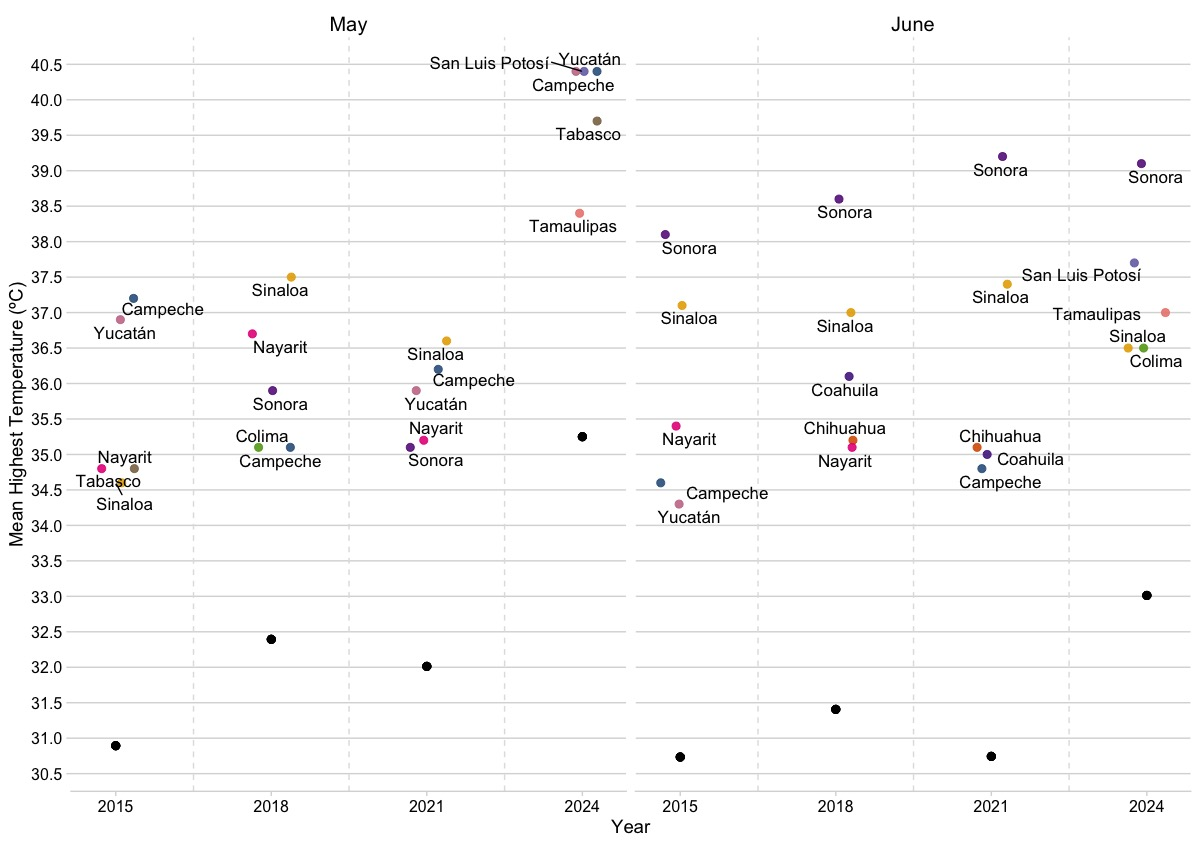
It can also be observed in Figure 1 that between 2015 and 2021, during the weeks preceding the national elections—held by law on the first Sunday of June—the average maximum temperature ranged between 34.5°C and 37.5°C. However, in 2024 these values increased considerably, reaching 40.5°C in states such as Campeche, San Luis Potosí and Yucatán. During the first half of 2024, states such as Campeche, Chihuahua, Coahuila, Guerrero, Michoacán, Morelos, Sinaloa, Veracruz and Yucatán experienced at least 50 days under extreme heat conditions. Moreover, between 20 May and 4 June, the longest heatwave of the year lasted 15 days (Arellano Guerrero et. al 2024), coinciding with the election day on 2 June.
The impacts of systemic increases in extreme temperatures are diverse. One of the most immediate and visible effects has been an increase in power outages in several regions. In May 2024, the peaks in energy consumption caused by extreme heat forced the National Energy Control Centre (Centro Nacional de Control de Energía, CENACE) to move from a state of alert to one of emergency, as the available energy supply dropped below the levels necessary to meet demand (DW 2024; France 24 2024). This affected the electrical supply in more than half of the country (Alire García and Barrera 2024) and increased the risk of dehydration, heat stroke and other health complications associated with excessive heat.
Direct impacts on public health have been equally alarming. In early July 2024, 2,813 cases of heat-related health damage and 183 deaths related to high temperatures were recorded. Oaxaca Tabasco, Tamaulipas, Veracruz and Yucatán were among the most affected states. Nationally, deaths due to high temperatures increased by 20.39 per cent compared to the same period in 2023 (Rojas 2024). In 2023, deaths from heat stroke and dehydration had already increased nearly 13-fold since 2021 (from 33 to 421), reflecting how climate change is transforming climatic risks into much deadlier threats (Ministry of Health 2024).
Additionally, the affected population has expanded, from adults over 70 to also significantly younger age groups. A recent study in Mexico revealed that individuals under 35 years old accounted for three-quarters of heat-related deaths between 1998 and 2019 (Rosenbluth 2024). This data is closely related to the growing number of young workers engaged in manual labour under extreme temperatures, increasing risks of heat stress, heat strokes and cardiovascular and/or kidney disease. These matters of occupational health and safety are of concern to the International Labour Organization, which has made proposals accordingly (ILO 2024).
Heatwaves and the 2024 elections
Mexico’s electoral system entails the concurrent renewal of multiple federal and local positions every three and six years. The 2023–2024 electoral process included the renewal of over 20,000 positions. These included the Presidency of the Republic, the Chamber of Deputies (500 seats), the Senate (128 seats), state governorships (9), local congresses (31 states) and thousands of municipal presidencies. The electoral process begins in September of the preceding year and involves a multitude of activities generally divided into three major stages: preparatory, electoral day and post-election. The INE selected and trained 1,532,358 citizens to serve as temporary election officials at polling stations in this cycle. Of this workforce, 20 per cent were over 60 years old, while 40 per cent were under 39 (INE 2024a). To train and supervise them, the INE hired further non-permanent staff: 7,000 electoral supervisors, and more than 42,000 assistant electoral trainers (INE 2024a).
Against this background, and the climate evidence discussed above, it is perhaps surprising that environmental risks have not featured more prominently on the agenda of the legislative bodies tasked with regulating elections in Mexico. According to the INE’s former Executive Secretary, Edmundo Jacobo, ‘there is not even a political debate considering any ecological aspect that would anticipate natural hazards’ (Jacobo 2025).
In fact, the latest electoral reform approved in 2014, which synchronized local and federal electoral timelines, had a counterproductive effect. According to the current INE electoral councillor, Claudia Zavala, concurrent elections limit the ‘tropicalization’ of local electoral processes (Zavala 2025), which previously allowed local EMBs to adjust to the climate and special needs of Mexico’s different regions. Synchronizing federal and local elections was compounded by the decision to move election day from July to June to increase voter turnout, but without considering the protection of citizens and temporary and permanent staff during periods of intense heat (Jacobo 2025; Zavala 2025). This affected subnational jurisdictions with extreme temperatures in June, such as Baja California, whose election day had in the past been differentiated accordingly.
Risk management, crisis management and protective measures for voters
Turning to the EMBs themselves, hazards have been on the institutional agenda, leading to the development of specific response protocols. Since the 2014–2015 electoral process, both the General Council and the JGE of the INE have issued a series of agreements to implement actions that would allow for the handling of emergencies that could impede the electoral process (DEA/INE 2024). In 2020 a dual approach was approved to address hazards: the first strand involved the business continuity protocols developed by the various executive directorates of the INE; the second addressed emergencies that could be managed through management actions laid out in the Executive Directorate of Administration (Dirección Ejecutiva de Administración, DEA) protocols.
Next, in May 2022 the DEA made modifications to the agreements for the 2023–2024 electoral process (INE 2024c). In this regard, three important changes were introduced: (a) local and district executive boards were clearly designated as the responsible units for addressing potential contingencies or threats; (b) preventive actions to be implemented by the local and district boards were introduced; and (c) the INE established a registration system to document and monitor the activation of the corresponding protocols.
Table 1 shows the INE protocols that directly reference hazards. It is noteworthy that in none of these are heatwaves or high temperatures included. As such, actions taken have been at the discretion of electoral officials with decision-making power. For example, former INE Executive Secretary between 2014 and 2023, Edmundo Jacobo, stated that he had created a risk management model with a control panel that included climatic factors from the different regions of the country (Jacobo 2025). Another example was provided by the current INE electoral councillor, Martín Faz, who highlighted the consideration of climatic conditions in the design of equipment for field electoral trainers in 2024: ‘we decided to incorporate some type of garment that helps them face such adverse climatic conditions … for example, a vest with removable sleeves, so that if they are assigned to a cooler location, they can put the sleeves on, or if it is hotter, they can remove them’ (Faz 2025).
As shown in Table 1, the protocols address a range of factors in business continuity from location of polling station booths to the integration of political party representatives, to storage of electoral materials and transmission of electoral results. There are also protocols outlining the actions to be taken in the event of natural hazards, yet none include heatwaves.
| Document | INE unit | Objective | Risks | Actions | Level of application |
|---|---|---|---|---|---|
DEA Protocols and Guidelines for Responding to Contingencies in the Federal Electoral Process 2023–2024 | DEA | Mitigation and monitoring of administrative contingencies to ensure the continuity of operations during electoral processes | Medical emergencies due to accidents or death of personnel; losses, material damage, or other equipment-related issues | Facilitate the availability of necessary resources for contingencies | Central, local and district offices |
Protocol for Continuity of Operations for the Integration of Polling Station Boards and Electoral Training | Executive Directorate of Electoral Training and Civic Education | Guarantee the integration of polling station boards and electoral training during the stages contemplated | Resignations of trainers; infrastructure and ICT system contingencies; hazards affecting the location of polling stations; health contingencies | Hiring personnel; seeking alternative properties; setting up extraordinary polling stations | District boards |
Protocol for Continuity of Operations for the Installation of Polling Stations | Executive Directorate of Electoral Organization | Continuity of operations for the location and installation of polling stations | Disasters due to rain, floods, landslides, earthquakes and fires; lack of equipment; impediment to accessing properties | Support in personnel and materials, and financial resources | District boards |
Protocol for Contingencies during the Storage of Electoral Documentation and Materials | DEOE | Ensure that electoral documentation and materials are stored under adequate conditions at the DEOE Distribution Logistics Centre | Damage to documents and electoral materials caused by a hazard or mishap | Financial and administrative support | District boards |
Protocol for Contingencies in the Transmission, Reception, and Capture of Information on Electoral Day | DEOE | Ensure the reception and capture of information transmitted by personnel in the field via voice during the electoral day | Extreme climatic conditions; interruption of electrical power | ICT personnel | DEOE |
Primary Computer Centre Continuity of Operations Plan | Executive Directorate of the Federal Registry of Voters | Actions to ensure the continuity of the operation of the Primary Computer Centre in situations that could affect information assets, the systems supporting operations and services provided by DERFE, as well as the safety of personnel and facilities | Emergencies caused by natural, social or external human factors; system or physical environment component failures | Financial and ICT personnel support | DERFE, DEA, Technical Unit of Information Technology Services (INE) |
Continuity Plan for the Federal 2024 Preliminary Electoral Results Programme | Technical Unit of Information Technology Services | Actions to ensure the operation of the system that will support the 2024 Preliminary Electoral Results Programme on the federal electoral day, as well as to provide a rapid and appropriate response to contingencies | Natural and environmental hazards; infectious diseases; sabotage; terrorism; cyberattacks; power supply interruptions; unavailability of infrastructure; takeover of facilities; formation of response groups | Training for personnel involved in the Continuity Plan | UTSI |
Continuity Plan for the Registration Process for Requests, Substitutions, and Accreditation of Representatives of Political Parties and Independent Candidates | DEOE | Implement a continuity plan to determine the strategies, procedures and necessary actions to reestablish and effectively operate the Registration Process for Representatives of Political Parties and Independent Candidacies | Natural and environmental hazards | Provide tactical, logistical and operational decisions for adequate coordination and supervision of the Response Groups | DEOE |
Civil Protection Protocols in case of ash, fire, earthquake, flood or heavy rains | DEA | Ensure updated protocols and guidelines to face disasters with a focus on continuity of operations | Ash; fire; earthquake; flood or heavy rains | Maintain permanent contact with security authorities, and make adjustments according to the situation | DEA, Subdirectorate of Civil Protection |
Actions considered in the protocols include changing locations for polling stations, for example, or establishing special polling stations outside the electoral section (district) when ‘geographical, infrastructural, or socio-cultural conditions make it difficult to access a specific section’ (DECEYEC/INE 2022). In the case of the Preliminary Electoral Results Programme (PREP)—through which citizens know the initial results of elections within the 24 hours of polling—the training plan for personnel involved in the continuity scheme requires familiarity with: (a) coordination and communication processes between groups; (b) their roles and responsibilities, as well as the vital records, and their purpose in the event of a contingency affecting PREP’s technological operation; and (c) the means of communicating contingency events (UTSI/INE 2024).
All interviewees for this study agreed on the importance of Mexico’s geographical diversity, which includes a variety of climates, soils, environments and ecosystems: ‘on election day we have as many climates as there are states in the Republic’ (Zavala 2025). They noted that a single model for addressing natural hazards across the country would therefore be inappropriate; rather, depending on local conditions, a ‘theoretical planning model … with the flexibility to consider the particular issues of each locality or region must be developed’ (Jacobo 2025).
The protocols for addressing potential disasters primarily rely on adherence to the chain of command. In the event of communication breakdowns, those with experience and the best knowledge of the territory and its characteristics should make local decisions. These individuals are members of the national professional electoral service (SPEN) in each state and district. In this context, emphasis was placed on maintaining a well-trained professional electoral service to implement the continuity plan (Zavala 2025). Similarly, the former Executive Secretary made a clear statement: ‘If there is a disaster, the police will be elsewhere, firefighters and civil protection will be occupied, and polling station officials will rush to care for their families. Who will take care of the ballots? It must be us [the electoral authorities]—there is no one else’ (Jacobo 2025).
The Mexican model of bringing the polling station closer to the citizen is undoubtedly a significant advantage as it delimits the geographical area and sets a low cap on the number of voters per polling station, which helps avoid long queues and allows for more efficient management of contingencies (Jacobo 2025). It is important to note, however, that none of the protocols adopted by the electoral bodies prioritize the protection of voters on election day (Baños 2025; Faz 2025; Hernández 2025; Jacobo 2025; Zavala 2025).
Another theme in interviewees’ responses was the importance of the INE’s collaborating with other institutions: ‘in the face of global warming, the effort of the electoral authorities should be accompanied by other authorities, such as municipalities, state governments, and other federal government presence’ (Baños 2025).
For some types of risks, collaboration protocols do exist or have been improvised in response to hazards once underway. For example, in 2023, an orange alert due to the eruption of the Popocatépetl volcano led the INE to maintain contact with the Civil Protection authorities, as local elections could have been at risk (Faz 2025). A meeting on 25 May 2023 established that the only expected impact would be the emission of ashes, so it was safe to hold the elections as planned (INE 2023).
Criminal-political violence
One of the risks that has received the most attention in recent electoral cycles is criminal-political violence. There is increasing consensus on the fact that organized crime has diversified and intensified its strategies to influence Mexican local politics over nearly two decades (Data Cívica 2024). According to Data Cívica, throughout elections held since 2006 there has been a growing number of direct attacks on elected authorities, public officials, candidates and political party members. While from 2006 to 2012 there were 311 such attacks (Trejo and Ley 2022), the period from 2018 to 2023 saw nearly 8,361 of these events—a 27-fold increase. Unfortunately, ‘organized crime has imposed its political preferences, often through the use of violence, by placing candidates of its choice or removing those who are inconvenient to them’ (Data Cívica 2024). For some interviewees, this is undoubtedly the greatest challenge for Mexican EMBs (Baños 2025; Hernández 2025; Zavala 2025). Criminal-political violence not only threatens candidates but also raises the possibility of organized crime co-opting the organization of the elections (Jacobo 2025).
The INE has set up security round tables to develop protocols and establish agreements with security authorities (Zavala 2025). This was the result of court rulings issued by the Electoral Tribunal of the Federal Judiciary (Tribunal Electoral del Poder Judicial de la Federación, TEPJF), which ordered the central EMB, within its competence, to adopt distinct measures and protocols necessary to create a national policy for preventing factors of electoral violence in both local and federal electoral processes (TEPJF 2021). Among the salient measures are to (a) generate risk maps, available to the public in the most appropriate manner; (b) create guidelines to investigate suspicious relationships with criminal groups, applicable to candidates; and (c) develop a protocol of guidance and action for authorities to safeguard the physical integrity of public servants and voters in areas where organized crime operates.
Additionally, to bolster public confidence in the elections and encourage voting, the INE has since the 2021 mid-term elections sought to open channels of communication and trust with local officials to address the emergence of fake news, which—like disasters and other substantive risks—may jeopardize electoral participation. Considering that ‘when someone is losing an election or believes they are going to lose, the first thing they do when the polling station opens is create a problem by saying “there were shootings at the polling station”’ (Jacobo 2025), the INE launched the ‘Certeza’ programme, aimed at dismantling narratives that might discourage voter turnout. Regarding the issue of heatwaves, the INE debunked false statements that extreme temperatures would prevent people from voting and urged citizens to go to the polls (Milenio Estados 2024).
Did the 2024 heatwaves have significant effects?
Electoral campaigning ran from 1 March to 29 May, meaning that towards the end of the campaigns, the national territory was experiencing the highest temperatures of the year. The presidential candidates thanked those attending their events for participating despite the heat on just one occasion (Yucatan Times 2024). Perhaps surprisingly also, only two incidents related to the heatwave were reported in national media during the campaign. The first was on 5 March, when a woman in León, Guanajuato, required medical attention due to discomfort caused by high temperatures (Alatorre 2024). The second incident occurred four days later in Morelia when, due to the intense heat, attendees at a candidate’s rally abandoned the event after its start was delayed by an hour (Ramírez 2024).
After the campaign period, election day on 2 June 2024 passed without major incidents. A total of 170,000 polling stations were approved for installation (INE 2024b), about 15,000 more than were planned for the 2018 elections. During the day, 29 polling stations were permanently suspended, and after the day ended, it was reported that another 23 polling stations had not been installed (INE 2024b). None of the suspensions were due to weather conditions, relating instead to incidents of violence such as discharge of firearms, destruction of documentation, intimidation by party representatives, and the presence of armed groups (INE 2024a).
However, media reports indicated that voters did change their behaviour, arriving at the polling stations earlier to avoid exposure to the sun. For example, some voters in Xalapa, Veracruz, reported doing so and warned that if the queues did not move quickly, they would prefer to leave without voting (Sánchez 2024). In Yucatán, citizens were also reported to prefer voting earlier, which in some places increased the queues under the sun (Dávila Valdés 2024; Pereyra 2024: 92). In areas such as Jalisco, Morelos, Tabasco, Tamaulipas and Veracruz, the waiting time in temperatures over 40°C was up to one and a half hours in special polling stations,25 compared to 15 minutes for voters at basic or adjacent polling stations (Sosa 2024). Despite the circumstances, only six cases of heat stroke were reported—one in Colima and five in Veracruz. Even though some local news reported that none of them had serious complications (Prado Rebolledo 2024: 41; Flores 2024), the importance of taking precautions against heatwaves must be emphasized, since one person died in Veracruz due to a stroke while waiting for his turn to vote (Milenio Estados 2024).
In terms of electoral participation, the average turnout in the 2024 general election was 61 per cent—a slight decrease from 63.4 per cent in 2018—which may not necessarily be attributable to the heatwaves. It is noteworthy that elections when both local and federal positions are being elected usually show higher participation rates compared to mid-term elections when only the federal Chamber of Deputies and some local positions are contested.
At the state level, turnout varied significantly. Figure 2 compares voter turnout in 2018 and 2024 by state. As can be seen, Yucatán leads in both elections with a turnout rate above 70 per cent, although it also recorded a slight decrease of 2.7 per cent between the two elections. Sonora and Baja California were at the other end of the distribution, with the lowest turnouts (and swapping their relative positions between the two election years).
When cross-referencing data on maximum temperatures, heat-related casualties and turnout, seven key states stand out where voter turnout decreased: Campeche, San Luis Potosí, Tabasco, Tamaulipas and Yucatán (the five most affected in May); Sonora (the most affected during June); and Veracruz, which had the most deaths in the first half of 2024 and incidents of heat stroke on election day (Flores 2024; Milenio Estados 2024; Rojas 2024).
Among the states most affected by heatwaves in the first half of 2024, Tabasco experienced the largest drop in participation compared to 2018 (9.7 per cent), followed by Veracruz (5.6 per cent lower) and Campeche (5.4 per cent). In terms of states’ rankings relative to one another Tabasco fell the most, moving from 2nd to 13th place, while Veracruz dropped from 11th to 17th.
However, none of the states most affected in May are among the 10 with the lowest turnout in any of the electoral processes, which raises some doubt about the negative impact of heatwaves on electoral participation to date.
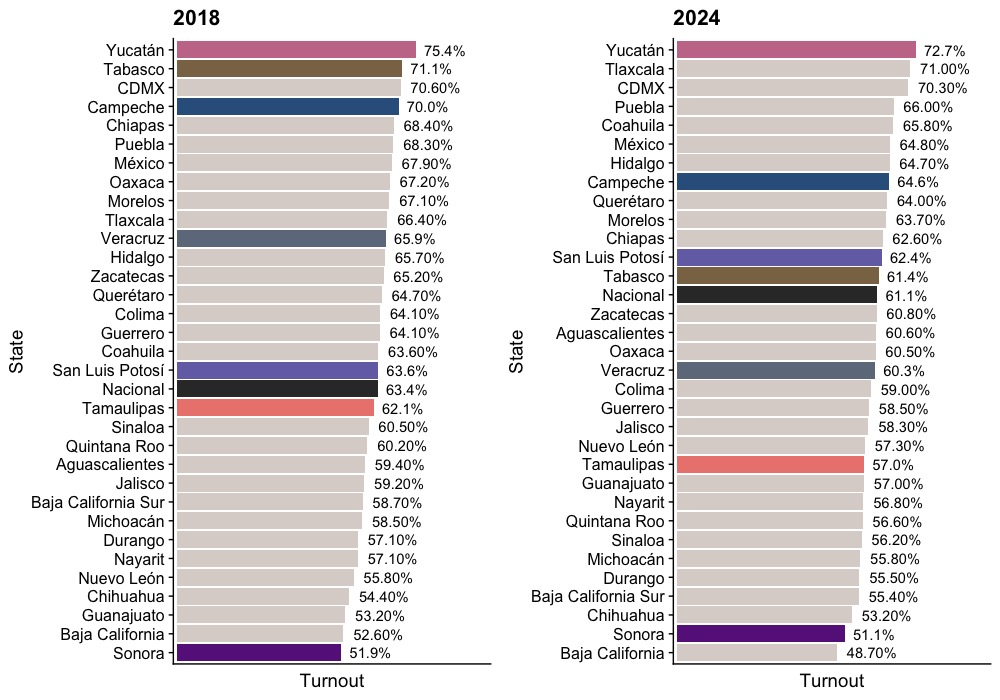
A specialized study of the relationship between maximum temperatures and their impact on turnout is beyond the scope of this case study.26 However, it is important to acknowledge that interventions to mitigate natural hazard risks at the level of local EMBs does not always occur. The case of Veracruz, presented below, is emblematic of this issue as it combines high temperatures, significant political violence risks—the main concern for electoral bodies today—and a lack of risk and crisis management tools.
Case study: Veracruz
Veracruz is a state located on the coast of the Gulf of Mexico. It is one of the states where the systemic increase in temperatures has been most dramatic. Figure 3 illustrates the variation in temperature in the state over the last four electoral cycles. In May 2015, the average temperature barely reached 30.0°C, but it peaked at 36.4°C by 2024—although temperatures dropped slightly in June 2024, heatwaves were present during the electoral process as a whole.
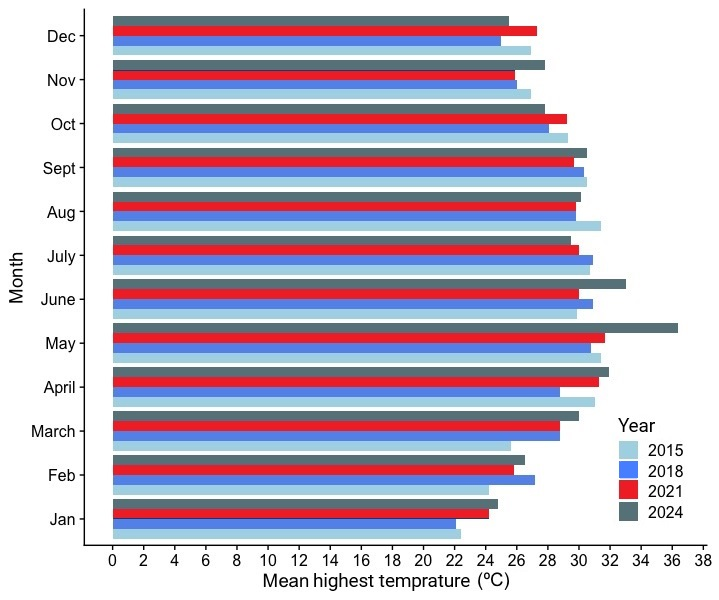
Commenting on this challenge in an interview with Mabel Hernández, the current councillor of the state-level EMB (OPLE Veracruz), stated that ‘they have had to deal with high temperatures during the electoral processes with the ordinary resources they have, without the existence of a specific action protocol for high temperatures’. She added: ‘I remember that in last year’s 2024 election, at one point, the issue was raised, “How are we going to ensure that the queues do not cause, for example, a heat stroke in an elderly person?” and it was implied that since it is an issue at the polling station … it is mainly the INE’s responsibility to foresee what can be done’ (Hernández 2025).
The councillor acknowledged that ‘the only document that considers the impact of temperatures in Veracruz pertains to the Preliminary Electoral Results Programme (PREP), since the computing equipment can be affected by high temperatures’. Another air-conditioned location is the Capture and Verification Centre of the Scrutiny and Counting Records, which is crucial for the validity of the results.
Conclusions and lessons learned
The national electoral authority in Mexico, the INE, has a strategic planning framework that includes very robust risk management schemes, with specific protocols for addressing the following natural hazards: heavy rain, flooding, landslides, earthquakes, ashfalls and fires. These protocols specify the activities of local EMBs that must address unforeseen events, including the chain of command that must be followed to ensure efficient crisis management. However, heatwaves have not thus far been seen as posing comparable risks to the electoral process, the continuity of planned actions or the credibility of elections.
The objective of risk and crisis management protocols and guidelines is the continuity of the electoral process, that is, to prevent the interruption of activities and ensure the exercise of the right to vote and be voted for. Institutional resilience measures against disasters are focused on training professional electoral service members who are responsible for directly addressing hazards at the local level. Given the growing impact of heat as a natural hazard, it is essential that this issue be institutionalized in the electoral management.
Some prescriptive lessons learned that may be useful for Mexico’s electoral stakeholders—as well as those in other countries—include the following:
- Special measures should be planned to mitigate the impact of heat on both voters and election officials (whether part of the permanent or temporary workforce) and to ensure the smooth conduct of the electoral process.
- Strengthening the INE’s local structure in each state is essential to effectively address the anticipated risks.
- Local EMBs (the so-called OPLE) should be encouraged to develop their own risk and crisis management frameworks, grounded in a thorough understanding of each state’s climatic conditions.
- Providing EMBs with the necessary resources to implement protocols and special measures to address the impact of heatwaves is crucial.
- Standardizing national responses to natural risks such as heatwaves remains an important and pending task.
- Stronger and more effective inter-institutional cooperation agreements are needed.
References
Alatorre, I., ‘Altas temperaturas en León causan malestar a mujer en evento de Claudia Sheinbaum’ [High temperatures in Leon cause discomfort to woman at Claudia Sheinbaum's event], El Sol de León, 5 March 2024, <https://oem.com.mx/elsoldeleon/elecciones-2024/altas-temperaturas-en-leon-causan-malestar-a-mujer-en-evento-de-claudia-sheinbaum-13145214.app.json>, accessed 10 April 2025
Alire García, D. and Barrera, A., ‘Mexico heatwave triggers “exceptional” power outages, president says’, Reuters, 8 May 2024, <https://www.reuters.com/world/americas/mexico-heat-wave-triggers-exceptional-power-outages-president-says-2024-05-08/>, accessed 10 April 2025
Arellano Guerrero, F. N., Farías Núñez, O. A., Reyna López, M., López Trujillo, J. A., López Quiroz, M., Loranca Domínguez, Y., Lunagomez Cruz, D. P., Ojeda Lerma, Z., Pascual Ramírez, R. and Zavala Fajardo, A., ‘Reporte anual del clima en México’ [Annual climate report in Mexico], National Meteorological Service, 2024, <https://smn.conagua.gob.mx/tools/DATA/Climatolog%C3%ADa/Diagn%C3%B3stico%20Atmosf%C3%A9rico/Reporte%20del%20Clima%20en%20M%C3%A9xico/Anual2024.pdf>, accessed 10 April 2025
Baños, M. A., former electoral councillor at the National Electoral Institute, author’s interview, Mexico City, February 2025
Blais, A., To Vote or Not to Vote: The Merits and Limits of Rational Choice Theory (University of Pittsburgh Press, 2000), <https://doi.org/10.2307/j.ctt5hjrrf>
Data Cívica, Democracia vulnerada: El crimen organizado en las elecciones y la administración pública en México [Democracy violated: Organized crime in Mexican elections and public administration], Analytical report, Data Civica, Animal Político, México Evalúa (Coords), 2024, <https://votar-entre-balas.datacivica.org/homeassets/REPORTEANALITICO-VOTARENTREBALAS2024.pdf>, accessed 10 April 2025
Dávila Valdés, C., ‘Entre la cortesía y el buen ánimo a 40°C: votaciones en la casilla básica de Cholul, en Mérida Yucatán’ [Between courtesy and good spirits at 40°C: voting at the basic polling station in Cholul, in Merida Yucatan] in R. López Santillán and A. Valdés Teja, A. (eds.), Dossier Ciudadano Jornada Electoral 2 de junio 2024 [Citizen Dossier Election Day, June 2, 2024] (Yucatán: Mexican Council of Social Sciences, 2024), <https://www.comecso.com/problemas-nacionales/dossier-ciudadano-jornada-electoral-2-de-junio-2024>, accessed 11 April 2025
DW, ‘México registra apagones intermitentes por ola de calor’ [Mexico registers intermittent power outages due to heatwave], 10 May 2024, <https://www.dw.com/es/m%C3%A9xico-registra-apagones-intermitentes-por-ola-de-calor/a-69040139>, accessed 10 April 2025
Electoral Tribunal of the Federal Judiciary (Tribunal Electoral del Poder Judicial de la Federación, TEPJF), Court Ruling SUP-JRC-166/2021 (Sentencia de la Sala Superior SUP-JRC-166/2021), Mexico, 2021, <https://www.te.gob.mx/EE/SUP/2021/JRC/166/SUP_2021_JRC_166-1090493.pdf>, accessed 11 April 2025
Executive Directorate of Administration (Dirección Ejecutiva de Administración, DEA), National Electoral Institute (Instituto Nacional Electoral, INE), Protocolos y Guías de actuación DEA para la atención de contingencias, eventos fortuitos o de fuerza mayor durante los procesos electorales [DEA Protocols and Guidelines for dealing with contingencies, force majeure events during electoral processes], 2024, <https://repositoriodocumental.ine.mx/xmlui/bitstream/handle/123456789/173659/INE-CCOE-022-2024-e2-5.pdf>, accessed 10 April 2025
Executive Directorate of Electoral Training and Civic Education (Dirección Ejecutiva de Capacitación Electoral y Educación Cívica, DECEYEC), National Electoral Institute (Instituto Nacional Electoral, INE), Protocolo de continuidad de operaciones para la Integración de Mesas Directivas de Casilla y Capacitación Electoral [Protocol for Continuity of Operations for the Integration of Polling Station Boards and Electoral Training] (2022)
Faz, M., electoral councillor at the National Electoral Institute, author’s interview, Mexico City, March 2025
Flores, D., ‘Reporta Cruz Roja, atención a cinco personas por Golpe de Calor en el estado’ [Red Cross reports attention to five people in the state due to heat stroke], Diario de Xalapa, 2 June 2024, <https://oem.com.mx/diariodexalapa/local/reporta-cruz-roja-atencion-a-cinco-personas-por-golpe-de-calor-en-el-estado-13446583.app.json>, accessed 10 April 2025
Forbes México, ‘México vivió en 2024 el año más caluroso de su historia, alertan expertos de la UNAM’ [Mexico experienced the hottest year in its history in 2024, UNAM experts warn], 17 January 2025, <https://forbes.com.mx/mexico-vivio-en-2024-el-ano-mas-caluroso-de-su-historia-alertan-expertos-de-la-unam/>, accessed 10 April 2025
France 24, ‘Ola de calor en México ha causado al menos 155 muertes desde marzo’ [Heatwave in Mexico has caused at least 155 deaths since March], 21 June 2024, <https://www.france24.com/es/am%C3%A9rica-latina/20240621-ola-de-calor-en-m%C3%A9xico-ha-causado-al-menos-155-muertes-desde-marzo>, accessed 10 April 2025
Frank, R. W. and Martínez i Coma, F., ‘Correlates of voter turnout’, Political Behavior, 45 (2021), pp. 607–33, <https://doi.org/10.1007/s11109-021-09720-y>
Geys, B., 'Explaining voter turnout: A review of aggregate-level research', Electoral Studies, 25 (2006), pp. 637–63, <https://doi.org/10.1016/J.ELECTSTUD.2005.09.002>
Hernández, M., local electoral councillor at the Local Electoral Institute of Veracruz, author’s interview, February 2025
International Labour Organization (ILO), Ensuring Safety and Health at Work in a Changing Climate (Geneva: ILO, 2024), <https://www.ilo.org/publications/ensuring-safety-and-health-work-changing-climate>, accessed 19 May 2025
Jacobo, E., former Executive Secretary at the National Electoral Institute, author’s interview, Mexico City, March 2025
Jiménez Espinosa, M., Cordero Devesa, D. A. and Monroy Cruz, V., ‘Ondas de Calor: Aspectos esenciales y su gestión’ [Heatwaves: Essential aspects and their management], Prevención. Revista de Divulgación y Difusión Cultural del Centro Nacional de Prevención de Desastres, September-December 2024, pp 12–17, <https://www.cenapred.gob.mx/es/Publicaciones/archivos/506-PREVENCION_NUM_1_2024.PDF>, accessed 10 April 2025
Matsusaka, J. G. and Palda, F., ‘Voter turnout: How much can we explain?’, Public Choice, 98 (1999), pp. 431–46, <https://doi.org/10.1023/A:1018328621580>
Mendez de Hoyos, I., Transición a la democracia en México. Competencia partidista y reformas electorales 1977–2003 [Transition to democracy in Mexico. Partisan competition and electoral reforms 1977–2003] (Mexico: Fontamara/Flacso Mexico, 2006)
Mexico (United Mexican States), Political Constitution of the United Mexican States, 1917 (revised 2015), <https://www.constituteproject.org/constitution/Mexico_2015>, accessed 11 April 2025
—, General Law of Institutions and Electoral Procedures, 2014 (updated October 2024), <https://www.icnl.org/research/library/mexico_proced/>, accessed 11 April 2025
Milenio Estados, ‘Bajo temperaturas de hasta 45 grados, mexicanos salen a votar en todos los estados por Elecciones 2024’ [Under temperatures of up to 45°C, Mexicans go out to vote in all states for the 2024 elections], 2 June 2024, <https://www.milenio.com/politica/elecciones/ciudadanos-votan-en-mexico-pese-a-temperaturas-con-calor-extremo>, accessed 11 April 2025
Ministry of Health, National Centre for Disease Control and Prevention, ‘Carpeta Técnica “Temporada de Calor” Daños por Calor y Enfermedades Diarreicas Agudas’ [Technical Folder ‘Heat Season’ Heat Damage and Acute Diarrheic Diseases], March 2024, <https://www.gob.mx/cms/uploads/attachment/file/905760/CARPETA_TECNICA__TEM_CALOR__2024-1__3__final.pdf>, accessed 11 April 2025
National Electoral Institute (Instituto Nacional Electoral, INE), ‘Determinan INE y la Coordinación Nacional de Protección Civil riesgo bajo de afectaciones electorales por actividad del volcán Popocatépetl en el Estado de México’ [INE and the National Coordination of Civil Protection determine low risk of electoral damages due to the activity of the Popocatepetl volcano in the State of Mexico], 26 May 2023, <https://centralelectoral.ine.mx/2023/05/26/determinan-ine-y-la-coordinacion-nacional-de-proteccion-civil-riesgo-bajo-de-afectaciones-electorales-por-actividad-del-volcan-popocatepetl-en-el-estado-de-mexico/>, accessed 10 April 2025
—, ‘Designa INE a 49 mil 748 Supervisores y Capacitadores Asistentes Electorales para PEF 2023-2024’, 13 January 2024a, <https://centralelectoral.ine.mx/2024/01/13/designa-ine-a-49-mil-748-supervisores-y-capacitadores-asistentes-electorales-para-pef-2023-2024/>, accessed 10 April 2025
—, ‘Instala el INE el 99.85% de las casillas aprobadas en todo el territorio nacional’ [INE installs 99.85% of approved polling places nationwide], 3 June 2024b, <https://centralelectoral.ine.mx/2024/06/03/instala-ine-el-99-85-de-las-casillasaprobadas-en-todo-el-territorio-nacional/>, accessed 10 April 2025
—, Protocolo para prevenir factores de riesgo en los procesos electorales [Protocol to prevent risk factors in electoral processes], 2024c, <https://repositoriodocumental.ine.mx/xmlui/bitstream/handle/123456789/147332/CGex202212-14-ap-25-P.pdf>, accessed 10 April 2025
National Meteorological Service (SMN), Glosario técnico: ‘Ola de calor’ [Technical glossary: ‘Heatwave’], [n.d.], <https://smn.conagua.gob.mx/es/smn/glosario>, accessed 15 February 2025
Peláez-Fernández, A. and O’Boyle, B., ‘Reeling from one heatwave, Mexico awaits “highest temperatures ever recorded”’, Reuters, 23 May 2024, <https://www.reuters.com/business/environment/reeling-one-heat-wave-mexico-awaits-highest-temperatures-ever-recorded-2024-05-23/>, accessed 11 April 2025
Pereyra, E., ‘Jornada electoral en Mérida: Experiencias en el norte de la ciudad y redes sociales’ [Election day in Merida: Experiences in the north of the city and social networks], in R. López Santillán and A. Valdés Teja (eds), Dossier Ciudadano Jornada Electoral 2 de junio 2024 [Citizen Dossier Election Day June 2, 2024] (Yucatán: Mexican Council of Social Sciences, 2024), <https://drive.google.com/file/d/1xPJHmVvxj7XuzKk-CFdgnzm7De460NyX/view?usp=embed_facebook>, accessed 11 April 2025
Prado Rebolledo, A. Y., ‘Dossier ciudadano sobre la jornada electoral 2024’ [Citizen dossier about election day 2024] in R. López Santillán and A. Valdés Teja, A. (eds) Dossier Ciudadano Jornada Electoral 2 de junio 2024 [Citizen Dossier Election Day June 2, 2024] (Yucatán: Mexican Council of Social Sciences, 2024), <https://drive.google.com/file/d/1xPJHmVvxj7XuzKk-CFdgnzm7De460NyX/view?usp=embed_facebook>, accessed 11 April 2025
Puley, G., ‘Extreme Heat: Preparing for the Heatwaves of the Future’, United Nations Office for the Coordination of Humanitarian Affairs, the International Federation of Red Cross and Red Crescent Societies, and the Red Cross Red Crescent Climate Centre, October 2022,<https://www.ifrc.org/sites/default/files/2022-10/Extreme-Heat-Report-IFRC-OCHA-2022.pdf>, accessed 11 April 2025
Ramírez, R., ‘Abandonan en Morelia mitin de Sheinbaum ante intenso calor y ella acorta su mensaje’ [Sheinbaum’s rally in Morelia abandoned due to intense heat and she cuts short her message], El Sol de México, 9 March 2024, <https://oem.com.mx/elsoldemexico/elecciones-2024/abandonan-en-morelia-mitin-de-sheinbaum-ante-intenso-calor-y-ella-acorta-su-mensaje-13057932>, accessed 11 April 2025
Rojas, A., ‘Suman 183 muertes por temperaturas altas en México’ [183 deaths due to high temperatures in Mexico], El Economista, 10 July 2024 <https://www.eleconomista.com.mx/politica/Suman-183-muertes-por-temperaturas-altas-en-Mexico-20240710-0006.html>, accessed 11 April 2025
Rosenbluth, T., ‘En México, las olas de calor matan incluso a los adultos jóvenes’ [In Mexico, heatwaves kill even young adults], New York Times, 7 December 2024, <https://www.nytimes.com/es/2024/12/07/espanol/tiempo-y-clima/mexico-olas-calor-muerte-jovenes.html>, accessed 11 April 2025
Sánchez, M., ‘Ciudadanía quiere “ganarle” al sol; pide agilidad en casillas’ [Citizens want to ‘beat’ the sun; they ask for agility at polling stations], 2 June 2024, <https://oem.com.mx/diariodexalapa/elecciones-2024/ciudadania-quiere-ganarle-al-sol-pide-agilidad-en-casillas-13420067>, accessed 11 April 2024
Somuano, F. and Nieto, F., ‘Participar o no participar: análisis tipológico de la participación ciudadana de los mexicanos’, Revista de Ciencia Política, 40/1 (2020), pp. 49–72, <https://doi.org/10.4067/S0718-090X2020000100049>
Sosa, A., ‘Mexicanos votan bajo temperaturas que superan los 30 grados’ [Mexicans vote in temperatures above 30°C], El Sol de Tampico, 2 June 2024, <https://oem.com.mx/elsoldemexico/elecciones-2024/mexicanos-votan-bajo-temperaturas-que-superan-los-30-grados-13055704>, accessed 11 April 2025
Stockemer, D., ‘What affects voter turnout? A review article/meta-analysis of aggregate research’, Government and Opposition, 52/4 (2017), pp. 698–722, <https://doi.org/10.1017/gov.2016.30>
Technical Unit of Information Technology Services (Unidad Técnica de Servicios de Informática, UTSI), National Electoral Institute (Instituto Nacional Electoral, INE), Programa de Resultados Electorales Preliminares. Plan de Continuidad [Continuity Plan for the Federal 2024 Preliminary Electoral Results Programme], (2024)
Trejo, G. and Ley, S., Votos, drogas y violencia. La lógica política de las guerras criminales en México [Votes, Drugs and Violence: The Political Logic of Criminal Wars in Mexico], Mexico City, Debate, 2022
United Nations, ‘Las olas de calor tienen la firma del cambio climático’ [Heatwaves have climate change signature], UN News, 29 July 2019, <https://news.un.org/es/story/2019/07/1459821>, accessed 11 April 2025
World Weather Attribution, ‘Deadly heatwaves in North and Central America 35 times more likely due to fossil fuel driven warming’, Press release, 20 June 2024a, <https://mcusercontent.com/854a9a3e09405d4ab19a4a9d5/files/dca0e854-eef1-0fcf-52f5-159d22939ad3/Press_release_Americas_heatwaves_2024.pdf>, accessed 11 April 2025
—, ‘Extreme heat killing more than 100 people in Mexico hotter and much more likely due to climate change [sic]’, 20 June 2024b, <https://www.worldweatherattribution.org/Extreme-heat-killing-more-than-100-people-in-Mexico-hotter-and-much-more-likely-due-to-climate-change/>, accessed 11 April 2025
Yucatan Times, The, ‘Mexico endures extreme heatwave just days before presidential election’, 28 May 2024, <https://www.theyucatantimes.com/2024/05/mexico-endures-extreme-heat-just-days-before-presidential-election/>, accessed 11 April 2025
Zavala, C., electoral councillor at the National Electoral Institute, author’s interview, March 2025
Annex A. Interview guide
Project context
International IDEA is interested in understanding the extent to which national and local electoral bodies are prepared to face the challenges posed by climate change. In the case of Mexico, International IDEA is particularly concerned about the extreme temperatures recorded in May and June (heatwaves), which may have affected both electoral campaigns and election day.
Introduction: General context
- To begin, what is your overall assessment of the performance of INE/OPLE Veracruz in the 2024 federal and local elections?
Climate crisis
Let’s discuss the climate crisis in Mexico, particularly the extreme temperatures and heatwaves, which are defined as a ‘significant warming of the air or an invasion of very hot air over a large area that usually lasts from a few days to a week’ (SMN n.d.).
According to data from CONAGUA, Mexico’s average highest temperature has systematically increased since 2015, reaching its highest point in 2024 at 30°C.
Among the states most affected by this phenomenon are Nayarit, Sinaloa and Yucatán, which have consistently ranked among the hottest in recent years. In 2024, Sinaloa’s average highest temperature reached 34.4°C.
This rise in extreme temperatures has had a severe impact on public health. By early July 2024, 2,813 cases of heat-related illnesses and 183 deaths had already been recorded due to high temperatures.
The states of Oaxaca, Tamaulipas, Tabasco, Veracruz and Yucatán were the most affected, with a 20.39 per cent increase in heat-related deaths nationwide compared to the same period in 2023.
- Was the INE/OPLE Veracruz aware of the potential risks associated with this climate phenomenon?
- Were heatwaves a topic on the council’s agenda?
- How did the institution become aware of the severity of the situation?
- Did you receive official information, such as prior meetings with Civil Protection or health authorities, or was it mostly through the media?
- How far in advance were electoral authorities informed about the heatwave and its possible effects on the elections?
- Were there any meetings or coordination efforts among different organizations to address these climate risks?
Voter protection measures
- What measures did the INE/OPLE take to ensure the safety and well-being of citizens participating in the elections?
- Was there any specific protocol related to extreme weather conditions affecting the voting process?
- Did the INE and OPLE establish any form of emergency communication with local authorities to address this climate crisis?
- What actions were taken to protect people at polling stations? For example, for hydration or ventilation, or adapting the facilities where voting took place.
- Were election schedules adjusted, or were additional voting locations set up with suitable conditions, particularly in the most affected areas?
- Were supplies such as water, fans or basic medical support provided at strategic points?
Emergency response and follow-Up
- During the heatwave, there were reports of deaths and extreme conditions. Was there any immediate response protocol in place for heat-related emergencies such as heat strokes or dehydration?
- Did the local electoral body have a contingency plan with other institutions (health, civil protection) to respond to critical situations during the elections?
- How did coordination with other entities ensure that affected individuals could vote safely?
Evaluation and lessons learned
- Do you think there were aspects that could have been improved or better anticipated?
- Is there a plan to enhance or adjust protocols for future elections in the context of climate crises?
- To what extent is climate change considered a factor to be incorporated into long-term electoral planning?
Thank the interviewee for their time and invite them to share any additional messages on climate crisis awareness and guarantees on the right to vote.
Annex B. Organic structure and functional division of the INE
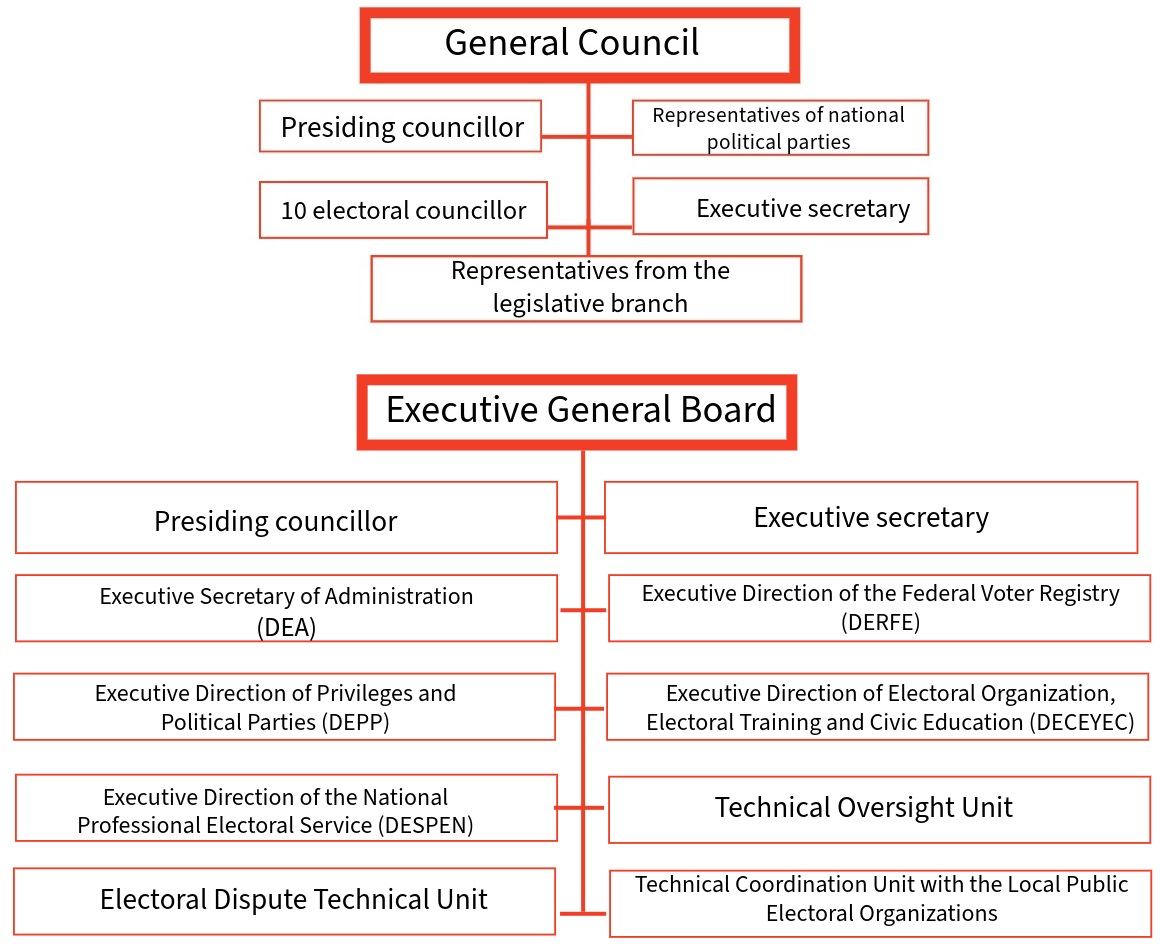
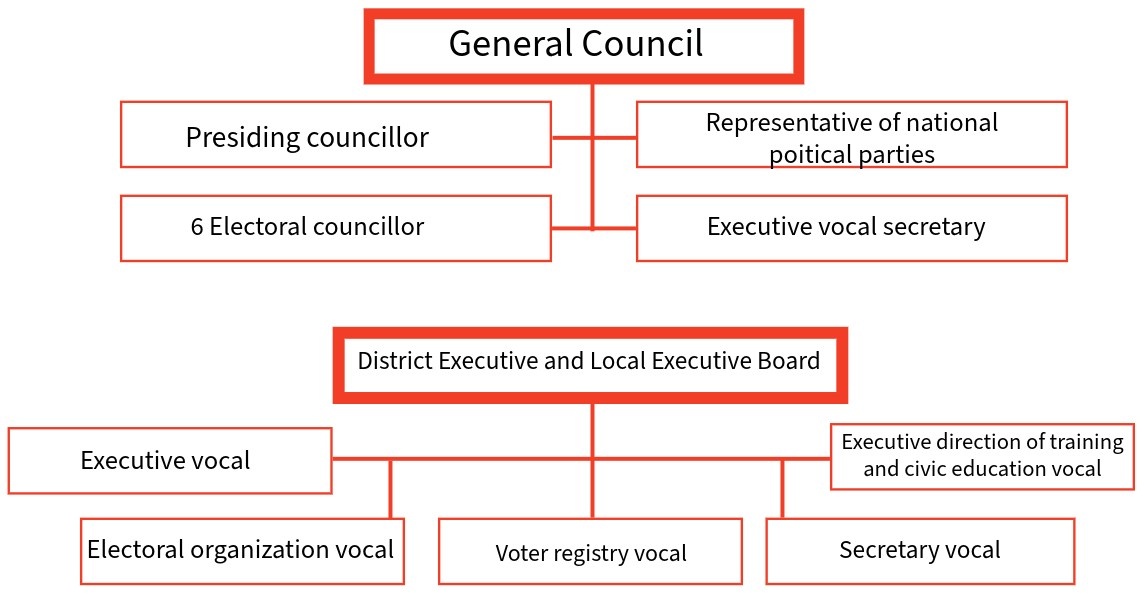
Abbreviations
DEA Executive Directorate of Administration [Dirección Ejecutiva de Administración] DECEYEC Executive Directorate of Electoral Training and Civic Education [Dirección Ejecutiva de Capacitación Electoral y Educación Cívica] DEOE Executive Directorate of Electoral Organization [Dirección Ejecutiva de Organización Electoral] DERFE Executive Directorate of the Federal Registry of Voters [Dirección Ejecutiva del Registro Federal de Electores] EMB Electoral management body INE National Electoral Institute [Instituto Nacional Electoral] JGE Executive General Board [Junta General Ejecutiva] OPLE Local Public Electoral Organizations [Organismos Públicos Local Electorales] PREP Preliminary Electoral Results Programme UTSI Technical Unit of Information Technology Services, INE [Unidad Técnica de Servicios de Informática, INE]
About the authors
Irma Méndez de Hoyos is a professor at the Latin American Faculty of Social Sciences (FLACSO) in Mexico. She holds a PhD in Government from the University of Essex, United Kingdom, and a Master’s in Public Policy from the University of London. A member of the National System of Researchers, Level 2, she teaches courses on political parties, elections, electoral bodies in Mexico and Latin America, electoral behaviour and public policy. Professor Méndez de Hoyos has coordinated international projects and specialized studies on the quality of democracy in Mexico and Latin America, electoral integrity (including independence of EMBs) and more recently on malpractice in electoral justice. She recently served as the General Coordinator of the Office of the President of the Federal Electoral Tribunal (2021–2024).
Marietha Pérez-Arellano is a PhD candidate in Political Science at the Centre for Economic Research and Teaching (CIDE) in Mexico. She holds an MA in Social Sciences from FLACSO Mexico, where she is currently a junior researcher in the Methods Lab. Her research interests include political behaviour, the effects of political discussion and methodology for the social sciences.
Domingos M. Rosario
Publishing date: 1 September 2022
Introduction
In recent years, the world has been increasingly affected in a cyclical way by natural disasters. In low-income countries such as Mozambique, these disasters have damaged the social and economic infrastructure that is key to making elections possible. The 2019 presidential, legislative and provincial elections in the country were held in the midst of disasters caused by cyclones Idai and Kenneth, as a result of which schools, power grids and roads were destroyed and people were forced to move to safer locations.
The disasters that occurred right in the middle of the 2019 election period took the country by surprise. Mozambique had never experienced any disasters of this magnitude while organizing elections before, and the public authorities found themselves in a difficult and uncertain situation as they searched for solutions. In addition to these emergency management difficulties, the country was facing an economic crisis (Ballard 2018), which would also have implications for the elections. With no experience in dealing with extreme weather events during an election period, the election authorities were unable to draw up plans to mitigate these disasters and their direct effects on the elections.
Resettlement assistance was the urgent priority for the authorities. As the resettlement process neared completion, albeit without the documents required for people to register to vote, the most important issues were to raise funds for new infrastructure, and then to acquire materials to make the electoral process viable as part of the government’s strategy to rebuild electoral capacity in the areas affected by the cyclones and prevent them from being dominated by its political opponents.
The dual disasters displaced populations and exacerbated logistical difficulties. The registration brigades set up in the rural areas affected by the cyclones were unable to register voters due to a lack of electricity. In addition, displaced voters who had lost their identification documents were prevented from registering since they had no witnesses to confirm their identity. Even in resettled locations where they were known to the local administrative authorities, they found no community support to vouch for them. Even those who did manage to register did not receive their polling cards as printers constantly broke down. Finally, a reduced workforce and lack of funds prevented the local election authorities from stepping in to resolve technical issues such as broken printers or lack of mobile equipment.
An election campaign conducted against the backdrop of infrastructure destroyed by the cyclones favoured the ruling party to the detriment of opposition parties. Benefiting from the use of state resources, the ruling party used the means at its disposal, including government security systems, to promote its election campaign in the areas affected by the cyclones and the insurgency by guerrillas from the country’s national resistance party, Resistencia Nacional Moçambicana (RENAMO). Opposition parties had their personnel detained and lacked the means to reach many places affected by the cyclones. They also struggled to get access to the people living in resettlement or accommodation centres. The distribution of supplies in these centres also became a political tool. The people in the centres were constantly in meetings or queuing for food assistance, which became a way to garner or buy votes for those who held power in the state administration (CDD/Catholic Church 2019a).
In addition to people in some of the areas affected by the cyclones not having polling cards, others were faced by military conflicts that made the electoral process even more difficult. This was especially the case in the far-northern province of Cabo Delgado, which suffers from Islamic extremism. Polling stations were destroyed, and terrorist attacks prevented people living in these areas from exercising their right to vote.
In the absence of any legal provisions on or experience of managing disasters during an election period, it is crucial that election authorities have an election emergency management plan in place that covers everything from financial issues to the training of staff. Electoral bodies must also advocate for electoral legislation that can meet the needs that arise from natural disasters. In the specific case of the 2019 elections, the areas affected by cyclones Idai and Kenneth were also affected by terrorism, and political and military conflict. These areas were generally opposition party strongholds, particularly for RENAMO. It therefore seems reasonable to conclude that these circumstances had a significant impact on the election results.
This case study analyses the effects of the natural disasters on the 2019 legislative, presidential and provincial elections in Mozambique, exploring all the stages of the electoral process from voter registration to campaigning and voting, and all the other aspects inherent to the process. It argues that the government’s decision not to postpone key stages of the electoral process despite the occurrence of the extreme weather events had an impact on election organization and citizen participation, and affected the results of the presidential election and the distribution of legislative and provincial seats.
Background and institutional context
The Constitution of the Republic of Mozambique enshrines multiparty democracy based on regular elections through universal, direct, secret and equal suffrage. The President of the Republic, the deputies in the Assembly of the Republic, the provincial governors and members of provincial assemblies, and mayors and members of the municipal assemblies are all elected for five-year terms. All citizens aged 18 or over on the date of the election are eligible to elect their representatives. The presidential elections follow a system of absolute majority, that is, a candidate must receive more than 50 per cent of the valid votes to be named President of the Republic. If no candidate receives this amount in the first round, a second round is held within 30 days of the date on which the results of the first round have been validated by the Constitutional Council. This round is contested by the two candidates who received the most votes in the first round of elections. The President of the Republic is limited to two consecutive five-year terms. In Mozambique, there has never been a need for a second round since the candidate from the Frente de Libertação de Moçambique (FRELIMO), the party that has been in power since the country gained independence in 1975, has always been elected in the first round.
Members of the Assembly of the Republic and the provincial assemblies are elected by a system of proportional representation, the closed party list system. For the legislative elections, 13 constituencies (11 administrative provinces as well as Maputo and Cidade) elect 248 deputies between them, and two constituencies in the diaspora (Africa and the rest of the world) elect one deputy each. These are elected by a simple majority.
The provincial and municipal elections use a system in which the voter elects a provincial governor and a member of the provincial assembly, or a mayor and a member of the municipal assembly, respectively, on a single ballot paper. The candidate who receives the most votes is automatically elected to each respective assembly. The candidate who receives the most votes for governor or mayor is also automatically elected. In the municipal elections, this method of electing a mayor was introduced in 2018 in a change from the system that had been in place since municipal elections began in 1998, when the two entities were elected on separate ballot papers.
These changes to the way municipal bodies are elected and the introduction of the principle of electing the provincial governor were formalized in 2018.27 This was linked to the signing of a final peace agreement between President Filipe Jacinto Nyusi and RENAMO leader Ossufo Momade in August 2019 (Vines 2019), which contained details on the demilitarization, demobilization and reintegration of all remaining RENAMO soldiers (Kingma 2020) and decentralization reforms. Previously, accusations of bias in the operation of the electoral management bodies (EMBs) had led RENAMO to break the political settlement (Khan 2018) signed in Rome in 1992, beginning a second civil war (Darch 2016), and to refuse to participate in the 2013 municipal elections, demanding the inclusion of its members at all levels of the EMBs (Rocha 2013). Talks took place between the government and RENAMO with the mediation of national and international partners. After 70 rounds of negotiations supported by national and international mediators (Vines 2019), amendments to the main electoral legislation were passed, and parliament approved a new National Electoral Commission law (O País 2014a).
The National Electoral Commission (Comissão Nacional de Eleições, CNE) is an independent body that regulates election procedures, with members from political parties and civil society organizations. It has 17 members: 5 appointed by FRELIMO, 4 by RENAMO and 1 by the Movimento Democrático de Moçambique (Mozambique Democratic Movement, MDM), proportionate to their number of seats in parliament. The remaining seven members are nominated by legally established civil society organizations co-opted by the political parties.28 The co-optation of CNE members from civil society organizations prevents this body from being able to remain impartial in its role (Bratton 1994).
Despite the parity between power and opposition defined as proportionality in parliamentary representatives and the inclusion of civil society in the EMBs, the composition of these bodies at the central level in the CNE and the Technical Secretariat for Electoral Administration (Secretariado Técnico de Administração Eleitoral, STAE), and at the provincial and district levels in the Provincial Electoral Commission (Comissão Provincial de Eleições) and the District Electoral Commission (Comissão Distrital de Eleições) continued to be dominated by a majority of members with strong links to the ruling party. This gave FRELIMO control of the decision-making mechanisms at all levels. The 2014 electoral legislation reform made changes to the composition of polling station personnel, increasing the number from five to seven, with four hired in a public recruitment process and three appointed by the political parties with seats in parliament (FRELIMO, RENAMO and the MDM). Political party members are included in polling stations as a way to ‘prevent electoral fraud’ and make elections more transparent.
Natural hazard context
As noted above, the 2019 presidential, legislative and provincial elections were disrupted by extreme weather events. Category 4 tropical Cyclone Idai hit the provinces of Manica, Sofala, Tete and Zambezia on 14 March 2019, causing strong winds and heavy rain. Its impact was particularly devastating as it came in three waves (Ministry of Health, INS and WHO 2019). In early March, a low pressure system caused flooding in the provinces of Tete and Zambezia; in mid-March, Cyclone Idai hit the port city of Beira; and on 16–17 March more than 200 mm of torrential rain fell in 24 hours, causing the Buzi, Pungwe and Save rivers to flood more than 3,000 hectares of crops and surrounding villages (Italian Agency for Development Cooperation 2019). Storm winds of more 220 km/hour ravaged some districts in the provinces of Manica, Sofala, Tete and Zambezia, where some 2.7 million people live (National Institute of Statistics 2019), destroying roads, bridges and other important infrastructure. The effects of Cyclone Idai displaced more than 400,000 people, caused outbreaks of infectious diseases such as cholera, and exacerbated malaria in the area (Ministry of Health, INS and WHO 2019). Tropical Cylone Idai also hit neighbouring Zimbabwe and Malawi, where it also affected election preparations. In Malawi, some registered voters living in evacuation camps lost their poll cards due to flooding, while candidates had difficulty conveying messages to their supporters living in these camps (Mapote 2019).
Cyclone Idai occurred two weeks before voter registration began. It had a considerable impact because approximately 3,200 classrooms were destroyed (INGC et al. 2019). Voter registration brigades usually operate from these classrooms, which also act as polling stations on election day. Access roads (UNICEF Mozambique 2019) and electricity supply infrastructure used for the biometric registration of voters and for vote counting, which takes place on the evening on election day, were also destroyed. Most notably, over 160,000 people forced to shelter in 164 collective, temporary accommodation centres (INGC et al. 2019) lost their identity documents, which are required to register to vote (SIC Notícias 2019).
Mozambique is one of the countries on the African continent most vulnerable to and affected by climate change. Cyclones are becoming increasingly frequent and more intense (Mozambican Ministry of Foreign Affairs 2018; Eckstein, Hutfils and Winges 2018). In 2000, floods killed 800 people and displaced more than 100,000. In 2012, a cyclone of the same magnitude battered southern Mozambique, destroying social and economic infrastructure, especially in the city of Xai-Xai, the capital of Gaza province, which was completely engulfed by water from adjacent rivers. Two further cyclones with much less devastating effects occurred in the central and northern regions in 2013 and 2014, respectively. The floods caused by Cyclone Idai in March 2019 had the same effect on the district of Buzi in Sofala province. Satellite photographs taken the day after the cyclone showed a district completely submerged by water from the Indian Ocean (SIC Notícias 2019).
While there were no specific detection and attribution studies for Idai and Kenneth, overall, there is high confidence that the rainfall associated with tropical cyclones is more intense because of global warming. However, there remain significant uncertainties about the impact of climate change on the numbers and strength of tropical cyclones per se.
—IPCC 2022: chapter 4, p.47
The severity of Cyclone Idai elicited responses from every corner of society. After consulting with all those political parties with parliamentary representation, particularly RENAMO, the largest opposition party (Pereiro Lopes 2019), the Mozambican National Institute for Disaster Risk Reduction and Management (INGD) and civil society organizations, the EMBs asked the government to postpone the start of voter registration for a minimum of 45 days in order to minimize the effects of the cyclone on this process (Canal de Moçambique 2019a). This was the first time that the electoral process had been affected by a natural disaster. The electoral law passed by parliament in 2014 contained no provisions on managing such situations at election time. In fact, the election authorities were also caught by surprise, and were unable to develop mechanisms and procedures to facilitate voting in the period between voter registration and the election itself.29
Postponement was required to allow the procurement of new equipment to cope with the effects of the cyclone, such as battery-powered computers and mobile equipment. It would also enable solar panels, generators and tents to be purchased, allowing registration teams to operate in places where schools had been destroyed, training for members of the registration teams to be resumed, and the electricity supply infrastructure and electoral structures to be repaired (STAE Zambézia 2019). The electoral bodies also wanted to strengthen mechanisms for promoting the now-suspended electoral civic education campaigns, in conjunction with the political parties, in the regions affected by the cyclone (CNE and STAE 2019b). According to the STAE, deployment of some 6,000 civic education agents across the country had only been completed in July but they were subsequently withdrawn during the campaign period to prevent incidents with party supporters (STAE Zambézia 2019).
A ‘minimal’ postponement to hold elections at all costs
The voter registration law gives the Council of Ministers (or Cabinet) the prerogative to decide on the dates for voter registration. At its ordinary meeting on 26 March 2019, the Council decided to grant a postponement of just 15 days, pushing the voter registration period back to 15 April to 30 May (from 1 April to 15 May).30 According to the government, this 15-day postponement was justified by the fact that the rescue operation in the areas affected by the cyclone was in its final stages, and the search and rescue operations in the regions at greatest risk were also almost complete (Portal do Governo de Moçambique 2019a). Thus, some 7.3 million additional voters were to be registered to vote in Mozambique’s elections in just six weeks, set against the devastating effects of a cyclone that had occurred just one month earlier (CNE and STAE 2019c).
The Government of Mozambique saw holding the 2019 presidential, legislative and provincial elections on the scheduled dates as imperative not only to support the discourse around election democracy in crises,31 but also to ensure the survival and legitimacy of a highly contested regime (Rosário and Guambe 2022). The decision by the Council of Ministers was interpreted by RENAMO as a politically motivated tactic by FRELIMO to prevent voters in RENAMO strongholds from registering—and not without cause (Rajá 2019). In countries with proportional electoral systems, and especially those with provincial-level constituencies, as is the case in Mozambique, the number of registered voters in each province is a determining factor when calculating how many seats each constituency will have in parliament.
At the same time, with help from its international cooperation partners—the United Nations Office for the Coordination of Humanitarian Affairs (OCHA), the United Nations Children’s Fund (UNICEF), the European Union, the United States, Italy and the World Bank—the government was raising funds for post-Idai reconstruction. This assistance included support for disease prevention, food security and early warning systems in the communities affected by Cyclone Idai. Since no proposals for mitigating extreme weather-related risk in elections had been outlined when planning the election cycle, it also included funds to purchase new election equipment. Two weeks after it began, voter registration was running smoothly in the southern regions and the provinces not affected by Cyclone Idai, with the exception of some districts in the province of Cabo Delgado which had been affected by recent terrorism. In Manica, Sofala, Tete and Zambezia, however, the provinces affected by Cyclone Idai, registration had not yet begun as there were still no solar panels or generators to run the computers and mobile equipment used for biometric registration (Breckenridge 2014). The situation deteriorated further with the advent of Cyclone Kenneth, which hit coastal regions in the northern provinces of Cabo Delgado and Nampula in April 2019 (UNICEF Mozambique 2019).
The effects of Cyclone Kenneth on voter registration in the north
As noted above, after voter registration had begun, coastal regions in the northern provinces were affected by Category 4 tropical Cyclone Kenneth, which was accompanied by gusts of up to 215 km/hour, causing flooding in the districts of Ibo, Macomia, Matemo Island, Metuge and Quissanga (in Cabo Delgado), as well as Eráti, Memba and Nacala (in Nampula) (Miller 2019). As a result, about 85 per cent (45,382) of the houses in the districts of Macomia, Matemo Island, Metuge and Quissanga in Cabo Delgado were completely destroyed. Access to these districts was also affected due to the destruction of roads, bridges and the communications network, and significant damage to the power supply system.
This new cyclone displaced about 300,000 people (CNE and STAE 2019b) and caused 44 families to seek shelter at temporary accommodation centres in Memba (Portal do Governo de Moçambique 2019b). It was the first time that the country had been affected by two cyclones of the same magnitude in such a short period of time. Cyclone Kenneth further depleted the infrastructure set up for voter registration and destroyed election materials such as electoral registers, polling cards and printers, and the classrooms where voter registration teams were operating in these two provinces (STAE Nampula 2019). This had a considerable impact on voter registration in the region, which was also feeling the effects of terrorist violence carried out by the jihadist group Al Sunnah wa Jama'ah, which is linked to the Islamic State group (West 2018).
Given both the cyclone and the terrorism in the region, coupled with the government’s refusal to postpone voter registration, a number of measures were taken by the election authorities to allow citizens to register and to vote.
Measures taken to enable the election(s) to be held: voter registration
Voter registration is a fundamental part of the electoral process, as it is a technical procedure by which individuals acquire electoral citizenship by being issued with a polling card (Schmitter 1997). In Mozambique, a new biometric census is carried out from scratch for each electoral cycle, which includes the municipal elections that take place one year before the presidential, legislative and provincial elections. In the year of the municipal elections, a census is conducted from scratch in all the cities and towns that constitute the municipalities. In the following year, a census is carried out from scratch in the rest of the country and the municipal census is updated.32
The CNE and the STAE (the latter is legally subordinate to the former) are the sole institutions in charge of organizing voter registration, and compiling and managing the voter register. These institutions are supported in the field by stationary and mobile brigades. The electoral law allows mobile brigades to register voters within a radius of up to 5 km.33 To register, voters must present their identity card or passport. If they do not have either of these documents, their identity can be verified using another document, provided that it contains a recent photograph or fingerprint. Alternatively, two citizens registered with the same registration brigade as the prospective voter can verbally affirm for their identity.34 Each voter who successfully completes registration is issued with a polling card, which indicates that they are registered on the electoral roll for the constituency closest to their usual residence, and are therefore eligible to vote. From the second to the fifth day after the end of the registration phase, the registers are displayed in the same locations where voters registered, allowing them to check that the procedure has been carried out correctly and to correct any errors (Rosário and Muendane 2016).
As noted above, the Council of Ministers authorized the postponement of the voter registration period for just 15 days in the provinces affected by Cyclone Idai. When voter registration began 15 days later, however, impassable roads, power outages and damaged schools made it impossible to station brigades in the locations they had established previously. It was also difficult to register voters in the north of the country due to Cyclone Kenneth, which had destroyed voter registration materials, and damaged printers, cards, paper and other items, affecting the registration brigades in Nampula and Cabo Delgado and interrupting registration in those areas for 10 days. Some of the voters who had already registered lost their polling cards (Jones et al. 2020). Moreover, the actions of the insurgent groups in Cabo Delgado exacerbated these voter registration issues.
In the districts affected by terrorist attacks, the registration brigades’ activities were limited by their dependency on escorts from the Defence and Security Forces, which were not always available. The chronic issues of computer or mobile equipment breakdowns that had always affected the two regions were made worse not only by the lack of electricity, but also by the inability of the EMBs to replenish registration materials (O País 2014b). These difficulties were linked to roads that remained impassable, delays in financial support to purchase the materials and attacks perpetrated by the military junta in the central regions and by the al-Shabaab group in the north.
Cyclones Idai and Kenneth led to thousands of people being relocated to safe zones, mainly accommodation centres, far from their homes. Most of these centres faced logistical issues that prevented voters from registering. In the province of Tete, for example, although the election authorities had provided new computers, mobile equipment and electricity generators (CIP 2019a), accommodation centres located in rural areas continued to find it difficult to mitigate the effects of the cyclones (CIP 2019b). First, the financial support provided to the election authorities to purchase fuel for the generators was insufficient; and, second, some of the fuel purchased was diverted by some leaders to be resold on the local informal market (CDD/Catholic Church 2019b). Replacing the printers destroyed by Cyclone Kenneth was a major problem (CIP 2019c), and the inoperability of printers made it difficult to issue and deliver polling cards to registered citizens (CIP 2019d).
In addition to not having any of the documents required by law for voter registration, the people displaced by the cyclones were new to the accommodation centres and therefore unknown to the local religious and community leaders who would have to vouch for their identity in the registration process. To allow more voters to register, the government called on the EMBs to ramp up civic education activities and strengthen financial, material and human resources in cyclone-affected provinces. A lot of money was spent rebuilding voter registration stations and restoring destroyed election infrastructure such as polling stations, but the EMB opted to extend each day of the registration period only by 90 minutes. This allowed more voters to register, but the target number of expected voters was not reached in these provinces. The target set for voter registration before the cyclones was all Mozambicans who would be aged 18 or over on the date of the election, and this was never readjusted.
| Provinces from south to north | Target number of voters for 2019 (I) | Voters actually registered in 2018 and 2019 (II) | Fulfilment of STAE targets (%) (III) |
|---|---|---|---|
| Cabo Delgado | 1,302,322 | 1,185,024 | 90.99 |
| Nampula | 3,085,692 | 2,361,973 | 76.54 |
| Zambezia | 2,733,532 | 2,140,125 | 78.29 |
| Tete | 1,455,999 | 1,119,378 | 76.88 |
| Manica | 1,063,767 | 893,426 | 83.98 |
| Sofala | 1,286,737 | 1,028,374 | 79.92 |
Table 1 shows that the election authorities were unable to meet their targets due to the lack of financial resources, transport problems in the areas affected by Cyclone Idai, and their inability to replace the voter registration materials destroyed by Cyclone Kenneth in the regions heavily affected by terrorism. The difficulties created by the cyclones and terrorism also affected the activities of political parties, especially those of the opposition during the campaign period.
Campaign period
In Mozambique, campaigning for the 2019 elections ran for 43 days (31 August to 12 October) and involved a number of parties in addition to the three with seats in parliament. All the parties conducted their campaigns door-to-door, while also using motorcades and rallies to try to convince the electorate to vote for their manifestos. The cyclones and terrorism were both central themes in the campaign. In their messages, the candidates and parties pledged to repair the infrastructure destroyed by the cyclones and combat the effects of climate change, which they argued is the main cause of the cyclones that are increasingly affecting the country (Sebastião 2019).
The opposition parties complained about the difficulties they faced running their campaigns in places where cyclone survivors and those fleeing terrorism had congregated:
It is very difficult for us in the opposition to run campaigns in the accommodation centres ... especially in places where they have been registering voters and where they are going to set up polling stations ... people are always in meetings organized by administration officials ... I think the food assistance is forcing people to be in meetings all the time.
(Jornal O Autarca 2019: 3)
Although also common in other electoral processes in the country, the use of state resources by candidates from the ruling party in the 2019 elections made it easier for them to overcome barriers to access to the innermost areas of the provinces affected by the cyclone and the terrorist attacks, notably Zambezia and Sofala (Jornal Txopela 2019).
At the local level, the ruling party, accompanied by the state military apparatus, was able to enter areas affected by the cyclones and the insurgency that were inaccessible to the opposition parties in order to promote its election campaign. In response, the opposition parties started rumours that ‘FRELIMO created al-Shabaab’ (Chichava 2020).
The destruction of sanitation facilities, the contamination of most sources of drinking water, the precariousness of conditions in communities housing families displaced by the insurgent attacks and other effects of the cyclones led to the spread of malaria (2,694 cases of malaria in Cabo Delgado continued to rise, with cumulative 2,694 malaria cases registered as of 8 May, with most cases being reported in Pemba (1,423) (Ministry of Health, INS and WHO 2019)), as well as outbreaks of cholera in the districts of Macomia, Mecúfi and Mocímboa da Praia (DW 2019) in Cabo Delgado. This prevented door-to-door campaigning in these districts (ADS/Catholic Church 2019). The disease outbreak led people in these districts to boycott the ruling party’s election campaign, accusing it of colluding with health workers to bring cholera to the communities, and to destroy the cholera treatment centres set up in the region (ADS/Catholic Church 2019). According to the health authorities, 109 cases of cholera were reported in Pemba (89) and in the districts of Mecúfi (10) and Metuge (10) on 8 May alone (Ministry of Health, INS and WHO 2019). To quell the unrest, about 50 people thought to be close to RENAMO who were spreading such false information were arrested (CDD/Catholic Church 2019a), but this provoked a wave of violence in Mecúfi. The joint CDD/Catholic Church election observation report states:
There was significant violence involving the police and RENAMO supporters... a crowd massed in front of the Mecúfi administration office demanding the release of people unjustly arrested by the police... they thought they were political arrests to prevent RENAMO members campaigning for their party... the police used and abused force to disperse the demonstrators.
(CDD/Catholic Church 2019b)
The wave of violence in the district during this period created a climate of intimidation that may have led voters to stay away on election day. At the same time, local health authorities increased their awareness-raising activities among communities on the reasons behind the spread of cholera and preventive measures were taken to avoid cases of diarrhoeal diseases (DW 2019). Administration of the ShanChol vaccine against cholerae was expanded to other districts (Portal do Governo de Moçambique 2019c). Although there was localized violence in the last few days of the campaign period, election day itself went satisfactorily.
Election day
Despite the terrorist activity, which had begun in 2017, and cyclones Idai and Kenneth, which occurred at the beginning of the voter registration period, the election authorities had failed to develop a crisis management procedure or to design specific voting processes for the people located in the accommodation centres set up to shelter potential voters. Using the help from the government, they were more concerned about finding safe places to house cyclone survivors. However, most of the accommodation centres were set up to house people in their original constituencies, so the electoral results and the political composition of the constituencies were not significantly affected.
Other previously identified polling stations where voters had been registered were moved to places where all the displaced persons could exercise their right to vote. With the help of cooperation partners such as the EU and the Austrian Development Cooperation, through a programme to support the consolidation of democracy in Mozambique implemented by the International Institute for Democracy and Electoral Assistance (International IDEA) as well as budget booster funds, tents (CNE and STAE 2019a) were procured by the local election authorities to be used as polling stations (Sala da Paz 2019; EISA 2019a). These new stations were not always located close to the displaced persons’ new residences, however, which made it difficult for them to exercise their right to vote. It should be noted that in Mozambique, under normal conditions (excluding exceptional cases), voters exercise their right to vote in the place where they are registered to vote, but this was not the case for some of the people who were affected by cyclones Idai and Kenneth.
Even with an increased election budget for the procurement of tents, there was no guarantee that potential voters facing the issues of flooding, terrorism and cholera, especially in the Cabo Delgado region, would exercise their right to vote or remain in the accommodation centres. Already during voter registration, for instance, 5,000 people in the district of Mecúfi had refused to register, citing a lack of support from the provincial government to resettle them in safe places near urban centres or in relatives’ homes, and the precarious nature of the temporary accommodation centres (Sala da Paz 2019; EISA 2019b).
As the effects of the cyclones eased, especially in regions in central Mozambique affected by Cyclone Idai, people tended to return to their places of origin. Managing the displacement of those affected by the cyclones exposed the election authorities, which had neither a budget nor a contingency plan for unforeseen circumstances (CNE and STAE 2019b). The initial election budget of EUR 95 million was already insufficient to ensure that voting could take place without any major issues. The impacts of cyclones Idai and Kenneth led the election authorities to call for an additional EUR 211 million (O País 2019) to implement an inclusive election process. At the time, the President of the CNE acknowledged in a private meeting with the national election observation missions that the elections would be held at the level possible, in line with what could be achieved (CNE 2019). In fact, training for the approximately 144,000 polling staff, which is carried out by the election authorities during each election process, went as smoothly as possible given the financial and cyclone-related constraints.
With the CNE limited in terms of financial capacity, supervision was not necessarily effective, and it was not possible to organize training for election staff that was adapted to the situation caused by the dual disasters. There are no reliable data on the number of people who did not exercise their right to vote as a direct result of the effects of cyclones Idai and Kenneth. The abstention rate in the elections was 48.16 per cent.
| Provinces affected by cyclones Idai and Kenneth | Abstention rate (%) | |
|---|---|---|
2014 | 2019 | |
| Cabo Delgado | 50.47 | 50.84 |
| Manica | 54.00 | 39.28 |
| Nampula | 59.49 | 57.84 |
| Sofala | 49. 61 | 42.39 |
| Tete | 45.36 | 40.43 |
| Zambezia | 59.77 | 57.66 |
Despite the displacement of people and destruction of infrastructure by the cyclones in Cabo Delgado, Manica, Nampula, Sofala, Tete and Zambezia provinces, Table 2 shows that voter turnout was not lower than the previous election. Voter turnout in general elections has been on the increase since the 2009 elections, and from 2014 to 2019 there was a 3 per cent increase at national level (International IDEA n.d.). Many provinces throughout Mozambique reflected that trend to varying degrees, acknowledging that voter turnout dynamics at provincial level may be affected by many different factors, from economic grievances or satisfaction, electoral violence and intimidation or their absence, localized fraud, armed conflict or natural disasters, perception of candidates and so on.
Attempts by the election authorities with help from the INGD to adjust implementation plans—especially for election day—by setting up new polling stations in places not prone to flooding did not produce tangible results by persuading displaced populations to participate effectively. On the contrary, these populations totally distanced themselves from an election held in highly complex conditions, as a result of both the cyclones and the terrorist attacks (Habibe, Forquilha and Pereira 2019). At a time when the public authorities had no plan to deal with the violence perpetrated by the insurgents, the cyclones added to the difficulties of managing the elections. Local election authorities were unable to come up with alternatives other than closing certain polling stations in Napire and Iphuho (Meluco) and three others in Banga Velha, Nacate and Ntapuala, all in Cabo Delgado province (Jones et al. 2020). In this context, space was created for election manipulation, as noted above, through the distribution of the voter registration brigades and the management of election materials in ways that favoured the ruling party, which controls the EMBs.
Election observation
The 2019 elections were monitored by various national and international election observation missions. Among the international missions included were those of the African Union, the EU, the Southern African Development Community, the Electoral Institute for Sustainable Democracy in Africa (EISA), the Commonwealth and the Community of Portuguese Language Countries. Among the domestic observers, three platforms should be highlighted: Sala da Paz, led by the Institute for Multiparty Democracy; the JOINT platform; and the Plataforma de Transparência Eleitoral (electoral transparency platfor) led by EISA (Jones et al. 2020). Some 537 international observers and over 42,000 domestic observers were approved to observe on election day at 20,590 polling stations (Constitutional Council 2019). However, national observation faced the issue of accreditation.
Due to obstacles created by the EMBs at the provincial level, about 3,000 of the 7,000 observers planned for the latter two platforms (Jones et al. 2020; EISA 2019c) failed to obtain credentials, while others were given their credentials the day before the vote or even on the day of the vote itself. These constraints prevented observers from getting to their polling stations on time, particularly in the provinces of Nampula, Tete and Zambezia, due to the inaccessibility of many of the regions severely affected by the cyclones. There were also political obstacles, such as the murder of an election observer one day before the vote (Rodrigues 2019) and the arrest of 18 young people belonging to a small political party, Nova Democracia, created in the days leading up to the elections. These young people remained incarcerated for more than a month, accused of falsifying their credentials (Mapote 2019).
Overall, however, while acknowledging the existence of numerous electoral irregularities and incidents, the international election observation missions concluded that these were not sufficient to render the electoral process unviable (European Union 2019). The EU Mission was the most critical of all. Its report presented a number of incidents, primarily perpetrated by members and supporters of the ruling party, involving factors such as the use of state property and police aggression (European Union 2019). The election observation difficulties faced in the regions affected by cyclones Idai and Kenneth were also acknowledged. In addition, no communication mechanisms were put in place to notify voters that their polling stations had been moved. Access difficulties caused by the cyclones and the insurgency may have contributed to the lack of information provided in the observation mission reports.
At the same time, the crisis caused by the cyclones made it easier to manipulate results in places that could not be accessed by election observers, such as the provinces of Nampula and Zambezia. It was partly through this window of opportunity that the results significantly favoured the ruling party in places that have traditionally been dominated by the opposition parties (Jones et al. 2020). The absence of election observers meant that many polling stations were fertile ground for results to be engineered and to go uncontested, even more so because many voters had been unable to identify their new polling stations because the changes had not been well publicized.
Informational environment
The increased use of digital communications platforms meant that the 2019 electoral cycle saw a level of information circulating not seen in previous elections. The monitoring of elections meant that election incidents, fraudulent actions and other events that occurred during the electoral process were reported, sometimes in real time. The Txeka platform run by a local civil society group, Olho do Cidadão, enabled local observers to report irregularities and violent incidents on digital platforms in real time. In addition, a study of the main social networks—Facebook, Twitter, WhatsApp and YouTube—found that these platforms were important not only because information was shared on them, but also because they reported on the main issues that might threaten the process (Jones et al. 2020). Traditional media are generally censored (Jones et al. 2020), but situations such as an increase in the number of voters registered in Gaza province, the arrest of the 18 election observers from the Nova Democracia party, the difficulties accessing some locations as a result of the flooding caused by cyclones Idai and Kenneth, and the actions of insurgents were all reported and shared through social media.
The spread of information on social media, however, also meant that there was a risk of unreliable information being shared with the potential to incite electoral violence. Such was the case, for example, when some election observation platforms spread information about the election results on the day after the vote but before any official announcement had been made. Some civil society organizations, such as MISA Mozambique, a media-oriented organization, monitored for disinformation during the voting process, which involved real-time fact checking of information suspected of being disinformation (MISA Mozambique 2019). Disinformation was a clear strategy adopted by political actors directly involved in the election process (Jones et al. 2020). For example, there was falsification of election results in some regions where results were expected to be more favourable to the opposition, such as Nampula, Tete and Zambezia, especially where national observers were not that present (CIP 2019b). With no risk management structure for tackling such disinformation campaigns, the EMBs called a number of press conferences to refute each rumour as it spread.
Cost of elections
The financial crisis that affected—and continues to affect—the country meant that the 2019 election process always faced a considerable budget deficit, which was exacerbated by the cyclones. Early on in the process, the electoral bodies announced that they were facing constraints on more than half of the budget. As noted above, the election authorities announced that EUR 95 million—44 per cent of the planned budget, as allocated in the general state budget—had been used to cover the first phase of the electoral process, and the total amount needed to organize the electoral process following the cyclones was EUR 211 million. This represented an increase of seven times the total spent on organizing the 2014 election process (CIP 2019c), which was about EUR 30 million.
The provinces of Manica, Sofala and Zambezia, which were hit by Cyclone Idai, and Cabo Delgado and Nampula, which were hit by Cyclone Kenneth, increased their initial budgets by over MZN 50 million (EUR 690,000). Most of the additional funds were allocated to repairing election infrastructure, procuring tents and renting vehicles to transport election materials to places with limited access (STAE Zambezia 2019). The Government of Mozambique used its disaster management fund (Fundo de Gestão de Calamidades) to mobilize support, especially for displaced people in the transit and accommodation centres. In the end, USD 880 million from the natural gas exploration projects under way in Cabo Delgado province, led by Occidental Petroleum and Total, was used not only to fund the deficit (O País 2019), but also to part-fund the election campaign of FRELIMO’s presidential candidate, Filipe Jacinto Nyusi (Verdade 2019). It is not known exactly how much was added to combat the issues that arose from the cyclones (CNE and STAE 2019b) but Nyusi is on record as stating that Mozambique borrowed the equivalent of USD 97 million to fund the elections, which the country would repay from its anticipated oil revenues (EISA 2020).
Election results
On 29 October 2019, the CNE submitted the election results, and the centralization and tabulation decrees to the Constitutional Council for approval before publishing in the national Gazeta. The Constitutional Council officially announced the results on 22 December 2019, almost two months after the elections were held. The results gave a resounding victory in the first round to FRELIMO and Nyusi, with about 71 per cent and 73 per cent of the votes, respectively. Voter turnout was around 51 per cent of the 13,162,321 registered voters nationwide and in the diaspora (Constitutional Council 2019). In the provincial elections, FRELIMO also emerged victorious in all provinces without exception, including in provinces such as Nampula, Sofala, Tete and Zambezia where RENAMO had nearly always received a majority of votes in the past (Rosário, Guambe and Salema 2020). An in-depth analysis of the results showed that FRELIMO had received the most votes in all 161 districts of Mozambique, which had never happened before.
The FRELIMO received over 60 per cent of the votes in all provinces, and in Gaza it secured about 95 per cent. Even if there is no direct or obvious causal relationship between the effects of cyclones Idai and Kenneth and the strong election results for the ruling party, it is reasonable to believe that the limitations imposed by the effects of these disasters created space for the ruling party to use state resources to put itself in a better position than its competitors. The effects of the cyclones limited the political campaigning of the opposition and hampered voter registration in the areas traditionally under their influence. The cyclones undoubtedly benefited the ruling party and had a direct impact on electoral performance, in particular of the opposition parties. After the official election results were published, RENAMO and the MDM rejected them and called for the process to be rerun on the grounds that the vote had been marred by ballot stuffing in favour of FRELIMO, violence against opposition candidates, an increase in the number of pre-marked ballots, the barring of election observers and the grooming of polling station officials (RFI 2019; EISA 2019d).
Conclusions
The 2019 elections in Mozambique were preceded by two cyclones that directly and significantly affected the electoral process in the central and northern regions (see Table 3). In addition to the cyclones, terrorist attacks which began in 2017 had a negative impact on voter registration and voting processes. In the absence of specific legislation on how to proceed in the event of a natural or human-induced disaster, the public authorities did little to alter their activities with respect to how the electoral process should be organized. The only concern was to get people to safe areas. However, redesigned procedures were needed to preserve the right to vote for displaced populations in specific conditions and according to their situation.
Even though the northern regions of the country had been subject to terrorist attacks since 2017, the election authorities were unable to design or develop a crisis management procedure for terrorist-related incidents and events, and adopt it during voter registration, the campaign period or voting. In the absence of any such tools, the ruling party, which controls the state media and the public media, used the campaign to promote itself both in hard-to-reach areas and in areas affected by the insurgency, to the detriment of the opposition parties. In addition, the cyclones and insurgency excluded much of the population from exercising their right to choose their representatives. The lack of any plan and the imbalance in the means for promoting political parties’ election campaigns helped FRELIMO to obtain a high number of votes in these regions and expand its dominance in an area that until then had been dominated by opposition parties.
Mozambique held elections in the context of extreme weather events for the first time. Many activities were left incomplete due to the lack of a legal framework adapted to this type of emergency. The main lessons that can be learned from this process and the key findings are set out below.
| 2018 | |
| 11 April | The date is set for the presidential, legislative and provincial elections |
| 4 August | The electoral calendar is published and the date for voter registration is set |
| 13 August | Receipt of candidacies for the municipal elections begins |
| 2019 | |
| 14 March | Cyclone Idai hits the provinces of Manica, Sofala, Tete and Zambezia |
| 24 March | A request to postpone voter registration is submitted to the Council of Ministers |
| 26 March | The Council of Ministers decides to postpone the start of voter registration and sets a new date |
| 15 April | Voter registration begins |
| 25 April | Cyclone Kenneth hits the provinces of Cabo Delgado and Nampula |
| 30 May | Voter registration ends |
| 24 June | The distribution of mandates for each constituency is disclosed |
| 31 August | Election campaigning begins |
| 4 September | Pope Francis visits Mozambique |
| 12 October | Election campaigning ends |
| 15 October | Elections take place |
| 23 December | The election results are validated |
| 2020 | |
| 15 January | The new President of the Republic is inaugurated |
| 30 March | A state of emergency is declared as a response to Covid-19 |
Main findings/lessons learned
- Mozambique is a country that is vulnerable to climate change. In 2019 this affected the organization of its elections. There is a need to provide the EMBs with the capacity for disaster response planning and an emergency fund to mitigate the effects of disasters on elections.
- There is a need to build in resilience and adapt elections infrastructure, schools and access roads to natural disasters. Most of the budget requested by the electoral bodies in the regions heavily affected by the cyclones was used to rebuild facilities, repair classrooms and buy tents.
- There is a need to design and maintain an elections risk and crisis management process that identifies potential risk areas from disasters and political and military conflicts, and provides a budget to enable more effective responses to such incidents.
- There is a need for parliament to pass electoral legislation that helps the public and the electoral authorities respond to natural disasters more predictably at election time.
- Although the election process is biometric, Mozambique needs to solidify its voter registration infrastructure with permanent voter registers updated by civil registry offices. This re-engineering of the registration process would minimize the challenges faced in handling the distribution of materials and voter registration brigades in regions heavily dominated by the opposition, as well as those most affected by disasters or extreme weather events.
- There is a need to create mechanisms to improve the accreditation of election observers. A single credential issued at the beginning of the process and valid for all phases of the electoral cycle would minimize accreditation issues such as those experienced by independent observers during the 2019 elections, which were exacerbated by cyclone-related constraints and the resulting tight budget.
- In order to facilitate voting, whenever the election authorities change the locations of polling stations, they should communicate the new locations through all means available to them, but especially community radio, at least seven days in advance.
- Election stakeholders should commence a discussion on the introduction of special voting arrangements, which can increase voters’ access to polls, especially in places that are vulnerable to the effects of disasters and severe weather events.
References
ADS/Catholic Church, Relatório da Observação da campanha eleitoral para as eleições de 2019 em Moçambique [Report on the observation of the electoral campaign for the 2019 elections in Mozambique] (Maputo: October 2019)
Ballard, B., ‘Mozambique’s dramatic economic reversal’, World Finance, 11 July 2018, <https://www.worldfinance.com/special-reports/the-mozambique-debt-crisis>, accessed 18 February 2022
Bratton, M., ‘Civil society and political transition in Africa’, IDR Reports, 11/6 (1994)
Breckenridge, K., Biometric State: The Global Politics of Identification and Surveillance in South Africa, 1850 to the Present (New York: Cambridge University Press, 2014), <https://doi.org/10.1017/CBO9781139939546>
Canal de Moçambique, ‘As “tabelas do Bartolomeu” que deram vitória à Frelimo e a Nyusi na CNE’ [The ‘Bartolomeu tables’ that gave victory to FRELIMO and Nyusi in the CNE], 31 October 2019
CDD/Catholic Church, ‘Relatório do semanal da fase da campanha eleitoral em Cabo Delgado’ [Weekly report on the electoral campaign phase in Cabo Delgado], September 2019a
—, Relatório final do recenseamento eleitoral na província de Tete [Final report on the electoral census in Tete province], June 2019b
Chichava, S., ‘Did Frelimo create ‘’Al Shabaab’’? An analysis of the 15 October 2019 elections from Cabo Delgado’, Cadernos Instituto de Estudos Sociais e Economicos (IESE), 18 (Maputo: IESE, 2020), <https://www.iese.ac.mz/wp-content/uploads/2020/10/CadernosIESE-18-SC_eng.pdf>, accessed 25 March 2022
Centro de Integridade Pública (CIP), ‘Dozens of registration posts not open due to Cyclone Idai, but most are operating’, Mozambique Political Process Bulletin, 9, 18 April 2019a
—, ‘Comunidades ainda não abrangidas pelo recenseamento na Zambézia’ [Mobile brigades did not reach Zambezia villages], Mozambique Political Process Bulletin, 29-30, 30 May 2019b
—, ‘Orçamento para as eleiçoes de 2019 é excessivo’ [Budget for 2019 elections is excessive], Anti-corrupção – Transparencia – Integridade, 2 (2019c)
—, ‘Problemas do STAE estarão a bloquear recenseamento na Zambézia?’ [Will STAE problems block census-taking in Zambezia?], Mozambique Political Process Bulletin, 17, 2 May 2019d
Comissão Nacional de Eleições (CNE), ‘Informe II sobre Processo de Recenseamento Eleitoral 2019’ [Report II on the 2019 voter registration process] (Maputo: CNE, 2019)
CNE and Secretariado Técnico de Administração Eleitoral (STAE), Gestão de Emergência e Riscos Eleitorais. Práticas Emergentes na Resposta dos EMBs às Emergências [Emergency management and electoral risks. Emerging practices in EMB emergency response] (Maputo: STAE, 2019a)
—, Práticas Emergentes na Resposta dos EMBs às Emergências. O Caso das Eleições Gerais de 2019 em Moçambique [Emerging practices in EMB emergency response. The case of the 2019 general elections in Mozambique] (Maputo: CNE, 2019b)
—, Previsões da população a recensear em 2019 [Forecasts of the population to be registered in 2019] (Maputo: CNE/STAE, 2019c)
Constitutional Council, Ruling No. 21/CC/2014: Validação e Proclamação dos Resultados das Eleições Presidenciais, Legislativas e das Assembleias Provinciais [Validation and proclamation of presidential, legislative and provincial assembly election results], 29 December 2014
—, Ruling No. 25/CC/2019: Validação e Proclamação de Resultados Eleitorais [Validation and proclamation of election results], 22 December 2019
Darch, C., ‘Separatist tensions and violence in the “model” post-conflict state: Mozambique since the 1990s’, Review of African Political Economy, 43/148 (2016), pp. 320–27, <https://doi.org/10.1080/03056244.2015.1084915>
DW, ‘Cabo Delgado regista casos de cólera apos cyclone Kenneth’ [Cabo Delgado records cholera cases after Cyclone Kenneth], 3 May 2019, <https://www.dw.com/pt-002/cabo-delgado-regista-casos-de-c%C3%B3lera-ap%C3%B3s-ciclone-kenneth/a-48586776>, accessed 25 March 2022
Eckstein, D., Hutfils, M.-L. and Winges, M., Global Climate Risk Index 2019: Who Suffers Most from Extreme Weather Events? Weather-related Loss Events in 2017 and 1998 to 2017 (Berlin: Germanwatch, 2018)
Electoral Institute for Sustainable Democracy in Africa (EISA), Relatório das Eleições Presidenciais, Legislativas e Provinciais 2019 [Report on the 2019 presidential, legislative and provincial elections] (Maputo: EISA, 2019a)
—, Relatório de Observação Especial de Cabo Delgado nas Eleições de 2019 [Cabo Delgado special observation report on the 2019 elections] (Maputo: EISA, 2019b)
—, Relatório preliminar da Observação do recenseamento eleitoral de 2019 em Moçambique [Preliminary report on the observation of 2019 voter registration in Mozambique] (Maputo: EISA, 2019c)
—, Relatório Preliminar: Contagem Paralela de Resultados (PVT) [Preliminary report: Parallel vote tabulation (PVT)] (Maputo: EISA, 2019d)
—, EISA International Election Observer Mission Report Mozambique: Presidential, Legislative and Provincial Elections 15 October 2019 (Johannesburg: EISA, 2020)
European Union, European Union Election Observation Mission Mozambique 2019: Final Report (Maputo: European Union, 2019), <https://eeas.europa.eu/sites/default/files/eueom_moz2019_final_report_en.pdf>, accessed 28 March 2022
Habibe, S., Forquilha, S. and Pereira, J., ‘Radicalização Islâmica No Norte de Moçambique: O Caso de Mocímboa da Praia’ [Islamic radicalization in northern Mozambique: The case of Mocímboa da Praia], Cadernos IESE, 17 (Maputo: IESE, 2019), <https://www.iese.ac.mz/wp-content/uploads/2019/09/cadernos_17.pdf>, accessed 25 March 2022
National Institute of Disaster Management (INGC), United Nation Office for Coordination of Humanitarian affairs (OCHA), ACAPS, REACH, MapAction, and the International Federation of Red Cross and Red Crescent Societies, Multi-sectoral Rapid Assessment Post-cyclone Idai (Maputo: United Nations Office for the Coordination of Humanitarian Affairs (UNOCHA), 2019)
Intergovernmental Panel on Climate Change (IPCC), Climate Change 2022: Impacts, Adaptation and Vulnerability, Summary for Policymakers, February 2022, <https://doi.org/10.1017/9781009325844>
International IDEA, Voter Turnout Database [n.d.], <https://www.idea.int/data-tools/country-view/222/40>, accessed 5 February 2022
Italian Agency for Development Cooperation, Programa de Mitigação dos Efeitos do Ciclone Idai [Idai cyclone effects mitigation programme] (Maputo: IADC, 2019)
Jones, E., Carr, H., Smith, J. and Krasodomski-Jones, A., New Frontiers: The 2019 Mozambique Elections on Social Media (Maputo: Demos, 2020), <https://demos.co.uk/wp-content/uploads/2020/05/Mozambique-140120.pdf>, accessed 8 August 2022
Jornal O Autarca, ‘Para fazer campanha eleitoral: Oposição critica inacessibilidade dos centros de reassentamento’, O Autarca, p.3
Jornal Txopela, ‘Frelimo usa meios do Estado na campanha eleitoral em Quelimane’ [FRELIMO uses state resources in election campaign in Quelimane], 2 September 2019
Khan, M. H., ‘Political settlements and the analysis of institutions’, African Affairs, 117/469 (2018), pp. 636–55, <https://doi.org/10.1093/afraf/adx044>
Kingma, K., ‘Um olhar ao DDR em curso em Moçambique. Discussões francas sobre planos realísticos de reintegração crucial para o sucesso da operação’ [A look at the ongoing DDR in Mozambique: Frank discussions on realistic reintegration plans crucial to the success of the operation], EISA Policy Brief No. 9 (Maputo: EISA, 2020)
Mapote, W. ‘Familiares lutam pela libertação de “18 presos políticos” do partido Nova Democracia’ [Relatives fight for release of ‘18 political prisoners’ of Nova Democracia party], VOA, 19 November 2019, <https://www.voaportugues.com/a/familiares-lutam-pela-liberta%C3%A7%C3%A3o-de-18-presos-pol%C3%ADticos-do-partido-nova-democracia/5172479.html>, accessed 5 February 2022
Miller, B., ‘Cyclone Kenneth: Thousands evacuated as Mozambique is hit with the strongest storm in its history’, Cable News Network, 25 April 2019, <https://edition.cnn.com/2019/04/25/africa/cyclone-kenneth-mozambique-evacuation-intl/index.html>, accessed 25 March 2022
Ministry of Health, Instituto Nacional de Saúde (INS) and World Health Organization (WHO), Tropical Cyclones Idai and Kenneth Mozambique: National Situation Report 1 (Maputo: WHO, 2019)
MISA Mozambique, Relatório de Monitoria da Cobertura dos Media das Eleições Gerais de 2019 em Moçambique [Monitoring report on the media coverage of the 2019 general elections in Mozambique] (Maputo: MISA Mozambique, 2019), <https://misa.org.mz/index.php/publicacoes/relatorios/eleicoes-2019/96-relatorio-de-monitoria-da-cobertura-dos-media-das-eleicoes-gerais-de-2019-em-mocambique/file>, accessed 25 March 2022
Mozambican Ministry of Foreign Affairs, ‘Climate Change Profile: Mozambique’, April 2018, <https://reliefweb.int/sites/reliefweb.int/files/resources/Mozambique_4.pdf>, accessed 25 March 2022
National Institute Statistics, 2019. IV Recenseamento geral da População e Habitação. Resultados definitivos [2019. IV General Population and Housing Census. definitive results], Maputo, April.2019
OPais, ‘“Reconstrução pos-ciclone”. Autoridades eleitorais pedem financiamento para fazer face a destruição de infraestruturas eleitorais’ [Post-cyclone reconstruction. Election authorities ask for funding to tackle destruction of electoral infrastructure], 9 May 2019
O País, ‘Parlamento aprova revisão da lei eleitoral para silenciar armas’ [Parliament approves revision to election law on disarmament], 24 February 2014a
—, ‘Renamo denuncia paralisação do processo e pede prorrogação’ [Renamo denounces paralysis of process and calls for extension], 21 April 2014b
Pereiro Lopes, P., ‘CNE e STAE recebem apoio para votação nas zonas afectadas pelo Idai’ [CNE and STAE receive support for voting in Idai-affected areas], O País, 13 October 2019, <https://www.opais.co.mz/cne-e-stae-recebem-apoio-para-votacao-nas-zonas-afectadas-pelo-idai>, accessed 28 March 2022
Portal do Governo de Moçambique, ‘Início do Recenseamento Eleitoral adiado para 15 de Abril’ [Start of voter registration postponed to 15 April], 27 March 2019a, <https://www.portaldogoverno.gov.mz/index.php/por/Imprensa/Noticias/Inicio-do-Recenseamento-Eleitoral-adiado-para-15-de-Abril>, accessed 31 January 2022
—, ‘PR sobrevoa em Nampula zonas afectadas pelo ciclone Kenneth’ [President flies over areas affected by Cyclone Kenneth in Nampula], 9 May 2019b, <https://www.presidencia.gov.mz/por/layout/set/print/Actualidade/PR-sobrevoa-em-Nampula-zonas-afectadas-pelo-ciclone-Kenneth>, accessed 1 February 2022
—, ‘C. Delgado: Mais de 248 mil pessoas vacinadas contra a cólera em Mecúfi, Metuge e Pemba’ [Over 248,000 people vaccinated against cholera in Mecúfi, Metuge and Pemba], 23 May 2019c, <https://www.portaldogoverno.gov.mz/por/Imprensa/Noticias/C.-Delgado-Mais-de-248-mil-pessoas-vacinadas-contra-a-colera-em-Mecufi-Metuge-e-Pemba>, accessed 5 February 2022
Rajá, R., ‘Renamo propõe adiamento por 45 dias para início do recenseamento eleitoral’ [RENAMO proposes 45-day postponement to start of voter registration], O País, 1 April 2019, <https://www.opais.co.mz/renamo-propoe-adiamento-por-45-dias-para-inicio-do-recenseamento-eleitoral>, accessed 5 February 2022
RFI, ‘Renamo e MDM rejeitam resultados provisórios’ [Renamo and MDM reject provisional results], 21 October 2019, <https://www.rfi.fr/pt/mocambique/20191021-renamo-recusa-resultados-e-pede-novo-acto-eleitoral>, accessed 5 February 2022
Rocha, A., ‘Sucesso das autárquicas só depende da CNE, diz a RENAMO’ [Success of municipalities depends only on CNE, says RENAMO], DW, 11 November 2013, <https://www.dw.com/pt-002/sucesso-das-aut%C3%A1rquicas-s%C3%B3-depende-da-cne-diz-a-renamo/a-17217887>, accessed 28 March 2022
Rodrigues, A., ‘Observador eleitoral assassinado em Moçambique’ [Election observer murdered in Mozambique], Público, 7 October 2019, <https://www.publico.pt/2019/10/07/mundo/noticia/observador-eleitoral-assassinado-mocambique-1889175>, accessed 5 February 2022
Rosário, D. M. and Guambe, E., ‘Decentralise fraud to build hegemony: New models of electoral manipulation during the 2019 general elections in Mozambique’, Journal of Southern African Studies (forthcoming 2022)
Rosário, D. M., Guambe, E. and Salema, E. (eds), Democracia Multipartidária em Moçambique [Multiparty democracy in Mozambique] (Maputo: EISA, 2020)
Rosário, D. M. and Muendane, E., ‘“To be registered? Yes. But voting?” Hidden electoral disenfranchisement of the registration system in the 2014 elections in Mozambique’, Politique Africaine, 144/4 (2016), pp. 73–94, <https://doi.org/10.3917/polaf.144.0073>
Sala da Paz, Relatório Final sobre Recenseamento Eleitoral 2019 [Final report on 2019 electoral census] (Maputo: Institute for Multiparty Democracy, 2019)
Schmitter, P. C., ‘Intermediaries in the consolidation of neo-democracies: the role of parties, associations and movements’, Institut de Ciències Politiques i Socials, 12 (1997), pp. 1–32
Sebastião, A., ‘Eleições em Moçambique: Apelos à mudança, contra as inundações em Sofala’ [Elections in Mozambique: Calls for change in the face of flooding in Sofala], DW, 12 September 2019, <https://www.dw.com/pt-002/elei%C3%A7%C3%B5es-em-mo%C3%A7ambique-apelos-%C3%A0-mudan%C3%A7a-contra-as- inunda%C3%A7%C3%B5es-em-sofala/a-50403761>, accessed 5 February 2022
SIC Notícias, ‘Os desastres naturais em Moçambique desde as cheias de 2000 a 2019’ [Natural disasters in Mozambique from the floods of 2000 to 2019], 22 March 2019, <https://www.dn.pt/lusa/idai-principais-desastres-naturais-em-mocambique-desde-as-cheias-de-2000-10712893.html>, accessed 5 February 2022
STAE Nampula, Informação sobre o impacto das chuvas no orçamento eleitoral [Information on the impact of the rains on the electoral budget] (Nampula: STAE, 28 April 2019)
STAE Zambezia, Informação sobre o impacto das chuvas no orçamento eleitoral [Information on the impact of the rains on the electoral budget] (Quelimane: STAE, 28 March 2019)
UNICEF Mozambique, ‘Cyclone Idai and Kenneth: For the first time in recorded history two strong tropical cyclones have hit Mozambique in the same season’, 13 May 2019, <https://www.unicef.org/mozambique/en/cyclone-idai-and-kenneth>, accessed 5 February 2022
Verdade, ‘ExxonMobil, outro dos financiadores do partido Frelimo, felicita Nyusi’ [ExxonMobil, another FRELIMO party sponsor, congratulates Nyusi], 6 November 2019, <https://verdade.co.mz/exxonmobil-outro-dos-financiadores-do-partido-frelimo-felicita-nyusi>, accessed 5 February 2022
Vines, A, Prospects for a Sustainable Elite Bargain in Mozambique: Third Time Lucky?, Africa Programme Research Paper (London: Chatham House, 2019), <https://www.chathamhouse.org/sites/default/files/08-05-2019-SustainableMozambique.pdf>, accessed 8 August 2022
West, S., ‘Ansar al-Sunna: A new militant Islamist group emerges in Mozambique’, Terrorism Monitor, 14 June 2018, pp. 5–7
About the author
Domingos Manuel do Rosário holds a PhD in political science from Institute of Political Studies, University of Bordeaux. He is a senior lecturer at the Department of Political Science and Public Administration of the Faculty of Arts and Social Science, Eduardo Mondlane University, and a senior researcher at the Centro de Estudos Urbanos de Moçambique (Ceurbe). He has written on decentralization, public policies in Mozambique, elections and electoral management bodies. He is currently researching on the new perspectives of the civil war in Mozambique and in the temporality of the vote by drawing on material repertoire, its biography and the respective mechanism of appropriateness and reinterpretation in Mozambique.
Rafael Arias Valverde and Wendy Adrianzén Rossi
Publishing date: 11 September 2025
Introduction
Peru faces an increasing risk from extreme natural phenomena, a situation exacerbated by the effects of climate change (Córdova Aguilar 2020). According to the World Risk Report 2024, Peru ranks 11th globally and 3rd in Latin America in terms of the risk of natural hazards (Bündnis Entwicklung Hilft/IFHV 2024). This risk arises not only from the likelihood of hazards occurring but also from conditions of structural vulnerability (IADB 2015). In this context, the World Risk Report classifies Peru as having ‘very high’ vulnerability and ‘very high’ lack of coping capacities—an indicator which encompasses social shocks, political stability, health services, infrastructure and material security, among others (Bündnis Entwicklung Hilft/IFHV 2024).
Events such as El Niño, landslides, floods and earthquakes have repeatedly disrupted the normalcy of the country by affecting infrastructure, paralysing communication routes and resulting in the suspension of essential services. The increasing vulnerability to natural hazards also has the potential to significantly impact the electoral process, as these can hinder access to polling places, delay the transport of electoral materials and compromise citizen participation (Asplund, Fischer and Birch 2022). Additionally, they can negatively affect the credibility of elections (Darnolf 2018).
Given that natural hazards are becoming increasingly unpredictable, response times are considerably shortened. It has been argued that electoral bodies must adopt a proactive approach and optimize use of limited resources by (a) coordinating with other state and local authorities through structures of advance disaster planning; and (b) reviewing and updating contingency plans on a regular basis (Darnolf 2018).
In this regard, early identification of at-risk electoral districts and the implementation of (inter-agency) preventive measures are crucial. This case study focuses on the actions taken by Peru’s National Office of Electoral Processes (ONPE) during the regional and municipal elections (ERM) of 2 October 2022, with the aim of evaluating EMBs’ capacity to mitigate natural hazard impacts at all stages of the electoral process.
The Peruvian case is particularly relevant due to the country’s institutional framework, which delegates electoral responsibilities to three autonomous and independent bodies: the ONPE, the National Jury of Elections (JNE) and the National Registry of Identification and Civil Status (RENIEC). Among these, the ONPE is specifically tasked with organizing and executing electoral processes and popular consultations (referendums), as established in article 5 of the Organic Electoral Law (Peru 1995). This mandate is further specified in the ONPE’s Organization and Functions Regulation (ROF), which outlines the responsibilities of its operational bodies (ONPE 2024). Given this institutional role, analysing the ONPE’s response during the 2022 elections offers valuable insight into how EMBs can adapt to environmental risks and ensure electoral integrity in hazard-prone regions.
Risk of natural hazards in Peru
Peru is located along the Pacific Ring of Fire, which exposes it to high seismic activity and a variety of natural hazards. In recent decades, the country has faced major weather/environmental events that have tested its response capacity and risk management systems. These include the Pisco earthquake in 2007, the Coastal El Niño in 2017, the sewage flooding in San Juan de Lurigancho in 2019 and, more recently, the effects of Cyclone Yaku in 2023.
Beyond these high-impact events, between 2003 and 2022 the country recorded over 99,683 emergencies. Recurrent hazards include heavy rains, urban and industrial fires, low temperatures, strong winds and floods, accounting for 84.4 per cent of all recorded incidents (INDECI 2023). However, the frequency of these hazards does not necessarily correlate with severity of impact. For instance, although heavy rains are the most frequent, low temperatures have caused the greatest harm to the population.
During the electoral year 2022 between January and October, the National Centre for Estimation, Prevention, and Disaster Risk Reduction (CENEPRED) issued 51 reports on risk scenarios due to rainfall, 49 related to low temperatures and 10 on forest fires. The rainfall and low temperature risk reports were based on meteorological alerts provided by the National Meteorology and Hydrology Service (SENAMHI). These reports, relayed by the National Institute of Civil Defence (INDECI), primarily focused on the Sierra (the Andes) and Selva (the jungle) regions of the country.
In the week of the electoral process two reports were issued, both related to risk scenarios due to rainfall. Between 30 September and 2 October 2022, the SENAMHI forecasted moderate to heavy rainfall in the Sierra, including snow, hail, sleet and rain.35 In response, the CENEPRED identified 101 districts out of 1,874 at ‘very high’ risk of mass movements: in the departments of Áncash, Huancavelica, Huánuco, Pasco, Junín and Lima. Within these districts 2,430 educational institutions were exposed to risk. Additionally, 133 districts in the same departments were classified as having a ‘high’ risk, with 2,710 educational institutions identified as potentially vulnerable (CENEPRED 2022a).
In the Selva region, between 29 September and 1 October, the SENAMHI forecasted moderate to heavy rainfall, accompanied by lightning and gusts of wind.36 Regarding the risk of mass movements, the CENEPRED identified 15 districts in the departments of San Martín and Loreto with a ‘very high’ risk, affecting 111,358 people, 27,603 households, 83 health facilities and 582 educational institutions. Additionally, 58 districts at ‘high’ risk were identified in San Martín, Huánuco, Loreto and Ucayali, with 750,843 inhabitants, 192,339 households, 387 health facilities and 2,240 educational institutions between them (CENEPRED 2022b).
Since a significant portion of Peru’s polling places are educational institutions (Peru 2019: article 65), damage to them has implications for elections. For example, in the ERM 2022, monitoring conducted by the Office of the Ombudsman—on election day and the day prior—identified that 4.7 per cent (99) of the 2,078 supervised polling places were affected by at least one natural hazard (Defensoría del Pueblo 2022). The departments of Lima and Ayacucho accounted for 30 per cent of those damaged (19 and 11 polling places, respectively) (Defensoría del Pueblo 2022).
The day after polling (3 October), the ONPE conducted a virtual survey targeting two specific groups: District Coordinators (CDIST), responsible for the administration at the district level, and Rural Population Centre Coordinators (CCP), in charge of rural jurisdictions within districts.37 These groups were selected to ensure a more accurate representation of issues at the district level. A total of 2,384 surveys were sent to CDIST personnel, with 682 responses received (28 per cent), while 371 out of 1,349 CCP representatives responded (29 per cent).
The survey responses were used to identify and understand problems that affected election day operations. One of the key findings was the presence of weather-related issues: 12.9 per cent of respondents reported that rainfall or floods occurred and affected the staff’s duties during the electoral process. The most affected regions in terms of the proportion of impacted jurisdictions were Huánuco (12), Amazonas (8) and Ayacucho (11). Extreme weather events thus posed some logistical challenges to electoral processes in several parts of the country.
More generally, natural hazards can do so by complicating access to polling locations, delaying the transportation of electoral materials (such as ballots, ballot boxes and booths, voter registration/voter counting and other records), and negatively affecting the participation of both voters and electoral personnel. During the ERM 2022 no emergencies caused by natural hazards were recorded. Nevertheless, districts with very high or high risk of disasters during the week of the elections were systematically identified, as well as polling places that had sustained damage from rainfall, landslides and earthquakes. All polling stations were properly established (ONPE 2023) and citizens were able to exercise their right to vote. The measures adopted by the ONPE to ensure this successful outcome are detailed in a subsequent section (3. The 2022 Regional and Municipal Elections).
Impacts of natural hazards on previous elections
There are no available records that detail cases of natural hazards affecting the ONPE’s efforts to set up polling stations or open polling locations to the public. However, fieldwork identified two cases in different electoral processes where natural hazards prevented the installation of polling stations or prompted their relocation. It is important to note that the information collected comes from the statements of interviewed individuals and reflects their best recollection of the events.
The first case occurred during the 2010 second regional election in the district of Oronccoy, located in La Mar Province, Ayacucho Department. According to the information provided, this district is situated high in the Andes at 3,394 metres above sea level. Due to difficulty of access, the electoral materials were made ready early and transported by air with the support of a military helicopter.
On that occasion, the rains did not cease during the entire week before the election. ONPE personnel, along with the armed forces, safeguarded the electoral materials at the Pichari Military Base, located in La Convención Province, Cusco, a jurisdiction adjacent to the district of Oronccoy. It was expected that the helicopter would depart from the base once the rains stopped. Departure was attempted on the Wednesday and Thursday, but the weather prevented it. Although the helicopter managed to take off on three subsequent days, it could not land in Oronccoy because of the rain—the Armed Forces stated that they were unwilling to take this risk with the lives of their personnel or the ONPE and JNE personnel traveling with them. As a result, polling stations were not set up in the district of Oronccoy. It is estimated that the right to vote of approximately 600 people was affected, involving two polling stations.
The second case occurred during the 2016 general elections. In this case, the interviewee could not determine whether it occurred in Alto Amazonas Province or Maynas Province, both located in Loreto Department, in the Peruvian jungle.
Due to heavy rains many structures in the jungle are built on elevated platforms to allow water to pass underneath without damaging them. As mentioned, polling locations are mostly situated in educational institutions, many of which have the elevated structure described.
The day before polling, the Head of the Decentralized Office of Electoral Processes (ODPE—ONPE’s offices operating at the subnational level) responsible for the area noticed that one such school designated as a polling location was surrounded by rainwater. Although the structure itself was not affected due to its elevation, accessing it became dangerous for voters and staff. For this reason, it was decided to relocate the polling location to another nearby school. This involved moving both personnel and electoral materials hours before the election started.
According to the interviewee, this decision was made so quickly that the Electoral Organization and Regional Coordination Management was not promptly informed and it was later documented in a JNE oversight report. Nevertheless, this urgent action allowed voters to cast their votes and contributed to the success of election day in the locality.
The experiences mentioned illustrate that hazard situations impacting the electoral process are not always recorded, and much depends on the staff coordinating to resolve them in real time. Unfortunately, in some cases, resolution is not possible. However, considering that more than 80,000 polling stations are set up nationwide, the incidence of such situations is minimal, and the capacity of ONPE personnel to resolve difficulties has to date been generally sufficient.
The 2022 Regional and Municipal Elections
Context and regulatory framework
It is important to first clarify the broader context and the regulatory framework that shaped this electoral process. First, according to the Law of Regional Elections (Law No. 27683, article 2) and the Law of Municipal Elections (Law No. 26864, article 1) these contests are held every four years in a single process. In regional elections, citizens elect regional authorities, including the governor, deputy governor and regional councillors. The relevant constituencies correspond to the 24 departments and the Constitutional Province of Callao. In municipal elections, citizens elect mayors and councillors, who serve on municipal councils. For the election of provincial municipal councils, each province in the country constitutes a single electoral constituency; for the election of district municipal councils, each district within a province forms its own electoral constituency.
For 2022, the electoral process was called for 2 October. During this electoral process, at the regional level, 25 governors, 25 deputy governors and 342 regional councillors were elected. At the provincial level, 196 provincial mayors and 1,714 provincial councillors were elected. Finally, at the district level, 1,694 district mayors and 9,036 district councillors were elected (ONPE 2022b).
Nationwide, just over 24.75 million voters (24,760,062) were registered on the electoral roll. To ensure a smooth and accessible voting process, 11,298 polling places were established, at which 84,323 polling stations were set up. Of this total, 3,890 polling stations, corresponding to 1,341 polling places, were located in centros poblados—small villages with low populations located in rural areas, far from the provincial capitals. (Access to these villages is often difficult and requires, in many cases, days of travel.) This way of structuring the elections aimed to facilitate voters in casting their ballots on election day (ONPE 2023).
Citizens’ obligations on election day
Voting is mandatory for all eligible citizens aged between 18 and 70 years, after which voting becomes optional, as established in article 9 of the Organic Elections Law (Peru 2019). Those who do not fulfil their voting obligation are subject to fines. In the ERM of 2022, these ranged from PEN 23 to 92 soles, approximately USD 7 to 24 (Redacción EC 2022). If the fine is not paid, individuals will face various restrictions, such as the inability to register any acts related to their civil status (like marriage, divorce or widowhood); to participate in judicial or administrative processes, execute notarial acts or sign contracts, to be appointed as public officials; to enrol in social programmes; and/or to obtain a driver’s licence (JNE 2022).
However, citizens may submit a request for exemption in case they are unable to attend to vote or fulfil their duty as a polling station member (JNE 2021: article 11). Various legitimate reasons for absences from the electoral process are recognized, including natural or human-made hazards. However, for the exemption or justification to be valid, it is necessary to present a copy of the document or equivalent supporting document, signed by a competent public official ‘that credibly certifies the natural/human disaster that prevented the fulfillment of the civic duty’ (JNE 2021).
The Organic Law of Elections requires polling station staff to remain in the electoral venue from 06:00 until the conclusion of the vote counting on election day (Peru 2019: article 249). According to article 55, the composition of each polling station includes three principal members, who assume specific roles, and three alternate members, who are available to replace any principal member in the event that they are unable to fulfil their duties. Members are selected by lot from a list of 25 voters assigned to each polling station. The process is conducted by the ONPE in coordination with the Civil Registry.
Article 58 of the same legislation establishes that the role of polling station members is compulsory, and those who do not fulfil this duty are also subject to a fine. In the most recent ERM, this fine amounted to approximately PEN 200, close to USD 65. The consequences for failing to pay are the same as per breaches of compulsory voting. However, polling station members can also submit requests for justification for absence, under similar grounds established for those unable to vote.
Actions taken on natural hazard risks: Pre-election
The electoral timeline approved by the JNE (2021) for the ERM 2022 begins with the closure of the electoral roll on 2 October 2021; the ONPE organizes and executes electoral activities approximately one year prior to election day. To achieve this, the ONPE carries out preliminary actions related to planning, generating guidelines, and projecting and obtaining resources, among other necessary steps. Following this, it executes the planned actions, such as training personnel and electoral actors, transporting electoral materials to the Decentralized Electoral Process Offices and polling locations, defining the composition of polling stations and selecting polling station members, among others. Some of these tasks are identified as more likely to be affected by potential natural hazards. Based on the information gathered from the interviews, the rest of this section detail the prevention and mitigation approaches taken to uphold citizens’ right to vote.
The ONPE’s General Secretariat, responsible for the security and national defence of electoral processes, prepares a risk matrix that is shared with all ONPE management units. The disaster risk matrix includes potential natural risks and how to address them, with information based on data collected by the ONPE in past elections as well as inputs from the INDECI and the CENEPRED. This information is an input for the ONPE’s sub-units to define their planning and budgeting, and to develop service level agreements whether internal or with contractors. Thus, the Deputy Office of Planning gathers the information shared by the General Secretariat and takes it into consideration when consolidating the tasks of the ONPE’s various functional units. According to the Security and National Defence specialist interviewed, the disaster risk matrix works mainly as a preventive tool, since in the event of a natural hazard, the response will come not only from the ONPE but also from the Armed Forces (FFAA), the National Police of Peru (PNP) and others (Iglesias Arévalo 2025).
Months before election day, the ONPE provides voters across the country with the opportunity to choose their preferred polling place—within their electoral district—through the platform Elige tu Local de Votación (Choose your Polling Station, ETLV). For example, for the ERM 2022 on 2 October, it was available from 15 May to 3 June. For this reason, the ONPE determines which locations will serve as polling places far in advance. This task falls to the Deputy Office of Electoral Organization and Execution, which verifies their suitability and readiness to receive voters on election day (Orna Robladillo 2025). Being mostly educational institutions, it is expected that polling station structures meet the building code established by the relevant government agency and overseen by the INDECI—and are therefore capable of operating in the event of a natural hazard. However, if sites are identified that do not meet the necessary minimum conditions, they are replaced with alternatives.
Voters’ ability to choose their polling places adds value in preventing disruptions due to natural hazards. In Peru, rainy seasons can cause landslides, blocked roads and swollen rivers; the risk of disenfranchisement due to mobility problems is reduced by having shorter distances to travel. Furthermore, the ONPE increased its polling places by 126 per cent in response to the Covid-19 pandemic (ONPE 2022a: 28) and has since maintained this change, providing voters with more options to ensure they can vote close to their homes. Similarly, the ONPE has increased polling locations in centros poblados (rural settlements) by 82 per cent (from 740 in the ERM 2018 to 1,350 in the ERM 2022) (Uipan Chávez 2022).
The tasks outlined in the ONPE’s Operational Plan are carried out by two types of personnel: permanent staff and temporary staff; the latter are contracted solely for the electoral process and include more than 60,000 individuals, whose work begins and ends according to the tasks assigned to them (Cueva Hidalgo 2025). In this regard, ONPE personnel are trained before carrying out their functions by the Deputy Office of Training and Electoral Development. Among the approximately 50 types of positions that exist during an electoral process, many are crucial—such as those related to the deployment and withdrawal of electoral materials, training polling station members,38 transmitting information from the polling places,39 transporting the electoral records to the result processing centres, assisting in district offices and operating polling places.
Above all, tasks that involve moving between districts require knowledge about how to travel and what precautions to take—whether that is transporting electoral materials or supporting remote rural districts. For this reason, the General Secretariat, in coordination with the Deputy Office of Training and Electoral Development, trains the staff in disaster risk management. The former prepares a document titled ‘Guidelines for Security and Disaster Risk Management’, which provides the ONPE’s decentralized offices with a step-by-step understanding of what they need to do at each electoral stage to prevent any impact from natural hazards or other risks (Iglesias Arévalo 2025). Additionally, both the Deputy Office of Electoral Organization and Execution and the Deputy Office of Electoral Production determine transportation routes for their personnel; these include a main route and at least one alternate route in case any difficulties arise, whether due to weather conditions, social conflict or other issues. In its contracts with transport service providers, the latter department also requires adherence to these established routes, with any changes needing the ONPE’s prior approval (Phang Sánchez 2025).
Hazard risk management: During the election
To reinforce security against natural hazards, all mobile units transporting electoral materials are accompanied by ONPE personnel, equipped with GPS trackers and provided with an escort from either the PNP or the FFAA. Both institutions are trained to respond to risk situations and are responsible for ensuring safe, timely delivery of personnel and materials.
Regarding how the PNP and FFAA coordinate with the ONPE, the General Secretariat requests a liaison officer from the Joint Command of the FFAA and from the PNP, with both officers typically being of high rank, usually a general. These officers are responsible for ensuring the deployment of escort units that accompany the electoral materials, as well as the assignment of personnel present at the polling places, and managing any emergency actions that may be required (Iglesias Arévalo 2025)—for example, the use of helicopters in the event of flooding or fires (Orna Robladillo 2025). To fulfil these functions, the ONPE’s General Secretariat prepares training materials for the FFAA and the PNP, as well as providing training both in person and online.
The ONPE’s training personnel work in urban, rural and remote districts, which means continual travel, including centros poblados. In this regard, they are in constant motion to contact polling station members, disseminate information to voters, visit district offices and transport training materials (manuals, information booklets, ballots, electoral records and support sheets for training purposes). As such, these staff have a schedule of visits, established routes and financial resources in case of incidents. Trainers are deployed days before the sessions for polling station members, to ensure that no climatic or social difficulties affect their function (Cueva Hidalgo 2025). Additionally, there is the ONPEduca platform, through which electoral actors can receive training virtually. This software tool was designed to expand the reach of training nationwide and ensure that any voter, polling station member or political organization representative who cannot attend training in person due to transportation difficulties can do so virtually (Cueva Hidalgo 2025).
During election day, 2 October 2022, no emergencies caused by natural hazards were recorded. However, it could easily have been otherwise and the heads of the ODPE, as well as the ONPE personnel present at the polling places, were equipped with the necessary tools and timely training to respond. They are required to complete the electoral operations report, which is designed to allow the actors involved in the electoral process to report on situations that hinder the proper execution of electoral operations. This report can include incidents related to natural hazards. The PNP and the FFAA at the polling places were likewise ready to respond to any requests from the ONPE, providing a continuous security presence that extended until the withdrawal of materials in the days after polling. It is worth noting that the presence of the justice ministry (Public Ministry of Peru) and the JNE at polling places also helped to ensure the proper conduct of election day.
Figure 1 shows the milestones mentioned and may help to illustrate the ONPE’s entry points for hazard risk reduction and other risk management.
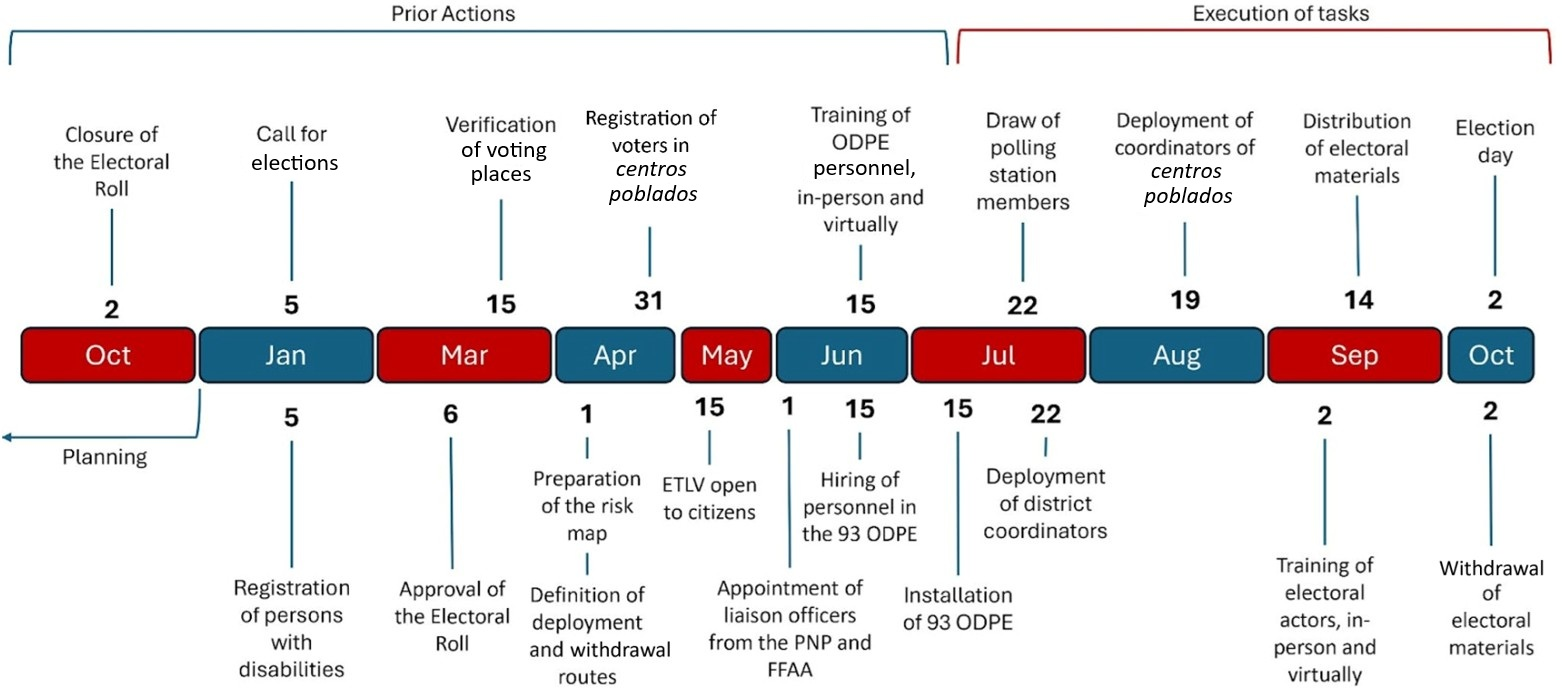
Identified difficulties
Despite all the strengths outlined, there are a number of obstacles to the ONPE having a comprehensive prevention or contingency plan for disasters. One of the main barriers is related to budget availability. Effective risk and disaster management requires specific resources; however, the justification process, before the Ministry of Economy and Finance (MEF), presents a challenge. In the Peruvian context, public entities are required to justify both the use and non-use of allocated resources. This means requesting funding for activities that may not be utilized—which is integral to contingencies—proves difficult to justify (Uipan Chávez 2025). Although the MEF has a contingency fund for emergency situations, the ONPE does not have the ability to access this fund directly nor to guarantee a budget sourced from it.
Another significant challenge is the guidance received from other entities such as the INDECI and the CENEPRED. While the ONPE previously worked on a Disaster Risk Prevention and Reduction Plan, the INDECI recommended that it not be maintained and that the ONPE should instead focus solely on the Operational Continuity Plan (Iglesias Arévalo 2025). This recommendation is based on the understanding that preventing natural hazards and risks is not a function that rests with ONPE personnel, but rather with the INDECI (Iglesias Arévalo 2025), supported by the FFAA and the PNP. Since the ONPE already coordinates directly with these entities, the INDECI suggested that the aforementioned plan should not be developed.
Another difficulty noted from fieldwork (Orna Robladillo 2025) concerns polling places. In some districts, there is only one educational institution, which is prioritized as the polling location. Although, in cases where the site does not meet the appropriate conditions, the municipality or another public infrastructure could be chosen, the options in less populated districts, especially rural ones, are limited. Therefore, the infrastructure in the best condition is selected, but it is not necessarily suitable to meet the requirements for being a polling place. This limits the choice of polling locations by citizens through the ETLV platform and also represents a latent risk in the event that a significant disaster occurs during the electoral day and the location sustains considerable damage.
Finally, the Deputy Office of Electoral Production emphasized that when deploying electoral materials to areas where access may be hindered, such as in cases of rising river levels, support from the FFAA is required to utilize helicopters. Although there were no issues in 2022, the FFAA have other priority functions requiring the use of their aerial vehicles (such as delivering supplies, transporting citizens in border areas and maintaining order in conflict zones), which means they may not always have helicopters available on time to support the ONPE, or the weather may not be favourable for take-off or landing (Orna Robladillo 2025). In such cases, the risk of being unable to install polling stations in remote areas, such as centros poblados, is a persistent concern.
Improvement proposals
Despite the aforementioned difficulties, it is essential for the ONPE to continue strengthening its preventive and response capacity in the face of disasters. The following are some proposals that the ONPE plans to implement in the upcoming elections (ERM and general elections due in 2026), and others considered important to consider for future cycles. Although these proposals are not specifically designed to address disasters, they could be effectively utilized in managing natural hazards/other risks.
The first improvement is related to the development of a contingency plan for risks (Uipan Chávez 2025) that may materialize into threats or crises. While it will not focus solely on natural hazards, it will include them among the topics addressed. This contingency plan would be designed by the Planning and Budget Department, using consolidated information from all the tasks of the ONPE’s functional units. The goal is for it to serve as an operational tool at each step of the electoral process.
The second innovation is the Electoral Conflict Alert Map (MACE), a system for early warning and response (SART) designed to identify and address threats during electoral processes in a timely way. Its fundamental objective is the detection, notification and efficient dissemination of electoral incidents at the national level, allowing for an agile, precise and coordinated response among the various actors involved in electoral management and oversight (Adrianzén 2024). Additionally, it offers the option to register information through SMS messages in areas where Internet connectivity is unstable or non-existent. This feature is particularly useful in cases of natural hazards that hinder communication via Internet signals.
The MACE platform is structured into two sections. The first corresponds to the electoral conflict report, designed to report any incidents related to conflict situations during the electoral process. Although it does not include a specific category for natural hazards within the predefined categories, there is the option to incorporate these events into existing categories, such as road blockages, or destruction or loss of electoral materials (Cueva Hidalgo 2025). Second, it is possible to record incidents in the electoral day module.
Regarding the functions of National Security and Defence, two improvement options were proposed by the specialist in this area. The first is to have a multi-year National Security and Defence Plan that transcends electoral processes and is updated over time. The second proposal is to establish a new functional area for the ONPE with an allocated budget, namely a National Security and Defence Office.40 This office could continue to depend on the General Secretariat, but it would be important to establish the usual clarity of relationships through the Organization and Functions Regulation (ROF).
Regarding electoral materials distribution and collection, the ONPE’s Electoral Management Department will assume nationwide responsibility starting with the 2026 general elections and then the ERM (Phang Sánchez 2025). To this end, ‘material distribution assistants’ will be hired, who will dedicate their work specifically to accompanying the materials and ensuring that they are complete and properly documented. (Currently, those responsible for fulfilling this task are staff who perform other functions, and the accompaniment of the materials is an ancillary task.)
Conclusions
Peru is a country highly vulnerable to natural hazards. Earthquakes, landslides, torrential rains and other events can compromise access to polling places and the safety of electoral personnel and citizens, jeopardizing the proper conduct of the electoral process. Given this scenario, it is important to consider that in Peru, voting and serving as a polling station member are mandatory, with economic penalties for noncompliance. While this regulation aims to ensure citizen participation, its application in emergency contexts could pose additional complications for voters and EMBs.
The ONPE, as the entity responsible for electoral organization, is tasked with integrating risk management measures into its processes. This research focused on actions taken for the ERM 2022. Although the institution did not implement a specific plan on disaster management, ONPE does have strategic actions and tools to address various types of emergencies, which could include those caused by natural phenomena.
The ONPE successfully organized the ERM 2022. The 84,323 polling stations were installed, and citizens came out to vote without encountering difficulties caused by natural hazards or other issues. This was achieved because the ONPE planned its tasks months in advance, taking into consideration possible risk situations, including natural hazards, social conflict, budget execution and other factors that could affect the electoral timeline. Furthermore, it sought to facilitate the voting process for citizens, given the mandatory nature of voting, through the ETLV platform, and increased the number of polling places in centros poblados by 82 per cent, bringing voting locations closer to individuals living in more remote areas.
Although the ONPE does not have a specific plan for prevention and response to natural hazards, its Electoral Operational Plan (ONPE 2022c) includes tasks that ensure compliance with the milestones of the electoral timeline by staff and contracted services. Among the activities are the development of a disaster risk matrix shared with all management units of the ONPE; training for both permanent and temporary staff in disaster risk management; verification of the infrastructure and access of polling places; the ability to offer voters a platform to choose a polling location close to their homes; mapping of primary and alternate routes for electoral materials and ONPE personnel; coordination with the FFAA and the PNP; and the option to train polling station members, voters and representatives virtually, thereby reducing transport-related risks.
However, ONPE officials recognize that there are opportunities for improvement, both in planning and in the organizational structure of the institution itself. Thus, there are proposals to develop a contingency plan for the 2026 elections, and personnel will be hired who will primarily focus on the secure distribution and collection of election materials. Additionally, a system for early warning and response (SART) called MACE will be implemented, enabling field personnel to register incidents that occur during the election—online or via SMS. Furthermore, it is considered that having a security and defence office with an assigned budget would help enhance actions related to risk prevention, risk management tools and training on issues related to natural hazards and other sources of risk.
Abbreviations
CENEPRED Centro Nacional de Estimación, Prevención y Reducción del Riesgo de Desastes (National Centre for Estimation, Prevention, and Disaster Risk Reduction) EMB Electoral management body ERM Elecciones Regionales Municipales (regional and municipal elections) ETLV Elige tu Local de Votación (Choose your Polling Station) FFAA Fuerzas Armadas (Armed Forces) INDECI Instituto Nacional de Defensa Civil (National Institute of Civil Defence) JNE Jurado Nacional de Elecciones (National Jury of Elections) MACE Mapa de Alertas de Conflictos Electorales (Electoral Conflict Alert Map) ODPE Oficina Descentralizada de Procesos Electorales (Decentralized Electoral Processes Offices) ONPE Oficina Nacional de Procesos Electorales (National Office of Electoral Processes) PNP Policía Nacional del Perú (National Police of Peru) ROF Reglamento de Organización y Funciones (Organization and Functions Regulation) SENAMHI Servicio Nacional de Meteorología e Hidrología del Perú (National Meteorology and Hydrology Service)
References
Adrianzén, W., 'Avance del Cuaderno Electoral n.° 8. Elecciones, nulidad y conflicto en el Perú' [Preview of Electoral Notebook No. 8. Elections, nullity and conflict in Peru], Oficina Nacional de Procesos Electorales, May 2024, <https://repositorio.onpe.gob.pe/bitstream/20.500.14130/1229/1/Avance%20del%20Cuaderno%20Electoral%20N%c2%b0%208%20-%20Elecciones%2c%20nulidad%20y%20conflicto%20en%20el%20Per%c3%ba.pdf>, accessed 24 June 2025
Asplund, E., Fischer, J. and Birch, S., ‘Wildfires, hurricanes, floods and earthquakes: How elections are impacted by natural hazards’, 1 September 2022, <https://www.idea.int/news/wildfires-hurricanes-floods-and-earthquakes-how-elections-are-impacted-natural-hazards>, accessed 24 June 2025
Bündnis Entwicklung Hilft and Ruhr University Bochum (Institute for International Law of Peace and Armed Conflict, IFHV), World Risk Report 2024 (Berlin: Bündnis Entwicklung Hilft/IFHV, 2024), <https://weltrisikobericht.de/worldriskreport/>, accessed 24 June 2025
Centro Nacional de Estimación, Prevención y Reducción del Riesgo de Desastres (CENEPRED), ‘Escenario de riesgo por lluvias 2022. Pronóstico de precipitaciones en la Sierra del 30 de septiembre al 02 de octubre de 2022’ [Risk Scenario for Rains 2022. Precipitation Forecast for the Highlands from 30 September to 2 October 2022], 2022a, <https://sigrid.cenepred.gob.pe/sigridv3/storage/biblioteca//14599_escenario-de-riesgo-por-lluvias-2022-aviso-meteorologico-de-pronostico-de-precipitaciones-en-la-sierra-del-30-de-septiembre-al-02-de-octubre-de-2022.pdf>, accessed 24 June 2025
—, ‘Escenario de riesgo por lluvias 2022. Pronóstico de lluvia en la Selva del 29 de septiembre al 01 de octubre de 2022’ [Risk Scenario for Rains 2022. Rain Forecast for the Jungle from 29 September to 1 October 2022], 2022b, <https://sigrid.cenepred.gob.pe/sigridv3/storage/biblioteca//14598_escenario-de-riesgo-por-lluvias-2022-aviso-meteorologico-de-pronostico-de-lluvia-en-la-selva-del-29-de-septiembre-al-01-de-octubre-de-2022.pdf>, accessed 24 June 2025
Córdova Aguilar, H., ‘Vulnerabilidad y Gestión Del Riesgo de Desastres Frente al Cambio Climático En Piura, Perú’ [Vulnerability and Disaster Risk Management in the Face of Climate Change in Piura, Peru], Semestre Económico, 23/54 (2020), pp. 85–112, <https://doi.org/10.22395/seec.v23n54a5>
Cueva Hidalgo, C., Deputy Training and Electoral Development Manager, Electoral Organization and Regional Coordination Department, ONPE, authors’ interview, Lima, March 2025
Darnolf, S., ‘Safeguarding our elections: Enhanced electoral integrity planning’, Review of International Affairs, 38/1 (2018), pp. 39–51, <https://doi.org/10.1353/sais.2018.0004>
Defensoría del Pueblo, Supervisión defensorial: Elecciones Regionales y Municipales 2022 [Ombudsman Supervision: 2022 Regional and Municipal Elections] (Lima: Defensoría del Pueblo, 2022), <https://cdn.www.gob.pe/uploads/document/file/3873555/Reporte%20de%20Supervisión%20Electoral%20-%20ERM%202022-1%20Y.pdf.pdf?v=1669325955>, accessed 24 June 2025
Iglesias Arévalo, W., Specialist in Security and Defence, ONPE General Secretariat, authors’ interview, Lima, March 2025
Instituto Nacional de Defensa Civil (INDECI), Compendio Estadístico 2023 [Statistical Compendium 2023] (Lima: INDECI, 2023), <https://sinia.minam.gob.pe/sites/default/files/archivos/public/docs/4965310-compendio-final-af-2023-indeci.pdf>, accessed 24 June 2025
Inter American Development Bank (IADB), Indicadores de Riesgo de Desastre y de Gestión de Riesgos: Programa Para América Latina y El Caribe: Perú [Disaster Risk and Risk Management Indicators: Programme for Latin America and the Caribbean: Peru], (Washington, DC: IADB, 2015), <https://doi.org/10.18235/0009616>
Jurado Nacional de Elecciones (JNE), Resolution No 0987-2021-JNE, 3 December 2021, <https://portal.jne.gob.pe/portal_documentos/files/3827aca8-32be-4b84-ba54-a0cf61ff7ddf.pdf>, accessed 24 June 2025
—, ‘Consultar si tienes multas electorales’ [Check if you have electoral fines], 24 November 2022, <https://www.gob.pe/382-multas-electorales>, accessed 24 June 2025
Mahoney, J. and Goertz, G., ‘A tale of two cultures: Contrasting quantitative and qualitative research‘, Political Analysis, 14/3 (2006), pp. 227–49, <https://doi.org/10.1093/pan/mpj017>
Oficina Nacional de Procesos Electorales (ONPE), Memoria Institucional 2021 [Institutional Report] (Lima: ONPE, 2022a) <https://repositorio.onpe.gob.pe/handle/20.500.14130/1034>, accessed 9 September 2025
—, Resolución Jefatural [Headquarters Resolution] N.° RJ-2035-2022-JN, 24 May 2022b, <https://www.gob.pe/institucion/onpe/normas-legales/3021166-rj-2035-2022-jn>, accessed 24 June 2025
—, Resolución Jefatural [Headquarters Resolution] N° 003550-2022-JN/ONPE, 28 September 2022c, <https://cdn.www.gob.pe/uploads/document/file/3711817/RJ-3550-2022-JN.pdf.pdf>, accessed 234 June 2025
—, Informe de Evaluación Del Plan Operativo Electoral de Elecciones 2022 [Evaluation Report of the Electoral Operational Plan for the 2022 Elections] (Lima: ONPE, 2023), <https://www.onpe.gob.pe/modTransparencia/downloads/2022/EVA-POE-2022.pdf> accessed 24 June 2025
—, Resolución Jefatural [Headquarters Resolution] N.° RJ-125-2024-JN, 27 June 2024, <https://www.gob.pe/institucion/onpe/normas-legales/5703137-rj-125-2024-jn>, accessed 24 June 2025
Orna Robladillo, H., Deputy Manager of Electoral Organization and Execution, Electoral Organization and Regional Coordination Department, ONPE, authors’ interview, Lima, March 2025
Peru, Republic of, Organic Law of the National Office of Electoral Processes, Law No. 26487, 21 June 1995, <https://www.jne.gob.pe/oc/2025/Compendio-de-Legislacion-Electoral/13-Ley-Org%C3%A1nica-de-la-Oficina-Nacional-de-Procesos-Electorales-Ley-N26487.pdf>, accessed 24 June 2025
—, Organic Law of Elections, Law No. 26859, 12 December 2019, <https://www.gob.pe/institucion/congreso-de-la-republica/normas-legales/368389-26859>, accessed 24 June 2025
Phang Sánchez, J., Deputy Manager of Electoral Production, Electoral Management Department, ONPE, authors’ interview, Lima, March 2025
Redacción EC, ‘Multa Por No Votar: ¿cuánto Es y En Qué Casos Aplica?’, El Comercio, 29 September 2022, <https://elcomercio.pe/respuestas/multa-por-no-votar-cuanto-es-y-en-que-casos-aplica-elecciones-2022-tdex-revtli-noticia/>, accessed 25 May 2025
Uipan Chávez, M., Deputy Planning Manager, Planning and Budget Department, ONPE, email communication with the authors, September 2022
—, authors’ interview, Lima, March 2025
Annex A. Methodology
This study employs a qualitative analysis and adopts the ‘causes-of-effects’ approach (Mahoney and Goertz 2006). This is because it seeks to explain the outcomes in a specific case. The objective is to explore in depth the management of the risk of natural hazards during the ERM of 2022. The selection of this methodological approach responds to the need for a comprehensive analysis of the specific actions that influenced risk management in the electoral process.
For data collection, various qualitative techniques were employed. First, a detailed document review was conducted, which included the gathering and analysis of technical reports and relevant legislation primarily produced by electoral bodies. Additionally, in-depth semi-structured interviews were conducted with key actors from the National Office of Electoral Processes (ONPE).
The selection of interviewees was based on their experience and responsibility in the electoral field, as well as their connection to the ONPE’s key areas of work in the planning and development of electoral processes. In particular, we are interested in the role of five organic units. The interviews focused on gathering detailed information regarding strategic decision making, the challenges faced and the lessons learned.
The following is the list of interviewees:
Henry Orna Robladillo, Deputy Manager of Electoral Organization and Execution of the Electoral Organization and Regional Coordination Department.
According to article 106 of the ROF, this deputy office sub-management is responsible for providing assistance and monitoring the progress of operational and administrative activities in the ODPE during the electoral process, based on the Electoral Operational Plan. This is the area of the ONPE responsible for ensuring the proper development of the electoral day. To this end, it directly coordinates with the ODPE the necessary actions, monitors the budget execution of each, and determines when resource transfers should occur. Similarly, it prepares the profiles of personnel to be hired at the national level and plans the actions that need to be taken regarding organization and execution necessary for the electoral day in an integrated manner throughout the country.
To fulfil these functions, interviewee Henry Orna mentions that the deputy office sub-management is structured into three internal areas (Orna Robladillo 2025). The first is the planning and budget area, whose main responsibility is the planning of activities and general strategies, as well as the allocation of the necessary economic resources for their proper development (Orna Robladillo 2025). The second area is in charge of monitoring the activities carried out by the ODPE during the electoral process. This monitoring occurs at two levels: first, through a compliance and reporting follow-up that supervises adherence to the Electoral Operational Plan; and second, through continuous monitoring by a team tasked with coordinating daily with the ODPE to ensure that all actions are carried out as planned (Orna Robladillo 2025). Finally, there is the logistics team, which provides support for the procurement process of goods and services for the ODPE (Orna Robladillo 2025).
Carla Cueva Hidalgo, Deputy Manager of Training and Electoral Development of the Electoral Organization and Regional Coordination Department.
This unit is responsible for overseeing all activities related to electoral training, aimed at the various actors involved in the electoral processes.
In the context of the electoral process, interviewee Carla Cueva Hidalgo indicates that the deputy office sub-management assumes the responsibility of coordinating training at two levels (Cueva Hidalgo 2025). First, training is provided to the personnel contracted to perform various roles within the electoral process, such as polling station coordinators and polling place coordinators, among others (Cueva Hidalgo 2025). Second, the training is directed towards electoral actors, including polling station members, voters and armed forces, among others (Cueva 2025).
Juan Phang Sánchez, Deputy Manager of Electoral Production of the Electoral Management Department.
According to Article 72 of the ROF, this office sub-management is responsible for coordinating, executing and verifying activities related to the design, printing, storage, assembly, dispatch and distribution (deployment and withdrawal) of electoral materials, ensuring their availability for election day. It is important to specify that, for this study, when electoral materials are mentioned, it refers to ballots, voter registration records (which includes the installation records of the polling station, the polling records of voters and the vote counting records), ballot boxes, voting booths and voter lists.
Milagros Uipan Chávez, Deputy Manager of Planning of the Planning and Budget Department.
According to article 45 of the ROF, this unit is responsible for coordinating and executing the phases of the institutional planning process, including the operational activities of the Decentralized Electoral Processes Offices and the Regional Coordination Offices. This deputy office holds meetings with the different areas of the ONPE to review the planning proposed by each, ensure that the planned activities align with the electoral timeline, and consolidate them to guarantee that no tasks overlap or negatively impact the development of the electoral processes.
Walter Iglesias Arévalo, Specialist in Security and Defence of the General Secretariat.
Currently, the General Secretariat is responsible for proposing, coordinating and developing actions related to security during electoral processes, as well as carrying out the functions of national defence in accordance with the relevant regulations. To this end, it coordinates with the FFAA, the PNP, the INDECI and the CENEPRED, among other entities. Similarly, it provides guidelines and generates tools for both internal and external stakeholders of the ONPE to prevent and respond to risks or disasters within the framework of electoral processes.
About the authors
Rafael Arias Valverde is a researcher at the Institute of Social Analytics and Strategic Intelligence—Pulso PUCP. He has directed quantitative and qualitative research related to elections, citizen security and gender. He has served as deputy manager of documentation and electoral research at the National Office of Electoral Processes of Peru and coordinated its magazine, Revista Elecciones. He contributed to the case study with the conceptualization, methodological design, conducting interviews, writing its draft and the review and editing of the final document.
Wendy Adrianzén Rossi is a political scientist from the Pontificia Universidad Católica del Perú (PUCP), with expertise in both quantitative and qualitative research methods. Her academic interests include electoral issues, emerging technologies, and innovation and digital transformation in the public sector. She contributed to the project by assisting with the development of the study's structure, conducting the literature review, analyzing interviews, and drafting the document.
Telibert Laoc, Lourisze Cayle Juliana Deseo and Yaelim Jeung
Publishing date: 2 February 2026
Executive summary
The 2025 Philippine national and local elections unfolded amid one of the country’s most prolonged and intense heatwaves on record. Between December 2024 and May 2025, heat indices in several regions reached ‘danger’ and ‘extreme danger’ levels of 42–47 °Celsius (°C). In this period, the Pangasinan, Bulacan and Metro Manila regions experienced high temperatures, which affected the operations and logistics of election management, campaigning and election day activities. Despite these unprecedented climatic conditions, the Philippine Commission on Elections (COMELEC) successfully administered polls across 93,000 precincts on 12 May 2025, recording an 83.4 per cent voter turnout—the highest for any midterm election in Philippine history.
This case study examines how COMELEC and partner agencies adapted election management practices to the extreme heat. It documents both the institutional resilience demonstrated by Philippine electoral authorities and the limits of existing risk-management frameworks, which have not yet systematically integrated climate-related or heat-specific hazards. Most contingency planning continues to prioritize floods, security threats or technology failures, leaving health-related and temperature-sensitive risks under-addressed.
The findings highlight the multidimensional character of ‘natural’ hazards in electoral contexts: while heatwaves are physical phenomena, their conversion into disasters stems from governance vulnerabilities—underscoring the United Nations Office for Disaster Risk Reduction (UNDRR) principle that there are ‘no natural disasters, only natural hazards interacting with social exposure and institutional weakness’ (UNDRR 2025). Additionally, the findings are supported by interviews with COMELEC officials at provincial and regional levels. While the extreme heat posed a challenge to the voters, poll workers and candidates, it ultimately did not unduly affect the election, because with the Philippines being a tropical country, stakeholders adapted and adjusted successfully.
The country’s 2025 experience demonstrates strong administrative performance but underscores the need to institutionalize climate adaptation. Key recommendations emerging from the Philippine case include:
- Integrate climate-risk management institutionally by formally embedding high temperatures and other climate hazards within COMELEC’s electoral risk-management framework and its resolutions governing election-periods;
- Leverage COMELEC’s constitutional and overarching mandate, deputizing any and all agencies of the State in pursuit of credible elections—to proactively mitigate heat and climate change-related issues;
- Adapt technical specifications of vote-counting machines (VCMs), ballots and other sensitive equipment to withstand higher temperatures and humidity;
- Develop data-driven early-warning and evaluation mechanisms linking temperature, turnout and incident reports—for example, to refine preparedness and guide resource allocation in future cycles; and
- Expand the use of ‘Register Anywhere’ to make voter registration more accessible and climate resilient. Continue expanding voting in shopping malls and other suitable climate-controlled places, which have proved beneficial to voters and polling staff.
- Overall, the Philippine heatwave election of 2025 underscores that safeguarding electoral integrity in a warming world requires expanding the definition of ‘credible elections’ to include physical safety, health protection and climate resilience. Building on the country’s strong electoral administration, embedding climate-adaptive governance will be critical to ensuring that future elections remain not only peaceful and credible but also safe and sustainable.
Introduction
The Philippine Atmospheric, Geophysical, and Astronomical Services Administration (PAGASA) reports that temperatures in the country have increased by 0.68°C over half a century, or a warming rate of 0.1°C per decade. Depending on the model used, the projection is that average temperatures will rise by between 0.9°C and 2.4°C by the mid-21st century (PAGASA 2018). From December 2024 to May 2025, the Philippines experienced one of the longest and most intense heatwave periods in its history. PAGASA reported 69 days of climate-influenced extreme heat between December and February, extending into 163 days by late May 2025. Heat indices in several areas reached ‘dangerous’ levels (42–45°C), particularly affecting provinces in Northern Luzon, Metro Manila and parts of Visayas and Mindanao (Angelo 2025).
In 2025, the electoral campaign opened on 11 February and lasted until 10 May. In this period, some parts of the country saw maximum temperatures of between 35°C and 39°C, while the average maximum temperature throughout the country was 32°C. Heat indices in the two weeks leading up to the elections ranged from 42°C to 46°C in many parts, including heavily populated areas like the provinces of Bulacan and Pangasinan, and the Metro Manila area (GMA News 2025a,
This study will investigate the effects of high temperatures, a climate risk, on the personnel involved in the administration of the elections, focusing on the voter registration period and logistics—preparing and deploying equipment, supplies and materials; the campaign period; election day itself; and the few days after.
This report draws on key informant interviews with COMELEC officials from Bulacan, Pangasinan, and the National Capital Region (NCR) regional office, conducted in September 2025. Based on data obtained from PAGASA, Bulacan and Pangasinan recorded the highest temperatures and heat indices during the election period. While the NCR ranked 11th (of 81 provinces in the country) in recorded high temperatures and heat indices, it is important to this study as the most densely populated region in Southeast Asia (World Population Review 2025). According to the Philippine Statistics Authority (PSA), there are at least 14 million people in the NCR, 21,760 per square kilometer, half of whom are voters (PSA 2021). On election day, Bulacan experienced the highest temperatures, followed by heavy rain in the evening. In Pangasinan, the central area registered the highest temperature, while western and eastern parts were relatively cooler, with rain occurring in the western area later in the day.
Legal and institutional background
COMELEC is a permanent bureaucracy headed by a seven-member commission, akin to a company board. Operational staff are led by an executive director. The line functions are performed by regional election directors, provincial election supervisors, and city and municipal election officers. Highly populated urban areas, like those in the NCR, are divided into multiple congressional districts, each of which is assigned an election officer.
In an election year, COMELEC temporarily recruits over 370,000 polling station officials, primarily from the Department of Education, who are deployed to over 93,200 polling stations. Lawyers from the Department of Justice also render duty as members of the canvassing boards in each of the municipalities and cities (numbering over 1,600) and in the 81 provinces throughout the country. Police and other uniformed personnel provide security. In addition to providing security for election personnel, candidates and property, the Armed Forces of the Philippines provides to COMELEC its land, air and sea transport assets, such as ships and planes.
The Philippines holds elections every three years. As provided in the Constitution, elections take place every second Monday of May. A total of 18,320 posts nationwide were up for elections on 12 May 2025.
The Philippines has a mixed electoral system. The president and vice president are elected separately by plurality vote for a single six-year term with no re-election. Members of the Senate (24 seats) are elected nationwide using plurality-at-large voting (each voter can vote for up to 12 candidates, every three years for half of the Senate). Members of the House of Representatives are chosen through a mixed system—around 80 per cent by first-past-the-post in single-member districts and up to 20 per cent through party-list proportional representation for marginalized and sectoral groups (with a two per cent vote threshold and a three-seat cap per party). Governors, mayors and councilors are elected directly in their respective provinces, cities, and municipalities through a plurality vote.
COMELEC is a constitutionally-created body tasked with managing elections and similar exercises such as referendums and plebiscites. Its duties also cover the accreditation of political parties and individual candidacies. COMELEC also serves as an electoral court, a quasi-judicial function to decide ‘all questions affecting elections’ (Philippines 1987 art. IX-C, 1–2). As a constitutional body, it enjoys fiscal autonomy and is authorized to deputize any of the agencies of the government ‘with the concurrence of the President, law enforcement agencies and instrumentalities of the Government … for the exclusive purpose of ensuring free, orderly, honest, peaceful, and credible elections’ (Philippines 1987 art. IX-C, 1–2).
In practice, during the election period, the commission issues directives or memorandums (see, e.g. COMELEC 2024) to various government agencies to support its operations. These agencies include the Armed Forces of the Philippines, the Department of Interior and Local Government, the Philippine National Police, the Department of Education and the National Disaster Risk Reduction and Management Council (NDRRMC) (Philippines 2010).
Voters
Under the continuing incremental voter registration process, 69.7 million voters were registered to 93,287 polling stations throughout the country (COMELEC 2025b). Of these, 83 per cent (or 57.9 million voters) attended on election day in 2025, making this the highest turnout for a midterm election.
COMELEC also administers out-of-country voting, referred to as overseas absentee voting. Mostly done online, this covered 511 jurisdictions and countries. The process is administered through the Department of Foreign Affairs’ 93 embassies and consulates. The consulate in Italy, for example, handled voting for those in Milan and in eight other locations (Lombardia, Veneto, Trentino-Alto Adige, Friuli Venezia Giulia, Emilia Romagna, Valle d'Aosta, Piemonte and Liguria) (COMELEC 2025a).
Natural Hazards and Elections in the Philippines
July 2025 was the third-warmest July globally (after 2023 and 2024), with average sea surface temperature also the third highest on record (World Meteorological Organization 2025). In the Philippines, the heatwave in 2025 exceeded prior temperature records, particularly in March and April, when electoral campaigning and logistical preparations were in full swing (Tachev 2025). PAGASA recorded some of the highest temperatures in the country in April; most provinces with the highest temperatures were in the island of Luzon, where Bulacan, Pangasinan and the NCR are located.
March average temperatures already reached 34.6°C, and the heat index in parts of Luzon reached ‘danger’ levels ranging from 42°C to 51°C (Dito sa Pilipinas 2025). The highest previous recorded temperature for Metro Manila had been 36.6°C, with a heat index of 39°C, in 2019 (Magsino 2019). On 5 March 2025, a month into the election campaign period and two months before election day, the Philippine Red Cross put out alerts about potential heat-related emergencies (Philippine Red Cross 2025a). Based on rising heat indices, it warned the public of heat strokes and heat exhaustion and offered ways to avoid them.
The high temperatures recorded in Luzon are a result of its tropical location and weather patterns. Being situated near the equator, Luzon experiences consistently warm temperatures throughout the year. The island’s large size and diverse landscape, including mountain ranges and plains, also contribute to the range of temperatures experienced, with valleys and plains generally being hotter. The interplay of monsoon winds and its proximity to the ocean influences humidity levels, leading to high sensible temperatures, especially from March to May
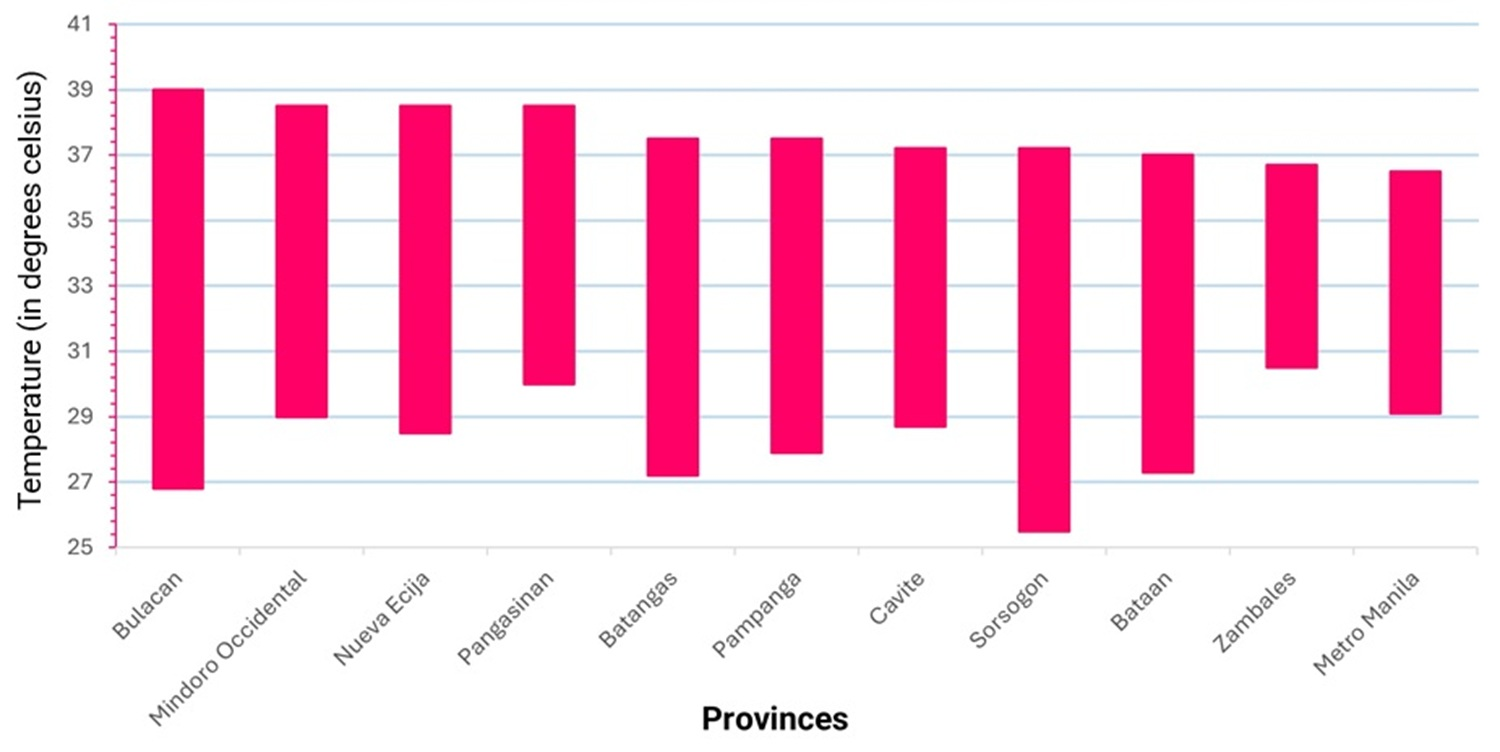
| Province | Maximum highest temperature recorded/date | Minimum highest temperature | Average highest temperature | Standard deviation |
|---|---|---|---|---|
| Bulacan | 25 April—39.0 | 26.8 | 33.7 | 2.5 |
| Mindoro Occidental | 20 April—38.5 | 29.0 | 34.9 | 1.7 |
| Nueva Ecija | 22 April—38.5 | 28.5 | 34.2 | 2.4 |
| Pangasinan | 8 April—38.5 | 30.0 | 33.3 | 1.6 |
| Batangas | 21 April—37.5 | 27.2 | 33.3 | 2.3 |
| Pampanga | 20 April—37.5 | 27.9 | 33.7 | 2.2 |
| Cavite | 16 April—37.2 | 28.7 | 33.8 | 2.1 |
| Sorsogon | 16 March—37.2 | 25.5 | 30.8 | 2.0 |
| Bataan | 28 April—37.0 | 27.3 | 33.1 | 1.8 |
| Zambales | 16 May—36.7 | 30.5 | 32.9 | 1.2 |
| Metro Manila | 17 April—36.5 | 29.1 | 33.8 | 1.9 |
The Philippines will continue to experience rising temperatures, even during months that are usually characterized by milder conditions (PAGASA n.d.a; IPCC 2021). Mean temperatures are anticipated to rise by 0.9°C to 1.1°C in 2020 and by 1.8°C to 2.2°C by 2050. The highest temperature increase is expected during the summer season, March–May (PAGASA n.d.b). Particularly in elections that take place during the summer season, extreme heat is likely to affect voters, poll workers and electoral logistics.
Climate change can directly explain why extreme weather events, such as the prolonged and intense heat experienced in the Philippines between December 2024 and May 2025, have become more frequent and severe. According to a recent study of megacities, Manila has a Climate Shift Index (CSI) of 69 days, with average temperatures 0.4°C above normal (Climate Central 2025; see Table 2).
Power supply
Availability of stable and uninterrupted power is critical in the administration of elections. The Department of Energy made this explicit in committing to ‘supporting the safe, orderly, and uninterrupted conduct of the elections by safeguarding the integrity of energy services throughout the voting, transmission, and canvassing periods’ (Department). The Philippine power supply is characterized by a fragmented grid system, with three main grids in Luzon, Visayas and Mindanao. While the Luzon and Visayas grids are interconnected by a high-voltage direct current line, the Mindanao grid remains largely isolated—hence the Mindanao-Visayas Interconnection Project is underway. This lack of complete interconnection presents challenges in terms of electricity costs, reliability and access, particularly for smaller islands (RTVM 2024).
The months of April, May and June typically experience peak demand due to increased electricity consumption for cooling purposes as temperatures rise
In its 2023–2050 plan, the Department of Energy elaborates the current energy mix as largely based on fossil fuels—oil and coal comprise over 60 per cent (Figure 3). Hydroelectric power, which supplies 4.1 per cent of the power requirements (Department of Energy n.d.), is directly affected by the lack of water during hotter months.
| Continent | Country | Megacity | Days at CSI 2 or higher | Seasonal temperature anomaly (C) |
|---|---|---|---|---|
| Africa | Nigeria | Lagos | 89 | 1.0 |
| Asia | India | Tamil Nadu | 81 | 1.0 |
| Asia | Philippines | Manila | 69 | 0.4 |
| Asia | Indonesia | Jakarta | 69 | 0.7 |
| Africa | Democratic Republic of the Congo (Kinshasa) | Kinshasa | 57 | 0.6 |
| North America | Mexico | Mexico City | 49 | 0.5 |
| Asia | India | Maharashtra | 36 | 1.2 |
| Asia | India | Telangana | 36 | 0.8 |
| South America | Brazil | Sao Paolo | 34 | 0.4 |
| Asia | Iran | Tehran | 34 | 1.6 |
| Asia | India | Karnataka | 31 | 0.7 |
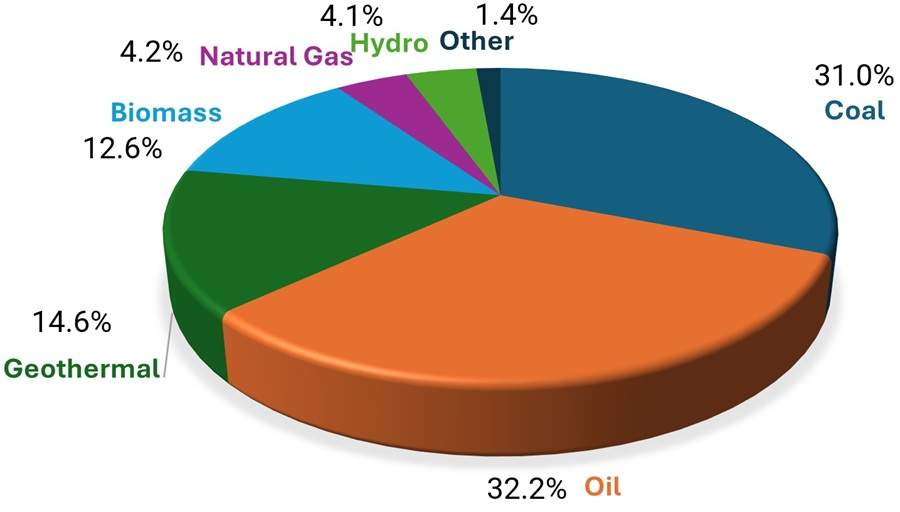
In early March 2025, the Institute of Climate and Sustainable Cities (ICSC) issued a yellow alert for Luzon because of the surge in electricity demand and a significant reduction in supply due to forced outages of baseload power plants (ICSC 2025). A yellow alert signifies that the available power reserves are low, and the system is operating with a reduced margin to meet demand—potentially leading to power interruptions if there are any unexpected plant outages or increased demand. It warns that the system is vulnerable and proactive measures are needed to prevent a more serious situation (Esmael 2025).
In 2024, the National Grid Corporation of the Philippines (NGCP) issued 62 such yellow alerts, as well as 16 red warnings (Lagare 2024). However, on 5 March 2025, the general power supply situation had improved as Luzon was the only island of the country placed on yellow alert (Jose 2025). During the 2022 presidential and national elections, which were also held during a heatwave (Tan 2022), 201 brief and isolated power outages occurred at the municipal level (Crismundo 2022)—undermining voter experience and COMELEC’s capacity to uphold transparency and credibility. This is why in the 2025 elections, contingency plans were made to ensure a ‘brownout-free election’. The NGCP suspended all maintenance activity and ensured that all transmission lines were cleared of vegetation and other obstructions. It also assured the public that in case of power tripping on election day, line crews, engineers, pilots, maintenance and testing personnel, and other technical staff were positioned and ready to respond (Adriano 2025; Galang 2025).
While COMELEC operations can be affected by power outages, vote-counting machines are the least affected. This is because each machine has a battery that allows operations throughout and beyond the 12-hour voting period. This is a precautionary measure borne out of the fact that the power supply in the country is unevenly distributed and power outages could occur without warning.
The heatwave and the 2025 national elections
Candidates of national-level elective positions had a 90-day campaign period, while those for locally elected posts had 45 days. The beginning dates were 11 February and 28 March, respectively, both campaigns ending on 10 May (with a one-day silence period before the polls on 12 May) (see Figure 4 and Table 3). This period, when COMELEC’s logistical preparations were also fully underway, coincided with the highest maximum temperatures of the summer.
COMELEC’s activities during this period involved printing of the paper ballots, preparing and testing the thousands of vote-counting machines (VCM—also sometimes known as automated counting machines, ACM), and packing and shipping election materials. New polling officials needed training, and since the vote-counting machines for these elections were all new (from Miru Solutions of South Korea), all polling officials had to be trained to operate them.
The printing of official ballot papers was done within the National Printing Office premises using special paper sized for the vote-counting machines. On 15 March, COMELEC reported having printed all 68.54 million ballots (Sampang 2025b). All paper ballots then needed to be verified, a process where each is fed into a machine to check if it is readable. COMELEC reported that verification of the final batch of ballots designated for the National Capital Region, where the NPO is located, would be completed by 21 April (Sampang 2025b). COMELEC received its full order of 110,620 voting machines in late 2024. Based on the terms of the contract, each machine had to go through hardware acceptance tests and configuration. These were conducted at the COMELEC warehouse in Biñan City, Laguna. After completion and as early as a month before election day, COMELEC started shipping machines and other components to regional staging areas or hubs through a transport and logistics contractor. The machines would then be distributed to the polling centres in time for the schedule of the Final Testing and Sealing (FTS). During interviews for this report, COMELEC’s Offices of the Provincial Election Supervisors of Bulacan and Pangasinan, as well as with the NCR Regional Election Director, noted that although the extreme heat did not directly affect logistical operations, regional offices had taken their own precautionary measures (Laoc, Deseo and Jeung 2025; see Annex A for interview guide). For example, they ensured that vote-counting machines were placed in well-ventilated areas, and that training for election personnel was conducted in either air-conditioned venues or adequately ventilated spaces.
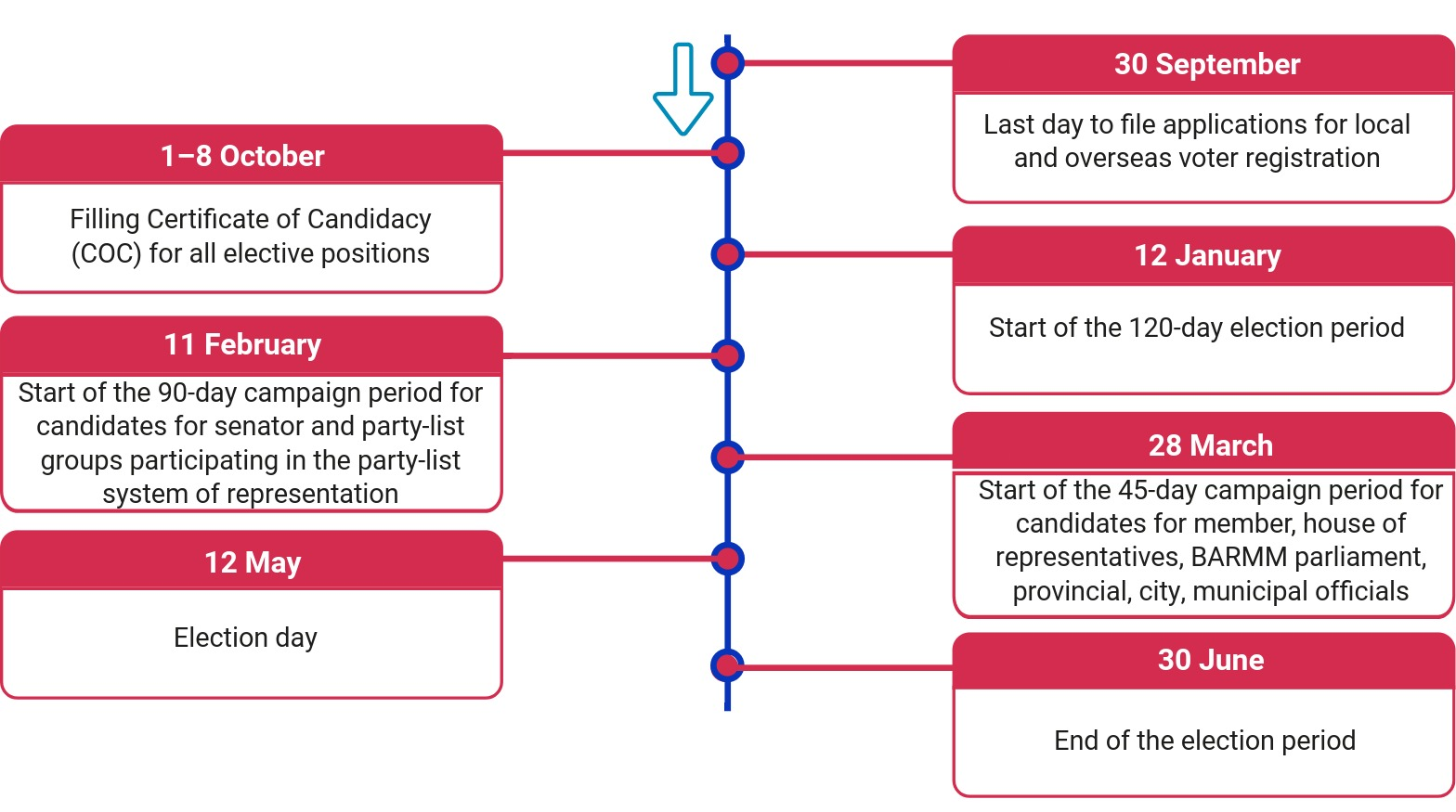
The Election Automation Law, also known as the Republic Act 9369 (Philippines 2007), requires COMELEC to test all vote-counting machines at the polling stations prior to their use to ensure functionality, readiness and accuracy. Between 2 and 12 May, this FTS was carried out nationwide (Republic of the Philippines 2007). The process involved polling station officials, and in some cases, candidates/representatives of political parties, election observers and the media. The representatives present were asked to fill out 10 test ballots which were then read by the machine, with the results verified against a printout. After verification, the results were transmitted to COMELEC’s remote servers and cross-checked. After the results were ascertained as correct and accurate, the machine would be sealed, to be unsealed only on election day, just before voting started.
On the day of FTS, the average maximum temperature recorded nationwide was 36.1°C (with a standard deviation of 0.79°C). While the ambient high heat might have caused discomfort among the participants, the FTS was done indoors in the polling stations (with just a few people inside) and did not appear to be affected by the heat.
Impact of heat on election management
Impact on voter registration
The Republic Act No. 8189, or Voter’s Registration Act, (Philippines 1996) provides for a system of continuing registration. All year round, citizens who will turn 18 years of age on or before election day may register by visiting the COMELEC office where they reside. Data shows that first-time voters in 2025, those aged between 17 and 20, comprise 6.22 per cent of the population or 4.25 million out of the 68.43 million in-country voters who were registered in 2025 (COMELEC 2025b).
The continuous voter registration process does not seem to have been much affected by the heatwave—or even by periods of heavy rain and typhoons in the second half of 2025. This is because those who want to register choose the day that is most convenient for them to visit the COMELEC office, where biometric information is submitted to complete the registration process. COMELEC has also deployed satellite voter registration centres outside its offices by collaborating with 170 malls, universities and other institutions nationwide to simplify and expand access
Before the 2025 elections, COMELEC further launched an online voter registration application system for in-country and out-of-country voters, called iRehistro (COMELEC 2023). Applicants provide all the necessary documentation online and personally attend COMELEC premises only to submit biometric information.
Impact on campaigning
Due to increasing temperatures and dangerously high heat indexes, typical campaign activities—rallies, motorcades and house-to-house visits under the hot sun—were more physically draining and carried increased risk of heat-related illnesses. Some campaigns installed air conditioning in open-air cars used in their motorcades as a health and safety measure (De Venecia 2025). The president of the Federation of Free Workers, who ran for the Senate, warned that ‘politicians must also encourage their campaign workers and volunteers to take the essential precautions—staying hydrated, wearing protective clothes, taking breaks in shaded areas, and changing schedules to avoid high heat hours’ (Ordonez, Atienza and Hufana 2025).
| National elective positions | Campaign period |
|---|---|
| Senators | 11 February to 10 May 2025 |
| Part-list representatives to congress | |
| Local elective positions | Campaign period |
| Governor | 25 March to 10 May 2025 |
| Vice-governor | |
| Provincial councilors | |
| District representative to congress | |
| Mayor | |
| Vice-mayors | |
| City or municipal councilors |
The Office of Civil Defense issued a Memorandum No. 66, s. 2025, urging local disaster risk reduction agencies as well as the management councils (DRRMCs) to prepare for the coming heatwave and its implications for heat exhaustion and heat stroke. The memo instructed the body’s regional directors to coordinate with national and local agencies to continuously monitor the conditions through the NDRRMC dashboard, stock protective gear and medical supplies, and ensure that they had vehicles readily available for deployment (De Leon 2025).
Those who live in warmer climates recognize the need to avoid outdoor activities during the warmest hours of the day. Traditional farming practices, still practiced today, reflect this wisdom: farmers who use cows and carabaos (water buffalo) often start plowing fields at early light and stop at 10:00, resuming work only after the temperature begins to cool in the afternoon. COMELEC officials noted that the campaign schedules proposed by contestants for its approval took place in the morning and late afternoons into early evening. Campaign events were generally held indoors in covered courts or gyms. There was no fixed schedule for house-to-house campaigning, as the candidates adjusted their activities depending on the heat.
Impact on logistics–Voter Information Sheet
COMELEC is required by the Republic Act 7904 to furnish each voter with a Voter Information Sheet (VIS) with the voter's personal details and simplified instructions as to the casting of votes: ‘The names of the candidates shall be listed in alphabetical order under their respective party affiliation and a one-line statement not to exceed three (3) words of their occupation or profession’ (Philippines 1995).
COMELEC encouraged voters to use the VIS to note down their choices of candidates and refer to it at the polling station when they vote. The distribution of the VIS was done through a third party, the contract being awarded through a local-level bidding process. A COMELEC provincial official noted that some parties refused to bid, citing the heat and the amount of work required for the distribution to be done all day, even at midday. In places where COMELEC could not find a suitable contractor, it asked village officials to help distribute the VIS.
Impact on logistics–Vote-Counting Machines
Since 2010, COMELEC has used machines to read and count votes marked on specially printed paper ballots. The internationally sourced machines, which use optical mark reader technology, are deployed in each polling station throughout the country. In 2025, a total of 127,000 such machines were purchased, 27 per cent of which served as back-up or replacement.
Since the VCMs used in 2025 were procured from a new supplier, almost 190,000 polling staff had to undergo training. Starting in March, municipal-level training of polling officials was held throughout the country (Sampang, 2025a). According to COMELEC officials, training sessions took place indoors, sometimes in hotels and similar establishments where the temperature was controlled or made more bearable through the use of cooling fans. None of the COMELEC officials interviewed cited heat as a factor that interfered with the training.
As early as in the third quarter of 2024, COMELEC conducted a national roadshow where the VCM and its features were introduced and demonstrated to the public—in schools, malls and other public areas. COMELEC respondents described the roadshows as a real-life ‘stress test’ for the VCMs’ operating environment. The machines were subjected to the rigours of being transported—from rough mountainous terrain to water crossings to extreme heat and damp conditions. Many hardware sensitivities were identified, enabling COMELEC to remedy these before election day. COMELEC specified conditions under which the machines were to be stored, such as well-ventilated warehouses or other locations. When finally delivered to the polling location (usually a school), they were likewise kept in well-ventilated rooms.
Impact on election day and run-up
On 27 March, COMELEC, the Department of Health, the Department of Interior and Local Government (DILG) and the Philippine Red Cross entered into a memorandum of agreement that aimed ‘to ensure that voters and persons rendering election-related services have easy access to free first-aid assistance, medicine, and emergency medical services during the 2025 national and local elections … and every election thereafter’. This alliance of organizations encouraged city and municipal governments to set up a health station or similar in all voting centres ‘with necessary resources, essential medicines, and an ambulance to provide free, timely, and effective first-aid assistance’ (DILG 2025b). While climate risks were not mentioned in the agreement, awareness of heat-related health issues was among the reasons for making health services readily available during polling.
PAGASA warned voters to take precautionary measures against heat-related illnesses on election day, noting that 28 areas across the country could expect extreme heat (PAGASA 2025). PAGASA placed several areas under the ‘danger’ classification with a forecast heat index ranging from 42°C to 45°C (Laqui 2025). PAGASA urged voters to avoid queuing during the peak heat hours of 10:00 to 15:00 to wear light clothing and to stay hydrated (Eguia 2025). Among those vulnerable to heat-related illness were seniors aged 60 and above, who comprised 16.8 per cent (11.7 million) of the registered voters (COMELEC 2025c, 2025f).
On election day itself, the Department of Health posted a reminder to voters to be ‘vigilant against heat-related illnesses … and to take basic precautions to protect their health while lining up and casting their ballots’ (Santos 2025). Citing data and the ‘danger level’ warning from PAGASA, the Department of Health advised the public to wear light clothing and keep themselves hydrated (Montemayor 2025).
As expected, health issues attributed to high heat were reported on election day. In the town of Tulunan in Cotabato province, six people collapsed while queuing to vote. At least 10 voters were brought to the medical tent inside the school after complaining of unease, which was later found to be caused by high blood pressure. On that day, the temperature in the municipality was 37°C (Magbanua 2025).
In Oas, Albay, a 65-year-old man felt dizzy inside the polling station in Central School; shortly after voting, he collapsed and died. According to the Bicol Police Regional Office, heat was the likely cause (Ogerio 2025). Nationwide, the Red Cross recorded heat-related incidents involving 11,531 people
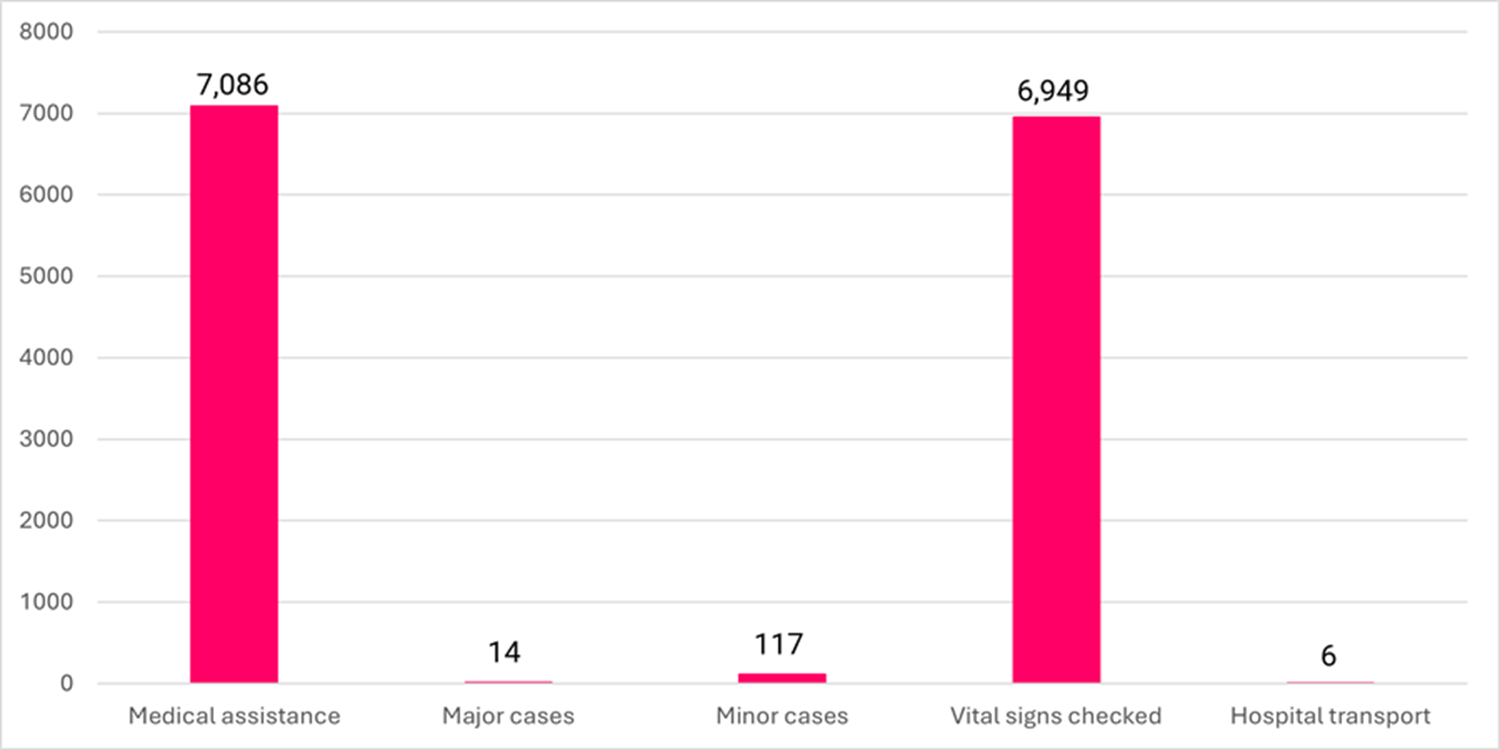
According to the COMELEC officials interviewed, voters themselves took practical precautions and chose a more convenient time to go to the polling station. Some waited until the sweltering heat eased, while others purposely braved the midday heat, knowing that queues would be shorter at those times. Depending on the population of the village, the size and location of the school building (as polling station), queues could spill out of the school premises and snake into the street, exposing voters directly to the hot sun (see Figure 6).
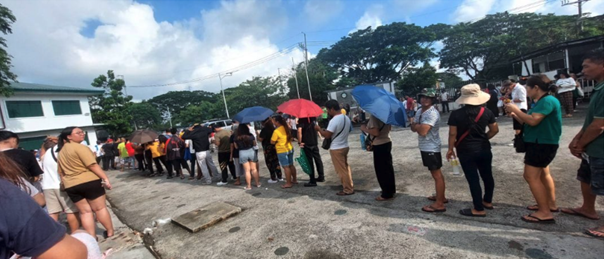
Polling staff noted that the long queues started to ease at 10:30 as the temperature rose. On past experience they expected that queues would build again from 15:00 when the heat recedes (
As a precautionary measure against overcrowding, COMELEC officials specified that polling stations within school premises must not be adjacent to each other. They selected well-ventilated classrooms and in some cases pitched tents to provide shade to voters waiting for their turn to vote. Other agencies, particularly local government units, were requested to help with cooling fans and water dispensers to place in the holding areas. Ventilation of the holding areas was critical because while it took on average 10 minutes for a voter to complete the process; the wait time could be longer because polling stations were set up to take only a maximum of 10 voters at any given time. The maximum number limit is determined more by the size of the classrooms—typically 63 square metres—than by any other factor.
On the whole, the NDRRMC situational report noted that the extreme heat and associated risks had been given utmost consideration, with various agencies and local government units preparing contingency plans to address them (NDRRMC 2025). This represents a significantly raised awareness of climate risk, including as it affects elections.
The ‘game changers’ in mitigating this risk, according to COMELEC, were early hours of voting and voting in the malls. In highly urbanized and densely populated areas, school buildings are clustered among other buildings, which reduces natural aeration and therefore requires ventilation from cooling fans. But under ambient high heat, these fans could not do much except to move hot air around. To help address this, COMELEC designated 42 malls throughout the country as polling centres, in agreement with owners. Voters registered at nearby polling stations could cast their votes at these new venues.
Early voting hours voting was arranged from 05:00 to 07:00, when the sun is still low, exclusively for pregnant women, the elderly and persons with disabilities. Regular voting would then continue from 07:00 until 19:00. COMELEC also provided Accessible Polling Places (APPs) on the ground floor of each polling center, ideally near the building's entrance. APPs are free of physical barriers and provide all essential services, including assistive equipment. Emergency Accessible Polling Places, meaning rooms or tents installed on the ground floor of multilevel polling facilities, were intended to make voting easier for people with disabilities, senior citizens and pregnant women (COMELEC 2025d art.1).
Vote-counting machines (VCMs)
The COMELEC and polling officials reported malfunctioning of some machines, which they attributed to internal heat buildup caused in part by high ambient temperatures. At the New Era Elementary School polling centre in Quezon City, Metro Manila, overheated machines ejected ballots that they had previously accepted (Antalan 2025). In past elections, polling officials reportedly directed cooling fans at the VCMs, suspecting heat was the reason for malfunctions; such incidents were noticeably fewer in 2025, aided by improved knowledge of machine operation among many polling staff.
The procedure for rejected ballots is stated in Section 46 of Resolution 11076 General Instructions for Voting, Counting, and Transmission of Results. If the VCM screen displays the ‘Misread Ballot’ message, the voter is allowed to re-feed the ballot paper in four different orientations (COMELEC 2024). This means flipping the paper on the long side and on the short side until it is accepted by the machine.
COMELEC assured the public that the ink (applied on voters’ fingers to indicate that they had already cast their votes) was ‘not expired’, and ‘any change in their colour or effectiveness may have been caused by the unusually high temperatures on election day’ (Antalan 2025). This would warrant a determination of the heat sensitivity and photosensitivity of silver nitrate, on which (indelible) election ink is based and also whether COMELEC’s specifications for bidders/suppliers, including packaging, are adequate for hot conditions.
Voter turnout
Voter interest in Philippine elections in 2025 was characteristically and comparatively high. The average turnout in presidential elections is 79.2 per cent, and in midterm elections, it is 77.7 per cent. The number of registered voters had increased by 12.78 per cent since 2019—from 61.8 to 69.7 million in 2025. Turnout in these midterm elections was 83.4 per cent, compared with 79.5 per cent in 2022 (presidential) and 83.4 per cent in 2019 (midterms). The reasons for high turnout are as follows:
First, with all positions (except for president and vice-president) contested, midterms involve a flurry of activity to drum up interest among voters. Elections are generally described as ‘festive’. The long campaign season of 90 days adds to the ubiquity of campaigns events, campaign posters and political advertising on various media—making it impossible for anyone to ignore the elections. Election day is a public holiday, held on a Monday, and thus a long weekend.
| Presidential | Mid-term | |
|---|---|---|
| Average | 97.2% | 77.7% |
| Std dev | 3.6% | 3.8% |
| Year | Type of election | Turnout |
| 2025 | Mid-term | 83.1% |
| 2022 | Presidential | 82.6% |
| 2019 | Mid-term | 74.3% |
| 2016 | Presidential | 80.7% |
| 2013 | Mid-term | 75.8% |
| 2010 | Presidential | 74.3% |
Second, COMELEC pursues enfranchisement of all who are qualified to vote. To its credit, the commission has made significant efforts through assertive and accessible voter registration in- and out-of-country; improving access to Indigenous communities, persons deprived of liberty (prisoners who are qualified to vote) and the ‘vulnerable sector’ (senior citizens, persons with disabilities and pregnant women); and making voting easier via the internet and at malls.
Third, the use of the VCMs has increased public acceptance of the election results, stating in a report on the 2022 elections by the Carter Center, ‘the use of VCMs is widely accepted by voters’ (The Carter Center 2024, p. 22). Previously, manual counting took between two weeks and one month for votes to be consolidated and reported—a delay in which doubts about the integrity of systems could circulate. Now, results start to come in as early as one hour after polling closes, and by morning the following day, almost all results are already known.
Table 5 compares the number of voters in the 2019 and 2025 midterm elections in NCR (column 2), which show a net increase of 7.1 per cent, with a standard deviation of 18.2 per cent. The comparative turnout in these two elections (column 3) also showed a net increase of 9.1 per cent, with a standard deviation of 4.6 per cent.
| City in the National Capital Region | Increase/decrease in voters (%) | Increase/decrease in turnout (%) |
|---|---|---|
| Las Piñas | -3.0 | 16.6 |
| Muntinlupa | -7.8 | 13.6 |
| Caloocan | 6.4 | 13.6 |
| Mandaluyong | -2.5 | 12.3 |
| Manila | 7.2 | 12.2 |
| Taguig-Pateros* | 50.4 | 11.1 |
| Quezon City | 9.3 | 10.6 |
| Malabon | 5.2 | 10.2 |
| Pasay City | 2.5 | 8.9 |
| Parañaque | 7.4 | 8.6 |
| Marikina | 28.4 | 7.8 |
| Makati* | -40.3 | 6.9 |
| Pasig | 5.2 | 6.7 |
| Valenzuela | 16.0 | 6.2 |
| Navotas | 7.7 | 3.3 |
| San Juan | 21.3 | -3.5 |
Comparing the number of voters in 2019 and 2025 in the most populous provinces (Table 6), voter registration went up by an average of 10.6 per cent, with a standard deviation of 3.9 per cent. The comparative turnout showed 6.0 per cent more voters participated (with a standard deviation of 1.6 per cent) in 2025 compared to the previous midterm elections in 2019.
| Top 20 provinces with the most voters | Increase/decrease in voters (%) | Increase/decrease in turnout (%) |
|---|---|---|
| Cebu | 10.5 | 4.6 |
| Cavite | 13.9 | 8.5 |
| Pangasinan | 10.8 | 6.4 |
| Laguna | 12.5 | 5.0 |
| Negros Occidental | 6.0 | 7.5 |
| Bulacan | 16.6 | 6.8 |
| Batangas | 14.1 | 8.1 |
| Rizal | 3.1 | 8.1 |
| Iloilo | 8.2 | 5.1 |
| Nueva Ecija | 10.9 | 7.3 |
| Pampanga | 14.7 | 6.5 |
| Davao del Sur | 4.4 | 3.5 |
| Leyte | 8.4 | 5.4 |
| Quezon | 16.5 | 6.2 |
| Camarines Sur | 12.0 | 3.9 |
| Zamboanga del Sur | 7.9 | 3.0 |
| Isabela | 7.1 | 6.2 |
| Misamis Oriental | 14.1 | 5.1 |
Comparing the turnout in the 2019 and 2025 elections in the top 20 provinces where the highest 2025 temperatures were recorded (Table 7) showed a similar average increase in turnout of 6.3 per cent, with a standard deviation of 1.9 per cent.
| Provinces (in order of highest temperatures recorded) | 2025 Turnout (%) | Increase/decrease vs. 2019 elections (%) |
|---|---|---|
| Bulacan | 85.0 | 6.8 |
| Occidental Mindoro | 79.6 | 3.6 |
| Nueva Ecija | 83.3 | 7.3 |
| Pangasinan | 86.8 | 6.4 |
| Batangas | 86.7 | 8.1 |
| Pampanga | 84.7 | 6.5 |
| Cavite | 78.6 | 8.5 |
| Sorsogon | 85.9 | 5.2 |
| Bataan | 84.5 | 5.8 |
| Zambales | 83.2 | 6.4 |
| Ilocos Norte | 89.0 | 6.5 |
| Samar | 80.4 | -0.3 |
| Eastern Samar | 86.1 | 6.7 |
| Zamboanga del Sur | 84.6 | 6.0 |
| Davao del Sur | 81.9 | 6.7 |
| Cotabato | 84.6 | 7.5 |
| Cagayan | 85.8 | 8.5 |
| Palawan | 84.0 | 7.6 |
| Ilocos Sur | 88.8 | 5.5 |
| South Cotabato | 84.1 | 6.7 |
Conclusion and recommendations
The 2025 Philippine general elections unfolded during one of the longest and most intense heatwave periods in recent history. Protecting elections under these conditions required coordinated, multilayered safeguards aimed at ensuring both electoral integrity and public safety.
COMELEC’s mandate to access the machinery and resources of the state in support of holding credible elections allows it to mitigate and address risks. In a whole-of-government approach, COMELEC is thus able to optimize resources and provide synergy in its responses down to the local level, including the removal of bureaucratic hurdles normally associated with nationally centralized agencies. While flooding and fire were among the scenarios that COMELEC had identified in its risk planning, extreme heat was not. Many areas in the country are prone to flooding aggravated by high tides, for example in the province of Bulacan where flood preparations were put in place. In this case, the Election Coordination Committee (spearheaded by COMELEC) included the Provincial Disaster Risk Reduction and Management Office; the Health Department, including the village-level health staff; the provincial Department of Local Government, which included police; the Bureau of Fire Prevention; the privately owned power utility; and others.
While general risk management is well developed, the 2025 elections thus revealed both the urgency and feasibility of embedding climate resilience into electoral governance. In the short term, several fixes can be mainstreamed into election operations within the next three years. These include standardizing health and safety measures at polling places—such as hydration points, first-aid posts and ambulance access—so that such provisions are not improvised but mandated. Clear communication with voters, polling officials and contestants on safe voting hours, protective clothing and other heat precautions should also become routine practice.
Expanding the use of climate-controlled venues (such as malls) and early-hours voting appears a feasible way to reinforce protection for voters and polling staff. Just as importantly, specifications for VCMs to be able to operate in high or higher temperatures and humidity (above the usually stated maximum operating temperature of 40°C) might need to be put in place.
The COMELEC officials interviewed for this paper cited microclimates—the differing temperature conditions within a province. Thus, different mitigating measures would also be required. The authors recommend that COMELEC issue a policy that supports the current setup, similar to the Election Coordinating Committee in Bulacan, but to authorize its local officials to institute appropriate measures to address risks such as those associated with extreme heat. The limits to forecasting microclimates is due to the relatively small number of weather sensors serving PAGASA—59 weather stations in 45 (of the 81) provinces. As weather patterns become more varying and unpredictable, local governments, such as the municipalities, might see the need to have their own weather sensors. COMELEC would then be able to use these to activate locally tailored measures based on heat triggers.
It would be incumbent on COMELEC to develop data-driven early-warning and evaluation mechanisms linking temperature, turnout and incident reports to refine its preparedness and guide resource allocation in future election cycles.
National (civil society) election observers play a prominent role in Philippine elections, particularly on election day. These could set up Voter Assistance Desks in polling centres to provide voting-related information and help voters locate their precincts. They could also provide advisories to voters, especially those queuing outside the polling stations, on precautions and mitigation measures. The more they are involved in this, the more likely they are to be consulted on improving heat mitigation measures more widely.
A longer-term reform, but one that could be initiated right away, is to make public schools—the backbone of COMELEC’s polling station network, but owned and maintained by the Department of Education—more climate-resilient. The Department could make thermometers standard equipment in schools and have thermal standards and appropriate warnings and remedies during hot conditions. This could become a standard for COMELEC to follow in operating polling stations on election day.
Internet voting was successfully piloted for the first time for overseas voters in the 2025 elections. Enabling the ‘ballot going to the voter’ as opposed to the ‘voter going to the ballot’, internet voting may be more resilient to climate risk, a factor to weigh in considering its expansion.
Regarding voter registration, from 1–10 August 2025, COMELEC pilot-tested the ‘Register Anytime, Anywhere’ programme—a system whereby voter registration could be conducted in selected hospitals, call centres, air and other transport terminals and other public places (Patinio 2025). Here again, roll-out of the change would make processes not only more accessible and convenient but also more resilient to climate-related events.
Summary of recommendations
The 2025 experience demonstrates the need to institutionalize climate adaptation:
- Integrate climate-risk management institutionally by formally embedding high-tempratures and other climate hazards within the COMELEC’s electoral risk management framework and its resolutions governing election-periods;
- Leverage COMELEC’s constitutional and overarching mandate deputizing any and all agencies of the state in pursuit of credible elections—to proactively mitigate heat and climate change-related issues;
- Adapt technical specifications of VCMs, ballots and other sensitive equipment to withstand higher temperatures and humidity;
- Develop data-driven early-warning and evaluation mechanisms linking temperature, turnout and incident reports, for example, to refine preparedness and guide resource allocation in future cycles; and
- Expand the use of ‘Register Anywhere’ to make voter registration more accessible and climate resilient. Continue expanding voting in shopping malls and other suitable climate-controlled places, which have proved beneficial to voters and polling staff.
References
Abello, L. T., ‘It’s too hot! Why some areas in the Philippines have hotter temperatures’, Manila Bulletin, 18 April 2024, <https://mb.com.ph/2024/4/18/it-s-too-hot-why-some-areas-in-the-philippines-have-hotter-temperatures-1>, accessed 6 November 2025
Adriano, L., ‘NGCP implements contingency measures for May 12 polls’, Philippine News Agency, 9 May 2025, <https://www.pna.gov.ph/articles/1249754>, accessed 6 November 2025
Angelo, F. A. L., ‘PHL endures extreme heat as climate change intensifies’, Daily Guardian, 24 March 2025, <https://dailyguardian.com.ph/phl-endures-extreme-heat-as-climate-change-intensifies/#google_vignette>, accessed 6 November 2025
Antalan, M., ‘COMELEC blames extreme heat for ballot ejection from counting machines’, DZRH, 12 May 2025, <https://dzrh.com.ph/post/comelec-blames-extreme-heat-for-ballot-ejection-from-counting-machines>, accessed 6 November 2025
Ateneo De Manila, ‘COMELEC Register Anywhere Project held onsite at Ateneo’, 29 April 2024, <https://www.ateneo.edu/news/2024/04/29/comelec-register-anywhere-project-held-onsite-ateneo>, accessed 6 November 2025
Baclig, C. E., ‘Explainer: Voter registration for 2025 elections’, Inquirer.net, 25 September 2024, <https://newsinfo.inquirer.net/1986839/explainer-voter-registration-for-2025-elections>, accessed 6 November 2025
Carter Center, ‘Philippines final report’, 2024, <https://www.cartercenter.org/wp-content/uploads/2024/03/philippines-final-report-050922.pdf>, accessed 27 November 2025
Climate Central, People exposed to climate change: December 2024–February 2025 (Princeton, NJ: Climate Central, 2025), <https://www.climatecentral.org/report/people-exposed-to-climate-change-dec2024-feb2025>, accessed 6 November 2025
Commission on Elections, Republic of the Philippines, ‘iRehistro’, 16 October 2023, <https://comelec.gov.ph/?r=VoterRegistration/iRehistro>, accessed 8 November 2025
—, ‘Resolution No. 11055’, 13 September 2024, <https://comelec.gov.ph/php-tpls-attachments/2025NLE/Resolutions/com_res_11055.pdf>, accessed 8 November 2025
—, ‘2025 NLE Specific Modes of Overseas Voting (Final)’, 5 February 2025a (amended 15 January 2025), <https://comelec.gov.ph/?r=OverseasVoting/2025_EOV/2025NLESpecificModesOfOverseasVoting/02052025_2025NLE_SMOV_FINAL>, accessed 8 November 2025
—, ‘Statistics’, updated 25 March 2025b, <https://comelec.gov.ph/?r=2025NLE/Statistics>, accessed 8 November 2025
—, ‘Data on the number of registered voters by single year age and sex [spreadsheet]’, 12 May 2025c, <https://docs.google.com/spreadsheets/d/1VpGsCoOb7Wt6PLmiDf5V3ljuSLuKjToc7B1tc-IjXDs/edit?usp=sharing>, accessed 26 November 2025
—, ‘Resolution No. 11076’, 12 May 2025d, <https://comelec.gov.ph/php-tpls-attachments/2025NLE/Resolutions/com_res_11076.pdf>, accessed 26 November 2025
Crismundo, K., ‘201 brief power interruptions reported on Election Day’, Philippine News Agency, 9 May 2022, <https://www.pna.gov.ph/articles/1174024>, accessed 6 November 2025
—, ‘DOE urges consumers to save power for summer’, Philippine News Agency, 13 March 2023, <https://www.pna.gov.ph/articles/1197261>, accessed 6 November 2025
De Leon, J., ‘Local DRRMCs asked to prep for heat wave’, SunStar, 5 March 2025, <https://www.sunstar.com.ph/pampanga/local-drrmcs-asked-to-prep-for-heat-wave>, accessed 6 November 2025
Department of Energy, ‘DOE mobilizes energy sector to ensure uninterrupted power for 2025 National and Local Elections’, 5 May 2025, <https://legacy.doe.gov.ph/press-releases/doe-mobilizes-energy-sector-ensure-uninterrupted-power-2025-national-and-local>, accessed 6 November 2025
—, ‘Philippine energy plan 2023–2050’, [n.d.], <https://legacy.doe.gov.ph/pep>, accessed 6 November 2025
Department of the Interior and Local Government (DILG), ‘Memorandum Circular No. 2025-046’, 2025, <https://dilg.gov.ph/PDF_File/issuances/memo_circulars/dilg-memocircular-202559_e8ca6a872c.pdf>, accessed 17 August 2025
De Venecia, J. C., ‘Battling the scorching heat’, Manila Bulletin, 8 March 2025, <https://mb.com.ph/2025/3/8/battling-the-scorching-heat>, accessed 6 November 2025
Dito sa Pilipinas, ‘March 2025 sees Record-Breaking Heat’, [n.d.], <https://ditosapilipinas.com/national/news/article/03/11/2025/march-2025-record-breaking-heat/1402>, accessed 12 August 2025
Eguia, A. D., 'Warm, humid weather expected on Election Day,' Daily Tribune, 11 May 2025, <https://tribune.net.ph/2025/05/11/warm-humid-weather-expected-on-election-day>, accessed 6 November 2025
Esmael, L. K., ‘NGCP puts Visayas, Mindanao power grids on “Yellow Alert”’, Inquirer.net, 1 August 2025, <https://business.inquirer.net/538844/ngcp-puts-visayas-mindanao-power-grids-on-yellow-alert>, accessed 6 November 2025
Galang, G. C., ‘NGCP halts substation maintenance, clears lines ahead of 2025 elections’, Manila Bulletin, 8 May 2025, <https://mb.com.ph/2025/05/08/ngcp-halts-substation-maintenance-clears-lines-ahead-of-2025-elections>, accessed 6 November 2025
GMA News, ‘“Danger level” heat index predicted for 5 areas on Friday, April 11, 2025’, 10 April 2025a, <https://www.gmanetwork.com/news/scitech/weather/942331/danger-level-heat-index-predicted-for-5-areas-on-friday-april-11-2025/story/>, accessed 6 November 2025
—, ‘“Danger level” heat index to hit 26 areas on Tuesday, April 22, 2025’, 21 April 2025b, <https://www.gmanetwork.com/news/scitech/weather/943455/danger-level-heat-index-to-hit-26-areas-on-tuesday-april-22-2025/story/>, accessed 13 November 2025
Independent Electricity Market Operator Philippines (IEMOP), ‘Average Electricity Prices Expected To Remain Stable In Q4’, 2024, <https://www.iemop.ph/2024/?post_type=news#:~:text=The%20Luzon%20region%20recorded%20an,6.63%20PhP/kWh%20in%20April>, accessed 6 November 2025
Institute for Climate and Sustainable Cities (ICSC), ‘ICSC: Luzon’s first yellow alert in 2025 warns of more grid alerts this dry season’, 7 March 2025, <https://icsc.ngo/icsc-luzons-first-yellow-alert-in-2025-warns-of-more-grid-alerts-this-dry-season/>, accessed 6 November 2025
Intergovernmental Panel on Climate Change (IPCC), ‘Climate change widespread, rapid, and intensifying’, 9 August 2021, <https://www.ipcc.ch/2021/08/09/ar6-wg1-20210809-pr/>, accessed 6 November 2025
Jose, A. E., ‘Power failure threatens integrity of May 12 Philippine elections’, Business World, 8 May 2025, <https://www.bworldonline.com/the-nation/2025/05/08/671481/power-failure-threatens-integrity-of-may-12-philippine-elections/>, accessed 6 November 2025
Joviland, R., ‘PH Red Cross: Over 7,000 patients sought medical aid on Election Day’, GMA News,13 May 2025, <https://www.gmanetwork.com/news/topstories/nation/946007/ph-red-cross-over-7-000-patients-sought-medical-aid-on-election-day/story/>, accessed 6 November 2025
Lagare, J. B., ‘Nationwide red, yellow alerts raised as power supply thins’, Inquirer.net, 24 April 2024, <https://business.inquirer.net/456089/nationwide-red-yellow-alerts-raised-as-power-supply-further-thins>, accessed 6 November 2025
Laoc, T., Deseo, L. and Jeung, Y., ‘Key informant interviews with COMELEC Offices of the Provincial Election Supervisors of Bulacan and Pangasinan, and the NCR Regional Election Director, conducted for this report’, 2025, unpublished interviews
Laqui, I., ‘Heat index hits 45°C in parts of Philippines on Election Day’, Philstar.com, 12 May 2025, <https://www.philstar.com/headlines/weather/2025/05/12/2442535/heat-index-hits-45c-parts-philippines-election-day>, accessed 6 November 2025
Magbanua, W., ‘6 voters collapsed due to heat in Cotabato town precinct’, Enquirer.net, 12 May 2025, <https://www.inquirer.net/442069/6-voters-collapsed-due-to-heat-in-cotabato-town-precinct/>, accessed 6 November 2025
Magsino, D., ‘Metro Manila records its hottest temperature in 2019 at 36.6°C’, GMA News, 21 April 2019, <https://www.gmanetwork.com/news/scitech/weather/691920/metro-manila-records-its-hottest-temperature-in-2019-at-36-6-deg-c/story/>, accessed 6 November 2025
Mier-Manjares, M. A., ‘Elderly voter dies after casting ballot in Albay’, Inquirer.net, 12 May 2025, <https://www.inquirer.net/441753/elderly-voter-dies-after-casting-ballot-in-albay/>, accessed 6 November 2025
Montemayor, M. T., ‘DOH: Be alert amid “danger” level heat index’, Philippine News Agency, 12 May 2025, <https://www.pna.gov.ph/articles/1249875>, accessed 6 November 2025
Ogerio, B. A., ‘Scorching heat, scattered rains mark Election Day – PAGASA’, BusinessMirror, 12 May 2025, <https://businessmirror.com.ph/2025/05/12/scorching-heat-scattered-rains-mark-election-day-pagasa/>, accessed 6 November 2025
Ordonez, J. V., Atienza, K. A. and Hufana, C. M., ‘Philippine gov’t crafting contingency plan amid extreme heat, says palace’, Business World, 3 March 2025, <https://www.bworldonline.com/the-nation/2025/03/03/656841/philippine-govt-crafting-contingency-plan-amid-extreme-heat-says-palace/>, accessed 6 November 2025
Patinio, F., ‘Comelec trial of “Register Anytime, Anywhere” program set in August’, Philippine News Agency, 10 July 2025, <https://www.pna.gov.ph/articles/1254032>, accessed 6 November 2025
Peña, K. D., ‘43°C heat alters voting behavior in many areas’, Inquirer.net, 12 May 2025, <https://www.inquirer.net/442128/45-degree-celsius-heat-alters-voting-behavior-in-many-areas/>, accessed 6 November 2025
Philippine Atmospheric, Geophysical and Astronomical Services Administration (PAGASA), Observed and projected climate change in the Philippines (Quezon City: PAGASA, 2018), <https://icsc.ngo/wp-content/uploads/2019/07/PAGASA_Observed_Climate_Trends_Projected_Climate_Change_PH_2018.pdf>, accessed 6 November 2025
—, ‘Climatological data: maximum, mean and minimum temperatures, 01 January 2024–30 June 2025', 2025a, <https://www.pagasa.dost.gov.ph/climate/climate-data>, accessed 26 November 2025
—, ‘Special Weather Outlook for 2025 National and Local Elections (12 May 2025)’, 9 May 2025b, <https://www.pagasa.dost.gov.ph/article/178>, accessed 6 November 2025
—, ‘Climate change in the Philippines’ [n.d.a], <https://www.pagasa.dost.gov.ph/information/climate-change-in-the-philippines>, accessed 12 November 2025
—, ‘Climate of the Philippines’, [n.d.b], <https://www.pagasa.dost.gov.ph/information/climate-philippines#:~:text=The%20combination%20of%20warm%20temperature,location%20of%20the%20mountain%20systems>, accessed 6 November 2025
Philippine Red Cross, ‘Ph Red Cross alerts the public against heat-related emergencies amid rising heat indices’, 5 March 2025a, <https://redcross.org.ph/2025/03/05/ph-red-cross-alerts-the-public-against-heat-related-emergencies-amid-rising-heat-indices/>, accessed 10 August 2025
—, ‘Going the Extra mile: Gordon salutes PRC staff, volunteers after successful 2025 election operations’, 10 June 2025b, <https://redcross.org.ph/2025/page/2/>, accessed 6 November 2025
Philippines Statistics Authority (PSA), ‘Highlights of the population density of the Philippines 2020 census of population and housing’, 23 July 2021, <https://psa.gov.ph/content/highlights-population-density-philippines-2020-census-population-and-housing-2020-cph>, accessed 12 November 2025
Philippines, Republic of, ‘1987 Constitution of the Republic of the Philippines’, 1987, <https://lawphil.net/consti/cons1987.html>, accessed 6 November 2025
—, ‘Republic Act No. 7904, 23 February 1995’, 1995, <https://elibrary.judiciary.gov.ph/thebookshelf/showdocs/2/2954>, accessed 6 November 2025
—, ‘Republic Act No. 8189: The Voter’s Registration Act of 1996 [Election law]’, 1996, <https://comelec.gov.ph/?r=VoterRegistration/RelatedLaws/RA8189>, accessed 8 November 2025
—, ‘Republic Act No. 9369: An Act Amending RA 8436, Philippine Senate / House of Representatives, Manila’, 2007, <https://comeleclaw.tripod.com/ra9369.pdf>, accessed 26 November 2025
—, ‘Republic Act No. 10121’, 2010, <https://lawphil.net/statutes/repacts/ra2010/ra_10121_2010.html>, accessed 25 December 2025
RTVM (official Presidential Broadcast Staff – Radio Television Malacañang), ‘Ceremonial Energization of the Mindanao-Visayas Interconnection Project’, 26 January 2024, <https://rtvm.gov.ph/ceremonial-energization-of-the-mindanao-visayas-interconnection-project/>, accessed 17 August 2025
Sampang, D., ‘Comelec to train over 186,000 teachers for 2025 polls’, Inquirer.net, 31 January 2025a, <https://www.inquirer.net/427048/fwd-comelec-to-train-over-186000-eb-members-for-2025-polls/>, accessed 8 November 2025
—, ‘Comelec completes printing of official ballots for 2025 polls’, Inquirer.net, 15 March 2025b, <https://www.inquirer.net/432723/printing-of-ballots-for-2025-polls-now-100-done-comelec/>, accessed 8 November 2025
Santos, J., ‘Voters warned of heat-related illnesses as Filipinos cast ballots’, Manila Bulletin, 12 May 2025, <https://mb.com.ph/2025/05/12/voters-warned-of-heat-related-illnesses-as-filipinos-cast-ballots>, accessed 6 November 2025
Sicat, A., ‘You can now register anywhere: Your guide to Comelec’s nationwide voter registration’, Philippine Information Agency, 23 January 2024, <https://pia.gov.ph/regions/you-can-now-register-anywhere-your-guide-to-comelecs-nationwide-voter-registration/>, accessed 6 November 2025
Tachev, V., ‘The 2025 Heatwave in Southeast Asia: a window into the future’, Climate Impacts Tracker Asia, 2025, <https://www.climateimpactstracker.com/2025-heatwave-in-southeast-asia/#:~:text=2025%20brought%20extreme%20heat%20to,the%20entire%2090%2Dday%20period>, accessed 25 December 2025
Tan, I. R. R., ‘Pagasa warns vs. extreme heat, advises on best time to vote’, Sunstar, 6 May 2022, <https://www.sunstar.com.ph/cebu/local-news/pagasa-warns-vs-extreme-heat-advises-on-best-time-to-vote?utm_source=chatgpt.com>, accessed 13 November 2025
UNDRR, ‘No such thing as a natural disaster’, United Nations Office for Disaster Risk Reduction, viewed 26 November 2025, <https://www.undrr.org/our-impact/campaigns/no-natural-disasters>, accessed 13 November 2025
World Meteorological Organization, ‘Extreme heat impacts millions of people’, 7 August 2025, <https://wmo.int/media/news/extreme-heat-impacts-millions-of-people>, accessed 13 August 2025
World Population Review, ‘Southeast Asia Population 2025’, 14 October 2025, <https://worldpopulationreview.com/continents/southeast-asia>, accessed 8 November 2025
Annex A. Interview guide—Case study on heatwave and the 2025 Philippine elections
Project context: This guide contains the questions that will be asked during the interview for the case study on Natural Hazards and Elections in the Philippines, commissioned by International IDEA and conducted by the Democratic Insights Group (DIG). The questions are tailored to your role and jurisdiction.
For provincial election supervisor of Bulacan
Can you describe how the heatwave conditions between December 2024 and May 2025 affected election preparations in Bulacan?
What measures did your office take to mitigate risks of extreme heat to voters, polling staff and election infrastructure?
Did your office coordinate with PAGASA, LGUs, or disaster agencies on heat advisories and their impact on election planning?
How did extreme heat affect voter turnout and voter experience in Bulacan?
Were election staff (BEIs, teachers, volunteers) given guidance or protection against heat stress?
How did the heatwave affect transport, storage, and functioning of election materials (e.g. ballots, VCMs)?
Looking back, what lessons can your office draw from administering elections under extreme heat?
What permanent or long-term measures should be institutionalized for future elections under climate stress?
Bulacan experienced both extreme heat and dense precinct populations. How did your office manage crowding and voter flow under these conditions?
For provincial election supervisor of Pangasinan
Can you describe how the heatwave conditions between December 2024 and May 2025 affected election preparations in Pangasinan?
What measures did your office take to mitigate risks of extreme heat to voters, polling staff and election infrastructure?
Did your office coordinate with PAGASA, LGUs, or disaster agencies on heat advisories and their impact on election planning?
How did extreme heat affect voter turnout and voter experience in Pangasinan?
Were election staff (BEIs, teachers, volunteers) given guidance or protection against heat stress?
How did the heatwave affect transport, storage, and functioning of election materials (e.g. ballots, VCMs)?
Looking back, what lessons can your office draw from administering elections under extreme heat?
What permanent or long-term measures should be institutionalized for future elections under climate stress?
Pangasinan recorded some of the highest heat indices nationwide. How did this localized intensity shape your preparations compared to previous elections?
For Regional election director of the national capital region
Can you describe how the heatwave conditions between December 2024 and May 2025 affected election preparations in NCR?
What measures did your office take to mitigate risks of extreme heat to voters, polling staff and election infrastructure?
Did your office coordinate with PAGASA, LGUs or disaster agencies on heat advisories and their impact on election planning?
How did extreme heat affect voter turnout and voter experience in NCR?
Were election staff (BEIs, teachers, volunteers) given guidance or protection against heat stress?
How did the heatwave affect transport, storage and functioning of election materials (e.g. ballots, VCMs)?
Looking back, what lessons can your office draw from administering elections under extreme heat?
What permanent or long-term measures should be institutionalized for future elections under climate stress?
As Regional Director, how did you ensure consistency of guidance across multiple highly urbanized cities in NCR during the heatwave?
Did the urban environment (e.g. heat island effect, limited shaded polling places) present unique challenges in NCR? How did you address them?
Annex B. Data source archiving
The datasets downloaded from the COMELEC Statistics page have been archived in the research team’s shared drive to ensure traceability of the materials used.
About the authors
Telibert Laoc is a co-founding trustee of the Democratic Insights Group, a think tank promoting electoral competitiveness and voter-centred processes. He is a senior professional lecturer at De La Salle University, Manila, and formerly served as senior resident director for elections and civil society development in Asia at the National Democratic Institute (NDI). Since joining NDI in 2004, he has directed election programmes across Afghanistan, Bangladesh, Bougainville, Indonesia, Papua New Guinea and Timor Leste. A former National Vice Chairperson of NAMFREL, he continues to work on electoral integrity, technology in elections and democratic reform. He holds an MBA from the Asian Institute of Management and is a fellow of the Institute of Corporate Directors.
Lourisze Cayle Juliana C. Deseo holds a Bachelor of Arts in Political Science from De La Salle University, where she graduated magna cum laude. She is currently working with the Democratic Insights Group. Her work focuses on Philippine politics and elections, with a particular interest in how psychological factors influence political attitudes and behaviour.
Yaelim Jeung works with the Democratic Insights Group and graduated magna cum laude with a Bachelor of Arts in Political Science from De La Salle University, where she held leadership roles in the Political Science Society and student government. Her work focuses on political participation, governance and behavioural sciences, and she has been involved in community initiatives such as the Esperanza Project, supporting advocacy and public engagement efforts.
Emre Toros
Publishing date: 14 March 2024
Introduction
On 6 February 2023, with a nine-hour interval, two earthquakes measuring 7.8 and 7.5 on the Richter scale struck southern Türkiye. Originating from the Pazarcık area of Kahramanmaraş province, the earthquakes also impacted the adjacent provinces of Adıyaman, Hatay, Kilis, Osmaniye, Gaziantep, Malatya, Şanlıurfa, Diyarbakır, Elazığ, and Adana—an area home to over 16 million residents, including around 1.8 million Syrian refugees. These consecutive earthquakes were the most lethal seismic events in the region since the first century CE, with verified fatalities of over 50,000 and over 100,000 injured. This was also the most deadly earthquake globally since the Haiti earthquake in 2010 and ranked as the fifth worst earthquake of the 21st century with regard to the damage created. The estimated damage amounted to USD 104 billion, making these earthquakes the fourth most costly in history (Support to Life 2023). The earthquake-affected provinces’ total population represents 16.4 per cent of the country’s total, over 95 per cent of whom resided in urban and district centres (DSB 2023).
Figure 1 displays the Mercalli intensity of the earthquakes, which measures the felt intensity. As can be seen from the figure, the disasters were felt quite intensely on a belt crossing five cities (Moral et al. n.d.). Just after the earthquakes, by Presidential Decree No. 6785 dated 8 February 2023, a state of emergency (Olağanüstü Hal or OHAL) was declared for a period of three months covering provinces affected by the earthquake. This decision was published in the Official Gazette on the same day. The Türkiye Büyük Millet Meclisi (Turkish Grand National Assembly, TBMM) approved the OHAL decision—further discussed below—on 9 February 2023.
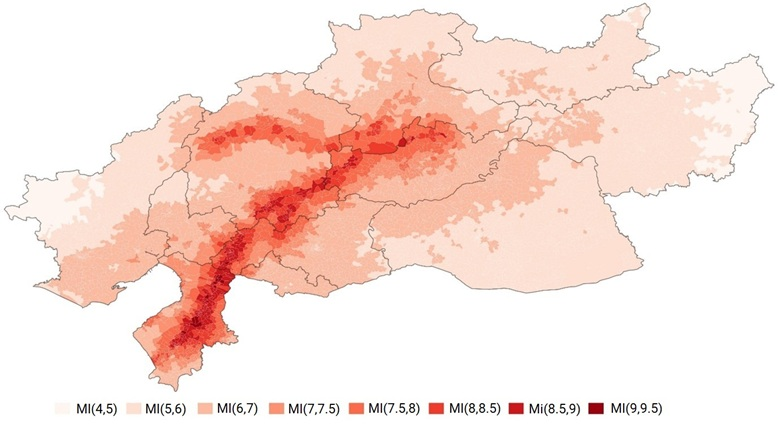
The earthquakes struck approximately four months before the country’s 2023 presidential and legislative elections. This case study examines the dynamics of holding these contests in the aftermath (see Table 1 for a chronology).
The following sections (1 and 2) will provide information on the legal and institutional background of elections in Türkiye, before relating this background to the post-earthquake electoral scene by elaborating on debates that took place about postponement. The third and fourth sections discuss the practical matters of organizing elections in the post-earthquake context and results, respectively. Section 5 concludes the case study with tentative lessons learned.
| Legislative elections and first round of presidential elections | |
|---|---|
| Date | Event |
| 6 February 2023 | Two consecutive earthquakes on 7.8 and 7.5 of Richter scale hit Türkiye. |
| 7 February 2023 | International relief teams from several countries arrive. |
| 8 February 2023 | Emergency rule for 90 days announced. |
| 6 March 2023 | President Erdoğan announces a comprehensive relief package including: a special fund of TRY 350 billion (approximately USD 12 billion); interest-free loans with a repayment grace period for the first year and a 60-month term for businesses heavily affected by the earthquake; and an emergency relief fund of TRY 10,000 (approximately USD 350) for more than a million earthquake victims. Erdoğan also pledges to build 500,000 new houses in one year. |
| 10 March 2023 | Presidential decision announced invoking the president’s power to call for early elections under article 116 of the Constitution of Türkiye, initially scheduled for 18 June 2023. |
| 10 March 2023 | Yüksek Seçim Kurulu (Supreme Electoral Council, YSK) announces the presidential and legislative elections to be held together on 14 May 2023. If the presidential election reaches the second ballot, it will be held on 28 May 2023. |
| 18 March 2023 | Election calendar starts. |
| 31 March 2023 | Official Gazette prints the final presidential candidate list, and the presidential election campaign period starts. |
| 12 April 2023 | Finalization of electoral rolls. |
| 27 April 2023 | Voting at the customs gates and overseas missions starts. |
| 4 May 2023 | Legislative election campaign period starts. |
| 9 May 2023 | Voting at the overseas missions finishes. |
| 13 May 2023 | Campaign periods end. |
| 14 May 2023 | Election day |
| 9 May 2023 | Emergency rule ends. |
| Second round of presidential elections | |
| 15 May 2023 | Campaign period starts. |
| 19 May 2023 | YSK announces the final results of the legislative election. |
| 20 May 2023 | Voting at the customs gates and overseas missions starts. |
| 24 May 2023 | Voting at the international missions finishes. |
| 28 May 2023 | Election day. |
| 29 May 2023 | YSK announces the provisional results of the presidential election. |
| 1 June 2023 | YSK announces the final results of the presidential election. |
Legal and institutional background
Turkish Supreme Electoral Council
In Türkiye, the highest electoral management body (EMB), Yüksek Seçim Kurulu (Supreme Electoral Council, YSK), leads the implementation of elections and ensures their integrity. The council’s structure and operations have undergone several changes throughout its history, determined by both specific needs and political influences. Although the council was first established on a legal basis in 1950, it gained full authorization with amendments in 1954 and its constitutional basis came with the 1961 Constitution. It is possible to claim that Act No. 5545, which established the council in 1950, is the result of democratic maturity and a negotiating culture far ahead of the understanding of the time.
Significant changes were made to the Turkish electoral system over the years, as multiple governments amended Act No. 5545, the central act on elections, to establish a more democratic and transparent election system. The YSK’s responsibilities changed accordingly. Constitutional reforms relating to regulations on radio and television propaganda, the General Directorate of Electoral Roll, and payments and fees, are among those that amended Act No. 5545.
The YSK employs a computerized system known as Seçim Bilgi Sistemi (Electoral Information System, SEÇSİS) to track electoral registration data. Despite minor issues, stakeholders have rated SEÇSİS an efficient and well-functioning mechanism. In their comments on the November 2015 elections, the Organization for Security and Co-operation in Europe (OSCE) election observation mission indicated broad trust in the accuracy of the voter list (OSCE-ODIHR 2015). In registering voters the YSK collaborates with various other state institutions and organizations (see 3.2: Preparation of electoral rolls). These intricate processes have occasionally invalidated elections by including on electoral rolls restricted voters—individuals banned from public services, or otherwise ineligible.
The YSK also has the authority to prohibit or permit political parties’ participation in elections. This authority is significant for early or snap elections. Participating in elections, in addition to the possibility of winning, confers additional and exclusive rights and obligations on political parties, such as campaigning through the press, information and communication technologies, and the Internet; having a representative in the YSK, provincial and district election boards; opening an election office; and submitting voter lists. Since the YSK is the sole authority for determining which political parties will participate in elections—based on criteria provided by the legislature—its judgements relating to this function directly influence election results.
The YSK has been at the centre of numerous contentious matters in recent years. For example, before the 2014 local elections, it re-drew the electoral boundaries and doubled the number of cities in the metropolitan areas. This change not only was beneficial for the ruling AKP (Adalet ve Kalkınma Partisi—Justice and Development Party), but it also significantly weakened the primary opponent, CHP (Cumhuriyet Halk Partisi—Republican People’s Party) (Aygül 2016). Moreover, the 2014 local election was the most controversial election of the early 2000s with allegations of various types of rigging including lost ballot papers, ballot-box tallies missing the legally required stamps and signatures, high numbers of invalid votes in constituencies that were likely to have close races, power blackouts and electoral violence (Toros and Birch 2019). In the 2017 referendum, which proposed changes to the Turkish Constitution, seeking to transition from a parliamentary system to a presidential system of governance, as voting was ongoing, the YSK lifted the law requiring each ballot to have an official stamp. This decision was controversial and raised questions about the reliability and impartiality of the YSK, including among segments of the general public.
Electoral system and Türkiye’s 2023 elections
In Türkiye, the TBMM comprises 600 MPs elected using the D’Hondt method, a party-list proportional representation system. To secure representation in parliament, a political party must achieve a vote share of over 7 per cent across the entire country—either independently or as part of an electoral alliance, provided that the combined votes of the alliance are above the specified threshold. Consequently, political parties may get the highest number of votes in some regions yet fail to obtain any seats due to country-wide poor performance. The parliamentary threshold was significantly higher, at 10 per cent, for 40 years from 1982 to 2022. This regulation damaged the representativeness of the TBMM since any votes cast for parties below 10 per cent of the total were considered invalid, while the seats won by parties that did surpass the national threshold received a corresponding uplift. For instance, in the 2002 general election, the AKP won 34.28 per cent of the total votes yet managed to obtain almost two-thirds of the available seats.
The legislative and presidential first-round elections were held on 14 May 2023, just three months after the earthquakes. There were three competing alliances in the elections. The first coalition, the People’s Alliance, consisted of four political parties but was primarily headed by incumbent Recep Tayyip Erdoğan’s AKP and the MHP (Milliyetçi Hareket Partisi—Nationalist Action Party). The second, the Nation Alliance, was the main opposition coalition consisting of the CHP, İyi Parti (The Good Party, İYİ), and four other minor parties, including two headed by former AKP members. The third group was the Labour and Freedom Alliance, which comprised many left-wing groups in addition to the Halkların Demokratik Partisi (HDP—People’s Democratic Party), a minor opposition party. The HDP ran with the support of Yeşil Sol Parti (YSP—Green Left Party) due to the danger of a pending case to close it down. The legislative election was conducted in line with the revisions made to Türkiye’s electoral statute in 2022. As in the previous election in 2018, each of Türkiye’s 87 electoral districts’ 600 parliamentary seats was allotted to party lists using a proportional method.
The overwhelming majority of public opinion polls indicated that the opposition coalition Nation Alliance, also known as the Altılı Masa (Table of Six) would emerge victorious due to the severe economic breakdown facing the country, coupled with the complications created by the earthquakes (Wilks 2023). Despite this, the opposition bloc suffered significant difficulties in the lead up and after polling, including an apparent lack of internal coalition unity and the government’s strong influence over judicial decisions, its financial supremacy and effective control of the media (, Gümüşçü and Yavuzyılmaz 2023: 163–203). There were also concerns about whether free and fair elections could be held, whether Erdoğan would relinquish power if he lost an election, and the potential complications of a close election (Rubin 2023).
The opposition was formed around a clear strategy prioritizing reinstating Türkiye’s pre-election parliamentary system that had been changed in the 2017 referendum and restricting presidential authority. This strategy also challenged the government’s stance on a variety of foreign and domestic policy problems, notably threats to democracy and the rule of law in Türkiye, and committed to implementing changes, with a focus on economic difficulties. The dominant focal points of the opposition’s electoral campaign were the disasters. The government faced criticism for its slow reaction to the earthquakes and the several development zoning amnesties that preceded it. The opposition especially highlighted the latter, a populist practice that entirely legalizes buildings that are non-compliant with existing laws and standards (e.g. having more floors than stated in the original plan) by issuing a ‘building registration certificate’. The last wave of this practice came into effect before the June 2018 general elections. Architects and urban planners in the country had long warned that building codes related to seismic activity are insufficiently enforced (Beaumont 2023).
Erdoğan got 49.5 per cent of presidential votes in the first round, only a half-point short of the 50 per cent needed to be elected. The primary challenger, Kemal Kılıçdaroğlu of the Nation Alliance, earned 44 per cent of the vote, while the remaining third contender, Sinan Oğan, received an unexpected 5.2 per cent. Despite losing 21 seats, Erdoğan and the AKP-led People’s Alliance maintained their majority in the Turkish Grand National Assembly with 323 MPs. These results necessitated a presidential run-off election—a first in the country’s electoral history, as prior elections of this sort in 2014 and 2018 concluded in the first round. While Türkiye’s economic troubles and the February earthquakes may have fuelled voter dissatisfaction with Erdoğan, his first-round electoral results outperformed many experts’ projections.
Erdoğan was thus considered the favourite to win on 28 May. His chances of victory were strengthened on 22 May when the third-placed candidate, Sinan Oğan, announced his support for the incumbent. Receiving 52.2 per cent of the vote in the second round, Erdoğan gained his third presidential term (second under the presidential system introduced in 2017). The opposition candidate, Kılıçdaroğlu, received 47.8 per cent of the votes cast. Although Kılıçdaroğlu gained almost a million new voters compared to the first round, it was not enough to surpass Erdoğan, who also received an extra 700,000 votes.
The Post-quake Electoral Context
Coupled with the disaster’s devastating effects, the post-quake period was marked by discussions about the approaching presidential and legislative elections. The government did not announce a specific election date before the earthquakes, set to be held on 18 June 2023, on normal conditions. At the same time, however, there was an expectation in the public that the elections would be on 14 May 2023. Following the earthquakes, two opposing camps emerged: those advocating for swift elections and those wanting a postponement.
When making international comparisons, postponing elections after a crisis emergency is fairly typical. For example, during the Covid-19 pandemic it was reported that at least 80 nations and territories worldwide chose to postpone national and subnational elections, with 42 countries and territories postponing national elections and referendums (James, Clark and Asplund 2023). Thus, postponing an election may not necessarily be an undemocratic choice because the integrity of the voting process is likely to be jeopardized by disaster conditions, and humanitarian concerns may be paramount in the short term (Asplund and Hickey 2023). Accordingly, the postponement camp in Türkiye argued that the 6 February 2023 earthquakes were of historical scale and expected to have long-lasting impacts, leaving as they did a state of complete destruction in 10 cities, whose residents were preoccupied with their struggle for survival (Euronews 2023). As mentioned earlier, the earthquakes impacted over 16 million residents, who are represented in the TBMM by 96 parliamentarians in total. Table 2 displays the breakdown of MPs of the earthquake-affected constituencies according to parties.
| Region | AKP | CHP | HDP | MHP | İYİ |
|---|---|---|---|---|---|
| Adana | 5 | 3 | 2 | 2 | 2 |
| Adıyaman | 4 | 1 | - | - | - |
| Diyarbakır | 3 | - | 9 | - | - |
| Elazığ | 4 | 1 | - | - | - |
| Gaziantep | 8 | 2 | 1 | 2 | 1 |
| Hatay | 5 | 4 | 1 | 1 | - |
| Kahramanmaraş | 6 | 1 | - | 1 | - |
| Kilis | 2 | - | - | - | - |
| Malatya | 4 | 1 | - | 1 | - |
| Osmaniye | 2 | 1 | - | 2 | - |
| Şanlıurfa | 8 | 1 | 4 | 1 | - |
Postponement supporters argued that since there were nearly no voters left in the region concerned (due to both casualties and migration), there was a need to update voter records. Since in the circumstances this was an impossible task, that made swift elections legally and practically impossible. This argument also underlined the necessity of adjusting the number of MPs representing the affected provinces, based on a new population census before the elections.
The contrary position, predominantly supported by opposition political parties, was that the schedule for elections must follow the provisions of the Constitution and existing electoral legislation. These discussions ended following President Erdoğan’s announcement of 14 May as the date for legislative and presidential elections. Justice Minister Bekir Bozdağ indicated that no new legal restrictions were required for the forthcoming elections and that existing laws would be followed.
The following section will elaborate on these discussions in detail through the lenses of existing laws and regulations.
Postponement debate
As specified by article 78 of the Constitution (Türkiye 1982), elections can be postponed by one year in the event of war. According to this explicit constitutional provision, a war declared by the Grand National Assembly is the only such circumstance, and the war situation must make it impossible to hold elections. There are examples in the country’s history where elections were conducted even under severe war conditions. For example, the initial Turkish National Grand Assemblies were formed after elections held in 1919 and 1920 during the National War of Independence. It is important to note that the existing wording of article 78 was a careful choice by the constitution-makers—it is known that the draft text of the 1982 Constitution contained provisions for the postponement of elections due to extraordinary events such as earthquakes, but these were removed from the final text because they were considered susceptible to misuse by those in power (Kanadoğlu and Şahin 2023).
Those favouring postponement claimed that due to force majeure, the elections could be postponed either by a decision of the YSK, through a new series of legislation, or by the State of Emergency Procedures and Institutions regulation (Kanadoğlu and Şahin 2023). The first stance, that the YSK itself can postpone elections, is supported by two sub-arguments: (a) that the YSK was granted the authority to do so by the Constitution and Law No. 7062 about the Formation and Responsibilities of the Supreme Election Board; and (b) the YSK’s prior practices of delaying municipal elections in light of catastrophic disasters, such as earthquakes.
Article 79 of the Constitution is as follows:
The Supreme Board of Election shall execute all the functions to ensure the fair and orderly conduct of elections from the beginning to the end, carry out investigations and take final decisions, during and after the elections, on all irregularities, complaints and objections concerning the electoral matters, and receive the electoral records of the members of the Grand National Assembly of Türkiye and presidential election. No appeal shall be made to any authority against the decisions of the Supreme Board of Election.
—(Türkiye 1982: article 79)
As is evident, the clause grants the YSK the authority to carry out all processes related to the management and integrity of elections. Stakeholders favouring a rescheduling of elections interpret this clause broadly, including the action of postponement. However, since the postponement of elections necessitates an entirely different authority and given the fact that the clause did not explicitly define such a right, this interpretation can be labelled as a ‘stretched’ one. The YSK can use its authority to manage a specific election with a set date and resolve disputes related to that election. However, claiming that the YSK has the authority to postpone elections based on this clause is not legally convincing.
These arguments were not completely without merit since they were built on prior YSK decisions to postpone elections because of some force majeure. Among those, the 1966 postponement due to earthquake of village chief and council member elections in Goltepe village (a district of Varto province of Van) was widely discussed. However, in that specific case the Supreme Board’s decision, published in the Official Gazette on 14 September 1966, stated that when natural disasters such as earthquakes, floods, significant fires, or similar events happened ‘just before the planned date of elections’, and which make it physically impossible to hold elections in a particular location, such elections can be postponed. It is noted that the Supreme Board of Elections decides when these elections, ‘which should take place shortly after disaster days’, will be held. Therefore, one is prompted to argue that rulings rendered by the board related to such matters apply to exceptionally infrequent and rare conditions.
Furthermore, it is important to highlight that the elections that the Supreme Board of Elections postponed had already commenced, and the unforeseeable circumstances occurred either on the day of the election or in its immediate vicinity. Whereas in 2023, there was a lead time of almost four months—sufficient for the YSK to identify individuals displaced by earthquakes, determine the cities they relocated to, and generate voter registration forms for these individuals in a format corresponding to their new residences. In practice, however, this responsibility was left to the citizens: the voters who were able to re-register in their new constituencies voted for the representatives of that particular constituency, and the ones who did not re-register either did not vote or travelled back to their initial constituencies to vote on election day.
Finally, two more recent rulings of the YSK should be mentioned, which rejected appeals seeking electoral postponement. The first involved a petition against Decision No. 708 dated 19 April 2015 and advocating postponement of the 25th term legislative elections scheduled for 7 June 2015 until 2016 due to ongoing military operations in the region against Kurdish armed groups. The appeal was unanimously declined by the YSK, since postponing elections due to war is exclusively the prerogative of the Turkish Grand National Assembly, based on article 78 of the Constitution (TRT Haber 2023). In the second one, the YSK similarly denied the request to defer the local council and elders’ council elections initially scheduled for 5 March 2023 in the Elazığ Güneykent neighbourhood, among the regions impacted by the earthquakes.
The postponement camp’s other resort was an appeal to the Constitutional Court. The basic argument was that article 79 of the Constitution only regulates legislative elections but not presidential ones. It is critical to consider the context that precipitated this appeal and the following decision. A constitutional amendment was ratified in 2007 which instituted the direct election of the president by the general populace. Following this, a Presidential Election Law was implemented which expanded the scope of article 78 (which, as we have seen, grants the Turkish Grand National Assembly the authority to adjourn legislative elections) to the presidential elections as well. In other words, the authority of the TBMM to postpone legislative elections by law automatically became applicable for presidential elections, even though there is no specific wording in article 78 for presidential elections (it fails to differentiate between presidential and legislative elections when it uses the phrase ‘elections’). Accordingly, the Constitutional Court has examined the constitutionality of the provision in the Presidential Election Law that allows the postponement of the presidential election due to reasons of war.
When confronted with the petitioners’ contention that legislation cannot establish such a rule, the Constitutional Court stated that legislation might render a provision of article 78 of the Constitution relevant to the presidential election. However, the Court’s ruling also noted that the Turkish Grand National Assembly and the Supreme Board of Elections would not be authorized to judge the postponement of presidential elections based on justifications such as ‘war and comparable circumstances’. Through jurisprudence, the Constitutional Court cannot broaden the restricted reasons (such as war) established by the Constitution. Furthermore, this legislation does not allow for delay for any cause other than war.
In the end, article 102 of the Constitution was applied to determine whether the pertinent legislation was constitutional. Article 102 was repealed due to the 2017 constitutional revision, which also mandated the simultaneous presidential and legislative elections scheduling. Consequently, the Constitutional Court’s stance about adjourning presidential elections on account of force majeure was rendered unlikely, as the Constitution now stipulates that both TBMM and presidential elections should be conducted simultaneously.
A final argument about the lawfulness of electoral postponement related to the announcement of the state of emergency (OHAL) by a Cumhurbaşkanlığı Kararnamesi (presidential decree) just after the earthquakes. A presidential decree in Türkiye is a regulation that allows the president to act without the need for a law enacted by the legislative body. However, these decrees cannot conflict with the Constitution and laws and are subject to oversight by the TBMM. Effective on being published in the Official Gazette, presidential decrees became a significant part of Türkiye's legal framework and public policy process when the country moved from a parliamentary to a presidential system in 2018.
According to article 119 of the Constitution, an OHAL can be imposed by presidential decree ‘in matters necessitated by the state of emergency’. These decrees can be issued for the duration of the state of emergency and for the regions covered by it. The OHAL was declared on 8 February 2023 by Presidential Decree No. 6785 and was declared only for the disaster area and for a period of three months. Although this period covers a considerable part of the election cycle, it did not cover the voting day and beyond. In its original form, therefore, it is clear that the elections could not be postponed nationwide based on this decree. It is important to note that, even if a state of emergency was declared for all of the country and for a longer period, still, elections could not be postponed based on this decree because, as explained earlier, article 78 of the Constitution explicitly outlines the authority and conditions for electoral postponement. Since this authority is exclusively vested in the TBMM, presidential decrees cannot be used for this matter.
Moreover, even if the president had decided to postpone elections using the authority granted by the OHAL decree, the Constitutional Court could have overturned such a decision since the Constitutional Court has the power to review and invalidate decisions or regulations it deems unconstitutional or in violation of fundamental legal principles, including those made under emergency powers. In its 1991 jurisprudence, the Constitutional Court stated that regulations made under OHAL decree must be subject to constitutional review, regardless of their substance.
For all these reasons, debate about the elections’ timing concluded with their being held on schedule, without postponement.
Campaigning
The legal structure delineated two distinct phases for political campaigning: the electoral period, which in 2023 commenced on 18 March for parliamentary elections and 31 March for the presidential election, and was characterized by specific campaign regulations (such as a prohibition on the improper use of administrative resources); and the formal campaign period, which extended for 10 days preceding both election days and entailed more stringent campaigning criteria.
The earthquakes forced political parties to rethink their campaigning strategies. For example, the incumbent AKP, which had been preparing its election manifesto with the perspective of ‘Türkiye Century’ since the previous summer, shaped its campaign with the slogan ‘We’re starting anew’. However, the party amended the election manifesto and campaign approach following the disaster, shifting from large rallies to visiting tents and other temporary structures housing the displaced. Party officials conducted a silent campaign without music. The AKP also set four messaging priorities focusing on the physical recovery of the earthquake-stricken region; improving the living conditions of the disaster-affected citizens; measures to be taken in the face of potential future earthquakes or other natural disasters, including regulations related to the environment; and steps to reverse the economic devastation caused by the earthquake (Kahvecioğlu 2023). Similarly, the opposition bloc decided to start and end the campaign period in the affected region.
Reorganizing the elections
Coupled with the postponement discussions, there were several concerns about the voting arrangements for people in the affected areas and those displaced to other cities. Table 3 provides the estimated displaced population in the 11 provinces of the earthquake zone.
| Region | Total population | Internally displaced persons (IDPs) (estimated) | (%) |
|---|---|---|---|
| Adana | 2,531,237 | 52,779 | 2.09 |
| Adıyaman | 657,888 | 307,204 | 46.70 |
| Diyarbakır | 1,827,867 | 98,913 | 5.41 |
| Elazığ | 604,486 | 28,090 | 4.65 |
| Gaziantep | 2,625,601 | 252,317 | 9.61 |
| Hatay | 2,043,472 | 774,483 | 37.90 |
| Kahramanmaraş | 1,274,468 | 489,149 | 38.38 |
| Kilis | 236,744 | 13,750 | 5.81 |
| Malatya | 845,352 | 320,100 | 37.87 |
| Osmaniye | 598,719 | 69,442 | 11.60 |
| Şanlıurfa | 2,543,524 | 58,895 | 2.32 |
| Total | 15,789,358 | 2,465,122 | 15.61 |
An early analysis made by the official news agency of the Turkish Republic, Anadolu Agency, on 4 March 2023 shows that the relocated population was dispersed around the country to multiple urban centres (Figure 2).
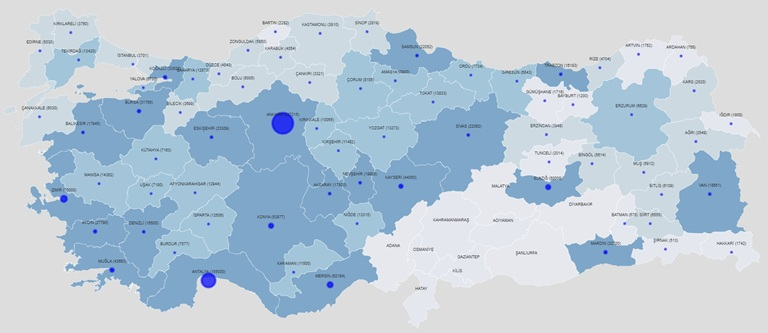
The cities with the highest influx were Ankara, Antalya and İzmir, with 205,454, 154,086 and 70,000 individuals, respectively. Despite being declared the 11th province affected by the earthquake, Elâzığ also received 50,000 earthquake victims from other provinces. The earthquake victims seemed to prefer not to relocate to Istanbul, Türkiye’s largest metropolis, due to the city’s significant seismic activity and higher living costs.
Undoubtedly, every election should fulfil the principle of fair representation, and the votes cast must have equal weight in distributing parliamentary seats. The post-quake period, accordingly, has necessitated careful thinking in considering the population decline in provinces that were heavily impacted. This consideration was also valid for the cities where populations significantly increased due to IDPs. The following section summarizes these discussions under three headings.
Distribution of seats to electoral districts
The first issue was how parliamentary representation should be distributed in regions where permanent or temporary migration occurred, consequent on the earthquake. Parliamentary Election Law No. 2839 explains how legislative elections are organized and conducted in Türkiye. According to its article 4, when allocating parliamentary seats to electoral districts, each province is initially allocated one of the total number of parliamentary seats, which is 600. The total population of Türkiye, as determined by the latest general population census, is divided by the remaining number of parliamentary seats (519) to obtain a specific number. Then, by dividing the population of each province by this number, the number of parliamentary seats each province will additionally elect is determined. After this calculation, if a province’s allocated number of deputies is equal to or under 18, that particular province is regarded as a single electoral district. Provinces with allocated deputies between 19 and 35 are divided into two electoral constituencies, while provinces with 36 or more deputies are divided into three. Table 4 provides an example of this calculation for Istanbul.
This formula helps to distribute parliamentary seats to provinces in a way that reflects their population. According to article 5 of the same law, the election districts and the number of parliamentary members to be elected from each are determined by the YSK within six months of the announcement of the results of the general population census. The Turkish Statistical Institute shares updated population data annually with the public, based on the Address-Based Population Registration System. The YSK updates its calculations each year based on this data.
| Total of Turkish population | Dividend | Istanbul population | Number of MPs | Number of Constituencies |
|---|---|---|---|---|
| 85,279,553 | 85,279,553/519 = 164 | 15,907,951 | 15,907,951/164 = 97 97 + 1 (pre-allocated) = 98 | 3 |
For the 2023 elections, the YSK used the data as of 31 December 2022 to calculate the number of parliamentary members that provinces elect for the TBMM (YSK 2023b). Accordingly, the deaths due to the earthquake or the migration of citizens from the earthquake-affected regions to other provinces did not change the number of parliamentary members each province elects. This decision prompted serious concerns about electoral integrity since a significant portion of the citizens in heavily populated, severely affected cities, such as Hatay, Kahramanmaraş and Gaziantep, left their homes for other provinces—either permanently or temporarily. The YSK did not take any steps to identify these individuals, confirm the deceased or update the address records of those who had moved—even though sufficient time and resources were available (Kanadoğlu and Şahin 2023).
Preparation of electoral rolls
The second problem was compiling voter rolls in the affected regions. Undoubtedly, accurate preparation of the electoral roll is crucial for ensuring the integrity of any election. Following article 33 of Law No. 298 on Basic Provisions of Elections and Electoral Rolls, voter rolls are updated yearly under the procedures and principles to be determined by the YSK based on the information in the address registration system. These rolls are updated automatically in each election period following the most recent relevant data and announced publicly. Concurrently, Law No. 7062 concerning the Organization and Duties of the Supreme Electoral Board designates the General Directorate of Electoral Roll with the responsibility of generating and maintaining the voter rolls, as well as procuring the requisite information and documents from all public institutions and organizations to ensure its accuracy. These regulations empower the YSK to seek guidance from heads of state, district governors, mayors and administrators in compiling the rolls. All public officials, including governors, district governors, mayors and headmen, are required by Law No. 298 to promptly and accurately transmit the information and documents requested by election boards about election affairs and voter registration.
Given the extraordinary circumstances of 2023, election boards in the affected areas provided additional facilities for earthquake victims to access the election rolls—typically announced by neighbourhood headman display lists. In the areas recognized as disaster zones, various communication channels were used to publicize where these lists were displayed, and the display period (YSK 2023a).
In the provinces recognized as disaster zones, voters with a registered residential address who wished to change their address during the display period were not asked to provide any of the usual documentation, and their addresses were registered as requested in their new locations. Since this automated task can be carried out online, it helped to compile the new electoral roll efficiently. Likewise, no approved address declaration documents were asked of state-appointed or voluntary relief personnel working newly in the region to change their residential addresses for voting purposes. At the same time, the YSK did not provide the same opportunities for those affected by the earthquake who stayed in their original settlements, and only relocated to temporary housing. In this category, those who wanted to vote at their place of residence during the display period were obliged to personally apply to the relevant population directorates of their current locations with documents confirming their stay, and to submit a signed and approved copy of the address declaration form and its attachments to the district election board presidency. Such inconsistencies may have led to problems in compiling the voter records and affected the integrity of the elections, but there is no data available to assess this.
The final voter registration matter that needed to be settled was the status of people who either had gone missing or were thought to have died in the earthquake. Since death and disappearance are treated differently in the regulations, it was a difficult task for the authorities to resolve. Article 31 of the Turkish Civil Code states that even if a person’s body is not discovered, they are deemed to be dead if they vanish in a way that suggests they have passed away. According to the Population Services Law, the civil authority of the location where the application is filed must issue an order before an official death record can be created. Death records are created at the civil authority’s discretion if the incident is recorded—people who are assumed to be dead in such a situation will not have any legal distinctions from the deceased. These people will, therefore, not be eligible to vote or hold public office. For a declaration of disappearance, on the other hand, a minimum of one year from when the danger of death has passed or five years from the date of the last news is required. Clearly, neither conditions were met before the 2023 election date, for declaring someone missing due to the earthquake. Therefore, the voting rights of individuals for whom a declaration of disappearance is requested have remained in effect and in 2023 they had the same status as living individuals in matters related to voter registers, among other things.
The Election Observation Mission (EOM) of the OSCE Office for Democratic Institutions and Human Rights (ODIHR), underlined this chaotic situation in its report. The report mentioned that the authorities took insufficient precautions to address the abovementioned problems, which affected an estimated 2 million voters. According to the Ministry of Interior, around 453,000 citizens, 70 per cent of whom were of voting age, had changed their addresses from the earthquake-affected areas to register in other provinces. Although we do not have any data on how the relocated citizens voted in the elections, and it is nearly impossible to isolate the impact of the disaster on voting, one can still say the relocation of voters did not produce dramatic changes in the end. Table 5 compares the five leading parties’ (those with the highest vote shares) performances in 2023 and 2018, in the five provinces with the highest influx numbers.
| Province | Estimated influx | 2018 | 2023 | 2018 | 2023 | 2018 | 2023 | 2018 | 2023 | 2018 | 2023 |
|---|---|---|---|---|---|---|---|---|---|---|---|
| Ankara | 237,215 | 15 | 15 | 10 | 13 | 1 | 0 | 5 | 3 | 5 | 5 |
| Antalya | 155,000 | 6 | 6 | 5 | 6 | 1 | 1 | 1 | 2 | 3 | 2 |
| İzmir | 70,000 | 8 | 8 | 14 | 14 | 2 | 2 | 2 | 1 | 2 | 3 |
| Mersin | 62,184 | 4 | 4 | 3 | 5 | 2 | 2 | 2 | 1 | 2 | 1 |
| Elazığ | 50,000 | 4 | 3 | 1 | 1 | 0 | 0 | 0 | 1 | 0 | 0 |
Numerous OSCE political party and civil society interlocutors during the EOM agreed that an extended period for address changes, free transportation, or other alternative measures would have made voting more accessible for individuals affected by the disasters (OSCE-ODIHR 2023). Furthermore, after a one-month break, the Council of Higher Education restarted in-person higher education nationally on 30 March; the news came just before the registration deadline closed, leaving students with a three-day window to register to vote at their study places. Despite several civil society organizations and political parties offering free transportation for earthquake-displaced individuals to vote at their permanent dwellings, many experienced considerable difficulty returning to vote (OSCE-ODIHR 2023).
Voting operations
The country’s election day was well managed and mostly peaceful, with few disturbances. The OSCE reported tensions or disturbances in 4 per cent of polling stations (OSCE-ODIHR 2023). Where the earthquake-affected regions were concerned, adhering to secure and confidential elections (ballot secrecy) was especially crucial. For this purpose, the YSK appointed a delegation on 5 April 2023 to conduct inspections in 11 provinces in the earthquake-affected region. The delegation made detailed assessments regarding the health status of personnel, institutional buildings, buildings where ballot boxes are placed, election and office supplies, transport and technical infrastructure of the system. Its measures recommended in response were presented to the board members (Dal 2023).
According to Law No. 298, the area where the ballot box is placed and the polling board operates is called the ‘polling area’, and locations for placing ballot boxes must be selected to ensure that voters can cast their votes easily, freely and confidentially. The law also states that, where applicable, polling boxes can be placed in common areas like school yards, in suitable sections of school buildings (including private schools and colleges) and, if necessary, in rented places like cafeterias or restaurants. (Polling boxes cannot be placed in military buildings, police stations, party buildings, nor muhtarlık (local headman) rooms. Following these regulations, the YSK and local authorities took additional measures to ensure the structural integrity of the buildings where polling boxes were placed in the earthquake-affected areas (Dal 2023). On that score, the YSK delegation made a second round of inspections in the earthquake-affected region and gathered information from the Ministry of National Education and the Ministry of Environment, Urbanization and Climate Change regarding the schools where ballot boxes were to be placed. The delegation determined that 80 per cent of the schools in the region were suitable for voting. Where schools were unsuitable, the YSK replaced them with other public institutions, and health centres. In Hatay’s Antakya and Defne districts, 245 polling stations in schools affected by the earthquake were replaced by 110 temporary structures (Gerçek 2023). Similarly, for villages with difficult access, voting tents were set up for the convenience of the citizens. No incidents were reported from the region stating that the principle of the secret ballot was violated or that polling board members were remiss in fulfilling their duties.
Turnout and results
According to the electoral rolls, the number of registered voters in the biggest four electoral districts in the affected region—Adıyaman, Hatay, Kahramanmaraş and Malatya—increased by around 9,000, corresponding to less than 1 per cent compared to the previous elections. Since, on average, this figure is around 8 per cent for all electoral districts in Türkiye, this reflects the heavy outflux of voters from the earthquake-affected region. While we observe a significant decrease in voter numbers for the Adıyaman and Malatya districts, there were minor increases for Hatay and Kahramanmaraş. In that sense, Malatya’s decline of over 4 per cent is noteworthy. However, this region continuously experiences out-migration due to socio-economic reasons, so the earthquake is unlikely to have been the sole cause. For example, in other districts like Gümüşhane and Ardahan, which are not in the earthquake zone, the number of voters has decreased by 4 and 2 per cent, respectively. Likewise, the increase in the number of voters in Hatay and Kahramanmaraş is higher than increases in Ardahan, Artvin, Bayburt, Gümüşhane, Kars, Kütahya, Tunceli and Yozgat, which were not related to the earthquake. Accordingly, it does not seem possible to attribute these voter number changes to a significant earthquake effect.
The earthquake’s impact on the region’s turnout rates is more pronounced. In Türkiye, voting is compulsory. Although compared to the 2018 elections the total number of votes cast for legislative elections increased—by over 8 per cent throughout the country on average—in these four provinces under examination, the number of votes cast decreased by around 130,000, a 5 per cent decrease on the 2.3 million cast in 2018. This decrease was around 6 per cent for Malatya and Hatay, which were severely hit by the earthquake. While the overall voter turnout in Türkiye was around 89 per cent (of registered voters), in these four provinces, it averaged just over 83 per cent. These differences in voter turnout are likely due to the thousands of families who relocated but did not update their voter information. Table 6 displays the turnout figures in the earthquake region and Türkiye as a whole in 2018 and 2023.
| Region | 2018 | 2023 |
|---|---|---|
| Adana | 86.5 | 87.9 |
| Adıyaman | 86.8 | 82.4 |
| Diyarbakır | 84.1 | 82.2 |
| Elazığ | 85.3 | 86.2 |
| Gaziantep | 86 | 86.1 |
| Hatay | 89.2 | 83.6 |
| Kahramanmaraş | 89.8 | 85.8 |
| Kilis | 88.1 | 89.1 |
| Malatya | 88 | 82 |
| Osmaniye | 86.7 | 88.1 |
| Şanlıurfa | 81.9 | 82.3 |
| Türkiye national average | 86 | 87 |
Lastly, Figure 3 displays the results of the presidential elections for the incumbent Erdoğan. The maps depict that the earthquakes did not substantially alter voting preferences.
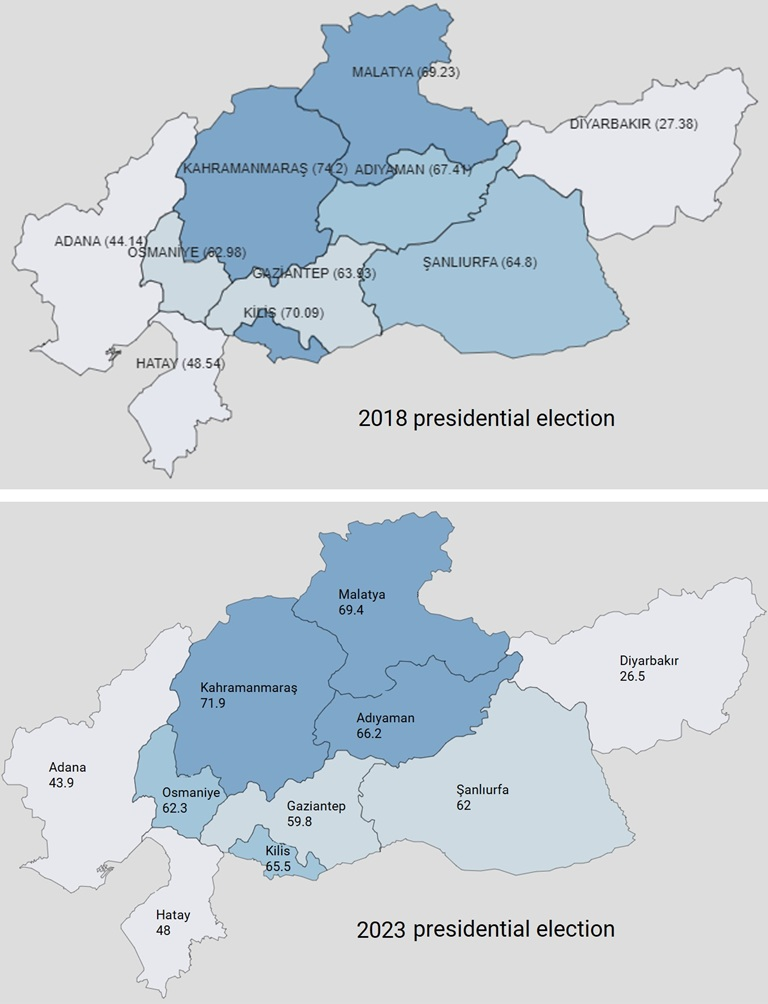
Conclusion and Lessons Learned
As discussed, Turkish society debated two primary issues regarding electoral procedures following the 2023 earthquakes. The first was the timeliness of holding elections—whether the legislative and presidential elections of 2023 should go ahead as scheduled or be postponed. Although these discussions were primarily conducted on legal grounds, it is also crucial to draw attention to the political dimension. The ruling bloc predominantly put forward arguments advocating for the postponement of elections, while those asserting the necessity of timely elections often came from the opposition bloc, and these positions were not coincidental. The opposition bloc’s insistence on the timely conduct of the 2023 elections can be linked to an expectation of the possibility of an alteration in government, as had happened after the earthquake disaster in 1999. Although that is the case, it is also vital to acknowledge that, despite the democratic backsliding that the country has experienced recently, whereby the government’s control of the media and restrictions on fundamental freedoms curtailed fair elections (Esen and Gümüşçü 2021; International IDEA 2023; OSCE-ODIHR 2023), Türkiye managed to carry out elections without changing the existing election legislation.
The second issue of debate related to the practical matters of conducting an election after such a devastating event. Evaluating the influence of natural disasters on the election procedure necessitates a detailed investigation of several elements, and all relevant parties, including the EMBs, must conduct meticulous investigations to arrive at an informed and efficient response. Even before 2023, Türkiye was grappling with problems that affected election administration. Pre-existing criticism of the YSK (the EMB) was exacerbated in the response to the earthquake; specifically the handling of voter registration in light of displacement and lost ID cards.
Residents who had lost their main identity papers (passport, driver’s licence, national ID card) were allowed to vote using a temporary ID document valid for three months that could be obtained through the e-government portal. But while additional efforts such as this were made, the overall process did not satisfy the general public. Second, the board did recalculate the seats allocated for districts which experienced heavy outflux and influx of citizens. Third, the YSK made only limited efforts to communicate the substantial modifications to the electoral cycle. To strengthen openness and public trust, EMBs should hold public sessions and publish material of public interest, including all agendas, decisions, and complete statistics on complaints and objections. Doing so in a timely and consistent way is critical to the operation of voting processes and voters’ trust.
Hence, lessons can be drawn from Türkiye’s experiences after these earthquakes. All administrative authorities related to elections should have plans and necessary resources for such unforeseen disasters. These plans should include solutions for practical voting day matters and the whole electoral cycle, including electoral rolls and other key public records. Considering the benefits of conducting such processes electronically through e-government applications, as seen in Türkiye’s example, the widespread adoption of such applications could be deemed beneficial for problem-solving in other contexts. In such a challenging environment, another crucial point within EMBs’ emergency policies is ensuring transparency and keeping communication channels open with the public. A communication strategy, additional training for observers and specialized expertise for verifying the accuracy of systems are all part of this.
Organizing elections after natural disasters of this magnitude presents multifaceted challenges beyond immediate logistical hurdles, including complexities arising from infrastructure damage, voter displacement and disruption of communications. Indeed, planning and administration efforts during these periods necessitate a nuanced and adaptive approach by EMBs, ensuring a delicate balance between upholding democratic principles and responding to the pressing needs of affected communities. Such an effort requires meticulous planning, contingency frameworks, and collaboration among governmental agencies, emergency services and the wider community.
References
Asplund, E. and Hickey, S. P., ‘Quake aftermath poses questions on timing and conditions for Turkey elections’ LSE Blog, 17 February 2023, <https://blogs.lse.ac.uk/mec/2023/02/17/quake-aftermath-poses-questions-on-timing-and-conditions-for-turkey-elections>, accessed 13 January 2024
Aygül, C., ‘Electoral manipulation in March 30, 2014 Turkish local elections’, Turkish Studies, 17/1 (2016), pp. 181–201, <https://doi.org/10.1080/14683849.2015.1135061>
Beaumont, P., ‘Turkey earthquake death toll prompts questions over building standards’, The Guardian, 7 February 2023, <https://www.theguardian.com/global-development/2023/feb/07/turkey-earthquakes-death-toll-prompts-questions-over-building-standards>, accessed 13 January 2024
Dal, A., ‘YSK Üyeleri Deprem Bölgesinde Inceleme Yapıyor’ [YSK members are inspecting the earthquake area], 5 April 2023, <https://www.aa.com.tr/tr/gundem/ysk-uyeleri-deprem-bolgesinde-inceleme-yapiyor/2864157>, accessed 13 January 2024
Directorate of Strategy and Budgeting (DSB), ‘2023 Kahramanmaraş ve Hatay Depremleri Raporu’ [2023 Kahramanmaraş and Hatay Earthquakes Report], March 2023, <https://www.sbb.gov.tr/wp-content/uploads/2023/03/2023-Kahramanmaras-ve-Hatay-Depremleri-Raporu.pdf>, accessed 13 January 2024
Esen, B. and Gümüşçü, S., ‘Why did Turkish democracy collapse? A political economy account of AKP’s Authoritarianism’, Party Politics, 27/6 (2021), pp. 1075–91, <https://doi.org/10.1177/1354068820923722>
Esen, B., Gümüşçü, S. and Yavuzyılmaz, H., Türkiye’nin Yeni Rejimi: Rekabetçi Otoriterlik [Türkiye’s New Regime: Competitive Authoritarianism] (Istanbul: İletişim Publications, 2023)
Euronews, ‘Eski TBMM Başkanı Arınç “seçim Ertelensin” Diyerek 3 Seçenek Sundu’ [Former Turkish Grand National Assembly Speaker Arınç says ‘election should be postponed’ and offers 3 options], 13 February 2023, <https://tr.euronews.com/2023/02/13/eski-tbmm-baskani-arinc-secim-ertelensin-diyerek-3-secenek-sundu>, accessed 13 January 2024
Gerçek, G., ‘YSK’dan Deprem Raporu: Hatay’da 110 Oy Konteyneri Kurulması Planlanıyor’ [Earthquake Report from YSK: Plans to establish 110 voting containers in Hatay], NTV, 11 April 2023, <https://www.ntv.com.tr/2023-secim/yskdan-deprem-raporu-hatayda-110-oy-konteyneri-kurulmasi-planlaniyor,Qo7R2HE050CItMqSUaOYSA>, accessed 13 January 2024
International IDEA, The Global State of Democracy 2023: The New Checks and Balances, (Stockholm: International IDEA, 2023), <https://doi.org/10.31752/idea.2023.78>
James, T. S., Clark, A., and Asplund, E., Elections during Emergencies and Crises: Lessons for Electoral Integrity from the Covid-19 Pandemic (Stockholm: International IDEA, 2023), <https://doi.org/10.31752/idea.2023.24>
Kahvecioğlu, A., ‘Seçim Kampanyasına Deprem Ayarı!’ [Earthquake setting for the election campaign!], Milliyet, 23 February, 2023, <https://www.milliyet.com.tr/gundem/kampanyaya-deprem-ayari-6907784>, accessed 13 January 2024
Kanadoğlu, K. and Şahin, B. N., ‘Seçimlerin Ertelenmesi ve Deprem Bölgelerindeki Seçimlerin Yürütülmesi’ [Postponement of Elections and Conducting Elections in Earthquake Regions], Lexpera Blog, 24 February 2023, <https://blog.lexpera.com.tr/secimlerin-ertelenmesi-ve-deprem-bolgelerindeki-secimlerin-yurutulmesi>, accessed 13 January 2024
Moral, M., Adıgüzel S., Sedashov E., Toros E. and Varol O., ‘On the Effects of the Earthquakes on Electoral Behaviour in the May 2023 Turkish Parliamentary and Presidential Elections’, Working Paper, [n.d.]
OSCE-ODIHR (Organization for Security and Co-operation in Europe–Office for Democratic Institutions and Human Rights), ‘Turkey, Early Parliamentary Elections, 1 November 2015: Statement of Preliminary Findings and Conclusions’, 2 November 2015, <https://www.osce.org/odihr/elections/turkey/186031>, accessed 13 January 2024
—, ‘Turkey, General Elections, 14 May 2023: Statement of Preliminary Findings and Conclusions’, 15 May 2023, <https://www.osce.org/odihr/elections/turkiye/543543>, accessed 13 January 2024
Rubin, M., ‘What will Erdogan do if he loses Turkey’s Elections?’, Washington Examiner, 17 April 2023, <https://www.aei.org/op-eds/what-will-erdogan-do-if-he-loses-turkeys-elections>, accessed 13 January 2024
Sağıroğlu, A. Z., Ünsal, R. and Özenci, F, ‘Deprem Sonrası Göç ve İnsan Hareketlilikleri: Durum Değerlendirme Raporu’ [Post-Earthquake Migration and Human Mobilities: Situation Assessment Report], AYBÜ-GPM, 1 March 2023, <https://aybu.edu.tr/GetFile?id=89c8b6eb-c9a1-482a-8e22-065eb9b71006.pdf>, accessed 13 January 2024
Support to Life, ‘Emergency Situation Report’, 13 October 2023, <https://www.supporttolife.org/wp-content/uploads/2023/10/231013_STL_SitRep26.pdf>, accessed 13 January 2024
Toros, E. and Birch, S., ‘Framing electoral impropriety: The strategic use of allegations of wrong-doing in election campaigns’, British Journal of Middle Eastern Studies, 47/4 (2019), pp. 794–810, <https://doi.org/10.1080/13530194.2019.1566694>
TRT Haber, ‘YSK'dan Elazığ'daki mahallede muhtarlık seçimleriyle ilgili karar’ [The decision from the Supreme Election Board (YSK) regarding the neighbourhood muhtar elections in Elazığ], 23 February 2023, <https://www.trthaber.com/haber/gundem/yskdan-elazigdaki-mahallede-muhtarlik-secimleriyle-ilgili-karar-748530.html>, accessed 12 February 2024
Türkiye, Republic of, Constitution of 1982, <https://www.refworld.org/docid/3ae6b5be0.html>, accessed 14 January 2024
Yiğit, M. A., ‘Depremzedeler Yurdun Dört Bir Yanında Misafir Ediliyor’ [Earthquake victims are hosted all around the country], Anadolu Agency, 4 March 2023, <https://www.aa.com.tr/tr/info/infografik/32685>, accessed 13 January 2024
Wilks, A., ‘Turkey’s Opposition Faces Difficult Road Ahead after Another Loss’, Aljazeera, 30 May 2023, <https://www.aljazeera.com/news/2023/5/30/turkeys-opposition-faces-difficult-road-ahead-after-another-loss>, accessed 13 January 2024
YSK (Supreme Electoral Council), ‘Questions on 2023 Elections’, 2023a, <https://www.ysk.gov.tr/tr/sss/1523>, accessed 13 January 2024
—, ‘YSK Decision No. 71’ [in Turkish], 3 March 2023b, <https://www.resmigazete.gov.tr/eskiler/2023/03/20230303-6.pdf>, accessed 13 January 2024
About the author
Emre Toros is a Professor of Political Science and Dean at the Faculty of Communication, Hacettepe University, Ankara, Türkiye. He undertook his academic studies in Türkiye and abroad, including at King’s College London, and at Malmö, Stanford and Harvard universities. A scholar of political behaviour, Professor Toros’ interests include elections, Turkish politics and electoral behaviour. His most recent book is on electoral integrity in Türkiye.
Sarah Birch and Jeff Fischer
Publishing date: 1 September 2022
Introduction
Like other natural disasters, wildfires can have sudden calamitous impacts on communities, destroying buildings, damaging infrastructure and displacing populations. In this chapter we examine the Californian wildfires occurring from September 2015 to November 2018 to assess their effect on two electoral cycles in the state (2016 and 2018), and to study how electoral practitioners cope with these challenges in a developed democratic setting. We thus consider the impact of these events on electoral management, campaigning and voter choices in a period before Covid-19 vastly complicated the US electoral administration context. We seek to establish how electoral officials grappled with the challenges posed by fires, and what lessons can be drawn from their experience.
California’s wildfires were an example of a long-term and migrating disaster rather than a single hit in a given location. The analysis will assess whether the responses from election officials changed in any way over the two-year period, by time and location. The research for this case study was conducted through desk studies and a survey distributed in first quarter 2022 to all 58 county election officials in California, to which there were 15 respondents. As there were no international election observers, such reporting was not available for research and analysis in this context.
Risk management, resilience-building and crisis-management are three approaches that election stakeholders can use in dealing with disasters (Alihodžić 2021). The United States takes an unusually fragmented and decentralized approach to electoral administration, which makes risk management strategies challenging. None of the Californian election authorities studied here had undertaken comprehensive risk management in advance of the elections. While that might have reduced the likelihood of wildfires occurring, such risk management will therefore not be within the scope of this case study.
By contrast, resilience-building is on the increase in the US. In 2017, the United States Electoral Assistance Commission (EAC) developed comprehensive six-step guidelines to help electoral administrators envisage the impacts of human-caused and natural disasters and undertake contingency planning (EAC 2017), which includes elements of resilience-building and of crisis management. These guidelines are not binding, and their applications vary with the jurisdiction, but as detailed below, many Californian counties have introduced contingency plans in recent years. Crisis-management advice in the EAC guidance includes practices relating to staffing, communications, dealing with logistical challenges and liaising with emergency services (EAC 2017). Many of these suggestions have been implemented by Californian counties.
Background (legal provisions)
In order to have comparable voting data from county to county, the focus of this case study is on national-level contests, which include presidential, senatorial and congressional elections in 2016 and senatorial and congressional elections in 2018.
Primary elections in California are held approximately five months before general elections. The US is unusual among democracies in asking (but not requiring) voters to select a party affiliation when they register to vote. Californian voters can vote in the presidential primary of the party for which they are registered. The US has two main political parties—Democrats and Republicans—with other political organizations playing very marginal roles. The Green, Libertarian, Peace and Freedom and American Independent parties are also active in California. Unaffiliated voters can choose which primary to vote in, if the party allows this (which the Democrats do but the Republicans do not).
Electoral system
Presidential primaries use a simple-majority electoral formula. For the election of seats in the US Senate and House of Representatives, California operates a ‘Top Two Candidates Open Primary’ system in which all candidates are listed on a single ballot and voters select one name. The top two candidates then advance to the general election. Primary elections are conducted by public electoral authorities, rather than by the parties themselves.
The US president is chosen indirectly through an Electoral College whose members (‘electors’) are allocated to states according to population. In California, electors are elected through an at-large majoritarian formula, whereby the candidate who wins the largest number of votes in the state sweeps all the seats. At the time of the 2016 election, California held 55 Electoral College seats, the largest number in the country. The winner of the presidential contest is decided by the Electoral College according to an absolute majority formula. The presidential term is four years and can be renewed only once.
The US Senate is composed of two senators from each state. Senators are elected on a staggered basis for terms of six years. The elections, which are conducted state-wide, are decided by simple majority, although California’s Top Two Candidates Open Primary system means that a 50 per cent + 1 vote is effectively delivered. There is no limit to the number of terms a US senator can serve.
The number of seats in the US lower chamber—the House of Representatives—allocated to each state is decided on the basis of the decennial population census. In 2016 and 2018, California had 53 congresspeople of 435 in the chamber as a whole. They are elected for terms of two years (with no term limits) according to the same electoral system as senators.
National-level elections are held in early November on the same day as state, regional and local elections. The US system of electoral administration is unusually decentralized: the national-level Federal Election Commission (FEC) and Election Assistance Commission serve as watchdog and advisory bodies that play little role in the running of elections on the ground. Elections in California are overseen by the state-level Secretary of State and administered by the counties. In March 2020, the Governor of California identified election personnel as an essential critical infrastructure workforce (California State Government 2022).
Registration and postal voting
US electoral administration is also unusually politicized (Norris et al. 2019), especially since the 2020 presidential election (Sullivan and Stewart III 2022). The result is that electoral integrity is lower there than in the vast majority of developed democracies, with California ranking 23rd out of the 50 US states in a 2016 analysis (Norris et al. 2019). When trust in electoral authorities is fragile, even entirely innocent and unintended disruptions to electoral processes can arouse suspicions (Norris et al. 2019). This is all the more reason why wildfires and other natural hazards represent a threat not only to the smooth running but also to the integrity of elections in the US context.
Since September 2016, California has maintained a centralized voter registration database, VoteCal, that contains voter registration data for the state’s 58 counties. Voters can register and update their registration information on the VoteCal website. Counties each maintain their own Election Management Systems (EMS) to register voters and update voter information (Secretary of State of California, n.d.a). Same-day voter registration was available for the first time in 2018 (Center for Election Innovation and Research n.d.).
California was in 1978 the first US state to introduce postal voting on demand (‘no-excuse mail-in voting’ in US parlance) (Waxman 2020). In-person early voting was available in 2016 and 2018 at all county election offices; some states also set up satellite polling stations for this purpose (Secretary of State of California 2016a). Under the 2016 Voter’s Choice Act, which came into effect on a trial basis for the 2018 elections, all eligible electors in selected counties in California were automatically sent a ballot by post. They could then return the ballot by the same means; alternatively, they could deposit it in a drop box or bring it to an in-person early voting centre (Center for Election Innovation and Research n.d.). California did not in either of these elections require identification to be shown at the polling station, except for first-time voters who had not supplied sufficient identification when they registered to vote. In the elections considered here, most people voted by mail. In the 2016 primary election the proportion was 58.9 per cent and 57.8 per cent in the general. In 2018, 67.7 per cent voted by mail in the primary and 65.3 per cent in the general (Secretary of State for California n.d.b).
Mail-in voting became highly controversial at the time of the 2020 election (Sullivan and Stewart III 2022), but already in 2016 and 2018 there were hints of discontent with a practice that had by then been used successfully in the state for four decades. After winning fewer votes than his opponent in the 2016 election, president-elect Donald Trump claimed that his failure to secure a popular mandate was due to fraud, citing California as a state where malpractice was likely to have taken place; yet the Californian Secretary of State, the president of the California Association of Clerks and Election Officials and the president of the California Voter Foundation all categorically denied that there had been any significant degree of misconduct in the elections (Nichols 2016). Several weeks after the 2018 election, Republican congressman and House Speaker Paul Ryan insinuated that California’s mail-in voting system may have been used to illicit ends, including the harvesting of votes cast on mail-in ballots (Wong 2018). An editorial in the Los Angeles Times refuted allegations of vote-harvesting but noted that the practice of allowing party operatives to handle postal votes was nevertheless ‘concerning’, as it could in theory facilitate vote harvesting (Los Angeles Times 2018).
Type of Hazard and Elections
Wildfires are one of the climate change effects expected to be observed with increasing frequency in many drier areas of the world. As stated in the sixth 2022 IPPC report, climate change is a catalyst for wildfires:
In the Amazon, Australia, North America, Siberia, and other regions, wildfires are burning wider areas than in the past. Analyses show that human-caused climate change has driven the increases in burned area in the forests of western North America. Elsewhere, deforestation, fire suppression, agricultural burning, and short-term cycles like El Niño can exert a stronger influence than climate change. Many forests and grasslands naturally require fire for ecosystem health, but excessive wildfire can kill people, destroy homes, and damage ecosystems.
—Intergovernmental Panel on Climate Change, ‘Climate Change 2022: Impacts, Adaption, and Vulnerability’ (2022: 2-57)
The study projects that with a 4-degree Celsius warming, the net increase in wildfires would be 30 per cent. The study also reveals that wildfires as natural hazard are claiming more vegetated areas as a result of increasing temperature, aridity and drought. In the western part of the United States, the areas burned by wildfire beyond natural levels doubled between 1984 and 2018 (IPPC 2022:2-66). Burned areas have increased in the Amazon, Artic, Australia, and parts of Asia and Africa. Wildfires also generate up to one third of global ecosystem carbon emissions, and up to two-thirds in major fire seasons (IPCC 2022:2-62).
Wildfires are already a chronic problem in California, affecting many thousands of acres and dozens of communities each year. In this sense their impact on elections is different from that of many other natural hazards, as they can be anticipated and prepared for by procedural and behavioural means. While California has long been vulnerable to wildfires, their incidence, severity and impact on communities has increased dramatically in recent years. By the 2000s, the Western US wildfire season was 2.5 months longer than it had been in the 1970s and large, long-duration fires had increased fourfold due to earlier snowmelt, temperature changes, and drought consistent with the known effects of climate change (National Research Council 2010). Moreover, there has been an especially marked increase in autumn fires, bringing the fire season closer to the early November election period (Goss et al. 2020). This trend has been linked to climate change, and a further increase in fires is expected in future years (Westerling et al. 2011). Figure 1 plots the number of acres burned in California for the three decades up to 2018. As can be seen from these data, there is a stark upward trend.
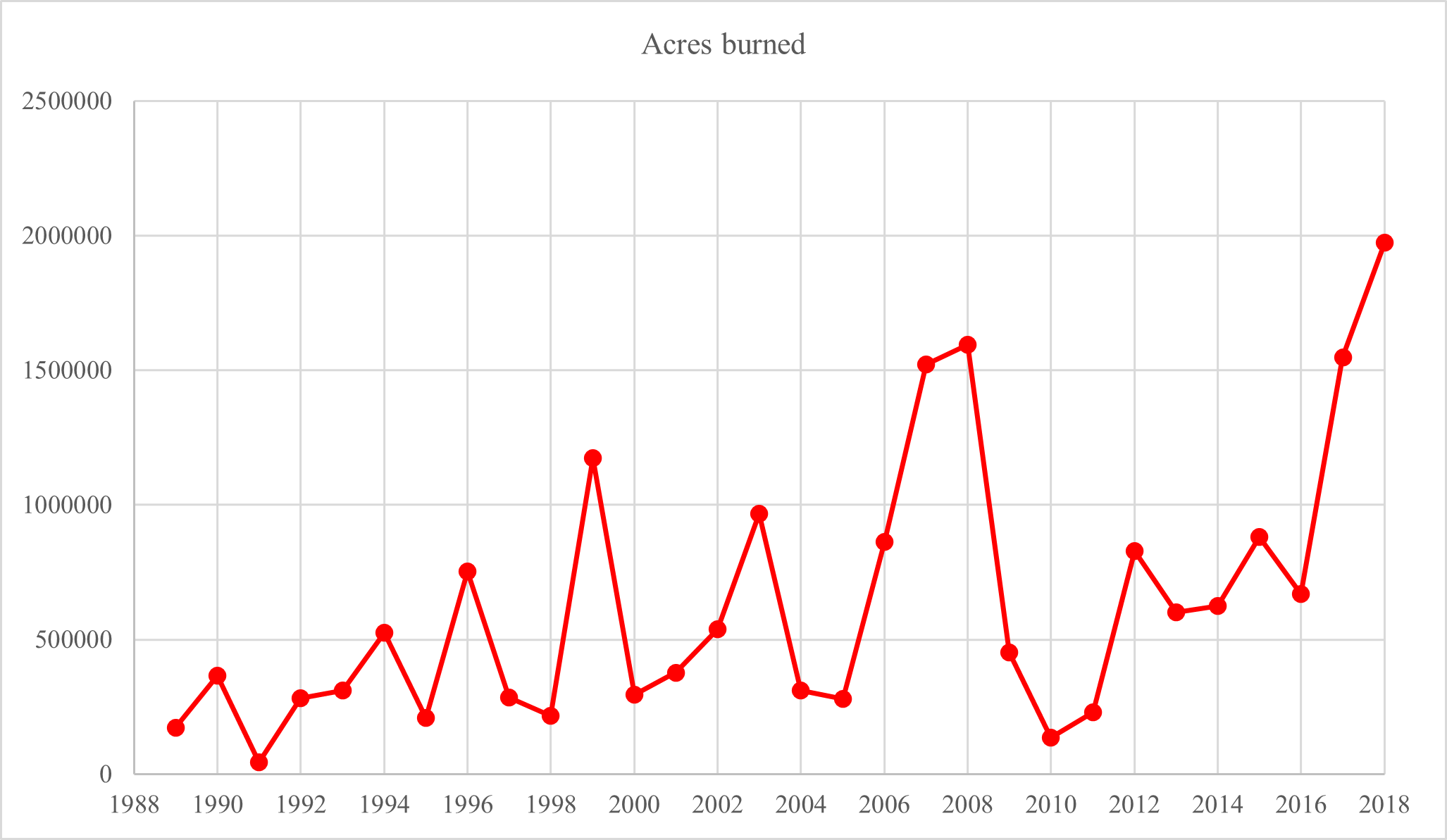
Wildfires affect most areas of the state, as shown in Figure 2, which maps the 104 major fires (burning over 5,000 acres each) that broke out between 2015 and 2018. The fire season starts in late June, after the California primaries, which were spared the disruption caused by contemporaneous fires. In 2016 there were 12 major fires in the three months leading up to the November general election, and in 2018 there were 15.
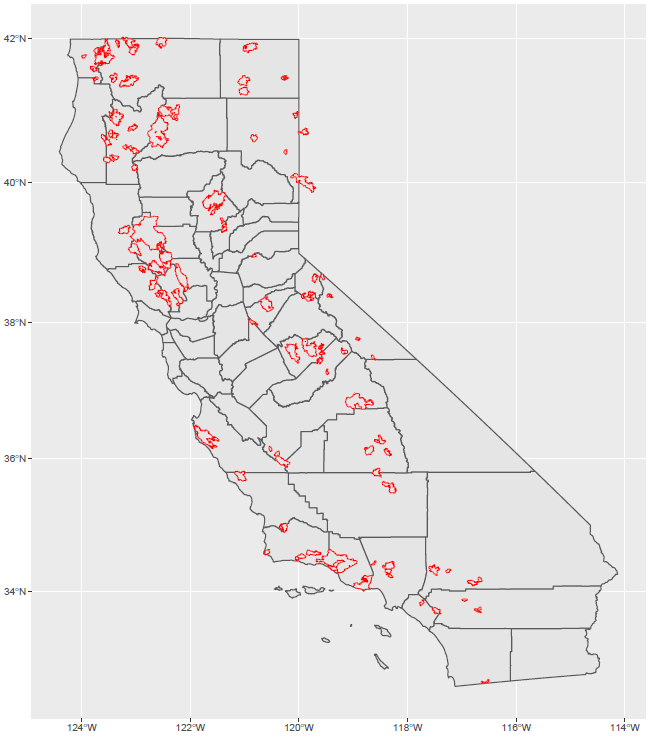
In addition to climate change, the risk to Californian communities has been exacerbated in recent years by increased numbers of people living on what fire scholars term the ‘wildland-urban interface’—in other words, areas at the edge of human settlements where people are most likely to be affected by conflagrations (Brenkert-Smith et al. 2006). The 2018 Camp Fire that started on 8 November, two days after voters went to the polls, was the deadliest fire California had ever experienced, killing 85 people and destroying 18,804 structures. The 2017 Tubbs Fire was the fourth most lethal on record, leading to the loss of 22 lives. The 2017 Redwood Valley and Atlas 2018 Car fires also rank in the top 20 most deadly fires in the state’s history (CalFire n.d.c). Focusing on the 2015–2018 period under analysis here, Table 1 provides an indication of the magnitude of physical and social effects of fires between 2015 and 2018.
| 2015 | 2016 | 2017 | 2018 | |
|---|---|---|---|---|
| Number of fires | 8,283 | 6,959 | 9,270 | 7,948 |
| Acres burned (million) | 0.88 | 0.67 | 1.55 | 1.98 |
| Structures destroyed | 3,194 | 1,274 | 10,868 | 22,905 |
| Financial damage (billions USD) | 3.06 | 0.15 | 12.14 | 4.08 |
The survey of electoral administrators (described in detail in the next section) queried respondents about the following kinds of damage inflicted by the wildfires.
- Polling stations burned;
- Residences burned/voters displaced;
- Election materials burned;
- Shortage of poll workers;
- Air quality limiting movement of electoral officials and voters;
- Disinformation related to elections;
- Polling station conflicts because of overcrowding or other wildfire related factors;
- Difficulty keeping voter registries up-to-date with death rates;
- Electoral malpractice or perceptions of malpractice;
- Limitations posed to election observation; and
- Chemical and biological hazards, Communications failures, Electrical outages; and Technological failures affecting the electoral process.
For the 2016 electoral cycle, one respondent cited burned residences and voter displacement as the only impact of the wildfire on electoral infrastructure. For the 2018 cycle, two respondents cited burned residences and voters displaced, and one cited polling stations having burned.
Enabling voting by people who have been affected by fires involves overcoming informational, logistical and psychological challenges. As California State Senator Anna Caballero notes: ‘The problem is, quite frankly, when you’ve lost everything—I gotta think the last thing you’re thinking about is voting. […] We need to get the message out so voters know they have lots of options’ (in Mansoor 2020).
A number of different types of organizations have a role to play in this awareness raising. Electoral administrators can help by providing clear guidance designed to address the specific obstacles that voters face in the wake of a fire. Examples of how this might be done at state level include the fire-specific guidance offered by the states of California, Oregon and Washington, targeted at voters who have been displaced (Secretary of State for California 2020; Secretary of State for California 2021; Secretary of State for Oregon n.d; Secretary of State for Washington n.d.). At the level of California counties, there are also examples of fire-specific information for voters, such as El Dorado County’s webpage with details of the locations of voting facilities and information on how to check voting status online (El Dorado n.d.).
Voluntary sector organizations have played their part in helping fire-affected voters to exercise their franchise, by reaching out to ethnic minority groups (Mansoor 2020). The media have also risen to the challenge, offering detailed advice on voting provisions for those whose lives have been thrown into chaos by conflagrations (Nichols 2021). Part of the human dimension to the damage inflicted is the death toll, which was at least 31 in 2018, of which 29 were in the Camp Fire. In the same year an estimated 250,000 people were displaced from their homes by the wildfires. In the town of Paradise/Butte County, more than 6,700 homes and businesses were burned down (BBC 2018). Figure 3 provides a chronology of electoral events against the dates when the wildfires were active.
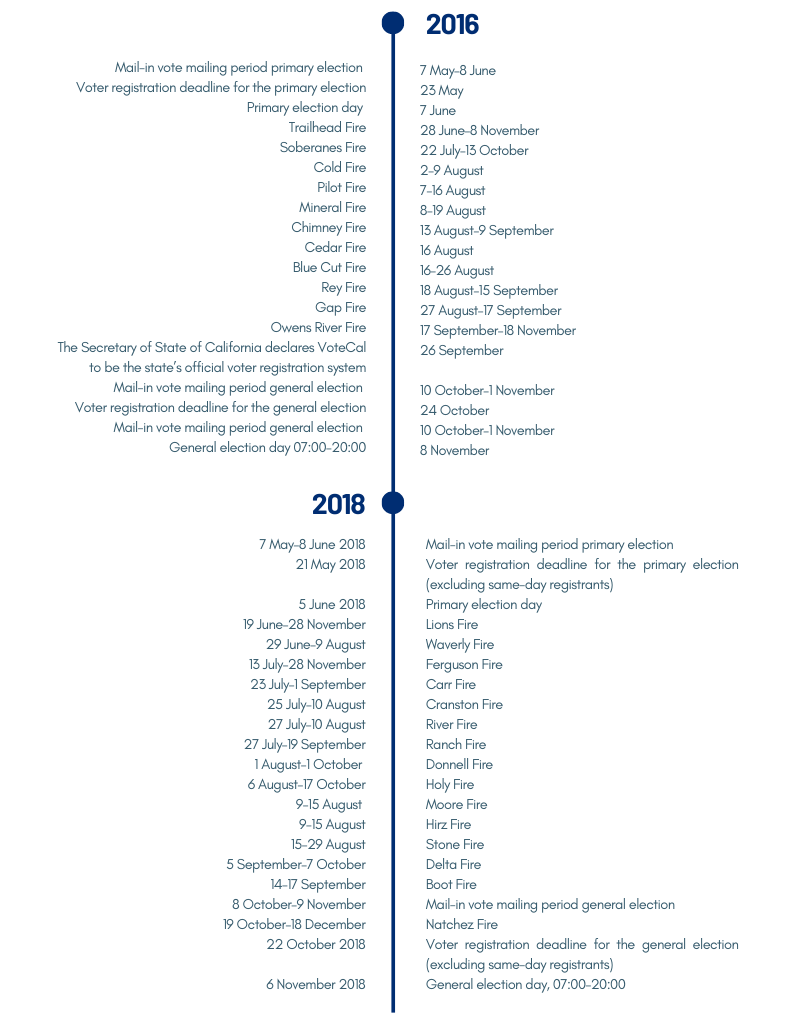
Survey findings
The EAC has issued six tips for election authorities to follow when confronting the impact of natural disasters on elections (EAC 2017): 1) Identify possible disasters and create contingency plans; 2) Make certain you create a comprehensive contingency plan; 3) Have a plan for communications failures; 4) Develop a contingency plan for relocating polling stations; 5) Be sure to plan for staffing shortages; and 6) Have a plan for ballot shortages or technology failures.
For the 2016 electoral cycle, 87.5 per cent of respondents to the survey for this study indicated that they had developed wildfire contingency plans for the elections and followed at least one of the EAC guidelines. There were no election postponements in either the 2016 or 2018 electoral cycles. The guidelines followed and percentage reporting doing so are shown in Table 2.
| Tips | 2016 | 2018 |
|---|---|---|
| Identify possible disasters and create contingency plans | 61.54% (8) | 64.29% (9) |
| Make certain you create a comprehensive contingency plan | 61.54% (8) | 64.29% (9) |
| Have a plan for communications failures | 46.15% (6) | 50.00% (7) |
| Develop a contingency plan for relocating polling stations | 69.23% (9) | 71.43% (10) |
| Be sure to plan for staffing shortages | 53.85% (7) | 64.29% (9) |
| Have a plan for ballot shortages or technology failures | 76.92% (10) | 92.86% (13) |
In their contingency plans, Amador, Butte, Calaveras, El Dorado, King’s, Madera, Los Angeles, Mariposa and Merced Counties all reported having provided staff (including those working the Vote Centres, and those providing technical and compliance support) with broadly standardized set of training programmes. These covered the operation and securing of the voting equipment, setting up a Vote Centre, assisting and processing voters, securing sensitive equipment each night, and the proper procedures in case of an emergency. Such standardized training may be provided in other counties as well.
Amador, Merced, Nevada and Tuolumne Counties referenced training for polling staff to deal with potential disruptions at Vote Centres and provided mobile telephones to poll staff to directly connect with the Registrar of Voters if necessary. Mobile telephones for poll workers were also provided by many reporting counties.
Voter Registration
For 2016, there were no special modalities for in-person registration at regular locations and 83.3 per cent of counties offered an online option. However, for 2018, 16.7 per cent of counties provided in-person registration at emergency locations and online registration became available in more (91.7 per cent) of the counties.
For 2016, 16.7 per cent of respondents indicated that a special application process was in place for voters displaced by wildfires, with 8.3 per cent involving interviews at county offices. Otherwise, there was no special process for 58.3 per cent of the respondents. Special application processes were reduced in 2018, but 33.3 per cent indicated that other processes were established.
For 2016, obituaries and hospital records were indicated as sources to identify deceased voters at 16.7 per cent and 8.4 per cent, respectively. For 2018, obituaries as sources increased to 25.0 per cent of respondents with hospital records increasing to 16.7 per cent and police records to 8.33 per cent.
After the 2016 and 2018 elections, many counties adopted contingency plans to manage the impact of wildfires for future voter registration. The Amador, Merced, Santa Clara and Ventura Counties contingency plans describe a provision that:
Vote Centre staff has access to the Election Information Management System (EIMS) to be able to determine if a voter is properly registered, whether the voter has received a ballot, whether the voter has returned a ballot, and what type of ballot to issue the voter (…) all laptops connected to the election management system will also be connected to VoteCal, the official statewide voter registration database managed by California Secretary of State. VoteCal will track voters across the state and notify vote centre staff if a voter is actively registered in another county and if the voter has received and/or returned a ballot in another county.
—Amador County Voter’s Choice Act Election Administration Plan, 2021 revision, page 10
Campaign period
Devastating wildfires have risen to prominence as election campaign issues in jurisdictions such as Australia (Chow 2019) and Greece (Vasilopoulos and Demertzis 2013). In California, major issues in the 2016 election campaign were housing, health and social protection (Paul 2016), and wildfires did not figure prominently. This changed in the 2018 campaign. In addition to inequality, housing, health and education, California’s fires—and related issues such as forest management and utility liability—were debated at local, state and national levels (Dillon and Mejdrich 2018; Lagos 2018; Tolan 2018).
Discussion revolved around both policy proposals and spending. The tempo of the debate increased when a pro-Democratic group pointed to the fact that Republican Congressman Tom McClintock had voted against post-wildfire assistance (Bowman 2018). The Congressman also cast doubt on anthropogenic climate change, even in the face of dramatic evidence from his locality; in response, opponents campaigned against him on the issue (Wildermuth and Garofoli 2018; Worland 2018). Republican President Donald Trump intervened with comments blaming California’s recent fires on forestry management practices in the state, an allegation that was widely discredited by forestry experts (Fuller 2018) and criticized by California Democrats (Marinucci and Hart 2018). In 2018 State Senator Hannah-Beth Jackson (Democrat) nevertheless backed legislation to expand prescribed burns and introduce other forest management practices on both public and private lands (Lagos 2018).
California wildfire funding also gained legislative attention at the federal level on Capitol Hill in 2018. Confronted with a massive spread of wildfire as in California, to cover the costs the US Forest Service had resorted to a practice termed ‘fire borrowing’ where the Service extracts funding to combat the wildfire from other sources in its budget. This practice was prohibited by legislation taking effect in 2020 (Dillon and Mejdrich 2018) compelling the Forest Service to seek other sources of emergency funding.
Voting operations
In the survey responses from some counties, contingency plans describe procedures to follow for potential disruption of voting at vote centres or drop-off sites and provide signage and staff to direct people to an alternative location. Poll workers are to receive written instruction of emergency procedures. In some counties, emergency responders receive a list of all vote centre locations.
Disruptions may also result from electrical power failures. The Butte County plan states, ‘for every election, the county provides a notification letter and list of facilities being used to the planned outage coordinator […] In the event of a power failure, the power agency is asked to contact the Butte County Clerk-Recorder/Registrar of Voters or the Assistant County Clerk Registrar of Voters immediately to provide information on the outage. During the outage period, all voting system equipment shall be run under battery power until electrical services are restored. The county has purchased uninterruptable power supply (UPS) battery backups to be provided to Voter Assistance Center locations’.
UPS and battery backup are also described in contingency plans for other counties as well. San Bernadino County provide for different contingency actions depending upon the length and source of the disruption. For example, if the disruption is a power outage which lasts over 15 minutes, the voter will be directed to an alternative location. A list of such alternative locations is drawn up in advance of election day. If the electronic voting equipment goes down, the poll workers can continue voting through the issuance of paper ballots.
The Los Angeles County plan states:
If a Vote Centre is significantly disrupted, the election authorities will immediately deploy a Pop-Up Vote Centre. This Pop-Up Vote Center consists of staff and all the equipment needed to set up ePoll books and [Ballot Marking Devices]. Mobile voting units could be deployed to serve as supplemental or replacement voting locations.
— Los Angeles County Election Administration Plan, pages 20-21
Mobile vote centres are referenced also in the Orange and Sonoma County contingency plans. However, Sacramento County evaluated the need for mobile vote centres and declined to pursue this option for the 3 March 2020 primary election or for 3 November 2020. This was due to concerns over cost and available staff to move, set-up and configure the required equipment.
Orange County takes a decentralized approach to managing disruptions in voting. Its contingency plan states:
During the voting period, election support personnel are located throughout Orange County, ready to respond to any incident. These field personnel have replacement voting equipment and supplies and are trained to handle technical issues. The response time of these support personnel will typically be less than 15 minutes. Field personnel can also respond to loss of power at a vote centre location with mobile electric generators. Vote Centre staff have emergency contact information, including a dedicated helpdesk that can quickly resolve issues, or dispatch a member of the support team in the field
—Orange County 2017
To assure continuity of service Ventura County employs a system of redundancies (over-supply) for equipment, voter centre personnel, server and network, and voting supplies. The contingency plan also offers guidelines on how to deal with suspicious objects or persons. A number of counties include security measures in their plans also.
In summary, given the structure of US elections, the contingency planning is decentralized by county. While on the downside this results in a lack of consistency in approach, it can also be viewed as allowing counties to experiment with a range of potential solutions, enabling trial-and-error and peer learning.
Special voting arrangements
The survey results revealed the following responses (Table 3) about the use of special voting arrangements (SVAs) in the 2016 and 2018 electoral cycles.
| Special voting arrangement | 2016 | 2018 | ||
|---|---|---|---|---|
| % | Responses | % | Responses | |
| No SVAs were reported by | 16.67% | 2 | 20.0% | 2 |
| Absentee – Excuse | – | 0 | – | 0 |
| Absentee – No excuse | 50.0% | 6 | 50.0% | 6 |
| Early in-person | 50.0% | 6 | 60.0% | 6 |
| Mail-in ballots | 75.0% | 9 | 80.0% | 8 |
| Election day drive-up | 33.33% | 4 | 40.0% | 4 |
| Drop box | 66.67% | 8 | 70.0% | 7 |
| Mobile telephone | – | 0 | – | 0 |
| Internet | – | 0 | – | 0 |
| Other (please specify) | 16.67% | 2 | – | 0 |
With small variations, the use of SVAs remained fairly constant from 2016 to 2018: an expansion in response to the wildfires was not in evidence.
Coordination across jurisdictions/levels of government
The survey inquired whether the county election authorities had any coordination mechanisms with other county, state or federal agencies to enhance responses to wildfire threats. Table 4 shows the responses for 2016 and 2018.
| Agency | 2016 | 2018 | ||
|---|---|---|---|---|
| % | Responses | % | Responses | |
| No county level coordination | 33.33% | 1 | – | 0 |
| Fire Department | 33.33% | 1 | 75.0% | 3 |
| Sheriff – Coroner | 66.67% | 2 | 100.0% | 4 |
| County Counsel | 33.33% | 1 | 75.0% | 3 |
| District Attorney | – | 0 | 24.0% | 1 |
| Environmental Health | – | 0 | 50.0% | 2 |
| Health Service | 33.33% | 1 | 50.0% | 2 |
| Social Services | 33.33% | 1 | 50.0% | 2 |
| Other (please specify) | 33.33% | 1 | 25.0% | 1 |
For 2016, there were virtually no coordination activities with state agencies (Other – 2 responses). The only federal agencies where coordination was cited were the EAC and the Federal Emergency Management Agency. As a result, only 2018 responses are listed in the Balance in Table 5.
| State | % | Responses |
|---|---|---|
| No state level coordination | – | 0 |
| California Department of Forestry and Fire Protection | 50.0% | 2 |
| California Wildfire and Forest Resilience Task Force | 25.0% | 1 |
| State and Regional Emergency Operations Centers | 50.0% | 2 |
| County Police Department | 25.0% | 1 |
| California Highway Patrol | 25.0% | 1 |
| California National Guard | 25.0% | 1 |
| California Conservation Corps | 25.0% | 1 |
| Emergency Medical Services Authority | 25.0% | 1 |
| California Department of Public Health | – | 0 |
| California Air Resources Board | 25.0% | 1 |
| CalVolunteers | – | 0 |
| Other (please specify) | 50.0% | 2 |
| Federal | ||
| No federal level coordination | 25.0% | 1 |
| Federal Emergency Management Agency | 50.0% | 2 |
| Electoral Assistance Commission | 50.0% | 2 |
| Disaster Survivor Assistance | – | 0 |
| Environmental Protection Agency | 25.0% | 1 |
Informational environment
The survey inquired whether polling stations had been forced to close by wildfires and whether there was any special communications outreach to voters to inform them of the change. For 2016, 13 respondents (93 per cent) indicated that no special communication arrangements were made and one response each (15.4 per cent) indicated that the county website, Facebook, Instagram, other social media, conventional media, and postal notices had been used.
In 2018, special communications activities increased, with two more counties reporting having used county websites, Facebook, Instagram, conventional media, and postal notices, and one each having used social media platforms and other means.
The survey reveals that the main voter education messages in 2016 focused upon describing any changes to polling station procedures (12 responses). There was one response each for messages concerning polling location changes, SVA availability and changes to voting procedures. The only case of misinformation messaging was noted by one county respondent and related to citing false claims of electoral malpractice in 2016.
In 2018, changes to polling station procedures remained the top voter education message (11 respondents, 85 per cent), followed by polling station changes and SVA availability and procedures by 15.4 per cent (2) each, and registering residential displacement and air quality notices on election day with one respondent for each (7.7 per cent).
As in 2016, 91.67 per cent (11) respondents reported no mis-disinformation messages and one respondent (8.3 per cent) reported messaging on false claims of electoral malpractice.
Orange County has developed an Incident Response Plan which can be used in the event of a cybersecurity incident, electrical power outage, or physical attack. The plan’s communications flowchart (Figure 4) depicts how information will be disseminated to voters, staff, and media outlets during a disruption. Delegations of authority have been set to avoid misinformation and make policy or operational decisions as appropriate.
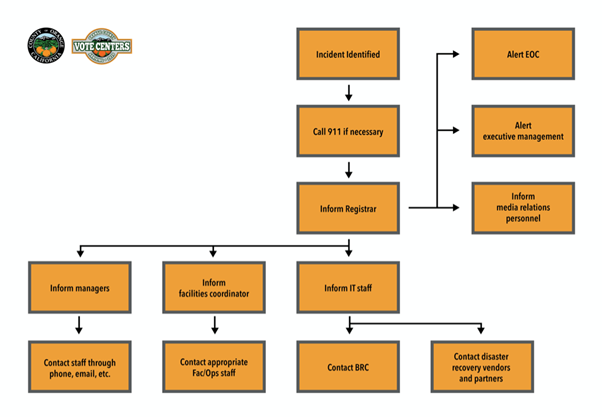
The plan identifies all critical processes required to administer an election. Each of these critical processes is analysed, and the technical dependencies for each of those processes are determined. For each of those technical dependencies, a recovery strategy is defined, including the restoration of required data. As an example, providing vote centre support is one of the many critical election processes identified. In order to provide support to vote centres, employees need access to a database with vote centre information and contact information. Therefore, the Incident Response Plan requires that there is a backup of that database and a strategy to be able to restore the data in a reasonable amount of time to continue operations.
Other procedural considerations
The survey respondents were asked if the impact of the wildfire prompted any legal, infrastructure or operational changes in 2016. Changes to the SVA legal framework were cited by one (10.0 per cent) respondent. There were no changes to infrastructure, and the operational change cited by three (30.0 per cent) of the respondents was the establishment of coordination mechanisms.
For 2018, changes to the SVA legal framework were cited by one (10.0 per cent) respondent. For changes to infrastructure, one respondent (11.11 per cent) cited the introduction of a crisis management protocol. Operational changes included an increase in coordination mechanisms by four respondents (40.0 per cent) and the development of a strategic communications capacity by one other respondent.
In 2016, the survey revealed that no respondents reported additional election costs associated with the impact of the wildfire. However, in 2018, additional costs were reported by one response each (10.0 per cent) for facilities and training; and 20.0 per cent (2) for materials. Otherwise, 80.0 per cent (8) of the respondents reported no additional costs. There were no reports of EMBs being underfunded for either the 2016 or 2018 electoral cycle.
Turnout and election results
Wildfires can potentially alter the choices that voters make when they go to the polls. Analysis of the electoral effects of wildfires in California have found that the experience of a fire is more likely to make voters in Democratic-dominated areas opt for pro-environmental local referendum (ballot initiative) options but has virtually no impact on Republican-dominated areas (Hazlett and Mildenberger 2020). Wildfires can also shift voters’ policy preferences, which may have electoral consequences. Hui and colleagues find that fire experience makes Californian Republicans more willing to support spending public funds on fire resilience measures (Hui et al. 2021).
Certainly, Californians appear for the most part to be aware of the link between climate change and the severity of fires. According to a 2017 survey, 66 per cent made this connection (Marlon and Cheskis 2017). There is also evidence that wildfires increase both taxation and public spending in Californian municipalities (Liao and Kousky 2021), suggesting that local residents are keenly aware of their effects, even if they have not been directly impacted by fire damage.
The best way to analyse the impact of fires on vote choice is by examining bipartisan congressional contests, where we can compare average vote shares across districts and across time for the same party. This approach smooths out any possible impacts that candidate-specific factors might have. The Californian top two candidates open primary system means that not all general election contests are between the two main parties, but this was the case for 44 out of 53 congressional seats in both 2016 and 2018. In the 2016 election, Democratic candidates in such districts won on average 54.0 per cent of the vote where the district had been affected by one or more major fires that year, but 61.6 per cent in seats not affected in this way. In 2018, the party won 57.6 per cent in fire-affected districts and 64.4 per cent in those not affected.
On the face of it, this would seem to suggest that the recent experience of a wildfire might depress the Democratic vote. However, this conjecture would be somewhat misleading, as fires occur predominantly in rural and semi-rural areas which tend to have lower Democratic support anyway. The two-way fixed effects statistical method provides a way around this problem by controlling for both district- and election-specific effects and thereby allowing us to isolate the impact of fires on the vote.41 Using this method, we find that in 2016 the Democratic vote was reduced on average by 2.4 percentage points in fire-affected seats, but that in 2018, there was no statistically significant difference in support for this party in seats affected by fires and those not affected. There is therefore only weak evidence that fires have a meaningful impact on voter choice in California.
It is also worth considering the possibility that wildfires might affect the proportion of the electorate that turns out to vote in California. There is limited research on the impact of wildfires on turnout, but one study found that wildfires that took place in California between 2006 and 2010 and were within 15 kilometres of an electoral precinct reduced turnout by approximately 1 per cent (Hazlett and Mildenberger 2020).
Turnout in the state was not far from the national average in either of the two years. In 2016, 58.7 per cent of Californians exercised their franchise (75.3 per cent of those registered to vote) against a national average of 60.2 per cent (Secretary of State of California 2016b); in 2018, 50.5 per cent of eligible electors turned out (64.5 per cent of those registered), while the national average was 50.3 per cent (Secretary of State of California 2018b).
Average turnout as a proportion of eligible electors in the 15 counties that experienced major wildfires in 2016 was 59.8 per cent, a figure almost identical to the 59.6 per cent mean turnout recorded in counties with no major fires that year. The 26 counties that experienced major wildfires in 2018 had turnout figures of 51.7 per cent on average that year, as against 52.9 per cent in counties with no major fires, hinting at the possibility that fires might have made people less likely to vote. Yet two-way fixed effects analysis of the sort described above does not find any statistically significant difference in turnout in either year, between counties that experienced major fires and those that did not. Similar analyses that break turnout down into participation by mail-in voters and that by in-person voters also fail to yield any significant differences between affected and non-affected counties in either year.
Although aggregate-level analysis of the sort offered here provides only a coarse approximation of the impact of wildfires on voting behaviour, there is little evidence that fires are having a major impact on whether or how Californians vote. Of course, if the frequency and intensity of fires increase in future, that could well change.
Conclusions and lessons learned
The United States has already begun to learn lessons from the increased frequency of wildfires, hurricanes and other natural hazards that are affecting the country, not to mention the Covid-19 pandemic. In 2019 the Election Assistance Commission established a Disaster Preparedness and Recovery Working Group to encourage and guide states in establishing risk management and resilience strategies (EAC 2019). In addition, 2016 California state legislation requires county election officials to develop contingency plans to mitigate disruptions caused by natural disasters and other events. The main lesson from California’s recent experience of wildfires is therefore that contingency planning can help to reduce election disruption in the wake of fires.
Given the likely increase in weather-related hazards in the years to come, the USA would benefit from moving its elections from November, which falls during the fire and hurricane seasons, to an earlier part of the year. However, this would require legislative action on the federal level and would impact the election calendar for the entire country, not solely California.
References
Alihodžić, S., ‘Protecting Elections: Risk Management, Resilience-building, and Crisis Management’, Paper presented at the Electoral Integrity Project virtual conference ‘Delivering Trusted Elections: New Challenges in Electoral Integrity’, 5–9 July 2021, <https://www.dropbox.com/sh/y8imno2i7gs2qns/AABcv7vX2VaQFHxCKartViwYa?dl=0&preview=6-4+Alihodzic_Protecting+Elections.docx>, accessed 25 June 2022
BBC News, ‘California wildfires: Death toll reaches grim milestone’, 12 November 2018, <https://www.bbc.com/news/world-us-canada-46175339>, accessed 25 June 2022
Bowman, B., ‘Democrat group launches wildfire ads against California congressman’, Roll Call, 8 August 2018, <https://rollcall.com/2018/08/08/democratic-group-launches-wildfire-ads-against-california-congressman>, accessed 26 June 2022
Brenkert-Smith, H., Champ, P. A. and Flores, N., ‘Insights Into Wildfire Mitigation Decisions Among Wildland–Urban Interface Residents’, Society and Natural Resources, 19/8 (2006), pp. 759–68, <https://doi.org/10.1080/08941920600801207>
CalFire (California Department of Forestry and Fire Protection), ‘2015 Wildfire Activity Statistics’, 2016, <https://www.fire.ca.gov/media/10061/2015_redbook_final.pdf>, accessed 27 June 2022
—, ‘2016 Wildfire Activity Statistics’, 2017, <https://www.fire.ca.gov/media/10060/2016_redbook_final.pdf>, accessed 27 June 2022
—, ‘2017 Wildfire Activity Statistics’, 2018, <https://www.fire.ca.gov/media/10059/2017_redbook_final.pdf>, accessed 27 June 2022
—, ‘2018 Incident Archive’, [n.d.a], <https://www.fire.ca.gov/incidents/2018>, accessed 27 June 2022
—, ‘California wildfires and acres for all jurisdictions’, [n.d.b], <https://www.fire.ca.gov/media/11397/fires-acres-all-agencies-thru-2018.pdf>, accessed 27 June 2022
—, ‘Top 20 deadliest California wildfires’, [n.d.c], <https://www.fire.ca.gov/media/lbfd0m2f/top20_deadliest.pdf>, accessed 27 June 2022
California State Government, ‘Essential Workforce’, <https://covid19.ca.gov/essential-workforce>, accessed 4 July 2022
Center for Election Innovation and Research, ‘California Voter’s Choice Act June 5, 2018 Primary Election Report’, [n.d.], <https://electioninnovation.org/wp-content/uploads/2020/03/VCA-June-2018-Primary-Report.pdf>, accessed 26 June 2022
Chow, D., ‘Australia is on fire, literally—and so are its climate politics’, NBC News, 18 December 2019, <https://www.nbcnews.com/science/environment/australia-fire-literally-so-are-its-climate-politics-n1104351>, accessed 26 June 2022
Dillon, J. and Mejdrich, K., ‘California wildfires headed to Capitol Hill’, Roll Call, 13 August 2018, <https://rollcall.com/2018/08/13/california-wildfires-headed-to-capitol-hill>, accessed 26 June 2022
EAC (US Election Assistance Commission), ‘Six Tips for Contingency and Disaster Planning from EAC’, 3 August 2017, <https://www.eac.gov/documents/2017/08/03/six-tips-for-contingency-and-disaster-planning-from-eac-audit-election-administration>, accessed 26 June 2022
EAC (US Election Assistance Commission), ‘Disaster Preparedness and Recovery’, 2019, <https://www.eac.gov/election-officials/disaster-preparedness-and-recovery>, accessed 26 June 2022
El Dorado County, ‘Elections and Voting Information’, [n.d.], <https://edcgov.us/Government/Elections/wild-fire-voting-information>, accessed 26 June 2022
Fuller, T., ‘Trump, touring fire ruins in California, repeats disputed claim on forest management’, New York Times, 17 November 2018, <https://www.nytimes.com/2018/11/17/us/trump-california-fires.html>, accessed 26 June 2022
Goss, M. et al., ‘Climate change is increasing the likelihood of extreme autumn wildfire conditions across California’, Environmental Research Letters, 15/9 (2020), <https://doi.org/10.1088/1748-9326/ab83a7>
Hazlett, C. and Mildenberger, M., ‘Wildfire exposure increases pro-environment voting within Democratic but not Republican areas’, American Political Science Review, 114/4 (2020), pp. 1359–65, <https://doi.org/10.1017/S0003055420000441>
Hui, I. et al., ‘Baptism by wildfire? Wildfire experiences and public support for wildfire adaptation policies’, American Politics Research, 11 June 2021, <https://doi.org/10.1177/1532673X211023926>
Intergovernmental Panel on Climate Change (IPCC), ‘Climate Change 2022, Impacts, Adaption, and Vulnerability’, Working Group II Contribution to the Sixth Assessment Report of the Intergovernmental Panel on Climate Change, 2022, <https://doi.org/10.1017/9781009325844>
Lagos, M., ‘Politics of wildfires: Biggest battle is in California’s capital’, NPR, 17 August 2018, <https://www.npr.org/2018/08/17/639357265/politics-of-wildfires-biggest-battle-is-in-californias-capital>, accessed 27 June 2022
Liao, Y. and Kousky, C., ‘The fiscal impacts of wildfires on California municipalities’, Journal of the Association of Environmental and Resource Economists, 9/3 (2021) (updated 11 April 2022), pp. 455–93, <https://doi.org/10.1086/717492>
Los Angeles Times, ‘Editorial: No, Republicans didn’t lose in California because of ballot harvesting. But the practice is concerning’, 7 December 2018, <https://www.latimes.com/opinion/editorials/la-ed-ballot-harvesting-20181207-story.html>, accessed 27 June 2022
Mansoor, S.,‘“They have lost so much but they will not lose their right to vote.” Advocates fight to enfranchise Americans displaced by wildfires’, Time Magazine, 25 September 2020, <https://time.com/5890215/wildfires-displaced-voting>, accessed 27 June 2022
Marinucci, C. and Hart, A., ‘Gov. Brown, fire-besieged California hit back at Trump over blame tweet’, Politico, 11 November 2018, <https://www.politico.com/story/2018/11/11/california-disaster-declaration-fires-trump-983168>, accessed 27 June 2022
Marlon, J. and Cheskis, A., ‘Wildfires and climate are related—are Americans connecting the dots?’, Yale Program on Climate Change Communication blog, 11 December 2017, <https://climatecommunication.yale.edu/news-events/connecting-wildfires-with-climate>, accessed 27 June 2022
National Research Council, Advancing the Science of Climate Change (Washington, DC: The National Academies Press 2010), <https://doi.org/10.17226/12782>
Nichols, C., ‘PolitiFact: Trump wrong on CA voter fraud’, Capitol Weekly, 29 November 2016, <https://capitolweekly.net/voter-fraud-california-politifact>, accessed 27 June 2022
—, ‘Wildfires have displaced thousands of El Dorado County voters. If you’re one of them, here’s how you can still participate in the Recall Election.’, Capradio, 31 August 2021, <https://www.capradio.org/articles/2021/08/31/wildfires-have-displaced-thousands-of-el-dorado-county-voters-if-youre-one-of-them-heres-how-you-can-still-participate-in-the-recall-election>, accessed 27 June 2022
Norris, P., Cameron, S. and Wynter, T., ‘Challenges in American elections’, in P. Norris, S. Cameron and T. Wynter (eds), Electoral Integrity in America: Securing Democracy (Oxford: Oxford University Press, 2019), pp. 3–29, <https://doi.org/10.1093/oso/9780190934163.001.0001>
Norris, P., Wynter, T. and Cameron, S., ‘Lessons for the Reform Agenda’, in P. Norris, S. Cameron and T. Wynter (eds.), Electoral Integrity in America: Securing Democracy (Oxford: Oxford University Press 2019), pp. 196–217, <https://doi.org/10.1093/oso/9780190934163.001.0001>
Orange County, ‘Business Continuity Plan for Registrar of Voters’, October 2017, <https://www.eac.gov/sites/default/files/eac_assets/1/6/BusinessContinuityPlan_OrangeCountyCA.pdf>, accessed 27 June 2022
Paul, S., ‘2016 California voter issues—a lot more than just Hillary and Trump’, UCLA School of Public Affairs blogpost, 2 November 2016, <https://luskin.ucla.edu/2016-california-voter-issues-lot-just-hillary-trump>, accessed 27 June 2022
—, ‘Secretary of State Padilla Reminds Voters of Early Voting Opportunities’, press release, 2 November 2016a, <https://admin.cdn.sos.ca.gov/press-releases/2016/pdf/ap16-149.pdf>, accessed 27 June 2022
—, ‘General Election—Statement of Vote, November 8, 2016’, 8 November 2016b, <https://www.sos.ca.gov/elections/prior-elections/statewide-election-results/general-election-november-8-2016/statement-vote>, accessed 27 June 2022
—, ‘November 8, 2016, General Election’, 2016c, <https://www.sos.ca.gov/elections/prior-elections/statewide-election-results/general-election-november-8-2016/key-dates-and-deadlines-nov-8-2016>, accessed 27 June 2022
—, ‘One Week Remaining for Californians to Register to Vote in June 7, 2016 Presidential Primary’, 2016d, <https://www.sos.ca.gov/administration/news-releases-and-advisories/2016-news-releases-and-advisories/one-week-remaining-californians-register-vote-june-7-2016-presidential-primary>, accessed 27 June 2022
—, ‘County Clerk/Registrar of Voters (CC/ROV) Memorandum #20215’, 17 September 2020, <https://elections.cdn.sos.ca.gov/ccrov/pdf/2020/september/20215jl.pdf>, accessed 27 June 2022
—, ‘Fact Sheet for Persons Displaced as a Result of Fire or Other Emergencies’, 2021, <https://elections.cdn.sos.ca.gov/statewide-elections/2021-recall/votesafe-displaced-voters-2021.pdf>, accessed 27 June 2022
—, ‘Summary of November 6, 2018, General Election Calendar’, 2018a, <https://www.sos.ca.gov/elections/prior-elections/statewide-election-results/general-election-november-6-2018/general-election-calendar>, accessed 27 June 2022
—, ‘General Election—Statement of Vote, November 6, 2018b’, 6 November 2018b, <https://www.sos.ca.gov/elections/prior-elections/statewide-election-results/general-election-november-6-2018/statement-vote>, accessed 27 June 2022
—, ‘Summary of June 5, 2018, Primary Election Calendar’, 2018c, <https://www.sos.ca.gov/elections/prior-elections/statewide-election-results/statewide-direct-primary-june-5-2018/primary-election-calendar>, accessed 27 June 2022
Secretary of State of California, ‘VoteCal Overview’, [n.d.a], <https://www.sos.ca.gov/elections/voter-registration/votecal-project>, accessed 27 June 2022
—, ‘Historical Vote-by-Mail (Absentee) Ballot Use in California’, [n.d.b], <https://www.sos.ca.gov/elections/historical-absentee>, accessed 27 June 2022
Secretary of State of Oregon, ‘Fires in Oregon’, [n.d.], <https://sos.oregon.gov/voting-elections/Pages/fires.aspx>, accessed 27 June 2022
Secretary of State of Washington, ‘Wildfires and Voting’, [n.d.], <https://www.sos.wa.gov/elections/wildfires-and-voting.aspx>, accessed 27 June 2022
Sullivan, K. and Stewart III, C., ‘Impact of Covid-19 on the 2020 US Presidential Election’ (Stockholm: International IDEA, 2020), International IDEA, 2020, <https://www.idea.int/sites/default/files/impact-of-covid-19-on-the-2020-us-presidential-election.pdf>, accessed 27 June 2022
Tolan, C., ‘The biggest California political questions of 2018’, The Mercury News, 1 January 2018, <https://www.mercurynews.com/2018/01/01/the-biggest-california-political-questions-in-2018>, accessed 27 June 2022
Vasilopoulos, P. and Demertzis, N., ‘The Greek Green voter: Environmentalism or protest?’, Environmental Politics, 22/5 (2013), pp. 728–38, <https://doi.org/10.1080/09644016.2013.824173>
Waxman, O. B., ‘Voting by mail dates back to America’s earliest years. Here’s how it’s changed over the years’, Time Magazine, 28 September 2020, <https://time.com/5892357/voting-by-mail-history>, accessed 26 June 2022
Westerling, A. L., et al., ‘Climate change and growth scenarios for California wildfire’, Climatic Change, 109/1 (2011) pp. 445–63, <https://doi.org/10.1007/s10584-011-0329-9>
Wildermuth, J. and Garofoli, J., ‘California wildfires raising environmental issues for vulnerable GOP’, San Francisco Chronicle, 12 August 2018, <https://www.sfchronicle.com/california-wildfires/article/California-wildfires-raising-environmental-issues-13150838.php>, accessed 26 June 2022
Wong, S., ‘Ryan casts doubt on “bizarre” California election results’, The Hill, 29 November 2018, <https://thehill.com/homenews/house/418880-ryan-casts-doubt-on-bizarre-california-election-results?userid=101662>, accessed 26 June 2022
Worland, J., ‘How some environmentalists hope to make climate change an issue in the midterms’, Time Magazine, 15 October 2018, <https://time.com/5413384/california-wildfires-climate-change>, accessed 2022
Acknowledgements
The section on survey findings was researched and written by Jeff Fischer, who designed and carried out the survey of electoral administrators.
We would like to thank Hyowon Park, Electoral Processes Programme, International IDEA for her support with the survey.
About the Authors
Sarah Birch is a Professor of Political Science in the Department of Political Economy at King’s College London.
Jeff Fischer currently serves as an independent consultant for election programming. Mr Fischer has held three election directorships in internationally supervised elections where electoral security was one of his responsibilities: in 1996 as OSCE’s Director General of Elections for the first post-conflict elections in Bosnia and Herzegovina; in 1999 as United Nations Chief Electoral Officer for the Popular Consultation for East Timor; and in 2000 as head of the UN Joint Registration Taskforce in Kosovo as well as the OSCE’s Director of Election Operations for municipal elections held that year. He has also served as an election official in the USA as a Commissioner with the Kansas City Board of Elections (1985–1990) and a Commissioner on the Missouri Political Finance Review Commission (1991–1992).
Hyowon Park, Madeline Harty, Erik Asplund
Publishing date: 1 October 2024
Introduction
The United States of America has experienced several severe hurricanes this century including Hurricane Katrina in 2005, Hurricane Sandy in 2012, Hurricanes Harvey, Maria and Irma in 2017, Hurricane Michael in 2018 and Hurricane Ian in 2022. Hurricane activity in the North Atlantic Ocean has increased since the 1980s (Colbert 2022), and the Intergovernmental Panel on Climate Change’s Sixth Assessment Report by Working Group II (IPCC 2022) found that extreme weather events are increasing in frequency and/or intensity due to climate change. In 2020 the North Atlantic experienced a record number of storms (Colorado State University n.d.), and with increased urbanization and residential settlements in coastal areas, over 60 million Americans were exposed to coastal flooding that year (Mansury, Ye and Yoon 2021).
Hurricane season in the USA—between June and November every year—usually coincides with election season; The chances of hurricanes disrupting US elections are ever-present and will become more catastrophic in intensity due to climate change. So far during the 21st century, four elections have been majorly disrupted—by Hurricane Katrina in 2005, Hurricane Sandy in 2012, Hurricane Michael in 2018 and Hurricane Ian in 2022. Initiatives to protect the integrity of electoral processes are increasingly critical as democracies become vulnerable during times of climate change–related crisis (James, Clark and Asplund 2023; Florini and Hill 2024). This paper will focus on the effects of Hurricane Sandy in New Jersey during the 2012 federal general election, and how electoral officials responded to ensure that the electorate was able to exercise their voting rights despite the ongoing disaster. Hurricane Sandy exemplifies the difficulties hurricanes bring to election operations as Sandy hit New Jersey just eight days before election day, making it the most disruptive hurricane in US electoral history.
This case study will firstly describe US electoral management and discuss hurricanes and their effects on elections in the country. Then, the present study will give a chronology and analysis of Hurricane Sandy’s effects on the 2012 electoral process in the two states and how election officials responded. It will then conclude with what electoral reforms were introduced after the hurricane, followed by the main findings and lessons learned.
Legal and institutional background
The US presidential election process begins with the primary elections and caucuses in each state, usually during the spring of the general election year (every four years), which major political parties use to select their presidential nominees. Primaries, through a secret ballot, allow voters to select their nominees, while caucuses are private gatherings run by political parties held at the county, district or precinct level where voters select a particular candidate at the end of each meeting. Both primaries and caucuses can be ‘open’, ‘closed’, or a hybrid of the two. A closed primary or caucus means that only voters registered with that party can take part and vote, while open ones allow people to vote for a candidate of any political party (USA.Gov 2024). For example, while New York holds closed primaries, New Jersey holds primaries that are open to unaffiliated voters but closed to affiliated voters (NCSL 2024b).
Two main political parties—the Democratic Party and Republican Party—dominate the political field at the different levels of government. Other parties are often termed ‘third parties’, and examples of these third parties in states such as New York and New Jersey include the Conservative Party, Green Party, Independence Party and the Libertarian Party (Vote Smart n.d.; League of Women Voters of the City of New York n.d.).
State and local government elections are typically held on the same date as the federal election, thus combining federal, state and local races onto a single ballot. The 2012 federal election elected the President, all members of the United States House of Representatives, and one-third of the United States Senate (Hall 2012).
The USA has a highly decentralized election administration system. At the federal level, there is no central electoral body that governs election administration, and the federal government plays a minor role in most elections. Rather, these roles are spread across various agencies and actors including the Department of Justice, Civil Rights Division, which enforces federal election laws such as the Voting Rights Act (1965), the National Voter Registration Act (1993) (DoJ n.d.) and the Help America Vote Act (HAVA 2002). The Election Assistance Commission (EAC) is an independent, bipartisan commission that cannot issue binding regulations. It is charged with, among others, developing guidance for state and local governments to help meet the requirements of the HAVA, and adopting voluntary voting system guidelines (Hall 2012).
Each state is responsible for certain aspects of the election, but it is at the local level where elections are administered. This means variation in election administration across and even within states; indeed, no two states administer elections the same way. During the 2012 elections, the USA comprised approximately 10,499 local electoral jurisdictions (Hall 2012; NCSL 2024a). A majority of voters, approximately 63 per cent, were required to cast their ballots on election day at one specified polling location, usually close to their place of residence. Special voting arrangements (SVAs) differed from state to state. In-person early voting—which allows voters to cast ballots days or weeks before election day—was available in 32 states and postal voting (also called mail-in voting) was available in all 50 states (Stein 2015).
Elections in New Jersey
Election administration in New Jersey is handled differently in each county. Overall, the New Jersey Division of Elections within the Department of State is responsible for overseeing elections with the Secretary of State as the chief election official. There are 21 counties in New Jersey, each of which has either two or three election offices. The elected county clerk prints all the ballots and mails them out to voters. For counties with a Board of Elections, made up by political party appointees, the board handles voting machines, registration, poll worker training, election certification, and all other responsibilities beyond those of the county clerk. For counties with a Superintendent of Elections, they handle voter registration and voting machines with the Board of Elections handling all other responsibilities (New Jersey Election Official 2024). Prior to Hurricane Sandy, New Jersey allowed for no-excuse absentee mail-in voting, but did not allow for early in-person voting (Stein 2015).
Elections in New York
The New York State Board of Elections is a bipartisan agency with responsibility for administering and enforcing New York state’s election laws. The board is composed of political appointees nominated by the two major parties. According to New York state’s election laws, the state board of elections is a state agency responsible for issuing instructions and promoting rules and regulations relating to the administration of the election process, election campaign practices, and campaign financing practices law (New York State Board of Elections n.d.). Within each county of the state and for the city of New York, there is a county board of elections responsible for administering elections, that is, 62 county boards of elections. It can be noted that prior to Hurricane Sandy, New York did not allow for in-person early voting or no-excuse absentee mail-in voting (Stein 2015).
Hurricanes in the USA
Hurricanes are North Atlantic tropical storms with sustained winds that reach at least 74 miles per hour, or 119 kilometres per hour, using heat from warm waters to power churning winds (Nordhaus 2013). The National Hurricane Center in the USA categorizes Atlantic hurricanes based on wind speed. A storm with winds stronger than 111 miles per hour, or 178 kilometres per hour, is considered a major hurricane, that is, a Category 3 or higher (Center for Climate and Energy Solutions n.d.a.). These categories, defined by the Saffir-Simpson Hurricane Wind Scale, are used to estimate potential property damage (Table 1). While hurricanes of all categories can produce deadly storm surges, rain-induced floods and tornadoes, this scale does not take them into account (National Hurricane Center n.d.). The Atlantic hurricane season is the period in a year from June through November when hurricanes usually form in the Atlantic Ocean (NOAA 2023).
| Category 1 | Category 2 | Category 3 (Major) | Category 4 (Major) | Category 5 (Major) |
|---|---|---|---|---|
74–95 miles per hour (mph)/ 119–153 kilometres (km)/h | 96–110 mph/ 154–177 km/h | 111–129 mph/ 178–208 km/h | 130–156 mph/ 209–251 km/h | 157 mph or higher/ 252 km/h or higher |
The extreme rainfall produced by hurricanes poses additional dangers. As warm air holds more moisture compared to cold air, the warm moist air in a tropical cyclone cools and condenses as the air rises, which produces a great amount of heavy rain. The heavy rainfall can travel inland long after an initial coastal storm, flooding infrastructure and forcing evacuations (NOAA 2020). Extreme rainfall also causes water tables to rise, and the saturated ground develops weak slope stability, resulting in greater potential for landslides (Center for Climate and Energy Solutions n.d.b; Geology Science 2023).
Hurricane activity in the Atlantic Ocean has increased significantly since 1995. Among weather-related disasters, landfalling tropical storms, such as hurricanes, are a leading cause of economic damage in the continental USA. This economic damage has increased since the middle of the 20th century (Klotzbach et al. 2018), and can be attributed to societal factors—namely population growth and urbanization in hazardous areas such as coastal areas (Bjarnadottir, Li and Stewart 2011). The changing pattern of residential settlements has increased the exposure of over 60 million Americans to the danger of coastal flooding (Mansury, Ye and Yoon 2021). For example, a study showed that the impacts of Hurricane Harvey—which made landfall on Texas and Louisiana in August 2017—were exacerbated by extensive residential development in flood-prone locations. Urbanization has increased the probability of extreme flood events several-fold especially in connection with changes in the climate (IPCC 2022; Zhang et al. 2018; van Oldenborgh et al. 2019).
Further, studies have shown that a warmer climate can increase a storm’s likelihood of undergoing rapid intensification—that is, when a storm’s wind speed increases by 35 miles per hour or more within 24 hours (Thompson 2024). Rapid intensification marks a massive burst of storm strength and can cause mass destruction. This was evident with Hurricane Beryl (June 2024), which unexpectedly progressed from a tropical storm to the strongest recorded hurricane in the Atlantic. Beryl’s strength flattened the island of Carriacou in Grenada in 30 minutes. The ocean heat content had been extremely high when Beryl began, which fuelled rapid intensification (Tang 2024).
In August 2011, one year before Sandy made landfall in New Jersey, Hurricane Irene hit the USA’s East Coast. More than 1,000 New Jersey homes are estimated to have been severely damaged; tens of thousands of people went without electricity for a week or more, and 44 people died as a direct result of Irene (Bates 2016; NWS n.d.c). While retroactive repairs were made to infrastructure against future storm damage, New York failed to invest in disaster prevention measures and seemed unprepared for the extent of damage caused by Hurricane Sandy (Joseph 2013). Realization of this failure brought forth a broader, sustained discussion on the need for climate adaptation and the importance of resiliency efforts (Ladislaw, Sanok Kostro and Walton 2013). Table 2 demonstrates the high cost of cyclones in recent years.
| Tropical cyclone | Year | Category | Costs in USD (adjusted based on the 2024 Consumer Price Index) |
|---|---|---|---|
| Andrew | 1992 | 5 | 60.2 billion |
| Ivan | 2004 | 3 | 34 billion |
| Katrina | 2005 | 3 | 200 billion |
| Wilma | 2005 | 3 | 30 billion |
| Ike | 2008 | 2 | 43.2 billion |
| Sandy | 2012 | 1 | 88.5 billion |
| Harvey | 2017 | 4 | 160 billion |
| Irma | 2017 | 4 | 64 billion |
| Maria | 2017 | 4 | 115.2 billion |
| Florence | 2018 | 1 | 30 billion |
| Michael | 2018 | 5 | 31 billion |
| Ida | 2021 | 4 | 84.6 billion |
| Ian | 2022 | 4 | 118.5 billion |
Hurricanes and elections
Disasters and emergencies on or before election day can suppress voter participation, particularly among citizens with a history of infrequent voting; this is usually due to inaccessible voting locations, voters and polling staff being unable to access polling stations, voter displaced to distant locations, and polling stations that are damaged and/or inoperable (Stein 2015). While state codes do contain a broad contingency plan to overcome emergencies affecting individual precincts on election day, there is no controlling authority to determine what happens when multiple states need to reschedule a federal general election. Some states may allow for the postponement of an election during a declared state of emergency, but few outline a detailed procedure to ensure voter enfranchisement (Green et al. 2013).
As hurricane season overlaps with the USA’s typical election period, it will become more common for more intense hurricanes to impact elections. New Orleans and Louisiana suffered through two hurricanes in two months in 2005—Hurricane Katrina in August, which caused the protective levees surrounding the city to fail, flooding the city, and Hurricane Rita in September, which caused the recently patched levees to fail once again. New Orleans had originally scheduled its municipal elections for early February 2006, but due to almost two-thirds of its population having been displaced and with voting infrastructure destroyed, they were postponed to April 2006 (Brox 2009). Hurricane Michael impacted Florida, Georgia and the Carolinas in October 2018, weeks before the midterm elections in November. Along with vast voter displacement, the storm destroyed many polling stations. Election officials in all four states took steps to try to accommodate voters and mitigate voting disruptions such as extending registration deadlines or early voting hours (Slack 2018). In Florida, Executive Order 18-283 provided greater flexibility in election administration following Hurricane Michael. The order relaxed restrictions on early and postal voting, but it did not allocate emergency funding to maintain the original number of polling places. As a result, polling stations were consolidated, and only 65 of the 125 planned locations were open across the eight counties affected by the executive order (Morris and Miller 2023).
Most recently, Hurricane Ian affected the 2022 midterm elections as it landed six weeks prior to election day. The storm’s impact resulted in cancelled campaign events and changes in messaging, as candidates pushed voters to prepare for the hurricane. A significant number of early voting sites and polling stations were damaged or rendered unusable by Hurricane Ian. The US Postal Service created alternative sites for displaced people to pick up their ballots for up to 10 days after the attempted delivery of mail-in ballots. In addition, the Governor of Florida extended the number of early voting days and early voting locations and allowed certain voters to receive mail-in ballots at alternative addresses. The Governor, a Republican, was accused of partisan manipulation for excluding Democrat-leaning counties from the executive order allowing counties to expand SVAs in these ways (State of Florida 2022; Towriss 2022; Oladipo 2022).
Hurricane Sandy
Hurricane Sandy was named the 18th tropical storm of 2012 on 22 October. On 23 October, it developed into a Category 1, making landfall in the Caribbean and impacting Jamaica, Cuba and the Bahamas. As Sandy approached the Gulf of Mexico, unusually warm waters for that time of the year strengthened the hurricane and caused it to grow (Devanandham and Ramirez-Marquez 2016). Before making landfall in the East Coast of the USA, Hurricane Sandy morphed into a hybrid-type storm, and as the cooler air from the North American continent approached the still-warm tropical storm, it transformed into an extratropical cyclone (for the track of the hurricane see Figure 1). This caused the US Government to issue both hurricane and blizzard warnings for the same storm (Halverson and Rabenhorst 2013). On 28 October, one day before Sandy made landfall in the USA, President Obama issued emergency declarations for New York, New Jersey, Connecticut, Washington, Delaware, Maryland, Massachusetts and Rhode Island.
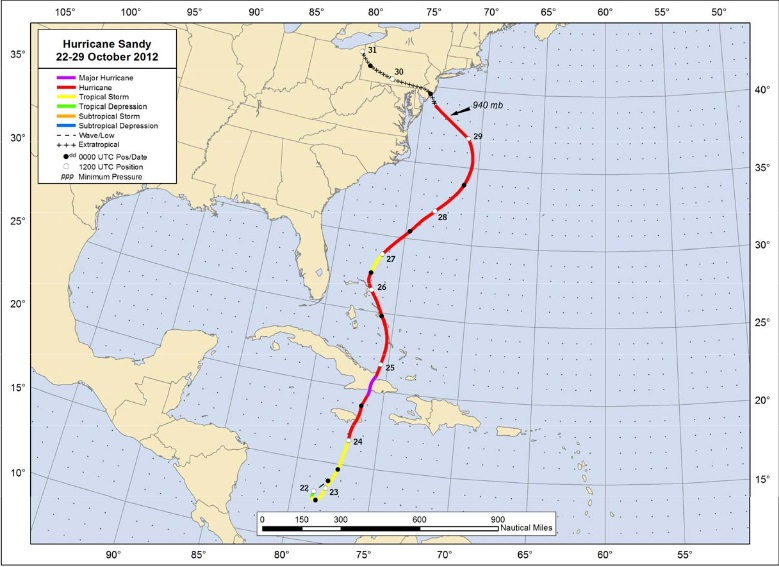
How much climate change played a role in the impact of Sandy on the Eastern Seaboard has been subject to debate. However, new research published in 2021 found that approximately USD 8 billion of Hurricane Sandy’s excess flooding damage can be attributed to climate-mediated anthropogenic sea-level rise, affecting between 40,000 and 131,000 additional people (Strauss et al. 2021).
General impact
On 29 October 2012, Sandy made landfall at Atlantic City, New Jersey. The highest gusts occurred along the Jersey Shore and over New York City. Around 20 million people in 24 states were said to have experienced direct impacts. This included power outages for almost 8.6 million clients across 17 states, with 570,000 buildings damaged or destroyed, and over 130 deaths (Halverson and Rabenhorst 2013). The affected 24 states sustained physical and financial damage from the storm, and the impact of Sandy highlighted vulnerabilities of healthcare, telecommunications, transport, water, wastewater and other critical infrastructure. For example, Sandy caused New York to shut down all six of the subway tunnels connecting Brooklyn to Manhattan; two tunnels—from Queens to Manhattan and from Long Island City to Greenpoint—were flooded. In all, the shutdown of various transport systems impacted about 8.6 million daily public transit commuters (Haraguchi and Kim 2016).
Prior to Hurricane Sandy, New Jersey election officials were aware of potential natural hazard impact on elections but planned for issues that might face singular towns or specific areas. The catastrophic levels of Hurricane Sandy’s impact were not expected or planned for.
Emergency response by federal and state agencies
Federal, state and territorial agencies build their command and coordination structures to support the local command and coordination structures during an emergency. President Obama’s emergency declarations for six states allowed them to request federal aid and make additional preparations before Sandy made landfall. After that point, the President issued major emergency declarations allowing New Jersey and New York to access a wide range of federal assistance programmes for individuals and public infrastructure (Jackson 2012; FEMA 2024).
After the storm had passed, a coordinated federal, state, tribal nation and local response team worked to restore power, public transportation and other critical infrastructure. At the peak of the response, approximately 17,000 federal personnel were involved, with the federal government providing more than USD 2.4 billion in relief through the Federal Emergency Management Agency (FEMA), the Department of Transportation, the Department of Health and Human Services, among other agencies (US Senate 2012). For example, New York City’s Fire Department was at full stretch as it moved to respond to hundreds of different emergencies that began to surface after the passing of Sandy—working together with the New York City Police Department and the New York National Guard, among others (Giles 2017).
2012 Federal Election
The federal election was scheduled to occur eight days after Hurricane Sandy made landfall. This set into motion a tight timeline for election officials, giving them one week to ensure that voters in affected states would be able to vote. Election officials were facing power outages, flooding and destroyed polling stations (Brennan 2012).
States have different emergency powers and processes, resulting in different administrative arrangements and outcomes during election emergencies (Table 3).
| State powers, Governors’ roles and statutes | New Jersey | New York |
|---|---|---|
| State powers relating to election emergencies | State can relocate polling places. | State can delay/reschedule the election. |
| Governor role in election emergencies | Governor can suspend statutes and regulations created by administrative agencies and can issue orders. | Governor can suspend rules or regulations and can issue orders. |
| Election emergency statutes | N.J. Stat. § 19:8-3.1: Polling places must be accessible to those with disabilities unless an emergency causes such a polling place to be unavailable. | Primaries can be postponed under the Emergency Primary Election Rescheduling Act of 2001.* NY ELEC § 3-108: If an emergency causes less than 25 per cent of registered voters to vote during an election, then there will be a second day of voting not more than 20 days after the original date. NY Elec § 7-120: If voting machines malfunction or break down, the local board of elections must provide emergency paper ballots. NY Elec § 16-100: The state court is vested with the power to determine questions of law and fact on the New York election code. |
In New Jersey, election officials began collaborating with neighbouring states to exchange information on how to best prepare for Sandy’s landfall. When the hurricane reached the New Jersey coast, officials assessed storm damage and over the following days learned that more than 25 per cent of polling places were destroyed. Five days prior to the election, the Lieutenant Governor42 began issuing six directives to increase SVAs for New Jerseyans who were desperate to maintain their democratic rights (for detail of the chronology see Figure 2 and ‘8. Special voting arrangements’, below). As one citizen in the north of the state put it, ‘I’ve lost my home and everything I own, please don’t let me lose my right to vote’ (New Jersey Election Official 2024). These adaptations included an extended deadline to apply for mail-in ballots; increased election office hours and access to provisional ballots; and a relaxing of laws that limit ballot assistance rendered per poll worker, and of the requirements on poll worker addresses and polling site locations. Many voters used newly allowed fax and email options to vote remotely on election day.
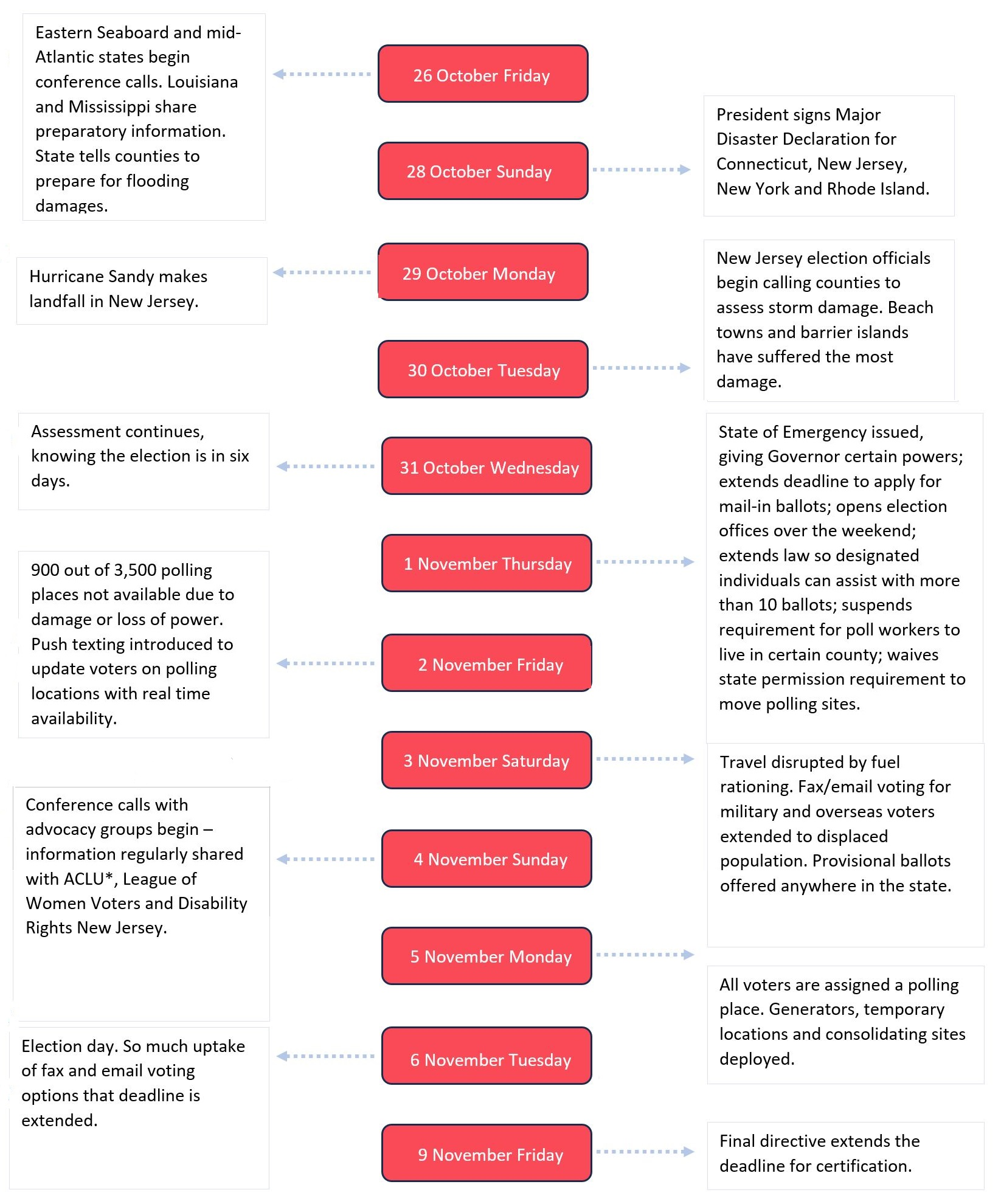
Source: Authors, interview data (New Jersey Election Official 2024).
Campaigning
Sandy made landfall on 29 October 2012 during the final stretch of the campaigning period for the presidential candidates. Both Democrat incumbent President Barack Obama, who was running for his second term, and Republican candidate Mitt Romney changed their campaigning plans. For example, as seen in Table 4, after the hurricane hit Romney turned a rally in Dayton, Ohio, into a ‘storm relief event’ before cancelling his campaign events for 30 October. However, by 31 October, Romney joined his running mate in Florida to continue campaigning (Sullivan 2012). Obama spent two days following the arrival of Sandy visiting the destruction in affected states (30 and 31 October) before resuming his campaign trail on 1 November to visit Midwestern and Western swing states (Jennings 2012).
Some political pundits and commentators speculated that the hurricane’s effect on early voting turnout could disadvantage President Obama and that television advertisements would be rendered useless, considering widespread deficits in access to electricity (Bruni 2012). Conversely, others suspected that Sandy could help Obama’s campaign as he would receive more widespread coverage, making him appear more presidential, a fear Romney alluded to in an interview seven months after the election (Roth 2013). However, the post-hurricane analysis showed that neither candidate received significantly more, or more positive, news coverage due to Sandy (Sides 2013).
29 October Monday | 30 October Tuesday | 31 October Wednesday | 1 November Thursday | 5 November Monday | 6 November Tuesday |
|---|---|---|---|---|---|
| Sandy makes landfall. Obama cancels his campaigning events and Romney turns a Dayton rally into a storm relief event. | Romney cancels campaign events. US President authorizes emergency declaration for New Hampshire, and major disaster declarations for New York and New Jersey. Obama visits storm-affected states. | Romney returns to campaigning in Florida with his running mate. | Obama returns to campaigning. NJ Lieutenant Governor begins issuing six directives increasing SVAs. | Governors Christie (NJ) and Como (NY) announce expansion of SVAs for their respective states. | Election day. |
Interagency collaboration
Prior to Hurricane Sandy there was some interagency collaboration in New Jersey but it did not amount to extensive emergency planning. The eye-opening events of 2012 served to change this. Days before Hurricane Sandy landed, New Jersey election officials reached out to the State Board of Public Utilities to share the list of every polling place in the state so that those places could get in the queue for power outage assistance. Since hospitals and water treatment facilities would come first, election officials wanted to flag the importance of getting polling sites up and running should the storm cut the power. Soon after Sandy landed, state election officials started conference calls with counties to assess the storm damage. Thereafter, election officials were having multiple calls per day with the New Jersey Regional Operations Information Center (within state police headquarters), which serves as a centre for emergency services coordination.
One New Jersey election official noted that regular Continuity of Operations Planning (COOP) is useful as ‘you don’t want to meet somebody for the first time on the day of an emergency’ (New Jersey Election Official 2024). Since Hurricane Sandy, New Jersey election officials have learned to be more regularly in contact with FEMA, the Board of Public Utilities and the New Jersey Regional Operations Information Center, and conducted their first tabletop exercise with many entities in 2019 (New Jersey Election Official 2024).
Special voting arrangements
Special voting arrangements ‘allow voters to exercise their right to vote by alternative means to casting their ballots in-person, on election day, in the default polling station in the voter’s constituency’ (Barrat et al. 2023). These include early voting, postal voting, proxy voting, mobile ballot box voting, and remote electronic voting. SVAs can go by different names depending on the country, and multiple SVAs can be applied to a scenario at once. For example, ‘absentee voting’ can refer to all SVAs in a given country, whereas some countries use ‘absentee voting’ to refer solely to postal voting. SVAs may often represent a departure from conventional voting methods in a certain environment, which can bring into question the integrity and legitimacy of the vote via changed voting procedures—with the trade-off that they can solve certain voting issues that arise (Barrat et al. 2023). The State of Emergency issued in New York by Governor Cuomo on 26 October (Executive Order No. 47) and New Jersey by Governor Christie on 27 October (Executive Order No. 104) gave additional powers for aid in voting during emergencies (Lawyers’ Committee for Civil Rights Under Law 2013).
In New Jersey, the introduction of SVAs began on 1 November where the Lieutenant Governor Kim Guadagno (who also serves as the Secretary of State and chief election official) began issuing six directives with her extended powers granted from the State of Emergency.43 As the election was scheduled for 6 November, the SVAs were deployed in a tight timeline. These included (New Jersey Election Official 2024; Lawyers’ Committee for Civil Rights Under Law 2013):
- 1 November: Extending the deadline to apply for mail-in ballots from 30 October to 2 November; requiring all election offices stay open from 08:30 to 16:30 Friday, Saturday, Sunday and Monday leading up to election day; suspending the requirement that a person could only assist 10 people with ballots; modifying that an individual designated by the state or county office could assist in delivering an unlimited number of mail-in ballots to displaced voters; waiving the requirement that poll workers had to live in the county they worked in; allowing polling places to be moved more than 1,000 feet out of precinct boundary line.
- 3 November: Applying the existing law of fax/email voting for military and overseas voters to those displaced by Hurricane Sandy while also extending the deadline to apply for fax/email voting to 17:00 on election day, though votes still had to be received by 20:00 on election day; extending the deadline for election boards to receive mail-in ballots up until 19 November as long as they were postmarked by 5 November.
- 3 November: Requiring boards of elections to inform voters on voting locations by posting information, using reverse 9-1-1 (emergency number) calls and making radio announcements.
- 3 November: Allowing displaced voters to vote with a provisional ballot at any polling site across the state for president, vice president and statewide offices and ballot questions.
- 6 November: Requiring county clerks to process mail-in ballot applications that were received through fax/email by 17:00 on 6 November together with ballots received by 9 November at 20:00.
- 9 November: Extending county election certification deadlines until 21 November along with extending the timelines for court-ordered recounts and voting machine impoundment, and extending federal and state election certification.
In New York, Governor Andrew Cuomo signed Executive Order No. 62 on 5 November to facilitate voting for New Yorkers affected by Hurricane Sandy (State of New York 2012). This Executive Order was a temporary suspension of provisions relating to the election law. The Order allowed any voter registered in a federally declared disaster county to vote on a provisional ballot44 at any poll site in New York, including first responders and emergency workers if they lived in one of the federally declared disaster counties and were involved in the recovery efforts. Furthermore, every county board of elections in New York state was mandated to send provisional ballots to the county board of elections where the voter was registered, to ensure that the vote was counted in the correct place (State of New York 2012; Pillifant and Paybarah 2012). However, the Governor did not authorize online voting as it was not secure (Morley 2018).
Election day
As election day approached, election officials were scrambling to relocate polling places and to devise ways to allow displaced residents to vote without a specific plan in place (Kaplan 2013). Many previously designated polling stations were damaged, destroyed, flooded, cut off by roads needing repairs or did not have electric power restored by election day. In New York and New Jersey, more than 250 polling stations were moved (Fischer and Coleman 2012; Cooper 2012) as a result. Others, such as schools, transformed into shelters for displaced people. One of the major challenges election officials in New York faced was to identify the number of kilowatts and the voltage to deploy the correct type of generators for each polling station to restore power (Green et al. 2013). Some election boards also struggled to find power or get assurances from the utilities that power would be restored by election day (Cooper 2012).
The night before election day more than 100 polling places in New York state had been changed, including about 60 in the city. In the Rockaways and the Throgs Neck section of the Bronx, the city was setting up polling places in tents powered by generators and outfitted with portable heaters. New York City’s Board of Elections had also arranged shuttle buses which would run every 15 minutes to transport voters to and from polling stations in three areas hit particularly hard by the storm—namely, the Rockaways, Coney Island and Staten Island (Halbfinger et al. 2012a). However, Douglas Kellner, co-chairman of the State Board of Elections in New York, said that few voters seemed to be using these shuttle buses on election day (Taylor 2012).
While state and county officials were working to ensure that voting went as smoothly as possible, they faced many challenges. For example, with their servers down, election boards were unable to update their websites for the public. A telephone hotline was set up by the New York City Board of Elections to help voters find their polling stations, but the hotline became out of service due to loss of power (Cooper 2012). In New Jersey, Governor Chris Christie’s directive on allowing voters to submit their ballots electronically placed the burden on county clerks who lacked both the manpower and technology to transmit and receive the ballots (Green et al. 2013; Kaplan 2012). Certain counties were unable to accept requests due to their email inboxes becoming full, or fax machines running out of paper or toner, for example (Morley 2018).
As Executive Order No. 62 was signed by Governor Andrew Cuomo only 13 hours before polling stations were planned to open, New York was not adequately prepared. There was no time to train poll workers on how to interpret the Order, and not all poll workers were informed of it, leading to delays and confusion at polling stations. For example, the city had only 250 printed provisional ballots per district and was not able to order more in time. As a result, many polling stations ran out of provisional ballots that would have allowed voters to cast a ballot outside their precincts (Taylor 2012; Green et al. 2013). Furthermore, some displaced residents seeking to use provisional ballots to vote away from home throughout New York faced the issue of election officials declining to accept them (Halbfinger et al. 2012b).
In 2010, the New York City Board of Elections had switched from voting machines with mechanical levers to new ballot scanning machines. The election in 2012 was the first presidential election in which the new scanning machine was used, and during polling many election workers were confused as to how they worked. Further, some machines even became jammed with ballots (Taylor 2012). Some posited that the issues present on election day overlaid others, given the reform had not been tested under non-emergency circumstances. For example, during a New York City Council meeting in December 2012, Speaker Christine C. Quinn argued that ‘poorly trained poll workers and chaotic polling place procedures have been recurring issues, election after election’ and called for new reforms to improve the city’s voting system (New York City Council 2012).
In New Jersey, because of the vast amount of email voting (and for most users, for the first time), election officials could not keep up with input. One clerk’s overloaded email address crashed and officials declared some ballots would not be processed in time (Tangel 2012).
Turnout and Results
While an isolated natural phenomenon does not necessarily pose a threat to public safety, disaster does occur when a natural hazard intersects with social vulnerabilities. Experience has shown that the poor and disadvantaged suffer the most when a natural hazard strikes, due to inadequate infrastructure and housing, and lack of general economic resources (Nordhaus 2013; Mansury, Ye and Yoon 2021). Before the election and after Hurricane Sandy had passed, some worried that Sandy would suppress voter turnout—electorates most affected by the hurricane might be more focused on finding shelter and getting power than voting, for example (Ghose 2012).
There are different methods of calculating voter turnout in the USA using different denominators. Turnout can be calculated using the total number of citizens eligible to vote or by using the total number registered. In this case study, the voting age population who are citizens is used to calculate the voter turnout. According to the US Census Bureau, New York had a voter turnout of 58.7 per cent, and New Jersey had a turnout of 61.9 per cent (US Census Bureau 2013). In comparison, during the last federal general election held in 2008, New York had a voter turnout of 58.8 per cent, and New Jersey 64.1 per cent.
| Voter turnout (% eligible population) | New Jersey | New York | Nationwide |
|---|---|---|---|
| 2008 federal general election | 64.1 | 58.8 | 63.6 |
| 2010 midterm election | 41.7 | 43.6 | 45.5 |
| 2012 federal general election | 61.9 | 58.7 | 61.8 |
Concerns that Hurricane Sandy would suppress overall voter turnout, therefore, did not eventuate. Although voter turnout in 2012 was lower than in 2008, it was only by a marginal decrease in both New York and New Jersey (Table 5).
A study by Debbage et al. (2014) investigated the voter turnout in 2012 (using registered voter turnout rates) in Connecticut and New Jersey, and it found that Sandy may have disrupted voting activities specifically at the finer municipal level in New Jersey. For example, of the municipalities with the 10 largest decreases in voter turnout in 2012 compared to 2008, nine were located on the coast in areas vulnerable to storm surges. There were exceptions found in Atlantic City and Middletown Township as they had voter turnout increases, and this may have been due to the two counties being the most successful at implementing the new voting policies to help those displaced. Generally, however, smaller decreases in voter turnout occurred further inland. The study’s correlation analysis found significant relationships between voter turnout change and the storm surge, vulnerability and socio-economic variables—one such being the Latino population. In New Jersey, the influence of storm surge on voter turnout change became more negative as the proportion of Latinos increased. These populations may have been disproportionately affected by Sandy because the new voting policies and changes in polling stations may have been more difficult to understand for non-native English speakers (Debbage et al. 2014).
Due to various levels of government being responsible for paying the administration costs of elections, it is difficult to determine the exact costs in ‘normal’ circumstances. This complication increases during a disaster with overlapping assistance and stakeholders involved. Although not the focus of this paper, it can be mentioned that a study on the effects of Hurricane Michael on voting behaviour in the 2018 Florida general election shows hurricanes can have a negative effect on voter turnout. The study also shows that early in-person voting ‘was the most effective method to vote for those who experienced the most damaging effects of the storm’ and that this voting channel ‘minimizes the costs of voting in the event of natural disasters’ (Zelin and Smith 2023).
Reforms
In the wake of Hurricane Sandy, a Task Force on Emergency Preparedness for Elections was established in January 2013 by the National Association of Secretaries of State (NASS). This task force would aim to assist state election administrators as they faced risks to electoral processes such as hurricanes, floods or wildfires. Based upon the real-world logistical challenges that election administrations had to tackle due to Sandy’s lingering effects, as well as emergency experiences in other areas of the USA, members created a list of issues for examination. These included: states’ laws authorizing the postponement of an election in an emergency; election contingency plans and alternative election procedures for emergencies; voting by individuals responding to or impacted by an emergency; involvement of election officials in state emergency preparedness planning; and federal government assistance in emergencies impacting an election.
Through the task force, state contingency plans were designed to guide local election officials during emergency situations. These could include communication plans and procedures for informing voters of changes in polling stations, for example, and evacuation procedures (NASS 2017). Since then, the EAC has also weighed in, publishing additional contingency planning guidelines recommending that all state election authorities conduct contingency planning (Darnolf 2018).
While Hurricane Sandy greatly impacted election administrations across the Eastern Seaboard, the cyber-attacks on the 2016 federal election prompted election reform efforts to consider elections as critical infrastructure. Elections were so designated in 2017 (United States Election Assistance Commission 2022), and since then further reforms such as active tabletop exercises and increased interagency collaboration have begun.
Conclusion and lessons learned
As tropical storms will continue to make landfall around the globe, it is important that policymakers, practitioners and academics can learn from the experiences of New Jersey and New York in organizing elections under emergency and crisis conditions. We suggest that four lessons may be of use for election stakeholders—in both lower and higher income countries—where hurricanes represent a risk to electoral integrity.
- Preparatory interagency collaboration. New Jersey’s county-level Board of Elections did show that (a) existing partnerships with advocacy groups and (b) the ability to quickly work with the Board of Public Utilities and New Jersey Regional Operations Information Center helped to deliver effective and inclusive voting arrangements. Strengthening interagency collaboration prior to emergencies can ensure smoother collaboration in times of crisis by utilizing existing networks.
- Careful expansion of special voting arrangements. Careful consideration is necessary prior to expanding SVAs to ensure voters have opportunity to vote. While SVAs were expanded in New York and New Jersey, some failed because of lack of voter education, limited clerk training or last-minute implementation. Some of the most effective SVAs implemented during Hurricane Sandy were a modification of existing ones. For example, New Jersey expanded eligibility for existing SVA on email voting. However, the enormous surge in email votes overwhelmed election workers and technological capacities, offering reflections for a more careful expansion in the future. Further, SVA expansion can become politicized. For instance, after Hurricane Ian struck Florida in 2022, the Governor did expand SVAs in several counties (State of Florida 2022) but was criticized for excluding Democrat-leaning counties. In a time of increasing climate emergencies and political polarization, considering SVA expansion in advance of crisis—and legislating, perhaps, to prevent ad hoc decisions from being politicized—will help to better promote democratic resilience. In addition, crises can be used as a learning opportunity to reflect on the adequacy of reforms.
- Training election officials in disaster preparedness and response. Hurricane Sandy demonstrated that election officials residing in states that are prone to hurricanes and other natural hazards can invest in peer-to-peer exchange and in training programmes on emergencies and crisis. Manuals, checklists, contingency plans for emergencies, and standardized training materials detailing responsibilities and procedures directly relevant to the tasks of poll workers (voter registration, regular voting, SVAs, counting and tabulation) should be regularly updated. Updates should be based on electoral reforms and needs assessments and made accessible to all election officials in advance of elections.
- Ensuring inclusion of marginalized groups. While Hurricane Sandy may not have affected the aggregate voter turnout in New Jersey and New York, it may have had an adverse impact on already vulnerable populations. Unless electoral management bodies implement proper communication and improved infrastructure for the whole electorate, socio-economic disparities will continue to suppress voter turnout under crisis conditions. Nonetheless, the New Jersey county-level Board of Elections did show that information sharing through existing partnerships held practical benefits for inclusion; continuing programmes with marginalized groups before and during disasters will only strengthen democratic engagement and integrity.
As illustrated, in 2012 conditions varied across New York and New Jersey as regards pre-existing electoral administration issues, interagency collaboration, election administrators’ comprehension of emergencies, inclusion of marginalized groups, and other factors—as did SVA expansion once the storm was underway. In all cases, resilience in times of crisis is served by prior crisis planning (and since 2017, assisted by elections designated as part of critical infrastructure) and having the proper contacts already in place, both between agencies and with civil society.
With hurricanes becoming more intense due to climate change and considering the unfortunate coinciding of US elections with hurricane season, it is not surprising to find elections can be negatively impacted. In the years since Hurricane Sandy the USA has seen Hurricane Michael disrupt the 2018 midterm elections in several states and Hurricane Ian disrupt the 2022 midterm elections in Florida, the Carolinas and Virginia. Looking ahead, climate change will almost inevitably act as a risk multiplier in US elections.
Organizing an election during the immediate aftermath of a hurricane is challenging, therefore regulation and contingency plans need to be adopted by the growing number of countries prone to experiencing extreme weather events. Beyond local-level reforms, taking a greater step by designating electoral processes as part of critical infrastructure can significantly enhance resilience and functionality, particularly during emergencies or crises. This can help governments secure resources, funding and technical support to ensure the integrity and continuity of elections, even in challenging situations such as disasters, pandemics or cyberattacks.
Afterword
15 October 2025
The USA concluded its presidential elections on 5 November 2024. Only weeks before the election, Hurricanes Helene and Milton collectively disrupted election operations in several south-eastern US states. Testimony presented to the US Congress provided further insights into how extreme weather events can disrupt democratic processes (United States Congress 2025).
References
Barrat, J., Ellis, A., Orr, G., Vashchanka, V. and Wolf, P., Special Voting Arrangements: The International IDEA Handbook (Stockholm: International IDEA, 2023), <https://doi.org/10.31752/idea.2023.84>
Bates, D. C., Superstorm Sandy: The Inevitable Destruction and Reconstruction of the Jersey Shore (New Brunswick: Rutgers University Press, 2016)
Bjarnadottir, S., Li, Y. and Stewart, M. G., ‘Social vulnerability index for coastal communities at risk to hurricane hazard and a changing climate’, Natural Hazards, 59/2 (2011), pp. 1055–75, <https://doi.org/10.1007/s11069-011-9817-5>
Brennan, A., ‘Sandy leaves election officials scrambling’, CNN, 1 November 2012, <https://www.cnn.com/2012/10/31/politics/sandy-voting-election-day/index.html>, accessed 10 September 2024
Brox, B., ‘Elections and voting in post-Katrina New Orleans’, Southern Studies: An Interdisciplinary Journal of the South, 16/2 (2009), pp. 1–23
Bruni, F., ‘Sandy the soothsayer’, New York Times, 29 October 2012, <https://www.nytimes.com/2012/10/30/opinion/bruni-sandy-the-soothsayer.html>, accessed 10 September 2024
Center for Climate and Energy Solutions, ‘Hurricanes and Climate Change’, [n.d.a],
<https://www.c2es.org/content/hurricanes-and-climate-change>, accessed 10 September 2024
—, ‘Extreme Precipitation and Climate Change’, [n.d.b], <https://www.c2es.org/content/extreme-precipitation-and-climate-change>, accessed 10 September 2024
Colbert, A., ‘A Force of Nature: Hurricanes in a Changing Climate’, NASA, 1 June 2022, <https://science.nasa.gov/earth/climate-change/a-force-of-nature-hurricanes-in-a-changing-climate>, accessed 10 September 2024
Colorado State University, Department of Atmospheric Science, ‘North Atlantic Ocean Historical Tropical Cyclone Statistics’, [n.d.], <https://tropical.atmos.colostate.edu/Realtime/index.php?arch&loc=northatlantic>, accessed 10 September 2024
Cooper, M., ‘Disruption from storm may be felt at the polls’, New York Times, 2 November 2012, <https://www.nytimes.com/2012/11/03/us/politics/hurricane-sandy-threatens-to-disrupt-voting-on-election-day.html>, accessed 10 September 2024
Darnolf, S., ‘Safeguarding our elections: Enhanced electoral integrity planning’, SAIS Review of International Affairs, 38/1 (2018), pp. 39–51, <https://doi.org/10.1353/sais.2018.0004>
Debbage, N., Gonsalves, N., Knox, J. A. and Shepherd, J. M., ‘Superstorm Sandy and voter vulnerability in the 2012 US presidential election: A case study of New Jersey and Connecticut’, Environmental Hazards, 13/3 (2014), pp. 181–99, <http://dx.doi.org/10.1080/17477891.2014.891500>
Devanandham, H. and Ramirez-Marquez, J. E., ‘On the impacts of power outages during Hurricane Sandy—a resilience-based analysis’, The Journal of the International Council on Systems Engineering, 19/1 (2016), pp. 59–75, <https://doi.org/10.1002/sys.21338>
Federal Emergency Management Agency (FEMA), ‘How a Disaster Gets Declared’, last updated 22 July 2024, <https://www.fema.gov/disaster/how-declared>, accessed 10 September 2024
Fischer, E. A. and Coleman, K. J., ‘Hurricane Sandy and the 2012 Election: Fact Sheet,’ Congressional Research Service, 6 November 2012, <https://www.eac.gov/sites/default/files/document_library/files/CRS-on-Hurricane-Sandy.pdf>, accessed 10 September 2024
Florini, K. and Hill, A., ‘Disenfranchised by Climate Change’, Climate Central, 18 September 2024, <https://www.climatecentral.org/report/disenfranchised-by-climate-change>, accessed 22 September 2024
Geology Science, ‘Slope Stability and Landslides’, 23 April 2023, <https://geologyscience.com/geology-branches/engineering-geology/slope-stability-and-landslides>, accessed 10 September 2024
Ghose, T., ‘Hurricane Sandy may affect election outcome’, NBC News, 5 November 2012, <https://www.nbcnews.com/id/wbna49692665>, accessed 10 September 2024
Giles, D. W., ‘A Cascade of Emergencies (B): Responding to Superstorm Sandy in New York City’, 2017, <https://case.hks.harvard.edu/a-cascade-of-emergencies-a-responding-to-superstorm-sandy-in-new-york-city>, accessed 22 September 2024
Green, R., Lippolis, E., Reulbach, S. and McCoy, A., ‘Election Delays in 2012’, William and Mary Law School Faculty Publications 1709, May 2013, <https://scholarship.law.wm.edu/facpubs/1709>, accessed 10 September 2024
Halbfinger, D. M., Kaplan, T. and Ruderman, W., ‘Officials rush to find ways for the storm-tossed to vote’, New York Times, 5 November 2012a, <https://www.nytimes.com/2012/11/06/nyregion/after-hurricane-sandy-efforts-to-help-the-displaced-vote.html>, accessed 10 September 2024
Halbfinger, D. M., Ruderman, W. and Kilgannon, C. ‘Displaced by hurricane, but returning home, briefly, to vote’, New York Times, 6 November 2012b, <https://www.nytimes.com/2012/11/07/nyregion/long-lines-at-polling-places-as-displaced-residents-find-ways-to-vote.html>, accessed 10 September 2024
Hall, T. E., Primer on the U.S. Election System (Washington, DC: International Foundation for Electoral Systems, 2012), <https://www.ifes.org/sites/default/files/migrate/english_primer_0.pdf>, accessed 10 September 2024
Halverson, J. B. and Rabenhorst, T., ‘Hurricane Sandy: The science and impacts of a superstorm’, Weatherwise, 66/2 (2013), pp. 14–23, <http://dx.doi.org/10.1080/00431672.2013.762838>
Haraguchi, M. and Kim, S., ‘Critical infrastructure interdependence in New York City during Hurricane Sandy’, International Journal of Disaster Resilience in the Built Environment, 7/2 (2016), pp. 133–43, <http://dx.doi.org/10.1108/IJDRBE-03-2015-0015>
Intergovernmental Panel on Climate Change (IPCC), Climate Change 2022: Impacts, Adaptation and Vulnerability (Cambridge: Cambridge University Press), <https://doi.org/10.1017/9781009325844>
Jackson, D., ‘Obama declares disaster areas in New York, New Jersey’, USA Today, 30 October 2012, <https://www.usatoday.com/story/theoval/2012/10/30/obama-sandy-disaster-new-jersey-new-york/1668025>, accessed 10 September 2024
James, T. S., Clark, A. and Asplund, E., Elections during Emergencies and Crises: Lessons for Electoral Integrity from the Covid-19 Pandemic (Stockholm: International IDEA, 2023), <https://doi.org/10.31752/idea.2023.24>
Jennings, N., ‘Obama to resume campaign schedule Thursday’, Washington Post, 31 October 2012, <https://www.washingtonpost.com/news/post-politics/wp/2012/10/31/obama-to-resume-campaign-schedule-thursday>, accessed 10 September 2024
Joseph, M., Fluid New York: Cosmopolitan Urbanism and the Green Imagination (Durham, NC: Duke University Press, 2013), <https://doi.org/10.1515/9780822378884>
Kaplan, T., ‘Using Hurricane Sandy as lesson for future elections’, New York Times, 12 November 2013, <https://www.nytimes.com/2013/11/13/nyregion/lessons-from-hurricane-sandy-being-applied-to-election-planning.html>, accessed 10 September 2024
Klotzbach, P. J., Bowen, S. G., Pielke Jr., R. and Bell, M., ‘Continental U.S. hurricane landfall frequency and associated damage: Observations and future risks’, Bulletin of the American Meteorological Society, 99/7 (2018), pp. 1359–76, <http://dx.doi.org/10.1175/BAMS-D-17-0184.1>
Ladislaw, S., Sanok Kostro, S. and Walton, M., ‘Hurricane Sandy: Evaluating the response one year later’, Center for Strategic and International Studies, 4 November 2013, <https://www.csis.org/analysis/hurricane-sandy-evaluating-response-one-year-later>, accessed 10 September 2024
Lawyers’ Committee for Civil Rights Under Law, Expecting the Unexpected: Election Planning For Emergencies (Washington, DC: Election Protection, 2013), <https://lawyerscommittee.org/wp-content/uploads/2015/07/Emergency-Planning-Report-10-29-13.pdf>, accessed 10 September 2024
League of Women Voters of the City of New York, ‘New York State Political Parties 2019–2022’ [n.d.], <https://my.lwv.org/sites/default/files/190911_lwvnyc_political_parties_2019-2022.pdf>, accessed 10 September 2024
League of Women Voters of New Jersey, ‘Video: Storming for the Vote: Hurricane Sandy and the Election’, September 2014, <https://vimeo.com/109842560>, accessed 22 September 2024
Mansury, Y., Ye, X. and Yoon, D. K., ‘Structural path analysis of extreme weather events: An application to Hurricane Katrina and Superstorm Sandy’, Applied Geography, 136 (2021), pp. 1–14, <https://doi.org/10.1016/j.apgeog.2021.102561>
Morley, M. T., ‘Election emergencies: Voting in the wake of natural disasters and terrorist attacks’, Emory Law Journal, 67/3 (2018), pp. 545–617, <https://scholarlycommons.law.emory.edu/cgi/viewcontent.cgi?article=1059&context=elj>, accessed 10 September 2024
Morris, K. and Miller, K., ‘Authority after the tempest: Hurricane Michael and the 2018 elections’, The Journal pf Politics, volume 85, No. 2, April 2023, <https://doi.org/10.1086/722772>
National Association of Secretaries of State (NASS), ‘State Laws and Practices for the Emergency Management of Elections’ Summary Paper of NASS Report of the Task Force on Emergency Preparedness for Elections, April 2017, <https://www.nass.org/sites/default/files/Election%20Cybersecurity/report-NASS-emergency-preparedness-elections-apr2017.pdf>, accessed 10 September 2024
National Conference of State Legislatures (NCSL), ‘Election Administration at State and Local Levels’ updated 22 December 2023a, <https://www.ncsl.org/elections-and-campaigns/election-administration-at-state-and-local-levels>, accessed 10 September 2024
—, ‘State Primary Election Types’ [updated 6 February 2024b, <https://www.ncsl.org/elections-and-campaigns/state-primary-election-types>, accessed 10 September 2024
National Hurricane Center, ‘Saffir-Simpson Hurricane Wind Scale’, [n.d.], <https://www.nhc.noaa.gov/aboutsshws.php>, accessed 10 September 2024
National Weather Service, ‘Saffir-Simpson Hurricane Scale’ [n.d.a], <https://www.weather.gov/hgx/tropical_scale>, accessed 10 September 2024
—, ‘Hurricane Sandy’, [n.d.b], <https://www.weather.gov/okx/HurricaneSandy5Year>, accessed 23 September 2024
—, ‘Hurricane Irene: 10 Years Later’, [n.d.c], https://www.weather.gov/gyx/Irene_Anniversary, accessed 23 September 2024
New Jersey Legislature, ‘NJ State Constitution’, November 2020, <https://www.njleg.state.nj.us/constitution>, accessed 22 September 2024
New Jersey Election Official, author’s interview, Stockholm, April 2024
New York City Council, ‘City Council reviews problems with Board of Elections’, 5 December 2012, <https://council.nyc.gov/press/2012/12/05/629>, accessed 10 September 2024
New York State Board of Elections, ‘About the New York State Board of Elections’, [n.d], <https://elections.ny.gov/about-new-york-state-board-elections>, accessed 22 September 2024
National Oceanic and Atmospheric Administration (NOAA), ‘Hurricanes’, updated 1 May 2020, <https://www.noaa.gov/education/resource-collections/weather-atmosphere/hurricanes>, accessed 10 September 2024
—, Atlantic Oceanographic and Meteorological Laboratory, ‘Hurricanes: Frequently Asked Questions’, updated 1 June 2023, <https://www.aoml.noaa.gov/hrd-faq>, accessed 10 September 2024
—, National Centers for Environmental Information, ‘Costliest U.S. Tropical Cyclones’, updated 8 August 2024, <https://www.ncei.noaa.gov/access/billions/dcmi.pdf>, accessed 10 September 2024
Nordhaus, W., ‘Intensification of hurricanes’, in W. Nordhaus (ed.), The Climate Casino: Risk, Uncertainty, and Economics for a Warming World (New Haven: Yale University Press, 2013), pp. 116–21, <https://doi.org/10.2307/j.ctt5vkrpp.14>
Oladipo, G., ‘Anger as DeSantis eases voting rules in Republican areas hit by hurricane’, The Guardian, 14 October 2022, <https://www.theguardian.com/us-news/2022/oct/14/ron-desantis-florida-hurricane-ian-voting-rules>, accessed 10 September 2024
Pillifant, R. and Paybarah, A., ‘Cuomo allows for affidavit voting anywhere’, Politico, 5 November 2012, <https://www.politico.com/states/new-york/albany/story/2012/11/cuomo-allows-for-affidavit-voting-anywhere-006065>, accessed 10 September 2024
Roth, Z., ‘Romney: Hurricane Sandy helped Obama’, NBC News, 7 June 2013, <https://www.nbcnews.com/news/world/romney-hurricane-sandy-helped-obama-flna6c10240905>, accessed 22 September 2024
Sides, J., ‘Hurricane Sandy was huge — but not for the 2012 presidential election’, Washington Post, 29 October 2013, <https://www.washingtonpost.com/news/monkey-cage/wp/2013/10/29/hurricane-sandy-was-huge-but-not-for-the-2012-presidential-election>, accessed 10 September 2024
Slack, D., ‘Midterms: Hurricanes leave election officials scrambling to put up polls as tight races hang in the balance’, Aberdeen News, 19 October 2018, <https://www.aberdeennews.com/story/news/2018/10/19/midterms-hurricanes-leave-election-officials-scrambling-to-put-up-polls-as-tight-races-hang-in-the-balance/48938083>, accessed 10 September 2024
State of Florida, ‘Executive Order Number 22-234’ (Emergency Management/Elections – Hurricane Ian), 12 October 2022, <https://www.flgov.com/wp-content/uploads/2022/10/EO-22-234.pdf>, accessed 10 September 2024
State of New York, ‘Executive Order No. 62: Temporary Suspension of Provisions Relating to the Election Law’, 5 November 2012, <https://casetext.com/regulation/new-york-codes-rules-and-regulations/title-9-executive-department/subtitle-a-governors-office/chapter-i-executive-orders/part-8-executive-orders-andrew-m-cuomo/section-862-executive-order-no-62-temporary-suspension-of-provisions-relating-to-the-election-law>, accessed 10 September 2024
Stein, R. M., ‘Election administration during natural disasters and emergencies: Hurricane Sandy and the 2012 election’, Election Law Journal: Rules, Politics and Policy, 14/1 (2015) pp. 66–67, <https://doi.org/10.1089/elj.2014.0271>
Strauss, B. H., Orton, P. M., Bittermann, K. et al., ‘Economic damages from Hurricane Sandy attributable to sea level rise caused by anthropogenic climate change’, Nature Communications, 12/2720 (2021), <https://doi.org/10.1038/s41467-021-22838-1>
Sullivan, A., ‘Hurricane Sandy blows U.S. election off course’, Reuters, 28 October 2012, <https://www.reuters.com/article/world/hurricane-sandy-blows-u-s-election-off-course-idUSDEE89R085>, accessed 10 September 2024
Tang, B., ‘Hurricane Beryl’s rapid intensification, Category 5 winds so early in a season were alarming: Here’s why more tropical storms are exploding in strength’, The Conversation, 2 July 2024, <https://doi.org/10.64628/AAI.e9sdnd997>
Tangel, A., ‘N.J. county overwhelmed by emailed and faxed ballots’, Los Angeles Times, 6 November 2012, <https://www.latimes.com/politics/la-xpm-2012-nov-06-la-pn-new-jersey-election-email-ballots-20121106-story.html>, accessed 10 September 2024
Taylor, K., ‘Chaos at city’s polls amid new voting machines and last-minute rules’, New York Times, 6 November 2012, <https://www.nytimes.com/2012/11/07/nyregion/chaos-at-new-york-city-polls-amid-new-rules-and-voting-machines.html>, accessed 10 September 2024
Thompson, A., ‘Why Hurricane Beryl’s unprecedented intensification is an “omen” for the rest of the season’, Scientific American, updated 2 July 2024, <https://www.scientificamerican.com/article/why-hurricane-beryl-underwent-unprecedented-rapid-intensification>, accessed 10 September 2024
Tirella, T., ‘What is affidavit voting? Do I have to show my ID? Polling woes leave New Yorkers asking questions’, PIX11, 8 November 2016, <https://pix11.com/news/what-is-affidavit-voting-do-i-have-to-show-my-id-polling-woes-leave-new-yorkers-asking-questions>, accessed 10 September 2024
Towriss, D., ‘How hurricanes threaten U.S. elections and why more flexible voting is needed’, International IDEA, 3 November 2022, <https://www.idea.int/blog/how-hurricanes-threaten-us-elections-and-why-more-flexible-voting-needed>, accessed 10 September 2024
United States Census Bureau, ‘Voting and Registration in the Election of November 2012’, Report No. P20-568, May 2013, <https://www.census.gov/data/tables/2012/demo/voting-and-registration/p20-568.html>, accessed 10 September 2024
United States Congress, ‘Committee on House Administration Rescheduled Elections Subcommittee Hearing, “Maintaining Election Operations in the Face of Natural Disasters”’, House Event 118461, 9 September 2025, <https://www.congress.gov/index.php/event/119th-congress/house-event/118461>, accessed 15 January 2026
United States Department of Justice (DoJ), ‘The National Voter Registration Act of 1993 (NVRA)’, [n.d.], <https://www.justice.gov/crt/national-voter-registration-act-1993-nvra>, accessed 22 September 2024
—, ‘Statutes Enforced By The Voting Section’, [n.d.], <https://www.justice.gov/crt/statutes-enforced-voting-section>, accessed 22 September 2024
United States Election Assistance Commission, ‘Elections – Critical Infrastructure’, 11 March 2022, <https://www.eac.gov/election-officials/elections-critical-infrastructure>, accessed 22 September 2022
United States Senate, ‘Hurricane Sandy: Response and Recovery Progress and Challenges’, Hearing 112-861, 5 December 2012, <https://www.govinfo.gov/content/pkg/CHRG-112shrg80812/html/CHRG-112shrg80812.htm>, accessed 10 September 2024
USA.Gov, ‘Presidential primaries and caucuses’, last updated 22 August 2024, <https://www.usa.gov/primaries-caucuses>, accessed 10 September 2024
van Oldenborgh, G. J., van der Wiel, K., Philip, S., Kew, S., Sebastian, A., Otto, F., Haustein, K., Singh, R., Arrighi, J. and Vecchi, G., ‘Rapid attribution of the extreme rainfall in Texas from Tropical Storm Imelda’, World Weather Attribution, 27 September 2019, <https://www.worldweatherattribution.org/rapid-attribution-of-the-extreme-rainfall-in-texas-from-tropical-storm-imelda>, accessed 10 September 2024
Vote Smart, ‘New Jersey Political Parties’, [n.d.], <https://justfacts.votesmart.org/political-parties/NJ>, accessed 28 August 2024
Zelin, W. A., and Smith, D. A., ‘Weather to vote: How natural disasters shape turnout decisions’, Political Research Quarterly, 76/2 (2023), pp. 553–64, <https://doi.org/10.1177/10659129221093386>
Zhang, W., Villarini, G., Vecchi, G. A. and Smith, J. A., ‘Urbanization exacerbated the rainfall and flooding caused by Hurricane Harvey in Houston’, Nature, 563/7731 (2018), pp. 384–88, <https://doi.org/10.1038/s41586-018-0676-z>
About the authors
Hyowon Park is an independent consultant. She previously served as a research assistant with the Electoral Processes and Democracy Assessment units, International IDEA.
Madeline Harty is an independent consultant. Her work includes contributions to International IDEA’s ‘Impact of Natural Hazards on Elections’ project, the Global Election Monitor, Building Resources in Democracy Governance and Elections (BRIDGE) and other training on electoral administration.
Erik Asplund is a Senior Advisor in the Electoral Processes Programme at International IDEA.
Table A.1. Have any elections in your country in the past five years been adversely affected by natural hazards other than Covid-19 (e.g. floods, wildfires, earthquakes)? If so, which election(s) and in what way?
| Frequency | Country | |
|---|---|---|
| Yes | 13/50 (26%) | Australia, Canada, Croatia, Ecuador, Fiji, Georgia, Kenya, Lebanon, New Zealand, Norway, Papua New Guinea, Senegal, Tuvalu |
| No | 37/50 (74%) | Albania, Argentina, Bangladesh, Bolivia, Bosnia and Herzegovina, Cabo Verde, Cameroon, Chile, Costa Rica, Cyprus, Czechia, Denmark, Dominica, El Salvador, France, Guyana, Hungary, Iceland, Latvia, Liberia, Libya, Malawi, Mauritius, Myanmar, the Netherlands, Peru, Portugal, Romania, Samoa, São Tomé and Príncipe, Sierra Leone, Slovakia, South Africa, Sweden, Tunisia, United Kingdom, Zambia |
Source: Compiled by the authors using data from T. James, H. Garnett, S. Campion and S. Caal-Lam, Electoral Management Survey 3.0, 2025, Harvard Dataverse, V1, <https://doi.org/10.7910/DVN/WE3RT2>.
Table A.2. Are extreme weather events impacting the work of your organization?
| Extreme weather events | Frequency of respondents | Country |
|---|---|---|
| On a regular basis | 1/33 (3%) | Tuvalu |
| Often | 3/33 (9%) | Cameroon, Papua New Guinea, Peru |
| Occasionally | 16/33 (48.4%) | Australia, Bangladesh, Canada, Dominica, Ecuador, El Salvador, Fiji, Guyana, Kenya, Liberia, New Zealand, Norway, Romania, Samoa, South Africa, Zambia |
| Never | 13/33 (39.3%) | Albania, Bolivia, Bosnia and Herzegovina, Cabo Verde, Chile, Costa Rica, Czechia, France, Hungary, Iceland, Lebanon, Sierra Leone, Sweden |
| No response | 17 | Argentina, Croatia, Cyprus, Denmark, Georgia, Latvia, Libya, Malawi, Mauritius, Myanmar, the Netherlands, Portugal, São Tomé and Príncipe, Senegal, Slovakia, Tunisia, United Kingdom |
Source: Compiled by the authors using data from T. James, H. Garnett, S. Campion and S. Caal-Lam, Electoral Management Survey 3.0, 2025, Harvard Dataverse, V1, <https://doi.org/10.7910/DVN/WE3RT2>.
Table A.3. Are changing temperatures impacting the work of your organization?
| Frequency | Countries | |
|---|---|---|
| On a regular basis | 1/17 (6%) | Cameroon |
| Often | 2/17 (12%) | Papua New Guinea, Peru |
| Occasionally | 7/17 (41%) | Bangladesh, Canada, Ecuador, Fiji, Kenya, Lebanon, South Africa |
| Never | 7/17 (41%) | Australia, Cyprus, Liberia, New Zealand, Samoa, Sweden, Zambia |
| No response | 33 | Albania, Argentina, Bolivia, Bosnia and Herzegovina, Cabo Verde, Chile, Dominica, Costa Rica, Croatia, Czechia, Denmark, El Salvador, France, Georgia, Guyana, Hungary, Iceland, Latvia, Libya, Malawi, Mauritius, Myanmar, the Netherlands, Norway, Portugal, Romania, São Tomé and Príncipe, Senegal, Sierra Leone, Slovakia, Tunisia, Tuvalu, the United Kingdom |
Table A.4. Is the environmental displacement of citizens impacting the work of your organization?
| Frequency | Countries | |
|---|---|---|
| On a regular basis | 1/22 (5%) | Cameroon |
| Often | 2/22 (9%) | Papua New Guinea, Samoa |
| Occasionally | 7/22 (32%) | Canada, Dominica, Kenya, Lebanon, Malawi, South Africa, Zambia |
| Never | 12/22 (55%) | Australia, Bangladesh, Bolivia, Cabo Verde, Fiji, Hungary, Iceland, Liberia, Libya, New Zealand, Peru, Sierra Leone |
| No response | 28 | Albania, Argentina, Bosnia and Herzegovina, Chile, Costa Rica, Croatia, Cyprus, Czechia, Denmark, Ecuador, El Salvador, France, Georgia, Guyana, Latvia, Mauritius, Myanmar, the Netherlands, Norway, Portugal, Romania, São Tomé and Príncipe, Senegal, Slovakia, Sweden, Tunisia, Tuvalu, the United Kingdom |
Source: Compiled by the authors using data from T. James, H. Garnett, S. Campion and S. Caal-Lam, Electoral Management Survey 3.0, 2025, Harvard Dataverse, V1, <https://doi.org/10.7910/DVN/WE3RT2>.
Table A.5. What measures are in place in your country to prevent electoral processes from being adversely affected by natural hazards (floods, wildfires, earthquakes, etc.)? Select all that apply.
| Prevention measure | Frequency | Country |
|---|---|---|
| Environmental policy | 7/50 (14%) | Bangladesh, Cameroon, Canada, Costa Rica, Liberia, the Netherlands, São Tomé and Príncipe |
| A lead person responsible for environmental issues | 2/50 (4%) | Cameroon, Canada |
| Contingency plans | 29/50 (58%) | Albania, Bolivia, Cameroon, Canada, Costa Rica, Croatia, Denmark, Dominica, Ecuador, Fiji, France, Kenya, Liberia, Malawi, the Netherlands, New Zealand, Norway, Papua New Guinea, Peru, Portugal, Romania, Samoa, São Tomé and Príncipe, Senegal, Sierra Leone, South Africa, Tunisia, Tuvalu, United Kingdom |
| A specific risk management framework | 12/50 (24%) | Albania, Bolivia, Cameroon, Canada, Costa Rica, Croatia, Cyprus, Kenya, Latvia, New Zealand, South Africa, Tunisia |
| Special voting arrangements (e.g., remote or early voting options) | 8/50 (16%) | Australia, Canada, Fiji, Iceland, Liberia, New Zealand, Norway, São Tomé and Príncipe |
| Inter-agency cooperation | 22/50 (44%) | Albania, Australia, Bosnia and Herzegovina, Canada, Croatia, Dominica, El Salvador, Fiji, Georgia, Hungary, Kenya, Latvia, Lebanon, Liberia, Malawi, the Netherlands, New Zealand, Papua New Guinea, Slovakia, Samoa, Tunisia, Tuvalu |
| Other | 6/50 (12%) | Chile, Costa Rica, Denmark, Georgia, Senegal, Romania |
Source: Compiled by the authors using data from T. James, H. Garnett, S. Campion and S. Caal-Lam, Electoral Management Survey 3.0, 2025, Harvard Dataverse, V1, <https://doi.org/10.7910/DVN/WE3RT2>.
| Year | Country | Hazard | Type of election |
|---|---|---|---|
| 2006 | USA | Tropical storm | Municipal and mayoral elections |
| 2007 | Jamaica | Tropical storm | General election |
| 2008 | Myanmar | Tropical storm | Constitutional referendum |
| Honduras | Tropical storm | Primary elections | |
| 2010 | Haiti | Earthquake | Presidential and legislative elections |
| Tropical storm | Presidential and legislative elections | ||
| 2011 | Japan | Earthquake | Unified local elections |
| 2012 | USA | Tropical storm | General election |
| 2013 | Philippines | Earthquake | Village (barangay) elections |
| 2014 | Bosnia and Herzegovina | Floods | General election |
| Solomon Islands | Floods | General election | |
| 2015 | Sri Lanka | Floods | Presidential election |
| Kazakhstan | Floods | Presidential election | |
| Tuvalu | Tropical storm | General election | |
| 2016 | UK | Floods | Referendum |
| USA | Wildfire | General election | |
| Haiti | Tropical storm | Presidential election | |
| 2017 | Ecuador | Earthquake | General election |
| Japan | Tropical storm | House of Representatives election | |
| Cuba | Tropical storm | Municipal election | |
| 2018 | Mexico | Earthquake | General election |
| USA | Wildfire | Midterm elections | |
| Tropical storm | Midterm elections | ||
| Fiji | Floods | General election | |
| Antigua and Barbuda | Tropical storm | General election | |
| 2019 | India | Tropical storm | Odisha State Assembly election |
| South Africa | Floods | General election | |
| Malawi | Tropical storm | General election | |
| Papua New Guinea | Volcanic eruption | Local government elections | |
| Mozambique | Tropical storm | General and provincial assembly elections | |
| Canada | Winter weather | General election | |
| 2020 | Trinidad and Tobago | Tropical storm | General election |
| Vanuatu | Tropical storm | General election | |
| Belize | Tropical storm | General election | |
| USA | Wildfire | General election | |
| Tropical storm | General election | ||
| India | Floods | Bihar state assembly election | |
| Indonesia | Tidal floods | Regional elections | |
| Tropical storm | Regional elections | ||
| 2021 | Australia | Floods | New South Wales council elections |
| Bahamas | Tropical storm | General election | |
| Canada | Wildfire | General election | |
| Tropical storm | General election | ||
| Germany | Floods | Federal election | |
| Somalia | Drought | Parliamentary and local elections | |
| USA | Tropical storm | Louisiana statewide local elections | |
| 2022 | Australia | Floods | Victoria state election |
| Australia | Floods | Federal flection | |
| Canada | Tropical storm | Quebec general election | |
| France | Heatwave | Parliamentary election | |
| Italy | Storm | General election | |
| Malaysia | Floods | General election | |
| USA | Tropical storm | Midterm congressional elections | |
| Philippines | Heatwave | Presidential and general elections | |
| USA | Tornado | Primary elections | |
| 2023 | Pakistan | Floods | Local government elections in Sindh |
| Türkiye | Earthquakes | Presidential and parliamentary elections | |
| Canada | Wildfire | Alberta provincial election | |
| Spain | Heatwave | General election | |
| Norway | Storm | Municipal and county council elections | |
| New Zealand | Severe winds | General election | |
| Canada | Wildfire | Northwest Territories general election | |
| Nigeria | Floods | Presidential election | |
| Thailand | Tropical storm | General election | |
| 2024 | USA | Winter weather | Iowa caucuses |
| Tuvalu | Tropical storm | Parliamentary election | |
| Indonesia | Floods | General election | |
| Iran | Floods | General election | |
| USA | Wildfire | Primary election in Texas | |
| Maldives | Heatwave | Parliament election | |
| Mexico | Heatwave | General election | |
| Austria | Floods | European Parliament election | |
| Romania | Heatwave | European Parliament and local elections | |
| India | Heatwave | General election | |
| USA | Tropical storm | Primary election in Florida | |
| Czech Republic | Storm | Senate and regional elections | |
| Austria | Storm | General election | |
| Mozambique | Floods | General election | |
| Bosnia and Herzegovina | Floods | Local elections | |
| Canada | Floods | British Columbia Assembly elections | |
| USA | Heatwave | Presidential election | |
| Tropical storm | Presidential election | ||
| Tropical storm | Presidential election | ||
| Floods | Presidential election | ||
| Senegal | Floods | Parliamentary election | |
| Indonesia | Floods | Local executive elections | |
| Volcanic eruption | Local executive elections | ||
| Iceland | Winter weather | Parliamentary election | |
| Kenya | Floods | Orange Democratic Movement grass-roots election | |
| Nigeria | Floods | Edo state gubernatorial election | |
| Brazil | Floods | Municipal elections | |
| 2025 | Vanuatu | Earthquake | General election |
| Canada | Winter weather | Ontario provincial election | |
| Ecuador | Floods | Presidential election (second round) | |
| Philippines | Heatwave | General election | |
| USA | Heatwave | New York mayoral primaries | |
| India | Floods | Bihar Legislative Assembly election | |
| Pakistan | Floods | By-election | |
| Papua New Guinea (Bougainville) | Floods | General election | |
| Kenya | Floods | By-elections | |
| Saint Vincent and the Grenadines | Tropical storm | General election | |
| India | Floods | Punjab Zila Parishad (district-level rural council) and Panchayat Samiti (block council) elections |
Source: Compiled by the authors using data from E. Asplund (ed.) Election Emergency and Crisis Monitor: Mapping Impact and Response to Disasters, International IDEA, 12 November 2024 (and updated), <https://www.idea.int/election-dashboard-election-emergency-and-crisis-monitor>, accessed 16 January 2026.
- The term ‘natural hazards’ refers to hazards with purely natural causes as well as meteorological and other phenomena that are the result of anthropogenic climate change.
- These case studies have already been published by International IDEA and can be found on the Impact of Natural Hazards on Elections webpage.
- Countries adversely affected (in whole or in part) include Antigua and Barbuda, Austria, Australia, The Bahamas, Belize, Bosnia and Herzegovina, Brazil, Canada, Czechia, Ecuador, Fiji, France, Germany, Haiti, Honduras, Iceland, India, Indonesia, Italy, Iran, Jamaica, Japan, Kazakhstan, Kenya, Malawi, Malaysia, Maldives, Mexico, Montserrat, Mozambique, Myanmar, New Zealand, Nigeria, Norway, Pakistan, Papua New Guinea, Papua New Guinea (Bougainville), the Philippines, Romania, Senegal, Somalia, Spain, Sri Lanaka, the Solomon Islands, South Africa, Thailand, Türkiye, Tuvalu, the United Kingdom, the United States and Vanuatu.
- See the Indonesia and Somalia briefs in the Election Emergency and Crisis Monitor.
- The affected countries include Antigua and Barbuda, Austria, The Bahamas, Belize, Canada, Cuba, Czechia, Haiti, Honduras, India, Indonesia, Italy, Jamaica, Japan, Malawi, Myanmar, Mozambique, Norway, Saint Vincent and the Grenadines, Trinidad and Tobago, Thailand, Tuvalu, the USA and Vanuatu.
- Two cyclones affected the 2019 Mozambique general and provincial assembly elections. This was also the case during the US 2024 general election when two hurricanes affected the election.
- The affected countries include Australia, Austria, Bosnia and Herzegovina, Brazil, Canada, Ecuador, Fiji, Germany, India, Indonesia, Iran, Kazakhstan, Kenya, Malaysia, Mozambique, Nigeria, Pakistan, Papua New Guinea (Bougainville), Senegal, Solomon Islands, South Africa, Sri Lanka, the UK and the USA.
- The affected countries include France, India, the Maldives, Mexico, the Philippines, Romania, Spain and the USA.
- Countries adversely affected (in whole or in part) in 2024 included Austria, Bosnia and Herzegovina, Brazil, Canada, Czechia, Iceland, India, Indonesia, Iran, Kenya, the Maldives, Mexico, Mozambique, Nigeria, Romania, Senegal, Tuvalu and the USA.
- This chapter relies on the ACE Electoral Knowledge Network for the conceptualization of the electoral cycle. The authors are aware of other understandings of the electoral cycle, such as Norris (2017) and Frank and Martínez i Coma (2017), which overlap with most of the dimensions presented here. However, the approach to the electoral cycle taken in this chapter is more suitable when addressing natural hazards.
- For more information about national adaptation plans, visit the UNFCCC website. For more information about the global status of national disaster risk reduction strategies, visit the UNDRR website.
- Under Target D, disaster damage to critical infrastructure and disruption of basic services.
- A fee-for-service election is when the Electoral Commission provides an election for a fee. The VEC offers such service based on the size of the election; the documented process for the election; and which other elections are held (VEC n.d.).
- Those regions are Eastern Victoria, North-Eastern Metropolitan, Northern Metropolitan, Northern Victoria, South-Eastern Metropolitan, Southern Metropolitan, Western Metropolitan, and Western Victoria. Five regions are metropolitan and three are rural.
- Those areas were Alpine, Ararat, Ballarat, Banyule, Baw Baw, Benalla, Boroondara, Brimbank, Buloke, Campaspe, Cardinia, Casey, Central Goldfields, Colac Otway, Corangamite, East Gippsland, Gannawarra, Glenelg, Golden Plains, Greater Bendigo, Greater Geelong, Greater Shepparton, Hepburn, Hindmarsh, Horsham, Hume, Indigo, Latrobe, Loddon, Macedon Ranges, Manningham, Mansfield, Maribyrnong, Maroondah, Melbourne, Melton, Mildura, Mitchell, Moira, Moonee Valley, Moorabool, Mornington Peninsula, Mount Alexander, Moyne, Murrindindi, Northern Grampians, Nillumbik, Pyrenees, South Gippsland, Southern Grampians, Strathbogie, Surf Coast, Swan Hill, Towong, Wangaratta, Warrnambool, Wellington, West Wimmera, Whittlesea, Wodonga, Wyndham, Yarra Ranges and Yarriambiack and one (1) Alpine Resort of Falls Creek.
- Some final statistical confirmations are still underway at the time of writing. However, the numbers can be taken as being as accurate as possible. Interstate voting is available for Victorians outside the state, who vote at an interstate voting centre. Drive-through voting was available in 2022 to those with a positive RAT test for Covid-19. For overseas voters in 2022 only postal vote drop-off was available, which is captured through postal voting total.
- In practical terms, the boundary between ‘risk management’ and ‘resilience building’—which is about strengthening electoral processes’ ability to sustain stresses and shocks from risks that materialize’ (Alihodžić 2021: 2)—can be blurred, especially when considering measures implemented. Expanding eligibility for telephone voting to those affected in flooded areas, for example, could be classified under both concepts.
- According to the Law on Principles of Local Self-Governance in the Federation of Bosnia and Herzegovina, a city is defined as a unit of local self-government established based on an agreement on association of two or more municipalities, each having at least 30,000 citizens, namely in whose city centre as an urban area live at least 10,000 citizens. A municipality is a unit of local self-government that is established by the law upon meeting the prescribed criteria.
- Including mobile teams, polling stations for voting in absentia, in person, and by tendered-enveloped ballots.
- BiH Ministry of Security, Federation Civil Protection Administration, Republika Srpska Civil Protection Administration.
- This International IDEA series uses the term ‘natural hazards’ in place of ‘natural disasters’ due to concerns raised by the United Nations about the latter term. Specifically, natural hazards (like wildfires) only become a disaster when damage caused to communities is due to inadequate protection—which is a human-made, not a ‘natural’ dimension of the problem. On this model, Disaster = hazard [whether natural or human-made] + exposure + vulnerability (see UNDRR n.d.).
- Workplace interventions for all workers to address heat stress, such as scheduled rest breaks, fixed work hours, and rest-shade-rehydrate programmes (RSH) have yet to become part of worker protection guidelines in the affected regions.
- Regulation No. 18 provides that in force majeure situations election officials can stop some or all stages of voting and tabulation. The election officials at the sub-district and village levels will collect data on locations affected by the disaster. They then propose to the district/municipal KPU for a communication to the national KPU, which issues a directive for the district/municipal KPU to postpone voting if necessary, and to set the date for rescheduled polling.
- According to the Constitution, the OPLE exercise their functions in the following areas: (a) the rights and access to the prerogatives of candidates and political parties; (b) civic education; (c) preparation of election day; (d) printing of documents and production of electoral materials; (e) scrutineering and counting as established by law; (f) declaration of validity and certification in local elections; (g) counting the election of the head of the executive; (h) preliminary results, polls or opinion surveys, electoral observation and rapid counts; and (i) organization, development, counting and declaration of results in citizen participation mechanisms (Mexico 1917: article 41.C).
- There are four different types of polling stations: (a) the basic, which correspond to a section (district) and receive the votes of between 100 and 750 voters; (b) the adjacent, which are installed when the section has more than 750 voters; c) the extraordinary, which serve residents of a section that due to communication or socio-cultural conditions is difficult to access and; d) the special, which are installed to receive votes from people in transit, that is, who are currently outside the electoral section in which they registered.
- Studies on electoral participation in Mexico have highlighted the importance of factors such as party identification, political efficacy, trust in institutions and, to a lesser extent, educational attainment. These elements align with those identified in the specialized literature (Blais 2000; Somuano and Nieto 2020; Geys 2006; Stockemer 2017; Frank and Martínez i Coma 2021; Matsusaka and Palda 1999). An analysis that also includes natural phenomena, such as heatwaves, should take into account not only the aforementioned political, social and institutional factors but also temperature spikes—particularly during electoral campaigns, when the population may be more exposed to the effects of extreme heat.
- Law No. 1/2018, Boletím da República, Series I/115, 12 June 2018.
- Law No. 9/2014, Boletím da República, Series I/21, supplement, 12 March 2014. The constitution of the CNE followed an informal political settlement between RENAMO and FRELIMO leaders reached during the 2014 negotiation process. Under the terms of the agreement, the three parliamentary benches would confirm the three civil society members who were elected by FRELIMO and who had already been part of the CNE since 2013. In return, the opposition would also choose its ‘civil society’ representatives with the support of FRELIMO’s majority vote.
- In December 2018, as part of its ‘Consolidation of Democracy in Mozambique’ programme which was funded by the European Union and Austria, International IDEA presented its Electoral Risk Management System (ERM) Tool to the Mozambique CNE with a view to implementing it in Mozambique to respond to electoral risks, including natural disasters. At the time, still affected by disputes over the results of the municipal elections, the CNE decided not to go ahead with this new system, as adopting it would have required a certain degree of political consensus among the members of the institution. Making specific reference to the impacts of cyclones Idai and Kenneth, which happened after the ERM Tool was rejected by the CNE, International IDEA resubmitted the project to the new CNE in late 2021 and the CNE agreed in principle to implement the system in 2022. Coincidentally, in February 2022, Mozambique was affected by cyclones Ana and Batsirai.
- Decree No. 79/2018: Establishes the period for the electoral census in districts without local authorities and abroad, and updates the census in districts with local authorities, Boletím da República, Series I/242, supplement, 12 December 2018.
- In 2014, Afonso Dhlakama and Armando Guebuza signed a cessation of hostilities agreement to allow the general election to be held that year. After the elections, military conflict resumed in the central region. To enable the 2018 and 2019 elections, another peace agreement, said to be final, was signed between Filipe Nyusi, the leader of FRELIMO and President of Mozambique, and Ossufo Momade, the President of RENAMO.
- Law 8/2014 amending and republishing Law 5/2013 of 22 February establishing the legal framework for systematic voter registration for elections.
- Law 8/2014 amending and republishing Law 5/2013 of 22 February establishing the legal framework for systematic voter registration for elections.
- Law 8/2014 amending and republishing Law 5/2013 of 22 February establishing the legal framework for systematic voter registration for elections.
- Instituto Nacional de Defensa Civil (INDECI) Meteorological Warning No. 198-2022.
- INDECI Meteorological Warning No. 197-2022.
- District coordinators are tasked with ensuring that polling stations are fully operational on election day. They also oversee the training of poll workers before the election and report any incidents, such as uninstalled polling stations or issues transporting tally sheets to the counting centres. Rural Population Centre Coordinators (CCP) perform the same functions as district coordinators, but in more remote and rural areas.
- It is important to note that the training activities for electoral actors—understood to include polling station members, voters and political organization representatives (Peru 2019: article 127)—can themselves be impacted by natural hazards if these risks are not adequately prevented.
- This only occurs in polling places that have the Technological Support Solution for Counting (STAE). This is a software tool that enables the transmission of information from the records directly to the results processing centre at ONPE Headquarters.
- Until 2021, the ONPE had a National Security and Defence Office, which functioned at the department level. However, for the 2022 elections, its functions were absorbed by the General Secretariat of the ONPE.
- In order to ensure comparability, two-way fixed effects regressions were run on one data set covering the 2012 and 2016 races, and a second data set based on the 2014 and 2018 elections.
- The Lieutenant Governor position in New Jersey was created through a constitutional amendment in 2006 to have a successor to the Governor position and serve as a department head (New Jersey Legislature 2020).
- For further illustration of election administration challenges and solutions in New Jersey following Hurricane Sandy, see ‘Storming for the Vote: Hurricane Sandy and the Election’ (League of Women Voters of New Jersey 2014).
- Known as affidavit ballots in New York, provisional ballots are used when a voter is registered and eligible to vote, but election workers at the polling station do not have their information. Once election officials have verified eligibility, the affidavit/provisional ballot is counted like a regular ballot (Tirella 2016). But see below for operational difficulties experienced with this channel in 2012.
This book could not have been completed without the valuable contributions made by many individuals and organizations. We would like to express our sincerest gratitude to all the experts, practitioners and partners worldwide who contributed their knowledge, insight and a range of crucial data.
Sarah Birch acknowledges the support of King’s College London.
Ferran Martínez i Coma thanks the Australian Research Council for financial support (FT240100370), as well as Griffith University.
In addition to the authors of the case studies, we are especially grateful to the following people who supported the authors throughout their endeavour to produce this book: Therese Pearce Laanela, Sead Alihodžić, Antonio Spinelli, Julian Tucker, Karen Florini, Michele Poletto, Suanne Segovia, Martyna Baginska, Gavin Charles, Nicolás Liendo, Olufunto Akinduro, Adhy Aman, John Dorber, Alice Hill, Zin Mar Aye and Tendai Chinamora-Jönsson. Special thanks are extended to Madeline Harty who was a vital part of the team during the early phase of this work.
Thanks also go to Curtis Budden and Andrew Robertson for their highly professional editing of the texts, to Stephanie Huitson for proofreading and to Lisa Hagman, International IDEA’s Publications Manager, and Tahseen Zayouna, International IDEA’s Publications Officer, for their excellent support in the production of this book.


© 2026 International Institute for Democracy and Electoral Assistance
International IDEA publications are independent of specific national or political interests. Views expressed in this publication do not necessarily represent the views of International IDEA, its Board or its Council members.
With the exception of any third-party images and photos, the electronic version of this publication is available under a Creative Commons Attribution-NonCommercial-ShareAlike 4.0 (CC BY-NC-SA 4.0) licence. You are free to copy, distribute and transmit the publication as well as to remix and adapt it, provided it is only for non-commercial purposes, that you appropriately attribute the publication, and that you distribute it under an identical licence. For more information visit the Creative Commons website: <http://creativecommons.org/licenses/by-nc-sa/4.0>.
Cover illustration: XNH:2006239711 Indonesia-general elections-vote. Photograph by Xinhua News Agency, Getty Images.
Copyeditors: Thematic chapters by Curtis Budden and the case studies by Andrew Robertson
Design and layout: International IDEA
DOI: <https://doi.org/10.31752/98760>
ISBN: 978-91-8137-117-8 (HTML)
ISBN: 978-91-8137-115-4 (PDF)
ISBN: 978-91-8137-116-1 (Print)


