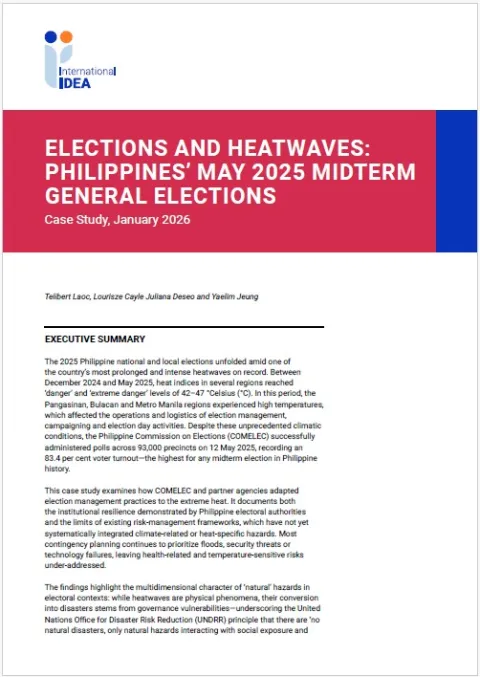
Elections and Heatwaves: Philippines' May 2025 Midterm General Elections
The 2025 Philippine national and local elections were held amid one of the country’s longest and most intense heatwaves, with heat indices climbing to 42–47°C across several regions. These conditions affected logistics, campaigning and election-day operations, particularly in Pangasinan, Bulacan and Metro Manila. Despite these challenges, the Commission on Elections (COMELEC) successfully managed voting in 93,000 precincts on 12 May 2025, achieving an 83.4 per cent turnout—the highest for any midterm election in Philippine history.
This case study highlights how COMELEC and partner agencies adapted to extreme heat, revealing both strong institutional resilience and gaps in climate‑risk planning. While stakeholders adjusted effectively due to the country’s tropical context, existing frameworks still focus more on floods, security issues and technical failures than heat-related risks. The 2025 experience underscores the need to institutionalize climate adaptation—through formal climate‑risk integration, strengthened inter‑agency coordination, climate‑resilient equipment standards, data‑driven early‑warning systems and expanded use of climate‑controlled voting and registration venues—to ensure future elections remain credible, safe and sustainable in a warming world.


Details

Contents
EXECUTIVE SUMMARY
INTRODUCTION
1. NATURAL HAZARDS AND ELECTIONS IN THE PHILIPPINES
2. THE HEATWAVE AND THE 2025 NATIONAL ELECTIONS
3. IMPACT OF HEAT ON ELECTION MANAGEMENT
4. VOTER TURNOUT
5. CONCLUSION AND RECOMMENDATIONS
REFERENCES
ANNEX A. INTERVIEW GUIDE—CASE STUDY ON HEATWAVEAND THE 2025 PHILIPPINE ELECTIONS
ABOUT THE AUTHORS
Give us feedback
Do you have a question or feedback about this publication? Leave us your feedback, and we’ll get back to you
Send feedbackElections and Heatwaves: Philippines' May 2025 Midterm General Elections


 Download PDF

| Total views | 9444 |
|---|---|
| Downloads | 87 |
| Rating |

|
Give us feedback
Do you have a question or feedback about this publication? Leave us your feedback, and we’ll get back to you
Send feedback