Analysing the report on women's participation in Panama's 2024 Elections
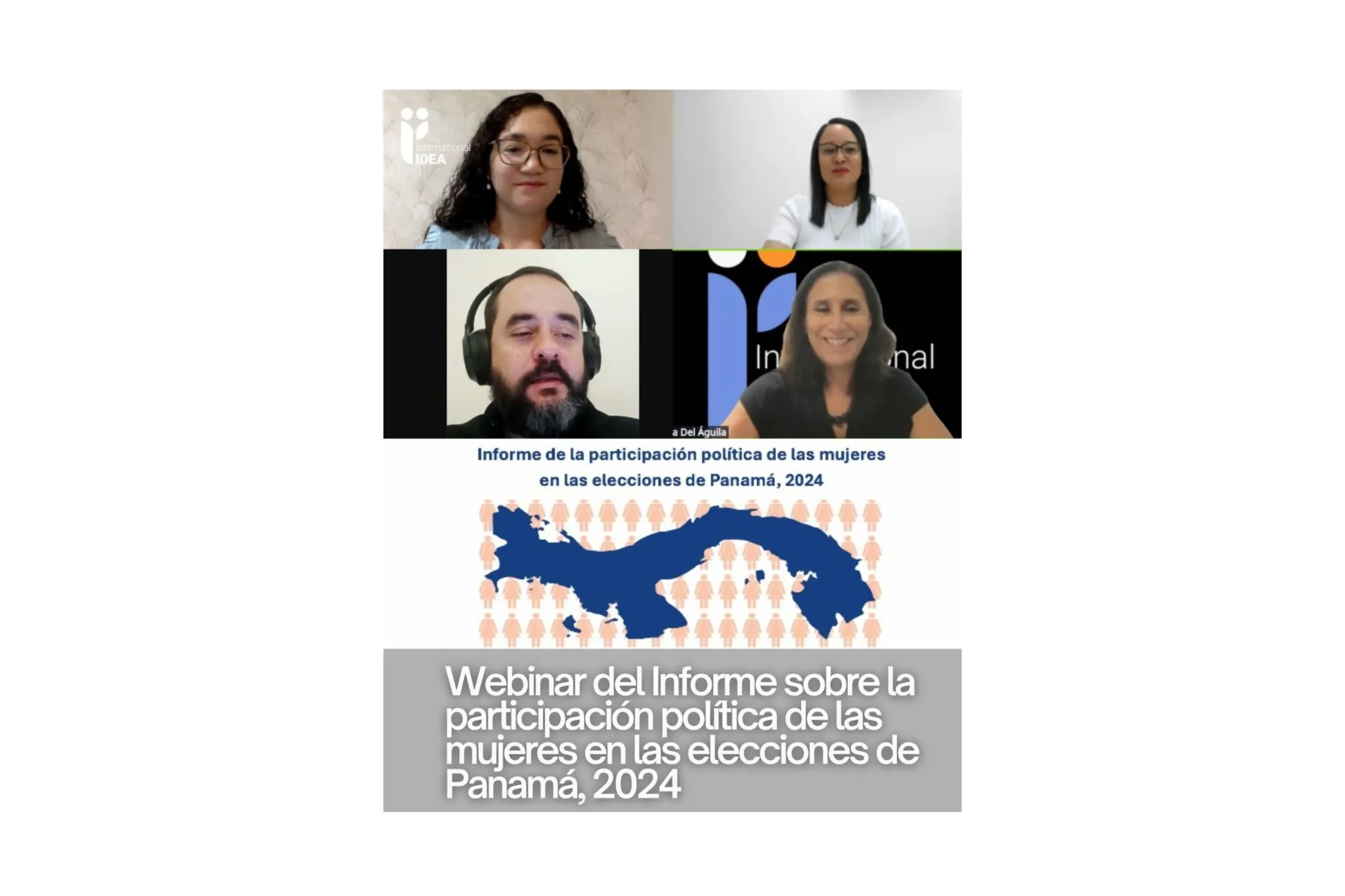
The Report on Women's Political Participation in Panama's 2024 Elections, prepared by researchers Tamara Martínez Paredes and Ramón Benjamín Miranda from the Institute for Democratic Studies (INED) of Panama's Electoral Tribunal, was presented and discussed during an online seminar attended by more than eighty participants. The event was moderated by Alicia del Águila, Programme Manager for International IDEA in Panama.
During the presentation, the authors highlighted a striking contrast: although women constitute 52.31 per cent of registered voters and account for more than 71 per cent of the volunteers serving on presidential election committees and at polling stations, they represented only 21.8 per cent of candidates for the main legislative seats, with just 152 women among a total of 697 candidates.
The researchers also drew attention to the impact of the electoral legislation's "escape clause", a regulatory provision that allows political parties to circumvent genuine gender parity in their principal candidate lists. As a result, no political party submitted gender-balanced slates in the 2024 elections. In addition, women accounted for only 19 per cent of candidates for municipal office. Faced with these barriers at the party leadership level, many women have become independent candidates as an alternative route to compete on more equal terms.
Arlín Rivas, a researcher at the University of Salamanca, emphasised that the report goes beyond statistical analysis and reflects the quality of Panamanian democracy. According to Rivas, women's underrepresentation is not due to a lack of interest in political participation, but rather to sociocultural barriers and structural forms of political violence that emerge long before any physical or verbal aggression occurs.
The discussion also highlighted that, despite facing elevated levels of vulnerability and limited access to economic resources, women in Indigenous territories and comarcas have achieved notable levels of political representation when supported by enabling institutional frameworks. Examples include the longstanding presence of women in the traditional leadership structures of the Ngäbe-Buglé Comarca, the election of women councillors in the Emberá Comarca, and the case of Darién Province, where three women were elected as mayors in the most recent elections.
Both Rivas and Alicia del Águila agreed on the need for rigorous audits of the public funds allocated to political parties for women's political training. They pointed to a significant gap between the resources earmarked for this purpose and their effective implementation in practice.
The full report will be available to the public at the Electoral Tribunal's stand during the Panama International Book Fair, this week.


About the authors