Regulating Social Media Influencers in Politics
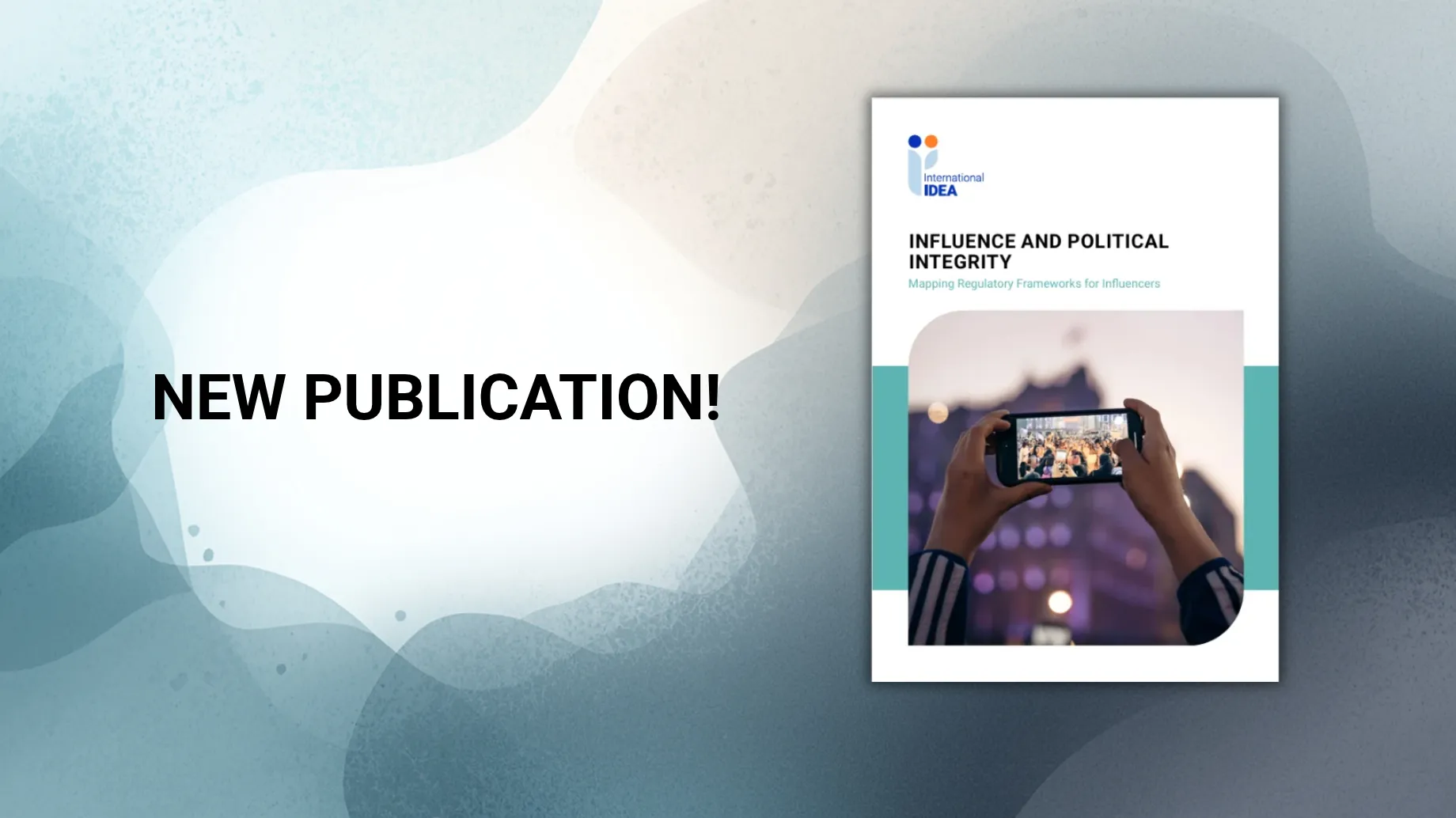
Should we be worried about influencers in elections? How can electoral authorities regulate influencers paid outside social media platforms? And what happens when the political message comes not from a politician, journalist or influencer, but from an AI-generated personality?
These were some of the questions discussed during the launch event of International IDEA's new report Influence and Political Integrity Mapping Regulatory Frameworks for Influencers, hosted by The University of Ottawa Centre for Law, Technology and Society and the Pol Comm Tech Lab.
The report, authored by Elizabeth Dubois, Louise Stahl, Katherine Dommett, Arturo Arriagada and Kyla Perry, explores how countries around the world are responding to the growing role of social media influencers in elections and political campaigns.
As democratic systems evolve, so do the ways in which political actors communicate with voters. Influencers have become a powerful tool in public discourse, capable of reaching audiences that traditional political actors often struggle to engage. Their involvement in politics can encourage participation, increase awareness of public issues and bring new voices into political debate. But it can also blur the line between authentic political expression, paid campaigning and coordinated influence operations.
Contrary to political parties, candidates or journalists, influencers do not fit neatly into the categories that existing laws and regulations were designed to govern. They operate in a grey area moving between different roles and blurring the lines between personal expression, commercial activity and political communication. Critically, these actors also often perform the role convenient to them at the time.
This makes influencers a particularly challenging group of political actors to regulate.
One of the most important findings of this report is that most regulatory frameworks around the world were not designed with political influencers in mind. Where regulations do apply, they often do so indirectly through rules governing campaign finance, political advertising or commercial endorsements.
To those tasked with strengthening these frameworks and ensuring effective regulation of influencers’ political activity – including electoral bodies, policymakers, platforms and civil society – the report authors provide a set of recommendations, including:
- Develop a clear definition of influencers – it is difficult to regulate something if you do not know what it is.
- Build free-expression safeguards – regulations targeting influencers should not infringe public opinion or free speech.
- Regulate both monetary and nonmonetary compensation – and critically, move beyond relying on within-platform payment triggers.
- Do not opt out with the simple solutions – for instance, blanket bans on political content are difficult to enforce and risk restricting legitimate forms of expression.
-
Ensure adaptability – frameworks need to continue to adapt to ever evolving issues, including AI-generated influencers and foreign interference.
Importantly, this report does not start from the assumption that influencers are inherently good or bad for democracy. Rather, it recognizes that they are now an established part of the political communication ecosystem.
The challenge for regulators is not whether influencers should exist in politics, but how democratic institutions can ensure that their growing role is transparent, accountable and consistent with electoral integrity.
Download the report here.
A recording of the event will also soon be available.


About the authors