Ten years after the Paris Agreement, COP30 produced mixed results
This year, the Paris Agreement turned ten–An occasion to commemorate a truly remarkable achievement of multilateral diplomacy, but also to note that we are still far off track to achieve its target of limiting global warming to 1.5 degrees. When world leaders met for this year’s UN climate change summit (COP30), expectations were higher than usual. Would the Brazilian presidency deliver a ‘COP of implementation’, moving beyond negotiating rules and commitments, to setting up concrete mechanisms, roadmaps, and initiatives to achieve the Paris Agreement goals?
In addition to the ten-year anniversary, several things set COP30 apart from the conference’s last iterations. Chief among them, that it took place in a democratic country, Brazil. The host city was another factor: Belém, a port in the Amazonian state of Pará, was chosen to put the spotlight on the rainforest’s crucial role in the global fight against climate change. Indigenous peoples’ inclusion was a central priority for the Brazilian Presidency, and concretely President Lula da Silva had set two main goals: Get negotiators to agree on a roadmap to transition away from fossil fuels, and a roadmap to end deforestation.
The choice of setting was not only symbolic but served as a physical reminder to attendees of why they were there: Sweltering heat and daily torrential rains contributed to the sense of urgency, further accentuated when a fire broke out inside the venue on the second to last day of the conference. Even so, geopolitical tensions and limitations of consensus-based processes once again delivered a disappointing result when, after two weeks of intense negotiations, the final text (‘the Mutirão Decision’) did not include any concrete roadmaps or even mention fossil fuels.
When multilateralism is under pressure, the significance of holding together the negotiations must be recognized. And while COP30 exposed once again just how slowly international climate politics move, it also firmly underscored that people would continue to drive and demand change, in a way not seen in years.
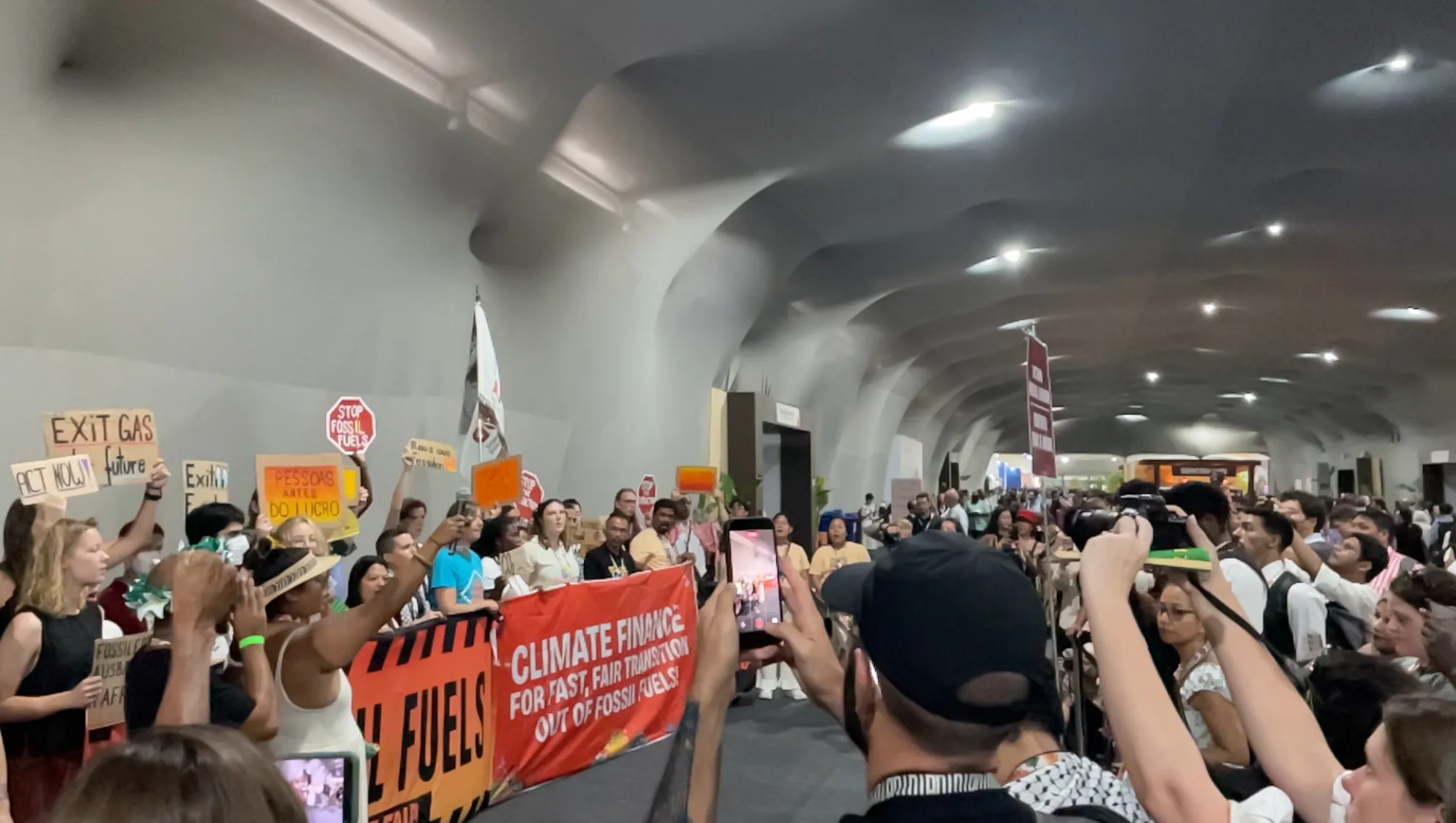
COP30 has been branded ‘the People’s COP’. With ‘mutirão’ as the keyword (an Indigenous term for collective, community-driven effort), the conference saw the largest mobilizations of civil society and activists at a COP in a long time. Demonstrations were held outside and inside the conference venue, with protest areas designated at its very center.
Indigenous presence was palpable throughout the conference, but when it came to the negotiations, it was business as usual, with Indigenous representatives mostly participating as observers with limited influence on decision-making. Thanks to improved disclosure requirements in the COP registration system, it was revealed that about 1600 fossil fuel lobbyists had Blue Zone passes, in contrast to 360 Indigenous Brazilian representatives. Frustration grew as it became clear that even when the climate conference was organized on Indigenous land, its people did not get any meaningful access to the negotiations. On day two of the conference, Indigenous protesters broke into the venue. The following days, military and security presence grew noticeably.
While it may have proven too ambitious to hope that an Amazonian COP would mean that Indigenous leadership would not only be recognized but finally listened to, one thing was clear: The topic of Indigenous inclusion and the right to protest were widely discussed throughout the conference in ways which would have been unlikely in an undemocratic society. And the Indigenous protests did yield some effect: At the beginning of week two of the conference, Brazil announced ten new protected Indigenous territories in the Amazon.
In line with the conference’s focus on implementation, the recurring discussions around climate finance moved beyond focusing on how to mobilize capital, to also concern how to set up systems by which money can reach those who need it. In this context, International IDEA’s launch of the report “Amazonian Climate Deliberation: Insights from Three Climate Assemblies on Climate Finance Held Ahead of COP30”, which presents the findings from a project developed with Delibera Brasil and supported by Agence Française de Développement, was received with great interest, in particular its policy recommendations on achieving a more effective and equitable climate finance ecosystem.
The Brazilian Presidency had moreover framed COP30 as the ‘COP of truth’, and as the first conference since the International Court of Justice (ICJ) issued its Advisory Opinion on the obligations of states in respect to climate change, many hoped for it to be a ‘COP of justice’. The conference did, however, not quite deliver on these promises. Despite its clear relevance for the UNFCCC processes, references to the ICJ Advisory Opinion were conspicuously absent from the Mutirão Decision. On a more positive note, the conference saw concrete steps forward on combatting climate disinformation with the Declaration of Information Integrity on Climate Change, now signed by 14 countries who commit to addressing climate mis- and disinformation at international, national, and local levels. Against this backdrop, International IDEA presented the International Climate and Democracy Coalition (ICDC), a platform for knowledge exchange, research coordination, policy outreach, and joint action around the Climate-Democracy Nexus, which advocates, among other topics, for integrity of climate information, citizens engagement and institutional reforms for more effective environmental action.
In concrete terms, one of COP30’s biggest achievements may have been that countries pledged to triple climate adaptation finance for Global South countries by 2035. It is also noteworthy how the Mutirão Decision reconfirms the role of Indigenous peoples and local communities, and for the first time recognizes the role of Afro-descendant communities. Progress was also made with e.g., the establishment of a just transition mechanism, the Belém Gender Action Plan, and the Global Ethical Stocktake, initiatives largely driven by civil society and supported by the Brazilian presidency. The final days of COP30 also saw the launch of the Citizens’ Track, which puts in place a global citizens’ assembly to feed into the UNFCCC processes, starting in 2026.
The perhaps most promising development however took place outside the negotiations, at the launch of the Belém Declaration on the Transition Away From Fossil Fuels and announcement of its first International Conference to be held in April 2026. This initiative is spearheaded by 24 countries who decided to go ahead with the roadmap to phase out fossil fuels, even though the initiative had failed within the negotiations. This may be the kind of leadership we need and could provide some healthy pressure ahead of COP31, which after prolonged talks will be held in Türkiye under shared presidency with Australia (a first-time arrangement we are curious to see play out).
At the end of COP30, it was clear that outcomes did not match the expectations set, decreasing the Paris Agreement implementation gap only slightly. It is frustrating but not all that surprising that negotiations once again fell for the same conflict of interests that lie at the very heart of the climate crisis. While Brazil clearly shared the disappointment in the lack of a fossil fuel phaseout roadmap, their ability in getting all states to unite behind it may have been clouded by Lula da Silva’s decision to grant new oil exploration licenses in the Amazon delta just weeks before COP30 began. But the final outcome notwithstanding, COP30 managed to set a tone of people-centered and inclusive climate action, demonstrating how even when international negotiations fall short, action will continue to be driven from the ground up. What this legacy means when the conference next year returns to a country with low-ranging performance in International IDEA’s GSoD Indices remains to be seen.
Disclaimer: Opinions expressed in this commentary are those of the author and do not necessarily represent the institutional position of International IDEA, its Board of Advisers or its Council of Member States.


About the author