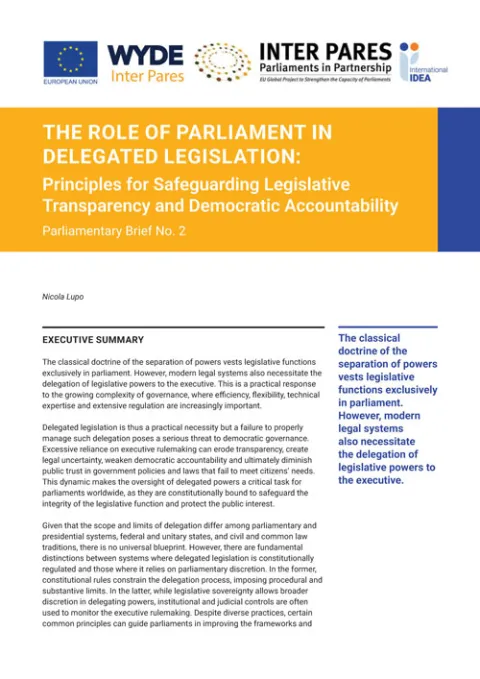
The Role of Parliament in Delegated Legislation: Principles for Safeguarding Legislative Transparency and Democratic Accountability
This brief explores how modern governance has made some delegation of legislative power to the executive both common and, in many cases, necessary. While delegated legislation can bring efficiency, flexibility and technical expertise to increasingly complex regulatory demands, it also carries real democratic risks if left unchecked, including reduced transparency, legal uncertainty and weaker accountability that can ultimately erode public trust.
Drawing on a comparative analysis of seven parliamentary systems—France, Germany, India, Italy, Nepal, Spain and the United Kingdom—the brief maps how different constitutional and institutional traditions shape the scope and limits of delegation, and how parliaments oversee executive rulemaking in practice. It offers seven guiding principles to help parliaments strengthen frameworks for authorizing delegated powers and scrutinizing delegated acts so delegation supports, rather than undermines, parliament’s constitutional role.


Details

Contents
Executive summary
Introduction
Enhancing the role of parliament in delegated legislation: Guiding principles
Country examples: Deep dive
1. France
2. Germany
3. India
4. Italy
5. Nepal
6. Spain
7. United Kingdom
Conclusions
References
Give us feedback
Do you have a question or feedback about this publication? Leave us your feedback, and we’ll get back to you
Send feedbackThe Role of Parliament in Delegated Legislation: Principles for Safeguarding Legislative Transparency and Democratic Accountability


 Download PDF

| Total views | 4431 |
|---|---|
| Downloads | 116 |
| Rating |

|
Give us feedback
Do you have a question or feedback about this publication? Leave us your feedback, and we’ll get back to you
Send feedback
Related publications