Why democratic backsliding should be on the World Bank and IMF agendas
Newly consolidated evidence from International IDEA’s latest report Democracy as an Engine of Social Development and Shared Prosperity reinforces this well-established but often underemphasized nexus: democracies tend to achieve stronger outcomes in health, education and social protection, while also fostering more inclusive economic growth. This reflects the crucial role of accountable institutions, rule of law and political competition in fostering shared prosperity. The report finds no evidence for a so-called “authoritarian advantage.” Non-democratic regimes that achieve strong social and economic outcomes are rare exceptions - not the rule.
At a time when democratic backsliding is affecting countries across regions and income levels, this relationship warrants closer scrutiny. The erosion of democratic institutions is not only a political concern. It has measurable economic consequences that are increasingly visible in both advanced and developing economies.
And vice versa: while democracy is an enabler of social development and shared prosperity, when democracies fail to deliver, trust in democratic institutions can erode, undermining the social contract and fueling support for authoritarian alternatives. Indeed, public opinion data across regions shows that waning support for democracy often stems from perceptions of its failure to deliver social progress and shared prosperity.
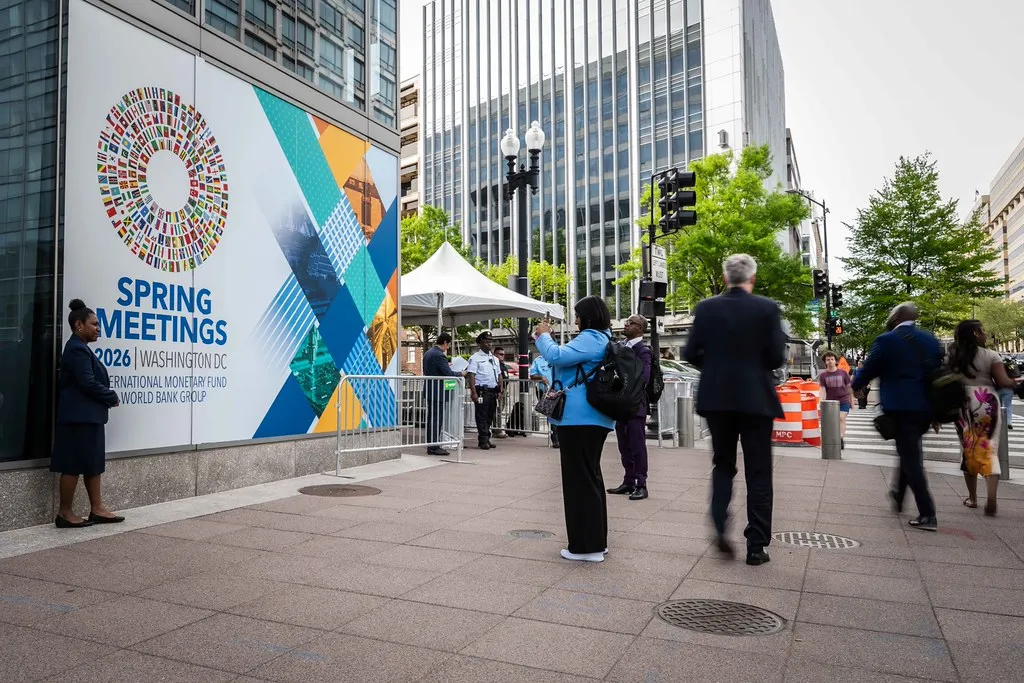
International IDEA is an intergovernmental organization of 35 democratic member states, with the mandate to strengthen and protect democracy worldwide. The relevance of this mandate to the World Bank and IMF Spring Meetings—traditionally focused on the global economy—may not appear immediately obvious. Yet recent developments have underscored the extent to which political and economic dynamics are deeply intertwined.
While the World Bank and the IMF do not engage in country-level politics, political developments shape the environments in which they operate, with direct implications for economic stability, policy effectiveness, global security and development outcomes.
Through its flagship report on the Global State of Democracy International IDEA tracks democratic developments worldwide and documents a sustained decline in democratic quality over the past decade. This is echoed by the V-Dem Institute and Freedom House, whose data similarly point to a global pattern of rising authoritarianism and democratic backsliding across all regions, including in high-income economies.
Recent research demonstrates the economic impacts of this global trend. Democratic backsliding weakens the institutional foundations of growth. Declining judicial independence, reduced protection of property rights and increased corruption undermine investor confidence and increase economic uncertainty. These institutional changes are reflected in financial markets, where countries experiencing democratic backsliding often face lower sovereign credit ratings and higher risk premiums.
The effects extend to innovation and long-term productivity. Evidence indicates that backsliding is associated with reductions in research and development investment and patenting activity, as weakened institutions diminish the incentives and protections required for technological advancement.
The distributional implications are also significant as democratic backsliding is linked to rising inequality and poverty. Economic gains become less inclusive, and disparities widen as accountability mechanisms weaken. Hungary provides a cautionary example: over the past decade, the erosion of institutional checks and balances have weakened rule of law and increased corruption and inequalities. International IDEA’s Global State of Democracy Indices show Rule of Law in Hungary declining by 30% since Orban came to power in 2010, with corruption levels increasing by 17% and income inequality by around 20%. Hungary’s levels of Rule of Law are now lower than a country like Malawi and its corruption and income inequality levels have increased to the highest in the EU.
In addition, democratic decline influences migration patterns. Studies show that the weakening of democratic norms acts as a “push factor” for emigration. This dynamic has important implications for labor markets, human capital and long-term development trajectories of both developing and developed economies.
Democratic backsliding is also associated with an elevated risk of armed conflict, which in turn disrupts trade, undermines investor confidence, and imposes significant negative spillovers on the global economy. The number of armed conflicts are now at the highest level since 1946, with violence estimated to cost the global economy nearly $20 trillion per year and 13% of global GDP, highlighting the macroeconomic burden of rising instability.
International IDEA’s work demonstrates how these dynamics operate across sectors and regions. In Africa, its research on critical minerals – essential to the green transition - highlights the importance of governance frameworks in determining how resource wealth can contribute to sustainable development, with transparent and accountable institutions as essential to ensuring that the benefits of mineral extraction are broadly shared. In Asia and the Pacific, International IDEA’s work on democracy and climate change demonstrates how democratic institutions and processes can advance climate policies. In Latin America, International IDEA’s work on inequality in partnership with UNDP illustrates how democratic institutions can help mitigate structural disparities and the impact of inequality on social cohesion and economic stability.
For the World Bank and the International Monetary Fund, these findings have direct relevance. While democratic governance may be politically sensitive, changes in the institutional quality of their client countries have direct implications for their mandates on economic growth, shared prosperity, poverty reduction and sustainable development. And democratic backsliding introduces risks that cannot be fully addressed through conventional macroeconomic tools. For institutions pursuing global prosperity, recognizing this link deserves greater attention.
Yet as security and trade alliances shift, conversations about democracy—and the costs of backsliding—are becoming increasingly uncomfortable for countries. Addressing these risks requires closer collaboration—between institutions with economic and political mandates and across disciplines—to better understand how democratic backsliding shapes growth, investment and global security.
This shift is particularly urgent in a context of rising geopolitical tensions and democratic backsliding and failing to recognize this nexus carries tangible costs. Efforts to promote inclusive growth and economic stability will fall short if they do not account for the institutional conditions that sustain them. In an evolving geopolitical landscape, this also places new demands on the democracy support community: to move beyond traditional approaches and embed democratic considerations within economic analysis and policy frameworks, including through expanded engagement with new partners and across a broader range of policy domains. Yet many governments remain reluctant to engage with what is often perceived as an uncomfortable and potentially divisive set of issues. Ultimately, acknowledging the nexus between democratic governance and shared prosperity is essential to building stronger economies and more resilient democracies.


About the authors