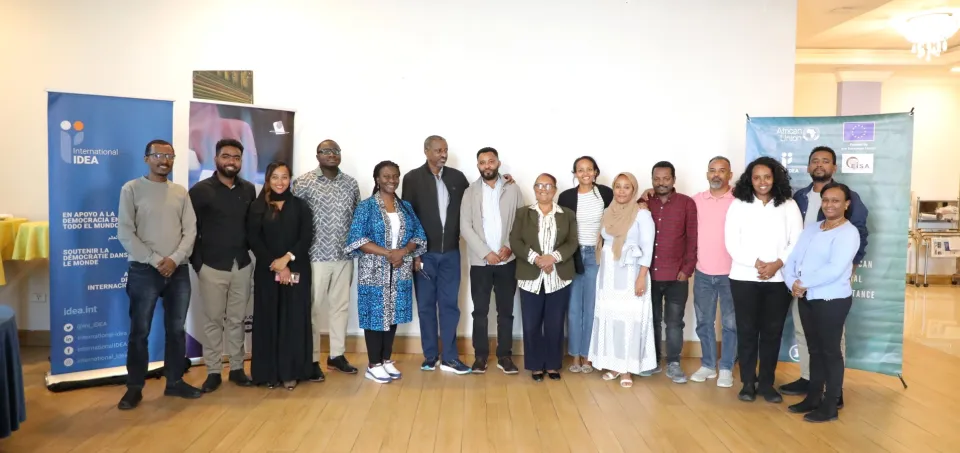
In this year’s Forum of the C3-Fiji Project, International IDEA is inviting women MPs, officials from the Ministry of Women, Fiji Women Rights Movement (FWRM), Fiji Women Crisis Centre (FWCC), Fijian Elections Office (FEO), civil society organizations, young aspiring interested women, women from marginalized groups, and academics to discuss the persistent challenges and emernging opportunities regarding women in politics in Fiji.
Search
Region
Country
Type
73 results
October 14, 2020
The need for physical distancing during this COVID-19 pandemic has raised the need for innovative campaign methods to be developed by election contestants because conventional campaign methods such as rallies, public meetings, etc. are prohibited in some jurisdictions. Distant and online election campaigning may be seen as restrictive to both contestants and voters alike due to physical and technological barriers that appear. To what degree is this true?
Events
June 19, 2020
Fiji of the South Pacific has successfully contained the COVID-19 outbreak without any deaths recorded to date. The Minister for Health and Medical Services, Dr Ifereimi Waqainabete will make a presentation on the ministry’s approach used in containing the COVID-19 outbreak, and also talk about the strategies being developed for possible future outbreaks.
Events
December 19, 2025
Fiji has taken an important step toward protecting its electoral processes from online threats with the signing of a three-year Memorandum of Understanding (MoU) between the Fijian Elections Office (FEO) and the Online Safety Commission (OSC) on 4 December 2025.
News
December 08, 2025
International IDEA’s Director for Asia and the Pacific, Leena Rikkilä Tamang, on behalf of the Secretary-General, was pleased to sign a Host Country Agreement with Hon. Siromi Turaga, Minister for Justice and Acting Attorney General of Fiji government in Suva on 3 December 2025.
News
December 08, 2025
La Directora de IDEA Internacional para Asia y el Pacífico, Leena Rikkilä Tamang, en representación del Secretario General, tuvo el placer de firmar un Acuerdo de País Anfitrión con la Honorable Siromi Turaga, Ministra de Justicia y Fiscal General interina del gobierno de Fiji, en Suva el 3 de diciembre de 2025.
News
October 13, 2025
Desde su primera publicación en 2013, la Revista Anual sobre la Construcción Constitucional se ha convertido en una referencia global de confianza sobre la evolución de las constituciones y lo que esta evolución revela sobre la democracia, la gobernanza y el Estado de derecho en todo el mundo.
News
October 13, 2025
Since its first publication in 2013, the Annual Review of Constitution-Building has become a trusted global reference on how constitutions evolve, and what that evolution reveals about democracy, governance, and the rule of law around the world.
News
October 06, 2025
The International IDEA Annual Review of Constitution-Building examines global constitutional reform efforts around the world. The 2024 review covers cases from Africa, Asia, the Caribbean and Europe, highlighting both the challenges and opportunities facing democratic constitutionalism today.
Publication
September 03, 2025
This primer guides the design of constitutional provisions relating to the roles, rights and regulation of political parties in a democracy. It covers the prohibition of anti-democratic parties, internal party democracy, party funding, registration, organization of caucuses and enforcement of party discipline through ‘anti-defection’ provisions.
Publication
June 05, 2025
There is clear support for democracy in the Pacific Islands region, but also reasons to be concerned about its contemporary practice. The complexity of Pacific democracy is rarely captured in global datasets. This has significant consequences for the understanding of democratic practice in the Pacific and the completeness of the global understanding of democracy.
Publication
February 07, 2025
The National Forum on Women in Politics brought together diverse voices to explore how Temporary Special Measures (TSMs) can foster inclusive governance in Fiji.
News
December 12, 2024
In late November 2024, representatives from several Fijian-based organizations signed a Terms of Reference to form a working group on preventing disinformation in electoral processes in Fiji.
News
November 06, 2024
Legislatures are vital institutions at the heart of any democracy. They not only enact laws and approve budgets, but also act as representative and deliberative assemblies, and as bodies that scrutinize and oversee the actions of the executive. In order to perform these functions effectively, legislatures need to be organized, in terms of their internal leadership, their committee structures, and the rules by which they transact public business.
Publication
May 30, 2024
In early May 2024, Suva hosted the two-day Roadmap Workshop, which aimed to empower local stakeholders in Fiji to effectively inform about threats surrounding elections.
News
May 30, 2024
A principios de mayo de 2024, Suva organizó el Taller de Hoja de Ruta de dos días de duración, cuyo objetivo era empoderar a las partes interesadas locales en Fiji para que informaran de manera efectiva sobre las amenazas en torno a las elecciones.
News
December 08, 2023
Democracies worldwide are facing a decline in trust in public institutions and the political system affecting election management bodies and electoral processes in ways that risk contested elections and societal instability.
News
June 02, 2023
Democracy is on trial in the climate crisis. It is charged with having failed to prevent dangerous climate change. To its critics, the very same features of democracy praised as its defining virtues—popular sovereignty, the accountability and responsiveness of elected officials, public debate and deliberation—are handicaps that impede effective climate action. However, this trial is not over and it would not be safe to deliver a verdict at this stage.
Publication
May 26, 2023
La Oficina Electoral de Fiji (OFE) y el Instituto Internacional para la Democracia y Asistencia Electoral (IDEA Internacional) firmaron conjuntamente un Memorando de Entendimiento (MoU) en Canberra, Australia y Suva, Fiji, el jueves 25 de mayo de 2023 que restablece los lazos entre las organizaciones.
News