Disclaimer: Opinions expressed in this commentary are those of the author and do not necessarily represent the institutional position of International IDEA, its Board of Advisers or its Council of Member States.
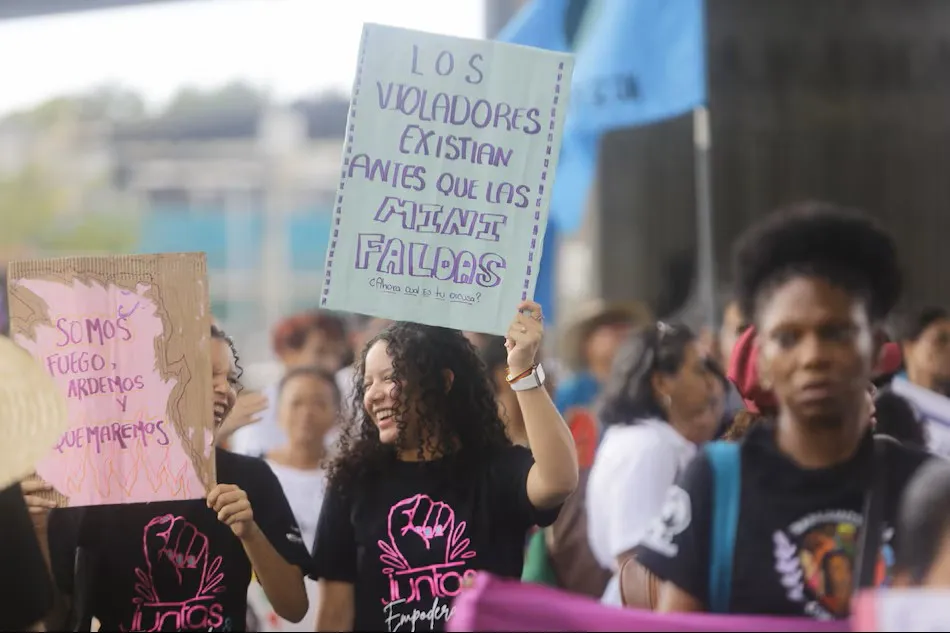
The Epstein case has shaken the world's political and economic elites. It is worth remembering the #MeToo movement and the brave victims and lawyers who brought it to trial in 2019, after years of struggle, now forgotten. Like #NiUnaMenos ("Not one [woman] less") in Latin America, the demonstrations were massive, taking place in cities and towns across the United States and other countries.
In these newly released documents, a common denominator appears among those implicated. It is not their political or ideological positions, nor their beliefs. What they have in common is that they are men belonging to a power elite—powerful men who perceive themselves as such. Above the law and beyond the rights of others. At least, the most vulnerable: girls and young women recruited through deception.
Why would a high-flying lobbyist run a sex trafficking ring, particularly involving girls? Feminist anthropologist Rita Segato coined the term “mandate of masculinity” to refer to a masculine socialization that demands proving “power,” in constant comparison with male peers. A need to control, assert, and sometimes, violate. Sexually subjugating women and girls is an extreme of this toxic masculinity.
As Segato herself points out, gender violence appears as the urgent need to assert “male honour” in front of friends, buddies, and acquaintances. That is, to assert their masculinity in front of the other men in the group. The cuckold is less of a man; he is one humiliated.
Returning to the Epstein files, the fact that men travelled thousands of miles to attend parties on a Caribbean island with elite peers, offering them unknown women for their sexual pleasure, is another version of this "male mandate." These women were anonymous. Their feelings do not matter. It is about enjoying that transgressive power within that sort of elite "pack of hunters."
These cases that have come to light starkly prove how the patriarchal construction of power makes women and girls more vulnerable. Hundreds of them are emotionally devastated to the point of, as in the case of Virginia Giuffre, deciding to end their lives.
Now, it is urgent to reflect on how these events also affect democracy itself. The opacity of spheres of power calls into question the necessary transparency in politics and other arenas. Furthermore, to remain unpunished, Epstein needed the complicity, achieved through corruption, of various institutions, especially the police and judiciary.
It is important to remember that those who managed to bring the elusive Epstein to justice were the thousands of women and their rights defenders, through their tireless protests (#MeToo). And this leads us to another lesson: civil society is a fundamental part of democracy, along with a free press. Social vigilance and activism refresh and consolidate a healthy system.
This case is undoubtedly a test for democracies. But we must point out a fundamental issue: without democracy, these cases would not have come to light. The coming months will prove the capacity of democratic institutions to respond in the countries where members of their elites have been implicated.
For now, this 8th March, let us reflect on how gender-based violence not only affects women and girls, but also our democracies. And how transparency and the rule of law are fundamental to guaranteeing a life free from violence.
Original content published by the newspaper La Prensa on 3 March, 2026.


About the authors