Are voluntary national reviews leaving democracy behind?
Drawing on an analysis of 402 Voluntary National Reviews (VNRs) submitted by 191 countries and observers between 2016 and 2025, the report examines how governments are integrating democratic principles into their reporting and implementation of the 2030 Agenda for Sustainable Development, particularly through Sustainable Development Goal (SDG) 16 on peace, justice, and inclusive societies. More specifically, these principles are reflected in references to 12 keywords: access to justice, civil society, corruption, democracy, elections, fundamental freedoms, human rights, political participation, political parties, political representation, press freedom, and rule of law.
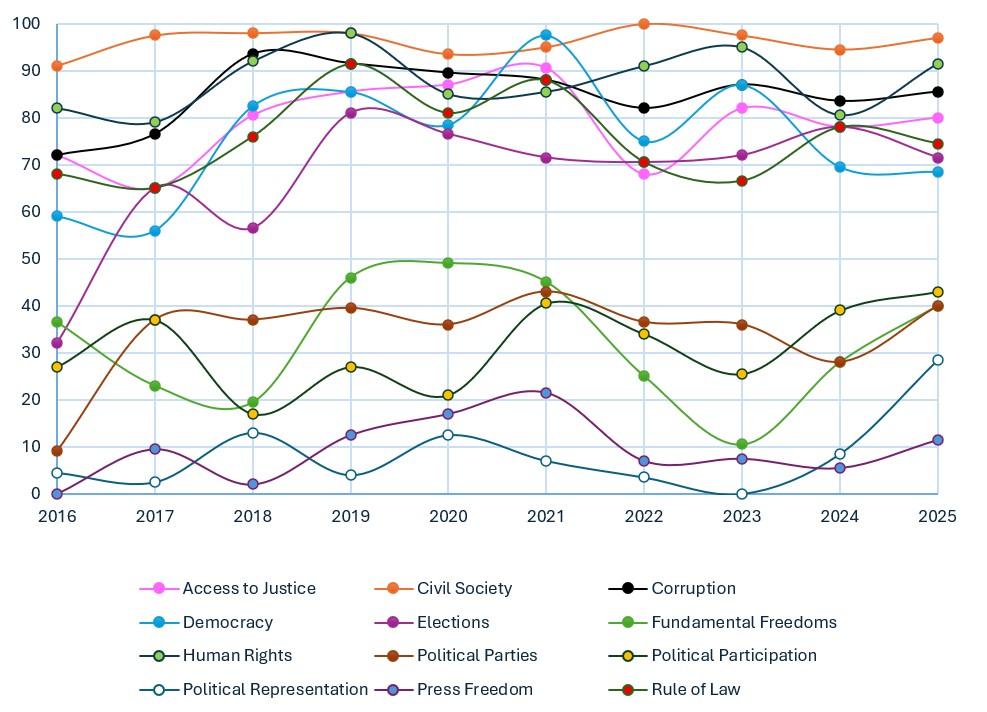
The findings reveal an intriguing paradox. On the one hand, some concepts of democracy are everywhere. Core dimensions, such as civil society participation, human rights, anti-corruption efforts, and access to justice, are widely reflected in national reporting. Civil society alone appears in nearly every VNR, underscoring its recognized role as a cornerstone of inclusive governance and accountability. Yet, on the other hand, other concepts are often only partially visible. Some of its most essential elements—political participation, representation, press freedom, and fundamental freedoms—are among the least addressed by countries (Figure 1). When they do appear, they are often diluted within broader governance narratives rather than treated as distinct, measurable priorities.
Figure 1. Percentage of VNRs that referenced the 12 democracy-related keywords each year from 2016 to 2025.
This imbalance is not trivial. It reflects a deeper trend in global governance and a tendency to emphasize institutional and procedural aspects of democracy while avoiding more politically sensitive issues tied to power, voice, and inclusion. At a time when democratic backsliding is accelerating, characterized by the erosion of checks and balances, constraints on civic space, declining electoral integrity, and the concentration of power in the executive branch, this gap raises serious concerns about the progress in implementing sustainable development efforts.
The report also underscores that the way countries talk about democracy varies widely. In some contexts, democratic principles are presented as lived realities supported by strong institutions and public trust. In others, they are framed as aspirational goals or symbolic commitments aligned with national narratives. These differences highlight the importance not only of what is reported, but also how and why.
Despite these variations, the conclusion is that democracy is deeply intertwined with the SDGs, even when it is not explicitly named. This is particularly true for SDG 16, which serves as an enabler of the 2030 Agenda, but its targets are still lagging behind. As the international community enters the final stretch towards 2030, strengthening the visibility, measurability and substantive treatment of democratic principles in the VNR process will be essential. This means going beyond broad statements and investing in more substantive reporting on participation, representation, media freedom and inclusion. It means ensuring that VNR processes themselves are genuinely open and participatory, engaging civil society, marginalized communities and independent institutions. It also means protecting civic space, strengthening accountability and leveraging diverse data sources—including non-official data—to provide a fuller and more transparent picture of progress.
Ultimately, the report positions VNRs not only as reporting tools but also as instruments of accountability and transformation. When used effectively, they can help identify governance gaps, strengthen democratic practices, boost implementation of the SDGs, and ensure that development is not only sustainable but also inclusive, just, and representative. Strengthening how democratic principles are reflected in VNRs is not simply a reporting exercise; it is a test of political will to ensure that development truly serves people through effective implementation. A more balanced, transparent, and inclusive approach to democracy in VNRs will be critical to building trust, closing persistent gaps, and delivering on the promise of the 2030 Agenda and leaving no one behind.
Read the report here: "Democracy and the 2030 Agenda: How is Democracy Addressed in the Voluntary National Reviews?"


About the authors