Marking a major achievement in the fight for stronger political transparency and accountability

The 11th Conference of State Parties (CoSP) to the UN Convention Against Corruption (UNCAC), adopted resolution 11/7 on Preventing and combating corruption through enhancing transparency in the funding of political parties, candidatures for elected public office, and electoral campaigns by consensus. The resolution, tabled by Albania, Ghana, Mongolia, and Norway and co-sponsored by nearly 60 countries, represents a historic milestone, as the first resolution and the most comprehensive set of global standards on this topic.
International IDEA, The International Foundation for Electoral Systems (IFES) and Transparency International applaud the vision and the tireless efforts of these State Parties to the UNCAC to establish the world’s most comprehensive global standards for strengthening transparency and accountability around money in politics.
The resolution sets standards for reporting and publication of data on political funds, independent oversight, and fair enforcement of rules for donations and spending. These standards will help prevent the economic crimes and conflicts of interest that ensue when political funds change hands unseen, or non-electoral contestants – from organized crime groups, to foreign governments, to private interests – seek to alter democratic outcomes through financial interference in elections and party politics.
What does the resolution mean for governments?
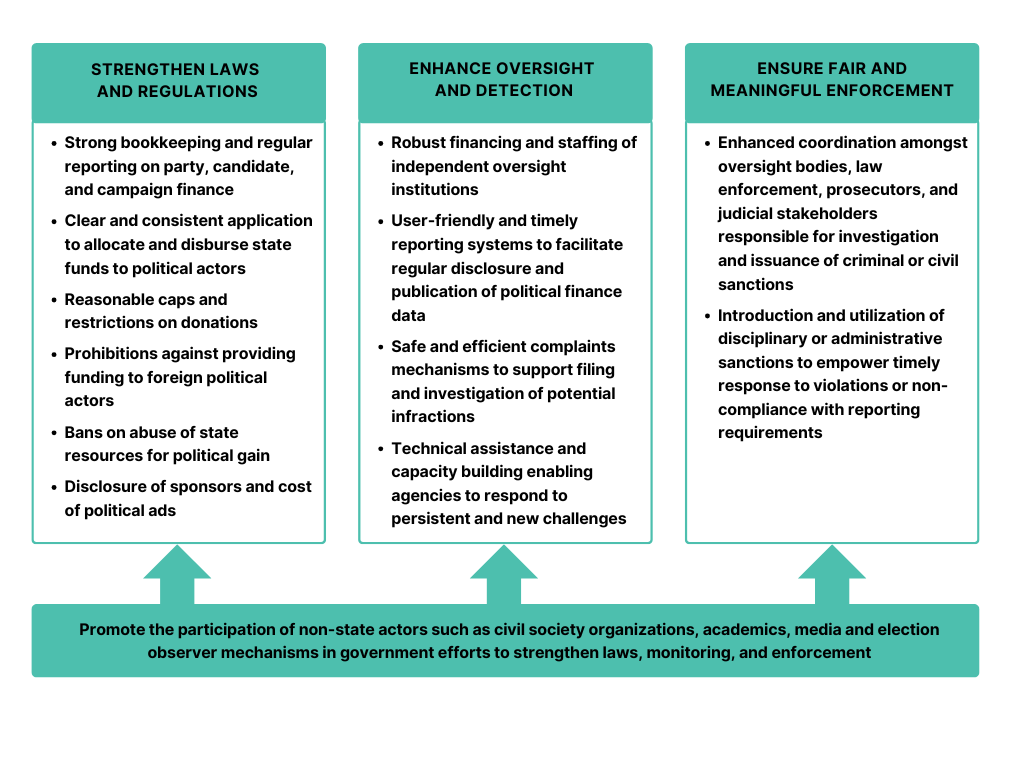
The resolution provides concrete standards for laws, regulations, and oversight and enforcement measures that State Parties are required to consider in cooperation with political parties and candidates, and non-state actors to strengthen their alignment with Article 7.3 of the UNCAC.
Building from this text and related UN resolutions and reports on public sector integrity and anti-corruption, the resolution urges states to take appropriate actions within their unique domestic contexts to strengthen transparency and accountability around money in politics. Key measures are meant to strengthen the legal framework, oversight, and enforcement of political finance rules.
What comes next?
The adoption of Resolution 11/7 marks a major milestone in global anti-corruption and democracy-strengthening efforts and will usher in a new era of reform opportunities.
At present, almost all countries have enacted some form of regulation governing the financing of political parties and electoral campaigns. However, the depth and scope of these legal frameworks vary significantly across jurisdictions. While there is no one-size-fits-all regulatory model, a number of recurring shortcomings and loopholes can be identified. For example, according to International IDEA’s Political Finance Database, 28% of the 181 countries surveyed are yet to prohibit foreign donations to political parties, and anonymous donations remain permissible in 25% of the countries. Similarly, public funding is not available to political parties in 28% of the countries. Beyond gaps in regulation, a major and persistent challenge lies in the effective implementation and enforcement of existing laws as scandals and allegations involving the misuse of political finance continue to be widespread globally.
When it comes to the actual practice, data publication is the most glaring gap. A 117-country survey conducted by Transparency International in Africa, Asia-Pacific and Latin America and the Caribbean in 2025 shows that 75% of these countries do not publish political finance information online. The essential prevention measure, donor identification, is published online in only 14 of 33 Latin American and Caribbean countries; seven of 33 in Asia-Pacific, and just one of 51 in Africa. Combining these findings with data from a 2023 report on Europe conducted by International IDEA, we estimate that in 102 –or 65%– of 157 countries no campaign donation information is published online by an oversight institution.
Ensuring compliance with the new standards for transparency and accountability will require time, hard work, and investment from stakeholders across sectors, including legislators, political parties and candidates, oversight agencies, law enforcement institutions such as police and prosecutors, civil society organizations, academics, and election observer groups.
Specifically, Resolution 11/7 calls on UNCAC State Parties to share good practices, acknowledge and address domestic challenges, provide technical assistance or funding to support advancements across the globe, and collaborate with non-state organizations and watchdogs as critical partners in the fight against corruption.
It also calls on the UNODC to compile State Parties’ good practices, consider developing resources to support state implementation of the resolution, and report on states’ progress in implementing the resolution when the next CoSP is convened in Uzbekistan in late 2027.
Non-state actors also have a role to play in the months ahead. CSOs, academics, and domestic election observers can review their country’s current laws and practices in light of the new standards, and push their governments to pursue reforms and initiatives to strengthen their alignment with the resolution. They can also help to convene and facilitate meetings between political finance oversight and enforcement agencies and the diplomats that liaise with UNODC. Non-state actors can also encourage their governments to contribute to the UNODC’s call for voluntary reporting on good practices and challenges in implementing the resolution.
Our commitment
International IDEA, IFES and Transparency International stand ready to support all actors in strengthening the integrity of political finance around the world. Our efforts will include working with legislators in improving laws, and partnering with political finance oversight agencies in strengthening their monitoring approaches. We will also continue to engage with election management and other oversight bodies, Financial Intelligence Units, prosecutors and political parties to support enhanced compliance and enforcement.
Last but not least, we are committed to continued partnerships with the non-state actors championing stronger transparency in their own contexts – whether through reviewing their country’s current laws and practices in light of the new standards, or pushing their governments to pursue reforms to strengthen their alignment with the resolution. We call on our peer international and nongovernmental organizations to partner with our teams as we seek to build on this major milestone, supporting continued research, trend analysis, and benchmarking of countries’ progress towards international standards and recommendations.
This blog post has been jointly authored by Dr Yukihiko Hamada and Khushbu Agrawal from International IDEA, Chelsea Dreher and Dr Magnus Ohman from IFES and Jorge Valladares and Jon Vrushi from Transparency International.
The blog has also been cross-posted by IFES here.