The courts have spoken on climate. Now comes the harder work

Disclaimer: Opinions expressed in this commentary are those of the authors and do not necessarily represent the institutional position of International IDEA, its Board of Advisers or its Council of Member States.
This month, 141 nations voted in the UN General Assembly to endorse the International Court of Justice’s landmark advisory opinion on States’ climate obligations. Secretary-General Guterres called it clearly: “The world’s highest court has spoken. Today, the General Assembly has answered.”
This is more than a symbolic moment. It marks a structural shift in how the world understands climate action, and one with direct consequences for democratic governance everywhere.
From political choice to legal duty
For decades, environmental - and later climate - commitments were treated as matters of political will. Without a firm legal basis, governments could dilute, defer, or abandon them depending on the electoral cycle. As explored in International IDEA’s eighth Stockholm Series lecture on Climate Change and Democracy, the emerging body of international and regional jurisprudence has been dismantling that logic, case by case, transforming political ambition into an increasingly concrete legal framework.
This convergence is visible through a rapidly developing line of decisions and advisory opinions. In April 2024, the European Court of Human Rights found that Switzerland had violated Article 8 of the European Convention - the right to private and family life - through inadequate climate action. The following month, the International Tribunal for the Law of the Sea (ITLOS) issued an advisory opinion stating that greenhouse gas emissions constitute marine pollution under the United Nations Convention on the Law of the Sea (UNCLOS), with implications that reach beyond Paris Agreement commitments. In May 2025, the Inter-American Court of Human Rights followed with its own advisory opinion on climate and human rights, recognising that climate inaction can violate rights to life, health, equality and non-discrimination, especially for women, children, Indigenous peoples and future generations. Then, on 23 July 2025, the International Court of Justice (ICJ) delivered its landmark advisory opinion, confirming that climate change is an urgent and existential threat and that States have a legal obligation under international law to protect the climate system from greenhouse gas emissions. The Court further confirmed that the 1.5°C emissions-reduction target is legally binding under the Paris Agreement, and that States failing to strengthen climate policies in line with the best available science may incur state responsibility and give rise to reparations.
Taken together, these opinions form an accumulating and mutually reinforcing body of legal authority, clarifying and redefining what governments owe their citizens, future generations, and each other on climate action. This shift is also visible in the scale of climate litigation. The Grantham Research Institute on Climate Change and the Environment’s 2025 litigation snapshot records at least 2,967 cases across 60 countries, two-thirds of them filed since the adoption of the Paris Agreement in 2015. These figures point not only to the rapid growth of climate litigation, but also to the courtroom as a critical arena for both climate and democratic accountability. As International IDEA’s publication Let the Courts Decide? The Potential and Limitations of Climate Litigation from a Democracy Perspective argues, litigation can also serve as a democratic corrective - holding public authorities to account for insufficient climate action while strengthening transparency, rights protection, and public participation, particularly for groups often under-represented in conventional political processes, including youth, women, and Indigenous peoples. At the same time, courts cannot substitute for democratic decision-making. What they can do is complement political and civic action and clarify the obligations that democratic institutions must then implement.
Who this matters for, and why now
The implications of this jurisprudence are not evenly distributed. They land hardest, and most urgently, in five places.
Vulnerable and Small Island Developing States are already experiencing irreversible climate harm. For them, this body of law is not abstract. The ICJ’s reparation framework and the ITLOS advisory opinion on marine pollution give Pacific and Caribbean nations a firmer legal basis to pursue accountability from major emitters. The Vanuatu-led initiative that drove the ICJ request was itself an act of democratic diplomacy: a small state channelling the voices of Pacific youth and wielding international law as a tool of self-defence.
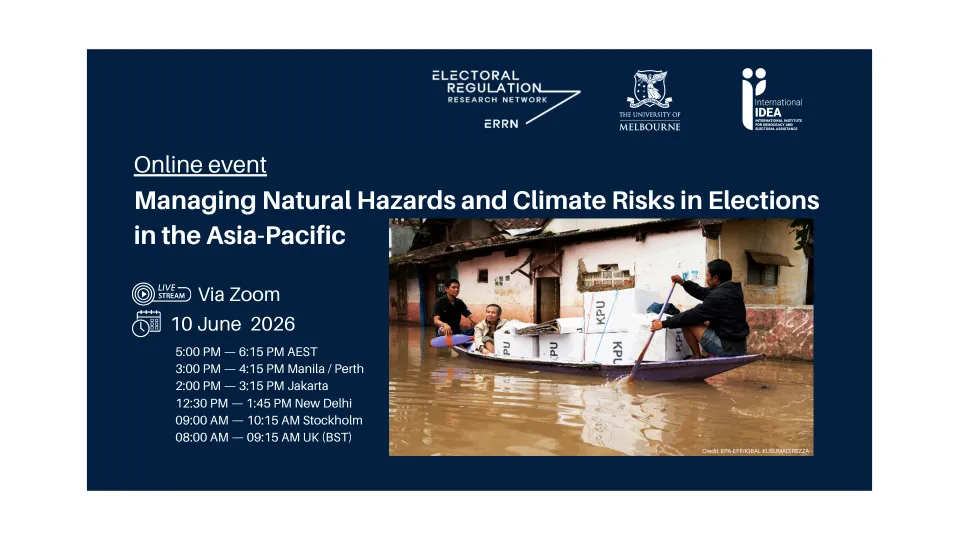
Electoral management bodies (EMBs) sit at the immediate intersection of climate and democracy. EMBs face the consequences of climate change not as an abstract governance problem but as an operational one. In the last 20 years, at least 94 election events in 52 countries have been affected by natural hazards such as storms, floods, wildfires and heatwaves. In 2024 alone, at least 23 elections in 18 countries – including the US presidential election, and India’s national elections – were disrupted by extreme weather events, exacerbated by climate change. Most EMBs lack the legal, institutional and operational safeguards - and the inter-agency cooperation - needed to protect electoral integrity from climate-driven disruption. As these events become more frequent and more severe, electoral integrity and climate accountability will increasingly rise or fall together.
National parliaments and legislatures now operate in a changed legal environment. Climate commitments expressed in the Paris Agreement, successive COP outcomes and domestic climate frameworks can no longer be treated as mere political declarations or diplomatic signalling; they form part of international legal compliance.
Parliaments that have not yet absorbed this logic are governing under legal risk they may not have mapped.
National human rights institutions (NHRIs) are uniquely positioned to translate this jurisprudence into domestic accountability. NHRIs already hold mandates that encompass promoting the right to life, health, and an adequate standard of living—precisely the rights the courts are now linking to climate obligations. But their effectiveness depends on the independence, institutional design, and analytical capacity that democratic governance frameworks either enable or undermine.
Constitutional and judicial actors face growing demand to adjudicate climate cases that turn on complex questions of science, causation, rights, and the interaction between institutional responsibility and capacity. Recent cases such as Smith v Fonterra in New Zealand and Lliuya v RWE in Germany demonstrate that courts are already being asked to adapt tort law to corporate responsibility and, in some cases, to transboundary climate harms. As climate-related loss and damage intensifies, courts elsewhere—including in emerging democracies—may face similar questions without the same depth of precedent, specialised expertise, or training opportunities.
The implementation gap is democratic, not just technical
What the legal community sometimes underestimates is that the gap between a ruling and its practical application is not primarily a legal problem. It is a governance problem.
Advisory opinions are non-binding. Landmark rulings can be resisted, diluted, or insufficiently understood by the domestic institutions responsible for implementation. But the deeper issue runs further than legal enforceability. Even binding obligations require functioning democratic institutions to give them traction: parliaments that can scrutinise whether governments are complying, courts that can receive and adjudicate climate claims, NHRIs with the independence and analytical capacity to hold states to account, and electoral processes credible enough to produce governments with a genuine mandate to act. When any of these is weak or absent, the chain breaks.
There is also a political economy problem that law cannot resolve. Climate and environmental policies often entail short-term pain for long-term gain—a structural difficulty for governments focused on the next election. They are also highly vulnerable to capture by vested interests, particularly fossil fuel and extractive industries. Through donations to political parties and candidates, high-carbon sectors can capture the policy agenda, narrowing the range of options lawmakers consider and delaying necessary reforms. Courts can establish what states owe the climate; they cannot dismantle the structural incentives that lead governments to fall short of those obligations cycle after cycle.
And there is a capacity problem. Many of the states most affected by climate change—and most exposed to liability claims from their own citizens—lack the institutional infrastructure to respond: parliaments without climate-literate committees, constitutional frameworks with no justiciable basis for climate claims, EMBs without adaptation plans for climate disruption. The jurisprudence is developing faster than the institutional capacity available to apply it.
This is where the democracy community has work to do.
What International IDEA can offer
For International IDEA, the starting premise is that while the science is clear and the solutions are known, the barriers to addressing climate change are primarily political. That framing shapes everything we do in this space, and it maps directly onto the governance challenges this jurisprudence creates.
Our Climate Change and Democracy portfolio explores and promotes democratic innovations for more effective climate action, including climate litigation as a tool for accountability, advocacy and higher political ambition. To support this, we will soon launch a tracker monitoring the implementation of key climate rulings. We also examine institutional reforms that would make democratic systems more climate-responsive and forward-looking: innovative constitutional provisions for future generations, dedicated parliamentary committees, and independent advisory and oversight bodies.
One of the sharpest political problems the new climate law landscape creates is accountability for decisions whose costs are immediate and whose benefits lie beyond the next electoral cycle. The landmark Neubauer ruling named this directly: the constitutional rights of young people and future generations were violated because existing legislation pushed the hard choices onto a future parliament. International IDEA has been developing citizen assembly and deliberative mini-public models specifically for climate - with a focus on the Global South - as tools to build genuine public ownership of these difficult trade-offs. Our publication on deliberative democracy and climate change, and our leadership in the International Climate and Democracy Coalition, established in 2025, reflect the conviction that democratic innovation is not a substitute for legal obligation, but an essential companion to it.
Our work on the impact of natural hazards on elections includes an ‘Election Emergency and Crisis Monitor’ and a global analysis of how natural hazards affect elections across the entire electoral cycle. A recent publication, ‘Managing Natural Hazards and Climate Risks’ sets out 11 action-oriented recommendations on how electoral stakeholders can build resilience into electoral cycles, in line with the Sendai Framework, as climate-driven disruptions become more frequent and more severe.
Our Global State of Democracy framework monitors climate change as a dimension of democratic performance, including NHRI independence and the institutional conditions that determine whether legal obligations can be acted upon.
Our INTER PARES project has been working with partner country parliaments to strengthen their capacity to legislate, oversee, and budget on climate. Parliaments that participated in our Catalysing Parliamentary Action to Fight Climate Change work have deepened their understanding of the international legal framework, post-legislative scrutiny of NDC compliance, and climate budgeting. With the ICJ now establishing that climate action is a legal duty, these are no longer good-governance aspirations; they are functions that parliaments must perform to keep their governments within the law.
Through our Constitutional Governance and Rule of Law work, we support constitution-building and reform processes with comparative, non-prescriptive expertise. The ICJ opinion gives new urgency to a question constitutional drafters are increasingly asked: how should climate obligations be embedded in constitutional text so that they are justiciable, not merely aspirational? International IDEA’s Environmental Protection in Constitutions Assessment Tool was developed to support precisely this kind of analysis, helping constitution-makers, advisors and civil society assess how existing or draft constitutions address environmental protection across areas such as rights, state duties, environmental governance, accountability and transboundary cooperation. Countries revising their constitutions now - in Africa, Asia, and Latin America - are doing so in a legal environment where these questions have a concrete answer. Our work puts the relevant comparative knowledge in the room when those decisions are made.
None of this works if the political incentives pulling in the opposite direction go unaddressed. International IDEA's work on money in politics tackles this layer of the implementation problem directly, because legal clarity alone will not overcome entrenched financial incentives unless democratic institutions are robust enough to resist them. Our work builds the evidentiary and normative foundations needed to close the gap between formal climate obligations and political reality. By systematically mapping where transparency infrastructure is weak, we provide direct technical assistance to States seeking to reform their political finance frameworks in ways that reduce fossil fuel capture: designing disclosure regimes that require identification of climate-relevant lobbying, advising on bans or caps on donations from high-emitting industries, and strengthening the independence of oversight bodies, among other measures.
The next frontier is institutional
The courts have done their part. They have established, with increasing precision and authority, what States owe the climate, to people within and beyond their borders, and even to future generations. What they cannot do is strengthen the parliaments, reform the constitutions, build the citizen mandates, or train the judges that give those obligations meaning in practice.
That is democratic governance work. And it has never been more urgent.
The question for the international community is whether the institutional investment in democratic capacity will keep pace with the legal expectations now being placed on democratic institutions. The jurisprudence is moving fast. The institutional infrastructure, in too many places, is not.
International IDEA is working to close that gap through knowledge, capacity development, deliberative innovation, and the convening of those who need to act together.
The world’s courts have spoken. Our work is to support democratic institutions so they can hear them - and act.
We welcome the perspectives of colleagues working on climate governance, constitutional law, elections, and democratic accountability. There is no single institution that holds all the tools this challenge requires.


About the author