Money in Politics 2026 Regional Conference concludes with cooperation memorandum signed by electoral authorities of Moldova, Ukraine, Albania and North Macedonia
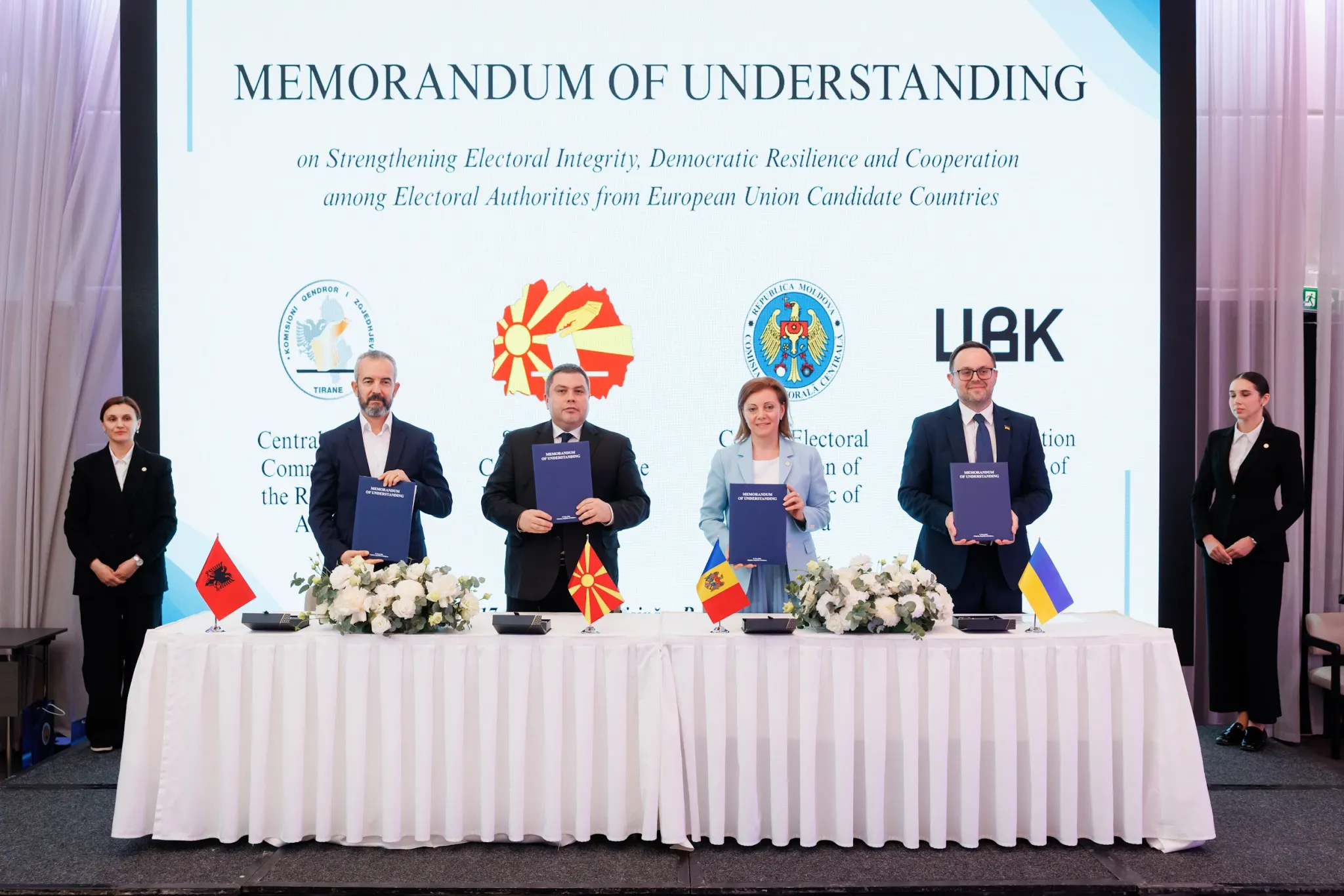
The seventh edition of the Money in Politics Regional Conference closed in Chisinau with the signing of a Memorandum of Cooperation between the central electoral authorities of the Republic of Moldova, Ukraine, Albania and North Macedonia - four countries pursuing European Union membership. Sealing two days of expert exchange on the region’s most pressing threats to electoral integrity, it marks a concrete step toward strengthening democratic resilience.
The second day opened with a plenary on harnessing technology for electoral oversight, moderated by Nana Kalandadze, Programme Manager for International IDEA’s Europe Regional Programme, who framed artificial intelligence as an opportunity rather than a threat: “The question is not whether these technologies will exist, but whether financial oversight bodies will be able to use them effectively and constructively.” Experts from the Council of Europe’s Venice Commission, ODIHR, Latvia, Romania and UNDP shared experience with AI-assisted and social media monitoring tools. International IDEA’s monitoring of Moldova’s recent cycles identified some 47 million political posts over twelve months, only 9 percent from political parties - evidence that authorities tracking only declared actors miss close to 90 percent of the online environment. The consensus: AI can serve electoral integrity as a decision-support tool, but legality, proportionality and accountability must remain with human institutions; those that adopt it without safeguards risk becoming instruments of surveillance rather than guardians of integrity.
A session on the enforcement ecosystem examined the “Moldovan model” for countering cross-border electoral corruption. Speakers framed illicit electoral funding as a national security challenge - increasingly foreign, coordinated, and channelled through crypto-enabled flows that can exceed declared financing by an order of magnitude. Moldova’s response combines cryptocurrency analytics, open-source intelligence and social media monitoring with inter-agency coordination and visible public communication as deterrence; authorities traced a single cryptocurrency wallet through transactions totalling 107 million US dollars and seized assets worth over one million euros in 2025. Counterparts from Ukraine and North Macedonia outlined the prevention-focused architectures they are building on the same lessons.
A closing peer-learning session warned that transparency gaps do not close as oversight improves but migrate - into pre-campaign activity, third-party advertising and largely uncontrolled digital channels - and urged candidate countries to build national foundations now rather than wait for European rules to fill every gap.
The day culminated in the signing of the Memorandum of Cooperation. It establishes a formal framework spanning political finance transparency, countering disinformation and foreign interference, cybersecurity, the digitalisation of electoral processes, and the alignment of national legislation with European standards. Signed for an initial three years with automatic renewal, it provides for exchanges of expertise, joint training, thematic working groups and annual cooperation plans, with each institution appointing a focal point. The four electoral authorities translated two days of analysis into a commitment to act together.
The conference brought together electoral management bodies, oversight institutions, international organisations and experts from more than 20 countries. It was organised by the Central Electoral Commission of the Republic of Moldova in partnership with International IDEA, the European Union Partnership Mission in Moldova (EUPM), the Council of Europe, UNDP, NDI and the Organisation Internationale de la Francophonie (OIF), with financial support from the European Union, Norway, Sweden, Denmark and Canada.