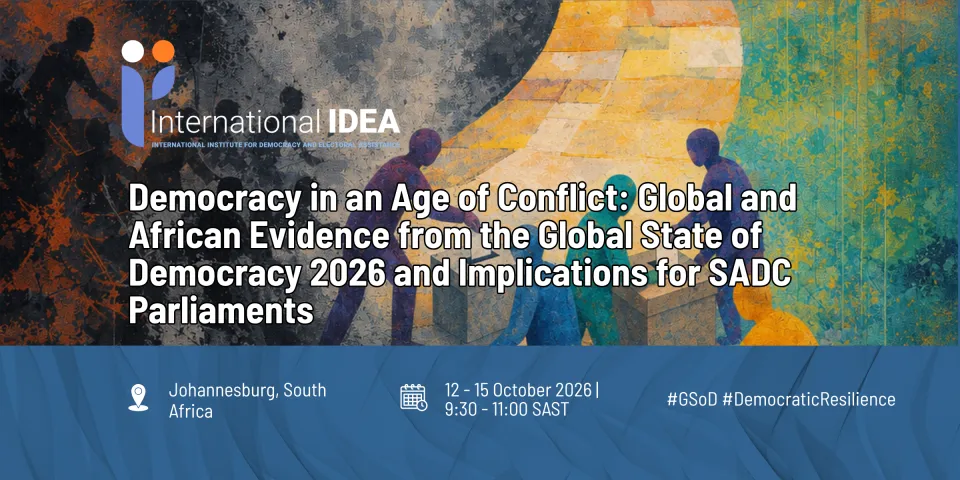
What the 2026 Global State of Democracy just told the world about Africa and West Asia
Opening the event, H.E. Jock Geselschap, the Deputy Ambassador of the Royal Netherlands Embassy who chaired the proceedings, took the opportunity to draw parallels between the Dutch experience of managing rivers and an encroaching sea and how national experiences are important in shaping governance systems. Against the backdrop of the rise in gender-based violence in South Africa, he acknowledged the impact of the phenomenon and called on all men to stand in solidarity with the women of South Africa.
In his opening remarks, Mosotho Moepya, the Chairperson of South Africa's Independent Electoral Commission, noted that when ballot integrity is compromised, the social contract fractures and the risk of political violence rises. Against the backdrop of 2025 having recorded more violent conflicts than any year in modern history, he argued that democratic systems must improve or risk drifting backwards. He stressed that democracy management efforts must be well informed, well researched, and evidence-based.
Speaking on behalf of International IDEA, Gram Matenga, Regional Head of Programmes for Africa and West Asia, bemoaned the deterioration in the trend of democracy across the world and praised the robust methodological approach behind the GSoD reports. He observed that the 2026 report set out to answer critical questions about the state of global democracy and the relevance of democracy in an age of conflict. He noted the timeliness of the report’s findings and called on development partners to employ its findings in shaping programmatic engagements.
A Report in Its Eighth Edition
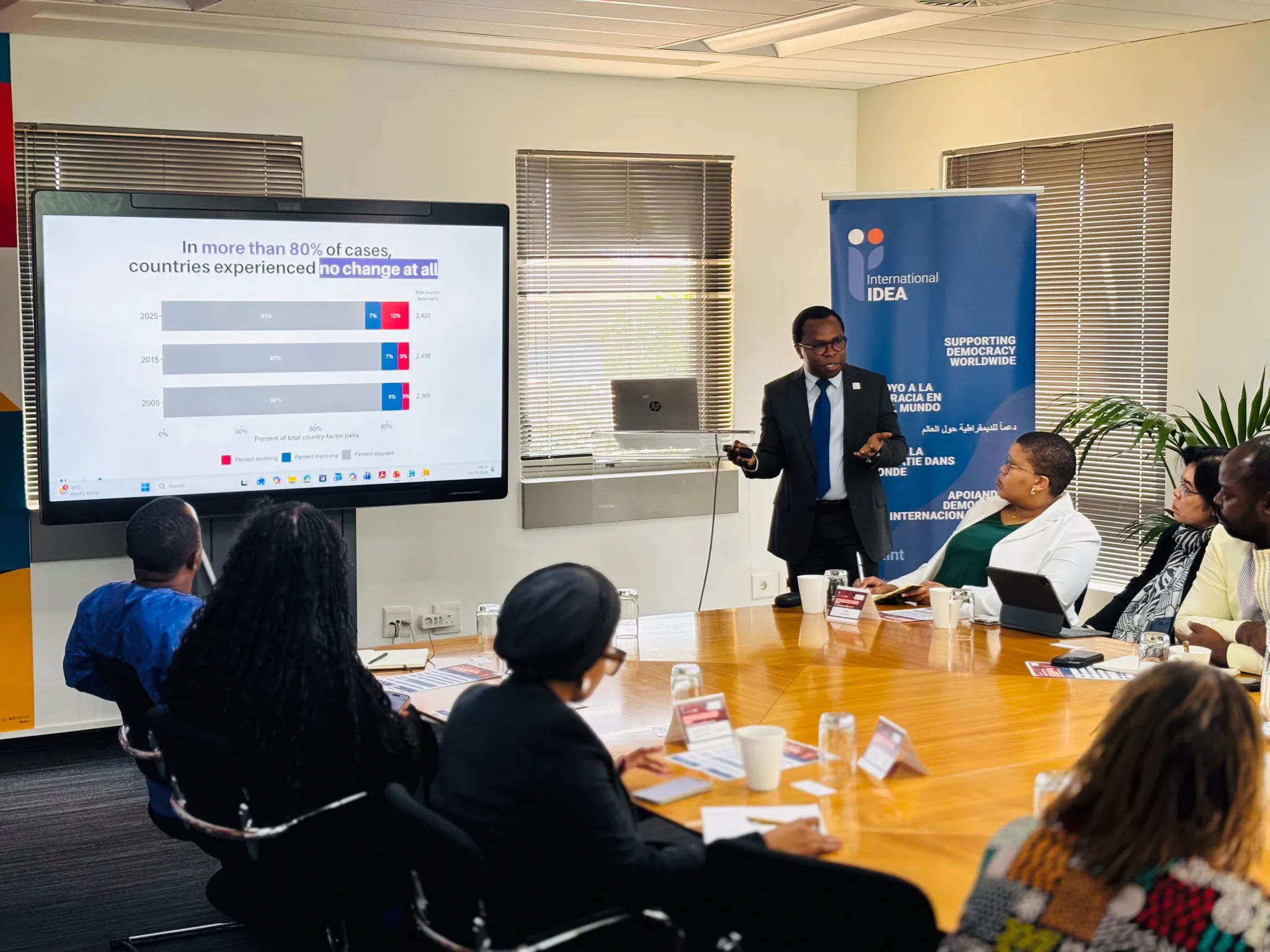
Presenting the findings of the report, Dr. Andrews Atta-Asamoah, International IDEA's Senior Advisor for the African Union, observed that democratic decline continues to outpace advances for the 11th consecutive year, with the gap between advances and declines widening significantly. He identified 2014 as the point at which global advances stopped outpacing declines, and cautioned that the more common pattern is one of stasis in which the majority of democratic countries are mid-performers and where changes are observed, are drifting downward rather than climbing toward high performance. The steepest global declines currently are in the areas of rule of law, alongside freedom of expression, freedom of the press, and access to justice.
Atta-Asamoah told the audience that Africa accounts for a significant share of the global pattern of decline, contributing 33 per cent of it in both 2024 and 2025, while the region's contribution to democratic advancement fell by four points over the same period. Performance across the region was weak in representation and rights, and especially severe in rule of law, with declines in elected government, credible elections, and effective parliaments, and in judicial independence, predictable enforcement, and the absence of corruption. Southern Africa was identified as a major contributor to Africa’s recorded advances, while West African countries, particularly Burkina Faso and Togo, were identified as a driver of decline across several indicators.
A central argument of the presentation was that democratic erosion is not only a governance concern but a security one. Comparing data from the Uppsala Conflict Database and International IDEA’s work on democratic trends since 1975, he observed that the report also finds that democratic trends are closely associated with conflict trends and that weak democracies are more vulnerable to conflicts. He argued that this is because weak democracies often have the institutional frameworks but lack the needed robustness to serve as instruments for peaceful resolution of grievances. He noted that, according to the report, hybrid regimes carry particular risk since they simulate democratic form without delivering institutional accountability.
Comparing the report's findings against the Global Peace Index, he noted that rule of law showed the strongest relationship with peace and stability, though all four democratic categories correlated positively with it. Active civil society and social accountability emerged as the two factors most closely associated with lower conflict risk in democratic contexts.
The presentation closed with three recommendations from the report: that democracy support be treated as a security strategy rather than a separate policy track; that social cohesion and accountability be strengthened at regional, national, and continental levels; and that early action be taken when democratic decline first appears, rather than waiting for institutional breakdown.
South Africa: Strong Institutions, Weakening Rule of Law
Responding to the findings of the report, Bonolo Makala of the University of Pretoria turned the discussion to South Africa specifically, noting that rule of law is the weakest-performing category globally, and that between 2020 and 2025 only two countries in the Africa and West Asia region improved in this category: Somalia and Syria, both from very low starting points. She reported that the region recorded 29 category-level declines in rule of law, with roughly 90 per cent of assessed countries falling into the low- or mid-range band.
South Africa itself was classified as high-performing in representation and participation, a result she linked to the 2024 elections and the peaceful formation of a government of national unity that avoided paralysis or instability. But she placed the country's rule-of-law performance in the middle band, ranked around 56th and four places lower than in the report's reference period. Her argument went beyond technical scoring: corruption, she said, is not merely a criminal justice issue but a democratic crisis, because it undermines the basic promise that democracy will respond to people's material needs. Citing ongoing corruption inquiries in South Africa, including 174 days of hearings, ten witnesses, and more than 26,000 reports submitted, she argued that democracy must be judged as substantive, not only procedural.
Reflecting on the findings
Reflecting on the findings, participants asked about the role of international democracy assistance, particularly in Francophone Africa, the impact of declines elsewhere on Africa and South Africa’s experience and what to expect. Olufunto Akinduro, International IDEA’s Senior Advisor, noted that global support for democracy is shrinking, citing the closure of USAID as a significant setback, and argued that Africa's performance has a major impact on global outcomes. She noted calls for Africa to build homegrown models of democratic assistance, noting that less than 30 percent of the African Union's budget currently comes from Member States. Atta-Asamoah added that democratic backsliding among established democracies undermines the standards the rest of the world aspires to, as it weakens the proof that democracy is a workable system, and cautioned against reducing democracy to elections alone.
Asked to unpack South Africa's democratic trajectory, Bonolo Makala observed that South Africans still largely regard democracy as the best form of government, but that a real tension exists between the concept of democracy and citizens' lived experience of it, shaped by persistent inequality and weak delivery. On whether democratic decline elsewhere affects Africa, and whether an election-centred view of democracy is too narrow for a continent with such a young population, Atta-Asamoah agreed that decline elsewhere has knock-on effects, and pointed to Ghana as an example of how election cycles, if handled carelessly, can push a country toward instability even without eroding the vote itself.
Conclusively, the Deputy Ambassador of the Netherlands extended thanks to speakers and all who attended and contributed to the discussion.


About the authors