Report on women’s political participation in Panama
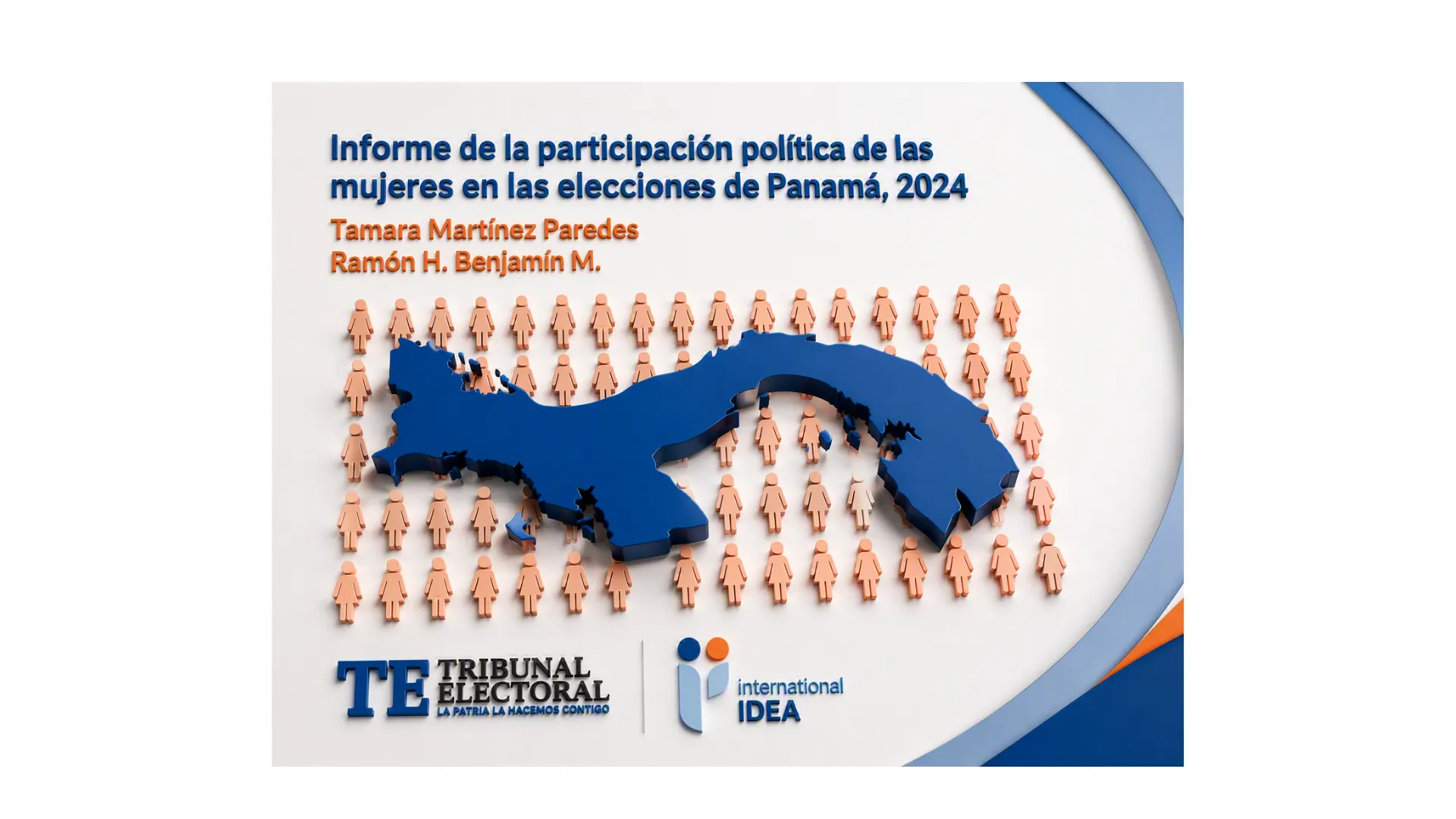
The report, prepared by researchers Tamara Martinez Paredes and Ramon Benjamin Miranda, documents both the progress achieved and the persistent structural barriers that continue to prevent Panamanian women from fully exercising their political rights on equal terms.
In this regard, Marcela Rios Tobar, International IDEA’s Regional Director for Latin America and the Caribbean, noted that the report serves as a critical tool for strengthening discussions on the reforms needed to advance women’s political participation in the country. Meanwhile, Narciso Arellano Moreno, Presiding Magistrate of Panama’s Electoral Tribunal, described the publication not merely as a compilation of statistics, but as a “call to transformative action” aimed at addressing a longstanding debt within Panamanian democracy.
The findings reveal a striking contrast between women’s high levels of civic engagement and their underrepresentation in decision-making spaces.
One particularly significant finding is that, for the fifth consecutive election, women played the leading role in Election Day participation, accounting for 52.31% of voters, compared to 47.69% men on May 5, 2024.
However, this civic participation did not translate into equivalent political representation. According to the results, women occupy only 13.7% of elected offices nationwide. In the National Assembly, women hold just 21.7% of seats, placing Panama well below the Latin American regional average of 35.8%.
One of the report’s key conclusions points directly to the design of the current electoral framework. Article 373 of the Electoral Code contains what is commonly referred to as the “escape clause.” Because there is no requirement to alternate women and men on electoral lists, women are frequently relegated to substitute positions, limiting their opportunities to compete on equal terms for principal candidacies.
The report also identifies digital political violence as a growing and alarming obstacle. Drawing on data from IPANDETEC, it highlights that 56% of online attacks targeting female candidates were rooted in gender roles and stereotypes. Such abuse seeks to discourage women’s participation in public life and restrict their freedom of expression, compounding the economic and psychological violence they already face in the political arena.


About the authors