Global Democracy Report: Rule of Law Weakens as the United States Hits 50-Year Lows
Read in Arabic, French, German, Portuguese and Swedish.
BRUSSELS/STOCKHOLM – Global deterioration in the Rule of Law and record declines in the United States are worsening prospects for democracy around the world, according to a report by the International Institute for Democracy and Electoral Assistance (International IDEA).
Major indicators of US democracy from press freedom to judicial independence hit their lowest levels in 50 years, and this is reverberating worldwide. Washington’s retreat from the rules-based international order has weakened confidence in multilateralism and emboldened authoritarian leaders and populists.
The report, “The Global State of Democracy 2026: Democracy in an Age of Conflict,” warns that democratic regression is expanding the conditions for domestic and international conflict. Politically fragile countries that face further declines are especially vulnerable to this risk.
“For decades, the rule of law both domestically and in the international order has underpinned the resilience of democracies,” International IDEA’s Secretary-General Kevin Casas-Zamora said. “Now, the rapid decline of democracy in the USA is weakening judicial independence and fragmenting the international system—threatening democracy around the world.”
Stagnating democratic performance was the most common trend in 2025. When change occurred, it was mostly negative. Around 57 percent of countries declined in at least one key indicator of democratic performance between 2020 and 2025. Rule of Law, Representation, and Rights all suffered broad deterioration.
This global democratic decline was concentrated in many fundamental building blocks of democracy: Judicial independence hit a 36-year low. Credible elections fell to a 30-year low. Freedom of expression, freedom of the press, and access to justice were also at their worst in over three decades.
The year 2025 was the 11th consecutive year with more countries showing a net decline rather than improvement in overall democratic performance, the longest consecutive fall since International IDEA’s records began in 1975, according to the report.
Nearly half of the 30 indicators International IDEA uses to measure US democracy fell to their lowest levels since the Global State of Democracy (GSoD) dataset began in 1975, including Access to Justice, Economic Equality, Effective Parliament, Freedom of Expression, Freedom of the Press, and Judicial Independence.
The report warns that this erosion—driven partly by concentration of executive power—is weakening checks and balances in the US while damaging confidence in multilateralism and international rule of law globally.
In a special section on violent conflict, the report finds that a recent decline in the number and quality of democracies threatens the “democratic peace” produced by decades of democratization. Weakening democratic performance has increased the number of countries that have some democratic procedures but lack real political competition or enforceable rights, and the data show that these countries are at especially high risk of conflict.
The report says governments should treat democracy support abroad as a national security priority because stronger democratic systems can help reduce conditions leading to conflict. Even small investments in democracy support can deliver significant peace and governance gains, at a lower cost than military responses.
“Democracy’s decline is no longer just about our national political rights; it is reshaping the conditions for peace and security around the world,” Casas-Zamora said. “Investing in democracy is also investing in peace.”
The report also highlights positive developments, especially in countries in political transitions, such as Bangladesh, Nepal, Poland, Sri Lanka, and Syria. Although improvements remain fragile, public mobilization and civil society have helped democratic renewal.
In Syria, which saw improvements in Rights, Rule of Law and Participation, gains in indicators for civil society were especially large. While there are still serious challenges regarding security, rights, and centralization of power, stronger respect for freedoms of association and expression helped widen space for these groups to operate. Even in more stable contexts, such as Australia, indicators of civil society’s participation improved.
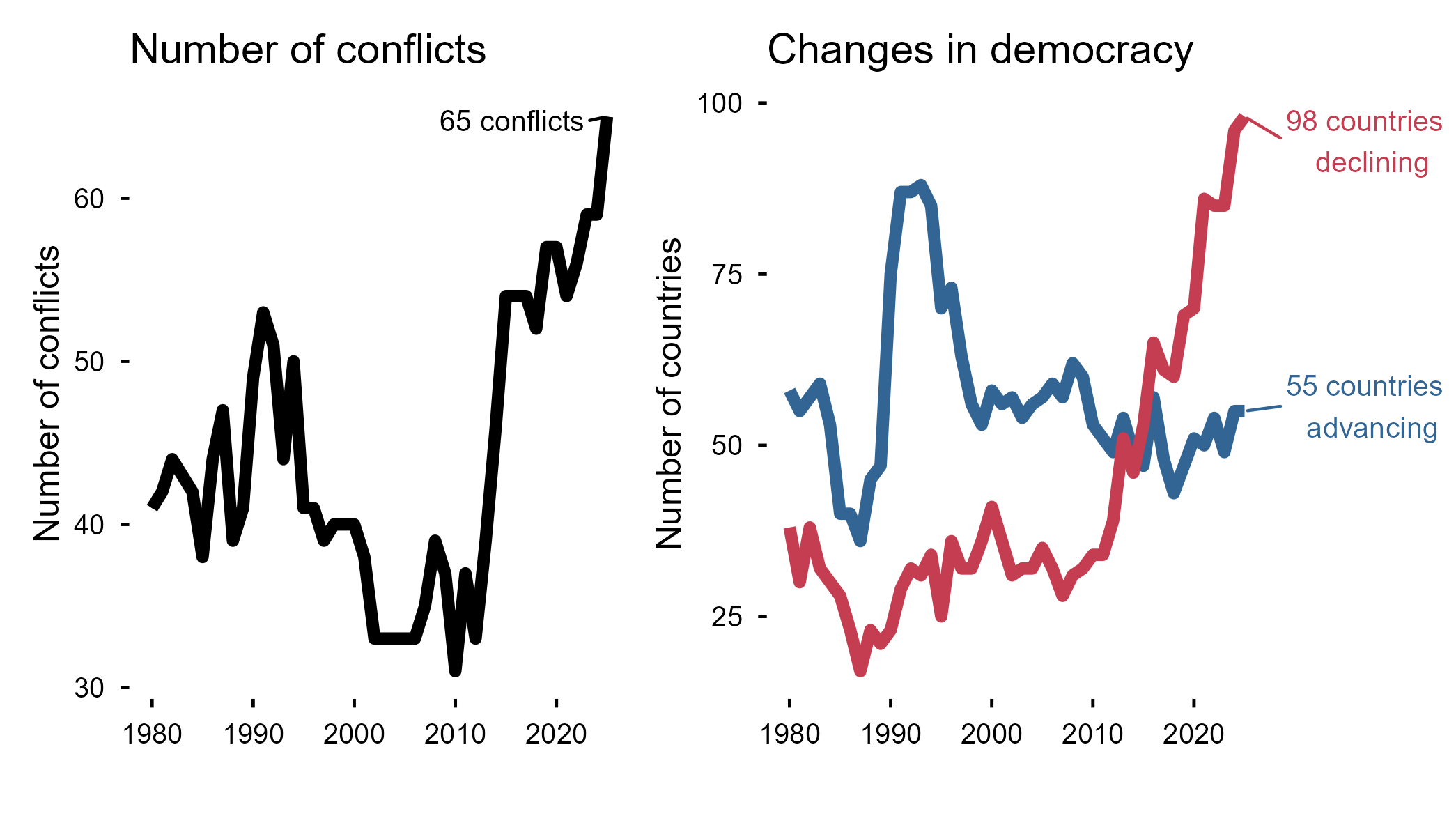
Source: Uppsala Conflict Data Program for data in left panel and GSoDI v10 data in right panel.
Key findings
Rule of Law was the weakest-performing category overall, with 71 countries, or 41 percent of those assessed (out of a total of 173), in the low-performance band. It also recorded more declines than any other democratic performance category, with 29 countries, or 17 percent, registering downturns. Judicial independence was among the worst hit.
Under the category of Rights, Freedom of Expression saw the most widespread decline, falling in 42 countries, or 24 percent of all countries assessed. Freedom of the Press also deteriorated sharply, declining in 23 percent of countries. Access to Justice fell in 18 percent of countries, underscoring pressure on core democratic rights and protections.
Representation remains democracy’s strongest-performing category globally, but its overall trend is still negative, recording 17 declines and only four advances between 2020 and 2025—reflecting deterioration in both electoral integrity and legislative oversight. Credible Elections deteriorated in nearly one in five countries worldwide (32 countries or 18 percent), while Effective Parliament deteriorated in 33 countries (19 percent).
African and European countries accounted for the largest shares of deterioration (33 and 27 percent of all declines respectively), while Asia and the Pacific led on improvements.
Background
The GSoD 2026 Report ranks countries in four major categories of democratic performance rather than one overall classification. These four categories are:
Representation—such as credible elections and effective parliamentary oversight.
Rule of Law—such as judicial independence and the degree to which people are free from political violence.
Rights—such as freedom of expression, freedom of press, and freedom of assembly.
Participation—such as how involved citizens are in democratic expression during and between elections.
These four categories are divided into 17 factors, such as credible elections or judicial independence. View the details on the research methodology.
REGIONS
Africa and West Asia
Africa and West Asia experienced more democratic declines than advances between 2020 and 2025, with setbacks concentrated in Credible Elections, Effective Parliament, Access to Justice, and Civil Liberties. West Africa remained a particular concern, with military-led governments in Burkina Faso and Niger further consolidating power and restricting political freedoms. However, there were signs of progress elsewhere: Syria’s political transition drove improvements in several democratic measures, while Gabon and The Gambia also recorded advances.
Europe
Europe remained the world’s strongest-performing democratic region overall, but signs of strain deepened. Civil Liberties, Access to Justice, and Credible Elections recorded the most setbacks, while Freedom of Expression and Freedom of the Press deteriorated in several long-standing democracies. Declines were concentrated in countries such as Georgia, Russia, and Slovakia, even as countries including Poland and Czechia recorded improvements in democratic governance and institutional accountability.
The Americas
Outside the United States, democratic performance in the Americas remained broadly stable, with most countries continuing to perform in the mid-range across all democratic categories. However, political polarization, disinformation, and declining public trust in institutions continued to shape the regional landscape. Democratic advances were recorded in countries including Brazil, Guatemala, and Honduras, while concerns persisted over democratic backsliding, organized crime, and governance challenges in several countries.
Asia and the Pacific
While overall declines slightly outnumbered advances, much of the deterioration was concentrated in Afghanistan and Myanmar. Excluding those two countries, the region recorded more advances than setbacks. Democratic improvements were particularly evident in Bangladesh and Sri Lanka, while concerns remained over declining electoral integrity, judicial independence, and executive concentration of power in several countries across the region.
LAUNCH QUICK LINKS
Key hashtag to follow on social media: #GSoD2026
MEDIA ENQUIRIES
International IDEA Secretary-General, Kevin Casas-Zamora, is available for text and visual interviews. Our regional experts are also available to talk to media.
For media enquiries, please contact: Alistair Scrutton, Head of Communications and Publications, at a.scrutton@idea.int , Tel: 0046 707 21 10 98
International IDEA
The International Institute for Democracy and Electoral Assistance (International IDEA) is an intergovernmental organization of 35 Member States with the sole mandate to support and advance democracy worldwide. International IDEA contributes to the public debate on democracy and assists in strengthening processes, reforms, institutions, and actors that build, advance and safeguard democracy, with a focus on electoral processes, constitution-building, democracy assessment and political participation and representation. Mainstreamed across all of our work are gender and inclusion, conflict sensitivity, and sustainable development.
International IDEA is one of the most trusted global sources of data and analysis on the health of democracy around the world.


Press contact