


Webinar: Democracy for All – Safety of Digital Spaces for All: Women’s Political Participation and Representation in the Digital Age, Challenging Technology-Facilitated Gender-Based Violence


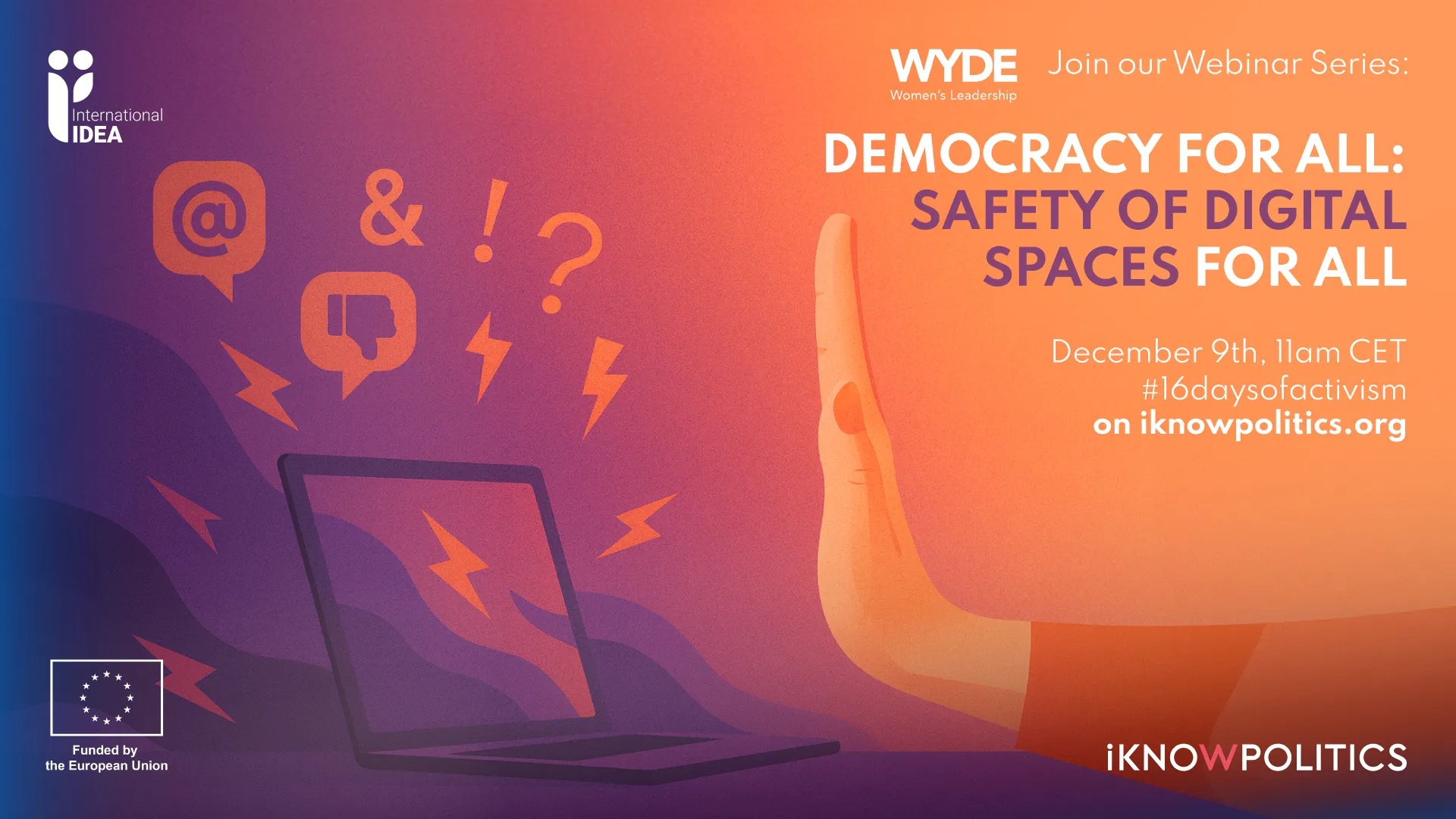
Organized under the European Union–funded WYDE Women's Leadership Initiative and the iKNOW Politics platform, this webinar aims to elevate the voices and experiences of women politicians from the global south. Together, we will reflect on how digital violence has shaped women’s political journeys and explore the social and cultural dynamics driving technology-facilitated gender-based violence.
Context
The global theme for 16 Days of Activism Against Gender Based Violence is UNiTE to End Digital Violence Against All Women and Girl. The UNiTE campaign focuses on one of the fastest-growing forms of violence, digital violence against all women and girls. Violence Against Women and Girls remains to be one of the more critical human right violations, and has a multi-tiered impact on individuals, families, communities and the society at large. Despite significant advances in legislation, services, awareness and social change the issue persists and according to global figures 1 in 3 women experience violence across their lifetime.
Digital technologies have reshaped the space for political discourse, opening new avenues for engagement, advocacy and knowledge-sharing. However, rapidly changing technologies have created new risks especially intensifying violence against women and girls. New forms and patterns of violence have emerged, as digital technologies have the capacity to entrench existing social inequalities and contribute to the reinforcement of harmful gender norms and restrictive gender roles in society. TFGBV manifests in many forms including increased misogynistic content and creation of the so-called ‘manosphere’, additionally technology is leveraged to increase abuse, hate speech, control, harassment, disinformation and misinformation, all leading to violence against women.
According to the United Nations online violence disproportionately impacts women with high online visibility, including younger women and women in public life and especially women in politics.[1] Young women in politics lie at the intersection of these two categories. Therefore, they remain to be the most vulnerable and marginalized group impacted by digital violence. The underlying reasons for this discrimination remain to be socially and culturally driven.
Participants
Panelists will include women politicians from the global south with selected participants from the WYDE Young Women’s Alumni Cohort[2].
-
Anita Kamanga, Deputy Mayor, Zambia
-
Annah Sande, First Female and Youngest Mayor of Epworth, Zimbabwe
-
Ayisat Aguda, Woman Leader of the Social Democratic Party, Nigeria
-
Mabel Obeng, Young Women of Africa Ghana Country Leader and Regional Director for ALSA West Africa, Ghana
-
Nerat Gyang, First Welfare Director of the Faculty of Social Sciences Students’ Union of the University of Jos, Nigeria
-
Savera Prakash, Politician (Candidate for the Provincial Assembly, KP, 2024 Elections), Pakistan
-
Sneha Padayan, Politician and Elected Local Representative, India
-
Wanja Mania, Aspiring Young Politician and Gender & Disability Specialist, Kenya
The session will be held online and will be recorded; live audience can join and share questions. The participants will also share their own experiences of navigating the digital space.
The webinar will probe the following questions.
-
How do harmful gender social norms play a role in increasing TFGBV?
-
How can we move to a survivor-centric approach when it comes to TFGBV?
-
How significant are women allies and support groups in coping with TFGBV?
-
How can we engage male allies in mitigating these challenges and acting as active advocates and not silent supporters?
-
How to safely navigate the digital space, good practices from around the world?
Event partners

Related Events


 Comments


