Launch of Influence and Political Integrity: Mapping Regulatory Frameworks for Influencers in Elections


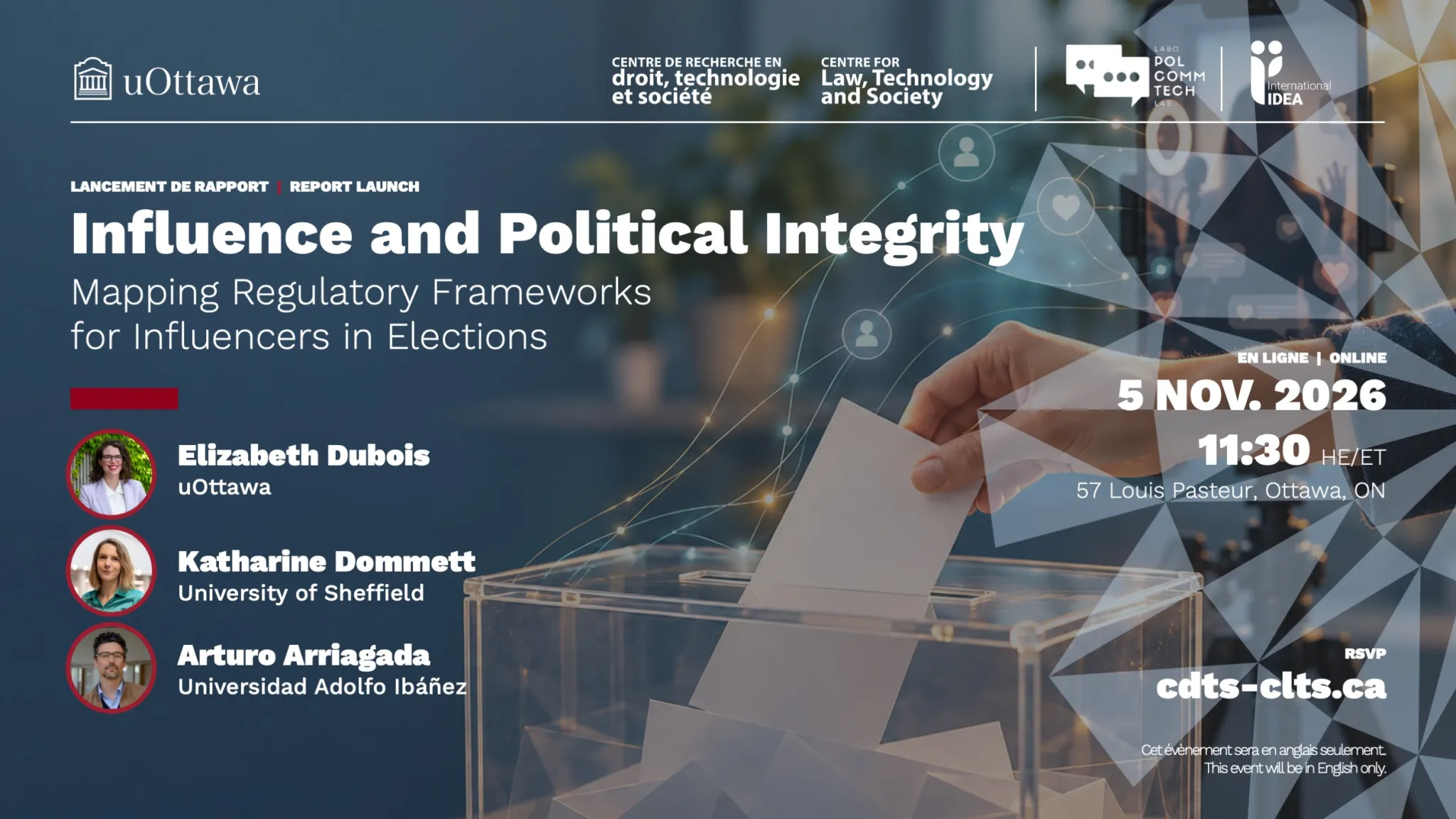
The University of Ottawa Centre for Law, Technology and Society and the Pol Comm Tech Lab, in collaboration with International IDEA, presents a conversation with Elizabeth Dubois (University of Ottawa), Katharine Dommett (University of Sheffield) and Arturo Arriagada (Universidad Adolfo Ibáñez) on the growing role of social media influencers in elections.
Parties, candidates, governments, civil society organizations and foreign actors all use influencers in election campaigns. They use them for voter outreach and civic engagement, and also for covert campaigning, disinformation and coordinated foreign interference. As a result, electoral management bodies and policymakers have to figure out whether to respond and how.
Influence and Political Integrity, a new report by the Pol Comm Tech Lab and International IDEA, reviews laws, regulations and guidelines in 18 countries and the European Union. It finds that existing political finance and electoral communication rules are stretched to cover influencers, and these rules usually apply only when money changes hands. But payment is an increasingly inadequate test, because non-monetary compensation, off-platform payments and unpaid ideological activity can all avoid it. Commercial advertising rules contain the most developed influencer-specific provisions, but they usually exclude political content. The same influencer can face extensive obligations when promoting a product and none when promoting a candidate.
The report makes 17 recommendations for electoral management bodies, legislators and platforms, organized around five priorities: foundational definitions, data access and safeguards for freedom of expression; moving beyond the payment trigger; platform design; enforcement capacity and cross-agency coordination; emerging gaps such as AI-generated influencers and non-financial foreign interference.
As part of this conversation, three of the report's authors will present its key findings and then discuss what it means for electoral bodies, policymakers, platforms and civil society in a moderated conversation.
About the speakers
Dr. Elizabeth Dubois is an Associate Professor and University Research Chair in Politics, Communication and Technology at the University of Ottawa where she runs the Pol Comm Tech Lab and is a member of the Center for Law, Technology and Society. She is also a Faculty Associate and former Fellow at the Berkman-Klein Center at Harvard University. Her work examines political uses of digital media, including artificial intelligence, political social media influencers, and online harassment of public figures.
Dr. Katharine Dommett is Professor of Digital Politics at the University of Sheffield. Her research focuses on the impact of digital technology on election campaigning, with a particular focus on regulation. Professor Dommett has worked closely with the UK Electoral Commission, the Irish Electoral Commission and Privacy Commissioners in a range of national contexts.
Dr. Arturo Arriagada is Associate Professor of Digital Culture and Creative Labor at Universidad Adolfo Ibáñez in Chile and a Research Associate at the Oxford Internet Institute (OII). His research interests include workers' experiences in the gig and creator economies, artificial intelligence, creativity, and cultural production.
Speakers