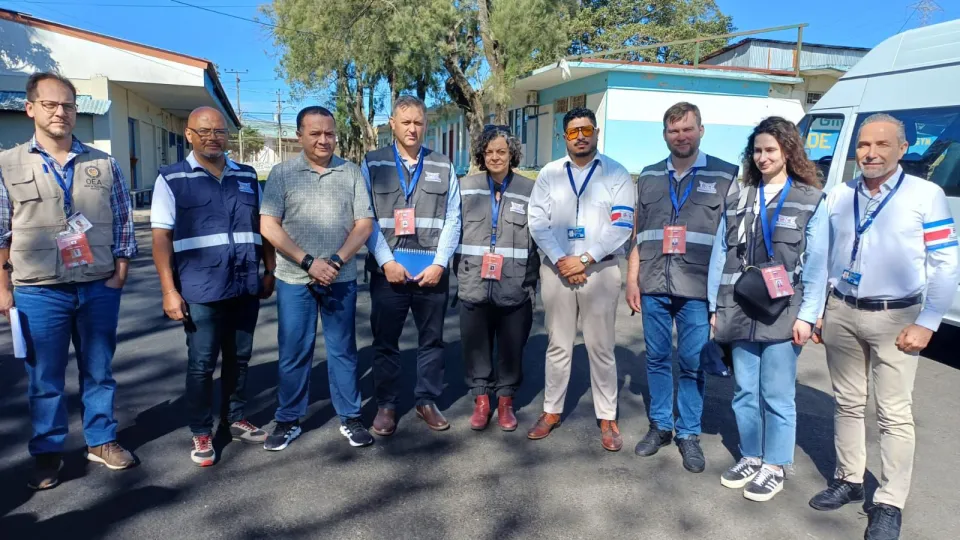
More than 25 million Peruvians will go to the polls on 6 June to define in ballotage who will be their next President of the Republic. This election comes after five years marked by a political crisis caused by the confrontation between Congress and the Executive. In addition, since 2020, a severe health crisis caused by the Covid-19 pandemic has made Peru one of the countries with the most deaths per million inhabitants in the world.
Búsqueda
Region
Country
Type
4634 results
June 04, 2021
El 7 de septiembre de 2020 inició formalmente el Proceso Electoral Federal 2020-2021. Se trata de un suceso sin precedentes pues se considera que son las elecciones más grandes y complejas en la historia de México.
News
June 04, 2021
IDEA Internacional expresa su profunda preocupación por el creciente deterioro de la situación de los derechos humanos, falta de garantías a la oposición política y libertad de prensa en Nicaragua.
Las últimas acciones del gobierno nicaraguense constituyen prácticas contrarias a los valores democráticos presentes en la Carta Democrática Interamericana, minando la credibilidad e integridad del proceso electoral general a realizarse en noviembre de 2021.
News
June 04, 2021
Más de 25 millones de peruanos irán a las urnas este 6 de junio para definir en ballotage quien será su próximo Presidente de la República. Esta elección se produce luego de cinco años marcados por una crisis política caracterizada por la confrontación entre el Congreso y el Ejecutivo. A ello se suma, en 2020, una severa crisis provocada por la pandemia de la Covid-19 que ha convertido a Perú en uno de los paises con más muertes por millón de habitantes en el mundo.
News
June 03, 2021
Training is the process of learning the skills you need to do a particular job or activity. For election officials, training organized by electoral management bodies (EMBs) can be geared towards election procedures before, during or after elections; or be part of staff's lifelong learning to maintain and improve the professional com
News
June 02, 2021
The discussion on how technology can be applied to improve the integrity and transparency of elections often focuses on complex and expensive technologies such as biometrics, electronic voting and voter identification systems.
Publication
June 02, 2021
The open-list proportional representation (OLPR) system, as opposed to the closed-list version, allows voters to pick their favourite candidate from the party list while retaining proportionality of the election results.
In the Asia & the Pacific region, this system is used in among others: Fiji, Indonesia and Sri Lanka. What are the upsides, downsides and unintended consequences of this system? Follow the lecture and/or read the paper for the answers.
Publication
June 02, 2021
Forms of special voting arrangements (SVAs) conventionally include early, postal, online, proxy voting and use of mobile ballot boxes.
Publication
June 02, 2021
This lecture deals with the intersection between three sets of challenges, each of which constitutes an existential threat to democracies across the world. The first is linked to money in politics, which poses the danger not only of ‘policy capture’ but also, in worse-case scenarios, of state capture by monied interests.
Publication
June 02, 2021
International IDEA and the United Nations Development Programme (UNDP) signed a Letter of Agreement initiating a partnership to support Timor-Leste’s electoral management bodies (EMBs) in preparing a manual and plan to conduct Covid-resilient elections under the project ‘Covid-Resilient Elections in Timor-Leste’ funded by the Government of Japan.
News
June 02, 2021
How can democracies better act when facing future health crises?
News
May 31, 2021
News
May 28, 2021
The need for physical distancing during this Covid-19 pandemic has raised the need for innovative campaign methods to be developed by election contestants because conventional campaign methods such as rallies, public meetings, etc. are prohibited in some jurisdictions.
Publication
May 28, 2021
What has happened to elections in Latin America in the context of the Covid-19 pandemic? How have the electoral management and judicial bodies faced the various challenges of the health crisis? Which best practices and lessons have been implemented to defend democracy in the region?
News
May 28, 2021
Los días 15 y 16 de mayo se llevaron a cabo las elecciones en Chile —que fueron postergadas dos veces1— para elegir 155 representantes de la Convención Constitucional (que sesionará a partir de julio por entre 9 y 12 meses para redactar una nueva constitución cuya aprobación será sometida a un referéndum con voto obligatorio); 13 gobernadores regionales —primera vez que se eligen y no son designados por el Presidente de la República—; 345 alcaldes o alcaldesas; y, concejales de esa
News
May 27, 2021
Systemic and legal barriers to equal political participation persist at all levels and take different forms, including unfavourable electoral systems, lack of support from political parties, socio-economic, and cultural.
Publication
May 27, 2021
There’s no denying that money plays an important role in politics. However, if the flow of money in politics, commonly known as political finance, is not well regulated, the danger is that this can mean that influence and political power are concentrated in the hands of a select few. There are already several systemic, cultural, educational, and legal barriers to the inclusion of women, people with disabilities, LGBTI individuals and young people in politics.
News
May 26, 2021
En el webinario que IDEA Internacional organizó en colaboración con el Observatorio para la Nueva Constitución, Centro Democracia y Comunidad, Chile 21, Horizontal, Instituto Libertad y Rumbo Colectivo, y que se celebró el día 30 de marzo de 2021, los panelistas discutieron experiencias de distintos órganos constituyentes desde una perspectiva comparada, centrándose sobre todo en los desafíos que se tuvieron que encarar y las innovaciones en términos de diseño del proceso constitucional que s
Publication
May 25, 2021
Elections were held in Chile on 15 and 16 May 2021—after being postponed twice[1]—to elect 155 delegates to the Constitutional Convention (which will meet as of July for 9 to 12 months to draft a new constitution whose adoption will be subject to a referendum with compulsory voting); 13 regional governors—the first time governors will be elected rather than designated by the President of the Republic; 345 mayors; and local council members.
News
May 24, 2021
The second webinar of the Democratic Development in Melanesia Webinar Series held on 20 May 2021 presented the main findings of a recent study by International IDEA and its partner, MEMO 98, a Slovak non-profitmedia-monitoring organization, investigating how women politicians of Fiji are treated on Facebook.
News