Five Ways Parliamentary Oversight Can Strengthen Infrastructure Investment
At a time when countries around the world are investing heavily in infrastructure to drive growth, strengthen resilience and expand access to essential services, the pressure to deliver is immense. Roads, railways, energy systems, water networks and digital infrastructure are often framed as symbols of progress – and they can be. When well conceived and effectively implemented, large-scale infrastructure projects can connect communities to opportunity, improve access to services, stimulate economic activity and support long-term development.
But infrastructure decisions also carry significant risk. Major public investments are costly, complex and often politically sensitive. Poor planning, weak procurement, opaque financing or inadequate public consultation can quickly turn transformative investments into fiscal burdens or missed opportunities. At a time when public resources are under pressure and citizens rightly expect transparency and results, how infrastructure decisions are made matters just as much as the infrastructure itself.
Poorly managed projects drain public resources, deepen inequalities, and erode trust in democratic institutions. — Dr. Kevin Casas-Zamora, Secretary-General, International IDEA
This is where parliamentary oversight becomes indispensable.
Parliaments are not simply legislative institutions; they are stewards of the public interest. As representatives charged with scrutinizing public spending and holding governments to account, they play a critical role in ensuring infrastructure investments serve citizens – not narrow political or commercial interests.
Yet effective oversight is rarely straightforward. Large-scale projects often span multiple political cycles, involve complex financial and technical arrangements, and generate pressure to move quickly. Asking difficult questions at the right moment can be politically uncomfortable – but it is often the difference between infrastructure that delivers lasting value and infrastructure that becomes an expensive cautionary tale.
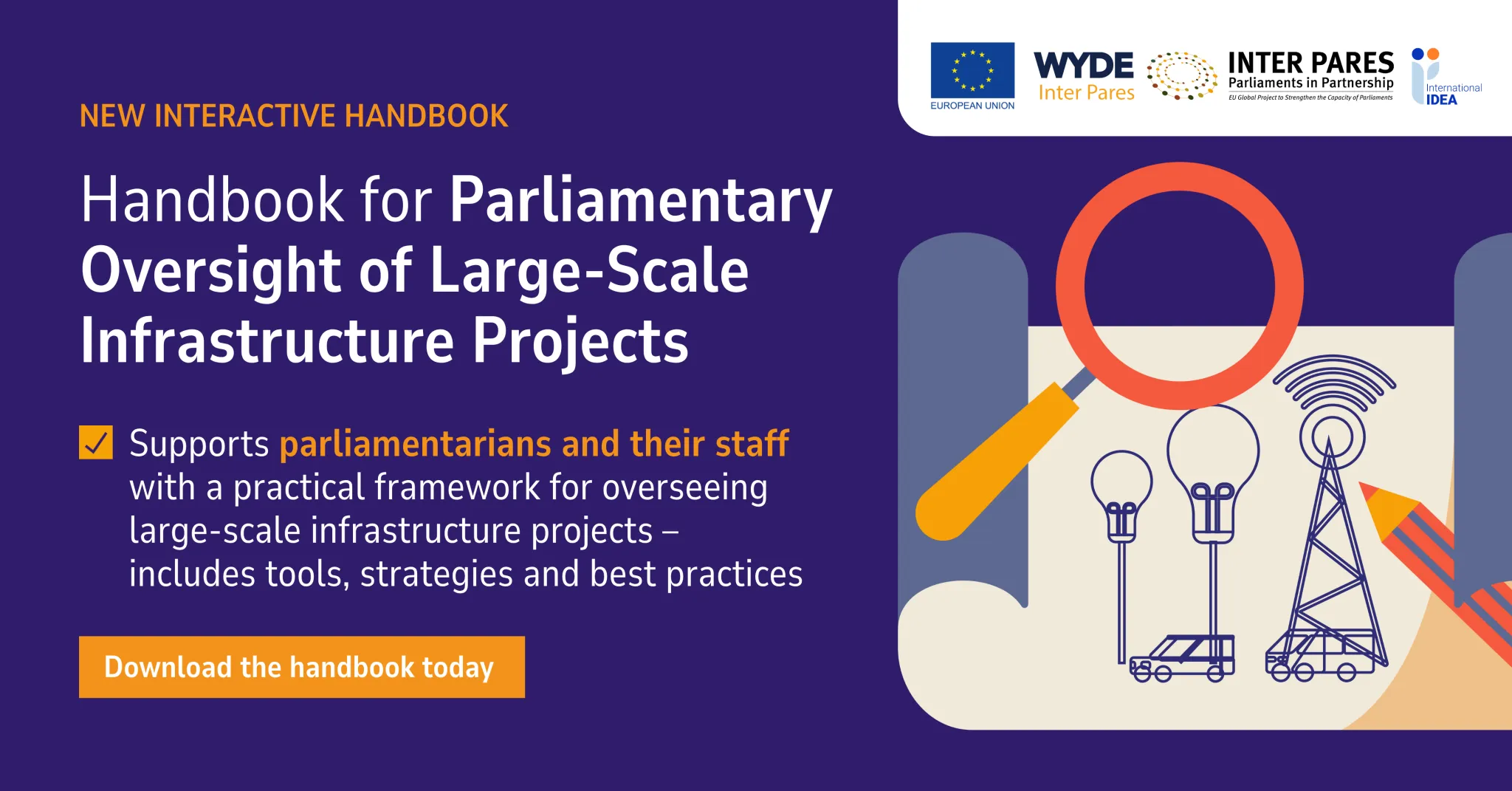
International IDEA’s new Handbook for Parliamentary Oversight of Large-Scale Infrastructure Projects was developed with exactly this challenge in mind. Designed as an interactive, highly practical resource for parliamentarians and parliamentary staff, it goes beyond high-level principles to offer actionable tools for oversight at every stage of the project lifecycle – from key questions parliamentarians should ask to warning signs to watch for, essential documents to request, and practical options for committee action.
At its core, the handbook makes a compelling case: effective oversight is not about slowing progress. It is about making sure progress actually delivers.
Here are five ways stronger parliamentary oversight can help turn public investment into lasting public value.
1. Start with the right question: Is this project truly needed?
One of the handbook’s most important messages is that meaningful oversight starts early.
Too often, parliamentary scrutiny intensifies only once construction delays emerge, budgets balloon or controversy becomes public. By then, parliament’s ability to influence outcomes may be limited.
But the earliest questions are often the most important.
At the initiation stage, oversight is not about engineering details. It is about fundamentals.
Is the proposed project solving a clearly defined public problem? Does it align with national development priorities? Have alternatives been properly considered? Who benefits – and who may be left out?
Infrastructure projects can build political momentum quickly, especially when framed as urgent, transformative or nationally significant. But good oversight means resisting “solution-first” thinking and ensuring the case for investment is genuinely sound before commitments harden.
For example, in Zambia: parliamentary oversight over infrastructure financing was strengthened through the 2022 Public Debt Management Act, which requires parliamentary approval for government borrowing – helping ensure major infrastructure investments are scrutinized not only for ambition, but affordability.
2. Following the evidence: Scrutinize the planning, not just the promise
As projects move into planning and development, parliamentary oversight becomes more evidence-driven.
This is where feasibility studies, cost-benefit analyses, environmental and social impact assessments, financing plans and risk analyses begin to shape a project’s trajectory. The handbook makes clear that these are not technical formalities – they are core accountability tools.
Just as importantly, it gives parliamentarians a practical roadmap for what to look for, what documents to request, and where early warning signs may emerge.
A polished budget should not automatically inspire confidence. Parliamentarians should ask whether costs include realistic contingencies, whether long-term operation and maintenance expenses have been factored in, and whether projected demand assumptions are credible.
And financial questions are only part of the picture.
Environmental and social assessments deserve equal scrutiny. Infrastructure that appears economically sound on paper can still impose significant costs on communities, ecosystems or marginalized groups if safeguards are weak.
For example, South Korea offers one useful model: large public infrastructure projects must undergo an independent preliminary feasibility study before public funds are committed – giving parliament a stronger evidence base for decision-making.
3. Treat the investment decision as the true accountability test
Formal project approval is often the most consequential oversight moment.
By this stage, political momentum may be strong. Political leaders may be invested. Public expectations may be rising. And that is precisely why scrutiny matters most here.
The handbook encourages parliamentarians to look beyond headline construction costs and interrogate the long-term financial picture: debt sustainability, contingent liabilities, financing risks, and the full lifecycle cost of the asset.
A project that looks attractive in the short term can create major financial burdens for years – or decades – if the underlying assumptions are weak.
This is where parliament’s constitutional role as guardian of the public purse becomes indispensable.
For example in Denmark, Parliament has institutionalized a more disciplined approach to infrastructure decision-making by embedding mandatory contingency reserves into transport infrastructure budgeting. Supported by parliamentary approval processes, this model helps account for predictable cost overruns before projects move forward – strengthening fiscal realism at the critical investment decision stage.
4. Stay engaged during delivery: Oversight doesn’t end when construction begins
Once contracts are signed and construction begins, parliamentary oversight should evolve – not disappear.
The handbook is clear that some of the most significant governance failures emerge during implementation, when delays, cost overruns, procurement irregularities, weak contractor performance or environmental compliance failures become visible.
Parliament is not there to manage the project. But it is there to ensure transparency, accountability and performance.
Repeated supplementary budgets, unexplained delays, limited disclosure, or single-source procurement should all trigger scrutiny. The handbook also encourages parliamentarians to watch for warning signs early and use oversight tools – from committee hearings to parliamentary questions – to demand answers before problems escalate.
For example in Uganda, parliamentary oversight of the Isimba Hydropower Plant – including committee hearings, technical briefings and site visits – shows how active oversight during implementation can help surface concerns before they become systemic failures.
5. Measure success by outcomes, not ribbon cuttings
A completed project is not automatically a successful one.
One of the handbook’s strongest contributions is its insistence that oversight continues after construction ends. Infrastructure should be judged not simply by whether it was built on time or on budget, but by whether it delivered the public benefits originally promised.
Did citizens gain meaningful access to services? Did projected economic benefits materialize? Were environmental and social commitments met? What lessons should shape future investments?
This phase is especially important for strengthening institutional learning. Large infrastructure projects often outlast electoral cycles, making continuity essential.
The handbook provides practical tools to help parliamentary staff and committees assess outcomes, preserve lessons learned and strengthen future oversight. Because ultimately, effective infrastructure oversight is about more than accountability.
It is about trust.
Effective oversight is not a bureaucratic impediment but a crucial function for ensuring that these massive investments deliver sustainable national development, provide value for money and avoid the pitfalls of corruption and unsustainable debt. — International IDEA, Handbook for Parliamentary Oversight of Large-Scale Infrastructure Projects
Please find the handbook on the International IDEA website.


About the author