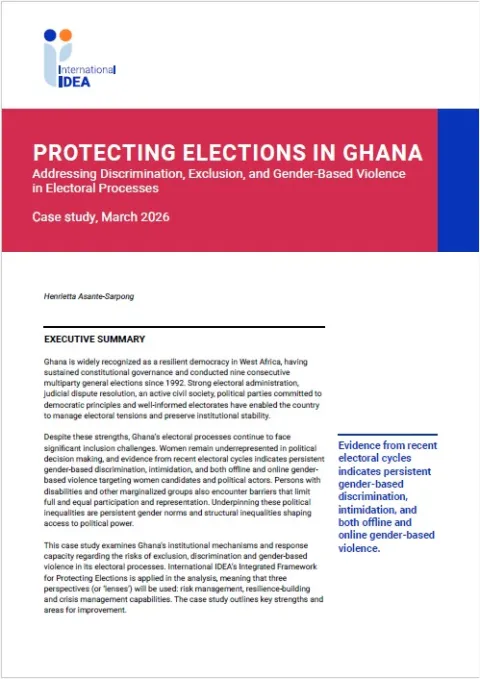
Protecting Elections in Ghana
Ghana is widely recognized as a resilient democracy in West Africa, but despite the Strong electoral administration, judicial dispute resolution, an active civil society and political parties committed to democratic principles, Ghana’s electoral processes continue to face significant inclusion challenges. Women remain underrepresented in political decision making, and evidence from recent electoral cycles indicates persistent gender-based discrimination, intimidation, and both offline and online genderbased violence targeting women candidates and political actors.
This case study examines Ghana’s institutional mechanisms and response capacity regarding the risks of exclusion, discrimination and gender-based violence in its electoral processes. International IDEA’s Integrated Framework for Protecting Elections is applied in the analysis, meaning that three perspectives (or ‘lenses’) will be used: risk management, resilience-building and crisis management capabilities. The case study outlines key strengths and areas for improvement.


Details

Contents
EXECUTIVE SUMMARY
BACKGROUND AND INTRODUCTION
1. PREVENTION
2. RESILIENCE
3. RECOVERY
4. CONCLUSION
ABBREVIATIONS
REFERENCES
ANNEX A. INTERVIEW EXTRACTS
ABOUT THE AUTHOR
Give us feedback
Do you have a question or feedback about this publication? Leave us your feedback, and we’ll get back to you
Send feedbackProtecting Elections in Ghana


 Download PDF

| Total views | 2397 |
|---|---|
| Downloads | 66 |
| Rating |

|
Give us feedback
Do you have a question or feedback about this publication? Leave us your feedback, and we’ll get back to you
Send feedback