Rights. Justice. Action: Protecting women’s political participation and representation in Ghana and beyond
Watch: “No Woman Should Be Silenced – Tackling Gender Based Violence in Elections (YouTube)”
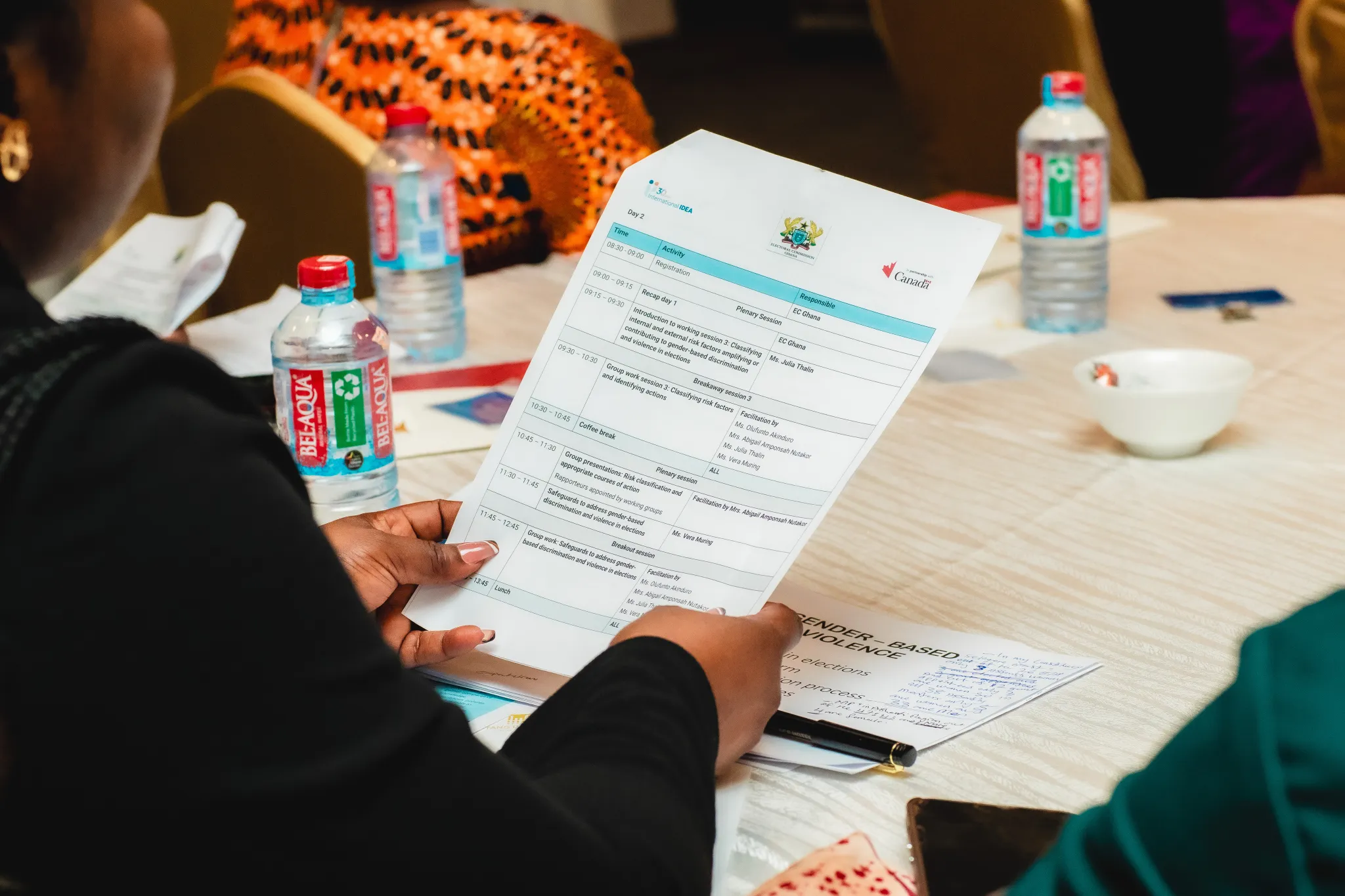
Discussions emerging from a Protecting Elections workshop in Ghana in December 2025 offer a powerful reminder of what it takes to put words into practice. Women’s political rights cannot remain aspirational. They must be actively protected, meaningfully enforced and translated into concrete action – in Ghana and around the world.
Rights: Beyond legal recognition
Across many democracies, important progress has been made to strengthen women’s political rights. In Ghana, the latest achievement is the 2024 Affirmative Action Act. Yet, as workshop discussions clearly demonstrated, rights on paper do not automatically translate into rights in practice.
Women continue to face discrimination, intimidation and abuse when engaging in elections – as voters, candidates, election officials, observers and activists. Electoral violence and intimidation targeting women are neither isolated nor incidental. They constitute structural barriers that undermine equal participation and distort representation by deterring candidacy, restricting public engagement and normalizing women’s exclusion from political life.
These challenges are often most acute for young women and women with disabilities, who experience intersecting forms of exclusion shaped by entrenched social norms, stereotypes and unequal power structures. Increasingly, these threats extend beyond physical spaces into digital environments, where online harassment and disinformation campaigns can be relentless and far-reaching.
As one participant noted, “It is very easy to overlook the issues that confront these demographics.” Yet when such realities are overlooked, women’s political rights are weakened in practice, and with them, the integrity and legitimacy of electoral processes themselves.
Rights must be lived and experienced, not merely proclaimed.
Justice: Closing accountability gaps
While legal frameworks to protect women’s political rights may exist, weak enforcement, limited institutional preparedness and the normalization of abuse often leave women without effective protection or remedy. Accountability gaps allow harmful practices to persist, reinforcing the perception that violence and intimidation are simply part of politics.
This is where justice becomes central. Ensuring justice means more than adopting laws; it requires sustained attention, preventive measures and institutions capable of acting effectively before and during harm, not only after it occurs.
Workshop participants highlighted that safeguarding women’s political participation cannot be confined to election day alone. “Democracy goes beyond election day,” one participant reflected. “What we do in the years between elections is just as important.” Ensuring justice therefore demands continuous oversight and accountability across the entire electoral cycle.
Action: From reaction to prevention
If rights are to be realized and justice enforced, action is needed.
The Protecting Elections Integrated Framework, developed by International IDEA with support from the Government of Canada, offers a practical pathway forward. The framework supports electoral management bodies and other stakeholders to identify, prevent and mitigate risks and threats – including gender-based violence – throughout the electoral cycle. By emphasizing gender-sensitive risk management, resilience-building and crisis management, it shifts the focus from reactive responses to prevention and long-term resilience and recovery (International IDEA).
Participants underscored the value of this practical approach. One shared that the risk analysis exercises “really helped us deepen our understanding of what a risk could be - and how we prevent those risks.” Another emphasized how the process helped to surface concrete entry points for addressing gender-based violence in electoral contexts.
Crucially, the framework promotes a whole-of-society approach. Protecting women’s political rights and addressing gender-based discrimination and violence in electoral processes is not the responsibility of electoral institutions alone. Political parties, security actors, civil society, media and digital platforms all have a role to play. As one media participant committed, “We are going to do more stories about these risk factors — to find out how we, as media, can help push women forward.”
A democratic imperative
The message of International Women’s Day 2026 is clear. Rights must be upheld in practice. Justice must be enforced through accountable institutions. Action must dismantle the structural barriers that continue to exclude and endanger women in political and public life.
The lessons from Ghana demonstrate that this action cannot be abstract. It requires practical risk analysis, institutional preparedness and sustained, coordinated collaboration and engagement across society. Protecting women from violence in elections is not a niche gender concern – it is a democratic imperative.
When legal safeguards are matched by strong institutions and gender-sensitive processes, elections become more inclusive, credible and resilient. And when women are able to participate safely and equally, democracy itself is strengthened.
No woman should be silenced in Ghana or anywhere else.


About the authors