


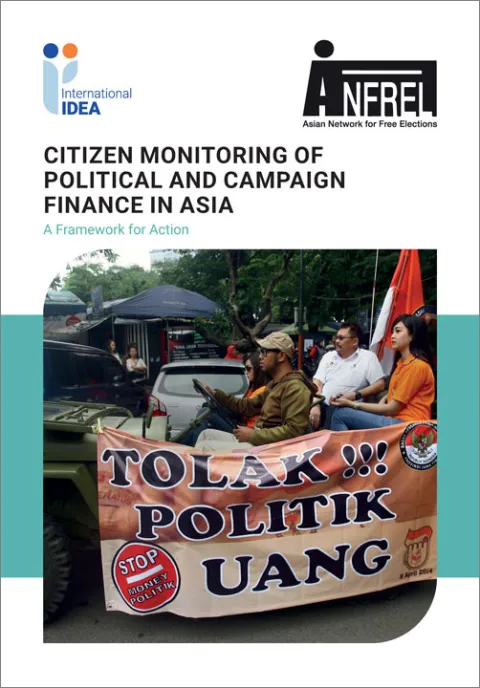
Citizen Monitoring of Political and Campaign Finance in Asia
A Framework for Action

This report examines how civil society organizations (CSOs) monitor political and campaign finance in five Asian democracies—India, Indonesia, Mongolia, the Philippines and Sri Lanka. While each country operates within its own political and regulatory context, they share common challenges in achieving transparency in political and campaign finance, including incomplete or unclear financial reporting, insufficient regulation of digital campaigning, gaps in legal frameworks, weak enforcement and limited investigative capacity on the part of electoral management bodies (EMBs). In this context, CSOs have adopted a range of strategies to address these constraints and strengthen overall transparency and accountability in campaign finance.
CSOs across all five countries undertake essential roles in monitoring political and campaign finance despite operating in different political and regulatory contexts. In India, organizations like the Association for Democratic Reforms digitize candidate disclosures and make them publicly accessible, while Indonesian CSOs verify official reports against external data sets such as Meta’s Ad Library to identify gaps in digital spending. Mongolian CSOs review standardized financial reports and use the national e-receipt system for verification, although informal transactions remain difficult to capture. In the Philippines, CSOs extract, process and visualize data on statements of contributions and expenditures and compare it with digital advertising and field observations. Sri Lankan CSOs rely on published reports and right-to-information requests, supplementing them with field monitoring and, since the adoption of the 2023 campaign finance law, have begun filing cases against non-compliant candidates.
In the face of the above-mentioned challenges, CSOs serve as critical accountability actors, using a combination of document analysis, digital monitoring, field observation, and public reporting to fill systemic gaps and strengthen campaign finance transparency across the region.
This report proposes a methodology that builds on the diverse practices observed across the five countries and offers a structured approach that CSOs can adopt to strengthen campaign finance monitoring in various political contexts. It is composed of two parts—(a) a modular framework for monitoring, which outlines the core pillars needed for assessing legal compliance, data accessibility, triangulation, digital oversight and accountability; and (b) a step-by-step process for CSO implementation, which provides a practical sequence of actions to guide organizations in operationalizing the framework in real monitoring environments.
Modular framework for monitoring
- Regulatory compliance monitoring. Review and assess campaign finance laws, reporting rules, deadlines and spending limits.
- Data access and disclosure verification. Verify the availability, accessibility and completeness of financial reports from EMBs.
- Triangulation using alternative financial sources and field monitoring. Cross-reference disclosures with tax records, procurement data, digital ad spending and field observations.
- Digital campaign monitoring. Track political ads, influencer activity and coordinated online networks with the help of transparency tools.
- Accountability and advocacy. Use evidence to pursue legal action, promote public audits and advocate systemic reforms.
Step-by-step process for CSO implementation
- Baseline assessment. Map laws, disclosure rules, institutional roles and data availability.
- Building of core team and gathering of funding and resources. Form a multidisciplinary team and prepare a costed workplan.
- Design of monitoring strategy. Specify the scope and identify priority races and monitoring tools.
- Recruitment of observers and accreditation. Select and train observers and secure accreditation with the EMB.
- Data collection. Obtain statements of contributions and expenditures, digital ad data, information on media spending and field documentation.
- Data analysis and verification. Identify discrepancies and classify potential violations.
- Raising public awareness and crowdsourcing audits. Publish accessible reports and develop open-data dashboards.
- Reform advocacy. Use findings to advocate reforms in law, reporting systems and oversight.
- Refining the methodology. Continuously update monitoring tools, track institutional responses and conduct post-election reviews.
The role of financial resources in politics is unequivocal: they enable political participation and representation and are associated with the manifestation of political support. Financial resources have been instrumental in shaping modern political campaigns, and their impact on electoral outcomes has escalated significantly. Regulating money in politics is crucial for guaranteeing genuine elections that represent the people’s will.
Throughout Asia, there is growing recognition of the need for transparency in political finance to mitigate corruption and ensure fairness in elections (International IDEA and Open Government Partnership 2019). The initiative to reform political financing regulations aims to create fair competition for all participants and ensure that political systems are free from the influence of illicit funds. Across Asia, many countries have undertaken reforms to regulate political and campaign finance, aiming to strengthen transparency and accountability; however, their impact remains inconsistent. Still, implementation often falls short: weak enforcement, legal loopholes and new challenges, such as digital campaigning, mean that regulations on the books do not always translate into transparent practices.
In this context, civil society organizations (CSOs) have become pivotal in monitoring political and campaign finance, as they continue not only to fill in gaps left by the under-resourced electoral management bodies (EMBs) but also to serve as watchdogs in calling out the transgressions of political contestants, as well as pressuring EMBs to enforce rules and parliaments to pass needed reform.
This report examines how CSOs monitor political and campaign finance in five Asian democracies—India, Indonesia, Mongolia, the Philippines and Sri Lanka. Each of these countries has its own distinct political landscape, but they share common concerns about money in politics. The objective is to analyse the methods observers employ to identify the effectiveness of those methods, the challenges involved in applying them and their overall impact on campaign finance transparency. Finally, the report aims to propose a methodology that can effectively monitor political and campaign finance in similar contexts.
A structured framework was developed to assess the status of political and campaign finance monitoring in each country. This framework provides a clearer basis for evaluating how effectively CSOs are addressing gaps in transparency and enforcement.
The framework draws from internationally recognized best practices and can be adapted to region-specific regulatory contexts. It is guided primarily by three reference documents: Model Commitments for Advancing Genuine and Credible Elections (International IDEA et al. 2024), International IDEA’s Funding of Political Parties and Election Campaigns (Falguera, Jones and Ohman 2014) and Ingrid van Biezen’s Financing Political Parties and Election Campaigns: Guidelines (van Biezen 2004). These documents outline principles for a legally enforceable and transparent campaign finance system, particularly concerning enforcement, data accessibility and digital expenditures.
Model Commitments identifies two critical commitments related to political and campaign finance—ensuring campaign finance transparency and establishing an independent finance monitoring organ (International IDEA et al. 2024).
Campaign finance transparency requires a legal framework that ensures transparency in electoral campaign financing. Such a framework should define campaign expenditures, mandate the disclosure of funds raised and spent, balance transparency with privacy and ensure that all types of political advertising are covered (International IDEA et al. 2024).
However, Model Commitments looks beyond legal frameworks, identifying the need to effectively administer these legal frameworks to ensure that they are adequately implemented. The publication identifies several commitments that are specific to political and campaign finance, including the need for an independent organ responsible for monitoring and reviewing the accounts of political parties’ income and expenditures for election campaigns (International IDEA et al. 2024). This organ may be either an independent state agency or a specific body under the EMB; however, in either case, it must be authorized to hold offenders liable. Model Commitments also emphasizes open-government and open-data principles in how political party accounts and campaign expenditures are reported, ensuring that reports are submitted on a timely basis and available to the public.
The framework consists of four parts: (a) legal and regulatory reporting requirements; (b) an independent audit body; (c) accountability for non-compliance; and (d) monitoring of digital campaign finance.
1.1. Legal and regulatory reporting requirements
One of the core principles emphasized in Model Commitments and Financing Political Parties and Election Campaigns is the need for a clear and enforceable reporting structure that mandates comprehensive disclosures by political parties and candidates. Key considerations incorporated into the framework include the following:
- Definition of campaign acts and actors. EMBs should clearly define which activities constitute campaigning (including digital campaigning) and who may conduct these activities (candidates, parties, authorized committees, independent groups) and specify the regulated time periods when these activities may be carried out.
- Reporting, oversight and sanctions. Political parties and candidates must maintain documented records of income and expenditure, ensuring transparency in political financing. Reports should be submitted at specified intervals (e.g. pre-election, post-election and on an annual basis), allowing for timely public scrutiny and regulatory oversight.
- Distinction between operational and campaign expenses. Effective monitoring systems must require the segregation of routine party operations from election-related expenditures to prevent the misuse of funds.
- Public accessibility of financial reports. For the purposes of transparency, these records must be readily available to the public through official government portals, ensuring electoral integrity and preventing illicit funding practices.
1.2. Independent audit body
Another key element identified is the need for an independent organ in charge of auditing political and campaign finance reports. Key considerations incorporated into the framework include the following:
- Mandatory audits of financial disclosures. All reported financial statements must be subject to audits, which may be conducted by electoral commissions, government audit institutions or contracted independent professional auditors.
- Audits at different levels to ensure integrity. Compliance audits should be conducted to verify procedural adherence and the accuracy of submissions, while investigative or forensic audits should be carried out to look for suspicious transactions and third-party campaign financing and to investigate potential financial misconduct, such as undisclosed donations.
- Investigative capacity of auditors. Identifying the effectiveness of an audit requires consideration of the capacity of the identified audit organ to investigate beyond procedural adherence and the accuracy of submissions. The ideal audit organ has the capacity to conduct in-depth investigations that go beyond reviewing the reports submitted by political actors.
1.3. Accountability and sanctions for non-compliance
A key factor in ensuring effective political finance monitoring is the imposition of proportionate and enforceable sanctions for violations. Key considerations incorporated into the framework include the following:
- Types of offences and the corresponding penalties. Sanctions and adequate penalties for specific offences will have to be stipulated by the law.
- Accountability. Effective regulatory enforcement requires that sanctions be imposed against those who violate regulations. The absence of accountability may result in circumstances in which the law is reduced to mere symbolism.
- Incentives for compliance. The law can incentivize actors such as candidates and donors to comply with requirements on issues such as access to public funding for candidates and parties and tax benefits for donors.
1.4. Monitoring of digital campaign finance
In response to the increasing significance of digital campaigning, the framework integrates new strategies for monitoring online political advertisements and social media spending. Principles derived from international best practice include the following:
- Mandatory reporting of digital campaign expenditures. Political parties and candidates must disclose detailed digital campaign expenses, including payments for online advertisements and influencer marketing.
- Third-party oversight and ad transparency tools. Regulatory agencies should collaborate with technology firms to track online political advertisements through platforms, e.g. Meta’s Ad Library and Google transparency reports (Meta n.d.; Google n.d.).
India, Indonesia, Mongolia, the Philippines and Sri Lanka each have political and electoral landscapes shaped by their own distinct histories, governance structures and socio-political dynamics. (Sahoo 2024). While they all adhere to democratic principles, the political contexts of these countries vary considerably (Burcher and Bértoa 2018). Each system presents distinct strengths, weaknesses and challenges in ensuring political stability, electoral competitiveness and democratic accountability (Hamada and Agrawal 2021).
Democratic structures across these five countries include parliamentary, presidential and hybrid systems. India and the Philippines both operate bicameral legislatures, while Mongolia and Sri Lanka have unicameral systems. Indonesia uses a decentralized presidential model, and Sri Lanka features a hybrid presidential–parliamentary system. Electoral systems range from first-past-the-post and closed-list proportional representation to mixed electoral systems that combine both approaches.
Despite structural differences, all five countries grapple with challenges in campaign finance regulation, particularly related to the misuse of state resources, enforcement capacity and the regulation of digital campaigning.
| Category | India | Indonesia | Mongolia | Philippines | Sri Lanka |
|---|---|---|---|---|---|
| Population | 1,438,069,600 | 281,190,070 | 3,481,140 | 114,891,200 | 22,037,000 |
| Number of registered voters | 969,700,000 | 204,807,222 | 2,238,360 | 68,618,667 | 17,140,354 |
| Electoral system for the national legislature | First-past-the-post | Open-list proportional representation | Parallel system combining block vote and closed-list proportional representation | Parallel system combining first-past-the-post and closed-list proportional representation | Open-list proportional representation |
| Parliamentary system | Bicameral: Lok Sabha and Rajya Sabha | Bicameral: People’s Representative Council and Regional Representative Council | Unicameral: State Great Khural | Bicameral: Senate and House of Representatives | Unicameral: Parliament |
| Primary | Election Commission of India | General Elections Commission and General Election Supervisory Agency | General Election Commission of Mongolia | Commission on Elections of the Philippines | Election Commission of Sri Lanka |
| Main political finance regulatory framework | Representation of the People Act, 1951; Election and Other Related Laws Act, 2003 | Law No. 2 of 2011 on Political Parties, Law No. 7 of 2017 on General Elections, KPU Regulation No. 18/2023 and various EMB regulations | Law on Elections, 2015; Law on Political Parties, 2023 | Omnibus Election Code of 1985; Corporation Code of 2019; Republic Act No. 7166 of 1991 | Regulation of Election Expenditure Act of 2023 |
| Definition of campaigning | Campaigning is indirectly defined in reference to ‘election matters’, which are defined as ‘any matter intended or calculated to influence or affect the result of an election’ (Representation of the People Act, 1951, section 126). | ‘[An election] campaign is the activity of Election Participants to persuade voters by offering their vision, mission, programs, and/or self-image’ (Law No. 7/2017 on General Elections, article 1 (definitions)). | Provides a list of actions considered to be campaigning: ‘[An election] campaign shall be run by the following means and forms, including printing/distribution of materials, billboards/flags, meetings, operation of campaign facilities, radio/TV programs, and website posts’ (Law on Elections, 2015, article 68.3). | An ‘election campaign’ or ‘partisan political activity’ refers to any act designed to promote the election or defeat of a particular candidate or candidates to a public office (Omnibus Election Code 1985, section 79). | Campaigning is indirectly defined as activities for promoting or securing the election of a recognized political party, independent group or candidate (Regulation of Election Expenditure Act, No. 3 of 2023, section 6). |
| Public funding for political parties | No | Yes | Yes, limited | No | No |
| Year of most recent national election | 2024 | 2024 | 2024 | 2022 | 2024 |

Each country imposes varying contribution and spending limits, with enforcement outcomes differing widely. For example, India does not cap overall contributions but requires disclosure above INR 20,000 (approximately USD 220); Indonesia and Mongolia enforce numerical limits based on income thresholds or minimum-wage benchmarks. In contrast, the Philippines applies outdated per-voter spending caps, and Sri Lanka uses a variable multiplier formula based on registered voters.
| Country | Limits on contributions | Limits on spending |
|---|---|---|
| India | 1. There is no overall cap on contributions. 2. Disclosure threshold. Donations above INR 20,000 must be reported (anonymous donations capped at INR 20,000). | 1. Candidates face a prescribed spending cap (e.g. around INR 9.5 million (approximately USD 105,000) for Lok Sabha elections). 2. Political parties have no overall limit on campaign-related expenditures. |
| Indonesia | 1. Presidential and vice presidential elections. Donations from individuals are capped at IDR 2.5 billion (approximately USD 150,000), while donations from groups and companies are capped at IDR 25 billion. 2. Elections to the Regional Representative Council. Donations from individuals are capped at IDR 750 million (approximately USD 45,000), while donations from groups are capped at IDR 1.5 billion (approximately USD 90,000). | 1. There is no explicit spending cap beyond what is outlined in state financing allocation rules; campaign funds must be used as per regulatory requirements. |
| Mongolia | 1. Individuals. The maximum donation per year may not exceed an amount equivalent to 12 times the minimum monthly wage. 2. Legal entities. The maximum donation per year may not exceed an amount equivalent to 50 times the minimum monthly wage. | 1. No fixed numerical cap on campaign spending is set directly in the law. Instead, spending is indirectly regulated via state financing mechanisms. |
| Philippines | 1. There is no overall cap on contributions; all contributions must be fully disclosed in statements of contributions and expenditures (SOCE). | 1. Spending limits are defined on a per-voter basis: For presidential candidates, the limit is PHP 10 (approximately USD 0.17) per voter; for other candidates, PHP 3 (approximately USD 0.05) per voter; for independent candidates, PHP 5 (approximately USD 0.09) per voter. For political parties, the limit is PHP 5 per voter. |
| Sri Lanka | 1. There is no explicit overall monetary cap on contributions, but certain sources (e.g. foreign entities) are prohibited. | 1. Campaign spending is capped using a formula based on the number of registered voters and a fixed multiplier set by the Election Commission. |
All five countries have statutory provisions intended to prevent the misuse of state, financial and coercive resources during election campaigns. India and Indonesia enforce specific clauses that limit the use of state resources during campaign activities, whereas Mongolia incorporates safeguards in its party finance regulations. The Philippines and Sri Lanka also impose legal restrictions, but both countries struggle with enforcement and judicial follow-up. These provisions are essential for maintaining a fair, competitive environment, though their effectiveness may differ based on institutional capacities.
| Country | Abuse of institutional resources (vehicles, stationery, etc.) | Abuse of financial resources | Abuse of coercive resources | Abuse of regulatory resources |
|---|---|---|---|---|
| India | Provisions exist in the Representation of the People Act and in guidelines published by the Election Commission of India (ECI) (e.g. misuse of public funds is prohibited). | Misuse of funds is prohibited and subject to administrative and criminal penalties. | Coercive practices are banned under electoral laws and model codes. | Regulatory bodies (the ECI) have powers to enforce compliance and impose sanctions. |
| Indonesia | Article 116 and related provisions prohibit receiving state contributions from prohibited sources, indirectly limiting abuse. | Abuse of financial resources is controlled through strict reporting, deposit requirements and sanctions imposed by the General Elections Commission (KPU). | Although they are not explicitly detailed, donor identity rules indirectly prevent abuse of coercive resources. | There is no specific provision for abuse of regulatory resources beyond standard sanctions for non‑compliance. |
| Mongolia | Not explicitly detailed in the provided law. | Some provisions exist regarding misuse of state financing. | Not explicitly detailed. | Not explicitly detailed. |
| Philippines | Electoral laws prohibit misuse of state resources (e.g. use of public funds for campaigning). | Misuse of campaign funds is subject to fines and disqualification. | Coercion is banned under election laws. | Regulatory provisions under the Omnibus Election Code empower oversight bodies. |
| Sri Lanka | Provisions exist but are not strongly enforced. | Financial misuse is subject to penalties, though enforcement is weak. | Coercive practices are prohibited, but practical enforcement is limited. | Regulatory mechanisms exist, but capacity issues hinder effective enforcement. |
In the following five chapters, we will explore each country in greater detail. We will outline their political and electoral context, discuss the status of political and campaign finance monitoring within the framework for political and campaign finance monitoring, and examine how CSOs are addressing issues related to the monitoring process.
3.1. Political and electoral context: A highly competitive multiparty democracy
India is the world’s largest democracy, operating within a parliamentary system with a bicameral legislature and a federal structure. The states within this federal structure enjoy significant autonomy. Political competition is intense, with a mix of national and regional parties contending for power at multiple levels. Since 2014 the Bharatiya Janata Party has dominated India’s political scene, implementing significant changes in electoral strategies primarily via digital means of campaigning (Sahoo 2024).
Digital campaigns have become a central aspect of Indian elections, with political parties investing heavily in social media, data analytics and artificial intelligence (AI) for voter outreach. The Election Commission of India (ECI) has introduced regulations to oversee online political advertising, but challenges remain regarding enforcement, third-party spending and the transparency of digital campaign financing (Sahoo 2024).
3.2. Status of political and campaign finance monitoring
3.2.1. Legal and regulatory reporting requirements
India mandates the disclosure of political donations and campaign expenditures by political parties and candidates. Candidates must submit statements of election expenditures within 30 days of election results certification, while political parties file annual contribution reports. However, there is no clear legal requirement to distinguish between operational and campaign expenditures. An electoral bond scheme was introduced in 2017, allowing anonymous donations to parties. However, the Supreme Court struck down the scheme in 2024 as unconstitutional and ordered the disclosure of donors and recipients (Saaliq 2024).
3.2.2. Public accessibility of financial reports
Reports submitted by candidates are available on the ECI website, although accessibility and standardization remain inconsistent. CSOs such as the Association for Democratic Reforms (ADR) and Common Cause rely on strategies like right-to-information (RTI) requests and strategic litigation to obtain deeper insights into donation patterns and to compel data disclosures when they are not readily available (ADR 2024; Mudgal 2024).
3.2.3. Independent audit body
India lacks a dedicated, independent audit body for campaign finance. While the ECI receives reports, it does not verify submissions through independent audits. Financial statements are not subjected to compliance or forensic audits, and the jurisdiction of the comptroller and auditor general does not extend to political parties. Thus, India’s framework lacks a formal mechanism for examining discrepancies or hidden sources of funding beyond what is presented in submitted reports (ADR 2024).
3.2.4. Accountability
Although there are legal provisions for penalizing non-compliance, such as disqualification for failing to submit reports, actual enforcement is rare. A legal challenge on anonymous electoral bonds resulted in a landmark Supreme Court ruling striking down the electoral bonds scheme as unconstitutional (Rajagopal 2024).
3.2.5. Digital monitoring
India lacks a comprehensive legal framework for monitoring digital campaigning. While the ECI has issued guidelines for pre-certification of social media content and advertisements, there is no requirement for candidates or parties to disclose detailed digital expenditures. Digital-rights researchers, such as Centre for Internet and Society (CIS), and investigative journalists use the ad libraries of online platforms (e.g. Google and Meta) to estimate online spending, but this information is neither verified nor incorporated into formal regulatory oversight (ECI 2021; ADR 2022; CIS 2019).
3.3. CSO interventions
3.3.1. CSO monitoring methodology
In India, the ADR begin their monitoring process by systematically collecting election affidavits and annual financial disclosures submitted by candidates and political parties to the ECI. These documents are often in non-machine-readable formats, so the ADR first converts and standardizes the data into structured formats for analysis. Following this step, it verifies and cross-references the reports with additional sources such as bank statements, published audit reports (if any) and disclosures obtained via RTI requests. The ADR then analyses the data to identify irregularities (ADR 2024).
To publicize its findings, the ADR publishes reports on its platform, MyNeta.info, which presents campaign finance data in accessible formats for the public and media (MyNeta n.d.). When data gaps or legal ambiguities are identified, the ADR proceeds to litigation, filing petitions in the Supreme Court to challenge provisions such as anonymous donations. This legal advocacy is complemented by public campaigns and media briefings to build public pressure (ADR 2024).
3.3.2. Relationship between the EMB and CSOs
The ECI acknowledges the contributions of CSOs, but has not formalized collaboration mechanisms (ADR 2024). CSOs have, for example, been engaged in the ECI’s Systematic Voters’ Education and Electoral Participation (SVEEP) programme. Data obtained or analysis presented by CSOs is often not acted upon unless there is public outcry or judicial intervention. Despite repeated appeals by the ADR and other groups, the ECI has resisted calls for full disclosure of political donations or independent audits of party finances (ADR 2024). In many instances, CSOs have had to rely on court rulings to compel the ECI to disclose information or enforce accountability.
3.3.3. Challenges
CSOs in India face several challenges, including regulatory pushback and limited access to financial data. Legal and political hurdles delay the acquisition of information, and political hostility often deters whistleblowers from coming forward (ADR 2024). CSOs have also cited difficulties in verifying digital ad expenditures, primarily where platforms do not provide comprehensive, verifiable data (ADR 2024). Additionally, CSOs encounter difficulties in sustaining long-term funding for technical and legal monitoring capacities.
Box 3.1. India case study: The open-data portal MyNeta.info
Background and context
Although the Election Commission of India mandates campaign finance disclosures, the data is often published in disparate formats (e.g. scanned PDFs) that are difficult for the public to interpret. Civil society organizations saw an opportunity to enhance transparency and accountability by transforming this fragmented data into a standardized, interactive format.
Implementation
- Data collection. MyNeta.info, an initiative of the Association for Democratic Reforms, collects official campaign finance disclosures from the Election Commission of India. These disclosures include details on candidate contributions, expenditures and other relevant financial data.
- Data integration and standardization. The portal aggregates the data and converts it into a unified format. This standardized data set categorizes information by candidate, political party and expenditure type (such as contributions versus campaign spending) and even distinguishes between digital and traditional spending when available.
- Interactive dashboard. MyNeta.info presents the aggregated data via an open data portal that is accessible to the public. The dashboard includes interactive features that allow users to:
- drill down by candidate or party;
- filter results by geographical region;
- view breakdowns of expenditure types; and
- analyse trends over time through visualizations and graphs.
Impact
MyNeta.info has played a significant role in improving political finance transparency in India by transforming complex and non-standardized campaign finance data into a unified, interactive and user-friendly dashboard. This innovation has substantially enhanced public access to candidate and party financial information. By enabling voters, journalists and academic researchers to easily review and compare campaign expenditures, the platform has strengthened public scrutiny and promoted greater accountability among political actors. Furthermore, the clear and accessible presentation of financial data has sparked meaningful public debate on the adequacy of existing disclosure rules and the influence of digital campaigning. These discussions have, in turn, contributed to increased demand for more robust regulatory oversight of political finance practices.
4.1. Political and electoral context: A decentralized and evolving political landscape
Indonesia has undergone a major democratic transition since the late 1990s, shifting from authoritarian rule to a presidential system with a bicameral legislature (Hamada and Agrawal 2021). Political competition is robust, with multiple parties vying for representation at the national and regional levels (Hamada and Agrawal 2021). The country operates under a decentralized governance system, which enables broader political participation but also poses challenges in ensuring accountability in campaign finance. Local monitoring often suffers from fragmented coordination and limited technical expertise, which can result in inconsistent compliance and reporting (Hamada and Agrawal 2021).
Despite the existence of public funding for political parties, financial resources remain inadequate, forcing parties to rely on private donors. Concerns persist over vote buying, the influence of business elites on political decisions and weak regulatory enforcement in campaign finance oversight (Hamada and Agrawal 2021).
4.2. Status of political and campaign finance monitoring
4.2.1. Legal and regulatory reporting requirements
Indonesia’s legal framework mandates that political parties, candidate pairs and individual legislative election candidates must submit detailed campaign finance reports. The regulatory structure includes pre-campaign, mid-campaign and post-campaign financial disclosures. Reports must itemize donations by source (candidates, political parties, corporations or individuals) and detail expenditures across categories, including services, goods and digital advertising. New regulations also distinguish between state-funded and privately funded campaign expenses (General Elections Commission of Indonesia 2023).
4.2.2. Public accessibility of financial reports
Indonesia has made strides in transparency by establishing Sikadeka, an online information system used by political actors, auditors and the General Elections Commission (KPU) to submit and access campaign finance documents. Reports are expected to be uploaded and accessible in real time. In practice, however, some documents are delayed or uploaded in non-machine-readable formats, limiting public and CSO access. The enforcement of public accessibility provisions is inconsistent across regions, particularly at the regency and municipal levels, where compliance and technical capacity vary (Perludem 2024).
4.2.3. Independent audit body
Indonesia’s campaign finance audit process is handled by public accounting firms that are selected through a competitive process managed by the KPU. These firms conduct compliance audits of submitted reports, focusing primarily on procedural accuracy rather than investigative rigour. The audit process lacks provisions for forensic auditing or third-party verification of reported income and expenditures. While these public accounting firms are expected to maintain independence, concerns persist over the consistency of audit quality across regions and whether regulatory bodies systematically follow up on red flags (Perludem 2024).
4.2.4. Accountability
Although sanctions, including disqualification and fines, may be applied in cases of non-compliance, enforcement remains limited. According to reports from CSOs and observers, political parties and candidates often file incomplete disclosures or under-report expenditures, particularly at the local level (ICW 2024; Perludem 2024). Moreover, the decentralized structure of enforcement means that accountability varies significantly between districts. Weak follow-through on audit findings and the lack of publicized penalties has done little to deter violations (Perludem 2024).
4.2.5. Digital monitoring
Digital campaign finance monitoring remains underdeveloped in Indonesia. While the legal framework now includes reporting obligations for online advertisements, there is limited clarity on how digital expenditures are verified or monitored. The Sikadeka system does not currently integrate with third-party platforms such as the Meta Ad Library or Google transparency reports (Perludem 2024). As a result, CSOs and researchers rely on manual cross-checking of social media posts, sponsored content and online advertisements to approximate digital expenditures (ICW 2024).
4.3. CSO interventions
4.3.1. CSO monitoring practices
In Indonesia, CSOs such as the Association for Elections and Democracy (Perkumpulan untuk Pemilu dan Demokrasi, Perludem) and Indonesia Corruption Watch (ICW) start their campaign finance monitoring by obtaining official financial disclosures from the KPU (ICW 2024; Perludem 2024). Recognizing the limitations of these self-reported statements, CSOs compare them against third-party data such as procurement records, commercial advertising logs and social media spending tracked via Meta’s Ad Library and Google transparency reports (Perludem 2024).
They then conduct a multi-source validation, cross-checking reported expenditures against real-world campaign activity, often documenting discrepancies using field observations and tip-offs from volunteer monitors (ICW 2024; Perludem 2024). The next step involves producing analysis reports, which are usually shared in policy briefings with KPU officials and published in public forums or press releases. Some CSOs also engage in platform advocacy, calling on tech companies to provide more granular political ad data (ICW 2024; Perludem 2024). While formal enforcement power is lacking, these CSOs shape public discourse and electoral reform proposals by providing empirical evidence of campaign finance gaps.
4.3.2. Relationship between the EMB and CSOs
The KPU has established formal consultations with CSOs at the national level but does not always integrate CSO findings into enforcement decisions (Perludem 2024). In many cases, CSOs report findings publicly or through media channels rather than through formal regulatory avenues (ICW 2024; Perludem 2024). While the KPU welcomes CSO participation during observation periods, its engagement with post-campaign analysis and enforcement remains limited. At the subnational level, cooperation is further hampered by lack of capacity or political will (ICW 2024).
4.3.3. Challenges
CSOs encounter several challenges in monitoring campaign finance in Indonesia. The decentralized structure of electoral governance means CSOs must coordinate with hundreds of local election offices, each with different levels of transparency and cooperation. Furthermore, digital ad monitoring remains difficult due to the lack of ad transparency tools and the non-mandatory reporting of platform-based expenditures. CSOs have also noted limitations in their ability to conduct forensic analyses due to restricted access to financial records and the absence of legal authority (Perludem 2024).
Box 4.1. Indonesia case study: Civil society monitoring of campaign finance through donor matching and legal advocacy
Context
In Indonesia, political finance regulations are governed by the General Elections Commission (KPU), which mandates that candidates and political parties must disclose contributions and expenditures. While the KPU requires the use of standardized campaign finance report formats (pre-campaign, mid-campaign and post-campaign financial disclosures), enforcement and accessibility issues persist. Civil society organizations such as Indonesia Corruption Watch (ICW) and the Association for Elections and Democracy (Perkumpulan untuk Pemilu dan Demokrasi, Perludem) have taken a leading role in bridging gaps in monitoring and advocating for reforms.
Implementation
- Data collection. The ICW and Perludem gather financial reports submitted to the KPU, including scanned pre-campaign, mid-campaign and post-campaign financial disclosures. They also utilize public procurement data, media monitoring and business ownership databases to supplement and verify campaign finance disclosures.
- Cross-verification and investigation. The ICW applies data triangulation methods to match donor names with government procurement databases, exposing potential patronage or conflicts of interest. This investigative approach is often paired with Perludem’s legal analysis of KPU resolutions and monitoring of campaign finance–related complaints.
- Public engagement and advocacy. Reports from both organizations are presented through media briefings, infographics, webinars and journalistic collaborations. The findings are used to pressure the KPU to adopt stricter regulations, improved transparency measures and broader data standardization. The ICW has also pushed for expanded rules on digital campaigning through targeted policy briefs and public campaigns.
Impact
These initiatives have illuminated hidden relationships between campaign donors and government contractors, encouraging debate on transparency and ethics in Indonesian politics. While the KPU has been slow to institutionalize these efforts, civil society monitoring has nonetheless influenced regulatory discourse and served as a deterrent against non-disclosure. The joint methodology of legal advocacy and investigative data matching provides a replicable model for watchdog accountability.
5.1. Political and electoral context: A democracy with institutional challenges
Mongolia operates a unicameral parliamentary democracy. The State Great Khural (parliament) is elected through a mixed electoral system, combining single-member majoritarian districts and proportional representation. Though formally a multiparty system, political competition is largely dominated by two parties—the Mongolian People’s Party and the Democratic Party.
In recent years, public dissatisfaction with corruption and elite dominance has led to rising civic participation and calls for stronger accountability mechanisms. Electoral reforms in 2023 and 2024 introduced new provisions for financial disclosures and voter engagement. However, gaps remain in enforcement, transparency and digital regulation (OSCE/ODIHR 2024; WSP 2024).
5.2. Status of political and campaign finance monitoring
5.2.1. Legal and regulatory reporting requirements
Under Mongolia’s Law on Elections and the amended Law on Political Parties, candidates and parties are required to report campaign-related income and expenditures. These must be submitted to the General Election Commission (GEC), the Tax Commission and the Gender Commission. The Law on Political Parties also sets spending ceilings and limits donations to one-time contributions per individual or entity, requiring full disclosure of the identity of donors. However, while the law is procedurally detailed, enforcement remains limited, particularly concerning third-party spending and undisclosed cash transactions (OSCE/ODIHR 2024; WSP 2024).
5.2.2. Public accessibility of financial reports
Although reports are technically public, access remains inconsistent. Political parties are responsible for publishing their own reports, and the GEC issues only general summaries. Available reports are often simplified and lack itemized data. There is no institutionalized open-data framework, and public awareness of how to access these reports remains limited (OSCE/ODIHR 2024; WSP 2024).
5.2.3. Independent audit body
Audits are conducted by the Tax Commission and, at times, by independent auditors contracted by political parties. While audit procedures exist, they are generally limited to compliance reviews. The legal framework lacks provisions for investigatory or forensic audits, and oversight bodies rarely conduct in-depth verification of the source or authenticity of reported transactions (OSCE/ODIHR 2024; WSP 2024).
5.2.4. Accountability
Legal penalties for non-compliance include disqualification from elections or loss of public funding. However, these penalties are applied to only a limited extent. Cases involving false declarations or unreported donations rarely result in sanctions, and political parties are rarely penalized solely on financial grounds (OSCE/ODIHR 2024; WSP 2024).
5.2.5. Digital monitoring
Mongolia’s legal framework does not comprehensively cover digital campaigning or online political advertisements (OSCE/ODIHR 2024). While campaign finance laws apply broadly to all forms of campaign expenditures, there is no specific provision requiring the disclosure of digital ad spending. The GEC requires each candidate to register their official Facebook page and any other official pages for approval (WSP 2024). While this requirement is a step towards regulation, disclosure of digital campaign spending remains limited (WSP 2024).
5.3. CSO interventions
5.3.1. CSO monitoring practices
In Mongolia, monitoring conducted by Women for Social Progress (WSP) relies on community participation. The WSP’s process begins by training local volunteers to observe campaign activities in their areas (WSP 2024). These observers gather information on in-kind donations, rally sizes and media placements during elections. The WSP then compares these local findings with the financial declarations submitted by candidates and parties to the GEC and checks them for under-reporting or unexplained funding sources.
The WSP then produces simplified reports and visual materials to help non-experts understand complex financial data. When inconsistencies are found, the WSP engages directly with the GEC, submitting letters and policy memos calling for stronger audit mechanisms and public disclosures. Their efforts are often tied to gender advocacy, highlighting how a lack of financial transparency can disadvantage female candidates. They also collaborate with journalists and international observers to widen their advocacy reach.
5.3.2. Relationship between the EMB and CSOs
The GEC has engaged with CSOs through consultations and briefings, but more substantive cooperation is lacking. In some instances, GEC representatives have expressed appreciation for CSO efforts but have cited legal limitations and resource constraints for not institutionalizing collaboration (WSP 2024).
5.3.3. Challenges
CSOs in Mongolia face several recurring challenges in monitoring political and campaign finance. Access to timely and complete financial disclosures remains a core issue, as data provided by candidates and political parties is often delayed or incomplete. The absence of explicit legal provisions specifically requiring the reporting of digital expenditures, such as those related to social media advertisements or influencer campaigns, limits the ability of CSOs to monitor online campaigning effectively. Resource constraints, particularly insufficient and short-term funding, hinder the capacity of CSOs to carry out sustained or nationwide monitoring efforts. Additionally, limited public engagement with campaign finance issues further reduces the impact of civil society findings and weakens pressure on authorities to address regulatory gaps (WSP 2024).
Box 5.1. Mongolia case study: Women for Social Progress and campaign finance monitoring
Context
In Mongolia, campaign finance oversight remains a regulatory and enforcement challenge. Although laws require candidates to disclose campaign expenditures, gaps persist in the accessibility, detail and timeliness of reporting. Women for Social Progress (WSP), a long-standing civil society organization, has taken an active role in campaign finance monitoring by collecting data, analysing compliance and advocating systemic reform.
Implementation
- Data collection. The WSP collects campaign finance disclosure reports filed with the State Audit Office and compiles statistics on candidate fundraising and expenditures.
- Cross-verification. The WSP compares aggregate financial data with field observations collected during the campaign period. The organization’s observers monitor violations such as vote buying and undeclared expenditures.
- Public reporting and advocacy. The WSP publishes post-election reports and press releases summarizing total expenditures, top donors and emerging trends. It uses these findings to push for legal reforms, such as the 2023 Law on Political Parties, which mandates semi-annual party finance disclosures on a public platform. The WSP played an active role as a civil society partner in drafting and advocating for the law.
Impact
The WSP’s monitoring and advocacy have helped elevate campaign finance as a key issue in Mongolia’s electoral transparency agenda. Its efforts contributed to the passage of significant legal reforms and increased public awareness about campaign expenditures. By collaborating with election bodies and the media, the WSP has strengthened the ecosystem of accountability and demonstrated the effectiveness of civil society–led financial monitoring.
6.1. Political and electoral context: A patronage-driven and dynastic political system
The Philippines operates under a presidential system featuring a bicameral legislature, where political influence is exercised primarily by political families or dynasties instead of political parties. Political competition is highly personalistic, with well-established political dynasties exerting considerable influence over electoral outcomes (LENTE 2024; PCIJ 2024).
Campaign finance regulations in the Philippines remain weak, with political parties and candidates often receiving financial support from private donors with minimal oversight. While laws exist to restrict corporate donations, enforcement remains inconsistent, and elections are often characterized by high spending and vote buying (Fonbuena 2026). Calls to reform the country’s outdated campaign finance laws have increased in recent years. Bills have been introduced to update spending limits, revise state subsidies for political parties and undertake a general overhaul of the Philippines’ electoral code. However, none of these bills has seen significant progress (LENTE 2024).
6.2. Status of political and campaign finance monitoring
6.2.1. Legal and regulatory reporting requirements
The Omnibus Election Code and Fair Election Act require candidates and political parties to submit statements of contributions and expenditures (SOCE) within 30 days after election day. Commission on Elections (COMELEC) Resolution No. 9991 (2015) elaborates on the content that must be provided in these statements, including sources of contributions, itemized expenditures and in-kind donations. However, reports are submitted once only, post-election, limiting timely oversight. There is also no clear separation between operational and campaign expenses (COMELEC PFAD 2025).
6.2.2. Public accessibility of financial reports
SOCE are submitted to the Campaign Finance Office and are technically public documents (COMELEC PFAD 2025). However, access is limited. Reports are not digitized or published online in an open-data format, and manual access requests may be slow or restricted (PCIJ 2024; COMELEC PFAD 2025). While COMELEC has committed to greater transparency, practical steps such as real-time publication or comprehensive data portals have not been fully realized (PCIJ 2024; COMELEC PFAD 2025).
6.2.3. Independent audit body
The Political Finance and Affairs Department within COMELEC is tasked with reviewing SOCE. However, its capacity remains limited. Audits consist primarily of compliance checks to verify the submission of statements and their format without a systematic investigation into the accuracy of the data or third-party validation. There is no routine use of investigative or forensic audit techniques, and the department lacks sufficient resources and trained staff for more robust analysis (COMELEC PFAD 2025).
6.2.4. Accountability
Legal sanctions exist, including fines and disqualification from holding office, for failure to submit SOCE (COMELEC PFAD 2025). In practice, however, enforcement is inconsistent. Disqualification is rarely imposed, and influential candidates often face no significant consequence even when violations are documented. In 2022, for example, high-profile candidates failed to submit proper documentation yet were not penalized (PCIJ 2024). The lack of enforcement undermines the deterrent value of the reporting system.
6.2.5. Digital monitoring
Digital campaign monitoring in the Philippines is constrained by legal and institutional limitations. While COMELEC has issued rules requiring the disclosure of digital ad spending in SOCE, the current legal framework lacks detailed provisions on digital campaigning, such as rules for influencer spending or third-party advertising (COMELEC PFAD 2025). Monitoring remains reactive and under-resourced, with no dedicated digital monitoring unit within COMELEC (COMELEC PFAD 2025). After COMELEC instituted requirements for the registration of social media profiles for the 2022 presidential election, it was observed that campaign strategies shifted towards influencer-based campaigning on social media, which makes gathering evidence of compensation difficult due to a lack of incentives for reporting (PCIJ 2024). The lack of standardized reporting formats and disaggregated data makes it difficult to assess the scale and scope of online campaign expenditures (PCIJ 2024). These gaps hinder efforts to ensure transparency and accountability in the digital campaign space.
6.3. CSO interventions
6.3.1. CSO monitoring practices
CSOs such as the Legal Network for Truthful Elections (LENTE), the National Citizens’ Movement for Free Elections (NAMFREL), and the Philippine Center for Investigative Journalism (PCIJ) have been actively involved in campaign finance monitoring. LENTE has deployed field volunteers to monitor campaign practices and coordinated with COMELEC for training on SOCE analysis. NAMFREL tracks expenditures through parallel monitoring and sample-based reviews in targeted localities. The PCIJ produces investigative reports on candidate spending, particularly pre-campaign and digital expenditures, using media research and ad library data.
LENTE initiates its monitoring cycle by training election volunteers, many of whom are lawyers or paralegals, to observe both campaign conduct and spending patterns in the field. These volunteers note visible expenditures such as tarpaulins, rallies, vote buying and digital advertisements. In recent cycles, LENTE has pushed for reforms to modernize the outdated SOCE process, including the adoption of real-time disclosure systems and digital submission platforms (LENTE 2024).
The PCIJ, on the other hand, leads a systematic campaign finance monitoring initiative that blends traditional data analysis with digital tools. Its work begins with collecting SOCE from COMELEC, often digitizing both hard and electronic copies. These documents are then processed using spreadsheets and advanced tools such as Flourish and emerging AI systems to visualize and analyse data patterns. To detect inconsistencies, the PCIJ performs cross-validation by comparing declared expenditures with third-party sources such as Meta’s Ad Library and field-verified data. This process includes identifying mismatches between declared spending and actual ad volumes observed online. Reports generated from these investigations are then published in user-friendly formats to improve public engagement and policy advocacy (PCIJ 2024).
6.3.2. Relationship between the EMB and CSOs
COMELEC has maintained an open-door policy but has been inconsistent in following through. While it has partnered with CSOs in observation efforts and data-sharing initiatives, these remain ad hoc. For example, access to SOCE is granted, but statements are not digitized, limiting usability. Feedback from CSOs is occasionally incorporated into policy discussions but not always implemented (PCIJ 2024).
6.3.3. Challenges
CSOs in the Philippines face several key challenges in monitoring political and campaign finance. Access to comprehensive data remains limited, as many financial reports are incomplete and are submitted manually (PCIJ 2024), complicating efforts to conduct a systematic analysis. The absence of formal regulations governing digital campaign expenditures further restricts oversight, forcing organizations to rely on informal tools and third-party platforms. Political sensitivity also poses a significant barrier, with violations often involving influential figures, making public reporting and advocacy potentially risky. Compounding these issues is the limited capacity of most CSOs, which lack the manpower and resources necessary to sustain nationwide monitoring initiatives.
Box 6.1. Philippines case study: Data analytics for SOCE reporting
Context
In the Philippines, the Commission on Elections (COMELEC) mandates the filing of detailed statements of contributions and expenditures (SOCE), which now include digital campaign spending. The system is designed to provide comprehensive data on candidate and party spending (COMELEC 2023).
Implementation
- Data collection. The Philippine Center for Investigative Journalism (PCIJ) collects and digitizes SOCE, and it has been developing and using machine learning in collaboration with academic partners, particularly the Asia Institute of Management, to help develop advanced analytics and visualization tools to break down digital expenditures.
- Cross‑verification. The PCIJ compares official SOCE data with external data sources (e.g. Facebook’s Ad Library) to identify discrepancies and flag potential cases of overspending or under-reporting. Data visualization software (e.g. Flourish) is also utilized to generate trends and key metrics (PCIJ 2025).
- Public reporting. The analysis is shared via interactive dashboards and detailed reports, illustrating key campaign finance trends for voters.
Impact
The PCIJ’s data‑driven approach has effectively highlighted inconsistencies in digital spending and catalysed discussions about necessary reforms. Although challenges include the redacting of certain data points by COMELEC, the methodology has increased accountability and public awareness.
7.1. Political and electoral context: A democracy navigating political and economic transitions
Sri Lanka is a semi-presidential democracy with a unicameral legislature and a strong tradition of electoral participation. Despite constitutional instability in recent decades, elections are generally competitive, and the electoral framework has seen significant reform. In 2023, after years of civil society advocacy and international pressure, the country enacted its first dedicated campaign finance law—the Regulation of Election Expenditure Act No. 3 of 2023 (TISL 2024; Rana and Salam 2025).
The 2024 presidential election marked the first national contest held under this law. While the introduction of legal expenditure ceilings and mandatory reporting requirements represented a major step forward, implementation revealed significant institutional and procedural gaps (Rana and Salam 2025). Political finance remains a contested space, with weak enforcement, low public awareness, and limited infrastructure for transparency and accountability.
7.2. Status of political and campaign finance monitoring
7.2.1. Legal and regulatory reporting requirements
The 2023 law requires all candidates to submit detailed financial reports within 21 days after polling, covering campaign-related donations and expenditures. Spending caps are set according to the number of registered voters in each constituency. However, reporting templates remain vague, with no breakdown required for digital ad spending or third-party contributions. Most candidates are unsure of what to include in their reports, with submission formats ranging from brief summaries to thousands of pages, without standardization (TISL 2024; Rana and Salam 2025).
7.2.2. Public accessibility of financial reports
Although the Election Commission of Sri Lanka (ECSL) received SOCE from presidential candidates in 2024, there is currently no systematic mechanism for public access to those statements. Reports are not published online and must be requested manually, limiting transparency. The absence of an open-data platform or searchable online system further hampers public and civil society engagement (TISL 2024).
7.2.3. Independent audit body
There is no specialized audit unit within the ECSL, and no external agency has been tasked with verifying campaign finance reports. Review processes are primarily administrative, focused on checking whether submissions were received. Neither forensic analysis nor cross-referencing with financial institutions is part of the current enforcement process (Rana and Salam 2025). CSOs have called for the creation of a dedicated compliance office with investigatory powers and coordination with anti-corruption bodies such as the Commission to Investigate Allegations of Bribery or Corruption (TISL 2024).
7.2.4. Accountability
While the 2023 law includes sanctions such as fines, disqualification and removal from office, no major enforcement actions were taken during the 2024 elections. The ECSL has limited legal tools to pursue violations, and there is no clear system for referring severe infractions to law enforcement or anti-corruption agencies. Political considerations have also been cited as a factor in the Commission’s reluctance to act (Rana and Salam 2025).
7.2.5. Digital monitoring
Digital campaigning remains entirely unregulated under the current framework. Candidates are not required to declare spending on online advertisements, influencers or coordinated social media campaigns. While some transparency initiatives have helped track visible digital trends, these remain CSO-led efforts and are not part of the legal disclosure regime (Rana and Salam 2025).
7.3. CSO interventions
7.3.1. CSO monitoring practices
In Sri Lanka, organizations like Transparency International Sri Lanka (TISL) and People’s Action for Free and Fair Elections (PAFFREL) begin by reviewing financial disclosures submitted to the ECSL. When such documents are missing or incomplete, they submit RTI requests to compel disclosure. TISL also reviews campaign materials, particularly media advertisements and billboards, and compares them with declared expenditures.
TISL supplements the information gathered from these reviews with interviews and local observation, especially during election periods, to identify signs of unreported spending (TISL 2024). It then publishes accessible reports that highlight discrepancies and make recommendations for regulatory reform, such as the inclusion of digital ad disclosures and the banning of anonymous third-party financing. TISL’s work is accompanied by public education campaigns aimed at mobilizing voters and other stakeholders around campaign finance accountability (TISL 2024).
With the passage of the campaign finance law in 2023, members of CSOs have been empowered to hold candidates accountable. After the release of campaign finance reports following the presidential election in 2024, members of civil society groups filed cases against candidates who failed to submit reports or who submitted incomplete documents (TISL 2024).
7.3.2. Relationship between the EMB and CSOs
The ECSL has maintained open lines of communication with CSOs, often accrediting observers and participating in stakeholder meetings. However, CSOs report limited impact on actual policy implementation. Despite receiving reports and recommendations from organizations like TISL and PAFFREL, the ECSL has yet to fully institutionalize civil society findings into its regulatory enforcement.
7.3.3. Challenges
In Sri Lanka, CSOs monitoring political and campaign finance face several enduring challenges. Before the passage of Sri Lanka’s campaign finance law, legal ambiguity hampered CSOs’ monitoring efforts, as the absence of a clear legal mandate previously limited their ability to demand transparency and accountability from political actors However, even in recent elections, where disclosure was mandated, data gaps remained a major concern. Financial records are often incomplete or difficult to access. Additionally, most CSOs operate under significant capacity constraints, lacking the financial and human resources required for sustained and comprehensive monitoring. These efforts are further complicated by political pushback, as organizations have at times been criticized or pressured by political figures, especially when their reports highlight undeclared or excessive campaign spending (TISL 2024).
Box 7.1. Sri Lanka case study: TISL’s use of the freedom of information to monitor campaign finance
Background and context
In the absence of a comprehensive campaign finance law before 2023, Transparency International Sri Lanka (TISL) sought to use existing transparency tools to strengthen oversight.
Implementation
TISL took the following steps: (a) filing freedom-of-information requests with the Election Commission of Sri Lanka and relevant ministries, demanding access to financial disclosures and asset declarations; (b) publishing a series of analyses comparing reported income with observed campaign activities; and (c) engaging the public through social media campaigns to highlight gaps in political finance transparency.
Findings
TISL identified discrepancies in spending patterns across candidates and parties and found limited compliance with voluntary disclosure guidelines.
Impact
TISL raised public awareness about the opacity of campaign financing and contributed to the legislative momentum that led to the passage of the Regulation of Election Expenditure Act in 2023.
Across India, Indonesia, Mongolia, the Philippines and Sri Lanka, CSOs face similar structural and contextual challenges in campaign finance monitoring. First, access to timely, complete and accessible data is a recurring problem. Although most countries legally require financial disclosures, a common issue is that the data that is required to be submitted and subsequently made available to the public is not in a digital, machine-readable format. This data is often provided only in a physical or scanned format, or it is incomplete and often published late, with requirements inconsistently enforced. These shortcomings restrict the ability of CSOs to conduct monitoring efficiently, undermining efforts to flag violations during the campaign period.
Second, the regulatory frameworks in all five countries struggle to address the realities of digital campaigning. With the rapid shift of campaign activities to online platforms, particularly Facebook, TikTok and YouTube, campaign finance laws have lagged behind. Few countries require political candidates to specifically declare their digital ad spending, and those that do often lack effective enforcement mechanisms. CSOs, therefore, must rely on third-party tools like Meta’s Ad Library, which, while useful, provide only partial visibility into actual campaign spending. However, the problem with relying on third-party tools that fall outside the scope of the law is that they may be subject to change at the discretion of social media companies. It was noted in several recent elections, particularly in the Philippines and Sri Lanka, that election campaigns have shifted towards influencer-based strategies. This shift adds an extra layer of complexity, as gathering evidence to prove that influencers received compensation—and were not simply exercising their right to free speech—may prove difficult.
Third, EMBs do not have the necessary capacity to conduct audits and enforce regulations. A common issue for all countries is that the independent audit body lacks the capacity, and sometimes even the mandate, to perform investigative audits. This is why, even though compliance with the law has been strong, offenders are rarely held accountable. Another factor contributing to low accountability is political interference. Political sensitivity around campaign finance also creates risks of backlash, intimidation or legal repercussions. CSOs are also in danger of facing intimidation and coercion, especially when they publish critical reports involving powerful actors.
Finally, resource constraints severely limit the scale and consistency of CSO monitoring. CSOs across the five countries operate with small teams and depend on volunteers for field observation and data collection. These constraints make sustained, comprehensive monitoring difficult, particularly outside major urban centres.
Despite all of these challenges, CSOs have continued pursuing greater transparency and accountability in political and campaign finance monitoring. Upon reviewing the methodologies employed by CSOs across the five countries, a common approach emerged that consists of three major steps: (a) data collection and disclosure monitoring; (b) data validation and analysis; and (c) publicity and advocacy.
8.1. Data collection and disclosure monitoring
In all five countries, CSOs commonly begin with a review of official SOCE or equivalent financial disclosures submitted by political candidates or parties. The process by which CSOs obtain relevant reports depends on the receptiveness of the respective EMB. In the Philippines—a country where the EMB is more receptive to collaboration—COMELEC allowed the PCIJ to obtain mandatory, albeit redacted, financial reports submitted by political candidates. However, in India, Indonesia and Sri Lanka—countries where the EMB is not as open—CSOs use RTI requests to gain access to these reports.
With one major issue being the lack of digital, machine-readable data, CSOs have to take on the extra step of manual data extraction. This is a process where CSOs have to review and extract data from scanned PDFs and inconsistently formatted reports and transfer the information manually into a spreadsheet. The PCIJ has also begun using AI tools to analyse, transform and cross-check data. While this approach is still being developed, the PCIJ is hoping to capitalize on AI technology to automate the otherwise arduous work of data extraction, regardless of the format of the reports.
8.2. Data validation and analysis
Across the five countries, the burden of sifting through the data and correlating and finding evidence of under-reporting falls to CSOs.
The data analysis process of CSOs encompasses two levels of examination. The initial level involves a detailed assessment of submitted reports, which entails verifying the completeness of the data and identifying any inconsistencies. The subsequent level consists of cross-referencing the data with publicly available information and conducting field monitoring. The primary objective is to uncover any instances of under-reported or unreported expenditures.
One technique CSOs have been using is to rely on other sources of data—the bodies responsible for these sources may have more robust and better developed monitoring and audit systems in place—such as companies’ tax returns, public procurement data and audited financial statements. In the Philippines, for example, the PCIJ utilizes data from Nielsen Ad Intel to highlight spending before the start of the official campaign period.
In addition to cross-referencing data against other documents, CSOs also carry out field monitoring to triangulate expenses. Due to their limited resources, however, CSOs often rely on local volunteers to track campaign events, the circulation of campaign materials and even instances of vote buying. These observations are triangulated with financial reports and digital and media ad tracking results to build a more holistic picture of campaign spending.
8.3. Publicity and advocacy
In the five countries, CSOs have assumed a more active role in addressing violations. Their efforts include two approaches. The first is to pursue legal accountability. In Sri Lanka, for example, individuals from CSOs or with the support of CSOs have filed cases against candidates who failed to submit campaign finance reports in the 2024 presidential election (Kuruwita 2025).
The second approach is to enact pressure through meta-legal channels, such as public awareness campaigns. Such campaigns and the resulting media coverage have played a critical role in pressuring governments and EMBs to enforce campaign monitoring laws.
In India, for example, persistent investigative reporting, along with initiatives like the cVIGIL app, has heightened public scrutiny and forced the Election Commission to refine its digital expenditure guidelines. Similarly, in Indonesia, watchdog groups like the ICW, through public campaigns and media exposure, have drawn attention to inconsistencies in decentralized finance monitoring, pushing for better coordination and enforcement at the local level. In the Philippines, extensive coverage by the PCIJ and other media organizations has spotlighted issues like under-reporting and outdated spending limits. In the 2025 elections, a series of articles published by the PCIJ on high campaign spending by potential national candidates months before the filing of certificates of candidacy resulted in potential candidates lowering their overt campaign spending. In Sri Lanka, media reports have catalysed public demand for tighter controls over campaign spending, indirectly pressuring authorities to address financial irregularities. Overall, these examples demonstrate that informed public debate and media vigilance are crucial for promoting accountability and reform in political campaign finance.
| Country | Methods employed | Challenges faced |
|---|---|---|
| India | 1. RTI and public data requests. CSOs file RTI requests to obtain election expenditure reports. 2. Manual data extraction. CSOs review and extract data from scanned PDFs and inconsistently formatted reports. 3. Cross-checking. Official reports are compared with publicly available information to spot discrepancies. 4. Voter awareness. CSOs translate complex financial data into accessible narratives for voters, occasionally filing legal petitions when significant discrepancies are found. | 1. Reports are often not uniform (scanned PDFs), making forensic analysis difficult. 2. There is limited capacity for in‑depth investigative audits. |
| Indonesia | 1. Online portal analysis. CSOs (e.g. Indonesia Corruption Watch and Perludem) routinely access data from the KPU’s online portal. 2. Freedom-of-information requests. When necessary, CSOs obtain additional details from government agencies. 3. Random sampling and cross‑verification. CSOs compare official data with external sources such as the Meta Ad Library to identify discrepancies (especially for digital spending). 4. Investigative reporting. CSOs publish comparative and investigative reports to highlight inconsistencies. | 1. Detailed line‑item data (especially on digital expenditures) is often missing from official reports. 2. Audits are procedural, so CSOs must fill in many gaps themselves. |
| Mongolia | 1. Standardized report analysis. CSOs (e.g. Women for Social Progress) review consolidated financial reports published in a standardized tax‑office format. 2. Verification via e‑receipt system. CSOs check reported transactions against the online e‑receipt/QR-code system to verify compliance. 3. Manual comparison. CSOs manually compare reported data against other public records for inconsistencies. | 1. There is limited capacity to capture cash or unofficial transactions that may be under-reported. 2. Data gaps in detailed breakdowns reduce forensic potential. |
| Philippines | 1. Digital data extraction. Organizations like the PCIJ obtain SOCE reports from COMELEC (often both physical and digitized copies). 2. Data processing tools. CSOs use spreadsheets, data visualization tools (e.g. Flourish) and emerging AI tools (currently in testing) to analyse, transform and cross‑check data. 3. Cross‑validation. SOCE data is compared with external sources (e.g. Meta Ad Library) and field data. 4. Publication. CSOs create accessible, user‑friendly reports and rankings for public consumption. | 1. Although statements of contributions and expenditures are detailed, some sensitive details (e.g. donor addresses) are redacted. 2. The very short legal challenge period (approximately 11 days) limits time for further investigation. |
| Sri Lanka | 1. Collection of published reports. CSOs such as Transparency International Sri Lanka gather reports from the Official Gazette, national newspapers and online sources. 2. RTI requests. Occasionally, requests are filed to obtain more detailed data. 3. Manual qualitative analysis. CSOs perform manual reviews to identify missing data or inconsistencies, given that no uniform report format exists. 4. Field monitoring. CSOs supplement their report analysis with field observations (e.g. monitoring major rallies). 5. Filing of cases. CSOs have filed cases against candidates and political parties who may have violated electoral laws. | 1. The absence of a standardized format makes comparative analysis challenging. 2. Auditing is costly, and CSOs have limited technical and financial capacity to conduct in-depth forensic audits. |
Building on the diverse practices identified in India, Indonesia, Mongolia, the Philippines and Sri Lanka, this chapter proposes a modular and scalable methodology to help CSOs strengthen their campaign finance monitoring efforts. The methodology is designed to tackle gaps in legal implementation, enhance transparency, improve oversight of digital advertising and ensure accountability among political actors. It includes a recommended step-by-step process for CSOs to implement their monitoring based on the results of the analysis and the corresponding framework.
9.1. Modular framework for monitoring
The proposed methodology is built around five core pillars:
- Regulatory compliance monitoring
- Collect and analyse all legal provisions on campaign finance and digital campaigning.
- Assess the adequacy and enforcement of reporting deadlines, contribution and spending limits, and digital ad regulations.
- Use a standardized checklist to monitor compliance across candidates and parties.
- Data access and disclosure verification
- Secure financial reports (SOCE or equivalent) from EMBs through open-data portals or, if necessary, through RTI requests.
- Track release dates and the completeness of submitted documents.
- Triangulation using alternative financial sources and field monitoring
- Collect publicly available reports (e.g. tax returns, audited financial statements, public procurement data, etc.).
- Gather expenditure estimates on ad buys for media and social media through third-party sources (e.g. Meta Ad Library, Nielsen Ad Intel, etc.).
- Use statistical tools and data visualization software (e.g. Flourish, Tableau) to generate trends and key metrics (e.g. total spending, the split between digital and traditional expenditures).
- Cross-reference reports to identify patterns of discrepancies.
- Utilize community-driven mobile reporting tools to crowdsource evidence of campaign activity.
- Digital campaign monitoring
- Use open-access tools such as Meta’s Ad Library and Google’s transparency reports to monitor political ads.
- Map influencer activity and use social listening tools to track hashtag campaigns and coordinated networks.
- Conduct keyword-based ad tracking and collect screenshots for validation.
- Accountability and advocacy
- Engage in legal follow-up through RTI requests, administrative complaints and litigation.
- Collaborate with journalists to share data, publish findings and increase public scrutiny.
- Publish open-data sources for general public consumption to encourage public audits.
- Work with EMBs and parliaments to recommend systemic reforms, such as real-time disclosures and API-based transparency dashboards.
- Advocate for the proactive publication of reports in machine-readable formats.
9.2. Step-by-step process for CSO implementation
- Baseline assessment
- Identify current legal provisions, disclosure practices and digital ad rules.
- Map institutional responsibilities and existing gaps.
- Assess the availability of and access to data sources.
- Building of core team and gathering of funding and resources
- Form the core team (project lead, operations, data and tech, communications, finance/administration).
- Prepare a concept note based on a baseline assessment with a budget and costed workplan.
- Gather resources.
- Design of monitoring strategy
- Determine the scope and prioritization of candidates (e.g. national versus local elections, focus on specific political parties, platform-based ads) based on available resources.
- Choose tools and platforms (e.g. data collection forms such as KoboToolbox, monitoring dashboards).
- Recruitment of observers and accreditation
- Recruit and train observers, legal experts and data analysts.
- Secure accreditation with the EMB (submit applications, observer IDs, codes of conduct, deadlines and reporting obligations).
- Data collection
- Gather SOCE, ad libraries, influencer data and media ad spending data.
- Utilize AI and machine-learning technology to facilitate the extraction of data from reports submitted to EMBs.
- Store data in structured formats (e.g. spreadsheets, databases).
- Gather data from alternative financial sources.
- Deploy trained field volunteers to monitor campaign rallies, poster distribution, giveaways and public advertisements to gather field observation data.
- Data analysis and verification
- Cross-reference expenditures with observed events and digital ads.
- Identify inconsistencies, under-reporting or potential circumvention of laws.
- Categorize findings (e.g. administrative lapse, potential violation, deliberate concealment or fraud).
- Raising public awareness and crowdsourcing audits
- Translate complex data sets into user‑friendly reports and infographics to enhance public understanding and empower voter engagement.
- Ensure that the data published covers both traditional and digital expenditures in a transparent, accessible format.
- Publish findings with media partners.
- Develop open-data portals or interactive dashboards that are made available to the public and that consolidate official and externally sourced campaign finance data.
- Reform advocacy
- Use the findings from data analysis to advocate for legislative reforms, such as more explicit legal provisions for digital spending and standardized reporting formats.
- Foster collaboration between the government, EMBs from other jurisdictions, CSOs, international non-governmental organizations, academic institutions and technology companies to continuously refine monitoring tools.
- Refining the methodology
- Regularly review and update the methodology to adapt to the evolving legislative landscape, disclosure requirements and campaign strategies (e.g. the growing influence of AI-generated content).
- Track the response of the EMB, institutions and key members of parliament.
- Conduct post-election evaluations to refine methodologies.
Association for Democratic Reforms (ADR), Analysis of Election Expenditure Statements of Political Parties and Candidates – Lok Sabha 2019 and State Assembly Elections, 2022, <https://adrindia.org/content/election-expenditure-report>, accessed 1 June 2026
—, author’s interview with ADR representative, 4 December 2024
Burcher, C. U. and Bértoa, F. C., Political Finance in Mongolia: Assessment and Recommendations (Stockholm and Ulaanbaatar, Mongolia: International IDEA and Open Society Forum, 2018), <https://doi.org/10.31752/idea.2018.68>
Centre for Internet and Society (CIS), ‘Should online political advertising be regulated?’, 8 November 2019, <https://cis-india.org/internet-governance/news/hindu-pj-george-november-8-2019-should-online-political-advertising-be-regulated>, accessed 1 June 2026
Commission on Elections of the Republic of the Philippines (COMELEC), BSKE 2023 Statement of Contributions and Expenditures (SOCE) Forms, 26 October 2023, <https://www.comelec.gov.ph/index.html?r=CampaignFinance/SOCEBSKE2023>, accessed 1 June 2026
Commission on Elections of the Republic of the Philippines, Political Finance and Affairs Department (COMELEC PFAD), author’s interview with representatives, 6 December 2025
Election Commission of India (ECI), Compendium of Instructions on Election Expenditure Monitoring, 2021, <https://www.eci.gov.in/compendium-of-instructions>, accessed 1 June 2026
E. Falguera, S. Jones and M. Ohman (eds), Funding of Political Parties and Election Campaigns : A Handbook on Political Finance (Stockholm: International IDEA, 2014), <https://www.idea.int/publications/catalogue/funding-political-parties-and-election-campaigns-handbook-political-finance>, accessed 25 November 2025
Fonbuena, C., ‘Before the campaign period, TV and radio ads of 2025 candidates exceed P10B before discounts’, Philippine Center for Investigative Journalism, 11 February 2025, <https://pcij.org/2025/02/11/television-radio-ads-2025-candidates-philippine-elections-billions-before-discounts>, accessed 25 February 2026
General Elections Commission of Indonesia, KPU Regulation on General Elections, No. 18/2023
Google, Google Transparency Report, Political Advertising Transparency, [n.d.], <https://adstransparency.google.com>, accessed 1 June 2026
Hamada, Y. and Agrawal, K., ‘Political party finance reform in Southeast-Asia. Comparative overview of political finance systems in Indonesia, Malaysia, the Philippines and Timor-Leste: The regional context and the way forward’ in RESPECT (The Asia Pacific Regional Support for Elections and Transition) Program, Political Party Finance Reform in Southeast-Asia, Perludem, Bersih 2.0 – Malaysia, LENTE (Legal Network for Truthful Elections) – Philippines, PRADET (Psychosocial Recovery and Development in East Timor) and Caucus Women in Politic Foundation – Timor Leste, and International IDEA, <https://www.idea.int/publications/catalogue/political-party-finance-reform-southeast-asia>, accessed 5 December 2024
India, Republic of, The Representation of the People Act, 1951
Indonesia Corruption Watch (ICW), author’s interview with ICW representative, November 2024
International IDEA and Open Government Partnership, ‘Political Finance Transparency’, Policy Brief, 11 March 2019, <https://www.idea.int/publications/catalogue/political-finance-transparency>, accessed 25 November 2025
International IDEA, the Carter Center, the National Democratic Institute, the International Foundation for Electoral Systems and the Kofi Annan Foundation, Model Commitments for Advancing Genuine and Credible Elections (International IDEA, the Carter Center, the National Democratic Institute, the International Foundation for Electoral Systems and the Kofi Annan Foundation, 2024), <https://www.idea.int/sites/default/files/2024-09/CC_Model%20Commitments%20Report_B2_final.pdf>, accessed 25 November 2025
Kuruwita, R., ‘Ranil’s brother among those facing legal action for failing to submit election expense reports’, The Island, 4 January 2025, <https://island.lk/ranils-brother-among-those-facing-legal-action-for-failing-to-submit-election-expense-reports>, accessed 21 April 2025
Legal Network for Truthful Elections (LENTE), author’s interview with LENTE representatives, 2024
Meta, Ad Library, [n.d.], <https://www.facebook.com/ads/library>, accessed 1 December 2025
Mongolia, Law on Political Parties, 2022
Mudgal, V., ‘The curious case of electoral bonds’, Common Cause, Vol. XLIII No. 2, April–June 2024, pp. 15–18
MyNeta.info, [n.d.], <https://myneta.info>, accessed 1 December 2025
Organization for Security and Co-operation in Europe Office for Democratic Institutions and Human Rights (OSCE/ODIHR), International Election Observation Mission, Mongolia, Parliamentary Elections, 28 June 2024, ‘Statement of Preliminary Findings and Conclusions’, 29 June 2024, <https://odihr.osce.org/odihr/elections/mongolia/571874>, accessed 1 December 2025
Perkumpulan untuk Pemilu dan Demokrasi (Perludem), author’s interview with Perludem representative, 26 November 2024
Philippine Center for Investigative Journalism (PCIJ), author’s interview with PCIJ journalist, 3 December 2024
—, SOCE Analysis and Political Finance Reports, [n.d.], accessed through PCIJ Newsletter dated 14 January 2025, <https://pcij.org/newsletter/pcij-newsletter-candidates-campaign-finance-spending-before-candidacy-filing>, accessed 1 June 2026
Philippines, Republic of the, Omnibus Election Code, 1985
Rajagopal, K., ‘Supreme Court declares electoral bonds scheme unconstitutional’, The Hindu, 23 May 2024, <https://www.thehindu.com/news/national/electoral-bonds-scheme-unconstitutional-sbi-should-reveal-the-details-of-donors-rules-sc/article67848211.ece>, accessed 5 December 2024
Rana, M. and Salam, B., Resilience in Democracy: Strengthening Electoral Processes in Post-Crisis Sri Lanka – Final Report: 2024 Sri Lankan Presidential Elections (Bangkok: Asian Network for Free Elections, 2025), <https://anfrel.org/wp-content/uploads/2025/06/ANFREL_2024-Sri-Lanka_Final-Report_Presidential-f.pdf>, accessed 1 December 2025
Saaliq, S., ‘India’s top court strikes down system for anonymous political donations ahead of national elections’, Associated Press, 15 February 2024, <https://apnews.com/article/india-election-funding-modi-8de67ea52eebfad104095b4db056e90e>, accessed 1 December 2025
Sahoo, N., ‘Political finance in the digital age: The case of India’, Case Study, 22 April 2024, <https://doi.org/10.31752/idea.2024.30>
Sri Lanka, Democratic Socialist Republic of, Regulation of Election Expenditure Act No. 3, 2023
Transparency International Sri Lanka (TISL), author’s interview with TISL representative, 30 November 2024
van Biezen, I., Financing Political Parties and Election Campaigns: Guidelines (Strasbourg: Council of Europe, 2004), <https://book.coe.int/en/making-democratic-institutions-work/2967-financing-political-parties-and-election-campaigns-guidelines.html>, accessed 1 June 2026
Women for Social Progress (WSP), author’s interview with representatives, 3 December 2024
Carlo Gino Africa is a democracy advocate who believes in building a better Philippines through citizen participation, inclusive governance and the development of young leaders. He is the co-founder and Executive Director of Hirayang Kabataan, a youth-led organization dedicated to empowering young Filipinos and strengthening civic engagement in communities across the country.
Carlo has extensive experience in electoral reform. He previously served as Head of the National Secretariat of the Legal Network for Truthful Elections (LENTE) during the 2016 Philippine elections and has since worked as a policy consultant on a range of electoral reform initiatives. His contributions include the development of policies related to the Election Redesign Project, the establishment of the Vulnerable Sector Office, and the drafting of provisions for the Bangsamoro Electoral Code. He also serves as spokesperson of the Dapat Isa Lang advocacy campaign, which promotes the enactment of a genuine anti-political-dynasty law in the Philippines.
About the Asian Network for Free Elections
The Asian Network for Free Elections (ANFREL) was formed in November 1997 to promote and support democratization in Asia at the national and regional levels. It has since established itself as one of the leading regional civil society networks working to advance electoral integrity, democratic governance and citizen participation across Asia.
ANFREL is an international, multi-sectoral, independent and non-political alliance of like-minded organizations working together to advance a common vision: that every state should have a government whose authority derives from the will of the people as expressed by secret ballot in genuine free and fair elections held at regular intervals on the basis of universal and equal suffrage. We strongly believe in the principles enshrined in article 25 of the International Covenant on Civil and Political Rights (ICCPR).
ANFREL’s work is organized around five mutually reinforcing pillars. These include conducting international election observation missions; implementing capacity-building programmes for electoral stakeholders such as domestic election observer groups, media organizations, electoral management bodies and civil society organizations; undertaking campaigns and advocacy initiatives to address electoral challenges and strengthen democratic institutions; promoting outreach and communications efforts to enhance public awareness, information integrity and regional dialogue on electoral issues; and advancing governance and electoral reform initiatives aimed at strengthening legal, institutional and policy frameworks that support genuine and credible elections.
These areas of work support and complement one another in furthering ANFREL’s mission of improving the quality of elections, strengthening democratic resilience and promoting meaningful citizen participation across Asia.
Today, ANFREL counts 26 member organizations from 18 countries across the region, forming a diverse network committed to advancing democratic values, electoral integrity and accountable governance.
About International IDEA
The International Institute for Democracy and Electoral Assistance (International IDEA) is an intergovernmental organization with 35 Member States founded in 1995, with a mandate to support sustainable democracy worldwide.
What we do
We develop policy-friendly research related to elections, parliaments, constitutions, digitalization, climate change, inclusion and political representation, all under the umbrella of the UN Sustainable Development Goals. We assess the performance of democracies around the world through our unique Global State of Democracy Indices.
We provide capacity development and expert advice to democratic actors including governments, parliaments, election officials and civil society. We develop tools and publish databases, books and primers in several languages on topics ranging from voter turnout to gender quotas.
We bring states and non-state actors together for dialogues and lesson sharing. We stand up and speak out to promote and protect democracy worldwide.
Where we work
Our headquarters is in Stockholm, and we have regional and country offices in Africa, Asia and the Pacific, Europe, and Latin America and the Caribbean. International IDEA is a Permanent Observer to the United Nations and is accredited to European Union institutions.
Our publications and databases
We have a catalogue with more than 1,000 publications and over 25 databases on our website. Most of our publications can be downloaded free of charge.
Abbreviations
| ADR | Association for Democratic Reforms |
|---|---|
| AI | Artificial intelligence |
| COMELEC | Commission on Elections, the Philippines |
| CSO | Civil society organization |
| ECI | Election Commission of India |
| ECSL | Election Commission of Sri Lanka |
| EMB | Electoral management body |
| GEC | General Election Commission, Mongolia |
| ICW | Indonesia Corruption Watch |
| KPU | General Elections Commission, Indonesia |
| LENTE | Legal Network for Truthful Elections |
| NAMFREL | National Citizens’ Movement for Free Elections |
| PCIJ | Philippine Center for Investigative Journalism |
| RTI | Right-to-information |
| SOCE | Statements of contributions and expenditures |
| TISL | Transparency International Sri Lanka |
| WSP | Women for Social Progress |
The International Institute for Democracy and Electoral Assistance (International IDEA) and the Asian Network for Free Elections (ANFREL) would like to thank all the interlocutors and partner organizations across India, Indonesia, Mongolia, the Philippines and Sri Lanka who generously contributed their insights. Their perspectives were invaluable in ensuring the accuracy, relevance and depth of the analysis presented in this report. Input was gathered from electoral management bodies, researchers, civil society organizations, open-data practitioners, and advocates working on political finance transparency and campaign monitoring across these five countries. Their willingness to share experiences, methodologies and lessons learned enriched the comparative lens of this study.
We are deeply grateful to the civil society leaders and monitoring groups whose work informed our case studies—from India’s open-data initiatives, Indonesia’s campaign finance reform advocates, Mongolia’s disclosure watchdogs, Philippine organizations leading analytics-driven monitoring of statements of contributions and expenditures, and Sri Lankan groups advancing transparency through right-to-information mechanisms.
We would like to extend special thanks to Adhy Aman and Brizza Rosales for their initiative and for their continuous collaboration throughout its development. Their leadership made this study possible.
We would also like to mention Carlo Gino Africa and Ayan Rahman Khan, whose tireless work, analytical rigour and dedication were instrumental in carrying out the research, interviews and comparative analysis. Their hard work and perseverance reflect the spirit of this project.
Finally, we offer sincere thanks to everyone who contributed, directly or indirectly, to the publication of this report.


©2026 The Asian Network for Free Elections (ANFREL)and International Institute for Democracy and Electoral Assistance
This publications is independent of specific national or political interests. Views expressed in this publication do not necessarily represent the views of ANFREL or International IDEA, their respective Boards or Council members.
With the exception of any third-party images and photos, the electronic version of this publication is available under a Creative Commons Attribution-NonCommercial-ShareAlike 4.0 (CC BY-NC-SA 4.0) licence. You are free to copy, distribute and transmit the publication as well as to remix and adapt it, provided it is only for non-commercial purposes, that you appropriately attribute the publication, and that you distribute it under an identical licence. For more information visit the Creative Commons website: <http://creativecommons.org/licenses/by-nc-sa/4.0>.
Design and layout: International IDEA
Cover image: ©AFP/Stringer
DOI: <https://doi.org/10.31752/79974>
ISBN: 978-91-8137-181-9 (HTML)
ISBN: 978-91-8137-180-2 (PDF)


