Towards a global understanding on Foreign Information Manipulation and Interference (FIMI)?
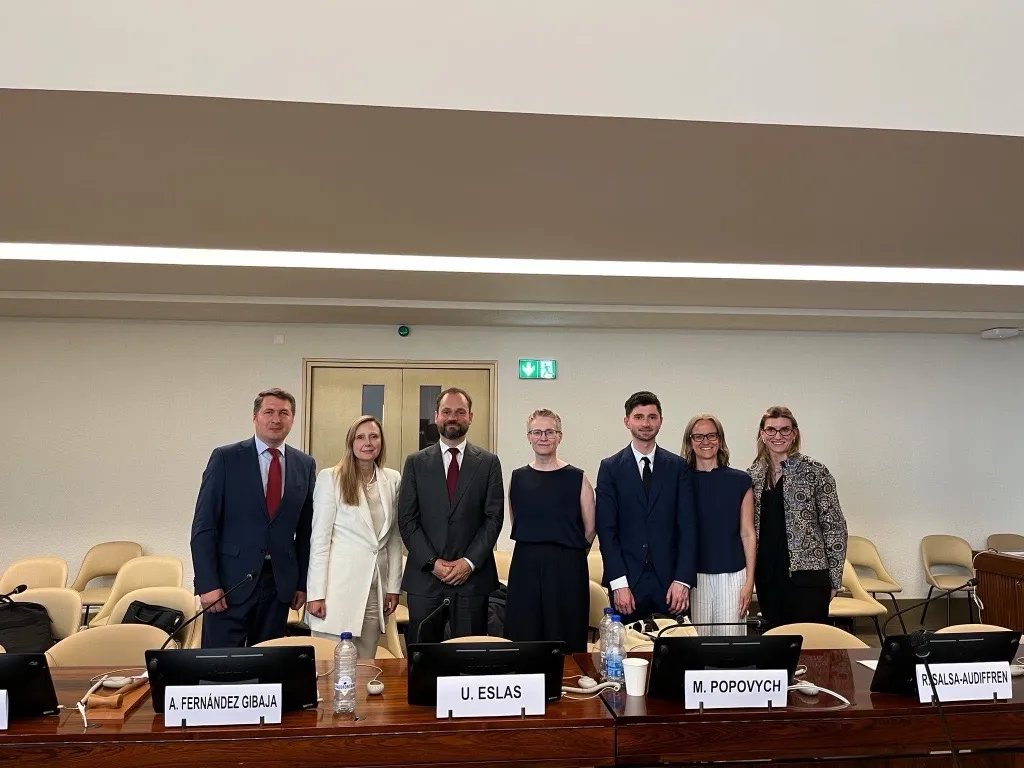
Discussing the impact of FIMI on human rights at the Human Rights Council in Geneva
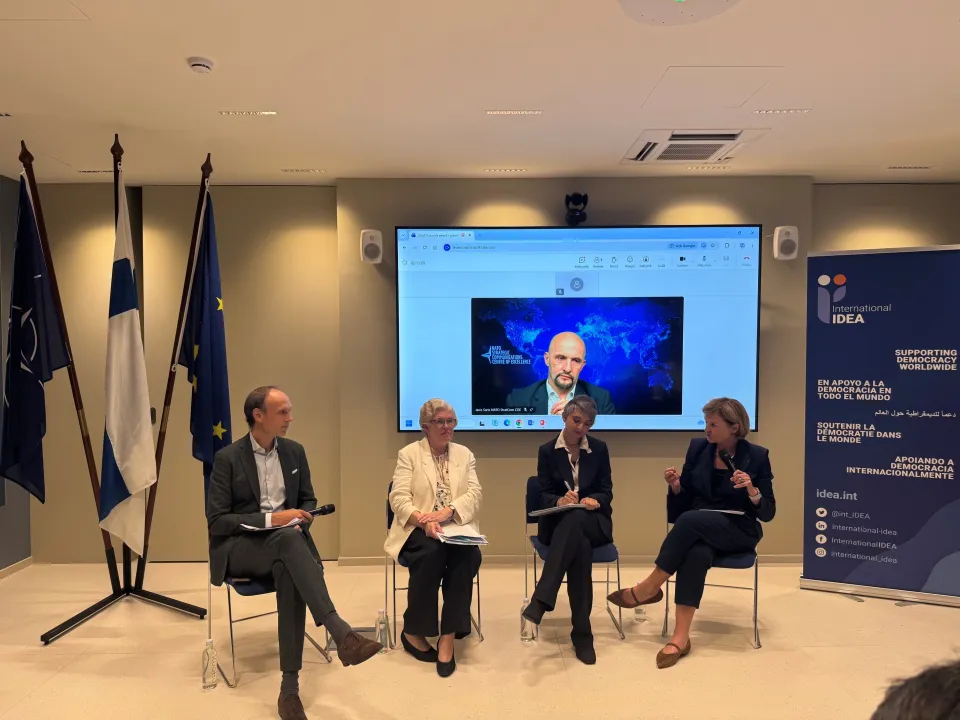
Reporting from International IDEA's side event at the 62nd Session of the Human Rights Council, Geneva, June 2026
On 25 June 2026, International IDEA's Digitalization and Democracy team, together with Member State Estonia, and the Republic of Moldova, co-organised an official side event at the 62nd Session of the Human Rights Council (HRC62). Titled "The Unseen Harm: The Impact of Foreign Information Manipulation and Interference (FIMI) on Human Rights", the event brought together the governments of Estonia and Moldova, international organisations, and civil society to make a case that has until recently been underexplored in Geneva: FIMI does not only negatively impact democratic systems, it is a direct threat to human rights.
The event was co-sponsored by the Core Group on the Disinformation Resolution, including Japan, Latvia, Lithuania, Poland, Ukraine and the United Kingdom, as well as the Council of Europe.
What Is FIMI, and why does it belong in human rights discussions?
Alberto Fernández Gibaja, Head of Digitalization and Democracy at International IDEA, opened by drawing a crucial distinction between foreign influence, interference and intervention under international law. Foreign influence, the legitimate exchange of ideas across borders, is protected under freedom of expression. Meanwhile, “intervention”, such as cyberattacks to alter electoral results, is clearly prohibited by the UN Charter. FIMI occupies a contested space in between: a mostly non-illegal pattern of behaviours that threatens or has the potential to negatively impact values, procedures and political processes.
While FIMI is not yet a treaty-based concept in international law, its effects are felt across the international human rights system.
The event sought to examine precisely that gap.
Opening remarks framed the core challenge: the integrity of the information space underpins democratic life, and when citizens can no longer trust what they read and hear, trust in institutions erodes with it. Speakers emphasized that countering FIMI does not require sacrificing fundamental freedoms. Estonia, which faces significant FIMI activity yet still ranks third in the World Press Freedom Index, serves as evidence that this balance is achievable.
Speakers argued that FIMI's effects span a wide spectrum of rights:
- Political rights, including the right to vote, through election interference.
- Freedom of expression, through manipulative content that restricts access to reliable information.
- Right to privacy, through surveillance tactics such as doxing, spyware, and monitoring.
- Equality and non-discrimination, when FIMI incites hostility or violence against specific communities.
- In severe cases, the right to life, for example when disinformation is deployed in active armed conflict.
Speakers argued that FIMI to date has been mostly viewed as a policy framing for security, foreign policy, or technology circles, while a human rights understanding of FIMI is yet to be developed. A recurring theme was the overlap between FIMI and transnational repression, where states target human rights defenders and dissidents living abroad. Speakers argued that linking these frameworks would support keeping human rights at the centre of the analysis.
Lessons from the front line
National experiences illustrated how these dynamics play out in practice.
In the case of Moldova, FIMI was described as part of a broader, integrated strategy — one element within a toolkit that also includes cyber operations, networked influence, and military pressure, closely tied to an ongoing frozen conflict that constrains democratic development. Sustained information manipulation was described as aiming to erode public trust, encourage civic disengagement, and steer the country away from its European trajectory. The response has centred on proactive strategic communication, inter-agency cooperation, and a "whole-of-society" model, recognising that government alone cannot safeguard the information environment.
In Estonia, coordinated hate campaigns targeting Ukrainian war refugees following Russia's 2022 invasion. These campaigns were traced through forensic analysis to a Russian social design agency operating as part of a broader influence operation aimed at turning Russian-speaking communities in the Baltics against Europe and Ukraine’s supporters. FIMI responses follow a same guideline: bots networks are not protected by International Human Rights Law Countermeasures included citizen reporting mechanisms, a volunteer movement to de-escalate heated online discussions, transparency reporting from security services, and media literacy education starting in kindergarten, contributing to a country that ranks among the world's strongest performers on both freedom and resilience indices.
The Legal Framing: Do we need for new legal Instruments?
The most legally complex part of the discussion addressed whether existing international human rights law adequately captures FIMI-related harms.
The Council of Europe's response was outlined: at a May 2026 ministerial meeting, the Committee of Ministers agreed to work toward a legal instrument, potentially a framework convention, specifically addressing FIMI, building on a feasibility study completed earlier in 2026. That study found that member states do not conceptualise FIMI uniformly, and differences in institutional capacity and threat perception hinder coordinated responses.
ARTICLE 19 urged caution alongside ambition, warning that negotiations involving many states often produce watered-down standards vulnerable to being hijacked by actors seeking to justify domestic speech restrictions. Referring to foreign agent laws in Russia, Georgia, and elsewhere as examples of how anti-interference language has been weaponised against civil society. Therefore, legal instruments should be targeted rather than general, focused on areas like electoral integrity, money laundering, and espionage, and should involve states, digital platforms, and civil society in different combinations depending on the issue.
There was broad agreement that existing customary international law on non-intervention in domestic affairs, as interpreted by the International Court of Justice, already provides a foundation. The task ahead is to identify genuine legal gaps rather than duplicate existing frameworks.
FIMI as an emerging debate in the Human Rights Council
Closing remarks noted that FIMI has so far received limited attention at the Human Rights Council, where disinformation is typically discussed as a broader concept. What distinguishes FIMI is its cross-border nature and the intent, planning, resources, and strategic geopolitical objectives behind it. In this way, FIMI can be seen as a more tractable problem deserving dedicated attention.
Four emerging priorities were identified:
- Maintaining the balance between national security responses and human rights safeguards
- Sharing national experiences so countries can learn from one another
- Supporting the standard-setting work now underway at the Council of Europe
- Considering whether European frameworks could serve as a model for broader international engagement, including at the United Nations
For International IDEA, the event marked an important step in positioning FIMI as a human rights concern central to democratic systems. Elevating the issue in forums such as the Human Rights Council will be essential to building shared international understanding and shaping rights-based responses to FIMI.
Learn more by visiting the Combating Electoral FIMI website.


About the authors