Trade and Democracy: Data show the EU trades more easily with democratic than autocratic countries
Disclaimer: Opinions expressed in this commentary are those of the author and do not necessarily represent the institutional position of International IDEA, its Board of Advisers or its Council of Member States.
Summary:
|
The EU’s trade agreement boom
Since the beginning of this year, the EU has entered into a flurry of trade agreements. After signing a trade deal with India in January, it concluded long-standing negotiations with Mercosur, followed by agreements with Australia, Mexico, and South Korea. The current wave is one of the most concentrated periods of trade agreement-making for the bloc in recent years, combining new agreements with the upgrade of existing deals. Particularly significant are the breakthroughs with India and Mercosur, given decades-long negotiations and the economic and demographic heft of the markets they encompass.
What is notable, however, is not only the scale of these agreements, but also their character: strategic considerations and shared values have moved increasingly to the centre of EU trade policy. Although these agreements vary in depth and scope, collectively they signal a push by the EU to diversify its trade dependencies in a volatile world, while prioritising partnerships with democratic or democratising countries.
Speaking on the conclusion of the EU-Mercosur agreement, European Commission President Ursula van der Leyen underscored the need to ‘forge stronger ties with like-minded partners,’ suggesting that trade agreements are not purely market-opening tools, but also vehicles for building and strengthening ‘communities of shared values.’ Similarly, at the signing of the EU-New Zealand Free Trade Agreement, then Trade Commissioner Valdis Dombrovskis noted the significance of similarities in 'politics, culture and values' in trade relations, particularly against the background of growing geopolitical uncertainty.
This analysis determines whether indeed there is a relationship between the depth of EU trade agreements and the democratic performance of its trade partners. Understanding this relationship can help the EU decide how to better link its trade and democracy support agendas.
Data and method
To examine this relationship, we combine three datasets. Democracy levels are measured using International IDEA’s Global State of Democracy (GSoD) Indices. The GSoD measures democracy in the four categories of Rights, Representation, Participation, and Rule of Law (see the box below).
Trade agreement depth is measured using the Design of Trade Agreements (DESTA) database, using the maximum depth score per country (in cases where a country is party to multiple agreements with the EU) on a scale of 0 to 7. The DESTA database codes the presence of seven key policy areas, including investment provisions, services provisions, public procurement access, competition policy, standards, and intellectual property rights, as well as whether the agreement creates a full free trade area by tariff elimination, combining them into an aggregate depth index. A higher DESTA depth index value therefore reflects more comprehensive agreements, signifying that countries have reached deeper and more extensive commitments across multiple domains of economic policy.
Bilateral trade volumes are drawn from Eurostat's 2025 data (bilateral trade in goods, calculated as the average of exports and imports). The sample includes 30 non-EU trading partners with complete data across all datasets.
What the Global State of Democracy Indices categories measureRepresentation
Rights
|
What the data show
In terms of trade volume, the relationship between each of the four GSoD Indices category scores (Rights, Representation, Participation, and Rule of Law) and trade flows shows a positive statistically significant relationship, and is strongest with Rule of Law and Rights. In other words, when democracy performs better, trade volumes are higher, even if modestly.
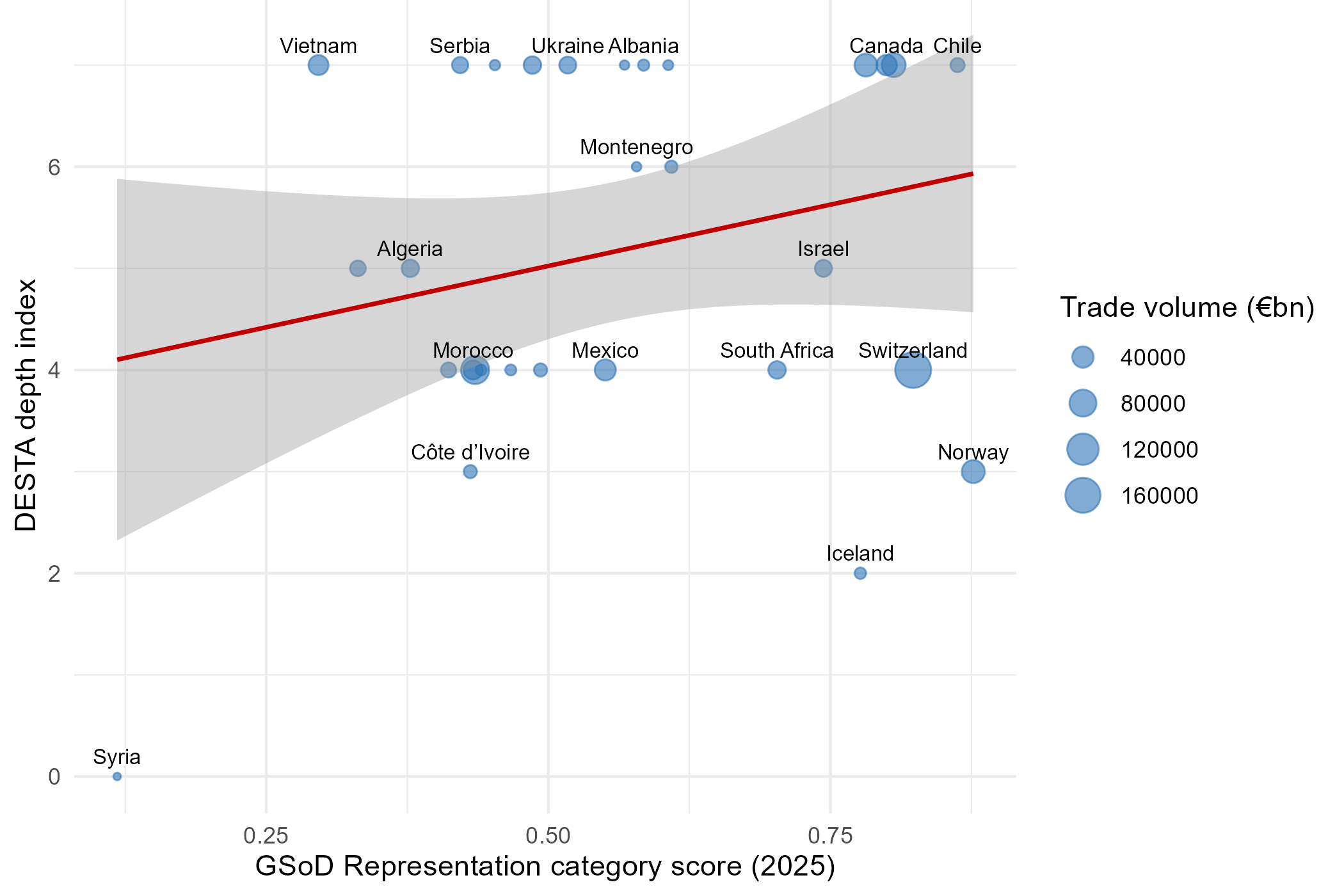
The correlation between the GSoD Indices Representation-score and the depth of the country’s agreement with the EU suggests a slight positive relationship, though the limited sample size naturally prevents firm statistical conclusions. Among the GSoD dimensions, Representation shows the strongest relationship with trade depth, while Rule of Law and Rights show weaker positive correlations. By contrast, Participation shows virtually no relationship with trade depth, possibly because it captures aspects of democracy less directly tied to the checks and balance institutions (courts, media, anti-corruption bodies, parliaments) that underpin stable trade relations.
When we group countries by their Representation scores, a clearer descriptive pattern emerges. Trade agreement depth generally increases as scores rise: countries in the low-performing democratic range have the shallowest agreements on average (DESTA depth: 4.3), while those in the middle range have deeper ones, averaging 5.4. Although the most democratic group shows a slight drop (to 5.1), the overall pattern still suggests that higher Representation scores tend to be associated with deeper agreements.
GSoD Indices Representation score and bilateral trade with the EU
Country-level patterns
Trends at the country-level reinforce this conclusion, although notable exceptions exist, as deep agreements with Serbia, Georgia and Vietnam demonstrate. Among the lowest-scoring countries in the Representation category - Syria, Egypt, and Vietnam - agreement depth ranges from 0 to 7, with most clustered around shallow association agreements or basic FTAs. In the mid-performing range, the EU's neighbourhood policy is clearly visible: North Macedonia, Serbia, Ukraine, Georgia, and Moldova all score 6 or 7 on the DESTA index, reflecting the Deep and Comprehensive Free Trade Areas the EU has used as a tool of democracy advancement in its eastern neighbourhood. Among high performers, Japan, Chile, and Canada, all show maximum depth scores of 7, consistent with the EU's tendency to conclude comprehensive agreements with established democracies.
The below heat map shows countries as rows and trade agreement features as columns, sorted by the GSoD Indices Representation score. It shows the 30 countries in the DESTA database with bilateral trade agreements with the EU. It highlights how coverage of these trade features (Standards, Investment, Services, Procurement, Competition Policy, and Intellectual Property Rights) varies across countries, where a greater number of features means a higher depth index.
Trade agreement features (sorted by GSoD Representation score)
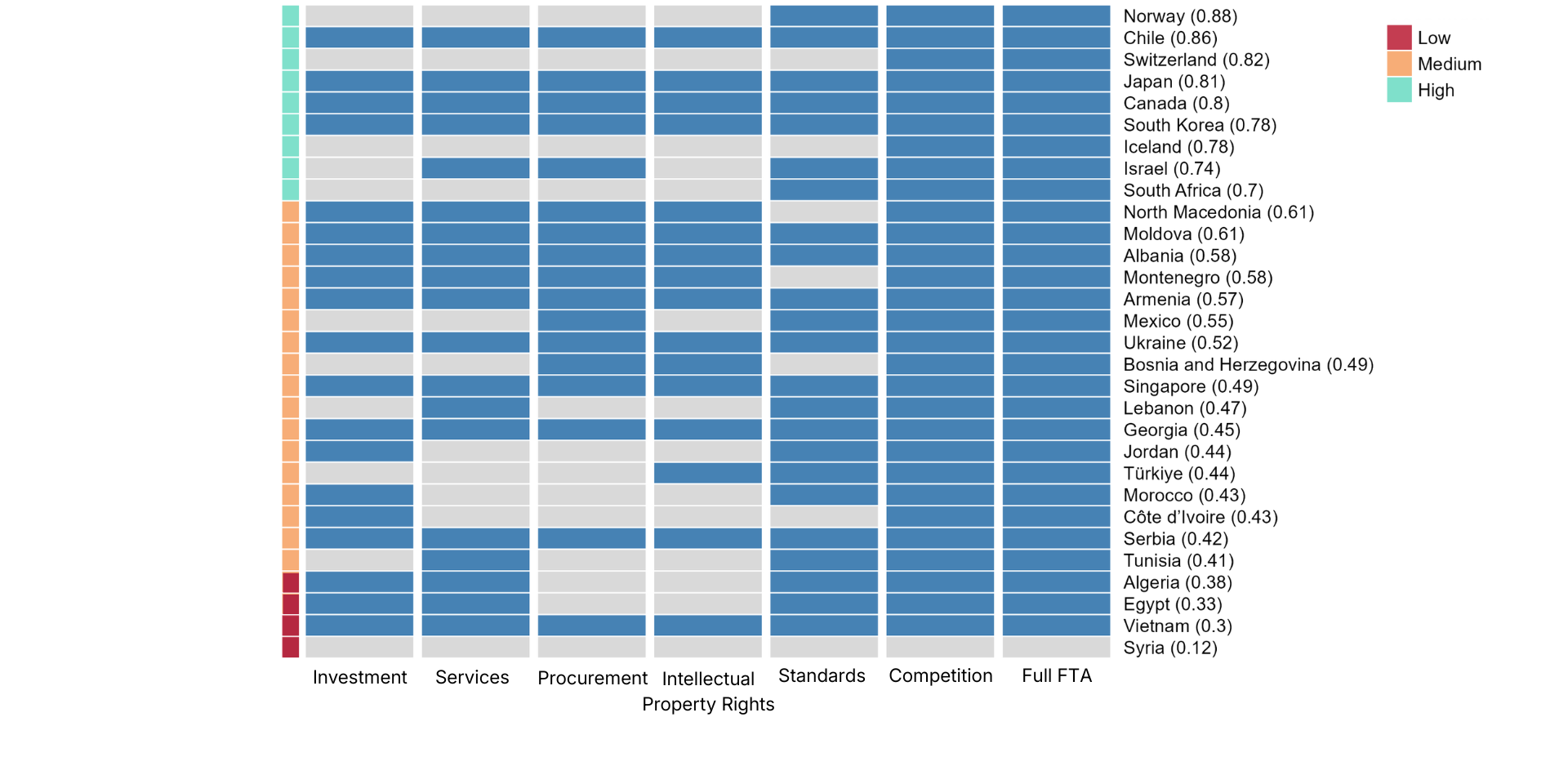
Some countries, such as Syria, have shallow trade agreements with the EU, with few or none of the features tracked in the DESTA database. Syria stands out as the lowest performer in Representation, which coincides with limited coverage of deep trade agreement features in its Cooperation Agreement. South Africa appears as an outlier, showing weaker coverage of these features, and thus a lower level of trade agreement depth, despite strong Representation performance, demonstrating that democratic performance does not always translate into deeper agreements and depends also on other factors.
A focus on bilateral agreements has limitations in capturing EEA-style integration. Norway and Iceland, arguably the EU's deepest trade partners along other measures, have a DESTA index of only 3 and 2 respectively, because their relationships are structured through other mechanisms. This depresses the mean of the high-performing group and likely understates the true democracy-depth gradient. If the depth of integration through EEA were reflected, the democracy-trade link would show even more positive (score of 5.7).
The new trade agreements with Mercosur, India, Australia, Mexico, and South Korea are not yet included in the DESTA database. Instead the FTA with Mexico struck in 2000 is listed here rather than the modernised agreement, which includes services and investment liberalisation and intellectual property rights protections. However, own analysis using the DESTA criteria would place them high up the heat map. This adds further strength to the EU trade-democracy correlation argument.
Democratic performance is therefore best understood as a facilitating rather than determining factor. Lower Representation scores do not preclude a country from entering into a trade agreement and the EU remains willing to conclude agreements with countries that perform relatively poorly. Still, democratic performance does seem to make it significantly easier to reach trade agreements, and therefore requires recognition as a trade facilitator.
The clearest signal that the data aligns with the EU’s own rhetoric around values-based trade lies not in the correlation coefficient but in the composition of the EU's deepest agreements: Canada, Chile, Japan, and South Korea feature prominently among the depth-7 agreements, and all perform strongly on the Representation dimension. Canada, Japan and South Korea also appear among the top 20 extra-EU trading partners by trade volume. This suggests the EU is better off trading with healthy democracies, systems that seem to enable greater depth and volumes of trade. The following section examines the mechanisms that make democratic governance conducive to trade partnerships.
Behind the numbers
Several complementary factors - economic and market considerations, political risk, and normative arguments - help explain why stronger democratic performance is often associated with deeper trade relationships and higher trade volumes. From a market perspective, democratic systems present favourable conditions for trade and investment, including lower transaction costs associated with corruption, uncertainty and informal practices; reduced risk of abrupt disruptions linked to internal repression or opaque decision-making; and stronger legal protections, as independent courts and rule of law make contract enforcement more reliable.
At the same time, trading with democracies can reinforce alliances and reduce exposure to strategic rivals. Democratic partners are less likely to become targets of EU sanctions or create reputational risks, while agreements grounded in shared values are easier to justify to European citizens and institutions.
Of course, strategic necessity means the EU continues to rely on non-democratic partners for critical raw materials, manufacturing capacity, and global value chains, highlighting the limits of a purely values-based approach from a realpolitik perspective. For example, despite relatively weak Representation scores, the Vietnam-EU Free Trade Agreement is surprisingly deep, perhaps reflecting the EU's strategic interest in Southeast Asian supply chain diversification.
An alternative explanation is that the relationship between democratic performance and trade is driven primarily by economic development. The EU may naturally trade more intensively with economies with larger consumer markets, better infrastructure, and higher purchasing power. As a result, the positive relationship between trade volumes and democratic indicators may partly reflect the fact that democracies are, on average, more economically developed. However, these are not necessarily competing explanations - as the institutional features associated with democratic governance (transparency, accountability and the rule of law) also support economic development by lowering commercial risks and facilitating investment.
The hidden return on democracy
While the data shows positive correlations the implication is not that the EU should trade only with democracies. Rather, the EU should place greater emphasis on a country’s democratic performance when entering trade agreements, as this is not consistently prioritised.
Even so, this gives pause to think how the EU’s decades long investment in the democratisation of partner countries is paying off by furthering EU trade interests, creating the institutional conditions that make deeper economic integration possible. What’s more, it is helping partner countries prosper at the same time as it does the EU.
Democracy support and trade policy therefore should be viewed as mutually reinforcing components of the EU’s external action. The above data also suggest that a sound EU trade policy requires an external democracy support budget to flank it. The increase in trade relations once countries further democratise means that investing in stronger democracy, which is a relatively low EU-expenditure, can generate significant trade benefits to the EU. Upholding accountable institutions and strong countervailing powers can also prevent significant trade costs when pressure on democratic safeguards rises. After all, to understand how democratic backsliding coincides with rising costs to trade, such as tariffs, the EU only has to look west.


About the authors