Remarks from Leena Rikkilä Tamang on the 95th Anniversary of Sri Lanka’s Universal Franchise and the International Day of Democracy
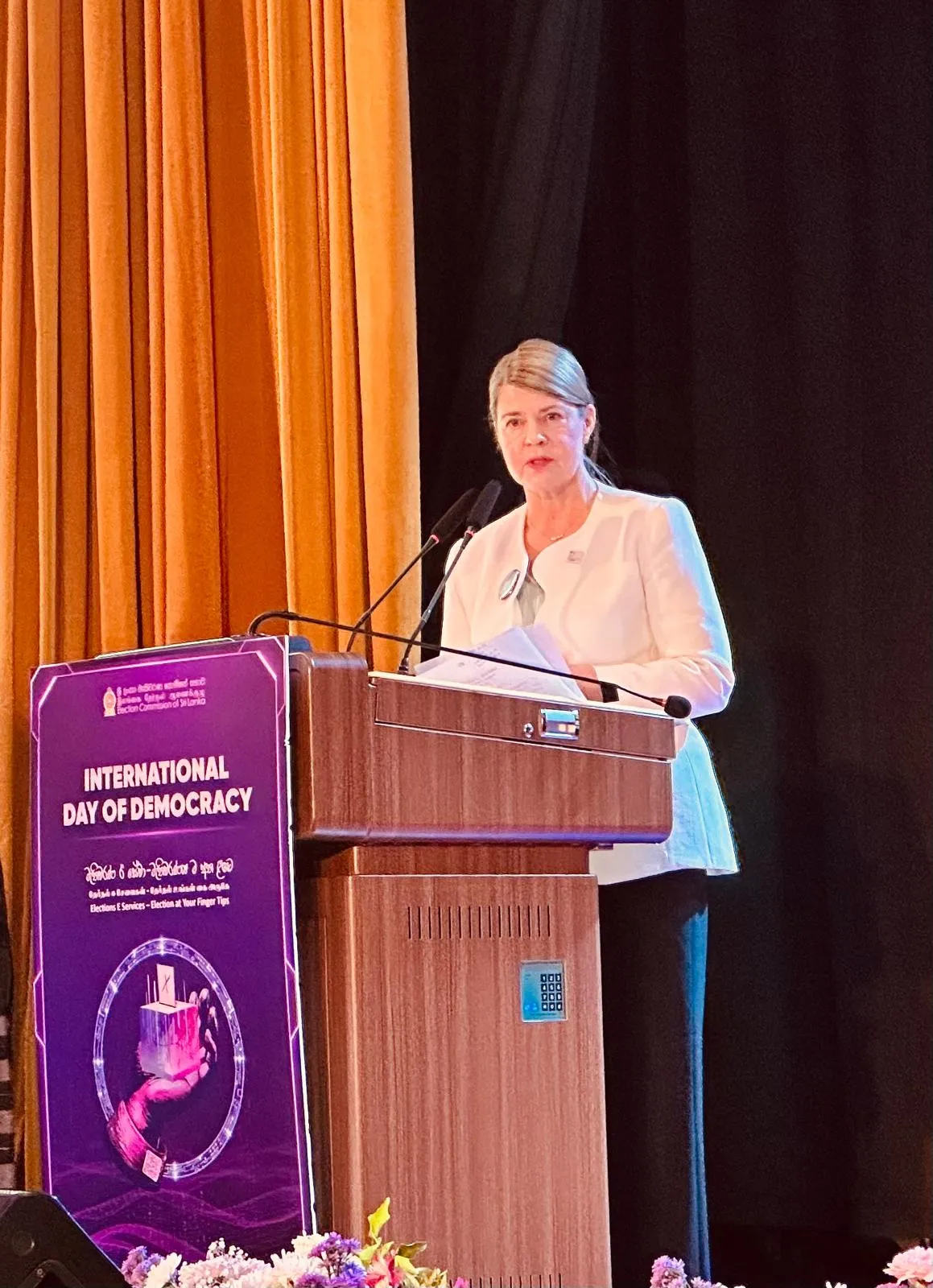
Good morning. Āyubōvan, Vaṇakkam, Assalaamu’alaikum.
Honourable Prime Minister, Dr. Harini Amarasuriya.
(Honourable Ministers)
Chair of the Election Commission, Mr. Rathnayake,
Honourable Commissioners,
Government representatives and officials,
Colleagues from international community
Excellencies, civil society and media representatives,
My name is Leena Rikkilä Tamang, and I serve as Regional Director for Asia and the Pacific at International IDEA—the International Institute for Democracy and Electoral Assistance. We are an intergovernmental organisation, dedicated to supporting democracy worldwide. Today, our membership spans 35 countries across all continents, reflecting a truly global commitment to democratic values.
It is an immense pleasure to address you all today. Today, we celebrate the 95th anniversary of universal suffrage in Sri Lanka, mark the International Day of Democracy, and reflect on the achievements made in the digitalization of electoral processes.
I wish to congratulate all Sri Lankans on the anniversary of universal franchise, and to congratulate the Election Commission of Sri Lanka—one of the guardian institutions of this historic achievement—for hosting today’s commemoration. This milestone is unquestionably worth celebrating.
Ninety-five years ago, Sri Lanka became the first British colony—and the first country in Asia—to hold elections based on universal adult suffrage for both men and women, following the recommendations of the Donoughmore Commission. As this audience no doubt is aware, the Commission initially considered limiting women’s voting rights to women over 30. It was the determined advocacy of the Women's Franchise Union and pioneering reformers such as Dr. Mary Rutnam and Agnes de Silva, that secured full equality. Their efforts overcame resistance from both colonial officials and elite Ceylonese politicians who perhaps feared mass empowerment.
Universal franchise laid the foundation for Sri Lanka’s later constitutional political and social developments and for independence in 1948. It reshaped political culture, requiring political parties to appeal to the people—not only to elites.
I can relate to these developments personally. My country of origin, Finland, adopted universal suffrage in 1906, becoming the first European country to grant full voting and candidacy rights to both women and men, though at the time only for those aged 24 and above. Finland achieved independence in 1917, 10 years after those first elections.
As today is also the International Day of Democracy, I will begin with a few observations on the global state of democracy and what the data tells us about Sri Lanka.
Later today, International IDEA will launch its Global State of Democracy 2026 report, titled Democracy in an Age of Conflict. According to the report, global democratic performance continues to decline—often to record lows.
Judicial independence has fallen to a 36-year low. Credible elections have dropped to a 30-year low. Freedom of expression, press freedom, and access to justice are at their weakest levels in more than three decades.
One of the report’s main messages is this: Democratic decline is no longer only about national political rights; it is reshaping the conditions for peace and security worldwide.
The report discusses how the global declined of democracy threatens the international rules-based system and increases the risk of instability, war and conflict.
Against this global backdrop, Sri Lanka is one of the few countries showing positive development. Over the past five years, it has improved in areas such as control of corruption, civil society engagement, predictable enforcement or rule of law, and credible elections.
These improvements reflect the reform momentum that emerged from the 2022 Aragalaya movement and were reinforced by the 2024 presidential and parliamentary elections. Landmark anti corruption legislation passed in 2025, along with other accountability measures such as the removal of public figures accused of abuse of power, point to encouraging advances.
However, the Political Equality indicator—which assesses equality between social groups and genders—has not improved. Women’s political representation reached a milestone in the 2024 parliamentary elections, with 21 women elected, yet overall representation remains low compared with the region. It is encouraging that the ruling party manifesto pledges to strengthen women’s political participation and progressively work toward parity; something that very few countries in the world have achieved.
A new electoral system that promotes inclusion, and constitutional reform to promote democracy, and accountability can help in this regard. For the last five years, Sri Lanka’s democratic story is one of advancement, albeit in tumultuous fashion, which is perhaps unsurprising given the country’s traumatic history, civil war and events which have unfolded.
The full report will be available in a few hours from the International IDEA website.
Let me now turn to credible elections and electoral participation, and the role of digitalisation in achieving these gains.
Sri Lanka’s Election Commission has received national recognition for its e services platform, winning major ICT awards for outstanding public sector achievement. Judges of these awards highlighted its transparency, real time voter services, accessibility for persons with disabilities, and strong public engagement.
The Commission has made significant efforts to increase voter awareness and civic participation, including youth outreach and community rights education.
The question now is how Sri Lanka can further strengthen and future proof its electoral systems using advanced technologies.
As part of its 2026–2029 Strategic Plan, the Commission aims to modernise its ICT infrastructure, prepare for legal reforms, and strengthen its capacity to integrate advanced tools such as artificial intelligence, blockchain, cybersecurity, cloud computing, and remote voting. International IDEA’s assessment of Sri Lankan capabilities carried out last year shows that the Commission’s current use of ICTs is both impressive and prudent.
Notably, the software tools are developed in house by ECSL staff, making the Commission independent from external vendors—a remarkable achievement compared with many other electoral management bodies.
Digital democracy trends in Asia
Sri Lanka’s progress is part of a much broader transformation across Asia, where digital democracy is advancing rapidly—though unevenly—and reshaping how citizens engage with public institutions.
Across the region, digital voter services are becoming standard practice. India, Indonesia, and South Korea have invested heavily in online voter registration, digital ID systems, and mobile based civic information platforms, while Indonesia’s Election Commission has expanded online systems for candidate registration and campaign finance disclosure. Australian eSafety Commission is one of the regulators worldwide with statutory mandate to prevent technology facilitated gender-based violence. These innovations have significantly increased transparency and reduced administrative burdens.
Second, digital civic engagement is redefining political participation, especially among young people. Youth movements from Nepal to Thailand, from Malaysia to the Philippines have used digital tools to organise, mobilise, and hold institutions accountable. Social media has become a primary arena for political debate, fact checking, and citizen oversight. In countries with large youth populations, digital platforms are often the first point of contact between citizens and the state.
Third, Asia is emerging as a global leader in election related innovation, particularly in cybersecurity and digital risk management. South Korea’s National Election Commission has developed advanced systems for monitoring cyber threats, while Taiwan has pioneered whole of society approaches to countering disinformation. Australian eSafety Commission is one of the few regulators worldwide with a statutory mandate to prevent technology facilitated gender-based violence. These models are increasingly studied worldwide.
Fourth, remote and out of country voting is gaining traction. The Philippines has experimented with online voting for overseas citizens, while Bangladesh piloted postal voting from abroad in the last elections. These experiences show that digital tools can help enfranchise large migrant populations—an issue highly relevant for Sri Lanka.
Finally, regional cooperation on digital democracy is strengthening. Election management bodies across Asia are sharing lessons on digitalisation, AI governance, and secure electoral technologies. This regional momentum creates an opportunity for Sri Lanka to position itself as a leader in responsible electoral innovation.
Taken together, these trends show that digital democracy in Asia is not only about technology—it is about expanding access, strengthening integrity, and building trust. Sri Lanka’s achievements place it firmly within this regional movement, and with continued investment, it can become one of the region’s most respected examples of prudent, citizen centred digitalisation.
As we know, technology can be also misused. Online harassment and harm against women politicians and candidates can have severe personal consequences, and undermine democracy. And it must be stopped.
Let me turn briefly to out of country voting, a legal reform currently under consideration where digitalisation may play a role.
Nearly three million Sri Lankans—one in eight citizens—live abroad. They build in the Gulf, provide care in Europe, study across Asia, and work in professional sectors across North America. Their presence is felt in Australia and beyond. Their contribution to Sri Lanka is immense. In 2024 alone, Sri Lankan migrant workers sent home more than US$6.58 billion through formal channels, providing one of the country’s most important sources of foreign exchange.
Yet these citizens remain disenfranchised unless they travel home to vote. Flights are costly, employers rarely grant leave, and polling is confined to a single day. The gap between principle and practice continues to widen.
Encouragingly, the Government of Sri Lanka has formed a committee to explore legal amendments to enable migrant voting. This signals recognition at the highest political level. Civil society organisations have been campaigning for the out of country voting for long. The challenge now is translating intent into legislation, institutional preparation, and sustained political will.
International practice offers tested solutions: postal voting, in person voting at embassies and consulates, and online voting—recently piloted by the Philippines. Each approach shows that migrant participation can be enabled while safeguarding electoral integrity.
Just as financial remittances strengthen livelihoods, “democratic remittances”—the participation of migrants in elections—can strengthen Sri Lanka’s democratic institutions, reinforce legitimacy, and foster accountability.
Let me conclude with couple of observations regarding the use of AI in elections.
Artificial intelligence is, above all, a tool. It goes without saying that the benefits or harms it will bring will depend on its use. Today, there is very little international agreement on how AI should be used in elections. Electoral management bodies (EMBs) around the world are exploring AI, asking what systems they need, what capacity to build, which use cases to prioritise, and how to govern them.
Global AI governance frameworks—such as the Hiroshima AI Process, the Global Digital Compact, the New Delhi Declaration,—emphasise democracy, information integrity, accountability, transparency, and the risks of synthetic content. But they do not treat elections as a distinct area of governance. They do not address how EMBs should adopt, procure, manage, or regulate AI systems. This leaves a significant governance gap.
The omission matters. Electoral calendars are fixed. EMBs must remain independent guarantor institutions. Results must withstand judicial scrutiny. Public confidence, once lost, is difficult to rebuild. General purpose frameworks are not designed for these conditions. Guidance tailored to electoral administration is urgently needed.
AI offers significant opportunities for electoral management, voter engagement, and access to information.
But it also raises risks of manipulation, disinformation, amplification of online harms, and unequal power. The challenge for democracies is to ensure that AI remains a tool that serves human dignity, informed citizenship, and democratic choice.
As Pope Leo XIV reminds us, "technology is never neutral." In an age of artificial intelligence, democracy depends not only on innovation but on our commitment to truth, human dignity, and accountable decision-making. He warns that "indifference to the truth leads, slowly but surely, to a descent to totalitarianism."
Let me conclude, on behalf of myself and International IDEA, by once again congratulating Sri Lanka—its government, its citizens, and its Election Commission—on this auspicious day, celebrating both universal adult franchise and democracy itself.
Thank you very much.


About the authors