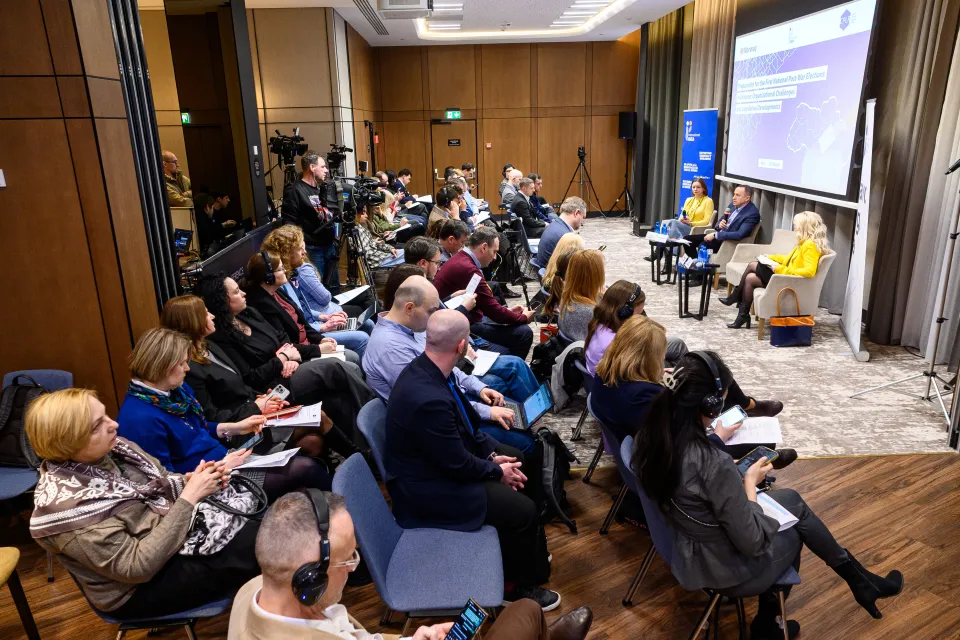
The Institute for European Studies (IEE), in collaboration with the Centre d'Étude de la Vie Politique (CEVIPOL), of the Université libre de Bruxelles will host a discussion on the crisis of the rule of law in Brussels, Belgium on Monday, 20 February 2017. Andrew Bradley of the Office of International IDEA to the European Union will chair the policy panel during the second half of t
Search
Region
Country
Type
516 results
February 16, 2017
News
February 07, 2017
Disclaimer: Views expressed in this commentary are those of the staff member. This commentary is independent of specific national or political interests. Views expressed do not necessarily represent the institutional position of International IDEA, its Board of Advisers or its Council of Member States.
News
January 05, 2017
The effective implementation of Agenda 2030 for Sustainable Development will depend on the ownership of the process at all levels of government, a multi-stakeholder approach, and the capacity to harmonize ambitions with realities.
News
December 20, 2016
Disclaimer: Views expressed in this article are those of the individual author. This commentary is independent of specific national or political interests. Views expressed do not necessarily represent the institutional position of International IDEA, its Board of Advisers or its Council of Member States.
News
December 16, 2016
On the 15-16th December, 2016, International IDEA's Secretary-General Yves Leterme took part in the high-level opening session of the “Warsaw Dialogue for Democracy 2016: From past to future: strengthening democratic values” in which he stressed the importance of fighting corruption and increasing democratic accountability to address the root causes of the current crisis of representation.
News
November 25, 2016
On 25 November 2016, International IDEA’s Secretary General Yves Leterme travelled to Bucharest, Romania, to participate in the Central and Eastern European Civil Society Forum.
News
November 23, 2016
On 22 and 23 November, International IDEA’s Secretary General, travelled to Sarajevo Bosnia and Herzegovina to attend the IX High Level Meeting on “The European Peace: What is Recipe for a Strong Union for All?” organized by the Nizami Ganjavi International Center.
News
November 15, 2016
Roundtable on the Inter-generational Dialogue for Democracy at the European Committee of the Regions
The Office of International IDEA to the European Union facilitated a discussion on how the Inter-Generational Dialogue can boost people’s faith in democracy by exploring ways to bring members of different age groups into the political process, and to find mechanisms for cooperation within democratic governance processes.
News
November 07, 2016
International IDEA is hosting the 6th High Level Meeting of the Inter-Regional Dialogue on Democracy (IRDD), to discuss the theme of Gender Equality and Political Empowerment of Women. This year the High Level Meeting will take place on 8 November 2016, at the Headquarters of the Council of Europe in Strasbourg, France.
News
September 10, 2016
STOCKHOLM—The International Institute for Democracy and Electoral Assistance is hosting a panel discussion on the crisis of political representation as it relates to political parties.
News
September 05, 2016
Brussels - The European Endowment for Democracy (EED) and the International Institute for Democracy and Electoral Assistance (International IDEA) are hosting a high-level panel discussion on State-building, democracy and corruption: Money in politics in the Eastern neighbourhood.
News
August 24, 2016
This Discussion Paper compares how three regional organizations—the African Union, the European Union and the Organization of American States—protect constitutionalism in their member states.
It focuses on the types of measures to protect constitutionalism in cases of fundamental threats to and violations of the constitutional order, rather than on the mechanisms to promote constitutional governance.
Publication
June 27, 2016
The people of the United Kingdom have spoken. In many ways, and for years to come, Brexit will have a profound impact on the United Kingdom, European Union (EU) and the world.
News
March 08, 2016
International IDEA is pleased to join the rest of the world in celebrating International Women's Day 2016.
News
January 21, 2016
The fourth in a series of global conferences highlighting the issues of Money in Politics will take place in Tbilisi, Georgia 18-19 February and focus on the role money plays in Eastern and Central Europe.
News
December 14, 2015
In 2016, International IDEA will be starting its operations in the wider-Europe region. This strategic shift reflects the geopolitical developments of the past years, in which European democracies, both established and emerging, have been going through turbulent changes.
News
November 23, 2015
The struggle between freedom and control in open society is constantly a hot topic in many democracies, but perhaps more so today given recent events in Paris. How can democracy deliver safety, prosperity and freedom to all?
This question was central to this year’s annual Forum for Democracy, organized by the Council of Europe in Strasbourg, France, and it is also central in International IDEA’s book Democratic Transitions: Conversations with World Leaders.
News
November 18, 2015
Regional organizations have an important role to play in the achievement of the United Nations global goals. They can support member states with the design of action plans for sustainable development, but also they can play a key role in monitoring the implementation of these commitments.
However, across the globe there is a growing skepticism among citizens about the effectiveness of the work of regional organizations and their relevance to people’s lives.
News
October 29, 2015
On 25 October 2015, Ukraine held its first local elections since the 2014 Euromaidan protests. The stakes were high for local and international stakeholders, both because of the promise of increased decentralization to the regions and because the polls were seen as a test of President Petro Poroshenko’s efforts to act on the Euromaidan protestors’ demands for increased transparency, accountability and inclusivity in government.
News
October 13, 2015
BRUSSELS, 13 OCTOBER 2015--The International Institute for Democracy and Electoral Assistance (International IDEA) and the European Parliament, in cooperation with the Friends of Europe, today launched Democratic Transitions: Conversations with World Leaders at an event at the Library of the European Parliament in Brussels.
News